Andrej Karpathy — “We’re summoning ghosts, not building animals” · 苏菲拉底
字幕 字幕位置
--:--
点击播放,这里会跟随视频显示当前句的中英字幕。

Andrej Karpathy — “We’re summoning ghosts, not building animals”

节目发布 2025-10-17 · Dwarkesh Patel
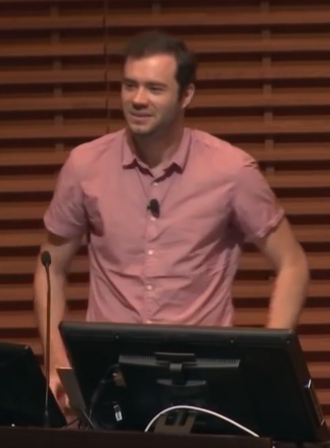
安德烈·卡帕西 DDwarkesh Patel
EDITED TRANSCRIPT · 依据现场录音编译整理,可划线生成便签
编者按:本文是《Dwarkesh Podcast》与安德烈·卡帕西(Andrej Karpathy)的一次长谈,原题为「我们是在召唤幽灵,不是在造动物」。卡帕西是 OpenAI 创始成员,2017 至 2022 年任特斯拉 AI 高级总监,领导 Autopilot 视觉团队,也是斯坦福最早那门深度学习课的开设者;提问者德瓦克什·帕特尔长期深度访谈 AI 研究者、经济学家与科学家。两人从「为什么是 agent 的十年而不是元年」谈起,一路谈到强化学习的粗陋、模型的坍缩、智能演化的偶然,以及卡帕西眼下真正投入的事:教育。本文依据现场录音编译整理,只删去口语枝节与重复,论证、例子与语气一概保留。

十年,不是一年

主持人: 你为什么说这将是 agent 的十年,而不是 agent 的元年?

卡帕西: 谢谢你请我来。你引的这句话其实是一个反应。之前有人说,这将是 agent 的元年,意思是大语言模型今年就会演化成能干活的智能体。我不知道最早是谁说的,但这句话戳到我了,因为行业里存在明显的过度预测。

卡帕西: 在我看来,更准确的说法是 agent 的十年。我们今天已经有了一些非常早期、也确实非常惊艳的 agent,我每天都在用,比如 Claude、Codex 之类。但我仍然觉得要做的事太多了。我的反应是:我们会和这些东西一起工作十年,它们会越来越好,那会非常美妙。我只是在纠正那个时间表的暗示。

主持人: 你觉得什么东西要花十年?瓶颈在哪里?

卡帕西: 让它真正能用。当你说 agent 的时候,不管是各大实验室心里想的,还是我心里想的,你都应该把它当成一个你雇来一起干活的员工或实习生。比如你这里也有员工。你什么时候会愿意让 Claude 或 Codex 来干他们的活?现在当然不行。要做到那一步还差什么?为什么你今天不这么做?原因很简单,它们就是不行。智能不够,多模态不够,不会用电脑,等等。它们缺你刚才提到的很多东西,没有持续学习的能力,你没法告诉它一件事,它就永远记住。

卡帕西: 它们在认知上是残缺的,所以就是不成。要把这些问题一个个啃下来,大概需要十年。

主持人: 有意思。作为一个职业播客主持人,一个远远观望 AI 的人,我很容易说出缺了什么:缺持续学习,缺多模态。但我没有办法给它安上一个时间表。如果有人问我持续学习要多久,我完全没有先验去判断这是一个五年、十年还是五十年的工程。为什么是十年?为什么不是一年?为什么不是五十年?

卡帕西: 这就要说到我自己的直觉了,以及基于我在这个领域里的经验所做的外推。我做 AI 快二十年了,差不多十五年吧,其实也不算久。你之前请过理查德·萨顿(Richard Sutton),他在这行的时间长得多。但我确实有十五年时间在看人做预测,在看那些预测后来怎么样。我在研究界待过,也在工业界待过一段时间。这些经历给我留下了一种总体直觉。我觉得这些问题是可解的,是能翻过去的,但依然很难。把这些平均一下,感觉就是十年。

十五年,三次转向

主持人: 这很有意思。我不只想听这段历史,我还想听每一个突破时刻里,屋子里的人当时是怎么感觉的。他们的感觉在哪些地方过于悲观,哪些地方过于乐观?要不我们一个一个过?

卡帕西: 这个问题太大了,你说的是十五年里发生的事。AI 迷人的地方在于,它经历过好几次地震级的转向,整个领域会突然朝一个完全不同的方向看过去。我大概活过其中两三次。我还觉得会继续有,因为它们出现的频率规律得让人吃惊。

卡帕西: 我的职业生涯开始的时候,我之所以开始做深度学习,之所以对它产生兴趣,纯粹是因为我碰巧就在多伦多大学杰弗里·辛顿(Geoff Hinton)旁边。辛顿当然是 AI 的教父级人物。他在训练那些神经网络,我觉得这太不可思议、太有意思了。但那绝不是当时 AI 圈里大家在做的主流。那是个边上的小众课题。

卡帕西: 第一次剧烈的地震是 AlexNet 那一波。AlexNet 让所有人转了向,大家都开始训神经网络,但仍然是一个任务一个模型:我有个图像分类器,我有个神经机器翻译系统,诸如此类。人们慢慢地开始对 agent 感兴趣,开始想:好吧,视觉皮层这一格算是打了勾,那大脑的其他部分呢?我们怎么才能得到一个完整的、能在世界里行动的智能体?

卡帕西: 2013 年前后的 Atari 深度强化学习转向,在我看来就是早期 agent 努力的一部分,因为它试图让智能体不只是感知世界,还要采取行动、与环境互动、从环境里拿到奖励。当时的载体是 Atari 游戏。我觉得那是一次走偏。这个偏差连我参与的早期 OpenAI 也接受了,因为当时的时代精神就是强化学习环境、游戏、打游戏、通关、找各种各样的游戏来玩,OpenAI 做了大量这类事。那又是 AI 的一个显赫阶段,大概有两三年、四年,所有人都在游戏上做强化学习。

卡帕西: 那整体上是走偏了。我在 OpenAI 想做的事情,一直对「游戏能通向 AGI」这件事抱有怀疑。因为在我心里,你想要的是一个会计那样的东西,一个和真实世界打交道的东西。我实在看不出游戏怎么加总成那个。比如我在 OpenAI 的项目属于 Universe 计划的一部分,做的是一个用键盘和鼠标操作网页的智能体。我真心想要一个和真实的数字世界互动、能做知识工作的东西。

卡帕西: 结果证明这太早了,早得离谱,早到我们根本不该做那件事。因为如果你只是在环境里瞎摸、乱敲键盘、乱点鼠标,试图拿到奖励,你的奖励太稀疏了,你根本学不到东西。你会烧掉一整片森林的算力,也什么都起不来。你缺的是神经网络里的表征能力。比如今天人们也在训练操作电脑的智能体,但他们是在一个大语言模型之上做的。你得先有语言模型,先有表征,那得靠全部的预训练和那一整套 LLM 工作换来。

卡帕西: 所以粗略地说,人们有好几次都太早地去抓那个完整的东西,太早地去追 agent。Atari 是,Universe 是,我自己的经历也是。你得先把一些事做完,才轮得到那些智能体。现在的 agent 能力强多了,但我们可能仍然缺了这个栈里的某些部分。

卡帕西: 所以我会说,人们做过的事大致是三大块:按任务训神经网络,第一轮 agent 尝试,然后是大语言模型,先去拿到神经网络的表征能力,再往上加别的东西。

我们在造幽灵

主持人: 有意思。如果我来替萨顿的观点辩护,大概会这么说:人类可以一次性把所有东西一起学,甚至动物也可以。动物可能是更好的例子,因为它们连语言这层脚手架都没有。它们被扔进世界里,没有任何标签,就得把一切弄明白。那么 AGI 的愿景就应该是这样一个东西:它看着感官数据,看着电脑屏幕,从零开始自己搞清楚发生了什么。如果把一个人放进同样的处境,从零训练起,这就像一个人长大,或者一只动物长大。为什么这不该是 AI 的愿景,而要去做那种几百万年量级的训练?

卡帕西: 这是个很好的问题。萨顿上过你的播客,我看了,也写过一篇文章谈我怎么看那期节目。我对拿动物做类比非常谨慎,因为它们是另一种优化过程的产物。动物是演化出来的,它们出厂时自带海量的硬件。我在文章里举的例子是斑马。小斑马一出生,几分钟后就能跑,能跟着母亲。那是极其复杂的能力。那不是强化学习,那是烤进去的。演化显然有办法把我们神经网络的权重编码进 ATCG 里,我完全不知道那是怎么做到的,但它显然做到了。

卡帕西: 大脑来自一个非常不同的过程,我很犹豫要不要从那里取经,因为我们跑的根本不是那个过程。我在文章里说,我们不是在造动物,我们是在造幽灵,或者精魂,随便人们怎么叫,因为我们不是靠演化来训练。我们是靠模仿人类、模仿他们放到互联网上的数据来训练。你最后得到的是这种缥缈的精魂式的存在,因为它们完全是数字的,而且在模仿人类。

卡帕西: 那是另一种智能。如果你想象一个智能的空间,我们几乎是从另一个点出发的。我们并不是在造动物。但让它们随时间变得更像动物一点,这也是可能的,我觉得我们应该往这个方向做。

卡帕西: 还有一点。萨顿的框架是「我们要造动物」。如果真能做成,那当然好极了,那会非常了不起。如果真存在一个单一算法,你把它放到互联网上一跑,它什么都学会了,那太不可思议了。但我不确定它存在,而且那肯定不是动物的做法,因为动物外面还套着一层演化的循环。

卡帕西: 很多看起来像学习的东西,其实更像是大脑的成熟。我认为动物身上的强化学习非常少。大部分强化学习更接近运动任务,不是智能任务。所以我其实认为,粗略地讲,人类并不怎么用强化学习。

主持人: 最后一句能重复一遍吗?很多智能不是运动任务,是什么?

卡帕西: 在我看来,真正算强化学习的,是那些更偏运动的、简单的任务,比如投篮。但我不认为人类在解题这类智能任务上用的是强化学习。这不等于我们做研究时不该用它,我只是说动物大概不是这么干的。

主持人: 我得花一秒消化一下,这里面掺了好几个想法。有个澄清性的问题也许能帮我理解你的视角。你的意思是,演化在做的事情,某种程度上就是预训练在做的事情,也就是造出一个随后能理解世界的东西。区别在于,在人类这里,演化必须通过三十亿碱基对的 DNA 来过滤。那和模型的权重非常不一样。模型的权重直接就是一个大脑,而大脑显然不存在于精子和卵子里,它必须长出来。而且大脑里每一个突触的信息,根本不可能装进那三十亿碱基里。演化看起来更接近于找到一个算法,再由这个算法完成一生的学习。当然,按你的说法,一生的学习也许并不类比于强化学习。这和你刚才说的兼容吗,还是你不同意?

卡帕西: 我想是兼容的。我同意你说的,这里有某种奇迹般的压缩,因为神经网络的权重显然没存在 ATCG 里。那是极其剧烈的压缩。里面编码了一些学习算法,接手之后在线完成一部分学习。这点我完全同意。

卡帕西: 我要说的是,我要实用主义得多。我不是从「我们来造动物」出发的,我是从「我们来造有用的东西」出发的。我戴着安全帽,我只是观察到:我们不会去跑演化,因为我不知道怎么跑。但事实证明,我们可以通过模仿互联网文档造出这些幽灵般的存在。这是管用的。它是一条路,能把你带到一个自带大量知识和某种智能的起点,某种程度上和演化做到的事类似。所以我把预训练叫做「粗劣的演化」。它是以我们现有技术和资源能实际做到的那个版本,把你送到一个起点,之后你才能做强化学习之类的事。

主持人: 再替另一边说两句。做完萨顿那期访谈又想了一阵,我觉得他这里有个重要的点。演化其实并不给我们知识,它给我们的是找到知识的算法,这和预训练似乎不是一回事。也许可以说,预训练帮助建立起一个更善于学习的实体,它教会的是元学习,因此和「找到一个算法」相似。但如果说法是「演化给我们知识,预训练给我们知识」,这个类比就站不住了。

卡帕西: 这个地方很微妙,你质疑得对。但基本上,预训练在做的事是:你在互联网上得到一个下一个词元的预测器,把它训进一个神经网络里。它同时在做两件互不相干的事。

卡帕西: 第一,它像我说的那样,把所有这些知识吸进去。第二,它真的变聪明了。通过观察互联网上的算法性模式,它在神经网络内部启动了各种小电路和小算法,做出上下文学习这类事情。你并不需要、也并不想要那些知识。我觉得知识大概总体上拖了神经网络的后腿,因为它让模型有时过分依赖知识。比如我觉得 agent 有一件事做得不好,就是走出互联网上已有数据的流形。

卡帕西: 如果它们的知识更少、记忆更少,也许反而会更强。我认为接下来要做的事,也会成为研究范式的一部分,就是想办法把一部分知识拿掉,留下我称之为「认知内核」(cognitive core)的东西。这是一个被剥去知识的智能实体,但它保留着算法,保留着智能与解题的魔法,保留着那些策略,等等。

上下文学习像什么

主持人: 这里面有意思的东西太多了。先从上下文学习说起。这是个显而易见的观察,但我觉得值得明说出来,好好体会一下。这些模型最像有智能的时刻,是我跟它说话时心想「哇,另一头真有个东西在回应我、在思考」的时刻。比如它犯了个错,然后说「等等,这么想不对,我退回去」。这一切都发生在上下文里。那才是我能肉眼看见的真正的智能。这个上下文学习的过程,是预训练时的梯度下降造出来的。它自发地元学习出了上下文学习,但上下文学习本身不是梯度下降,就像我们人类一生中做事的智能是被演化塑造的,但我们一生中的学习是靠另一个过程完成的。

卡帕西: 我不完全同意这个说法,不过你先说完。

主持人: 我很想知道这个类比是在哪里断掉的。

卡帕西: 我很犹豫要不要说上下文学习不是梯度下降。它不是显式的梯度下降。上下文学习是在一个词元窗口里做模式补全。而互联网上恰好有海量的模式。你说得对,模型学会了补全模式,这个能力在权重里。神经网络的权重在努力发现模式、补全模式。神经网络内部发生了某种适应,这很神奇,而它就是从互联网里掉出来的,仅仅因为模式太多了。

卡帕西: 但我要说,有几篇论文我觉得挺有意思,它们去看上下文学习背后的机制。我确实认为,上下文学习有可能在神经网络的层内部跑了一个小小的梯度下降循环。我记得有一篇论文,是用上下文学习做线性回归。你喂给神经网络的输入是一串 XY 对,XY、XY、XY,恰好都落在一条直线上。然后你给一个 X,期待它给出 Y。这样训练出来的神经网络,做的就是线性回归。正常情况下你跑线性回归,是有一个小的梯度下降优化器,看 XY,算误差,对权重求梯度,更新几次。

卡帕西: 结果他们去看那个上下文学习算法的权重,发现了一些和梯度下降机制相似的结构。我记得那篇论文更强的地方在于,他们还把神经网络的权重硬编码出来,让注意力和网络内部机制真的去执行梯度下降。这就是我唯一想反驳的地方。谁知道上下文学习到底怎么运作,但我觉得它内部大概在做某种古怪的梯度下降。

主持人: 我觉得这是可能的。

卡帕西: 我只是不同意你说它「不是梯度下降」这一点。谁知道它在干什么,也许是在做某种类似的事,但我们不知道。

主持人: 那就值得想想:如果上下文学习和预训练实现的都是类似梯度下降的东西,为什么上下文学习给我们的感觉是那种接近持续学习、接近真智能的东西,而预训练本身给不了同样的感觉?如果算法是同一个,差别可能在哪?一种想法是:模型每接收一份训练信息,存下了多少信息?

主持人: 看预训练,以 Llama 3 为例,它训练用了十五万亿个词元。70B 的模型,折算下来,模型权重里的信息量相对于它读过的词元,大约是每个词元 0.07 比特。而看 KV 缓存,在上下文学习里每多一个词元它增长多少,大约是 320 千字节。也就是说,模型从每个词元里吸收的信息量相差三千五百万倍。我不知道这是不是有关。

卡帕西: 我挺同意的。我通常的说法是:任何在神经网络训练阶段发生的事,那些知识只是对训练时所见的一个模糊回忆。因为压缩太剧烈了。你拿十五万亿词元,压进一个几十亿参数的最终网络里,显然压缩量巨大。所以我称它为对互联网文档的模糊回忆。而任何发生在上下文窗口里的事,你把所有词元插进去,建起那些 KV 缓存表征,对神经网络来说是可以直接取用的。所以我把 KV 缓存和测试时发生的一切,比作工作记忆。

卡帕西: 上下文窗口里的一切,神经网络都能直接拿到。LLM 和人之间总有这些几乎让人意外的类比。我觉得意外,是因为我们并不是在直接造一个人脑,我们只是发现这样管用就这么做了。但我确实认为,权重里的东西就像你一年前读过的东西的模糊回忆,而你在测试时作为上下文给它的东西,直接就在工作记忆里。这个类比很有力量。比如你去问一个 LLM 某本书里写了什么,比如尼克·莱恩(Nick Lane)的书,它常常会给你一些大致正确的东西。但如果你把整章塞进去再问,结果会好得多,因为它现在装进了模型的工作记忆。所以绕了一大圈,我同意,原因就在这里。

哪些脑区还没有

主持人: 退一步说,人类智能中我们最没能复制出来的那部分是什么?

卡帕西: 大部分都没复制出来。也许可以这样想,我不确定这是不是最好的方式,而且这些类比注定不完美:我们跌跌撞撞弄出了 Transformer,它极其强大,非常通用。你可以拿它训音频、训视频、训文本,什么都行,它就能学到模式,而且效果很好。这在我看来几乎说明它是某种皮层组织。类似那样的东西,因为皮层也以可塑性著称。

卡帕西: 大脑是可以改接线的。有过一些略显残忍的实验,把视觉皮层接到听觉通路上,那只动物照样学会了,等等。所以我认为这是皮层组织。我认为当神经网络内部在做推理和规划,思考型模型在生成推理轨迹时,那有点像前额叶皮层。这些也许算打了几个勾,但我仍然觉得有很多脑区和核团还没被碰过。比如我们用强化学习微调模型时,基底神经节那部分算是有点了。可海马体在哪儿?不明显。

卡帕西: 有些部分大概不重要。小脑对认知和思想也许不重要,那也许可以跳过。但我还是觉得,比如杏仁核,情绪和本能这一整块,以及脑中其他一堆非常古老的核团,我不认为我们真的复制出来了。不过我也不认为我们应该去追求造一个人脑的类比物,我骨子里还是个工程师。

卡帕西: 也许换个方式回答这个问题:你不会把这东西当实习生雇进来。它缺的东西很多,它带着我们和模型对话时都能直觉感受到的那些认知缺陷。所以它还没到位。你可以把它看成:不是所有脑区都打上了勾。

缺一个蒸馏阶段

主持人: 这也许关系到这些问题要多快才能解决。有人谈到持续学习时会说:「你看,这个能力很容易复现。就像上下文学习是预训练的自发产物一样,只要模型被激励去在更长的时间跨度上回忆信息,跨度超过单次会话,更长程的持续学习也会自发涌现。」也就是说,如果外层有一个跨越很多次会话的强化学习循环,那么这种持续学习,不管是它自己微调自己,还是写入外部记忆,就会自发出现。你觉得这类事有多大可能?我实在没有一个先验。

卡帕西: 我不太能共鸣这个说法。这些模型启动时窗口里有零个词元,它们永远是从原地重新开始。所以在那个世界观里,它究竟长什么样,我不清楚。

卡帕西: 还是拿人类打个比方,因为这挺具体也挺有意思。我醒着的时候,在不断累积一天里发生的事,堆出一个上下文窗口。但我睡着之后,有某种神奇的事发生了,我不认为那个上下文窗口还留着。有某种把它蒸馏进我大脑权重的过程,在睡眠里发生,等等。大语言模型没有对应的东西。你说持续学习缺失,我觉得更接近缺的是这个。

卡帕西: 这些模型没有一个蒸馏阶段:把发生过的事拿来,反复琢磨,想透,做一些合成数据生成,再蒸馏回权重里,也许每个人配一个专属的网络。也许是个 LoRA,不是全权重的网络,只是一小撮稀疏的权重被改动。但我们确实想造出这种拥有很长上下文的个体。这不只是靠留在上下文窗口里,因为上下文窗口会变得非常非常长,也许我们还有某种很精巧的稀疏注意力覆盖其上。但我仍然认为人类显然有某个过程把一部分知识蒸馏进权重,这个我们没有。

卡帕西: 我也认为人类有某种非常精巧的稀疏注意力机制,我觉得我们已经开始看到一些早期的苗头。DeepSeek v3.2 刚出来,我看到他们就用了稀疏注意力,这是实现超长上下文窗口的一条路。所以我觉得,我们正在用一个非常不同的过程,把演化想出来的很多认知技巧重新做一遍。但我们在认知上会收敛到相似的架构。

十年后还会是什么

主持人: 十年后你认为它还会是 Transformer 一类的东西吗,只是注意力被大改、MLP 更稀疏之类?

卡帕西: 我喜欢用时间上的平移不变性来想这个问题。十年前我们在哪儿?2015 年。2015 年我们主要用卷积网络,残差网络刚出来。所以既相当相似,又还是挺不一样的。Transformer 还不存在,那些对 Transformer 的现代改造也都不存在。按平移等变性,十年后我们大概可以押的是:我们仍然在训练巨大的神经网络,有前向、反向和梯度下降更新,只是样子会有点不同,而且一切都大得多。

卡帕西: 前几年我做过一个有趣的练习,一路回到 1989 年,复现了杨立昆(Yann LeCun)1989 年的卷积网络。据我所知那是第一个用梯度下降训练的现代意义上的神经网络,做手写数字识别。我当时就是想知道能不能把它现代化。多少功劳归算法?多少归数据?多少归算力和系统?我很快就把误差砍掉了一半,方法是把算法穿越三十三年。也就是说,把算法向后旅行三十三年,我就能改造杨立昆 1989 年做的东西,把误差减半。

卡帕西: 但要再往前走,我就必须加更多数据,把训练集扩大十倍,还得加上更多计算上的优化,用 dropout 和其他正则化手段训练更久。所以这些东西必须同时改进。我们大概会有多得多的数据,好得多的硬件,好得多的核函数和软件,也会有更好的算法。所有这些因素,几乎没有哪一个占压倒性优势,它们出奇地势均力敌。这个趋势已经持续很久了。

卡帕西: 所以回答你的问题:我预期算法上会和今天不一样。但我也预期,那些已经留存了很久的东西大概还会在。它大概仍然是一个用梯度下降训练的巨大神经网络。这是我的猜测。

主持人: 令人惊讶的是,所有这些加在一起,三十年的进步也只把误差减了一半。

卡帕西: 一半其实不少。因为误差减半,这意味着的东西……一半是很多了。

主持人: 让我震惊的是,每一样东西都得同时进步:架构、优化器、损失函数。

卡帕西: 而它们也确实一直在全面进步。所以我预期所有这些变化都还会活着,而且活得很好。

nanochat 怎么学

主持人: 我正想问你一个关于 nanochat 的很类似的问题。你刚把它写出来,造一个聊天机器人的每一步都还热在你的内存里。我好奇你是不是有类似的感受:从 GPT-2 走到 nanochat,没有哪一件事是唯一关键的。这次经历里有什么让你意外的收获?

卡帕西: nanochat 是我发布的一个代码库,昨天还是前天来着,我记不清了。

主持人: 从你的睡眠不足里能看出投入了多少。

卡帕西: 它想做的是最简单的完整代码库,端到端覆盖造一个 ChatGPT 克隆的整条流水线。所有步骤都在,不只是其中某一步,而那是一大堆步骤。过去我做过每一个单独的步骤,也发布过一些小代码,用简单的代码从算法意义上告诉你某一步怎么做。但这个处理的是整条流水线。

卡帕西: 至于收获,我不觉得我从中学到了什么新东西。怎么造它我脑子里本来就有。这只是机械地把它造出来,并且弄得足够干净,让别人能从中学到东西、觉得有用。

主持人: 别人学它最好的方式是什么?是把代码全删掉,从零重新实现,还是在上面做改动?

卡帕西: 好问题。它大概八千行代码,带你走完整条流水线。我可能会把它放在右边的显示器上。如果你有两块屏,就放右边。你要从头自己造,从最开始造。不许复制粘贴,可以参考,但不许复制粘贴。我大概会这么做。

卡帕西: 但我也觉得这个库本身是个挺大的怪兽。你写这种代码时不是从上往下写的,你是按块来写,再把块长大,而这个信息在库里是缺失的。你不会知道从哪儿下手。所以需要的不只是最终的代码库,还有代码库被造出来的过程,那是一个复杂的、按块生长的过程。那部分现在还没有。我很想这周晚点把它补上,大概是做个视频之类。粗略说,我会这么建议:自己造,但不许复制粘贴。

卡帕西: 我觉得知识几乎分两类。一类是高层的、表面的知识;而当你从零造一个东西,你会被迫面对你不懂的部分,还有那些你压根不知道自己不懂的部分。这总会带来更深的理解。这是唯一的造法。造不出来,就是没懂。我相信这是费曼的话。我一直非常强烈地相信这一点,因为总有无数微小的东西没被摆到正确的位置上,你其实并不掌握那个知识,你只是以为你掌握了。所以别写博客,别做幻灯片,别搞那些。写代码,把它排布好,让它跑起来。这是唯一的路。否则你就是缺着知识。

没写过的代码

主持人: 你发推说,编程模型在你组装这个库的过程中帮助非常有限。我很好奇为什么。

卡帕西: 这个库我大概写了一个多月。我会说现在人跟代码打交道大概有三大类方式。有些人彻底拒绝所有 LLM,全部手写。这大概已经不是正确的做法了。中间那一类,也就是我所在的位置,是你仍然大量手写,但会用这些模型提供的自动补全。你写出一小段,它就替你补全,你按一下就过去了。大多数时候是对的,有时不对,你就改。但你仍然是你写的东西的建筑师。然后是氛围编程:「嗨,请实现这个那个」,回车,让模型去干。那就是 agent。

卡帕西: 我觉得 agent 在非常特定的场景里是好用的,我也会在特定场景里用它们。这些都是你手上的工具,你得学会它们擅长什么、不擅长什么、什么时候该用。比如做样板代码,agent 相当好。那种复制粘贴式的样板代码,它们非常在行。凡是互联网上高频出现的东西,它们都很在行,因为训练集里有大量例子。有些类型的活它们干得非常好。

卡帕西: nanochat 不属于那一类,因为它是个相当独特的库。按我组织它的方式,代码量并不大,它不是样板代码,它几乎是智力密集型的代码,每一处都必须极其精确地摆放。而模型的认知缺陷太多了。举个例子,它们不停地误解我的代码,因为它们对互联网上那些典型写法的记忆太重,而我恰恰不采用那些写法。它们老是以为我在写常规代码,而我不是。

主持人: 能举个具体例子吗?

卡帕西: 你有八块 GPU 都在做前向、反向。它们之间同步梯度的常规做法,是用 PyTorch 的分布式数据并行(DDP)容器,它会在你做反向的时候自动开始通信、同步梯度。我没用 DDP,因为我不想用,因为没必要。我把它扔了,自己写了一个同步例程,放在优化器的 step 里。而模型一直想让我用 DDP 容器,它们非常担心。这就说得太技术了,但我不用那个容器是因为我不需要它,我有一个自定义的等价实现。它们就是没法把「你有自己的实现」这件事内化进去,怎么都过不了这道坎。

卡帕西: 它们还老是把风格搞乱。它们过度防御,到处加 try-catch,一门心思要把它写成生产级代码库,而我的代码里有一堆假设,这没关系,我不需要那些额外的东西。所以我觉得它们在给代码库注水,给复杂度注水,不停地误解,还反复用已经废弃的 API。一团糟。净收益是没有的。我可以进去收拾干净,但那不是净收益。

卡帕西: 我还觉得,把我想要的东西用英语打出来这件事本身很烦,打字太多了。如果我直接导航到代码里我要动的那个位置,去到我知道代码该出现的地方,敲出头几个字母,自动补全就懂了,直接把代码给你。这是一种信息带宽极高的表达方式:你指着代码该出现的地方,敲出前几个字符,模型就补完。

卡帕西: 所以我的意思是,这些模型在栈上的某些部分很好用。我用模型的两个例子挺有代表性。一个是我生成报告的时候,那比较样板化,所以那部分我部分地氛围编程了。那没问题,因为不是关键部分,跑得挺好。另一个是我用 Rust 重写分词器的时候。我 Rust 不太行,刚上手不久。所以写 Rust 那部分有一些氛围编程的成分。但我有一个我完全理解的 Python 实现,我只是在做一个更高效的版本,而且我有测试,所以那样做我心里更踏实。

主持人: 它们能提高你进入不熟悉的语言或范式的门槛。

卡帕西: 在那方面我觉得它们非常有帮助。世界上 Rust 代码很多,模型相当在行,而我恰好不太懂,所以模型在那里很有用。

主持人: 这个问题之所以这么有意思,是因为关于 AI 迅速爆炸并走向超级智能的主流叙事,正是 AI 自动化 AI 工程与 AI 研究。人们会看到 Claude Code 能从零做出整个应用、整套增删改查的程序,然后想:「如果 OpenAI、DeepMind 内部有同样的能力,想象一千个你、一百万个你并行去找那些细小的架构改进。」所以听你说这恰恰是它们相对最差的一块,很有意思。这对判断 AI 2027 那种爆炸会不会很快发生,是相当有分量的。

卡帕西: 你这么说很到位,这也正是我时间表更长的原因。你说得对。它们不擅长那种从来没被写过的代码,也许可以这么说。而那恰恰是我们造这些模型时要做的事。

主持人: 一个很外行的问题:你加到 nanochat 里的那些架构改动,在某篇论文里是有的吧?说不定某个库里也有。它们没法在你说「加上 RoPE 位置编码」的时候把它正确整合进来,这件事奇怪吗?

卡帕西: 这很难说。它们知道,但又不完全知道。它们不知道怎么把它完整地整合进你的库、你的风格、你的代码和你的位置,还有你在做的那些自定义的东西,以及它怎么和整个库的假设咬合。它们是有一些知识,但还没到能把它整合起来、理解它的地步。

卡帕西: 很多东西在持续变好。我现在会去用的最强模型是 GPT-5 Pro,那是个非常强的模型。如果我有二十分钟,我会把整个库复制粘贴过去,去问这个神谕一些问题。往往结果不差,跟一年前存在的东西比,好得让人意外。但总体上,模型还没到位。我觉得这个行业跳得太大了,还假装这已经很了不起,其实不是,就是些糊弄人的东西。他们不肯直面这一点,也许是为了融资吧。我不知道在发生什么,但我们正处在一个中间阶段。模型很惊艳,但还需要大量工作。眼下,自动补全是我的甜点区,不过对某些类型的代码,我会去找 agent。

自动化的滑杆

主持人: 还有一点让这件事很有意思。编程史上有过很多提升生产力的东西:编译器、代码检查、更好的编程语言,它们提高了程序员的生产力,但没有引发爆炸。那听起来很像自动补全这一类。而另一类是对程序员本身的自动化。有意思的是,你看到的更多是编译器那种历史类比。

卡帕西: 这也许牵出我另一个想法。我很难分清 AI 从哪儿开始、到哪儿结束,因为我从根本上把 AI 看作计算的延伸。从一开始起,我就看到一条递归自我改进、或者说加速程序员的连续谱:代码编辑器、语法高亮、甚至类型检查,所有这些我们为彼此造的工具。连搜索引擎也算。为什么搜索引擎不算 AI?排序就是 AI。谷歌在很早期就把自己看成一家做搜索引擎的 AI 公司,这完全说得通。

卡帕西: 我比别人更把它看成一条连续谱,很难划线。我觉得我们现在拿到了好得多的自动补全,也拿到了一些会打转的 agent,只是它们有时会脱轨。真正在发生的事情是,人类在逐步地做越来越少的底层工作。我们不写汇编了,因为有编译器,编译器会把我的高级语言 C 翻译成汇编。我们在非常非常缓慢地把自己抽象上去。我把这叫做「自主性滑杆」(autonomy slider):在任何时点上,能被自动化的东西里越来越多被自动化了,我们做得越来越少,在自动化之上把自己提升到更高的抽象层。

用吸管吸监督

主持人: 我们聊聊强化学习。你在推特上写过一些很有意思的东西。从概念上说,我们该怎么理解人类仅靠与环境互动就能建立起丰富的世界模型,而且这个过程似乎和一段经历末尾的最终奖励关系不大?如果一个人创业,十年后才知道公司成还是败,我们会说她攒下了大量的智慧和经验。但那并不是因为过去十年里每一件事的对数概率被调高或调低了。那里发生的事要审慎和丰富得多。对应的机器学习类比是什么?和我们今天在 LLM 上做的事比起来如何?

卡帕西: 我大概会这么说:如我刚才所言,人类不用强化学习,他们做的是别的事。强化学习比一般人以为的要糟糕得多。强化学习很糟。只不过在它之前我们有的东西更糟,因为之前我们只是在模仿人,那有一堆问题。

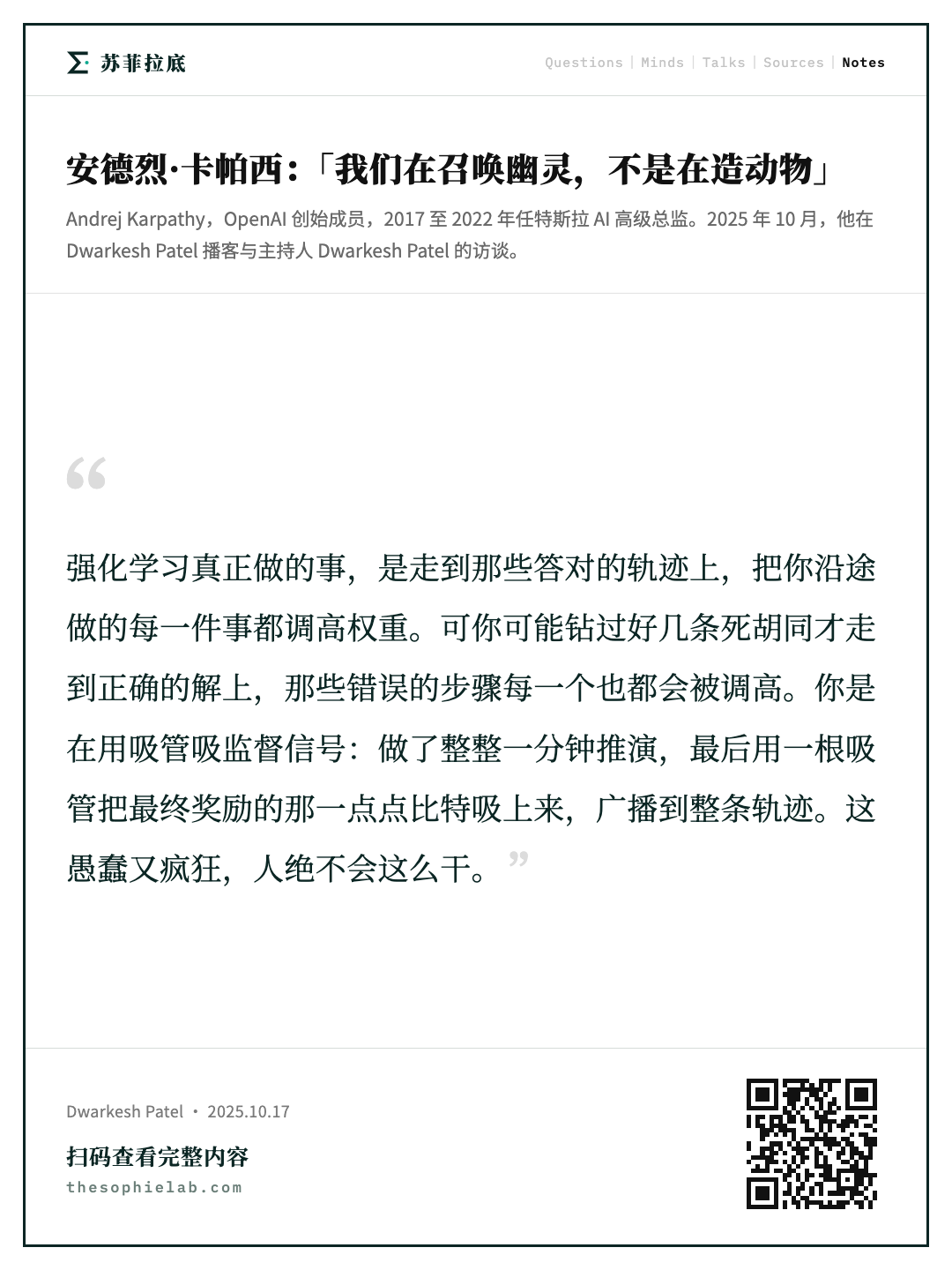
卡帕西: 在强化学习里,比如你在解一道数学题,因为这最简单。给你一道题,你要找出解法。强化学习会先并行地试很多东西。给你一道题,你试几百种不同的做法。这些尝试可以很复杂,可以是「我试试这个,试试那个,这个不行,那个也不行」等等。然后你也许得到一个答案。现在你翻到书后面,看到正确答案是这个。你会发现这几条路答对了,而另外九十七条没答对。强化学习真正做的事情,就是走到那些表现很好的轨迹上,把你沿途做的每一件事、每一个词元都调高权重:多做这个。

卡帕西: 问题在于,人们会说你的估计量方差很大,但说白了它就是噪声。它几乎是在假设,凡是通向正确答案的每一个小步骤都是对的做法,而这不成立。你可能钻过好几条死胡同才走到正确的解上。只要你最后走对了,那些错误的步骤每一个都会被调高权重,都变成「多做这个」。这太糟了,这就是噪声。你做了这么多工作,最后只拿到一个数:你答对了。基于这个数,你把整条轨迹整个地加权或减权。

卡帕西: 我喜欢的说法是:你是在用吸管吸监督信号。你做了可能整整一分钟的推演,然后你用一根吸管把最终奖励的那一点点比特吸上来,广播到整条轨迹上,用它来给这条轨迹加权或减权。这愚蠢又疯狂。人绝不会这么干。第一,人不会做几百次推演。第二,当一个人找到解法,他会有一个相当复杂的复盘过程:这几部分我做得不错,这几部分不太好,下次我大概该这样或那样。他们会把事情想一遍。现在的 LLM 里没有任何东西在做这件事,没有对应物。但我确实看到有论文开始往这个方向做,因为这对领域里所有人来说都是显而易见的。

卡帕西: 顺便说,最早的模仿学习本身是极其令人惊讶、堪称奇迹的,我们竟然能靠模仿人类来做微调。那太不可思议了。因为一开始我们只有基座模型,而基座模型就是自动补全。当时这对我并不显然,我是学来的。让我大脑炸掉的那篇论文是 InstructGPT,因为它指出:你可以拿预训练模型,也就是自动补全,只要用看起来像对话的文本微调它,模型就会飞快地适应,变得非常善于对话,而且保留了预训练里的全部知识。这让我震惊,因为我没意识到,仅仅几轮在那类数据上的微调,它在风格上就能调整得这么快,变成一个面向用户的助手。那对我来说太神奇了,太不可思议了。那是两三年的工作。

卡帕西: 然后强化学习来了。强化学习让你能比单纯的模仿学习做得好一点,因为你可以有奖励函数,可以在奖励函数上爬坡。有些问题就是有正确答案,你可以直接爬坡,不需要专家轨迹来模仿。这很了不起。模型还能发现人类可能永远想不到的解法,这很不可思议。但它仍然是愚蠢的,我们需要更多东西。我昨天看到谷歌有篇论文在试着实现这种复盘与反思的想法。

主持人: 是那篇记忆库的论文吗?

卡帕西: 不知道,我看到过好几篇这个路子的。所以我预期在这个领域会出现对 LLM 算法的重大更新。我觉得我们还需要三四个、五个这种级别的东西。

过程奖励为何难

主持人: 你太会造那种一击即中的说法了。「用吸管吸监督」,太妙了。你的意思是,结果导向的奖励的问题在于:你有一条巨长的轨迹,最后你却要从那一个比特里,学会关于该怎么做、该从世界里学到什么的所有事。既然这么显而易见,为什么过程导向的监督作为替代方案,一直没能把模型变得更强?是什么拦住了我们用这个范式?

卡帕西: 过程监督说的就是,我们不只在最末尾给一个奖励函数。你干了十分钟活,我不是等到最后才告诉你干得好不好,我在每一步都告诉你干得怎么样。我们之所以没有这个,是因为要做对很难。你面对的是部分解,你不知道怎么分配功劳。当你拿到正确答案时,那只是和标准答案做一次相等性匹配,实现起来非常简单。要做过程监督,你怎么以可自动化的方式做部分功劳分配?这并不显然。

卡帕西: 很多实验室在用 LLM 裁判来做。你让 LLM 来干,你给它一个提示词:「看看这个学生的部分解答,如果答案是这个,你觉得他做得怎么样?」然后去调这个提示词。这件事棘手的原因相当微妙。关键在于,只要你用 LLM 来给奖励,这些 LLM 就是有几十上百亿参数的庞然大物,而它们是可以被钻空子的。如果你对着它做强化学习,你几乎一定会为你的 LLM 裁判找到对抗样本。所以这事你不能做太久。你做十步、二十步也许还行,但你没法做一百步、一千步。我知道这不显然,但基本上模型会找到那些小裂缝。它会在这个巨大模型的犄角旮旯里找到各种伪相关,找到骗过它的路子。

卡帕西: 我印象很深的一个例子,这个大概已经是公开的了:如果你用 LLM 裁判做奖励,你把学生的解答喂给它,问它学生做得好不好。我们对着这个奖励函数做强化学习,一开始效果非常好。然后突然之间,奖励变得极其巨大,一个巨大的跳跃,满分。你看着它想:「哇,这意味着学生在所有问题上都完美,数学被彻底解决了。」可你去看模型生成的补全,全是胡话。开头还正常,然后就变成「dhdhdhdh」。你看着那些东西:「好吧,我们来算二加三,然后这样这样,然后 dhdhdhdh。」你看着它想,这太荒唐了,它怎么会拿到百分之百的奖励?

卡帕西: 你去看那个 LLM 裁判,结果发现「dhdhdhdh」对它来说是一个对抗样本,它给这东西赋了百分之百的概率。原因很简单,这对那个 LLM 来说是样本外的东西,训练时从没见过,你进入的是纯粹的泛化地带。在纯泛化地带里,你总能找到能把它搞崩的样本。你等于是在训练一个提示注入模型。其实连提示注入都算不上,那说得太花哨了,你只是在找对抗样本。这些是明显错误的、毫无意义的解答,但模型认为它们棒极了。

主持人: 如果你认为这是让强化学习更好用的瓶颈,那想自动化地做下去,就要求 LLM 成为更好的裁判。是不是会走成某种类似 GAN 的路子,得把模型训得更鲁棒?

卡帕西: 实验室大概都在干这些事。显而易见的做法是:「dhdhdhdh」不该拿百分之百。好,那就把「dhdhdhdh」放进 LLM 裁判的训练集,标成零分而不是满分。你可以这么做,但每次你这么做,你就得到一个新的 LLM,而它仍然有对抗样本。对抗样本是无穷多的。如果你这样迭代几次,找到对抗样本大概会越来越难,但我不敢百分之百确定,因为这东西有上万亿参数。我打赌实验室们在试。

卡帕西: 我仍然认为我们需要别的想法。

主持人: 有意思。那个别的想法大概长什么样,你有轮廓吗?比如某种复盘式的方案,它生成合成样本,你在上面训练之后变得更强,并且某种程度上把它元学习下来?

卡帕西: 我开始看到一些这类论文冒出来。我现在只停留在读摘要的阶段,因为很多论文只是想法。得有人在前沿实验室的规模上、以完全的通用性把它做成。你看这些论文冒出来,噪声挺大的。想法很酷,但我还没见到谁令人信服地证明这是可行的。话说回来,LLM 实验室相当封闭,谁知道他们现在在干什么。

合成数据会坍缩

主持人: 我能想象你怎么在自己造出来的合成样本或合成题目上训练。但人类似乎还做另一件事,也许睡眠是这个,也许做白日梦是这个,那不一定是编出假题目,而只是反刍。我不确定做白日梦或睡觉、或者单纯的回味,在机器学习里对应什么。最基础的类比无非是在反思产生的文本上微调,但我感觉实际上那大概效果不会太好。你对这件事的机器学习对应物有什么看法?

卡帕西: 我确实认为我们在那里缺了一些东西。举个例子,读书。现在 LLM 读书是什么意思?我们把一段文本拉成序列,模型预测下一个词元,从中获得一些知识。人类根本不是这么读的。我读书时,甚至不觉得书是我该去注意、该去训练的陈述材料。书是一组提示词,用来让我做合成数据生成,或者让你去读书会上和朋友们讨论它。是通过对那些信息的摆弄,你才真正获得了知识。

卡帕西: LLM 完全没有对应的东西,它们不做这件事。我很想看到预训练阶段里有一个环节,让模型把材料想一遍,试着和它已知的东西调和,花一些时间把它想透,并且真的让这件事work。现在完全没有对应物,这全是研究课题。这里面有一些非常微妙、我觉得很难理解的原因,让它并不简单。

卡帕西: 我可以描述其中一个:为什么我们不能直接生成合成数据然后在上面训练?因为每一个合成样本,如果我让模型对一本书做一次合成生成,你看一眼会觉得,这看起来很棒啊,为什么不能训?你可以试,但只要你继续这么干,模型会变得差很多。原因是,你从模型里采到的所有样本都在悄悄地坍缩。是悄悄地,你看任何单个样本都看不出来,但它们只占据了「关于某内容的全部可能想法」这个空间里极小的一块流形。LLM 输出的东西,我们说它是「坍缩」的,它有一个坍缩了的数据分布。

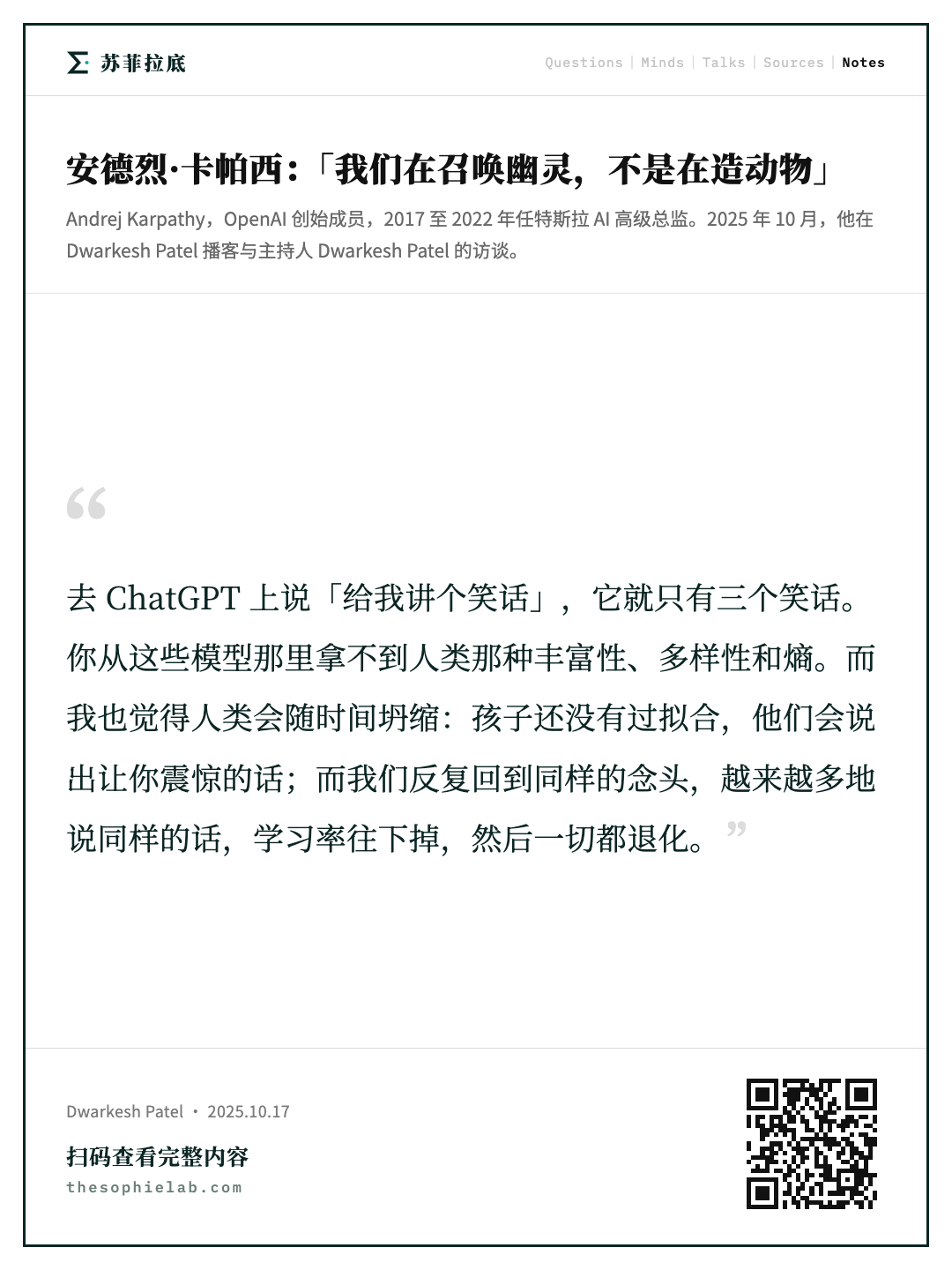
卡帕西: 一个很容易看出来的办法,是去 ChatGPT 上说「给我讲个笑话」。它就只有三个笑话。它不会把所有可能的笑话的广度给你,它只知道三个笑话。它们悄悄地坍缩了。你从这些模型那里拿不到人类那种丰富性、多样性和熵。人类噪声大得多,但至少人类没有偏,在统计意义上说。人类没有悄悄坍缩,人类维持着巨量的熵。所以,怎么在坍缩的情况下把合成数据生成做成,同时把熵保住?这是个研究问题。

主持人: 我确认一下我理解对了:坍缩之所以和合成数据生成有关,是因为你希望造出的合成问题或反思,不是已经在你数据分布里的东西?

卡帕西: 我想说的是,假设我们有书里的一章,我让 LLM 去想一想,它会给你一个看起来非常合理的东西。但如果我让它想十次,你会发现十次都一样。你没法在同样多的提示信息上不断扩大「反思」的规模,然后指望有回报。任何单个样本看起来都还行,但它的分布相当糟糕。糟糕到只要你继续在太多自己产出的东西上训练,你真的会坍缩。

卡帕西: 我觉得这可能没有根本性的解法。我也觉得人类会随时间坍缩。这些类比好得出奇。人在一生中是会坍缩的。所以孩子还没有过拟合,他们会说出让你震惊的话,你能看出他们从哪儿来的,但那就不是人们通常会说的话,因为他们还没坍缩。而我们坍缩了。我们反复回到同样的念头,越来越多地说同样的话,学习率往下掉,坍缩继续恶化,然后一切都退化。

主持人: 你有没有看到过那篇很有意思的论文,说做梦正是一种防止这种过拟合和坍缩的机制?做梦之所以在演化上是适应性的,就是要把你放进那些和你日常现实非常不同的古怪处境里,以防止这种过拟合。

卡帕西: 这想法很有意思。我确实认为,当你在脑子里生成东西、然后又去注意它,你就是在自己的样本上训练,在自己的合成数据上训练。干太久你就会脱轨,坍缩得太厉害。你必须一直在生活里寻找熵。和别人说话是很好的熵来源,诸如此类。所以也许大脑也内建了一些机制,用来提高那个过程里的熵。这想法很有意思。

孩子为什么记不住

主持人: 下面这个念头还很不成形,我就抛出来,你随便反应。我们所知最好的学习者是孩子,而孩子极其不擅长回忆信息。事实上在最早期的童年,你会把一切都忘掉,对某个年龄之前发生的一切完全失忆。但你极其擅长学新语言、从世界里学东西。也许这里有某种「见林不见木」的成分。反过来看谱系的另一端是 LLM 预训练,这些模型能一字不差地背出维基百科下一句是什么,但它们像小孩那样飞快掌握抽象概念的能力要有限得多。成年人在中间,他们没有童年学习的那种灵活性,但能以孩子做不到的方式记住事实和信息。我不知道这条谱系里是不是藏着什么。

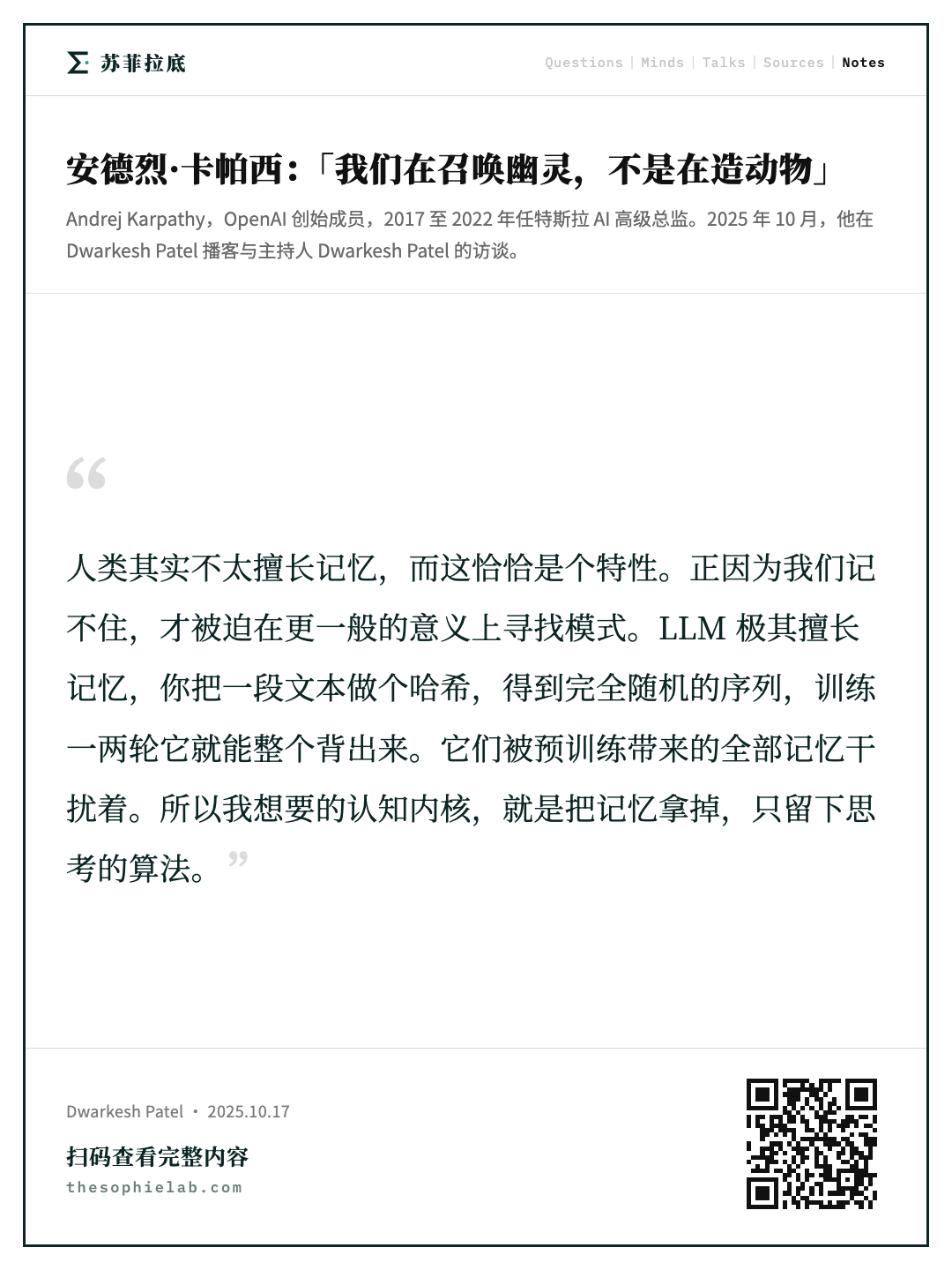
卡帕西: 我百分之百觉得这里有非常有意思的东西。和 LLM 相比,人类身上确实有多得多的「见林」的成分。我们其实不太擅长记忆,而这恰恰是个特性。正因为我们记不住,我们被迫在更一般的意义上寻找模式。相比之下 LLM 极其擅长记忆,它们能背诵训练材料里的整段文字。你可以给它们完全没有意义的数据,比如把一段文本做个哈希,得到一个完全随机的序列,你训练一到两轮,它就突然能把整个东西背出来,它会记住。人不可能读一遍随机数字序列就背给你听。那是特性,不是缺陷,因为这逼着你只学那些可泛化的部分。而 LLM 被它们从预训练文档里带来的全部记忆干扰着,从某种意义上说,那对它们大概是非常分心的。

卡帕西: 所以当我谈认知内核时,我想拿掉的就是记忆,就是我们刚才说的那个。我希望它们的记忆更少,少到必须去查,它们只保留思考的算法、做实验的想法,以及行动所需的那些认知的黏合剂。

主持人: 这和防止模型坍缩也有关系吗?

卡帕西: 让我想想。我不确定,这几乎是另一条轴。模型太擅长记忆了,我们该想办法把它拿掉。人差得多,但那是好事。

主持人: 模型坍缩的解法是什么?有一些很朴素的招可以试,比如让 logits 上的分布更宽之类。朴素的做法最后的问题是什么?

卡帕西: 好问题。你可以想象给熵加一个正则项之类。我猜它们只是经验上效果没那么好,因为现在的模型就是坍缩的。但我要说,我们想让模型干的大多数活其实并不需要多样性。这大概才是真正的答案。前沿实验室在努力让模型有用。输出的多样性并不那么……第一,多样性更难处理、更难评估;第二,它也许并不是价值的大头所在。

主持人: 事实上它还被主动惩罚。你在强化学习里如果特别有创意,那不是好事。

卡帕西: 是的。或者如果你大量用 LLM 帮你写东西,那大概是坏事,因为模型会悄悄给你同样的东西,不会去探索回答一个问题的很多不同方式。也许因为需要多样性的应用不够多,模型就没有多样性。但到合成数据生成的时候,这就成了问题。所以我们其实在搬石头砸自己的脚,没有让熵在模型里留下来。也许实验室们该更努力一点。

主持人: 你好像暗示这是个非常根本的问题,不容易解决。你这个直觉从哪里来?

卡帕西: 我不确定它有多根本,我也不确定我想这么说。我没做过这些实验,但我确实认为你大概可以把熵正则化到更高,让模型给你越来越多不同的解法。但你又不希望它偏离训练数据太远,它会开始编自己的语言,开始用极其罕见的词,从分布上飘得太远。所以控制这个分布本身就很棘手,这个意义上它大概不是小事。

认知内核有多大

主持人: 如果非要你猜,智能的最优内核最后会有多少比特?就是我们要放进冯·诺依曼探测器里的那个东西,它得有多大?

卡帕西: 这在这个领域的历史里很有意思。曾经有一阵所有人都是「规模派」,说我们要造大得多的模型,万亿参数的模型。而模型的尺寸走势是先上去,现在又下来了。最先进的模型变小了。即便如此,我还是觉得它们记住的东西太多了。

卡帕西: 我以前有个预测:我几乎觉得我们能拿到十亿参数级别就很好的认知内核。如果你和一个十亿参数的模型对话,我觉得二十年后你能和它有一场非常有收获的交谈。它会思考,而且更像人。但如果你问它某个事实性的问题,它可能得去查,可它知道自己不知道,知道该去查,会把所有理智的事情都做对。

主持人: 你觉得要十亿参数,这让我意外。因为我们已经有十亿或几十亿参数的模型很聪明了。

卡帕西: 可最先进的模型是万亿参数级的,但它们记住的东西太多了。

主持人: 是,可我意外的是,按这个速度,十年之后……我们有 gpt-oss-20b,它比最初那个万亿参数级的 GPT-4 强得多。按这个趋势,你居然认为十年后认知内核还是十亿参数。我倒以为你会说「那会是几千万,甚至几百万」。

卡帕西: 问题在这儿:训练数据是互联网,而互联网真的很糟。而正因为它很糟,可改进的空间巨大。你我说到互联网,脑子里想的是《华尔街日报》,可它不是那个东西。当你在前沿实验室里看预训练数据集,随便翻一个网页文档,那是彻头彻尾的垃圾。全是股票代码、符号,来自互联网各个角落的海量废话和垃圾。我都不知道这玩意儿到底是怎么работ的。不是你想的《华尔街日报》文章,那种极其罕见。

卡帕西: 正因为互联网这么糟,我们才必须造非常大的模型把它压进去。而那些压缩里大部分是记忆的活,不是认知的活。可我们真正想要的是认知的部分,把记忆删掉。我想说的是,我们需要有智能的模型来帮我们提炼预训练集本身,把它收窄到认知的成分上。那样我觉得你能用小得多的模型,因为数据集好得多,你可以在上面训练。不过它大概不会直接在上面训,多半还是从一个更好的模型蒸馏出来的。

主持人: 那为什么蒸馏出来的还是十亿?

卡帕西: 我就是觉得蒸馏效果极好。几乎所有小模型,只要它是小模型,八成就是蒸馏来的。

主持人: 对,但为什么十年后蒸馏不会降到十亿以下?

卡帕西: 哦,你觉得应该比十亿还小?我不知道,我觉得做点有意思的事至少得要十亿个旋钮吧。你觉得还能更小?

主持人: 对。如果你看过去几年的趋势,从万亿参数级降到小两个数量级的模型,前后不过两年,性能还更好,这让我觉得智能的内核可能远远更小。用费曼的话说,底下的空间还大着呢。

卡帕西: 我本来觉得我说十亿参数的认知内核已经够反主流了,你比我还激进。也许我们能再小一点。不过我确实认为,实用地说,你希望模型带一些知识,你不希望它什么都去查,那样你就没法在脑子里思考了,你一天到晚都在查太多东西。基本的知识课程必须在,但不需要那些冷僻的知识。

前沿模型会变多大

主持人: 我们讨论的是认知内核可能是多大。另一个独立的问题是,前沿模型的尺寸随时间会怎么走?我好奇你有没有预测。我们看到规模一路涨到大概 GPT-4.5,现在看到的是下降或者持平。这背后可能有很多原因。往后看,最大的模型会更大、更小,还是差不多?

卡帕西: 我没有特别强的预测。实验室们只是在务实。他们有算力预算和成本预算,而事实证明,预训练并不是你最该投入算力和成本的地方。这就是模型变小的原因。它们是小了一些,预训练阶段小了一些,但他们在强化学习、中期训练以及之后的各个阶段补回来。他们只是在所有阶段之间做性价比最优的安排。要预测这个趋势相当难。我仍然预期还有大量低垂的果子,这是我的基本判断。我在这里的分布很宽。

主持人: 你预期那些低垂的果子在性质上和过去两到五年发生的事类似吗?如果我拿 nanochat 和 nanoGPT 比,看你做的那些架构改动,你预期继续发生的就是这个味道?你不预期什么巨大的范式转变?

卡帕西: 基本上是的。我预期数据集会好得多得多。你看现在的平均数据集,糟糕得离谱,糟到我都不明白这东西怎么会work。看看训练集里的平均样本:事实错误、笔误、不知所云的东西。不知怎么,一旦规模上去,噪声互相抵消掉了,剩下一点信号。数据集会大幅改善。所有东西都会变好:我们的硬件,跑硬件、榨干硬件的那些核函数。英伟达在慢慢地调硬件本身、张量核心,这一切都会继续发生。所有的核函数都会更好,把芯片用到极致。所有算法大概都会在优化、架构和建模的各个环节上改进,包括我们究竟在用什么算法训练。

卡帕西: 我确实预期没有哪一项占压倒地位。全都加百分之二十。这大致就是我一直看到的样子。

AGI 落进经济里

主持人: 人们提出过各种衡量我们离完整 AGI 还有多远的方式。只要你能画出一条线,就能看它和 AGI 在横轴上什么时候相交。有人提议用教育水平:先是个高中生,然后靠强化学习上了大学,接着要读博士。我不喜欢这个。也有人提议用任务时长:也许它能自主做一分钟的任务,然后是一小时,然后是人类要花一周的任务。你觉得这里相关的纵轴是什么?我们该怎么看 AI 的进展?

卡帕西: 我有两个回答。第一,我几乎想直接否定这个问题,因为我把它看成计算的延伸。我们讨论过怎么给计算的进展画图吗?从上世纪七十年代以来你怎么给计算的进展画图?纵轴是什么?从这个角度看,这问题本身就有点好笑。

卡帕西: 第二,当人们谈 AI,谈最初的 AGI,谈我们在 OpenAI 创立时说的那个 AGI,指的是这么一个系统:你可以把任何有经济价值的任务交给它,它做到人类水平或更好。那是当时的定义。我当时很满意这个定义,我一直沿用到今天,后来人们又发明了各种别的定义。但我喜欢那个定义。

卡帕西: 人们做的第一个让步,永远是把所有物理的东西拿掉,只谈数字化的知识工作。这相对于原来那个「人能做的任何任务」的定义,是一次相当大的让步。我可以搬东西之类,AI 显然不行,但这个让步我们接受了。那么只说知识工作,我们从经济里砍掉了多少?我不知道具体数字,如果让我猜,大概只有百分之十到二十是纯知识工作,是某个人可以在家里完成的那种活。即便如此,这也是个非常大的市场。美国经济规模有多大,它的百分之十或二十是多少?还是几万亿美元的市场份额或工作量。所以这仍然是个极大的盘子。

卡帕西: 回到定义上,我要看的是:这个定义在多大程度上成立?有没有一些工作,或者大量的任务?如果我们把单位看成任务而不是职业。这件事很难,因为社会会围绕哪些任务可自动化重新组合职业的构成。今天有哪些工作被 AI 替代了?最近一个好例子是辛顿预测放射科医生这个职业会消失,结果这在好几个方面都被证明大错特错。

卡帕西: 放射科医生活得好好的,人数还在增长,尽管计算机视觉在识别他们要在图像里识别的各种东西上真的非常强。那只是一份又乱又复杂的工作,有大量接触面,还要跟病人打交道,还有那一整套情境。按那个定义,我不觉得 AI 到现在为止已经砸出了多大的凹坑。

卡帕西: 我会盯着的那些工作,有一些特征使它们比别的工作更早适合自动化。比如呼叫中心的员工经常被提到,我觉得提得对。呼叫中心员工有一系列让今天的自动化变简单的性质。工作相当简单,它是一串任务,而每个任务看起来都差不多。你接一个人的电话,互动十分钟左右,也许更长。

主持人: 按我的经验,长得多。

卡帕西: 你在某个流程里完成一个任务,改几条数据库记录之类。你一遍遍重复同一件事,这就是你的工作。所以你希望任务时长这个维度是短的,同时你希望把上下文剥掉。你不需要和公司的不同服务部门或别的客户打交道,只有数据库、你和你服务的那个人。它更封闭,更可理解,而且纯数字。所以我会盯着这些特征。

卡帕西: 但即便在那里,我也不是在看完全的替代。我看的是一个自主性滑杆。我预期我们不会瞬间替换掉人。我们会换上做百分之八十工作量的 AI,把百分之二十的量委派给人,而人在监督着五个 AI 组成的小队去做那些更机械的呼叫中心工作。我会去找那些新界面或新公司,它们提供某一层,让你能管理这些还不完美的 AI。然后我预期这会在整个经济里铺开。

主持人: 很多工作比呼叫中心员工难多了。放射科医生那边我完全是瞎猜,我不知道他们的真实工作流是什么。但也许可以类比 Waymo 刚投放的时候,前排会坐一个人,你就是得有那个人在那儿,万一出大问题他能兜住。哪怕到今天,也还有人在盯着确保一切正常。刚部署的 Robotaxi 车里也还是坐着人。

主持人: 现在可能出现这样一种情形:如果你自动化了一份工作的百分之九十九,那最后百分之一必须由人来做的部分变得极其值钱,因为它卡住了其他一切。如果放射科医生的情况就像那个坐在 Waymo 前排的人,而那个人必须经过多年的专门训练才能提供最后那百分之一,他的工资就应该暴涨,因为他是唯一卡住大规模部署的环节。放射科医生的工资涨了,我想原因也类似:你是最后的瓶颈,而且你不可替代。Waymo 里的司机彼此之间大概是可替代的。

主持人: 所以你可能会看到这样一条曲线:你的工资一路涨到百分之九十九,然后在最后那百分之一被拿掉的瞬间,直线掉下去。我好奇放射科、呼叫中心员工的薪资上是不是在发生类似的事。

卡帕西: 有意思的问题。我不认为放射科现在正在发生这个。

卡帕西: 我觉得放射科不是个好例子。我不知道辛顿为什么挑放射科,因为我觉得那是个极其杂乱复杂的职业。我会对呼叫中心员工今天的情况更感兴趣,因为我预期很多机械的部分今天就该是可自动化的。我没有第一手数据,但我会去看呼叫中心员工那边的趋势。我还预期另一件事:也许他们确实换上了 AI,但我会再等一两年,因为我预期他们有可能往回撤,重新雇一些人回来。

主持人: 已经有证据表明,这在采用 AI 的公司里普遍发生了,我觉得挺出人意料的。我还发现另一件事很意外。AGI 嘛,一个什么都能干的东西。我们把体力活拿掉,但它应该能做所有知识工作。你天真地预期,这个推进过程会是这样:咨询顾问在做的一小块任务被拿走,会计在做的一小块任务被拿走,然后你在所有知识工作里都这么来一遍。可如果我们相信自己正走在通往 AGI 的路上,实际的推进完全不是这样。

主持人: 看起来顾问和会计并没有获得巨大的生产力提升,反倒是程序员的工作被一点点啃掉。如果看这些公司的收入,把和���歌那种类似的普通聊天收入剔掉,只看 API 收入,那是被编程压倒性主导的。所以这个本该能做任何知识工作的「通用」东西,压倒性地只在做编程。AGI 以这种方式落地,是挺让人意外的。

为什么先是编程

卡帕西: 这里有个有意思的点。我确实相信编程是这些 LLM 和 agent 最完美的第一块阵地。因为编程从根本上一直是围着文本转的。是计算机终端和文本,一切都建立在文本之上。而 LLM 在互联网上被训练出来,它们爱文本,它们是完美的文本处理器,外面还有海量的数据。天作之合。

卡帕西: 我们还为处理代码和文本预先搭好了大量基础设施。比如我们有 Visual Studio Code 或者你喜欢的任何 IDE 来显示代码,agent 可以直接插进去。如果 agent 做了修改产生了一个 diff,我们早就有一整套代码用 diff 展示一个代码库的全部变化。几乎可以说,我们已经为代码预先造好了很多基础设施。

卡帕西: 对比一下那些完全没有这种待遇的东西。比如有人想为幻灯片而不是代码做自动化。我见过一家做幻灯片的公司。那难多了。之所以难得多,是因为幻灯片不是文本。幻灯片是一些小图形,在空间里排布,还有视觉成分。幻灯片没有这些预先造好的基础设施。比如一个 agent 要改你的幻灯片,它怎么给你看 diff?你怎么看这个 diff?没有任何东西能显示幻灯片的 diff,得有人去造。所以有些东西并不适配今天这种作为文本处理器的 AI,而代码出人意料地适配。

主持人: 我不确定光靠这个能解释全部。我个人试过让 LLM 在纯语言进、语言出的领域里派上用场,比如改写文字稿、根据文字稿挑出片段。很可能我没有把所有可能的招都用上,我往上下文里放了一堆好例子,但也许我还该做点微调。

主持人: 我们共同的朋友安迪·马图夏克(Andy Matuschak)跟我说,他试了五百亿种办法让模型写出好的间隔重复提示卡。同样是彻头彻尾的语言进、语言出的任务,本该正中这些 LLM 的靶心。他试了带少样本示例的上下文学习,试了监督微调,试了检索。他就是没法让它们做出让他满意的卡片。所以我觉得很惊人,即便在语言输出的领域里,除了编程之外,也很难从这些模型身上榨出大量经济价值。我不知道怎么解释。

卡帕西: 有道理。我不是说凡是文本的东西就都简单。我确实认为代码是相当结构化的。文本大概要飘逸得多,文本里的熵大得多,我不知道还能怎么说。另外代码也难,所以哪怕只是简单的知识,人们也会觉得被 LLM 大大赋能了。我没有特别好的答案。显然文本让事情容易得多,但这不意味着所有文本都简单。

超级智能什么样

主持人: 你怎么看超级智能?你预期它在质感上和普通人类、和人类公司不同吗?

卡帕西: 我把它看成社会自动化进程的延续。沿着计算的趋势外推,会有大量东西被逐步自动化,超级智能就是那条曲线的外推。我们预期随时间会有越来越多自主的实体,先做大量数字工作,再过一段时间连物理工作也做。基本上,粗略地说,我把它看成自动化。

主持人: 但自动化包含的是人类已经能做的事,而超级智能暗示的是人类做不到的事。

卡帕西: 可人类做的事情之一就是发明新东西,我会把那也算进自动化里,如果这么说得通的话。

主持人: 那换个更不抽象、更偏质感的说法:因为这东西可以想得这么快,或者有这么多份拷贝,或者拷贝可以合并回自身,或者聪明得多,反正 AI 可能有的任何一种优势,那么这些 AI 所在的文明,在质感上会不会和人类的完全不同?

卡帕西: 我认为会。它本质上是自动化,但会极其陌生,会看起来非常古怪。就像你说的,我们可以把这一切跑在一个计算集群上,而且快得多。当世界变成那样时,让我开始紧张的一类情形,是对正在发生的事情逐步失去控制和理解。我认为这是最可能的结局,一种渐进的理解的丧失。我们会把这些东西一层层铺到各处,而理解它的人会越来越少。然后就是对正在发生的事情逐步失去控制和理解。在我看来,这是这一切最可能的走向。

主持人: 我在这里追问一下。我不觉得失去控制和失去理解是一回事。台积电、英特尔,随便哪家公司的董事会,都是一群有声望的八十岁老人。他们的理解非常有限,实际上也许也并不真的握有控制权。更好的例子是美国总统。总统拥有极大的权力,我不是要对现任者作什么评价,也许我就是,但理解的水平和控制的水平确实是两码事。

卡帕西: 这个反驳是公道的,很好。我想我预期的是两者都会丧失。

主持人: 为什么?失去理解是显然的,但为什么会失去控制?

卡帕西: 我们已经走到我完全不知道那是什么样子的地带了,但如果我来写科幻小说,它大概不会是某个单一实体接管一切,而是多个互相竞争的实体逐步变得越来越自主。其中一些走向失控,另一些去压制它们。这是一锅完全自主的活动的热汤,而我们把事情都委派给了它。我觉得会是这个味道。

主持人: 所以导致失控的并不是它们比我们聪明这件事,而是它们彼此竞争,以及那场竞争里长出来的东西。

卡帕西: 这些东西里有很多会是人的工具,是代表某个人在行动。所以也许那些人还握着控制权,但从社会想要的结果这个意义上说,整体仍然是失控的。你有一堆代表个体行动的实体,而它们整体上大致仍然处在失控状态。

这是不是智能爆炸

主持人: 这个问题我该更早问的。我们刚才说,现在做 AI 工程或 AI 研究时,这些模型更像编译器那一类,而不是替代品那一类。但如果有了 AGI,它应该能做你在做的事。你觉得一百万个你并行工作,会让 AI 的进展大幅加速吗?如果真发生了,你预期在有了真正的 AGI 之后会出现智能爆炸吗?我说的不是今天的 LLM。

卡帕西: 我预期会,但那只是照常营业,因为我们已经身处智能爆炸之中,而且已经几十年了。基本上就是 GDP 那条曲线,它是整个产业无数方面的指数加权和。一切都在被逐步自动化,而且已经这样几百年了。工业革命就是自动化,是物理环节的自动化、工具的制造,等等。编译器是早期的软件自动化。我们已经递归自我改进、已经爆炸很久了。

卡帕西: 换个角度看:如果你不看生物力学之类,地球曾经是个相当无聊的地方,长期看起来都差不多。从太空看,我们正处在一次鞭炮爆炸的当中,只是我们是在慢动作里看它。我确实觉得这件事已经发生很久了。再说一遍,我不把 AI 看成一项相对于已经发生很久的事情而言截然不同的技术。

主持人: 你认为它和这条超指数曲线是连续的?

卡帕西: 是的。这也是为什么这件事对我很有意思:我有一阵子一直想在 GDP 里找到 AI。我以为 GDP 应该往上跳。可后来我去看那些我觉得非常有变革性的技术,比如计算机、比如手机,你在 GDP 里找不到它们。GDP 就是同一条指数。连早期 iPhone 都没有应用商店,没有现代 iPhone 那些花样。所以尽管我们把 iPhone 问世的 2008 年想成一次巨大的地震式变化,实际上并不是。一切都摊得太开、扩散得太慢,最后全被平均进同一条指数里。计算机完全一样,你在 GDP 里找不到「哦我们现在有计算机了」的痕迹,因为那是极其缓慢的推进。

卡帕西: AI 也会一模一样。它只是更多的自动化。它让我们能写出以前写不出来的程序,但 AI 本质上仍然是程序。它是一种新的计算机,一种新的计算系统。但它有各种毛病,会随时间扩散,最后仍然加总成同一条指数。我们依然会有一条指数,而且会变得极其陡峭。生活在那样的环境里会非常陌生。

主持人: 你的意思是,如果看工业革命之前到现在的趋势,你会看到一条超指数:从百分之零的增长,到一万年前百分之零点零二的增长,到现在百分之二的增长。那是超指数。你是说把 AI 画上去之后,AI 会把你带到百分之二十或百分之二百的增长?还是说,如果看过去三百年,你看到的是一项技术接一项技术,计算机、电气化、蒸汽机、铁路等等,可增长率一直是同一个,百分之二?你是说增长率会上去吗?

卡帕西: 增长率也是大致恒定的,对吧?

主持人: 只在过去两三百年里是。但在整个人类历史尺度上,它是爆炸式的,从百分之零变得越来越快,工业革命一炸,到百分之二。

卡帕西: 有一阵我努力想在 GDP 曲线里找到 AI,最后我说服了自己这是假的。哪怕人们谈递归自我改进、谈实验室之类,那也是照常营业。它当然会递归自我改进,它一直在递归自我改进。LLM 让工程师更高效地去造下一轮 LLM,更多的环节被自动化、被调优。工程师能用谷歌搜索,这就是其中一部分。工程师有 IDE,有自动补全,有 Claude Code,这些都是同一个加速的一部分。它平滑得很。

主持人: 我再确认一下:你是说增长率不会变。智能爆炸表现出来的形式,就是它让我们得以继续待在百分之二的增长轨道上,就像互联网帮我们留在百分之二的轨道上一样。

卡帕西: 是的,我的预期是它保持同样的模式。

主持人: 那我把反面论证抛给你。我的预期是它会炸开,因为我认为真正的 AGI,我说的不是今天的 LLM 编程机器人,而是真正能替代服务器里一个人的东西,和别的提高生产力的技术有质的不同,因为它本身就是劳动力。我认为我们活在一个劳动力极度受限的世界里。你去问任何一个创业者、任何一个人,你最需要更多的什么?你需要真正有才华的人。如果你有几十亿多出来的人,他们在发明东西,把自己整合进经济,从头到尾把公司开起来,那和一项单一技术有质的不同。那相当于地球上多出一百亿人。

卡帕西: 也许可以这样反驳。比如说,计算就是劳动力。计算过去就是劳动力,很多工作消失了,因为计算机把一大堆数字信息处理自动化了,你现在不需要人来做。所以计算机就是劳动力,而那已经演完了。自动驾驶也是计算机在做劳动,那也已经在演了。但它仍然是照常营业。

主持人: 你有一台机器,它在以可能更快的速度吐出更多这样的东西。历史上我们有过增长体制切换的例子,从百分之零点二切到百分之二。对我来说,一台不断吐出下一辆自动驾驶汽车、下一个互联网的机器,很可能会造成同样的切换。

卡帕西: 我明白这想法从哪里来。但同时我确实觉得,人们做了这样一个假设:「我们有一个盒子里的神,现在它什么都能干」,而现实不会是那样。它能做一些事,在另一些事上会失败。它会被逐步放进社会,而我们最后仍然会得到同样的模式。这是我的预测。

卡帕西: 那种假设,突然之间我们有了一个完全智能、完全灵活、完全通用的人装在盒子里,可以拿去对付社会上任意问题,我不认为我们会有这种离散的跃变。我认为我们会走到同样的、在整个产业里渐进扩散的结局。

主持人: 这类对话里有个词常常造成误导。我不喜欢在这个语境下用「智能」这个词,因为「智能」暗示你觉得会有一个单一的超级智能坐在服务器里,凭空参悟出引发爆炸的新技术和新发明。我想象百分之二十的增长时,脑子里不是那个。我想象的是几亿甚至几十亿个非常聪明、类人的心智,而这也许就够了。关键在于,有几亿个、几十亿个,每一个都在做出新产品,自己琢磨怎么把自己整合进经济。如果一个经验丰富又聪明的移民来到这个国家,你不需要去想怎么把他整合进经济,他自己会搞定。他可以开公司,可以发明东西,可以提高世界的生产力。

主持人: 即便在当下这个体制里,我们也有过百分之十到二十经济增长的地方。如果你有很多人而资本相对稀缺,你就能有香港、深圳那样连续几十年百分之十以上的增长。有大量非常聪明的人准备好去利用资源,完成这段追赶,因为之前出现过断层。我觉得 AI 可能类似。

卡帕西: 我理解,但我仍然觉得你预设了某种离散的跃变,某种等着被兑现的解锁,然后突然之间数据中心里住满天才。我还是觉得你预设了一个离散跃变,而它没有我能找到的历史先例,在任何统计数据里我都找不到,我觉得它大概不会发生。

主持人: 工业革命就是这样一次跃变啊。你从百分之零点二的增长跳到百分之二的增长。我只是说会再来一次那样的跳跃。

卡帕西: 我有点怀疑,得再去看看。比如工业革命之前的记录质量不太好。我有点怀疑,但我没有强烈的看法。你是说这是一次极其神奇的单一事件,你是说也许还会有一次一模一样的、极其神奇的事件,它会打破范式,等等。而我其实不认为……

主持人: 工业革命的关键恰恰在于它并不神奇。如果你放大到 1770 年或 1870 年去看,你看不到某个关键发明。但与此同时,经济确实被推进了一个进展快得多的体制,那条指数翻了十倍。我预期 AI 也一样,不会有某个做出关键发明的单一时刻。

卡帕西: 也就是说,有一个存量被释放了。就像出现了一种新能源,出现了某种解锁,在这里是某种认知能力的解锁,而世界上堆着大量等着被做的认知工作。

主持人: 对。

卡帕西: 你预期这个存量会被这项新技术填上,一旦它越过某个门槛。

主持人: 也许可以这样想:纵观历史,很多增长来自人想出点子,然后有人去执行这些点子、做出有价值的产出。在这段历史的大部分时间里,人口一直在爆炸,那是增长的驱动力。过去五十年人们一直说增长停滞了,而前沿国家的人口也停滞了。我认为我们会回到人口的指数增长,从而带来产出的超指数增长。

卡帕西: 很难讲。我理解这个视角,但我直觉上没有这种感受。

智能演化有多偶然

主持人: 尼克·莱恩的书是你推荐给我的。看完之后我也觉得极其有意思,还采访了他。我有一些关于智能和演化史的问题。你做了二十年 AI 研究,对智能是什么、造出它需要什么大概有了更具体的感觉。因此,你对演化竟然自发撞上了智能这件事,是更惊讶了还是更不惊讶了?

卡帕西: 我很喜欢尼克·莱恩的书,来这儿的路上我还在听他的播客。就智能及其演化而言,它非常非常晚近。我对它居然演化出来了感到惊讶。

卡帕西: 我很喜欢想象外面那些世界。假设有一千颗像地球的行星,它们会是什么样子。尼克·莱恩在你这里谈过最早期的那些环节,他预期大多数行星上会有大致相似的生命形式,细菌那样的东西。中间有几处坎。智能的演化,直觉上我觉得应该是相当罕见的事件。

卡帕西: 也许可以按某样东西存在了多久来判断。如果细菌存在了二十亿年什么都没发生,那么走到真核生物大概相当难,因为细菌在地球演化史里出现得相当早。动物存在多久了?多细胞的、会跑会爬的动物,大概几亿年,那差不多是地球寿命的百分之十。在那个时间尺度上,也许它没那么难。但直觉上我仍然觉得智能的出现令人惊讶。我本来更预期会有一大堆像动物的生命形式做着像动物的事。你能得到一个创造文化、创造知识并把它们积累下来的东西,这让我惊讶。

主持人: 这里有几个有意思的追问。如果你接受萨顿的视角,认为智能的核心是动物智能,他的原话是「如果你能造出松鼠,你就走完了通往 AGI 的大部分路」。而我们在六亿年前寒武纪大爆发之后马上就有了松鼠级别的智能。促成那件事的似乎是六亿年前的大氧化事件。但智能的算法立刻就位了,足以造出松鼠那样的智能。这暗示动物智能就是那样的东西:只要环境里有了氧,有了真核细胞,算法就能拿到手。也许演化这么快撞上它是个意外,但我不确定这是否意味着,归根结底它其实相当简单。

卡帕西: 这类事情都太难判断了。你可以稍微依据某样东西存在了多久,或者某件事看起来被卡了多久。尼克·莱恩非常擅长描述细菌和古菌身上那个极其明显的瓶颈。二十亿年,什么都没发生。生物化学的多样性极其丰富,却没有什么长成动物。二十亿年。按你的说法,我不确定我们在动物和智能之间看到过完全对应的东西。我们也可以换个角度,看某种智能独立出现过多少次。

主持人: 这是个很值得研究的方向。关于这个我有个想法。有人科的智能,也有鸟类的智能。乌鸦之类极其聪明,但它们的脑区相当不同,和我们没多少共同之处。这稍微暗示了智能可能出现过好几次。如果是这样,你会预期它更常见。

主持人: 我之前的一位嘉宾格温(Gwern),还有卡尔·舒尔曼(Carl Shulman),在这点上提过一个很有意思的看法。他们认为人类和灵长类拥有的那个可扩展算法,在鸟类身上也出现了,也许还出现过别的次数。但人类找到了一个生态位,这个生态位会奖励智能的边际提升,同时又有一个可扩展的大脑算法能兑现这些提升。比如一只鸟如果脑子更大,它就会从天上掉下来。按脑子的尺寸算它非常聪明,但它不在一个奖励大脑变大的生态位里。

卡帕西: 有点像某些很聪明的……比如海豚?

主持人: 正是。而人类有手,这奖励了学会使用工具。我们还能把消化外包出去,把更多能量留给大脑,飞轮就转起来了。

卡帕西: 而且手边有东西可以摆弄。如果我是海豚,我猜这会更难。你怎么生火?在水里、水下能做的事情,从化学上说大概比在陆地上少。我同意生态位和激励这个视角。但我仍然觉得这不可思议。我本来会预期事情卡在「肌肉更大的动物」那一步。能穿过智能这个关口,是一个极其迷人的断点。

主持人: 格温的说法是,之所以这么难,是因为那是一条非常窄的线:一边是某件事重要到根本不值得把恰当的电路直接蒸馏回你的 DNA,另一边是它重要得不够,压根不值得学。

卡帕西: 它必须是能激励你去建立一个「一生之中学习」的算法的那种东西。你得激励出某种适应性。你需要不可预测的环境,好让演化没法把算法烤进你的权重里。很多动物在这个意义上是预烤好的。人类必须在出生之后、在测试时自己搞明白。你需要的是变化非常快的环境,快到你无法预见什么会管用,于是你造出智能,让它在测试时去搞明白。

主持人: 昆汀·波普(Quintin Pope)有篇很有意思的博客文章,他说他之所以不预期会有陡峭的起飞,是因为陡峭的起飞发生在人类身上:大约六万年前我们似乎就已经有了今天的认知架构。一万年前是农业革命,然后是现代性。那中间那五万年在干什么?你必须搭起一套文化脚手架,才能让知识跨代累积。而在我们做 AI 训练的方式里,这个能力是免费的。很多时候它们就是字面意义上的蒸馏。如果你重训一个模型,它们可以互相训练,可以在同一个预训练语料上训练,不必真的从零开始。所以人类花了很久才把这个文化循环转起来,但 LLM 的训练方式里它是白送的。

卡帕西: 是也不是。因为 LLM 其实没有文化的对应物。也许我们给了它们太多,反而让它们没有动力去创造文化之类。但文化的发明,文字记录的发明,人和人之间传递笔记,我不觉得今天的 LLM 里有对应的东西。LLM 现在没有文化,我认为这是一个障碍。

文化与自我对弈

主持人: 能给我描述一下 LLM 的文化可能是什么样吗?

卡帕西: 最简单的情形,是一个巨大的草稿本,LLM 可以编辑它。它一边读东西,一边帮人干活,一边为自己编辑这个草稿本。为什么一个 LLM 不能给别的 LLM 写一本书?那会很酷。为什么别的 LLM 不能读这个 LLM 写的书,被它启发,或者被它震动?这些东西现在一个对应物都没有。

主持人: 有意思。你预期这类事什么时候开始发生?还有多智能体系统,以及某种独立的 AI 文明和文化?

卡帕西: 在多智能体这个领域里,有两个强有力的想法都还没被认领。第一个我会说是文化,是 LLM 为自己的目的积累起一套不断生长的知识库。第二个更像自我对弈这个强大的想法。在我看来它极其强大。演化里有大量竞争在驱动智能和演化本身。在算法层面,AlphaGo 是和自己下棋,它就是这样把围棋下得极好的。

卡帕西: 现在没有自我对弈的 LLM,但我预期这个也应该存在,只是还没人做出来。比如为什么一个 LLM 不能出一堆题,让另一个 LLM 去学着解?然后出题的那个不断端出越来越难的题目,诸如此类。组织方式有很多种。这是一个研究领域,但我还没见过令人信服地把这两项多智能体改进拿下的东西。我们大体上还停留在单个个体智能体的层面,但这会变。文化这一块我也会把「组织」算进去,我们同样没有见过任何令人信服的东西。所以说我们还很早。

主持人: 你能指出阻碍 LLM 之间这种协作的关键瓶颈吗?

卡帕西: 我大概会这么说:有些类比本来不该成立,但不知怎么,它们出奇地成立。很多较小的模型,或者说较笨的模型,出奇地像一个幼儿园小朋友,或者小学生、中学生。不知怎么,我们还没毕业到这些东西能接手的程度。我的 Claude Code 或者 Codex,感觉仍然像小学生。我知道它们能做博士水平的测验,但它们在认知上仍然像幼儿园或小学的孩子。我不认为它们能创造文化,因为它们还是孩子,是天才儿童,对所有东西都有完美的记忆,能像模像样地生成各种看上去很好的糊弄货。但我仍然觉得它们并不真的知道自己在干什么,也没有那一格格还等着我们去收集的认知能力。

演示与产品之间

主持人: 你 2017 到 2022 年在特斯拉领导自动驾驶,亲眼看着它从很酷的演示,走到今天有成千上万辆车真的在自主行驶。为什么那花了十年?那段时间里发生了什么?

卡帕西: 我几乎要立刻反驳的一点是:这件事远远没有完成,我一会儿会从几个方面说。

卡帕西: 自动驾驶非常有意思,我的很多直觉肯定来自这里,因为我在上面花了五年。它有一整段历史,最早的自动驾驶演示可以一路追到上世纪八十年代。你能看到 1986 年卡内基梅隆的演示,一辆卡车在路上自己开。快进到我加入特斯拉的时候,我很早就体验过 Waymo 的演示。2014 年左右它给了我一次完美的行程,十年前就有一次完美的 Waymo 行程。它带我们在帕洛阿托转了一圈,因为我有个朋友在那儿工作。

卡帕西: 我当时觉得已经很近了,可后来它还是花了很久。对某些任务和职业来说,从演示到产品之间有一道非常大的鸿沟:演示很容易,产品很难。在自动驾驶这种失败代价太高的领域尤其如此。很多行业、任务和职业也许没有这个性质,但一旦你有了这个性质,时间表一定会被拉长。

卡帕西: 比如在软件工程里,我认为这个性质是存在的。对很多氛围编程来说不存在,但如果你在写真正的生产级代码,这个性质就该存在,因为任何一个错误都会导致安全漏洞之类,几百万、几亿人的社保号可能就泄露了。所以在软件里人们应该小心,就像在自动驾驶里一样。自动驾驶出事你可能受伤,还有更坏的结果。但在软件里,糟糕的程度几乎是没有上限的。我认为它们共享这个性质。

九的行军

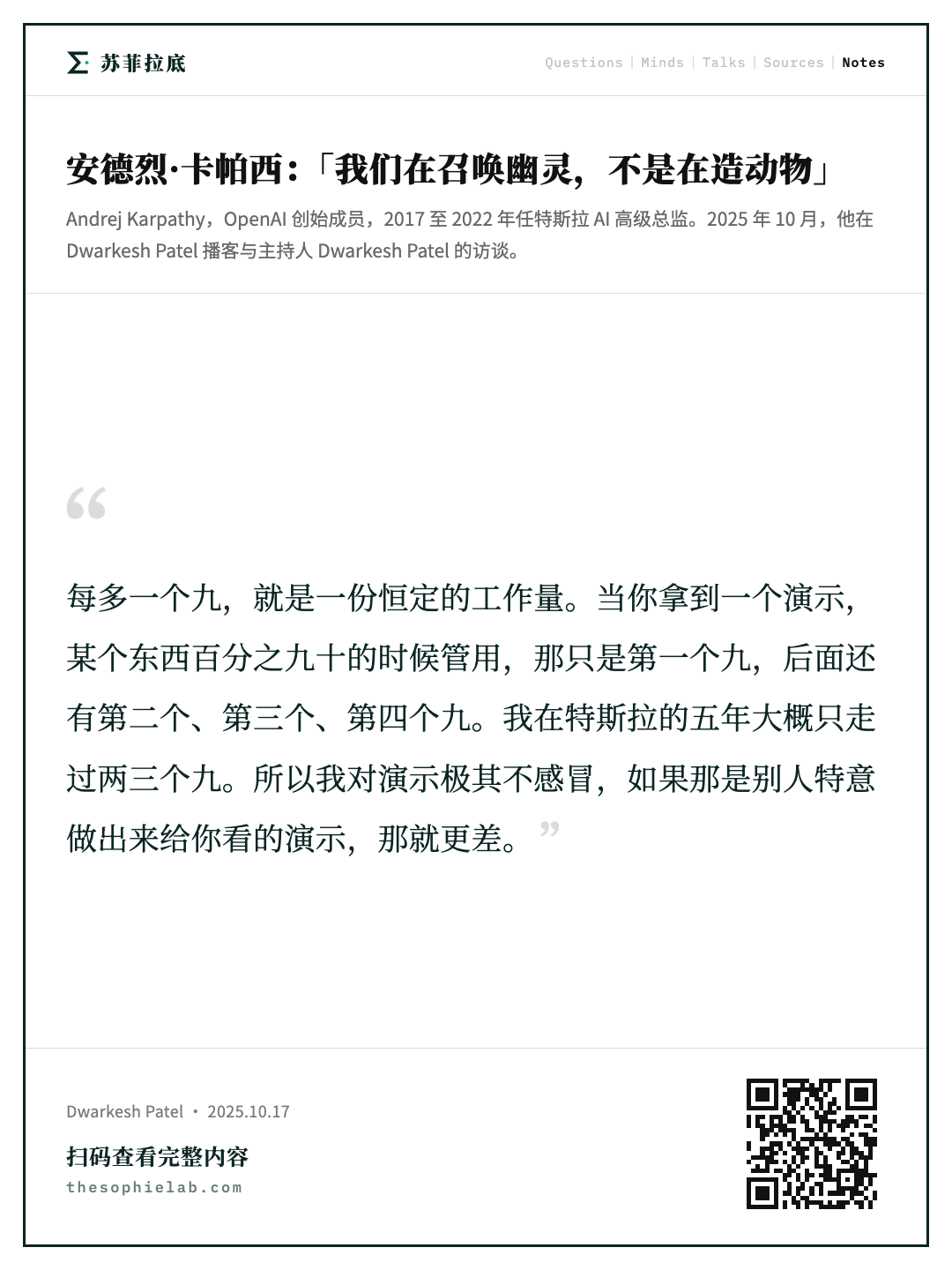
卡帕西: 花掉大量时间的东西,以及该怎么理解这件事,是「九的行军」。每多一个九,就是一份恒定的工作量。每一个九都是同样的工作量。当你拿到一个演示,某个东西百分之九十的时候管用,那只是第一个九。然后你需要第二个九、第三个九、第四个九、第五个九。我在特斯拉的五年左右里,我们大概走过了两三个九。我记不清具体数字,但是好几个九的迭代。后面还有更多九要走。这就是为什么这些东西要花这么久。

卡帕西: 这对我确实是塑造性的,看着一个演示走到那里。我对演示非常不感冒。我看到任何东西的演示,都极其不感冒。如果那是别人特意做出来给你看的演示,那就更差。如果你能自己上手玩,会好一点。但即便如此,你也远没有完成。你需要的是真正的产品。它接触现实的时候会遇到所有这些挑战,会遇到各种需要打补丁的行为角落。我们会看到这一切一一上演。这是九的行军,每个九都是恒定的工作量。演示令人鼓舞,但要做的工作依然巨大。而这是一个关键安全领域,除非你做的是氛围编程,那当然轻松愉快。所以从这个角度,我的时间表也被加固了。

主持人: 听你说软件所需的安全保证和自动驾驶并无本质不同,这很有意思。人们通常会说,自动驾驶之所以这么久,是因为失败代价太高。人类平均每四十万英里、或者说每七年才犯一次错。如果你要发布一个至少七年不能出错的编程 agent,部署难度会大得多。但你的意思是,如果你每七年犯一次灾难性的编程错误,比如搞垮某个重要系统……

卡帕西: 那太容易发生了。事实上按墙上时钟算,会远远短于七年,因为你在不停地吐代码。按词元算也许是七年,但按墙上时钟算……

主持人: 某些方面这是个更难的问题。自动驾驶只是人类做的成千上万件事里的一件,几乎算一个单一垂直领域。而我们谈通用软件工程时,表面积要大得多。

主持人: 关于这个类比,人们还有另一个反驳:自动驾驶花掉的很大一部分时间,是在解决「具备稳健的基础感知」这个问题,是在建立表征,是在得到一个有点常识、能对稍微超出分布的东西泛化的模型。如果有人在路边这样挥手,你不需要专门为它训练,那东西会有某种理解知道该怎么反应。而这些今天我们从 LLM 或者视觉语言模型那里是白拿的,所以我们不必解决这些非常基础的表征问题。于是把 AI 部署到不同领域,就像把今天的自动驾驶汽车部署到另一个城市,很难,但不是一个十年的活。

卡帕西: 我不百分之百同意。我不知道我们究竟白拿了多少,对于我们到底拿到了什么,还有很多认识上的空白。我们确实在单个实体里拿到了更可泛化的智能,而自动驾驶是一个非常专用的任务。从某种意义上说,造一个专用的东西也许反而更难,因为它不是从你大规模在做的某个更一般的东西里掉出来的。但这个类比对我还是不完全成立,因为 LLM 仍然相当容易出错,仍然有大量缺口要填。我不认为我们真的开箱即得了什么神奇的泛化。

自动驾驶远未完成

卡帕西: 我还想回到另一面:自动驾驶汽车远远没有完成。部署量相当小。Waymo 之类的车非常少。他们之所以如此,粗略地说是因为不经济。他们造出了一个活在未来的东西,他们把未来拽了过来,但代价是让它不经济。那里有各种成本,不只是那些车的边际成本、运营和维护,还有整件事的资本开支。让它变得经济,对他们仍将是一场苦战。

卡帕西: 还有,当你看到这些车里没人开,我其实觉得这有点骗人,因为背后有非常精密的远程操作中心,有人在某种程度上和这些车处在同一个回路里。我不掌握全貌,但人在回路里的程度比你以为的要高。有人在天边某个地方连进来。我不知道他们是不是完全在驾驶回路里,有些时候是,但他们肯定是参与其中的,而且那是人。某种意义上说,我们并没有真的把人去掉,我们只是把人挪到了你看不见的地方。

卡帕西: 我仍然认为,像你说的,从一个环境换到另一个环境还有工作要做。要让自动驾驶成为现实,仍然有挑战。但我同意它确实越过了某个门槛,感觉上像是真的了,除非它其实是被远程操作的。比如 Waymo 不能去城市的所有地方,我猜是那些信号不好的地方。反正我对他们的技术栈一无所知,我是在瞎编。

主持人: 你在特斯拉领导了五年自动驾驶。

卡帕西: 抱歉,Waymo 的具体细节我确实不了解。顺便说,我很喜欢 Waymo,我经常坐。我只是觉得人们有时候对这些进展有点太天真了,要做的工作还非常多。在我看来特斯拉采取了一条可扩展得多的路线,团队做得极好。我对这件事会怎么走是留下过公开记录的。Waymo 起步早,因为你可以在车上塞进那么多传感器。但我确实认为特斯拉的策略更可扩展,未来会更像那个样子。

卡帕西: 所以这件事还得继续演下去,还没演完。我不想把自动驾驶说成一件花了十年的事,因为它还没走到头。一来起点是 1980 年而不是十年前,二来终点还没到。终点还远着,因为我们说自动驾驶时,我心里通常指的是规模化的自动驾驶:人们不必再去考驾照,等等。

算力是不是建多了

主持人: 我好奇再看两个这个类比可能不成立的地方。我对此格外好奇,是因为 AI 被部署得多快、早期阶段它有多大价值,可能是当下世界上最重要的问题。如果你想为 2030 年的世界建模,这是你必须有所把握的问题。第一,自动驾驶有延迟要求。我不知道实际模型多大,但我猜是几千万参数量级,而这对 LLM 做知识工作并不是必要的约束。也许在操作电脑之类上会有。

主持人: 但也许更重要的是资本开支这一点。是的,多服务一份模型拷贝有额外成本,但一次会话的运营成本相当低,而且取决于推理侧的规模化怎么走,你可以把 AI 的成本摊进训练本身。这和为多服务一个模型实例而造一整辆新车完全不是一回事。所以更广泛部署的经济账要有利得多。

卡帕西: 我认为这是对的。如果你停留在比特的世界里,比特比任何触及物理世界的东西容易一百万倍。这我完全承认。比特是可以任意改动、任意重排的,而且速度极快。你也该预期产业里的适应速度快得多。第一点是什么来着?

主持人: 延迟要求,以及它对模型尺寸的影响。

卡帕西: 我觉得那也大致对。不过我也认为,如果我们谈的是规模化的知识工作,实践上会有一些延迟要求,因为我们得造出并供给巨量的算力。

卡帕西: 最后一个我想很简短提一下的方面,是其余的一切。社会怎么看它?法律后果是什么?法律上怎么运转?保险上怎么运转?那些层面和方面是什么?「有人往 Waymo 上放个交通锥」在这里对应的是什么?所有这些都会有对应物。所以我觉得自动驾驶是个很好的类比,你可以从中借用很多东西。汽车里的交通锥对应什么?那个藏起来的远程操作员对应什么?所有这些方面。

主持人: 这对当前的算力建设意味着什么,你有看法吗?这轮建设会在一两年里把世界上可用的算力放大十倍,到这个十年末也许放大一百倍以上。如果 AI 的使用量低于一些人天真的预测,是不是意味着我们算力建多了?还是说这是另一个问题?就像铁路那样,或者说是电信业那样,九十年代末为十年后才来的互联网提前铺好了路,也吹出了一个泡沫。

卡帕西: 我知道我这里听起来非常悲观。其实我是乐观的。我认为这会成,我认为这是可解的。我之所以听起来悲观,是因为我一刷推特时间线,就看到一堆在我看来毫无道理的东西。这背后有很多原因,说实话很大一部分就是融资,是激励结构。还有一部分是注意力,是在互联网上把注意力变成钱之类。这种事很多,而我只是在对那些做反应。但我总体上对技术非常看多。

卡帕西: 我们会把这些问题一个个解决。进展的速度很快。我不认为存在建设过剩。我认为按我的理解,正在建的算力我们是能吃下去的。比如 Claude Code 或者 OpenAI Codex 之类,一年前压根不存在,对吧?这是一项一年前还不存在的奇迹般的技术。需求会非常巨大,我们已经在 ChatGPT 之类上看到了需求。所以我不觉得是建多了。

卡帕西: 我只是在对一些人反复给出的、错误的极短时间表做反应。在我做 AI 的这十五年里,我见过太多次非常有声望的人一次次搞错。我希望这件事被正确地校准,因为其中一些问题还有地缘政治后果之类。我不希望人们在那个层面上犯错。我确实希望我们对技术的实际能与不能保持清醒。

为什么做教育

主持人: 我们聊聊教育和 Eureka。你本可以再开一家 AI 实验室去解决那些问题。我好奇你现在在做什么,为什么不是 AI 研究本身?

卡帕西: 我大概会这么说:我对 AI 实验室在做的事有某种宿命感。我觉得我去那里能帮上忙,但我不确定我会带来独一无二的改进。我个人最大的恐惧,是这一切发生在人类的边上,而人类被它剥夺了力量。我在意的不只是我们、以及 AI 将会完全自主地建造的那些戴森球,我在意的是人会怎么样。我希望人类在未来过得好。

卡帕西: 我觉得在这件事上,我比在前沿实验室里做一点增量改进能贡献得独特得多。我最怕的是《机器人总动员》或《蠢蛋进化论》里那种景象,人类被晾在一边。我希望人类在那个未来里好得多得多。在我看来,这要通过教育来实现。

主持人: 那你具体在做什么?

卡帕西: 最容易的描述方式是,我们在造星际舰队学院。不知道你看没看过《星际迷航》。

主持人: 没看过。

卡帕西: 星际舰队学院是一所精英机构,做前沿技术,造飞船,把学员培养成这些飞船的驾驶员之类。所以我想象的就是一所面向技术知识的精英机构,一所非常跟得上时代的、第一流的学校。

主持人: 我有一类问题想问你,就是怎么把技术性或科学性的内容讲好,因为你是这件事上世界级的高手。我既好奇你怎么看待你已经放上 YouTube 的那些内容,也好奇在 Eureka 上你的想法有没有不同。

卡帕西: 关于 Eureka,教育里让我极其着迷的一点是,我确实认为有了 AI 在旁边,教育会发生相当根本的变化,它必须被重新接线、被改造。但我仍然觉得我们还很早。会有很多人去做那些显而易见的事:放一个 LLM 在那儿让人提问,把你现在靠提示词能做的基本操作都做一遍。那是有帮助的,但在我看来仍然有点糊弄。我想把它做对,而我想要的那种能力现在还不存在。我想要的是一种真正的家教体验。

一个好家教做了什么

卡帕西: 我脑子里很鲜明的一个例子,是我最近在学韩语。我经历过一个阶段,自己在互联网上学韩语。又经历过一个阶段,在韩国上小班课,和一堆人一起学,挺好玩的,一个老师带十来个人。然后我换成了一对一的家教。

卡帕西: 让我着迷的是,我想我遇到了一位非常好的老师。去想她为我做了什么,那体验有多不可思议,以及我最终想造的东西门槛有多高。仅仅通过一段很短的对话,她立刻就明白了我这个学生处在什么位置,我知道什么、不知道什么。她能精准地探出该问哪些问题、该看哪些东西,来摸清我的世界模型。今天没有任何 LLM 能百分之百替你做到这件事,差得远。但一个好的家教能做到。

卡帕西: 一旦她弄明白了,她就会把我在当前这一薄层能力上所需要的一切端给我。我必须始终被恰如其分地挑战,不能碰到太难的东西,也不能碰到太琐碎的东西,而好的家教特别擅长把恰到好处的东西端给你。我当时感觉,学习的唯一约束就是我自己。我总能拿到完美的信息,唯一的阻碍是我。我感觉很好,因为存在的唯一障碍就是我,而不是我找不到知识,或者它没有被讲清楚。那只是我记忆力之类的问题。我希望人们得到的就是这个。

主持人: 怎么把它自动化?

卡帕西: 非常好的问题。以现在的能力,你做不到。这也是为什么我认为现在还不是造这种 AI 家教的正确时机。我仍然觉得那是个有用的产品,会有很多人去造,但门槛太高了,能力还不到位。哪怕在今天,我也会说 ChatGPT 已经是一个极有价值的教育产品。但对我来说,看到那个门槛有多高,实在太震撼了。当我坐在她面前时,我几乎觉得我不可能造出这个东西。

主持人: 可你在造它,对吧?

卡帕西: 任何一个遇到过真正好家教的人都会想:「你打算怎么造出这个?」我在等那个能力到来。我做过计算机视觉方向的 AI 咨询,很多时候我给公司带来的价值,就是告诉他们别用 AI。我是那个 AI 专家,他们描述完问题,我说:别用 AI。这就是我的增值。我觉得教育现在也一样。就我心里想要的那个东西而言,时候还没到,但它会到。眼下我在造的是更常规一些的东西,有实体的部分,也有数字的部分。

主持人: 在你能说的范围内,今年或明年你希望发布的是什么?

卡帕西: 我在造第一门课。我想做出一门非常非常好的课,一个显而易见的、你要学 AI 就该去的最高水准的目的地。AI 只是我熟悉的领域,所以它是一个很好的起步产品,我可以把它做到真的很好。你刚提到的 nanochat,是 LLM101N 这门课的毕业设计,那门课我正在造,nanochat 是其中很重的一块。但现在我还得把大量中间环节搭起来,还要招一个小的助教团队,把整门课建完。

卡帕西: 还有一点我想说:很多时候人们想到教育,想到的是那种比较软的、传播知识的成分。我心里想的是非常硬、非常技术的东西。在我看来,教育是一个很困难的技术过程:为知识修坡道。在我看来 nanochat 就是一条通往知识的坡道,因为它非常简单,是极度简化的全栈版本。如果你把这个东西交给一个人,他一路读下去,他会学到大量东西。它给你的是我所谓的「每秒的顿悟数」,也就是每秒的理解量。这就是我想要的,大量的每秒顿悟。

卡帕西: 所以对我来说,这是一个技术问题:我们怎么高效地修出这些坡道,让人永远不会卡住,让一切永远不太难也不太琐碎,让你手上永远有恰好合适的材料往前走。从这个意义上说,我几乎觉得 Eureka 和某些前沿实验室、和那里正在进行的工作没有那么不同。

主持人: 你设想的短期版本是:与其让家教来探你的理解,不如你自己有足够的自我觉察去探自己,那样你就不会卡住。你可以在问助教、问 LLM 和看参考实现之间找到答案。听起来自动化或者 AI 并不是其中的重头。到目前为止,真正的超额价值来自你解释 AI 的能力,被固化在课程的原始材料里。

卡帕西: 课程本质上就是那个。你永远要校准到行业里现有的能力。很多人会去走「直接问 ChatGPT」那条路。但我觉得现在,你去 ChatGPT 说「教我 AI」,是不可能的,它会给你一堆糊弄的东西。AI 现在也绝不可能写出 nanochat。但 nanochat 是个非常有用的中间点。

卡帕西: 我是在和 AI 协作创作这些材料的,所以 AI 从根本上仍然非常有帮助。早些年我在斯坦福建过 CS231n,我想那是斯坦福第一门深度学习课,后来变得很受欢迎。当年做 231n 和现在做 LLM101N,差别相当鲜明。我觉得现在的 LLM 让我很有力量,但我非常深地在回路里。它们帮我造材料,我走得快多了,它们替我干掉很多无聊的活。我感觉课程开发得快多了,而且是被 LLM 浸润过的,但它还没到能创造性地生成内容的地步,那部分仍然得我来。棘手之处永远是把自己校准到现实存在的能力上。

主持人: 想象几年后 Eureka 能提供什么,最大的瓶颈似乎会是:在一个又一个领域里找到能把自己的理解转化成这种坡道的「卡帕西」。

卡帕西: 这会随时间变化。现在是招教员,让他们和 AI 以及一个团队手把手地合作,造出最高水准的课程。随着时间推移,也许一部分助教可以是 AI。你把全部课程材料喂进去,我觉得你能给学生提供一个非常好的自动助教,应付比较基础的问题之类。但我认为课程的整体架构、以及确保它咬合得上,还是需要教员。所以我能看到一条演进路径。也许在未来某个点上,我本人都不那么有用了,AI 在设计上比我做得好得多。但我仍然觉得那要过一段时间才会发生。

主持人: 你设想的是让其他领域的专家来贡献课程,还是说,鉴于你对怎么教有自己的理解,由你来设计内容是这个愿景的核心?萨尔·可汗(Sal Khan)给可汗学院所有视频配音,你想的是那种模式吗?

卡帕西: 不是,我会招教员,因为有些领域我不是专家。那是最终能给学生提供最高水准体验的唯一办法。所以我预期我会招教员,但我自己大概还会在 AI 这块待一阵。

卡帕西: 就当前的能力而言,我心里的东西比人们预期的要常规一些。当我造星际舰队学院时,我想象的大概是一所实体机构,下面一层是数字版。数字版不是那种最高水准的体验,最高水准的体验是有人全职来到线下,我们从头到尾一起过材料,确保你真的懂了。那是实体的部分。数字的部分是网上的一堆东西,也许配一个 LLM 助手,它会花哨一点、次一等,但至少八十亿人都能拿到。

主持人: 你基本上是在用今天可用的工具,从第一性原理重新发明大学,并且筛选出那些真有动力、真想跟材料较劲的人。

卡帕西: 将来需要的不只是教育,还有大量的再教育。我很想在那里帮上忙,因为工作大概会变化不少。比如今天很多人在努力补 AI 的技能,从这个角度说这是一门很值得教的课。

卡帕西: 至于动机,在 AGI 之前,动机很好解决,因为人们想赚钱,这是今天在这个行业里赚钱的方式。AGI 之后可能有意思得多:如果一切都自动化了,谁都没事可做,为什么还有人去上学?我常说,AGI 之前的教育是有用,AGI 之后的教育是好玩。就像今天人们去健身房。

后 AGI 时代的学习

卡帕西: 我们并不需要他们的体力去搬重物,因为我们有机器。他们还是去健身房。为什么去健身房?因为好玩,因为健康,因为有六块腹肌好看。从非常深的心理和演化意义上说,这对人类是有吸引力的。教育会以同样的方式演下去。你会像去健身房一样去上学。

卡帕西: 现在没那么多人学东西,因为学习很难。你会从材料上弹开。有些人能翻过那道坎,但对大多数人来说很难。这是一个技术问题。把我学韩语时那位家教为我做的事情做出来,这是个技术问题,是可解的、可造的,应该有人去造。它会让学任何东西都变得轻而易举,而且变得令人向往,人们会为了好玩去学,因为它轻而易举。如果我对任意一块知识都有那样一位家教,学任何东西都会容易太多了,人们就会去学,理由和他们去健身房一样。

主持人: 这听起来和……那么 AGI 之后,你把它当成娱乐或者自我提升。可你之前听起来还有另一个愿景,说这种教育关系到让人类保有对 AI 的控制。那是两回事。对一部分人是娱乐,对另一部分人是赋权?你怎么看?

卡帕西: 我确实觉得,长期来看这是一场必输的游戏。长期而言,这个长期比行业里大多数人考虑的要长,它是必输的。但我确实认为人可以走得非常远,而我们对一个人能走多远还只是刚刚触到皮毛。原因就是人们总是从太容易或太难的材料上弹开。人可以走得远得多。每个人都会说五门语言,为什么不呢?因为太容易了。每个人都会掌握本科的全部基础课程,等等。

主持人: 现在我理解这个愿景了,非常有意思。它在健身文化里有完美的对应。我不觉得一百年前有谁是肌肉分明的。没人能自发地卧推两片或三片杠铃片。而现在这很常见,因为有了系统训练和举铁这套观念,或者系统训练去跑马拉松,那也是大多数人不会自发拥有的能力。

卡帕西: 正是。

主持人: 你想象的是在很多不同领域里发生类似的事,更强、更深、更快地学习。

卡帕西: 没错。我确实隐含地押注于人性中某些永恒的东西。做这些事会是令人向往的,而且我认为人们会像几千年来一样敬重它。这一点会继续成立。历史上也有些证据。比如你看贵族,或者看古希腊,凡是出现过某种意义上「后 AGI」的小环境时,人们都会把大量时间花在某种意义的繁盛上,或者身体的,或者心智的。

卡帕西: 我对这个前景感觉还行。如果这是错的,如果我们最后落进《机器人总动员》或者《蠢蛋进化论》那样的未来,那我就算有戴森球也不在乎。那是个糟糕的结局。我是真的在意人类。每个人都必须在某种意义上变得超人。

主持人: 但在那个世界里,这些并不能让我们……有点像《文明》系列小说里的世界,对吧?你从根本上不可能靠自己的劳动或认知去改变技术的轨迹、去影响决策。也许你能影响决策,因为 AI 会来征求你的许可,但那不是因为我发明了什么,或者我想出了一个新设计,从而真正在影响未来。

卡帕西: 也许吧。我认为会有一个过渡期,在那段时间里,只要我们理解足够多的东西,就仍然能在回路里推动事情。长期来看,那大概会消失。

卡帕西: 它甚至可能变成一项运动。现在有力量举运动员在那个方向上走到极致。认知时代的力量举是什么?也许是那些真把「知道东西」这件事办成奥运会的人。如果你有一个完美的 AI 家教,也许你能走得极远。我觉得今天的天才也只是刚刚触到人类心智所能达到的皮毛。

主持人: 我很喜欢这个愿景。我还觉得,和你最有产品契合度的人就是我,因为我的工作就是每周都得学一个不同的学科,我非常期待。

卡帕西: 这一点我和你一样。很多人恨学校,一心想逃出去。我很喜欢学校,我爱学东西。我想留在学校,我一路留到博士,然后他们不让我再留了,我就去了工业界。粗略地说,我为了学习本身而爱学习,但我也因为学习是一种赋权、一种让自己有用和有产出的方式而爱它。

主持人: 你还说了一个很微妙的点,我想把它挑明。至今为止的在线课程,为什么没能让每个人都学会一切?因为它们太依赖动机了,没有明显的上手坡道,太容易卡住。如果换成那个东西,就像一位真正好的家教,那从动机的角度会是一次巨大的解锁。

卡帕西: 我想是的。从材料上弹开的感觉很糟。你投入了一段时间却没有结果,这会给你负奖励;或者因为拿到的东西太容易或太难而无聊透顶,也很糟。而当这件事被做对了,学习的感觉是好的。要走到那一步,是个技术问题。有一段时间里它会是 AI 加人的协作,某个时点之后,也许就是纯 AI 了。

物理学教会我什么

主持人: 我能问几个关于怎么教好的问题吗?如果要给另一个你感兴趣的领域里的教育者一些建议,让他们做出你做过的那种 YouTube 教程,你会说什么?也许特别有意思的是那些没法让人写段代码来检验理解的领域。

卡帕西: 这话题挺宽的。我大概有十到二十条半自觉在用的小技巧。但很多东西来自我的物理学背景,我真的非常享受物理学的训练。

卡帕西: 我有一整套观点,认为每个人在早期学校教育里都该学物理。因为早期学校教育不是为了积累知识、为了以后在行业里用的记忆,它是为了给大脑开机。而物理学独一无二地把大脑开得最好,因为学物理时它逼你在脑子里做的一些事,后来极其有价值。比如建立模型和抽象的观念;理解存在一个一阶近似能描述系统的大部分,而二阶、三阶、四阶项可能在也可能不在;理解你在观察一个噪声很大的系统,但其中有一些基本频率可以被抽象出来。

卡帕西: 当一个物理学家走进教室说「假设有一头球形的牛」,所有人都会笑,可这太高明了。这是极其高明、也极其可迁移的思维方式,因为一头牛在很多方面确实可以近似成一个球。比如有本很好的书叫《规模》(Scale),是一位物理学家在谈生物学,这也是我会推荐的书。你能得到很多非常有意思的近似,能给动物画出标度律。

卡帕西: 你可以看它们的心跳之类,它们和动物的体型能对上。你可以把一只动物当成一个体积来谈。你可以谈它的散热,因为散热是随表面积增长的,也就是随平方增长,而产热是随立方增长的。所以我就是觉得,物理学家拥有解决世界上各种问题所需的全部认知工具。

卡帕西: 正因为这套训练,我总在寻找一切事物的一阶项和二阶项。当我观察一个系统或一个事物时,我脑子里是一团缠绕的想法和知识的网,我要找的是:什么是真正要紧的?什么是一阶成分?我怎么把它简化?我怎么能有一个最简单的东西,把那件事展示出来、让它跑起来,然后再把其他项加回去?

卡帕西: 我自己的库里有个例子挺能说明这一点,叫 micrograd。micrograd 是一百行代码,展示反向传播。你可以用加法、乘法这类简单运算搭出神经网络,那是神经网络的乐高积木。你建起一张计算图,做一次前向、一次反向,拿到梯度。而这是所有神经网络学习的核心。所以 micrograd 是一百行相当可读的 Python 代码,能对任意神经网络做前向和反向,只是不高效。

卡帕西: 所以这一百行 Python,就是理解神经网络如何训练所需要的全部。其余一切都只是效率。其余全是效率。要做到高效有海量的工作:你需要张量,你要排布它们、设置步长,你要确保你的核函数正确地编排内存搬运,等等。粗略地说,那全是效率。但神经网络训练在智识上的核心就是 micrograd,一百行,你很容易就能读懂。它是链式法则的递归应用,用来求出梯度,从而让你能优化任意可微函数。

卡帕西: 所以我喜欢找到这些低阶项,把它们端到盘子上,把它们发现出来。我觉得教育是智识上最有意思的事,因为你手上有一团缠绕的理解,你要把它铺开,铺成一条坡道,让每一样东西都只依赖它前面的东西。这种把知识解缠的过程,作为一项认知任务实在太有意思了。我个人非常享受,我对把事情按某种方式铺开这件事有种痴迷。也许这就是帮到我的地方。

先给痛,再给药

主持人: 这也让学习体验变得有动机得多。你那期讲 Transformer 的教程,是从二元组开始的,字面意义上就是一张查找表:这是当前这个词,这是前一个词,这是下一个词,就是一张表。

卡帕西: 精髓就在那儿。

主持人: 这太妙了,从一张查找表开始,一路走到 Transformer。每一块都有动机。你为什么要加那个?你为什么要加下一样东西?你可以去背注意力的公式,但理解每一块为什么相关、它解决什么问题,完全是两回事。你是在给出解法之前先呈现痛点,这多聪明。

卡帕西: 你要带着学生走完那个递进。另外还有很多小细节让它变得好看、有意思、有参与感。要不断向学生发问。有很多这样的小事很重要,很多好的教育者都会这么做。你会怎么解决这个?我不会在你猜之前就把解法给你,那太浪费了。在你有机会自己试一把之前就把答案端给你,那有点……我不想骂人,但那是对你的一种不厚道。因为如果你自己试着想,你会更好地理解动作空间是什么、目标是什么,然后才明白为什么只有这个动作能达成那个目标。你有机会自己试过,我再给你解法时你才有体会。这让每增加一个新事实所带来的知识量最大化。

主持人: 你觉得为什么默认情况下,真正的领域专家常常讲不清给一个刚入门的人听?

卡帕西: 这是知识和专长的诅咒。这是真实存在的现象,我自己也深受其害,尽管我尽力避免。你会把某些东西当成理所当然,你没法把自己放进一个刚起步的人的处境里。这非常普遍,我身上也会发生。

卡帕西: 有一件事极其有用。举个例子,最近有人想给我看一篇生物学论文,我立刻就有一堆很蠢的问题。我的做法是,把论文放进上下文窗口,用 ChatGPT 去问那些问题,它帮我理清了一些简单的东西。然后我把整段对话分享给写那篇论文、做那项工作的人。我觉得如果他们能看见我那些蠢问题,也许能帮他们以后讲得更好。对我自己做的材料,我也很希望人们把他们和 ChatGPT 之间那些傻乎乎的对话分享给我,因为那真的能帮我重新站到一个初学者的位置上。

主持人: 还有一个招,效果好得惊人。如果有人写了一篇论文、一篇博客、一则发布,百分之百的情况下,他们在午饭时向你口头解释那件事的转录稿,不仅更好懂,而且实际上更准确、更科学。因为人们有一种倾向,要用最抽象、最堆术语的方式写东西,还要清四段嗓子才讲到核心。但和一个人面对面交流有某种东西,逼着你把话直接说出来。

卡帕西: 就把话说出来。我看到那条推文了,我觉得太对了,还转给了一堆人。我注意到这件事很多很多次。最鲜明的例子是我读博做研究的时候。你读某人的论文,费劲去弄懂它在干什么。然后你在会议上碰到他们,一起喝啤酒,你问:「你这篇论文到底在做什么?这论文讲的是什么?」他们会用三句话完美地抓住这篇论文的精髓,把想法彻底讲明白。你根本不用读那篇论文。只有当你和他们坐在桌边喝着啤酒时,他们才会说:「哦,这篇论文就是,你拿这个想法,拿那个想法,做这个实验,再试一下这个东西。」他们有办法用口语把它讲得刚刚好。

主持人: 那为什么那不能是摘要?

卡帕西: 正是。

学生该怎么学

主持人: 刚才是从「想解释一个想法的人该怎么组织表达」这个角度说的。那从学生的角度,如果你身边没有一个卡帕西来做讲解,你在读某人的论文或某本书,你会用什么策略去学一个你感兴趣但并不精通的领域?

卡帕西: 老实说,我不觉得我有什么独门秘诀,这是个痛苦的过程。一直对我帮助不小的一点,我发过一条相关的推文,是按需学习很好用,也就是纵深式地学。

卡帕西: 我确实觉得你需要在两种学习之间交替。一种是纵深式的、按需的,你在冲某个具体项目,能从中拿到奖励。另一种是广度式的,就是「好吧,先把某某 101 过一遍,这些是你以后可能需要的东西」。学校做的很多是广度式学习:「相信我,你以后会用到的。」好吧,我信你,我学,因为我猜我需要它。但我喜欢的是那种做成一件事能拿到回报、按需学的学习。

卡帕西: 另一件我发现极其有用的事,这一点上教育有点利他的意味,是把东西讲给别人听,那是把一样东西学得更深的绝妙方式。这在我身上一直发生。别人大概也一样,因为我发现,如果我并没有真的懂某样东西,我就讲不出来。我一边讲一边意识到:哦,这个我不懂。要面对这一点很烦人。但你可以回去确认自己真的懂了,它会填上你理解里的这些窟窿,逼着你面对它们、把它们弥合。

卡帕西: 我喜欢反复地重新讲一遍东西,人们也应该多这么做。那逼着你去摆弄知识,确保你在讲的时候知道自己在讲什么。

主持人: 这是个绝佳的收尾。安德烈,聊得太好了,谢谢你。
本期讲者
安德烈·卡帕西OpenAI 创始成员,2017 至 2022 年任特斯拉 AI 高级总监,领导 Autopilot 视觉团队;斯坦福 CS231n 深度学习课程创建者。近年发布 micrograd、nanoGPT、nanochat 等教学代码库,并创办教育公司 Eureka Labs。
Dwarkesh Patel《Dwarkesh Podcast》主持人,长期深度访谈 AI 研究者、经济学家与科学家,此前曾对话 Richard Sutton、Nick Lane、Gwern 等人。
章节 · 点击跳转视频
0:48 为什么是 agent 的十年 ▶ 正在看
3:47 十五年 AI 的三次转向 ▶ 正在看
7:36 造幽灵,而不是造动物 ▶ 正在看
14:13 上下文学习与认知内核 ▶ 正在看
27:31 nanochat 与编程模型的局限 ▶ 正在看
40:53 强化学习为何像用吸管吸监督 ▶ 正在看
50:36 合成数据、模型坍缩与熵 ▶ 正在看
59:34 认知内核到底该有多小 ▶ 正在看
1:07:13 AGI 如何落进真实经济 ▶ 正在看
1:32:28 智能演化的偶然与瓶颈 ▶ 正在看
1:43:33 自动驾驶与九的行军 ▶ 正在看
1:57:08 Eureka:教育是技术问题 ▶ 正在看
本期论点
本期回应
2:03:24
教育本质上是一个困难的技术问题:为知识搭建一条每步只依赖前一步的坡道 靠更强的工具往前走难题的出路在更强的技术吗?
其他论点
1:21
这不是 agent 元年,而是 agent 的十年
6:06
靠打游戏通不向通用人工智能,真正需要的是能与真实世界打交道的系统
7:05
能操作电脑的智能体必须建在语言模型的表征之上,否则奖励太稀疏学不会
9:23
当前的 AI 不是在造动物,而是在模仿互联网数据造出数字幽灵,那是另一种智能
30:25
掌握一门知识的唯一方式是亲手把代码写出来并跑起来,写博客、做幻灯片都不算 做法
42:48
结果奖励把整条轨迹一律加权,等于假定通向正确答案的每一步都对,而这并不成立
47:02
用大模型当裁判做过程监督撑不过上百步,强化学习必然会找到裁判的对抗样本
51:19
人类读书不是在预测下一个词,而是把书当作提示词去生成思考,知识来自这道加工
52:15
大模型的每个输出样本都已悄然坍缩,只占据可能思考空间中极窄的一块流形
56:22
人类记性不好是优点,正因为记不住才被迫去寻找更一般的模式
1:01:53
模型必须做得很大是因为互联网数据太糟糕,大部分参数花在记忆而非认知上
1:24:33
AI 不会抬高经济增长率,它会像计算机和手机一样被平均进同一条指数曲线
1:40:50
大模型至今没有文化:没有写给彼此的书、没有互传的笔记,这是通往更强智能的障碍
1:45:59
可靠性是一场「九的行军」,每多一个 9 所需的工作量都恒定不变
01为什么是 agent 的十年
0:48
Today I'm speaking with Andrej Karpathy. Andrej, why do you say that this will be the decade of agents and not the year of agents? First of all, thank you for having me here. I'm excited to be here. The quote you've just mentioned, "It's the decade of agents," is actually a reaction to a pre-existing quote. I'm not actually sure who said this but they were alluding to this being the year of agents with respect to LLMs and how they were going to evolve. I was triggered by that because there's some over-prediction going on in the industry.
今天我要和 Andrej Karpathy 对话。Andrej,你为什么说这将是 agent 的十年,而不是 agent 元年?首先,谢谢你邀请我来。我很高兴能来到这里。你刚才提到的那句话——「这是 agent 的十年」——其实是对另一句已有说法的回应。我不太确定是谁先说的,但他们的意思是,就 LLM 以及它们将如何演进而言,今年是 agent 元年。我被那句话触动了,因为业内存在一些过度预测的现象。
便签引用
1:21
In my mind, this is more accurately described as the decade of agents. We have some very early agents that are extremely impressive and that I use daily—Claude and Codex and so on—but I still feel there's so much work to be done. My reaction is we'll be working with these things for a decade. They're going to get better, and it's going to be wonderful. I was just reacting to the timelines of the implication. What do you think will take a decade to accomplish? What are the bottlenecks? Actually making it work. When you're talking about an agent, or what the labs have in mind and maybe what I have in mind as well, you should think of it almost like an employee or an intern that you would hire to work with you. For example, you work with some employees here.
在我看来,更准确的描述是:这是 agent 的十年。我们已经有了一些非常早期的 agent,它们相当令人惊艳,我每天都在用——Claude、Codex 等等——但我仍然觉得还有大量的工作要做。我的反应是,我们还要和这些东西打十年交道。它们会变得越来越好,那会很美妙。我只是对那种时间预期的暗示做出反应而已。你觉得什么事情需要十年才能做成?瓶颈在哪里?让它真正能用起来。当你说到 agent,或者说各大实验室心目中的、也许也是我心目中的 agent,你应该把它想成几乎像一个员工,或者一个你雇来和你一起工作的实习生。比如说,你这里也有一些员工。
便签引用
2:04
When would you prefer to have an agent like Claude or Codex do that work? Currently, of course they can't. What would it take for them to be able to do that? Why don't you do it today? The reason you don't do it today is because they just don't work. They don't have enough intelligence, they're not multimodal enough, they can't do computer use and all this stuff. They don't do a lot of the things you've alluded to earlier. They don't have continual learning. You can't just tell them something and they'll remember it.
什么时候你会更愿意让 Claude 或 Codex 这样的 agent 来做那些工作?当然,目前它们还做不到。要让它们做到,需要什么条件?为什么你今天不这么做?你今天不这么做的原因是它们根本不行。它们的智能还不够,多模态能力不够,不会使用电脑,等等这些。它们做不到很多你之前提到的事情。它们没有持续学习能力。你没法告诉它们一件事,它们就能记住。
便签引用
2:27
They're cognitively lacking and it's just not working. It will take about a decade to work through all of those issues. Interesting. As a professional podcaster and a viewer of AI from afar, it's easy for me to identify what's lacking: continual learning is lacking, or multimodality is lacking. But I don't really have a good way of trying to put a timeline on it. If somebody asks how long continual learning will take, I have no prior about whether this is a project that should take 5 years, 10 years, or 50 years. Why a decade? Why not one year? Why not 50 years? This is where you get into a bit of my own intuition, and doing a bit of an extrapolation with respect to my own experience in the field.
它们在认知上有欠缺,就是跑不通。把所有这些问题一一解决,大概需要十年。有意思。作为一个职业播客主持人、一个远远观望 AI 的人,我很容易指出缺了什么:缺持续学习,或者缺多模态。但我其实没有什么好办法给它定一个时间表。如果有人问持续学习还要多久,我心里没有任何先验判断——这是一个该花 5 年、10 年,还是 50 年的项目。为什么是十年?为什么不是一年?为什么不是 50 年?这就涉及我个人的一些直觉,以及基于我自己在这个领域的经历做的一点外推。
便签引用
3:14
I've been in AI for almost two decades. It's going to be 15 years or so, not that long. You had Richard Sutton here, who was around for much longer. I do have about 15 years of experience of people making predictions, of seeing how they turned out. Also I was in the industry for a while, I was in research, and I've worked in the industry for a while. I have a general intuition that I have left from that. I feel like the problems are tractable, they're surmountable, but they're still difficult. If I just average it out, it just feels like a decade to me.
我在 AI 领域待了将近二十年。差不多 15 年吧,其实也没那么久。你之前请过 Richard Sutton,他在这行待的时间比我长得多。我确实有大约 15 年的经验,看着人们做出各种预测,再看这些预测后来怎么样了。而且我在产业界待过一阵子,也做过研究,还在产业界工作过一段时间。这些经历给我留下了一种总体的直觉。我觉得这些问题是可解的、可以克服的,但仍然很难。如果我把它们平均一下,感觉就是十年。
便签引用
02十五年 AI 的三次转向
3:47
This is quite interesting. I want to hear not only the history, but what people in the room felt was about to happen at various different breakthrough moments. What were the ways in which their feelings were either overly pessimistic or overly optimistic? Should we just go through each of them one by one? That's a giant question because you're talking about 15 years of stuff that happened. AI is so wonderful because there have been a number of seismic shifts where the entire field has suddenly looked a different way.
这挺有意思的。我不只想听这段历史,还想知道在各个突破性时刻,当时在场的人觉得接下来会发生什么。他们的感受在哪些方面过于悲观,又在哪些方面过于乐观?要不我们一个一个来讲?这个问题太大了,因为你说的是长达15年里发生的事。AI之所以奇妙,是因为出现过好几次天翻地覆的转变,整个领域突然换了一副面貌。
便签引用
4:17
I've maybe lived through two or three of those. I still think there will continue to be some because they come with almost surprising regularity. When my career began, when I started to work on deep learning, when I became interested in deep learning, this was by chance of being right next to Geoff Hinton at the University of Toronto. Geoff Hinton, of course, is the godfather figure of AI. He was training all these neural networks. I thought it was incredible and interesting. This was not the main thing that everyone in AI was doing by far.
我大概经历过其中两三次。我依然认为还会有更多,因为它们出现的规律性几乎令人惊讶。我职业生涯刚开始的时候,我开始做深度学习、对深度学习产生兴趣,纯属偶然——因为我在多伦多大学就坐在Geoff Hinton旁边。Geoff Hinton当然是AI界的教父级人物。他在训练各种神经网络。我觉得那太不可思议、太有意思了。这在当时远不是AI圈里大家都在做的主流方向。
便签引用
4:43
This was a niche little subject on the side. That's maybe the first dramatic seismic shift that came with the AlexNet and so on. AlexNet reoriented everyone, and everyone started to train neural networks, but it was still very per-task, per specific task. Maybe I have an image classifier or I have a neural machine translator or something like that. People became very slowly interested in agents. People started to think, "Okay, maybe we have a check mark next to the visual cortex or something like that, but what about the other parts of the brain, and how can we get a full agent or a full entity that can interact in the world?"
这只是个边缘的小众课题。那大概就是第一次剧烈的转变,随着AlexNet等等到来。AlexNet让所有人调转了方向,大家开始训练神经网络,但还是非常任务导向、针对某个具体任务。比如我做一个图像分类器,或者做一个神经机器翻译系统之类的。人们慢慢开始对智能体产生兴趣。大家开始想:“好吧,也许我们在视觉皮层这一项上打了勾,但大脑的其他部分怎么办?我们怎样才能造出一个完整的、能在世界中互动的智能体或完整实体?”
便签引用
5:19
The Atari deep reinforcement learning shift in 2013 or so was part of that early effort of agents, in my mind, because it was an attempt to try to get agents that not just perceive the world, but also take actions and interact and get rewards from environments. At the time, this was Atari games. I feel that was a misstep. It was a misstep that even the early OpenAI that I was a part of adopted because at that time, the zeitgeist was reinforcement learning environments, games, game playing, beat games, get lots of different types of games, and OpenAI was doing a lot of that.
2013年前后Atari深度强化学习的转向,在我看来就属于智能体的那波早期努力,因为它试图造出的智能体不只是感知世界,还要采取行动、与环境互动并获得奖励。当时用的是Atari游戏。我觉得那是一次走偏。连我参与过的早期OpenAI也走了这条弯路,因为在那个时候,时代精神就是强化学习环境、游戏、玩游戏、打通游戏、搞很多不同类型的游戏,OpenAI在这方面做了大量工作。
便签引用
5:54
That was another prominent part of AI where maybe for two or three or four years, everyone was doing reinforcement learning on games. That was all a bit of a misstep. What I was trying to do at OpenAI is I was always a bit suspicious of games as being this thing that would lead to AGI. Because in my mind, you want something like an accountant or something that's interacting with the real world. I just didn't see how games add up to it. My project at OpenAI, for example, was within the scope of the Universe project, on an agent that was using keyboard and mouse to operate web pages.
那是AI的另一个显赫阶段,大概有两三年、三四年,所有人都在用游戏做强化学习。这整件事都有点走偏了。我在OpenAI想做的事情是——我一直对“靠游戏通向AGI”这个想法有点怀疑。因为在我看来,你想要的是像会计那样、能与真实世界打交道的东西。我实在看不出游戏怎么加总成那个东西。比如我在OpenAI的项目属于Universe项目的范畴,做的是一个用键盘和鼠标操作网页的智能体。
便签引用
6:30
I really wanted to have something that interacts with the actual digital world that can do knowledge work. It just so turns out that this was extremely early, way too early, so early that we shouldn't have been working on that. Because if you're just stumbling your way around and keyboard mashing and mouse clicking and trying to get rewards in these environments, your reward is too sparse and you just won't learn. You're going to burn a forest computing, and you're never going to get something off the ground. What you're missing is this power of representation in the neural network. For example, today people are training those computer-using agents, but they're doing it on top of a large language model.
我很想要一个能与真正的数字世界互动、能做知识工作的东西。只不过事实证明,这实在太早了,早得离谱,早到我们当时根本不该做那件事。因为如果你只是在环境里瞎摸索、乱敲键盘、乱点鼠标,试图拿到奖励,你的奖励太稀疏了,你根本学不会。你会为了算力烧掉一片森林,却永远起不了步。你缺的是神经网络里那种表征的力量。举个例子,今天人们在训练那些会用电脑的智能体,但他们是在大语言模型之上做的。
便签引用
7:05
You have to get the language model first, you have to get the representations first, and you have to do that by all the pre-training and all the LLM stuff. I feel maybe loosely speaking, people kept trying to get the full thing too early a few times, where people really try to go after agents too early, I would say. That was Atari and Universe and even my own experience. You actually have to do some things first before you get to those agents. Now the agents are a lot more competent, but maybe we're still missing some parts of that stack.
你得先有语言模型,得先有那些表征,而这要靠全部的预训练和所有那些LLM的工作来实现。我觉得,粗略地说,人们有好几次都想过早地一步到位,我会说,大家好几次都太早地去追求智能体了。Atari是这样,Universe是这样,我自己的经历也是这样。在做出那些智能体之前,你其实得先把一些事情做好。现在智能体的能力强多了,但也许这个技术栈里我们还缺一些部分。
便签引用
03造幽灵,而不是造动物
7:36
I would say those are the three major buckets of what people were doing: training neural nets per-tasks, trying the first round of agents, and then maybe the LLMs and seeking the representation power of the neural networks before you tack on everything else on top. Interesting. If I were to steelman the Sutton perspective, it would be that humans can just take on everything at once, or even animals can take on everything at once. Animals are maybe a better example because they don't even have the scaffold of language. They just get thrown out into the world, and they just have to make sense of everything without any labels.
我会说,人们做过的事大致分三大类:按任务训练神经网络,第一波智能体的尝试,然后可能就是LLM,先去追求神经网络的表征能力,再在上面叠加其他所有东西。有意思。如果让我为Sutton的观点做最有力的辩护,那就是:人类可以一次性把所有事情都扛下来,甚至动物也能一次性扛下所有事情。动物可能是更好的例子,因为它们连语言这个脚手架都没有。它们就是被扔进这个世界,必须在没有任何标签的情况下把一切搞明白。
便签引用
8:10
The vision for AGI then should just be something which looks at sensory data, looks at the computer screen, and it just figures out what's going on from scratch. If a human were put in a similar situation and had to be trained from scratch… This is like a human growing up or an animal growing up. Why shouldn't that be the vision for AI, rather than this thing where we're doing millions of years of training? That's a really good question. Sutton was on your podcast and I saw the podcast and I had a write-up about that podcast that gets into a bit of how I see things.
那么AGI的愿景就应该是:一个东西看着感官数据、看着电脑屏幕,从零开始自己搞清楚是怎么回事。如果把一个人放在类似的处境里、必须从零开始训练……这就像一个人长大,或者一只动物长大。为什么AI的愿景不该是这样,而非要搞成��种要训练几百万年的东西?这问题问得真好。Sutton上过你的播客,我看了那期节目,也写过一篇关于那期播客的文章,里面讲了一些我的看法。
便签引用
8:41
I'm very careful to make analogies to animals because they came about by a very different optimization process. Animals are evolved, and they come with a huge amount of hardware that's built in. For example, my example in the post was the zebra. A zebra gets born, and a few minutes later it's running around and following its mother. That's an extremely complicated thing to do. That's not reinforcement learning. That's something that's baked in. Evolution obviously has some way of encoding the weights of our neural nets in ATCGs, and I have no idea how that works, but it apparently works.
我对拿动物来做类比非常谨慎,因为它们是通过一个非常不同的优化过程产生的。动物是演化来的,出生时就自带大量内置的“硬件”。比如我在文章里举的例子是斑马。一匹斑马出生,几分钟后就能跑来跑去、跟着母亲走。那是件极其复杂的事。那不是强化学习。那是天生就写好的。演化显然有某种方式把我们神经网络的权重编码进ATCG里,我完全不知道那是怎么运作的,但它显然奏效了。
便签引用
9:14
Brains just came from a very different process, and I'm very hesitant to take inspiration from it because we're not actually running that process. In my post, I said we're not building animals. We're building ghosts or spirits or whatever people want to call it, because we're not doing training by evolution. We're doing training by imitation of humans and the data that they've put on the Internet. You end up with these ethereal spirit entities because they're fully digital and they're mimicking humans.
大脑来自一个非常不同的过程,我很犹豫要不要从中取经,因为我们实际上并没有在跑那个过程。我在文章里说过,我们不是在造动物。我们是在造幽灵、造灵体,随便人们怎么叫,因为我们做的不是演化训练。我们做的是对人类的模仿训练,模仿他们放到互联网上的数据。于是你得到的是这些飘渺的灵体,因为它们完全是数字化的,而且在模仿人类。
便签引用
9:45
It's a different kind of intelligence. If you imagine a space of intelligences, we're starting off at a different point almost. We're not really building animals. But it's also possible to make them a bit more animal-like over time, and I think we should be doing that. One more point. I do feel Sutton has a very... His framework is, "We want to build animals." I think that would be wonderful if we can get that to work. That would be amazing. If there were a single algorithm that you can just run on the Internet and it learns everything, that would be incredible. I'm not sure that it exists and that's certainly not what animals do, because animals have this outer loop of evolution.
那是另一种智能。如果你想象一个智能的空间,我们几乎是从一个不同的起点出发的。我们并不是真的在造动物。但随着时间推移,让它们更像动物一些也是可能的,我认为我们应该这么做。还有一点。我确实觉得Sutton有一个很强的……他的框架是:“我们要造动物。”如果能把那条路走通,那会非常棒。那会很惊人。如果真有一个单一算法,你把它放到互联网上跑,它就学会一切,那会不可思议。我不确定它是否存在,也不确定当然不是动物那样,因为动物有进化这个外层循环。
便签引用
10:24
A lot of what looks like learning is more like maturation of the brain. I think there's very little reinforcement learning for animals. A lot of the reinforcement learning is more like motor tasks; it's not intelligence tasks. So I actually kind of think humans don’t really use RL, roughly speaking. Can you repeat the last sentence? A lot of that intelligence is not motor task…it's what, sorry? A lot of the reinforcement learning, in my perspective, would be things that are a lot more motor-like, simple tasks like throwing a hoop.
很多看起来像学习的东西,其实更像是大脑的成熟过程。我觉得动物身上的强化学习非常少。强化学习中很大一部分更像是运动类任务,不是智力类任务。所以我其实有点认为,粗略地说,人类并不真的在用 RL。你能重复一下最后那句话吗?很多智力不是运动任务……抱歉,是什么来着?在我看来,强化学习中很大一部分会是更偏运动类的东西,比如投篮这种简单任务。
便签引用
10:53
But I don't think that humans use reinforcement learning for a lot of intelligence tasks like problem-solving and so on. That doesn't mean we shouldn't do that for research, but I just feel like that's what animals do or don't. I'm going to take a second to digest that because there are a lot of different ideas. Here’s one clarifying question I can ask to understand the perspective. You suggest that evolution is doing the kind of thing that pre-training does in the sense of building something which can then understand the world.
但我不认为人类在很多智力任务上使用强化学习,比如解决问题之类的。这并不意味着我们在研究中不该这么做,我只是觉得那是动物做或不做的事情。我得花点时间消化一下,因为这里面有很多不同的观点。我可以问一个澄清性的问题来理解这个视角。你的意思是,进化在做的事情类似于预训练所做的,即构建出某种之后能够理解世界的东西。
便签引用
11:24
The difference is that evolution has to be titrated in the case of humans through three gigabytes of DNA. That's very unlike the weights of a model. Literally, the weights of the model are a brain, which obviously does not exist in the sperm and the egg. So it has to be grown. Also, the information for every single synapse in the brain simply cannot exist in the three gigabytes that exist in the DNA. Evolution seems closer to finding the algorithm which then does the lifetime learning. Now, maybe the lifetime learning is not analogous to RL, to your point. Is that compatible with the thing you were saying, or would you disagree with that? I think so. I would agree with you that there's some miraculous compression going on because obviously, the weights of the neural net are not stored in ATCGs. There's some dramatic compression.
区别在于,对人类来说进化必须通过三个 GB 的 DNA 来传递。这和模型的权重非常不一样。从字面上说,模型的权重就是一个大脑,而大脑显然并不存在于精子和卵子里。所以它必须被生长出来。而且,大脑中每一个突触的信息,根本不可能装进 DNA 里那三个 GB。进化似乎更接近于找到一种算法,这个算法再去做终身学习。当然,也许终身学习并不类比于 RL,这是你的观点。这和你刚才说的能兼容吗,还是你不同意?我想是的。我同意你说的,这里面有某种神奇的压缩在发生,因为显然,神经网络的权重并不是存储在 ATCG 里的。这里有某种剧烈的压缩。
便签引用
12:14
There are some learning algorithms encoded that take over and do some of the learning online. I definitely agree with you on that. I would say I'm a lot more practically minded. I don't come at it from the perspective of, let's build animals. I come from it from the perspective of, let's build useful things. I have a hard hat on, and I'm just observing that we're not going to do evolution, because I don't know how to do that. But it does turn out we can build these ghosts, spirit-like entities, by imitating internet documents. This works. It's a way to bring you up to something that has a lot of built-in knowledge and intelligence in some way, similar to maybe what evolution has done. That's why I call pre-training this crappy evolution. It's the practically possible version with our technology and what we have available to us to get to a starting point where we can do things like reinforcement learning and so on. Just to steelman the other perspective, after doing this Sutton interview and thinking about it a bit, he has an important point here.
其中编码了一些学习算法,它们接管过来,在线地完成一部分学习。这一点我完全同意你。我会说我更偏向实用主义。我不是从“我们来造动物”这个视角出发的。我是从“我们来造有用的东西”这个视角出发的。我戴着安全帽,我只是观察到我们不会去做进化,因为我不知道怎么做。但事实证明,我们可以通过模仿互联网文档,造出这些幽灵般、精灵般的实体。这是行得通的。这是一种把你带到某个起点的方式,那个起点已经内置了大量知识和某种意义上的智能,有点类似于进化所做的事情。这就是为什么我把预训练叫做“蹩脚版的进化”。它是在我们的技术条件和现有资源下,实际可行的版本,能让我们到达一个起点,然后在此之上做强化学习之类的事情。为了给另一种视角做一下正面辩护,在做完 Sutton 那期访谈并思考了一阵之后,我觉得他这里有个重要的观点。
便签引用
13:09
Evolution does not give us the knowledge, really. It gives us the algorithm to find the knowledge, and that seems different from pre-training. Perhaps the perspective is that pre-training helps build the kind of entity which can learn better. It teaches meta-learning, and therefore it is similar to finding an algorithm. But if it's "Evolution gives us knowledge, pre-training gives us knowledge," that analogy seems to break down. It's subtle and I think you're right to push back on it, but basically the thing that pre-training is doing, you're getting the next-token predictor over the internet, and you're training that into a neural net. It's doing two things that are unrelated.
进化其实并没有给我们知识。它给我们的是发现知识的算法,这似乎和预训练不一样。也许可以这样看:预训练帮助构建出一种更擅长学习的实体。它教会的是元学习,因此它类似于找到一种算法。但如果说法是“进化给我们知识,预训练也给我们知识”,这个类比似乎就站不住脚了。这很微妙,我觉得你这样反驳是对的,但基本上预训练在做的事情是:你得到一个在互联网上做下一个词元预测的预测器,然后把它训练进一个神经网络里。它同时在做两件互不相关的事。
便签引用
13:43
Number one, it's picking up all this knowledge, as I call it. Number two, it's actually becoming intelligent. By observing the algorithmic patterns in the internet, it boots up all these little circuits and algorithms inside the neural net to do things like in-context learning and all this stuff. You don't need or want the knowledge. I think that's probably holding back the neural networks overall because it's getting them to rely on the knowledge a little too much sometimes. For example, I feel agents, one thing they're not very good at, is going off the data manifold of what exists on the internet.
第一,它在吸收我所说的所有这些知识。第二,它其实在变得聪明。通过观察互联网上的算法性模式,它在神经网络内部启动起各种小回路和小算法,用来做上下文学习之类的事情。你并不需要、也不想要那些知识。我认为这大概整体上拖累了神经网络,因为它有时让网络过于依赖知识。比如,我觉得智能体有一件事做得不太好,就是走出互联网上已有数据的流形。
便签引用
04上下文学习与认知内核
14:13
If they had less knowledge or less memory, maybe they would be better. What I think we have to do going forward—and this would be part of the research paradigms—is figure out ways to remove some of the knowledge and to keep what I call this cognitive core. It's this intelligent entity that is stripped from knowledge but contains the algorithms and contains the magic of intelligence and problem-solving and the strategies of it and all this stuff. There's so much interesting stuff there. Let's start with in-context learning. This is an obvious point, but I think it's worth just saying it explicitly and meditating on it.
如果它们知识更少、记忆更少,也许反而会更好。我认为我们接下来要做的——这也会是研究范式的一部分——是找到办法去掉一部分知识,保留我所说的“认知内核”。那是一个被剥离了知识的智能实体,但它包含算法,包含智能与问题解决的魔力,以及相关的策略等等。这里面有太多有意思的东西了。我们从上下文学习开始说。这是个显而易见的点,但我觉得值得明确说出来并好好想想。
便签引用
14:48
The situation in which these models seem the most intelligent—in which I talk to them and I'm like, "Wow, there's really something on the other end that's responding to me thinking about things—is if it makes a mistake it's like, "Oh wait, that's the wrong way to think about it. I'm backing up." All that is happening in context. That's where I feel like the real intelligence is that you can visibly see. That in-context learning process is developed by gradient descent on pre-training. It spontaneously meta-learns in-context learning, but the in-context learning itself is not gradient descent, in the same way that our lifetime intelligence as humans to be able to do things is conditioned by evolution but our learning during our lifetime is happening through some other process.
这些模型显得最聪明的时刻——就是我和它们对话时会想,“哇,对面真的有某种东西在回应我、在思考问题”——是当它犯了错时会说:“哦等等,这个思路不对,我退回去重来。”所有这些都发生在上下文里。我觉得那才是你能明显看到的真正智能所在。而这个上下文学习的过程,是在预训练中由梯度下降培养出来的。它自发地元学习出了上下文学习,但上下文学习本身并不是梯度下降,就像我们人类一生中做各种事情的智能是由进化所塑造的,但我们一生中的学习是通过另外某种过程发生的。
便签引用
15:30
I don't fully agree with that, but you should continue your thought. Well, I'm very curious to understand how that analogy breaks down. I'm hesitant to say that in-context learning is not doing gradient descent. It's not doing explicit gradient descent. In-context learning is pattern completion within a token window. It just turns out that there's a huge amount of patterns on the internet. You're right, the model learns to complete the pattern, and that's inside the weights. The weights of the neural network are trying to discover patterns and complete the pattern. There's some adaptation that happens inside the neural network, which is magical and just falls out from the internet just because there's a lot of patterns. I will say that there have been some papers that I thought were interesting that look at the mechanisms behind in-context learning.
我不完全同意这个说法,不过你先把想法说完。那我很好奇这个类比是在哪里失效的。我不太愿意说上下文学习不是在做梯度下降。它不是在做显式的梯度下降。上下文学习是在一个词元窗口内做模式补全。只不过事实上,互联网上存在海量的模式。你说得对,模型学会了补全模式,而这是在权重里的。神经网络的权重是在试图发现模式并补全模式。神经网络内部会发生某种适应,这很神奇,而它就这样从互联网中自然涌现出来,只是因为那里有大量的模式。我要说的是,有一些论文我觉得很有意思,它们研究了上下文学习背后的机制。
便签引用
16:14
I do think it's possible that in-context learning runs a small gradient descent loop internally in the layers of the neural network. I recall one paper in particular where they were doing linear regression using in-context learning. Your inputs into the neural network are XY pairs, XY, XY, XY that happen to be on the line. Then you do X and you expect Y. The neural network, when you train it in this way, does linear regression. Normally when you would run linear regression, you have a small gradient descent optimizer that looks at XY, looks at an error, calculates the gradient of the weights and does the update a few times.
我确实认为,上下文学习有可能在神经网络的各层内部运行了一个小的梯度下降循环。我特别记得有一篇论文,他们用上下文学习来做线性回归。你输入神经网络的是 XY 对,XY、XY、XY,这些点恰好落在一条直线上。然后你给出 X,期待得到 Y。以这种方式训练时,神经网络就会做线性回归。通常你跑线性回归时,会有一个小的梯度下降优化器,它看 XY,看误差,计算权重的梯度,然后做几次更新。
便签引用
16:50
It just turns out that when they looked at the weights of that in-context learning algorithm, they found some analogies to gradient descent mechanics. In fact, I think the paper was even stronger because they hardcoded the weights of a neural network to do gradient descent through attention and all the internals of the neural network. That's just my only pushback. Who knows how in-context learning works, but I think that it's probably doing a bit of some funky gradient descent internally. I think that that's possible. I was only pushing back on your saying that it's not doing in-context learning.
结果发现,当他们观察上下文学习算法的权重时,他们发现了一些与梯度下降机制的类比。事实上,我觉得那篇论文的结论还更强,因为他们把一个神经网络的权重硬编码成通过注意力以及神经网络内部的各种结构来执行梯度下降。这只是我唯一想反驳的一点。谁知道上下文学习到底是怎么运作的,但我觉得它内部可能确实在做某种奇特的梯度下降。我觉得这是有可能的。我只是想反驳你说它没有在做上下文学习这一点。
便签引用
17:24
Who knows what it's doing, but it's probably maybe doing something similar to it, but we don't know. So then it's worth thinking okay, if in-context learning and pre-training are both implementing something like gradient descent, why does it feel like with in-context learning we're getting to this continual learning, real intelligence-like thing? Whereas you don't get the analogous feeling just from pre-training. You could argue that. If it's the same algorithm, what could be different? One way you could think about it is, how much information does the model store per information it receives from training?
谁知道它在做什么,但它做的事情可能跟梯度下降有点像,只是我们不知道。那接下来值得思考的是:如果上下文学习和预训练都在实现类似梯度下降的东西,为什么我们会觉得上下文学习带来了那种持续学习、接近真正智能的感觉,而单靠预训练却给不了你这种感觉?你可以这样论证。如果算法是一样的,那可能哪里不同呢?一种思考方式是:模型每接收一份训练信息,它实际存下了多少信息?
便签引用
18:00
If you look at pre-training, if you look at Llama 3 for example, I think it's trained on 15 trillion tokens. If you look at the 70B model, that would be the equivalent of 0.07 bits per token that it sees in pre-training, in terms of the information in the weights of the model compared to the tokens it reads. Whereas if you look at the KV cache and how it grows per additional token in in-context learning, it's like 320 kilobytes. So that's a 35 million-fold difference in how much information per token is assimilated by the model. I wonder if that's relevant at all.
看看预训练,比如以 Llama 3 为例,我记得它是在 15 万亿个 token 上训练的。如果看 70B 的模型,那相当于预训练中每看到一个 token 只存下 0.07 比特——这是拿模型权重里的信息量和它读过的 token 量来比。而如果你看 KV 缓存,看它在上下文学习中每多一个 token 会增长多少,大概是 320 KB。所以在“每个 token 被模型吸收的信息量”上,这中间差了 3500 万倍。我在想这是不是有什么关联。
便签引用
18:34
I kind of agree. The way I usually put this is that anything that happens during the training of the neural network, the knowledge is only a hazy recollection of what happened in training time. That's because the compression is dramatic. You're taking 15 trillion tokens and you're compressing it to just your final neural network of a few billion parameters. Obviously it's a massive amount of compression going on. So I refer to it as a hazy recollection of the internet documents. Whereas anything that happens in the context window of the neural network—you're plugging in all the tokens and building up all those KV cache representations—is very directly accessible to the neural net. So I compare the KV cache and the stuff that happens at test time to more like a working memory.
我基本同意。我通常的说法是:任何在神经网络训练过程中发生的事情,那些知识都只是对训练时所见内容的模糊回忆。这是因为压缩太剧烈了。你把 15 万亿个 token 压缩进最终那个只有几十亿参数的神经网络。显然这中间发生了巨量的压缩。所以我把它称作对互联网文档的模糊回忆。而任何发生在神经网络上下文窗口里的东西——你把所有 token 塞进去,构建起那些 KV 缓存表示——对神经网络来说是非常直接可及的。所以我把 KV 缓存、把测试时发生的那些东西,比作工作记忆。
便签引用
19:11
All the stuff that's in the context window is very directly accessible to the neural net. There's always these almost surprising analogies between LLMs and humans. I find them surprising because we're not trying to build a human brain directly. We're just finding that this works and we're doing it. But I do think that anything that's in the weights, it's a hazy recollection of what you read a year ago. Anything that you give it as a context at test time is directly in the working memory. That's a very powerful analogy to think through things. When you, for example, go to an LLM and you ask it about some book and what happened in it, like Nick Lane's book or something like that, the LLM will often give you some stuff which is roughly correct.
上下文窗口里的所有内容,神经网络都能非常直接地取用。LLM 和人类之间总有这些几乎让人意外的类比。我觉得意外,是因为我们并没有在直接尝试造一个人脑。我们只是发现这么做管用,于是就这么做了。但我确实认为,任何存在权重里的东西,就像是你一年前读过的内容的模糊回忆。而你在测试时作为上下文给它的东西,则直接在工作记忆里。这是一个很有力的类比,可以用来想清楚很多事。比如说,你去问一个 LLM 某本书里讲了什么,比如尼克·莱恩的书之类的,LLM 通常会给你一些大致正确的内容。
便签引用
19:49
But if you give it the full chapter and ask it questions, you're going to get much better results because it's now loaded in the working memory of the model. So a very long way of saying I agree and that's why. Stepping back, what is the part about human intelligence that we have most failed to replicate with these models?
但如果你把整章内容给它再提问,你会得到好得多的结果,因为现在这些内容已经加载进模型的工作记忆里了。所以绕了一大圈,我想说的是我同意,而且这就是原因。退一步说,人类智能中哪一部分是我们用这些模型最没能复制出来的?
便签引用
20:12
Just a lot of it. So maybe one way to think about it, I don't know if this is the best way, but I almost feel like — again, making these analogies imperfect as they are — we've stumbled by with the transformer neural network, which is extremely powerful, very general. You can train transformers on audio, or video, or text, or whatever you want, and it just learns patterns and they're very powerful, and it works really well. That to me almost indicates that this is some piece of cortical tissue. It's something like that, because the cortex is famously very plastic as well.
很多部分都没复制出来。也许可以这样想,我不确定这是不是最好的思路,但我几乎觉得——再说一次,这些类比并不完美——我们靠 Transformer 神经网络歪打正着了,它极其强大、非常通用。你可以在音频、视频、文本或者任何东西上训练 Transformer,它就会学到模式,而且很强大,效果非常好。这在我看来几乎说明,它相当于某一块皮层组织。大概是这样的东西,因为大脑皮层出了名的可塑性也很强。
便签引用
20:42
You can rewire parts of brains. There were the slightly gruesome experiments with rewiring the visual cortex to the auditory cortex, and this animal learned fine, et cetera. So I think that this is cortical tissue. I think when we're doing reasoning and planning inside the neural networks, doing reasoning traces for thinking models, that's kind of like the prefrontal cortex. Maybe those are like little checkmarks, but I still think there are many brain parts and nuclei that are not explored. For example, there's a basal ganglia doing a bit of reinforcement learning when we fine-tune the models on reinforcement learning. But where's the hippocampus? Not obvious what that would be.
你可以重新连接大脑的某些部分。曾经有一些略带血腥的实验,把视觉皮层接到听觉皮层上,结果那只动物照样学得好,等等。所以我认为这就是皮层组织。我认为当我们在神经网络内部做推理和规划、为思考型模型生成推理链时,那有点像前额叶皮层。这些也许算是打了几个勾,但我仍然觉得还有很多脑区和核团没有被探索。比如说,当我们用强化学习微调模型时,基底神经节在做一点强化学习的事。但海马体在哪儿?那对应什么并不明显。
便签引用
21:23
Some parts are probably not important. Maybe the cerebellum is not important to cognition, its thoughts, so maybe we can skip some of it. But I still think there's, for example, the amygdala, all the emotions and instincts. There's probably a bunch of other nuclei in the brain that are very ancient that I don't think we've really replicated. I don't know that we should be pursuing the building of an analog of a human brain. I'm an engineer mostly at heart. Maybe another way to answer the question is that you're not going to hire this thing as an intern.
有些部分可能不重要。也许小脑对认知、对思维并不重要,所以有些可以跳过。但我仍然觉得,比如杏仁核,还有所有的情绪和本能。大脑里可能还有一堆非常古老的核团,我认为我们并没有真正复制出来。我也不确定我们是否应该去追求造一个人脑的类似物。我骨子里主要还是个工程师。也许回答这个问题的另一种方式是:你不会把这东西当实习生雇进来。
便签引用
21:52
It's missing a lot of it because it comes with a lot of these cognitive deficits that we all intuitively feel when we talk to the models. So it's not fully there yet. You can look at it as not all the brain parts are checked off yet. This is maybe relevant to the question of thinking about how fast these issues will be solved. Sometimes people will say about continual learning, "Look, you could easily replicate this capability. Just as in-context learning emerged spontaneously as a result of pre-training, continual learning over longer horizons will emerge spontaneously if the model is incentivized to recollect information over longer horizons, or horizons longer than one session." So if there's some outer loop RL which has many sessions within that outer loop, then this continual learning where it fine-tunes itself, or it writes to an external memory or something, will just emerge spontaneously.
它缺了很多东西,因为它带着一堆认知缺陷——我们跟模型对话时都能直觉地感受到。所以它还没完全到位。你可以把这看成:大脑的各个部分还没全部打上勾。这也许跟“这些问题多快能解决”这个问题有关。有时候人们会这样谈持续学习:“你看,这个能力其实很容易复制出来。就像上下文学习是预训练的结果自发涌现出来的一样,如果模型被激励去在更长的时间跨度上回忆信息,更长跨度的持续学习也会自发涌现,这个跨度比单次会话更长。”所以如果有某种外层的强化学习循环,循环里包含很多次会话,那么这种模型自我微调、或者写入外部记忆之类的持续学习,就会自发涌现出来。
便签引用
22:49
Do you think things like that are plausible? I just don't have a prior over how plausible that is. How likely is that to happen? I don't know that I fully resonate with that. These models, when you boot them up and they have zero tokens in the window, they're always restarting from scratch where they were. So I don't know in that worldview what it looks like. Maybe making some analogies to humans—just because I think it's roughly concrete and interesting to think through—I feel like when I'm awake, I'm building up a context window of stuff that's happening during the day. But when I go to sleep, something magical happens where I don't think that context window stays around.
你觉得这类说法靠谱吗?我对它有多靠谱完全没有先验判断。这发生的可能性有多大?我不太能认同这个说法。这些模型启动时,窗口里是零个 token,它们总是从原点重新开始。所以我不知道在那种世界观下,情况会是什么样。再打个跟人类的类比吧——因为我觉得这大致具体、也值得想一想——我感觉我清醒的时候,是在不断累积一个关于当天发生的事的上下文窗口。但当我入睡时,会发生某种神奇的事情,我不认为那个上下文窗口会留存下来。
便签引用
23:23
There's some process of distillation into the weights of my brain. This happens during sleep and all this stuff. We don't have an equivalent of that in large language models. That's to me more adjacent to when you talk about continual learning and so on as absent. These models don't really have a distillation phase of taking what happened, analyzing it obsessively, thinking through it, doing some synthetic data generation process and distilling it back into the weights, and maybe having a specific neural net per person. Maybe it's a LoRA. It's not a full-weight neural network.
有某种过程,把它蒸馏进了我大脑的权重里。这发生在睡眠期间,诸如此类。在大语言模型里我们没有对应的东西。在我看来,这更接近于你谈到持续学习之类的话题时所缺失的那部分。这些模型并没有一个真正的蒸馏阶段——把发生过的事情拿来,反复分析、仔细思考,做一些合成数据生成的过程,再把它蒸馏回权重里,也许还能为每个人配一个专属的神经网络。也许是一个 LoRA,它不是一个全权重的神经网络,
便签引用
24:01
It's just some small sparse subset of the weights that are changed. But we do want to create ways of creating these individuals that have very long context. It's not only remaining in the context window because the context windows grow very, very long. Maybe we have some very elaborate, sparse attention over it. But I still think that humans obviously have some process for distilling some of that knowledge into the weights. We're missing it. I do also think that humans have some very elaborate, sparse attention scheme, which I think we're starting to see some early hints of.
只是权重中一小部分稀疏的子集被改变了。但我们确实希望创造出一些方法,来造出这些拥有超长上下文的个体。这不只是停留在上下文窗口里,因为上下文窗口正变得非常非常长。也许我们会在上面加一套非常精巧的稀疏注意力。但我仍然认为,人类显然有某种把一部分知识蒸馏进权重的机制,而我们缺了这一块。我也认为人类有某种非常精巧的稀疏注意力机制,我觉得我们已经开始看到一些早期的苗头了。
便签引用
24:33
DeepSeek v3.2 just came out and I saw that they have sparse attention as an example, and this is one way to have very, very long context windows. So I feel like we are redoing a lot of the cognitive tricks that evolution came up with through a very different process. But we're going to converge on a similar architecture cognitively. In 10 years, do you think it'll still be something like a transformer, but with much more modified attention and more sparse MLPs and so forth? The way I like to think about it is translation invariance in time. So 10 years ago, where were we? 2015.
DeepSeek v3.2 刚刚发布,我看到他们用了稀疏注意力,这就是个例子,这也是实现超长上下文窗口的一条路子。所以我感觉我们是在用一种非常不同的过程,把进化想出来的很多认知技巧重新做了一遍。但我们最终会在认知层面收敛到相似的架构。十年后,你觉得它还会是类似 Transformer 的东西,只是注意力被大幅改造、MLP 更稀疏之类的吗?我喜欢的思考方式是时间上的平移不变性。那么十年前我们在哪儿?2015 年。
便签引用
25:05
In 2015, we had convolutional neural networks primarily, residual networks just came out. So remarkably similar, I guess, but quite a bit different still. The transformer was not around. All these more modern tweaks on the transformer were not around. Maybe some of the things that we can bet on, I think in 10 years by translational equivariance, is that we're still training giant neural networks with a forward backward pass and update through gradient descent, but maybe it looks a bit different, and it's just that everything is much bigger. Recently I went back all the way to 1989 which was a fun exercise for me, a few years ago, because I was reproducing Yann LeCun's 1989 convolutional network, which was the first neural network I'm aware of trained via gradient descent, like modern neural network trained gradient descent on digit recognition.
2015 年,我们主要用的是卷积神经网络,残差网络刚刚出来。所以我想是相当相似的,但还是差别不小。当时 Transformer 还不存在,所有这些对 Transformer 更现代的改良也都不存在。按照这种平移等变性,十年后我们也许可以押注的一些东西是:我们仍然在训练巨大的神经网络,用前向反向传播,通过梯度下降来更新,只是看起来可能有点不一样,而且就是一切都大得多了。最近我一路回溯到了 1989 年,那对我来说是个有趣的练习,是几年前做的,当时我在复现 Yann LeCun 1989 年的卷积网络,那是我所知道的第一个用梯度下降训练的神经网络,就是现代意义上用梯度下降在数字识别任务上训练的神经网络。
便签引用
25:57
I was just interested in how I could modernize this. How much of this is algorithms? How much of this is data? How much of this progress is compute and systems? I was able to very quickly halve the learning just by time traveling by 33 years. So if I time travel by algorithms 33 years, I could adjust what Yann LeCun did in 1989, and I could halve the error. But to get further gains, I had to add a lot more data, I had to 10x the training set, and then I had to add more computational optimizations.
我当时就是好奇,我能怎么把它现代化。这里面有多少是算法的功劳?多少是数据的功劳?这些进步里有多少来自算力和系统?我只靠穿越 33 年的时间,就很快把误差减半了。所以如果我在算法上穿越 33 年,我可以调整 Yann LeCun 在 1989 年做的事情,把误差减半。但要想拿到更多收益,我就得加大量的数据,我得把训练集扩大十倍,然后还得加更多的计算优化。
便签引用
26:25
I had to train for much longer with dropout and other regularization techniques. So all these things have to improve simultaneously. We're probably going to have a lot more data, we're probably going to have a lot better hardware, probably going to have a lot better kernels and software, we're probably going to have better algorithms. All of those, it's almost like no one of them is winning too much. All of them are surprisingly equal. This has been the trend for a while. So to answer your question, I expect differences algorithmically to what's happening today. But I do also expect that some of the things that have stuck around for a very long time will probably still be there.
我得用 dropout 和其他正则化技术训练更长时间。所以所有这些东西都得同时进步。我们大概会有多得多的数据,大概会有好得多的硬件,大概会有好得多的 kernel 和软件,大概还会有更好的算法。所有这些因素,几乎没有哪一个占了太大的头。它们的贡献意外地不相上下。这个趋势已经持续一段时间了。所以回答你的问题:我预计在算法上会和今天的情况有所不同。但我同时也认为,有些已经存在了很久很久的东西,很可能仍然会在那里。
便签引用
27:01
It's probably still a giant neural network trained with gradient descent. That would be my guess. It's surprising that all of those things together only halved the error, 30 years of progress…. Maybe half is a lot. Because if you halve the error, that actually means that… Half is a lot. But I guess what was shocking to me is everything needs to improve across the board: architecture, optimizer, loss function. It also has improved across the board forever. So I expect all those changes to be alive and well.
它大概率仍然是一个用梯度下降训练的巨型神经网络。这是我的猜测。令人意外的是,所有这些东西加在一起,也只是把误差减半了,三十年的进步……也许减半已经很多了。因为如果你把误差减半,那实际上意味着……减半确实很多。但我想让我震惊的是,所有方面都需要改进:架构、优化器、损失函数。而且它一直以来也确实在全方位地改进。所以我预计所有这些变化都会继续存在、继续发挥作用。
便签引用
05nanochat 与编程模型的局限
27:31
Yeah. I was about to ask you a very similar question about nanochat. Since you just coded it up recently, every single step in the process of building a chatbot is fresh in your RAM. I'm curious if you had similar thoughts about, "Oh, there was no one thing that was relevant to going from GPT-2 to nanochat." What are some surprising takeaways from the experience? Of building nanochat? So nanochat is a repository I released. Was it yesterday or the day before? I can't remember. We can see the sleep deprivation that went into the… It's trying to be the simplest complete repository that covers the whole pipeline end-to-end of building a ChatGPT clone. So you have all of the steps, not just any individual step, which is a bunch. I worked on all the individual steps in the past and released small pieces of code that show you how that's done in an algorithmic sense, in simple code. But this handles the entire pipeline.
是的。我正想问你一个关于 nanochat 的非常类似的问题。因为你最近刚把它写出来,构建一个聊天机器人的每一个步骤都还在你的「内存」里。我很好奇你有没有类似的想法,比如:「哦,从 GPT-2 到 nanochat,并没有哪一件单独的事情是起决定作用的。」这次经历有哪些让你意外的收获?构建 nanochat 吗?nanochat 是我发布的一个代码仓库。是昨天还是前天来着?我记不清了。我们能看出这里面有多少熬夜的成分……它试图成为一个最简单、最完整的仓库,端到端覆盖构建 ChatGPT 克隆的整个流程。所以你能看到所有步骤,而不只是其中某一个单独的步骤——而步骤是很多的。我过去做过所有这些单独的步骤,也发布过一些小段代码,展示它们是怎么做的,从算法的意义上讲,用简单的代码呈现。但这个仓库处理的是整条流程。
便签引用
28:32
In terms of learning, I don't know that I necessarily found something that I learned from it. I already had in my mind how you build it. This is just the process of mechanically building it and making it clean enough so that people can learn from it and that they find it useful. What is the best way for somebody to learn from it? Is it to just delete all the code and try to reimplement from scratch, try to add modifications to it? That's a great question. Basically it's about 8,000 lines of code that takes you through the entire pipeline. I would probably put it on the right monitor.
要说学到什么,我不觉得自己一定从中学到了什么新东西。我脑子里早就知道该怎么搭。这只是把它机械地搭出来,并且做得足够干净,好让别人能从中学习、觉得它有用。那么对一个人来说,最好的学习方式是什么?是把代码全删了从零重新实现,还是尝试在上面做改动?这是个好问题。基本上它大概有 8000 行代码,带你走完整条流程。我大概会把它放在右边的显示器上。
便签引用
29:07
If you have two monitors, you put it on the right. You want to build it from scratch, you build it from the start. You're not allowed to copy-paste, you're allowed to reference, you're not allowed to copy-paste. Maybe that's how I would do it. But I also think the repository by itself is a pretty large beast. When you write this code, you don't go from top to bottom, you go from chunks and you grow the chunks, and that information is absent. You wouldn't know where to start. So it's not just a final repository that's needed, it's the building of the repository, which is a complicated chunk-growing process. So that part is not there yet.
如果你有两块显示器,就把它放右边。你想从零开始搭,那就从头开始搭。你不能复制粘贴,你可以参考,但不能复制粘贴。我大概会这么做。但我也觉得,这个仓库本身是个挺庞大的东西。当你写这些代码时,你不是从上往下写的,你是一块一块地写,然后让这些块慢慢长大,而这部分信息是缺失的。你会不知道该从哪儿开始。所以需要的不只是一个最终的仓库,还有仓库被构建出来的过程,那是一个复杂的、逐块生长的过程。这部分目前还没有。
便签引用
29:40
I would love to add that probably later this week. It's probably a video or something like that. Roughly speaking, that's what I would try to do. Build the stuff yourself, but don't allow yourself copy-paste. I do think that there's two types of knowledge, almost. There's the high-level surface knowledge, but when you build something from scratch, you're forced to come to terms with what you don't understand and you don't know that you don't understand it. It always leads to a deeper understanding.
我很想把这部分补上,可能这周晚些时候吧。大概会是一个视频之类的形式。大致来说,这就是我会尝试的做法。自己动手搭,但不许自己复制粘贴。我确实认为,知识差不多可以分成两种。一种是高层次的表面知识,但当你从零搭一个东西时,你被迫直面自己不懂的部分,并且你并不知道自己没搞懂。它总会带来更深的理解。
便签引用
30:09
It's the only way to build. If I can't build it, I don't understand it. That’s a Feynman quote, I believe. I 100% have always believed this very strongly, because there are all these micro things that are just not properly arranged and you don't really have the knowledge. You just think you have the knowledge. So don't write blog posts, don't do slides, don't do any of that. Build the code, arrange it, get it to work. It's the only way to go. Otherwise, you're missing knowledge. You tweeted out that coding models were of very little help to you in assembling this repository. I'm curious why that was.
这是唯一的构建方式。如果我造不出来,就说明我没理解它。我记得这是费曼的名言。我一直百分之百地深信这一点,因为有太多细微的东西其实并没有被妥善安排好,而你其实并不具备那些知识,你只是以为自己掌握了。所以别写博客文章,别做幻灯片,那些都别做。去写代码,把它组织好,让它跑起来。这是唯一的路。否则,你就是缺失了知识。你发推说,编程模型在你搭建这个仓库时帮不上什么忙。我很好奇为什么会这样。
便签引用
30:43
I guess I built the repository over a period of a bit more than a month. I would say there are three major classes of how people interact with code right now. Some people completely reject all of LLMs and they are just writing by scratch. This is probably not the right thing to do anymore. The intermediate part, which is where I am, is you still write a lot of things from scratch, but you use the autocomplete that's available now from these models. So when you start writing out a little piece of it, it will autocomplete for you and you can just tap through. Most of the time it's correct, sometimes it's not, and you edit it. But you're still very much the architect of what you're writing. Then there's the vibe coding: "Hi, please implement this or that," enter, and then let the model do it. That's the agents. I do feel like the agents work in very specific settings, and I would use them in specific settings.
这个仓库我大概是花了一个多月的时间搭起来的。我觉得现在人们和代码打交道的方式大致可以分成三大类。有些人完全排斥所有大模型,纯粹从零手写。这在今天可能已经不是正确的做法了。中间那一档,也就是我所处的位置,是你仍然大量地从零手写,但你会用现在这些模型提供的自动补全。所以当你开始写出一小段代码时,它会帮你补全,你只要按一下 tab 就行。大多数时候它是对的,有时候不对,你就改一改。但你依然是你所写内容的架构师。然后还有 vibe coding(凭感觉写代码):“嗨,请帮我实现这个那个”,回车,然后让模型去干。那就是 agent。我确实觉得 agent 在某些特定场景下是好用的,我也会在特定场景里用它们。
便签引用
31:33
But these are all tools available to you and you have to learn what they're good at, what they're not good at, and when to use them. So the agents are pretty good, for example, if you're doing boilerplate stuff. Boilerplate code that's just copy-paste stuff, they're very good at that. They're very good at stuff that occurs very often on the Internet because there are lots of examples of it in the training sets of these models. There are features of things where the models will do very well. I would say nanochat is not an example of those because it's a fairly unique repository.
但这些都是你可以使用的工具,你得学会它们擅长什么、不擅长什么,以及什么时候该用。所以 agent 挺不错的,比如说,如果你在写样板代码。那种复制粘贴式的样板代码,它们非常擅长。它们也非常擅长互联网上频繁出现的东西,因为这些模型的训练集里有大量这类例子。有些类型的东西模型会做得非常好。我觉得 nanochat 不属于那一类,因为它是个相当独特的仓库。
便签引用
32:03
There's not that much code in the way that I've structured it. It's not boilerplate code. It's intellectually intense code almost, and everything has to be very precisely arranged. The models have so many cognitive deficits. One example, they kept misunderstanding the code because they have too much memory from all the typical ways of doing things on the Internet that I just wasn't adopting. The models, for example—I don't know if I want to get into the full details—but they kept thinking I'm writing normal code, and I'm not.
按我的组织方式,代码量并不大,也不是样板代码。它几乎可以说是智力密集型的代码,每一处都必须安排得非常精确。这些模型有太多认知缺陷了。举个例子,它们一直误解我的代码,因为它们关于互联网上那些常规做法的“记忆”太多了,而我恰恰没有采用那些做法。比如说模型——我不知道要不要展开讲全部细节——它们一直以为我在写常规代码,但我不是。
便签引用
32:36
Maybe one example? You have eight GPUs that are all doing forward, backwards. The way to synchronize gradients between them is to use a Distributed Data Parallel container of PyTorch, which automatically as you're doing the backward, it will start communicating and synchronizing gradients. I didn't use DDP because I didn't want to use it, because it's not necessary. I threw it out and wrote my own synchronization routine that's inside the step of the optimizer. The models were trying to get me to use the DDP container. They were very concerned. This gets way too technical, but I wasn't using that container because I don't need it and I have a custom implementation of something like it.
能举个例子吗?你有八块 GPU,都在做前向、反向传播。在它们之间同步梯度的方式,是用 PyTorch 的 Distributed Data Parallel(DDP)容器,它会在你做反向传播的过程中自动开始通信并同步梯度。我没有用 DDP,因为我不想用,因为没那个必要。我把它扔掉了,自己写了一个同步例程,放在优化器的 step 里面。模型一直想让我去用 DDP 容器。它们非常担心这一点。这就太技术化了,但我没用那个容器是因为我不需要它,而且我有一个类似功能的自定义实现。
便签引用
33:14
They just couldn't internalize that you had your own. They couldn't get past that. They kept trying to mess up the style. They're way too over-defensive. They make all these try-catch statements. They keep trying to make a production code base, and I have a bunch of assumptions in my code, and it's okay. I don't need all this extra stuff in there. So I feel like they're bloating the code base, bloating the complexity, they keep misunderstanding, they're using deprecated APIs a bunch of times. It's a total mess. It's just not net useful. I can go in, I can clean it up, but it's not net useful. I also feel like it's annoying to have to type out what I want in English because it's too much typing.
它们就是没法内化“你有自己的一套实现”这件事。它们过不去这个坎。它们一直想把代码风格搞乱。它们过度防御,太过头了。它们会加一堆 try-catch 语句。它们一直想把这写成一个生产级代码库,而我的代码里有一堆假设,这是没问题的。我不需要那些额外的东西。所以我感觉它们在让代码库变得臃肿,让复杂度膨胀,还一直误解我,而且好多次用的是已废弃的 API。简直一团糟。净收益是负的。我可以进去把它清理干净,但净收益还是不划算。我还觉得,得用英文把我想要的东西敲出来,这挺烦的,因为要打太多字了。
便签引用
33:54
If I just navigate to the part of the code that I want, and I go where I know the code has to appear and I start typing out the first few letters, autocomplete gets it and just gives you the code. This is a very high information bandwidth to specify what you want. You point to the code where you want it, you type out the first few pieces, and the model will complete it. So what I mean is, these models are good in certain parts of the stack. There are two examples where I use the models that I think are illustrative. One was when I generated the report.
如果我直接跳到我想改的那部分代码,走到我知道代码该出现的位置,敲出头几个字母,自动补全就懂了,直接把代码给你。这是一种信息带宽极高的方式来表达你想要什么。你指向你想要它出现的代码位置,敲出开头几个片段,模型就会把它补全。所以我的意思是,这些模型在技术栈的某些部分是很好用的。有两个我使用模型的例子,我觉得挺有代表性的。一个是我生成报告的时候。
便签引用
34:26
That's more boilerplate-y, so I partially vibe-coded some of that stuff. That was fine because it's not mission-critical stuff, and it works fine. The other part is when I was rewriting the tokenizer in Rust. I'm not as good at Rust because I'm fairly new to Rust. So there's a bit of vibe coding going on when I was writing some of the Rust code. But I had a Python implementation that I fully understand, and I'm just making sure I'm making a more efficient version of it, and I have tests so I feel safer doing that stuff.
那部分比较样板化,所以我有一部分是凭感觉让模型写的。那没问题,因为那不是关键任务的东西,而且跑得挺好。另一部分是我用 Rust 重写 tokenizer 的时候。我 Rust 没那么好,因为我接触 Rust 时间不长。所以我写那些 Rust 代码时,确实有点 vibe coding 的成分。但我有一个我完全理解的 Python 实现,我只是在确保我做的是一个更高效的版本,而且我有测试,所以做这些事我会更有安全感。
便签引用
34:56
They increase accessibility to languages or paradigms that you might not be as familiar with. I think they're very helpful there as well. There's a ton of Rust code out there, the models are pretty good at it. I happen to not know that much about it, so the models are very useful there. The reason this question is so interesting is because the main story people have about AI exploding and getting to superintelligence pretty rapidly is AI automating AI engineering and AI research. They'll look at the fact that you can have Claude Code and make entire applications, CRUD applications, from scratch and think, "If you had this same capability inside of OpenAI and DeepMind and everything, just imagine a thousand of you or a million of you in parallel, finding little architectural tweaks." It's quite interesting to hear you say that this is the thing they're asymmetrically worse at. It's quite relevant to forecasting whether the AI 2027-type explosion is likely to happen anytime soon.
它们提升了你去接触那些你不太熟悉的语言或范式的可及性。我觉得它们在那方面也非常有帮助。外面有海量的 Rust 代码,模型对它相当在行。而我恰好不太懂 Rust,所以模型在那儿就非常有用。这个问题之所以特别有意思,是因为人们关于 AI 爆发、迅速通往超级智能的主流叙事,正是 AI 把 AI 工程和 AI 研究自动化。他们会看到你可以用 Claude Code 从零做出整个应用、CRUD 应用,然后想:“如果 OpenAI、DeepMind 这些地方内部也有同样的能力,想象一下一千个你、一百万个你并行地去找那些细小的架构改进。”听到你说这恰恰是它们相对最不擅长的,挺有意思的。这对于预测AI 2027 那类爆发是否会很快发生,是很有参考价值的。
便签引用
35:53
That's a good way of putting it, and you're getting at why my timelines are a bit longer. You're right. They're not very good at code that has never been written before, maybe it's one way to put it, which is what we're trying to achieve when we're building these models. Very naive question, but the architectural tweaks that you're adding to nanochat, they're in a paper somewhere, right? They might even be in a repo somewhere. Is it surprising that they aren't able to integrate that into whenever you're like, "Add RoPE embeddings" or something, they do that in the wrong way?
这个说法很到位,你也点到了为什么我的时间线要更长一些。你说得对。它们不太擅长写那些从未被写过的代码,也许可以这么说,而这恰恰是我们在构建这些模型时想要达成的目标。一个很naive的问题:你加进 nanochat 的那些架构改进,它们在某篇论文里,对吧?甚至可能在某个仓库里。它们没法把这些整合进来,这件事奇怪吗?比如你说“加上 RoPE 位置编码”之类的,它们却用错误的方式做了?
便签引用
36:29
It's tough. They know, but they don't fully know. They don't know how to fully integrate it into the repo and your style and your code and your place, and some of the custom things that you're doing and how it fits with all the assumptions of the repository. They do have some knowledge, but they haven't gotten to the place where they can integrate it and make sense of it. A lot of the stuff continues to improve. Currently, the state-of-the-art model that I go to is the GPT-5 Pro, and that's a very powerful model. If I have 20 minutes, I will copy-paste my entire repo and I go to GPT-5 Pro, the oracle, for some questions.
这很难说。它们知道,但又没有完全知道。它们不知道怎么把它完整地融入你的仓库、你的风格、你的代码、你的上下文,以及你在做的一些自定义的东西,还有它如何与整个仓库的各种假设相契合。它们确实有一些知识,但还没有到能把它整合起来并理解透的地步。很多东西还在持续改进。目前我会去用的最先进的模型是 GPT-5 Pro,那是个非常强的模型。如果我有 20 分钟,我会把整个仓库复制粘贴过去,带着一些问题去找 GPT-5 Pro 这个“神谕”。
便签引用
37:06
Often it's not too bad and surprisingly good compared to what existed a year ago. Overall, the models are not there. I feel like the industry is making too big of a jump and is trying to pretend like this is amazing, and it's not. It's slop. They're not coming to terms with it, and maybe they're trying to fundraise or something like that. I'm not sure what's going on, but we're at this intermediate stage. The models are amazing. They still need a lot of work. For now, autocomplete is my sweet spot.
很多时候它表现不算差,跟一年前的水平比,好得出人意料。但总体来说,这些模型还没到位。我觉得整个行业步子迈得太大了,一直想装作这有多惊艳,但其实并没有。那是“糟粕”(slop)。他们不愿正视这一点,也许他们是想融资之类的。我不确定是怎么回事,但我们正处在这个中间阶段。模型很了不起,但还需要很多打磨。就现在而言,自动补全是我的甜蜜点。
便签引用
37:38
But sometimes, for some types of code, I will go to an LLM agent. Here's another reason this is really interesting. Through the history of programming, there have been many productivity improvements—compilers, linting, better programming languages—which have increased programmer productivity but have not led to an explosion. That sounds very much like the autocomplete tab, and this other category is just automation of the programmer. It's interesting you're seeing more in the category of the historical analogies of better compilers or something.
不过有时候,对某些类型的代码,我会去用 LLM agent。这里还有一个让这件事很有意思的理由。纵观编程的历史,出现过很多提升生产力的东西——编译器、代码检查、更好的编程语言——它们提高了程序员的生产力,但并没有带来爆发式增长。那听上去很像是自动补全那一类,而另一类则是对程序员本身的自动化。有意思的是,你看到的更多是更好的编译器那种历史类比的范畴。
便签引用
38:13
Maybe this gets to one other thought. I have a hard time differentiating where AI begins and stops because I see AI as fundamentally an extension of computing in a pretty fundamental way. I see a continuum of this recursive self-improvement or speeding up programmers all the way from the beginning: code editors, syntax highlighting, or checking even of the types, like data type checking—all these tools that we've built for each other. Even search engines. Why aren't search engines part of AI? Ranking is AI. At some point, Google, even early on, was thinking of themselves as an AI company doing Google Search engine, which is totally fair.
也许这引出了另一个想法。我很难界定 AI 从哪里开始、到哪里结束,因为在我看来,AI 本质上就是计算的延伸,是非常根本意义上的延伸。我看到的是一条连续谱,这种递归式的自我改进、或者说加速程序员的过程,从一开始就存在:代码编辑器、语法高亮,甚至类型检查、数据类型检查——所有这些我们为彼此造出来的工具。甚至搜索引擎也算。为什么搜索引擎不算 AI 的一部分?排序就是 AI。在某个时期,谷歌,甚至在很早的时候,就把自己看成是一家做谷歌搜索引擎的 AI 公司,这完全说得通。
便签引用
38:59
I see it as a lot more of a continuum than other people do, and it's hard for me to draw the line. I feel like we're now getting a much better autocomplete, and now we're also getting some agents which are these loopy things, but they go off-rails sometimes. What's going on is that the human is progressively doing a bit less and less of the low-level stuff. We're not writing the assembly code because we have compilers. Compilers will take my high-level language in C and write the assembly code. We're abstracting ourselves very, very slowly. There's this what I call "autonomy slider," where more and more stuff is automated—of the stuff that can be automated at any point in time—and we're doing a bit less and less and raising ourselves in the layer of abstraction over the automation.
我比别人更把它看成一条连续谱,很难划出那条线。我感觉我们现在得到了好得多的自动补全,同时也得到了一些 agent,就是那种会循环的东西,但它们有时候会跑偏。正在发生的事情是,人类在逐步地、越来越少地去做那些底层的活儿。我们不再写汇编代码了,因为我们有编译器。编译器会拿走我用 C 这种高级语言写的东西,然后生成汇编代码。我们在非常非常缓慢地抽象自己。这就是我所说的“自主性滑杆”,越来越多的东西被自动化——在任何一个时间点上那些可被自动化的东西——而我们做得越来越少,把自己抬升到自动化之上的抽象层。
便签引用
06强化学习为何像用吸管吸监督
40:53
Let's talk about RL a bit. You tweeted some very interesting things about this. Conceptually, how should we think about the way that humans are able to build a rich world model just from interacting with our environment, and in ways that seem almost irrespective of the final reward at the end of the episode? If somebody is starting a business, and at the end of 10 years, she finds out whether the business succeeded or failed, we say that she's earned a bunch of wisdom and experience. But it's not because the log probs of every single thing that happened over the last 10 years are up-weighted or down-weighted. Something much more deliberate and rich is happening. What is the ML analogy, and how does that compare to what we're doing with LLMs right now? Maybe the way I would put it is that humans don't use reinforcement learning, as I said. I think they do something different.
我们来聊聊强化学习吧。你发过一些关于这个的很有意思的推文。从概念上讲,我们该怎么理解人类仅仅通过与环境互动就能建立起丰富世界模型的这种能力,而且这种方式似乎几乎与一段经历结束时的最终奖励无关?如果有人创业,十年之后她才知道这生意是成了还是败了,我们会说她积累了很多智慧和经验。但这并不是因为过去十年里发生的每一件事的 log prob 被上调或下调了。发生的是某种远为审慎、远为丰富的东西。这在机器学习里对应什么?它和我们现在用大模型做的事相比如何?也许我会这么说:人类并不使用强化学习,就像我之前说的。我认为他们做的是别的事情。
便签引用
41:42
Reinforcement learning is a lot worse than I think the average person thinks. Reinforcement learning is terrible. It just so happens that everything that we had before it is much worse because previously we were just imitating people, so it has all these issues. In reinforcement learning, say you're solving a math problem, because it's very simple. You're given a math problem and you're trying to find the solution. In reinforcement learning, you will try lots of things in parallel first. You're given a problem, you try hundreds of different attempts. These attempts can be complex.
强化学习比一般人想象的要糟糕得多。强化学习很烂。只不过恰好我们在它之前拥有的东西更烂,因为以前我们只是在模仿人,所以那套东西有各种各样的问题。在强化学习里,比方说你在解一道数学题,因为这很简单。给你一道数学题,你要找出答案。在强化学习里,你会先并行地尝试很多很多东西。给你一个问题,你尝试上百种不同的解法。这些尝试可以很复杂。
便签引用
42:18
They can be like, "Oh, let me try this, let me try that, this didn't work, that didn't work," etc. Then maybe you get an answer. Now you check the back of the book and you see, "Okay, the correct answer is this." You can see that this one, this one, and that one got the correct answer, but these other 97 of them didn't. Literally what reinforcement learning does is it goes to the ones that worked really well and every single thing you did along the way, every single token gets upweighted like, "Do more of this."
可能是这样的:“哦,让我试试这个,让我试试那个,这个不行,那个也不行”,等等。然后也许你得到了一个答案。现在你翻到书后面对答案,你看到,“好,正确答案是这个。”你能看到这一次、这一次、还有那一次答对了,但另外 97 次没答对。强化学习真正做的事情,就是找到那些效果很好的尝试,然后把你一路上做过的每一件事、每一个 token 都上调权重,就像在说:“多做这样的。”
便签引用
42:42
The problem with that is people will say that your estimator has high variance, but it's just noisy. It's noisy. It almost assumes that every single little piece of the solution that you made that arrived at the right answer was the correct thing to do, which is not true. You may have gone down the wrong alleys until you arrived at the right solution. Every single one of those incorrect things you did, as long as you got to the correct solution, will be upweighted as, "Do more of this." It's terrible. It's noise. You've done all this work only to find, at the end, you get a single number of like, "Oh, you did correct."
问题在于,人们会说你的估计量方差很大,但说白了就是噪声很大。就是噪声。它几乎是在假定:你为得出正确答案而做出的每一个小步骤都是正确的做法,而这并不成立。你可能走了很多条死胡同才走到正确的解法。你做的每一件错事,只要你最终到达了正确的解,都会被上调权重,变成“多做这样的”。这太糟糕了。这是噪声。你做了这么多工作,到头来只得到一个数字,比如“哦,你做对了”。
便签引用
43:14
Based on that, you weigh that entire trajectory as like, upweight or downweight. The way I like to put it is you're sucking supervision through a straw. You've done all this work that could be a minute of rollout, and you're sucking the bits of supervision of the final reward signal through a straw and you're
然后基于这个,你把整条轨迹整体加权为上调或下调。我喜欢这么形容:你是在用一根吸管吸取监督信号。你做了这么多工作,可能是一分钟的 rollout,然后你用一根吸管去吸取最终奖励信号里的那点信息量,再把它
便签引用
43:33
broadcasting that across the entire trajectory and using that to upweight or downweight that trajectory. It's just stupid and crazy. A human would never do this. Number one, a human would never do hundreds of rollouts. Number two, when a person finds a solution, they will have a pretty complicated process of review of, "Okay, I think these parts I did well, these parts I did not do that well. I should probably do this or that." They think through things. There's nothing in current LLMs that does this. There's no equivalent of it. But I do see papers popping out that are trying to do this because it's obvious to everyone in the field.
广播到整条轨迹上,用它来给这条轨迹上调或下调权重。这又蠢又疯。人类绝不会这么干。第一,人类绝不会做上百次 rollout。第二点,当一个人找到一个解法之后,他会经历一个相当复杂的复盘过程:“好,我觉得这几部分我做得不错,这几部分我做得不太好。我大概应该这样做或者那样做。”他们会把事情想透。而现在的大语言模型里完全没有这种东西,没有任何对应的机制。不过我确实看到有论文开始冒出来在尝试做这件事,因为这一点对业内所有人来说都是显而易见的。
便签引用
44:05
The first imitation learning, by the way, was extremely surprising and miraculous and amazing, that we can fine-tune by imitation on humans. That was incredible. Because in the beginning, all we had was base models. Base models are autocomplete. It wasn't obvious to me at the time, and I had to learn this. The paper that blew my mind was InstructGPT, because it pointed out that you can take the pretrained model, which is autocomplete, and if you just fine-tune it on text that looks like conversations, the model will very rapidly adapt to become very conversational, and it keeps all the knowledge from pre-training.
顺便说一句,最早的模仿学习本身就极其令人惊讶、极其神奇、极其了不起,也就是我们可以通过模仿人类来做微调。那真的不可思议。因为一开始,我们手上只有基础模型。基础模型就是自动补全。当时这一点对我来说并不显然,我是后来才明白的。真正让我震撼的论文是 InstructGPT,因为它指出,你可以拿一个预训练模型——也就是一个自动补全器——只要你在看起来像对话的文本上对它做微调,模型就会非常迅速地适应,变得非常善于对话,同时还保留了预训练阶段学到的全部知识。
便签引用
44:36
This blew my mind because I didn't understand that stylistically, it can adjust so quickly and become an assistant to a user through just a few loops of fine-tuning on that kind of data. It was very miraculous to me that that worked. So incredible. That was two to three years of work. Now came RL. And RL allows you to do a bit better than just imitation learning because you can have these reward functions and you can hill-climb on the reward functions. Some problems have just correct answers, you can hill-climb on that without getting expert trajectories to imitate. So that's amazing. The model can also discover solutions that a human might never come up with. This is incredible. Yet, it's still stupid. We need more. I saw a paper from Google yesterday that tried to have this reflect & review idea in mind.
这让我大为震撼,因为我之前不理解它在风格上竟然能调整得这么快,只用在那类数据上做几轮微调,就变成了一个面向用户的助手。它居然真的奏效了,这在我看来非常神奇,太不可思议了。那大概是两三年的工作成果。接下来就是强化学习。强化学习让你能比单纯的模仿学习做得更好一些,因为你可以设定奖励函数,然后在奖励函数上做爬山优化。有些问题就是有标准答案的,你可以直接在这上面爬山,而不需要专家轨迹来模仿。这非常了不起。模型甚至能发现一些人类可能永远想不到的解法。这很不可思议。但它还是很笨。我们需要更多东西。我昨天看到 Google 的一篇论文,就是想把这种“反思与复盘”的思路做进去。
便签引用
45:25
Was it the memory bank paper or something? I don't know. I've seen a few papers along these lines. So I expect there to be some major update to how we do algorithms for LLMs coming in that realm. I think we need three or four or five more, something like that. You're so good at coming up with evocative phrases. "Sucking supervision through a straw." It's so good. You're saying the problem with outcome-based reward is that you have this huge trajectory, and then at the end, you're trying to learn every single possible thing about what you should do and what you should learn about the world from that one final bit.
是那篇 memory bank 的论文还是什么?我不太确定。这个方向的论文我已经看到好几篇了。所以我预计在这个领域,大语言模型的算法会迎来一些重大的更新。我觉得我们还需要三四个、五个左右这样的突破。你特别擅长想出那种很形象的说法。“用吸管吸监督信号。”太妙了。你的意思是,基于结果的奖励的问题在于,你有一条很长的轨迹,然后到最后,你要从那唯一一个比特的信息里,去学到关于该怎么做、以及该从世界中学到什么的所有东西。
便签引用
46:07
Given the fact that this is obvious, why hasn't process-based supervision as an alternative been a successful way to make models more capable? What has been preventing us from using this alternative paradigm? Process-based supervision just refers to the fact that we're not going to have a reward function only at the very end. After you've done 10 minutes of work, I'm not going to tell you you did well or not well. I'm going to tell you at every single step of the way how well you're doing. The reason we don't have that is it's tricky how you do that properly.
既然这一点这么明显,为什么基于过程的监督作为一种替代方案,一直没能成功地让模型变得更强?是什么在阻碍我们使用这种替代范式?基于过程的监督,说白了就是我们不再只在最末尾给一个奖励函数。你干了十分钟活之后,我不是只告诉你干得好还是不好,而是在每一步都告诉你做得怎么样。我们之所以没有这个,是因为要正确地做到这一点很棘手。
便签引用
46:32
You have partial solutions and you don't know how to assign credit. So when you get the right answer, it's just an equality match to the answer. It’s very simple to implement. If you're doing process supervision, how do you assign in an automatable way, a partial credit assignment? It's not obvious how you do it. Lots of labs are trying to do it with these LLM judges. You get LLMs to try to do it. You prompt an LLM, "Hey, look at a partial solution of a student. How well do you think they're doing if the answer is this?" and they try to tune the prompt. The reason that this is tricky is quite subtle.
你手上是一些局部的解,而你不知道该怎么分配功劳。当你拿到正确答案时,那就只是和答案做个相等匹配,实现起来非常简单。但如果你做过程监督,你怎么用一种可自动化的方式去做这种部分功劳的分配?该怎么做并不显然。很多实验室都在尝试用大模型裁判(LLM judge)来做这件事。你让大模型来干这活儿。你给大模型一个提示词:“嘿,看看这个学生的部分解法。如果答案是这个,你觉得他做得怎么样?”然后他们再去调这个提示词。这件事棘手的原因相当微妙。
便签引用
47:02
It's the fact that anytime you use an LLM to assign a reward, those LLMs are giant things with billions of parameters, and they're gameable. If you're reinforcement learning with respect to them, you will find adversarial examples for your LLM judges, almost guaranteed. So you can't do this for too long. You do maybe 10 steps or 20 steps, and maybe it will work, but you can't do 100 or 1,000. I understand it's not obvious, but basically the model will find little cracks. It will find all these spurious things in the nooks and crannies of the giant model and find a way to cheat it.
问题在于,只要你用大模型来给奖励,这些大模型就是有几十上百亿参数的庞然大物,而它们是可以被钻空子的。如果你针对它们做强化学习,你几乎必然会找到大模型裁判的对抗样本。所以这个过程不能持续太久。你也许能做 10 步、20 步,还行得通,但你做不了 100 步或 1000 步。我知道这不是一眼就能看出来的,但基本上模型会找到那些小裂缝。它会在这个庞大模型的犄角旮旯里找到各种虚假的规律,然后找到作弊的方法。
便签引用
47:34
One example that's prominently in my mind, this was probably public, if you're using an LLM judge for a reward, you just give it a solution from a student and ask it if the student did well or not. We were training with reinforcement learning against that reward function, and it worked really well. Then, suddenly, the reward became extremely large. It was a massive jump, and it did perfect. You're looking at it like, "Wow, this means the student is perfect in all these problems. It's fully solved math." But when you look at the completions that you're getting from the model, they are complete nonsense.
有个例子我印象特别深,这个应该是公开过的:假如你用一个大模型裁判来给奖励,你把学生的解法丢给它,问它这个学生做得好不好。我们就针对这个奖励函数做强化学习训练,一开始效果非常好。然后突然之间,奖励值变得极其高。那是一个巨大的跃升,而且拿了满分。你看着它会想:“哇,这意味着这个学生在所有这些题上都是完美的,数学彻底被解决了。”但当你去看模型实际生成的那些结果时,会发现完全是胡言乱语。
便签引用
48:08
They start out okay, and then they change to "dhdhdhdh." It's just like, "Oh, okay, let's take two plus three and we do this and this, and then dhdhdhdh." You're looking at it, and it's like, this is crazy. How is it getting a reward of one or 100%? You look at the LLM judge, and it turns out that "dhdhdhdh" is an adversarial example for the model, and it assigns 100% probability to it. It's just because this is an out-of-sample example to the LLM. It's never seen it during training, and you're in pure generalization land.
开头还挺正常,然后就变成了“dhdhdhdh”。就像是:“哦,好的,我们取二加三,然后做这个做那个,然后 dhdhdhdh。”你看着它,心想,这也太离谱了。它怎么会拿到 1 分、也就是 100% 的奖励?你去查那个大模型裁判,结果发现“dhdhdhdh”正好是这个模型的一个对抗样本,它给这东西打了 100% 的概率。原因就是这对大模型来说是一个样本外的例子。它在训练中从没见过,你完全处在纯泛化的地带。
便签引用
48:34
It's never seen it during training, and in the pure generalization land, you can find these examples that break it. You're basically training the LLM to be a prompt injection model. Not even that. Prompt injection is way too fancy. You're finding adversarial examples, as they're called. These are nonsensical solutions that are obviously wrong, but the model thinks they are amazing. To the extent you think this is the bottleneck to making RL more functional, then that will require making LLMs better judges, if you want to do this in an automated way.
它在训练中从没见过,而在纯泛化的地带,你就能找到这些能把它击穿的样本。你本质上是在把大模型训练成一个提示注入模型。其实连这都算不上,提示注入这说法太高级了。你是在找所谓的对抗样本。这些解法毫无意义、明显是错的,但模型却觉得它们棒极了。如果你认为这就是让强化学习更好用的瓶颈,那么要想用自动化的方式来做,就必须让大模型成为更好的裁判。
便签引用
49:05
Is it just going to be some sort of GAN-like approach where you have to train models to be more robust? The labs are probably doing all that. The obvious thing is, "dhdhdhdh" should not get 100% reward. Okay, well, take "dhdhdhdh," put it in the training set of the LLM judge, and say this is not 100%, this is 0%. You can do this, but every time you do this, you get a new LLM, and it still has adversarial examples. There's an infinity of adversarial examples. Probably if you iterate this a few times, it'll probably be harder and harder to find adversarial examples, but I'm not 100% sure because this thing has a trillion parameters or whatnot. I bet you the labs are trying.
这会不会最终变成某种类似 GAN 的做法,你得把模型训练得更鲁棒?各家实验室大概都在搞这些。最显而易见的做法是:“dhdhdhdh”不该拿到 100% 的奖励。好,那就把“dhdhdhdh”放进大模型裁判的训练集里,告诉它这不是 100%,这是 0%。你可以这么做,但你每做一次,就得到一个新的大模型,而它依然有自己的对抗样本。对抗样本是无穷无尽的。也许你这样迭代几轮之后,找到对抗样本会越来越难,但我也不敢百分之百肯定,因为这东西有上万亿个参数之类的。我敢打赌各家实验室都在试。
便签引用
49:41
I still think we need other ideas. Interesting. Do you have some shape of what the other idea could be? This idea of a review solution encompassing synthetic examples such that when you train on them, you get better, and meta-learn it in some way. I think there are some papers that I'm starting to see pop out. I am only at a stage of reading abstracts because a lot of these papers are just ideas. Someone has to make it work on a frontier LLM lab scale in full generality because when you see these papers, they pop up, and it's just a bit noisy. They're cool ideas, but I haven't seen anyone convincingly show that this is possible. That said, the LLM labs are fairly closed, so who knows what they're doing now. I can conceptualize how you would be able to train on synthetic examples or synthetic problems that you have made for yourself.
我还是觉得我们需要别的思路。有意思。你对另一种思路大概长什么样有想法吗?就是那种“复盘式解法”的想法,让它涵盖合成样本,使得你在这些样本上训练之后能变得更好,并以某种方式把这个过程元学习出来。我觉得已经开始有一些这方向的论文冒出来了。我目前还停留在只读摘要的阶段,因为这些论文很多都只是想法。得有人在前沿大模型实验室的规模上、在完全通用的情况下把它跑通才行,因为你看到这些论文时,它们冒出来,信号里噪声挺大的。想法很酷,但我还没见到谁令人信服地证明这条路走得通。话说回来,大模型实验室相当封闭,所以谁知道他们现在在做什么呢。我能想象出,你怎么在自己造出来的合成样本或合成问题上做训练。
便签引用
07合成数据、模型坍缩与熵
50:36
But there seems to be another thing humans do—maybe sleep is this, maybe daydreaming is this—which is not necessarily to come up with fake problems, but just to reflect. I'm not sure what the ML analogy is for daydreaming or sleeping, or just reflecting. I haven't come up with a new problem. Obviously, the very basic analogy would just be fine-tuning on reflection bits, but I feel like in practice that probably wouldn't work that well. Do you have some take on what the analogy of this thing is? I do think that we're missing some aspects there. As an example, let’s take reading a book.
但人类似乎还会做另一件事——也许睡眠就是这个,也许做白日梦就是这个——那不一定是编出假问题,而只是单纯地反思。我不确定做白日梦、睡觉,或者单纯反思,在机器学习里对应的是什么。我并没有想出一个新问题。显然最朴素的类比就是在反思的片段上做微调,但我感觉实践中这大概效果不会太好。你对这件事在机器学习里对应什么有什么看法吗?我确实认为我们在那方面缺了点东西。举个例子,就拿读书来说。
便签引用
51:11
Currently when LLMs are reading a book, what that means is we stretch out the sequence of text, and the model is predicting the next token, and it's getting some knowledge from that. That's not really what humans do. When you're reading a book, I don't even feel like the book is exposition I'm supposed to be attending to and training on. The book is a set of prompts for me to do synthetic data generation, or for you to get to a book club and talk about it with your friends. It's by manipulating that information that you actually gain that knowledge.
现在大模型“读书”意味着什么?意味着我们把这段文本序列铺开,模型去预测下一个 token,然后从中获得一些知识。但人类其实不是这么做的。当你读一本书的时候,我甚至不觉得这本书是我该去关注、去训练的讲解材料。这本书对我来说是一组提示词,用来做合成数据生成,或者对你来说是拿去读书会上和朋友们讨论的素材。正是通过对这些信息的加工,你才真正获得了知识。
便签引用
51:37
We have no equivalent of that with LLMs. They don't really do that. I'd love to see during pre-training some stage that thinks through the material and tries to reconcile it with what it already knows, and thinks through it for some amount of time and gets that to work. There's no equivalence of any of this. This is all research. There are some subtle—very subtle that I think are very hard to understand—reasons why it's not trivial. If I can just describe one: why can't we just synthetically generate and train on it?
大模型完全没有与之对应的东西,它们并不会这么做。我很希望能在预训练阶段看到某个环节,让模型把材料想透,试着把它和自己已知的东西对照调和,花一定时间琢磨,并且真的让这套机制跑通。现在完全没有任何对应的东西。这全都还是研究课题。这里面有一些微妙的原因——我觉得非常微妙、很难理解——导致这件事并不简单。我可以说其中一个:为什么我们不能直接合成生成然后在上面训练?
便签引用
52:04
Because every synthetic example, if I just give synthetic generation of the model thinking about a book, you look at it and you're like, "This looks great. Why can't I train on it?" You could try, but the model will get much worse if you continue trying. That's because all of the samples you get from models are silently collapsed. Silently—it is not obvious if you look at any individual example of it—they occupy a very tiny manifold of the possible space of thoughts about content. The LLMs, when they come off, they're what we call "collapsed." They have a collapsed data distribution.
因为每一个合成样本——比如我让模型生成一段它对一本书的思考——你看一眼会觉得:“这看起来挺棒的。为什么我不能拿这个来训练?”你可以试,但如果你一直这么练下去,模型会变得糟糕得多。原因在于,你从模型里拿到的所有样本都是悄无声息地坍缩过的。悄无声息——你单看任何一个样本都看不出来——它们只占据了“关于某内容的所有可能思考”这个空间中极其狭小的一块流形。大模型输出的东西,我们称之为“坍缩了”。它们的数据分布是坍缩的。
便签引用
52:34
One easy way to see it is to go to ChatGPT and ask it, "Tell me a joke." It only has like three jokes. It's not giving you the whole breadth of possible jokes. It knows like three jokes. They're silently collapsed. You're not getting the richness and the diversity and the entropy from these models as you would get from humans. Humans are a lot noisier, but at least they're not biased, in a statistical sense. They're not silently collapsed. They maintain a huge amount of entropy. So how do you get synthetic data generation to work despite the collapse and while maintaining the entropy? That’s a research problem. Just to make sure I understood, the reason that the collapse is relevant to synthetic data generation is because you want to be able to come up with synthetic problems or reflections which are not already in your data distribution?
一个很容易观察到的办法是,去 ChatGPT 上跟它说:“给我讲个笑话。”它就只会那么三个笑话。它不会把所有可能的笑话都呈现给你,它就会三个。它们是悄悄坍缩了的。你从这些模型里拿不到像从人类那里能拿到的那种丰富性、多样性和熵。人类的噪声大得多,但至少从统计意义上说,人类是无偏的。人类没有悄悄坍缩,人类保有巨大的熵。那么,在存在坍缩的情况下,你怎么让合成数据生成真正奏效,同时保住熵?这是个研究问题。我确认一下我理解得对不对:坍缩之所以和合成数据生成相关,是因为你希望能造出那些还不在你数据分布里的合成问题或反思?
便签引用
53:20
I guess what I'm saying is, say we have a chapter of a book and I ask an LLM to think about it, it will give you something that looks very reasonable. But if I ask it 10 times, you'll notice that all of them are the same. You can't just keep scaling "reflection" on the same amount of prompt information and then get returns from that. Any individual sample will look okay, but the distribution of it is quite terrible. It's quite terrible in such a way that if you continue training on too much of your own stuff, you actually collapse.
我想说的是,假设我们有一本书的一章,我让大模型去思考它,它会给你一段看起来非常在理的内容。但如果我让它做十次,你会发现这十次全都一样。你没法就这么在同样多的提示信息上不断扩大“反思”的规模并从中获得收益。单看任何一个样本都还行,但它的分布相当糟糕。糟糕到这种程度:如果你继续在太多自己产出的东西上训练,就真的会坍缩。
便签引用
53:50
I think that there's possibly no fundamental solution to this. I also think humans collapse over time. These analogies are surprisingly good. Humans collapse during the course of their lives. This is why children, they haven't overfit yet. They will say stuff that will shock you because you can see where they're coming from, but it's just not the thing people say, because they're not yet collapsed. But we're collapsed. We end up revisiting the same thoughts. We end up saying more and more of the same stuff, and the learning rates go down, and the collapse continues to get worse, and then everything deteriorates. Have you seen this super interesting paper that dreaming is a way of preventing this kind of overfitting and collapse?
我觉得这件事可能根本不存在一个根本性的解法。我也认为人类会随着时间坍缩。这些类比好得出人意料。人类在一生的过程中会不断坍缩。这就是为什么孩子——他们还没有过拟合。他们会说出让你震惊的话,因为你能看出他们的思路从哪来,但那就是常人不会说的话,因为他们还没坍缩。而我们已经坍缩了。我们反复回到同样的念头,我们说的话越来越千篇一律,学习率不断下降,坍缩越来越严重,然后一切都开始衰退。你看过那篇特别有意思的论文吗?说做梦是一种防止这种过拟合和坍缩的机制。
便签引用
54:34
The reason dreaming is evolutionary adaptive is to put you in weird situations that are very unlike your day-to-day reality, so as to prevent this kind of overfitting. It's an interesting idea. I do think that when you're generating things in your head and then you're attending to it, you're training on your own samples, you're training on your synthetic data. If you do it for too long, you go off-rails and you collapse way too much. You always have to seek entropy in your life. Talking to other people is a great source of entropy, and things like that.
做梦之所以在进化上是适应性的,就是为了把你放进那些和你日常现实非常不同的怪异情境里,从而防止这种过拟合。这想法挺有意思。我确实认为,当你在脑子里生成东西、然后又去关注它时,你就是在自己的样本上训练,你是在自己的合成数据上训练。如果这么干太久,你就会跑偏,坍缩得太厉害。你必须一直在生活里主动寻找熵。跟别人聊天就是一个很好的熵来源,诸如此类。
便签引用
55:05
So maybe the brain has also built some internal mechanisms for increasing the amount of entropy in that process. That's an interesting idea. This is a very ill-formed thought so I’ll just put it out and let you react to it. The best learners that we are aware of, which are children, are extremely bad at recollecting information. In fact, at the very earliest stages of childhood, you will forget everything. You're just an amnesiac about everything that happens before a certain year date. But you're extremely good at picking up new languages and learning from the world.
所以也许大脑内部也演化出了某些机制,用来在这个过程中增加熵。这个想法挺有意思。这是一个非常不成形的念头,所以我就先抛出来,看你怎么回应。我们已知的最好的学习者,也就是小孩子,在回忆信息方面极其糟糕。事实上,在童年最早的阶段,你会把一切都忘掉。对于某个年份之前发生的所有事情,你完全是失忆的。但你在学新语言、从世界中学习方面又极其擅长。
便签引用
55:36
Maybe there's some element of being able to see the forest for the trees. Whereas if you compare it to the opposite end of the spectrum, you have LLM pre-training, where these models will literally be able to regurgitate word-for-word what is the next thing in a Wikipedia page. But their ability to learn abstract concepts really quickly, the way a child can, is much more limited. Then adults are somewhere in between, where they don't have the flexibility of childhood learning, but they can memorize facts and information in a way that is harder for kids.
也许这里面有某种“见林不见木”的成分。而如果你拿它和光谱的另一端对比,那就是大模型的预训练,这些模型真的能一字不差地背出维基百科页面上的下一句是什么。但它们像小孩那样飞快学会抽象概念的能力,就要受限得多。成年人则处在中间某个位置,他们没有童年学习的那种灵活性,但他们记住事实和信息的能力,是孩子较难做到的。
便签引用
56:05
I don't know if there's something interesting about that spectrum. I think there's something very interesting about that, 100%. I do think that humans have a lot more of an element, compared to LLMs, of seeing the forest for the trees. We're not actually that good at memorization, which is actually a feature. Because we're not that good at memorization, we're forced to find patterns in a more general sense. LLMs in comparison are extremely good at memorization. They will recite passages from all these training sources. You can give them completely nonsensical data.
我不知道这个光谱里是不是有什么值得琢磨的东西。我觉得这里面绝对有非常有意思的东西,百分之百。我确实认为,和大模型相比,人类身上“见林不见木”的成分要多得多。我们其实并不太擅长记忆,而这恰恰是个优点。正因为我们记性不够好,我们才被迫去在更一般的意义上寻找模式。相比之下,大模型极其擅长记忆。它们能把各种训练来源里的段落背出来。你甚至可以喂给它们完全没有意义的数据。
便签引用
56:41
You can hash some amount of text or something like that, you get a completely random sequence. If you train on it, even just for a single iteration or two, it can suddenly regurgitate the entire thing. It will memorize it. There's no way a person can read a single sequence of random numbers and recite it to you. That's a feature, not a bug, because it forces you to only learn the generalizable components. Whereas LLMs are distracted by all the memory that they have of the pre-training documents, and it's probably very distracting to them in a certain sense. So that's why when I talk about the cognitive core, I want to remove the memory, which is what we talked about.
你可以对一段文本之类的东西做哈希,得到一串完全随机的序列。如果你拿它去训练,哪怕只跑一两个迭代,它突然就能把整段东西原样背出来。它会记住。人是不可能读一遍一串随机数字就给你背出来的。这是特性,不是缺陷,因为它逼着你只去学那些可泛化的成分。而大语言模型则会被它们脑子里那些预训练文档的记忆分散注意力,从某种意义上说,这对它们大概是非常干扰的。所以这就是为什么我在讲认知内核的时候,想把记忆去掉,也就是我们刚才聊的那个。
便签引用
57:13
I'd love to have them have less memory so that they have to look things up, and they only maintain the algorithms for thought, and the idea of an experiment, and all this cognitive glue of acting. And this is also relevant to preventing model collapse? Let me think. I'm not sure. It's almost like a separate axis. The models are way too good at memorization, and somehow we should remove that. People are much worse, but it's a good thing. What is a solution to model collapse? There are very naive things you could attempt.
我很希望它们的记忆更少一些,这样它们就不得不去查资料,只保留那些思考的算法、做实验的那种意识,以及所有这些行动上的认知黏合剂。这跟防止模型坍缩也有关系吗?让我想想。我不确定。这几乎像是另一个维度的问题。模型太擅长记忆了,我们得想办法把这个去掉。人在这方面差得多,但这反而是好事。模型坍缩有什么解法?有一些很朴素的办法可以试。
便签引用
57:52
The distribution over logits should be wider or something. There are many naive things you could try. What ends up being the problem with the naive approaches? That's a great question. You can imagine having a regularization for entropy and things like that. I guess they just don't work as well empirically because right now the models are collapsed. But I will say most of the tasks that we want from them don't actually demand diversity. That’s probably the answer to what's going on. The frontier labs are trying to make the models useful.
比如让 logits 上的分布更宽一些之类的。有很多朴素的做法可以尝试。那这些朴素做法最后的问题出在哪?这是个好问题。你可以设想加一个针对熵的正则化之类的东西。我猜实证上效果就是没那么好,因为现在的模型确实是坍缩的。但我想说,我们想让它们做的大多数任务其实并不需要多样性。这大概就是这件事的答案。前沿实验室在努力让模型变得有用。
便签引用
58:22
I feel like the diversity of the outputs is not so much... Number one, it's much harder to work with and evaluate and all this stuff, but maybe it's not what's capturing most of the value. In fact, it's actively penalized. If you're super creative in RL, it's not good. Yeah. Or maybe if you're doing a lot of writing, help from LLMs and stuff like that, it's probably bad because the models will silently give you all the same stuff. They won't explore lots of different ways of answering a question. Maybe this diversity, not as many applications need it so the models don't have it. But then it's a problem at synthetic data generation time, et cetera. So we're shooting ourselves in the foot by not allowing this entropy to maintain in the model. Possibly the labs should try harder.
我感觉输出的多样性并没有那么……第一,多样性让使用和评测都难得多,等等一堆问题,但也许它并不是捕获大部分价值的地方。事实上,它是被主动惩罚的。如果你在强化学习里特别有创意,那不是好事。是的。或者说,如果你大量用大语言模型帮你写东西之类的,那可能挺糟糕的,因为模型会悄无声息地给你一堆一模一样的东西。它们不会去探索回答一个问题的很多不同方式。也许多样性这东西,需要它的应用没那么多,所以模型就没有。但到了生成合成数据的时候,这就成问题了,等等。所以我们不让模型保持这种熵,其实是在搬石头砸自己的脚。也许实验室应该更努力地试一试。
便签引用
59:06
I think you hinted that it's a very fundamental problem, it won't be easy to solve. What's your intuition for that? I don't know if it's super fundamental. I don't know if I intended to say that. I do think that I haven't done these experiments, but I do think that you could probably regularize the entropy to be higher. So you're encouraging the model to give you more and more solutions, but you don't want it to start deviating too much from the training data. It's going to start making up its own language.
我感觉你在暗示这是个非常根本的问题,不会那么容易解决。你的直觉是什么?我不确定它是不是特别根本。我也不确定我是不是想表达那个意思。我确实认为——虽然我没做过这些实验——但我确实觉得你大概可以把熵正则化到更高。于是你在鼓励模型给你越来越多的解法,但你又不希望它开始偏离训练数据太远。它会开始自创一套语言。
便签引用
08认知内核到底该有多小
59:34
It's going to start using words that are extremely rare, so it's going to drift too much from the distribution. So I think controlling the distribution is just tricky. It's probably not trivial in that sense. How many bits should the optimal core of intelligence end up being if you just had to make a guess? The thing we put on the von Neumann probes, how big does it have to be? It's really interesting in the history of the field because at one point everything was very scaling-pilled in terms of like, "Oh, we're gonna make much bigger models, trillions of parameter models."
它会开始用一些极其罕见的词,于是就会偏离分布太多。所以我觉得控制这个分布本身就很棘手。从这个意义上说,大概不是件轻松的事。如果让你猜,智能的最优内核最终应该是多少比特?就是我们放到冯·诺依曼探测器上的那个东西,它得有多大?这在这个领域的历史上很有意思,因为曾经大家都特别信奉规模定律,觉得“哦,我们要做大得多的模型,万亿参数的模型”。
便签引用
1:00:08
What the models have done in size is they've gone up and now they've come down. State-of-the-art models are smaller. Even then, I think they memorized way too much. So I had a prediction a while back that I almost feel like we can get cognitive cores that are very good at even a billion parameters. If you talk to a billion parameter model, I think in 20 years, you can have a very productive conversation. It thinks and it's a lot more like a human. But if you ask it some factual question, it might have to look it up, but it knows that it doesn't know and it might have to look it up and it will just do all the reasonable things. That's surprising that you think it'll take a billion parameters. Because already we have billion parameter models or a couple billion parameter models that are very intelligent.
而模型在尺寸上的实际走势是:先涨上去,现在又降下来了。最先进的模型反而更小了。即便如此,我还是觉得它们记住的东西太多了。所以我之前有个预测,我几乎觉得我们能做出非常好的认知内核,甚至只要十亿参数。如果你跟一个十亿参数的模型对话,我觉得二十年后,你能跟它进行一场非常有成效的对话。它会思考,而且更像一个人。但如果你问它某个事实性问题,它可能得去查,但它知道自己不知道,它可能得去查,然后它会做所有合理的事情。你觉得要十亿参数,这挺让我意外的。因为我们现在已经有十亿参数或者几十亿参数的模型,而且已经很聪明了。
便签引用
1:00:51
Well, state-of-the-art models are like a trillion parameters. But they remember so much stuff. Yeah, but I'm surprised that in 10 years, given the pace… We have gpt-oss-20b. That's way better than GPT-4 original, which was a trillion plus parameters. Given that trend, I'm surprised you think in 10 years the cognitive core is still a billion parameters. I'm surprised you're not like, "Oh it's gonna be like tens of millions or millions." Here's the issue, the training data is the internet, which is really terrible.
可最先进的模型差不多是一万亿参数。但它们记住的东西太多了。是啊,可我很意外,十年之后,按这个速度……我们已经有 gpt-oss-20b 了。它比最初的 GPT-4 强多了,而那可是一万亿参数往上的。照这个趋势,我很意外你会觉得十年后认知内核还得是十亿参数。我很意外你没说“哦,那得是几千万甚至几百万参数”。问题在这儿:训练数据是互联网,而互联网真的很糟糕。
便签引用
1:01:26
There's a huge amount of gains to be made because the internet is terrible. Even the internet, when you and I think of the internet, you're thinking of like The Wall Street Journal. That's not what this is. When you're looking at a pre-training dataset in the frontier lab and you look at a random internet document, it's total garbage. I don't even know how this works at all. It's some like stock tickers, symbols, it's a huge amount of slop and garbage from like all the corners of the internet. It's not like your Wall Street Journal article, that's extremely rare.
正因为互联网很糟糕,这里面有巨大的提升空间。就连“互联网”这个词,你我想到互联网的时候,脑子里是《华尔街日报》那种东西。但它不是那样的。当你在前沿实验室里看一份预训练数据集,随便翻开一份网页文档,那完全是垃圾。我甚至都不知道这玩意儿到底是怎么运作的。里面是些股票代码、符号,全是来自互联网各个角落的大量废话和垃圾。不是你想的那种《华尔街日报》文章,那种东西极其罕见。
便签引用
1:01:53
So because the internet is so terrible, we have to build really big models to compress all that. Most of that compression is memory work instead of cognitive work. But what we really want is the cognitive part, delete the memory. I guess what I'm saying is that we need intelligent models to help us refine even the pre-training set to just narrow it down to the cognitive components. Then I think you get away with a much smaller model because it's a much better dataset and you could train it on it. But probably it's not trained directly on it, it's probably distilled from a much better model still. But why is the distilled version still a billion?
所以正因为互联网这么糟糕,我们才不得不造非常大的模型去压缩这一切。而这种压缩大部分是记忆的活,而不是认知的活。但我们真正想要的是认知的那部分,把记忆删掉。我想说的是,我们需要聪明的模型来帮我们提炼预训练数据集本身,把它收窄到只剩认知成分。那样的话我觉得你用小得多的模型就够了,因为数据集好得多,你可以拿它来训练。但它大概不会直接在上面训练,更可能是从一个更好的模型蒸馏出来的。但为什么蒸馏出来的版本还是十亿参数?
便签引用
1:02:28
I just feel like distillation works extremely well. So almost every small model, if you have a small model, it's almost certainly distilled. Right, but why is the distillation in 10 years not getting below 1 billion? Oh, you think it should be smaller than a billion? I mean, come on, right? I don't know. At some point it should take at least a billion knobs to do something interesting. You're thinking it should be even smaller? Yeah. If you look at the trend over the last few years of just finding low-hanging fruit and going from trillion plus models to models that are literally two orders of magnitude smaller in a matter of two years and having better performance, it makes me think the sort of core of intelligence might be even way, way smaller.
我就是觉得蒸馏的效果特别好。所以几乎每个小模型,如果你手上有个小模型,它几乎肯定是蒸馏来的。对,但为什么十年后蒸馏还降不到十亿以下?哦,你觉得应该比十亿还小?我是说,不至于吧?我不知道。到了某个程度,总得有至少十亿个旋钮才能干点有意思的事吧。你觉得应该更小?是的。如果你看过去几年的趋势,就是不断摘取那些低垂的果实,从上万亿参数的模型,走到两年之内参数量整整小了两个数量级、性能却更好的模型,这让我觉得智能的那个内核可能还要小得多得多。
便签引用
1:03:09
Plenty of room at the bottom, to paraphrase Feynman. I feel like I'm already contrarian by talking about a billion parameter cognitive core and you're outdoing me. Maybe we could get a little bit smaller. I do think that practically speaking, you want the model to have some knowledge. You don't want it to be looking up everything because then you can't think in your head. You're looking up way too much stuff all the time. Some basic curriculum needs to be there for knowledge, but it doesn't have esoteric knowledge.
用费曼的话来说,底下的空间还大着呢。我本来觉得自己讲十亿参数的认知内核就已经很反主流了,结果你比我还激进。也许我们能做得更小一点。不过我确实认为,从实用角度讲,你还是希望模型具备一些知识。你不希望它什么都得去查,因为那样你就没法在脑子里思考了。那就是无时无刻都在查太多东西。一些基础的知识课程是必须要有的,但它不需要那些冷僻的知识。
便签引用
1:03:38
We're discussing what plausibly could be the cognitive core. There's a separate question which is what will be the size of frontier models over time? I'm curious if you have predictions. We had increasing scale up to maybe GPT 4.5 and now we're seeing decreasing or plateauing scale. There are many reasons this could be going on. Do you have a prediction going forward? Will the biggest models be bigger, will they be smaller, will they be the same? I don't have a super strong prediction. The labs are just being practical. They have a flops budget and a cost budget.
我们现在讨论的是,认知内核大概可能是什么样。还有另一个问题是:随着时间推移,前沿模型的规模会是多大?我很好奇你有没有什么预测。我们经历了规模不断变大,大概到 GPT-4.5,现在看到规模在缩小或者趋于平稳。这背后可能有很多原因。你对接下来有什么预测吗?最大的模型会更大,会更小,还是差不多?我没有特别强的预测。那些实验室只是在务实行事。他们有算力预算,也有成本预算。
便签引用
1:04:10
It just turns out that pre-training is not where you want to put most of your flops or your cost. That's why the models have gotten smaller. They are a bit smaller, the pre-training stage is smaller, but they make it up in reinforcement learning, mid-training, and all this stuff that follows. They're just being practical in terms of all the stages and how you get the most bang for the buck. Forecasting that trend is quite hard. I do still expect that there's so much low-hanging fruit. That's my basic expectation.
事实证明,预训练并不是你想把大部分算力或成本投进去的地方。这就是模型变小的原因。它们是小了一些,预训练阶段小了,但他们在强化学习、中期训练以及后面这一整套环节上补了回来。他们只是在所有阶段上务实地权衡,看怎么才能花得最值。要预测这个趋势相当难。我还是认为有太多低垂的果实可摘。这是我的基本预期。
便签引用
1:04:38
I have a very wide distribution here. Do you expect the low-hanging fruit to be similar in kind to the kinds of things that have been happening over the last two to five years? If I look at nanochat versus nanoGPT and the architectural tweaks you made, is that the flavor of things you expect to continue to keep happening? You're not expecting any giant paradigm shifts. For the most part, yeah. I expect the datasets to get much, much better. When you look at the average datasets, they're extremely terrible. They’re so bad that I don't even know how anything works. Look at the average example in the training set: factual mistakes, errors, nonsensical things. Somehow when you do it at scale, the noise washes away and you're left with some of the signal. Datasets will improve a ton. Everything gets better. Our hardware, all the kernels for running the hardware and maximizing what you get with the hardware. Nvidia is slowly tuning the hardware itself, Tensor Cores, all that needs to happen and will continue to happen.
我在这里的分布非常宽。你预期这些低垂的果实,跟过去两到五年发生的那类事情是同一种类型吗?如果我看 nanochat 和 nanoGPT 的对比,以及你做的那些架构上的调整,你预期继续发生的就是这个味道的东西吗?你并不预期会有什么巨大的范式转变。大体上,是的。我预期数据集会变得好得多得多。当你去看那些平均水平的数据集,它们糟糕透顶。烂到我都不知道这东西怎么还能work。看看训练集里的平均样本:事实性错误、各种错漏、莫名其妙的内容。不知怎么的,当你把规模做上去,噪声就被冲刷掉了,剩下一些信号。数据集会有巨大改进。所有东西都会变好。我们的硬件,跑硬件的各种 kernel,以及如何把硬件榨到极致。英伟达也在慢慢调优硬件本身,Tensor Core,这些都需要发生,而且会继续发生。
便签引用
1:05:36
All the kernels will get better and utilize the chip to the max extent. All the algorithms will probably improve over optimization, architecture, and all the modeling components of how everything is done and what the algorithms are that we're even training with. I do expect that nothing dominates. Everything plus 20%. This is roughly what I've seen.
所有的 kernel 都会变得更好,把芯片利用到极致。所有算法大概也会在优化方法、架构,以及整个建模环节——我们到底用什么算法在训练——这些方面持续改进。我确实预期不会有哪一项占绝对主导。是每样都加 20%。这大致就是我看到的情况。
便签引用
09AGI 如何落进真实经济
1:07:13
People have proposed different ways of charting how much progress we've made towards full AGI. If you can come up with some line, then you can see where that line intersects with AGI and where that would happen on the x-axis. People have proposed it's the education level. We had a high schooler, and then they went to college with RL, and they're going to get a Ph.D. I don't like that one. Or they'll propose horizon length. Maybe they can do tasks that take a minute, they can do those autonomously.
人们提出过各种不同的方式,来衡量我们朝完整 AGI 走了多远。如果你能画出一条线,你就能看出这条线什么时候和 AGI 相交,交点在 x 轴上落在哪里。有人提出用教育程度来衡量。我们有了一个高中生,然后他们靠强化学习上了大学,接下来要读博士了。我不喜欢这个说法。也有人提出用任务时长(horizon length)。也许它们能自主完成一分钟的任务。
便签引用
1:07:41
Then they can autonomously do tasks that take an hour, a human an hour, a human a week. How do you think about the relevant y-axis here? How should we think about how AI is making progress? I have two answers to that. Number one, I'm almost tempted to reject the question entirely because I see this as an extension of computing. Have we talked about how to chart progress in computing, or how do you chart progress in computing since the 1970s or whatever? What is the y-axis? The whole question is funny from that perspective a little bit.
然后能自主完成一小时的任务,人类要花一小时的、一周的任务。你怎么看这里合适的 y 轴?我们该怎么理解 AI 的进展?我有两个回答。第一,我几乎想干脆否定这个问题,因为我把这看作计算的延续。我们有讨论过怎么衡量计算的进展吗,或者说,从 1970 年代到现在,你怎么衡量计算的进展?y 轴是什么?从这个角度看,整个问题就有点好笑。
便签引用
1:08:13
When people talk about AI and the original AGI and how we spoke about it when OpenAI started, AGI was a system you could go to that can do any economically valuable task at human performance or better. That was the definition. I was pretty happy with that at the time. I've stuck to that definition forever, and then people have made up all kinds of other definitions. But I like that definition. The first concession that people make all the time is they just take out all the physical stuff because we're just talking about digital knowledge work.
当人们谈 AI、谈最初的 AGI,谈 OpenAI 刚成立时我们是怎么讲它的,AGI 是这样一个系统:你可以交给它任何有经济价值的任务,它能以人类水平或更好的水平完成。那就是定义。当时我对这个定义挺满意的。我一直坚持这个定义,后来人们又造出了各种各样别的定义。但我喜欢那个定义。人们做的第一个让步永远是把所有物理性的东西都拿掉,因为我们只在谈数字化的知识工作。
便签引用
1:08:48
That's a pretty major concession compared to the original definition, which was any task a human can do. I can lift things, etc. AI can't do that, obviously, but we'll take it. What fraction of the economy are we taking away by saying, "Oh, only knowledge work?" I don't know the numbers. I feel about 10% to 20%, if I had to guess, is only knowledge work, someone could work from home and perform tasks, something like that. It's still a really large market. What is the size of the economy, and what is 10% or 20%?
相比最初的定义,这已经是相当大的让步了,原定义说的是人类能做的任何任务。我能搬东西,等等。AI 显然做不到,但这我们认了。当我们说"哦,只算知识工作"时,我们把经济里多大一块给切掉了?我不知道具体数字。要我猜的话,大概 10% 到 20% 是纯知识工作,一个人可以在家办公、完成任务,差不多是这样。这仍然是个非常大的市场。经济体量有多大,10% 或 20% 又是多少?
便签引用
1:09:19
We're still talking about a few trillion dollars, even in the US, of market share or work. So it's still a very massive bucket. Going back to the definition, what I would be looking for is to what extent is that definition true? Are there jobs or lots of tasks? If we think of tasks as not jobs but tasks. It's difficult because the problem is society will refactor based on the tasks that make up jobs, based on what's automatable or not. Today, what jobs are replaceable by AI? A good example recently was Geoff Hinton's prediction that radiologists would not be a job anymore, and this turned out to be very wrong in a bunch of ways.
即便只算美国,我们说的也还是几万亿美元的市场份额或工作量。所以这仍然是非常庞大的一块。回到那个定义,我会去看的是:那个定义在多大程度上成立?有没有一些工作,或者大量的任务?如果我们把它想成任务而不是工作。这很难说,因为问题在于,社会会根据构成工作的那些任务重新组合,根据什么能自动化、什么不能。今天,哪些工作能被 AI 取代?最近一个很好的例子是 Geoff Hinton 预测放射科医生这个职业将不复存在,而这在很多方面都被证明是大错特错的。
便签引用
1:10:00
Radiologists are alive and well and growing, even though computer vision is really, really good at recognizing all the different things that they have to recognize in images. It's just a messy, complicated job with a lot of surfaces and dealing with patients and all this stuff in the context of it. I don't know that by that definition AI has made a huge dent yet. Some of the jobs that I would be looking for have some features that make it very amenable to automation earlier than later. As an example, call center employees often come up, and I think rightly so.
放射科医生活得好好的,人数还在增长,尽管计算机视觉在识别他们需要在影像中识别的各种东西上已经非常、非常厉害了。这就是个杂乱、复杂的工作,有很多接触面,还要跟病人打交道,以及这份工作背景里的各种事。我不觉得按那个定义AI 到目前为止已经造成了多大的冲击。我会关注的一些工作,具备某些特征,使它们更容易被较早自动化。举个例子,呼叫中心的员工经常被提到,我觉得这个说法是对的。
便签引用
1:10:30
Call center employees have a number of simplifying properties with respect to what's automatable today. Their jobs are pretty simple. It's a sequence of tasks, and every task looks similar. You take a phone call with a person, it's 10 minutes of interaction or whatever it is, probably a bit longer. In my experience, a lot longer. You complete some task in some scheme, and you change some database entries around or something like that. So you keep repeating something over and over again, and that's your job. You do want to bring in the task horizon—how long it takes to perform a task—and then you want to also remove context.
呼叫中心员工的工作,在今天可自动化的范畴里,有不少让事情变简单的特性。他们的工作相当简单,就是一连串任务,而且每个任务看上去都差不多。你接一个人的电话,一次互动大概十分钟左右,可能还要长一点。以我的经验来看,是长得多。你在某套系统流程里完成某个任务,改一改数据库里的条目之类的。所以你就是不停地重复同样的事情,这就是你的工作。你确实要考虑任务时长——完成一个任务需要多久——然后你还要把上下文剥离掉。
便签引用
1:11:05
You're not dealing with different parts of services of companies or other customers. It's just the database, you, and a person you're serving. It's more closed, it's more understandable, it's purely digital. So I would be looking for those things. But even there, I'm not looking at full automation yet. I'm looking for an autonomy slider. I expect that we are not going to instantly replace people. We're going to be swapping in AIs that do 80% of the volume. They delegate 20% of the volume to humans, and humans are supervising teams of five AIs doing the call center work that's more rote. I would be looking for new interfaces or new companies that provide some layer that allows you to manage some of these AIs that are not yet perfect. Then I would expect that across the economy.
你不需要跟公司里不同部门的服务,或者别的客户打交道。就只有数据库、你,还有你正在服务的那个人。它更封闭、更容易理解,而且是纯数字化的。所以我会去找这类工作。但即便在这里,我看的也还不是完全自动化,我看的是一个自主程度的滑杆。我预计我们不会立刻把人替换掉。我们会换上 AI 来处理 80% 的话务量。它们把 20% 的量交给人类,然后人类去监督由五个 AI 组成的团队,让它们做呼叫中心里比较机械的活儿。我会去留意有没有新的界面、新的公司,提供某种中间层,让你可以管理这些还不够完美的 AI。然后我预计这种模式会在整个经济中出现。
便签引用
1:11:48
A lot of jobs are a lot harder than a call center employee. With radiologists, I'm totally speculating and I have no idea what the actual workflow of a radiologist involves. But one analogy that might be applicable is when Waymos were first being rolled out, there'd be a person sitting in the front seat, and you just had to have them there to make sure that if something went really wrong, they're there to monitor. Even today, people are still watching to make sure things are going well. Robotaxi, which was just deployed, still has a person inside it.
很多工作都比呼叫中心员工难得多。说到放射科医生,我完全是在猜测,我根本不知道放射科医生的实际工作流程是什么样的。但有个类比可能适用:当年Waymo 刚开始投放的时候,前排会坐着一个人,你就是必须让他在那儿,确保万一出了大问题,有人在监控。哪怕到今天,还是有人在盯着,确保一切正常。刚刚部署的 Robotaxi,车里也还是有个人。
便签引用
1:12:19
Now we could be in a similar situation where if you automate 99% of a job, that last 1% the human has to do is incredibly valuable because it's bottlenecking everything else. If it were the case with radiologists, where the person sitting in the front of Waymo has to be specially trained for years in order to provide the last 1%, their wages should go up tremendously because they're the one thing bottlenecking wide deployment. Radiologists, I think their wages have gone up for similar reasons, if you're the last bottleneck and you're not fungible. A Waymo driver might be fungible with others.
现在我们可能处在类似的情形里:如果你把一份工作自动化了 99%,剩下那 1% 必须由人来做的部分就变得极其值钱,因为它卡住了其他所有环节。如果放射科医生的情况也是这样——就像坐在 Waymo 前排的那个人必须经过多年专门训练,才能提供那最后的 1%——那他们的工资应该大幅上涨,因为他们是大规模部署的唯一瓶颈。放射科医生,我觉得他们的工资上涨也是类似的原因:如果你是最后的瓶颈,而且你不可替代。Waymo 车里的那个驾驶员,也许是可以互相替换的。
便签引用
1:12:53
So you might see this thing where your wages go up until you get to 99% and then fall just like that when the last 1% is gone. And I wonder if we're seeing similar things with radiology or salaries of call center workers or anything like that. That's an interesting question. I don't think we're currently seeing that with radiology.
所以你可能会看到这样一种情况:你的工资一路上涨,直到自动化达到 99%,然后在最后那 1% 也被拿掉的瞬间,直接掉下来。我在想我们是不是正在放射科、或者呼叫中心员工的薪资之类的地方看到类似的现象。这是个有意思的问题。我觉得我们目前在放射科并没有看到这种情况。
便签引用
1:13:15
I think radiology is not a good example. I don't know why Geoff Hinton picked on radiology because I think it's an extremely messy, complicated profession. I would be a lot more interested in what's happening with call center employees today, for example, because I would expect a lot of the rote stuff to be automatable today. I don't have first-level access to it but I would be looking for trends of what's happening with the call center employees. Some of the things I would also expect is that maybe they are swapping in AI, but then I would still wait for a year or two because I would potentially expect them to pull back and rehire some of the people.
我觉得放射科不是个好例子。我不知道 Geoff Hinton 为什么盯上放射科,因为我认为那是一个极其杂乱、极其复杂的职业。我会对今天呼叫中心员工的情况更感兴趣,因为我预计其中很多机械性的部分今天就是可以自动化的。我没有第一手的数据渠道,但我会去找呼叫中心员工那边的趋势。我还预计会出现的一种情况是,也许他们确实换上了 AI,但我还是会再等上一两年,因为我觉得他们有可能会往回退,重新把一些人招回来。
便签引用
1:13:49
There's been evidence that that's already been happening generally in companies that have been adopting AI, which I think is quite surprising. I also found what was really surprising. AGI, right? A thing which would do everything. We'll take out physical work, but it should be able to do all knowledge work. What you would have naively anticipated is that the way this progression would happen is that you take a little task that a consultant is doing, you take that out of the bucket. You take a little task that an accountant is doing, you take that out of the bucket. Then you're just doing this across all knowledge work. But instead, if we do believe we're on the path of AGI with the current paradigm, the progression is very much not like that.
已经有证据表明,这种事在采用 AI 的公司里普遍发生了,我觉得这挺出人意料的。我还发现一件特别出人意料的事。AGI,对吧?一个什么都能做的东西。先不算体力劳动,它应该能做所有的知识工作。你天真地设想,这个过程的推进方式会是:你把咨询顾问做的一个小任务拿出来,从桶里拿掉。你把会计做的一个小任务拿出来,从桶里拿掉。然后你就这样在所有知识工作上做一遍。但实际上,如果我们真相信当前范式正走在通往 AGI 的路上,那这个推进过程完全不是这样。
便签引用
1:14:30
It does not seem like consultants and accountants are getting huge productivity improvements. It's very much like programmers are getting more and more chiseled away at their work. If you look at the revenues of these companies, discounting normal chat revenue—which is similar to Google or something—just looking at API revenues, it's dominated by coding. So this thing which is "general", which should be able to do any knowledge work, is just overwhelmingly doing only coding. It's a surprising way that you would expect the AGI to be deployed. There's an interesting point here. I do believe coding is the perfect first thing for these LLMs and agents.
看起来咨询顾问和会计并没有获得巨大的生产力提升。更像是程序员的工作被一点一点地凿掉。如果你看这些公司的收入,把普通的聊天收入刨掉——那部分跟谷歌之类的差不多——只看 API 收入,那就是被编程主导的。所以这个号称“通用”、应该能做任何知识工作的东西,却压倒性地只在做编程。这是一种出人意料的 AGI 落地方式。这里有个有意思的点。我确实认为编程是这些 LLM 和智能体最完美的第一个落脚点。
便签引用
1:15:12
That’s because coding has always fundamentally worked around text. It's computer terminals and text, and everything is based around text. LLMs, the way they're trained on the Internet, love text. They're perfect text processors, and there's all this data out there. It's a perfect fit. We also have a lot of infrastructure pre-built for handling code and text. For example, we have Visual Studio Code or your favorite IDE showing you code, and an agent can plug into that. If an agent has a diff where it made some change, we suddenly have all this code already that shows all the differences to a code base using a diff.
那是因为编程从根本上一直是围绕文本展开的。是计算机终端和文本,一切都建立在文本之上。而 LLM,从它们在互联网上训练的方式来说,就爱文本。它们是完美的文本处理器,而且外面有海量这样的数据。这是天作之合。我们还为处理代码和文本预先建好了大量基础设施。比如说,我们有 Visual Studio Code 或者你喜欢的任何 IDE 来展示代码,智能体可以接进去。如果智能体做了某个改动、产生了一个 diff,我们突然发现,已经有现成的一大堆代码,能用 diff 展示代码库的所有差异。
便签引用
1:15:51
It's almost like we've pre-built a lot of the infrastructure for code. Contrast that with some of the things that don't enjoy that at all. As an example, there are people trying to build automation not for coding, but for slides. I saw a company doing slides. That's much, much harder. The reason it's much harder is because slides are not text. Slides are little graphics, they're arranged spatially, and there's a visual component to it. Slides don't have this pre-built infrastructure. For example, if an agent is to make a change to your slides, how does a thing show you the diff?
这几乎就像我们提前为代码搭好了很多基础设施。再对比一下那些完全享受不到这种待遇的东西。举个例子,有人在做自动化,不是做编程,而是做幻灯片。我见过一家做幻灯片的公司。那要难得多得多。之所以难得多,是因为幻灯片不是文本。幻灯片是一个个小图形,它们在空间上排布,还有视觉成分。幻灯片没有这种预先建好的基础设施。比如说,如果智能体要改你的幻灯片,它怎么把 diff 展示给你?
便签引用
1:16:24
How do you see the diff? There's nothing that shows diffs for slides. Someone has to build it. Some of these things are not amenable to AIs as they are, which are text processors, and code surprisingly is. I’m not sure that alone explains it. I personally have tried to get LLMs to be useful in domains which are just pure language-in, language-out, like rewriting transcripts, coming up with clips based on transcripts. It's very plausible that I didn't do every single possible thing I could do. I put a bunch of good examples in context, but maybe I should have done some kind of fine-tuning.
你怎么看这个 diff?没有任何东西能展示幻灯片的 diff。得有人去造出来。有些东西就是不适合现在这个形态的 AI,因为 AI 是文本处理器,而代码恰好出人意料地契合。我不确定光靠这一点就能解释清楚。我自己也试过让 LLM 在那些纯粹是语言进、语言出的领域里派上用场,比如改写文字稿、根据文字稿想剪辑片段。很有可能是我并没有把所有能试的办法都试一遍。我在上下文里放了一堆好例子,但也许我该做某种微调。
便签引用
1:17:06
Our mutual friend, Andy Matuschak, told me that he tried 50 billion things to try to get models to be good at writing spaced repetition prompts. Again, very much language-in, language-out tasks, the kind of thing that should be dead center in the repertoire of these LLMs. He tried in-context learning with a few-shot examples. He tried supervised fine-tuning and retrieval. He could not get them to make cards to his satisfaction. So I find it striking that even in language-out domains, it's very hard to get a lot of economic value out of these models separate from coding.
我们共同的朋友 Andy Matuschak 跟我说,他试了五百亿种办法,想让模型擅长写间隔重复的提示卡。同样也是非常典型的语言进、语言出的任务,这种事本该正正好落在这些 LLM 的拿手范围正中央。他试过用少量示例做上下文学习。他试过有监督微调,试过检索。他就是没法让模型做出让他满意的卡片。所以我觉得很惊人的一点是,哪怕在语言输出的领域里,除了编程之外,也很难从这些模型身上榨出多少经济价值。
便签引用
1:17:45
I don't know what explains it. That makes sense. I'm not saying that anything text is trivial. I do think that code is pretty structured. Text is maybe a lot more flowery, and there's a lot more entropy in text, I would say. I don't know how else to put it. Also code is hard, and so people feel quite empowered by LLMs, even from simple knowledge. I don't know that I have a very good answer. Obviously, text makes it much, much easier, but it doesn't mean that all text is trivial. How do you think about superintelligence? Do you expect it to feel qualitatively different from normal humans or human companies? I see it as a progression of automation in society. Extrapolating the trend of computing, there will be a gradual automation of a lot of things, and superintelligence will an extrapolation of that.
我不知道该怎么解释。这说得通。我不是说只要是文本就都很简单。我确实觉得代码是相当结构化的。文本可能要花哨得多,而且我会说,文本里的熵要大得多。我不知道还能怎么表述。另外代码本身很难,所以人们哪怕只是从一点简单的知识里,也会觉得被 LLM 大大赋能了。我不觉得我有什么特别好的答案。显然,文本让事情容易得多得多,但这不意味着所有文本都很简单。你怎么看超级智能?你预计它会让人感觉在本质上不同于普通人类或人类公司吗?我把它看作社会中自动化进程的延续。沿着计算的趋势外推,很多事情会被逐步自动化,而超级智能就是这条线的外推。
便签引用
1:18:47
We expect more and more autonomous entities over time that are doing a lot of the digital work and then eventually even the physical work some amount of time later. Basically I see it as just automation, roughly speaking. But automation includes the things humans can already do, and superintelligence implies things humans can’t do. But one of the things that people do is invent new things, which I would just put into the automation if that makes sense. But I guess, less abstractly and more qualitatively, do you expect something to feel like… Because this thing can either think so fast, or has so many copies, or the copies can merge back into themselves, or is much smarter, any number of advantages an AI might have, will the civilization in which these AIs exist just feel qualitatively different from humans?
我们预计随着时间推移,会有越来越多自主的实体在做大量的数字工作,然后再过一段时间,甚至开始做体力工作。基本上,粗略地说,我就是把它看作自动化。但自动化包含的是人类已经能做的事,而超级智能意味着人类做不到的事。不过人类做的事情之一就是发明新东西,而我会把这个也归进自动化里,如果你懂我意思的话。但我想,抽象层面少讲一点、感受层面多讲一点:你预计会有某种感觉……因为这东西要么能想得极快,要么有极多副本,要么副本可以合并回自身,要么聪明得多,AI 可能拥有的任何一种优势,都会让这些 AI 所处的文明,在感觉上跟人类的截然不同吗?
便签引用
1:19:39
I think it will. It is fundamentally automation, but it will be extremely foreign. It will look really strange. Like you mentioned, we can run all of this on a computer cluster and much faster. Some of the scenarios that I start to get nervous about when the world looks like that is this gradual loss of control and understanding of what's happening. I think that's the most likely outcome, that there will be a gradual loss of understanding. We'll gradually layer all this stuff everywhere, and there will be fewer and fewer people who understand it. Then there will be a gradual loss of control and understanding of what's happening. That to me seems the most likely outcome of how all this stuff will go down. Let me probe on that a bit.
我觉得会。它本质上还是自动化,但会极其陌生。它看上去会非常怪异。就像你说的,我们可以把这一切跑在计算集群上,而且快得多。当世界变成那个样子时,让我开始紧张的一些情景,是这种对正在发生的事情的掌控和理解的逐渐丧失。我觉得最可能的结局就是,会出现理解上的逐渐丧失。我们会把这些东西一层一层铺到所有地方,而懂它的人会越来越少。然后就会出现对正在发生的事情的掌控和理解的逐渐丧失。在我看来,这是这一切最可能的收场方式。让我就这点再追问一下。
便签引用
1:20:22
It's not clear to me that loss of control and loss of understanding are the same things. A board of directors at TSMC, Intel—name a random company—they're just prestigious 80-year-olds. They have very little understanding, and maybe they don't practically actually have control. A better example is the President of the United States. The President has a lot of fucking power. I'm not trying to make a good statement about the current operant, or maybe I am, but the actual level of understanding is very different from the level of control.
在我看来,失去掌控和失去理解不一定是一回事。台积电、英特尔——随便说个公司——的董事会,里头就是一群德高望重的八十岁老人。他们的理解非常有限,而且也许实际上并没有掌控权。更好的例子是美国总统。总统手里有他妈的一大堆权力。我不是想对现任者做什么好评价,或者也许我就是想,但实际的理解水平和掌控水平是非常不一样的。
便签引用
1:20:56
I think that's fair. That's a good pushback. I think I expect loss of both. How come? Loss of understanding is obvious, but why loss of control? We're really far into a territory where I don't know what this looks like, but if I were to write sci-fi novels, they would look along the lines of not even a single entity that takes over everything, but multiple competing entities that gradually become more and more autonomous. Some of them go rogue and the others fight them off. It's this hot pot of completely autonomous activity that we've delegated to.
我觉得这话说得公道,这是个很好的反驳。我想我预计的是两者都会丧失。为什么呢?理解的丧失是显而易见的,但为什么掌控也会丧失?我们已经深入到一个我不知道会长成什么样的领域了,但如果让我写科幻小说,那大概会是这样的路数:不是某一个实体接管了一切,而是多个相互竞争的实体逐渐变得越来越自主。其中一些走向失控,另一些去把它们打退。那是一锅完全自主的活动的乱炖,而我们把事情都委派给了它。
便签引用
1:21:37
I feel it would have that flavor. It is not the fact that they are smarter than us that is resulting in the loss of control. It's the fact that they are competing with each other, and whatever arises out of that competition leads to the loss of control.
我感觉会是这种味道。导致掌控丧失的,并不是它们比我们聪明这件事。而是它们彼此竞争这件事,以及这种竞争中涌现出来的东西,导致了掌控的丧失。
便签引用
1:21:58
A lot of these things, they will be tools to people, they're acting on behalf of people or something like that. So maybe those people are in control, but maybe it's a loss of control overall for society in the sense of outcomes we want. You have entities acting on behalf of individuals that are still roughly seen as out of control. This is a question I should have asked earlier. We were talking about how currently it feels like when you're doing AI engineering or AI research, these models are more in the category of compiler rather than in the category of a replacement. At some point, if you have AGI, it should be able to do what you do. Do you feel like having a million copies of you in parallel results in some huge speed-up of AI progress?
这些东西里有很多,会是人的工具,它们代表人在行动之类的。所以也许那些人是有掌控权的,但从社会整体想要的结果这个意义上说,也许这是一种整体性的失控。你会有一堆代表个体在行动的实体,但整体上还是大致被看作是失控的。这个问题我本该早点问。我们之前聊到,现在感觉上,当你在做 AI 工程或 AI 研究时,这些模型更属于编译器这一类,而不是替代品那一类。到某个时点,如果你有了 AGI,它应该就能做你做的事了。你觉得有一百万个你的副本并行工作,会让 AI 进展出现巨大的提速吗?
便签引用
1:22:43
If that does happen, do you expect to see an intelligence explosion once we have a true AGI? I'm not talking about LLMs today. I do, but it's business as usual because we're in an intelligence explosion already and have been for decades. It's basically the GDP curve that is an exponential weighted sum over so many aspects of the industry. Everything is gradually being automated and has been for hundreds of years. The Industrial Revolution is automation and some of the physical components and tool building and all this stuff.
如果那真的发生了,你预计在我们有了真正的 AGI 之后,会看到一场智能爆炸吗?我说的不是今天的 LLM。我觉得会,但那只是照常营业,因为我们已经身处一场智能爆炸之中,而且已经持续几十年了。基本上就是 GDP 那条曲线,它是对这个行业方方面面加权求和之后的一条指数曲线。一切都在被逐步自动化,而且已经持续了几百年。工业革命就是自动化,是其中一些物理环节、是工具制造,诸如此类。
便签引用
1:23:13
Compilers are early software automation, et cetera. We've been recursively self-improving and exploding for a long time. Another way to see it is that Earth was a pretty boring place if you don't look at the biomechanics and so on, and looked very similar. If you look from space, we're in the middle of this firecracker event, but we're seeing it in slow motion. I definitely feel like this has already happened for a very long time. Again, I don't see AI as a distinct technology with respect to what has already been happening for a long time. You think it's continuous with this hyper-exponential trend? Yes. That's why this was very interesting to me, because I was trying to find AI in the GDP for a while.
编译器是早期的软件自动化,等等。我们已经递归地自我改进、不断爆炸很长时间了。换个角度看,地球在过去是个相当无聊的地方,如果你不去看生物力学之类的东西,它看上去一直差不多。但如果你从太空看,我们正处在一场鞭炮炸响的当中,只不过我们是在用慢动作看它。我真的觉得这件事已经发生很久很久了。再说一次,我不认为 AI 相对于已经持续很久的那件事来说,是一项独立的技术。你觉得它跟这条超指数趋势是连续的?是的。这也是为什么这件事让我很感兴趣,因为我有一阵子一直想在 GDP 里找到 AI。
便签引用
1:23:57
I thought that GDP should go up. But then I looked at some of the other technologies that I thought were very transformative, like computers or mobile phones or et cetera. You can't find them in GDP. GDP is the same exponential. Even the early iPhone didn't have the App Store, and it didn't have a lot of the bells and whistles that the modern iPhone has. So even though we think of 2008, when the iPhone came out, as this major seismic change, it's actually not. Everything is so spread out and it so slowly diffuses that everything ends up being averaged up into the same exponential. It's the exact same thing with computers.
我本以为 GDP 应该会往上走。但后来我看了另外几项我认为极具变革性的技术,比如计算机、手机等等。你在 GDP 里根本找不到它们。GDP 就是同一条指数曲线。就连早期的 iPhone 都没有 App Store,也没有现代 iPhone 上那么多花里胡哨的功能。所以尽管我们把 2008 年 iPhone 问世看作一次重大的地震式变化,但实际上并不是。一切都摊得那么开、扩散得那么慢,最后所有东西都被平均进了同一条指数曲线里。计算机也是一模一样的情况。
便签引用
1:24:28
You can't find them in the GDP like, "Oh, we have computers now." That's not what happened, because it's such slow progression. With AI we're going to see the exact same thing. It's just more automation. It allows us to write different kinds of programs that we couldn't write before, but AI is still fundamentally a program. It's a new kind of computer and a new kind of computing system. But it has all these problems, it's going to diffuse over time, and it's still going to add up to the same exponential.
你没法在 GDP 里找到它们,比如说“哦,我们现在有计算机了”。那并没有发生,因为它的进展是如此缓慢。AI 也会是完全一样的情况。它只是更多的自动化。它让我们能写出以前写不出来的那类程序,但 AI 本质上仍然是程序。它是一种新型的计算机,一种新型的计算系统。但它也有各种各样的问题,它会随着时间慢慢扩散开来,最后加总起来,还是同一条指数曲线。
便签引用
1:24:52
We're still going to have an exponential that's going to get extremely vertical. It's going to be very foreign to live in that kind of an environment. Are you saying that, if you look at the trend before the Industrial Revolution to now, you have a hyper-exponential where you go from 0% growth to then 10,000 years ago, 0.02% growth, and to now when we're at 2% growth. That's a hyper-exponential. Are you saying if you're charting AI on there, then AI takes you to 20% growth or 200% growth? Or are you saying that if you look at the last 300 years, what you've been seeing is that you have technology after technology—computers, electrification, steam engines, railways, et cetera—but the rate of growth is the exact same, it's 2%.
我们仍然会有一条指数曲线,而且会变得极其陡峭。生活在那样一种环境里,会让人非常不适应。你的意思是,如果你看从工业革命之前到现在的趋势,你会看到一个超指数:从 0% 增长,到一万年前的0.02% 增长,再到现在的 2% 增长。这就是超指数。你是说,如果把 AI 也画到这条曲线上,AI 会把你带到 20% 增长,甚至 200% 增长?还是说,如果你看过去 300 年,你会发现一项技术接着一项技术——计算机、电气化、蒸汽机、铁路等等——但增长率完全一样,就是 2%。
便签引用
1:25:33
Are you saying the rate of growth will go up? The rate of growth has also stayed roughly constant, right? Only over the last 200, 300 years. But over the course of human history it's exploded. It's gone from 0% to faster, faster, faster. Industrial explosion, 2%. For a while I tried to find AI or look for AI in the GDP curve, and I've convinced myself that this is false. Even when people talk about recursive self-improvement and labs and stuff like that, this is business as usual. Of course it's going to recursively self-improve, and it's been recursively self-improving.
你是说增长率会上升吗?增长率大体上也一直保持恒定,对吧?但那只是过去两三百年而已。而在整个人类历史的尺度上,它是爆炸式的。从 0% 一路变快、更快、再更快。工业大爆发,到 2%。有一阵子我试着在 GDP 曲线里找 AI 的影子,后来我说服了自己,这个想法是错的。就算人们谈论递归自我改进、实验室之类的东西,这其实也就是照常运转。它当然会递归地自我改进,而且它一直都在递归地自我改进。
便签引用
1:26:05
LLMs allow the engineers to work much more efficiently to build the next round of LLM, and a lot more of the components are being automated and tuned and et cetera. All the engineers having access to Google Search is part of it. All the engineers having an IDE, all of them having autocomplete or having Claude code, et cetera, it's all just part of the same speed-up of the whole thing. It's just so smooth. Just to clarify, you're saying that the rate of growth will not change. The intelligence explosion will show up as it just enabled us to continue staying on the 2% growth trajectory, just as the Internet helped us stay on the 2% growth trajectory.
大模型让工程师能更高效地工作,去构建下一代大模型,而且越来越多的环节正在被自动化、被调优等等。所有工程师都能用谷歌搜索,这也是其中一环。所有工程师都有 IDE,都有自动补全,或者都在用 Claude Code,诸如此类,这些都只是同一个整体加速过程的一部分。它就是这么平滑。澄清一下,你是说增长率不会改变。智能爆炸表现出来的形式,就是它让我们得以继续待在 2% 的增长轨道上,就像互联网帮我们维持在 2% 的增长轨道上一样。
便签引用
1:26:42
Yes, my expectation is that it stays in the same pattern. Just to throw the opposite argument against you, my expectation is that it blows up because I think true AGI—and I'm not talking about LLM coding bots, I'm talking about actual replacement of a human in a server—is qualitatively different from these other productivity-improving technologies because it's labor itself. I think we live in a very labor-constrained world. If you talk to any startup founder or any person, you can be like, what do you need more of? You need really talented people. And if you have billions of extra people who are inventing stuff, integrating themselves, making companies bottom start to finish, that feels qualitatively different from a single technology. It's as if you get 10 billion extra people on the planet. Maybe a counterpoint. I'm pretty willing to be convinced one way or another on this point. But I will say, for example, computing is labor.
是的,我的预期是它会保持同样的模式。那我来唱个反调。我的预期是它会爆发,因为我认为真正的 AGI——我说的不是大模型写代码的机器人,而是真正能在服务器里替代一个人的东西——和其他那些提高生产率的技术在性质上是不同的,因为它本身就是劳动力。我认为我们生活在一个非常受劳动力约束的世界里。你去问任何一个创业者、任何一个人,你缺什么?你缺真正有才华的人。如果你有几十亿额外的人在发明东西、自己把自己整合进去、从头到尾把公司做起来,那感觉上就和单一一项技术有本质区别。那就好像地球上多了一百亿人。也许可以反驳一下。在这个问题上我挺愿意被说服到任何一边的。但我想说,比如说,计算就是劳动。
便签引用
1:27:42
Computing was labor. Computers, a lot of jobs disappeared because computers are automating a bunch of digital information processing that you now don't need a human for. So computers are labor, and that has played out. Self-driving as an example is also computers doing labor. That's already been playing out. It's still business as usual. You have a machine which is spitting out more things like that at potentially faster pace. Historically, we have examples of the growth regime changing where you went from 0.2% growth to 2% growth. It seems very plausible to me that a machine which is then spitting out the next self-driving car and the next Internet and whatever… I see where it's coming from. At the same time, I do feel like people make this assumption of, "We have God in a box, and now it can do everything," and it just won't look like that. It's going to be able to do some of the things.
计算曾经就是劳动。计算机出现后很多岗位消失了,因为计算机自动化了大量数字信息处理的工作,现在不再需要人来做。所以计算机就是劳动力,而这件事已经上演过了。自动驾驶也是一个例子,也是计算机在干活。这件事已经在发生了。它仍然是照常运转。但现在你有一台机器,能以可能更快的速度不断吐出更多这样的东西。历史上我们有过增长体制发生转变的例子,从 0.2% 的增长变成 2% 的增长。在我看来很有可能,一台机器能接着吐出下一个自动驾驶、下一个互联网,等等……我明白这种想法从何而来。但与此同时,我确实觉得人们有个假设:“我们有了一个盒子里的上帝,现在它什么都能干。”事情不会是那个样子。它能做一些事情,
便签引用
1:28:36
It's going to fail at some other things. It's going to be gradually put into society, and we'll end up with the same pattern. That is my prediction. This assumption of suddenly having a completely intelligent, fully flexible, fully general human in a box, and we can dispense it at arbitrary problems in society, I don't think that we will have this discrete change. I think we'll arrive at the same kind of gradual diffusion of this across the industry. It often ends up being misleading in these conversations.
也会在另一些事情上失败。它会被逐步地引入社会,最后我们还是会得到同样的模式。这是我的预测。这种突然拥有一个装在盒子里的、完全智能、完全灵活、完全通用的人,然后我们可以把它随意投放到社会的各种问题上——我不认为我们会经历这种离散的跃变。我认为我们会走向同样的、在各行各业中逐步扩散的过程。这些讨论里,这个词往往会造成误导。
便签引用
1:29:09
I don't like to use the word intelligence in this context because intelligence implies you think there'll be a single superintelligence sitting in a server and it'll divine how to come up with new technologies and inventions that cause this explosion. That's not what I'm imagining when I'm imagining 20% growth. I'm imagining that there are billions of very smart human-like minds, potentially, or that's all that's required. But the fact that there's hundreds of millions of them, billions of them, each individually making new products, figuring out how to integrate themselves into the economy. If a highly experienced smart immigrant came to the country, you wouldn't need to figure out how we integrate them in the economy. They figure it out. They could start a company, they could make inventions, or increase productivity in the world.
在这个语境下我不喜欢用“智能”这个词,因为“智能”暗示你认为会有一个单一的超级智能坐在服务器里,然后它凭空推演出新技术和新发明,从而引发这场爆发。我说 20% 增长的时候,想象的并不是那个。我想象的是,可能会有几十亿个非常聪明、类似人类的心智,或者说,需要的也就是这些而已。但关键在于,有几亿个、几十亿个这样的个体,每一个都在做出新产品,自己琢磨怎么把自己嵌入经济体系。如果一个经验丰富又聪明的移民来到这个国家,你不需要去想办法把他整合进经济里。他们自己就会搞定。他们可以创办公司、做出发明,或者提高世界的生产率。
便签引用
1:29:55
We have examples, even in the current regime, of places that have had 10-20% economic growth. If you just have a lot of people and less capital in comparison to the people, you can have Hong Kong or Shenzhen or whatever with decades of 10% plus growth. There's a lot of really smart people who are ready to make use of the resources and do this period of catch-up because we've had this discontinuity, and I think AI might be similar. I understand, but I still think that you're presupposing some discrete jump.
即使在当前这个体制下,我们也有过 10%–20% 经济增长的例子。如果你有很多人,而资本相对于人来说比较少,你就会有香港、深圳这样的地方,出现几十年 10% 以上的增长。有大量非常聪明的人准备好去利用这些资源,完成这段追赶期,因为我们经历了这种断层。我觉得 AI 可能也类似。我理解,但我还是认为你预设了某种离散的跃变。
便签引用
1:30:28
There's some unlock that we're waiting to claim. And suddenly we're going to have geniuses in data centers. I still think you're presupposing some discrete jump that has no historical precedent that I can't find in any of the statistics and that I think probably won't happen. I mean, the Industrial Revolution is such a jump. You went from 0.2% growth to 2% growth. I'm just saying you'll see another jump like that. I'm a little bit suspicious, I would have to take a look. For example, some of the logs are not very good from before the Industrial Revolution.
好像有某个开关等着我们去解锁,然后我们突然就会在数据中心里拥有一群天才。我还是认为你预设了某种离散跃变,而这种跃变没有历史先例,我在任何统计数据里都找不到,我觉得它大概率不会发生。我的意思是,工业革命就是这样一次跃变。你从 0.2% 的增长变成了 2% 的增长。我只是说,你会再看到一次那样的跃变。我有点怀疑,得去查一查。比如说,工业革命之前的一些记录质量并不好。
便签引用
1:30:59
I'm a bit suspicious of it but I don't have strong opinions. You're saying that this was a singular event that was extremely magical. You're saying that maybe there's going to be another event that's going to be just like that, extremely magical. It will break the paradigm, and so on. I actually don't think… The crucial thing with the Industrial Revolution was that it was not magical. If you just zoomed in, what you would see in 1770 or 1870 is not that there was some key invention. But at the same time, you did move the economy to a regime where the progress was much faster and the exponential 10x'd. I expect a similar thing from AI where it's not like there's going to be a single moment where we've made the crucial invention.
我对这一点有点怀疑,但我也没有很强的看法。你是说,那是一次极其神奇的独一无二的事件。你是说,也许还会有另一次事件和它一模一样,同样极其神奇。它会打破现有范式,等等。我其实不这么认为……工业革命最关键的一点恰恰是,它并不神奇。如果你放大去看,你在 1770 年或 1870 年看到的,并不是出现了某项关键发明。但与此同时,你确实把经济推进到了一个进步快得多的体制里,指数增长率翻了十倍。我预期 AI 也会类似:并不是会有某个单一时刻,我们做出了那项关键发明。
便签引用
1:31:42
It’s an overhang that's being unlocked. Like maybe there's a new energy source. There's some unlock—in this case, some kind of a cognitive capacity—and there's an overhang of cognitive work to do. That's right. You're expecting that overhang to be filled by this new technology when it crosses the threshold. Maybe one way to think about it is throughout history, a lot of growth comes because people come up with ideas, and then people are out there doing stuff to execute those ideas and make valuable output. Through most of this time, the population has been exploding. That has been driving growth. For the last 50 years, people have argued that growth has stagnated. The population in frontier countries has also stagnated. I think we go back to the exponential growth in population that causes hyper-exponential growth in output.
那是一段被释放出来的势能落差。比如说也许出现了一种新能源。出现了某种解锁——在这个例子里是某种认知能力——同时还有大量积压的认知工作等着去做。没错。你预期当这项新技术越过某个门槛时,这段积压的势能会被填满。也许可以这样想:纵观历史,很多增长来自于人们想出点子,然后有人去把这些点子执行出来、做出有价值的产出。在这段历史的大部分时间里,人口一直在爆炸式增长,那正是推动增长的原因。过去 50 年,人们一直在说增长停滞了。前沿国家的人口也停滞了。我认为我们会回到人口的指数增长,而这会带来产出的超指数增长。
便签引用
10智能演化的偶然与瓶颈
1:32:28
It's really hard to tell. I understand that viewpoint. I don't intuitively feel that viewpoint. You recommended Nick Lane's book to me. On that basis, I also found it super interesting and I interviewed him. I have some questions about thinking about intelligence and evolutionary history. Now that you, over the last 20 years of doing AI research, you maybe have a more tangible sense of what intelligence is, what it takes to develop it. Are you more or less surprised as a result that evolution just spontaneously stumbled upon it? I love Nick Lane's books. I was just listening to his podcast on the way up here. With respect to intelligence and its evolution, it's very, very recent. I am surprised that it evolved.
这真的很难说。我理解这个观点,但我直觉上并不认同。你曾经向我推荐过尼克·莱恩(Nick Lane)的书。正因如此,我也觉得特别有意思,还采访了他。关于智能和演化史,我有一些问题想聊。你做了 20 年 AI 研究,对智能到底是什么、要造出它需要什么,可能有了更具体的感受。结果是,你对演化竟然自发地撞上了智能这件事,是更惊讶还是更不惊讶?我很喜欢尼克·莱恩的书。我来这儿的路上还在听他的播客。至于智能及其演化,那是非常非常晚近的事。我很惊讶它竟然演化出来了。
便签引用
1:34:23
I find it fascinating to think about all the worlds out there. Say there's a thousand planets like Earth and what they look like. I think Nick Lane was here talking about some of the earliest parts. He expects very similar life forms, roughly speaking, and bacteria-like things in most of them. There are a few breaks in there. The evolution of intelligence intuitively feels to me like it should be a fairly rare event. Maybe you should base it on how long something has existed. If bacteria were around for 2 billion years and nothing happened, then going to eukaryote is probably pretty hard because bacteria came up quite early in Earth's evolution or history.
想象宇宙中所有那些世界,我觉得特别迷人。假设有一千颗像地球一样的行星,它们会是什么样子。我记得尼克·莱恩在这儿聊过最早期的那些阶段。他认为其中大多数星球上会有大致相似的生命形式,类似细菌那样的东西。中间有几道坎。智能的演化,直觉上我觉得应该是相当罕见的事件。也许你可以根据某样东西存在了多久来判断。如果细菌存在了 20 亿年都没发生什么,那走到真核生物这一步大概相当难,因为细菌在地球演化史上出现得相当早。
便签引用
1:35:02
How long have we had animals? Maybe a couple hundred million years, multicellular animals that run around, crawl, et cetera. That’s maybe 10% of Earth's lifespan. Maybe on that timescale it's not too tricky. It's still surprising to me, intuitively, that it developed. I would maybe expect just a lot of animal-like life forms doing animal-like things. The fact that you can get something that creates culture and knowledge and accumulates it is surprising to me. There's a couple of interesting follow-ups.
我们有动物多久了?也许两三亿年吧,那种会跑会爬的多细胞动物。这大概是地球寿命的 10%。在这个时间尺度上,也许它没那么难。但直觉上,它竟然发展出来了,这对我来说仍然很意外。我可能会预期只是出现一大堆类似动物的生命,做着类似动物的事情。竟然能出现能创造文化和知识、并把它们积累起来的东西,这让我觉得意外。有几个有意思的追问。
便签引用
1:35:35
If you buy the Sutton perspective that the crux of intelligence is animal intelligence… The quote he said is "If you got to the squirrel, you'd be most of the way to AGI." We got to squirrel intelligence right after the Cambrian explosion 600 million years ago. It seems like what instigated that was the oxygenation event 600 million years ago. But immediately the intelligence algorithm was there to make the squirrel intelligence. It's suggestive that animal intelligence was like that. As soon as you had the oxygen in the environment, you had the eukaryote, you could just get the algorithm. Maybe it was an accident that evolution stumbled upon it so fast, but I don't know if that suggests that at the end it's going to be quite simple. It's so hard to tell with any of this stuff.
如果你认同萨顿(Sutton)的观点,认为智能的核心是动物智能……他的原话是:“如果你能做出松鼠,你就已经走完了通往 AGI 的大部分路。”而我们在 6 亿年前的寒武纪大爆发之后很快就有了松鼠级别的智能。看起来引发那件事的是 6 亿年前的大氧化事件。但紧接着,产生松鼠智能的那套智能算法就已经就位了。这暗示动物智能大概就是这么回事。环境里一有氧气,你有了真核生物,你就能拿到那套算法。也许演化这么快就撞上它是个偶然,但我不确定这是否意味着归根到底它会相当简单。这些事情都太难判断了。
便签引用
1:36:23
You can base it a bit on how long something has existed or how long it feels like something has been bottlenecked. Nick Lane is very good about describing this very apparent bottleneck in bacteria and archaea. For two billion years, nothing happened. There’s extreme diversity of biochemistry, and yet nothing grows to become animals. Two billion years. I don't know that we've seen exactly that kind of an equivalent with animals and intelligence, to your point. We could also look at it with respect to how many times we think certain intelligence has individually sprung up.
你可以稍微依据某样东西存在了多久,或者某个环节看起来被卡了多久来判断。尼克·莱恩非常擅长描述细菌和古菌身上那种非常明显的瓶颈。整整 20 亿年,什么都没发生。生物化学上极其多样,然而没有任何一支发展成动物。20 亿年。按你说的,在动物和智能这件事上,我不确定我们见过完全等价的情况。我们也可以换个角度看:看看我们认为某种智能独立涌现过多少次。
便签引用
1:36:55
That's a really good thing to investigate. One thought on that. There's hominid intelligence, and then there's bird intelligence. Ravens, etc., are extremely clever, but their brain parts are quite distinct, and we don't have that much in common. That's a slight indication of maybe intelligence springing up a few times. In that case, you'd expect it more frequently. A former guest, Gwern, and Carl Shulman, they’ve made a really interesting point about that. Their perspective is that the scalable algorithm which humans have and primates have, arose in birds as well, and maybe other times as well.
这真是个值得研究的问题。关于这点我有个想法。有人科的智能,还有鸟类的智能。渡鸦之类的鸟极其聪明,但它们大脑的结构部件相当不同,和我们没有太多共同之处。这在一定程度上暗示,智能可能独立涌现过好几次。如果是那样,你就会预期它出现得更频繁。之前的一位嘉宾格温(Gwern),还有卡尔·舒尔曼(Carl Shulman),在这点上提出过一个很有意思的观点。他们认为,人类和灵长类拥有的那种可扩展算法,在鸟类身上也出现了,也许还出现过其他几次。
便签引用
1:37:39
But humans found an evolutionary niche which rewarded marginal increases in intelligence and also had a scalable brain algorithm that could achieve those increases in intelligence. For example, if a bird had a bigger brain, it would just collapse out of the air. It's very smart for the size of its brain, but it's not in a niche which rewards the brain getting bigger. It’s maybe similar to some really smart… Like dolphins? Exaclty, humans, we have hands that reward being able to learn how to do tool use. We can externalize digestion, more energy to the brain, and that kicks off the flywheel. Also stuff to work with. I'm guessing it would be harder if I were a dolphin. How do you have fire? The universe of things you can do in water, inside water, is probably lower than what you can do on land, just chemically.
但人类找到了一个演化生态位,这个生态位会奖励智能的边际提升,同时人类又有一套可扩展的大脑算法,能够实现这些智能提升。比如说,如果一只鸟长了更大的脑子,它就会从天上掉下来。按脑容量算它非常聪明,但它所处的生态位并不奖励脑子变大。这可能有点像某些很聪明的……比如海豚?没错。而人类有手,这会奖励学会使用工具的能力。我们可以把消化过程外置,把更多能量留给大脑,于是飞轮就转起来了。而且还有东西可以摆弄。我猜如果我是海豚会更难。你怎么生火?在水里、在水下能做的事情的范围,从化学上讲,大概比在陆地上要小得多。
便签引用
1:38:33
I do agree with this viewpoint of these niches and what's being incentivized. I still find it miraculous. I would have expected things to get stuck on animals with bigger muscles. Going through intelligence is a really fascinating breaking point. The way Gwern put it is the reason it was so hard is that it's a very tight line between being in a situation where something is so important to learn that it's not worth distilling the exact right circuits directly back into your DNA, versus it's not important enough to learn at all.
我确实认同这种关于生态位和激励的观点。但我仍然觉得这很不可思议。我本来会预期事情卡在“肌肉更大的动物”这一步就停下了。智能的出现是一个非常迷人的临界点。Gwern 的说法是,之所以这么难,是因为中间有一条非常窄的界线:一边是某件事重要到根本不值得把恰好正确的"线路"直接固化回你的 DNA 里,另一边是它压根就不重要到需要去学。
便签引用
1:39:10
It has to be something that incentivizes building the algorithm to learn in a lifetime. You have to incentivize some kind of adaptability. You want environments that are unpredictable so evolution can't bake your algorithms into your weights. A lot of animals are pre-baked in this sense. Humans have to figure it out at test time when they get born. You want these environments that change really rapidly, where you can't foresee what will work well. You create intelligence to figure it out at test time.
它必须是那种能激励你构建出"在一生中去学习"的算法的东西。你必须去激励某种适应性。你需要的是不可预测的环境,这样进化就没法把算法直接烤进你的权重里。从这个意义上说,很多动物都是被预先烤好的。而人类出生后必须在测试时自己摸索出来。你需要的是那种变化非常快的环境,在里面你无法预见什么做法会奏效。于是你就得创造出智能,让它在测试时去搞明白。
便签引用
1:39:45
Quintin Pope had this interesting blog post where he's saying the reason he doesn't expect a sharp takeoff is that humans had the sharp takeoff where 60,000 years ago we seem to have had the cognitive architectures that we have today. 10,000 years ago, agricultural revolution, modernity. What was happening in that 50,000 years? You had to build this cultural scaffold where you can accumulate knowledge over generations. This is an ability that exists for free in the way we do AI training. In many cases they are literally distilled. If you retrain a model, they can be trained on each other, they can be trained on the same pre-training corpus, they don't literally have to start from scratch. There's a sense in which it took humans a long time to get this cultural loop going, but it just comes for free with the way we do LLM training.
Quintin Pope 写过一篇很有意思的博客,他说他之所以不预期会有"陡峭起飞",是因为人类本身就经历过陡峭起飞:大约六万年前我们似乎就已经拥有了和今天一样的认知架构。而一万年前才有农业革命,然后是现代社会。那中间那五万年里发生了什么?你得先搭建起这套文化脚手架,让知识可以跨代累积。而在我们训练 AI 的方式里,这种能力是白送的。很多情况下它们真的就是被蒸馏出来的。如果你重新训练一个模型,它们可以互相训练,可以在同一个预训练语料上训练,它们不必真的从零开始。从某种意义上说,人类花了很久才把这个文化循环跑起来,但在我们训练大模型的方式里它是免费附送的。
便签引用
1:40:36
Yes and no. Because LLMs don't really have the equivalent of culture. Maybe we're giving them way too much and incentivizing not to create it or something like that. But the invention of culture and of written record and of passing down notes between each other, I don't think there's an equivalent of that with LLMs right now. LLMs don't really have culture right now and it's one of the impediments I would say. Can you give me some sense of what LLM culture might look like? In the simplest case it would be a giant scratchpad that the LLM can edit and as it's reading stuff or as it's helping out with work, it's editing the scratchpad for itself. Why can't an LLM write a book for the other LLMs? That would be cool. Why can't other LLMs read this LLM's book and be inspired by it or shocked by it or something like that? There's no equivalence for any of this stuff.
是也不是。因为大模型其实并没有真正对应"文化"的东西。也许是我们给了它们太多,反而在激励它们不去创造文化之类的。但文化的发明、文字记录的发明、彼此之间传递笔记的做法——我不觉得现在的大模型有任何对等物。大模型现在真的没有文化,我认为这也是障碍之一。你能不能大概描述一下大模型的文化会是什么样子?最简单的情况下,它会是一个巨大的草稿本,模型可以编辑它;在它读东西、或者帮你干活的过程中,它会为自己修改这个草稿本。为什么大模型不能给别的大模型写一本书?那会很酷。为什么别的大模型不能读这本书,然后被它启发、或者被它震撼之类的?这些东西现在统统没有对应物。
便签引用
1:41:20
Interesting. When would you expect that kind of thing to start happening? Also, multi-agent systems and a sort of independent AI civilization and culture? There are two powerful ideas in the realm of multi-agent that have both not been really claimed or so on. The first one I would say is culture and LLMs having a growing repertoire of knowledge for their own purposes. The second one looks a lot more like the powerful idea of self-play. In my mind it’s extremely powerful. Evolution has a lot of competition driving intelligence and evolution. In AlphaGo more algorithmically, AlphaGo is playing against itself and that's how it learns to get really good at Go.
有意思。你预期这类事情什么时候会开始出现?还有多智能体系统,以及某种独立的 AI 文明和文化?在多智能体这个领域里有两个非常强大的想法,两个都还没被真正拿下。第一个我认为就是文化,让大模型为了自己的目的积累起不断增长的知识库。第二个则更像是 self-play(自我博弈)这个强大想法。在我看来它极其强大。进化中有大量竞争在推动智能和演化。而在 AlphaGo 里则更算法化,AlphaGo 通过和自己对弈来学会把围棋下得非常好。
便签引用
1:42:03
There's no equivalent of self-playing LLMs, but I would expect that to also exist. No one has done it yet. Why can't an LLM for example, create a bunch of problems that another LLM is learning to solve? Then the LLM is always trying to serve more and more difficult problems, stuff like that. There's a bunch of ways to organize it. It's a realm of research, but I haven't seen anything that convincingly claims both of those multi-agent improvements. We're mostly in the realm of a single individual agent, but that will change. In the realm of culture also, I would also bucket organizations. We haven't seen anything like that convincingly either. That's why we're still early. Can you identify the key bottleneck that's preventing this kind of collaboration between LLMs?
目前还没有大模型版本的 self-play,但我预期它也会出现。还没有人做出来。比如说,为什么不能让一个大模型出一堆题,另一个大模型学着去解?然后出题的模型不断端出越来越难的题目,诸如此类。有很多种组织方式。这是一个研究方向,但我还没看到任何令人信服地实现了这两项多智能体进展的工作。我们目前基本还停留在单个个体智能体的层面,但这会改变。在文化这个范畴里,我还会把"组织"也归进去。我们同样还没看到任何令人信服的东西。所以说我们还处在很早期。你能指出是什么关键瓶颈在阻碍大模型之间形成这种协作吗?
便签引用
1:42:50
Maybe the way I would put it is, some of these analogies work and they shouldn't, but somehow, remarkably, they do. A lot of the smaller models, or the dumber models, remarkably resemble a kindergarten student, or an elementary school student or high school student. Somehow, we still haven't graduated enough where this stuff can take over. My Claude Code or Codex, they still feel like this elementary-grade student. I know that they can take PhD quizzes, but they still cognitively feel like a kindergarten or an elementary school student. I don't think they can create culture because they're still kids. They're savant kids. They have perfect memory of all this stuff.
也许我会这么说:有些类比本来不该成立,但不知怎的,它们惊人地成立了。很多较小的模型,或者说较笨的模型,惊人地像一个幼儿园小朋友,或者小学生、中学生。不知怎的,我们还没"毕业"到足以让这些东西挑大梁的程度。我用的 Claude Code 或 Codex,感觉还是像个小学生。我知道它们能做博士级别的测验,但从认知上它们感觉还是像幼儿园或小学生。我觉得它们造不出文化,因为它们还是小孩。它们是天才型的"学者症候群"小孩,对所有这些东西都有完美的记忆。
便签引用
11自动驾驶与九的行军
1:43:33
They can convincingly create all kinds of slop that looks really good. But I still think they don't really know what they're doing and they don't really have the cognition across all these little checkboxes that we still have to collect. You've talked about how you were at Tesla leading self-driving from 2017 to 2022. And you firsthand saw this progress from cool demos to now thousands of cars out there actually autonomously doing drives. Why did that take a decade? What was happening through that time? One thing I will almost instantly push back on is that this is not even near done, in a bunch of ways that I'm going to get to.
它们能一本正经地生成各种看起来很漂亮的"水货"。但我还是觉得它们并不真正明白自己在做什么,也还不具备我们仍需一项项去攒齐的那些认知能力。你聊过你 2017 到 2022 年在特斯拉领导自动驾驶。你亲眼见证了它从很酷的 demo,一路发展到今天成千上万辆车真的在自主行驶。为什么这花了十年?这期间发生了什么?有一点我几乎会立刻反驳:这件事根本还远远没做完,具体有好几个方面我待会儿会讲。
便签引用
1:44:13
Self-driving is very interesting because it's definitely where I get a lot of my intuitions because I spent five years on it. It has this entire history where the first demos of self-driving go all the way to the 1980s. You can see a demo from CMU in 1986. There's a truck that's driving itself on roads. Fast forward. When I was joining Tesla, I had a very early demo of Waymo. It basically gave me a perfect drive in 2014 or something like that, so a perfect Waymo drive a decade ago. It took us around Palo Alto and so on because I had a friend who worked there.
自动驾驶非常有意思,因为我很多直觉确实来自它——我在上面花了五年。它有一整段历史,最早的自动驾驶 demo可以一直追溯到 1980 年代。你能看到 CMU 在 1986 年的演示,一辆卡车在路上自己开。快进到我加入特斯拉的时候,我体验过 Waymo 很早期的一次演示。大概是 2014 年吧,它给了我一次完美的行程——也就是十年前就有一次完美的 Waymo 体验。因为我有个朋友在那儿工作,车带着我们在帕洛阿尔托转了一圈。
便签引用
1:44:50
I thought it was very close and then it still took a long time. For some kinds of tasks and jobs and so on, there's a very large demo-to-product gap where the demo is very easy, but the product is very hard. It's especially the case in cases like self-driving where the cost of failure is too high. Many industries, tasks, and jobs maybe don't have that property, but when you do have that property, that definitely increases the timelines. For example, in software engineering, I do think that property does exist. For a lot of vibe coding, it doesn't.
我当时觉得已经很接近了,结果还是花了很久。对某些类型的任务和工作来说,从 demo 到产品之间有巨大的落差:demo 很容易,产品非常难。尤其是在像自动驾驶这种失败代价太高的场景里。很多行业、任务和工作也许没有这个属性,但一旦你有了这个属性,时间线肯定会被拉长。比如在软件工程里,我确实认为这个属性是存在的。对很多 vibe coding 来说不存在,
便签引用
1:45:24
But if you're writing actual production-grade code, that property should exist, because any kind of mistake leads to a security vulnerability or something like that. Millions and hundreds of millions of people's personal Social Security numbers get leaked or something like that. So in software, people should be careful, kind of like in self-driving. In self-driving, if things go wrong, you might get injured. There are worse outcomes. But in software, it's almost unbounded how terrible something could be. I do think that they share that property.
但如果你写的是真正的生产级代码,这个属性就该存在,因为任何差错都可能导致安全漏洞之类的问题,几百万甚至上亿人的社保号被泄露之类的。所以在软件领域,人们也该小心,就像在自动驾驶里一样。在自动驾驶里,出了问题你可能受伤,也有更糟的后果。但在软件里,糟糕程度几乎是没有上限的。所以我确实认为它们共享这个属性。
便签引用
1:45:59
What takes the long amount of time and the way to think about it is that it's a march of nines. Every single nine is a constant amount of work. Every single nine is the same amount of work. When you get a demo and something works 90% of the time, that's just the first nine. Then you need the second nine, a third nine, a fourth nine, a fifth nine. While I was at Tesla for five years or so, we went through maybe three nines or two nines. I don't know what it is, but multiple nines of iteration. There are still more nines to go. That's why these things take so long.
真正耗时间的地方,可以这样理解:这是一场"九的行军"。每多一个 9,工作量是恒定的。每一个 9 所需的工作量都一样多。当你做出一个 demo,某个东西 90% 的时候能work,那只是第一个 9。然后你需要第二个 9、第三个 9、第四个 9、第五个 9。我在特斯拉的五年左右里,我们大概走完了两三个 9。具体是多少我说不准,反正是好几个 9 的迭代。后面还有更多的 9 要走。这就是为什么这些事情要花这么久。
便签引用
1:46:31
It's definitely formative for me, seeing something that was a demo. I'm very unimpressed by demos. Whenever I see demos of anything, I'm extremely unimpressed by that. If it's a demo that someone cooked up as a showing, it's worse. If you can interact with it, it's a bit better. But even then, you're not done. You need the actual product. It's going to face all these challenges when it comes in contact with reality and all these different pockets of behavior that need patching. We're going to see all this stuff play out. It's a march of nines. Each nine is constant. Demos are encouraging. It’s still a huge amount of work to do. It is a critical safety domain, unless you're doing vibe coding, which is all nice and fun and so on.
这对我确实是塑造性的经历——看着一个曾经只是 demo 的东西。我对 demo 非常无感。无论看到什么 demo,我都极度不为所动。如果是别人特意攒出来给你看的 demo,那更糟。如果你能自己上手交互,那稍微好一点。但即便如此,你也远没有完事。你需要真正的产品。当它接触现实时,会遇到各种各样的挑战,以及各种需要打补丁的行为死角。这些我们都会一一看到。这是一场九的行军,每个 9 的成本恒定。demo 令人鼓舞,但后面还有海量的工作要做。这是一个关乎安全的关键领域,除非你在做 vibe coding——那当然轻松又好玩。
便签引用
1:47:11
That's why this also enforced my timelines from that perspective. It's very interesting to hear you say that, that the safety guarantees you need from software are not dissimilar to self-driving. What people will often say is that self-driving took so long because the cost of failure is so high. A human makes a mistake on average every 400,000 miles or every seven years. If you had to release a coding agent that couldn't make a mistake for at least seven years, it would be much harder to deploy. But your point is that if you made a catastrophic coding mistake, like breaking some important system every seven years...
所以从这个角度看,这也强化了我对时间线的判断。听你这么说很有意思——你认为软件所需的安全保证和自动驾驶并没有太大差别。人们常说的是,自动驾驶之所以花这么久,是因为失败代价太高。人类平均每四十万英里、或者说每七年才出一次错。如果你必须发布一个至少七年不能出错的编码智能体,那部署起来就难多了。但你的意思是,如果你每七年犯一次灾难性的编码错误,比如搞垮某个重要系统……
便签引用
1:47:47
Very easy to do. In fact, in terms of wall clock time, it would be much less than seven years because you're constantly outputting code like that. In terms of tokens, it would be seven years. But in terms of wall clock time... In some ways, it's a much harder problem. Self-driving is just one of thousands of things that people do. It's almost like a single vertical, I suppose. Whereas when we're talking about general software engineering, it's even more... There's more surface area. There's another objection people make to that analogy, which is that with self-driving, what took a big fraction of that time was solving the problem of having basic perception that's robust, building representations, and having a model that has some common sense so it can generalize to when it sees something that's slightly out of distribution. If somebody's waving down the road this way, you don't need to train for it. The thing will have some understanding of how to respond to something like that. These are things we're getting for free
太容易发生了。而且按实际时间算,其实会远远短于七年,因为你在不停地大量产出代码。按 token 算可能是七年,但按实际时钟时间算……某种程度上这是个更难的问题。自动驾驶只是人们做的成千上万件事中的一件,几乎可以算一个单一垂直领域。而当我们谈论通用软件工程时,那就更……它���表面积大得多。对这个类比人们还有另一个反驳:自动驾驶当年耗掉很大一部分时间,是在解决如何获得鲁棒的基础感知、如何构建表征的问题,以及如何让模型具备一些常识,好让它在遇到略微分布外的情况时能泛化。比如有人在路上这样挥手,你不需要专门为此训练,模型会有某种理解,知道该怎么应对。而这些东西,我们今天从大模型或视觉语言模型那里
便签引用
1:48:44
with LLMs or VLMs today, so we don't have to solve these very basic representation problems. So now deploying AIs across different domains will sort of be like deploying a self-driving car with current models to a different city, which is hard but not like a 10-year-long task. I'm not 100% sure if I fully agree with that. I don't know how much we're getting for free. There's still a lot of gaps in understanding what we are getting. We're definitely getting more generalizable intelligence in a single entity, whereas self-driving is a very special-purpose task that requires.
是白拿的,所以我们不必再去解决这些最基础的表征问题。于是现在把 AI 部署到不同领域,就有点像用现有模型把自动驾驶车部署到另一个城市——难,但不是一个耗时十年的任务。我不能百分之百认同这一点。我不确定我们到底白拿了多少。对于我们究竟拿到了什么,理解上还有很多空白。我们确实在单一实体里获得了更可泛化的智能,而自动驾驶是一个非常专用的任务。
便签引用
1:49:14
In some sense building a special-purpose task is maybe even harder in a certain sense because it doesn't fall out from a more general thing that you're doing at scale, if that makes sense. But the analogy still doesn't fully resonate because the LLMs are still pretty fallible and they have a lot of gaps that still need to be filled in. I don't think that we're getting magical generalization completely out of the box, in a certain sense. The other aspect that I wanted to return to is that self-driving cars are nowhere near done still. The deployments are pretty minimal.
某种意义上,构建一个专用任务甚至可能更难,因为它并不是从你大规模在做的某个更通用的东西里自然掉出来的,如果这样说得通的话。但这个类比还是不完全让我共鸣,因为大模型仍然相当容易出错,还有很多空白需要填补。从某种意义上说,我不认为我们开箱就能拿到魔法般的泛化能力。另外我想回过头说的一点是,自动驾驶汽车其实还远远没做完。部署规模相当有限。
便签引用
1:49:51
Even Waymo and so on has very few cars. They're doing that roughly speaking because they're not economical. They've built something that lives in the future. They've had to pull back the future, but they had to make it uneconomical. There are all these costs, not just marginal costs for those cars and their operation and maintenance, but also the capex of the entire thing. Making it economical is still going to be a slog for them. Also, when you look at these cars and there's no one driving, I actually think it's a little bit deceiving because there are very elaborate teleoperation centers of people kind of in a loop with these cars. I don't have the full extent of it, but there's more human-in-the-loop than you might expect. There are people somewhere out there beaming in from the sky. I don't know if they're fully in the loop with the driving. Some of the time they are, but they're certainly involved and there are people. In some sense, we haven't actually removed the person, we've moved them to somewhere where you can't see them.
连 Waymo 之类的车队也很小。大体上是因为它不经济。他们造出了一个活在未来的东西,他们把未来提前拽了过来,但代价是它不经济。这里面有各种成本,不只是那些车的边际成本、运营和维护成本,还有整套体系的资本开支。要让它变得经济,对他们来说仍将是一场苦战。还有,当你看到这些车里没人在开,我其实觉得这有点误导,因为背后有非常庞大复杂的远程操作中心,里面的人某种程度上在和这些车形成回路。我不知道全貌,但"人在回路"的程度比你想象的要高。某个地方有人从天上接进来。我不确定他们是不是完全参与驾驶回路,有些时候是,但他们肯定有参与,那里确实有人。某种意义上我们并没有真的把人去掉,只是把人挪到了你看不见的地方。
便签引用
1:50:48
I still think there will be some work, as you mentioned, going from environment to environment. There are still challenges to make self-driving real. But I do agree that it's definitely crossed a threshold where it kind of feels real, unless it's really teleoperated. For example, Waymo can't go to all the different parts of the city. My suspicion is that it's parts of the city where you don't get good signal. Anyway, I don't know anything about the stack. I'm just making stuff up. You led self-driving for five years at Tesla.
我还是认为,正如你提到的,从一个环境迁移到另一个环境仍会有工作量。要让自动驾驶真正落地,挑战依然存在。但我同意它确实跨过了一个门槛,开始有了"真实"的感觉——除非它其实是远程操控的。比如 Waymo 没法去城市的所有区域。我猜测那些是城市里信号不好的部分。总之,我对他们的技术栈一无所知,我就是随口编的。你在特斯拉领导了五年自动驾驶。
便签引用
1:51:17
Sorry, I don't know anything about the specifics of Waymo. By the way, I love Waymo and I take it all the time. I just think that people are sometimes a little bit too naive about some of the progress and there's still a huge amount of work. Tesla took in my mind a much more scalable approach and the team is doing extremely well. I'm kind of on the record for predicting how this thing will go. Waymo had an early start because you can package up so many sensors. But I do think Tesla is taking the more scalable strategy and it's going to look a lot more like that.
抱歉,Waymo 的具体细节我确实不了解。顺便说一句,我很喜欢 Waymo,我经常坐。我只是觉得人们有时候对这些进展稍微天真了一点,后面还有海量的工作。在我看来特斯拉采取了一条可扩展得多的路线,而且团队做得非常好。我算是公开表过态,预测过这件事会怎么发展。Waymo 起步早,因为你可以在车上堆一大堆传感器。但我确实认为特斯拉走的是更可扩展的策略,最终局面会更像那样。
便签引用
1:51:48
So this will still have to play out and hasn't. But I don't want to talk about self-driving as something that took a decade because it didn't take it yet, if that makes sense. Because one, the start is at 1980 and not 10 years ago, and then two, the end is not here yet. The end is not near yet because when we're talking about self-driving, usually in my mind it's self-driving at scale. People don't have to get a driver's license, etc. I'm curious to bounce two other ways in which the analogy might be different.
所以这还有待展开,目前还没有。但我不想把自动驾驶说成"花了十年的事",因为它还没花完,如果这样说得通的话。因为第一,起点是 1980 年,而不是十年前;第二,终点也还没到。终点还远着呢,因为当我们谈自动驾驶的时候,通常我脑子里想的是大规模的自动驾驶。人们不用再考驾照之类的。我很好奇再聊聊这个类比可能不成立的另外两个方面。
便签引用
1:52:19
The reason I'm especially curious about this is because the question of how fast AI is deployed, how valuable it is when it's early on is potentially the most important question in the world right now. If you're trying to model what the year 2030 looks like, this is the question you ought to have some understanding of. Another thing you might think is one, you have this latency requirement with self-driving. I have no idea what the actual models are, but I assume it’s like tens of millions of parameters or something, which is not the necessary constraint for knowledge work with LLMs.
我之所以特别好奇,是因为AI 部署得有多快这个问题,以及它在早期阶段有多大价值,可能是当下世界上最重要的问题。如果你想推演2030 年会是什么样子,这就是你应该有所理解的问题。你可能会想到的一点是,自动驾驶有延迟方面的要求。我不知道实际用的模型是什么,但我猜大概是几千万参数级别,而这对用大语言模型做知识工作来说并不是必要的约束。
便签引用
1:52:51
Maybe it might be with computer use and stuff. But the other big one is, maybe more importantly, on this capex question. Yes, there is additional cost to serving up an additional copy of a model, but the opex of a session is quite low and you can amortize the cost of AI into the training run itself, depending on how inference scaling goes and stuff. But it's certainly not as much as building a whole new car to serve another instance of a model. So the economics of deploying more widely are much more favorable.
也许在计算机操作之类的场景里会有。但另一个更大的、也许更重要的点是资本开支的问题。是的,多提供一份模型副本确实有额外成本,但一次会话的运营开支相当低,而且你可以把AI 的成本摊销到训练本身里去,这取决于推理阶段的扩展情况等等。但这肯定比不上为了多跑一个模型实例而造一辆全新的车。所以更大规模部署的经济账要划算得多。
便签引用
1:53:28
I think that's right. If you're sticking to the realm of bits, bits are a million times easier than anything that touches the physical world. I definitely grant that. Bits are completely changeable, arbitrarily reshuffleable at a very rapid speed. You would expect a much faster adaptation also in the industry and so on. What was the first one? The latency requirements and its implications for model size? I think that's roughly right. I also think that if we are talking about knowledge work at scale, there will be some latency requirements, practically speaking, because we're going to have to create a huge amount of compute and serve that.
我觉得这没错。如果你只停留在比特的世界里,比特比任何触及物理世界的东西都要容易上百万倍。这一点我完全承认。比特是完全可改的,可以以极快的速度任意重组。你也可以预期行业里的适应速度会快得多。第一个问题是什么来着?延迟要求以及它对模型规模的影响?我觉得大致没错。我也认为,如果我们谈的是大规模的知识工作,实际操作上还是会有一些延迟要求,因为我们得建起海量的算力并把服务提供出去。
便签引用
1:54:06
The last aspect that I very briefly want to also talk about is all the rest of it. What does society think about it? What are the legal ramifications? How is it working legally? How is it working insurance-wise? What are those layers of it and aspects of it? What is the equivalent of people putting a cone on a Waymo? There are going to be equivalents of all that. So I feel like self-driving is a very nice analogy that you can borrow things from. What is the equivalent of a cone in the car? What is the equivalent of a teleoperating worker who's hidden away and all the aspects of it.
我还想非常简短地谈一下最后一个方面,就是其余的那些东西。社会怎么看它?法律后果是什么?法律上怎么运作?保险上怎么运作?这些层面和方面都是什么?有人往Waymo 车上放交通锥,对应的情形会是什么?所有这些都会有对应的版本。所以我觉得自动驾驶是个很好的类比,你可以从中借鉴很多东西。车上那个锥桶对应的是什么?躲在幕后的远程操作员对应的是什么,以及所有这些方面。
便签引用
1:54:45
Do you have any opinions on what this implies about the current AI buildout, which would 10x the amount of available compute in the world in a year or two and maybe more than 100x it by the end of the decade. If the use of AI will be lower than some people naively predict, does that mean that we're overbuilding compute or is that a separate question? Kind of like what happened with railroads. With what, sorry? Was it railroads or? Yeah, it was. Yeah. There's historical precedent. Or was it with the telecommunication industry? Pre-paving the internet that only came a decade later and creating a whole bubble in the telecommunications industry in the late '90s.
关于当下的AI 基建扩张,你有什么看法?它会在一两年内把全球可用算力提升10 倍,到这个十年末可能超过100 倍。如果AI 的使用量比一些人天真预测的要低,那是不是意味着我们在过度建设算力?还是说这是另一个问题?有点像当年铁路发生的事。不好意思,像什么?是铁路吗?对,是的。历史上有先例。还是说是电信行业?在互联网真正到来的十年前就提前铺好了路,结果在90 年代末造出了整个电信行业的泡沫。
便签引用
1:55:28
I understand I'm sounding very pessimistic here. I'm actually optimistic. I think this will work. I think it's tractable. I'm only sounding pessimistic because when I go on my Twitter timeline, I see all this stuff that makes no sense to me. There's a lot of reasons for why that exists. A lot of it is honestly just fundraising. It's just incentive structures. A lot of it may be fundraising. A lot of it is just attention, converting attention to money on the internet, stuff like that. There's a lot of that going on, and I'm only reacting to that. But I'm still overall very bullish on technology.
我知道我在这儿听起来非常悲观。其实我是乐观的。我觉得这事能成,我觉得它是可解的。我之所以听起来悲观,只是因为我刷推特时间线的时候,看到一堆在我看来毫无道理的东西。这种现象存在有很多原因。老实说,很大一部分就是为了融资。这就是激励结构的问题。很多可能就是为了融资。很多就是为了注意力,在互联网上把注意力变现,诸如此类。这类事情很多,我只是在对这些做出反应。但总体上我对技术依然非常看好。
便签引用
1:56:05
We're going to work through all this stuff. There's been a rapid amount of progress. I don't know that there's overbuilding. I think we're going to be able to gobble up what, in my understanding, is being built. For example, Claude Code or OpenAI Codex and stuff like that didn't even exist a year ago. Is that right? This is a miraculous technology that didn't exist. There's going to be a huge amount of demand, as we see the demand in ChatGPT already and so on. So I don't know that there's overbuilding.
我们会把这些问题一个个解决掉。已经有了非常快速的进展。我不确定是不是在过度建设。我觉得据我理解,正在建的这些算力,我们是能消化得掉的。比如说Claude Code 或者OpenAI Codex 之类的东西,一年前根本还不存在,对吧?这是一项一年前还不存在的神奇技术。需求会非常巨大,我们已经看到ChatGPT 的需求了,等等。所以我不确定是不是在过度建设。
便签引用
1:56:37
I'm just reacting to some of the very fast timelines that people continue to say incorrectly. I've heard many, many times over the course of my 15 years in AI where very reputable people keep getting this wrong all the time. I want this to be properly calibrated, and some of this also has geopolitical ramifications and things like that with some of these questions. I don't want people to make mistakes in that sphere of things. I do want us to be grounded in the reality of what technology is and isn't.
我只是在对一些人不断给出的、错误的超快时间表做出反应。在我做AI 的这15 年里,我听过很多很多次,那些很有声望的人一直在这件事上判断错误。我希望这件事的预期能被校准好,其中一些问题还牵扯到地缘政治后果之类的东西。我不希望大家在那个领域里犯错。我确实希望我们脚踏实地地认清技术能做什么、不能做什么。
便签引用
12Eureka:教育是技术问题
1:57:08
Let's talk about education and Eureka. One thing you could do is start another AI lab and then try to solve those problems. I’m curious what you're up to now, and why not AI research itself? I guess the way I would put it is I feel some amount of determinism around the things that AI labs are doing. I feel like I could help out there, but I don't know that I would uniquely improve it. My personal big fear is that a lot of this stuff happens on the side of humanity, and that humanity gets disempowered by it. I care not just about all the Dyson spheres that we're going to build and that AI is going to build in a fully autonomous way, I care about what happens to humans. I want humans to be well off in the future.
我们聊聊教育和Eureka 吧。你本可以再去开一家AI 实验室,然后试着解决那些问题。我很好奇你现在在做什么,以及为什么不做AI 研究本身?我大概会这么说:我觉得AI 实验室正在做的那些事有某种必然性。我觉得我能在那边帮上忙,但我不确定我能带来独一无二的提升。我个人最大的担忧是,很多事情都发生在人类的旁边,而人类因此被剥夺了能动性。我关心的不只是我们、以及AI 将以完全自主的方式建造的那些戴森球,我关心人类会怎么样。我希望人类在未来过得好。
便签引用
1:58:00
I feel like that's where I can a lot more uniquely add value than an incremental improvement in the frontier lab. I'm most afraid of something depicted in movies like WALL-E or Idiocracy or something like that, where humanity is on the side of this stuff. I want humans to be much, much better in this future. To me, this is through education that you can achieve this. So what are you working on there? The easiest way I can describe it is we're trying to build the Starfleet Academy. I don’t know if you’ve watched Star Trek.
我觉得在这方面,比起在前沿实验室做出渐进式改进,我能更独特地创造价值。我最害怕的是电影里描绘的那种场景,比如《机器人总动员》或者《蠢蛋进化论》那样,人类被晾在一边。我希望人类在这个未来里变得好得多、强得多。对我来说,这是可以通过教育实现的。那你在那边具体做什么?最简单的描述方式是,我们想建一所星际舰队学院。不知道你看没看过《星际迷航》。
便签引用
1:58:34
I haven’t. Starfleet Academy is this elite institution for frontier technology, building spaceships, and graduating cadets to be the pilots of these spaceships and whatnot. So I just imagine an elite institution for technical knowledge and a kind of school that's very up-to-date and a premier institution. A category of questions I have for you is explaining how one teaches technical or scientific content well, because you are one of the world masters at it. I'm curious both about how you think about it for content you've already put out there on YouTube, but also, to the extent it's any different, how you think about it for Eureka.
我没看过。星际舰队学院是一所面向前沿技术的精英机构,造飞船,培养学员成为这些飞船的驾驶员之类的。所以我就想象一所面向技术知识的精英机构,一所内容非常与时俱进的一流学校。我想问你的一类问题是,怎样才能把技术或科学内容讲好,因为你是这方面世界级的高手之一。我既好奇你对自己已经发在YouTube 上的内容是怎么想的,也好奇在Eureka 上你的思路有什么不同。
便签引用
1:59:16
With respect to Eureka, one thing that is very fascinating to me about education is that I do think education will pretty fundamentally change with AIs on the side. It has to be rewired and changed to some extent. I still think that we're pretty early. There's going to be a lot of people who are going to try to do the obvious things. Have an LLM and ask it questions. Do all the basic things that you would do via prompting right now. It's helpful, but it still feels to me a bit like slop. I'd like to do it properly, and I think the capability is not there for what I would want. What I'd want is an actual tutor experience.
关于Eureka,教育里让我非常着迷的一点是,我确实认为有了AI 在旁边,教育会发生相当根本性的改变。它必须在某种程度上被重新接线、重新改造。但我还是觉得现在挺早期的。会有很多人去尝试那些显而易见的做法。弄个大语言模型,然后向它提问。做所有那些你现在通过提示词就能做的基本操作。这有帮助,但对我来说还是有点像糊弄出来的东西。我想把它做扎实,而我认为现在的能力还达不到我想要的水平。我想要的是真正的一对一辅导体验。
便签引用
1:59:51
A prominent example in my mind is I was recently learning Korean, so language learning. I went through a phase where I was learning Korean by myself on the internet. I went through a phase where I was part of a small class in Korea taking Korean with a bunch of other people, which was really funny. We had a teacher and 10 people or so taking Korean. Then I switched to a one-on-one tutor. I guess what was fascinating to me was, I think I had a really good tutor, but just thinking through what this tutor was doing for me and how incredible that experience was and how high the bar is for what I want to build eventually. Instantly from a very short conversation, she understood where I am as a student, what I know and don't know.
我脑子里一个突出的例子是,我最近在学韩语,也就是语言学习。我经历过一个阶段,是自己在网上学韩语。我也经历过一个阶段,在韩国参加一个小班,和一群人一起学韩语,那还挺好玩的。一个老师,大概十来个人一起学韩语。后来我换成了一对一的家教。让我着迷的是,我觉得我遇到了一位非常好的老师,但当我细想她为我做了什么、那体验有多不可思议,就明白我最终想做的东西门槛有多高。只用一段很短的对话,她就立刻明白了我作为学生处在什么位置,我知道什么、不知道什么。
便签引用
2:00:35
She was able to probe exactly the kinds of questions or things to understand my world model. No LLM will do that for you 100% right now, not even close. But a tutor will do that if they're good. Once she understands, she really served me all the things that I needed at my current sliver of capability. I need to be always appropriately challenged. I can't be faced with something too hard or too trivial, and a tutor is really good at serving you just the right stuff. I felt like I was the only constraint to learning. I was always given the perfect information. I'm the only constraint. I felt good because I'm the only impediment that exists.
她能精准地探问出那些问题,来了解我的心智模型。现在没有任何大语言模型能百分之百做到这一点,差得还很远。但一个好老师能做到。她一旦理解了,就真的能按我当前那一薄层能力,给我端上我需要的一切。我需要始终被恰到好处地挑战。不能给我太难或者太琐碎的东西,而好的老师非常擅长只给你恰好合适的内容。我觉得学习的唯一瓶颈就是我自己。我总是拿到完美的信息,唯一的限制就是我。我感觉很好,因为唯一的障碍就是我自己。
便签引用
2:01:11
It's not that I can't find knowledge or that it's not properly explained or etc. It's just my ability to memorize and so on. This is what I want for people. How do you automate that? Very good question. At the current capability, you don't. That's why I think it's not actually the right time to build this kind of an AI tutor. I still think it's a useful product, and lots of people will build it, but the bar is so high and the capability is not there. Even today, I would say ChatGPT is an extremely valuable educational product.
不是我找不到知识,也不是知识没被讲清楚之类的。就只是我的记忆能力等等。这就是我希望大家都能拥有的。这怎么自动化?很好的问题。以现在的能力,做不到。所以我认为现在其实不是做这种AI 家教的合适时机。我依然觉得它是个有用的产品,很多人会去做,但门槛太高,而能力还没到。即便是今天,我也会说ChatGPT 是一个极有价值的教育产品。
便签引用
2:01:45
But for me, it was so fascinating to see how high the bar is. When I was with her, I almost felt like there's no way I can build this. But you are building it, right? Anyone who's had a really good tutor is like, "How are you going to build this?" I'm waiting for that capability. I did some AI consulting for computer vision. A lot of times, the value that I brought to the company was telling them not to use AI. I was the AI expert, and they described the problem, and I said, "Don't use AI." This is my value add. I feel like it's the same in education right now, where I feel like for what I have in mind, it's not yet the time, but the time will come. For now, I'm building something that looks maybe a bit more conventional that has a physical and digital component and so on.
但对我来说,看到这个门槛有多高,实在太让人震撼了。跟她上课的时候,我几乎觉得我不可能做出这个东西来。可你还是在做,对吧?任何上过真正好的一对一课的人都会想:这玩意儿你要怎么做出来?我在等那个能力到来。我做过计算机视觉方面的AI 咨询。很多时候,我给公司带来的价值就是告诉他们别用AI。我是那个AI 专家,他们描述完问题,我说:“别用AI。”这就是我的增值所在。我觉得现在教育也是一样,就我心里想做的那个东西而言,时机还没到,但时机会来的。眼下,我在做的是看起来可能更传统一些的东西,有实体部分也有数字部分等等。
便签引用
2:02:30
But it's obvious how this should look in the future. To the extent you're willing to say, what is the thing you hope will be released this year or next year? I'm building the first course. I want to have a really, really good course, the obvious state-of-the-art destination you go to to learn, AI in this case. That's just what I'm familiar with, so it's a really good first product to get to be really good at it. So that's what I'm building. Nanochat, which you briefly mentioned, is a capstone project of LLM101N, which is a class that I'm building.
但未来它该长成什么样,是很明显的。在你愿意透露的范围内,今年或明年你希望发布的是什么?我在做第一门课。我想做一门真的非常非常好的课,一个理所当然的、最先进的学习目的地,这里就是学AI。这正好是我熟悉的领域,所以作为第一个产品很合适,能把它做到很好。这就是我在做的事。Nanochat,你刚才简单提到的那个,是LLM101N 这门我正在做的课的毕业项目。
便签引用
2:03:02
That's a really big piece of it. But now I have to build out a lot of the intermediates, and then I have to hire a small team of TAs and so on and build the entire course. One more thing that I would say is that many times, when people think about education, they think more about what I would say is a softer component of diffusing knowledge. I have something very hard and technical in mind. In my mind, education is the very difficult technical process of building ramps to knowledge. In my mind, nanochat is a ramp to knowledge because it's very simple. It's the super simplified full-stack thing.
它是其中很重要的一块。但现在我得把大量中间环节搭建起来,然后还得招一个小的助教团队等等,把整门课建完。我还想说一点:很多时候人们想到教育,他们想的更多是我所谓的、传播知识中偏软的那部分。我心里想的是非常硬核、非常技术性的东西。在我看来,教育是一个非常困难的技术过程:为知识搭建坡道。在我看来,nanochat 就是一条通往知识的坡道,因为它非常简单。它是极度简化的全栈实现。
便签引用
2:03:38
If you give this artifact to someone and they look through it, they're learning a ton of stuff. It's giving you a lot of what I call eurekas per second, which is understanding per second. That's what I want, lots of eurekas per second. So to me, this is a technical problem of how do we build these ramps to knowledge. So I almost think of Eureka as maybe not that different from some of the frontier labs or some of the work that's going on there. I want to figure out how to build these ramps very efficiently so that people are never stuck and everything is always not too hard or not too trivial, and you have just the right material to progress. You're imagining in the short term that instead of a tutor being able to probe your understanding, if you have enough self-awareness to be able to probe yourself, you're never going to be stuck. You can find the right answer between talking to the TA or talking to an LLM and looking at the reference implementation.
如果你把这个东西交给某个人,让他从头看一遍,他能学到海量的东西。它给你带来大量我称之为“每秒顿悟数”的东西,也就是每秒的理解量。这就是我想要的,大量的每秒顿悟。所以对我来说,这是个技术问题:怎么搭建这些通往知识的坡道。所以我几乎觉得Eureka 跟某些前沿实验室、跟那边正在做的一些工作,差别也许没那么大。我想搞清楚怎样极高效地搭建这些坡道,让人永远不会卡住,让一切都既不太难也不太琐碎,让你总能拿到恰好合适的材料往前走。你是不是在设想,短期内没有老师来探问你的理解程度,但如果你有足够的自我觉察能力去探问自己,你就永远不会卡住。你可以在问助教、问大语言模型、看参考实现之间找到正确答案。
便签引用
2:04:33
It sounds like automation or AI is not a significant part. So far, the big alpha here is your ability to explain AI codified in the source material of the class. That's fundamentally what the course is. You always have to be calibrated to what capability exists in the industry. A lot of people are going to pursue just asking ChatGPT, etc. But I think right now, for example, if you go to ChatGPT and you say, teach me AI, there's no way. It's going to give you some slop. AI is never going to write nanochat right now.
听起来自动化或者AI 在其中并不是很重要的一部分。目前为止,最大的超额价值在于你把自己对AI 的理解固化进课程材料的能力。这本质上就是这门课。你必须始终对行业里现有的能力保持校准。很多人会选择直接去问ChatGPT 之类的。但我觉得现在,比如你去ChatGPT 说“教我AI”,根本不可能。它会给你一堆糊弄的东西。现在的AI 绝不可能写出nanochat。
便签引用
2:05:09
But nanochat is a really useful intermediate point. I'm collaborating with AI to create all this material, so AI is still fundamentally very helpful. Earlier on, I built CS231n at Stanford, which I think was the first deep learning class at Stanford, which became very popular. The difference in building out 231n then and LLM101N now is quite stark. I feel really empowered by the LLMs as they exist right now, but I'm very much in the loop. They're helping me build the materials, I go much faster. They're doing a lot of the boring stuff, etc. I feel like I'm developing the course much faster, and it's LLM-infused, but it's not yet at a place where it can creatively create the content.
但nanochat 是一个非常有用的中间点。我是在和AI 协作创作这些材料的,所以AI 依然从根本上非常有帮助。更早的时候,我在斯坦福建了CS231n,我觉得那是斯坦福第一门深度学习课,后来变得非常受欢迎。当年做231n 和现在做LLM101N,差别相当明显。现在这些大语言模型让我感觉能力大增,但我依然深度参与在其中。它们帮我搭建材料,我推进得快多了。它们干了很多枯燥的活儿等等。我感觉课程开发速度快多了,而且是融入了大语言模型的,但它还没到能创造性地产出内容的程度。
便签引用
2:05:50
I'm still there to do that. The trickiness is always calibrating yourself to what exists. When you imagine what is available through Eureka in a couple of years, it seems like the big bottleneck is going to be finding Karpathys in field after field who can convert their understanding into these ramps. It would change over time. Right now, it would be hiring faculty to help work hand-in-hand with AI and a team of people probably to build state-of-the-art courses. Over time maybe some of the TAs can become AIs. You just take all the course materials and then I think you could serve a very good automated TA for the student when they have more basic questions or something like that. But I think you'll need faculty for the overall architecture of a course and making sure that it fits.
那部分还得我来做。难点永远在于把自己校准到现有的能力上。当你设想几年后通过Eureka 能得到什么,最大的瓶颈似乎会是:在一个又一个领域里,找到能把自己的理解转化成这些坡道的“Karpathy 们”。这会随着时间改变。就现在来说,就是招聘教师,让他们和 AI 以及一个团队紧密协作,去打造最顶尖的课程。随着时间推移,也许一部分助教可以变成 AI。你只要把所有课程材料喂进去,我觉得就能为学生提供一个很不错的自动化助教,处理那些比较基础的问题之类的。但我觉得课程的整体架构、以及确保它前后契合,还是需要真人教师。
便签引用
2:06:40
So I see a progression of how this will evolve. Maybe at some future point I'm not even that useful and AI is doing most of the design much better than I could. But I still think that's going to take some time to play out. Are you imagining that people who have expertise in other fields are then contributing courses, or do you feel like it's quite essential to the vision that you, given your understanding of how you want to teach, are the one designing the content? Sal Khan is narrating all the videos on Khan Academy.
所以我能看到这件事演进的路径。也许在未来某个时刻,我自己都没那么有用了,AI 做的课程设计比我做得好得多。但我还是觉得,这需要相当一段时间才会真正发生。你设想的是:在其他领域有专长的人来贡献课程,还是说你觉得,这个愿景里很关键的一点是——以你对自己想怎么教的理解,必须由你来设计内容?就像萨尔曼·可汗(Sal Khan)给可汗学院上所有视频做讲解那样。
便签引用
2:07:09
Are you imagining something like that? No, I will hire faculty because there are domains in which I'm not an expert. That's the only way to offer the state-of-the-art experience for the student ultimately. I do expect that I would hire faculty, but I will probably stick around in AI for some time. I do have something more conventional in mind for the current capability than what people would probably anticipate. When I'm building Starfleet Academy, I do probably imagine a physical institution, and maybe a tier below that a digital offering that is not the state-of-the-art experience you would get when someone comes in physically full-time and we work through material from start to end and make sure you understand it. That's the physical offering. The digital offering is a bunch of stuff on the internet and maybe some LLM assistant. It's a bit more gimmicky in a tier below, but at least it's accessible to 8 billion people. I think you're basically inventing college from first principles for the tools that are available today and just selecting
你设想的是那样吗?不,我会招聘教师,因为有些领域我并不是专家。归根结底,那才是给学生提供顶尖体验的唯一办法。我确实预计自己会招教师,但我大概还会在 AI 里再待一段时间。对于现阶段的能力,我心里想的东西可能比大家预期的要传统得多。在打造「星舰学院」的时候,我脑子里想的多半是一个实体机构,然后下面再有一层数字化的产品,但那不是你本人全职到场、我们从头到尾把材料过一遍、确保你真的理解了——那种顶尖体验。那是实体的部分。数字的部分就是网上的一堆东西,也许再加一个 LLM 助手。它更花哨一点、层次低一点,但至少能覆盖 80 亿人。我觉得你基本上是在用今天可用的工具,从第一性原理重新发明大学,并且筛选出那些真正有动力、有兴趣去啃材料的人。
便签引用
2:08:11
for people who have the motivation and the interest of really engaging with material. There's going to have to be a lot of not just education but also re-education. I would love to help out there because the jobs will probably change quite a bit. For example, today a lot of people are trying to upskill in AI specifically. I think it's a really good course to teach in this respect. Motivation-wise, before AGI motivation is very simple to solve because people want to make money. This is how you make money in the industry today. Post-AGI is a lot more interesting possibly because if everything is automated and there's nothing to do for anyone, why would anyone go to a school? I often say that pre-AGI education is useful. Post-AGI education is fun. In a similar way, people go to the gym today.
将来不只需要大量的教育,还需要大量的再教育。我很愿意在这方面出力,因为工作岗位大概会变化很大。比如说,今天有很多人正想在 AI 这个方向上提升技能。我觉得从这个角度看,这门课特别值得教。从动机上说,AGI 之前的动机很好解决,因为人们想赚钱。这就是今天在这个行业里赚钱的方式。AGI 之后可能有意思得多,因为如果一切都自动化了,谁都没事可做,那还有谁会去上学?我常说,AGI 之前教育是有用的,AGI 之后教育是好玩的。就像今天人们去健身房一样。
便签引用
2:09:06
We don't need their physical strength to manipulate heavy objects because we have machines that do that. They still go to the gym. Why do they go to the gym? Because it's fun, it's healthy, and you look hot when you have a six-pack. It's attractive for people to do that in a very deep, psychological, evolutionary sense for humanity. Education will play out in the same way. You'll go to school like you go to the gym. Right now, not that many people learn because learning is hard. You bounce from material. Some people overcome that barrier, but for most people, it's hard.
我们并不需要他们的体力去搬重物,因为有机器可以做。但人们还是会去健身房。为什么去健身房?因为好玩、健康,而且有腹肌的时候你看起来很性感。从非常深层的、心理的、进化的意义上讲,这对人类来说是有吸引力的。教育会以同样的方式展开。你去上学,就像你去健身房一样。现在学习的人并不多,因为学习很难。你会被材料弹开。有些人能跨过那道坎,但对大多数人来说很难。
便签引用
2:09:46
It's a technical problem to solve. It's a technical problem to do what my tutor did for me when I was learning Korean. It's tractable and buildable, and someone should build it. It's going to make learning anything trivial and desirable, and people will do it for fun because it's trivial. If I had a tutor like that for any arbitrary piece of knowledge, it's going to be so much easier to learn anything, and people will do it. They'll do it for the same reasons they go to the gym. That sounds different from using… So post-AGI, you're using this as entertainment or as self-betterment.
这是一个可以解决的技术问题。我学韩语时我的家教为我做的那些事,就是一个技术问题。它是可解的、可以做出来的,应该有人去做。它会让学任何东西都变得轻而易举、令人向往,人们会为了好玩去学,因为太容易了。如果我对任意一块知识都有那样一位家教,学任何东西都会容易太多,人们就会去学。他们去学的理由,和他们去健身房的理由是一样的。这听起来和……不太一样。所以 AGI 之后,你把它当作娱乐,或者自我提升。
便签引用
2:10:21
But it sounded like you had a vision also that this education is relevant to keeping humanity in control of AI. That sounds different. Is it entertaining for some people, but then empowerment for some others? How do you think about that? I do think eventually it's a bit of a losing game, if that makes sense. It is in the long term. In the long term, which is longer than maybe most people in the industry think about, it's a losing game. I do think people can go so far and we've barely scratched the surface of how much a person can go.
但听起来你还有另一层设想:这种教育关系到让人类保持对 AI 的掌控。那听起来不一样。对一部分人来说是娱乐,对另一部分人来说是赋能吗?你怎么看这个问题?我确实觉得,最终这多少是一场必输的游戏,如果你懂我意思的话。长期来看是这样。长期——比业内大多数人所考虑的时间尺度还要长——这是一场必输的游戏。但我确实觉得人能走得很远,而且我们对一个人到底能走多远,才刚刚触到皮毛。
便签引用
2:10:53
That's just because people are bouncing off of material that's too easy or too hard. People will be able to go much further. Anyone will speak five languages because why not? Because it's so trivial. Anyone will know all the basic curriculum of undergrad, et cetera. Now that I'm understanding the vision, that's very interesting. It has a perfect analog in gym culture. I don't think 100 years ago anybody would be ripped. Nobody would have been able to just spontaneously bench two plates or three plates or something. It's very common now because of this idea of systematically training and lifting weights in the gym, or systematically training to be able to run a marathon, which is a capability most humans would not spontaneously have.
这只是因为人们总是被太简单或太难的材料弹开。人们能走得远得多。任何人都会说五种语言,因为为什么不呢?太容易了。任何人都会掌握本科阶段的全部基础课程,等等。现在我理解你的愿景了,这非常有意思。它在健身文化里有一个完美的对应。我不觉得一百年前会有人有那种身材。没人能随随便便就卧推两片或三片杠铃片。但现在这很常见,就是因为有了在健身房系统训练、举铁这个概念;或者系统训练去跑马拉松——这也是大多数人自然状态下不具备的能力。
便签引用
2:11:38
You're imagining similar things for learning across many different domains, much more intensely, deeply, faster. Exactly. I am betting a bit implicitly on some of the timelessness of human nature. It will be desirable to do all these things, and I think people will look up to it as they have for millennia. This will continue to be true. There's some evidence of that historically. If you look at, for example, aristocrats, or you look at ancient Greece or something like that, whenever you had little pocket environments that were post-AGI in a certain sense, people have spent a lot of their time flourishing in a certain way, either physically or cognitively.
你设想的是在很多不同领域的学习上出现类似的事情,强度更大、更深入、更快。没错。我多少是隐含地押注于人性的某些永恒性。做这些事会一直是令人向往的,而且我觉得人们会像几千年来那样去仰慕它。这一点会继续成立。历史上也有一些证据。比如你看贵族阶层,或者你看古希腊之类的,每当出现某种意义上「后 AGI」的小型局部环境,人们都会把大量时间花在某种形式的繁荣发展上——要么是身体上的,要么是认知上的。
便签引用
2:12:22
I feel okay about the prospects of that. If this is false and I'm wrong and we end up in a WALL-E or Idiocracy future, then I don't even care if there are Dyson spheres. This is a terrible outcome. I really do care about humanity. Everyone has to just be superhuman in a certain sense. It's still a world in which that is not enabling us to… It's like the culture world, right? You're not fundamentally going to be able to transform the trajectory of technology or influence decisions by your own labor or cognition alone. Maybe you can influence decisions because the AI is asking for your approval, but it's not because I've invented something or I've come up with a new design that I'm really influencing the future. Maybe. I think there will be a transitional period where we are going to be able to be in the loop and advance things if we understand a lot of stuff. In the long-term, that probably goes away.
所以我对这个前景还算乐观。如果这是错的、我判断失误,我们最后走向《机器人总动员》或者《蠢蛋进化论》那样的未来,那就算有戴森球我也不在乎了。那是个糟糕透顶的结局。我是真的在乎人类。每个人都必须在某种意义上变成超人。但那仍然是一个无法让我们……有点像《文化》系列里的世界,对吧?你从根本上不可能靠自己的劳动或认知去改变技术的轨迹,或者影响决策。也许你还能影响决策,因为 AI 会来征求你的批准,但那不是因为我发明了什么、或者想出了什么新设计,从而真正影响了未来。也许吧。我觉得会有一个过渡期,在那段时间里,只要我们懂得足够多,我们还是能参与其中、推动事情往前走。长期来看,这大概会消失。
便签引用
2:13:25
It might even become a sport. Right now you have powerlifters who go extreme in this direction. What is powerlifting in a cognitive era? Maybe it's people who are really trying to make Olympics out of knowing stuff. If you have a perfect AI tutor, maybe you can get extremely far. I feel that the geniuses of today are barely scratching the surface of what a human mind can do, I think. I love this vision. I also feel like the person you have the most product-market fit with is me because my job involves having to learn different subjects every week, and I am very excited. I'm similar, for that matter. A lot of people, for example, hate school and want to get out of it. I really liked school. I loved learning things, et cetera. I wanted to stay in school.
它甚至可能变成一项运动。现在有力量举运动员在那个方向上走到极致。那在认知时代,力量举是什么样的?也许是一群人真的想把「懂东西」搞成奥运会。如果你有一个完美的 AI 家教,也许你能走到极远的地方。我觉得今天的那些天才,对人类心智能做到什么,也不过是刚碰到皮毛而已。我很喜欢这个愿景。我也觉得,和你最有产品市场契合度的人就是我,因为我的工作就是每周都得学不同的学科,我非常兴奋。说起来我也一样。很多人比如说讨厌上学,巴不得赶紧毕业。我是真的喜欢上学。我喜欢学东西之类的。我想一直待在学校里。
便签引用
2:14:16
I stayed all the way until Ph.D. and then they wouldn't let me stay longer, so I went to the industry. Roughly speaking, I love learning, even for the sake of learning, but I also love learning because it's a form of empowerment and being useful and productive. You also made a point that was subtle and I want to spell it out. With what’s happened so far with online courses, why haven't they already enabled us to enable every single human to know everything? They're just so motivation-laden because there are no obvious on-ramps and it's so easy to get stuck.
我一路读到博士,然后他们不让我再待下去了,于是我就去了工业界。大致上说,我热爱学习,哪怕只是为了学习本身;但我也热爱学习,因为它是一种赋能,让人有用、有产出。你刚才还讲了一点很微妙,我想把它挑明。到目前为止在线课程已经发展成这样了,为什么它们还没能让每个人都学会一切?因为它们太依赖动机了——没有明显的入门坡道,而且太容易卡住。
便签引用
2:14:52
If you had this thing instead—like a really good human tutor—it would just be such an unlock from a motivation perspective. I think so. It feels bad to bounce from material. It feels bad. You get negative reward from sinking an amount of time in something and it doesn't pan out, or being completely bored because what you're getting is too easy or too hard. When you do it properly, learning feels good. It's a technical problem to get there. For a while, it's going to be AI plus human collab, and at some point, maybe it's just AI.
如果你有的是另一种东西——比如一个真正好的人类家教——那从动机的角度看会是巨大的解锁。我觉得是这样。被材料弹开的感觉很糟。真的很糟。你在一件事上投入了大量时间却没有结果,会得到负奖励;或者因为东西太简单或太难而完全无聊。当你做对了的时候,学习是让人愉悦的。要达到那一步,是一个技术问题。有一段时间,会是 AI 加人类协作,到某个时候,也许就只剩 AI 了。
便签引用
2:15:27
Can I ask some questions about teaching well? If you had to give advice to another educator in another field that you're curious about to make the kinds of YouTube tutorials you've made. Maybe it might be especially interesting to talk about domains where you can't test someone's technical understanding by having them code something up or something. What advice would you give them? That's a pretty broad topic. There are 10–20 tips and tricks that I semi-consciously do probably. But a lot of this comes from my physics background. I really, really did enjoy my physics background.
我能问几个关于「怎么把课教好」的问题吗?如果要给另一个领域里、你也感兴趣的教育者一些建议,让他们做出你做过的那种 YouTube 教程。也许特别有意思的是讨论那些没法靠让学生写段代码来检验技术理解的领域。你会给他们什么建议?这题挺大的。大概有十到二十条我半下意识在用的技巧。但其中很多来自我的物理背景。我真的非常享受我的物理训练。
便签引用
2:16:06
I have a whole rant on how everyone should learn physics in early school education because early school education is not about accumulating knowledge or memory for tasks later in the industry. It's about booting up a brain. Physics uniquely boots up the brain the best because some of the things that they get you to do in your brain during physics is extremely valuable later. The idea of building models and abstractions and understanding that there's a first-order approximation that describes most of the system, but then there're second-order, third-order, fourth-order terms that may or may not be present. The idea that you're observing a very noisy system, but there are these fundamental frequencies that you can abstract away.
关于「为什么每个人都该在基础教育阶段学物理」,我有一整套长篇大论:因为基础教育不是为了积累知识或记忆,以便日后在工业界完成任务。它是为了给大脑启动引导。物理在启动大脑这件事上独一无二地做得最好,因为物理让你在脑子里做的一些事,日后极其有价值。比如建立模型和抽象的思路;理解「有一个一阶近似能描述系统的绝大部分,但还有二阶、三阶、四阶项,可能存在也可能不存在」;比如「你在观察一个噪声很大的系统,但其中有一些基频,你可以把它抽象出来」。
便签引用
2:16:43
When a physicist walks into the class and they say, "Assume there's a spherical cow," everyone laughs at that, but this is brilliant. It's brilliant thinking that's very generalizable across the industry because a cow can be approximated as a sphere in a bunch of ways. There's a really good book, for example, Scale. It's from a physicist talking about biology. Maybe this is also a book I would recommend reading. You can get a lot of really interesting approximations and chart scaling laws of animals.
当一个物理学家走进教室说:「假设有一头球形的牛。」大家都笑,但这其实很精妙。这是非常可迁移的精妙思维,因为在很多方面,一头牛确实可以近似成一个球。比如有本很好的书叫《规模》(Scale),是一位物理学家在谈生物学。这可能也是我会推荐读的一本书。你能得到很多非常有意思的近似,画出动物的标度律。
便签引用
2:17:11
You can look at their heartbeats and things like that, and they line up with the size of the animal and things like that. You can talk about an animal as a volume. You can talk about the heat dissipation of that, because your heat dissipation grows as the surface area, which is growing as a square. But your heat creation or generation is growing as a cube. So I just feel like physicists have all the right cognitive tools to approach problem solving in the world. So because of that training, I always try to find the first-order terms or the second-order terms of everything. When I'm observing a system or a thing, I have a tangle of a web of ideas or knowledge in my mind. I'm trying to find, what is the thing that matters? What is the first-order component? How can I simplify it? How can I have a simplest thing that shows that thing, shows it in action, and then I can tack on the other terms?
你可以看它们的心跳之类的,它们和动物的体型是对得上的。你可以把一个动物看成一个体积。你可以谈它的散热,因为散热随表面积增长,也就是按平方增长。但你的产热是按立方增长的。所以我就觉得,物理学家拥有解决世间问题所需的全部正确的认知工具。正因为这种训练,我总是试图去找任何事情的一阶项或二阶项。当我观察一个系统或一样东西时,脑子里有一团缠绕的想法或知识之网。我在找的是:真正重要的那个东西是什么?一阶成分是什么?我怎么把它简化?我怎么做出一个最简单的东西,把那个要点展示出来、展示它在运作,然后再把其他项一项项加上去?
便签引用
2:17:58
Maybe an example from one of my repos that I think illustrates it well is called micrograd. I don't know if you're familiar with this. So micrograd is 100 lines of code that shows backpropagation. You can create neural networks out of simple operations like plus and times, et cetera. Lego blocks of neural networks. You build up a computational graph and you do a forward pass and a backward pass to get the gradients. Now, this is at the heart of all neural network learning. So micrograd is a 100 lines of pretty interpretable Python code, and it can do forward and backward arbitrary neural networks, but not efficiently.
我觉得我某个仓库里有个例子很能说明这一点,叫 micrograd。不知道你熟不熟悉。micrograd 就是 100 行代码,展示反向传播。你可以用加、乘之类的简单运算搭出神经网络,就像神经网络的乐高积木。你构建一张计算图,做一次前向传播和一次反向传播,得到梯度。而这正是所有神经网络学习的核心。所以 micrograd 就是 100 行可读性相当好的 Python 代码,它能对任意神经网络做前向和反向——只是效率不高。
便签引用
2:18:29
So micrograd, these 100 lines of Python, are everything you need to understand how neural networks train. Everything else is just efficiency. Everything else is efficiency. There's a huge amount of work to get efficiency. You need your tensors, you lay them out, you stride them, you make sure your kernels, orchestrating memory movement correctly, et cetera. It's all just efficiency, roughly speaking. But the core intellectual piece of neural network training is micrograd. It's 100 lines. You can easily understand it. It's a recursive application of chain rule to derive the gradient, which allows you to optimize any arbitrary differentiable function.
所以 micrograd 这 100 行 Python,就是你理解神经网络如何训练所需的全部。其余的都只是效率问题。其余都是效率。要做到高效需要巨量的工作:你需要张量,要安排它们的内存布局、步长,要保证你的 kernel 正确地编排内存搬运,等等。大致来说,这些都只是效率。但神经网络训练的核心智力内容就是 micrograd。就 100 行。你很容易就能看懂。它就是链式法则的递归应用,用来求梯度,从而让你可以优化任意可微函数。
便签引用
2:18:58
So I love finding these small-order terms and serving them on a platter and discovering them. I feel like education is the most intellectually interesting thing because you have a tangle of understanding and you're trying to lay it out in a way that creates a ramp where everything only depends on the thing before it. I find that this untangling of knowledge is just so intellectually interesting as a cognitive task. I love doing it personally, but I just have a fascination with trying to lay things out in a certain way. Maybe that helps me.
所以我特别喜欢找出这些低阶项,把它们端到盘子上、把它们发掘出来。我觉得教育是智力上最有意思的事情,因为你手里有一团缠绕的理解,而你要把它铺开,铺成一条坡道,让每一步都只依赖它前面的那一步。我觉得这种「把知识解缠」的过程,作为一项认知任务,在智力上实在太有趣了。我个人非常享受这件事,我就是痴迷于把东西按某种方式铺陈出来。也许这帮了我。
便签引用
2:19:31
It also makes the learning experience so much more motivated. Your tutorial on the transformer begins with bigrams, literally a lookup table from, "Here's the word right now, or here's the previous word, here's the next word." It's literally just a lookup table. That’s the essence of it, yeah. It’s such a brilliant way, starting with a lookup table and then going to a transformer. Each piece is motivated. Why would you add that? Why would you add the next thing? You could memorize the attention formula, but having an understanding of why every single piece is relevant, what problem it solves. You're presenting the pain before you present a solution, and how clever is that? You want to take the student through that progression. There are a lot of other small things that make it nice and engaging and interesting. Always prompting the student.
这也让学习体验有动机得多。你讲 Transformer 的那个教程,是从 bigram 开始的,字面上就是一张查找表:「现在这个词是什么,或者上一个词是什么,下一个词是什么。」它就只是一张查找表。对,本质就是这样。从一张查找表开始,一路走到 Transformer,这种讲法太精彩了。每一步都有动机。为什么要加这个?为什么要加下一个?你可以把注意力公式背下来,但真正理解每一部分为什么必要、它解决了什么问题,完全不同。你是先把痛点摆出来,再给出解法——这多聪明啊。你要带着学生走过这个递进过程。还有很多别的小做法,让它变得好看、有参与感、有意思。比如总是向学生抛问题。
便签引用
2:20:17
There's a lot of small things like that are important and a lot of good educators will do this. How would you solve this? I'm not going to present the solution before you guess. That would be wasteful. That's a little bit of a…I don’t want to swear but it’s a dick move towards you to present you with the solution before I give you a shot to try to come up with it yourself. Because if you try to come up with it yourself, you get a better understanding of what the action space is, what the objective is, and then why only this action fulfills that objective.
有很多这样的小细节很重要,很多好的教育者都会这么做。「你会怎么解这个?在你猜之前我不会给出答案。」那样就浪费了。那有点……我不想说脏话,但在你自己有机会试着想出来之前就把答案塞给你,这对你有点不厚道。因为如果你自己试着去想,你会更清楚动作空间是什么、目标是什么,然后才明白为什么只有这个动作能达成那个目标。
便签引用
2:20:53
You have a chance to try it yourself, and you have an appreciation when I give you the solution. It maximizes the amount of knowledge per new fact added. Why do you think, by default, people who are genuine experts in their field are often bad at explaining it to somebody ramping up? It's the curse of knowledge and expertise. This is a real phenomenon, and I suffered from it myself as much as I try not to. But you take certain things for granted, and you can't put yourself in the shoes of new people who are just starting out. This is pervasive and happens to me as well. One thing that's extremely helpful. As an example, someone was trying to show me a paper in biology recently, and I just instantly had so many terrible questions.
你有机会自己试一遍,等我给出答案时,你才会有那种领悟和欣赏。它能让每新增一个事实所带来的知识量达到最大。你觉得为什么默认情况下,那些真正的领域专家常常不擅长把知识讲给刚入门的人听?这就是知识和专业的诅咒。这是个真实存在的现象,我自己也深受其害,尽管我一直努力避免。但你会把某些东西当成理所当然,没法站在刚起步的新人的角度去思考。这种情况非常普遍,我自己也会遇到。有一件事特别有帮助。举个例子,最近有人想给我看一篇生物学的论文,我立刻就冒出一大堆很蠢的问题。
便签引用
2:21:38
What I did was I used ChatGPT to ask the questions with the paper in the context window. It worked through some of the simple things. Then I shared the thread to the person who wrote that paper or worked on that work. I felt like if they could see the dumb questions I had, it might help them explain better in the future. For my material, I would love it if people shared their dumb conversations with ChatGPT about the stuff that I've created because it really helps me put myself again in the shoes of someone who's starting out. Another trick that just works astoundingly well.
我的做法是,把论文放进上下文窗口,用 ChatGPT 来问这些问题。它帮我理清了其中一些简单的东西。然后我把整段对话分享给了写那篇论文、做那项工作的人。我觉得如果他们能看到我那些很蠢的问题,也许能帮他们以后讲得更好。对于我自己做的材料,我特别希望大家能把他们和 ChatGPT 聊我做的东西时那些“蠢问题”对话分享给我,因为这真的能帮我重新站到初学者的角度去看问题。还有一个招数,效果好得惊人。
便签引用
2:22:16
If somebody writes a paper or a blog post or an announcement, it is in 100% of cases that just the narration or the transcription of how they would explain it to you over lunch is way more, not only understandable, but actually also more accurate and scientific, in the sense that people have a bias to explain things in the most abstract, jargon-filled way possible and to clear their throat for four paragraphs before they explain the central idea. But there's something about communicating one-on-one with a person which compels you to just say the thing.
如果有人写了一篇论文、一篇博客或者一份公告,几乎百分之百的情况下,只要把他们在午饭时会怎么跟你讲这件事口述或转录下来,效果都要好得多,不仅更容易理解,而且实际上还更准确、更科学,因为人们有一种倾向,总想用最抽象、最堆砌术语的方式来解释,还要先清四段嗓子才肯讲到核心观点。但一对一跟人交流时,有种东西会逼着你直接把话说出来。
便签引用
2:22:57
Just say the thing. I saw that tweet, I thought it was really good. I shared it with a bunch of people. I noticed this many, many times. The most prominent example is that I remember back in my PhD days doing research. You read someone's paper, and you work to understand what it's doing. Then you catch them, you're having beers at the conference later, and you ask them, "So this paper, what were you doing? What is the paper about?" They will just tell you these three sentences that perfectly captured the essence of that paper and totally give you the idea.
直接说重点。我看到那条推文,觉得写得真好。我把它分享给了很多人。这种情况我注意到很多很多次了。最典型的例子是,我记得读博做研究的那会儿。你读某个人的论文,费劲去弄明白它到底在干什么。然后你在会议上碰到他们,大家一起喝啤酒,你就问他们,“那这篇论文,你当时在做什么?这篇论文讲的是什么?”他们就会用三句话,完美地抓住那篇论文的精髓,让你一下子就明白了。
便签引用
2:23:26
And you didn't have to read the paper. It's only when you're sitting at the table with a beer or something, and they're like, "Oh yeah, the paper is just, you take this idea, you take that idea and try this experiment and you try out this thing." They have a way of just putting it conversationally just perfectly. Why isn't that the abstract? Exactly. This is coming from the perspective of how somebody who's trying to explain an idea should formulate it better. What is your advice as a student to other students, if you don't have a Karpathy who is doing the exposition of an idea? If you're reading a paper from somebody or reading a book, what strategies do you employ to learn material you're interested in in fields you're not an expert at? I don't know that I have unique tips and tricks, to be honest. It's a painful process. One thing that has always helped me quite a bit is—I had a small tweet about this—learning things on demand is pretty nice. Learning depth-wise.
而你根本不用去读那篇论文。只有当你和他们坐在桌边喝点啤酒之类的时候,他们才会说:“哦对,这篇论文其实就是,你拿这个想法,再拿那个想法,然后试试这个实验,再试试这个东西。”他们就是有本事用聊天的方式把事情讲得恰到好处。那为什么摘要不这么写呢?就是啊。这是从一个想把某个想法讲清楚的人的角度出发,思考该怎么更好地表达。作为一名学生,你对其他学生有什么建议?如果你身边没有一个像 Karpathy 这样的人来帮你讲解一个想法呢?如果你在读某个人的论文或者读一本书,你会用什么策略去学习你感兴趣但并不精通的领域的内容?说实话,我不觉得自己有什么独门技巧,这是个痛苦的过程。有一件事一直对我帮助很大——我之前发过一条相关的推文——按需学习是件挺好的事。也就是深度学习(往深里学)。
便签引用
2:24:31
I do feel you need a bit of alternation of learning depth-wise, on demand—you're trying to achieve a certain project that you're going to get a reward from—and learning breadth-wise, which is just, "Oh, let's do whatever 101, and here's all the things you might need." Which is a lot of school—does breadth-wise learning, like, "Oh, trust me, you'll need this later," that kind of stuff. Okay, I trust you. I'll learn it because I guess I need it. But I love the kind of learning where you'll get a reward out of doing something, and you're learning on demand. The other thing that I've found extremely helpful.
我确实觉得你需要在两种学习之间来回切换:一种是深度的、按需的学习——你想完成某个项目,能从中得到回报;另一种是广度的学习,也就是“哦,我们来学个什么什么入门吧,这里是你可能会用到的所有东西”。学校里很多都是这样——做的是广度学习,像是“相信我,你以后会用到的”之类的。行吧,我信你。我去学,因为我想我以后需要它。但我更喜欢那种能从做事情中获得回报、按需去学的学习方式。另一件我发现极其有用的事情是——
便签引用
2:24:59
This is an aspect where education is a bit more selfless, but explaining things to people is a beautiful way to learn something more deeply. This happens to me all the time. It probably happens to other people too because I realize if I don't really understand something, I can't explain it. I'm trying and I'm like, "Oh, I don't understand this." It's so annoying to come to terms with that. You can go back and make sure you understood it. It fills these gaps of your understanding. It forces you to come to terms with them and to reconcile them.
这方面教育更像是一种付出——把东西讲给别人听,是把某个东西理解得更透彻的绝佳方式。这种情况在我身上经常发生。可能别人也一样,因为我会发现,如果我并没有真正理解某个东西,我就讲不出来。我试着讲,然后就想:“哦,我其实没搞懂这个。”意识到这一点真的挺让人难受的。但你可以回过头去,确认自己真的弄懂了。这会填补你理解上的这些空缺。它逼着你去正视这些空缺,去把它们理顺。
便签引用
2:25:28
I love to re-explain things and people should be doing that more as well. That forces you to manipulate the knowledge and make sure that you know what you're talking about when you're explaining it. That's an excellent note to close on. Andrej, that was great. Thank you.
我很喜欢反复地去重新讲解一些东西,大家也应该多这么做。这会逼着你去摆弄这些知识,确保你在讲的时候真的知道自己在说什么。用这句话来收尾再合适不过了。Andrej,聊得太棒了,谢谢你。
便签引用
视频总结 · 一句话概括与核心要点

一句话概括

Andrej Karpathy 认为当前的 LLM 不是"造动物"而是"召唤幽灵"——靠模仿互联网文本得到的数字灵体,虽已惊人但在认知上仍严重残缺,真正可用的 agent 需要十年而非一年;他本人正转向教育(Eureka / Starfleet Academy),因为他相信 AI 的扩散会是缓慢、连续、被并入既有指数曲线的过程,而人类在其中的处境才是更值得下注的问题。

核心要点

  • "agent 的十年"是对"agent 之年"的直接反驳,理由是可雇佣性而非能力演示。 判断标准是"你会不会像雇实习生一样把活交给它":今天不会,因为它不够聪明、多模态不足、不会用电脑、没有持续学习(你告诉它的事它记不住)。这些缺口按他 15 年从业经验外推平均下来大约是十年。
  • 历史上 AI 反复犯"太早去做完整 agent"的错。 2013 年前后的 Atari 深度强化学习、以及他自己在 OpenAI Universe 项目里做的键鼠操作网页的 agent,都是在没有表征能力的前提下硬上:奖励过于稀疏,纯靠乱点乱敲"烧掉一片森林的算力"也学不出来。今天的 computer-use agent 之所以行,是因为下面先垫了一个语言模型。
  • 预训练是"廉价版进化",产物是幽灵不是动物。 斑马出生几分钟就能跟着母亲跑,那不是 RL 而是进化写死在 ATCG 里的东西;我们不跑进化这套流程,所以不要拿动物打比方。预训练同时干了两件不相干的事:塞进知识、以及在网络里长出 in-context learning 这类算法电路。他想要的是剥掉知识、只留"认知内核"(cognitive core)。
  • 知识记得太牢反而是缺陷。 模型能把随机哈希串训一两轮就整段背出来,人做不到——而人做不到恰恰是 feature,逼人只学可泛化的部分。模型则被预训练记忆"分心",尤其不擅长走出互联网数据流形之外。他猜十亿参数级的认知内核在 20 年后就能有很深的对话能力,事实性问题去查即可;主持人则认为可能远小于十亿,他表示可以被说服。
  • 权重是"朦胧回忆",上下文是"工作记忆",两者信息密度差 3500 万倍。 Llama 3 用 15T token 训 70B 模型,约合每 token 沉淀 0.07 bit;而 KV cache 每多一个 token 约增加 320KB。这解释了为什么把整章书塞进上下文问,效果远好于凭记忆问。他还指出有论文显示 in-context learning 内部可能在跑某种梯度下降(线性回归任务中在注意力层里找到了梯度下降式机制)。
  • RL 是"用吸管吸监督信号"。 一道数学题并行跑几百条 rollout,对照答案发现 3 条对、97 条错,于是把对的那几条里的每一个 token 全部上调权重——哪怕中间走了一堆死胡同。人类绝不会这么干:人会复盘"哪段做得好、哪段不好"。而过程监督(process supervision)难在自动化的部分信用分配:用 LLM 当裁判就会被攻破,他亲历过奖励突然暴涨到满分,一看输出是"dhdhdhdh"这类对抗样本,判分模型给了 100%。修补一个就冒出新的,对抗样本是无穷的。
  • 合成数据的死穴是"静默坍缩"。 让模型反思一章书,单看每个样本都很好,但问 10 次得到的是同一坨东西——分布占据了极小的流形。ChatGPT 的"讲个笑话"只有三个笑话就是例证。人类更吵但至少无偏、保有熵。他补充人也会随年龄坍缩(小孩没过拟合所以语出惊人),并对"做梦是为了防止过拟合"的论文表示有意思。坍缩没被认真解决,部分原因是前沿实验室的任务并不需要多样性,RL 里过于有创造性甚至会被惩罚。
  • 模型对"没被写过的代码"格外无力,这直接拉长了他的时间线。 写 nanochat(约 8000 行、覆盖 ChatGPT 全流程)时他基本只用自动补全:模型反复不理解他没用 PyTorch DDP 而是自己在 optimizer step 里写了梯度同步,硬要他用回 DDP;还狂加 try-catch、往生产级代码靠、用弃用 API,"净收益是负的"。只有生成报告(样板)和写 Rust 分词器(他不熟但网上代码多、且有 Python 参考实现和测试)时他才放手让模型做。这恰好是"AI 自动化 AI 研究导致智能爆炸"叙事所依赖的能力。
  • 进步是全面小幅推进,没有单点主导。 他复现 Yann LeCun 1989 年的卷积网络,只把算法穿越 33 年就把误差减半,但再往下必须同时加 10 倍数据、加算力与正则化。十年后他仍押注"用梯度下降训练的巨大神经网络",只是更大、数据更好、kernel 更好——"每样 +20%"。
  • 自动驾驶给出的是"九的长征"教训。 1986 年 CMU 就有 demo,他 2014 年坐过一次完美的 Waymo,Tesla 五年只推进了两三个"9",每多一个 9 都是等量的工作。而且这事远没完成:部署量小、不经济(含整体 capex),无人驾驶的车背后还有远程遥控中心的人——"我们没有去掉人,只是把人挪到你看不见的地方"。他认为生产级软件同样是"失败代价极高"的领域(安全漏洞、数据泄露),所以共享这个属性。

结论与值得注意的细节

  • 他拒绝"智能爆炸"是离散事件的设定:AI 就是计算的延续,编译器、搜索引擎、排序都算 AI;递归自我改进已经持续了几百年。计算机和 iPhone 在 GDP 曲线上都找不到拐点,因为扩散太慢、被平均进同一条指数。主持人反驳工业革命正是 0.2%→2% 的增速换挡、AGI 相当于凭空多出几十亿劳动力;Karpathy 承认可被说服,但坚持"不会有盒子里的神",会是渐进弥散。
  • 他最担心的不是被更聪明的 AI 支配,而是渐进失去理解与控制:多个自主实体互相竞争、有的失控、其他的去围剿,形成一锅无人真正理解的自主活动。主持人指出"失去理解"与"失去控制"未必等同(美国总统理解有限但权力极大),他接受这一质疑但认为两者都会丢。
  • 编程被优先自动化是基础设施决定的:代码天然是文本、数据量大,且 IDE、diff 等展示与校验设施早已建好;而幻灯片是空间化图形,连"怎么给你看 diff"都没人做。但他也承认这不足以解释全部——主持人和 Andy Matuschak 在纯文本任务(改写转录、生成间隔重复卡片)上试遍 few-shot、SFT、检索仍不满意。
  • "AGI"的定义在悄悄缩水:OpenAI 早期定义是"任何有经济价值的任务达到人类水平",如今默认砍掉所有物理工作,只剩知识工作——他估计那只占经济的 10%~20%(在美国仍是数万亿美元)。他预期的落地形态是"自主度滑杆":AI 干 80% 的量,20% 交给人,一个人监督五个 AI,并期待出现管理这些不完美 AI 的新界面和新公司。他认为 Hinton 拿放射科医生举例选错了对象(该职业依旧兴旺),呼叫中心才是更好的观察指标,且要留意一两年后企业回头重新招人的现象。
  • LLM 缺"文化"和"自我对弈"两块:没有 LLM 写书给别的 LLM 读、没有代代累积的笔记,也没有 AlphaGo 式的自对弈(比如一个 LLM 不断给另一个出更难的题)。他认为现有模型"认知上像幼儿园或小学生,只是记忆力超群的学者症候群儿童",还造不出文化。
  • 关于对 AI 泡沫的态度:他强调自己整体看多,"没觉得算力在过度建设"(Claude Code、Codex 一年前还不存在),他只是在反击时间线上的过度承诺——那背后很多是融资和注意力变现的激励,而且这类误判有地缘政治后果。
  • 教育才是他下注的地方:Eureka 想做"星际舰队学院",先做一门顶级 AI 课(LLM101n,nanochat 是其毕业项目),未来招 faculty、让 AI 先承担助教角色。他定义教育是一个硬技术问题——搭建"通往知识的坡道",让每一步只依赖前一步,最大化"每秒顿悟数"。关键参照是他学韩语时的一对一老师:几句话就摸清他的世界模型,永远只喂刚好难度的内容,让他自己成为唯一的瓶颈;他坦言现有 LLM 远达不到这个标准,所以现在做的东西"比人们预期的更传统",含实体校园。
  • 教学与学习的具体方法论:物理训练出的"先找一阶项、球形奶牛式近似"是他的核心思维工具;micrograd 的 100 行代码就是神经网络训练的全部智识内核,其余都是效率问题。讲 transformer 从 bigram 查表开始,先呈现痛点再给解法,且绝不在学习者尝试之前抛出答案。专家讲不清是"知识的诅咒"——他建议把自己问 ChatGPT 的蠢问题分享给作者。以及那个屡试不爽的观察:作者在酒桌上用三句话讲清的论文,比论文本身更准确也更好懂,"那为什么那不是摘要?"

核心句型 · 9
1. X is more accurately described as Y
“In my mind, this is more accurately described as the decade of agents.”
用于温和纠正他人措辞:不否定对方判断,只替换描述。比 "You're wrong" 更得体,适合评论、书评、会议发言中提出修正。
2. What would it take for … to …?
“What would it take for them to be able to do that?”
问「需要什么条件才能做到」,把空泛的「能不能」转成可讨论的条件清单。访谈与需求评审中极实用,回答者必须列出具体缺口。
3. We're not X. We're Y.
“We're not building animals. We're building ghosts or spirits or whatever people want to call it.”
先否定通行比喻再给出自己的比喻,两句短促并置,冲击力强。写观点段落的开头句式,注意 Y 要比 X 更具体、更可感。
4. It just so turns out that …
“It just so turns out that this was extremely early, way too early.”
引出「事后才发现」的转折,语气带一点无奈的客观。比 However 更口语、更有叙事感,适合复盘失败时使用。
5. That's a feature, not a bug.
“That's a feature, not a bug, because it forces you to only learn the generalizable components.”
把看似缺点的东西重新定义为优点,是科技圈高频反转句式。后面通常紧跟 because 给出机制,不能只丢结论。
6. I don't know that I … / I'm not sure that …
“I don't know that I fully resonate with that.”
英美口语里比 I don't think 更委婉的否定式,表达「我未必同意」。学术讨论与礼貌异议场合常用,注意 that 从句用肯定形式。
7. Just to steelman the other perspective, …
“Just to steelman the other perspective, after doing this Sutton interview and thinking about it a bit, he has an important point here.”
在反驳前先替对方把论点补到最强,是理性讨论的标志性开场。可与 straw man(稻草人)对照记忆,写议论文时用于让步段。
8. It's a march of Xs. Every single X is a constant amount of work.
“It's a march of nines. Every single nine is a constant amount of work.”
先起一个自造名词短语,再用一句话把它定义死。这是让抽象规律变得可引用的写法,适合给自己的观察命名。
9. X is nowhere near done.
“Self-driving cars are nowhere near done still.”
nowhere near 表示「远远不到」,语气比 not yet 强得多。用于泼冷水式判断,后面通常接具体证据(部署量、成本、人力介入)。
词汇精讲 · 161 · 按出现顺序
alluding to /əˈluːdɪŋ/ phr. 0:48
暗指、影射;allude to 后接所指之事
over-prediction /ˌoʊvər prɪˈdɪkʃn/ n. 0:48
过度预测(对时间或效果的高估)
bottlenecks /ˈbɑːtlneks/ n. 1:21
瓶颈;限制整体进度的关键环节
multimodal /ˌmʌltiˈmoʊdl/ adj. 2:04
多模态的(可同时处理文本、图像、音频等)
extrapolation /ɪkˌstræpəˈleɪʃn/ n. 2:27
外推;由已知趋势推断未知区间
tractable /ˈtræktəbl/ adj. 3:14
(问题)可解的、可处理的
surmountable /sərˈmaʊntəbl/ adj. 3:14
可克服的、可逾越的
seismic shifts /ˈsaɪzmɪk/ phr. 3:47
地震式剧变;根本性的格局转变
godfather figure phr. 4:17
教父级人物;某领域的开创性权威
niche /niːʃ/ n. 4:43
小众领域;生态位(后文取生物学义)
reoriented /ˌriːˈɔːrientɪd/ v. 4:43
使重新定向;调转方向
zeitgeist /ˈzaɪtɡaɪst/ n. 5:19
时代精神;某时期的主流思潮(德语借词)
misstep /ˈmɪsstep/ n. 5:19
失策、走错一步
suspicious of /səˈspɪʃəs/ phr. 5:54
对…存疑、不信任
sparse /spɑːrs/ adj. 6:30
稀疏的;此处指奖励信号稀少
get something off the ground phr. 6:30
让某事起步、启动起来
steelman /ˈstiːlmæn/ v. 7:36
为对方观点做最强辩护(与 straw man 相对)
scaffold /ˈskæfoʊld/ n. 7:36
脚手架;支撑学习的外部结构
baked in phr. 8:41
内置的、天生写好的;不可再改动的
ethereal /ɪˈθɪriəl/ adj. 9:14
缥缈的、非实体的
hesitant /ˈhezɪtənt/ adj. 9:14
迟疑的;hesitant to do 不愿贸然做某事
maturation /ˌmætʃəˈreɪʃn/ n. 10:24
成熟过程(区别于「学习」)
titrated /ˈtaɪtreɪtɪd/ v. 11:24
滴定;此处喻「经由极窄通道一点点传递」
synapse /ˈsɪnæps/ n. 11:24
突触;神经元之间的连接点
miraculous /mɪˈrækjələs/ adj. 11:24
奇迹般的、不可思议的
crappy /ˈkræpi/ adj. 12:14
蹩脚的、劣质的(口语,偏粗)
manifold /ˈmænɪfoʊld/ n. 13:43
流形;高维空间中数据实际占据的低维结构
cognitive core phr. 14:13
认知内核;剥离记忆后只保留思考算法的部分
gradient descent /ˈɡreɪdiənt dɪˈsent/ phr. 14:48
梯度下降;神经网络的基本优化方法
spontaneously /spɑːnˈteɪniəsli/ adv. 14:48
自发地、未经刻意设计地
falls out from phr. 15:30
自然地从…中产生;无需专门设计即涌现
hardcoded /ˈhɑːrdkoʊdɪd/ v. 16:50
硬编码;把数值直接写死在程序里
funky /ˈfʌŋki/ adj. 16:50
古怪的、别致的(口语)
assimilated /əˈsɪməleɪtɪd/ v. 17:24
吸收、内化(信息或知识)
hazy recollection /ˈheɪzi ˌrekəˈlekʃn/ phr. 18:34
模糊的回忆;此处指权重中被压缩的知识
cortical tissue /ˈkɔːrtɪkl ˈtɪʃuː/ phr. 20:12
大脑皮层组织
plastic /ˈplæstɪk/ adj. 20:12
可塑的(神经科学义,非「塑料的」)
gruesome /ˈɡruːsəm/ adj. 20:42
令人毛骨悚然的、血腥的
basal ganglia /ˈbeɪsl ˈɡæŋɡliə/ phr. 20:42
基底神经节;与奖励学习相关的脑区
hippocampus /ˌhɪpəˈkæmpəs/ n. 20:42
海马体;负责情景记忆的脑区
cerebellum /ˌserəˈbeləm/ n. 21:23
小脑;主管运动协调
amygdala /əˈmɪɡdələ/ n. 21:23
杏仁核;与情绪和本能反应相关
deficits /ˈdefɪsɪts/ n. 21:52
缺陷、不足;cognitive deficits 认知缺陷
incentivized /ɪnˈsentɪvaɪzd/ v. 21:52
被激励去做;用奖励结构驱动
distillation /ˌdɪstɪˈleɪʃn/ n. 23:23
蒸馏;把大模型或经验压缩进小模型/权重
elaborate /ɪˈlæbərət/ adj. 24:01
精巧复杂的(形容词读音尾音弱化)
translation invariance phr. 24:33
平移不变性;此处借指「时间上前后推移结论不变」
translational equivariance /ˌekwɪˈveriəns/ phr. 25:05
平移等变性;输入平移则输出同步平移
regularization /ˌreɡjələraɪˈzeɪʃn/ n. 26:25
正则化;抑制过拟合的技术手段
sleep deprivation /ˌdeprɪˈveɪʃn/ phr. 27:31
睡眠不足、缺觉
a pretty large beast /biːst/ phr. 29:07
庞然大物;难以驾驭的大东西(口语)
come to terms with phr. 29:40
正视并接受(不愿面对的事实)
vibe coding /vaɪb/ phr. 30:43
凭感觉编程;把需求丢给模型生成而不逐行把控
boilerplate /ˈbɔɪlərpleɪt/ n. 31:33
样板代码;千篇一律的套路化内容
over-defensive /ˌoʊvər dɪˈfensɪv/ adj. 33:14
过度防御的;写太多容错分支
bloating /ˈbloʊtɪŋ/ v. 33:14
使臃肿膨胀
deprecated /ˈdeprəkeɪtɪd/ adj. 33:14
(接口、函数)已废弃、不再推荐使用的
asymmetrically /ˌeɪsɪˈmetrɪkli/ adv. 34:56
不对称地;此处指「相对而言尤其差」
naive /naɪˈiːv/ adj. 35:53
天真的、未加深究的(常指最朴素的做法)
oracle /ˈɔːrəkl/ n. 36:29
神谕、先知;此处戏称最强模型
slop /slɑːp/ n. 37:06
泔水;引申为 AI 批量生成的低质内容
go off-rails phr. 38:59
脱轨、跑偏;失去控制
autonomy slider /ɔːˈtɑːnəmi/ phr. 38:59
自主性滑杆;自动化程度可连续调节的比喻
log probs /lɔːɡ prɑːbz/ phr. 40:53
对数概率;模型对各 token 的打分
gone down the wrong alleys /ˈæliz/ phr. 42:42
走进死胡同、走了弯路
sucking supervision through a straw /strɔː/ phr. 43:14
用吸管吸监督信号;喻反馈信息带宽极窄
rollout /ˈroʊlaʊt/ n. 43:14
(强化学习)一次完整的采样轨迹
blew my mind phr. 44:05
让我大为震撼;blow one's mind
hill-climb v. 44:36
爬山(优化);沿目标函数逐步向上改进
credit assignment phr. 46:32
功劳分配;判断哪一步对最终结果有贡献
gameable /ˈɡeɪməbl/ adj. 47:02
可被钻空子的、可被操纵的
nooks and crannies /nʊks ənd ˈkræniz/ phr. 47:02
犄角旮旯;各种细微隐蔽之处
spurious /ˈspjʊriəs/ adj. 47:02
虚假的、伪相关的
out-of-sample adj. 48:08
样本外的;未在训练数据中出现过的
prompt injection /ɪnˈdʒekʃn/ phr. 48:34
提示注入;用输入文本劫持模型行为的攻击
in full generality /ˌdʒenəˈræləti/ phr. 49:41
在完全通用的情况下(而非特例)
collapsed /kəˈlæpst/ adj. 52:04
(分布)坍缩的;输出多样性急剧退化
entropy /ˈentrəpi/ n. 52:34
熵;此处指输出的多样性与不可预测性
overfit /ˌoʊvərˈfɪt/ v. 53:50
过拟合;过度贴合已见样本而失去泛化力
deteriorates /dɪˈtɪriəreɪts/ v. 53:50
恶化、退化
amnesiac /æmˈniːziæk/ n./adj. 55:05
失忆者;患失忆症的
regurgitate /rɪˈɡɜːrdʒɪteɪt/ v. 55:36
反刍;引申为原样复述、机械照搬
see the forest for the trees phr. 55:36
见林而不止见木;把握整体而非陷于细节
cognitive glue /ɡluː/ phr. 57:13
认知黏合剂;把各项能力串起来的行动机制
shooting ourselves in the foot phr. 58:22
搬石头砸自己的脚;自毁前程
von Neumann probes /prəʊbz/ phr. 59:34
冯·诺依曼探测器;能自我复制的星际探测装置设想
scaling-pilled adj. 59:34
笃信规模定律的(-pilled 为网络构词,指被某观念说服)
stock tickers /ˈtɪkərz/ phr. 1:01:26
股票代码、行情滚动条
low-hanging fruit phr. 1:02:28
低垂的果实;容易取得的改进
orders of magnitude /ˈmæɡnɪtuːd/ phr. 1:02:28
数量级;一个数量级即十倍
contrarian /kənˈtreriən/ n./adj. 1:03:09
唱反调者;与主流看法相左的
esoteric /ˌesəˈterɪk/ adj. 1:03:09
冷僻的、只有小圈子才懂的
bang for the buck /bʌk/ phr. 1:04:10
性价比;花钱换来的效果
concession /kənˈseʃn/ n. 1:08:13
让步;对原有主张的削减
refactor /riːˈfæktər/ v. 1:09:19
重构;不改变功能地重新组织结构
amenable /əˈmiːnəbl/ adj. 1:10:00
易于接受…的;amenable to automation 易被自动化
rote /roʊt/ adj. 1:10:30
机械重复的、死记硬背的
fungible /ˈfʌndʒəbl/ adj. 1:12:19
可互相替代的、同质可换的
chiseled away at /ˈtʃɪzld/ phr. 1:14:30
一点点凿掉、逐步蚕食
flowery /ˈflaʊəri/ adj. 1:17:45
辞藻华丽的、修饰过多的
go rogue /roʊɡ/ phr. 1:20:56
脱离掌控、擅自行事
bells and whistles /ˈwɪslz/ phr. 1:23:57
花哨的附加功能(非核心)
hyper-exponential /ˌekspəˈnenʃl/ adj. 1:24:52
超指数的;增长率本身还在上升
played out phr. 1:27:42
已经上演、逐步展开完毕
presupposing /ˌpriːsəˈpoʊzɪŋ/ v. 1:30:28
预设、以…为前提
overhang /ˈoʊvərhæŋ/ n. 1:31:42
积压、悬置量;此处指等待被释放的势能
stagnated /ˈstæɡneɪtɪd/ v. 1:31:42
停滞不前
eukaryote /juːˈkæriəʊt/ n. 1:34:23
真核生物;具细胞核的生物
Cambrian explosion /ˈkæmbriən/ phr. 1:35:35
寒武纪大爆发;动物门类在短期内大量出现
archaea /ɑːrˈkiːə/ n. 1:36:23
古菌;与细菌并列的原核生物域
Ravens /ˈreɪvnz/ n. 1:36:55
渡鸦;以工具使用与推理能力著称
externalize /ɪkˈstɜːrnəlaɪz/ v. 1:37:39
外置化;把体内过程移到体外完成
flywheel /ˈflaɪwiːl/ n. 1:37:39
飞轮;自我强化的正反馈循环
pre-baked adj. 1:39:10
预先烤好的;能力已被先天固化的
sharp takeoff /ˈteɪkɔːf/ phr. 1:39:45
陡峭起飞;能力在极短时间内骤增
impediments /ɪmˈpedɪmənts/ n. 1:40:36
障碍、阻碍因素
scratchpad /ˈskrætʃpæd/ n. 1:40:36
草稿本;模型可随时读写的中间记录区
self-play phr. 1:41:20
自我博弈;通过与自身对抗来提升能力
savant /səˈvɑːnt/ n. 1:42:50
在单一方面能力超常的人;学者症候群天才
demo-to-product gap phr. 1:44:50
演示到产品的落差
march of nines phr. 1:45:59
九的行军;可靠性每加一个 9 都要付出同等工作量
formative /ˈfɔːrmətɪv/ adj. 1:46:31
塑造性的;对认知或性格影响深远的
teleoperation /ˌteliɑːpəˈreɪʃn/ n. 1:49:51
远程操作;人在异地介入设备控制
capex /ˈkæpeks/ n. 1:49:51
资本开支(capital expenditure 缩写)
slog /slɑːɡ/ n. 1:49:51
苦战、长期的苦活
on the record phr. 1:51:17
公开表态、有案可查地说过
amortize /ˈæmərtaɪz/ v. 1:52:51
摊销;把一次性成本分摊到多次使用上
opex /ˈɑːpeks/ n. 1:52:51
运营开支(operating expenditure 缩写)
ramifications /ˌræməfɪˈkeɪʃnz/ n. 1:54:06
(复杂的)后果与连带影响
bullish /ˈbʊlɪʃ/ adj. 1:55:28
看多的、乐观的(源自股市「牛市」)
gobble up /ˈɡɑːbl/ phr. 1:56:05
大口吞下;迅速消化掉(供给或产能)
calibrated /ˈkælɪbreɪtɪd/ adj. 1:56:37
校准过的;预期与实际相符的
disempowered /ˌdɪsɪmˈpaʊərd/ v. 1:57:08
被剥夺能动性与话语权
Dyson spheres /ˈdaɪsn/ phr. 1:57:08
戴森球;包裹恒星以采集全部能量的设想
cadets /kəˈdets/ n. 1:58:00
(军校或学院的)学员
probe /proʊb/ v. 1:59:51
探问、试探性追问以摸清底细
sliver /ˈslɪvər/ n. 2:00:35
细长的一小片;此处指能力的薄薄一层
ramps to knowledge /ræmps/ phr. 2:03:02
通往知识的坡道;循序渐进的入门路径
eurekas per second /jʊˈriːkə/ phr. 2:03:38
每秒顿悟数;作者自造的教学效率指标
gimmicky /ˈɡɪmɪki/ adj. 2:07:09
噱头式的、花招多而实质少的
six-pack /ˈsɪks pæk/ n. 2:09:06
六块腹肌
losing game phr. 2:10:21
必输的游戏;长期注定不利的局面
bouncing off phr. 2:10:53
被弹开;因难度不匹配而学不下去
ripped /rɪpt/ adj. 2:10:53
肌肉线条分明的(健身俚语)
aristocrats /əˈrɪstəkræts/ n. 2:11:38
贵族阶层
flourishing /ˈflɜːrɪʃɪŋ/ n./v. 2:11:38
繁荣兴盛;哲学上指人的充分发展
powerlifters /ˈpaʊərlɪftərz/ n. 2:13:25
力量举运动员
empowerment /ɪmˈpaʊərmənt/ n. 2:14:16
赋能;获得行动与影响的能力
boots up the brain /buːts/ phr. 2:16:06
给大脑「装引导程序」;建立基础思维方式
spherical cow /ˈsfɪrɪkl/ phr. 2:16:43
球形奶牛;物理学家自嘲式的极简化建模
heat dissipation /ˌdɪsɪˈpeɪʃn/ phr. 2:17:11
散热;热量向外释放的过程
chain rule phr. 2:18:29
链式法则;复合函数求导的基本规则
differentiable /ˌdɪfəˈrenʃiəbl/ adj. 2:18:29
可微的;可以求导的
untangling /ʌnˈtæŋɡlɪŋ/ v. 2:18:58
解开缠结;理顺纠缠在一起的东西
bigrams /ˈbaɪɡræmz/ n. 2:19:31
二元组;相邻两词构成的统计单元
curse of knowledge /kɜːrs/ phr. 2:20:53
知识的诅咒;专家无法还原初学者的无知状态
pervasive /pərˈveɪsɪv/ adj. 2:20:53
无处不在的、普遍渗透的
clear their throat /θroʊt/ phr. 2:22:16
清嗓子;喻正题前冗长的铺垫
jargon-filled /ˈdʒɑːrɡən/ adj. 2:22:16
堆砌行话术语的
on demand phr. 2:23:26
按需的;用到时才去学或取
reconcile /ˈrekənsaɪl/ v. 2:24:59
调和、使一致;把矛盾的说法对上
精读便签
下载便签 手机:长按图片也可保存
← 上一期 · NO.188How to Find the Meaning You’ve Been Looking For - Jordan Peterson (4K) 下一期 · NO.190 →The Wealth Secrets No One Teaches You | Morgan Housel
苏菲周报 · THE WEEKLY 每周一封,
追问一个大问题。
苏菲拉底的每周来信,写这一周在追问的问题和看到的回应。
苏菲拉底
ASK THE BIG QUESTIONS · THINK DEEPLY · SEE THE WORLD DIFFERENTLY
苏菲拉底微信公众号二维码 微信公众号
© 2026 苏菲拉底 · 内容仅供学习 [email protected]