视频库 / NO.059ASK THE BEST MINDS THE BIG QUESTIONS一人,一实验室
视频库 / NO.059
字幕 字幕位置
--:--
点击播放,这里会跟随视频显示当前句的中英字幕。
第 59 期

A Conversation with Bertrand Russell (1952)

节目发布 2020-07-10
章节 · 点击跳转视频
0:36 变化的信念与不变的希望 ▶ 正在看
1:20 原子弹时代与帝国崩解的世界 ▶ 正在看
2:17 祖父罗素勋爵与1832年改革法案 ▶ 正在看
3:15 维多利亚时代对秩序进步的笃信 ▶ 正在看
5:20 八名仆人下的清教式简朴童年 ▶ 正在看
6:46 十八岁进剑桥终于遇到同类 ▶ 正在看
8:10 从数学转向哲学的两个动机 ▶ 正在看
9:44 一生的分歧:一战反战立场 ▶ 正在看
11:46 1920年访苏与在中国的一年 ▶ 正在看
13:52 自办学校与对进步教育的批评 ▶ 正在看
17:26 清晰思考的价值与哲学的局限 ▶ 正在看
19:41 世界政府、经济平等与人口停滞 ▶ 正在看
23:46 亚洲要求平等与白人必须让步 ▶ 正在看
25:58 马克思的仇恨与善意驱动的哲学 ▶ 正在看
27:55 历经苦难人类终将走向更好世界 ▶ 正在看
01变化的信念与不变的希望
0:36
BERTRAND RUSSELL: How do you do? INTERVIEWER: How do you do, Lord Russel? BERTRAND RUSSELL: Won't you sit down? INTERVIEWER: Thank you.
伯特兰·罗素:你好。采访者:你好,罗素勋爵。伯特兰·罗素:请坐吧。采访者:谢谢。
便签笔记
0:45
BERTRAND RUSSELL: Now what are we going to talk about? INTERVIEWER: Well Lord Russel, as you approach your 80th birthday, I think we'd like you to tell us what you think you have learned, and what you think you will never learn in your career as a philosopher? BERTRAND RUSSELL: Well, there are some things that I don't think I shall ever learn, and that indeed, I hope I should never learn. I don't wish to learn to change my hopes for the world. I'm prepared to change my beliefs about the state of the world, about what happens, but not about what I hope.
伯特兰·罗素:那么我们今天聊些什么呢?采访者:罗素勋爵,您就快过八十岁生日了,我们想请您谈谈,在您作为哲学家的生涯中,您认为自己学到了什么,以及您认为自己永远都不会学到什么?伯特兰·罗素:嗯,有些东西我想我永远都不会学会,而且说实话,我也希望自己永远别学会。我不希望学会改变我对这个世界的期望。我愿意改变我对世界现状的看法,对所发生之事的看法,但不愿改变我所希望的东西。
便签笔记
02原子弹时代与帝国崩解的世界
1:20
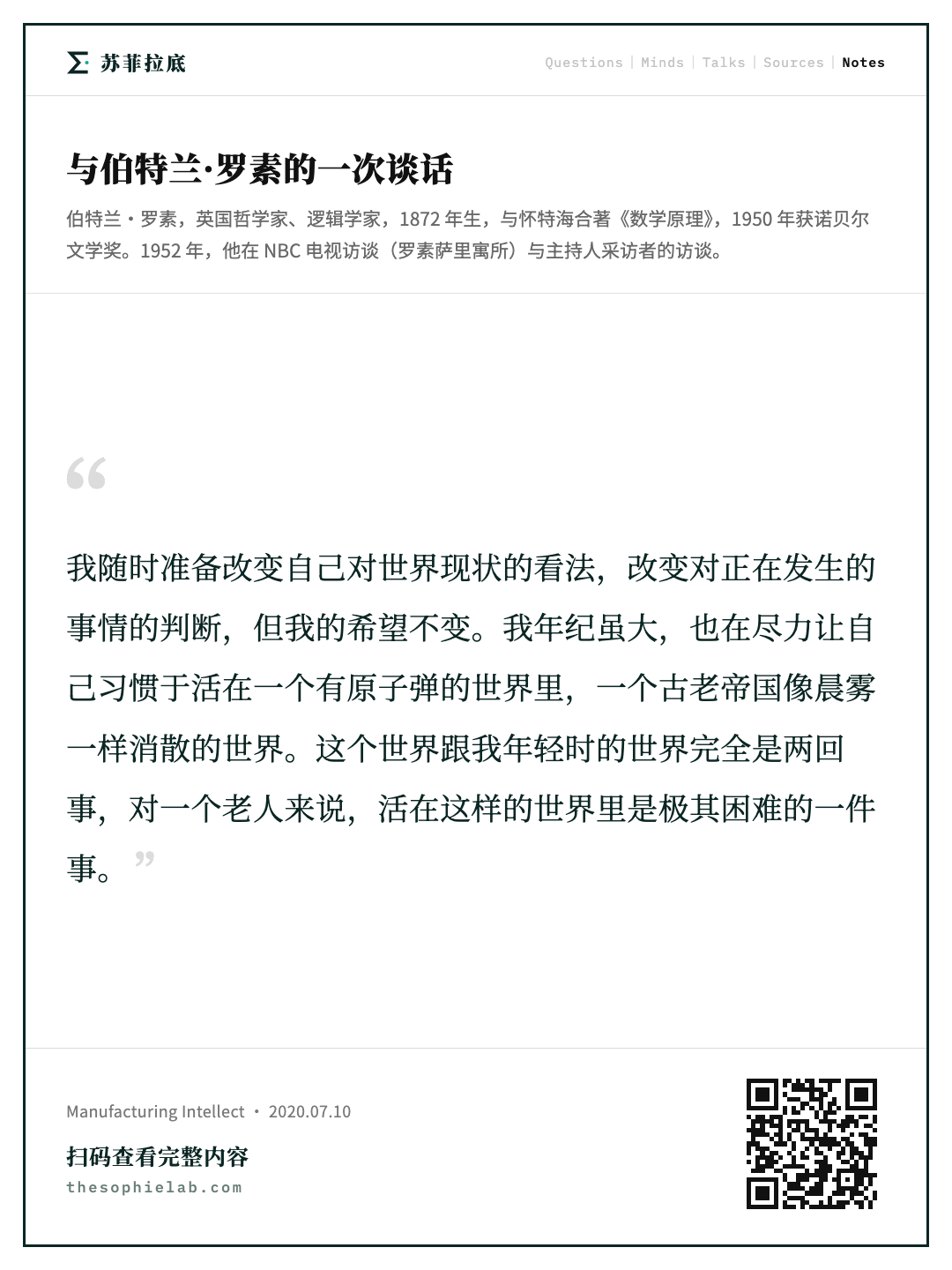
About that, I hope to remain constant. I think we might call the subject of our talk, 80 years of changing beliefs and unchanging hopes. It's very difficult for anybody born since 1914 to realize how profoundly different the world is now from what it was when I was a child. The change has been almost unbelievable. I try as best I can, in spite of my years, to get used to living in a world of atom bombs. A world where ancient empires vanish like morning mist, where we have to accustom ourselves to Asiatic self-procession, the Communist menace.
在这一点上,我希望自己始终如一。我想我们这次谈话的主题可以叫做:八十年来不断改变的信念与始终不变的希望。对任何1914年之后出生的人来说,都很难体会到今天的世界与我童年时的世界有多么天差地别。这种变化几乎令人难以置信。尽管上了年纪,我还是尽我所能去适应生活在一个有原子弹的世界里。在这个世界上,古老的帝国像晨雾一样消散,我们不得不适应亚洲的自主进程、共产主义的威胁。
便签笔记
03祖父罗素勋爵与1832年改革法案
2:17
The world is altogether, so different from what it was when I was young, that it's an extraordinarily difficult thing for an old man to live in such a world. I was born in 1872-- my parents died when I was still an infant, and so I was brought up by my grandparents. INTERVIEWER: Can you tell us something about your grandfather? BERTRAND RUSSELL: Yes, I can tell you something about my grandfather. He was born in the early years of the French Revolution. He was a member of parliament while Napoleon was still on the throne.
总而言之,这个世界与我年轻时太不一样了,对一个老人来说,生活在这样的世界里是极其困难的事。我出生于1872年——我还是婴儿时父母就去世了,所以我是由祖父母抚养长大的。采访者:您能给我们讲讲您祖父的事吗?伯特兰·罗素:好的,我可以讲讲我的祖父。他出生在法国大革命初期。拿破仑还在位的时候,他就已经是国会议员了。
便签笔记
3:00
In common with all the Whig followers of Fox, he thought English hostility to Napoleon was excessive. And he visited Napoleon in Elba.
和所有追随福克斯的辉格党人一样,他认为英国对拿破仑的敌意过头了。他还去厄尔巴岛拜访过拿破仑。
便签笔记
04维多利亚时代对秩序进步的笃信
3:15
It was he who introduced the reform bill in 1832, which started England on the road towards democracy. He was prime minister during your Mexican War, during the revolutions of 1848. I remember him quite well-- but as you can see, he belonged to an age that now seems rather removed. And the world where I was young was a sullied world-- a world where all kinds of things-- that have now disappeared-- were thought to going to last forever. It didn't dawn on people that they would cease. English people certainly regarded English naval supremacy as a sort of law of nature.
1832年正是他提出了改革法案,让英国走上了通向民主的道路。在你们的墨西哥战争期间,以及1848年的革命期间,他担任首相。我对他记得相当清楚——但如你所见,他属于一个如今看来相当遥远的时代。我年轻时的那个世界是个污浊的世界——在那个世界里,各种如今已经消失的东西——都被认为会永远存在下去。人们根本想不到它们会终结。英国人当然把英国的海上霸权看作某种自然法则。
便签笔记
4:05
Britannia ruled the waves-- it didn't occur to us that might-- INTERVIEWER: Even with this Bismark? BERTRAND RUSSELL: Bismarck was regarded as a rascal, and was thought of as a sort of uneducated farmer. But it was assumed that the influence of Goethe and Schiller would gradually bring Germany back to a more civilized point of view. And moreover, we thought of Germany as only a land power. Germany had, at that time, no Navy. We weren't at all afraid of Germany. In fact, numerable opinion was more favorable to Germany than to France at that time.
不列颠统治海洋——我们从没想过会有什么——采访者:连俾斯麦也不在话下?伯特兰·罗素:俾斯麦被看作一个无赖,被当成某种没受过教育的农夫。但大家认为歌德和席勒的影响会逐渐把德国带回到更文明的立场上来。而且,我们把德国只看作一个陆上强国。德国那时候没有海军。我们一点儿也不怕德国。事实上,那时候舆论对德国比对法国更有好感。
便签笔记
4:46
And Germany-- Bismarck himself compared Germany and England to an elephant and a whale-- each formidable in it's own element, but no danger to each other. And that was how we felt-- so we were not afraid of Bismark at all. It was thought that there was going to be ordered to progress throughout the world. Gradually, every country was going to take to Parliament-- there was going to be a bicameral legislature and two parties, and it was all going to be exactly like England everywhere-- all over the world.
而德国——俾斯麦本人把德国和英国比作大象和鲸鱼——各自在自己的领域里都很强大,但彼此并不构成威胁。我们当时就是这么想的——所以我们根本不怕俾斯麦。当时人们认为,全世界都将走向有序的进步。每个国家都会逐渐采用议会制——会有两院制的立法机构和两个政党,一切都会跟英国一模一样——全世界都是如此。
便签笔记
05八名仆人下的清教式简朴童年
5:20
My grandmother used to laugh, because one time he said to the Russian ambassador, perhaps some day, you will have a parliament in Russia. And he said, God forbid my dear lady Russel. Except for the first word, the Russian ambassador, at the present day, might give the same answer. But that was the assumption-- that it was all going to be orderly, and all quite nice. The atmosphere, apart from politics, it was one of Puritan piety-- very great piety, very great austerity. We always had family prayers at eight, and before family prayers, I had to do half an hour's practice at the piano-- which I hated.
我祖母以前常笑,因为有一次他对俄国大使说,也许有一天,你们俄国也会有议会。大使说,上帝保佑千万别,我亲爱的罗素夫人。除了第一个词以外,今天的俄国大使可能还会给出同样的回答。但当时的假设就是这样——一切都会有条不紊,一切都会相当美好。除政治之外,那种氛围是清教徒式的虔诚——极其虔诚,极其克己。我们总是八点做家庭祷告,在家庭祷告之前,我得练半小时钢琴——我讨厌死了。
便签笔记
6:11
Although there were eight servants in the house, the food was always of the utmost simplicity. And even of what there was, if there was anything at all nice, I wasn't allowed to have it, because it wasn't good for children to eat nice things. For instance, there would be rice pudding and apple tart-- the grownups had the apple tart, and I had the rice pudding. And there was extreme austerity in all those ways. My grandmother, until she was over 70, would never sit-in an arm chair until after dinner-- never.
尽管家里有八个仆人,饭菜却总是极其简单。而且就是有的那点东西,如果有什么稍微好吃一点的,也不许我吃,因为小孩吃好东西不好。比如说,会有米布丁和苹果馅饼——大人吃苹果馅饼,我吃米布丁。在所有这些方面都极端节制。我祖母直到七十多岁,晚饭前从不坐扶手椅——从来不坐。
便签笔记
06十八岁进剑桥终于遇到同类
6:46
It's almost gone out-- that sort of austere living by well to do people, which in those days was fairly common. INTERVIEWER: When did you get to Cambridge? BERTRAND RUSSELL: Oh, I got to Cambridge when I was 18. And that, of course, was a new world to me completely. I, for the first time, met people who, when I said anything that I really thought, he didn't think it absurd. I'd learned to tell them to say almost nothing about what I really thought. People had a horror of philosophy, which interested me.
那种富裕人家的清苦生活几乎已经绝迹了,而在那个年代还相当普遍。采访者:您什么时候进的剑桥?伯特兰·罗素:哦,我十八岁那年进的剑桥。那对我来说当然是个全新的世界。我第一次遇到这样的人:我说出自己真实想法的时候,他不觉得那很荒唐。我早就学会了对他们几乎绝口不提自己真正的想法。人们对哲学怀有一种恐惧,而哲学正是我感兴趣的。
便签笔记
7:25
And they would say, every time philosophy was mentioned, philosophy is summed up completely in these two questions-- what is matter? Never mind. What is mind? No matter. And at about the sixtieth repetition of this remark, I ceased to be amused by it. When I got to Cambridge, it was a great comfort to me to find people who didn't regard philosophy as absurd. So I was very, very happy when I first got to Cambridge. I quickly got to know a great many people who became my lifelong friends. Most of them, I'm sorry to say, are dead now, but those who are still alive are still my friends.
每次提到哲学,他们就会说,哲学完全可以归结为这两个问题——什么是物质(matter)?不要紧(never mind)。什么是心灵(mind)?无所谓(no matter)。这句话大概重复到第六十遍的时候,我就再也觉得不好笑了。我到了剑桥,发现有人不把哲学当作荒唐事,这对我是极大的安慰。所以刚到剑桥的时候,我非常非常快乐。我很快就认识了许多人,他们成了我一辈子的朋友。很遗憾,他们大多数如今都不在了,但还在世的仍然是我的朋友。
便签笔记
07从数学转向哲学的两个动机
8:10
INTERVIEWER: You started with mathematics, didn't you-- and then moved to philosophy? BERTRAND RUSSELL: That is so, yes. I did three years mathematics and one year's philosophy at Cambridge. I had only done mathematics before going to Cambridge. INTERVIEWER: What caused your interest in philosophy? BERTRAND RUSSELL: Well, two things-- two very different things caused my interest in philosophy. On the one hand, I wanted to understand the principles of mathematics. I observed that all the proofs of mathematical propositions that were taught me were obviously fallacious-- they didn't really prove what they said they did.
采访者:您是从数学开始的,对吧——然后转向了哲学?伯特兰·罗素:是这样,没错。我在剑桥读了三年数学,一年哲学。去剑桥之前我只学过数学。采访者:是什么引起了您对哲学的兴趣?伯特兰·罗素:嗯,有两件事——两件截然不同的事引起了我对哲学的兴趣。一方面,我想理解数学的原理。我发现别人教给我的那些数学命题的证明显然都是谬误的——它们并没有真正证明它们声称证明的东西。
便签笔记
8:57
And I wanted to know whether there is any truth in the world to teach now. And I thought if there is any, it's probably in mathematics. But it's not in mathematics as I was taught it. And so I tried to find out some truth there. The other thing that made me interested in philosophy was the hope that I might find some basis for religious belief. INTERVIEWER: And did you find it? BERTRAND RUSSELL: No, in the mathematical part, I hope, I was fairly satisfied. But in the other part, no, not at all. For a time I found a certain satisfaction in the platonic eternal world of ideas, which has a sort of religious flavor and gave me a certain satisfaction.
我想知道当时所教的东西里到底有没有什么真理。我想,如果有的话,多半在数学里。但不在我被教的那种数学里。所以我试着在那里面找出一些真理来。另一件使我对哲学产生兴趣的事,是希望能为宗教信仰找到某种根据。采访者:那您找到了吗?伯特兰·罗素:没有。在数学那部分,我想,我还算相当满意。但在另一部分,没有,完全没有。有一段时间,我在柏拉图式的永恒理念世界里找到了某种满足,那多少带点宗教意味,给了我一定的满足感。
便签笔记
08一生的分歧:一战反战立场
9:44
But then I came to the conclusion that that was nonsense. And I was left without any satisfaction to that-- except of my desires to remain so. So it-- as far as that goes, philosophy proved washed out to me. But not on the side of technical basis mathematics. INTERVIEWER: Wasn't it about here that you entered into what you called a life of disagreements? BERTRAND RUSSELL: Yes. I disagreed, firstly, with my people about both mathematics and about philosophy. They cared only about virtue-- they thought virtue was the only thing of importance in the world.
但后来我得出结论,那是胡说八道。于是我在那方面就再没有任何满足了——除了我那些欲望仍然存在。所以就这一点而言,哲学对我来说是彻底落空了。但在技术性的数学基础那一面并非如此。采访者:您所说的“充满分歧的一生”,不就是差不多从这时候开始的吗?伯特兰·罗素:是的。首先,我在数学和哲学两件事上都跟家里人有分歧。他们只在乎德行——他们认为德行是世上唯一重要的东西。
便签笔记
10:25
Mathematics therefore, was unimportant because it has no ethical content, and philosophy was positively pernicious because they thought it undermined virtue. So on that point, I had a strong disagreement with my people. But as regards to that, of course, that disagreement was, as far as my personal life was concerned, was solved by my living among academic people who didn't take that view-- so that I got again into a circle of people with whom I was quite at home. But that was brought to an end by the first war, where I took a pacifist line-- I was against the first war.
因此数学不重要,因为它没有伦理内容,而哲学则绝对有害,因为他们认为哲学会腐蚀德行。所以在那一点上,我跟家里人有很强烈的分歧。不过就那件事而言,当然,就我个人生活来说,那种分歧靠着我生活在不这么看问题的学界人士当中而化解了——所以我又进入了一个让我感到自在的人际圈子。但这一切被第一次世界大战终结了,我在战争中采取了和平主义立场——我反对第一次世界大战。
便签笔记
11:10
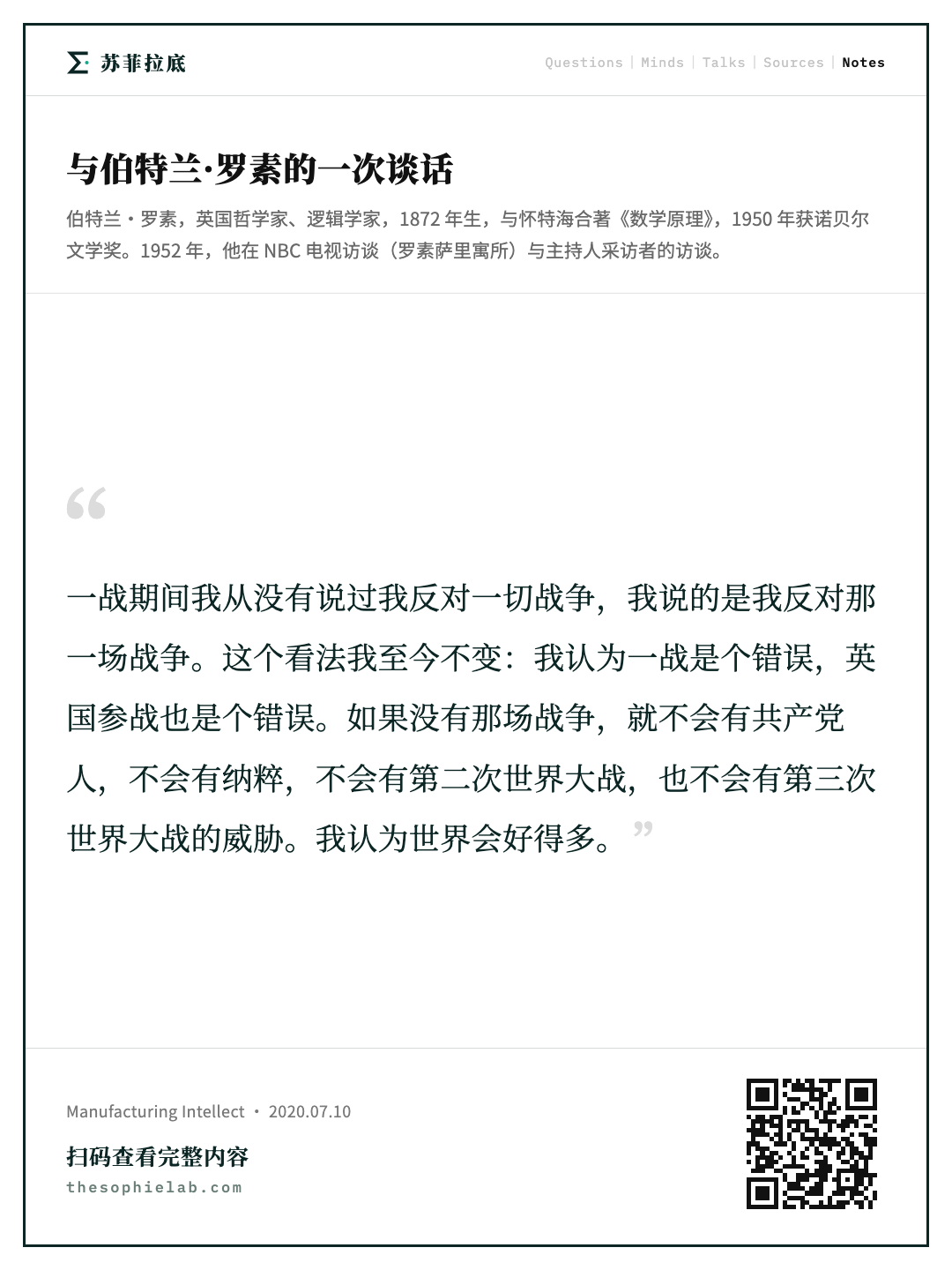
I was not against the second-- some people think that this is an inconsistency, but it isn't. I never during the first war, said that I was against all war, I said I was against that war. And I still hold that view-- I think that the first war was a mistake, and I think England's participation in it was a mistake. I think if that hadn't happened, you would not have had the communists, you would not have had the Nazis. You would of not had the Second World War, you would not had the threat of a third.
我并不反对第二次——有人认为这是前后矛盾,但并不是。第一次大战期间我从没说过我反对一切战争,我说的是我反对那场战争。我至今仍持这个看法——我认为第一次世界大战是个错误,我认为英国参战也是个错误。我认为如果那件事没有发生,就不会有共产党人,就不会有纳粹。就不会有第二次世界大战,也不会有第三次世界大战的威胁。
便签笔记
091920年访苏与在中国的一年
11:46
The world would have been a very much better place, I think. Germany in the time of the Kaiser was not uncivilized. There was a certain amount of suppression of opinion, but less than there now is-- everywhere except in England and Scandinavia. So it really wasn't very bad. For propaganda purposes, the Kaiser's government was presented as dreadful, but that was only talk-- it was really true. INTERVIEWER: Your opinions today in regard to Russia are not altogether friendly. Did you always feel that way about the Bolsheviks?
我想,这个世界本来会好得多。德皇时代的德国并非不文明。那里对言论有一定程度的压制,但比现在少——除了英国和斯堪的纳维亚之外,哪儿都是如此。所以其实并不算太糟。出于宣传的需要,德皇政府被描绘得很可怕,但那不过是说说而已——并非真的如此。采访者:您今天对俄国的看法并不算友好。您对布尔什维克一向都是这种感觉吗?
便签笔记
12:23
BERTRAND RUSSELL: Yes. And that caused another violent disagreement. Into my pacifism during the first war, I became estranged from what you might call conventional people. And then I went to Russia in 1920 and found that I abominated the Soviet government-- thought they were dreadful people-- dreadful people already, and becoming more so, and sure to go on becoming more so. And so then I had to break with all the people who endured my pacifism-- who all liked Russia, or thought they did. So I was left in a very great isolation at that time.
伯特兰·罗素:是的。这又引起了另一场激烈的分歧。第一次大战期间我持和平主义立场,因而与所谓的传统人士疏远了。后来我在1920年去了俄国,发现自己极其厌恶苏维埃政府——认为他们是些可怕的人——当时就已经很可怕了,而且越来越可怕,并且肯定会继续变本加厉。于是我又不得不跟所有容忍我的和平主义的人决裂——他们全都喜欢俄国,或者自以为喜欢。所以那时候我陷入了极大的孤立。
便签笔记
13:10
However, I escaped some of the pain of it by going to China where I spent a very happy year-- I liked the Chinese very much. And there I found people that I could agree with, that I could like. INTERVIEWER: Any conclusions about China? BERTRAND RUSSELL: Oh, I don't know about conclusions. I don't think I came to any particular conclusions. I continue to think, as I had thought before, that democracy is the best form of government where it will work. It didn't work very well in China-- it wasn't working at all.
不过我去中国躲开了其中一些痛苦,在那里度过了非常愉快的一年——我很喜欢中国人。在那里我找到了能与之意见相合、能让我喜欢的人。采访者:对中国有什么结论吗?伯特兰·罗素:哦,谈不上什么结论。我想我并没有得出什么特别的结论。我还是像从前一样认为,凡是行得通的地方,民主是最好的政体。在中国它运作得不太好——根本没有运作起来。
便签笔记
10自办学校与对进步教育的批评
13:52
And one could see that it wouldn't work there. They hadn't the political experience. But I thought it would work there in time, and I dare say it would have done if circumstances had been a little more propitious. INTERVIEWER: On your return, the focus of your interests changed, didn't it? BERTRAND RUSSELL: Yes. Going to the birth of my two elder children, I became very much interested in education. And at first, especially in education in the very early years, I didn't like the old fashioned schools for a number of reasons.
可以看得出来,它在那里行不通。他们没有政治经验。但我认为假以时日它在那里是行得通的,而且我敢说,要是情况稍微有利一些,它本来是可以做到的。采访者:您回国之后,兴趣的重心变了,是吗?伯特兰·罗素:是的。随着我两个大孩子的出生,我对教育产生了浓厚的兴趣。起初尤其关注幼年阶段的教育,出于种种原因,我不喜欢那种老派的学校。
便签笔记
14:37
I didn't altogether like the progressive schools, though in some respects I thought them much better than the older ones. But some things about progressive schools, at least about most progressive schools, that I didn't feel right-- I thought they didn't pay enough attention to instruction. It seems to me that in our technically complex world, you can't play any important part unless you have a very considerable amount of actual knowledge. And I don't think that most children will acquire much knowledge unless there is a certain amount of discipline in school.
我也并不完全喜欢进步学校,尽管在某些方面我认为它们比老式学校好得多。但进步学校的有些做法,至少大多数进步学校的做法,让我觉得不对劲——我认为它们对教学不够重视。在我看来,在我们这个技术上高度复杂的世界里,一个人若没有相当可观的实际知识,就无法扮演任何重要的角色。而且我认为,如果学校里没有一定程度的纪律,大多数孩子是学不到多少知识的。
便签笔记
15:20
I think that the real discipline required for acquiring knowledge ought to be insisted upon-- and isn't sufficiently insisted upon in a good many modern schools that I know. INTERVIEWER: Did you change any of your opinions in that regard? BERTRAND RUSSELL: Well, I suppose to some degree. I tried running a school of my own, because I wasn't satisfied with other schools. I haven't the talents of an administrator, and I wasn't satisfied with the school that I tried to run. Fortunately, it was just about that time a certain modern school that I was interested in became, I thought, quite good enough-- and I was satisfied with that.
我认为,获取知识所必需的那种真正的纪律,应该被严格要求——而据我所知,在相当多的现代学校里,这一点并没有被足够地强调。采访者:在这方面,您有没有改变过自己的看法?伯特兰·罗素:嗯,我想在某种程度上是有的。我曾经试着自己办过一所学校,因为我对别的学校不满意。我没有做管理者的才能,而且我对自己试着办的那所学校也不满意。幸运的是,大约就在那个时候,我所关注的某一所现代学校变得——在我看来——相当不错了,我对它感到满意。
便签笔记
16:05
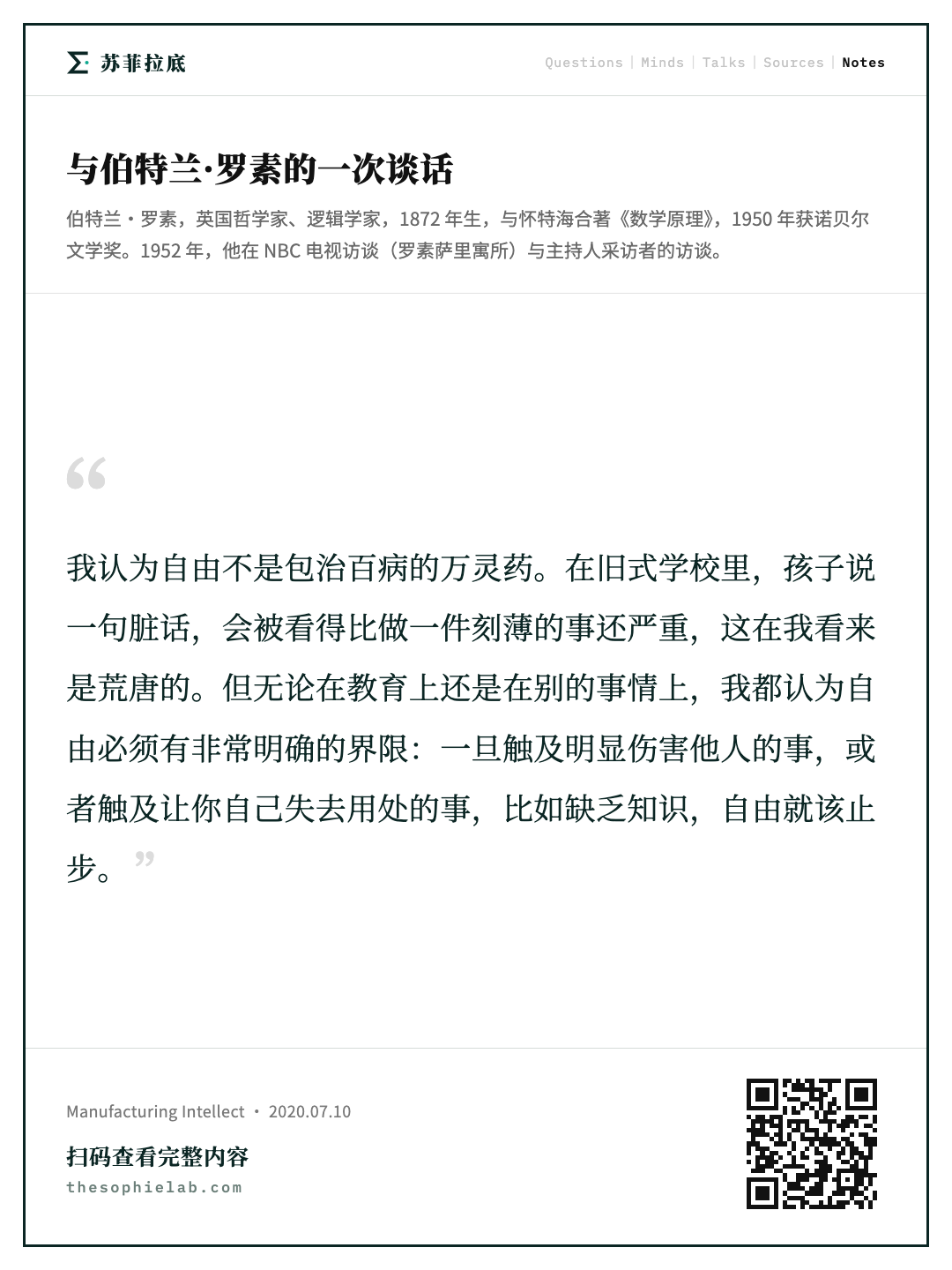
I have, I suppose, changed my opinions-- not only about education, but about a good many things-- as a result of seeing the kind of nefarious things that people do. I think that freedom is not a panacea for all things. I think there are a good many matters in which freedom should be restrained. Some of them things in which it's not sufficiently restrained at present-- in the relations between nations, there ought to be less freedom than there is, I think. And to some degree, this applies in modern education too.
我想我确实改变了一些看法——不只是关于教育,还有很多别的事情——那是因为我看到了人们所做的那些恶劣的勾当。我认为自由并不是包治百病的灵丹妙药。我认为有相当多的事情,自由应当受到约束。其中有些事情目前受到的约束还不够——比如在国与国的关系上,我认为应该比现在有更少的自由。在某种程度上,这一点也适用于现代教育。
便签笔记
16:47
I think that some progressive schools certainly have more freedom than you ought to have. There are some freedoms that I think very desirable in education. Now, in the old fashioned school, if a child uses a swear word, it's thought worse than if he commits an unkind action-- and that seems to me absurd. I think that clearly, the unkind action matters more. In that sort of way, I don't like the old fashioned way. I also think that children should be free to explore the facts of life to a degree that they're not when they're brought up in an old fashioned way.
我认为有些进步主义学校给予的自由,确实超出了应有的限度。当然,也有一些自由,我认为在教育中是非常可取的。比如说,在老式的学校里,如果一个孩子说了句脏话,人们会觉得这比他做了一件不厚道的事还要糟糕——在我看来这很荒谬。我认为很显然,那件不厚道的事更要紧。就这类事情而言,我不喜欢老式的做法。我还认为,孩子们应当有自由去了解生活的实情,其程度要超过他们在老式教养方式下所能获得的。
便签笔记
11清晰思考的价值与哲学的局限
17:26
I think there should be free speech-- there are a number of things that I like very much about modern education. But both in education and in other matters, I think that freedom must have very definite limitations-- where you come to things that are definitely harmful to other people, or things that prevent you yourself from being useful, such as lack of knowledge. So there are those respects in which I suppose, I should lay less stress on freedom than in former times. INTERVIEWER: Do you still believe in the importance of abstract philosophy?
我认为应该有言论自由——现代教育里有不少东西是我非常喜欢的。但无论在教育上还是在其他事情上,我认为自由必须有非常明确的界限——当涉及那些明显有害于他人的事情,或者那些使你自己无法变得有用的事情,比如缺乏知识。所以在这些方面,我想我对自由的强调应该比从前少一些。采访者:您现在还相信抽象哲学的重要性吗?
便签笔记
18:05
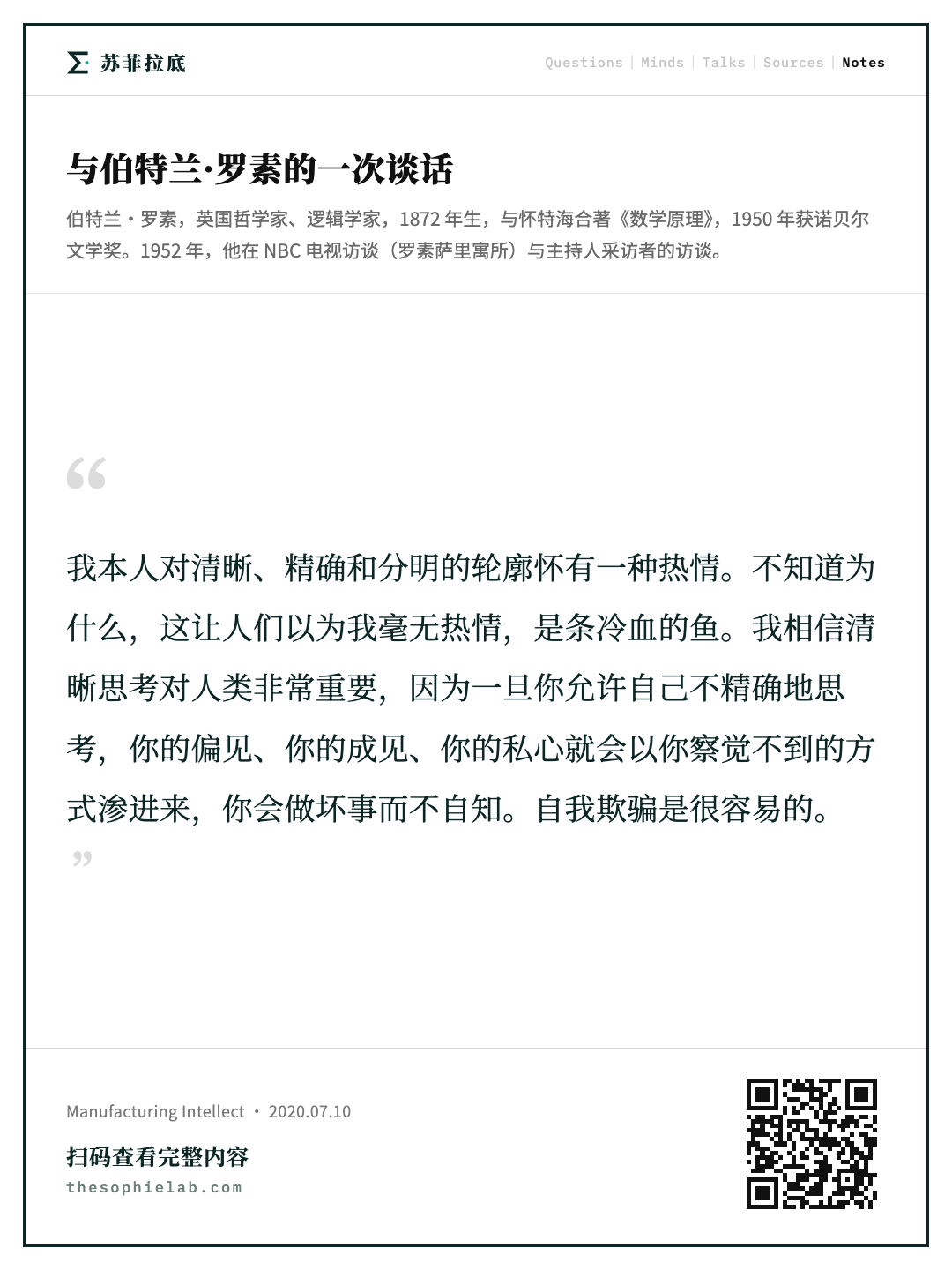
BERTRAND RUSSELL: Well, now that's a very difficult question. I have myself a passion for clarity, and exactness, and sharp outlines. For some reason that I've never understood, this makes people think that I have no passions, that I'm a cold fish. I don't know why, but it does cause people to think that. I don't think that's altogether together just. So that's neither here nor there. But I do like clarity and exact thinking. And I believe that very important to mankind because when you allow yourself to think inexactly, your prejudices, your bias, your self-intuition comes in in ways you don't notice, and you do bad things without knowing that you're doing them-- self-deception is very easy.
伯特兰·罗素:嗯,这是个很难回答的问题。我本人对清晰、精确和鲜明的轮廓有一种热情。出于某种我从来不明白的原因,这让人们觉得我没有热情,觉得我是个冷冰冰的人。我不知道为什么,但这确实让人们那么想。我并不认为这完全公平。不过这无关紧要。但我确实喜欢清晰和精确的思考。而且我相信这对人类非常重要,因为当你允许自己思考得不精确时,你的偏见、你的成见、你的自以为是就会以你察觉不到的方式渗进来,你会在不知不觉中做出坏事——自欺是非常容易的。
便签笔记
18:56
So that I do think clear thinking immensely important. But I don't think philosophy, in the old fashioned sense, is quite the thing the world needs nowadays. I think the needs of the world are different from that. INTERVIEWER: Well, just what do you feel today's needs are? BERTRAND RUSSELL: Well, of course, the needs depend on what the person's capacities are. But if I were now, at this moment, a young man-- whether in England or in America-- I should not take to philosophy, I should think there were other things better to take too.
所以我确实认为清晰的思考极其重要。但我不认为老式意义上的哲学,正是当今世界所需要的东西。我认为世界的需要与此不同。采访者:那么,您觉得今天的需要究竟是什么?伯特兰·罗素:嗯,当然,需要取决于一个人的才能是什么。但如果我此时此刻是个年轻人——不论在英国还是在美国——我都不会去搞哲学,我会觉得还有别的更值得去做的事情。
便签笔记
12世界政府、经济平等与人口停滞
19:41
If I had the necessary capacity, I think I would be a physicist. If my capacities didn't run in that direction, I should think that history, psychology-- mass psychology, especially-- theory of politics, things of that sort are much better worth working at than pure philosophy. And it's that sort of thing that I should take too now if I were now young. INTERVIEWER: Lord Russell, what do you think the world needs to reach a happier state? BERTRAND RUSSELL: Well, I think there are three things that are needed if the world is to adapt itself to the Industrial Revolution.
如果我具备必要的才能,我想我会去当物理学家。如果我的才能不在那个方向上,我会觉得历史、心理学——尤其是群体心理学——政治理论,诸如此类的东西,远比纯粹哲学更值得去钻研。如果我现在还年轻,我会去做的正是那类事情。采访者:罗素勋爵,您认为世界要达到一种更幸福的状态,需要些什么?伯特兰·罗素:嗯,我认为如果世界要适应工业革命,有三件事是必需的。
便签笔记
20:25
The troubles we are suffering now, are essentially troubles due to adapting ourselves to a new phase of human life-- namely the industrial phase. And I think three things are necessary if people are to live happily in the industrial phase-- one of these is world government. The second is an approximate economic equality between different parts of the world. And the third is a nearly stationary population. I'd like to say a little about each of those. As to world government, the world government should be, of course, a federal government-- leaving a very great deal of freedom to the individual national governments.
我们现在所遭受的种种困扰,本质上是由于我们要适应人类生活的一个新阶段——也就是工业阶段——而产生的困扰。我认为,人们要想在工业阶段幸福地生活,有三件事是必要的——其中之一是世界政府。第二是世界各地之间大致的经济平等。第三是近乎静止的人口。这几点我都想稍微谈一谈。关于世界政府,这个世界政府当然应该是一个联邦制政府——把很大一部分自由留给各个国家自己的政府。
便签笔记
21:22
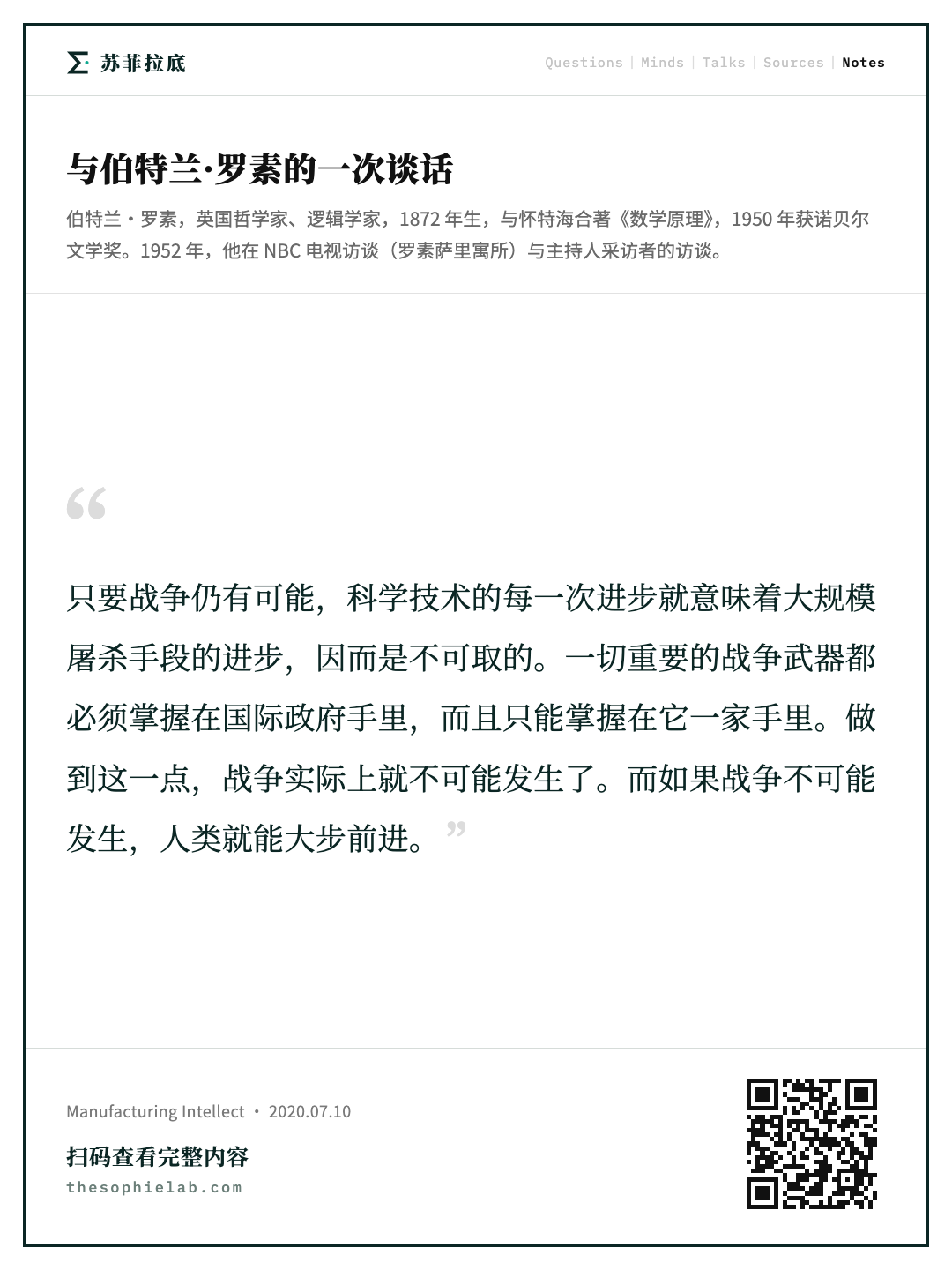
And only those things controlled by the world government, which are absolutely necessary for the avoidance of war. The most important, and the most difficult of these, is armed forces. All the important weapons of war will have to be in the hands of the international government, and of it alone. When that happens, war will become practically impossible. And if war were impossible, mankind could go ahead. If war is not impossible, every advance in scientific technique means an advance in mass murder, and is therefore undesirable.
只有那些为避免战争所绝对必需的事情,才由世界政府来管。其中最重要、也最困难的,就是武装力量。所有重要的战争武器都必须掌握在这个国际政府手中,而且只能掌握在它手中。一旦做到这一点,战争就实际上不可能发生了。如果战争不可能发生,人类就能够向前发展。如果战争仍然可能发生,那么科学技术的每一次进步都意味着大规模屠杀的进步,因此是不可取的。
便签笔记
22:05
But if, once world peace were achieved, it would be just the opposite-- that's the first point. Now, I come on to the question of approximate economic equality. As things stand at the present, Western Europe, and still more the United States of America, have a higher standard of life. On the whole, the great majority of mankind live fairly comfortably from a material point of view. Asia, on the other hand, lives in very, very grave poverty-- so does most of Africa. And the moment people are sufficiently educated to be aware of these facts, the inevitable result is a great development of envy in the poorer parts of the world.
但一旦实现了世界和平,情况就正好相反了——这是第一点。现在我来谈谈大致的经济平等这个问题。就目前的情形而言,西欧、尤其是美国,享有更高的生活水平。总体上说,那里的绝大多数人从物质角度看过得相当舒适。而另一方面,亚洲生活在非常非常严重的贫困之中——非洲大部分地区也是如此。一旦人们受到足够的教育、意识到这些事实,必然的结果就是世界较贫穷地区滋生出强烈的嫉妒。
便签笔记
23:00
That envy is a cause of unrest, and inevitably makes world peace precarious. There's only one way of dealing with it, which is to produce approximate economic equality-- of course, it's a long story but it can be done. The third point about population is very vital indeed. The food supply of the world-- it tends at present to diminish through the [INAUDIBLE] of soil. It tends, of course, also to increase through various technical advances. But those two are not balanced, so that on the whole, the food produced of the world does not increase appreciably.
这种嫉妒是动荡的根源,也不可避免地使世界和平变得岌岌可危。应对它只有一个办法,那就是造就大致的经济平等——当然,这是个漫长的过程,但是可以做到的。第三点关于人口的问题,确实极其关键。世界的粮食供应——目前由于土壤的[听不清]而趋于减少。当然,它也由于各种技术进步而趋于增加。但这两者并不平衡,所以总体上,世界生产的粮食并没有明显增加。
便签笔记
13亚洲要求平等与白人必须让步
23:46
Now, that means that unless everybody is to be very poor-- especially if you have economic equality-- unless everybody is to be very poor, there must be not more people to be fed-- not many more than there are now. And therefore, you've got to get approximate economic equality-- approximate proximity equality of population-- and approximately stationary population. Otherwise, those parts of the world where the population increases fast will want to go to war with those where it increases slowly. INTERVIEWER: That brings us precisely to the problem of Asia, and what part Asia will play in the immediate future.
这就意味着,除非人人都要过得非常穷——尤其是在实行经济平等的情况下——除非人人都要过得非常穷,否则需要养活的人口就不能再多了——不能比现在多出太多。因此,你必须实现大致的经济平等——大致的人口平衡——以及大致静止的人口。否则,那些人口增长快的地区就会想要同人口增长慢的地区开战。采访者:这恰好把我们引向亚洲的问题,以及亚洲在不久的将来会扮演什么角色。
便签笔记
24:29
BERTRAND RUSSELL: Well, Asia, first of all, has risen to the point of education-- some Asians have-- where it is not prepared any longer to be subservient to the white man. It hasn't noticed that Russians are white. If it had, it would take a different line. But it seems to think that Russians are yellow, or black, or some other color. And I think our propaganda ought to be mainly devoted to saying only, Russians also are white. I believe that would be the effective propaganda to use in Asia-- but I'll pass that point by.
伯特兰·罗素:嗯,首先,亚洲——至少有一部分亚洲人——在教育上已经上升到这样一个程度:它不再准备屈从于白人了。它似乎没有注意到俄国人也是白人。如果它注意到了,态度就会不一样。但它好像认为俄国人是黄色的、黑色的,或者别的什么颜色。我认为我们的宣传主要应当致力于说明一点:俄国人也是白人。我相信这会是在亚洲行之有效的宣传——不过这一点我就先放下不谈了。
便签笔记
25:11
Asia, clearly, is going to claim equality with the white man. And it's perfectly futile-- absolutely futile-- for the white man to resist that game. It will infallibly win-- infallibly. And we ought, therefore, to concede it graciously at once before we're driven to it-- to concede complete equality to Asia. But if Asia is not to overwhelm the rest of the world with a vast flood of population and poverty, Asia must live up to its responsibilities, and must learn the sort of things we have learned in the West, which is how to maintain a roughly stationary population.
很显然,亚洲将会要求与白人平等。而白人去抗拒这种局面是完全徒劳的——绝对徒劳的。它必定会赢——必定会。因此,我们应当在被迫之前就痛快地立刻让步——承认亚洲完全平等的地位。但如果亚洲不想以庞大的人口和贫困的洪流淹没世界其他地方,亚洲就必须担起自己的责任,必须学会我们在西方所学到的那类东西,也就是如何维持一个大致静止的人口。
便签笔记
14马克思的仇恨与善意驱动的哲学
25:58
And if they can't learn that, which I fully believe they can learn-- and learn quickly-- much more quickly than most people think-- if they can't learn that, they will not have won their claim to equality. INTERVIEWER: Lord Russell, speaking as of today, can you see the influence of any one philosopher more than any other one? BERTRAND RUSSELL: Well, I suppose in recent years, the most important influence has been Marx. If you would dignify him with the name of philosopher, I should hardly like to dignify him so myself, but I suppose he must count in the list.
如果他们学不会这一点——我完全相信他们学得会,而且学得很快——比大多数人想象的要快得多——如果他们学不会这一点,他们就没有真正赢得平等的资格。采访者:罗素勋爵,就今天而言,您能看出哪一位哲学家的影响力超过其他人吗?伯特兰·罗素:嗯,我想近些年来,最重要的影响来自马克思。如果你愿意抬举他、称他为哲学家的话——我自己是不太愿意这样抬举他的,但我想他总归得算在这个名单里。
便签笔记
26:34
And he certainly has had more influence than anybody else. INTERVIEWER: For those of us who reject Marx, can you offer any positive philosophy to help us toward a more hopeful future? BERTRAND RUSSELL: Well, that-- you see, I think one of the troubles of the world has been the habit of dogmatically believing something or other. And I think all these matters are full of doubt, and the rational man will not be too sure that he's right. I think we ought always to entertain our opinions with some measure of doubt.
而他的影响力确实超过了任何其他人。采访者:对于我们这些拒斥马克思的人,您能提供某种积极的哲学,帮助我们走向更有希望的未来吗?伯特兰·罗素:嗯,这个——你看,我认为这个世界的麻烦之一,就是人们习惯于教条地相信这样或那样的东西。而我认为所有这些问题都充满疑问,理性的人不会太确信自己是对的。我认为我们对待自己的观点,应该始终保留几分怀疑。
便签笔记
27:15
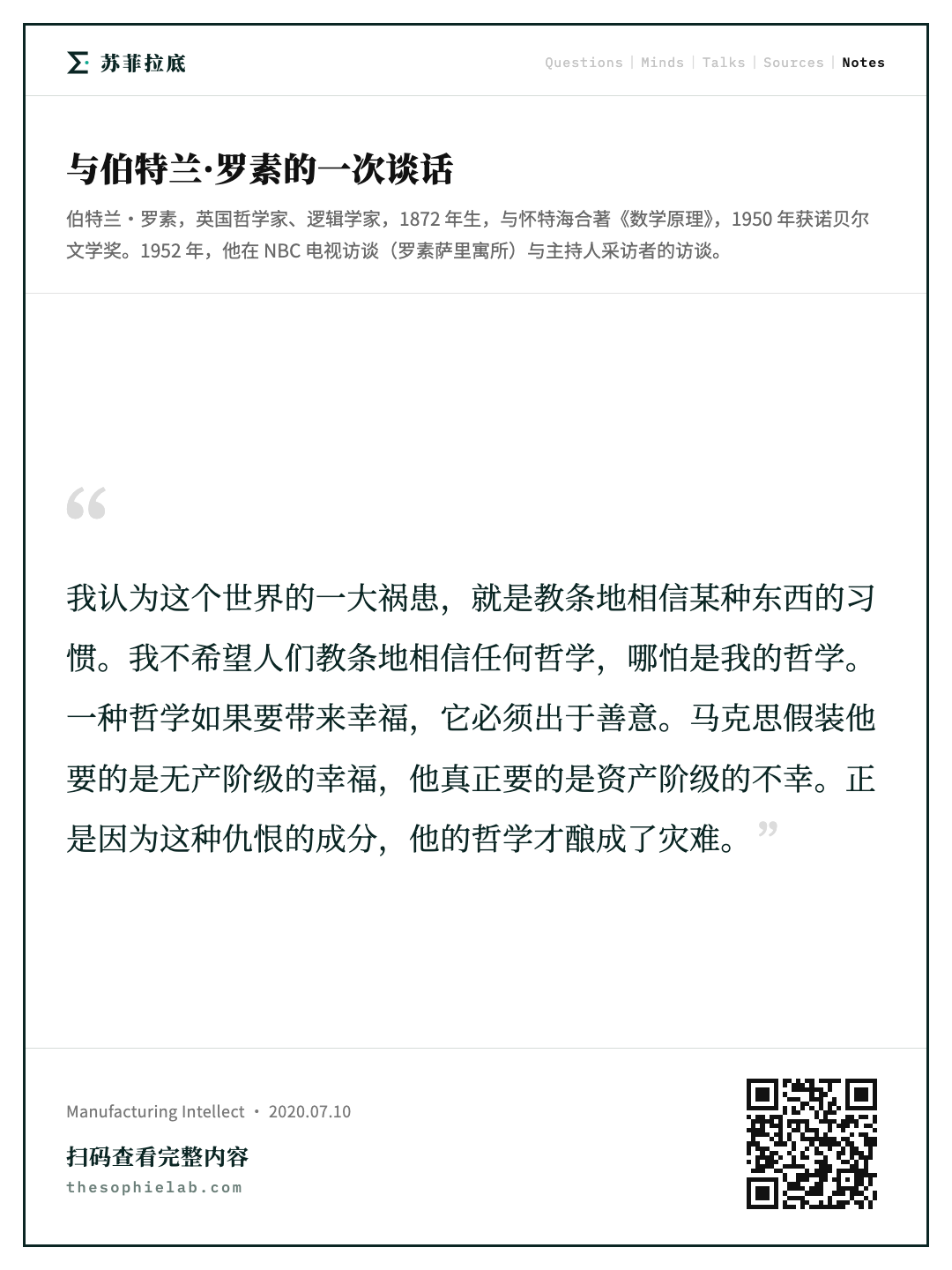
I shouldn't wish people dogmatically to believe any philosophy, not even mine-- not even mine. No. I think we should accept our philosophies with a measure of doubt. What I do think is this-- that if a philosophy is to bring happiness, it should be inspired by kindly feeling. Now, Marx is not inspired by a kindly feeling. Marx pretended that he wanted the happiness of the proletariat-- what he really wanted was the unhappiness of the Bourgeois. And it was because of that negative element, because of that hate element, that his philosophy produced disaster.
我不希望人们教条地相信任何哲学,哪怕是我的哲学——哪怕是我的。不。我认为我们应当以几分怀疑的态度来接受我们的哲学。但我确实这样认为——如果一种哲学要带来幸福,它就应该出自一种善意的情感。而马克思并不是出于善意的情感。马克思假装他想要无产阶级的幸福——他真正想要的其实是资产阶级的不幸。正是因为那种否定性的成分,因为那种仇恨的成分,他的哲学才带来了灾难。
便签笔记
15历经苦难人类终将走向更好世界
27:55
A philosophy which is to do good, must be one inspired by kindly feeling, and not by unkindly feeling. INTERVIEWER: Summing up, Lord Russell-- do you feel that there is hope for the world today? BERTRAND RUSSELL: Well, I do. I feel it very strongly. But how far that is really a rational conviction, and how far it's temperamental, I can't say. But I do most strongly feel that there is hope. There may be very dreadful times ahead of us-- I daresay there are. But I still believe-- I believe most firmly, that through whatever pain and suffering, mankind will emerge through these dreadful things, and will emerge into some world that will be happier than any world that has existed in the past.
一种要行善的哲学,必须是由善意的情感所激发的,而不是由不善的情感。采访者:总结一下,罗素勋爵——您觉得今天的世界还有希望吗?伯特兰·罗素:嗯,我觉得有。我非常强烈地这样感觉。但这在多大程度上真的是一种理性的信念,又在多大程度上只是性情使然,我说不好。但我确实非常强烈地感到,希望是存在的。前方也许会有非常可怕的时期——我敢说是会有的。但我依然相信——我最坚定地相信,无论经历怎样的痛苦与磨难,人类都将穿过这些可怕的事情,走进某个比过去任何世界都更幸福的世界。
便签笔记
28:46
I am firmly persuaded of that.
我对此深信不疑。
便签笔记

这期还没有生成总结。

这期还没有生成核心句型(制作精读 PDF 时会一并生成)。

这期还没有生成生词表(制作精读 PDF 时会一并生成)。

这期还没有生成自测题(制作精读 PDF 时会一并生成)。

精读便签
下载便签 手机:长按图片保存
← 上一期 · NO.058The Philosophy of Language - John Searle & Bryan Magee (1977) 下一期 · NO.060 →Descartes' Philosophy - Bernard Williams & Bryan Magee (1987)
问题周报 WEEKLY LEDGER 每周一封:本周入库的精读、一个值得带走的问题、一条苏菲按。随时退订。
免费 · 每周一封 · 一键退订
苏菲拉底 THE SOPHIE LAB · ASK THE BEST MINDS THE BIG QUESTIONS 内容仅供学习 · thesophielab.com