The Social Context of Philosophy - Ernest Gellner & Bryan Magee (1977) · 苏菲拉底
字幕 字幕位置
--:--
点击播放,这里会跟随视频显示当前句的中英字幕。

The Social Context of Philosophy - Ernest Gellner & Bryan Magee (1977)

节目发布 2022-04-09 · Philosophy Overdose
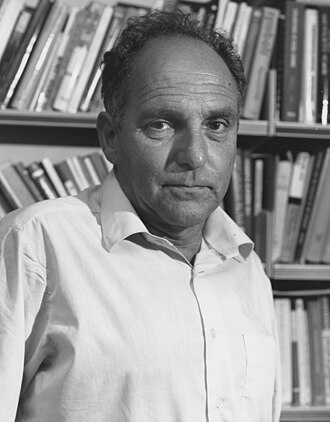
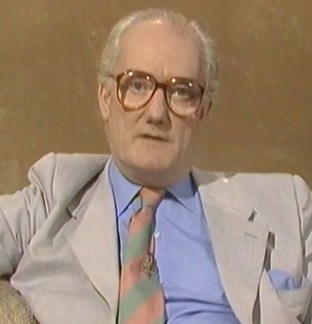
厄内斯特·盖尔纳 布莱恩·马基
EDITED TRANSCRIPT · 依据现场录音编译整理,可划线生成便签
编者按:本文是英国广播公司哲学访谈系列《思想者》(Men of Ideas)中的一期,录制于一九七七年。主持人布赖恩·马基是哲学作家、广播人及工党议员;对谈嘉宾欧内斯特·盖尔纳时任伦敦政治经济学院哲学教授(其教席全称为「特别关涉社会学的哲学教授」),后转任剑桥大学社会人类学教授,以《词与物》及对语言哲学的批判著称。两人在这次对谈中把现代西方哲学放回它的社会与历史语境中审视,追问知识问题何以成为三百年来的核心,并逐一评断马克思主义、相对主义、存在主义与后期维特根斯坦哲学。本文依据现场录音编译整理。

退后三步看现代哲学

马基:在这一期节目里,我们要把现代西方哲学各个流派的种种发展收拢起来,拼成一幅前后连贯的整体图景。可以说,我们要退后三步,从一定的距离上看清全貌。这就意味着把现代西方哲学放到现代西方社会的语境中去看,也意味着把它放到自身的历史中去看:弄清它的核心关切究竟为什么、又是怎样发展成今天这个样子,并由此判断我们眼下所处位置的突出特征是什么。在这个基础上,或许还可以对不远的将来会出现哪些发展做几句非正式的猜测。

哲学家所说的「现代哲学」(modern philosophy),指的是笛卡尔以来的哲学,笛卡尔活跃于十七世纪初。自那以后,哲学的发展构成了一个连续的传统,尽管头绪复杂,所以我们今天的哲学必须放在这个背景下考察。而在笛卡尔之前的几百年里,情形则截然不同。当时只有一种世界观,以基督教为基础,由政治权威强制推行,任何对它的公开质疑都在禁止之列,通常还会处以死刑。

同今天相比,那时人们的知识几乎是静止的,至少变化极其缓慢,而且人们对它抱有极大的确信,因为它的依据不是别的,正是上帝,或者上帝在人间的教会。直到文艺复兴和宗教改革之后,新科学才引人注目地冒出来并迅速成长,它带来的东西之一便是一种新的哲学。旧的确定性被掏空了,旧的权威也随之倒塌。于是一个问题以新的、尖锐的形式被提了出来:我们的知识主张如何才能得到验证?

这个问题至今没有解决。在很长一段时间里,人们以为科学能够提供绝对的确定性,但现在我们知道并非如此。为了在这样的历史与社会背景下讨论当代哲学,我请来了欧内斯特·盖尔纳,他既是职业哲学家,也是职业社会学家,他在伦敦政治经济学院的正式头衔就是「特别关涉社会学的哲学教授」。盖尔纳教授,在我看来,现代哲学,也就是当代哲学、二十世纪哲学,只有放在我刚才在开场白里粗略勾勒的那种历史与社会视角下才能真正得到理解,这一点是不言自明的。可我同样觉得不言自明的是,您的大多数同行,那些职业哲学家,对这个历史与社会的维度多少有点视而不见。您同意这个说法吗?

盖尔纳:同意。您的两个主要论点我都非常赞同,对其中一些附带的说法我或许有所保留,但两个核心论点在我看来完全正确。主要的那一点我想换个说法来表述:您所定义的现代哲学,也就是从笛卡尔、从十七世纪开始的哲学,本质上是对此后发生的社会与思想变迁的一种评注,虽然这种评注未必总是自觉的。只有从这样的动因出发,才能正确地理解它。与之相连的第二点我也认为是对的:清楚意识到这一点的人还远远不够。

知识问题为何成为核心

马基:这样看问题,有一件事就凸显出来了:为什么自笛卡尔以来,现代哲学的核心问题一直是知识问题。这个根本的问题就是,我们知道什么?或者说,我们真的知道任何东西吗,在绝对确定的意义上?如果知道,我们又是怎么知道自己知道的?这自始至终都是中心问题,是不是?

盖尔纳:这确实是中心。如果要给现代哲学下定义,而且只允许用一个特征、一种品性来定义它,我想人们会挑出的就是这一条,至少我会挑这一条:它对知识问题着了魔。要是您允许我用两个特征,我会再加一个,稍后会说到。但只允许一个的话,就是知识在思想中的核心地位。可以这样概括:在这个时期以前,知识是世上诸事物中的一件。它是重要的事物,但终归是一件事物,还有别的东西存在。知识是世界中的一个事件,重要的事件,但只是众多事件之一。而这个时期的思想的特点在于,它倾向于把这个关系倒转过来:世界变成了知识中的一个事件。这是一种颠倒,知识成了绝对的枢轴。这当然同您开场时讲的那一点密切相关,也就是这种哲学赖以运作的现代世界的独特之处。

马基:您是否也同意我的看法,这一切源于旧权威的崩溃?从前,人们之所以知道自己所知道的,是因为上帝这样说、《圣经》这样说、教会这样说。一旦这个根基被掏空,问题就来了:我们所相信的东西,究竟有什么权威作为依据?

盖尔纳:同意,不过我倾向于把它扩展开来,不一定只盯着先前那种秩序的一神论前提或别的什么前提。先前那种秩序真正的特点在于它相当稳定。可以说,社会能够在一个稳定的背景下,满怀信心地把自己的观念反馈给自己。而现在,稳定没有了。我们这个社会大概是唯一一个与持续的认知增长(cognitive growth)共处的社会。如今人们满脑子都是经济增长,可经济增长同知识正在增长这个事实密不可分。而这是非常令人不安的。它有若干个特征,您提到了一个,即知识的增长,但还有几个与之相连的特征,而且都是绝无仅有的。

现代处境的三个特征

马基:您说还有别的特征与之相连,那我们就来谈谈它们是什么。

盖尔纳:我会列出三四个。第一个,是知识在某一特定领域内的惊人增长。第二个特征,倒不完全是知识在其他领域的收缩,而是一种相对的收缩。也就是说,同大致可称为自然科学的那个领域里的成功故事相比,其他领域上演的是失败的故事:人们从前很自信,现在则没那么自信了。这又同若干因素纠缠在一起,比如中央权威的瓦解。

马基:我猜您指的是伦理和宗教信仰这类东西吧?人们从前对自己的伦理信念和道德信念很有把握,认为自己有权威作为依据,现在他们没把握了,甚至根本不知道该相信什么。

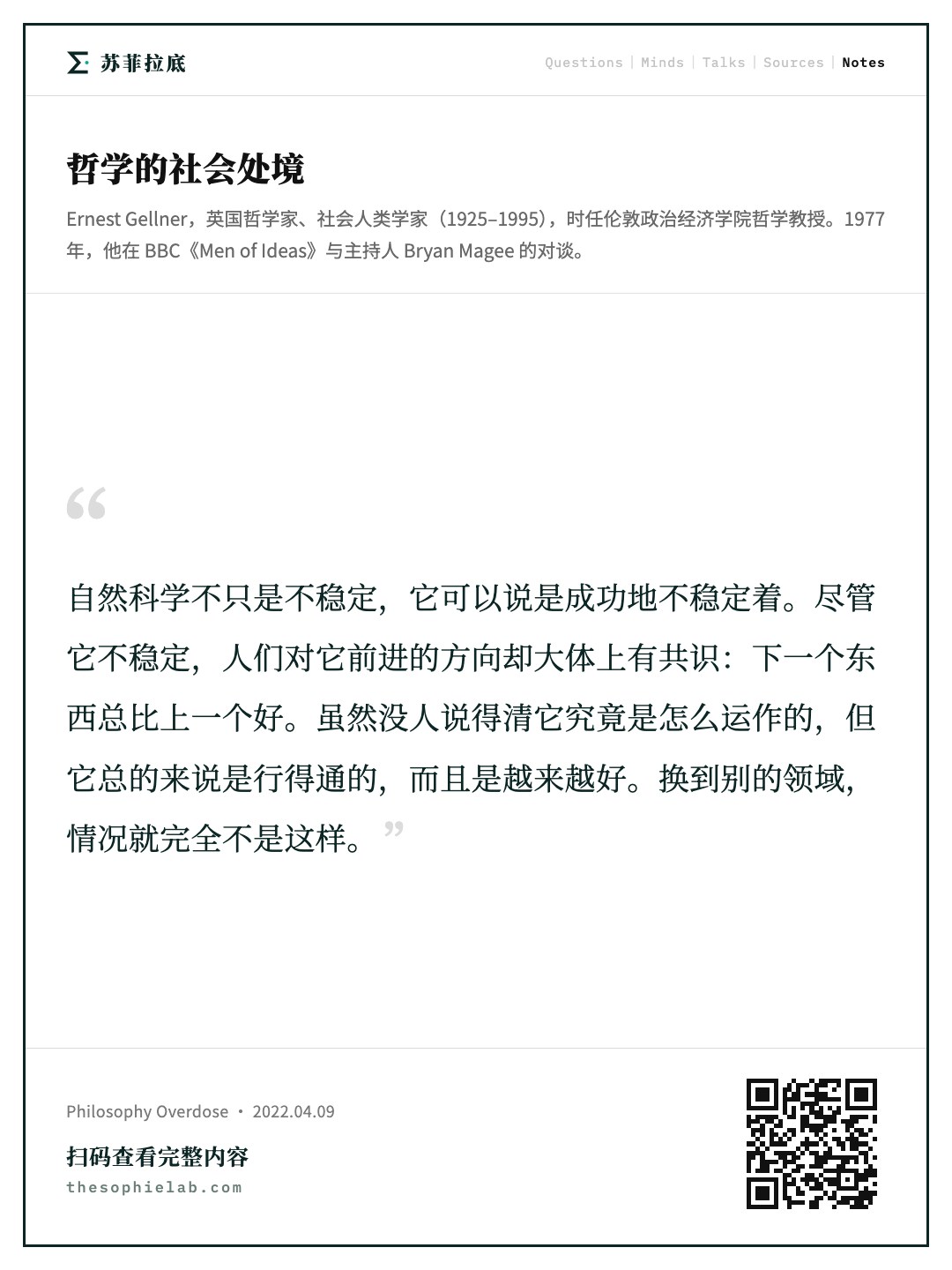
盖尔纳:是的,如今人们对自己的伦理信念、社会信念以及其他各种信念都不再有把握了。而与之形成鲜明对照的,是自然科学领域里那种辉煌的成功。自然科学不只是不稳定,它可以说是成功地不稳定着。尽管它不稳定,人们对它前进的方向却大体上有共识:下一个东西总比上一个好。总的来说,虽然没人说得清它究竟是怎么运作的,但它总的来说是行得通的,而且是越来越好。换到别的领域,情况就完全不是这样。

马基:换句话说,您是说在笛卡尔之前,人们知道的不多,但同今天的态度相比,他们对自己所知的东西非常确信。他们确信自己自以为知道的东西,不管实际上知不知道。然后科学以及科学式的知识开始了失控的增长,整个知识的格局就被扭曲了,因为有些领域明显在增长,另一些领域要么根本不增长,要么增长得极慢,甚至实际上在收缩,或者,那里原有的东西被怀疑一点点腐蚀掉。这就是两个特征:一个方向上的扩张,以及其他领域绝对的或相对的收缩。

盖尔纳:与此相连的还有第三个特征。一旦出现了这种不稳定,或者说这些领域之间的失衡,你就没法用一个领域来支撑另一个领域。那种成功的知识变得专门化了,人们知道它不稳定,它有极高的权威,而这种权威颇为奇特:它受到尊重,却并非定论。与此同时,它是一种高度专门化的语汇。自然科学知识的专门化意味着,它不再使用我们平时思考人的时候所说的那种语言。这就使它无法充当我们构想社会生活的前提。所以,第三个特征可以说是那种大致可称为实证知识(positive knowledge)的东西的专门化。

上帝的替代品:科学、历史与方法

马基:我有一个看法,不知道您是否同意。在人们对知识的旧有神学前提失去信心之后的很长时间里,他们在寻找的,或许是不自觉地寻找的,是一个替代品。他们在找另一个单一的范畴,一切最终都能用它来解释。在西方,有两百年左右的时间,这个范畴是科学。人们相信,到头来一切都可以用科学来解释。然后,与此并行成长起来的是黑格尔式的哲学,其中至高的范畴变成了历史,一切最终都可以用历史来解释。再往后是马克思主义,它试图把两者结合起来,拿出一套框架,把历史解释和科学解释合并为一切事物的最终解释形式。

盖尔纳:只要它声称历史知识是科学知识的一种,那么是的,这幅图景我接受。不过我的刻画方式会同您有所不同。

马基:您会怎样刻画?

盖尔纳:对这种解体的反应有两大主要趋向。一方面是对知识问题的专注。这里科学与其说是先前那种确定性的替代品,不如说替代品是获得科学的方法。如果关于世界的某一幅图景不再稳定,至少发现世界的方式可以是稳定的。这是您所定义的那种现代哲学的主题之一:把知识论当作一块试金石来经营,用它区分什么是好的知识、什么不是。回过头来审视自己的工具,既然世界不稳定,至少让我们借以认识世界的工具成为稳定的前提。这是一个持续不断、贯穿始终的主题。用知识论,也就是对我们自身认知机能、心灵运作方式,或者我们区分事物的标准的考察,来解决问题,这是一个持久的主题,而且我认为是一个很好的主题。它只有放在您我刚才勾勒的背景下才能得到恰当的理解。

另一个主题,以您已经提到的马克思主义为典型,是建立一种新的形而上学。它其实不是对某种超越的实在的说明,而可以称为一种关于人和社会的形而上学:它要指明人的处境或社会历史处境的一般特征。这两条线索差不多涵盖了过去三百年间发生的大部分事情,它们的交织就是现代思想的故事。

马克思主义:问对问题,答错答案

马基:您提了一条,我也提了一条重要的线索,那就是马克思主义。我打算逐一请您谈谈所有这些流派,既然这个话题已经冒出来了,我现在就问:您认为马克思主义在应对这些根本问题上有多成功?

盖尔纳:基本上不成功。它恰恰因为试图从社会语境去看我们的困境而理应得满分。但在很多方面它失败了。它在提出正确的问题,或者说部分正确的问题上得满分,但它根本上是错的,就这么简单。

马基:能举例说明它的哪些问题是对的,为什么某些答案又是错的吗?

盖尔纳:这是个大题目。我认为正确的问题是去考察现代世界得以出现的前提条件。至于错误的答案,我要挑出的、在我看来至关重要的错误成分,首先是一种乌托邦式的、弥赛亚式的期待:以为只要清除现有社会秩序中的某些缺陷和弊病,某种全面的圆满就唾手可得,会有一个自动的、自我调节的系统,各种问题从此不再出现;而在此之前,一切都是根本错误的。这是一种一般性的乌托邦主义或弥赛亚主义,人们常常把它追溯到宗教根源,或者追溯到紧接其前、深刻影响了马克思的德国浪漫主义所奉的绝对价值。

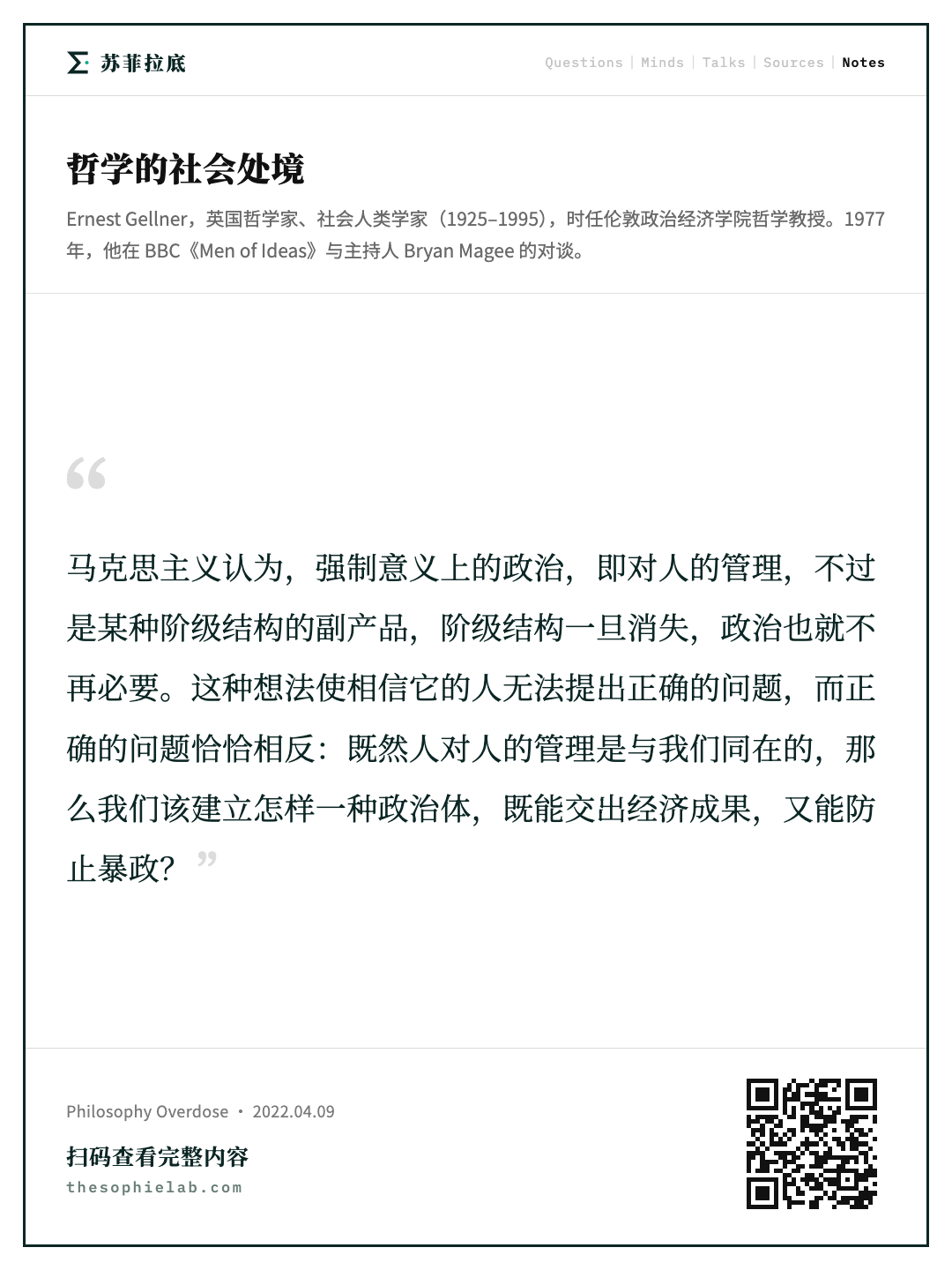
更具体地说,我认为还有关于政治本性的错误,这些错误是绝对核心的。马克思主义认为,强制意义上的政治,即对人的管理,不过是某种阶级结构的副产品,阶级结构一旦消失,政治也就不再必要。这种想法使相信它的人无法提出正确的问题,而正确的问题恰恰相反:既然人对人的管理,以及政治体对经济的控制,是与我们同在的,而且理应与我们同在,那么我们该建立怎样一种政治体,既能交出经济成果,又能防止暴政?事实上,马克思主义正是在这一点上引导人们去问错误的问题。

相对主义为何不是选项

马基:我想再同您讨论另一种哲学,经过前面的讨论,我们现在能把它放到语境中看清楚了,那就是相对主义。在现代世界,人们很时髦地相信并宣称,任何一种意见同别的意见一样好,不存在终极真理,因此你几乎可以在各种哲学中间逛店挑选,买下最合自己口味的那一种。它是怎样在我们前面讨论的语境中产生的,也不难看出:传统权威崩溃了,人们不知道该去哪里为自己的信念寻求验证,有时候最后就得出结论,信念根本无法验证,它们全都同样有效,或者同样无效。您怎样看现代思想中的相对主义?

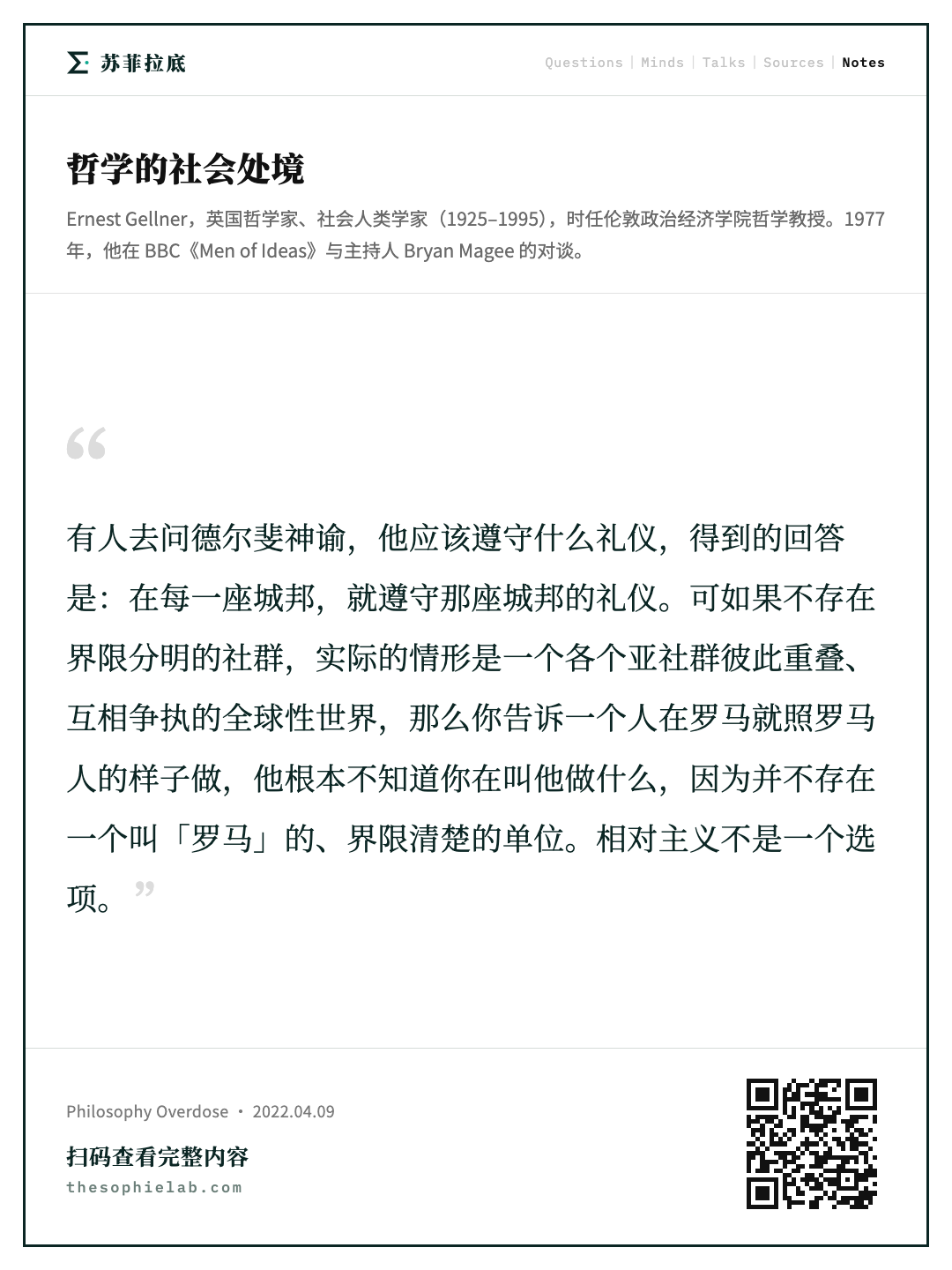
盖尔纳:相对主义压根就不是一个可用的选项。撇开它本身是否为真这个抽象问题不谈,作为应对权威崩溃、应对我们前面勾勒的那种总体问题处境的药方,它只有在存在一个个孤岛社群、每个社群都能活在自己的世界观之内的情况下才行得通。世界历史上确实有过一些处境,虽然没有完全满足这些条件,但在一定程度上满足了。有一个著名的故事:有人去问德尔斐神谕,他应该遵守什么礼仪,得到的回答是:在每一座城邦,就遵守那座城邦的礼仪。这没问题。在亚历山大之前的古希腊,城邦是可以辨认的,一个人被告知要遵守他所居住的城邦的礼仪,或者他所造访的城邦的礼仪,他确实做得到。可如果不存在界限分明、可以隔离的社群,如果实际的情形正是我们所勾勒的那样,即急剧的变化,以及一个各个亚社群彼此重叠、互相争执的全球性世界,那么你告诉一个人在罗马就照罗马人的样子做,他根本不知道你在叫他做什么,因为并不存在一个叫「罗马」的、界限清楚的单位,其他任何城市也一样。正是出于这类理由,相对主义不是一个选项。

马基:但相对主义者可能会对您说:既然你要否定我对相对主义的坚持,你就得给我指出某种办法,让我能够验证一种信念优于另一些信念。

盖尔纳:我认为,现代哲学的主流传统恰恰在这一点上并没有失败。

马基:您认为它是一个成功的故事?

盖尔纳:大体上是的。试图把有效知识的标准编成法典的那种知识论,并不是一个完全的成功故事,我没法给您指出一本一劳永逸解决这个问题的书,但总体而言,它相当成功。是的,我是这样看的。

知识进步的非人化代价

盖尔纳:顺便说一句,我们其实有点本末倒置,先讨论了解决方案,还没把问题说全。我们指明了问题处境的几个特征:知识在某些领域的增长,在另一些领域的收缩,描述性知识同日常生活、日常处境的语汇相脱离。我认为还有一个您没有提到的特征,而它显得极其重要,可以称之为知识进步的非人化(dehumanization)代价。我认为这一点很重要。

马基:能展开讲讲您的意思吗?

盖尔纳:关于知识进步的故事,要点似乎在于:知识的秘诀之一,是把各种事件和现象,包括行为,包括人的行为,都归入可以用中性语言表述、可以由他人重复的概括之下。而这样做的代价,是它似乎把被描述的现象非人化了。如果你的行为、你的态度或者别的什么,被解释为那种用中性语言指明的实体之间的相互作用,这就多少摧毁了你的个体性。顺便说一句,就它最令人不安的方面而言,它可能还会摧毁你关于自由的幻觉,如果那确实是幻觉的话。这种非人化效应,也就是社会学家受马克斯·韦伯影响有时所说的「世界的祛魅」(disenchantment of the world),即把人的事件归入非人的、抽象的范畴之下,是非常非常令人不安的。

如果要我单独挑出现代哲学的第二个主要特征,那就是一场保存人的运动:保留人对自身的人性形象,以此抵御被科学所解释,不管那种科学是否特别成功。这就是我说非人化时的意思。这是现代哲学的第二个主题,与前一个主题成对。一个主题是专注于知识,把它当作终极试金石,当作替代性的确定性来源,用划定知识边界的办法提供根基;另一个主题是提供论证,以保留我们对人的那种人性形象。

马基:我认为您把现代哲学的这两大主题区分开来,一个是研究什么构成知识,一个是试图为保存我们自身的人性寻找理论基础,这是非常有启发的。但为了清楚起见,我想在这次讨论中让它们保持分开。在转到可以说是社会哲学的那一面之前,我想把知识论这条线再往下追一追,因为在我看来,这一发展还有两三个极其有趣而重要的方面我们尚未触及。

不稳定性与进化认识论之争

马基:您提到了现代知识的不稳定性,我认为这一点极其重要。现代知识一直在以惊人的速度增长,这就意味着,可以说,我们世界观的前提是不稳定的,二十年之内就不可能保持不变,以致你永远无法建立起一套连贯而稳定的世界观。我们一直在从一种世界观挪向另一种世界观,总觉得脚下的地面在不停地移动。

盖尔纳:确实如此。现有的某些知识哲学试图把这个特征纳入自身,然后说:这不是问题,这是解决方案,事情本该如此。像卡尔·波普尔爵士或者美国逻辑学家蒯因这样的哲学家,都以各自不同的方式,把对不稳定性的强调恰恰纳入了自己的知识论。我认为这在某种程度上可能做过了头。这又回到我们开头讲的那一点,即我们处境的独特性。把不稳定性做过头的方式,就是把它看作一个永恒的特征,不仅是人类处境的永恒特征,而且是生命本身的永恒特征。如果你试图把增长这个事实,或者认知增长这个事实,锚定在某个一路上溯到生物史的永恒故事上,我认为那是错的。这是一种我碰巧不同意的解决方案。它试图在一个宇宙故事的基础上重建安全感:从阿米巴虫一路走来的总体发展,靠试错、靠实验而成长,如此等等。这个故事总的来说是用来取代神的,充当事情终将有个圆满结局的担保人。

我认为这行不通,理由有很多。我认为对这一点的说明必须同十七世纪前后以来这种颇为独特的处境有关,必须指明急剧的认知增长究竟有何独特之处,因为在此之前,相对的稳定才是人类的常态。

从超自然转向人的活动

马基:我还想同您讨论另一点。在笛卡尔之前,哲学的题材可以说是超自然的,人与上帝的关系是终极关切所在。笛卡尔之后,焦点转向了人的活动:人的政治、社会生活、心理、文化生活等等。于是不仅对这些东西的科学的或准科学的研究大量增加,哲学对研究这些东西的介入也大量增加。您赞同这个说法吗?

盖尔纳:赞同。不过您的表述方式似乎有可以商榷之处。您一直把哲学和科学说得好像当时就已经分开了。实际上,两者直到十八世纪的某个时候才真正明确地分开。「自然哲学」这个说法指的就是物理学,这至今还保留在一些名号里,比如苏格兰大学的物理学教授至今仍叫「自然哲学教授」。所以这个分离来得相当晚。而这个分离本身部分地反映了我们正在谈的东西,也就是实质性探究同对认知本身的探究相分离。但总的来说,您的基本论点我完全接受。

存在主义:被历史化的普遍处境

马基:您已经就笛卡尔以来哲学的发展做了这些很有启发的宏观概括,现在我想请您在这个背景下审视几个具体的当代流派。马克思主义和相对主义我已经请您谈过了,其他的呢?比如存在主义,您认为它怎样嵌入这幅图景?

盖尔纳:存在主义确实嵌得进去。它是一种奇特的哲学,同笛卡尔传统一样,它非常个人主义;但同笛卡尔传统不同,它的核心关切并不是知识问题。典型的存在主义对自然科学根本没有多大兴趣,它关心的基本上是人的处境。

马基:这就把我们带到了您所说的第二个主题,是不是?也许我们现在就该接过这个主题,并且,如果您愿意的话,在第二个传统的背景下展开您对存在主义的刻画。

盖尔纳:关于存在主义,有几个颇具反讽意味的事实。其一是,它专注于人的处境,并且隐含地声称自己是对人的处境本身、对任何地方的人的处境的说明。可反讽的是,它实际上是对后笛卡尔世界里,甚至可以说是对特定的现代世界里人的处境的说明。它盯住的是这样一个个体:他必须为自己的总体世界观和道德承诺承担责任,无法把责任推给别人。而在我看来,在大多数社会,即拥有稳定信念体系的社会里,人的处境的特点恰恰在于他用不着自己扛。权威是自信的,除非他主动做一个反叛者,否则他可以倚靠权威。所以存在主义虽然声称是对人的处境的一般说明,实际上却是对一种非常独特的处境的说明。

马基:但就它所及的范围而言,照您刚才的说法,它毕竟是对我们的处境的说明。就此而言,它显然有些有意思的话可说,它曾经的流行也反映了这一点。

盖尔纳:当然。关于它的一个重要之处是,它在尖锐危机和思想消沉的时期极为时髦:第一次世界大战后在德国大行其道,第二次世界大战后在法国大行其道。随着富裕的到来,随着至少是相对的共识的形成,即所谓「意识形态终结」的时期,它就不那么时髦了。这是可以说的一点。

还有别的可说。作为一门大学学科,它有某种缺陷。把人的处境变成一门学问、一种职业,这多少有点滑稽和怪诞。人的处境是我们大家都了解的东西,我们就身在其中,用不着去读那些极其艰深、相当冗长的书来了解它。这是它稍显滑稽的地方,也导致了它的一个特点:它有时候用极其矫饰的语言来表述,我想这是它从黑格尔那里继承来的遗产的一部分。

它的另一个特点,在萨特这样的思想家身上非常显眼,就是存在主义是一种先验心理学(a priori psychology)。它告诉你你感觉如何、想些什么,不是通过问你或观察你,而是从你处境的某些一般特征中推演出来:比如你终将死去,比如你必须做出道德抉择却得不到任何担保,比如他人对你而言是对象,而你对他人而言也是对象。这些非常一般的特征,关于人的存在的有限性,关于人与他人那种令人恼火的相互依赖,关于人必须在证据不足的情况下做决定,就是它的前提。它从这些前提推演出你的真实感受。它确实说出了一些有意思的东西,但对它的反驳之一是,弄清楚人们真实的感受其实是很有用的,而人们的感受未必符合它的理论所要求的样子。萨特是一位非常有意思的思想家,他试图把存在主义同马克思主义结合起来,这一点他自己也公开承认。可他的存在主义的先验主义,同他关于社会的具体、经验性的观察,根本合不到一起。这就是我要说的几点。

康德式最低限度的人性保存

马基:在存在主义之外,现代哲学的其他地方,是否有哪些发展在您看来特别有前途、特别有意思,符合您前面提到的这条为保存人性而哲学化的线索?

盖尔纳:我不认为我们能指望太轻易地保存太多的人性。有一类人提供药方,或者近乎空白支票式的公式,声称我们真的就是我们自以为的那样,用不着感到威胁。我认为我们确实需要感到威胁。这就是一种代价。我们越是能解释世界,我们自己就越是被解释;两者不可得兼。所以在这个领域,我对「人性保护协会」不怎么同情。我认为我们应当保存人性,但不要太多,尤其是不要太廉价。我在这个领域的榜样是一位相当老派的哲学家,伊曼努尔·康德。他很关心保存最低限度的人性,即自由意志、道德责任、自主的认知,这类前提,但只保存必要的那些,绝不多要,也不图廉价,只带上绝对最低限度的行李。至于其余的,就接受这一点:知识进步的代价是我们自己也成了知识的对象。

维特根斯坦与语言转向的误诊

马基:那么在这个背景下,您怎样看您我实际上在其中成长、学习和执教的那些哲学流派,也就是本世纪的英美哲学?

盖尔纳:在您我作为学生和教师涉足其中的那个时期,影响最大的哲学,我想大概就是所谓的语言哲学,其最主要的单一源头是路德维希·维特根斯坦的后期著作。您知道,我对它是高度批判的。为了讨论它,我不得不违反您给我定的规矩,不再把知识论传统和保存人性的传统分开。

马基:现在您尽可以打破这条规矩。

盖尔纳:维特根斯坦同许多其他思想家一样,是跨在这两条线上的。他的出发点是知识论传统的一个略显古怪的变种。他一开始的事业,与其说是划定什么可以被认识,不如说是划定什么可以被思考、什么可以被言说,也就是意义的界限。这是一项极具本世纪特色的创新:不再去圈定什么可以被认识、给知识的规则编纂法典,而是去编纂什么可以被意指、有什么东西是可以说的。

这是一种非常便利的手段。就像圈定可知的范围一样,如果只有一块有限的区域是可知的,或者是可说、可意指的,这本身就给你提供了前提,这是旧的稳定性的一种替代品。人们获得这种语言或意义上的精细意识,我想有各种原因,其中之一纯粹是形式数理逻辑的技术进步:某些看似有意义的表达式必须被排除出去,或者说人们试图把它们排除出去。于是人们想到,你我之间可以说、可以意指的东西是有边界的,而且比我们的直觉所感受到的边界要窄。如果能把这个边界划得非常非常窄,就能提供一个漂亮的根基。这就是维特根斯坦的早期哲学,伯特兰·罗素身上也有强烈的这种成分:把可言说之物的界限当作重建一幅安全图景的根基。

后来他以一种过度反应的方式反对了这个立场,说这是错的。语言的真正本质不在于它覆盖着有限的几样东西,而在于你我在各种各样的社会语境中,为各种各样的目的使用它,而这没什么不对。一旦我们认识到这一点,问题就消失了。错误在于去寻求某种外在的验证者,他年轻时曾以为,揭开记法的秘密或语言的秘密就能找到它。

我认为他在这一点上完全错了。

马基:您指的是他的后期哲学。

盖尔纳:正是后期哲学,它是错的。错的理由就是我们前面勾勒过的:激发现代人追求判准的那些条件,并不是一场误入歧途的、寻找某种可以充当思想典范的理想记法的追求。这些条件不是从哲学内部强加的,何况当时哲学根本还不是一门独立的学科。这些条件来自我们共同的人类社会处境:来自这样一些事实,即我们在一个领域知道得太多,在另一个领域知道得太少;我们对自身的图景正在被非人化;我们知道得很多、并且持续知道得很多的那些领域,并不能充当好的前提,供我们决定比方说该建立怎样的社会政治秩序。这就是具体的问题处境,人们正是在对它的回应中进行哲学思考,也就是试图陈述一些有说服力的前提,好让人们不诉诸暴力就能达成共识。这是一个客观的处境。它同那著名的「语言的蛊惑」毫无关系,同追求理想记法也毫无关系。我要说,这就是那种哲学的关键错误。

前进之路:规范认识论与社会学的汇流

马基:我已经请您对当代哲学的若干流派做了评述:以后期维特根斯坦为顶点的晚近英美哲学、存在主义、马克思主义、相对主义。也许您认为它们全都还有不少汁水,就是说能够或者可能在未来结出果实。您觉得哪些有,如果有的话?

盖尔纳:我不打算点名挑出哪些运动,但我认为两大主流,一方面是专注于知识的过程、试图表述知识判准的编纂工作,另一方面是对我们人类社会制度的持续考察,都很有价值。而前进的道路,在我看来,在于这两者在更精细的层面上汇流。关于那个考察知识、考察思想,或者在其后期变体中考察语言的传统,要点似乎是这样:它基本上是一种确立规范的工作,是试图为有效的知识主张编纂判准,相当于试图确立「知识共和国宪法」中那些不可动摇的固定条款。在我看来这是一项令人钦佩的工作,而把它看作这样一项工作,对它是有好处的。过去人们常常把它看作一种描述性的说明,或者是对个人知识实际如何运作的描述性或解释性的说明;作为这样的东西,它并没有多少价值。

马基:因为您把现代哲学更多地看作一种工具论(Organon),一种实际获取知识的工具,告诉我们该怎样着手。

盖尔纳:可以这么说,它更接近这个。我在其他方面都予以否定的维特根斯坦后期哲学,有一个有效的成分:他强调了一件人们知道却没有认真对待的事,那就是,把那个传统当作对语言实际运作方式的说明,当然是荒谬的。语言不是把句子同感觉或者小小的观察一一对应起来,再像堆沙堡那样从一粒粒沙子往上搭出一幅图景,最后把评价像旗子一样插在城堡顶上。那种说法,即知识由小小的描述句累积而成,然后再分别加上评价和其他所有东西,包括那些非人化的东西,是荒谬的,事情不是这样运作的。语言的实际使用显然嵌在我们的制度、习俗等等之中。他在这一点上完全正确。所以,作为对一种描述性语言理论的拆除,我认为他是对的,如果这件事确实需要做的话,他做对了。类似地,我认为乔姆斯基在语言学上的工作的重要性在于,它在我看来是一个完全决定性的证明:作为对我们如何获得技能的解释性说明,在他那里是语言技能,但同样适用于认知技能,旧的知识论传统在提供一个好的模型方面表现很差,而这门科学我接受。

然而,即便接受了晚近思想界这些否定性的拆除工作,也并不迫使人放弃、在我看来也不允许人放弃知识论,也就是为认知事业编纂判准、确立规范的努力。这是我所看到的前进之路的一个要素。与此相结合,我认为它必须同一种远为切实的关于我们社会和历史处境的说明联系起来:指明泛称为工业社会的那种社会的独特之处,即它是一个以对自然日益有效的控制、应用技术、普遍化的利益、数学化的组织等等为基础的社会。

颇具反讽意味的是,我是在说哲学一方面必须更抽象、更着力于确立规范,另一方面又必须更社会学、更具体。我不认为这两条建议之间有矛盾。马克思主义就是具体的、社会学的,只不过不幸弄错了。我宁愿看到别的人把它弄对,而且顺便说一句,弄对的时候不要夹带弥赛亚式的期待。在我看来这就是前进之路:把对工业文明独特性、对其前提与含义的切实感受,同确立规范的工作结合起来,把知识的判准当作我们所能拥有的唯一安全根基。

语言不是统一主题

马基:您会不会把对语言的关注看作当代哲学的一个统一因素?因为放眼望去,即便是在许多问题上彼此分歧的流派,也似乎有这一点共同之处,即对语言的极度关注。

盖尔纳:我认为存在一种潜在的统一性。您在开场白里编织了一条主线,大体上是有这么一条线的,只是它在表面上往往看不出来。在整场讨论中,我们对那些共同的潜在主题、关切和情节是有共识的。可奇怪的是,语言在我看来不在其列。它表面上像是,但我能想到本世纪至少有三个主要运动都在语言上大做文章,而它们援引语言的方式如此不同,以至于相似只是完全表面的。

我能看到的最大的反差,是维特根斯坦及其在英语哲学界的追随者对语言的关注,与乔姆斯基对语言的关注之间的反差。两者都在语言上大做文章,但方向几乎截然相反。后期维特根斯坦运用语言的要点,是把它当作一种解决方案,语言是一个歇脚处。语言的实际使用提供了我们所能拥有、所确实拥有、所需要拥有的唯一规范。换言之,他的想法是,追求更一般的、外在的验证是一种妄想,而实际的语言习惯就是歇脚的地方。而在我看来,使乔姆斯基变得重要的核心思想,在于他真正让人们领会到语言是多么成问题:构造和理解句子所涉及的那些技能,我们习以为常,却绝不该习以为常。所以两者对语言的运用几乎截然相反。乔姆斯基发现了语言在多大程度上是一个问题,维特根斯坦则试图把它当作解决方案。因此,尽管两者都在语言上大做文章,我却几乎想不出还有哪两套思想体系比它们彼此对立得更彻底,不管他们各自的追随者是否意识到这一点。此外,维特根斯坦援引语言的方式,同早先所谓的逻辑实证主义者及相关运动之间的反差也非常大。后者试图用语言的界限为重建共识、重建一幅世界图景提供根基;维特根斯坦则把语言当作前提,用来论证我们不需要这样的根基,我们从来不需要,根本没必要去找。所以,语言在我看来不是一个统一的主题。「语言」这个观念被用得如此五花八门,它实际上并没有给二十世纪思想带来统一性。

马基:您认为在不远的将来,哲学是否可能在别的基础上继续保持某种统一?

盖尔纳:预测人们会做什么是非常非常棘手的。我只知道在我看来什么是正确的做法。而正确的做法,就我所能看到的,是追求认识论的、知识论的方向,即试图编纂何为知识、何为非知识的判准,并把它同一种远为具体、远为硬朗的对实际社会现实的兴趣结合起来。这是一种特定的风格,在我看来是富有成果的。不过,这更多是在说我希望看到什么,而不是在说我认为人们必定会去做什么。

马基:我希望您在后一点上的悲观最终被证明是错的。非常感谢您,盖尔纳教授。
本期讲者
厄内斯特·盖尔纳英国哲学家、社会人类学家(1925–1995),时任伦敦政治经济学院哲学教授,后任剑桥社会人类学教授。以《Words and Things》(1959) 批判语言哲学、《Nations and Nationalism》(1983) 提出民族主义的工业社会理论而闻名。
布莱恩·马基英国哲学作家、广播主持人及工党议员(1930–2019)。主持 BBC 哲学访谈系列《Men of Ideas》(1978) 和《The Great Philosophers》(1987),著有《Confessions of a Philosopher》。
章节 · 点击跳转视频
0:14 退后三步:现代哲学的社会语境 ▶ 正在看
3:27 知识问题为何成为核心 ▶ 正在看
5:20 现代处境的三个特征 ▶ 正在看
8:50 上帝的替代品:科学、历史与方法 ▶ 正在看
11:29 马克思主义:问对问题答错答案 ▶ 正在看
14:24 相对主义为何不是选项 ▶ 正在看
17:25 知识进步的非人化代价 ▶ 正在看
20:25 不稳定性与进化认识论之争 ▶ 正在看
23:58 存在主义:被历史化的普遍处境 ▶ 正在看
28:31 康德式最低限度的人性保存 ▶ 正在看
30:01 维特根斯坦与语言转向的误诊 ▶ 正在看
35:10 前进之路:规范认识论与社会学的汇流 ▶ 正在看
40:03 语言不是统一主题 ▶ 正在看
本期论点
本期回应
5:02
知识问题成为哲学核心,源于上帝、圣经、教会等旧有认知权威的崩塌 只做澄清哲学应该产出什么?布莱恩·马基
25:06
存在主义自称在讲普遍的人的处境,实际讲的只是后笛卡尔世界里的一种特殊处境 只做澄清哲学应该产出什么?厄内斯特·盖尔纳
33:57
推动现代人追寻知识标准的是人类共同的社会处境,而不是哲学内部强加的问题 只做澄清哲学应该产出什么?厄内斯特·盖尔纳
35:34
哲学的出路在于让知识标准的法典化与对社会制度的考察在更精致的层面上汇流 该给出理论哲学应该产出什么?厄内斯特·盖尔纳
8:27
自然科学的语汇高度专门化,已无法充当人理解自身社会生活的前提 会取消人人的行为能不能用科学的语言讲?厄内斯特·盖尔纳
18:08
知识得以推进的秘诀,是把包括人的行为在内的现象归摄到中性语言可重复检验的概括之下 应当归摄人的行为能不能用科学的语言讲?厄内斯特·盖尔纳
18:32
用中性语言和实体间相互作用来解释一个人的行为与态度,等于摧毁他的个体性 会取消人人的行为能不能用科学的语言讲?厄内斯特·盖尔纳
29:38
值得保存的人性前提只有自由意志、道德责任与自主认知,不应超出这个最低限度 留最低限人的行为能不能用科学的语言讲?厄内斯特·盖尔纳
7:11
自然科学是成功地不稳定的:虽不断变动,但对后来者优于前者仍有相当共识 仍在变清楚知识越多,人越懂自己的处境吗?厄内斯特·盖尔纳
20:37
现代知识增长过快,看待世界的前提无法保持二十年不变,因而建立不起融贯稳定的世界观 反而更糊涂知识越多,人越懂自己的处境吗?布莱恩·马基
12:53
马克思主义最关键的错误是弥赛亚式期待:消除当下秩序的弊病后就能达成彻底圆满 指望圆满最危险人类的冲突与苦难会有尽头吗?厄内斯特·盖尔纳
14:02
无法摆脱人对人的管理与经济调控,真正的问题是何种政体既有经济成果又能防暴政 消不掉人类的冲突与苦难会有尽头吗?厄内斯特·盖尔纳
15:29
相对主义要能成立,前提是存在一个个界限分明、各有自己世界图景的孤岛式共同体 要纳入外来的推理判断对错该越出自己的传统吗?厄内斯特·盖尔纳
其他论点
4:16
现代哲学最突出的单一特征,是它变得极度痴迷于知识问题 厄内斯特·盖尔纳
4:44
现代思想颠倒了知识与世界的关系:世界从容纳知识的场所变成知识中的一个事件 厄内斯特·盖尔纳
01退后三步:现代哲学的社会语境
0:14
In this program, we're going to try and draw together the various developments in schools of modern Western philosophy into a single, coherent picture. We're going to take three paces back, as it were, and try and see the whole in some perspective. This means looking at modern Western philosophy in the context of modern Western society. And it also means looking at it in the context of its own past, trying to see just why and how the central concerns developed as they did, and in consequence of that, what the outstanding features of our present position are. And perhaps, on the basis of that, a few informal guesses about what developments are likely to be in the immediate future.
在本节目中,我们将试着把现代西方哲学各个流派的种种发展汇聚成一幅完整、连贯的图景。我们要往后退三步,可以这么说,试着从某种视角来看待整体。这意味着要把现代西方哲学放在现代西方社会的背景下来考察。同时也意味着要把它放在它自身历史的背景下来看,试着弄清楚那些核心关切究竟为何、又如何发展成今天这个样子,以及由此而来的,我们当下处境的突出特征是什么。或许在此基础上,还可以对不久的将来可能出现的发展作一些非正式的猜测。
便签引用
0:54
When philosophers use the term "modern philosophy," they mean philosophy since Descartes, who flourished in the early 17th century. The development of philosophy since then has been one continuous, if complex, tradition, so that the philosophy of our own day has to be looked at against that background. For some hundreds of years before Descartes, on the other hand, the situation had been entirely different. There had been one single world view based on Christianity and enforced by the political authorities, so that any public questioning of it was forbidden, and usually punished by death.
哲学家们使用“现代哲学”这个词时,指的是笛卡尔以来的哲学,而笛卡尔活跃于17世纪初。自那以后,哲学的发展一直是一个连续的传统,尽管相当复杂,所以我们今天的哲学必须放在那个背景下来看。而在笛卡尔之前的好几百年里,情况则完全不同。当时存在着一种以基督教为基础、由政治权威强制推行的单一世界观,任何公开质疑它的行为都被禁止,而且通常会被处死。
便签引用
1:31
By comparison with today, people's knowledge was almost static, or at least, very slow changing, and held with great certainty, being based on no less an authority than God, or his church on Earth. It's only after the Renaissance and the Reformation that you get the spectacular emergence and growth of the new science, which produced, among other things, a new philosophy. The old certainties are undermined, and with them topple the old authorities. So the problem was raised in a new and acute form -- how can our claims to knowledge be validated?
跟今天相比,人们的知识几乎是静止的,或者至少变化非常缓慢,而且被极其确信地持有,因为它的依据不是别的,正是上帝,或者上帝在人间的教会。直到文艺复兴和宗教改革之后,才出现了新科学的惊人兴起和成长,而新科学除了别的成果之外,还催生了一种新哲学。旧的确定性被动摇了,旧的权威也随之倒塌。于是,一个问题以全新而尖锐的形式被提了出来——我们对知识的宣称如何才能得到证实?
便签引用
2:06
It It's a problem which is still unsolved. For a long time, people thought that science was the provider of absolute certainty. But now we know that this is not so. Well, to discuss contemporary philosophy against this historical and social background, I've invited Ernest Gellner, who is both a professional philosopher and a professional sociologist. In fact, his official title is Professor of philosophy with Special Reference to Sociology at the London School of Economics. Professor Gellner, it seems to me self-evident that modern philosophy, contemporary philosophy, 20th century philosophy, can only really be understood against the background of some such historical and social perspective, as I very lightly sketched in that introduction just now.
这是一个至今仍未解决的问题。长期以来,人们认为科学能提供绝对的确定性。但现在我们知道并非如此。那么,为了在这样的历史和社会背景下讨论当代哲学,我邀请了欧内斯特·盖尔纳,他既是职业哲学家,也是职业社会学家。事实上,他的正式头衔是伦敦政治经济学院“哲学(侧重社会学)教授”。盖尔纳教授,在我看来有一点是不言自明的:现代哲学、当代哲学、20世纪哲学,只有放在我刚才在开场白里非常粗略勾勒的那种历史和社会视角下,才能真正被理解。
便签引用
2:50
But it also seems to me self-evident that most of your colleagues, as professional philosophers, are sort of blind to this historical and social dimension. Would you agree with that? Yes. I very strongly agree with your two main points. I may have reservations about some of the outside remarks, but your two central points seem to me entirely correct. Now, the main point I'll rephrase as follows. What you defined as modern philosophy -- Descartes onwards, 17th century onwards -- is basically, though not always consciously, a kind of commentary on the social and intellectual change which has taken place since then.
但在我看来同样不言自明的是,您那些身为职业哲学家的同行中,大多数人对这个历史和社会的维度可以说是视而不见的。您同意这一点吗?同意。您的两个主要观点我都非常赞同。对其中一些附带的说法我或许有保留意见,但您的两个核心观点在我看来完全正确。那么,我把主要那一点重新表述一下。您所定义的现代哲学——笛卡尔以降,17世纪以降——本质上是对此后发生的社会与思想变迁的一种评论,尽管这并不总是自觉的。
便签引用
02知识问题为何成为核心
3:27
And it can only be correctly understood in the light of this kind of motivation. And your second point associated with it also seems to me correct. Not enough people are clear enough aware of this. One thing that looking at it in that way brings to the fore is why it is that the central problem of modern philosophy ever since Descartes has been the problem of knowledge -- this basic question of what do we know -- or, indeed, do we really know, in the sense of being absolutely certain of, anything? And if so, how do we know that we know? This has, all the way through, been the central question, hasn't it?
而且只有在这种动因的观照下,它才能被正确理解。您与之相关的第二点在我看来也是对的。意识到这一点的人还不够多。以这种方式看问题,会凸显出一件事:为什么自笛卡尔以来,现代哲学的核心问题一直是知识的问题——也就是“我们知道什么”这个根本问题——或者说,我们究竟是否真的知道,在绝对确信这个意义上,知道任何东西?如果知道,我们又怎么知道自己知道呢?这自始至终都是核心问题,不是吗?
便签引用
4:06
Well, this is central. If one has to define modern philosophy, if one has to define it with one feature only, or one trait only, I think this is the one one would pick out, or at least, I would pick out, namely, that it gets absolutely obsessed with the problem of knowledge. If you give me two features, I'll add another one, and I'll do it in due cause. But if you allow me one, the centrality of knowledge to thought. One could sum this up as follows -- that prior to this period, knowledge is one thing amongst others. It's an important thing, but it's a thing. There are other programs.
确实,这是核心。如果非要给现代哲学下个定义,如果只能用一个特征、一个特点来定义它,我想这就是人们会挑出来的那一个,或者至少,我要挑出来的一点是,它变得极度痴迷于知识的问题。如果你给我两个特征,我会再加一个,而且我会给出充分的理由。但如果你只允许我讲一个,那就是知识在思想中的核心地位。可以这样总结——在这个时期之前,知识只是众多事物中的一样。它是重要的东西,但终究只是一样东西。还有别的议题。
便签引用
4:39
Knowledge is an event in the world, an important one, but it is one amongst others. What characterizes thought of this period is that it tends to get the other way around. The world becomes an event in knowledge. There's a kind of inversion. Knowledge becomes absolutely pivotal. And -- this is, of course, very much connected with your opening point -- the distinctive features of the modern world in which this philosophy operates. And do you also agree with me that this arises from the breakdown of the old authority, that men are no longer -- at one time, they knew what they knew because God said so, or The Bible said so, or the church said so. Once that's undermined, then the question arises, well, what authority do we have for what we believe?
知识是世界中的一个事件,一个重要的事件,但也只是众多事件之一。而这个时期的思想的特点在于,它倾向于把这个关系颠倒过来。世界成了知识中的一个事件。这是一种反转。知识变得绝对关键。而且——这当然跟你开头提到的那点密切相关——也就是这种哲学所处的现代世界的种种独特特征。你是否也同意我的看法:这源于旧有权威的崩塌,人们不再——曾几何时,他们之所以知道自己所知道的,是因为上帝这么说了,或者《圣经》这么说了,或者教会这么说了。一旦这一点被动摇,问题就来了:我们所相信的东西,究竟有什么权威作依据?
便签引用
03现代处境的三个特征
5:20
Yes. I do agree, but I would be inclined to expand it, and not necessarily concentrate on the monotheistic, or whatever the other premises were of the preceding order. What was really characteristic of the preceding order was that it was fairly stable. And that, so to speak, society could feed back its own ideas to itself in confidence against a stable background. Well, the stability is gone. This is probably the only society to live with sustained cognitive growth. I mean, nowadays, people are preoccupied with economic growth, but economic growth is intimately connected with the fact that knowledge is growing. And this is very disturbing. And this has a number of features. You mentioned one, the growth of knowledge. But there are various other features which are connected with it. And it's absolutely unique.
是的,我同意,但我倾向于把它扩展开来,不一定只聚焦于一神论,或者说前一个秩序所依据的其他前提。前一个秩序真正的特点在于,它相当稳定。可以说,社会能够在一个稳定的背景下,充满信心地把自己的观念反馈给自己。而如今,这种稳定性没有了。这大概是唯一一个在持续的认知增长中生活的社会。我的意思是,如今人们满脑子想的是经济增长,但经济增长与知识不断增长这一事实密不可分。而这是非常令人不安的。这有若干个特征。你提到了其中一个,知识的增长。但还有其他一些与之相关的特征。而这是绝对独一无二的。
便签引用
6:06
Now, you say there are other features connected with it. Let's start talking about some of them are. Well, I'd say -- I'd list three or four. The phenomenal growth of knowledge in one particular area. The second feature is not exactly a contraction of knowledge in other areas, but a relative contraction -- that is to say, by comparison with the success story in what is, roughly speaking, natural science, there's the failure story in other fields -- whereas people were previously confident, they're now less confidence. This is tied up with a number of features, like the breakdown of a central authority.
那么,你说还有其他与之相关的特征。我们就来谈谈其中的一些吧。嗯,我会说——我会列出三四个。第一是某一个特定领域中知识的惊人增长。第二个特征并不完全是其他领域知识的收缩,而是一种相对的收缩——也就是说,跟大致可称为自然科学的那种成功故事相比,其他领域则是失败的故事——人们从前很有信心,如今则不那么有信心了。这跟一系列因素有关,比如中心权威的崩塌。
便签引用
6:44
You're referring, I take it, to ethics and religious belief, are you, and things of that kind? Yes. That men used to be sure of their ethical beliefs and moral beliefs, and thought they had authority for these. Now, they're no longer sure -- or, even, indeed, know what to believe. Now they're no longer sure about their ethical, social, and various other beliefs. And the sheer contrast of this were the kind of glorious success in the field of natural science. Natural science is not only unstable, but it's, so to speak, successfully unstable. There's a fair amount of consensus about the way -- although there's instability -- that the next thing is better than the last one.
我想你指的是伦理和宗教信仰,以及诸如此类的东西,对吗?是的。过去人们对自己的伦理信念和道德信念很确信,并认为这些是有权威依据的。如今他们不再确信了——甚至根本不知道该信什么。如今他们对自己的伦理、社会以及其他种种信念都不再确信。而这与自然科学领域那种辉煌的成功形成了鲜明对比。自然科学不仅是不稳定的,而且可以说是成功地不稳定。尽管存在不稳定,但对于后一个东西比前一个更好这一点,还是有相当程度的共识。
便签引用
7:21
By and large --although nobody knows quite how it works -- by and large, it works. And it works for the better. With another field, this is by no means so. So in other words, what you're saying is that before Descartes, people didn't know much. But by comparison with present attitudes, they were very sure of what they did know. They were sure of what they thought they knew, whether, in fact, they knew it or not. And then you get this runaway growth of science, and scientific kinds of knowledge. The mental knowledge gets distorted, because some areas are obviously growing and other areas are either not growing at all or growing very slowly, or actually contracting. Or what there is gets kind of corroded by doubt. So these are the two features, the expansion in one direction and the absolute, or relative, contraction in other areas.
总的来说——尽管没有人完全清楚它是怎么运作的——总的来说,它是有效的。而且是越来越好。而在别的领域,情况就远非如此了。换句话说,你的意思是,在笛卡尔之前,人们知道的东西并不多。但和今天的态度相比,他们对自己所知道的东西非常确信。他们确信自己以为知道的东西,不管他们实际上是不是真的知道。接着就出现了科学以及各种科学知识的失控式增长。于是精神层面的知识就被扭曲了,因为有些领域明显在增长,而另一些领域要么完全不增长,要么增长得非常缓慢,甚至在萎缩。或者说,原有的那些东西被怀疑一点点腐蚀掉了。所以这就是两个特征:一个方向上的扩张,以及其他领域绝对的或相对的收缩。
便签引用
8:02
Connected with that is a third feature. Once you have this instability, or disproportion between these areas, you can't use the one area to sustain the other. If you have -- the successful kind of knowledge gets specialized. It's known to be unstable. It's highly authoritative -- in a curious kind of way in that it's respected, though it's not definitive. And at the same time, it's some very specialized idiom -- the specialization of natural scientific knowledge. It's no longer in the same idiom in which we normally speak when we think about human beings. That makes it unavailable as a premise for one's vision of one's social life. So if you like, the third feature would be the specialization of what could loosely be called positive knowledge, yes.
与此相关的还有第三个特征。一旦出现这种不稳定,或者这些领域之间的失衡,你就没法用其中一个领域去支撑另一个领域。如果你有——那种成功的知识会变得专门化。人们知道它是不稳定的。它又极具权威性——这很奇怪,它受人尊重,却并不是定论。与此同时,它使用的是一套非常专门的语汇——自然科学知识的专门化。它已经不再是我们平常谈论人的时候所用的那套语汇了。这就使它无法充当我们理解自身社会生活的前提。所以如果你愿意这么说,第三个特征就是那种可以宽泛地称为实证知识的东西的专门化,是的。
便签引用
04上帝的替代品:科学、历史与方法
8:50
It seems to me -- I don't know whether you would agree with this or not -- but it seems to me that for a long time after, confidence in the old theistic premises of knowledge was undermined. What people were looking for, possibly unconsciously, was a substitute for that. They were looking for some other single category in terms of which everything could ultimately be explained. And for a couple of hundred years or so in the West, it was science. People believed that in the end, everything would be explicable in terms of science. Or then, growing up alongside that, you get the Hegelian kind of philosophy, in which the supreme category becomes history. Everything is ultimately explicable in terms of history. Or then you get, say, Marxism, which comes along and tries to combine the two and produce a kind of schema which combines historical explanation and scientific explanation as the forms in which everything is ultimately to be explained.
在我看来——我不知道你是否同意——在那之后很长一段时间里,人们对旧有的、以神为前提的知识基础的信心被动摇了。人们在寻找的,也许是无意识地在寻找的,是某种替代品。他们在寻找另一个单一的范畴,一切都可以最终用它来解释。在西方,有两百来年,这个范畴就是科学。人们相信,最终一切都能用科学来解释。或者说,与之并行发展起来的,还有黑格尔式的哲学,在其中,最高的范畴变成了历史。一切最终都能用历史来解释。再或者,比如马克思主义,它试图把这两者结合起来,造出一套图式,把历史的解释和科学的解释合为一体,作为一切最终得以被解释的形式。
便签引用
9:42
And if the claim was historical knowledge is a version of scientific knowledge, yes. I'd accept the picture. I think I would characterize it somewhat differently from you. How would you characterize it? Well, the two -- we mentioned one -- well, the two main trends in reaction to this breakup are the following. On the one hand, the concentration on the problem of knowledge. It isn't so much that science is a substitute for the previous certainty. It was the method in which it is obtained.
而它的主张是:历史知识本身就是科学知识的一种形态。是的,这个描述我可以接受。不过我大概会用和你有点不同的方式来概括它。你会怎么概括呢?嗯,这两条——我们提过一条——对这种崩解的反应,主要有两大趋势。一方面,是对知识问题的集中关注。与其说科学是先前那种确定性的替代品,不如说,重点在于获得知识的那套方法。
便签引用
10:18
If one vision of the world is no longer stable, at least the way in which one finds out about it could be stable. This is one of the main themes of modern philosophy in the sense which you define it, the preoccupation with a theory of knowledge as a provider of a kind of touchstone for what is good knowledge and what isn't. Looking in upon one's tools, if the world isn't stable, let, at least, the tools by which we find out about it be the stable premise. And this is one sustained, continual theme.
如果关于世界的图景不再稳定,至少我们了解世界的方式可以是稳定的。这是现代哲学——按你界定的那种意义上的现代哲学——的主要主题之一:执着于用一套知识论来提供一块试金石,判断什么是好的知识、什么不是。也就是转过头来审视自己的工具,如果世界不稳定,那至少让我们借以认识世界的工具成为稳定的前提。这是一条持续不断的主线。
便签引用
10:47
The attempt to use the theory of knowledge -- the examination of our own cognitive operators, the working of our minds, or the criteria by which we separate things, that's one persistent theme -- and, I think, a very good one. And it can only properly be understood against the background which you and I have sketched out, I think. The other theme, which is exemplified by Marxism, which you've already mentioned, is to have a new kind of metaphysic which is not really an account of some kind of transcendent reality, but what could be called a human social metaphysic -- a specification of the general features of either the human or the social historic situation.
也就是试图运用知识论——考察我们自身的认知机能、我们心智的运作方式,或者我们据以区分事物的标准,这是一条一贯的主题——而且我认为是很好的一条。而且我想,只有放在你我刚才勾勒的那个背景下,才能真正理解它。另一条主题,其典型就是你已经提到过的马克思主义,那就是提出一种新的形而上学——它并不真是关于某种超验实在的说明,而可以称之为一种人的、社会的形而上学,即对人类处境或社会历史处境之一般特征的界定。
便签引用
05马克思主义:问对问题答错答案
11:29
And these two strands really cover most of what has happened in the past 300 years. And their intertwining is really the story of modern thought. Now, you mentioned one and I've mentioned one of the important strands, Marxism. I'm going to want to ask you about all of them in turn, but since this has cropped up, let me ask you about this now. How successful do you think Marxism has been in its attempt to cope with these basic problems? Well, basically it hasn't. I mean, it gets top marks by precisely trying to look at the social context of our predicament. But in various ways, it fails. I mean, it doesn't -- it gets top marks on asking the right kind of question, or some of the right kind of questions. But basically it's mistaken. It's as simple as that.
这两条线索基本上涵盖了过去三百年里发生的大部分事情。而它们的交织,其实就是现代思想的故事。你提到了一条,我也提到了其中一条重要线索,马克思主义。我打算把它们一条条都请教你,不过既然已经说到这里,那就先问这个吧。你认为马克思主义在应对这些根本问题上有多成功?嗯,基本上并不成功。我的意思是,它在着眼于我们处境的社会背景这一点上可以得满分。但它在好几个方面都失败了。也就是说,它在提出正确的问题这一点上得满分,或者说提出了部分正确的问题。但它基本上是错的。就这么简单。
便签引用
12:22
Can you give examples of which of its questions are right, and why some of the answers are mistaken? Well, this is a big topic. I think the right question is to look at the preconditions of the emergence of the modern world. But the wrong answers -- well, the ones I'd pick out, the elements of error which seem to me crucial is, first of all, an Utopian and messianic expectation -- the idea that some kind of total fulfillment is available when certain defects and disadvantages in present social order are removed, there'll be a kind of automatic, self-adjusting system in which the problems will no longer arise. And until one has this, something is radically wrong.
能不能举例说明它哪些问题问对了,而有些答案又为什么是错的?嗯,这是个大题目。我认为正确的问题是去考察现代世界得以出现的种种前提条件。至于错误的答案——我要挑出来的、在我看来最关键的错误成分,首先是一种乌托邦式和弥赛亚式的期待——认为一旦当前社会秩序中的某些缺陷和弊病被消除,就能实现某种彻底的圆满,会出现一个自动的、自我调节的体系,问题不再产生。而在实现这一点之前,一切都根本上是有毛病的。
便签引用
13:16
Now, this is the kind of general Utopianism, or general Messianism, which people often trace back to religious sources, or to the absolute value of the German romanticism which immediately preceded it, and which influenced Karl Marx. More specifically, I should have thought there were the errors about the nature of politics, which are absolutely central-- the idea that politics in the sense of coercion, and the management of people, is simply the byproduct of a certain kind class structure, and once that goes, it will not be necessary -- deprives anyone who believes in that theory from asking the right question, which is, on the contrary, given that the management of people by people, and the management -- the control by the polity of the economy is with us, and rightly with us -- what kind of polity shall we have which will both deliver the economic goods and prevent tyranny? And in fact, Marxism does lead people to ask the wrong question on that score.
这是那种一般意义上的乌托邦主义或弥赛亚主义,人们常把它追溯到宗教根源,或者追溯到紧接其前、并影响了卡尔·马克思的德国浪漫主义的绝对价值观念。更具体地说,我认为它对政治本性的看法是错的,而这一点绝对是核心——即认为强制意义上的政治、对人的管理,不过是某种阶级结构的副产品,一旦阶级结构消失,政治就不再必要——这就使得任何相信这套理论的人都无法去问那个正确的问题。而那个问题恰恰相反:既然人对人的管理、既然政治体对经济的调控是我们无法摆脱的,而且理应如此——那么我们该有一种什么样的政体,既能带来经济上的成果,又能防止暴政?而事实上,在这个问题上,马克思主义确实把人们引向了错误的提问方式。
便签引用
06相对主义为何不是选项
14:24
I'd like to take up with you another philosophy which we are now in a position to see in its context in this discussion. And that is relativism. It's very fashionable in the modern world for people to believe and to say, well, any opinion is as good as any other opinion. There is no ultimate truth. Therefore, you can almost, as it were, shop among philosophies to buy the one that suits you best. And it's clear to see how this arose in the context that we were discussing earlier, namely, you get a breakdown of traditional authorities.
我想和你讨论另一种哲学,如今我们已经可以把它放在这场讨论的脉络中来看了。那就是相对主义。在现代世界,有一种说法非常时髦,人们相信并宣称:任何一种意见都和其他意见一样好。不存在终极真理。因此,你几乎可以像逛商店一样,在各种哲学里挑一个最合你心意的。而它是怎么在我们前面讨论的那个脉络里产生的,也很清楚,也就是说,传统权威崩塌了。
便签引用
14:58
People no longer know where to look for the validation of their beliefs. And they come in the end, sometimes, to think, well, beliefs can't be validated. They're all equally valid or equally invalid. What is your view of relativism in modern thought? Relativism simply isn't an available option at all. Leaving aside the abstract question of whether it's true in itself, as a recipe for coping with this breakdown of authority, the general problem situation which we sketched, it could only work if there were island communities, each of them within their own vision within which you could live. The were situations in world history which, while not satisfying those conditions perfectly, satisfied them in some measure.
人们不再知道该到哪里去为自己的信念寻找依据。于是他们有时最终会想:算了,信念根本没法被证成。它们要么同样有效,要么同样无效。你怎么看现代思想中的相对主义?相对主义压根就不是一个可行的选项。撇开它本身是否为真这个抽象问题不谈,作为应对我们刚才勾勒的那种权威崩解、那种普遍问题处境的药方,它要行得通,就得存在一个个孤岛式的共同体,每一个都有自己的一套图景,人可以在其中生活。世界历史上确实有过这样的情形,虽然并不完全符合这些条件,但在某种程度上是符合的。
便签引用
15:49
There's the celebrated story about the man who asked the Delphic Oracle as to what rights he should observe. And the reply was, in each city, observe the rights of their city. That's all right. In ancient Greece prior to Alexander, there were identifiable cities. And a man who was told to observe the rights of the city he was inhabiting could in fact do so -- or the cities he was visiting, as the case may be. If, on the other hand, there are no well-defined, isolatable communities -- if, in fact, the terms of reference are what we sketched out -- namely, rapid change and a kind of global world with overlapping sub-communities in disagreement, when you're tell a man to do in Rome as Romans would, he doesn't know what you're telling him to do, because there's no unambiguously marked unit called "Rome" -- or, in fact, any other city. Relativism is not an option for this kind of reason.
有个著名的故事:有人去问德尔斐神谕,他该遵守什么样的礼法。回答是:在每一座城邦,就遵守那座城邦的礼法。这没问题。在亚历山大之前的古希腊,城邦是可以清楚辨认的。一个人被告知要遵守自己所居住的城邦的礼法,他确实做得到——或者说他所到访的城邦的礼法,视情况而定。但另一方面,如果并不存在界限分明、可以孤立开来的共同体——如果实际情形就是我们刚才勾勒的那样,也就是急速的变迁,以及一个由彼此重叠、彼此不合的次共同体构成的全球化世界,那么当你告诉一个人「入乡随俗」时,他并不知道你到底要他做什么,因为根本没有一个界限分明、叫做「罗马」的单位——其他任何城市也一样。正是出于这类理由,相对主义不是一个选项。
便签引用
16:42
But a relativist might say to you, well, if you're going to deny my attachment to relativism, you've got to show me some way in which I can validate one belief as against other beliefs. Well, I think the main tradition of modern philosophy hasn't been a failure, precisely in this respect. You think it's a success story? By and large, yes. Yes, I do. I think the theory of knowledge which attempts to codify the criteria of valid knowledge -- it's not a compete success story. I can't refer you to a book which will finally settle this -- has, on the whole, been fairly successful, yes. Yes, I do.
但相对主义者可能会对你说:如果你要否定我对相对主义的坚持,你就得向我指出,我该怎样证成某一信念优于其他信念。这个嘛,我认为现代哲学的主流传统恰恰在这一点上并不是失败的。你认为它是个成功的故事?大体上是的。是的,我这么认为。我认为,那种试图把有效知识的标准加以系统化的知识论——它不是完全的成功。我没法给你指出一本书,说它就此一锤定音——但总体而言,它相当成功,是的。我确实这么认为。
便签引用
07知识进步的非人化代价
17:25
What I would like to add, incidentally -- we're in a way doing this back to front by discussing the solution without the problem. We specified some of the features of our problem situation -- the growth of knowledge in some areas, the contraction in others, the separation of descriptive knowledge from the idiom of daily life and daily situation. I think there's one further feature which you haven't mentioned, which seems to be terribly important. And this might be called a kind of, the dehumanization price of the advance of knowledge. I think this is important.
顺便说一句,我还想补充一点——我们某种程度上是在本末倒置,先谈解决方案而没有把问题谈完。我们说了我们这一问题处境的若干特征:某些领域知识的增长、另一些领域的收缩、描述性知识与日常语言和日常处境的脱节。我认为还有一个特征你没有提到,而它似乎极其重要。这个特征也许可以称为知识进步所付出的非人化代价。我认为这一点很重要。
便签引用
18:01
Will you go into what you mean by that? Yes. Well, the point of the stories on the advancement of knowledge seems to be this, that knowledge proceeds -- one of the secrets of knowledge is the subsumption of events, phenomena-- including behavior, including human behavior-- under generalizations that can be formulated in neutral language repeatable by other people. Well, the price of this is it seems to dehumanize the phenomena which I described. If your behavior, your attitude, or whatever, are explained in terms in the kind of interplay of entities which I specified in kind of neutral language, it kind of destroys your individuality -- incidentally, to take the most septic aspect of this, it also possibly destroys your illusion of freedom, if it is an illusion. This kind of dehumanization effect -- or what sociologists sometimes call, under the influence of Max Weber, the "disenchantment with the world" -- as a subsumption of human events under non-human abstract categories is very, very disturbing.
你能展开说说你指的是什么吗?可以。关于知识进步的那套说法,要害似乎在于:知识之所以能推进——它的秘诀之一,就是把事件、现象——包括行为,包括人的行为——归摄到某些概括之下,而这些概括可以用中性的语言表述,并且能被别人重复检验。可是,这样做的代价,就是它似乎把我所说的这些现象非人化了。如果你的行为、你的态度或别的什么,被用我刚才所说的那种中性语言、用某些实体之间的相互作用来解释,那就等于摧毁了你的个体性——顺带说一句,从最刺人的一面来看,它可能还摧毁了你关于自由的幻觉,如果自由确实是幻觉的话。这种非人化效应——社会学家在马克斯·韦伯影响下有时称之为「世界的祛魅」——把人的事件归摄到非人的抽象范畴之下,是非常非常令人不安的。
便签引用
19:08
And if I were to single out the second main feature of modern philosophy, it's been the kind of movement for the preservation of man -- the kind of retention of the human image of man as a defense against being explained by science, whether or not that science is particularly successful. And this is what I meant when I mentioned dehumanization. And this is the kind of twin theme, the second theme, of modern philosophy. One theme is preoccupation with knowledge as a kind of ultimate touchstone, as a substitute source of certainty -- the delimitation knowledge serves to provide as a basis. The other is a provision of arguments for the retention of our kind of human image of...
如果要我指出现代哲学的第二个主要特征,那就是某种维护人之为人的运动——保住关于人的那幅人性化图像,用以抵御被科学解释掉,不管那种科学是否特别成功。这就是我说非人化时的意思。这是现代哲学的孪生主题中的第二条。一条主题是执着于知识,把它当作某种终极的试金石、当作确定性的替代来源——通过划定知识的界限来提供一个基础。另一条则是提供各种论证,以保住我们关于人的那种人性图像。
便签引用
19:49
I think in sorting out, in separating these two main themes of modern philosophy, the study of what constitutes knowledge and the attempt to find a theoretical basis for the preservation of our own humanity, I think you've done something very illuminating there. But for the sake of clarity, I want to keep them separate in this discussion. And I'd like to pursue the line of the theory of knowledge a little more before I come onto, as it were, the social philosophy. Because there seem to me to be one or two or three extremely interesting and important aspects of this development that we still haven't touched on.
我认为,你这样梳理、区分出现代哲学的这两大主题——对知识之构成的研究,以及为保全我们自身的人性寻找理论基础的努力——是非常有启发性的。不过为了清楚起见,我想在这场讨论里把它们分开来谈。在转到所谓的社会哲学之前,我想先把知识论这条线再往下谈一谈。因为在我看来,这一发展中还有两三个极其有趣、极其重要的方面我们还没触及。
便签引用
08不稳定性与进化认识论之争
20:25
You've referred to the instability of modern knowledge, and I think this is an extremely important thing. I mean, the fact that modern knowledge is growing so sensationally fast all the time means that, so to speak, the premises of our outlook are unstable -- that they never remain the same for two decades together, so that you can never build up a coherent and stable world outlook -- so that we're moving all the time from one world outlook to another, with a sense of the ground permanently shifting beneath our feet.
你提到了现代知识的不稳定性,我认为这一点极其重要。我是说,现代知识一直以惊人的速度增长,这就意味着,可以说,我们看待世界的前提是不稳定的——它们从来不会连续二十年保持不变,所以你永远建立不起一套融贯而稳定的世界观——我们始终在从一种世界观转向另一种世界观,总觉得脚下的地面在不停地移动。
便签引用
20:58
Well, this is so. Some of the philosophies of knowledge which are available try to incorporate this feature and say, it's not a problem. It's a solution. This is how it should be. I mean, in different kind of ways, philosophers such as Sir Karl Popper or the American logician Quine, incorporate precisely the stress on instability as part of their theory of knowledge. Now, I think to some extent, this can be overdone. This comes back to our opening point about the distinctiveness of our situation.
确实如此。现有的一些知识哲学试图把这个特征吸纳进来,说这不是问题,这正是答案,事情本该如此。我是说,以各自不同的方式,像卡尔·波普尔爵士或美国逻辑学家蒯因这样的哲学家,恰恰把对不稳定性的强调纳入了他们的知识论。不过我认为,这在某种程度上可能被推得过头。这就回到我们开头说的那一点:我们处境的独特性。
便签引用
21:28
The way instability can be overdone is if one considers it a permanent feature, not only of the human condition or such, but the condition of life. If you try to anchor the fact of growth, or the fact of cognitive growth, to some kind of permanent story going back right into biological history, I think this is wrong. It's a kind of solution which I happen to disagree with. It's a solution which tries to reestablish security on the basis of the cosmic story -- the kind of overall development from the amoeba onwards -- of growth by trial and error, experimentation, and so on, which, on the whole, replaces the deity as a kind of guarantor that the thing will have a happy end.
不稳定性被推过头的方式,就是把它看成一种恒久的特征,不只是人类境况的恒久特征,而是生命本身境况的恒久特征。如果你试图把增长这一事实、认知增长这一事实,锚定在某个一直上溯到生物史的恒久故事里,我认为这是错的。这是一种我恰好不同意的解法。这种解法试图在宇宙演化的故事上重建安全感——从变形虫开始的那种整体发展,靠试错、实验等等一步步增长,总的来说,它把神取而代之,充当某种担保人,保证事情终将有个圆满结局。
便签引用
22:10
Now, I don't think this will do for a variety of reasons. I think one has to, as well -- that the parentheses have to have something to do with this rather distinctive situation since the 17th century or so, the specification of what is distinctive of rapid cognitive growth as opposed to the relative stability which was a normal human condition before that. Another point I want to take up with you is this, that before Descartes, the subject matter of philosophy was, so to speak, supernatural. Man's relationship with God was, so to speak, the matter of ultimate concern. After Descartes, you get the switch of focus to human activities -- to man's politics, social life, psychology, cultural life, and so on. And an enormous increase, not only in the scientific, or quasi-scientific study of these things, but in the involvement of philosophy with the study of these things. Would you go along with that?
可是出于种种理由,我认为这行不通。我认为人还必须——括号里的这部分必须与那个相当独特的处境有关,也就是十七世纪前后以来的处境,必须说清楚急速的认知增长的独特之处何在,与此前作为人类常态的相对稳定形成对照。我想和你讨论的另一点是:在笛卡尔之前,哲学的题材可以说是超自然的。人与上帝的关系可以说是终极关切之所在。笛卡尔之后,焦点转向了人的活动——人的政治、社会生活、心理、文化生活等等。而且不仅是对这些事物的科学的或准科学的研究大量增加,哲学对这些研究的介入也大量增加。你同意这个说法吗?
便签引用
23:11
I would go along with that. The way you formulate it seems to be open to some objection. You keep talking about philosophy and science as if these had been separated at that time. Now, in fact, they didn't really get sharply separated until some point in the 18th century. And the expression "natural philosophy" meant physics. And this is still enshrined in things like titles of professors of physics in Scottish universities are still "professors of natural philosophy." So the separation came fairly late. And the separation is partly a reflection of what we're talking about, namely, the separation of substantive inquiry from the inquiry into myth of the knowing. But by and large, your basic point I accept entirely, yes.
我同意。不过你的表述方式似乎有可以商榷之处。你一直在谈哲学和科学,好像它们在当时已经分开了。可事实上,它们要到十八世纪的某个时候才真正明确分开。而「自然哲学」这个说法指的就是物理学。这一点至今还保留在一些头衔里,比如苏格兰的大学里,物理学教授的头衔仍然是「自然哲学教授」。所以这种分离发生得相当晚。而这种分离在某种程度上正是我们所谈的东西的反映,也就是实质性的探究与对认识本身的探究之间的分离。不过总体而言,你的基本观点我完全接受,是的。
便签引用
09存在主义:被历史化的普遍处境
23:58
Now that you've made, I think, these very illuminating broad generalizations about the development of philosophy since Descartes, I'd like us to look at some of the specific contemporary schools against that background. I've already asked you to do this in the case of Marxism and relativism. But what about some of the others? What, for example, about existentialism? How do you see that as fitting into this picture? Well, existentialism does fit into this picture. Existentialism is a curious kind of philosophy in that, like the Cartesian tradition, it's very individualistic.
既然你已经对笛卡尔以来哲学的发展做了这些——我认为非常富有启发性的——宏观概括,我想请我们在这个背景下来看看一些具体的当代哲学流派。关于马克思主义和相对主义,我已经请你谈过了。那其他的呢?比如说,存在主义怎么样?你觉得它在这幅图景中处在什么位置?嗯,存在主义确实能放进这幅图景里。存在主义是一种很奇特的哲学,因为它和笛卡尔传统一样,非常个人主义。
便签引用
24:34
But unlike it, it's not really preoccupied with-- it's not centrally preoccupied with the problem of knowledge. Characteristically, it's not all that interested in natural science at all. It's basically preoccupied with the human situation. Well, that brings us, really, to the second of your two main themes, doesn't it? And perhaps we ought to take that up now and, if you like, develop your characterization of existentialism against the background of this second tradition. Well, the ironic fact about existentialism is -- well, there are a number of ironic facts.
但和笛卡尔传统不同的是,它并不真正关注——它的核心关切并不是知识问题。它的特点是,它根本对自然科学没多大兴趣。它基本上关注的是人的处境。那么,这其实就把我们带到了你那两大主题中的第二个,对吧?也许我们现在就该谈这个,如果你愿意的话,就在这第二种传统的背景下来展开你对存在主义的刻画。嗯,存在主义身上有个讽刺之处——其实讽刺之处有好几个。
便签引用
25:01
One of them is, it's preoccupied with the human situation. It claims, by implication, to be an account of the human situation, as such, anywhere. But in fact, the irony is, it's distinctively an account of the human situation in the post-Cartesian -- or even particularly, post-existential world. It concentrates on the individual who has to take responsibility for his general world view and his moral commitment, and who cannot pass a buck. Now, of course, it seems to me the characteristic of the human situation in most societies, societies with stable belief systems, is precisely that he doesn't have to pass the buck. The authority's confident. And unless he's actively a rebel, he can fall back on it. So existentialism, while it's claiming to be a general account of human situation, is, in fact, an account of a very distinctive character.
其中之一是,它关注的是人的处境。它言下之意是在宣称,自己讲的是任何地方、作为一般意义上的人的处境。但事实上,讽刺的是,它讲的其实是后笛卡尔——甚至特别是后存在(原文如此)世界中人的处境。它聚焦于那个必须为自己的总体世界观和道德承诺承担责任、无法把责任推给别人的个体。当然,在我看来,在大多数社会里——在那些拥有稳定信仰体系的社会里——人的处境的特征恰恰在于:他并不需要把责任推出去。权威是自信笃定的。除非他主动去做一个反叛者,否则他随时可以退回到权威那里。所以存在主义虽然自称是对人的处境的普遍说明,实际上讲的却是一种非常特殊的处境。
便签引用
25:56
But still, as far as it goes, it is, in the terms you've just outlined, an account of ours. And as far as it goes, it's obviously -- and its popularity, when it was popular is a reflection of this -- has interesting things to say about it. Of course, one interesting -- one of the significant things about it is it's highly fashionable in periods of acute crises and intellectual depression -- I mean, highly fashionable in German after the first war, in France after the second. With the coming of affluence, and of the kind of relative-- at least, relative consensus, the so-called end-of-ideology period, it became less fashionable. But yes, this is one of the things to be said about it.
但不管怎么说,就它所及的范围而言,用你刚才描述的话说,它讲的正是我们的处境。而就它所及的范围来说,它显然——它当年流行的时候之所以流行,也正反映了这一点——对此说出了一些有意思的东西。当然,其中一个有意思的——一个值得注意的地方是,它在急剧危机和思想低沉的时期特别时髦——我是说,一战后在德国特别时髦,二战后在法国特别时髦。随着富裕时代的到来,随着那种相对的——至少是相对的——共识出现,也就是所谓“意识形态终结”的时期,它就不那么时髦了。不过是的,这是关于它可说的一点。
便签引用
26:39
And there are other things to be -- well, it has a certain defect as a university subject. There's something slightly comic and bizarre about turning the human condition into a learned profession. The human condition is something you either -- you know, we all know about. We're in it. And we don't actually have to read extremely difficult, rather protracted books to find out about it. This is slightly comic about it. And it leads to one of its features. It tends sometimes to be said in extremely pretentious language, which is, I suppose, part of its Hegelian heritage.
还有别的可说的——嗯,它作为一门大学学科有个毛病。把“人的境况”变成一门专门学问,这事儿多少有点滑稽、有点怪异。人的境况这东西,你要么——你知道,我们都懂。我们就身在其中。我们其实并不需要去读那些极其艰深、相当冗长的书才能了解它。这一点有点滑稽。而这也导致了它的一个特征:它有时候用极其故弄玄虚的语言来表述,我想,这大概是它黑格尔血统的一部分。
便签引用
27:11
And another feature of it, which is very conspicuous in a thinker like Sartre, existentialism is a kind of a priori psychology. It tells us about how you feel and how you think, not by asking you or observing you, but by deducing it from certain general features of your situation, such as the fact that you're going to die, the fact that you have to make moral decisions without having them guaranteed, these kind of -- the fact that other people are objects to you, but you're an object to the other people. There are these very general features about the limitation of one's existence, one's infuriating interdependence with other people, and the fact that one has to make decisions on inadequate evidence. These are the kind of premises.
它还有另一个特征,这在萨特这样的思想家身上非常明显:存在主义是一种先天的心理学。它告诉我们你有什么感受、你怎么思考,靠的不是去问你或观察你,而是从你处境的某些一般特征中推演出来——比如你终将死去这个事实,比如你必须做出道德抉择而这些抉择又得不到任何保证,诸如此类——比如他人对你而言是客体,而你对他人而言也是客体。存在着这样一些非常一般的特征:个人存在的有限性、人与人之间那种令人恼火的相互依赖,以及人必须在证据不足的情况下做决定。这些就是它的前提。
便签引用
27:54
From that, it deduces how you really feel. Well, it does, in fact, say interesting things about it. But one of the objections against it is that it's quite useful, actually, to find out how people really feel. And people don't necessarily feel how they ought to feel on their theory. And in the case of a very interesting thinker like Sartre, who tries, then, to combine it, when he tries to marry -- as he admittedly, confessedly does -- marry existentialism and Marxism, the a priorism of his existentialism and the concrete, empirical context of his observations about society don't mix at all easily. These are the things I would say about it, yes.
从这些前提出发,它推演出你究竟有什么感受。嗯,它对此确实说出了一些有意思的东西。但反对它的一个理由是:其实去弄清楚人们真实的感受是很有用的。而人们的感受未必就是按他们那套理论“应该”有的感受。而在萨特这样一位非常有意思的思想家那里——他后来试图把两者结合起来,当他试图把存在主义和马克思主义联姻时(他自己也公开承认在这么做),他那存在主义的先天论,和他对社会所作观察中那种具体的、经验性的语境,根本就很难融合。这就是我对它想说的话,是的。
便签引用
10康德式最低限度的人性保存
28:31
Are there any developments elsewhere in modern philosophy, outside existentialism, which seem to you to be particularly promising and interesting along the lines of this strand of philosophizing for the preservation of our humanity, which you mentioned earlier? Well, I don't think we can expect to preserve too much of our humanity too easily. I mean, I think this is one of the main themes is people who offer recipes, or almost carte blanche kind of
那么在现代哲学里,除了存在主义之外,还有没有别的什么发展,在你看来沿着你先前提到的那条“保存我们的人性”的哲学思路,特别有前途、特别有意思?嗯,我不认为我们可以指望轻轻松松就保住太多的人性。我是说,我认为其中一个主要问题就是那些提供药方的人,或者说提供几乎是空头支票式的
便签引用
29:03
formulae for saying that we really are the way we think we are, and we needn't feel threatened. I think we do need to feel threatened. It's just -- it is a price. The more we can explain the world, the more we are ourselves explained. And you can't have one without the other. No, no. In this kind of sphere, I'm not terribly sympathetic to the Society for the Preservation of Humanity. I think we should preserve humanity, but not too much. And above all, not too cheaply. And my model in this sphere is quite an old-fashioned philosopher, Immanuel Kant, who was very concerned with preserving the minimum of humanity -- namely, free will, moral responsibility, autonomous cognition -- the kind of premises, but no more than was necessary, and not cheaply. Only the absolute minimum kind of baggage. And, for the rest, accept it that the price of the advancement of knowledge is that we also become objects of knowledge.
公式的人,说我们真的就是我们自以为的那个样子,我们不必感到受威胁。我认为我们确实需要感到受威胁。这只是——这是代价。我们越是能解释这个世界,我们自身也就越是被解释。你不可能只要其中一样而不要另一样。不,不。在这个领域,我对“人性保护协会”并不怎么有好感。我认为我们应该保存人性,但不要保存太多。而尤其是,不要保存得太廉价。在这方面我的榜样是一位相当old-fashioned(老派)的哲学家,伊曼努尔·康德,他非常关心保存最低限度的人性——也就是自由意志、道德责任、自主的认知——这一类前提,但绝不超出必要的限度,而且绝不廉价。只留绝对最低限度的那点“行李”。至于其余的,就接受这一点:知识进步的代价就是我们自己也成为知识的对象。
便签引用
11维特根斯坦与语言转向的误诊
30:01
Well, now, how, in the context of this background, do you see the schools of philosophy in which you and I have, in fact, grown up and developed and learned and taught -- Anglo-Saxon philosophy in this century? Well. I mean, I suppose the most influential philosophy in the period in which you and I were involved in it as both the students and teachers of it was presumably the so-called linguistic philosophy, or the philosophy which the main single source is the later work of Ludwig Wittgenstein. And of course, I'm highly critical of this, as you know. In order to discuss it, I have to violate the rule you imposed on me of separating the theory of knowledge tradition from the preservation of humanity.
那么现在,在这个背景之下,你怎么看你我实际上在其中成长、发展、学习和教书的那些哲学流派——本世纪的盎格鲁-撒克逊哲学?嗯。我是说,在你我作为学生和教师参与其中的那个时期,最有影响力的哲学,我想大概就是所谓的语言哲学,或者说主要源头是路德维希·维特根斯坦后期著作的那种哲学。当然,我对此是高度批判的,这你也知道。为了讨论它,我不得不违反你给我定的那条规矩——把知识论传统和人性保存这两条线分开来谈。
便签引用
30:51
Well, feel free to break that rule now. Well, he, as many other thinkers, of course, are astride this philosophy. Now, he started from the position which was a slightly eccentric variant of the theory of knowledge tradition. He started from the enterprise of delimiting not so much what could be known, but what could be thought and what could be said -- the limits of meaning. Now, this was an innovation highly characteristic of the century, that instead of circumscribing what could be known and codifying the rule of knowledge, instead one codified what could be meant, what was there to be said.
那你现在尽管打破这条规矩好了。嗯,他和许多别的思想家一样,其实是横跨在这两条线之上的。他一开始的立场,是知识论传统的一个略显古怪的变体。他一开始着手的事业,与其说是划定什么是可知的,不如说是划定什么是可思的、什么是可说的——也就是意义的界限。而这是一项极具本世纪特色的创新:不再去圈定什么是可知的、去把知识的规则法典化,而是去把什么是可意谓的、什么是可说的加以法典化。
便签引用
31:34
Now, it's a very convenient kind of device. As in the case of circumscribing what can be known, if there's only a limited area that can be known, or that can be said or meant, that provides you with the premises. And this is a kind of substitute for the old stability. And I suppose there are various reasons why people acquired this kind of language or meaning sophistication. One of them was -- were simply technical advances in formal mathematical logic, where certain expressions which looked as if they had meaning had to be excluded -- or attempts were made to exclude them. So people hit on the idea that what is available for you and I to say to each other, and to mean, is circumscribed.
这是个非常方便的办法。就像圈定什么是可知的一样,如果只有一个有限的范围是可知的、或者是可说可意谓的,那这就给了你前提。这是对旧日那种稳固性的一种替代品。我想,人们之所以获得这种关于语言或意义的精细讲究,原因有好几个。其中之一,纯粹是形式数理逻辑上的技术进展,在那里,某些看起来像是有意义的表达式必须被排除掉——或者说,有人试图把它们排除掉。于是人们想到一个念头:可供你我彼此言说、彼此意谓的东西,是被圈定了范围的。
便签引用
32:21
And it's circumscribed more narrowly than our intuitions give us. And if this could be circumscribed very, very narrowly, this would provide a kind of nice basis. Well, this was the early philosophy of Wittgenstein. And Anderson or Bertrand Russell had a strong element of this -- of using the limitations of what could be said as a kind of basis for re-establishing a safe picture. Now, he reacted against this by kind of over-reaction, saying this was an error. The real essence of language is not that it is a cover for a limited number of things. The real essence of language is that you and I use it in a wide variety of purposes, in a wide variety of social contexts. And it is all right.
而且这个范围比我们的直觉所给的要窄得多。如果这个范围能被圈定得非常非常窄,那就能提供一个不错的基础。这就是维特根斯坦的早期哲学。而安德森,或者说伯特兰·罗素,身上也有很强的这种成分——利用“可说之物”的界限来作为重建一幅安全图景的基础。后来他对此做出了反弹,可以说是一种矫枉过正,说这是个错误。语言的真正本质并不在于它是有限数量事物的一层外衣。语言的真正本质在于,你我在各种各样的社会情境中、为各种各样的目的使用它。而这没什么不对。
便签引用
33:13
Once we realize this, the problem disappears. And one error is to seek some kind of external validator, which in his youth he had thought, in unmasking the secrets of notation or the secrets of language. Now, I think he was totally mistaken in this. Well, in his later philosophy, you mean. In his later philosophy, indeed. That's mistaken. Well, it's mistaken for the reasons which we outlined, that the terms of reference which stimulated the modern pursuit of criteria wasn't a misguided pursuit of a single ideal notation which would be the model for thought. The terms of reference were imposed not from within philosophy, which, in any case, didn't exist as a separate subject then.
一旦我们认识到这一点,问题就消失了。而其中一个错误,就是去寻求某种外部的裁定者——他年轻时曾以为,在揭开记法的秘密或语言的秘密时能找到这样的裁定者。而我认为,他在这一点上完全错了。你是说,在他的后期哲学里。确实是在他的后期哲学里。那是错的。嗯,之所以说它错,理由就是我们前面讲过的:激发现代人去追寻标准的那套问题框架,并不是什么被误导的、对某种单一理想记法(可作为思想模型)的追求。这套问题框架不是从哲学内部强加的——反正当时哲学也还不是一门独立的学科。
便签引用
33:57
The terms of reference arose from our shared human social situation -- from the fact that we knew too much in one area, too little in another, that our picture of ourselves was getting dehumanized, that the areas in which we did know a lot -- or do know a lot and continue to know a lot -- don't serve as very good premises for deciding, let us say, what kind of social political order we have. This is the concrete problem situation, in reaction to which people have philosophized, namely, tried to state premises which would be persuasive so that they can arrive at a consensus without using violence in so doing. Now, this is an objective situation.
这套问题框架源自我们共同的人类社会处境——源自这样的事实:我们在一个领域知道得太多,在另一个领域知道得太少;我们关于自身的图景正在被去人性化;而那些我们确实知道很多——或者说现在知道很多、并将继续知道很多——的领域,并不能充当很好的前提,去决定,比方说,我们该有什么样的社会政治秩序。这才是人们据以进行哲学思考、并作出反应的那个具体的问题处境,也就是说,人们试图陈述出一些有说服力的前提,以便能够在不诉诸暴力的情况下达成共识。而这是一个客观的处境。
便签引用
34:39
It has nothing to do with the famous bewitchment by language, or the pursuit of an ideal notation. This, I would say, is the crucial error in that particular philosophy. I've asked you to give your observations on a number of schools of contemporary philosophy, recent Anglo-Saxon philosophy culminating in later Wittgenstein, existentialism, Marxism, relativism -- perhaps you think all of them have a lot of juice in them in the sense of being able to, or likely to, bear fruit in the future. Which, if any, do you think?
它跟那个著名的“被语言所蛊惑”,或者对理想记法的追求,毫无关系。我要说,这就是那种哲学的关键错误。我请你对当代哲学的若干流派谈了看法——以后期维特根斯坦为顶点的晚近盎格鲁-撒克逊哲学,存在主义、马克思主义、相对主义——也许你觉得它们都还很有活力,也就是说,能够或者很可能在未来结出果实。你认为哪一个(如果有的话)是这样?
便签引用
12前进之路:规范认识论与社会学的汇流
35:10
I don't think I'll single out movements by name, but I think both these -- both the mainstreams -- on the one hand, the codification -- the concentration on the process of knowledge and the attempt to formulate criteria of knowledge on the one hand, and the sustained investigation of our human social institution on the other -- are highly meritorious. And the way forward seems to me -- well, seems to me to consist of a kind of confluence of these two at a more sophisticated level. Now, the point about the tradition which examines knowledge or thought or, in it's later variant, language -- the point about this seems to be the following.
我想我不会点名挑出某个运动来,但我认为这两者——这两条主流——一方面是那种法典化,是对认知过程的专注、以及试图为知识确立标准的努力;另一方面是对我们人类社会制度的持续考察——这两者都极有价值。而在我看来,前进的道路——嗯,在我看来,就在于让这两者在一个更精致的层面上汇流。那么,关于那条考察知识、或思想、或者在其后期变体中考察语言的传统,我要说的是这样一点。
便签引用
35:59
It's basically a kind of norm-setting exercise. It's an exercise in trying to codify the criteria for valid claims to knowledge. It's a kind of attempt to establish the entrenched clauses of the Constitution of the Republic of Knowledge. Now, this seems to me an admirable exercise which will benefit from being seen as such. It was often in the past seen as a kind of descriptive account -- either a descriptive or an explanatory account of how individual knowledge actually works. And as such, it doesn't have all that much merit.
它基本上是一种设定规范的工作。它是在试图把有效知识主张的标准法典化。它是一种尝试,要为“知识共和国”的宪法确立那些不可更改的条款。在我看来这是一项令人钦佩的工作,而且把它就当作这样一项工作来看待,会大有好处。过去人们常常把它看作一种描述性的说明——要么是描述性的、要么是解释性的说明,讲个体知识实际上是怎么运作的。而作为那样的东西,它其实没多大价值。
便签引用
36:37
Because what you see it as is a sort of -- you see modern philosophy more as an Organon, as an instrument for actually acquiring knowledge, telling us how we should go about. If you like. It's closer to that than -- I mean, one of the valid elements in the later philosophy of Wittgenstein, which I otherwise repudiate, is, of course, the following -- that what he stressed was something which people knew but didn't treat very seriously -- that as an account of how language actually works -- which, of course, is absurd. Language isn't a matter of matching sentences to sensations or little observations and then building up from this a picture, in a kind of sandcastle way from little grains, and then adding evaluation as a kind of flag stuck on top of the castle.
因为你把它看作是一种——你更多是把现代哲学看作一部“工具论”(Organon),一件实际获取知识的工具,告诉我们该怎么去做。可以这么说吧。它更接近那个,而不是——我是说,维特根斯坦后期哲学里有一个有效的成分(虽然我在其他方面都否定它),当然就是下面这一点:他所强调的是人们其实知道、但没怎么当真的东西——即作为一种关于语言实际如何运作的说明,那种老看法当然是荒谬的。语言并不是把句子跟感觉或细小的观察一一对应起来,然后由此像用一粒粒沙子堆沙堡那样搭起一幅图景,再把价值评价像插在城堡顶上的一面小旗那样加上去。
便签引用
37:26
And the account of the accumulation of knowledge from little descriptive sentences and then adding evaluation and all the other things -- the dehumanizing things -- separately, this is absurd. It doesn't work like that. The actual employment of language is obviously built into institutions and our customs and so on. And he was dead right on that. So as a demolition of a descriptive account of language, I think he was right. If this needed to be doing, he was right on this. Similarly, I think the importance of the work in linguistics of Chomsky's is, to my mind, a completely conclusive demonstration of things. As an exploratory account of how we acquire -- well, in his case, linguistic skills, but it applies to cognitive skills -- that this cannot be done in the -- the old theory of knowledge tradition was very poor on offering a good model of this. And this science, I'd accept.
那种说法——知识由细小的描述性句子累积而成,然后再把评价以及所有其他东西(那些去人性化的东西)分开加上去——是荒谬的。事情不是那样运作的。语言的实际使用显然是嵌在制度、我们的习俗等等之中的。他在这一点上完全正确。所以,作为对一种描述主义语言观的拆解,我认为他是对的。如果这活儿需要有人干,那他在这点上做对了。同样,我认为乔姆斯基在语言学上工作的重要性,在我看来是一次完全决定性的证明,证明了一些东西。作为对我们如何习得——就他的情形而言是语言能力——的一种探究性说明,但它同样适用于认知能力——这件事不可能按老办法完成;旧的知识论传统在为此提供一个好模型方面很糟糕。这种科学,我是接受的。
便签引用
38:22
However, if one accepts these kind of negative demolition jobs in the recent intellectual scene, it doesn't actually oblige one -- or indeed, in my view, allow one -- to abandon the theory of knowledge as a kind of attempt to codify, to set the norms for a cognitive enterprise. Now, this is one element where I seem to see the way forward. In conjunction with this, I think it has to be tied with a kind of much more realistic account of our social and historical situation -- the distinctiveness of what is loosely called industrial society, that it is a society based on growing effective control of nature, applied technology, universal interests, mathematical organization, and so on.
不过,即便一个人接受晚近思想界这类否定性的拆解工作,这实际上并不迫使一个人——事实上,在我看来也不允许一个人——去放弃知识论,放弃那种把认知事业法典化、为它设定规范的尝试。这就是我似乎看到的前进方向的一个要素。与此相配合,我认为它必须跟一种远为现实的、关于我们社会与历史处境的说明结合起来——也就是那个被笼统地称为“工业社会”的东西的独特性:它是一个建立在对自然日益有效的控制、应用技术、普遍主义取向、数理化组织等等之上的社会。
便签引用
39:15
Ironically enough, I'm saying philosophy has to be both more abstract and norm-setting on the one hand, and more sociological and concrete on the other. And I don't think there's a contradiction in making these two recommendations. I mean, Marxism was concrete and sociological. It just, unfortunately, got it wrong. But I would prefer to see somebody else get it right. And, incidentally, to get it right without messianic exploitations. This seems to me the way forward -- the marriage of the realistic sense of the distinctiveness of industrial civilization, its preconditions and implications, combined with doing this normative job -- this norm-setting job of using the criteria of knowledge as the only basis for security that we can possibly have.
说来颇有讽刺意味,我是在说哲学一方面必须更抽象、更具规范设定性,另一方面又必须更社会学、更具体。而我不认为同时提出这两条建议有什么矛盾。我是说,马克思主义就是具体而社会学的。只不过,很不幸,它搞错了。但我更希望看到别的什么人把它搞对。另外顺带说一句,要在没有救世主式的曲用的情况下把它搞对。在我看来这就是前进的道路——把对工业文明之独特性、对其前提条件和后果的现实认识,同那项规范性的工作结合起来——那项设定规范的工作,就是把知识的标准当作我们所能拥有的唯一的确定性基础。
便签引用
13语言不是统一主题
40:03
Would you see a concern with language as being a unifying factor in contemporary philosophy? Because it does appear that wherever you look, even schools that differ from each other about a great many things have that in common, an enormous concern with language. I think there is an underlying unity. I mean, in your opening remarks, you sort of spin one plot. Well, it has, more or less. But on the surface it hasn't, quite often. And on the whole of the discussion, we agreed about what the underlying shared themes and preoccupations and plots were. Language, oddly enough, doesn't seem to me to be one of them. It looks like it on the surface. But I can think of three major movements in this century which make a fuss about -- three at least -- which make a big fuss about language. And it seems to me that the way in which they invoke language is so different that the similarity is entirely superficial.
你会不会认为,对语言的关注是当代哲学中一个具有统一性的因素?因为看上去,无论你看向哪里,即便是在许多问题上彼此分歧的流派,也都有这个共同点:对语言极度的关注。我认为是存在一种深层的统一性的。我是说,在你的开场白里,你差不多讲出了一条主线。嗯,多多少少是有的。但在表面上,往往并没有。而在整场讨论中,我们对于深层共有的主题、关切和主线是什么,是有共识的。而语言,说来奇怪,在我看来并不在其中。表面上看像是。但我能想到本世纪有三个大的运动都在大做文章——至少三个——都在拿语言大做文章。而在我看来,它们援引语言的方式差别如此之大,以致这种相似完全是表面的。
便签引用
40:55
Now, the major-- the really big contrast I can see is, for instance, is between the language preoccupation of someone like Wittgenstein, and his followers in the English-speaking philosophic world, and someone like Chomsky. They both make a fuss about language, but it's almost diametrically opposite. The main point about the late Wittgenstein and use of language was to use it as a kind of solution. Language was a resting place. The actual employment of language provided the only norms that we could have, or did have, or needed to have.
那么,我能看到的最大的——真正巨大的对比,比方说,就是维特根斯坦这类人(以及他在英语世界哲学界的追随者)对语言的关注,同乔姆斯基这样的人之间的对比。他们都拿语言大做文章,但两者几乎是截然相反的。后期维特根斯坦以及语言使用问题的要点在于,要用把它当作一种解决方案。语言是一个可以安歇的落脚点。语言的实际使用提供了我们唯一能有、实际拥有、也唯一需要的规范。
便签引用
41:31
In other words, the idea was that the pursuit of more general, extraneous validations was a delusion. And actual linguistic custom was the kind of resting place. Now, it seems to me the central idea of Chomsky which makes him important, that he really brought home how problematic language was -- namely, that the kind of skills which go into the construction and understanding of sentences, which we take for granted, is something which mustn't be taken for granted. So their use of language is almost diametrically opposite.
换句话说,这个想法是:去追求更普遍的、外在的证成,是一种妄想。而实际的语言习惯就是那个落脚点。而在我看来,乔姆斯基之所以重要,其核心思想在于,他真正让人们意识到语言是多么成问题——也就是说,我们习以为常的那些构造和理解句子的能力,恰恰是不该被视为理所当然的。所以他们对语言的运用几乎是完全相反的。
便签引用
42:11
Chomsky discovered how very much it is a problem. Wittgenstein tried to use it as a solution. So that although both make a fuss about language, they seem to me -- I could hardly think of two systems of thought which were more radically opposed to each other, whether or not their individual followers recognize this. And again, of course, the contrast in the invocation of language with Wittgenstein and the earlier so-called logical positivists and the legal movement is also very considerable. They tried to use the limits of language, as it were, providing us with bases for a reestablishment of a consensus, of a vision of the world-- whereas Wittgenstein used language as a premise for saying that we don't need such a basis -- that we never need -- there's no need to look for it. So that language doesn't seem to me a unifying theme. The idea of language has been used in such widely different ways that it doesn't, in fact, give a unity to 20th century thought.
乔姆斯基发现了语言在多大程度上是个问题。维特根斯坦则试图把它当作解决方案。所以尽管两人都大谈语言,在我看来——我很难想出还有哪两种思想体系比它们彼此对立得更彻底,不管他们各自的追随者是否意识到这一点。当然,再者,维特根斯坦对语言的诉诸,与更早的所谓逻辑实证主义者以及法律运动对语言的诉诸,两者的反差也非常大。他们试图利用语言的界限,可以说,为我们重建共识、重建一种世界图景提供基础——而维特根斯坦则把语言当作一个前提,用来说明我们并不需要这样一个基础——我们从来都不需要——根本没必要去寻找它。所以在我看来,语言并不是一个统一性的主题。语言这个观念被以如此千差万别的方式使用,以至于它实际上并没有赋予20世纪思想任何统一性。
便签引用
43:12
Do you think there's likely to continue to be a unity on some other basis in the philosophy of the immediate future? Well, I wouldn't-- it's very, very tricky making predictions about what people will do. All I know is what seems to me the correct thing to do. And the correct thing, as far as I can see, is the pursuit of the epistemological, the theory of knowledge condition -- the attempt to codify the criteria of what is and what isn't -- married to a much more concrete, hard-headed interest in the actual social reality. This is a particular style which seems to me to be fertile. And this is more a statement of what I like to see done than what I think that people necessarily do.
那您认为,在不远的将来,哲学中还有可能在其他某种基础上出现统一性吗?嗯,我不会——预测人们会做什么是非常非常棘手的事。我只知道在我看来什么才是正确的做法。而据我所见,正确的做法是继续追求认识论、知识论的那个方向——也就是试图把什么算数、什么不算数的标准系统化——并且把它与一种远为具体、务实的兴趣结合起来,去关注真实的社会现实。这种特定的路数在我看来是富有成果的。这更多是我希望看到别人去做的事,而不是我认为人们一定会去做的事。
便签引用
44:02
Well, I hope that your pessimism on that latter point turns out to be mistaken. Thank you very much, Professor Gellner.
那我希望您在后一点上的悲观最终被证明是错的。非常感谢您,盖尔纳教授。
便签引用
视频总结 · 一句话概括与核心要点

一句话概括

Gellner 认为,笛卡尔以来的现代西方哲学本质上是对"知识爆炸式增长却又不稳定"这一独特社会处境的回应,其两大主线是"把知识论当作确定性的替代基石"与"在科学解释面前保存人的形象",而出路在于把规范性的知识论与对工业社会的清醒社会学分析结合起来。

核心要点

  • 现代哲学的唯一核心特征是对知识问题的痴迷。 笛卡尔之前,知识是"世界中的一件事";之后发生了倒转,"世界成了知识中的一个事件"。原因是教会/上帝/圣经的权威崩塌后,人必须回答"我们凭什么相信我们所相信的"。
  • 当代社会是史上唯一经历持续认知增长的社会。 经济增长本身依赖知识增长,而这种增长带来三重失衡:自然科学领域知识爆炸;伦理、宗教、社会信念领域相对萎缩、被怀疑侵蚀;成功的科学知识高度专门化,其语言与日常谈论人的语言脱节,因而无法用作社会政治秩序的前提。
  • 哲学的两大回应策略。 其一,既然世界图景不稳定,至少让"获取知识的工具"稳定——这是知识论传统的动机,它本质是为"知识共和国"制定宪法的规范性工作,而非描述个体认知如何运作。其二,建立"人的/社会的形而上学"(马克思主义为代表),描述人类历史处境的一般特征。
  • 马克思主义提问正确、答案错误。 它正确地追问现代世界出现的先决条件,却犯了两个致命错误:乌托邦式弥赛亚主义(以为消除某些缺陷后社会会自动自我调节);把政治强制视为阶级结构的副产品,从而无法提出真正的问题——既然人管理人不可避免,何种政体能既提供经济成果又防止暴政?
  • 相对主义根本不是可选项。 德尔斐神谕"入境随俗"在前亚历山大时代的希腊城邦可行,因为存在边界清晰的孤立共同体;而在快速变化、次群体相互重叠又彼此分歧的全球化世界中,"罗马"根本无法被明确界定,因此这一建议没有可操作的含义。
  • 知识进步的代价是"去人化"。 知识靠把现象(包括人的行为)归入可用中性语言重复表述的概括,这摧毁了个体性乃至自由的幻觉——即韦伯所说的"世界的祛魅"。现代哲学第二主线正是抵御被科学解释的"保存人的形象运动"。Gellner 对此不甚同情:应像康德那样只保留最低限度的人性(自由意志、道德责任、自主认知),且不能廉价地保留。
  • 存在主义把特殊处境误当普遍处境。 它描述的"个体必须自负世界观与道德承诺、无法推卸"其实只是后笛卡尔时代的处境,在有稳定信仰体系的社会中人恰恰可以依靠权威。它还是一种"先验心理学",从必死、无保证的抉择等一般前提推导出人"应该"怎么感受,而不去实际观察;萨特试图将其与马克思主义的经验观察嫁接,两者格格不入。其流行度与危机期高度相关(一战后德国、二战后法国),富裕与"意识形态终结"时代随之退潮。
  • 后期维特根斯坦的根本错误在于把哲学问题归因于"语言的蛊惑"。 前期他与罗素以"可说的界限"作为新的稳定基础;后期则过度反弹,主张语言在多种社会语境中的日常使用本身即是归宿,无需外部验证。Gellner 认为,现代哲学寻求标准的动机并非源自对理想记号法的追求,而是客观的社会处境——在某些领域知道太多、另一些领域知道太少、自我图景被去人化——目标是在不诉诸暴力的前提下达成共识。
  • "语言"并非 20 世纪哲学的统一主题。 维特根斯坦把语言当作解决方案(语言习惯即规范),乔姆斯基则揭示语言是一个巨大的问题(造句和理解的技能绝不能视为理所当然);逻辑实证主义又以语言界限重建世界图景的基础。三者对语言的调用方式几乎截然相反,表面相似完全是肤浅的。

结论与值得注意的细节

  • Gellner 提出的前进方向看似悖论:哲学必须同时"更抽象、更规范性"(继续做知识论的标准制定工作)和"更社会学、更具体"(认真研究以有效控制自然、应用技术、数学化组织为基础的工业文明的独特性)。他认为二者并不矛盾,马克思主义只是具体化时"搞错了",他希望有人"不带弥赛亚期待地把它做对"。
  • 他承认乔姆斯基和后期维特根斯坦作为对"描述性语言/知识模型"(从感觉句子像堆沙堡一样累积、再把评价当旗子插上去)的拆解是正确的,但这种否定性工作不允许人放弃知识论的规范性任务。
  • 他反对波普尔和蒯因把"不稳定性"本身写进知识论,尤其反对把认知增长锚定到从阿米巴开始的宇宙演化叙事——那不过是以宇宙故事替代上帝来担保"善终";现代处境是 17 世纪以来的特殊现象,此前相对稳定才是人类常态。
  • 细节:哲学与科学直到 18 世纪才分离,"自然哲学"当时即指物理学,苏格兰大学至今仍保留"自然哲学教授"头衔;存在主义"把人的处境变成一门学问"有些滑稽——我们都身在其中,无需读艰深冗长的书来了解。
  • 他明确拒绝预测哲学未来走向,只陈述自己认为正确的做法;Magee 结尾希望他"对别人是否会这样做"的悲观是错的。

核心句型 · 8
1. It seems to me self-evident that … But it also seems to me self-evident that …
“It seems to me self-evident that modern philosophy … can only really be understood against the background … But it also seems to me self-evident that most of your colleagues … are sort of blind to this”
用 it seems to me 软化断言,再以 But it also… 并列第二个判断,形成对比递进。适合先立论再指出反常现象,引出讨论。
2. X is one thing amongst others. … The world becomes an event in knowledge. There's a kind of inversion.
“Knowledge is one thing amongst others … The world becomes an event in knowledge. There's a kind of inversion.”
先陈述常态,再用同一名词短语调换位置表达颠倒,最后点明「这是一种反转」。学术表达中概括范式转换的经典结构。
3. It gets top marks on …, but basically it's mistaken.
“It gets top marks on asking the right kind of question … But basically it's mistaken. It's as simple as that.”
先肯定局部再整体否定,语气干脆。top marks 为口语化评价,可用于评论某理论/方案「问题问对、答案答错」。
4. Leaving aside the abstract question of whether …, as a recipe for …, it could only work if …
“Leaving aside the abstract question of whether it's true in itself, as a recipe for coping with this breakdown of authority … it could only work if there were island communities”
用 leaving aside 搁置一个层面的争议,转而从可行性条件(could only work if)评判。适合避开真假之争、改从实践条件批评。
5. The more we can …, the more we are ourselves …. And you can't have one without the other.
“The more we can explain the world, the more we are ourselves explained. And you can't have one without the other.”
the more… the more 双比较结构配主被动对照,制造警句效果;后句强调两者不可分。适合表达代价与收益的绑定关系。
6. I think we should …, but not too much. And above all, not too cheaply.
“I think we should preserve humanity, but not too much. And above all, not too cheaply.”
以 but not too… / above all not too… 层层限定立场,短句节奏感强。适用于表达「有条件支持」的审慎态度。
7. X discovered how very much it is a problem. Y tried to use it as a solution.
“Chomsky discovered how very much it is a problem. Wittgenstein tried to use it as a solution.”
两个平行短句,用 problem / solution 的对立一语概括两种立场差异。仿写时可用于对比两位学者或两种方法。
8. This is more a statement of what I like to see done than what I think that people necessarily do.
“This is more a statement of what I like to see done than what I think that people necessarily do.”
more A than B 结构区分「愿望」与「预测」,在回答预测类问题时用来避免过度承诺,语气诚实而克制。
词汇精讲 · 120 · 按出现顺序
coherent /koʊˈhɪrənt/ adj. 0:14
连贯的,融贯的
in consequence of phr. 0:14
由于……的结果
flourished /ˈflɜːrɪʃt/ v. 0:54
(人物)活跃于某一时期;繁荣
undermined /ˌʌndərˈmaɪnd/ v. 1:31
逐渐削弱,动摇(基础)
topple /ˈtɑːpl/ v. 1:31
倒塌,推翻
validated /ˈvælɪdeɪtɪd/ v. 1:31
证实,证成(哲学:使有效)
acute /əˈkjuːt/ adj. 1:31
尖锐的,严重的
self-evident /ˌself ˈevɪdənt/ adj. 2:06
不言自明的
sketched /sketʃt/ v. 2:06
粗略勾勒
reservations /ˌrezərˈveɪʃnz/ n. 2:50
保留意见
commentary on phr. 2:50
对……的评论/注解
in the light of phr. 3:27
鉴于,根据
brings to the fore phr. 3:27
使凸显出来,使成为焦点
obsessed with phr. 4:06
极度痴迷于
trait /treɪt/ n. 4:06
特征,特点
in due cause phr. 4:06
(应为 in due course)到适当时候;此处意为「给出充分理由」
inversion /ɪnˈvɜːrʒn/ n. 4:39
倒转,颠倒
pivotal /ˈpɪvətl/ adj. 4:39
关键的,核心的
monotheistic /ˌmɑːnoʊθiˈɪstɪk/ adj. 5:20
一神论的
premises /ˈpremɪsɪz/ n. 5:20
前提(逻辑学)
sustained /səˈsteɪnd/ adj. 5:20
持续的
cognitive /ˈkɑːɡnətɪv/ adj. 5:20
认知的
preoccupied with phr. 5:20
全神贯注于,满脑子想着
phenomenal /fəˈnɑːmɪnl/ adj. 6:06
惊人的,非凡的
contraction /kənˈtrækʃn/ n. 6:06
收缩,萎缩
tied up with phr. 6:06
与……密切相关
sheer /ʃɪr/ adj. 6:44
纯粹的,十足的(强调程度)
consensus /kənˈsensəs/ n. 6:44
共识
By and large phr. 7:21
总的来说,大体上
runaway /ˈrʌnəweɪ/ adj. 7:21
失控的,急速的
corroded /kəˈroʊdɪd/ v. 7:21
腐蚀,侵蚀
disproportion /ˌdɪsprəˈpɔːrʃn/ n. 8:02
不成比例,失衡
definitive /dɪˈfɪnətɪv/ adj. 8:02
决定性的,权威定论的
idiom /ˈɪdiəm/ n. 8:02
(此处)表达方式,语汇体系
theistic /θiˈɪstɪk/ adj. 8:50
有神论的
explicable /ɪkˈsplɪkəbl/ adj. 8:50
可解释的
schema /ˈskiːmə/ n. 8:50
图式,纲要
touchstone /ˈtʌtʃstoʊn/ n. 10:18
试金石,检验标准
transcendent /trænˈsendənt/ adj. 10:47
超验的,超越的
metaphysic /ˌmetəˈfɪzɪk/ n. 10:47
形而上学(体系)
intertwining /ˌɪntərˈtwaɪnɪŋ/ n. 11:29
交织,缠绕
cropped up phr. 11:29
突然出现,被提到
predicament /prɪˈdɪkəmənt/ n. 11:29
困境,处境
preconditions /ˌpriːkənˈdɪʃnz/ n. 12:22
前提条件
messianic /ˌmesiˈænɪk/ adj. 12:22
弥赛亚式的,救世主式的
coercion /koʊˈɜːrʒn/ n. 13:16
强制,胁迫
byproduct /ˈbaɪprɑːdʌkt/ n. 13:16
副产品
polity /ˈpɑːləti/ n. 13:16
政体,政治组织
tyranny /ˈtɪrəni/ n. 13:16
暴政
on that score phr. 13:16
在那一点上
recipe for phr. 14:58
……的药方/方法
celebrated /ˈselɪbreɪtɪd/ adj. 15:49
著名的
Delphic Oracle n. 15:49
德尔斐神谕(古希腊阿波罗神庙)
terms of reference phr. 15:49
职权范围;(此处)问题框架、前提条件
unambiguously /ˌʌnæmˈbɪɡjuəsli/ adv. 15:49
毫不含糊地
codify /ˈkɑːdɪfaɪ/ v. 16:42
法典化,系统化
back to front phr. 17:25
本末倒置,前后颠倒
dehumanization /diːˌhjuːmənaɪˈzeɪʃn/ n. 17:25
非人化
subsumption /səbˈsʌmpʃn/ n. 18:01
归摄,归入(更大范畴)
septic /ˈseptɪk/ adj. 18:01
(此处)刺人的、令人不快的(本义:感染的)
disenchantment /ˌdɪsɪnˈtʃæntmənt/ n. 18:01
祛魅;幻灭
single out phr. 19:08
单独挑出
delimitation /diːˌlɪmɪˈteɪʃn/ n. 19:08
划界,界限的划定
illuminating /ɪˈluːmɪneɪtɪŋ/ adj. 19:49
富有启发性的
sensationally /senˈseɪʃənəli/ adv. 20:25
惊人地
overdone /ˌoʊvərˈdʌn/ adj. 20:58
做过头的
anchor /ˈæŋkər/ v. 21:28
锚定,使固定
amoeba /əˈmiːbə/ n. 21:28
变形虫
guarantor /ˌɡærənˈtɔːr/ n. 21:28
担保人
quasi-scientific /ˌkwɑːzi ˌsaɪənˈtɪfɪk/ adj. 22:10
准科学的
go along with phr. 22:10
同意,赞成
enshrined /ɪnˈʃraɪnd/ v. 23:11
(被)庄严保存,载入
substantive /ˈsʌbstəntɪv/ adj. 23:11
实质性的
Cartesian /kɑːrˈtiːʒn/ adj. 23:58
笛卡尔的
by implication phr. 25:01
言下之意,暗含地
pass the buck phr. 25:01
推卸责任
fall back on phr. 25:01
退而依靠
affluence /ˈæfluəns/ n. 25:56
富裕
protracted /proʊˈtræktɪd/ adj. 26:39
冗长的,拖延的
pretentious /prɪˈtenʃəs/ adj. 26:39
故弄玄虚的,矫饰的
conspicuous /kənˈspɪkjuəs/ adj. 27:11
显眼的,明显的
a priori /ˌeɪ praɪˈɔːraɪ/ adj. 27:11
先天的,先验的(不依赖经验)
infuriating /ɪnˈfjʊrieɪtɪŋ/ adj. 27:11
令人恼火的
confessedly /kənˈfesɪdli/ adv. 27:54
公开承认地
carte blanche /ˌkɑːrt ˈblɑːnʃ/ n. 28:31
全权委托,空白支票(法语借词)
autonomous /ɔːˈtɑːnəməs/ adj. 29:03
自主的
baggage /ˈbæɡɪdʒ/ n. 29:03
(比喻)包袱,附带的负担
Anglo-Saxon /ˌæŋɡloʊ ˈsæksn/ adj. 30:01
盎格鲁-撒克逊的(此处指英语世界)
violate /ˈvaɪəleɪt/ v. 30:01
违反
astride /əˈstraɪd/ prep. 30:51
横跨
eccentric /ɪkˈsentrɪk/ adj. 30:51
古怪的,偏离常规的
delimiting /diːˈlɪmɪtɪŋ/ v. 30:51
划定界限
circumscribing /ˈsɜːrkəmskraɪbɪŋ/ v. 30:51
限定,圈定范围
hit on phr. 31:34
忽然想到
over-reaction /ˌoʊvər riˈækʃn/ n. 32:21
过度反应,矫枉过正
unmasking /ʌnˈmæskɪŋ/ v. 33:13
揭露,揭开
notation /noʊˈteɪʃn/ n. 33:13
记法,符号系统
persuasive /pərˈsweɪsɪv/ adj. 33:57
有说服力的
bewitchment /bɪˈwɪtʃmənt/ n. 34:39
蛊惑,迷惑
culminating in phr. 34:39
以……为顶点/告终
bear fruit phr. 34:39
结出果实,产生成果
meritorious /ˌmerɪˈtɔːriəs/ adj. 35:10
值得称赞的,有价值的
confluence /ˈkɑːnfluəns/ n. 35:10
汇流,汇合
entrenched /ɪnˈtrentʃt/ adj. 35:59
根深蒂固的;(法律)不可轻易修改的
Organon /ˈɔːrɡənɑːn/ n. 36:37
工具论(亚里士多德逻辑著作总称)
repudiate /rɪˈpjuːdieɪt/ v. 36:37
否认,拒斥
demolition /ˌdeməˈlɪʃn/ n. 37:26
拆除,摧毁(比喻:论证的推翻)
dead right phr. 37:26
完全正确(口语)
conclusive /kənˈkluːsɪv/ adj. 37:26
决定性的,无可辩驳的
oblige /əˈblaɪdʒ/ v. 38:22
迫使,使有义务
Ironically enough phr. 39:15
颇具讽刺意味的是
make a fuss about phr. 40:03
对……大做文章,小题大做
diametrically opposite phr. 40:55
截然相反
extraneous /ɪkˈstreɪniəs/ adj. 41:31
外来的,无关的
delusion /dɪˈluːʒn/ n. 41:31
妄想,错觉
brought home phr. 41:31
使人深刻认识到
invocation /ˌɪnvəˈkeɪʃn/ n. 42:11
援引,诉诸
epistemological /ɪˌpɪstəməˈlɑːdʒɪkl/ adj. 43:12
认识论的
hard-headed /ˌhɑːrd ˈhedɪd/ adj. 43:12
务实的,头脑清醒的
fertile /ˈfɜːrtl/ adj. 43:12
富有成果的,多产的
精读便签
下载便签 手机:长按图片也可保存
← 上一期 · NO.067The Spell of Linguistic Philosophy - Bernard Williams & Bryan Magee (1977) 下一期 · NO.069 →Intelligence as Infrastructure: How AI Is Rewiring the Economy
苏菲周报 · THE WEEKLY 每周一封,
追问一个大问题。
苏菲拉底的每周来信,写这一周在追问的问题和看到的回应。
苏菲拉底
ASK THE BIG QUESTIONS · THINK DEEPLY · SEE THE WORLD DIFFERENTLY
苏菲拉底微信公众号二维码 微信公众号
© 2026 苏菲拉底 · 内容仅供学习 [email protected]