There's something that I'd like you to see. (Video) Reporter: It's a story that's deeply unsettled millions in China: footage of a two-year-old girl hit by a van and left bleeding in the street by passersby, footage too graphic to be shown. The entire accident is caught on camera. The driver pauses after hitting the child, his back wheels seen resting on her for over a second. Within two minutes, three people pass two-year-old Wang Yue by. The first walks around the badly injured toddler completely.
Others look at her before moving off. Peter Singer: There were other people who walked past Wang Yue, and a second van ran over her legs before a street cleaner raised the alarm. She was rushed to hospital, but it was too late. She died. I wonder how many of you, looking at that, said to yourselves just now, "I would not have done that. I would have stopped to help." Raise your hands if that thought occurred to you. As I thought, that's most of you. And I believe you. I'm sure you're right. But before you give yourself too much credit, look at this.
UNICEF reports that in 2011, 6.9 million children under five died from preventable, poverty-related diseases. UNICEF thinks that that's good news because the figure has been steadily coming down from 12 million in 1990. That is good. But still, 6.9 million is 19,000 children dying every day. Does it really matter that we're not walking past them in the street? Does it really matter that they're far away? I don't think it does make a morally relevant difference. The fact that they're not right in front of us, the fact, of course, that they're of a different nationality or race, none of that seems morally relevant to me.
What is really important is, can we reduce that death toll? Can we save some of those 19,000 children dying every day? And the answer is, yes we can. Each of us spends money on things that we do not really need. You can think what your own habit is, whether it's a new car, a vacation or just something like buying bottled water when the water that comes out of the tap is perfectly safe to drink. You could take the money you're spending on those unnecessary things and give it to this organization, the Against Malaria Foundation, which would take the money you had given and use it to buy nets like this one to protect children like this one, and we know reliably that if we provide nets, they're used, and they reduce the number of children dying from malaria, just one of the many preventable diseases that are responsible for some of those 19,000 children dying every day.
Fortunately, more and more people are understanding this idea, and the result is a growing movement: effective altruism. It's important because it combines both the heart and the head. The heart, of course, you felt. You felt the empathy for that child. But it's really important to use the head as well to make sure that what you do is effective and well-directed, and not only that, but also I think reason helps us to understand that other people, wherever they are, are like us, that they can suffer as we can, that parents grieve for the deaths of their children, as we do, and that just as our lives and our well-being matter to us, it matters just as much to all of these people.
So I think reason is not just some neutral tool to help you get whatever you want. It does help us to put perspective on our situation. And I think that's why many of the most significant people in effective altruism have been people who have had backgrounds in philosophy or economics or math. And that might seem surprising, because a lot of people think, "Philosophy is remote from the real world; economics, we're told, just makes us more selfish, and we know that math is for nerds." But in fact it does make a difference, and in fact there's one particular nerd who has been a particularly effective altruist because he got this.
This is the website of the Bill & Melinda Gates Foundation, and if you look at the words on the top right-hand side, it says, "All lives have equal value." That's the understanding, the rational understanding of our situation in the world that has led to these people being the most effective altruists in history, Bill and Melinda Gates and Warren Buffett. (Applause) No one, not Andrew Carnegie, not John D. Rockefeller, has ever given as much to charity as each one of these three, and they have used their intelligence to make sure that it is highly effective.
According to one estimate, the Gates Foundation has already saved 5.8 million lives and many millions more, people, getting diseases that would have made them very sick, even if eventually they survived. Over the coming years, undoubtably the Gates Foundation is going to give a lot more, is going to save a lot more lives. Well, you might say, that's fine if you're a billionaire, you can have that kind of impact. But if I'm not, what can I do? So I'm going to look at four questions that people ask that maybe stand in the way of them giving.
They worry how much of a difference they can make. But you don't have to be a billionaire. This is Toby Ord. He's a research fellow in philosophy at the University of Oxford. He became an effective altruist when he calculated that with the money that he was likely to earn throughout his career, an academic career, he could give enough to cure 80,000 people of blindness in developing countries and still have enough left for a perfectly adequate standard of living. So Toby founded an organization called Giving What We Can to spread this information, to unite people who want to share some of their income, and to ask people to pledge to give 10 percent of what they earn over their lifetime to fighting global poverty.
他们担心自己究竟能带来多大的改变。但你并不需要成为亿万富翁。这位是托比·奥德,他是牛津大学的哲学研究员。他成为有效利他主义者,是因为他算了一笔账:以他在整个学术生涯中可能挣到的钱,他可以捐出足够的钱,治好发展中国家 8 万人的失明,同时自己还剩下足够维持完全体面生活的收入。于是托比创立了一个叫「Giving What We Can(我们能捐多少)」的组织来传播这个信息,把那些愿意分享部分收入的人聚在一起,并邀请人们承诺:终身捐出收入的 10%,用于对抗全球贫困。
便签笔记
7:38
Toby himself does better than that. He's pledged to live on 18,000 pounds a year -- that's less than 30,000 dollars -- and to give the rest to those organizations. And yes, Toby is married and he does have a mortgage. This is a couple at a later stage of life, Charlie Bresler and Diana Schott, who, when they were young, when they met, were activists against the Vietnam War, fought for social justice, and then moved into careers, as most people do, didn't really do anything very active about those values, although they didn't abandon them.
And then, as they got to the age at which many people start to think of retirement, they returned to them, and they've decided to cut back on their spending, to live modestly, and to give both money and time to helping to fight global poverty. Now, mentioning time might lead you to think, "Well, should I abandon my career and put all of my time into saving some of these 19,000 lives that are lost every day?" One person who's thought quite a bit about this issue of how you can have a career that will have the biggest impact for good in the world is Will Crouch.
He's a graduate student in philosophy, and he's set up a website called 80,000 Hours, the number of hours he estimates most people spend on their career, to advise people on how to have the best, most effective career. But you might be surprised to know that one of the careers that he encourages people to consider, if they have the right abilities and character, is to go into banking or finance. Why? Because if you earn a lot of money, you can give away a lot of money, and if you're successful in that career, you could give enough to an aid organization so that it could employ, let's say, five aid workers in developing countries, and each one of them would probably do about as much good as you would have done.
So you can quintuple the impact by leading that kind of career. Here's one young man who's taken this advice. His name is Matt Weiger. He was a student at Princeton in philosophy and math, actually won the prize for the best undergraduate philosophy thesis last year when he graduated. But he's gone into finance in New York. He's already earning enough so that he's giving a six-figure sum to effective charities and still leaving himself with enough to live on. Matt has also helped me to set up an organization that I'm working with that has the name taken from the title of a book I wrote, "The Life You Can Save,"
which is trying to change our culture so that more people think that if we're going to live an ethical life, it's not enough just to follow the thou-shalt-nots and not cheat, steal, maim, kill, but that if we have enough, we have to share some of that with people who have so little. And the organization draws together people of different generations, like Holly Morgan, who's an undergraduate, who's pledged to give 10 percent of the little amount that she has, and on the right, Ada Wan, who has worked directly for the poor, but has now gone to Yale to do an MBA to have more to give.
Many people will think, though, that charities aren't really all that effective. So let's talk about effectiveness. Toby Ord is very concerned about this, and he's calculated that some charities are hundreds or even thousands of times more effective than others, so it's very important to find the effective ones. Take, for example, providing a guide dog for a blind person. That's a good thing to do, right? Well, right, it is a good thing to do, but you have to think what else you could do with the resources.
It costs about 40,000 dollars to train a guide dog and train the recipient so that the guide dog can be an effective help to a blind person. It costs somewhere between 20 and 50 dollars to cure a blind person in a developing country if they have trachoma. So you do the sums, and you get something like that. You could provide one guide dog for one blind American, or you could cure between 400 and 2,000 people of blindness. I think it's clear what's the better thing to do. But if you want to look for effective charities, this is a good website to go to.
GiveWell exists to really assess the impact of charities, not just whether they're well-run, and it's screened hundreds of charities and currently is recommending only three, of which the Against Malaria Foundation is number one. So it's very tough. If you want to look for other recommendations, thelifeyoucansave.com and Giving What We Can both have a somewhat broader list, but you can find effective organizations, and not just in the area of saving lives from the poor. I'm pleased to say that there is now also a website looking at effective animal organizations.
GiveWell 的存在就是为了真正评估慈善机构的实际成效,而不只是看它们运营得好不好,它已经筛选了数百家慈善机构,而目前只推荐三家,其中排在第一位的就是「对抗疟疾基金会」。所以标准非常严格。如果你想看看别的推荐,thelifeyoucansave.com 和 Giving What We Can 都有一份范围稍广一些的名单,你可以从中找到高效的机构,而且不限于「拯救穷人生命」这个领域。我很高兴地告诉大家,现在也有一个网站在评估高效的动物保护机构了。
便签笔记
08动物福利与人类灭绝风险
13:06
That's another cause that I've been concerned about all my life, the immense amount of suffering that humans inflict on literally tens of billions of animals every year. So if you want to look for effective organizations to reduce that suffering, you can go to Effective Animal Activism. And some effective altruists think it's very important to make sure that our species survives at all. So they're looking at ways to reduce the risk of extinction. Here's one risk of extinction that we all became aware of recently, when an asteroid passed close to our planet.
Possibly research could help us not only to predict the path of asteroids that might collide with us, but actually to deflect them. So some people think that would be a good thing to give to. There's many possibilities. My final question is, some people will think it's a burden to give. I don't really believe it is. I've enjoyed giving all of my life since I was a graduate student. It's been something fulfilling to me. Charlie Bresler said to me that he's not an altruist. He thinks that the life he's saving is his own.
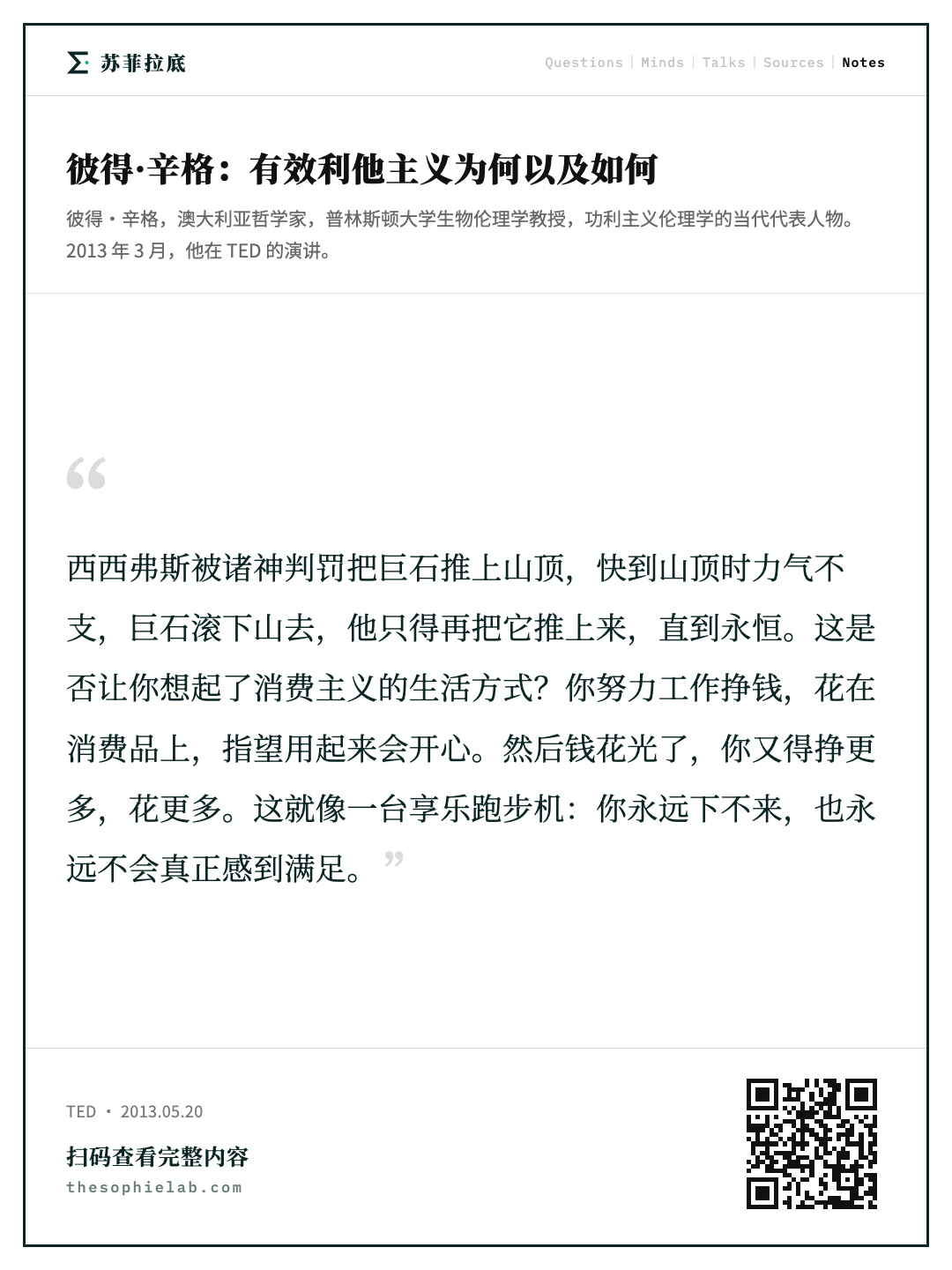
And Holly Morgan told me that she used to battle depression until she got involved with effective altruism, and now is one of the happiest people she knows. I think one of the reasons for this is that being an effective altruist helps to overcome what I call the Sisyphus problem. Here's Sisyphus as portrayed by Titian, condemned by the gods to push a huge boulder up to the top of the hill. Just as he gets there, the effort becomes too much, the boulder escapes, rolls all the way down the hill, he has to trudge back down to push it up again, and the same thing happens again and again for all eternity.
Does that remind you of a consumer lifestyle, where you work hard to get money, you spend that money on consumer goods which you hope you'll enjoy using? But then the money's gone, you have to work hard to get more, spend more, and to maintain the same level of happiness, it's kind of a hedonic treadmill. You never get off, and you never really feel satisfied. Becoming an effective altruist gives you that meaning and fulfillment. It enables you to have a solid basis for self-esteem on which you can feel your life was really worth living.
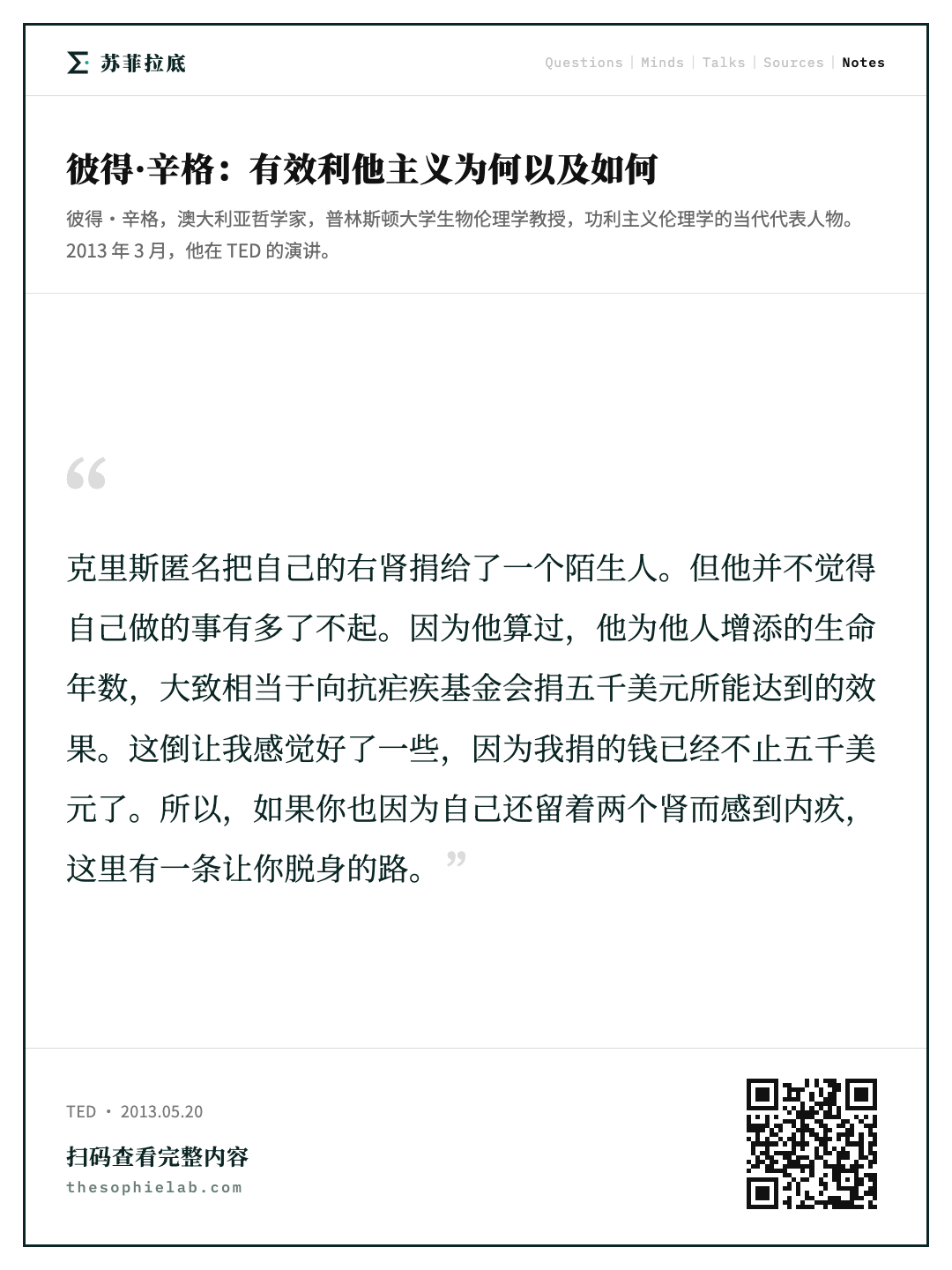
I'm going to conclude by telling you about an email that I received while I was writing this talk just a month or so ago. It's from a man named Chris Croy, who I'd never heard of. This is a picture of him showing him recovering from surgery. Why was he recovering from surgery? The email began, "Last Tuesday, I anonymously donated my right kidney to a stranger. That started a kidney chain which enabled four people to receive kidneys." There's about 100 people each year in the U.S. and more in other countries who do that.
I was pleased to read it. Chris went on to say that he'd been influenced by my writings in what he did. Well, I have to admit, I'm also somewhat embarrassed by that, because I still have two kidneys. But Chris went on to say that he didn't think that what he'd done was all that amazing, because he calculated that the number of life-years that he had added to people, the extension of life, was about the same that you could achieve if you gave 5,000 dollars to the Against Malaria Foundation. And that did make me feel a little bit better, because I have given more than 5,000 dollars to the Against Malaria Foundation and to various other effective charities.
后半段以「四个阻碍捐赠的问题」组织:(1)我能做多大改变——Toby Ord 的10%誓言与 Bresler 夫妇的中年回归;(2)该不该放弃职业——80,000 Hours 与「赚钱以捐」的五倍逻辑;(3)慈善真的有效吗——导盲犬 vs 沙眼手术的千倍差距,GiveWell 数百家中只推荐三家,并延伸到动物福利与灭绝风险;(4)捐赠是负担吗——关键转折:从义务论证转向自利论证,用西西弗斯与「享乐跑步机」说明消费主义的空转,而利他提供意义与自尊。
1. Does it really matter that …? I don't think it does.
“Does it really matter that we're not walking past them in the street? Does it really matter that they're far away? I don't think it does make a morally relevant difference.”
连续自问后自答,用于挑战听众默认假设。适合论证性演讲:先把对方的隐含前提说出来,再否定。仿写时注意 does 的强调用法。
2. before you give yourself too much credit, look at this
“But before you give yourself too much credit, look at this.”
先让对方自我肯定,再用转折引入反例。「give sb. credit」= 认可某人。适合在演讲或写作中制造认知反转。
3. You could A, or you could B. I think it's clear what's the better thing to do.
“You could provide one guide dog for one blind American, or you could cure between 400 and 2,000 people of blindness. I think it's clear what's the better thing to do.”
并列两种选择并让数据自己说话,结论句故意克制。用于对比论证,比直接断言更有说服力。
4. Well, you might say, … But if I'm not, what can I do?
“Well, you might say, that's fine if you're a billionaire, you can have that kind of impact. But if I'm not, what can I do?”
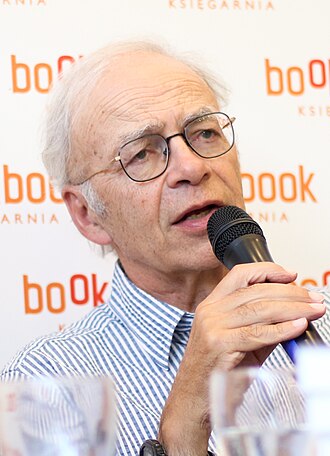
Toby Ord 是牛津大学哲学研究员,创办了 Giving What We Can(第9段),邀请人们承诺终身捐出收入的10%对抗全球贫困;他本人承诺每年只靠1.8万英镑(不到3万美元)生活,其余全捐,且已婚有房贷。Will Crouch(即后来的 Will MacAskill)是哲学研究生,创办了 80,000 Hours 网站(第12段),名字来自人一生投入职业的小时数,提供高影响力职业建议,其中包括建议有能力者进入金融业以「赚钱来捐」,因为捐款可雇用多名援助工作者,影响力能放大五倍。
「心」指共情——你为那个孩子感到的痛(第5段);「脑」指理性——确保你的行动有效、方向正确。辛格认为二者缺一不可:光有共情可能把钱捐给低效机构,光有理性则没有行动动机。他在第6段进一步主张,理性不只是达成欲望的「中立工具」,还能让我们「看清处境全貌」,即扩展道德关怀圈。正因如此,善于抽象推理、习惯比较与量化的哲学、经济学、数学背景者更容易接受「所有生命等价」和「按效果分配资源」的结论——他以盖茨(「书呆子」)为例,说盖茨基金会的口号「All lives have equal value」正是这种理性理解的体现。
这是他的第四个问题(第19-21段)。他先给个人证词:自己从研究生起就享受捐赠;Charlie Bresler 说他拯救的是「自己的人生」;Holly Morgan 曾抑郁,投身有效利他主义后成了最快乐的人之一。然后给出解释:消费主义生活像西西弗斯推石——努力挣钱、消费、钱花完、再挣、再花,幸福感始终回落到原点,这就是心理学所说的「享乐跑步机」,你永远下不来也永远不满足。而有效利他主义提供意义感和成就感,给自尊一个「坚实基础」,让人觉得人生值得一过。因此捐赠不是负担,反而是摆脱空转的出路。
9. 结尾的捐肾故事在整个论证中起什么作用?辛格为何说「这让我好受了一点」?
Chris Croy 匿名捐出右肾,启动了让四人获肾的捐赠链(第22段)。这个故事首先展示有效利他主义可以走到极端的身体牺牲;但辛格的重点在第23段的折算:Croy 自己算出,他为他人增加的生命年数大约等于捐5,000美元给对抗疟疾基金会的效果。辛格说这让他「好受一点」,因为他捐的钱早已超过5,000美元——即他已在做等价的好事,不必因「还有两个肾」而内疚。这个结尾的作用是:一方面用同一尺度(生命年)把捐肾与捐款放在一起比较,再次体现「道德可计算」的思路;另一方面用幽默消解全篇的道德压力,告诉听众有一条容易得多的「脱身之道」。
根据演讲中的立场,辛格大概会这样回应:第一,拒绝计算并不能让个体「更有尊严」,只会让更多个体死去——第16段中被导盲犬方案「忽视」的那400到2,000个失明者同样是有尊严的个体,不计算恰恰是对他们的漠视。第二,计算的前提正是尊重每个人(「All lives have equal value」,第7段),拒绝计算往往是在暗中给「离我近的人」更高权重,那才是把远方的人当成统计单位。第三,他会承认(第5段)「心」仍然重要——共情是动机来源,计算只是保证共情不被浪费。他可能补充第23段的例子:捐肾者自己就用生命年折算自己的善行,并不觉得这贬低了自己。
11. 辛格的论证在2013年针对的是「全球贫困」;如果把同样的逻辑用于「资助 AI 安全研究」这种收益高度不确定的领域,还成立吗?
部分成立,部分需要修改。成立的部分:辛格在第18-19段已经把逻辑延伸到「降低人类灭绝风险」(如偏转小行星),承认高影响、低概率的事业也值得投入,这与后来 EA 关注 AI 风险一脉相承。不成立或需修改的部分:辛格对抗疟疾基金会的推荐依赖「可靠证据」(第4段:蚊帐发放后会被使用,死亡率确实下降)和 GiveWell 式的严格筛选(第17段:数百家中只推荐三家)。AI 安全研究缺乏这种可验证的成本效益数据,收益估算依赖主观概率,容易出现「巨大数字乘以微小概率」的推理陷阱。因此按辛格自己的「用脑确保有效」标准,对这类领域应保持更高的证据要求,而不能简单套用「期望值最大化」。