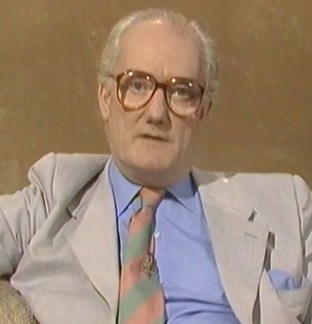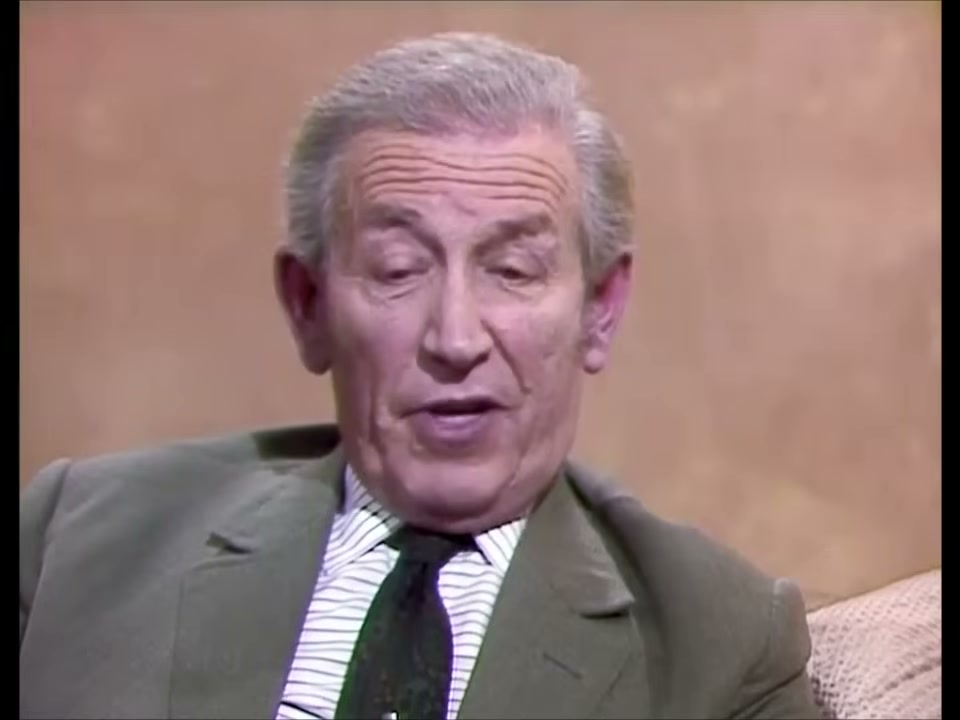
视频库 / NO.056ASK THE BEST MINDS THE BIG QUESTIONS一人,一实验室
视频库 / NO.056
字幕 字幕位置
--:--
点击播放,这里会跟随视频显示当前句的中英字幕。
第 56 期

Friedrich Nietzsche's Philosophy - J. P. Stern & Bryan Magee (1987)

节目发布 2023-08-25
章节 · 点击跳转视频
0:00 尼采生平与著作概览 ▶ 正在看
1:51 上帝之死与价值重估的起点 ▶ 正在看
4:23 批判基督教道德与扶弱伦理 ▶ 正在看
6:39 反对普遍规则与民主平庸 ▶ 正在看
7:46 苏格拉底如何终结希腊黄金时代 ▶ 正在看
8:54 起源决定价值:达尔文与19世纪思潮 ▶ 正在看
11:26 尼采的心理学洞见与无意识 ▶ 正在看
13:43 知识不是绝对:求知的致命代价 ▶ 正在看
14:45 破坏之后他主张建立什么 ▶ 正在看
17:12 扫除弱者:与法西斯的危险距离 ▶ 正在看
19:28 生命至上:真理服从于强者断言 ▶ 正在看
23:03 权力意志:叔本华的反转 ▶ 正在看
25:34 超人不是纳粹的超人 ▶ 正在看
28:08 永恒轮回作为思想实验 ▶ 正在看
30:30 隐喻与概念交融的独特文风 ▶ 正在看
34:06 审美地为人生辩护:悲剧的智慧 ▶ 正在看
36:23 叶芝、劳伦斯与欧陆文学的回响 ▶ 正在看
39:53 纳粹挪用尼采:公平还是冤枉 ▶ 正在看
01尼采生平与著作概览
0:00
there can be little doubt I think that the two 19th century philosophers who have had the widest influence outside philosophy are Marx and Nietzsche in Continental Europe especially the influence of Nietzsche on philosophers since his day has been prodigious but he's also influenced creative writers including some of the most eminent in the English language for instance Bernard Shaw WB Yates and D.H Lawrence the quality of his own prose is simply dazzling and is second to nobody's Friedrich Nietzsche was born in Saxony in 1844 he had an academic career of extraordinary Brilliance as a classic scholar and became a full professor in his mid-20s an almost unheard of thing but then he threw over his University career went into isolation and became a philosopher for 16 years he poured out his writings mostly either short books or books of essays and aphorisms some of the best known titles are the birth of tragedy human All Too Human the gay science Beyond Good and Evil and most famous of all Thus Spoke zarathustra
我想毫无疑问,19世纪对哲学之外的领域影响最广泛的两位哲学家就是马克思和尼采。尤其在欧洲大陆,尼采对他之后的哲学家们的影响是惊人的,但他也影响了众多作家,包括一些英语世界中最杰出的作家,比如萧伯纳、叶芝和D.H.劳伦斯。他自己的散文品质简直令人炫目,不逊于任何人。弗里德里希·尼采1844年出生在萨克森。他有着极为辉煌的学术生涯,作为一名古典学者,二十多岁就当上了正教授,这在当时几乎闻所未闻。但随后他放弃了大学的职位,隐居起来,成了一名哲学家。在十六年里,他倾泻般地写作,大多是些篇幅不长的书,或者由随笔和箴言组成的集子。一些最著名的书名有《悲剧的诞生》《人性的,太人性的》《快乐的科学》《善恶的彼岸》,还有最有名的《查拉图斯特拉如是说》。起初他深受叔本华和瓦格纳思想的影响,但他
便签笔记
1:08
first he was deeply influenced by the ideas of schopenhauer and Wagner but he rebelled against both and went on to produce some Notorious anti-wagner polemics until the last four years of his creative life he made no attempt to build a system of any kind but then he began to think of drawing all his main themes together into one single comprehensive work first to be called the will to power then the revaluation of all values but it was not to be always plagued by ill health in January 1889 he collapsed into mental illness a condition almost certainly caused by tertiary syphilis and he was helplessly insane until his death in 1900.
对二者都起而反叛,后来还写出了几篇声名狼藉的反瓦格纳论战文章。直到他创作生涯的最后四年,他都没有试图去构建任何体系,但那时他开始考虑把自己所有的主要主题汇拢进一部综合性的著作,起初打算叫《权力意志》,后来叫《一切价值的重估》。但这没能实现。他一直饱受疾病困扰,1889年1月,他精神崩溃,陷入精神疾病,这几乎可以肯定是三期梅毒所致。此后他一直处于无助的疯癫状态,直到1900年去世。
便签笔记
02上帝之死与价值重估的起点
1:51
with me to discuss his work is J.P Stern professor of German in the University of London and author of one of the best known of the many books on Nietzsche Professor Stern I think one can say that Nietzsche was the first philosopher really to face up to Western man's loss of faith in religion loss of belief in God or in the existence of any world outside this one and if there's no God and no transcendental world then all values or truth rationalities standards of any kind are not given to man from some agency outside himself but are created by man presumably for his own needs we choose our values or at least we create our values now this is an extraordinary disruptive and disturbing thing to confront Anita knew that can we start the story from there yes I think that this is a perfectly Fair will starting in addition to what you said about his life I think I might mention that he was the son of the man's that he himself had his father was a was a minister of the Lutheran Church and therefore his attack on Christianity is
与我一起讨论他著作的是伦敦大学德语教授J.P.斯特恩,他也是最出色的一部作品的作者……在众多研究尼采的著作中——斯特恩教授,我想可以这么说,尼采是第一位哲学家真正直面了西方人信仰的丧失,不再相信上帝,也不再相信存在任何此世之外的世界。而如果没有上帝、没有超验世界,那么一切价值、真理、理性、标准便不再是由人之外的某种力量赐予人的,而是由人自己创造的,大概是为了满足他自身的需要。我们选择自己的价值,或者至少是我们创造了自己的价值。而这是一件极其颠覆、极其令人不安的事,尼采对此心知肚明。我们能不能就从这里讲起?是的,我认为这是一个非常合理的开端。除了你刚才谈到的他的生平之外,我想我或许该补充一点:他出身牧师之家,他父亲曾是路德宗的一位牧师,因此他对基督教的攻击并不是中立的,而是带着切身利害的,绝不是
便签笔记
3:06
not a neutral not it is interested not a Pacific thing at all but is violent dramatic melodramatic in many ways days it's an attack on Christianity rather than on Christ and I think the point that you made that he envisages 19th Century men to have to stand on his own feet without the support of Faith or dogma of any kind is Central is a central kind of starting point to his philosophy I think we want to see him as somebody who does not simply profess a flat kind of atheism but who is personally intimately involved in the denial of divine Justice and divine mercy and all that but this nichean starting point did launch him didn't it into a revaluation of all values yes to use the title of his book I mean one thing he was saying was that uh in a way we are basing our lives on false premises because we adopt attitudes and values and standards which when we actually examine the premises of them we reject those premises premises what he believed in what he tried to show was that the whole edifice
平和的,反而在很多方面是激烈的、戏剧化的、甚至有些夸张的。那是对基督教的攻击,而不是对基督本人的攻击。我认为你提到的那一点——他设想19世纪的人必须靠自己站立,不依靠任何信仰或教条的支撑——是核心,是他哲学的一个核心出发点。我想我们应该把他看作这样一个人:他并不只是平淡地宣称自己是无神论者,而是切身地、深深地卷入到对神圣正义、神圣慈悲等等的否定之中。不过,尼采的这个出发点确实把他引向了“重估一切价值”,不是吗?是的,借用他那本书的书名。我的意思是,他所说的一点是,某种程度上我们是把生活建立在虚假的前提之上,因为我们采纳了一些态度、价值和标准,可当我们真正去审视它们的前提时,我们其实是拒斥那些前提的前提,他所信仰的东西,他试图表明的是:整座大厦——无论是基督教价值观,还是唯心主义(理想主义)
便签笔记
03批判基督教道德与扶弱伦理
4:23
both of Christian values and of idealism which he saw derivative from those values was false had to be thrown over and something else to be put in instead the question is to want us to be put in instead is not quite so simple but that was the basic premise from which he began and that I think makes for the melodrama the extraordinary melodrama of the person of the style of the whole phenomenon of nature now this revaluation of all values is of course a colossal task and I think it'll make our discussion of it clearer if we divide our consideration of it up a little bit yes there are four main Traditions within Western Civilization to which Nietzsche addressed himself in which he attacked the tradition of Christian morality the tradition of secular morality uh the herd values as he called them the ordinary morality of the mass of mankind and some at least of the Traditions deriving from ancient Greece that's right from Socrates now let's have a look at each of those four in turn can you say a little bit more about his
——他认为后者是从那些价值观派生出来的——都是虚假的,必须被推翻,然后用别的东西取而代之问题在于,究竟要用什么来取代它,这就没那么简单了,但这是他出发时的基本前提他就是从这里开始的,我想这也造就了那种情节剧式的效果——这个人本身、这种文风、乃至整个尼采现象所具有的那种非同寻常的戏剧性。那么,这种“重估一切价值”当然是一项极其庞大的工程,我想如果我们把它稍微分开来讨论,会更清楚一些。是的,在西方文明中有四大传统是尼采所针对、所抨击的:基督教道德的传统世俗道德的传统,还有他所谓的“畜群价值”,也就是大众的日常道德以及至少一部分源自古希腊的传统。没错,源自苏格拉底。那我们就依次来看看这四个方面吧。你能不能再多讲一点他对基督教价值观最根本的批评?我想先从
便签笔记
5:32
fundamental criticism of Christian values well I think to say to start with on the Christian I think the attack is a very simple one a very straightforward one all the positive values of Christianity turning your own turning the other cheek loving your neighbors you love yourself having compassion for those suffering all these are ruled out of court now not absolutely because as we shall see later I think I want to make that point very clearly nature is constantly making special rules for special people and he is very much against the notion of generalizing simply rules in the in the way in which Kant had done in the categorical imperative so yes the first thing then is the attack on not on Christ but on Christianity as really furthering the underdog furthering the person who cannot stand on his own feet and requires compassion requires pity requires illicitly requires sympathy from the outside but why was he against compassion and against pity why did he despise those so much he's not against
基督教这一点说起,我认为这个抨击非常简单、非常直截了当。基督教所有那些正面的价值——把另一边脸也转过去爱邻如己、对受苦者怀有同情——所有这些统统被他判定为不能成立。当然也不是绝对如此,因为我们后面会看到,这一点我想说得非常清楚:尼采总是不断地为特殊的人制定特殊的规则,他非常反对把规则一般化的做法,反对像康德在“绝对命令”中所做的那样。所以,第一点就是他的抨击——不是针对基督本人,而是针对基督教,因为基督教实际上是在助长弱者,助长那些无法自立、需要怜悯、需要同情、乃至不正当地需要外界给予的怜恤的人。但他为什么反对同情、反对怜悯呢?他为什么那么鄙视这些?他并不反对
便签笔记
04反对普遍规则与民主平庸
6:39
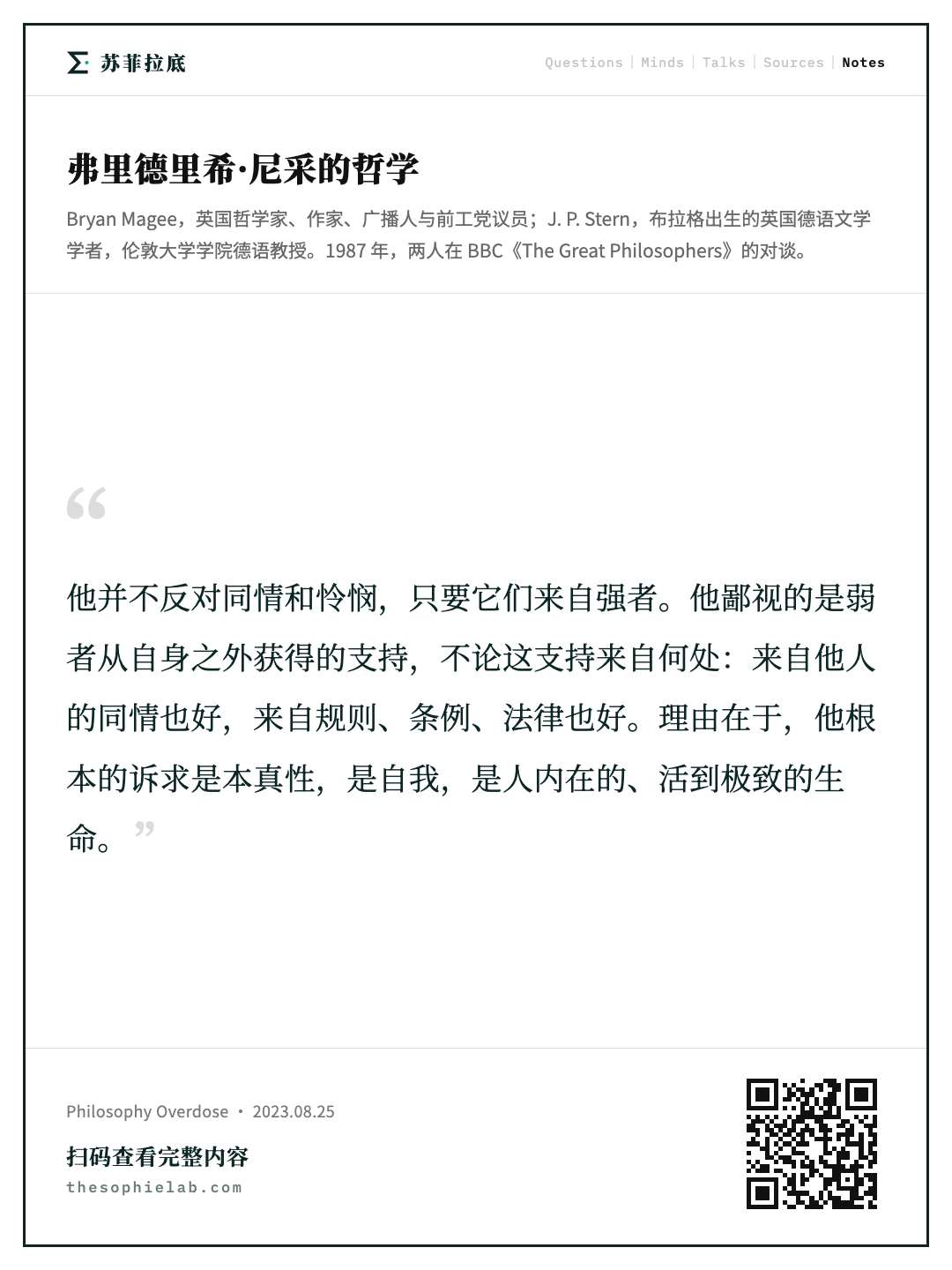
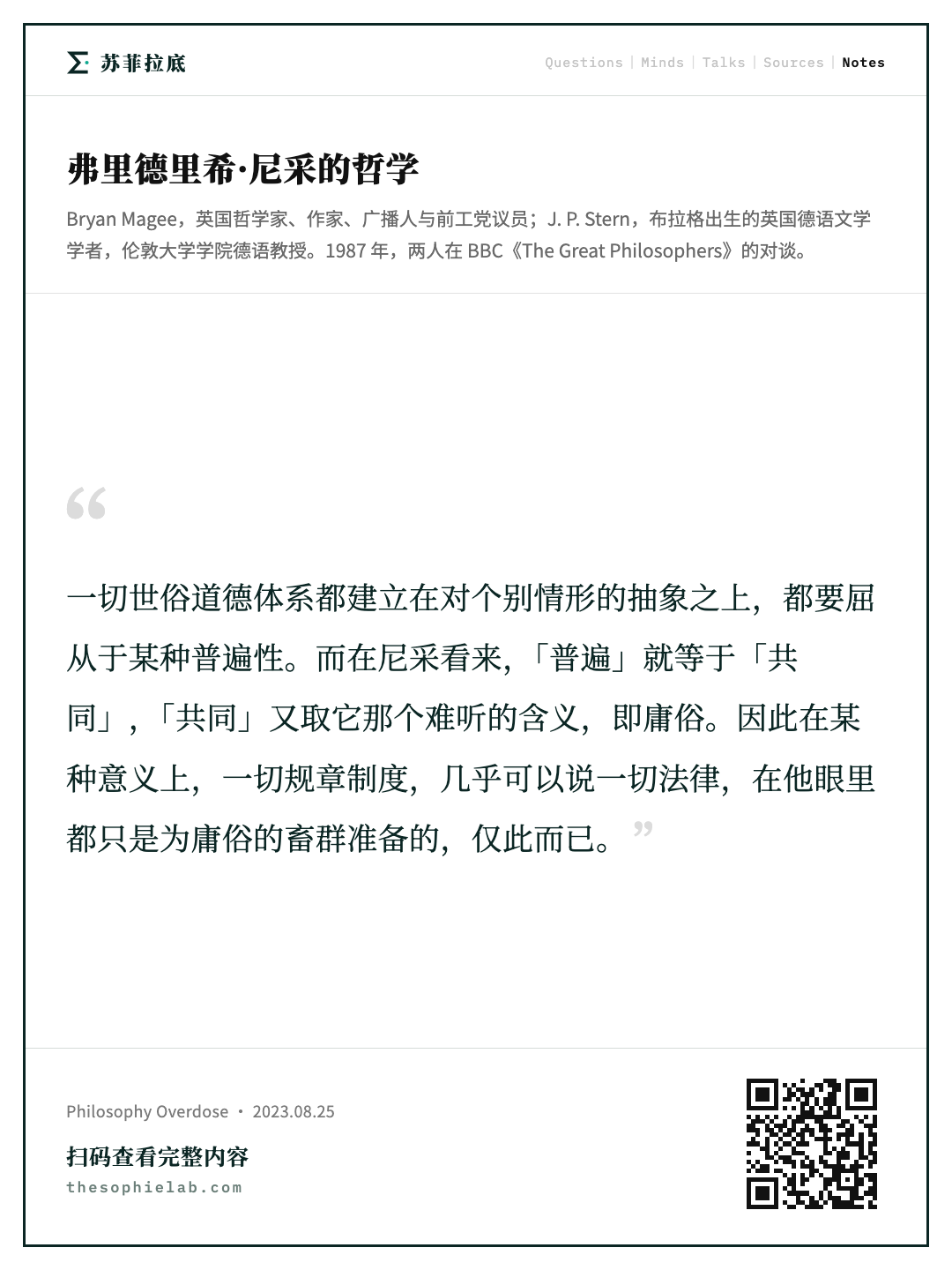
them he does not despise them and they come from the strong person what he despises is the support of the weak person from outside himself whatever that source is the outside Source may be whether it's another person his Compassion or rules or regulations laws or whatever and the reason for being against this was what the reason for being against it was his fundamental appeal is to authenticity to selfhood to the ELO vital to the life within the person lived to the Forum yeah now what about his criticism of secular morality I mean the Great moral philosophers like Kant or in his own day the utilitarians and so on that wasn't Christian morality quite but he was against that too yeah why I think the main reason there is this that all systems of secular moralities are based on an abstraction from the individual case they're based on nope yield to a generality for nature the word General is the same as common and by Common he means common in the nasty sense of the word and therefore in a sense all rules and regulations one
这些东西,他并不鄙视它们——只要它们出自强者。他所鄙视的,是弱者从自身之外获得支撑,无论那个来源是什么。这个外部来源可能是另一个人的怜悯,也可能是规则、规章、法律等等。那么他反对这一点的理由是什么呢?理由在于,他最根本的诉求是本真性、是自我,是生命的冲力,是人内在活生生的生命。好,那他对世俗道德的批评又是怎样的呢?我是说那些伟大的道德哲学家,比如康德,或者他同时代的功利主义者等等,那并不算是基督教道德但他同样反对,是吧?为什么?我想主要的原因在于:一切世俗道德体系都建立在对个别情形的抽象之上它们不是从个案出发,而是诉诸某种普遍性。而对尼采来说,“普遍的”(general)跟“共同的、平庸的”(common)是一回事而他说的 common,取的是这个词最难听的那层意思。因此,从某种意义上说,一切规则和规章
便签笔记
05苏格拉底如何终结希腊黄金时代
7:46
might almost go as far as saying all laws are for him matters for the common herd and no more and now we're of course already on the third point that you made the point about the common herd yeah he's most emphatically not a democratic philosopher he is a philosopher of the Great and the noble people the heroic kind of philosophy and therefore for him the appeal of democratic ideology is very very low indeed he thought that the the noble man the great man the hero should be a law under himself and shouldn't be hamstrung yes rules and regulations yes and so on that's the best phrase you can use a law unto himself yeah it's not the sentence he used but it's very very precise what he meant now what about the last of the four uh uh Traditions that I mentioned that of ancient Greece yes it's worth remembering in this context that he did start adult life as a classic scholar yes he knew about ancient Greece and became deeply critical didn't he of the whole tradition deriving from Socrates yes but
——甚至几乎可以说一切法律——在他看来都只是给芸芸畜群准备的,仅此而已。这样我们当然就已经说到你提的第三点了,也就是关于“畜群”的那一点。是的,他绝对不是一个民主的哲学家。他是属于伟大者、高贵者的哲学家,是一种英雄式的哲学。因此对他来说民主意识形态毫无吸引力可言。他认为高贵的人、伟大的人、英雄应当自成法度,不应当被束缚住手脚。对,被规则和规章之类束缚。“自成法度”正是最贴切的说法是的,这不是他原话里的句子,但非常精确地表达了他的意思。那么我提到的四大传统中的最后一个也就是古希腊的传统,又如何呢?在这个语境下值得记住的是,他成年后的第一份职业是古典学者。是的,他熟知古希腊,而且后来对整个源自苏格拉底的传统产生了深刻的批判,是吧?是的。不过他那部古典学著作——我认为那是有史以来关于悲剧问题
便签笔记
06起源决定价值:达尔文与19世纪思潮
8:54
uh his uh classical work and I think it's one of the most remarkable Works ever written on the whole problem of tragedy uh is concerned with pre-socratic Greece with pre-socratic tragedy which for him is a kind of golden age and the whole thing uh goes flat at the point when uh euripides Aristophanes and and Socrates come on the scene what happens there is that strength and Good Will and warmth and Beauty are replaced by reason are replaced by rationalizing things by the socratic arji bhaji he never forgave Plato so to speak for bringing up a hero whose main qualities are those of talking everybody else into the ground now this concern with the origins of culture which he displayed in such a rich way one has to say um was all bound up with his notion that we remake our that we make our values because if we if if human values and human culture are made by us and not given to us by God or authority outside ourselves then the whole question of how we get them where they come from becomes a fundamental one for him doesn't it and
所写的最了不起的著作之一——关注的是前苏格拉底的希腊,是前苏格拉底的悲剧,在他看来那是一种黄金时代;而整个局面在欧里庇得斯、阿里斯托芬和苏格拉底登场的那一刻就变得索然无味了。在那里发生的是:力量、善意、温情与美被理性所取代,被那种把一切理性化的东西所取代,被苏格拉底式的那套喋喋不休的论辩所取代。可以说,他从未原谅柏拉图塑造了这样一位英雄——其主要本领就是把所有人都用嘴皮子驳倒。那么他对文化起源问题的这种关注——他在这方面展现得如此丰富,这一点不得不说——都跟他这样一个观念紧密相连:我们重造、我们制造自己的价值。因为如果人的价值和人的文化是由我们自己造出来的,而不是由上帝或我们之外的某种权威赋予的,那么关于我们如何获得它们、它们从何而来的整个问题,对他来说就变成了根本性的问题,对吧?而这也是十九世纪的一个
便签笔记
10:17
it's also a fundamental 19th century concern the whole is concern with Origins yes and thinks of the Origin of Species was Nietzsche influenced by Darwin uh yes well as he certainly was anti-darwinian and I think the idea is that you didn't really understand very clearly what the whole theory of the origin of the species came to like so many 19th century figures he was always going to stay study physiology going to study chemistry going to study Physics but never got around to it so I don't think that there's an awful lot of interesting things to be said about his attitude to that but I think the main point about Origins is that again like some philosophers like Marx for instance he believes that you can determine the quality of the product by the nature and quality of the origin this after all is very much what Freud didn't I suspect Detroit got it very largely from Niche although he does isn't very ready to acknowledge it now what that means is really that the background the the genealogy of morals for institute quoted
根本关切,整个时代都在关注“起源”。是的,比如《物种起源》。尼采受到达尔文的影响了吗?呃,是的,不过他肯定是反达尔文的;而且我想问题在于,他并没有真正弄清楚整个物种起源理论到底讲的是什么。像许多十九世纪的人物一样,他总说要去研究生理学、要去研究化学、要去研究物理学,但从来没真正着手去做。所以我不认为在他对达尔文的态度上有多少值得一说的有趣东西。但关于“起源”,我认为最主要的一点是:他和某些哲学家一样——比如马克思——相信你可以通过起源的性质和品质来判定产物的品质。说到底,弗洛伊德做的也正是这件事,而我猜弗洛伊德很大程度上是从尼采那里得来的尽管他不太愿意承认这一点。这实际上意味着,道德的背景、道德的谱系——借用他的一个书名
便签笔记
07尼采的心理学洞见与无意识
11:26
one of the titles is in fact indicative of the quality of morals now let me say I don't believe this is true but I mean that is very much the 19th century view over and over again that you can determine the quality of a mental product by the nature by the origin that is is at the back of it yes and we are now inclined sometimes to call that the genetic fallacy which I don't want to go into this I think it's very close yes you all mentioned Freud prompts another question that I wanted to put to you this program of uh reevaluating values and seeing values as something that we create to meet our needs let Nietzsche to a psychological analysis of values in terms of both individual and social news it becomes an essentially psychological it is a way of cycle of psychologizing a lot of phenomena this is perfectly correct and indeed I think he was very remarkable psychologist in many ways and he puts um he does not produce a system either in Psychology or in anything else and in that sense he's different from Freud but
《道德的谱系》——恰恰能指示出道德的品质。我得说,我并不认为这是对的,但我的意思是这非常典型地代表了十九世纪的看法,一再出现:你可以通过一种精神产物的性质、通过它的起源来判定它的品质,这就是背后的想法。是的,而我们现在有时倾向于把这叫做“发生学谬误”,这个我不想深入展开。我想这两者非常接近。是的。你提到弗洛伊德,这引出了我想问你的另一个问题这种重估价值、并把价值看作我们为满足自身需要而创造出来的东西的纲领,把尼采引向了对价值的心理学分析,既从个体需要也从社会需要的角度来分析。它本质上变成了心理学的它是一种把大量现象加以心理学化的方式。这完全正确,而且我确实认为他在许多方面都是一位非常了不起的心理学家。他并没有建立一个体系,无论在心理学上还是在别的方面都没有;从这个意义上说他和弗洛伊德不同。但他又非常相似,实际上可以说是弗洛伊德的重要先驱,因为他
便签笔记
12:40
he's very very similar in fact very much of an antecedent to Freud because he places very great deal of emphasis upon the unconscious there is a myth about to the effect that Freud invented the unconscious nothing could be further from the truth the unconscious has been about since the end of the 18th century and Nietzsche is one of those who used the term and put tremendous emphasis on it but he does not have a layer theory of the self the way that Freud did as I say he is very very much less systematic he distrusts systems he thinks there's something indecent about trying to encapsulate a human being a human psyche within a systematic account another aspect of that is is his notion that that different moralities are different are appropriate for different people yes which he certainly had I mean wouldn't it be true to say well in fact you have said it I think that he distrusted rules he thought they hamstrung the strong they limited the creative yes yes he does believe that individual people are
极其强调无意识。外界有一种迷思,认为是弗洛伊德发明了无意识——这完全是误解,无意识这个概念早在18世纪末就已经存在了尼采就是使用这个术语的人之一,而且极为强调它,但他并没有像弗洛伊德那样提出一套自我的层次理论。正如我所说,他远没有那么系统化,他不信任体系,他认为试图用一套系统化的说法把一个人、一个人的心灵framework住,这里头有某种不体面的东西。另一个方面是,他认为不同的道德适用于不同的人。是的他确实这么认为。我是说,这样讲难道不对吗——其实我想你已经说过了——他不信任规则他认为规则束缚了强者,限制了有创造力的人。是的,是的,他确实相信每个个体
便签笔记
08知识不是绝对:求知的致命代价
13:43
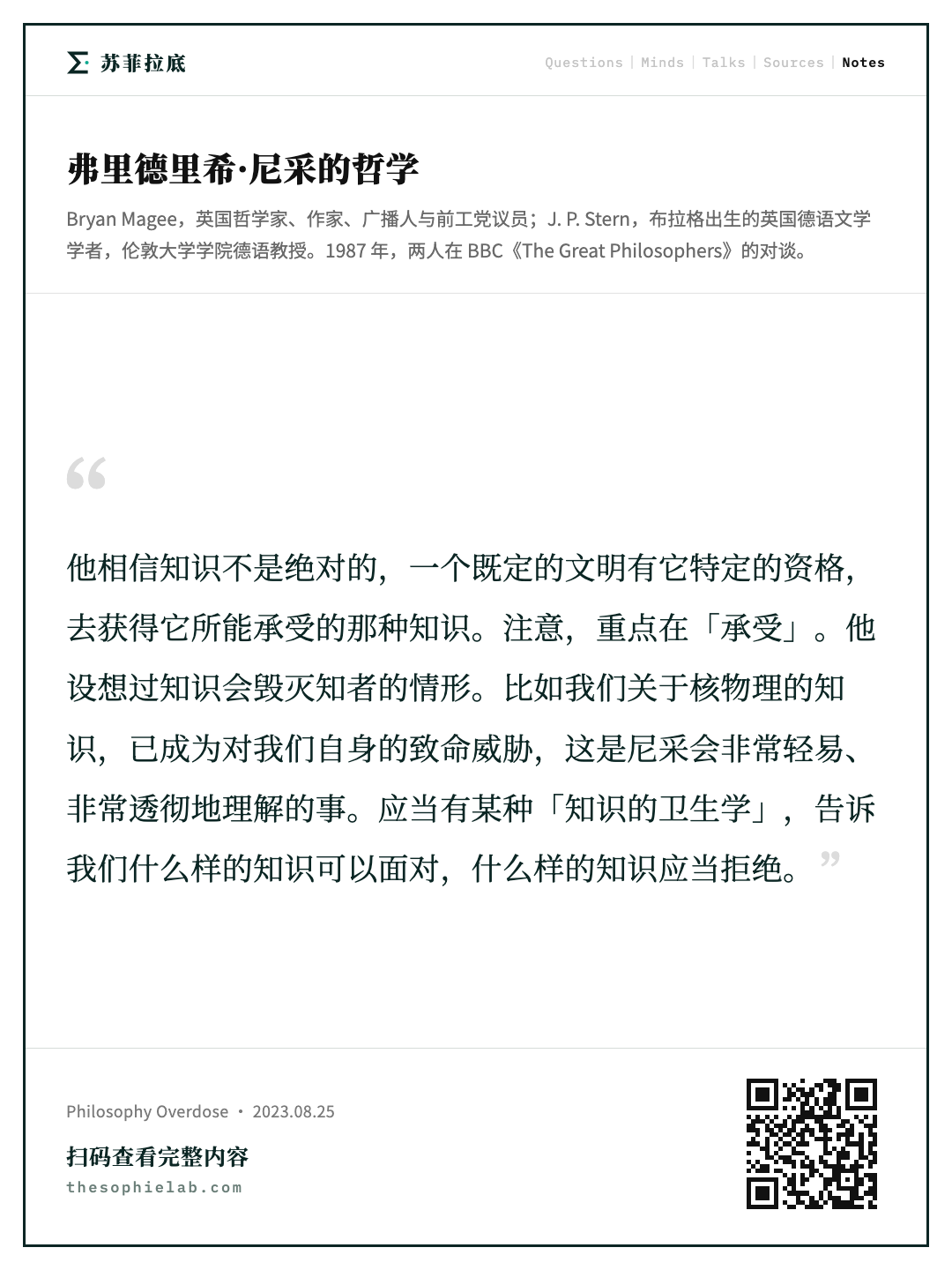
entitled to individual kinds of behavior and to individual bits of knowledge this is the most astonishing thing and also I think in many ways very prophetic kind of thing that he believed that knowledge was not absolute that the that the acquisition the pursuit of knowledge was not to be taken absolutely but that a given civilization had its own particular entitlement to the kind of knowledge that it could bear you see the emphasis is on it could bear it he didn't visit situations where knowledge would destroy the Noah our knowledge of nuclear figures for example has become a lethal threat to us and that is something that nature would very easily and very well have understood yes and she did in fact say so I mean not about nuclear physics of course but in about knowledge generally you see we only have really one other theory of knowledge apart from our own our own is that all knowledge is worth pursuing regardless isn't it yes well the other one is the Soviet idea which goes on and which
有权拥有属于自己的行为方式,有权拥有属于自己的那一份知识。这是最令人惊讶的一点,而且我认为在很多方面也极具预见性——他相信知识不是绝对的,对知识的获取、对知识的追求,不应被当作绝对的事情,而是每一个特定的文明都有其自身的资格,只能承受它所能承受的那种知识。你看,重点在于“它能够承受”。他没有设想过那种知识会带来毁灭的情形。比如我们对核物理的知识已经变成了对我们自身的致命威胁,而这恰恰是尼采会非常容易、非常透彻地理解的事情。是的,他事实上也确实这么说过——我是说,当然不是关于核物理,而是关于一般意义上的知识。你看,除了我们自己的知识观之外,我们其实只有另外一种知识理论。我们自己的观点是:一切知识都值得追求,无论如何。是这样吧?是的。而另一种就是苏联式的观念,它至今仍在延续,它建立的那套体系是:如果知识在社会上有用就去追求,如果没有
便签笔记
09破坏之后他主张建立什么
14:45
simply creates a system by which knowledge is socially useful and then pursued and not pursued if it's not socially useful Nature's view is somewhat similar to this he does believe that given civilizations can destroy themselves and the basic the ground on which all this is erected is in fact we're coming back now to Socrates the socratic Yin for knowledge there's this endless uh this driving force which pushes us on up to this point in our discussion we've talked about Nietzsche's critical Enterprise yes this basic view that up to this point in our history the morals and values and standards of Western Union have all been historically based on belief in a God or in Gods who gave us these values gave us these moral standards and so on and would judge us by our failure to live up to them or success in living to them and so on now he comes along he says we've lost belief in God we've lost belief in religion that means we've lost belief in the whole Foundation of our value system and if we're to have a valid value
社会用处就不去追求。尼采的看法与此有些相似。他确实相信特定的文明可以毁灭自己,而这一切所建立的基础,其实——我们现在又回到苏格拉底了——就是苏格拉底式的对知识的渴求,那是一种无穷无尽的、推动我们不断向前的驱动力。到目前为止,我们讨论的是尼采的批判性事业。是的,就是这个基本观点:直到我们历史上的这一刻为止,西方世界的道德、价值和标准,在历史上一直建立在对一位神或诸神的信仰之上,是他们给了我们这些价值、这些道德标准等等,并且会根据我们是否达到这些标准来审判我们,如此等等。而现在他出现了,他说:我们已经失去了对上帝的信仰,失去了对宗教的信仰,这就意味着我们失去了对整个价值体系之根基的信仰。如果我们要拥有一套有效的价值体系,就必须重新评估它,从根基上重新奠定它。我们
便签笔记
15:57
system we've got to re-evaluate it and re-found it from the bottom up and we've not we've talked of some of the various critiques individual critiques into which this led him I now want us to move on from this to the next stage of the discussion in a sense it's the obvious question to ask what were his positive values having as it were swept everything away on a colossal scale what is he now advocating that we put in its place well the answer to that is a very simple and a very complicated one both at the same time the simple answer is be yourself at the top of of everything that you are to to to the hilt live your life Fully live it adventurously and all the other things which later on come under the under the heading of elong vital that in the human sphere I mean that essentially the be thou thyself is the major premise from which he begins since also the goal to towards which ethics ought to the goal uh towards which ethics ought to be directed now you may ask of course if everybody is himself and himself alone
已经谈了这一思路引出的若干具体批判。现在我想让我们从这里进入讨论的下一个阶段。从某种意义上说,这是个显而易见的问题:他积极主张的价值是什么?在他以如此宏大的规模把一切都扫除之后,他现在主张我们用什么来取代它们呢?嗯,这个问题的答案既非常简单又非常复杂,两者兼具。简单的回答就是:做你自己,把你身上的一切发挥到极致,彻彻底底地活出你的人生,充分地活,冒险地活,以及后来被归到“生命冲动”(élan vital)这一名目下的所有那些东西——我指的是在人的领域里。本质上,“成为你自己”正是那个最重要的大前提,由此出发……他从这里出发,同时也把它当作伦理应当指向的目标——伦理应当朝着的那个目标。当然,你可能会问,如果每个人都只是他自己、只属于他自己,那这该怎么做到呢?在更大的范围内该怎么做到?在一个政治体系当中又该怎么做,等等。对这个问题的回答,
便签笔记
10扫除弱者:与法西斯的危险距离
17:12
how is this to be done uh in a wider sphere how is this to be done in a political system and so on the answers to that question are I'm afraid very unsatisfactory as far as he's concerned as indeed his whole attitude towards social questions never does get very far now I said also that this is very very complicated precisely for this reason because it makes living together living together in some kind of Harmony extremely difficult if you add to this The View that laws are after all theirs simply to make easy make things easy for the weak person you can see there's not very much purchase to be got out of that either so it is on the face of it a simple system but um basically I think there is a great deal of difficulty facing anyone who's going to put this forward in a sense I think we can say that some of the more uh some of the fascist uh politics early of of the early part of this century is based to some extent among the intellectuals at any rate on this view that you must create your own values
恐怕就他而言是非常不能令人满意的,正如他对社会问题的整体态度也从来没有走得很远。我刚才还说过,这件事非常非常复杂,恰恰就是因为这个原因,因为它使得共同生活——以某种和谐的方式共同生活——变得极其困难。如果你再加上这样一种看法:法律说到底只是为了让弱者的日子好过一些、让事情变得容易一些,你就会发现,从那里也得不出什么有用的东西来。所以表面上看它是一个简单的体系,但从根本上说,我认为任何一个要来主张这套东西的人,都会面临极大的困难。在某种意义上,我想我们可以说,本世纪早期一些法西斯政治,至少在知识分子当中,在某种程度上就是建立在这种观念之上的,即你必须创造你自己的价值。可是正如你所见,这并没有带我们走多远。
便签笔记
18:23
well it hasn't got us very far as you can see but this notion that you must say as he put it say yes to life yes affirm life is be untraveled to the top of your Bend uninhibited also led him to the view that that of course this is going to lead you into conflict with other people but you must simply sweep them aside you must sweep away the weak and the unable and all those who as it were get in your way yes that of course is absolutely flat head on in conflict with Christian morality yes it has but then you see you've only mentioned one half of it the other part of it is you must also conquer all that is comfortable all that is cowardly or that is less than adventurous within yourself and if you've done that that is the view that he puts forward in saratustra for instance if you've done that you won't really want to be so very aggressive towards the others you will have some understanding of their weaknesses though the understanding of the the positive the tolerant understanding of weaknesses is not
但这种观念——用他的话说,你必须对生命说'是',肯定生命,要毫无拘束地走到极限、毫无顾忌——也使他得出这样的看法:这当然会让你和别人发生冲突,但你必须干脆把他们推到一边。你必须扫除弱者、无能者,以及所有挡在你路上的人。是的,这当然是与基督教道德正面、彻底地冲突。是的,确实如此。不过你看,你只提到了它的一半,另一半是:你还必须征服一切安逸的东西、一切怯懦的东西,或者那是一种在你内心之中不那么冒险的东西——如果你做到了这一点,这就是他在《查拉图斯特拉》里提出的观点,比如说,如果你做到了这一点,你就不会真的想对他人那么咄咄逼人,你会对他们的弱点有某种理解,不过对弱点的那种理解——那种正面的、宽容的理解——恰恰不是尼采的强项,他最出名的
便签笔记
11生命至上:真理服从于强者断言
19:28
precisely uh nietro's very strong what is most famous for yeah I mean people of course have always been shocked by his saying this and they've thought that what he was advocating was contrary to moral standards and so on yes but his point of course was that that in fact model standards ought to be derived from life or to be subordinate to life yes that our nations of Truth and rationality and all the rest ought to derive from Life assessments from the great man yes from the great man and by the great man he meant as I already mentioned uh Gerta would be one um Napoleon would be another sometimes Luther sometimes even some of the great borja popes would figure is that and sometimes even Socrates would because he had the strength of mine to carry through his own project but this supremacy of Life assertion yes self-assertion it means that even truth truth itself must be subjugated to them if there are truths that would damages that in other words would damage Our Lives then we don't want to yes you see
是——是啊,我是说,人们当然一直对他说这种话感到震惊,他们认为他所主张的东西是违背道德标准的等等,是的,但他的意思当然是,事实上道德标准应该从生命中推导出来,或者说应该从属于生命,是的,我们关于真理、理性以及其他一切的观念应该来自对生命的评判,来自伟人,是的,来自伟人,而所谓伟人,他指的是我前面已经提到过的,比如歌德算一个,嗯,拿破仑算一个,有时是路德,有时甚至是某些伟大的博尔吉亚家族的教皇们会是这样的形象,有时甚至苏格拉底也会,因为他有足够坚强的意志去贯彻自己的规划。但这种生命至上的主张——是的,自我肯定——它意味着连真理,真理本身,也必须服从于它们如果有些真理会损害这一点,换句话说会损害我们的生命,那我们就不要它。是的,你看
便签笔记
20:34
we're back again at the question of the entitlement to truth or of at what he once called the hygiene of knowledge there ought to be some kind of hygiene that would tell us what kind of knowledge we may face and what kind of knowledge we should reject and you're quite right the truth itself in that way is subjected to this kind of embargo to this kind of to this kind of sanction that he puts forward well about to see is absolutely how this is flat contrary to all moralities that have actually existed would it be true to say that Nietzsche's defense if he deigned to defend himself against criticism would have been to say something like this but look the whole of civilization Humanity itself if you like the whole evolutionary process has consisted of the strong eliminating the weak the able eliminating the unable the intelligent eliminating the stupid and it's only because these processes have gone on perpetually over millions of years that we have any civilization at all that we have any Humanity at all these things
我们又回到了那个问题:我们是否有资格拥有真理,或者他曾经称之为「知识的卫生学」的那个问题应该有某种卫生学,告诉我们哪一类知识是我们可以直面的,哪一类知识是我们应该拒斥的。你说得很对,真理本身就这样被置于这种禁令之下,被置于他所提出的这种……这种制裁之下嗯,我们接下来要看的是,这一点与所有实际存在过的道德体系是何等地截然相反存在,那么可以说,尼采如果肯屈尊为自己辩护、回应批评的话,他的辩护大概会是这样的:可是你看,整个文明,人性本身,如果你愿意这么说的话,整个进化过程,都是由强者淘汰弱者、能者淘汰无能者、聪明人淘汰愚蠢者构成的,正是因为这些过程在数百万年间不断进行,我们才有了文明,才有了人性,是这些东西创造了我们的价值。是的,我认为他说的正是这个意思,而你
便签笔记
21:41
have created us value yes I think that is precisely what he says and what you would say a number of occasions different contexts and his worry about the future is precisely that this kind of thing will not go on that the Democratic Spirit the spirit of the plebs of the of the rebelment will take over and will annihilate all these values that it will put into reverse the very process that has actually created civilization but in addition to that I think we have to bear in mind that he has a view of History which is rather different from The View on which your analysis was based he sees history as repeating itself now what that means we shall talk about that a little later but what it essentially means is this that any historical situation can create and absorb and make use of the highest that man is capable of creating their own to any privileged situations there are no privileged errors and and therefore any era that sees itself as capable of fully understanding of fully creating these values should be should allow should be
会说他在许多场合、不同语境下都这么讲过。而他对未来的担忧,恰恰就是这种事情不会再继续下去,就是说民主精神,那种平民的精神、贱民的精神会占上风,会毁掉所有这些价值,会把真正创造了文明的那个过程整个倒转过来。但除此之外,我认为我们还必须记住,他的历史观和你的分析所依据的那种看法相当不同。他把历史看作是不断重复的。这究竟意味着什么,我们稍后再谈,但它本质上的意思是:任何一个历史处境都能够创造、吸收并运用人所能创造的最高的东西,不存在什么享有特权的处境,不存在享有特权的时代,因此任何一个自认为有能力充分理解、充分创造这些价值的时代,都应当被允许这样去做。而问题在于
便签笔记
12权力意志:叔本华的反转
23:03
allowed to do that and the trouble is that late 19th century the early 20th century may very well be what he calls areas of decadence in which this strength cannot be fully realized now your mention of his doctrine that history repeats itself brings me to what I would like to think of as the next stage in our discussion when one comes to regard Nature's later work there are four big themes in it and again I think for clarity's sake it will help if we take them one at a time yes one is uh what you might summarize under the phrase the will to power a phrase which he has popularized one is the Ubermensch or translated as the Superman again an invention of his that's entered our language one is this Doctrine new mention of the Eternal currents of time and the fourth I would say is his notion of the aesthetic understanding of life now let's deal with those in order let's cut let's talk first about the will to power which at one time he was going to give as a title to the summation of his life's work yes
十九世纪末、二十世纪初很可能正是他所谓的颓废时代,在其中这种力量无法充分实现。那么你提到他那个历史不断重复的学说,这就把我引向了我们讨论的下一个阶段。当我们来看尼采的后期著作时,其中有四大主题,我还是认为为清楚起见,我们一个一个来谈会比较好。好的。第一个就是可以概括为“权力意志”的东西,这个说法是他让它流行起来的。第二个是“超人”(Übermensch),译作 Superman,同样是他的发明,已经进入了我们的语言。第三个就是你刚提到的那个永恒轮回的学说。第四个我认为是他关于从审美角度理解人生的看法。那我们就按顺序来谈。我们先谈权力意志,他曾经一度打算把它作为自己毕生思想总结之作的书名。是的。他这个概念到底是什么意思?好的,权力
便签笔记
24:12
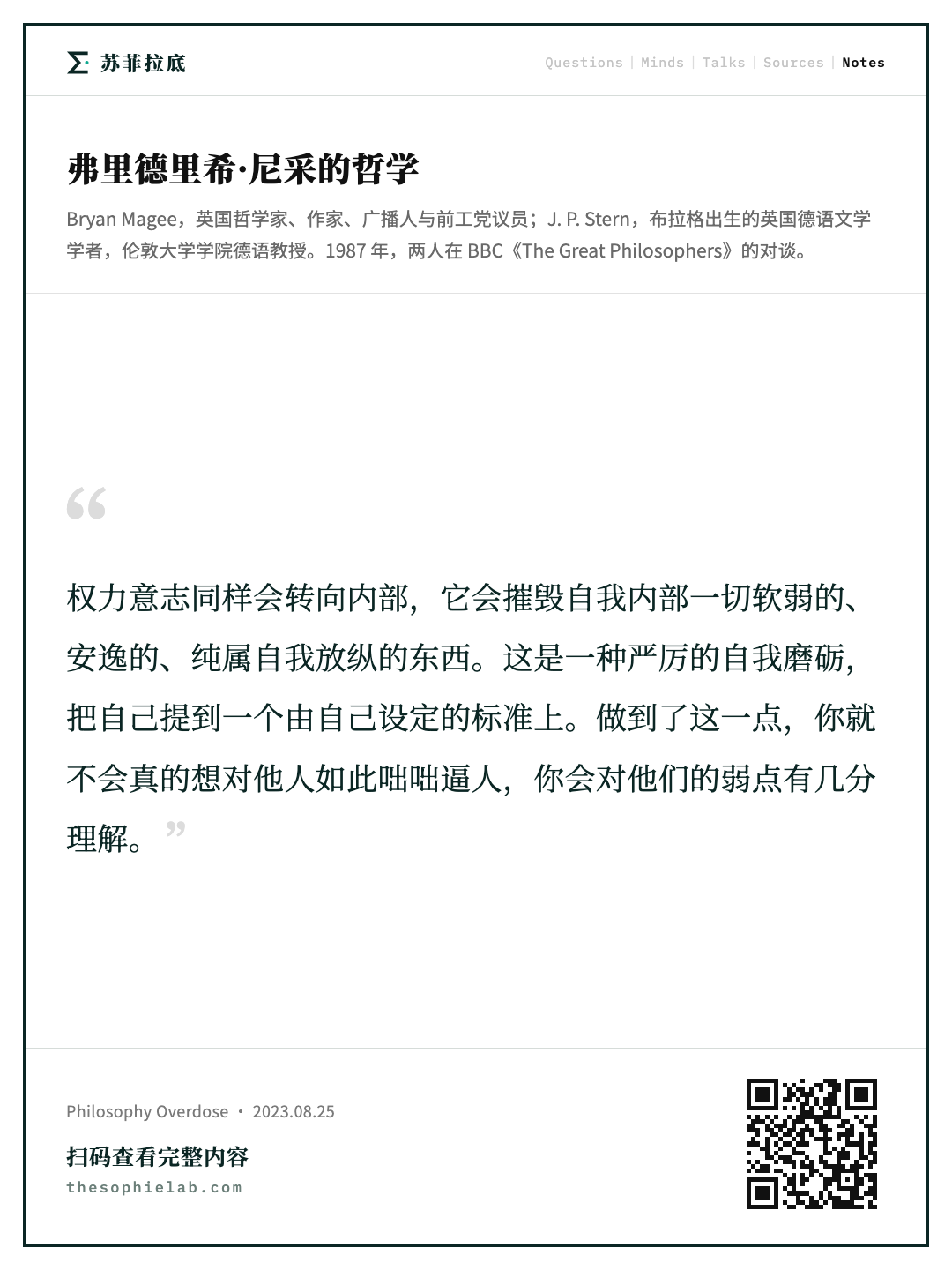
what was this notion of his yes the will to power well he takes the notion the will from your own special philosopher Schult of course and he reverses the the evaluation of that where she regarded the will as the source of all evil in the world and as the source of man's unhappiness he regards it as the strength of uh of men's man's strength the source of man's strength and the um the cultivation the permission to the will to enact what it can enact is part of a healthy culture now the the difficulty there I think is that this obviously brings you in conflict with other people and therefore at this stage the will to power becomes it becomes a will to self-assertion uh will to use a user a patient of the other but that's not all there is to the will I think it's to be emphasized not over emphasized as some some critics have done but to be emphasized that the will to power also turns itself inward that is to say it destroys within the Seraph all that is weak or that is comfortable or that is uh simply
意志。他从你所专门研究的那位哲学家叔本华那里接过了“意志”这个概念,当然,然后他把对它的评价整个颠倒过来。叔本华把意志看作世上一切恶的根源,看作人类不幸的根源,而尼采则把它看作人的力量,人的力量之所在、力量的源泉。而且培育意志、允许意志去实现它所能实现的东西,这是健康文化的一部分。而我认为这里的困难在于这显然会使你和别人发生冲突,因此在这个层面上,权力意志就变成了一种自我伸张的意志,一种利用他人、把他人当作受动者的意志。但意志并不止于此,我认为这一点应该强调——不是像某些批评者那样过度强调,但确实应该强调——那就是权力意志也会转向内部,也就是说,它会摧毁自身之中一切软弱的、贪图安逸的东西,或者说一切属于人自我放纵的东西,是一种极其严厉地把自己逼到自己所设定的标准之上的做法,
便签笔记
13超人不是纳粹的超人
25:34
um yes part of uh a man's self-indulgence kind of drastic bringing of oneself out to the market up to up to the mark which one has created oneself and this is the difference yes that's right yes yes well now let's move on then to the the next of the four main themes of his later words the Superman now everybody knows the word Superman and it was in fact nature who invented it it's been a very much misunderstood concept people have Associated it with the blonde Beast of hitlerian Mythology and Nazi caricature because that's not what he meant at all I think that is not what he meant at all um I think the Superman is the man the production I mean who can be produced by any civilization remember I said that any any era is capable of bringing forth the maximum values that men are capable of Superman is the man who lives all that the will to power will secure for him lives it to the full is capable of uh repeating his own willing and infinitum we're already arriving at the doctrine at that most
而且这标准是自己定的。这就是区别所在。对,正是如此。好,那我们现在就谈他后期著作四大主题中的下一个:超人。现在人人都知道“超人”这个词,而它其实正是尼采发明的。这个概念一直被严重误解,人们把它和希特勒神话里的“金发野兽”以及纳粹式的漫画形象联系在一起。因为那根本不是他的意思。我认为那完全不是他的意思。嗯,我认为超人是任何一种文明都可能造就出来的那种人。记得我说过,任何时代都有能力产生出人所能达到的最高价值。超人就是那种把权力意志所能为他争得的一切都活出来的人,把它活到极致,并且能够无限地一再重复自己的意愿。我们这就已经要谈到那个学说了,那个在他所有观点中最有争议、如果你愿意说的话也最离奇的观点,
便签笔记
26:52
controversial of all the things the most bizarre if you like of these views the the Eternal recurrence yes let's get there yet because I want to unpack this notion of the Superman yes which is played such an enormous role in his thought in the last hundred years yes and being so abused and misused by the nuts yes for example um wouldn't it be truer to say that what Nietzsche was actually trying to get at was the notion of an unrepressed man yes and if you like the Freudian sense yes a man who has re-evaluated his values yes who is not living his life according to false values who is being to the top of his best in an uninhibited untrammeled free spirit way isn't that rather yes I think that is so and but it would be a man who without as it were restricting himself would naturally instinctively not do any of the things that Nietzsche regards as evil for instance the one category that he comes out uh unequivocally that comes out unequivocally in his system is grudgingness is what he calls
永恒轮回。是的,但我们先别急着谈到那儿,因为我还想把超人这个概念说透,它在过去一百年里在他的思想中扮演了如此巨大的角色,也被纳粹严重滥用和曲解。比如说,是不是可以更准确地说,尼采真正想表达的其实是一种未受压抑的人的观念?如果你愿意,可以是弗洛伊德意义上的。是的,一个重估了自身价值的人,一个不按照虚假价值生活的人,一个以毫无拘束、不受羁绊的自由精神方式把自己最好的一面发挥到极致的人。这样说是不是更贴切?是的,我认为是这样。不过这个人会是这样一种人:他并不刻意约束自己,却自然而然、本能地不去做任何尼采视为恶的事情。比如说,在他的体系中,有一类东西他毫不含糊地予以谴责,那就是心怀怨恨、吝于承认——也就是他所说的 ressentiment,那种小气、那种吝啬地表达善意、
便签笔记
14永恒轮回作为思想实验
28:08
resentimo is the grudgingness the grudging admission of warmth the grudging admission of success and all these kind of things now the Superman is one who naturally does not feel any of these things you know the story generous Spirit it is a general it is a generous Spirit um yes and there again you see the whole notion of the Christian General spirit is not all that far from Nature's purview now let us move on to the third of our four main themes and you've touched on it already this notion of the Eternal recurrence now I would say that if anything of all the doctrines of nature this is the hardest not just for people to understand but even to take seriously I mean on the face of it he appears to be saying that the whole of History moves in epicycles vast epicycles so that everything comes round again and again and again forever so that you and I have actually sat in this studio having this conversation a numberable times before and will do so unnumberable times again now is he really saying that
吝啬地承认别人的成功等等。而超人就是那种天生就不会有这些感受的人。是那种慷慨的精神。对,是一种慷慨的精神。嗯,是的。而在这里你又会看到,整个基督教式的慷慨精神这一观念,其实和尼采的视野相距并不远。那我们现在来谈第三个主题,你刚才已经提到过了,就是永恒轮回这个观念。我要说,如果说尼采所有学说中有哪一个最难,那就是这一个——不仅难以让人理解,甚至难以让人认真对待。我的意思是,表面上看,他似乎是在说整个历史是按周期运行的,是巨大的周期,以至于一切都会一次又一次、永远地循环回来,所以你和我其实已经坐在这个演播室里进行过这场对话无数次了,而且还将无数次地再进行下去。他真的是这个意思吗?
便签笔记
29:19
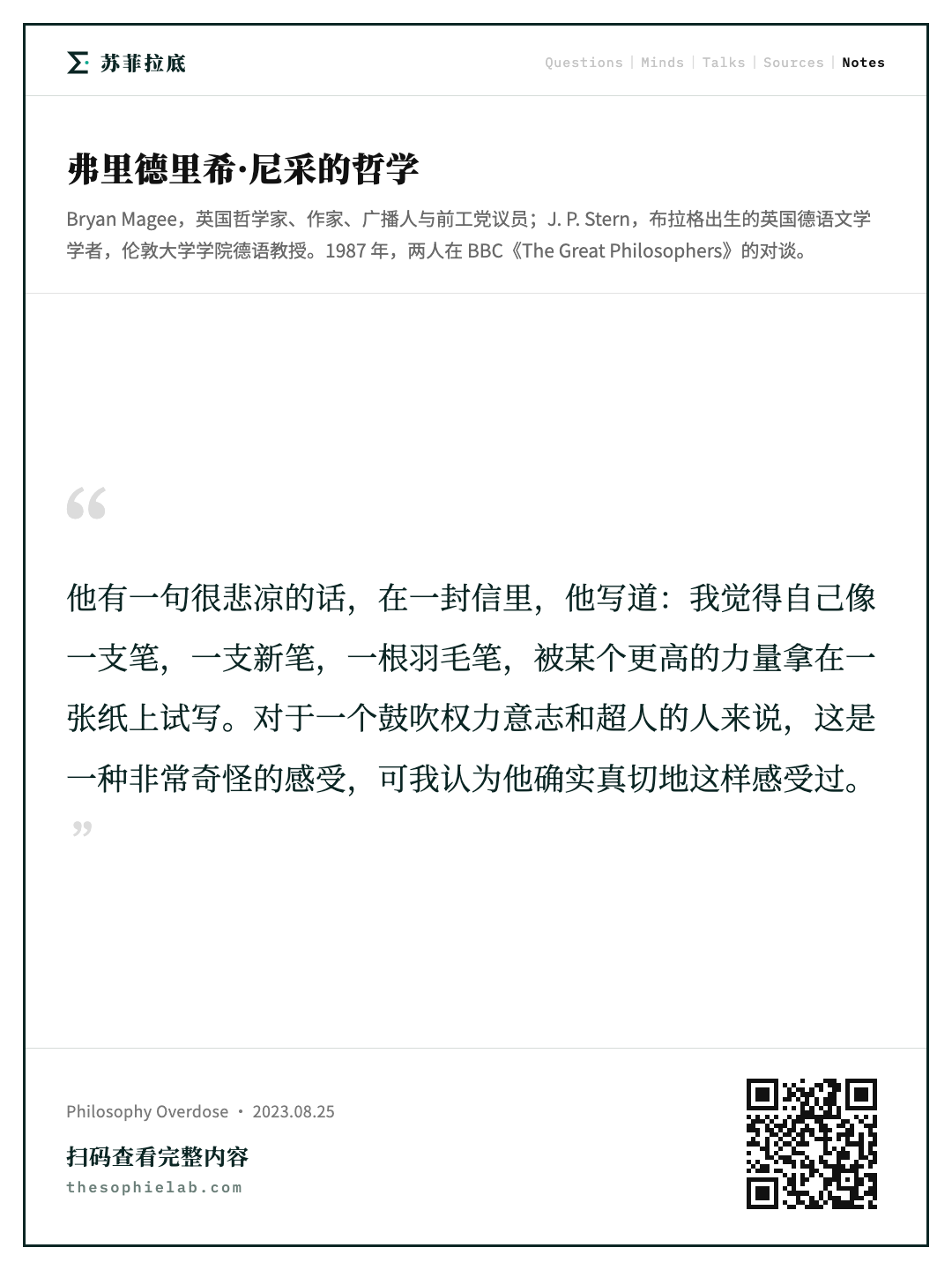
well he's really saying that and he is trying out what might happen if you took that view seriously and I think we want to say all together in our whole discussion that a great deal of his thinking is of this experimental kind and by that I don't mean that is not serious I don't mean that it is not responsible I don't mean that it is Trivial but I do mean that here's somebody who is facing the whole of human thought and is trying to make some sort of shift with almost any area in it and is trying out again and again different views there's a saying of his I think a very tragic saying of his in a letter where he writes I feel as though I wear a pen be a new PIN a quilt presumably being tried out by some Superior power on a bit of paper it's a very strange thing to be feeling for somebody who's advocating the will to power and the Superman and yet I think he did genuinely feel that now he does then try out this thought and it seems to me not so much a theory of being not so much a theory of the cosmos it seems
他确实是这个意思,而且他是在试验:如果你真的认真对待这种看法,会发生什么。我想我们在整个讨论中都应该始终指出,他的很多思考都属于这种试验性的。我这么说并不是指它不严肃,不是说它不负责任,也不是说它无关紧要,但我确实是说,这是一个面对人类全部思想的人,他试图在其中几乎每一个领域都有所推进,一次又一次地尝试不同的看法。他有一句话,我觉得是一句非常悲哀的话,写在一封信里,他说,我觉得自己仿佛是一支笔,被某种更高的力量拿去在一张纸上试写。对于一个鼓吹权力意志和超人的人来说,有这样的感受是非常奇怪的,然而我认为他确实真心有过这种感受。那么他接下来就试验了这个想法。在我看来,它与其说是一种关于存在的理论,与其说是一种关于宇宙的理论,不如说
便签笔记
15隐喻与概念交融的独特文风
30:30
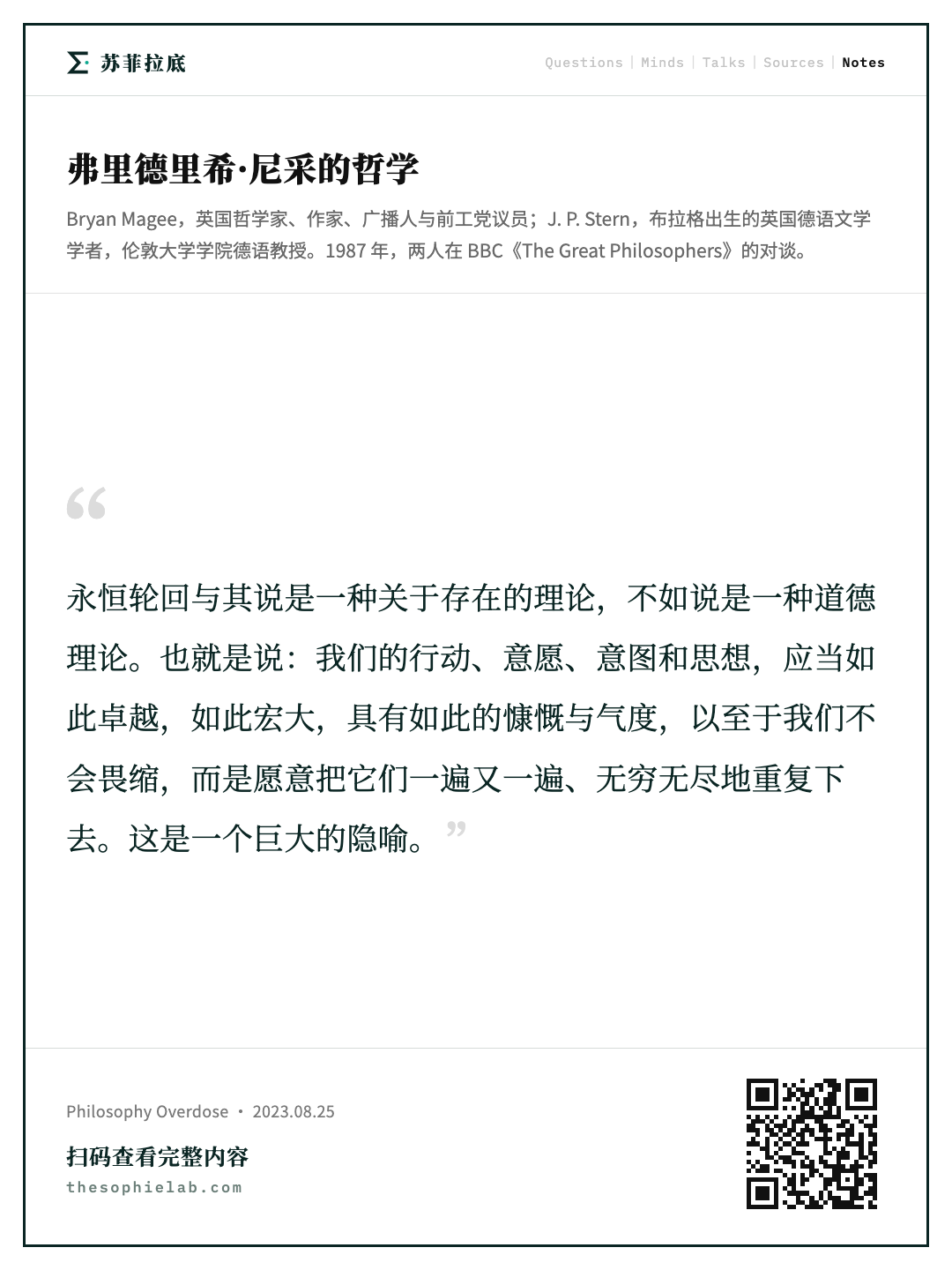
to me a moral theory that is to say our actions our willing our intentions our thought should be of such a superior kind of such a grand kind have such generosity and grandness about them that we should not flinch to uh and be able to be willing to repeat them over and over again add nauseam add infinitum so in other words you're really only saying yes to life yes embracing life as he always says we should if you would be willing to with that kind of consequence that's what you're doing and only ever this yes I think to go on very much further than that and try to produce geometrical or mathematical equations in order to prove either the possibility or the impossibility of these rules which has been tried has been done doesn't seem to me to be terribly sensible at the point in other words it's a huge metaphor it is a huge metaphor and of course a great deal must be said about Nietzsche's uses of metaphors well say just something about it because it's very relevant at this point I think we
是一种道德理论。也就是说,我们的行为、我们的意愿、我们的意图、我们的思想,都应当具有如此卓越、如此宏大的品质,带有如此的慷慨与恢弘,以至于我们不会退缩,而且能够心甘情愿地把它们一遍又一遍地重复下去,直到无休无止、直到无穷。换句话说,你其实只是在对生命说“是”,就像他一贯所说的那样拥抱生命,只不过你要愿意承担这样的后果,这就是你在做的事,仅此而已。是的,我认为再往前推得太远,试图搞出几何式或数学式的公式,来证明这种循环的可能或不可能——这样的尝试确实有人做过——在我看来在这一点上并不怎么明智。换句话说,这是一个巨大的隐喻。它是一个巨大的隐喻。当然,关于尼采对隐喻的使用还有很多可说的。那就稍微说几句吧,因为这在这里非常切题。我想我们习惯于
便签笔记
31:38
we I think we we are in the habit of taking things literally in a way in which which doesn't make sense as far as a great many of his statements are concerned you spoke to begin with about his Grand style and I think it is an extraordinarily powerful effective style if I ask myself where it derives from I think it derives from a strange invention a strange Discovery he seems to have made of placing his discourse his language somewhere halfway between metaphor and literal meaning and this is something which very very few people said very few German writers have done before him he stands entirely on his own as far as thinking is concerned you have mentioned that and we've we've seen how he attacks every tradition in the west where he does find his his precursors is in the style and mountain and Pascal and are his favorite authors and that whole aphoristic style I think derives a tremendous lot from them and it's not only me saying it it's himself saying it and this style which is pitched halfway
从字面上去理解事物,而对他的许多说法来说,这样理解是讲不通的。你一开始谈到他的宏大文体,我认为那是一种异常有力、有效的文体。如果我问自己它从何而来,我想它源自他似乎做出的一个奇特的发明、一个奇特的发现,那就是把他的论述、他的语言安放在隐喻与字面意义之间的某个中间地带。而这是极少极少有人做到的,在他之前几乎没有哪个德语作家这么做过。就思想而言,他完全独树一帜,你刚才也提到了,我们也看到他如何攻击西方的每一种传统。而他确实找到自己先驱的地方,是在文体上——蒙田和帕斯卡尔是他最喜欢的作者,我认为那整套箴言式的文体从他们那里汲取了极多。这不只是我说的,他自己也这么说。而这种介于
便签笔记
32:51
between metaphor and literal statement is something quite extraordinary and I think unless we understand it for what it is we are going to misread him I have a quotation which I think gives a an example of what I have in mind when he talked about the terrible deprivation that he felt 19th century people experienced through what he called luridly the death of God he wrote as follows he says rather than cope with the unbearable loneliness of their condition men will continue to seek their shattered God and for his sake they will love the very serpents that dwell among his ruins now you see this mixture of on the one hand conceptual thinking I mean loneliness and condition are abstract terms belonging to concept truth or on the other hand you've got the serpents glistening somewhere through the ruins of the shattered god well that and the refusal I think to go beyond that in other words to write out the theory behind the metaphors I think essentially constitutes what what he's about and it does give us the readers a
隐喻与字面陈述之间的文体是相当不寻常的,我认为,除非我们理解它本来的样子,否则我们就会误读他。我有一段引文,我觉得可以说明我想说的意思。当他谈到他所感受到的十九世纪人们因为他所谓的“上帝之死”这一耸人听闻的说法而经历的可怕匮乏时,他这样写道:人们与其去承受自身处境中那种难以忍受的孤独,不如继续去寻找他们破碎的神,并且为了他的缘故去爱那些盘踞在他废墟之间的蛇。你看,这里一方面混杂着概念性的思考——我是说孤独、处境这些都是属于概念领域的抽象词——另一方面你又看到蛇在破碎之神的废墟间某处闪着微光。而这一点,再加上他拒绝越过这一步、拒绝把隐喻背后的理论写出来,我认为这本质上就构成了他的特点。而这确实给我们读者带来了难题。这种一方面是诗与隐喻、另一方面又是
便签笔记
16审美地为人生辩护:悲剧的智慧
34:06
problem this makes this Fusion of poetry and metaphor on the one hand with Concepts yes hard Concepts on the other yes gives us a problem about how to take him and that's really interested in what you've just been doing exactly this leads to the fourth of the fourth yesms of the later philosophy we've talked now uh briefly about the will to power about the Superman and about his doctrine of the Eternal recurrence of time what you've just been saying about his use of metaphor leads us to the fourth of the four main themes in the later work which is his notion that life is to be understood aesthetically yes and I suppose the point here is is that if there's nothing outside this world no God no Transcendent real or anything then any meaning or justification that life has must be meaning derived from inside itself yes so that like a work of art I mean the only meaning of work of art has yes is what it so to speak gives itself I mean it doesn't derive its meaning from outside is that well that
概念——是的,硬邦邦的概念——的融合,让我们很难拿捏该怎么理解他,而这也正引向了你刚才一直在做的事情。正是如此,这就引向了后期哲学的第四个主题。我们现在已经简要谈了权力意志、超人,还有他的永恒轮回学说。你刚才关于他使用隐喻所说的这些,把我们引向了后期著作四大主题中的第四个,也就是他认为人生要从审美的角度来理解。是的。我想这里的关键在于,如果这个世界之外什么都没有,没有上帝,没有超验的实在或别的什么,那么人生所拥有的任何意义或正当理由,都必须是从它自身内部得来的意义。是的,就像一件艺术品,我是说艺术品所拥有的唯一意义,就是它可以说是自己赋予自己的,它的意义不是从外部得来的。是这样吗?这当然是相当贴切的一种
便签笔记
35:13
certainly is a very fair way of of of of coming close to what he's after in the very first of his books the birth of uh the the the the the birth of tragedy he uses this phrase three times it's only as an aesthetic phenomenon that uh the being of man and the world are eternally Justified it's a very complicated sentence and I don't think I want to go into all the details of it but what he's saying essentially is this the greatness of the early Greeks of the pre-socratics lay in their tragedy their tragedy was a way of facing the worst aspects of human life that is its transiteriness uh its impermanence its corruptness its dependence upon force is greater than yourself and to make of these a major tale a story a wonderful tragedy and this here applies in the largest in the most Cosmic possible sense and he's asking as indeed I think Shakespeare did occasionally he's asking is the whole world really to be taken seriously or is it not a great game a great place some kind of drama played out by we do not
接近他本意的说法。在他的第一本书《悲剧的诞生》里,他三次用了这样一句话:只有作为一种审美现象,人和世界的存在才获得永恒的辩护。这是一个非常复杂的句子,我不打算深入它的所有细节,但他本质上要说的是:早期希腊人、前苏格拉底时期的希腊人的伟大之处在于他们的悲剧。他们的悲剧是一种直面人生最糟糕方面的方式——也就是人生的短暂、无常、腐坏、以及受制于比自身更强大的力量——并把这些做成一个宏大的故事、一出精彩的悲剧。而这一点在最宏大、最具宇宙性的意义上同样适用。他在追问——我想莎士比亚偶尔也这样追问过——整个世界真的应该被严肃对待吗?还是说它不过是一场大游戏、一出由我们不知道是谁上演的戏剧?而如果说要有某种辩护——请注意,“辩护”是他用的词,
便签笔记
17叶芝、劳伦斯与欧陆文学的回响
36:23
know who um and if there is to be a justification mind you justification is the phrase he uses which is a very dicey word to use in this context because of course it's a Judicial phrase isn't it but if there is a justification for men being here and being what he is maybe it is simply as part of this huge Cosmic drama and a great deal of his thought and I think of some of his most interesting and greatest thought goes precisely into rehearsing and trying to make sense of this justific this aesthetic justification of man now you're talking about the way metaphor and aesthetic considerations are fused into the very substance of the thought itself and you spoke very interestingly a moment or two ago about his actual style yes and the tradition to which it related it in its turn has had immense influences hasn't it I instant some of the great creative writers yes that he has influenced in my introduction to this program yes now the old particular field of expertise if I may say so is is known to be comparative
在这个语境里用这个词是相当冒险的,因为它当然是个司法用语,不是吗——但如果说人存在于此、成为他所是的样子有什么辩护理由,也许那只不过是因为他是这出巨大的宇宙戏剧的一部分。而他的大量思考,我认为其中一些是他最有意思、最伟大的思考,正是投入在演绎和试图弄清这种对人的审美辩护上。你刚才谈到隐喻和审美考量如何融进了思想本身的实质之中,而且你刚才对他的文体本身以及它所属的传统讲得非常有意思。这种文体反过来又产生了巨大的影响,不是吗?我在本节目的开场白里提到了一些受他影响的伟大创作型作家。是的。而你本人的专长领域,如果我可以这么说的话,众所周知是比较文学。我想,如果能在讨论的最后请你
便签笔记
37:32
literature it would be extremely interesting I think to end this discussion with just a word or two from you about the way Nietzsche and his writing and his philosophy have influenced creative writers since his well simply to take the three names that you yourself mentioned wb8s is the first one Yates read nature for the first time in a very brief little excerpts translated by a man called John Coleman of all things it seems to be a most inappropriate name for a translator of Nietzsche and from 19 to onwards when he read him I think that is a very clear change in the general tenor and in the attitude of yates's poetry and that slightly sultry slightly sentimental yellow roses kind of poetry or Founders he creates changes very much and the great poetry which is the Poetry or as he him as Yates himself calls it the Poetry of blood and Maya I think it's very strongly influenced by his reading of Nietzsche by his attempts to grasp some of the problems that we discussed earlier on with sure that the influence
简单谈几句尼采及其写作、其哲学对他之后的创作型作家产生了怎样的影响,那会非常有意思。那就直接说你自己提到的那三个名字吧。第一位是 W.B. 叶芝。叶芝第一次读到尼采,读的是很简短的一点节选,译者是一个叫约翰·科尔曼的人,说来也怪,这名字用在尼采的译者身上,实在再不合适不过了。从他读到尼采的那时候起,我认为叶芝诗歌的整体基调和态度都有了非常明显的变化。那种略带闷热、略带感伤的“黄玫瑰”式的诗,发生了很大的改变,而他那些伟大的诗,也就是叶芝自己所说的“血与月”的诗,我认为深受他阅读尼采的影响,深受他试图把握我们前面讨论过的那些问题的影响。至于(另一位),那影响就非常非常不同了,非常
便签笔记
38:46
is a very very different one it is very much in the biological sphere it is in the sphere of that alone vital which I mentioned it it is in the sphere of the ruthless life the life that justifies itself and the with the H Lawrence I think again it is the question of authenticity now the authenticity as Lawrence conceives it's a very different kind of authenticity from the one that nature had in mind in other words it's social and sexual and of course both of these are really rather minor factors in Nietzsche but it is certainly from Nietzsche uh through his wife Frida Lawrence that he acquired some knowledge of Nature and that he was deeply influenced by it in a very late and I think rather Dreadful Christ story of Lawrence's seems to me to derive straight out of nature psychologizing of the Christ figure if we look on the continent of course pirandello Thomas man um Andrei malho all these people not only have been very strongly under his influence but they acknowledge the influence throughout
更多的是在生物学层面,是在我提到的那种纯粹生命力的层面,是在那种冷酷无情的生命的层面——那种自我证成的生命。至于 D.H. 劳伦斯,我想同样也是本真性的问题。不过劳伦斯所理解的本真性,跟尼采心目中的本真性很不一样,换句话说,它是社会性的、性方面的,而这两点在尼采那里其实都是相当次要的因素。但可以肯定的是,正是通过尼采——经由他的妻子弗里达——劳伦斯才对尼采有了一些了解,并且深受其影响。在劳伦斯很晚期的一部我认为相当糟糕的关于基督的小说里,在我看来直接源自尼采对基督形象的心理学化解读。如果我们看欧洲大陆,当然还有皮兰德娄、托马斯·曼、安德烈·马尔罗,所有这些人不仅深受他的影响,而且始终公开承认这种影响。斯特林堡曾通过一位共同的朋友与尼采长期通信,等等。我认为这些影响都极其强大,但我们必须记住,那种格言警句式的
便签笔记
18纳粹挪用尼采:公平还是冤枉
39:53
strinberg had a long correspondence through a common friend with Nietzsche and so on I think that there are immensely powerful influences but we have to bear in mind that the aphoristic style the tremendous attractiveness of the metaphors the brevity of the message and literary persons don't like to read heavy books they like to read aphorisms all these play very much into Nature's hand one last question Professor Stern I don't think we can finish our discussion without touching on it if you say the name Nietzsche the most educated people in the west nowadays what they immediately think of is the Nazis and the Nazis seem to have appropriated nature as their philosopher in the same sort of ways they appropriated vadna as their composer and that's had the effect ever since of contaminating the reputation of those two Geniuses in the minds of large numbers of people now is it fair or is it unfair to associate nature with fascism I think you must be associated with it to some extent and fascism rather national socialism it was
文风、那些比喻惊人的吸引力、讯息的简短——而文人们又不喜欢读大部头,他们喜欢读格言——所有这些都非常有利于尼采的传播。斯特恩教授,最后一个问题,我想我们的讨论不能不谈到它就结束。如今在西方,你对大多数受过教育的人提起尼采这个名字,他们立刻想到的就是纳粹,纳粹似乎把尼采占为己有当作他们的哲学家,就像他们把瓦格纳占为己有当作他们的作曲家一样。而这件事从此就产生了一种效果,在许多人心目中玷污了这两位天才的声誉。那么,把尼采和法西斯主义联系在一起,究竟公不公平?我认为在某种程度上,他必然要与之有所牵连——与其说是法西斯主义,不如说是国民社会主义。是墨索里尼大量读过他的书,1938年在布伦纳山口,元首还送了他一套尼采全集作为礼物。至于希特勒本人,我想
便签笔记
41:06
Mussolini who read him extensively who received a copy of the collected works from the fura on the Brenner in 1938 as a present Hitler himself I think probably knew phrases I mean certainly new phrases like the world to power but hadn't read anything of his I think in some way is this is a justifiable charge and I would put it this way that to the extent that these parties dependent upon their intellectuals and to the extent that the intellectuals depended upon some sort of more or less ill assorted ideology nature was part of it but of course at the same time I think it's to be emphasized very strongly there are lots of things in him much more important things in him which are absolute anathema to these people to these gangsters let's put it quite quite plainly and self-control and the the inward struggle of the self and the attainment of valid of of of of of generosity for instance uh and and and and greatness of the kind that we have described have nothing whatever to do with the kind of murderous ideologies
他大概知道一些句子——当然知道像“权力意志”这样的说法——但我认为他并没有读过尼采的任何著作。在某种意义上,这个指控是站得住脚的,我会这样表述:就这些政党依赖于他们的知识分子、而这些知识分子又依赖于某种多少有些杂凑拼合的意识形态而言,尼采是其中的一部分。但与此同时,我认为必须非常强调的是,他身上还有很多东西——远为重要的东西——是这些人、这些暴徒(我们不妨直说)绝对无法容忍的。自我克制、自我的内在斗争、比如说达致慷慨这种品质的有效性,以及我们所描述过的那种伟大,跟第三帝国时期出现的、以及更早时候在意大利人当中出现的
便签笔记
42:13
that came into being in the Third Reich and among the and and early on among the Italians and it's quite plain from the fact that you yourself have devoted so much of your life to studying nature and writing about him that you think this is a hugely valuable Undertaker yes nevertheless yes I certainly think it is an immensely available undertaking providing we do not go to it with some expectation of getting a Panacea on how to live right but provided we go to it with a view to finding out what human beings can do what the human possibility is what the being of man is capable of understanding and creating from within itself thank you very much Professor Stern thank you
那类杀人的意识形态,毫无关系。而且很明显,从你自己把生命中如此多的时间投入研究尼采、撰写关于他的著作这一事实来看,你认为这是一项极有价值的事业。是的,不过——是的,我确实认为这是一项极有价值的事业,前提是我们不要带着某种期待去做,指望从中得到一剂关于如何生活的万灵药;而是带着这样的目的去做:去弄清楚人能够做什么、人的可能性是什么、人的存在能够从自身内部理解和创造出什么。非常感谢你,斯特恩教授。谢谢。
便签笔记

这期还没有生成总结。

这期还没有生成核心句型(制作精读 PDF 时会一并生成)。

这期还没有生成生词表(制作精读 PDF 时会一并生成)。

这期还没有生成自测题(制作精读 PDF 时会一并生成)。

精读便签
下载便签 手机:长按图片保存
← 上一期 · NO.055Wittgenstein's Two Philosophies Explained: Anthony Quinton Interview (1977) 下一期 · NO.057 →A Conversation with Frank Lloyd Wright (1953)
问题周报 WEEKLY LEDGER 每周一封:本周入库的精读、一个值得带走的问题、一条苏菲按。随时退订。
免费 · 每周一封 · 一键退订
苏菲拉底 THE SOPHIE LAB · ASK THE BEST MINDS THE BIG QUESTIONS 内容仅供学习 · thesophielab.com