The AI Awakening: Implications for the Economy [Erik Brynjolfsson] · 苏菲拉底
字幕 字幕位置
--:--
点击播放,这里会跟随视频显示当前句的中英字幕。

The AI Awakening: Implications for the Economy [Erik Brynjolfsson]

节目发布 2020-07-23 · New Economic Thinking
埃里克·布莱恩约弗森 PPia Malaney 罗罗伯·约翰逊
EDITED TRANSCRIPT · 依据现场录音编译整理,可划线生成便签
编者按:2020年7月,新经济思维研究所(INET)举办线上研讨会,邀请斯坦福大学教授、《第二次机器时代》作者埃里克·布莱恩约弗森主讲「人工智能的觉醒:对经济的影响」。INET高级经济学家、创新中心主任皮娅·马拉尼主持,INET主席罗布·约翰逊致开场辞。布莱恩约弗森以自己团队的最新研究为线索,谈机器学习跨过的门槛、哪些任务会被机器接手、远程办公的骤然普及、生产率悖论与J曲线,以及生产率与中位收入的大脱钩。本文依据现场录音编译整理。

开场

马拉尼:欢迎收看INET线上研讨会「人工智能的觉醒:对经济的影响」,主讲人是埃里克·布莱恩约弗森。我是皮娅·马拉尼,INET高级经济学家,也是INET旧金山创新中心的主任。几年前我搬到硅谷筹建中心,当时很好奇为什么大家都在谈通用人工智能(AGI),那在我听来还是科幻小说里的概念。我们距离AGI成真仍然很远,但技术对世界的冲击,在这次危机之后明显大大加速了。技术与就业的关系,越来越成为我们不得不忧心的问题。

马拉尼:2000年到2010年间,美国失去了大约560万个制造业岗位。关于全球化对制造业的冲击,讨论已经很多。可是根据鲍尔州立大学商业与经济研究中心的一项研究,这些岗位流失中有85%其实要归因于技术变革,主要是自动化。麦肯锡最近的一份报告估计,到2030年,全球可能有多达8亿个岗位被自动化取代。这些都还是疫情之前的估算,而疫情显然让这一趋势急剧加重。

马拉尼:埃里克研究这些问题已经很多年,他既深刻理解技术世界,又理解技术运行于其中的经济环境。他的研究考察信息技术对企业战略、生产率与绩效、数字商务和无形资产的影响。他是斯坦福大学新成立的数字经济实验室主任,斯坦福经济学与商学教授,美国国家经济研究局(NBER)研究员,著有多部著作,包括与安德鲁·麦卡菲合著、登上《纽约时报》畅销榜的《第二次机器时代:智能技术时代的工作、进步与繁荣》。在把话筒交给埃里克之前,INET主席罗布·约翰逊想先讲几句。演讲结束后我们开放问答,屏幕下方有提问按钮,请把问题打进去,我们会尽量多回答。现在请罗布。

约翰逊:谢谢皮娅。埃里克,你今天能来,我实在高兴。刚才我在脑子里把这些年我们交往的片段过了一遍:在麻省理工见到你,和你与比尔·简韦一起围着《第二次机器时代》讨论,在中国发展高层论坛的走廊里撞见你。不管在哪里遇到你,不管读到你写的什么东西,我看到的都是你在把零散的东西拼合起来。经济学常常像一支窄窄的箭,而你为我们大家拼出了一幅马赛克:技术如何驱动社会结构与政治结构,有时还牵涉到东西方之间可以称为哲学体系的冲突,而这些技术问题恰恰常常在那里被推到紧张与痛苦的临界点。所以我一开始就说,你能来我很高兴。无论你坐在哪里,是我的母校麻省理工,还是你的新家斯坦福,你都在照亮问题。皮娅在北加州,我每年也有不少时间在博利纳斯的家里。不管你在哪儿,我都会追着看。也就是说,接下来这一个小时,我会一直笑着听。谢谢。

布莱恩约弗森:非常感谢罗布,也谢谢皮娅,两位的介绍太客气了,我会尽力不辜负。我也要说,INET诸位在做的事同样令我印象深刻,能有机会和大家分享我们的一点研究,我感到很荣幸。我尤其期待之后的讨论和问答。在线的各位,请把你们的问题和评论告诉我,凡是我讲到的,或者你们想多聊的,我都很乐意讨论,那是最有趣的部分。我先把幻灯片共享出来。大家能看到标题页了吧?好。

几周之内,几十年的变化

布莱恩约弗森:我今天要谈的,正如皮娅所说,是「人工智能的觉醒」以及它对经济意味着什么。机器学习的能力,或者更广义地说人工智能、数字技术的能力,近年来出现了一些令人屏息的跃升。过去几个月,新冠疫情迫使我们所有人改变工作方式,这种跃升又明显加速了,包括我们现在正在Zoom上开的这场研讨会。全国乃至全世界数以百万计的人,生活被彻底改变了。而这只是新技术与新工作方式引发的更广泛、更根本的经济变化的一部分。有一句话我觉得说得很到位:有些十年里什么也没发生,有些几周里发生了几十年的事。过去这几周、这几个月,正是后者。就远程办公这类领域而言,过去十周里我们大概经历了至少十年的变化。稍后我会给大家看这方面的数据,也会看自动化其他领域的数据。

布莱恩约弗森:先说自动化,说这些技术如何被越来越多地使用。要让人安全地工作、安全地把活干完,办法之一就是多用这些技术。举一个例子,TensorFlow,大概是眼下最流行的机器学习工具,下载量已经超过一亿次。我的团队全都下载了,用得很多,其他许多人也是。每个月都有更多的人在想办法把机器学习用到自己的工作里,纪录不断刷新。

跨过一道关键门槛

布莱恩约弗森:我们正在跨过一道非常重要的门槛。看看机器学习在许许多多任务上的表现,举一个例子,图像识别。十年前,机器还完全做不到像人一样认出物体。后来斯坦福的李飞飞建立了ImageNet,一千四百万张图片,每一张都由人手工打上标签,这里给大家看其中四张。随后是一系列竞赛,看机器能多准地识别图片里是什么。起初它们表现并不好,看那条紫线就知道。然后就急剧提速了。真正的拐点在2012年左右,杰弗里·辛顿引入了深度学习方法。此前人们并不用深度学习和神经网络。这些大家大概都听说过,是规模极大的网络,在某种意义上模仿人脑处理信息的方式。就在最近,我说的是过去八年左右,我们有了足够的计算能力,算法有所改进,最重要的是数据可得性、数字数据的可得性大幅增加。三者合在一起,让我们能够把神经网络用得远比过去有效。到了今天,在包括ImageNet在内的许多应用上,机器已经超过人类。人在ImageNet上也并非完美,而机器现在辨认狗的品种或者别的物体,比一般人辨得更准。

布莱恩约弗森:但不只是图像识别,还有语音识别。我们大多数人都有一部这样的手机,iPhone或者别的什么,都玩过Siri、Alexa或者Google Now。我觉得它们远非完美,但我们正处在这样一个十年之中:从无法对机器说话,到习以为常地对它们讲话,并且指望它们回话、替我们回答问题。这方面也在飞速进步。我想在多数应用里它还没到人类水平,但已经非常接近了。

布莱恩约弗森:我和安德鲁·麦卡菲在《哈佛商业评论》上发过一篇文章,梳理了机器正在接手过去只有人能做的事的各个领域:录音转写、分析市场数据、分析药物的化学性质、开发新配方、分析购买行为,当然还有人脸识别。左边这个例子来自放射科和组织病理学,机器读医学影像,判断是不是癌症。几乎每个星期我都能在《自然》或《科学》上读到新文章,说某个新的机器学习系统又在类似任务上超过了人。

布莱恩约弗森:所以眼下正在上演一场淘金热。数千亿美元的风险投资和大企业资金涌入,争着抢占用机器学习解决那些过去只有人能解决的问题的机会。他们在下注,赌这会带来巨大回报。当然,不是所有赌注都会赢,但平均而言,我相当乐观,我们会看到越来越多像已经出现的那些一样的突破。

布莱恩约弗森:我们研究过一个小例子,机器翻译,效果立竿见影。这是我们去年发表的一篇论文,讲eBay的机器翻译。eBay上线了一套新的机器翻译系统,效果立刻显现。他们在好几个语言对上推行:英语与西班牙语、英语与法语、英语与意大利语、英语与俄语。每一组都构成一个自然实验,我们可以对比机器翻译上线前后交易的变化。这是拉丁美洲西班牙语的例子。大家可以看到,系统一开启,人们可以用自己的母语(英语或西班牙语)读eBay上的商品列表之后,销售额出现了非常明显的提升,大约增长了11%到12%。这是能够清楚量出经济效应的案例之一。

替代还是互补

布莱恩约弗森:不过,正如皮娅和罗布在开场时提到的,尽管可以创造大量财富,人们也担心财富如何分配,担心岗位被毁掉。这种担忧由来已久,可以追溯到差不多整整两百年前的卢德派。大家都知道,他们砸毁织机,因为他们认为织机会消灭大量熟练工匠的岗位。而他们其实是对的,那项技术确实消灭了很多岗位。总体上财富增加了,但正如我们稍后会谈到的,没有哪条经济规律保证每个人都会受益。完全可能出现一部分人受损、另一部分人受益的局面。我们此刻正处在这样一场转型之中。我认为它会比工业革命时期的转型更大,实际上已经在变得更大。今天,用安德鲁·麦卡菲和我的说法,是「第二次机器时代」:被增强和自动化的不再只是体力肌肉,还有头脑和脑力劳动。这是一个大得多的任务范围。

布莱恩约弗森:要理解技术如何影响工资,最自然的思路是看替代(substitution)。这是多数人首先想到的:机器做了原本由人做的事。但机器影响工作的方式还有很多。除了替代,还有互补(complementarity)。互补的意思是,机器让人的工作变得更值钱,而不是更不值钱。哪一种更重要呢?看数据,过去两百年的大部分时间里,互补一直是更重要的因素。我这样说的理由是,只要看看一个普通劳动者的工资,自卢德派的年代以来,两百年间工资涨了极多。不过最近二十年左右,这种增长停住了,甚至逆转了,工资不再增长。所以,技术也许正在从主要作为互补品,越来越转向作为替代品。

布莱恩约弗森:还有四个因素同样影响技术对工资的作用:需求弹性、收入弹性、供给弹性,以及新任务的发明。汤姆·米切尔和我在《科学》杂志上那篇《机器能学会什么》里做了更详细的讨论,梳理了其中的经济学逻辑,以及影响每个因素的技术类型。我现在不深入展开,如果你们想深挖其中任何一点,问答环节我很愿意谈。它们都很重要。我想留给大家的主要一课是:我们不该只想着替代。技术可以、也应当被用来补足和帮助人。我在TED演讲里说过,我们要学会与机器同跑,让它们帮我们把工作做好,而不是与机器赛跑,把它当成非此即彼的对立。

哪些任务会交给机器

布莱恩约弗森:皮娅提到我们距离通用人工智能还很远。AGI的意思是机器能做人类所做的全部事情,无论广度还是深度,就像好莱坞电影《终结者》里那种,基本上和人一样。也许有一天我们会走到那里,我猜多半会,但那可能是一百年后,至少也是五十年后,我想多数机器学习专家都这么看。此刻我们有的是非常强大的人工智能,我已经举了视觉、语音识别和其他领域的例子,但它们仍然相当窄,并不通用。于是就有了一个问题,至少对汤姆·米切尔和我来说是问题:机器学习擅长哪些任务,不擅长哪些任务?如果我们能拿出一套评价标准,一种把任务归入这两类的分类办法,我们就能更好地理解经济正在怎样变化。

布莱恩约弗森:于是我们请教了大量机器学习专家,花了一段时间开发出我们称为「机器学习评价量表」(machine learning rubric)的工具,并把它用到ONET里的任务上。注意不要和INET混了。ONET是一个职业数据库,收录了大约一万八千项具体职业任务,950种职业,每种二三十项任务。公交车司机、经济学家、小学教师、放射科医生,都在O*NET里,每一种职业都有一份描述,说明做这份工作的人需要完成哪些任务。我们的方法是,用这套量表逐项评估每一项任务,给它打分,判断机器学习是否适合、是否有可能完成它。有些事机器学习做得很好,那些数据密集、界定清楚的事情;另一些事它就做不好。我们对每一项任务都按五分制打分,而且请了十位不同的人来打,这样结果具备一定的信度,我们对答案也更有信心。

布莱恩约弗森:为了让大家有更具体的感受,看放射科这个例子。搞机器学习的人都爱拿放射科医生说事,说他们的饭碗岌岌可危,这不无道理,因为放射科医生最重要的工作之一,就是借助计算机辅助检测与诊断系统来解读影像。我前面展示过,这件事机器现在做得同样好,按数据看,在许多方面甚至比多数放射科医生更好。所以,借助计算机识别影像这部分工作已经被机器做得很出色。但放射科医生还有别的任务。有些情况下他们要给病人实施镇静,出于显而易见的原因,这不是你愿意交给机器去做的事。在放射科的27项任务里,我们发现适合机器学习的不到一半,其余许多项,即便在放射科,仍然最好留给人来做。

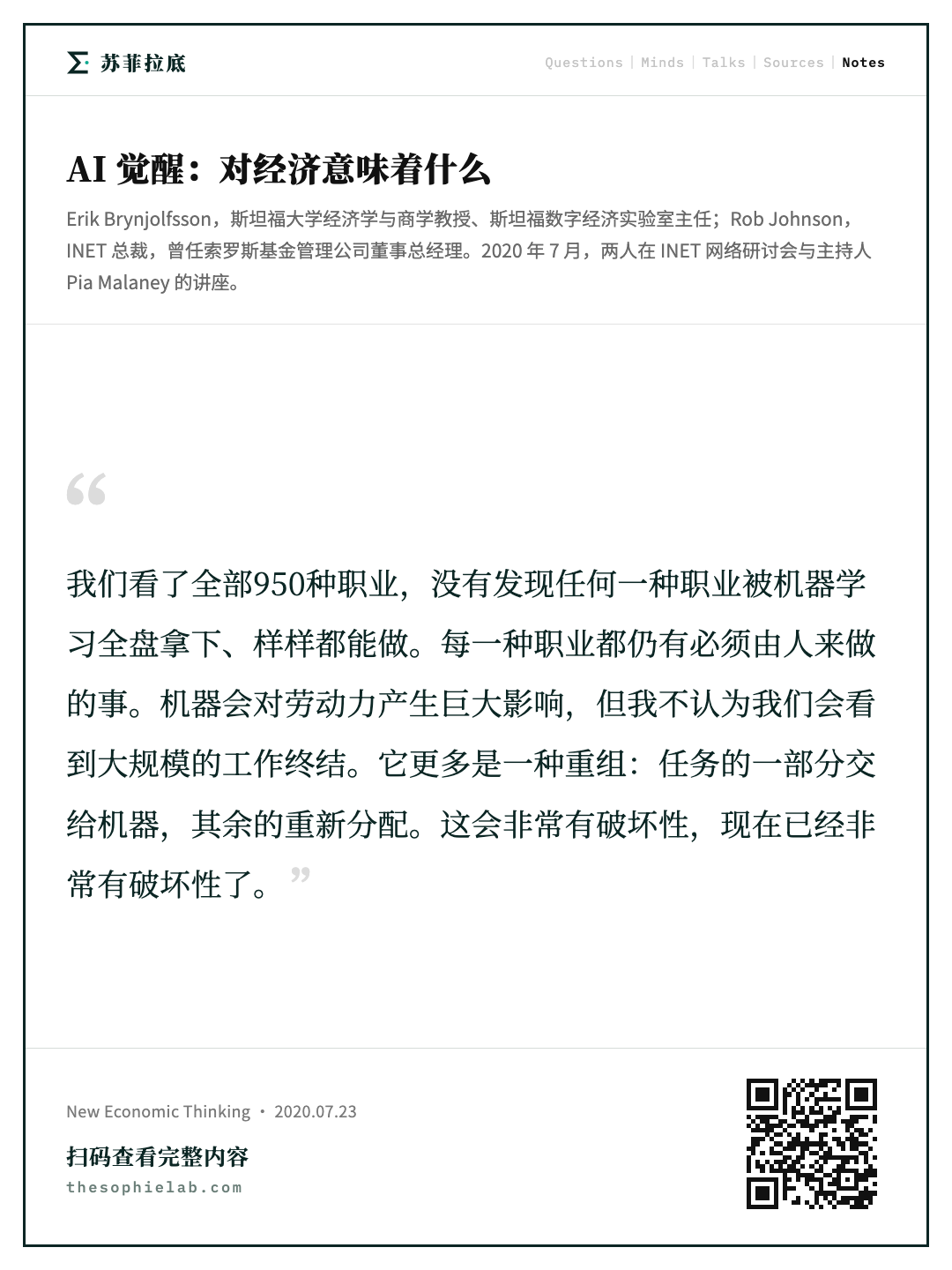
布莱恩约弗森:这个模式在每一种职业里都能看到。我要说清楚:我们看了全部950种职业,没有发现任何一种职业被机器学习全盘拿下、样样都能做。每一种职业都仍有必须由人来做的事。因此我认为很重要的一点是:机器会对劳动力产生巨大影响,但我不认为我们会看到大规模的工作终结或者失业。它更多是一种重组:任务的一部分交给机器,其余的重新分配。这会非常有破坏性,现在已经非常有破坏性了,但我们还没到机器能做人类大部分事情、能覆盖一个典型职业全部范围的阶段。

从任务到职业与地区

布莱恩约弗森:总体来看,那些最适合机器学习的任务,合起来大约值7130亿美元,是经济中非常大的一块。我们还只是刚刚触到表面。我认为未来短短三到五年,会有巨额投资涌入,去收割桌面上这些价值,投资机器学习系统的人会把它们收入囊中。不同行业之间有些差别。这张图是我们按行业做的,可以看到零售、运输、餐饮服务,这些行业里适合机器学习的任务最多。说明一下,我们这里的做法是拿每一项具体任务,汇总到行业层面。可以看到不同行业有不同的脆弱程度。

布莱恩约弗森:也可以按职业的相似程度来分组。比如文书人员,图中间黄色那一团,他们的任务彼此重叠,所以聚在一起,不管是制造业、零售业还是医疗行业的文书人员,都做着非常相似的事,正如大家能想到的。他们都相当脆弱,工厂工人也一样。有些群体则不那么脆弱:艺术家和媒体从业者不那么脆弱,一些专业人士、科学家、神职人员也不那么脆弱。我们可以按职业分组,尽管如我所说没有哪种职业能被完全自动化,数据中还是有一些清楚的规律。

布莱恩约弗森:这张图的横轴是工资百分位,右边是高薪工作,左边是低薪工作。纵轴是有多少任务适合机器学习,我们按加权平均来算,因为有些任务比别的更重要。首先能看到一条向下的斜线。这意思是,像收银员这样的工作,大量任务越来越可以自动化。要是你在CVS药店或者超市用过自助结账,就知道它不但能认条形码,现在,至少在我家附近的超市,它还能认出洋葱、橙子和柠檬,并且分类。它在学越来越多过去由人做的事。但也有一些高薪工作,比如航空公司飞行员,同样有大量任务适合机器学习,我们也在看到这种情况发生。我忍不住偷看了一眼经济学家在哪里。经济学家在靠近高薪那一端,有一些任务适合机器学习,但不像其他一些职业那么多。950种职业每一种都可以这样看,每个红点是一种职业。这些写在我们去年发表于美国经济学会《论文与会议录》的文章里。

布莱恩约弗森:我们也可以按国家来做。我的团队为不同国家建了一套分类对应表。不是每个国家都用O*NET和美国劳工统计局的分类,但我们为许多国家做了映射,这就能聚焦到具体职业上。可以聚焦到内科医生、外科医生、放射科医生,像我刚才讲的那样,其他职业也都能放大看。图中方块的大小代表这个职业有多少人。还可以按地理来看。去年我在国会做了这个报告,他们非常想知道哪些地区受影响更大。可以看到情况极不均衡,因为美国不同地区的人做不同的工作。曼哈顿或迈阿密海滩的人干的活,和威奇托或夏延的人不一样。怀俄明州看起来有很多脆弱的人,迈克·恩齐参议员当时在场,看到这一点很感兴趣。

布莱恩约弗森:还可以按公司汇总。这是放大看一家大型零售企业,沃尔玛。我主要给大家看右边这张图。红点的位置,纵轴是有多少任务适合机器学习。和整个经济相比,沃尔玛有大量任务可以由机器来做,并且很可能在未来几年被自动化。同时,在AI技能指数上,它比其他企业略微偏右一些。意思是他们公司里确实有很多人掌握了用TensorFlow做这类工作的技能。所以一方面他们很脆弱,另一方面他们很有能力把这件事做成。每一家公司都可以这样汇总来看。还能看不同公司的脆弱程度随时间如何变化。这是一家大型金融服务公司,随着时间推移,他们越来越多的任务变得适合机器学习。

布莱恩约弗森:让我再放大一点,看看用这些东西能做什么。左边是不同的岗位,红条越长,表示越多任务适合机器学习。靠下的位置有柜员、行政助理、个人理财经理。系统把哪些任务更适合、哪些更不适合机器学习分了类。我们聚焦到个人理财经理。左上角显示,个人理财经理可以转向许多新方向。虽然他们的大量任务适合机器学习,一个选择是重新设计这份工作,叫它「个人理财经理2.0」。右上象限显示,他们可以多做一些领导工作和客户关系管理,少做信贷审批和数据录入。这样一来,在自动化侵蚀其他任务时,他们的岗位就更稳固。另一个选择是学新角色,转到别的岗位上去。左下角显示,他们可以转做业务分析师、抵押贷款专员、人力资源经理。这些领域在增长,而个人理财经理在萎缩。根据右侧的技能差距分析,许多个人理财经理已经具备在那些岗位上成功所需的技能。这就是我参与的一家初创公司「第二次机器时代技术公司」(Second Machine Age Technologies)所做的分析,研究企业如何随时间适应自动化。用这些数据我们还能做很多别的分析。

远程办公的骤然普及

布莱恩约弗森:下面我转到远程办公,再讲讲生产率效应,然后开放提问。人们很关心远程办公如何影响经济,《华尔街日报》《纽约时报》和许多媒体都写过,援引的正是我们过去几个月做的一些研究。这是我们深入研究的其中一篇论文,今天早上我刚收到通知,它将在明年一月的美国经济学会年会上宣读。我们做的是一项覆盖约七万五千人的调查,问他们是在家工作还是在办公室工作,从事什么职业,身处何地。由此我们得到了一张远程办公转变的快照。

布莱恩约弗森:说几个要点。我们发现超过三分之一的美国人已经转为在家工作,包括我,可能也包括你们中的许多人。疫情之前,大约15%的美国人本来就在家工作。两个数字加起来,目前大约一半美国人在家工作。这当然是极其巨大的转变,对房地产、工资、全球化和其他因素都有各种影响,我们正在进一步细看,之后可以讨论。这种转变在全国范围内很不均衡。我们发现,正如大家会料到的,有两个因素能预测人们是否在家工作。一是新冠疫情的发生率,一个州疫情越重,转为在家工作的人就越多,这不奇怪。二是信息工作者的比例。看专业人士和管理者,以及其他主要与数据、知识、信息打交道的人,他们更可能转为在家工作;而从事制造、装配、建筑的人,不出所料,没有在家工作的机会。不幸的是,他们反而更可能失业或被停职。所以,依据人们所做工作的类型不同,这种转变的影响极不均衡,受影响的州也随之不同。

布莱恩约弗森:我们也用这些工具来更好地理解劳动力市场。这是一篇新论文,大概下周发布,叫Job2Vec。它把所有招聘启事转换成可以分析的数学向量。我们看了Burning Glass Technologies提供的两亿多条在线招聘启事,然后训练这些巨大的神经网络系统。我们用了一个参数超过一亿的语言模型,让它在某种意义上理解这些岗位是什么,彼此之间有什么关系。然后我们就能对它们做一些数学分析。比如我们可以问:假设拿一个软件工程师的岗位,往招聘启事里加几项技能,前面提到的TensorFlow、Python,或者别的机器学习技能,这个岗位的前景会怎样?我们发现,分类器会把它从软件工程师重新归为机器学习专家,预测薪资比原来高出大约六千美元。我们可以做这类操作,至少在模型内部看:增加技能、把人从一个地区挪到另一个地区、让他们在时间中移动,或者做其他调整,会发生什么。我想这会成为一件非常有力的工具,用两亿条在线招聘启事这样庞大的数据集来理解劳动力市场、理解均衡工资和均衡需求。

布莱恩约弗森:我们用它做的一件有趣的事,是用这个自然语言工具预测哪些任务最适合远程完成,哪些最不适合。左边可以看到,更适合远程的岗位有销售经理、教育工作者、市场营销经理。不太适合远程的是做装配的人、索具工、汽车车身修理工、卡车机修工。可以想见,这些在可远程性上得分不高。这给了我们一种相对客观的办法,去分析远程办公最可能在哪些地方奏效。

生产率悖论

布莱恩约弗森:下面简短谈谈生产率繁荣,然后我很想转入问答和讨论。其实并没有生产率繁荣,我认为这才是真正的谜。至少在我看来,这些工具相当了不起,但它们没有出现在生产率数据里。事实上,生产率增长不但没有加快,反而放慢了,已经放慢了大约十年。2004年之前的十年,美国生产率年均增长2.8%,此后不到这个数的一半。去年又是令人失望的一年,大约1.3%,这是过去十年的典型水平。而且不只是美国,几乎每一个经合组织国家都经历了类似幅度的放缓。这就是我们所说的现代生产率悖论:技术惊人,却不见于生产率数据。

布莱恩约弗森:那么究竟怎么回事?我简要列出四种解释,这是我与芝加哥大学的查德·西弗森和丹尼尔·罗克合作的研究,罗克曾在麻省理工做我的博士后,现在是沃顿商学院的教授。第一种可能是,像我这样的人,以及许多其他人,只不过被技术唬住了,它也许并没有看上去那么了不起。第二种可能是我们测量有误,收益是有的,只是没有体现在生产率数据里。第三种可能是,收益被一个极小的群体攫取了,所以我们看不到广泛共享的繁荣。第四种可能是,它正在路上,生产率收益需要时间才能渗透整个经济。

布莱恩约弗森:我认为这四种解释各有一些证据支持,但总体上,就宏观全局而言,前三种不如第四种有说服力。逐一简评一下。诚然有炒作,但同时,我们做过分析,发现即便一些较简单的技术也颇具变革性。说视觉、语言理解、各领域的智能或人工智能这样根本性的东西不是重要技术,是讲不通的。它的重要性大概至少不亚于电力。

布莱恩约弗森:测量误差确实是个问题,我过去认为这是最主要的部分,因为毫无疑问,数字革命的很大一块我们没有测量到。任何价格为零的东西,维基百科、电子邮件、Zoom,对GDP统计的贡献恰好是零,因为GDP只计算有正价格的东西。你可能因此认为我们漏掉了大部分收益,我也认为确实漏掉了。但我现在不那么相信这是放缓的主因,理由是:二十年前、五十年前、一百年前,我们同样漏掉了很多收益。青霉素、收音机、电视,以及更早年代的其他发明,也是免费或近乎免费的,也给生活水平带来了巨大提升。所以现在不那么明显的是,免费品的份额是否真的增加了。我想大概是增加了,但这个论证要难得多,不像只说「存在一些免费品」那么容易。

布莱恩约弗森:分配失衡是这个故事的重要部分。尤其在INET,我想你们非常熟悉,而且在这方面做了许多开创性的工作,证明财富变得极不均衡,最富的1%拿到了大得多的份额。但我们算过数字,这不足以解释生产率放缓。所以我要把更多注意力放在实施与重组的滞后上,把它作为主线。

生产率J曲线

布莱恩约弗森:这里的想法是:技术很了不起,但要真正驾驭它,你必须重新发明工作方式,而我们还没有做到。我们还没有做出那些配套的发明,没有在技能和组织变革上做出投资。等我们做了这些投资,就会开始收获。早先的时代也是同样的情形,电力就是例子,花了三四十年才拿到电力的全部好处。所以这个悖论可以这样化解:乐观派看着今天的技术,想象它未来(希望是不远的未来)能做什么;悲观派看着过去,说我们还没有做出那些改变。他们其实说的不是同一件事,所以两者可以同时都对。

布莱恩约弗森:不过,如果要从过去外推,你不应假定过去的生产率增长是未来生产率增长的最佳预测。我们做了一个小练习:横轴是任意一个十年期的生产率增长,然后看它对下一个十年生产率增长的预测力有多强。可以看到,基本没有相关性。一个时期生产率差,并不意味着下一个十年生产率也会差,或者会好,或者中等。几乎没有相关性。因此,我认为不该拿过去十年的糟糕表现外推,说未来也会如此。我在华盛顿报告时试图向国会预算办公室说明这一点。你们可能知道,他们以「我们过去表现不好」为理由,下调了未来十年的所有生产率估计。我告诉他们,我认为这为时过早,理解未来的更好办法是理解底层技术,而不是假定未来与过去相同。

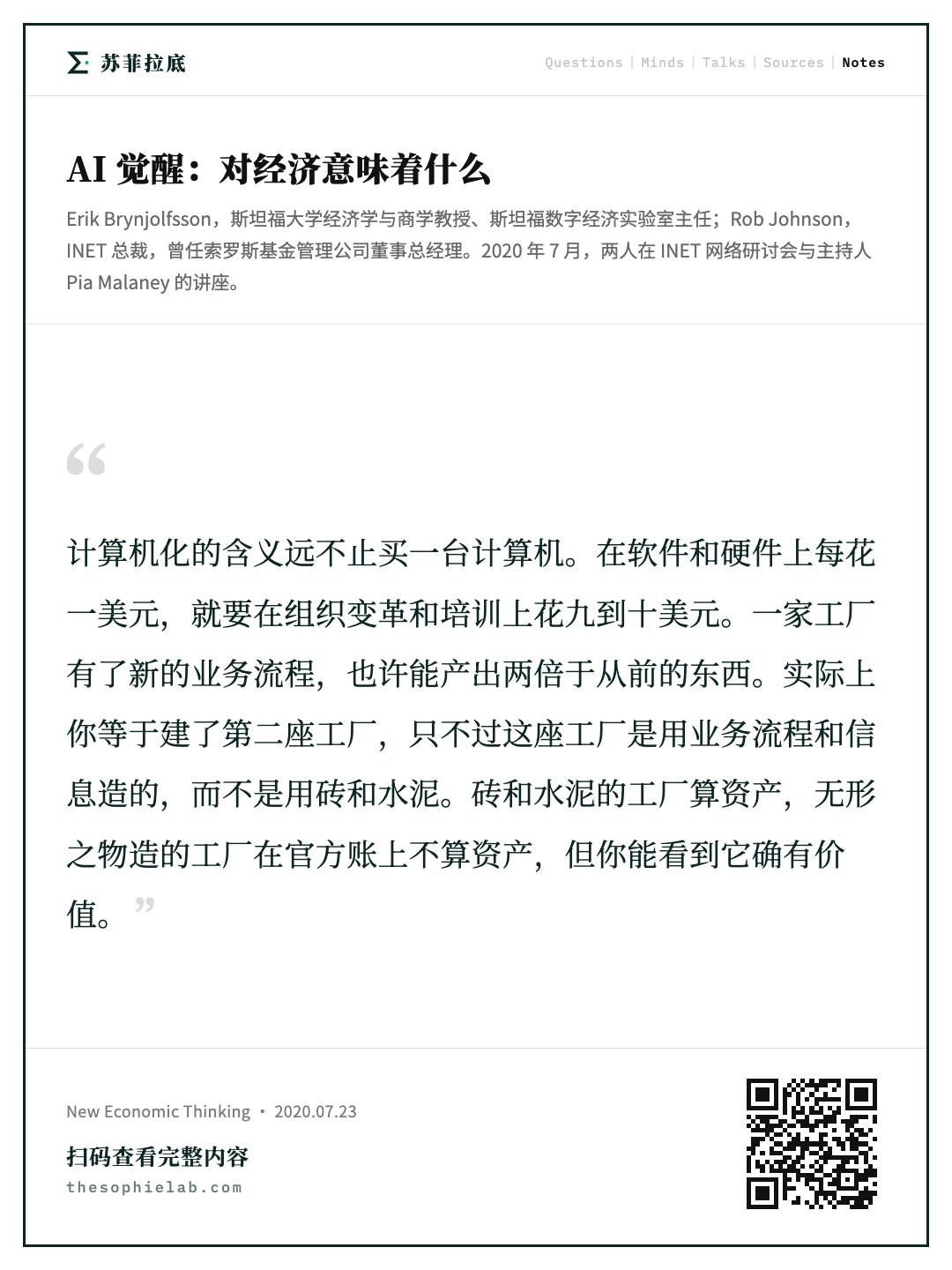
布莱恩约弗森:我已经提到过电力。这个论证的核心是:计算机化的含义远不止买一台计算机或者买一套机器学习系统。九成的投资在新技能和新业务流程上。我们分析过,当一家公司安装比如说一套新的企业资源规划系统时,在软件和硬件上每花一美元,就要在组织变革和培训上花九到十美元。这笔额外的投资是一种无形资产,一般不会作为资本资产出现在公司的资产负债表上,通常也不会作为资产出现在国民账户里。但在经济学家眼中,我认为这是实实在在的投资。一家工厂有了新的业务流程,产出速度就比以前更快,也许能产出两倍于从前的东西。实际上你等于建了第二座工厂,只不过这座工厂是用业务流程和信息造的,而不是用砖和水泥。砖和水泥的工厂算资产,无形之物造的工厂在官方账上不算资产,但你能看到它确有价值。

布莱恩约弗森:问题在于,这些无形资产的投资需要时间和精力,不会瞬间完成。于是在你投资无形资产的时候,会有一种什么也没发生的错觉,要到后来才能收获。这就导致了查德·西弗森、丹尼尔·罗克和我所称的「生产率J曲线」(productivity J-curve)。这是一种错觉:在最初五到十年甚至更久,测得的生产率会下探。在曲线下行的这段,实际发生的是企业在投资重塑业务流程,工人在学习新技能,整个经济在经历转型。所有这些投资在国民账户里都没有被测量、没有被计入。于是看起来是一片折腾,却拿不出什么成果。然后到了后期,你开始收获。

布莱恩约弗森:一旦开始收获,收益就来了,而这时整个故事反过来了。企业看起来像是凭空获得了收益。实际上是因为它们做了那些投资,但由于投资没有被测量,就显得它们用同样多的砖瓦、同样多的设备,变得异乎寻常地高产。净结果就是这条J曲线,或者说近似J形的曲线:先下行,后上扬。我们看到的这种情形不只出现在人工智能上。回到历史,保罗·戴维等人记录过,电力的情形与此完全一致;不少人描述过蒸汽机也是如此;还有研究表明内燃机和其他通用技术也出现过同样的现象。所以这是一个普遍的模式:起初令人失望,随后生产率激增,看似无中生有,而我认为真正的答案是,它来自对无形资产的投资。

布莱恩约弗森:我们也算了一下数字,然后就进入提问。拿自动驾驶汽车来说,投入自动驾驶技术的资金超过八百亿美元,但商业上可用的自动驾驶汽车基本上一辆也没有。没有一个司机被裁,没有一个卡车司机被裁。这很可能会发生,大概在未来五到十年内,但眼下我们看到的是大量投资进去,另一头的产出却没有任何改善。随着时间推移,论文里我们把数学算了一遍,我们预计它在未来十五年会给生产率增长贡献约0.11个百分点。而像这样的应用还有十几个,每一个大概都能贡献零点一个百分点左右。所以,如果这些应用兑现,我们很容易看到生产率每年增长1个百分点或更多,足以回到原先的水平,甚至超过。

大脱钩

布莱恩约弗森:最后我要说,生产率非常重要,把经济这块饼做大是好事,数字进步正在把饼做大,但没有哪条经济规律保证每个人都会受益。大多数人被落下是完全可能的。工业革命以来两百年的大部分时间,事情不是这样的,但不幸的是,过去二十年左右的情形正是如此。我们看到经济整体大幅增长,生产率和GDP总量都创下纪录(撇开新冠这几个月不谈),百万富翁和亿万富翁比历史上任何时候都多,但中位收入实际上停滞了。

布莱恩约弗森:这张图显示的正是这个缺口,我们称之为「大脱钩」(great decoupling),现在很多人都指出过,我们在《第二次机器时代》里也写过:生产率不断创新高,而普通人、处在第50百分位的人,却没有分到多少。这怎么可能?因为大部分收益流向了最顶端的1%。事情不必如此。在战后的大部分时期,乃至更早,生产率和中位收入大致同步增长,有时中位收入甚至增长得更快。但由于种种原因(我们可以在讨论中谈),它变得极不平衡。要提高中位收入,我们能做的事情之一,就是让这两条线重新靠近。

布莱恩约弗森:让我总结一下。第一,我们已经拥有强大的技术,不只是机器学习,也包括远程办公,技术已经在这里了。我很享受在硅谷待一段时间,原因之一就是我离那些发明这些技术的人更近,能学到很多关于它们能力的东西。第二点非常重要:仅仅拥有技术,不足以收获这些好处,不足以提高生产率。商业模式必须改变,需要新的技能,政府也需要更新政策。其中一部分已经加速了,系统受到了一次冲击,远程办公这类事情比原本可能的速度快了很多,但这仍然是一个进行中的过程。最终,理解这些变化的性质,将决定哪些个人、哪些企业、哪些国家是赢家,哪些被落在后面。如果你想要共享的繁荣,我想我们所有人都想,那么坐等它自然展开是不够的。你需要有意识的政策,政府政策,还有企业和个人都得思考如何为自己配备在第二次机器时代、在这个新经济中成功所需的技能。

布莱恩约弗森:我刚才讲的内容背后有大量研究,我讲得很快,材料很多。大家可以去我的网站brynjolfsson.com免费下载我所有的论文。我们还有一些网站,对我和第二次机器时代技术公司做的部分工作有更深入的介绍。我也有推特,经常在那里更新我的研究。那么我们就进入问答吧。感谢你们给我机会展示这些研究,现在很乐意回答各位的任何问题和评论。

激励结构决定技术走向

马拉尼:埃里克,谢谢,这太有帮助了。你覆盖了极广的题目,而且用的是我们平时不常见到的数据。我们这么频繁地讨论这些问题,能看到背后的数据实在难得。在转到收到的提问之前,我想了想你为生产率与技术之间的落差列出的四个原因。这让我想到卡洛塔·佩雷斯的研究,她谈技术如何以周期的方式被吸纳进经济。她说得很明确的一点是,这取决于我们有什么样的政策和制度,它不会自动发生,如何发生取决于它发生时的环境。你也讲了可以转向「个人理财经理2.0」。谈到技术的替代效应与互补效应时,人们常举的例子是ATM机:当时人们担心ATM会取代银行职员,结果银行职员只是改变了工作内容,最后我们雇用的人反而更多了。但这同样取决于环境。而且正如你指出的,我们已经看到了大脱钩,看到了技术所有权的问题。如果我们真的要转向更多互补、更少替代的技术(我不确定该用什么词),这难道不取决于我们在经济体系里内置的激励结构吗?有没有办法设计激励,把技术引向不替代劳动、而是增加劳动需求的方向?比如你展示的自动驾驶汽车的数字,说它们一旦上路,生产率会大幅提升,而这其实来自取代司机。我们该如何思考这个问题,才能把技术引向人人都能分享的方向?

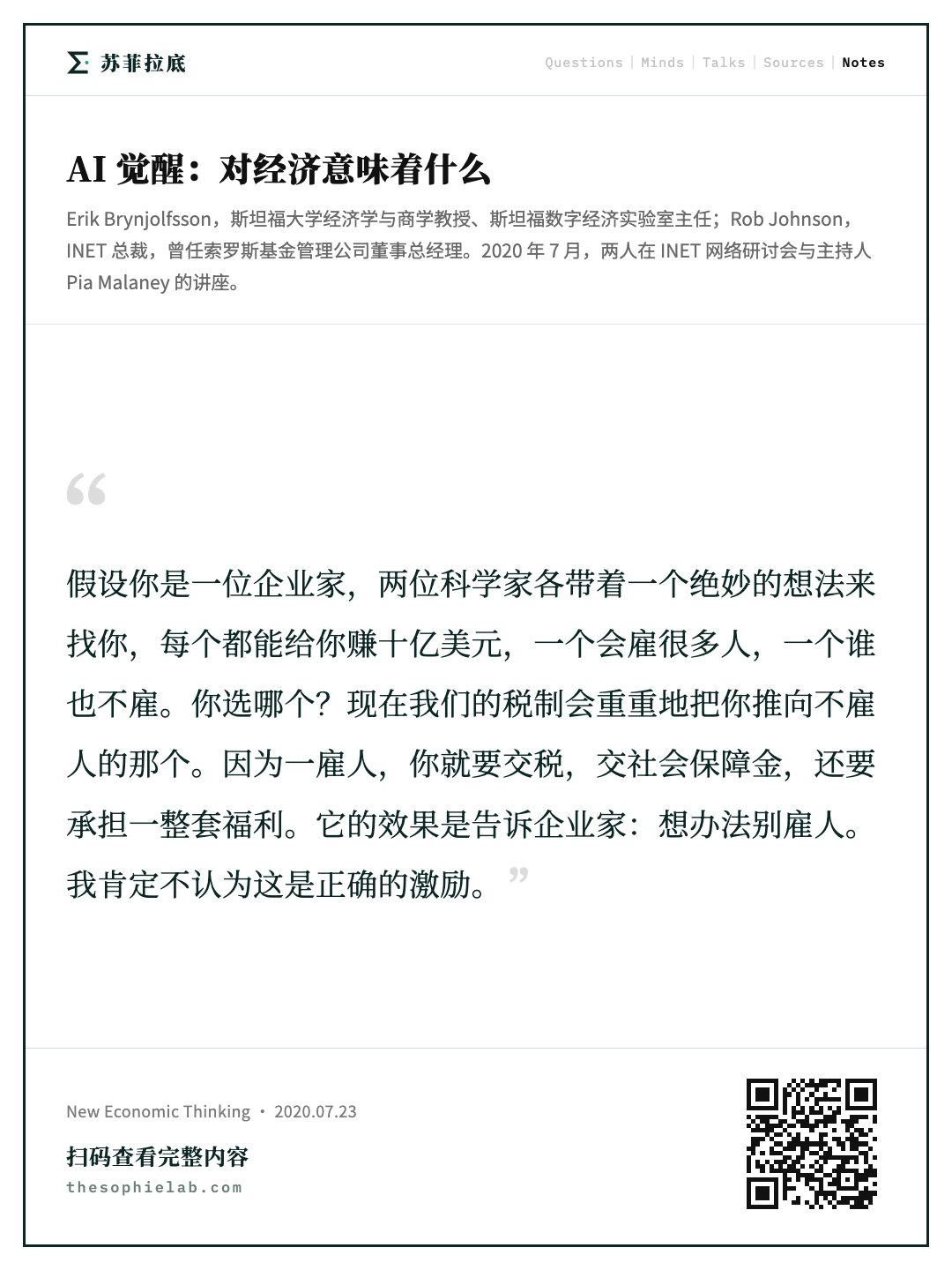
布莱恩约弗森:你正好说中了要害。我们可以改变激励。在我看来,近来形势对劳动者不利的原因之一,是有人非常明确地、也许是有意识地,把激励朝相反方向拧。眼下我们大规模补贴自动化和资本投资,却惩罚劳动。假设你是一位企业家,两位科学家各带着一个绝妙的想法来找你,每个都能给你赚十亿美元,一个会雇很多人,一个谁也不雇。两者都给你带来十亿利润,就这么假定。你选哪个?现在我们的税制会重重地把你推向不雇人的那个。因为一雇人,你就要交税,交社会保障金,还要承担一整套医疗和其他福利,不雇人就没有这些负担。如果你能不增雇一个人就无成本地扩大规模,用他们的话说,一个「可扩展」的流程,不涉及人,那你就能把全部好处留下,不必给政府那么多。政府在你雇人时收得比不雇人时多得多。我不认为这是我们想要的激励。它的效果是告诉企业家:想办法别雇人。这在一百年前、我们也许比现在更缺劳动力的时候,或许还有点道理(我不确定曾经有过),但此刻,我肯定不认为这是正确的激励。

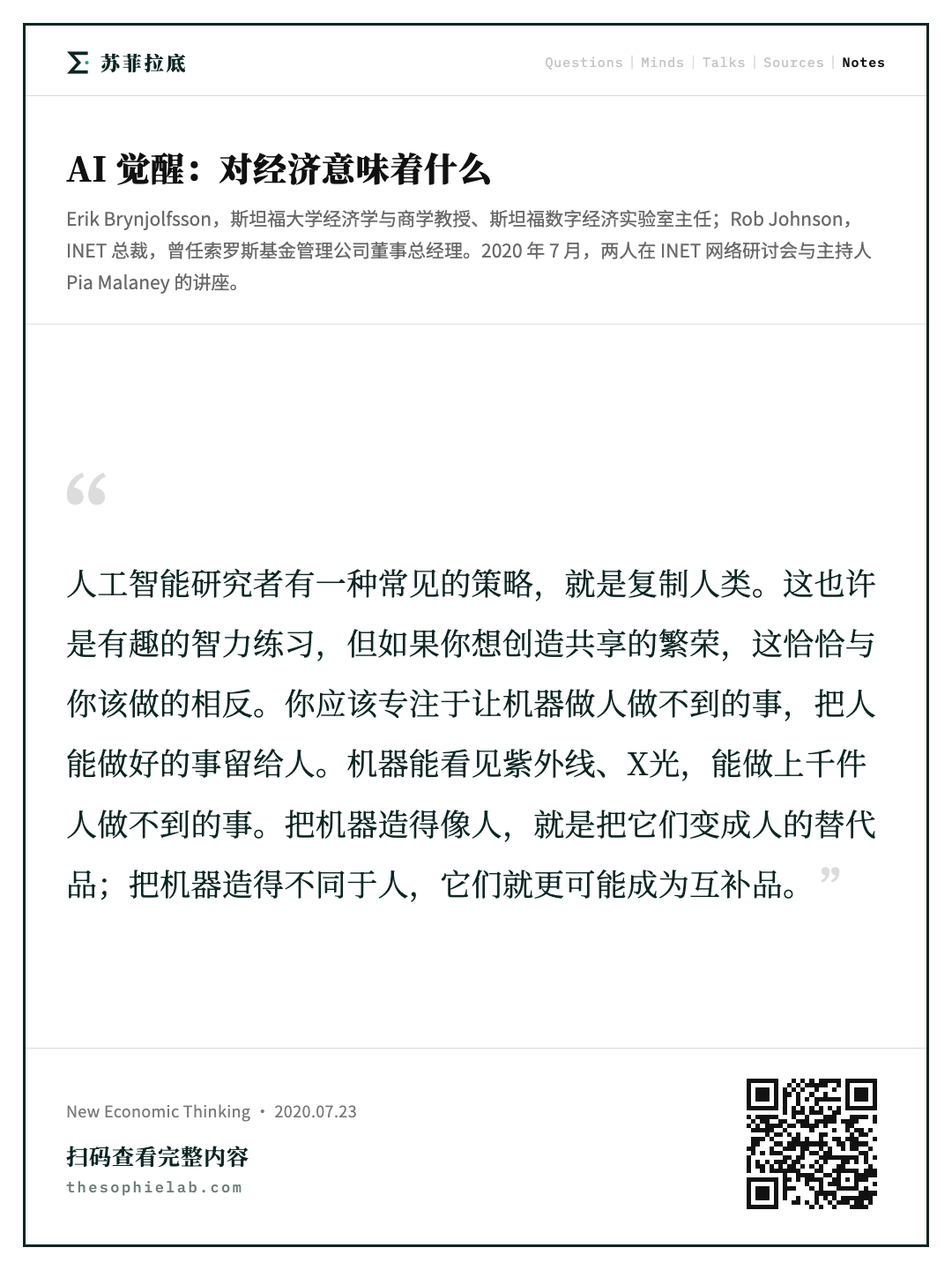
布莱恩约弗森:此外还有培训和教育的问题。有一整套本应鼓励互补而非替代的政策,我们并没有到位。我也认为这不只是政府的事。如果国会和政府对此更敏感当然好,也许选举之后会好一些。但这同样是首席执行官们需要思考的事,劳工领袖需要思考,个人也需要思考自己的技能发展。我在一个最大的人工智能会议上做过报告,我告诉他们,别把那么多精力放在制造替代人类的人工智能上。人工智能研究者有一种常见的策略,就是复制人类。有所谓图灵测试,看你能不能造出一台与人无法区分的机器;不管是机械手还是别的什么,他们总以人为标准去复制。我对他们说,这也许是有趣的智力练习,但如果你想创造共享的繁荣,这恰恰与你该做的相反。想创造共享的繁荣,你应该专注于让机器做人做不到的事,把人能做好的事留给人。机器能看见紫外线、X光,能做上千件人做不到的事。去开发那些能力,而不是让它们越来越像人。把机器造得像人,就是把它们变成人的替代品;把机器人造得不同于人,它们就更可能成为互补品。所以我再说一遍:政府、产业、劳动者个人、技术人员,都应该从互补与替代的角度来思考。

信息工作的全球化

马拉尼:谢谢。我来看看收到的问题。汤姆·科因问:新冠迫使大量高技能劳动者在家工作,由此引发的技术开发浪潮,会不会导致这些岗位面临远为激烈的全球竞争,给高工资地区的就业带来下行压力?

布莱恩约弗森:这是个很好的问题,我一直在想同样的事。很多人指出人们在远程工作,但问题是,一旦远程,你在十英里外还是一万英里外,大概没有多大区别。皮娅,你现在在哪儿?

马拉尼:我在洛杉矶。

布莱恩约弗森:你在洛杉矶,那我现在离你三四千英里,可我们照样在一起远程工作。正如汤姆所说,一位企业家或经理,不再需要只和住在自己附近的人一起工作。只要在线,通勤圈就变得越来越无关紧要。我认为会出现一个有趣的悖论。大家都指出,原子世界的全球化正面临压力:供应链回迁,贸易限制增加,移民减少。凡是涉及实物、服务、人员的物理流动,我们看到的是全球化的退潮。但没有得到足够关注的,正是汤姆的这一点:随着人们远程工作,我们会看到信息工作的进一步全球化。这可能给那些城市里的许多人带来下行压力。确切地说,对美国的一部分人是下行压力,对印度或非洲那些从前接触不到全球市场、现在能接触到的人,则是上行压力。这就是经济学家所说的要素价格均等化(factor price equalization):无论你有什么技能,你现在都在一个全球市场里。这可能是好事也可能是坏事,取决于你在工资和能力上,与其他国家的人相比有多大竞争力。

中美人工智能之比

马拉尼:谢谢。爱德华·哈达德问:美国与中国或其他国家在人工智能进展上有显著差异吗?

布莱恩约弗森:这个问题我看得不少。我参与了一个叫「AI指数」(AI Index)的机构,是我和另一些人一起发起的,现在设在斯坦福,追踪许多不同领域的进展。网址是AIIndex.org,每年出一份大报告,也有持续更新的统计。我们看到的是,中国确实在大步前进,在某些领域,比如人脸识别,中国领先于美国。稍微简化一点说,在更基础的类别上,我想共识是美国的核心基础研究更强;在许多应用领域,尤其是涉及大数据集的领域,中国要么在迅速追赶,要么已经超过美国。

布莱恩约弗森:我去过AAAI,说起来有意思:AAAI过去是这个领域最顶尖的会议,名字原本是「美国人工智能协会」。现在改名了,因为来自中国的投稿已经多于美国,新名字大概是「人工智能促进协会」,把「美国」从名字里去掉了,因为它已经成了一个全球性会议。来自中国的论文比来自美国的多,我要说明,不是超过一半,但多于美国。当然也有许多来自其他国家的论文,中美是前两位。主观上,和许多研究者交谈,他们觉得美国论文的质量和基础性突破更强。所以这有点像数量与质量的取舍,也许还有应用与基础的取舍,但中国无疑是人工智能领域的一个巨大力量。我推荐李开复的著作《AI·未来》(AI Superpowers),我认为是这方面较好的一本书,比较了两国人工智能体系各自的长短。

新的数字鸿沟

马拉尼:罗伯特·欧文问:机器学习及相关的新数字技术,会在多大程度上加剧发达国家与外围地区之间的又一道数字鸿沟?国家和国际层面的政策协调,在应对这一挑战时应扮演什么角色?

布莱恩约弗森:这在某种意义上是汤姆·科因问题的另一面。随着全球化加深,对于发展中国家里那些能上网、又具备一定技能的人,这可能是好事。另一方面,那些国家里许多人要么没有技术接入(尽管仅凭手机,接入也在变得越来越普遍),更常见的是,他们没有眼下市场需要的技能。我认为存在一个真实的风险:发展中国家过去用来向上攀爬的梯子,有几级正在被抽掉。过去你可以搞低工资制造业,不需要很多技术工人,不管是纺织还是其他行业,越南或台湾的工人可以仅凭工资更低,就与德国、瑞士或美国的工人竞争。但现在许多这类工作由机器人来做了,单靠低工资就没那么有吸引力了。那些不太可能被机器接手的任务,往往认知要求更复杂,更需要创造性,通常也需要更多教育。有些国家和地区已经成功地或者正在成功地穿越这个转型,比如台湾,以及我们刚提到的中国大部分地区,但另一些国家可能被卡在转型的另一侧,找不到同样的前进路径。所以,很可能有大量的人被落下,除非我们主动去提升他们的人力资本,提升他们在数字时代用得上的技能。

让技术适应现有劳动力

马拉尼:杰克有一条评论,呼应了上一场研讨会里的说法:我们应该停止幻想一支理想的劳动力队伍,而是让技术为现有的劳动力服务。

布莱恩约弗森:我不认为这是非此即彼。当然,正如我提到的,和技术人员交谈时,我鼓励他们开发与人类劳动者互补的技术。但我们一直也在大力投资于劳动力的再培训。我说「我们」,是指美国之所以成为世界领先者,不仅在生产率上,也在平等上,是因为它在教育上的投资远多于其他国家。回到十九世纪,小学在美国已经普及,而在欧洲还很不普遍。有人当时觉得让农家子弟学读书写字和其他技能是发疯,结果证明这是极其重要的投资。后来有了高中运动、大学运动。美国如今领先优势不如从前,甚至在落后,原因之一就是它没有像过去那样在教育和培训上投入。但我认为这必须是全方位的。人们将不得不持续地改变和升级技能,我不认为这种需要已经走到了尽头。技术人员也应该让技术去适应他们。同样,企业家需要思考如何以不同方式把技术与人结合起来创造价值,政府需要建设支撑这一切的基础设施。这是一项全方位的事情,没有哪一方必须或者能够独自完成全部工作。

马拉尼:谢谢。时间到了。埃里克,再次感谢你抽时间和我们做这场活动,尽管中间有那么多技术故障要应付。我们非常感激。这是一场非常有意思的讨论,涉及我们正在苦苦应对的一系列问题,而这些问题被疫情加重了,或者说,被疫情加速了。我们很期待与你在斯坦福新成立的数字经济实验室建立联系。也感谢今天所有在线收看的朋友。我们下一场研讨会在两周后,8月6日,考希克·巴苏将讨论疫情对全球经济的长期影响,涉及印度和其他一些发展中经济体,谈疫情对这些国家已经产生和将会产生的影响。再次感谢,大家保重。

布莱恩约弗森:非常感谢,皮娅。这真是一次愉快的交流,很高兴有机会和大家连线。
本期讲者
埃里克·布莱恩约弗森斯坦福大学经济学与商学教授、斯坦福数字经济实验室主任,此前长期任教于麻省理工。与 Andrew McAfee 合著《第二次机器革命》,提出生产率 J 曲线与「机器学习适用性」任务评分体系。
Pia Malaney新经济思维研究所(INET)资深经济学家、INET 旧金山创新中心主任,本场主持人。
罗伯·约翰逊INET 总裁,曾任索罗斯基金管理公司董事总经理、美国参议院预算委员会首席经济学家,本场致开场词。
章节 · 点击跳转视频
0:00 开场:制造业岗位流失与自动化 ▶ 正在看
4:44 AI 觉醒:十周走完十年 ▶ 正在看
6:22 从 ImageNet 到语音:机器超越人类 ▶ 正在看
10:31 eBay 翻译实验与卢德分子之忧 ▶ 正在看
12:29 替代还是互补:两百年工资史 ▶ 正在看
14:34 机器学习评分表:无一职业被通吃 ▶ 正在看
20:08 谁最脆弱:按工资、地区、公司拆解 ▶ 正在看
25:07 远程办公快照与 Job2Vec ▶ 正在看
29:38 生产率悖论的四种解释 ▶ 正在看
36:19 无形资产与生产率 J 曲线 ▶ 正在看
41:00 大脱钩:蛋糕变大,中位数停滞 ▶ 正在看
44:46 问答:税制偏向、全球化与中美差距 ▶ 正在看
本期论点
本期回应
1:02
2000 至 2010 年美国制造业岗位流失约 85% 源于自动化等技术变革,而非全球化 净取代AI 会怎样改变人的工作?皮娅·马拉尼
11:51
两百年前砸毁织布机的卢德分子是对的,机械化确实淘汰了大量熟练工匠的工作 净取代AI 会怎样改变人的工作?埃里克·布莱恩约弗森
13:30
最近二十年普通劳动者工资增长停滞,意味着技术正从互补人类转向越来越多地替代人类 净取代AI 会怎样改变人的工作?埃里克·布莱恩约弗森
17:57
机器学习会重构劳动力市场的任务分配,但不会带来大规模失业或工作的终结 人机互补AI 会怎样改变人的工作?埃里克·布莱恩约弗森
47:51
现行税制大规模补贴自动化和资本投资,却在惩罚企业雇人 制度与选择技术的后果由什么决定?埃里克·布莱恩约弗森
50:27
要创造共享繁荣,就该让机器去做人类做不到的事,而不是把机器造得越来越像人 制度与选择技术的后果由什么决定?埃里克·布莱恩约弗森
14:53
通用人工智能大概会实现,但那至少是五十年甚至一百年以后的事 要几十年AI 改变一切,要几年还是几十年?埃里克·布莱恩约弗森
其他论点
11:11
eBay 上线机器翻译后,相应语言对的跨境销售立刻增长约 11% 到 12% 观察埃里克·布莱恩约弗森
20:59
民航飞行员这类高薪职业同样有大量任务适合机器学习,自动化冲击并非只落在低薪端 埃里克·布莱恩约弗森
27:21
远程办公的转变极不均衡:处理数据和信息的人转为居家,制造与建筑业者更可能失业或停工 观察埃里克·布莱恩约弗森
32:52
视觉与语言理解这类通用智能技术的重要性至少不亚于电力 埃里克·布莱恩约弗森
36:54
企业部署新信息系统时,软硬件之外的组织变革与培训投入通常是其九到十倍 观察埃里克·布莱恩约弗森
38:19
无形资产投入在国民核算中不被计量,使通用技术早期出现五到十年的生产率下滑假象 埃里克·布莱恩约弗森
42:09
过去二十年生产率与 GDP 屡创新高,收入中位数却基本停滞,大部分收益流向最顶端的 1% 观察埃里克·布莱恩约弗森
52:14
实体世界的全球化正在退潮,信息类工作的全球化却会因远程办公继续推进 埃里克·布莱恩约弗森
01开场:制造业岗位流失与自动化
0:00
Hello and welcome to the INET webinar the AI awakening implications for the economy with Erik Brynjolfsson. I am Pia Malaney, senior economist here at INET and director of INET's Innovation Center in San Francisco. Uh when I moved to Silicon Valley to start the center a few years ago, I was very curious to hear the focus on AGI or artificial general intelligence, which at the time seemed like a science fiction concept to me. While we're still a long ways from um the reality of AGI, the impact of technology on our world has clearly been accelerated dramatically in the wake of the crisis. Um and the focus on technology on jobs has clearly been an issue that we need to be uh concerned about more and more. Um the US lost about 5.6 million manufacturing jobs between 2000 and 2010, and there's been much discussion about the impact of globalization on the manufacturing center uh sector. But according to a study by the Center for Business and Economic Research at Ball State University, 85% of the job losses are actually attributed attr- attributable
大家好,欢迎参加 INET 网络研讨会——《AI 觉醒:对经济的影响》,主讲人是 Erik Brynjolfsson。我是 Pia Malaney,INET 的资深经济学家,也是 INET 旧金山创新中心的主任。几年前我搬到硅谷来创办这个中心时,我很好奇地发现大家都在谈 AGI,也就是通用人工智能,当时在我看来这还像是科幻概念。虽然我们离 AGI 成为现实还有很长的路要走,但在这场危机之后,技术对我们这个世界的冲击显然被大大加速了。技术对就业的影响,也显然成了一个我们必须越来越重视的问题。2000 到 2010 年间,美国大约流失了 560 万个制造业岗位,关于全球化对制造业部门的冲击,大家已经讨论了很多。但根据鲍尔州立大学商业与经济研究中心的一项研究,其中 85% 的岗位流失,实际上应该归因于
便签引用
1:16
to technological change, largely automation. A recent report from McKinsey suggests that up to 800 million jobs could be lost to automation by 2030. These were estimates from before the pandemic, which of course has exacerbated this trend quite dramatically. Erik has been working on these issues for many years now and brings us uh the perspective of someone who deeply understands the world of technology and the economic context within which it functions. His research examines the effects of information technologies on business strategy, productivity, and performance, digital commerce, and intangible assets. He is the director of the newly started uh Digital lab at Stanford and professor of economics and business at Stanford. He's a research research associate at the NBER and the author of several books including with co-author Andrew McAfee, the New York Times bestseller The Second
技术变革,主要是自动化。麦肯锡最近的一份报告估计,到 2030 年可能有多达 8 亿个工作岗位被自动化取代。而这些还是疫情之前的估计,疫情当然又把这个趋势急剧地加剧了。Erik 多年来一直在研究这些问题,他既深刻理解技术世界,也理解技术运行其中的经济背景,能给我们带来这样一种视角。他的研究关注信息技术对企业战略、生产率与绩效、数字商务以及无形资产的影响。他是斯坦福新成立的数字实验室的主任,也是斯坦福的经济学与商学教授。他还是美国国家经济研究局(NBER)的研究员,著有多本著作,包括与合著者 Andrew McAfee 一起写的《纽约时报》畅销书《第二次机器革命》——
便签引用
2:12
Machine Age, Work, Progress, and Prosperity in a Time of Brilliant Technologies. Before I turn over to Eric, INET's president Rob Johnson would like to say a few words and then after the presentation we'll open it up for Q&A. You have a button at the bottom of your screen so if you can type in your questions we'll get to as many of them as we can. So let me now turn it over to Rob. Thank you, Pia. Well, Eric, I am absolutely delighted that you're here with us today.
《第二次机器革命:智能技术时代的工作、进步与繁荣》。在把时间交给 Erik 之前,INET 的主席 Rob Johnson 想先说几句,之后演讲结束我们再进入问答环节。你们屏幕下方有一个按钮,可以把问题打进去,我们会尽量回答更多的问题。那么现在有请 Rob。谢谢你,Pia。Erik,你今天能来,我真的非常高兴。
便签引用
2:46
I just kind of danced through the memories of our interactions over the years. Seeing you at MIT or meeting with you and Bill Janeway around the Second Machine Age. Running into you at the China Development Forum in the hallways and everywhere I go and every time I read something you write or everywhere I go and run into you, every time I read something you write I see you pulling things together. And when the economics like a narrow arrow you just you have this mosaic that you've created for all of us to share in seeing. Related to the structure of society, the structure of politics driven by technology and at times involving what you might call the philosophical systems clash between East and West over which these technological issues are
我脑子里刚才像跳舞一样闪过了这些年我们打交道的种种回忆。在 MIT 见到你,或者围绕《第二次机器革命》和你还有 Bill Janeway 一起开会。在中国发展高层论坛的走廊里碰到你——其实我走到哪儿都能碰到你,每次读到你写的东西,我都能看到你在把各种线索拼到一起。当经济学像一支细窄的箭一样时,你却给我们所有人拼出了一幅马赛克,让我们能一起看见。它关乎社会结构,关乎被技术驱动的政治结构,有时还牵涉到东西方之间那种可以称之为哲学体系的冲突——而这些技术议题
便签引用
3:47
often brought to a point of tension and pain. So I like I said at the at the outset, I'm delighted that you're here. You illuminate things wherever you sit, whether it's my alma mater MIT or your new home in Stanford. And as Pia's in Northern California, I come out there to my home in Bolinas good portions of the year. So, but wherever you are, I will stay tuned, which means for the next hour, I'll be grinning. Thank you. Well, thank you so much, Rob, and thank you, Pia. Uh, those are very kind introductions. I'll I'll do my best to live up to them. And I want to say, uh, likewise, I've been so impressed with what what you all are doing at I-Net. And I'm feel very privileged to have a chance to share a little bit of our research with you all. And I'm especially looking forward to the, uh, discussion and the Q&A afterwards. So, uh, anybody out there listening, please,
常常在那里被推到紧张和痛苦的临界点上。所以就像我一开始说的,你今天能来我非常高兴。不管你坐在哪里,你都能把事情照亮,无论是我的母校 MIT,还是你在斯坦福的新家。Pia 在北加州,我也有大半年时间会回到我在博利纳斯的家。总之不管你在哪儿,我都会一直关注——也就是说接下来这一个小时,我会一直咧着嘴笑。谢谢。谢谢你,Rob,也谢谢你,Pia。这些介绍太抬举我了,我会尽力不辜负。我也想说,你们在 INET 做的事情让我印象非常深刻,能有机会和大家分享一点我们的研究,我感到很荣幸。我尤其期待后面的讨论和问答环节。所以在线的各位,
便签引用
02AI 觉醒:十周走完十年
4:44
uh, uh, let me know what questions you have, what comments, and and and anything that we touch on or or you'd like to discuss more. I'm very happy to discuss it. That's, uh, one of the most fun parts. Let me just now, um, see if I can share my slides, which I should be able to, so you can see. And let me just confirm. So, you can see now my title slide? Yeah. Great. Um, okay. So, what I'm going to talk about today, as Pia mentioned, is this idea of the AI awakening and what it means for the economy. Um, there have been some just breathtaking improvements in the power
请把你们的问题、评论告诉我,我们今天谈到的任何内容,或者你们想更深入聊的东西,我都很乐意讨论。那是最有意思的部分之一。现在让我看看能不能把幻灯片共享出来,应该没问题。我确认一下,大家现在能看到我的标题页吗?能。太好了。好的。那么就像 Pia 提到的,我今天要讲的是 AI 觉醒这个想法,以及它对经济意味着什么。近来我们看到了一些令人惊叹的进步,尤其是机器学习的能力——
便签引用
5:24
of machine learning in particular, but AI more broadly or digital technologies even more broadly. And, uh, certainly that's accelerated a lot in the past, uh, few months as COVID has forced us all to change the way we're working, including this seminar here I here are doing it on on Zoom. And a lot of my work, uh, millions of people around the country and around the world have had their lives transformed. And it's part of a a much broader fundamental change in the economy triggered by these new technologies and and new ways of doing work. And there's a saying that I think captures some of this. There are decades where nothing happens and there are weeks where decades happen. I think the the past few weeks, the past few months have been an example of that. In the past 10 weeks we probably had at least 10 years of change in in areas like remote work. I'll show you some of the data on that as well as in in other areas of automation.
更广义地说是 AI,甚至更广义的数字技术。而在过去这几个月,随着新冠迫使我们所有人改变工作方式,这个进程显然大大加速了,包括我们今天这个研讨会也是在 Zoom 上开的。我的很多工作,还有全国乃至全世界数百万人的生活,都因此被改变了。这只是这些新技术和新工作方式所引发的、更宏大也更根本的经济变革的一部分。有句话我觉得很好地概括了这一点:有些年代什么都没发生,有些星期却发生了几十年的事。我觉得过去这几个星期、几个月就是一个例子。在过去 10 周里,像远程办公这样的领域,我们大概经历了至少 10 年的变化。我待会儿会给大家看一些相关数据,自动化领域也有类似情况。
便签引用
03从 ImageNet 到语音:机器超越人类
6:22
Let me first so talk about automation and how the technology has been used more and more. One of the ways to have people work safely and get work done safely is to use more of these technologies. And one example is TensorFlow, which is probably the most popular tool for doing machine learning. Now over 100 million downloads. My team has all downloaded it and we use it quite extensively and so are a lot of other people. And and every month it's breaking new records in terms of people trying to find ways of using machine learning in their work. And it's uh We're now crossing a really important threshold. If you look at the use of machine learning for many many tasks, here's one example, image recognition. A decade ago machines really could not recognize objects very well the way humans could. But then Fei-Fei Li at Stanford put together ImageNet, 14 million different images. Here are are four of them.
我先来谈谈自动化,谈谈这些技术是如何被越来越多地使用的。让人们安全地工作、把活安全地干完,方法之一就是更多地使用这些技术。一个例子是 TensorFlow,它大概是目前做机器学习最流行的工具,现在下载量已经超过一亿次。我的团队全都下载了,我们用得相当多,很多其他人也在用。而且每个月它都在刷新纪录,说明越来越多的人想找到在工作中使用机器学习的方法。我们现在正跨过一个非常重要的门槛。如果你看机器学习在许多任务上的应用,比如图像识别这个例子:十年前,机器其实还远远做不到像人一样识别物体。但后来斯坦福的李飞飞建立了 ImageNet,收录了 1400 万张不同的图片。这里是其中四张。
便签引用
7:21
Each painstakingly labeled by humans. And then there was a series of contests to see how well the machines could identify what was in them. At first they weren't that good. You can see by the the purple line there. But then it accelerated dramatically. The real inflection point was around 2012 when Jeff Hinton introduced deep learning techniques. Before that they weren't using the deep learning and neural network techniques. You you probably all heard about those. Um these are very large networks that um in some ways mimic the way the human brain in um processes information. And just recently, well, I'd say in the past 8 years or so, we've had enough computer power and some improvements in the algorithms and most importantly, massive increases in data availability, digital data availability. And those three things put together have allowed us to use neural nets much, much more effectively. To the point now in many applications, including ImageNet, they now surpass humans. Humans are not perfect at ImageNet. Um And and machines can now uh recognize say dog breeds of
每一张都是人工一点点标注出来的。然后有一系列的比赛,看机器能多好地识别出图中的东西。一开始它们表现并不好,你可以从那条紫线看出来。但接着就急剧加速了。真正的拐点大约在 2012 年,当时 Jeff Hinton 引入了深度学习技术。在那之前大家并没有使用深度学习和神经网络技术,这些你们大概都听说过。这是一种非常大的网络,在某种程度上模仿人脑处理信息的方式。而就在最近,我是说过去八年左右,我们有了足够的算力,算法也有所改进,而最重要的是数据可得性——数字化数据的可得性——大幅提升。这三样加在一起,让我们能够更加高效地使用神经网络。以至于现在在很多应用里,包括 ImageNet,机器已经超越了人类。人类在 ImageNet 上也不是完美的。机器现在识别狗的品种
便签引用
8:27
dog or other objects more successfully than the typical person can. But it's not just image recognition. Uh it's also speech recognition. You know, most of us have uh a phone like like this, iPhone or or something else that and and we have played with it, you know, whether it's Siri or Alexa or or Google Now. I think it's far from perfect, but we're beginning to be in this I'd say 10-year period where we went from not being able to speak to our machines to just routinely talking to them and expecting them to talk back to us and answer questions for us. And that's getting a lot better, too. I'd say it's not quite at human level in most applications, but it's getting very close. And uh with Andrew McAfee, we wrote an article in Harvard Business Review where we just reviewed all the different areas where we are getting um machines to do things that once only humans could do, whether it's in voice recording or analyzing market data or
或者其他物体,已经比一般人做得更准了。但不只是图像识别,语音识别也是如此。我们大多数人都有这样一部手机,iPhone 或者别的什么,我们都玩过 Siri、Alexa 或者 Google Now。我觉得它离完美还差得远,但我们正进入这样一个十年:从没法跟机器说话,变成理所当然地跟它们说话,还指望它们回应我们、替我们回答问题。而且这方面也在快速变好。我认为在多数应用里它还没到人类水平,但已经很接近了。我和 Andrew McAfee 在《哈佛商业评论》上写过一篇文章,梳理了所有那些机器正在做原本只有人类能做的事情的领域,比如语音录制、分析市场数据,或者
便签引用
9:24
analyzing drug chemical properties, uh new recipes, analyzing purchases, um of course, recognizing faces. Um on the left there is an example of uh radiology um where they and and and histology, where uh they're looking at medical images and recognizing uh cancer versus not cancer. And it seems like hardly a a week goes by when I don't see a new article in in nature or science um describing how a new machine learning system is outperforming humans in a task similar to that. So, right now we're having a bit of a gold rush going on. Um Hundreds of billions of dollars are going into venture capital and by uh large corporations uh trying to stake out opportunities in using machine learning to solve problems that previously only humans could do. And uh they're making bets that that this is going to pay off in a big way, and I think you know, certainly not all the bets are going to pay off, but I think on average we're we're I'm pretty optimistic that we'll have more and more breakthroughs like the ones we've already seen.
分析药物的化学性质、开发新配方、分析购买行为,当然还有人脸识别。左边是放射科的一个例子,还有组织病理学,他们在看医学影像,识别是不是癌症。而且现在几乎每周我都能在《自然》或《科学》上看到新文章,讲某个新的机器学习系统在类似任务上超越了人类。所以现在有点像是一场淘金热。数千亿美元的风险投资,还有大公司的投入,都在涌向机器学习,想抢占用机器学习解决那些原本只有人类能做的问题的机会。他们在下注,赌这会带来巨大的回报。我想当然不是所有的赌注都会成功,但平均而言我还是相当乐观的,我们会看到越来越多像已经出现过的那种突破。
便签引用
04eBay 翻译实验与卢德分子之忧
10:31
Uh one small example that we looked at was just a machine translation. We saw an immediate impact. So, here's a paper we published last year um on machine translation at eBay. Uh they introduced a new system for machine translation and had immediate results. Uh they did it in several language pairs between English and Spanish, English and French, English and Italian, English and Russian. And in each case, it was a a natural experiment. We could see how transactions changed before and after machine translation. Here's the example for Spanish in Latin America. And as you can see, um there was a a a very noticeable improvement in sales, about 11 or 12% increase in sales once they switched on the system and people were able to read uh listings on eBay in in English um or in Spanish, whichever was their native language. So, this is one of the cases where you could see a a very measurable economic effect. But, as as Pia and Rob were mentioning in the introduction, there's a lot of concern that while there are a
我们研究过的一个小例子是机器翻译,我们看到了立竿见影的影响。这是我们去年发表的一篇论文,讲 eBay 上的机器翻译。他们上线了一套新的机器翻译系统,效果立刻就出来了。他们做了好几个语言对:英语和西班牙语、英语和法语、英语和意大利语、英语和俄语。每一次都是一个自然实验,我们能看到机器翻译上线前后交易量的变化。这是拉丁美洲西班牙语的例子。你可以看到,销售额有非常明显的提升——系统一打开,人们可以用自己的母语(英语或西班牙语)阅读 eBay 上的商品信息之后,销售额增长了大约 11% 到 12%。所以这是一个能看到非常可量化的经济效应的案例。但正如 Pia 和 Rob 在开场时提到的,很多人担心的是:虽然确实能创造出
便签引用
11:39
lot of wealth can be created, there's also concern about the distribution of that wealth and and jobs being destroyed. This is an age-old concern going back to to the Luddites almost exactly 200 years ago. As you I think you all know, they were smashing the looms because they saw them as eliminating a lot of jobs for skilled artisans. And they were actually right. A lot of jobs were eliminated by this technology. Overall, more wealth was created, but but as we'll talk about later, there's there's no economic law that says that everyone's going to benefit. It's possible for some people to be hurt even as others benefit. And we're going through a transition like that right now. I think it's going to be even bigger already is becoming even bigger than what we saw in the Industrial Revolution. And today, it's what Andrew McAfee and I call the second machine age where what's being augmented and
大量财富,但也有人担心这些财富的分配,以及工作岗位被摧毁。这是一个古老的担忧,可以一直追溯到差不多正好 200 年前的卢德分子。我想大家都知道,他们砸织布机,是因为他们看到这些机器消灭了大量熟练手工艺人的工作。而他们其实是对的,很多岗位确实被这项技术消灭了。总体上创造了更多财富,但正如我们后面会谈到的,没有任何一条经济规律保证每个人都会受益。完全可能有一部分人受损,而另一部分人受益。我们现在正经历这样一场转型。我认为它会比工业革命时更大,实际上已经在变得更大。而今天,我和 Andrew McAfee 称之为第二次机器革命,因为被增强和
便签引用
05替代还是互补:两百年工资史
12:29
automated isn't just physical muscle power, but brains and mental work as well. And that's a much broader scope of a set of tasks. Now, the most natural way to think about how technology is affecting wages to to look at substitution. It's the first thing I think of I think most people is a machine doing what a human used to do. But, there are many other ways that machines are also affecting work. In addition to substitution, there are also complementarities. Complementarities mean that the machine is making the human work more valuable, not less valuable. Now, which of these is more important? Well, if you look at the data, actually for most of the past 200 years, the complementarities have been the more important factor. And the reason I say that is if you just take a look at what's happened to the wages of a of a typical person working in the economy, wages have gone up tremendously over the past 200 years since the time of the Luddites, although in the last 20 years or so,
被自动化的不只是体力,还包括大脑和脑力劳动。这涉及的任务范围要宽广得多。现在,思考技术如何影响工资,最自然的方式是看替代。我想这是我、也是大多数人首先想到的:机器做人过去做的事。但机器影响工作还有很多其他方式。除了替代之外,还有互补。互补的意思是,机器让人的劳动更有价值,而不是更没价值。那么这两者哪个更重要?如果你看数据,其实在过去 200 年的大部分时间里,互补都是更重要的因素。我这么说的理由是:只要看看经济中一个普通劳动者的工资发生了什么变化就知道,自卢德分子的时代以来,工资在过去 200 年里大幅上涨。不过在最近 20 年左右,
便签引用
13:30
um that improvement has stopped and even reversed, and wage growth has has ceased. So, we may be moving from technology mostly being a complement to increasingly being a substitute. There are four other factors, demand elasticity, income elasticity, supply elasticity, and the invention of new tasks that also affect how technology is going to affect wages. And Tom Mitchell and I discussed them in more detail in this article called "Why What Can Machines Learn in Science?" And we worked through some of the economics of that and and some of the types of technologies that are affecting each of those. I won't go into them in depth right now. Although, I guess I'm I'm happy to discuss them during the Q&A part if you'd like to dive into any of them in more depth. Um, they're all important and I think um, the main lesson I wanted to just leave it is we shouldn't just only think about substitution. Technology can and should be used to complement and help people. Um, what I said in my TED Talk is we should learn how to race with the machines, helping having them help us get our work done, rather than racing against the machines, where we see it as an either or.
这种改善停止了,甚至出现了倒退,工资增长陷入停滞。所以我们可能正在从技术主要扮演互补角色,转向它越来越多地扮演替代角色。此外还有四个因素也会影响技术如何作用于工资:需求弹性、收入弹性、供给弹性,以及新任务的创造。我和 Tom Mitchell 在《科学》上那篇《机器能学会什么?》的文章里更详细地讨论了这些。我们梳理了其中一部分经济学逻辑,以及影响每个因素的技术类型。我现在不深入展开了,不过如果你们想深入聊其中任何一点,我很乐意在问答环节讨论。它们都很重要,而我想留给大家的主要一课是:我们不应该只想着替代。技术可以、也应该被用来补充和帮助人。我在 TED 演讲里说过,我们应该学会与机器一起赛跑,让它们帮我们把工作做完,而不是与机器赛跑,把它看成一个非此即彼的问题。
便签引用
06机器学习评分表:无一职业被通吃
14:34
Um, Pia mentioned that we're far from artificial general general intelligence, AGI. AGI is this idea that machines can do the whole uh breadth and depth of what humans do. Um, the kind of thing you might see in a Hollywood movie like The Terminator that can just is is essentially human-like. Um, maybe someday we will get to that. I I suspect we probably will, but it could be 100 years from now or at least 50 years. I think most uh machine learning experts think. Right now, we have very powerful AI and I gave you some examples for vision and voice recognition and other areas, but they're still pretty narrow. They're not general. Um, and that raises a question, at least it did for Tom Mitchell and I, of what are the tasks that machine learning can do well, and what are the tasks that it does not do well? And if we could kind of come up with a a rubric or a way of classifying which tasks are in each of those categories, we'd be better able to understand how the economy is changing.
Pia 提到我们离通用人工智能 AGI 还很远。AGI 指的是机器能覆盖人类所做事情的全部广度和深度,就像好莱坞电影《终结者》里那种,基本上和人一样。也许有一天我们会做到,我猜多半会,但可能是 100 年以后,或者至少 50 年。我想大多数机器学习专家都是这么认为的。现在我们拥有非常强大的 AI,我刚才举了视觉、语音识别和其他领域的例子,但它们仍然相当狭窄,不是通用的。这就引出一个问题——至少对我和 Tom Mitchell 来说是这样:哪些任务是机器学习能做好的,哪些是它做不好的?如果我们能拿出一套评分标准,或者一种把任务分门别类的方法,我们就能更好地理解经济正在如何变化。
便签引用
15:34
So, we went ahead and we consulted with a lot of machine learning experts, and over a period of time we developed what we call this machine learning rubric, and we applied it to the tasks that are in O*NET, not to be confused with I*NET. Um O*NET, as you may know, is the an occupational database that has about 18,000 occupation-specific tasks. Um about about 20 or 30 for each of 950 specific occupations. So, for instance, bus driver, economist, primary school teacher, uh radiologist, they're all in O*NET, and um each of them has There's a description of what tasks a person has to do in those. And so, what we did, um just to explain the methodology, we took our rubric and we applied it to each of the tasks, and we scored it as to whether or not machine learning was suitable, was likely to be able to do that. So, there are some things that machine learning can do very well, things that are data-intensive and well-described, other things that machine learning can't do as well. And uh so, we scored every single
于是我们去咨询了很多机器学习专家,经过一段时间,我们开发出了所谓的机器学习评分表,并把它应用到 O*NET 里的任务上——注意别和 INET 搞混了。你们可能知道,O*NET 是一个职业数据库,包含大约 18000 个特定职业任务,950 个具体职业里每个职业大约有 20 到 30 个任务。比如公交车司机、经济学家、小学老师、放射科医生,都在 O*NET 里,每一个都有对应岗位需要完成哪些任务的描述。我们做的事情——解释一下方法论——就是把我们的评分表应用到每一个任务上,给它打分,判断机器学习是否适合、是否有可能完成这项任务。有些事情机器学习能做得很好,就是那些数据密集、描述明确的事情;另一些事情机器学习就做不好。所以我们给每一个
便签引用
16:35
task on a five-point scale. Actually, we had 10 different people score them, so we had some reliability um and confidence in our answers that way. And uh to give you a little better feel, here's the example for radiology. I think everybody that I the machine learning folks love to talk about radiologists as as having their jobs threatened, and uh with good reason, and that's because some of the most important things radiologists do are interpreting images using computer-aided detection and diagnosis systems. And this is something, as I showed earlier, machines can now do as well, or actually, according to the data, better than most radiologists in in many areas. And so, that part of the job using computers to recognize images has been done very well, but there are other tasks that radiologists also do. In some cases, they are called upon to administer sedation, and that's not something you would want a a machine to be doing for for obvious reason. And of the 27 tasks, we found that um you know less than half of them were suitable for machine learning, and uh many other
任务打了一个五分制的分数。实际上我们请了 10 个不同的人来打分,这样我们的答案就有了一定的信度和可信度。为了让大家有更直观的感觉,这是放射科的例子。我想搞机器学习的人都特别爱拿放射科医生说事,说他们的饭碗要保不住了,而且这话是有道理的,因为放射科医生做的一些最重要的事情,就是借助计算机辅助检测与诊断系统来解读影像。而正如我刚才展示的,这件事机器现在也能做得一样好,甚至根据数据,在很多领域比大多数放射科医生做得更好。所以用计算机识别影像的那部分工作,机器做得非常出色。但放射科医生还要做很多别的任务。某些情况下他们需要实施镇静,而出于显而易见的原因,这不是你希望交给机器去做的事。在这 27 项任务里,我们发现适合机器学习的还不到一半,而其他很多
便签引用
17:36
ones, even in radiology, uh were really best still left to humans. And this was a pattern we saw for every single occupation. Uh let me be clear. Although we looked at all the 950 occupations, we did not find a single one where machine learning ran the table and was able to do everything. In each case, there was still scope for humans having to do some things. And and as a result, I think it's important to understand that while machines are going to have tremendous effect on the workforce, um I don't think we'll see massive end of work or unemployment. It's really more about restructuring as parts of tasks get done by machines and reallocated, and it's I it's going to be very disruptive. It already is very disruptive, but we're not yet at the stage where machines can
任务,即使是在放射科,也最好还是留给人来做。这是我们在每一个职业里都看到的模式。我要说清楚:虽然我们看了全部 950 个职业,但没有找到任何一个职业是机器学习能够通吃、把所有事情全包下来的。每一个职业里,都还有需要人来做的部分。因此我认为很重要的一点是要明白:尽管机器会对劳动力产生巨大影响,但我并不认为我们会看到工作的终结或者大规模失业。它更多是一种重构——部分任务由机器完成,然后重新分配。这个过程会非常具有破坏性,现在已经很具破坏性了。但我们还没有走到机器能
便签引用
18:19
do most of the things that humans can do or uh run the the full scope of a typical occupation. Um overall, it is about $713 billion if you look at the the tasks that are most suitable for machine learning. So, it's a very large chunk of the economy. We've barely scratched the surface. Uh and I think that uh over the next just 3 to 5 years, we'll see huge uh investments to harvest some of that uh value that's on the table and capture it by uh people who are uh investing in machine learning systems. Um and it varies a bit across industries. Here's a chart we did of the different industries. You can see uh retail trade, transportation, food services. Those are some of the industries that have the most tasks that are suitable for machine learning. Just to be clear, what we did here is we took the individual tasks, and we aggregated them up to industry.
完成人类大部分事情、或者能包办一个典型职业全部工作的阶段。总体来看,如果你把最适合机器学习的那些任务加总起来,大约相当于 7130 亿美元。所以这是经济中相当大的一块,而我们才刚刚触及皮毛。我认为在接下来短短三到五年里,我们会看到巨额投资涌入,去把这些摆在桌上的价值收割掉、拿到手,而收割者就是那些投资机器学习系统的人。不同行业之间也有差异。这是我们做的一张各行业的图。你可以看到零售业、运输业、餐饮服务业,这些是适合机器学习的任务最多的行业之一。说清楚一点,我们这里的做法是拿单个任务,然后把它们加总到行业层面。
便签引用
19:13
Um and you can see that different industries have different um vulnerabilities. You can also group them based on how similar occupations are. So, for instance, clerical workers um they're in yellow in the middle. Uh they all cluster together in terms of having overlapping tasks and it doesn't matter whether it's a clerical worker in manufacturing or in retailing or in uh medicine healthcare. Um we find that they do very similar kind of tasks as you can imagine. And um they're all fairly vulnerable as our factory workers. Uh there are other things that are are less vulnerable. Um artists and media are less vulnerable. Um some of the professional workers, scientists, uh clergy are less vulnerable. Um and we can group it by occupations and and although as I mentioned there's no occupation that is fully automatable, we do see some clear patterns in the data.
你可以看到不同行业的脆弱程度不一样。你也可以按职业的相似度来分组。比如文书类员工,就是中间那些黄色的,他们在任务重叠度上聚成一团,不管是制造业里的文员、零售业里的文员,还是医疗行业里的文员,我们发现他们做的任务都非常相似,这也在意料之中。而他们都相当脆弱,工厂工人也一样。还有一些工作没那么脆弱,比如艺术和媒体从业者。一些专业人士,科学家、神职人员,也不那么脆弱。我们可以按职业来分组,而虽然我刚才说过没有哪个职业是完全可自动化的,但我们确实在数据里看到了一些清晰的模式。
便签引用
07谁最脆弱:按工资、地区、公司拆解
20:08
Uh on the horizontal axis here is the wage percentile. Um the ones on the right are the higher paid jobs and the ones on the left are the lower paid jobs. And the vertical axis is how many of the tasks are suitable for machine learning. We did this on a weighted average basis. So, some tasks are more important than others. And on the left you can see Well, you can see a downward slope first off. What What that means is that, you know, there are jobs like cashiers where a lot of the tasks are increasingly automatable. So, if any of you have been, you know, checking out from a CVS or a supermarket, you know that it can not only recognize the barcodes, but now um at least at our my supermarket can recognize, you know, an onion and an orange and a lemon um and uh and classify them as well. So, it's it's learning more and more of the tasks that humans used to do. But, there are some very high-paid jobs like airline pilot that also have a lot of tasks that are suitable for machine learning. And uh uh we're seeing that happening as well.
这里横轴是工资分位数,右边是收入更高的工作,左边是收入更低的工作。纵轴是有多少任务适合机器学习。我们是按加权平均算的,因为有些任务比另一些更重要。左边你可以看到——首先你能看到一条向下的斜线。它的意思是,像收银员这样的工作,越来越多的任务是可自动化的。如果你去 CVS 或者超市结过账,你就知道机器不仅能识别条形码,现在——至少在我常去的超市——还能认出洋葱、橙子、柠檬,并把它们分类。所以它在学会越来越多原本由人来做的任务。但也有一些薪酬非常高的工作,比如航空公司飞行员,同样有很多任务适合机器学习。我们也确实看到这在发生。
便签引用
21:11
I couldn't help peeking at where economists were. So, economists are down there um towards the higher end of the pay scale, it looks like. Um and sort of some tasks suitable for machine learning, but but not as many as some of the other occupations. And we can do this for each of the 950 occupations. Each of those red dots is a different occupation, and that's written up in our paper in the American Economic Association Papers and Proceedings uh last year. Um we can also do it by country. So, my team has developed a um a taxonomy for the different countries. Not every country uses uh O*NET and the BLS classifications, but we have a mapping for uh many of the countries, and that allowed us to basically zoom in on particular occupations. So, you can zoom in on physicians and surgeons and radiologists, like I was mentioning earlier, but all these other ones you can also zoom in on. The size of the box there represents how many people are in
我忍不住偷看了一下经济学家在哪儿。经济学家在那儿,看起来偏向薪酬较高的那一端。有一些任务适合机器学习,但没有其他一些职业那么多。这件事我们可以对全部 950 个职业都做一遍。图上每一个红点就是一个职业,这写在我们去年发表在美国经济学会《论文与会议记录》上的那篇论文里。我们也可以按国家来做。我的团队为不同国家开发了一套分类体系。并不是每个国家都用 O*NET 和美国劳工统计局的分类,但我们对很多国家做了映射,这让我们基本上可以放大看某个具体职业。比如你可以放大看内科医生、外科医生和放射科医生——就是我刚才提到的那些——其他所有职业你也都可以放大看。方框的大小代表有多少人从事
便签引用
22:04
that occupation. Um and um you can also do it by geography. I presented this in in Congress uh last year, and uh they were uh very interested in knowing which regions were more affected. And you can see it's very uneven, and that's because um people in America do different jobs in different regions. The people in Manhattan or in Miami Beach do different work than they do in in Wichita or Cheyenne. Um Wyoming looks like it has a lot of vulnerable folks. Uh Senator Mike Enzi was at the meeting and was very uh interested to see that. Um and you can also uh aggregate it by company. So, this is uh zooming in on uh a big retailing company, Walmart. And um I guess I'll just show you the the chart on the right in particular. The red dot is where it is in terms of the vertical axis is how many tasks are suitable for machine learning. So, Walmart has a lot of tasks compared to the rest of the economy that could be done by machines and will
这个职业。你也可以按地理来看。我去年在国会做过这个报告,他们非常想知道哪些地区受影响更大。你可以看到分布非常不均衡,这是因为美国不同地区的人做的工作不一样。曼哈顿或迈阿密海滩的人,和威奇托或夏延的人做的工作不一样。怀俄明州看起来有很多脆弱的从业者。参议员 Mike Enzi 当时在场,对这个结果非常感兴趣。你还可以按公司来加总。这是放大看一家大型零售公司——沃尔玛。我想我就重点说右边这张图。红点的纵轴位置表示有多少任务适合机器学习。所以和整体经济相比,沃尔玛有很多任务是机器可以做的,未来几年也很可能
便签引用
23:05
likely be automated in the coming years. It's also a little bit to the right on the AI skills index um compared to other firms. What that means is they actually have a lot of folks on their in their company that have some of the skills that work with TensorFlow to do this work. So, on one hand, they have a lot lot of vulnerability. On the other hand, they have a lot of capability to carry out this. And we can do this for every every company by aggregating it up this way. Um you can see how the vulnerability has changed for different companies over time. This is a large uh financial services company. And uh over time, more and more their tasks have been suitable for machine learning. Let me zoom in a little bit on on what we can do with this. So, for instance, um on the left is the different roles.
会被自动化。它在 AI 技能指数上相对其他公司也稍微偏右一些。这意味着他们公司里其实有不少人具备用 TensorFlow 做这类工作的技能。所以一方面,他们有很大的脆弱性;另一方面,他们也有很强的执行这件事的能力。用这种加总方式,我们可以对每一家公司都做一遍。你还能看到不同公司的脆弱性随时间的变化。这是一家大型金融服务公司,随着时间推移,他们越来越多的任务变得适合机器学习。让我再往里放大一点,看看用这些能做什么。比如说,左边是不同的岗位角色。
便签引用
23:49
And the bigger the red bar is, the more of the tasks are suitable for machine learning. Towards the bottom there, you see uh teller, executive assistant, personal banker. Um and it classifies which of the tasks are more suitable versus less suitable. Let's zoom in on personal banker um in the upper left corner there, you see that personal banker could transition into a number of new things. So, while personal bankers have a lot of their tasks that are suitable for machine learning, one option is to reinvent the job and call it personal banker 2.0. Um in the upper right quadrant, you see that um they could maybe do uh more leadership and customer relationship management and less credit authorization and data entry. And that would make them uh more um make their job more robust as automation affects some of the other tasks. Another option is for them to learn new roles and transition to In the bottom left there, you see they could transition into being a business analyst, a mortgage loan officer, HR manager. Uh these are things that are areas that are growing as opposed to personal banker and uh many of the personal bankers have the skills according to the skill cap analysis on the right that would allow them to be successful in those roles.
红色条越长,说明这份工作里越多的任务适合用机器学习来做。看下面那一段,你能看到出纳员、行政助理、私人银行顾问。它会区分哪些任务更适合、哪些不太适合。我们把私人银行顾问放大来看,在左上角你会看到,私人银行顾问可以转向好几种新方向。所以,虽然私人银行顾问有很多任务适合机器学习,但一个选择是重新设计这份工作,把它叫做私人银行顾问 2.0。在右上象限你会看到,他们也许可以多做一些领导力和客户关系管理的工作,少做一些信贷审批和数据录入。这样一来,当自动化影响到其他任务时,他们的工作会更稳固。另一个选择是学习新的角色并转型。在左下角你会看到,他们可以转型成业务分析师、房贷信贷专员、人力资源经理。这些都是正在增长的领域,而私人银行顾问不是;而且根据右边的技能差距分析,很多私人银行顾问已经具备了在这些岗位上做好的技能。
便签引用
08远程办公快照与 Job2Vec
25:07
So, this is the kind of analysis we do in in a in a startup I'm helping with called Second Machine Age Technologies that analyzes how we can how companies can adapt to automation over time. Um, and we do just a lot of other analysis we can do with these data. Um, and let me now switch talking a little bit about remote work and then some of the productivity effects and then we'll open up for questions. Um, there's a lot of concern about how remote work is affecting the economy and the Wall Street Journal, New York Times, a lot of other um, media have written about it focusing on some of the research that we've been doing the past couple of months. Um, here's one of the papers that we dove in a little bit. I just got announcement this morning that it's going to be presented at the American Economic Association in in January. And what we did is we looked at about 75,000 people did a survey of 75,000 people and asked them about their use whether they were working at home or working in the office, what professions they were in, where they were, what occupations. And
这就是我们在一家我参与帮忙的创业公司——Second Machine Age Technologies——所做的那类分析,研究企业如何随着时间适应自动化。用这些数据我们还能做很多其他分析。下面我想稍微换个话题,讲讲远程办公,然后再讲一些生产率方面的影响,之后我们就开放提问。大家对远程办公如何影响经济有很多担忧,《华尔街日报》《纽约时报》以及很多其他媒体都写过,重点关注了我们过去几个月做的一些研究。这是我们深入做的一篇论文。我今天早上刚收到通知,它将在明年一月的美国经济学会年会上发表。我们做的是调查了大约七万五千人,问他们是在家办公还是在办公室办公、从事什么行业、在哪里、做什么职业。
便签引用
26:18
from this we were able to get a snapshot of what was going on with the shift to remote work. And what we found, well, I'll just give you a few highlights here. What we found was that over a third of Americans have switched to working at home including me and maybe many of you even before COVID about 15% of Americans had been working at home. So, if you put those two numbers together it adds up to about 50% of Americans are working at home currently. That's a huge huge transition of course and has all sorts of effects on real estate, wages, globalization, other factors. We're looking at them a little bit more closely now. Happy to discuss them later. Um it's been uneven across the country. Uh we found that as you might expect, um there are a couple of things that predicted people working at home. One was the incidence of COVID. When COVID hits a state harder, it uh tends to have more people who shift to working at home, as you might expect.
由此我们得以看到向远程办公转变的一个快照。我们的发现——我先讲几个要点。我们发现超过三分之一的美国人转成了在家办公,包括我,可能也包括你们中的很多人;而在新冠之前,大约有 15% 的美国人本来就在家办公。所以把这两个数字加起来,目前大约有 50% 的美国人在家办公。这当然是一个极其巨大的转变,对房地产、工资、全球化以及其他因素都有各种影响。我们现在正在更细致地研究这些,很乐意稍后讨论。这个转变在全国范围内并不均衡。正如你可能预料的,我们发现有几个因素能预测人们是否在家办公。一个是新冠的发病率。当新冠对某个州冲击更严重时,转向在家办公的人往往更多,这在意料之中。
便签引用
27:21
Um also, the share of information workers. So, if you look at professionals and managers, other people who work mostly with data, knowledge, and information, they are more likely to switch to working at home, whereas people who work in manufacturing or assembly or construction, uh not surprisingly, they don't have the opportunities to work at home. And unfortunately, instead, they're more likely to become unemployed or furloughed. So, um it has very uneven effects depending on the kinds of work people are doing, and therefore the kinds of states that are affected. Um and we've also used these tools to understand the workforce better. So, this is a new paper um that we're just releasing uh probably next week um called Job2Vec. And what it does is it takes all the job postings and it converts them into vectors that we can analyze, uh mathematical vectors. We looked at over 200 million online job postings from Burning Glass Technologies, and then we trained the system um these huge neural net systems.
另一个是信息工作者的占比。如果你看专业人士、管理者,以及其他主要跟数据、知识和信息打交道的人,他们更可能转向在家办公;而在制造业、装配线或建筑业工作的人,不出所料,就没有在家办公的机会。不幸的是,他们反而更可能失业或被强制休假。所以,这件事的影响非常不均衡,取决于人们从事的工作类型,也因此取决于是哪些州受到影响。我们还用这些工具更好地理解劳动力市场。这是一篇新论文,我们大概下周就会发布,叫 Job2Vec。它做的事情是把所有的招聘启事转换成向量——数学意义上的向量——供我们分析。我们看了 Burning Glass Technologies 提供的超过两亿条在线招聘启事,然后训练了这些庞大的神经网络系统。
便签引用
28:23
We used one of these language models with over 100 million parameters, and this allowed it to understand in some sense um what the jobs were and how they were related to each other. And we could then do some mathematical analyses on them. For instance, we could say, "Suppose you took a software engineer, and you added some skills to the job posting and you give them skills and I mentioned TensorFlow earlier or Python or other machine learning skills, what would that do to that person's that job's prospects? And what we found was that the classifier would reclassify them from software engineer into machine learning expert and uh make a have a predicted uh salary that was about $6,000 higher than they were before. So, we can do those kinds of manipulations of what what would happen at least according to the model um as you added skills or move people from one geography to another geography or move them through time or do other manipulations. So, this I think is going to be a very powerful tool going forward to understand the workforce and what the equilibrium wages are and equilibrium demand is uh using this just massive data set of uh of 200 million online job postings.
我们用了其中一个参数超过一亿的语言模型,这让它在某种意义上理解了这些工作是什么、彼此之间有什么关系。然后我们就能对它们做一些数学分析。比如我们可以问:假设你拿一个软件工程师,在招聘启事里给他加上一些技能,比如我前面提到的 TensorFlow、Python 或其他机器学习技能,这会对这个人、这份工作的前景产生什么影响?我们发现,分类器会把他们从软件工程师重新归类为机器学习专家,并且预测薪资比之前高出大约六千美元。所以我们可以做这类操作,至少在模型看来,当你增加技能、把人从一个地区换到另一个地区、或者在时间上推移、或者做其他调整时会发生什么。所以我认为,用这个包含两亿条在线招聘启事的海量数据集,这会是未来理解劳动力市场、理解均衡工资和均衡需求的一个非常强大的工具。
便签引用
09生产率悖论的四种解释
29:38
Um one of the one of the things we did with it that was kind of fun was we uh used the um natural language tool to make predictions about which tasks were most remotable versus less remotable and you can see here the on the left some of the more remotable um types of jobs were like sales managers and uh educators, marketing managers. The ones that were less remotable were people who are assembling things or rigging um automotive body, uh truck mechanics. As you can imagine, those did not score very high on remotability. But, this gives us a a way to sort of objectively analyze where uh remote um remote work is going to most likely to be effective. Um let me uh now speak briefly about the productivity boom and then I'd love to switch into getting Q&A and discussions. Um there hasn't been a productivity boom and I think that's actually the mystery because these tools, at least in my view, have been quite quite remarkable, but we're not seeing it show up in the
我们用它做的一件挺好玩的事,是用自然语言工具预测哪些任务最适合远程、哪些不太适合。你可以看到,左边是一些更适合远程的工作类型,比如销售经理、教育工作者、市场营销经理。不太适合远程的是那些做装配的人,或者索具工、汽车车身工、卡车修理工。你可以想象,这些在“可远程性”上得分不会很高。但这给了我们一种相对客观的方式,去分析远程办公在哪些地方最可能有效。下面我想简要谈谈生产率繁荣,然后我很想转入问答和讨论。其实并没有出现生产率繁荣,我觉得这才是真正的谜题,因为这些工具——至少在我看来——相当了不起,但我们在生产率数据里看不到它。
便签引用
30:41
productivity data. Um in fact, rather than growing, productivity growth has slowed down. It's slowed down for about a decade. Um in the decade preceding 2004, productivity growth averaged 2.8% per year uh in the United States, and since then it's been less than half that much. Uh last year was another disappointing year of productivity growth, about 1.3%, which is typical for the past decade. And it's not just the US. Virtually every OECD country has had similar-sized slowdowns. So, this is what we call a modern productivity paradox. Um amazing technologies, but it's not showing up in the productivity data.
在生产率数据里看不到。事实上,生产率增速非但没有加快,反而放缓了。它已经放缓了大约十年。在 2004 年之前的那十年里,美国的生产率增速平均每年 2.8%,而此后还不到那个数字的一半。去年又是令人失望的一年,生产率增速约为 1.3%,这在过去十年里是常态。而且不只是美国。几乎每一个经合组织国家都经历了类似幅度的放缓。所以这就是我们所说的现代生产率悖论:技术惊人,却没有体现在生产率数据里。
便签引用
31:22
So, what's going on? Let me just lay out briefly four explanations, and this is work I've done with Chad Syverson of um University of Chicago and Daniel Rock. Uh was a postdoc with me at MIT, and now he's a professor at Wharton. Um so, one possibility is that just people like me and a lot of others have just been um fooled by the technology, and that maybe it's not as amazing as it appears. Another possibility is that we've been mismeasuring things, and um that there are benefits, but they aren't showing up in the productivity data. A third possibility is that um the benefits are being captured by a very small group, and so we're not seeing broad shared prosperity. And finally, a fourth possibility is that, you know, it's coming. It takes time for the productivity benefits to work their way through the economy.
那么到底怎么回事?我简单讲四种解释,这是我和芝加哥大学的 Chad Syverson、以及 Daniel Rock 一起做的研究。Daniel 曾在麻省理工做我的博士后,现在是沃顿商学院的教授。第一种可能是,像我这样的人以及很多其他人只是被技术给唬住了,也许它并没有看上去那么惊人。第二种可能是我们的测量出了问题,收益是有的,但没有体现在生产率数据里。第三种可能是,这些收益被很小一部分人拿走了,所以我们没有看到广泛共享的繁荣。最后第四种可能是,收益正在路上,生产率的好处需要时间才能渗透到整个经济中。
便签引用
32:15
I think there's some evidence for all four of these explanations, um but overall, I think the first three are less convincing for the broad story than the fourth one. Um you know, just to quickly criti- critique each of these four explanations, you know, while there are certainly hype about things, at the same time, um we went through an analysis and found that that even even some of the simpler technologies are are quite transformative. And so it it's not doesn't make sense to say something as fundamental as vision or language understanding or intelligence, artificial intelligence in various domains, is is not an important technology. It's probably at least as important as say electricity. Um mis-measurement is certainly a problem. And I used to think this was the biggest part of the story um because there's no question that we're mis-measuring a lot of the digital revolution. Anything that has a price of zero, like uh Wikipedia
我认为这四种解释都有一些证据支持,但总体而言,就大的图景来说,我觉得前三种不如第四种有说服力。快速点评一下这四种解释:确实有些东西被炒作了,但与此同时,我们做过分析,发现即便是一些较简单的技术也相当具有变革性。所以说视觉、语言理解,或者各个领域的人工智能这样根本性的东西“不是重要技术”,是说不通的。它的重要性大概至少不亚于电力。测量误差当然是个问题。我以前认为这是故事里最主要的部分,因为毫无疑问,我们对数字革命的很多部分测量不足。任何价格为零的东西,比如维基百科、
便签引用
33:14
or email or Zoom, um gets a contribution of precisely zero to the GDP statistics because GDP only counts things that have a a positive value. So you might think that we're missing most of the benefit, and I think we are. But the reason that I'm less convinced now that this is the main explanation of the slowdown is that we were also missing a lot of benefits 20 years ago and 50 years ago and 100 years ago. Um penicillin and radio and TV and other innovations in earlier eras were also free uh or nearly and also could added tremendous value to living standards. And now it's less obvious that the share of free goods has grown. I think they probably have, but it's it's just a tougher argument to make than I than just saying there are some. Uh mal-distribution is a big part of the story. I I especially at INET, I think you guys are very familiar with and have pioneered a lot of the work on showing that work has uh or sorry, wealth has become much more uneven. The top 1% has gotten a much bigger share. Uh but we
电子邮件或 Zoom,对 GDP 统计的贡献恰好是零,因为 GDP 只统计有正价值的东西。所以你可能会认为我们漏掉了大部分收益,我认为确实漏掉了。但我现在不太相信这是放缓的主要解释,原因是二十年前、五十年前、一百年前我们同样漏掉了大量收益。青霉素、广播、电视以及更早年代的其他创新也是免费或近乎免费的,同样为生活水平增添了巨大价值。而现在,免费商品的占比是否真的变大了,并不那么显而易见。我认为可能是变大了,但这个论证比只说“存在一些免费商品”要难得多。分配失衡是故事中很大的一部分。尤其在 INET,我想各位对此非常熟悉,也在展示财富变得远为不均这方面做了很多开创性工作。最高的那 1% 拿走了大得多的份额。但我们
便签引用
34:21
ran the numbers, that wasn't enough to account for the the productivity showdown slowdown. So I'm going to focus more of my attention on the implementation and restructuring lags as the main story. Um and the idea here is that the technology is amazing, but to really harness it, you have to reinvent work, and we haven't done that. We haven't made the complementary inventions, the investments in skills, and organizational change. And that as we make those investments, we'll start to harness it. The same thing happened in earlier eras with with electricity, for instance. It took 30 or 40 years to get the full benefits of electricity. So, the the paradox can be resolved by if you look at the optimist, they are looking at the today's technologies and imagining what they can do in the future, hopefully the near future.
算了算,这还不足以解释生产率的放缓。所以我会把更多注意力放在实施与重组的滞后上,把它当作主线。这里的想法是,技术很惊人,但要真正驾驭它,你必须重新设计工作方式,而我们还没有做到。我们还没有做出那些互补性的发明,还没有在技能和组织变革上投入。随着我们做出这些投入,我们才会开始驾驭它。更早的年代也发生过同样的事,比如电力。要拿到电力的全部好处花了三四十年。所以这个悖论是可以化解的:如果你看乐观派,他们看的是今天的技术,并想象它们在未来——希望是不远的未来——能做什么。
便签引用
35:10
The pessimists are looking at the past and saying, "Well, we haven't made those changes yet." So, they're not actually talking about the same thing, and they could both be correct at the same time. Um if you extrapolate from the past, though, you shouldn't assume that past productivity growth is the best predictor of future productivity growth. We did a little exercise where we looked at any given 10-year period of productivity growth on the horizontal axis, and then we looked at how much that predicted 10 the productivity growth in the next 10 years. And as you can see, there's essentially no correlation. So, if you had bad productivity in one period, it did not mean you were going to have bad productivity in the next 10-year period, or good productivity, medium productivity. There's basically no correlation, and therefore, I don't think it's a good idea to extrapolate our bad performance in the past 10 years and say that's the way it's going to be. I tried to make this point to the uh the Bureau of Sorry, the Congressional Budget Office when I was presenting in Washington. Uh as you may know, they have lowered all the productivity uh estimates for the next 10 years
悲观派看的是过去,说:“可是我们还没做出那些改变。”所以他们其实说的不是同一件事,两边可以同时都是对的。不过,如果你要从过去外推,你不该假设过去的生产率增速是未来生产率增速的最佳预测指标。我们做了个小练习:横轴取任意一个十年期的生产率增速,然后看它对接下来十年生产率增速的预测力有多强。你可以看到,基本上没有相关性。所以如果你在某个时期生产率不好,并不意味着下一个十年也会不好,好的、中等的也一样。基本上没有相关性,因此我认为把过去十年的糟糕表现外推、说未来就会是这样,不是个好主意。我在华盛顿做演讲时,试图向……抱歉,是向国会预算办公室说明这一点。你可能知道,他们把未来十年的生产率预测全都下调了,
便签引用
10无形资产与生产率 J 曲线
36:19
on the argument that we haven't done well in the past, and I said I told them I thought that was premature, and that the better way to understand what's going on in the future is to understand the underlying technologies rather than just um assume that the future's going to be the same as the past. Um So I think I've mentioned electricity a little bit. Um let me just mention that the core of this argument is that computerization means a lot more than just buying a computer or buying machine learning systems. 90% of the investment is in new skills and new business processes. So when somebody installs, say a new enterprise resource planning system, we analyze this. Um for every dollar they spend on the software and the hardware, they spend nine or $10 on organizational change and training. That additional investment is an intangible asset and it generally does not show up as a capital asset on the company's
理由是我们过去表现不好。我告诉他们,我认为这么做为时过早,理解未来更好的方式是去理解底层技术,而不是简单假设未来会和过去一样。我前面提到了一点电力。我想说,这个论点的核心在于,计算机化的含义远不止是买一台电脑或买一套机器学习系统。90% 的投资花在新技能和新业务流程上。所以当有人安装比如一套新的企业资源规划系统时——我们分析过——他们在软件和硬件上每花一美元,就要在组织变革和培训上花九到十美元。那笔额外的投资是一种无形资产,通常不会作为资本资产出现在公司的
便签引用
37:25
balance sheet and it doesn't generally does not show up as an asset in the national accounts. But to an economist, I think it it is a real investment. The fact that you can have a say a factory that is has new business processes, it allows it to produce output at a greater rate than they did before. Maybe that factory can now produce twice as much output as before. So effectively, you've built a second factory. It's just a factory that's made of business processes and information rather than a factory that's made of bricks and mortar. The bricks and mortar factory counts as an asset. The one that's made of intangibles doesn't officially count as an asset, but you can see that it does have value. Um The thing is that those investments in intangibles take time and energy and uh they don't happen instantaneously.
资产负债表上,而且在国民经济核算里通常也不会计为一项资产。但在经济学家看来,我认为它是实实在在的投资。比方说,一家工厂有了新的业务流程,就能以比以前更高的速度产出。也许这家工厂现在的产量是原来的两倍。那实际上你就等于建了第二座工厂,只不过这座工厂是由业务流程和信息构成的,而不是砖头和水泥。砖头水泥的工厂算作资产,由无形资产构成的那座在官方口径里不算资产,但你能看出它确实是有价值的。问题在于,这些对无形资产的投入需要时间和精力,不是一瞬间就能完成的。
便签引用
38:19
So you have this illusion of nothing happening while you're investing in the intangibles and then only later you can harvest it. And it leads to what Chad Syverson, Daniel Rock, and I call the productivity J-curve. It's a It's an illusion where during the first 5 to 10 or more years, you have a dip in measured productivity. During that downward part of the curve, what's going on is that companies are investing in reinventing their business processes and workers are in learning new skills, and the economy is going through a transformation. All that investment goes unmeasured and uncounted in our national accounts. So, it seems like a lot of churn with no real nothing really to show for it. And then later, you start to harvest it.
于是你就有了这样一种错觉:在投资无形资产的那段时间里好像什么都没发生,要到后来才能收获成果。这就引出了我和查德·塞弗森(Chad Syverson)、丹尼尔·罗克(Daniel Rock)所说的“生产率 J 曲线”。这是一种错觉——在最初的五到十年甚至更长时间里,测得的生产率会出现下滑。在曲线向下的那一段,实际发生的是:企业在投资重塑自己的业务流程,员工在学习新技能,整个经济在经历转型。所有这些投资在国民核算中都没有被测量、没有被计入。所以看上去就是一片折腾,却拿不出什么实实在在的成果。然后到了后来,你才开始收获。
便签引用
39:05
And once you harvest it, now you get benefits and and now actually the whole story is reversed. Now companies are getting benefits seemingly out of thin air. In reality, it's because they made these investments, but since the investments weren't measured, it just appears that they're becoming unusually productive um with the same amount of bricks and mortar, same amount of equipment. And the net result is this is this J-curve or sort of a J-curve where it goes down at first and then it it rises later. And uh we've seen this happen not just um with artificial intelligence, but you go back to the history and Paul David and others have documented exactly this happened with uh electricity. Um a number of people have described it happening with uh with the steam engine. Uh in other work, it's been shown to uh have occurred with internal combustion and other general-purpose technologies.
一旦开始收获,收益就来了,而整个故事也反转了过来。现在企业看上去像是凭空获得了好处。实际上,那是因为它们此前做了这些投资,只是这些投资没有被测量,所以看起来就好像它们用同样多的厂房、同样多的设备,却变得异常高产。最终结果就是这条 J 曲线,或者说类似 J 形的曲线——先向下走,之后再上扬。而且我们看到,这不只是发生在人工智能身上,你回顾历史,保罗·大卫(Paul David)等人记录过,电力的普及正是这样一个过程。还有不少人描述过蒸汽机也是如此。在另外一些研究中,也有人证明内燃机以及其他通用技术都出现过同样的情况。
便签引用
39:57
So, it's a pervasive pattern of uh disappointment at first followed by a surge in productivity um that seemingly came out of nowhere, but I think the real answer is it came out of investments in intangibles. Um did run the numbers a little bit and then we'll we'll go to to questions. Um Take self-driving cars. Uh there were over $80 billion worth of investment in self-driving car technology, but there are essentially no uh self-driving cars you can use in commercial uh uh use. The no no chauffeurs have been laid off, no truck drivers have been laid off. Um that may well happen, probably will happen next 5 or 10 years, but for now we're seeing a lot of investment going in and no improvement in output on the other side. Over time, if you, you know, in the paper we work through the math in this, we expect it to add about um 0.11% to productivity growth over the next 15 years, and there over a dozen other applications like
所以这是一个普遍的模式:先是令人失望,随后生产率突然大幅上扬,看似不知从何而来,但我认为真正的答案是,它来自对无形资产的投资。我们也确实算了一些数字,然后我们就进入提问环节。就拿自动驾驶汽车来说,这方面的投资已经超过 800 亿美元,但基本上还没有可供商用的自动驾驶汽车。没有司机因此被裁,也没有卡车司机因此失业。这些很可能会发生,未来五到十年大概率会发生,但眼下我们看到的是大量投资投进去,而产出端却没有改善。随着时间推移,我们在论文里把这套账算了一遍,预计未来 15 年它会为生产率增长贡献大约 0.11 个百分点,而类似这样的应用还有十几种,
便签引用
11大脱钩:蛋糕变大,中位数停滞
41:00
this, each of which will add maybe a tenth of a percent. So, we could if if if if the uh if these uh applications come through, we could easily see productivity grow by 1% or more per year, which would be uh enough to bring it back to old levels and even surpass the old levels. Let me just finally say that while productivity is very important and it's great to have uh the economic pie bigger, digital progress is making the economic pie bigger, um there's no economic law that everyone's going to benefit. Um it's possible for uh a majority of the people to be left behind. Now, that's not what happened for most of the past 200 years since the Industrial Revolution, but unfortunately, it does describe what's happened the past 20 years or so, where we've seen tremendous growth in the economy overall. We have record levels overall of of productivity and and and GDP, uh setting aside the past couple of months with COVID.
每一种大概都能贡献零点几个百分点。所以,如果这些应用真的兑现,我们完全有可能看到生产率每年增长 1% 甚至更多,那足以把它拉回到过去的水平,甚至超过过去的水平。最后我还想说一点:虽然生产率非常重要,把经济这块蛋糕做大是好事,数字技术的进步确实在把蛋糕做大,但并没有哪条经济规律保证人人都能受益。大多数人被落下是完全可能的。在工业革命以来的两百年里,多数时候并不是这样,但遗憾的是,这恰恰描述了过去二十年左右所发生的事——整体经济增长非常可观,生产率和 GDP 的总量都创下纪录,先不算最近几个月的疫情影响。
便签引用
42:00
And uh uh more millionaires, more billionaires than ever in history, but um median incomes has really stagnated. Here's a chart uh we call it great decoupling of that gap that many people have pointed out now, um, and we wrote about it in our in our book Second Machine Age, um, where productivity is hitting new highs, but the typical person or the person at the 50th percentile hasn't seen uh, a significant share of that. How is that possible? Well, it's because most of the gains have gone to the top 1%. It doesn't have to be that way. For most of the post-war period or for that matter before then, uh, productivity and median income kind of grew in tandem, at times median income even growing faster, but for a number of reasons we could talk about it in the in the discussion, it's become much more unbalanced. And, uh, and one of the things we can do to raise median income would be to, uh, to bring those lines in closer alignment with each other.
百万富翁、亿万富翁也比历史上任何时候都多,但收入中位数其实一直停滞不前。这里有一张图,我们把它叫作“大脱钩”,现在很多人都指出了这个缺口,我们在《第二次机器革命》那本书里也写过——生产率屡创新高,但普通人、也就是处在第 50 百分位的那个人,并没有分享到其中相当的份额。这怎么可能?原因是大部分收益都流向了最顶端的 1%。事情本不必如此。在战后的大部分时间里,甚至在那之前,生产率和收入中位数基本是同步增长的,有时收入中位数涨得还更快,但由于一些原因——我们可以在讨论环节展开——这种关系变得非常失衡。而我们要提高收入中位数,能做的事情之一,就是让这两条线重新靠拢。
便签引用
43:03
So, let me just, uh, conclude by saying that we have powerful technologies already available, not only for machine learning, but also for remote work, um, and the technologies are here. And one of the reasons I'm I'm enjoying spending some time in Silicon Valley is I I'm closer to some of the people who are inventing these technologies and learning a lot about their capabilities. But, the second point is is very important, and that is that simply having the technology is not enough to uh, har- harvest these benefits or to increase productivity. Business models need to change, they need new skills, governments for that matter need to update their policies. Now, some of this has accelerated. There's been a a shock to the system and things like remote work have happened a lot faster than they probably would have had otherwise, um, but it's still something that is an ongoing process.
那么最后我想这样总结:我们已经拥有强大的技术,不只是机器学习,还有远程办公,技术已经就位。我很享受在硅谷待上一段时间,原因之一就是我离那些发明这些技术的人更近,能更多地了解它们的能力。但第二点非常重要,那就是:光有技术不足以收获这些好处,也不足以提高生产率。商业模式需要改变,需要新的技能,政府也需要更新政策。当然,其中一些进程已经加快了。整个系统受到了一次冲击,像远程办公这样的事情比原本要快得多地发生了,但这仍然是一个持续进行的过程。
便签引用
43:52
And ultimately, understanding the nature of those changes, um, is going to determine which individuals, which companies, which nations are the winners and which ones are left behind. But, um, if you want to have shared prosperity, which I think all of us do, then it's not going to be enough to just uh sit back and wait for it to unfold. You need conscious policies in terms of government policies, as well as uh corporate and and individuals have to think about how they're going to position themselves with the skills to succeed in the the second machine age in this new economy. So, there's a lot of research behind what I covered there. I went through a lot of material quickly. You can go to my website and and download all my papers for free at brynjolfsson.com. Um, we also have some websites that they're going to more depth in some of the stuff I did with the company Second Machine Age Technologies. Or I have a Twitter feed. I'm happy to uh have uh uh I I I
而归根结底,理解这些变化的本质,将决定哪些个人、哪些企业、哪些国家成为赢家,哪些被落在后面。但如果你希望实现共享的繁荣——我想我们都希望——那么光是袖手旁观、等着它自然展开是不够的。你需要有意识的政策,既包括政府政策,企业和个人也必须思考如何让自己具备在第二次机器时代、在这个新经济中取胜的技能。我刚才讲的内容背后有大量研究。我讲得很快,涵盖了很多材料。你可以到我的网站 brynjolfsson.com 免费下载我所有的论文。我们还有一些网站,会更深入地讲我和 Second Machine Age Technologies 这家公司一起做的一些事情。我也有推特,我很乐意
便签引用
12问答:税制偏向、全球化与中美差距
44:46
update my my uh research there quite frequently as well. So, with that, um why don't we turn it over to uh Q&A and and uh want to thank you for giving me a chance to present the research. I'm happy to have any questions or comments you all may have at this point. Eric, thank you. That was um so helpful. You covered a huge range of subjects and you did it with data that we uh don't often get a chance to see. So, it was really helpful to see some of the data underlying these questions that we discuss so frequently. Um before I turn to the questions that have come in, I was thinking a little bit about the four different reasons you laid out for um the discrepancy between productivity and technology. And it brings to mind some of Carlota Perez's work where she talks about how we see cycles with respect to technology and how they're incorporated.
在上面相当频繁地更新我的研究进展。那么,我们就把时间交给问答环节吧,也感谢各位给我这个机会来介绍这些研究。此刻各位有任何问题或意见,我都很乐意回答。埃里克,谢谢你。这真的非常有帮助。你涵盖了极广的话题,而且用的是我们平时很少有机会看到的数据。能看到这些我们经常讨论的问题背后的一些数据,真的很有启发。在转向收到的提问之前,我想了一下你列出的关于生产率与技术之间落差的那四个原因。这让我想到卡萝塔·佩雷斯(Carlota Perez)的一些研究,她谈到技术及其被吸纳的方式呈现出周期性。
便签引用
45:44
And one of the points that she makes quite clearly is that it it really is dependent on what kind of policies and structures we have in place. Uh it this doesn't happen automatically. The way it happens really depends on what is the context within which it's happening. And you talked a little bit about how we can shift to uh personalized banking 2.0. And you know, the example that's often given when we talk about substitution versus complement mentality effects of technology is this issue of ATMs and how there was a concern about how ATMs were going to replace bankers and instead bankers just changed what they were doing and we ended up employing many more. Um But really once again, what this is going to depend on is the context within which this is happening. And as you point out, we've seen this great decoupling. And we've seen really this issue of ownership of technology. And if we are really going to be shifting towards technologies that are more complementary than substitutive, I'm not quite sure what the word is, but um won't that depend on the incentive structures that we have built into our
她讲得非常清楚的一点是,这真的取决于我们已有的政策和制度结构。这不是自动发生的。它以什么方式发生,很大程度上取决于它发生在什么样的环境之中。你刚才也谈到我们如何转向“个性化银行 2.0”。而在讨论技术的替代效应还是互补效应时,人们常举的例子就是 ATM——当时人们担心 ATM 会取代银行职员,结果职员只是换了工作内容,最后雇的人反而更多了。但同样,这归根结底取决于事情发生的环境。正如你指出的,我们已经看到了这种“大脱钩”,也看到了技术所有权的问题。如果我们真的要转向更具互补性而非替代性的技术——我不太确定该用哪个词——那这难道不取决于我们在经济体系中所内建的激励结构吗?
便签引用
47:01
economic systems? Is there a way of structuring incentives so that we actually steer technology towards the kinds of technologies that will not substitute for labor, but rather in the direction where we can increase labor. For example, if if I look at the numbers you presented on self-driving cars, it said that we would have this huge increase in productivity once they come online and that was really a result of them replacing the drivers. So, how do we think about this so that we can actually steer technology in a direction that leads us to everyone being able to share? I think you've hit hit the nail on the head exactly. We can change the incentives and one of the reasons in my view that things have gone against workers recently is that there's been a very explicit and perhaps conscious effort to switch the incentives in the opposite way. Right now, we massively subsidize for instance automation and capital investment and penalize labor. Um so, if if you if you're a if you're an entrepreneur and you have your your two scientists come to you with brilliant ideas that each make you a a billion dollars, one of which will employ lots of people and one of which will employ nobody. And they
有没有办法去设计激励机制,让我们真正把技术引导向那些不替代劳动、反而能增加劳动需求的方向?举个例子,看你展示的自动驾驶汽车的数字,那上面说一旦它们落地,生产率会大幅提升,而这其实是替代司机的结果。所以我们该如何思考这个问题,才能真正把技术引向让所有人都能共享成果的方向?我觉得你说到了点子上。我们是可以改变激励的。在我看来,近来局面对劳动者不利,原因之一是有一种非常明确、也许是有意为之的努力,把激励往相反的方向扭。眼下我们在大规模补贴自动化和资本投资,却在惩罚雇佣劳动。所以,假如你是一位创业者,你手下两位科学家各自带来一个绝妙的点子,每个都能给你赚十亿美元,其中一个需要雇很多人,另一个不需要雇任何人。而它们
便签引用
48:15
both lead to a billion dollars to your profit, let's just say they do. Um which one are you going to pick? Well, right now our tax system heavily heavily steers you towards the one that doesn't employ people. Cuz if you employ people, you have to pay taxes, you pay social security. Um there's a whole set of uh health and other benefits that um you become responsible for that you wouldn't have been otherwise. If you can um have um a uh what what's the word that they use? A um you know, if you can if you can scale up costlessly without employing more people, a scalable if you're going to have a scalable uh process is what they call it uh that doesn't involve people, then you can keep all those benefits without having to pay the government as much. The government collects a lot more when you employ people than when you don't. I don't think that's the set of incentives we want. I mean, I think what that does is it is it tells entrepreneurs think about ways of avoiding hiring people. That might have been something to do in in you know, 100 years ago when we were maybe more labor scarce than we are now.
都能给你带来十亿美元的利润,就假定如此。那你会选哪一个?眼下,我们的税制会强烈地把你推向不雇人的那一个。因为你雇人就得交税,得缴社保,还得承担一整套原本不必承担的医疗和其他福利。如果你能——他们用的那个词是什么来着?——如果你能在不增加雇员的情况下无成本地扩张,也就是所谓“可扩展”的流程,一个不依赖人的可扩展流程,那你就能把这些收益都留下,而不必向政府缴那么多。你雇人的时候,政府收到的钱要比你不雇人时多得多。我不认为这是我们想要的激励安排。我是说,它实际上是在告诉创业者:想办法别雇人。这在一百年前也许还说得过去,那时候劳动力也许比现在更稀缺。
便签引用
49:17
I'm not sure it ever was, but certainly right now I don't think it's the right set of incentives. On top of that, there are issues around training and education. Um there's a whole set of policies that you know, are not in place for encouraging complements versus substitutes. I also think it's not just on the government. I mean, you know, it would be great if if Congress and administration were more attuned to this and maybe they will be after the election. Um but um it's also something CEOs uh need to think about and labor leaders and individuals need to think about it develop their skills. And I I gave a talk to at the one of the biggest AI conferences and I told them to think about not focusing so much on making AI that substitutes for humans. There's a a common strategy among AI researchers of trying to replicate humans, you know, there's something called the Turing test which is can you make a machine that can't be distinguished from a human and often whether it's a hand gripper or something else, they have it's the human is the standard they're trying to replicate. And I told them that that might be a fun intellectual exercise, but it's actually the opposite of what
我不确定它是否曾经是对的,但至少现在,我认为这不是一套正确的激励机制。除此之外,还有培训和教育方面的问题。嗯,有一整套政策是缺失的,也就是鼓励"互补"而不是"替代"的政策。我也认为这不只是政府的事。我是说,如果国会和政府能更重视这一点当然很好,也许大选之后他们会更重视。嗯,但这也是 CEO 们需要思考的事,劳工领袖需要思考,个人也需要思考、需要发展自己的技能。我曾在一个最大的 AI 会议上做过一次演讲,我告诉他们,不要太执着于做那种替代人类的 AI。AI 研究者中有一种常见的策略,就是试图复制人类,比如有个东西叫图灵测试,就是看你能不能造出一台无法与人类区分开的机器;很多时候,无论是做机械手爪还是别的什么,他们都是以人类为标准去复制。我告诉他们,这也许是个有趣的智力游戏,但如果你想创造共享的繁荣,这其实恰恰是反方向的。
便签引用
50:27
you want to do if you want to create shared prosperity. If you want to create shared prosperity, you should be focusing on making machines do things that humans cannot do and leave the humans to do the things that they can do well. So, machines can see, you know, ultraviolet, x-rays, they can do, you know, a thousand things that humans can't do. Work on those capabilities rather than try to make them more and more similar to humans. If you make them similar to humans, you turn them into substitutes for humans. If you make the robots different, they're more likely to be complements. So, I think, you know, again, it's government, industry, individual workers, technologists, they should all be thinking about complements versus substitutes. Thank you. Uh I'm going to turn to the questions we have here. I have a question from Tom Coin. Will the burst of technology development driven by COVID's forcing more highly skilled workers to work from home lead to far more global competition for these jobs and downward pressure on employment in high wage locations?
如果你想创造共享的繁荣,你应该专注于让机器去做人类做不到的事,把人类能做好的事留给人类。比如机器能看见紫外线、X 射线,它们能做上千件人类做不到的事。去开发这些能力,而不是让它们越来越像人类。如果你把它们做得像人类,你就把它们变成了人类的替代品。如果你把机器人做得跟人不一样,它们更可能成为互补品。所以我认为,还是那句话,政府、产业界、普通劳动者、技术人员,大家都应该思考互补还是替代的问题。谢谢。呃,我来看看我们这边收到的问题。我这里有一个来自 Tom Coin 的问题:新冠疫情迫使更多高技能劳动者居家办公,由此带来的技术发展爆发,是否会导致这些岗位面临远为激烈的全球竞争,并对高工资地区的就业形成下行压力?
便签引用
51:25
That is a a great point, something I've been thinking about. So, Tom is I've been thinking along the same ways. So, a lot of people are pointing out that, you know, people are working remotely, but the thing is if you work remotely, you could be 10 miles away or you could be 10,000 miles away and it probably doesn't make that much of a difference. I'm I'm Where are you in Are you in New New or California right now? Uh uh yeah. Uh I'm not sure we can get a response. Let's see if Oh. Oh, no, no, but but where where where are you, Pia?
这是个很好的观点,也是我一直在思考的问题。所以 Tom,我和你的思路是一样的。很多人都指出,大家现在远程办公,但问题在于,如果你是远程办公,你可能在十英里之外,也可能在一万英里之外,这大概不会有太大区别。我……你现在在哪儿?你在纽约还是在加州?呃,呃,是的。呃,我不确定我们能不能收到回答。看看是不是……哦。哦,不不,但你在哪儿呢,Pia?
便签引用
51:54
Oh, me, Pia? I'm in Los Angeles, yes. You're in Los Angeles. So, I'm I'm like 3 or 4,000 mi away from you right now. Um but, you know, we're we're working remotely. But, as Tom was saying, um we are able to have, you know, an entrepreneur manager they don't need to work with just the people who are in their neighborhood anymore. And the commuting zone becomes increasingly irrelevant if you're online. And I think there's going to be this interesting paradox that over time we everyone has pointed out that globalization in the world of atoms is under pressure. People are reshoring their supply chains. There are trade restrictions going up. There's less immigration. So, when it involves physically moving material goods, services, people, we're seeing less globalization. But, what not enough people are paying attention to is Tom's point that I think we'll see more globalization of information work as we people work remotely. And that could put downward
哦,我吗,Pia?我在洛杉矶,对。你在洛杉矶。那我现在离你大概有三四千英里。嗯,但你看,我们在远程协作。而正如 Tom 所说,嗯,一个创业者或者管理者,已经不再需要只和自己周边的人合作了。如果一切都在线上,通勤圈就越来越无关紧要了。而且我觉得会出现一个有意思的悖论:随着时间推移,大家都指出,"原子世界"的全球化正在承压。人们把供应链搬回本国,贸易限制在增加,移民在减少。所以只要涉及实体货物、服务和人的物理流动,我们看到的是全球化在退潮。但还不够多的人注意到 Tom 的这一点:我认为随着大家远程办公,信息类工作的全球化反而会加强。而这可能会带来下行的……
便签引用
52:55
pressure on a lot of the people um who are working in those cities. Well, downward pressure may be some of the people in America, upward pressure if there are people in India or Africa who now have access to a global market that they didn't have before. But, it's what economists call factor price equalization. That um whatever skills you have, you are now in a global marketplace. And that could be good or bad depending on how competitive you are in terms of wage and capabilities with with people in other countries. Thank you. Uh we have a question here from Edward Haddad. Is there a significant difference in AI advancement in the US versus China or other countries? Yeah, so I've looked at this a fair amount. Um I'm involved in an organization called the AI Index. I started this with uh other folks. It's based at Stanford now, and we map um progress in a lot of different areas. Um so, you can go to It's called AI Index.org, and we have a report a big report that comes out once a year, but ongoing statistics. And um what we've seen is certainly that China is making a lot of strides, and there are certain
……压力,对很多在那些城市里工作的人来说。当然,对美国的一部分人来说是下行压力,但如果印度或非洲有些人因此进入了他们以前接触不到的全球市场,那对他们就是上行压力。这就是经济学家说的"要素价格均等化"。也就是说,不管你拥有什么技能,你现在都身处一个全球市场。这是好是坏,取决于你在工资和能力上相对于其他国家的人有多大竞争力。谢谢。呃,我们这里有一个来自 Edward Haddad 的问题:美国与中国或其他国家在 AI 发展上是否存在显著差异?是的,这个我研究过不少。嗯,我参与了一个叫 AI Index 的组织,是我和另外几个人一起发起的,现在设在斯坦福,我们会追踪很多不同领域的进展。嗯,你可以去看看,网址是 AIIndex.org,我们每年会发布一份很大的报告,另外还有持续更新的统计数据。嗯,我们看到的情况是,中国确实取得了很大进展,在某些……
便签引用
53:59
areas like face recognition where where China is ahead of the United States. Um to oversimplify a little bit, in more of the fundamental categories, um I think the consensus is is the US has better core basic research in many of the applied areas, um especially ones that involve large data sets. China is either catching up rapidly or has surpassed the United States. I was uh at the AAAI, the American Well, actually, that's interesting. The AAAI used to be the main conference. It used to The top The AAAI used to stand for American Association for Artificial Intelligence. They've renamed it because more people submit papers from China now than the United States. So, the new name of it is the something like the Association for the Advancement of Artificial Intelligence. They took American out of the title because it's become a global uh conference. And uh more than half of the papers are or It's not more than half, I should say. More More than the More papers from the United uh are from
……领域,比如人脸识别,中国是领先于美国的。嗯,稍微简化一点说,在更偏基础的类别上,嗯,我想大家的共识是美国在很多方面拥有更好的核心基础研究;而在应用领域,尤其是涉及大规模数据集的领域,中国要么在快速追赶,要么已经超过了美国。我当时在 AAAI,也就是美国的……哦,其实这挺有意思的。AAAI 以前是最主要的会议。它以前……AAAI 的全称原本是"美国人工智能协会"(American Association for Artificial Intelligence)。他们后来改名了,因为现在从中国投稿的论文比美国还多。所以新名字大概是"人工智能促进协会"(Association for the Advancement of Artificial Intelligence)。他们把"美国"从名字里去掉了,因为它已经变成了一个全球性的会议。而且超过一半的论文……其实我该说得准确点,不是超过一半。是来自中国的论文多于来自美国的……
便签引用
54:58
China than the United States. There are also many papers from other countries, of course. Those are the top two. Um subjectively talking to a lot of the researchers, they felt like the quality of the papers and the fundamental advances were better from the Americans. So, it was sort of a little bit of a quantity versus quantity trade-off, and maybe applied versus basic trade-off, but it's um certainly China is a is a is a huge power in artificial intelligence. I'd point you to uh Kaifu Lee's work, who I think he's written one of the better books on this, AI Superpowers, where he compares the relative strengths and weaknesses of each of each uh nation's AI systems. Uh I have a question here from Robert Owen. To what extent will machine learning and other related recent digital technologies likely contribute to yet another digital divide between developed countries and other periphery
……多于美国。当然也有很多来自其他国家的论文,但那两个是最靠前的。嗯,从主观感受上讲,我跟很多研究者聊过,他们觉得美国那边论文的质量和基础性突破更好。所以某种程度上这是一个数量和质量的权衡,也许还是应用与基础研究之间的权衡,但嗯,中国在人工智能上确实是个巨大的力量。我推荐你去看看李开复的作品,我觉得他写了这方面比较好的一本书,《AI 新世界》(AI Superpowers),书里比较了各国 AI 体系各自的强项和弱项。呃,我这里有一个来自 Robert Owen 的问题:机器学习和其他相关的新近数字技术,在多大程度上可能造成发达国家与其他边缘……
便签引用
55:49
zones? What is the role for national and international policy coordination responding to such an such a challenge? Well, I guess this is in some ways the flip side of Tom Coin's question. I mean, as we get more globalization, it could be beneficial for the people in developing countries who have access to the internet and have some of the skills. On the other hand, um many people in those countries don't have either the technology access, although that's becoming more ubiquitous even just with mobile phones. Um but often they don't have the the skills um that uh are in demand now. And I think there's a real risk that um some of the rungs of the ladder are being removed that developing countries used to use to climb up the development ladder. It used to be you could you could have low-wage manufacturing and it wasn't didn't require a lot of skilled work, but you know, whether it's in textiles or other areas, um these were places where a uh worker in in Vietnam or Taiwan could compete with a worker in Germany or Swiss or United States just on the basis of having lower wages. But now many of those jobs are done by robots and that makes it you know, low
……地区之间又一道新的数字鸿沟?在应对这样的挑战时,国家层面和国际层面的政策协调应扮演什么角色?嗯,我想这在某种意义上是 Tom Coin 那个问题的反面。我是说,随着全球化推进,对发展中国家那些能上网、具备一定技能的人来说,这可能是有利的。另一方面,嗯,那些国家有很多人要么缺乏技术接入——不过即便只靠手机,接入也越来越普及了——嗯,但他们往往不具备当下所需要的技能。而且我认为有一个现实的风险:发展中国家过去用来向上攀爬的那把梯子,有些横档正在被抽掉。过去你可以靠低工资制造业起步,那不需要太多技能,无论是纺织业还是别的领域,嗯,在这些地方,越南或台湾的工人可以仅凭工资更低就与德国、瑞士或美国的工人竞争。但现在很多这类岗位由机器人来做了,这就使得单靠低……
便签引用
57:01
wages alone are less attractive. Um the kinds of tasks that are less likely to be done by machines tend to be ones with more complicated cognitive demands, more creative work that often requires more education. And uh and just so some countries have successfully or are in the midst of successfully navigating that like like Taiwan and and large parts of China we were just mentioning, but other countries may be caught on the other side of that uh transition without the same kind of path going forward. So, it's certainly possible or even likely that that a lot of people are going to be left behind unless we unless we actively try to improve their human capital and the skills that are that are suitable for them in the digital age. Now, we have a comment here from Jack referencing something that came up in a previous webinar which says we should stop wishing for the ideal workforce but making make technology work for the current workforce. Well, you know, I don't think it's an either or. Certainly when I talk to the technologists as I mentioned I I encourage them to develop technologies that complement human workers. But, we've always invested heavily in
……工资已经没那么有吸引力了。嗯,那些不太可能被机器取代的任务,往往是认知要求更复杂的、更有创造性的工作,而这些通常需要更多教育。呃,确实有些国家已经成功、或正在成功地完成这一转型,比如台湾,还有我们刚提到的中国的很大一部分地区,但另一些国家可能会被困在这场转型的另一侧,前方没有同样的路径可走。所以完全有可能、甚至很有可能,会有很多人被落下——除非我们主动去提升他们的人力资本,以及那些让他们能适应数字时代的技能。现在我们这里有一条来自 Jack 的评论,引用的是之前一场网络研讨会上提到的说法:我们应该别再幻想有一支理想的劳动力队伍,而是让技术去适配现有的劳动力。嗯,你知道,我不认为这是非此即彼的。当然,像我刚才说的,我跟技术人员交流时会鼓励他们去开发能补充人类劳动者的技术。但我们也一直在大力投入……
便签引用
58:11
reskilling the workforce as well. The reason when I say we the United States has you know became a world leader both in productivity but also in equality because it invested much more in education than other countries. You go back to the 1800s and primary schools became common in the United States even when they weren't very common in Europe. People thought it was Some people thought it was crazy to have you know farm children learning reading and writing and other skills. Of course, it that turned out to be a very important investment. Later there was the high school movement, the college movement. And one of the reasons the United States is not as far ahead or even falling behind now is it it hasn't made those same level of investment in education and training as it used to. But, I think it has to be you know across the board. Um people are constantly going to have to change and upgrade their skills. I I don't think that that we reached the end of time need for doing that. And technologists should be adapting their technology for them as well. And and for that matter you know other groups, entrepreneurs need to be thinking of how to combine technology and and people in in different ways to create value. And governments need to create the
……劳动力的再培训。我说"我们"是指美国之所以在生产率和平等这两方面都曾成为世界领先者,正是因为它在教育上的投入远超其他国家。回到 1800 年代,小学在美国已经很普遍,而当时在欧洲还并不常见。有人认为……有些人觉得让农家孩子学读写和其他技能简直是疯了。当然,事实证明那是一项非常重要的投资。后来又有了高中运动、大学运动。而美国如今领先优势缩小、甚至开始落后的原因之一,就是它在教育和培训上不再像过去那样投入同等力度。但我认为这必须是全方位的。嗯,人们将不得不持续地改变和升级自己的技能。我不认为我们已经走到了不再需要这么做的那一天。同时技术人员也应该让他们的技术去适配这些人。还有其他群体也一样,比如创业者需要思考如何用不同的方式把技术和人结合起来创造价值。而政府需要建设……
便签引用
59:26
infrastructure to support it. So, it's uh it's an across-the-board. There's no one party that has to or could do the whole job by themselves. Thank you. Um with that, we are out of time. So, Eric, I would like to thank you again for taking the time to do this with us despite all the technological glitches that you had to struggle with. Um we really appreciate it. That was a really interesting um discussion of a range of issues that we're struggling with um that have been really exacerbated, I think, by the pandemic or accelerated by the pandemic, I should say. And um we are eager to connect with you uh with your new center at the Digital Economy Lab at Stanford. Uh and I would also like to thank everyone who tuned in today.
……支撑这一切的基础设施。所以这是一件全方位的事。没有哪一方必须、也没有哪一方能够独自完成全部工作。谢谢。嗯,说到这里,我们的时间到了。所以 Erik,我想再次感谢你抽时间跟我们做这场交流,尽管你一路上还得跟各种技术故障作斗争。嗯,我们真的非常感谢。这是一场非常有意思的讨论,涉及我们正在面对的一系列难题,而这些难题我想是被疫情大大加剧了——或者我该说,被疫情加速了。嗯,我们也很期待与你在斯坦福新设立的数字经济实验室建立联系。呃,我还要感谢今天所有收看的朋友。
便签引用
1:00:17
Uh we will be having our next webinar in 2 weeks on August 6th, where we will have Kaushik Basu uh discussing the long-run impact of the pandemic on the global economy. So, touching um on India and some of the other developing economies and what the effect uh has been and will be on those countries. So, thanks once again, and um take care, everyone. Thank you so much, Pia. It was a really a pleasure. I'm glad I got a chance to connect.
呃,我们的下一场网络研讨会将在两周后、也就是 8 月 6 日举行,届时 Kaushik Basu 会来谈疫情对全球经济的长期影响。所以会涉及印度以及其他一些发展中经济体,谈谈疫情对这些国家已经产生和将要产生的影响。那么,再次感谢大家,嗯,各位保重。非常感谢你,Pia。真的很愉快,很高兴有机会跟大家交流。
便签引用
视频总结 · 一句话概括与核心要点

一句话概括

Erik Brynjolfsson 在 INET 网络研讨会上提出:机器学习与远程办公技术已跨过关键门槛,但生产率数据尚未体现,原因是企业与社会尚未完成配套的无形资产投资("生产率 J 曲线");技术做大蛋糕并不自动带来共享繁荣,需要政策、企业与技术研发者有意识地把 AI 引向"互补人类"而非"替代人类"。

核心要点

  • 机器学习已在多项窄任务上超越人类,转折点是 2012 年深度学习。 ImageNet(1400 万张人工标注图片)的识别竞赛在 Hinton 引入深度学习后急剧加速,如今机器识别犬种等物体已胜过普通人;语音识别十年内从"不能对话"走到"接近人类水平"。三大驱动力:算力、算法改进、以及最重要的数字数据量激增。TensorFlow 下载已超 1 亿次。
  • 疫情把"十年变化压缩进十周"。 对 7.5 万人的调查显示,超过三分之一的美国人因疫情转为居家办公,加上疫情前已有的 15%,当前约一半美国人在家工作。转变高度不均:新冠越严重的州、信息类工作者(专业人员、经理)占比越高的州,居家比例越高;制造、装配、建筑工人无法远程,更多面临失业或停薪。
  • AI 的经济效应可以被精确测量:eBay 机器翻译使销售提升 11~12%。 在英语与西班牙语、法语、意大利语、俄语等语言对上,系统上线前后构成自然实验,销售出现明显跃升,这是少数能直接量化 AI 经济收益的案例。
  • 没有任何一个职业能被机器学习"通吃"。 他与 Tom Mitchell 制定"机器学习适用性量表",由 10 人对 O*NET 数据库中 950 个职业、约 1.8 万项任务逐一打五分制。以放射科医生为例,27 项任务中不到一半适合机器学习(影像判读机器已胜过多数医生,但施用镇静剂等任务仍须人类)。结论:是任务重组与再分配,而非"工作的终结";但适合机器学习的任务总价值约 7130 亿美元,未来 3~5 年将有巨额投资去收割它。
  • 自动化脆弱性与工资的关系呈下行斜坡,但高薪职业并不安全。 收银员等低薪岗位大量任务可自动化(超市自助结账已能识别洋葱、橙子),但飞行员等高薪岗位同样有大量可自动化任务;文员类岗位无论所在行业,任务高度重叠、普遍脆弱;艺术家、科学家、神职人员相对安全。零售、运输、餐饮是最脆弱的行业;按地区看怀俄明州暴露度很高。
  • 200 年来"互补效应"一直大于"替代效应",但近 20 年可能正在逆转。 证据是自卢德运动以来典型工人工资长期大幅上涨,而最近 20 年增长停滞甚至倒退。除替代与互补外,需求弹性、收入弹性、供给弹性和新任务的发明四个因素也决定技术对工资的影响。
  • 企业可用任务级数据设计"岗位 2.0"或转岗路径。 以银行个人理财经理为例:一是重塑岗位,增加领导力与客户关系管理、减少信贷审批与数据录入;二是凭现有技能转向业务分析师、房贷专员、人力资源经理等增长岗位。Job2Vec 模型(训练于 Burning Glass 2 亿条招聘信息、超 1 亿参数的语言模型)显示,给软件工程师加上 TensorFlow/Python 等技能后,模型会把该岗位重分类为机器学习专家,预测薪资高出约 6000 美元。
  • 现代生产率悖论:技术惊人,生产率却减半。 2004 年之前十年美国生产率年均增长 2.8%,此后不足一半,去年仅 1.3%,且几乎所有 OECD 国家同样放缓。他与 Chad Syverson、Daniel Rock 列出四种解释——技术被高估、测量失真、收益被少数人独占、效益尚在路上——认为前三者各有道理但不足以解释整体,主因是第四种:实施与重组的滞后。
  • "生产率 J 曲线":每 1 美元软硬件投入对应 9~10 美元的组织变革与培训投入。 这 90% 的无形资产投资既不计入企业资产负债表,也不计入国民账户,于是前 5~10 年表现为"大量折腾、毫无产出",之后收益"凭空出现"。电力用了 30~40 年才释放全部效益,蒸汽机、内燃机同理。自动驾驶已投入超 800 亿美元却无商用车辆、无司机被裁,预计未来 15 年可贡献约 0.11 个百分点的年生产率增长;类似应用有十几项,合计可使生产率增速重回甚至超过 1% 以上的旧水平。
  • 不应用过去十年的表现预测未来。 数据显示任意十年生产率增长与下一个十年几乎零相关;他曾以此劝告国会预算办公室不要因近期表现下调未来十年的生产率预估,应从底层技术本身出发判断。
  • "大脱钩":生产率与 GDP 创新高,中位数收入却停滞。 战后大部分时期生产率与中位收入同步增长,近 20 年收益大多流向前 1%。没有经济规律保证人人受益,多数人被抛下是可能的。

结论与值得注意的细节

  • 税制正在"补贴自动化、惩罚雇佣"。 回答提问时他指出:两个同样能赚十亿美元的项目,雇人的要交工资税、社保和医疗福利,不雇人的"可无成本扩张",现行制度明确把企业家推向后者。他呼吁调整这一激励结构,并配合教育与培训政策。
  • 对 AI 研究者的忠告:别再以图灵测试为目标。 追求"与人无法区分"的机器等于制造替代品;应让机器做人做不到的事(看紫外线、X 光等上千种能力),这样才成为互补品,实现共享繁荣。
  • 远程办公将带来"信息工作的全球化"与要素价格均等化。 实物世界的全球化正在退潮(回流供应链、贸易壁垒、移民减少),但线上工作让 10 英里和 1 万英里没有区别,通勤圈失去意义:美国高薪城市的信息工作者面临下行压力,印度、非洲有技能者获得上行机会。
  • 中美 AI 对比:美国基础研究更强,中国在依赖大数据的应用领域(如人脸识别)已追平或领先。 AAAI 会议因中国投稿数超过美国,已把"American"从名称中去掉;研究者主观认为美方论文的质量与根本性突破仍更胜一筹。推荐李开复《AI Superpowers》。
  • 发展中国家的"梯子横档"正在被抽走。 低薪制造业曾是越南、台湾等地凭低工资参与竞争的上升通道,如今这些岗位被机器人接手,仅靠低工资不再有吸引力;不被自动化的任务需要更高认知与创造力、更多教育,除非主动投资人力资本,否则大量人口将被落下。
  • 美国历史优势来自教育投资。 19 世纪普及小学(当时欧洲尚未普及)、之后的高中运动与大学运动,是美国同时领先于生产率与平等的原因;如今领先缩小甚至落后,正是因为不再以同等力度投资教育培训。
  • 所有论文可在 brynjolfsson.com 免费下载;他参与创立的 AI Index(aiindex.org)每年发布 AI 进展报告;其创业公司 Second Machine Age Technologies 提供上述任务级自动化分析。

核心句型 · 9
1. There are X where nothing happens, and there are Y where X happen.
“There are decades where nothing happens and there are weeks where decades happen.”
交错对仗,名词互换位置形成反差。适合概括「平静与剧变」的对比,仿写时保持两句结构完全平行。
2. Hardly a week goes by when I don't …
“It seems like hardly a week goes by when I don't see a new article in nature or science”
双重否定表「几乎每周都」。比 every week 更有画面感,强调频繁到令人惊讶,仿写可换 day / month。
3. It's not just X. It's also Y.
“But it's not just image recognition. it's also speech recognition.”
递进扩展论点范围:先承认已知例子,再引入更广的例子。口语与书面都常用,第二句可用 also / equally 衔接。
4. There's no economic law that says (that) …
“There's no economic law that says that everyone's going to benefit”
否定一个被默认为必然的假设。适合反驳「理所当然」的乐观,仿写可换 rule / guarantee / reason。
5. Let me be clear. Although we …, we did not find a single … where …
“Let me be clear. Although we looked at all the 950 occupations, we did not find a single one where machine learning ran the table”
先声明立场,再用「尽管样本全覆盖,仍无一例」强化结论。not a single 比 no 语气更强,适合汇报关键发现。
6. It's just a X that's made of A rather than B.
“It's just a factory that's made of business processes and information rather than a factory that's made of bricks and mortar.”
用同一名词对比两种构成材料,把抽象概念具体化。适合解释无形资产、虚拟组织等看不见的事物。
7. They're not actually talking about the same thing, and they could both be correct at the same time.
“So, they're not actually talking about the same thing, and they could both be correct at the same time.”
化解争论的经典句式:指出双方视角不同而非谁对谁错。适合总结乐观派与悲观派之争,仿写可用于任何两极辩论。
8. If you make them X, you turn them into Y. If you make them Z, they're more likely to be W.
“If you make them similar to humans, you turn them into substitutes for humans. If you make the robots different, they're more likely to be complements.”
两个平行条件句构成对照,把设计选择与后果一一对应。适合表达「怎么做决定得到什么」,第二句用 more likely 留余地。
9. You've hit the nail on the head.
“I think you've hit the nail on the head exactly.”
回应提问时表示「说到点子上」,比 good question 更具体地肯定对方抓住了要害,后面通常接展开论述。
词汇精讲 · 145 · 按出现顺序
in the wake of phr. 0:00
紧随……之后,作为……的后果
attributable /əˈtrɪbjətəbəl/ adj. 0:00
可归因于……的(attributable to)
exacerbated /ɪɡˈzæsərbeɪtɪd/ v. 1:16
使加剧,使恶化
intangible assets /ɪnˈtændʒəbəl ˈæsets/ n. 1:16
无形资产(如专利、品牌、组织流程)
mosaic /moʊˈzeɪɪk/ n. 2:46
马赛克拼图;此处喻由多条线索拼成的整体图景
alma mater /ˌælmə ˈmɑːtər/ n. 3:47
母校(拉丁语借词)
live up to phr. 3:47
不辜负,达到(期望、标准)
illuminate /ɪˈluːmɪneɪt/ v. 3:47
照亮;阐明,使清楚
stay tuned phr. 3:47
持续关注(原为广播用语「别换台」)
grinning /ˈɡrɪnɪŋ/ v. 3:47
咧嘴笑
breathtaking /ˈbreθteɪkɪŋ/ adj. 4:44
惊人的,令人屏息的
threshold /ˈθreʃhoʊld/ n. 6:22
门槛,临界点
painstakingly /ˈpeɪnzteɪkɪŋli/ adv. 7:21
煞费苦心地,一丝不苟地
inflection point /ɪnˈflekʃən pɔɪnt/ n. 7:21
拐点,转折点
mimic /ˈmɪmɪk/ v. 7:21
模仿
surpass /sərˈpæs/ v. 7:21
超越,胜过
routinely /ruːˈtiːnli/ adv. 8:27
例行地,习以为常地
far from perfect phr. 8:27
远非完美(far from + adj. 表强烈否定)
radiology /ˌreɪdiˈɑːlədʒi/ n. 9:24
放射学,影像科
histology /hɪˈstɑːlədʒi/ n. 9:24
组织学(显微镜下研究组织切片)
gold rush /ˈɡoʊld rʌʃ/ n. 9:24
淘金热;喻资本蜂拥而入的热潮
stake out phr. 9:24
圈定,抢占(地盘、机会)
pay off phr. 9:24
(投入)得到回报,见效
outperforming /ˌaʊtpərˈfɔːrmɪŋ/ v. 9:24
表现优于,胜过
natural experiment n. 10:31
自然实验(非人为设计、可比较前后差异的真实事件)
measurable /ˈmeʒərəbəl/ adj. 10:31
可测量的,显著可见的
age-old /ˌeɪdʒ ˈoʊld/ adj. 11:39
古老的,由来已久的
Luddites /ˈlʌdaɪts/ n. 11:39
卢德分子;泛指反对新技术的人
looms /luːmz/ n. 11:39
织布机
artisans /ˈɑːrtɪzənz/ n. 11:39
手工艺人,工匠
augmented /ɔːɡˈmentɪd/ v. 11:39
增强,扩充
substitution /ˌsʌbstɪˈtuːʃən/ n. 12:29
替代(经济学:机器取代人力)
complementarities /ˌkɑːmpləmenˈterətiz/ n. 12:29
互补性(一方投入提高另一方的价值)
ceased /siːst/ v. 13:30
停止
demand elasticity /dɪˈmænd ˌiːlæˈstɪsəti/ n. 13:30
需求弹性(价格变动引起的需求量变动幅度)
either or phr. 13:30
非此即彼的(选择)
breadth and depth phr. 14:34
广度与深度
rubric /ˈruːbrɪk/ n. 14:34
评分标准,评估量表
data-intensive /ˈdeɪtə ɪnˈtensɪv/ adj. 15:34
数据密集型的
with good reason phr. 16:35
有充分理由地,不无道理
administer sedation /ædˈmɪnɪstər sɪˈdeɪʃən/ phr. 16:35
实施镇静(给药);administer 指给药、执行
called upon phr. 16:35
被要求(做某事)
ran the table phr. 17:36
通吃,全部拿下(源自台球一杆清台)
disruptive /dɪsˈrʌptɪv/ adj. 17:36
颠覆性的,造成剧烈扰动的
reallocated /riːˈæləkeɪtɪd/ v. 17:36
重新分配
scratched the surface phr. 18:19
触及皮毛(常用 barely / only scratch the surface)
harvest /ˈhɑːrvɪst/ v. 18:19
收获;此处喻兑现价值
on the table phr. 18:19
摆在桌面上、可供争取的
aggregated /ˈæɡrɪɡeɪtɪd/ v. 18:19
汇总,加总
vulnerabilities /ˌvʌlnərəˈbɪlətiz/ n. 19:13
脆弱性,易受冲击之处
clerical /ˈklerɪkəl/ adj. 19:13
文书的,办公事务性的
cluster together phr. 19:13
聚集成群
clergy /ˈklɜːrdʒi/ n. 19:13
神职人员(集合名词)
percentile /pərˈsentaɪl/ n. 20:08
百分位数
weighted average /ˈweɪtɪd ˈævərɪdʒ/ n. 20:08
加权平均
downward slope n. 20:08
向下的斜率,下行趋势
peeking /ˈpiːkɪŋ/ v. 21:11
偷看,瞥一眼
taxonomy /tækˈsɑːnəmi/ n. 21:11
分类体系
zoom in on phr. 21:11
放大细看,聚焦于
uneven /ʌnˈiːvən/ adj. 22:04
不均衡的
reinvent /ˌriːɪnˈvent/ v. 23:49
重新设计,彻底改造
quadrant /ˈkwɑːdrənt/ n. 23:49
象限
robust /roʊˈbʌst/ adj. 23:49
稳固的,抗冲击的
credit authorization n. 23:49
信贷审批
mortgage loan officer /ˈmɔːrɡɪdʒ loʊn ˈɔːfɪsər/ n. 23:49
房贷信贷员
dove in phr. 25:07
深入研究(dive in 的美式过去式)
snapshot /ˈsnæpʃɑːt/ n. 26:18
快照;某一时点的概况
incidence /ˈɪnsɪdəns/ n. 26:18
发生率(流行病学用语)
furloughed /ˈfɜːrloʊd/ v. 27:21
被强制无薪休假(保留雇佣关系)
job postings n. 27:21
招聘启事
parameters /pəˈræmɪtərz/ n. 28:23
参数(神经网络的可训练权重)
reclassify /riːˈklæsɪfaɪ/ v. 28:23
重新归类
manipulations /məˌnɪpjəˈleɪʃənz/ n. 28:23
(对变量的)操控、调整
equilibrium /ˌiːkwɪˈlɪbriəm/ n. 28:23
均衡(经济学:供需相等状态)
remotable /rɪˈmoʊtəbəl/ adj. 29:38
可远程完成的(讲者自造词)
rigging /ˈrɪɡɪŋ/ n. 29:38
索具装配;起重吊装作业
paradox /ˈpærədɑːks/ n. 30:41
悖论
lay out phr. 31:22
陈述,铺陈
postdoc /ˈpoʊstdɑːk/ n. 31:22
博士后
mismeasuring /mɪsˈmeʒərɪŋ/ v. 31:22
测量有误,测不准
work their way through phr. 31:22
逐步渗透、穿过(某系统)
critique /krɪˈtiːk/ v. 32:15
评析,批评性评价
hype /haɪp/ n. 32:15
炒作,夸大宣传
transformative /trænsˈfɔːrmətɪv/ adj. 32:15
变革性的
penicillin /ˌpenɪˈsɪlɪn/ n. 33:14
青霉素
mal-distribution /ˌmældɪstrɪˈbjuːʃən/ n. 33:14
分配失衡
pioneered /ˌpaɪəˈnɪrd/ v. 33:14
开创,率先做
ran the numbers phr. 34:21
算了一笔账,做了测算
account for phr. 34:21
解释,说明(原因);占(比例)
lags /læɡz/ n. 34:21
滞后,时间差
harness /ˈhɑːrnɪs/ v. 34:21
驾驭,利用
extrapolate /ɪkˈstræpəleɪt/ v. 35:10
外推(据已知趋势推测未来)
correlation /ˌkɔːrəˈleɪʃən/ n. 35:10
相关性
premature /ˌpriːməˈtʃʊr/ adj. 36:19
为时过早的
enterprise resource planning n. 36:19
企业资源规划系统(ERP)
balance sheet /ˈbæləns ʃiːt/ n. 37:25
资产负债表
national accounts n. 37:25
国民经济核算
bricks and mortar /brɪks ənd ˈmɔːrtər/ phr. 37:25
砖瓦水泥;喻实体的、有形的
illusion /ɪˈluːʒən/ n. 38:19
错觉,假象
dip /dɪp/ n. 38:19
下探,短暂下降
churn /tʃɜːrn/ n. 38:19
翻腾,剧烈变动
to show for it phr. 38:19
作为成果可以展示(常与 nothing 连用:白忙一场)
out of thin air phr. 39:05
凭空而来
net result n. 39:05
最终结果,净效应
general-purpose technologies n. 39:05
通用技术(如电力、计算机,可广泛应用并催生互补发明)
pervasive /pərˈveɪsɪv/ adj. 39:57
普遍存在的
surge /sɜːrdʒ/ n. 39:57
激增,猛涨
chauffeurs /ʃoʊˈfɜːrz/ n. 39:57
专职司机
laid off phr. 39:57
被裁员
come through phr. 41:00
兑现,实现
left behind phr. 41:00
被落下,被甩在后面
stagnated /ˈstæɡneɪtɪd/ v. 42:00
停滞
decoupling /diːˈkʌplɪŋ/ n. 42:00
脱钩,分离
in tandem /ɪn ˈtændəm/ phr. 42:00
同步地,协同地
shock to the system phr. 43:03
对整个系统的剧烈冲击
sit back phr. 43:52
袖手旁观
position themselves phr. 43:52
为自己定位、布局
discrepancy /dɪˈskrepənsi/ n. 44:46
差异,不一致
incentive structures /ɪnˈsentɪv ˈstrʌktʃərz/ n. 45:44
激励结构
hit the nail on the head phr. 47:01
一针见血,说到点子上
steer /stɪr/ v. 47:01
引导,操纵方向
subsidize /ˈsʌbsɪdaɪz/ v. 47:01
补贴
penalize /ˈpiːnəlaɪz/ v. 47:01
惩罚,使处于不利地位
scalable /ˈskeɪləbəl/ adj. 48:15
可扩展的(扩大规模而成本不按比例增加)
labor scarce adj. 48:15
劳动力稀缺的
attuned to /əˈtuːnd/ phr. 49:17
对……敏感、留意
replicate /ˈreplɪkeɪt/ v. 49:17
复制,再现
Turing test /ˈtʊrɪŋ test/ n. 49:17
图灵测试(机器能否让人分辨不出其非人)
gripper /ˈɡrɪpər/ n. 49:17
机械抓手
commuting zone n. 51:54
通勤圈(劳动经济学的地方劳动力市场单位)
reshoring /riːˈʃɔːrɪŋ/ n. 51:54
制造回流(与 offshoring 相对)
factor price equalization n. 52:55
要素价格均等化(贸易使各国工资、资本回报趋同)
strides /straɪdz/ n. 52:55
大步;make strides 取得长足进展
oversimplify /ˌoʊvərˈsɪmplɪfaɪ/ v. 53:59
过度简化
consensus /kənˈsensəs/ n. 53:59
共识
trade-off /ˈtreɪdɔːf/ n. 54:58
权衡取舍
flip side n. 55:49
另一面,反面
ubiquitous /juːˈbɪkwɪtəs/ adj. 55:49
无处不在的
rungs of the ladder /rʌŋz/ phr. 55:49
梯子的横档;喻上升阶梯的各级台阶
navigating /ˈnævɪɡeɪtɪŋ/ v. 57:01
(艰难地)应对、穿越
human capital n. 57:01
人力资本(劳动者的技能与知识)
reskilling /riːˈskɪlɪŋ/ n. 58:11
技能再培训
across the board phr. 58:11
全面地,各方面一律
glitches /ˈɡlɪtʃɪz/ n. 59:26
小故障
tuned in phr. 59:26
收看、收听
精读便签
下载便签 手机:长按图片也可保存
← 上一期 · NO.159'Weapons of Math Destruction' interview with Cathy O'Neil | Vlog 下一期 · NO.161 →Kai-Fu Lee on the Global AI Race | The Mishal Husain Show
苏菲周报 · THE WEEKLY 每周一封,
追问一个大问题。
苏菲拉底的每周来信,写这一周在追问的问题和看到的回应。
苏菲拉底
ASK THE BIG QUESTIONS · THINK DEEPLY · SEE THE WORLD DIFFERENTLY
苏菲拉底微信公众号二维码 微信公众号
© 2026 苏菲拉底 · 内容仅供学习 [email protected]