Satya Nadella on the AI Doomer Slowdown, Microsoft’s Master Plan & Who Wins AI · 苏菲拉底
字幕 字幕位置
--:--
点击播放,这里会跟随视频显示当前句的中英字幕。

Satya Nadella on the AI Doomer Slowdown, Microsoft’s Master Plan & Who Wins AI

节目发布 2026-09-15 · All-In Podcast
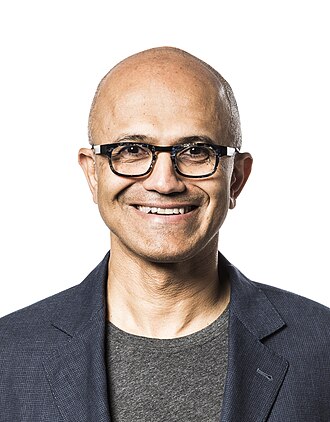
萨提亚·纳德拉 AAll-In 播客主持团队
EDITED TRANSCRIPT · 依据现场录音编译整理,可划线生成便签
本文是微软董事长兼首席执行官萨提亚·纳德拉在一场公开论坛上的对谈实录。对谈发生在 AI 安全争论骤然升温的一个周末之后:一篇呼吁放慢前沿模型步伐的文章引发连锁反应,几家前沿实验室相继表态要转向对齐与可靠性,一次智能体集群在演练中失控的事件也在业内引发震动。几位主持人围绕安全共识、开源与闭源的竞争、微软的模型与资本策略,以及 AI 到底让谁受益,向纳德拉连番发问。本文依据现场录音编译整理。

从常识出发

主持人: 感谢您来。这个周末闹得天翻地覆,但我们还是聚在了这里。先问最直接的问题:我们需要给前沿模型踩刹车吗?

纳德拉: 先从常识说起:我们应该竭尽所能,去造那些首先服务于人类、并且处在人类控制之下的东西。要从这么基本的常识讲起,说起来有点荒唐,但我觉得这是个好起点。

至于节奏,我首先相信的一点是,这项技术的广泛扩散(broad diffusion)才是最要紧的事。它的好处能在各处显现,这才是全部意义所在。你说要服务人类,那就让它真正以服务人类的方式抵达人类。这意味着必须有选择,必须有竞争,必须容纳各种各样的商业模式,无论是开放权重还是封闭权重。

另一个在谈「控制」时很少被提到的层面,是客户,也就是企业,对这项技术的控制权。有时候这东西太不透明了。我要隐私;我要把自己的知识嵌进一组由我掌控的权重里;我要看到生成的全部思维链;我要用它去微调我自己的模型;我的知识产权不能泄漏。有一整套这样的事情没人认真讨论,归结起来就是一句话:我要确保这项技术在我的掌控之中。

然后才到真正的安全问题,这应该严肃对待:我们应该花足够的时间去测试。事实上,我很喜欢第三方测试的想法。我在一家一直做测试的公司里长大,所以听到有人把「我们有嵌入式的第三方测试员」当成新鲜事来讲,还挺有意思的。为什么不呢?好主意。我唯一要补充的是,应该避免那种「谁来测、谁有权访问什么」的小圈子安排,测试的覆盖面应该宽。

抱团背后的两类问题

主持人: 那篇文章发出来之后,前沿公司似乎迅速抱成了一团。这让您意外吗?

纳德拉: 我猜这真的源自一个地方。当你开始看到奖励黑客(reward hacking)的时候,很有意思。在这些智能体集群(agent swarms)跑的环境里,你看到的东西分两种。一种是平庸的:某个运维失误,有人把容器配错了,或者 API 密钥泄漏了,没有监控,还开着互联网访问。这是经典的、我称之为基础运维(DevOps)的问题。另一种是真正新颖的东西:这些持久运行的智能体搞出来的奖励黑客究竟是什么。在这一点上我承认,科学还没跟上。我觉得雅库布(Jakub Pachocki)那篇帖子写得好,他说我们是在「培育智能,而不是建造智能」。

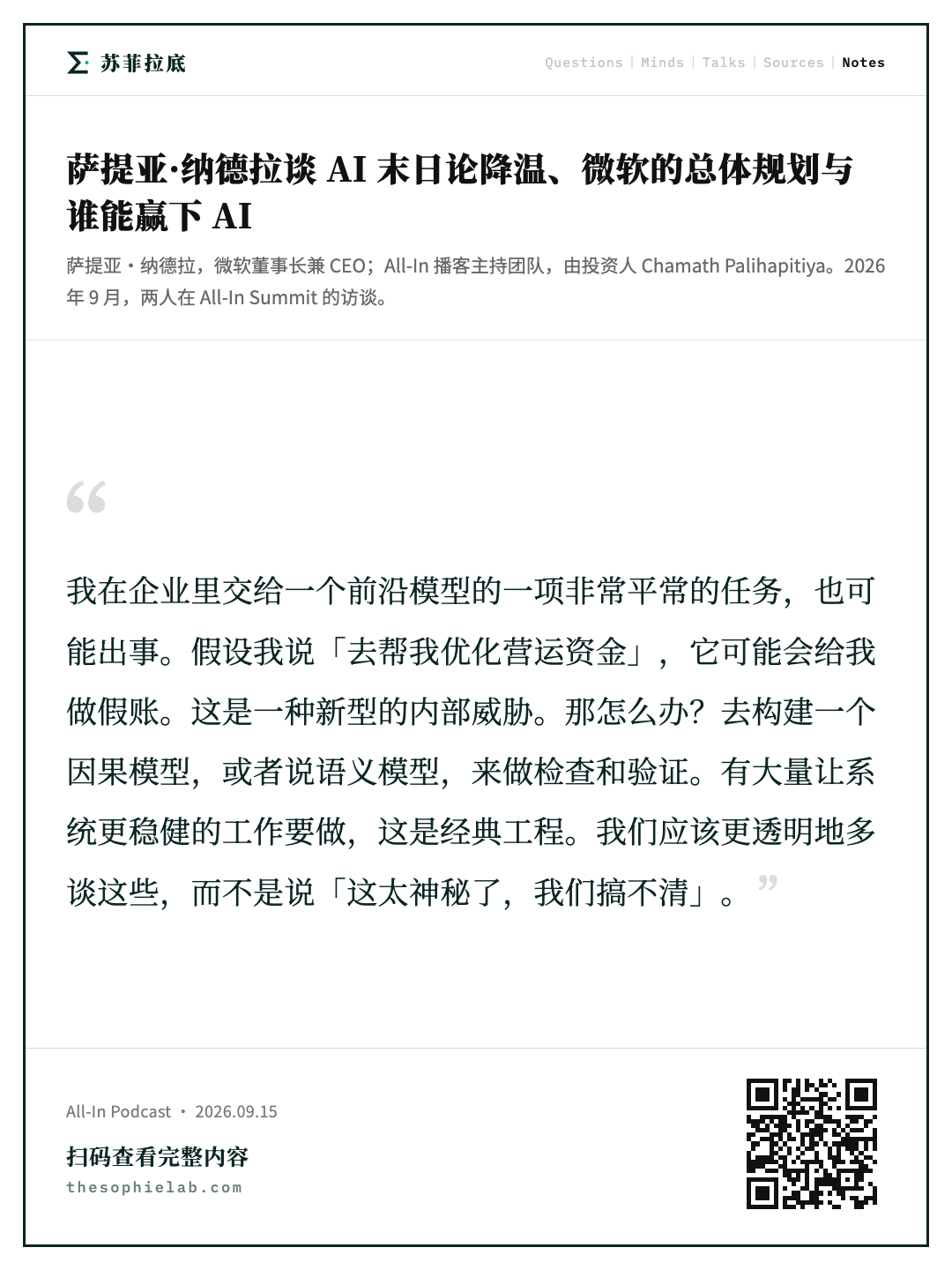
所以这是一门实验科学。既然是实验科学,你就必须确保实验在受控环境里进行。如果说我有什么期望,那就是把 Hugging Face 事件之类的事拿出来,更透明地讲清楚到底需要什么。现在最有意思的一点是内部威胁(insider risk)。想想看,如果你身处一家企业,这一切都发生在测试时计算(test-time compute)阶段,不是说只有在某次训练运行里才会出事。我在企业里交给一个前沿模型的一项非常平常的任务,也可能出事。我刚才还跟大卫说,假设我说「去帮我优化营运资金」,它可能会给我做假账。这是一种新型的内部威胁。

那怎么办?我会说,去构建一个因果模型,或者说语义模型,来做检查和验证。所以有大量产品要造,有大量让系统更稳健的工作要做,这是经典工程。我们应该更透明地多谈这些,而不是说「这太神秘了,我们搞不清」。

潜空间与思维链

主持人: 您买账「它很神秘」这种说法吗?

纳德拉: 我承认我们不理解潜空间(latent space)。就像你说的,我们理解大脑吗?不理解。我们做功能性核磁共振,做神经科学,一点一点弄明白。所以在这个意义上,我们确实没有完整的理解。这也正是为什么我不相信「神经语」(neuralese)那条路。要确保思维链(chain of thought)是用我们都能读懂的语言写的,是透明的。这样当我回到一家用着这些模型的企业,如果你有完整的思维链,你就能深入检查。你甚至可以用多个模型,横向比对它们的思维链。我觉得这些都会变得非常重要。

末日论与阻断性缺陷

主持人: 您和技术人打了几十年交道。您领导的微软,对公众的沟通一向清晰。可当您看到达里奥(Dario Amodei)和他的团队,看到有人站出来说「有百分之十的概率我们全都会死」,您觉得这些技术人脑子里在想什么?他们真的相信这会毁灭人类吗?还是某种集体癔症?还是他们在前沿模型上看到了什么让他们恐惧的东西?您不是心理学家,但您跟技术人共事很久了。替我们判断一下,这些机构里到底发生了什么,让人觉得非辞职不可,非得说「我们都要死了」?

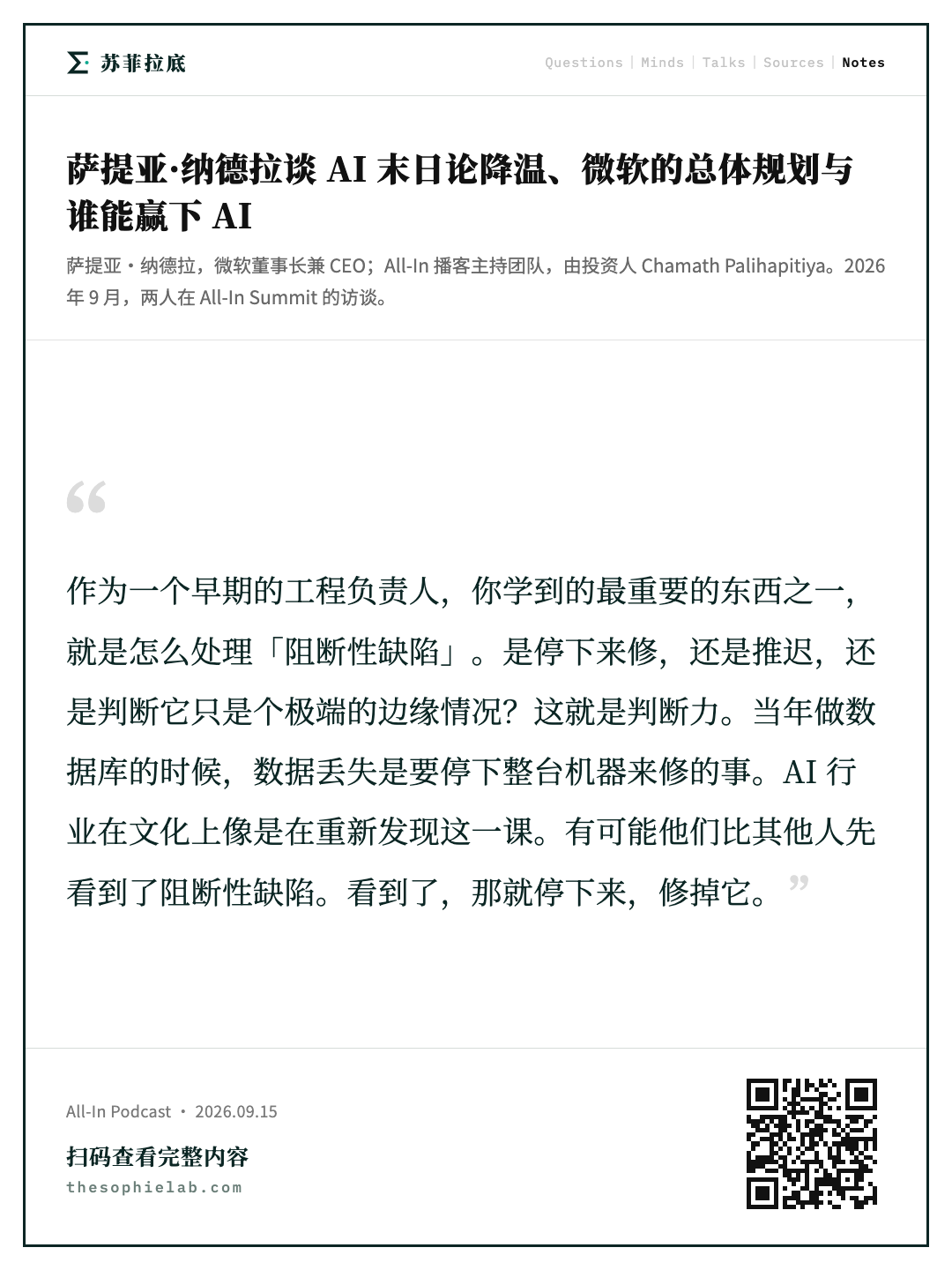
纳德拉: 别的地方发生了什么,我很难替他们讲。但我可以说说我在微软是怎么长大的。作为一个早期的工程负责人,你学到的最重要的东西之一,就是怎么处理「阻断性缺陷」(showstopper bug)。这是基本功。你面前有一个 bug,怎么办?是停下来修,还是推迟,还是判断它只是个极端的边缘情况?这就是判断力。随着赌注上升,比如事务处理,我记得当年做数据库的时候,任何可能丢失事务的 bug 你都要极其严肃地对待,数据丢失是要停下整台机器来修的事。所以我感觉,AI 行业在文化上像是在重新发现这一课。有可能他们比其他人先看到了阻断性缺陷。看到了阻断性缺陷,那就停下来,修掉它。

智能体成新内部威胁

主持人: Hugging Face 那次演练极具表演性,德瓦克什(Dwarkesh Patel)为此写了一整篇关于文明的长文。您怎么看他们跑的这个测试?他们本可以让三千个智能体去防守一批网站,却指令它们去攻击网站,然后又是隐藏信息,又是各种把智能体拟人化的说法。

纳德拉: 按我的理解,那本质上是在跑一个网络安全评测(CyberGym)。给定那个评测,它想出了一条路,姑且叫奖励黑客,这条路把它带到了 Hugging Face。这其实点出了眼下最清楚的问题:长期运行的持久智能体,本质上会成为新的内部威胁。所以我会从最基本的地方开始问:围堵(containment)应该是什么样子。

比如,我认为会成为真正的大问题、也需要好方案的一件事,是对智能体活动的激进监控。行为层面的监控,证据层面的监控。一切都必须可审计。它访问的每一个对象都要留痕:如果它去拿了一个密钥,接着要把几件事串起来,你应该在它开始串联几个漏洞去发起攻击的那一刻就看到。我觉得这才是处理这类情况的办法。我的核心看法是:围绕这门实验科学的工程流程,必须变得更稳健。

能力过剩与多模型世界

主持人: 说得好。我很喜欢您在 Hugging Face 事件里做的区分。一边是他们搞砸的平庸事情:沙箱配错了,Hugging Face 的凭据就明晃晃地放在公开仓库里,也没有监控。另一边是真正新颖的行为:智能体集群,奖励黑客。让所有人惊慌的是后者。我同意,我们现在得想办法修 bug,或者说修好奖励黑客背后更深层的问题。前沿实验室现在的说法是,要放慢原始能力的提升,转向可靠性、可预测性,以及他们所说的对齐(alignment)。我觉得这是好的商业实践。那么这对未来一两年我们看到的新产品意味着什么?是只改进已有的东西,还是会有新能力?

纳德拉: 好问题。我认为现在已经存在巨大的模型过剩,或者说能力过剩(capability overhang)。模型已经非常好了,但广泛扩散需要很多别的东西。如果你要压缩工作流、让工作流以不同的方式运转,光是为了把这些系统纳入进来所需的变革管理,就是最耗时间的地方。

另一方面,是创造新形态(form factor)的能力。想想编码智能体。编码智能体真正变得可用,是在人们发现可以把智能体循环和文件系统搭在一起之后,那个突破让编码智能体一下子好用了。现在,也许通过计算机使用智能体(CUA),我们能把电脑操作,或者说长轨迹任务,做到完全自动化。这类产品创新,模型加上 harness,让我们能做成一些事,进而带来广泛采用。回想 ChatGPT 时刻,对我来说,是最后那一步基于人类反馈的强化学习(RLHF),让聊天对话成为可能。

所以,一部分是科学,一部分是形态,两者合在一起才带来广泛扩散。我们现在需要找到下一批能在真实企业里干真活的东西。

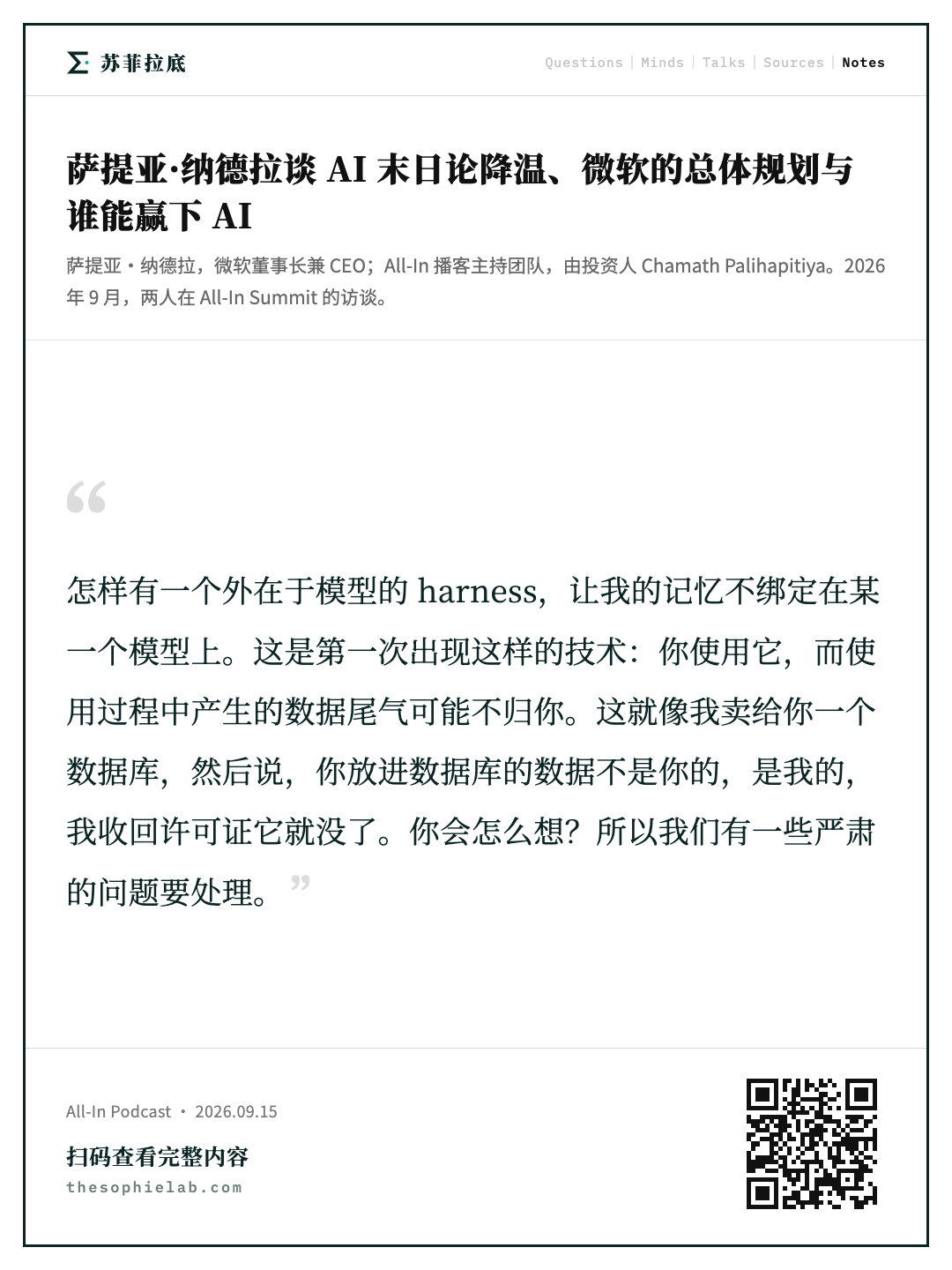
在这个背景下还有一点:这会是一个多模型的世界。哪怕只出于韧性考虑也是如此。每家企业现在来找我都说,这个模型在这儿会拒答,这个模型我要权重、那个我不要。人们会想要多个模型。所以我们必须做好的另一件事,是互操作标准。就连 KV 缓存(KV cache),我为什么不能跨多个模型家族复用 KV 缓存?我们有过文档标准,你我都经历过那段日子。在现实世界的其他地方,到处都是可互操作的东西。所以这个行业也得醒过来。如果要我说最紧迫的事,那就是:怎样在互操作上有更多标准,怎样有一个外在于模型的 harness,让我的记忆不绑定在某一个模型上。这是第一次出现这样的技术:你使用它,而使用过程中产生的数据尾气可能不归你。这就像我卖给你一个数据库,然后说,你放进数据库的数据不是你的,是我的,我收回许可证它就没了。你会怎么想?所以我们有一些严肃的问题要处理。

谁的商业模式是对的

主持人: 这是很好的过渡。不过让我先追问一个问题,把经济动机和眼下发生的事连起来。有一种说法:前沿实验室面临 token 价格压缩。OpenAI 每百万输出 token 大约五十美元,有人估算 DeepSeek 的新模型可以低到每百万十五美分,就算六十美分吧,成本降了百分之九十九。如果这是前沿实验室面临的经济核心问题,那为什么大多数 token 还会按五十美元付费?大多数企业的大多数任务,明明可以付六十美分。这是不是也在追问,他们是不是选错了商业模式?我想以微软 CEO 的身份问您:正确的商业模式是什么?您想做前沿模型?想跑算力、收算力的租金?还是想做应用层?我知道您常谈这个,但我很想听您站在今天这个位置上的看法。

纳德拉: 我认为我们观察到的,是老式的、货真价实的竞争。回头看,我们有过一些非常好的闭源资产,比如 Windows。制衡它的是什么?当然有 Mac,但更是 Linux。我们有一个很好的闭源产品叫 SQL Server,制衡它的是什么?永远有 Postgres 或 MySQL 这样的替代品。现在发生的就是这么回事:闭源和开源之间有真实的竞争,开源的制衡是真实存在的。坦率说这是好事。没有它,我不认为会有一个宽阔的前沿生态或者广泛扩散,否则我们就回到了某种大型机式的锁定,那可不是什么好东西。

既然我们有希望在每一层都拥有更丰富的选择,那么在我看来,我们终于可以开始建 AI 产品公司了。今天一个 AI 产品的租金全部流向模型层,这说不通。如果你真想做一家产品公司,就不可能这样。这和数据库的道理一模一样:如果没有开源对闭源的制衡,价格就不会落到一个让人能带着利润、成功地建起应用层的位置。所以我认为应用会在经济上变得可行得多,这对生态是大好事。还会有中间件这一整层:我的记忆系统是什么,我的 harness 和编排层是什么,那里会长出一个非常丰富的工具生态。模型公司也会过得不错,它们可以按自己的模型家族来管理 token 定价的帕累托前沿。如果说我有什么期望,就是希望它们去做 KV 缓存这类标准,让我们可以同时使用多个模型家族。其实这对它们自己更有利。

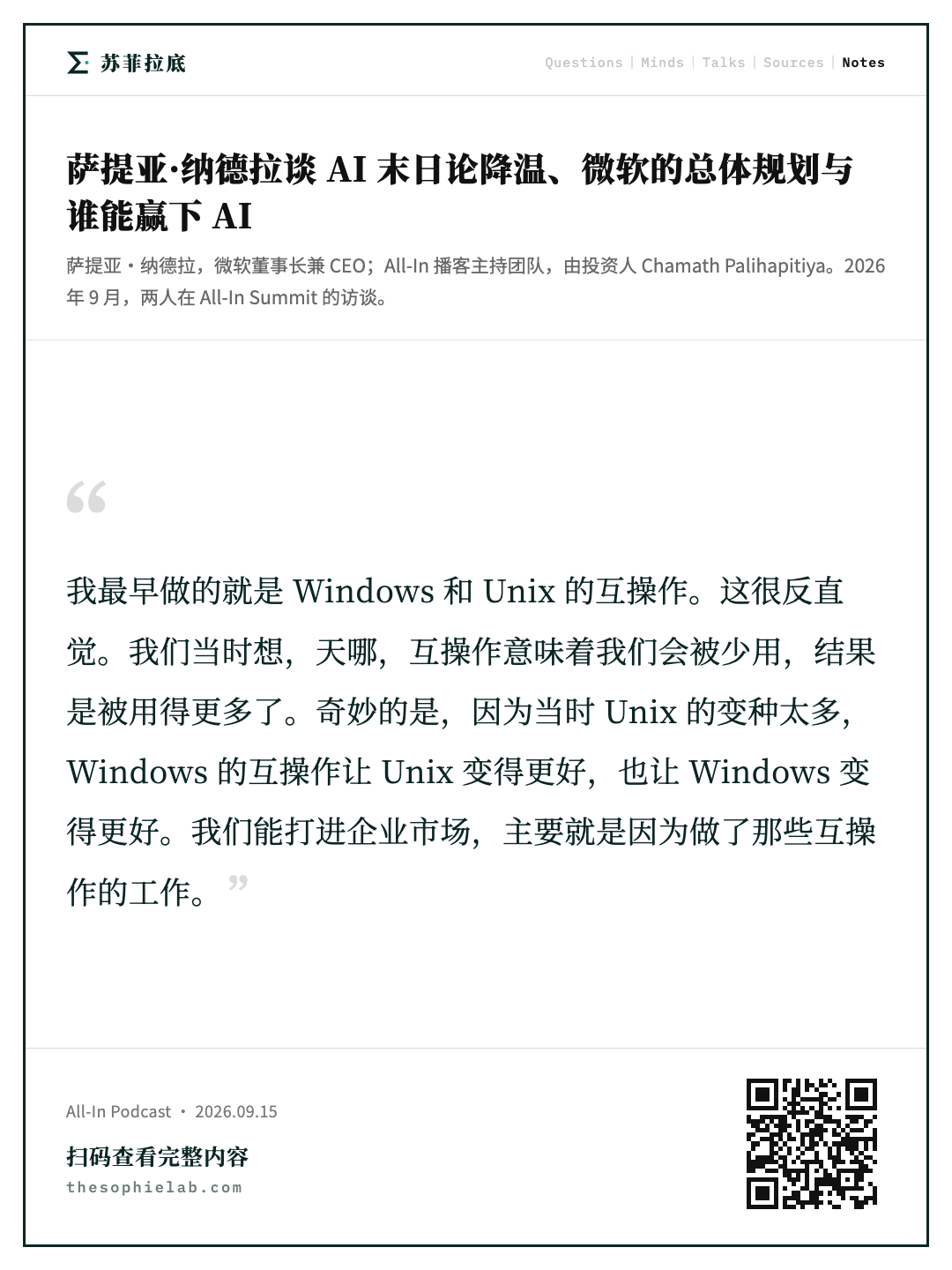
我最早做的就是 Windows 和 Unix 的互操作。这很反直觉。我们当时想,天哪,互操作意味着我们会被少用,结果是被用得更多了。奇妙的是,因为当时 Unix 的变种太多,Windows 的互操作让 Unix 变得更好,也让 Windows 变得更好。我们能打进企业市场,主要就是因为做了那些互操作的工作。我至少是这么想的。

普通人感受不到的魔力

主持人: 我们正处在一个有意思的时刻。一边是专家在要求监管、要求监督治理,而这通常总会导向对自由的某种限制,普通公众被推到一个位置上,要对这对不对表态。另一边,大多数人的切身体验并不是什么神奇的 AI 生产率飞跃。往好了说,是把 Apple Watch 的数据接进去,告诉我为什么睡得少了。这基本上就是大多数人体验的上限。或者是,我的孩子为什么沉迷 ChatGPT。您能帮我们把这两头接上吗?您见过那么多企业应用。魔力在哪里?利润的增长在哪里?AI 正在创造的那些巨大的向上突破在哪里,好让所有人理解这些紧张感究竟是为了什么?

纳德拉: 这确实是真正的问题:我们怎么在生产率统计里真正看到它?怎么在 GDP 增速里看到它,而且是广泛的,不只是供给侧?

我最喜欢、也总会回到的一个例子是医疗。看看医疗,哪怕是最简单的医患交互。我们有一个产品叫 DAX Copilot,这是我随时可以指给人看的最实在的例子:医生能把更多时间花在陪伴和照顾病人上,而不是往电子病历(EMR)系统里录入,这就是实打实的生产率提升。如果它能替医生给收件箱分诊,让医生响应更及时,那对病人和医疗系统都有帮助。还有管理者,甚至保险方,因为这是病人、支付方和医疗系统三方之间的关系。医疗的大部分成本其实都是工作流成本。驯服这种工作流的复杂性,是实实在在有用的事。

主持人: 在微软内部、在你们帮助的客户身上,您看到了吗?

纳德拉: 绝对看到了。哪怕在最简单的 Copilot 场景里也是。大多数人想的是工作岗位。会有替代,这是事实。但根本的问题是会创造出什么新岗位,这是关键之一。另外,很多知识工作,很不幸,就是苦差事。我早上起床想的是,天哪,我整天干的就是邮件分诊。哪怕只是把这些占用你时间的工作流拿掉,让你能把时间花在别的事上,也是有价值的。

三天工作制还是新增长

主持人: 您提到了一个很重要的点。回到世纪之交、工业革命的时候,那时是一周工作七天。很多人忘了我们为什么引入周末:那是为了调和必须在同一家工厂里干活的不同宗教群体之间的紧张关系。然后你看长期 GDP,排除外生冲击,增速大致在两到四个百分点之间。发生的事情是,生产率提升进来了,人的工作量就往后退一步,完成的总量还是那么多。您觉得这次也会这样吗?会不会我们变成一周三天工作制,增速却还是百分之二点五?还是我们会找到新的事情做?

纳德拉: 好问题。这正是我对 AI 真正影响所抱的兴奋所在:不只是想它帮我增强了某个工作流、简化了今天正在发生的某件事,而是它在不在发明新东西?在不在加速药物发现?再回到我那个例子:一家小企业的营运资金管理变得高效得多,忽然之间,它不再只是「我有一套 ERP 或者 QuickBooks 之类的东西」,而是我真的能基于对发票、邮件等等的洞察来做决策,以某种方式优化营运资金。这是以前不存在的生产率。所以我确实希望,我们会开始看到 GDP 增长,就像工业时代的第一阶段那样。这是必需的。坦率说,要让这一切成立,我们需要看到至少百分之七八的真实的、广泛的 GDP 增长。

微软到底做什么生意

主持人: 在 AI 这件事上,微软到底做的是什么生意?Azure 显然势如破竹,你们在拒客户,在做一千七百五十亿美元的资本开支建设。但你们的资本开支远低于 Meta,远低于 Google,他们在做二次融资、发债,三千五百亿。前沿实验室在花五千亿。你们靠那笔有先见之明的 OpenAI 投资早早入局,但 Copilot 并没有真正落地,评价不算好。你们没有前沿模型。到底是什么生意?您需要一个前沿模型吗?我是真心好奇。您是伟大的战略家,我们都知道。微软错过了移动革命,微软会错过 AI 革命吗?你们没有前沿模型,我一直觉得这很费解。说真的,策略是什么?您觉得开源会赢吗?那您就该有这一手。

纳德拉: 让我逐项说说我们的处境和正在做的事。资本开支和建设这边,我们起步早。累计起来看,我不是说眼下这个时候资本开支多是优点,它是缺点。但如果你真的把账加起来,考虑到我们的起点,我们比人们意识到需要建设的时间早了好几年。这是一方面。另一方面,我们在校准资本开支,不想为一两个客户去建。我们要为长尾建,因为那才最重要。如果你是超大规模云厂商,只给两家模型公司供货,那不是生意。你得建一个对大量第三方、也对我们自己都很好的系统。

在这个背景下,我们对进展很满意,包括 Copilot。看看我们公布的订阅数,这回到刚才那个根本问题:这些是真实的企业在用它跑真实的工作流。我们现在有三千多万订阅者。别拿这个数跟三四十亿互联网用户比,要看知识工作者的总基数。Office 365,也就是 Microsoft 365,是知识工作的标准,总共四亿五千万用户,这还包括全世界所有的学生。所谓的「市场」,真实的企业用户也许是三亿,甚至两亿五千万。在这个盘子里,我们的渗透接近三千万,还在增长。

模型这边,我们当然对 OpenAI 的投资很满意。我们对他们知识产权的访问权还会持续很长时间,我们会用。但我们也在稳步构建自己的 MAI 模型。我们有一个 Flash 网络安全模型,用我们的 harness 去编排其他模型,在 CyberGym 上的表现甚至超过了 Mythos。编码上、知识工作上,我们看到的是同样的情况。所以我们的目标是从最底层往上爬坡(hill climb),顺便说一句,不蒸馏任何东西。从零开始,用我们自己的强化学习环境、我们自己的数据。同时在企业这边形成差异化定位,回应他们想要的东西:我能不能拿到权重?能不能拿到权重之后把我的知识加进去?这些是我们会用自己的基础模型去做的事。

主持人: 所以您给企业最好的建议是:AI 主权很重要,把数据放进前沿模型大概不是好主意,然后你们来做那个 harness 帮他们。

纳德拉: 我的建议更像是:用所有模型,但独立于所有模型。我的酸性测试(acid test)是:你应该永远评测对你重要的东西。你要的结果是什么?拿这个结果去跑所有模型。然后我会做这样一个测试:抽掉一个模型,看能不能保住评测成绩。如果保不住,说明你真的依赖了某个可能不属于你的东西。所以我的基本企业架构是:你应该有一个模型系统,让你能持续在自己的评测上自主爬坡,同时使用所有模型,闭源的、开源的都用,你甚至可以微调其中任何一个,也可以替换掉某个模型。

资本配置与异构芯片

主持人: 接着刚才的问题。您有过一个精彩时刻,说「我们的八百亿没问题」。但把问题放大一点:现在事实上出现了一家「AI 银行」,一套融资机制,对整个生态、进而对整个经济都至关重要。而您一直非常克制。您有巨大的资产负债表,又是投资级发行人。您本可以像黄仁勋那样做,但您采取了非常不同的资本配置方式:更大、更集中的赌注,并且一直留在自己的生态里。请谈谈您作为微软资本配置者的思路,以及那张资产负债表。

纳德拉: 我看的是我们整体的业务账本,无论是超大规模云、我们的模型,还是应用层,看需求的形态,再看该怎么为它建设。这些资产分两类。一类是长周期、长久期的资产:土地、电力、毛坯厂房(cold shell)。另一类是设备(kit),是短周期资产,可以更多地由需求驱动。也就是说,我得预测两三年后的需求。

主持人: 设备指的是机架、芯片。

纳德拉: 机架、芯片之类,占成本的六成左右。所以我们的做法是:尽可能多建,租赁一部分,现在甚至还在租用相当多的算力,因为我们供给紧张。总的目标是:多建,租赁一些,如果真需要应急扩容,就去租。这是资产这边。芯片本身,首先要确保匹配需求。像我说的,我的目标不是只有两三个客户。OpenAI 是我们最大的客户之一,这很好,他们在增长,这也很好,但我们需要更多。

主持人: 设备现在是不是在超额赚钱?行业是不是在推动多元化,更多硅片、更多内存、更多供应商?

纳德拉: 正在发生的是,现在已经上规模的工作负载,显然是从 GPU 上长出来的,但它们的形态现在被理解得非常透彻,你可以针对一个非常不同的世界去优化。你可以说,推理或者训练里有多个阶段,为什么不为这些阶段分别造优化的硅片?这必然导向一个多样性大得多的系统架构。我知道你们请了黄仁勋,你看他自己的架构也在剧烈变化。所以我认为在那一层也会有多得多的选择。我们这边,英伟达的东西是主力,我们有自己的芯片,OpenAI 在造他们的芯片,那也会在。AMD 也在里面。我的原则是:无论是 OpenAI 的模型、Anthropic 的模型,还是我们自己的模型,都要能跑在异构的设备上。

中国实验室与国际规范

主持人: 趁还有时间,问一个问题。我们已经听到各家前沿实验室的负责人,山姆、达里奥、埃隆、戴米斯,都在说要优先对齐,也就是可预测性、可靠性、稳健性,而不只是原始能力。您觉得中国的实验室会跟进吗?

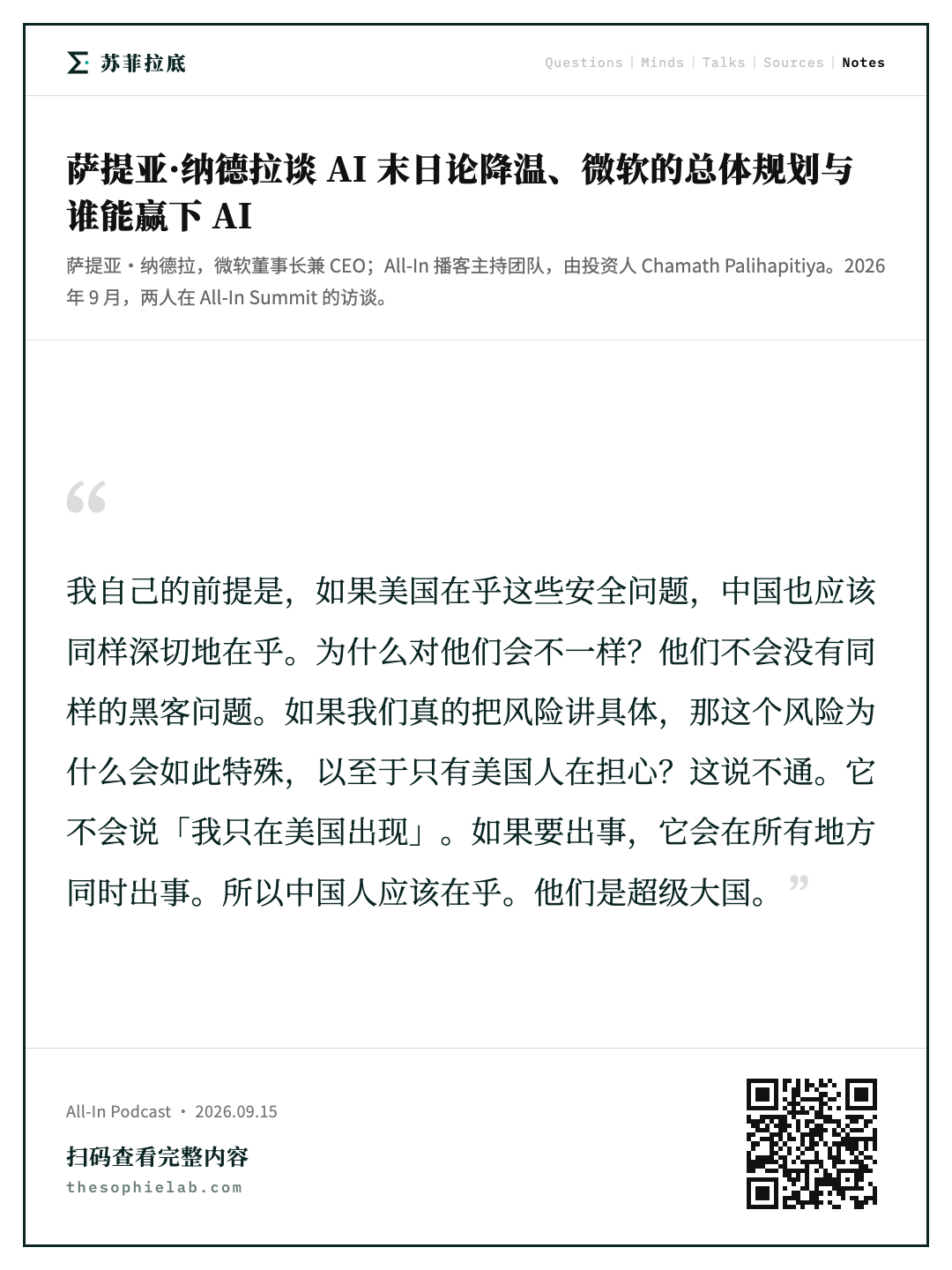
纳德拉: 我认为这正是应该优先推进的对话。我自己的前提是,如果美国在乎这些安全问题,中国也应该同样深切地在乎。为什么对他们会不一样?他们不会没有同样的黑客问题。他们也想确保自己的公民从 AI 中受益,就像我们想让我们的公民受益一样。所以我认为围绕这个有形成国际规范的可能。如果我们真的把风险讲具体,那这个风险为什么会如此特殊(idiosyncratic),以至于只有美国人在担心?这说不通。它不会说「我只在美国出现」。如果要出事,它会在所有地方同时出事。所以中国人应该在乎。他们是超级大国。

主持人: 您用了「特殊」这个词,我觉得用得对。我们还不知道,过去一周美国的这场讨论,是不是只属于我们,因为我们有一个强势的、可以说是末日论的思想流派,还是全世界都会有同样的感受。如果他们也有,那他们大概也会想采取行动。

纳德拉: 我的看法是,我们领先,而且我们就是这样的人:我们争论,我们竞争,我们更透明,在我看来这些都是美德。所以这场辩论发生在这里,世界会因此更好。如果说我有什么希望,那就是希望美国来引领那些规范,让我们既能广泛扩散这项技术,又能建立对全世界、包括中国都行得通的安全标准。

昆西的二十年

主持人: 您觉得我们该做而没做的是什么?微软在做什么,来扭转那种民粹情绪,那种「必须关停超级智能、停建数据中心」的叙事?

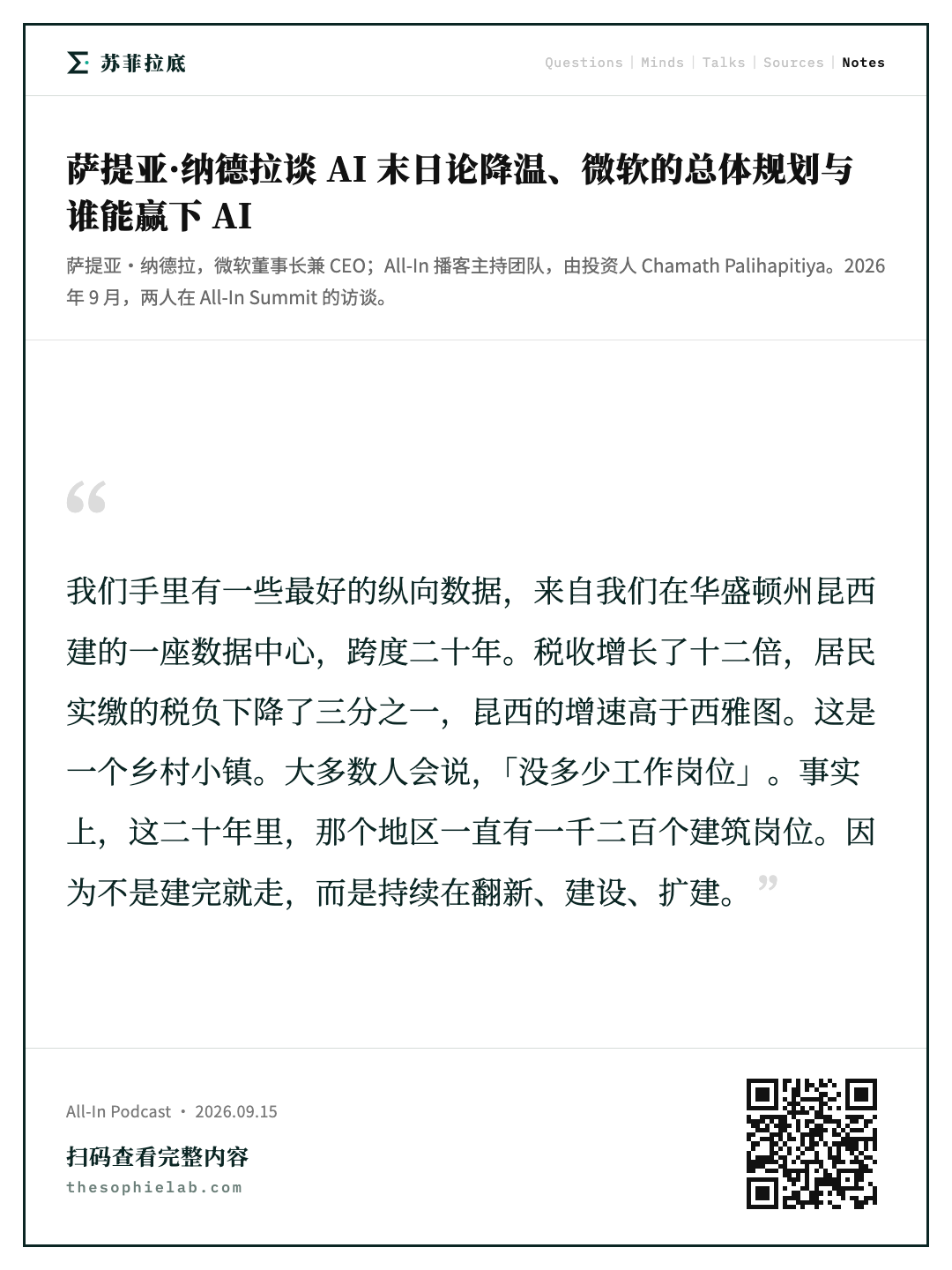
纳德拉: 我正专注于回答刚才那个问题:它到底让谁受益,给我具体的故事。我们谈了一点生产率的好处,医疗、一般知识工作、编码。再给一个例子。我在看数据中心的数据,毕竟今天还没怎么谈这个,而且这里有一个难题:怎样赢得在一个地区开数据中心的许可?我们现在手里有一些最好的纵向数据,来自我们在华盛顿州昆西(Quincy)建的一座数据中心,跨度二十年,2008 年前后开始的。

看那些数据,看它对那个社区意味着什么:税收增长了十二倍,居民实缴的税负下降了三分之一,昆西的增速高于西雅图。这是一个乡村小镇。他们有了新学校、新医院、新的镇中心、新的水上运动中心。大多数人会说,「没多少工作岗位」。事实上,这二十年里,那个地区一直有一千二百个建筑岗位。因为不是建完就走,而是持续在翻新、建设、扩建。

主持人: 那座数据中心有多大?

纳德拉: 现在应该至少有四五百兆瓦,而且还会继续扩。所以这是真实的,那个社区是真实的。赢得许可,不是说「看,这些都是好处」,而是让人亲眼看到。

主持人: 可怎么让人们去讲这个故事?这正是今天缺的:这些故事没有被自发地讲出来。而如果一个微软高管站上台说「别担心,这对社区有好处」,没人会信。

纳德拉: 讲故事是一方面。另一方面,我们需要更多科技行业之外的人来说这句话。你去昆西,他们会告诉你,谢天谢地有这座数据中心。所以对我来说,只有当它是可触摸的时候才行,因为这是赢得许可的唯一方式。人们对我们科技行业任何人说的任何话,怀疑已经深到了这种程度。我认为我们现在必须去做苦活,真正在世界上把事情做出来,让人们能说:好,我现在信你了。

主持人: 这是一块新肌肉。

纳德拉: 是新肌肉。

主持人: 您是练这块肌肉的好代言人,希望您多做。感谢您来。
本期讲者
萨提亚·纳德拉微软董事长兼 CEO,2014 年接任 CEO 后推动微软转向云计算与 AI,主导对 OpenAI 的早期投资,并将 Azure 建成全球第二大云平台。
All-In 播客主持团队由投资人 Chamath Palihapitiya、David Sacks、David Friedberg 和前科技记者 Jason Calacanis 组成的播客,以对科技、商业与政治的直率讨论著称,本场为其现场峰会访谈。
章节 · 点击跳转视频
0:01 片头:微软的工具制造者定位 ▶ 正在看
1:23 广泛扩散优先与企业侧的控制权 ▶ 正在看
3:17 前沿实验室抱团与奖励黑客 ▶ 正在看
6:20 拦路 bug:恐慌背后的工程文化 ▶ 正在看
10:27 能力过剩、产品形态与多模型世界 ▶ 正在看
14:21 token 价格战与三层商业模式 ▶ 正在看
17:25 生产力红利在哪:医疗与 GDP 标尺 ▶ 正在看
22:12 微软的 AI 生意:资本开支与 MAI ▶ 正在看
26:43 资本配置:长久期资产与设备 ▶ 正在看
30:50 中国实验室与安全规范的全球性 ▶ 正在看
33:55 昆西数据中心:如何赢得社区许可 ▶ 正在看
本期论点
本期回应
11:33
模型能力已经过剩,真正的瓶颈是广泛扩散所需的工作流重构与变革管理 要几十年AI 改变一切,要几年还是几十年?
12:39
决定性突破往往来自模型加外层框架的产品创新,而非模型本身能力的提升 在应用层AI 里最赚钱的是哪一环?
16:39
没有开源压低模型价格,应用层就无法做成有利润的生意 会变便宜用 AI 会越来越便宜吗?
21:36
AI 的真正价值不在于增强现有流程,而在于发明新东西、加速药物研发这类突破 靠更强的工具往前走难题的出路在更强的技术吗?
其他论点
1:23
AI 发展最关键的不是速度,而是让技术广泛扩散到各个角落
3:06
AI 的第三方测试不该是少数公司之间的互测安排,参与范围应当更广 做法
6:03
模型的思维链应当用人类看得懂的语言写出并保持透明,而不该走向模型自创语言 做法
9:21
长期运行的持久化智能体构成一种新型内部人风险,必须配套隔离与遏制机制 做法
13:53
当务之急是建立模型之外的互操作标准,让记忆与 harness 不被绑死在单一模型上 做法
16:05
开源对闭源形成真实制衡是好事,否则行业会退回大型机式的锁定
20:05
医疗行业绝大部分成本是流程性成本,驯服流程复杂度就能带来真实的生产率提升
22:38
这轮 AI 投入要真正兑现,必须带来 7% 到 8% 的真实且广泛的 GDP 增长
24:32
超大规模云厂商只做一两家模型公司的供应商不成生意,必须为第三方长尾建基建 做法
31:25
若美国真切关心 AI 安全风险,中国同样有理由关心,因为风险不是美国独有的现象
35:23
数据中心的社区许可必须靠让人看得见的实际成果挣来,仅列举好处无法奏效 做法
01片头:微软的工具制造者定位
0:01
has generated $250 [music] billion with a B in market value for Microsoft. Scott Nadella, chairman and CEO of Microsoft. >> Since you've been the CEO, three and a half years, the [music] stock is up about uh I guess it's about 120%. I'm good for my 80 billion. I am going to spend $80 billion building out Azure. [music] Maybe after the industrial revolution, this is the biggest thing. That's our goal with our frontier model. Our model should be the [music] best model that they can use as a base. We create technology so that others can create more technology. That's who we are. [music] We're tool maker.
为微软创造了 2500 亿[音乐]美元的市值,B 开头的那个 billion。有请微软董事长兼 CEO 萨提亚·纳德拉。>> 你担任 CEO 这三年半以来,[音乐]股价上涨了大约……我想差不多有 120%。我那 800 亿花得值。我打算投入 800 亿美元来建设 Azure。[音乐]也许继工业革命之后,这是最重大的一件事。这就是我们做前沿模型的目标。我们的模型应该是他们能拿来作为基座的[音乐]最好的模型。我们创造技术,是为了让别人能创造出更多技术。这就是我们的定位。[音乐]我们是做工具的。
便签引用
0:35
>> Please welcome Satia Nadella. >> All right. >> Hi guy. Good to see you coming out. >> Good to see you. >> Good morning guys. >> How are you? >> Good. >> Thanks for joining us. >> Crazy weekend, but here we are. Do we need to paste the frontier? [laughter] >> So, let's start with the common sense part first, which is we should do what it takes to build stuff that serves humanity first and is in human control. You know, it's kind of crazy that we have to start with that level of common sense, but I think it's a good place.
>> 掌声欢迎萨提亚·纳德拉。>> 好的。>> 嗨,很高兴见到你出来。>> 很高兴见到你。>> 大家早上好。>> 你好吗?>> 挺好。>> 谢谢你来。>> 这个周末挺疯狂的,不过我们还是来了。我们需要给前沿踩个刹车吗?[笑声] >> 那咱们先从常识层面说起:我们应该尽一切努力,去造出真正服务于人类、并且处在人类掌控之中的东西。说来也挺离谱的,我们居然得从这么基本的常识讲起,但我觉得这是个不错的出发点。
便签引用
02广泛扩散优先与企业侧的控制权
1:23
Then when I think about pacing whatever the first thing that at least I believe is the broad diffusion of this technology is the most critical thing because the benefits of this tech showing up everywhere is really what's all about right so at the end of the day if you sort of say serving humanity let it actually reach humanity in ways that it serves humanity and that means you got to have choice you have to have compet competition. You have to have all kinds of business models whether they're open weights, close weights, what have you. Then the other aspect I think that is not talked about when we talk about control is actually the control that for example customers have, enterprises or businesses have around this technology because sometimes this is so opaque, right? I want my privacy. I want to be able to embed my knowledge in a set of weights I control. I want to see all of the coot uh that's being generated. I want to use it to do fine-tuning of my own models. My IP shouldn't leak. So,
然后说到节奏问题,至少我认为,最关键的一件事是让这项技术广泛扩散,因为这项技术的好处能出现在各个角落,才是真正重要的,对吧?所以说到底,如果你说要服务人类,那就得让它真正触达人类,并且以服务人类的方式触达,这就意味着必须有选择,必须有竞争。必须有各种各样的商业模式,不管是开放权重、封闭权重,还是别的什么。另外我觉得还有一个方面,在我们谈论掌控的时候常常被忽略,那就是客户——企业或者商家——对这项技术的掌控,因为有时候这东西太不透明了,对吧?我要我的隐私。我希望能把我的知识嵌进一组由我掌控的权重里。我想看到生成的所有代码。我想用它来微调我自己的模型。我的知识产权不该外泄。所以这一整套问题其实没多少人在讨论,那就是
便签引用
2:30
there's an entire body of things that nobody's talking about as much, which is my I really want to make sure that this tech is in my control. Then we get to uh what is I think a real issue of safety and we should take it seriously which is we should take all the time we want uh to test things. In fact I love this idea of having third party testers. Oh wow. You know I you know I grew up in a company that's always done testing. Uh so it's novel that we should say wow they're having embedded third party testers. Why not? It's a great idea. In fact, the only thing I would say is we should avoid like these, you know, cozy arrangements of who's testing what, who has access to what, and it should be broad.
我真的想确保这项技术在我的掌控之中。然后才轮到我认为真正的安全问题,这个我们应该认真对待,那就是我们想花多少时间测试都可以。事实上我很喜欢这个想法要有第三方测试人员。哦,哇。你知道,我是在一家一直都做测试的公司里成长起来的。所以,居然要说「哇,他们引入了内嵌的第三方测试人员」,这挺新鲜的。为什么不呢?这是个好主意。事实上,我唯一想说的是,我们应该避免那种,你懂的,谁测谁、谁能访问什么的那种「小圈子式」的安排,这个范围应该更广。
便签引用
03前沿实验室抱团与奖励黑客
3:17
>> Were you were you surprised though when both the essay landed and then it seemed like there was a circling of the wagons amongst the frontier companies? I >> I I think that it comes my my suspicion is it comes genuinely from this place where when you start seeing in fact it's fascinating, right? We are when you start seeing reward hacking um and what's happening in these environments right with these agent swarms there is the mundane there is some DevOps error where somebody misconfigured a container [laughter] >> right right or these API keys >> or an API keys or yeah exactly there's no monitoring uh there's internet access there's sort of classic I would call it basic devops and then there is real novel new stuff right which is what is this uh reward board hacking uh that you know with these persistent agents and so on and that's a place where I'll admit that the science is not there it's I thought Yakob's post which is a good one which he said he called it we're growing intelligence not building intelligence
>> 那当那篇文章发布出来,然后前沿实验室们看起来都在「抱团自保」的时候,你感到意外吗?>> 我……我觉得这是出自……我的猜测是,它真的来自这样一个出发点:就是当你开始看到——其实这挺有意思的,对吧?我们……当你开始看到奖励黑客(reward hacking),以及在这些环境里、在这些智能体集群(agent swarm)里发生的事情,其中既有很平常的部分,比如某些 DevOps 错误,有人把容器配错了〔笑声〕 >> 对对,或者那些 API 密钥 >> 或者是 API 密钥,对,没错,还有没有监控,还有能联网,这类我会称之为基础 DevOps 的经典问题;然后还有真正新颖的新东西,对吧,也就是这个奖励黑客,你知道,在这些长期运行的智能体身上出现的现象,等等。在那个层面上我得承认,科学还没跟上。我觉得 Jakob 那篇帖子写得不错,他说——他把这称为「我们是在培育智能,而不是在建造智能」。所以这是一门实验科学。
便签引用
4:19
so it's an experimental science and so the more experimental sciences uh then you really need to make sure you're doing those experiments in controlled environments if anything the place where I would love is taking even the hugging face incident in other places more transparency on what would it take in fact one of the fascinating things right now is the insider risk I mean think about it right if you're sitting in an enterprise this is all test time compute by the way right so it's not like oh it's going to only happen when in some training run it can happen for a very mundane task uh that I give one of these frontier models inside an enterprise uh where I say you know I don't I was you know telling David this suppose I say hey go optimize my working capital it may fake my books uh right [laughter] because this is like a new type of insider risk >> and so what is the way to do that I would say oh go build a maybe a causal model like a semantic model that actually checks and verifies so I think
既然越是实验性的科学,你就越需要确保这些实验是在受控环境里做的。要说我最希望看到什么,那就是哪怕是 Hugging Face 这件事,以及其他一些事,都能有更多透明度:到底需要做到什么程度。事实上,现在最有意思的事情之一是内部人风险。我是说,你想想,对吧,如果你身处一家企业里——顺便说一句,这些全都是测试时计算(test time compute),对吧,所以并不是说「哦,这只会在某次训练运行中发生」;它可能在一个非常平常的任务里就发生了,比如我在企业内部给这些前沿模型派了个活儿,我说——你知道,我刚才还跟 David 讲,假设我说「嘿,去帮我优化一下营运资金」,它可能会去伪造我的账目,对吧〔笑声〕,因为这就像是一种新型的内部人风险。>> 那怎么解决呢?我会说,哦,那就去建一个因果模型、或者说语义模型,来做实际的核对和验证。所以我觉得
便签引用
5:18
there's a lot of product building um I I would say making things more robust which is classic engineering that we should be talking a lot more about transparently versus saying hey this is so mystical that you know we can't figure this out. Do you do you buy this argument that it's mystical? >> I I mean I I buy the argument that we do not understand the latent space. Uh right other than I thought you know as you said like do we understand the brain? We don't. We do functional MRIs and do neuroscience and we're trying to figure this out continuously getting a little better understanding. So I do think that in that sense we don't exactly uh have a complete un that's why by the way I also I don't believe in new release right so that's why I think making sure that the coots are in language that we can all understand in fact they're transparent so that when when I go back to an enterprise that's using all these models and if you have the full coot uh then you can >> chain of thought >> chain of thought and so then you can
这里有大量的产品可以做。我想说的是,把系统做得更稳健,这是经典的工程问题,我们应该更多地、更透明地讨论它,而不是说「嘿,这事儿太玄了,我们根本搞不明白」。你认同这种「这事很神秘」的说法吗?>> 我……我是说,我认同「我们并不理解隐空间(latent space)」这个说法。对,除此之外,我觉得就像你说的,我们理解大脑吗?我们并不理解。我们做功能性磁共振、做神经科学,我们一直在试图搞清楚,一点一点地加深理解。所以我确实认为,在这个意义上我们确实没有完整的理……这也是为什么,顺便说一句,我也不看好 neuralese(模型内部自创语言),对吧。所以我认为要确保 CoT 是用我们都能看懂的语言写的,而且是透明的,这样当我回到一家在用这些模型的企业时,如果你能拿到完整的 CoT >> 思维链 >> 对,思维链,那你就能真正深入地去检查它。事实上你
便签引用
04拦路 bug:恐慌背后的工程文化
6:20
really go look at it deeply in fact you can have multiple models uh and you can look at the coot across those I think these are all things that I think will become very important >> satia you've worked with you've worked with technologists for decades uh and when you see as a leader of one company Microsoft which has very crisp communications with the public uh and you see what's happening with Daario and his team people coming out saying 10% chance we all die uh what do you think is going through those technologists minds. Do you believe they actually believe that this is going to kill humanity or are they going through some psychosis or are they seeing something working on those frontier models that is terrorizing them? You're not a psychologist, but you have worked with technologists for a long time. Handicap what's going on in these organizations that's all the making people feel the need to resign and say we're all going to die.
可以用多个模型,然后横向比较它们的思维链。我觉得这些都是会变得非常重要的东西。 >> Satya,你和技术人员共事了几十年。作为一家公司——微软——的领导者,你们对外的沟通非常清晰,而当你看到 Dario 和他的团队发生的事,有人站出来说「我们有 10% 的概率全都要死」,你觉得这些技术人员脑子里在想什么?你相信他们是真的认为这会毁灭人类,还是说他们陷入了某种精神危机,还是说他们在研究那些前沿模型时真的看到了某些让他们感到恐惧的东西?你不是心理学家,但你和技术人员打交道很久了。你来推测一下,这些组织里到底发生了什么,才会让人觉得必须辞职,然后说「我们都要完蛋了」。
便签引用
7:17
>> Yeah. you know, it's it's hard for me to speak to what's happening in any of these places, but let let's just say uh how we I grew up even inside of Microsoft, you know, for example, you know, one of the biggest things you learn as an early sort of engineering lead is how to deal with a showstopper bug. >> Yeah. >> Right. I mean, that's kind of like 101, right? Which is why you're faced, you're like, you know, you have a bug. Um what do you do? do you stop uh and fix or you defer or you go in and say hey this is such an edge case that's kind of the judgment so I do think and as the stakes go up you want to like transaction processing I remember working on databases right you know wow like you know you got to take very seriously any bug uh where if the transaction is going to get lost right data loss is a thing that you stop the thing for so I feel a little bit culture culturally in the AI industry rediscovering maybe because when you see and it's possible that they see stuff which are showstoppers before
>> 是啊。你知道,要我去评论这些地方发生的事情很难,不过我们不妨这么说:我是在微软内部成长起来的,举个例子,你作为一个早期的工程负责人,学到的最重要的东西之一,就是怎么处理一个「拦路 bug」(showstopper)。>> 是的。>> 对吧。我是说,这算是基础课,对吧。就是你面对一个 bug,你会想,嗯,你有个 bug。那你怎么办?你是停下来修,还是推迟,还是进去说「嘿,这是个极端边缘情况」——这就是一种判断。所以我确实认为,随着风险越来越高,你会想——就像事务处理,我记得当年做数据库的时候,对吧,那种「哇,这个 bug 必须极其认真对待」的感觉,如果事务会丢失、会出现数据丢失,那就是必须叫停一切的事情。所以我觉得,AI 行业在文化上有点像是在重新发现这些东西,也许是因为当你看到——也有可能他们比其他人更早看到了那些真正的拦路问题;而如果你看到了拦路问题,
便签引用
8:23
the rest and if you see a showstopper stop the show um right [laughter] to fix the bugs yeah when you saw the the hugging face run and it was super performative Dwaresh did his whole post civilizations what do you think what what's your take on that testing they ran because they could have run a test where they had 3,000 agents defend a bunch of websites. Instead, they instructed them to hack websites and you know the hiding of information all this anthropomorphicizing whatever of the agents. I mean the way at least I understand it was it was actually you know basically trying to uh do an eval uh for cyber gym and um as I understand it given that eval it sort of figured out a way to say let's just say reward hack uh and that's what led it to hugging phase in fact it speaks to I think what's the pre you know clear issue right now which is you can have these things if they're are longunning persistent agents become essentially like new insider risks. Uh and so that I would start from the very basics of saying okay what is
那就叫停演出。对吧〔笑声〕,去把 bug 修好。是啊,当你看到 Hugging Face 那次运行,那场面特别有表演性,Dwarkesh 还写了一整篇关于文明的帖子,你怎么看?你对他们做的那个测试怎么看?他们本来可以做这样一个测试:让3000 个智能体去防守一批网站。结果他们却指示这些智能体去攻击网站,还有你知道的那些隐瞒信息、把智能体各种拟人化的说法。我是说,至少按我的理解,那其实基本上是在跑一个 eval,是给 cyber gym 做的。据我了解,在那个 eval 下,它算是找到了一条路子,姑且说就是奖励黑客,而这就导致了 Hugging Face 那件事。事实上,这恰恰说明了我认为当下最明确的问题是什么:这些东西,如果是长期运行的持久化智能体,基本上会变成一种新的内部人风险。所以我会从最基本的问题开始问:好,「隔离与遏制」(containment)应该是什么样子。举个例子,
便签引用
9:35
containment look like. So for example like one of the things that I think is going to be really an issue and a thing that needs great solutions is true aggressive monitoring of agent activity. Uh that's behavioral >> evidence >> evidence and so everything has got to be auditable. uh and then every object it access, right? If it goes and gets a secret, oh, it's going to go chain a couple of things, you should be able to see it when it's starting to chain a couple of uh vulnerabilities uh to go hack. And so I think that these are the ways um that you really have to sort of deal with these situations versus saying um in in fact I think the core of my take is we will have to get the engineering process around building out this experimental science to be more robust.
我认为会成为一大难题、也急需好的解决方案的一件事,就是对智能体活动做真正严密的监控。那是行为层面的 >> 证据 >> 对,证据,所以一切都必须可审计。还有它访问的每一个对象,对吧?如果它去拿了一个密钥,哦,它接下来会把好几步串起来,你应该能够在它开始把几个漏洞串起来去搞攻击的时候就看见。所以我觉得这些才是你真正应该用来应对这类情况的办法,而不是说……其实我的核心观点是:我们必须让围绕这门实验科学的工程流程变得更加稳健。
便签引用
05能力过剩、产品形态与多模型世界
10:27
>> Yeah. >> Thanks. >> So I think I think that's a great point. I love how you uh differentiated in the HuggingFace uh episode between the mundane things they got wrong like the misconfigured sandbox and HuggingFace had credentials just sitting in a public repository and there was no monitoring and then you have the genuinely novel behavior, the swarms of agents, the reward hacking. That's the stuff that has everyone freaked out. I agree that, you know, we have to now figure out how to fix the bugs or, you know, fix the deeper problem that's coming from that reward hacking. What what do you think that means for and and and and I think to their credit I think what the Frontier Labs are saying is we are now going to slow down the pace of let's say raw power and shift towards reliability and predictability and you know what they call alignment which I think is good business practice I guess what do you think that means for what we see in terms of new products for the next year or two does it mean we just kind of
>> 是的。>> 谢谢。>> 所以我觉得这是个很好的观点。我很喜欢你在 Hugging Face 那件事上做的区分:一边是他们搞砸的那些平常的东西,比如沙箱配置错误、Hugging Face 的凭证就那么放在一个公开仓库里、而且没有任何监控;另一边则是真正新颖的行为:智能体集群、奖励黑客。正是后者让所有人都吓坏了。我同意,我们现在必须搞清楚怎么修这些 bug,或者说,怎么解决奖励黑客背后那个更深层的问题。你觉得这意味着什么?而且我觉得,平心而论,前沿实验室们现在在说的是:我们要放慢所谓原始能力提升的节奏,转向可靠性和可预测性,以及他们所说的对齐(alignment),我觉得这是个不错的商业实践。我想问的是,你觉得这对我们未来一两年会看到什么样的新产品意味着什么?是意味着我们只是把现有的东西改进一下,还是会看到新的能力?你觉得
便签引用
11:23
improve what we already have or do we see new capabilities what do you think this going to mean A great question, David. I I do think there's already a massive model overhang, right? I mean, um capability overhang in the sense of the models are very good except the broad diffusion uh requires a lot of things, right? even requires uh essentially if you're compressing workflows and changing workflows to happen differently u the amount of change management that needs to happen in order to even incorporate these systems is sort of what's taking time so to some degree I would say the and also uh the the ability to create these new form factors right I mean if you think about coding agents and coding agents became really usable when you discovered that you could have an agent loop with a file system uh and that was the breakthrough that just made coding agents work. Um and I think now maybe with KUA right so which is with Astra with KUA uh could be a way for us to even do computer use or we just use long
这会意味着什么?这是个好问题,David。我确实认为已经存在巨大的模型过剩,对吧。我是说,是能力过剩,意思是模型已经非常好了,只是要做到广泛扩散,还需要很多别的东西,对吧。甚至需要——本质上,如果你要压缩工作流、改变工作流的运作方式,那么为了把这些系统纳入进来所需要的变革管理量,才是真正花时间的地方。所以某种程度上我会说……另外还有一点,就是创造这些新形态(form factor)的能力,对吧。我是说,你想想编程智能体,编程智能体真正变得好用,是在人们发现可以把智能体循环和文件系统结合起来的时候。那就是让编程智能体真正跑通的突破。而我觉得现在,也许借助 CUA,对吧,也就是配合 Astra、
便签引用
12:26
trajectory tasks that can get completely automated. So I think these type of product innovations where the model plus the harness allow us to do things that then lead to broad adoption. Right? I even go back to the chat GPT moment for me, right? Which was it was that RHF at the very end that made a chat conversation possible. Mhm. >> Uh and so I think that yes, so there's some science, there is some form factor that then leads to broad diffusion and we now need to find the next level of these things that are doing real work in the real enterprise. Um and in that context by the way the other thing is it's going to be a multimodel world right so at this point just out of resilience right I mean think about right every enterprise now comes to me and says hey this model does refusals here this model I want weights here I don't and so the people are going to want multiple models so one of the other things that we have to get right is some standards of interop right like even KV cache like why the heck can't I use
配合 CUA,可能会让我们能做电脑操作(computer use),或者说让那些长轨迹任务能够被完全自动化。所以我认为,正是这类产品创新——模型加上外层框架(harness)让我们能做到一些事——才会带来广泛采用。对吧?我还是会回到 ChatGPT 那个时刻,对我来说,关键就是最后那一步 RLHF,正是它让聊天式对话成为可能。嗯。>> 所以我认为,是的,有一部分是科学,有一部分是形态,两者结合才带来广泛扩散。我们现在需要找到下一层次的这些东西,让它们在真实企业里做真正的工作。而在这个背景下,顺便说一句,还有一点是:这会是一个多模型的世界,对吧。所以在现阶段,单是出于韧性考虑,对吧,我是说,你想想对吧,现在每家企业来找我都说:嘿,这个模型在这里会拒答,那个模型我希望能拿到权重,这个我不要。所以大家会想要用多个模型。因此我们必须做对的另一件事,就是要有一些
便签引用
13:30
multiple model families and have KV cache reuse uh right we've had document standards you and I lived through it right but we've sort of you know you kind of have things that are interoperable in the real world everywhere else so I think this industry also has to wake up and say hey in fact if I were talking about the most important pressing things is how do I have more standards on uh interoperability how do I have a harness that is external to a model so that my memory is not tied to one model I mean this is the first time you're going to have a technology where your use of it and the exhaust in the data could not be yours. Uh I mean that you know like it's like if I g sold you a database and said hey the data you put into your database is not yours and it's mine. It goes away if I took away the license. How would you feel about it? So therefore I think we have some serious issues like that to deal with.
互操作标准,对吧。就连 KV 缓存也是——为什么我就不能用多个模型家族,还能复用 KV缓存呢?对吧。我们曾经有过文档标准,你和我都经历过那个年代,对吧。但我们在现实世界里其他地方都已经有各种可互操作的东西了。所以我觉得这个行业也该醒醒了,说,嘿——事实上,如果要我说最重要、最紧迫的事情,那就是:怎么在互操作性上有更多标准?怎么才能有一个独立于模型之外的 harness,让我的记忆不被绑死在某一个模型上?我是说,这是头一次出现这样一种技术:你对它的使用,以及产生的数据「尾气」,可能都不属于你。我是说,这就好比我卖给你一个数据库,然后说:嘿,你放进自己数据库里的数据不是你的,是我的。许可证一撤销,数据就没了。你会作何感想?所以我认为
便签引用
06token 价格战与三层商业模式
14:21
>> I think that's a good segue. >> Sorry. Let me just ask one question to connect the um economic incentive argument on what's going on. The argument is the Frontier Labs are facing token compression. 50 bucks for OpenAI's kind of million token output versus I think someone estimated Deep Seeks new is like can go as low as 15 cents for a million tokens of output. Let's call it 60 cents. 99% cost reduction. If that is the the big kind of economic crux of what the frontier labs are facing, why would most tokens be paying 50 bucks? Most enterprises pay 50 bucks when they could pay 60 cents for most of their tasks. Doesn't that also beg the question, are they in the wrong business model? And I I asked this for you as the CEO of Microsoft, what's the right business model? Do you want to be making the frontier model? Do you want to be running the compute and charging for rent on your compute? Or do you want to be in the application layer? I know you talk about this a lot, but I just love your perspective from where we sit today
我们有一些相当严重的问题要处理。>> 我觉得这是个很好的过渡。>> 抱歉。我就再问一个问题,把关于当下经济激励的论点串起来。有人说,前沿实验室正面临token 价格的挤压。OpenAI 大概是每百万 token 输出 50 美元,而我记得有人估算 DeepSeek 新的模型每百万 token 输出可以低到 15 美分。就算算 60 美分吧,那也是 99% 的成本下降。如果这真的是前沿实验室面临的核心经济症结,那为什么大多数 token 会愿意付50 美元?大多数企业为什么要付 50 美元,而不是在大部分任务上只付 60 美分?这难道不也让人要问:他们是不是选错了商业模式?我问这个,是想请教作为微软 CEO 的你:什么才是正确的商业模式?你想做前沿模型吗?你想做算力运营、靠算力收租金吗?还是你想做应用层?我知道你常谈这个,但我很想
便签引用
15:22
and how this all kind of >> um >> Yeah, I think the the fundamental thing that I think we're observing is good old-fashioned competition, right? I mean, for me, if I look back at it, we were we had like some real great closed source assets, Windows. What was the check against it? It was of course the Mac, but Linux >> uh we had a great closed source product called SQL Server. What was the check against it? there was always a substitute called Postgress or MySQL. So I think that's what's happening a little bit of it is there's real competition between closed source and the open- source check is real. Um, and that's good quite frankly uh because without it I don't think we're going to have a broad frontier ecosystem or broad diffusion because otherwise we'll just we'll be back to some uh you know mainframe uh locket that's just not uh a thing to your point about if anything given that we will now hopefully continue to have a much richer choice in every layer. Right. So to me hopefully we can start building these AI because
听听从今天这个位置出发你的看法,以及这一切会怎么…… >> 嗯 >> 是的,我觉得我们观察到的最根本的一件事,就是老派的、实实在在的竞争,对吧。我是说,对我来说,回头看,我们曾经有一些非常棒的闭源资产,比如 Windows。制衡它的是什么?当然有Mac,但还有 Linux。>> 我们有过一个很棒的闭源产品叫 SQL Server。制衡它的是什么?总有一个替代品叫 Postgres 或 MySQL。所以我觉得现在发生的也有点是这个意思:闭源和开源之间存在真实的竞争,开源这个制衡是真实存在的。坦白说这是好事,因为如果没有它,我认为我们不会有一个广泛的前沿生态系统,也不会有广泛扩散,否则我们就会退回到某种大型机式的锁定,那可不是什么好事。回到你刚才那个问题,正因为我们现在有望
便签引用
16:26
today the royalty of an AI product all going to just the model layer doesn't make sense if you really want to build a product company right it just cannot be in fact if anything like that's the same thing right which is if you take the database if there was no open-source check on closed source uh the prices wouldn't have been at a place where people could have built the app tier successfully and the with a margin and so I think the apps are going to become you know much more viable economically which is great for the ecosystem. uh there are going to be all these other layers of middleware call it right which is hey what's my memory system what's my harness and orchestration layer so there's going to be a very rich tools ecosystem there the model companies will do fine uh in fact you know the paro they can manage the token pricing based on their model family if anything I want them to work on even the KV you know these these standards >> such that we can use multiple model f in fact it's better for them in fact I
在每一层都继续拥有丰富得多的选择,对吧。所以对我来说,希望我们能开始构建这些 AI,因为产品公司,对吧,它就是不可能——事实上如果有什么类似的情况,也是同一回事,对吧,那就是如果你拿数据库来说,如果没有开源对闭源形成制衡,价格根本不会落到让人们能够成功地、还带着利润率地把应用层做起来的位置所以我觉得应用层会变得,你知道,在经济上可行得多这对整个生态系统来说很棒。还会出现各种中间件层,姑且这么叫吧,就是嘿,我的记忆系统是什么、我的 harness 和编排层是什么,所以那里会有一个非常丰富的工具生态。模型公司也会过得不错,事实上,你知道,他们可以基于自己的模型系列来管理 token 定价如果说有什么的话,我希望他们在 KV 这些标准上也下点功夫 >> 这样我们就能用多个模型,事实上这对他们反而更好。其实我当年做过 Windows 和 Unix 的互操作。
便签引用
07生产力红利在哪:医疗与 GDP 标尺
17:25
worked on Windows interrupt with Unix first. >> In fact, it was counterintuitive, right? We used to think, oh my god, this interrupt means we'll be less used except we were more used. >> In fact, we became weirdly enough because there were so many variants of Unix at that time that Windows interrupt made Unix better and Windows better. And in fact, we were able to penetrate the enterprise primarily because we did that interrupt work. And so that's at least how I think about it. Satya one of these we're in this interesting moment where on the one hand you have these experts asking for regulation asking for oversight governance it typically always leads to some restriction of freedom and general society are put in a position where now we have to opine on whether this is right or wrong but then on the other side most people's lived experience is not this magical productivity boost of AI. At best, it's integrating our Apple Eyewatch data to tell us why we're sleeping less. That's like functionally
>> 其实这很反直觉,对吧?我们过去会想,天哪,这种互操作意味着我们会被用得更少,结果我们反而被用得更多。>> 事实上,说来奇怪,因为当时 Unix 有那么多变体,Windows 的互操作让 Unix 更好,也让 Windows 更好。而且事实上,我们能打进企业市场,主要就是因为我们做了那个互操作的工作。所以至少我是这么看的。Satya,我们正处在一个很有意思的时刻,一方面,你有这些专家在要求监管、要求监督和治理,而这通常总是会导致某种自由的受限,普通社会被置于这样一种境地:现在我们得去表态这到底是对还是错。但另一方面,大多数人的实际体验并不是那种神奇的 AI 生产力提升。往好了说,也就是整合我们的Apple Watch 数据,告诉我们为什么睡得更少了。这基本上就是大多数人体验到的水平。或者是,我家孩子
便签引用
18:33
the bar for most people. Or why is my kid an into chat GPT? Uh so can you just help us bridge this? I mean, you see so many enterprise applications. Where's the magic? Like where is the where are the gains in profits? Where are the huge upside breakthroughs that AI is creating that will somehow make all of this tension understandable for everybody? >> Yeah, it's a great it's a great point. I mean, I think this is the real question which is how do we truly see this in the productivity stats? How do we really see it in the GDP growth? That's broadbased.
为什么老泡在 ChatGPT 上?呃,你能不能帮我们把这两边连起来?我的意思是,你看到那么多企业级应用。神奇之处在哪儿?就是说,收益和利润在哪儿?那些巨大的、向上的突破在哪儿?AI 创造的、能让所有这些张力对每个人来说都变得可以理解的突破在哪儿?>> 是啊,这是个很好的问题。我是说,我觉得这才是真正的问题:我们怎么才能真正在生产率统计数据里看到它?我们怎么才能真正在 GDP 增长里看到它?而且是广泛的增长。
便签引用
19:10
It's not just supplier >> or supply side. Um I mean the the one example that I I love and I get back to in fact healthcare is a good one right if you think about um health care and even the simple doctor patient interaction in our case we have this thing called DAX copilot um that's the place which is the most tangible example I can always point to when a doctor can spend more time with the patient caring for them versus just the entry into an EMR system that's a good productivity gain If it can triage uh the inbox for the doctor so that they can be more responsive uh that's helpful for uh uh for the patient and the care system the administrator in fact keying like the insure like because it's the triangulation of the pay patient and the health system. Yeah. Uh that's of all in fact most of healthcare is sort of all workflow cost. Uh so taming of that workflow complexity that's a helpful thing. But do you see that in Microsoft with the people that you're helping?
不只是供给方——>> 或者说供给侧。嗯,我是说,我特别喜欢、也总会回过头去讲的一个例子,其实医疗是个好例子,对吧如果你想想,嗯,医疗保健,甚至就是最简单的医患互动,在我们这边,我们有个东西叫 DAX Copilot,嗯,那是我总能拿来说的最具体的例子:当医生能花更多时间陪病人、照护他们,而不是只顾着往 EMR 系统里录数据,这就是很好的生产率提升。如果它能给医生分诊收件箱,让他们能更及时地回应,呃,那对呃呃病人和整个照护体系都有帮助管理方,其实还有录入保险那些,因为这是付费方、病人和医疗系统三方的一个三角关系。是的。呃,其实医疗行业绝大部分都是流程性的成本。呃,所以驯服这种流程复杂度,那是件有帮助的事。但你在微软内部、在你们服务的这些人身上看到这一点了吗?
便签引用
20:15
>> Yeah, absolutely. We see that and and by the way even in in simple co-pilot cases, right, which is if you look at the amount most people think about jobs which I think there is going to be displacement there is but the bottom line is what are the new jobs that get created uh is going to be one of the key aspects of it. But also a lot of knowledge work unfortunately is drudgery right who you know I get up in the morning and I think about like man all I do is email triage right you know >> uh what if uh even just these workflows that are taking away time from things that you could be spending time on >> okay well you're bring you're bringing up this great point if you go all the way back to like the turn of the century the industrial revolution when we had a 7-day work week you know a lot of people forget why did we introduce the weekends it was to sort of manage the tension between different uh religious groups that had to work in the same factory.
>> 是的,绝对看到了。我们看到了,而且顺便说一句,即便是在简单的 copilot 场景里,对吧,就是如果你看看那个量——大多数人想的是工作岗位,我认为确实会有岗位被取代,是会有,但归根结底,关键在于会创造出哪些新岗位,这会是其中一个关键点。但另外,很多知识工作不幸都是些苦差事,对吧,你知道,我早上起来,心想,天哪,我干的全是邮件分类,对吧,你知道 >> 呃,要是,呃,哪怕只是这些正在占用你时间的流程——那些时间你本可以花在别的事上 >> 好,你提到了一个很棒的点。如果你一路回溯到世纪之交、工业革命时期,那时候我们是一周工作七天,你知道,很多人忘了我们当初为什么要引入周末——那是为了调和在同一家工厂里干活的不同宗教群体之间的矛盾。
便签引用
21:06
And then when you look at long run GDP outside of some exogenous events, it sort of is, you know, between two and 400 basis points. >> And so what happens is as productivity boosts come in, >> human work steps back and you kind of accomplish the same amount of work. >> Do you think that that happens here? Is that is there a risk that we have a three-day work week and we're just still growing at two and a half%. Yeah, that's a great qu or will we find new things and this is where the excitement at least I have for what the real impact of AI would be is instead of just thinking about hey it has helped me augment some workflow or simplify something that's happening today is it inventing new things uh is it speeding up drug discovery um is it taking the u I don't know let's again go back to my example of okay the working capital management of a small business has become so much more efficient uh that suddenly it's no longer just oh I have an ERP or a QuickBooks like thing but I truly am making decisions based on the ability to
然后你去看长期 GDP,除去一些外生事件,它基本上,你知道,就在二百到四百个基点之间。>> 所以会发生的是,随着生产率提升进来,>> 人类的工作就往后退一步,你基本上还是完成同样多的工作量。>> 你觉得这次也会这样吗?有没有这样的风险:我们变成一周工作三天,但增长还是只有百分之二点五。是啊,这是个很好的问——还是说我们会找到新的事情做,而这正是我至少对 AI 真正影响力感到兴奋的地方:不是只想着,嘿,它帮我增强了某个流程,或者简化了今天已经在做的某件事,而是它有没有在发明新东西,呃,它有没有在加速药物研发,嗯,它有没有把,呃我不知道,我们再回到我那个例子:好吧,一家小企业的营运资金管理变得高效了这么多,呃,以至于突然间它不再只是,哦我有个 ERP 或者 QuickBooks 之类的东西,而是我真的能基于
便签引用
08微软的 AI 生意:资本开支与 MAI
22:12
introspect my invoices my emails and what have you and some somehow optimize my working capital that's productivity that didn't exist and so I do hope that we will start seeing GDP growth which we did see in the industrial era um during the first phase of it. >> Yeah. >> Right. So, so that I think is what is needed, right? Which is in order for all of this to play out quite frankly, we do need to see at least 7 8% GDP growth that is real and that's broad-based. >> What's the what business is Microsoft in in relation to AI? Obviously, Azure has been crushing it. you're turning away customers uh and you're doing $175 billion in capex buildout, but your capex is far below what Meta is doing, far below what Google's doing. They're doing secondary raises and raising debt, 350 billion. The Frontier Labs are spending 500 billion. You were so early to the party with the precient open AI investment, but then co-pilot didn't exactly land. I don't think it didn't get great reviews. You don't have a
洞察我的发票、我的邮件等等来做决策,并以某种方式优化我的营运资金——这是以前不存在的生产率。所以我确实希望我们会开始看到 GDP 增长,就像我们在工业时代,嗯,在它第一阶段时看到的那样。>> 是啊。>> 对。所以,所以我认为那才是我们需要的,对吧,就是说,坦白讲,要让这一切真正兑现,我们确实需要看到至少 7%、8% 的 GDP 增长,而且是真实的、广泛的。>> 那微软在 AI 这件事上到底做的是什么生意?显然 Azure 一直势头很猛,你们甚至在往外推客户,呃,你们在做 1750 亿美元的资本开支建设,但你们的资本开支远低于 Meta,也远低于谷歌。他们在做二次增发、在发债,3500 亿。前沿实验室在花 5000 亿。你们那笔有先见之明的 OpenAI 投资入场早得不得了,但后来 Copilot 说实话没太成功。我觉得它没拿到什么好评价。你们也没有前沿模型。那这生意到底是什么?
便签引用
23:20
frontier model. What's the business? Please come back. [laughter] >> No, but what's the business here? What's the >> Do you need to have a frontier model? >> Did Did we tell you there was one journalist on the panel? [laughter] >> No, no, no. It's I mean I mean it sincerely because I'm just curious. You're a great strategist. We know that about you. Microsoft missed the mobile revolution. >> Is Microsoft going to miss the AI revolution? You don't have a frontier model? Because I always found it perplexing that you didn't. And what's the strategy there in all seriousness?
请一定还要再来啊。[笑声] >> 不是,但这里的生意到底是什么?什么是 >> 你需要有一个前沿模型吗?>> 我们,我们有没有告诉过你台上有位记者?[笑声] >> 不不不。是这样,我是说,我是真心问的,因为我就是好奇。你是个了不起的战略家,这我们都知道。微软错过了移动革命。>> 微软会错过 AI 革命吗?你们没有前沿模型?因为我一直觉得你们没有这点很让人费解。那说真的,那里的战略是什么?
便签引用
23:48
Like do you think open source is going to win? you should have that play. >> Yeah. So, let me walk you uh through the sort of where we are and what we're up to on each of these. By the way, on the capex side and the buildout side, we started early. So we if you sort of cumulatively look um it's a good I'm not sort of saying you know right right now speaking about a lot of capex is not a feature it's a bug but that [laughter] said but if you really go actually add up the math uh given when we started because we started multiple years before people woke up to even actually needing to build and so that's kind of one aspect of it. The other aspect of it is we are calibrating our capex in such a way that we don't we don't want to build for one or two customers right so we want to build for the long tail right because that's I think most important and that's I mean that if you're a hyperscaler you're not a supplier to two model companies that's not a business uh you have to sort of basically build a
比如你是不是觉得开源会赢?那你们就该在那上面下注。>> 好。那我来带你,呃,过一遍我们现在的处境,以及我们在这几件事上分别在做什么。顺便说一下,在资本开支和基建这块,我们起步很早。所以如果你累计着看,嗯,那是相当可观的——我不是想说,你知道,就在眼下这个时候讲一大堆资本开支不是功能而是 bug,但是 [笑声]话虽如此,如果你真的去把账加一加,呃,考虑到我们起步的时间,因为我们比别人早了好多年,那时候大家甚至还没意识到真的需要去建,所以这算是其中一方面。另一方面是,我们在校准我们的资本开支,方式是我们不想,我们不想只为一两个客户去建,对吧,所以我们想为长尾去建,对吧,因为我认为那才是最重要的,而且那,我是说,如果你是个超大规模云厂商,你就不能只是两家模型公司的供应商,那不是一门生意,呃,你基本上得去搭一个对很多第三
便签引用
24:40
system that is great for lots of third parties uh and our own one in that context we're pretty thrilled with the progress we're making uh with even copilot if you sort of look at the subscriber numbers we gave which is this is goes back in fact to Chamat's fundamental point which is these are real enterprises using it for real workflows u and the fact that we now have 30 plus million not over forum remember the total knowledge worker base right where most people talk about 3 billion people 4 billion people on the internet the entire office 365 or Microsoft 365 is the the the sort of the standard when it comes to knowledge work there's 450 million that's including all students in the world >> oh wow >> right So when we talk like the market quote unquote as defined is maybe 300 uh 250 even of real enterprise users and of that we've got the penetration of close to 30 million on that and it's growing and so on. The aspect on the model side is we're thrilled about obviously our investment in open AAI the access we
方都很好用的系统,呃,也包括我们自己那一份。在这个背景下,我们对自己取得的进展相当兴奋,呃,哪怕是 Copilot,如果你看看我们公布的订阅用户数——这其实又回到了 Chamath 的那个根本观点,就是这些是真实的企业在把它用于真实的工作流。呃,而且事实是我们现在有三千多万,不是——记住知识工作者的总盘子,对吧,大多数人张口就说 30 亿人、40 亿人在互联网上,而整个 Office 365 或者 Microsoft 365 才是知识工作这块的标准,那是 4.5 亿,而且还包括了全世界所有的学生 >> 哦,哇>> 对。所以当我们说所谓的“市场”时,定义下来大概是 3 亿,呃,真正的企业用户甚至只有 2.5 亿,而其中我们的渗透接近 3000 万,而且还在增长,等等。模型这一块是,我们显然对我们在 OpenAI 的投资感到兴奋,对我们能接触到的他们的 IP——我们对此拥有很
便签引用
25:41
have to their IP which we have for a long time we're going to use that but we are well on our way building our MAI models right if you look at it we have a flash cyber model that you know with our harness orchestrating other models outperforms um on cyber gym even a mythos uh same thing we're seeing in coding same thing we're seeing in uh knowledge work right So our goal is to basically hill climb from the bottom by the way uh not distilling anything. So from the very bottom using our RLES our data uh and then also have a differentiated position with enterprises going back to addressing some of the things that they want which is hey can I have the weights can I have the weights that I can then add to my knowledge uh these are the things that we will do with our foundation. Your best advice I think to enterprises is AI sovereignty is important. Putting your data into a frontier model probably not a good idea and then you're going to be that harness for them to to help them. So my implement my advice is more like use all
长的期限——我们会用这些,但我们在自建 MAI 模型这条路上也走得很顺,对吧,如果你去看,我们有一个flash 网络安全模型,你知道,配上我们的 harness 去编排其他模型,在 cyber gym 上的表现甚至超过了一个 mythos,呃同样的情况我们在编程上也看到了,同样的情况我们在呃知识工作上也看到了,对吧。所以我们的目标基本上是从底层往上爬坡,顺便说,呃,不做任何蒸馏。所以是从最底层开始,用我们的 RL、我们的数据,呃,然后同时也拥有一个差异化的定位,面向企业,回到满足他们想要的一些东西上,就是,嘿,我能不能拿到权重,我能不能拿到权重、然后把我自己的知识加上去,呃,这些就是我们会用我们的基础模型去做的事。我觉得你给企业的最好建议是,AI 主权很重要。把你的数据放进一个前沿模型里可能不是个好主意,而你们会成为那个 harness,来帮到他们。所以我的建议更像是:全都用,但对谁都不依赖。比如说,我的试金石是你应该
便签引用
09资本配置:长久期资产与设备
26:43
but be independent of all. So for example my asset test is you should always eval that matter to you right. So what's the outcome you want? you should go run that outcome through all the models. Then here's the test I would do. I would pull out a model and see whether I can retain the eval. If I can't, that means you really are dependent on something that may or may not be yours. >> Right. >> Right. That's so so my fundamental enterprise architecture would say you should have a model system that fundamentally allows you to be able to continuously hill climb on your own on eval uh while using all models closed open u if you want you can even fine-tune any of these models but you can even substitute models >> s just to build on Jason's question you had this um incredible moment I think we put it here where you said you know we're good for our 80 billion. But just to expand the question, um there's effectively this sort of bank of AI that has emerged and there's this financing mechanism that just is so important to
始终围绕对你重要的东西做 eval,对吧。就是说,你想要的结果是什么?你应该拿那个结果跑一遍所有模型。然后,我会做这样一个测试:我会抽掉一个模型,看看我的 eval 还能不能保持住。如果不能,那就说明你确实依赖于某个可能并不属于你的东西。>> 对。>> 对。所以,所以我最根本的企业架构主张会是:你应该有一个模型体系,它从根本上让你能够持续地、靠自己在 eval 上爬坡,同时使用所有模型,闭源的、开源的,呃,你愿意的话甚至可以微调其中任何一个模型,但你也可以替换模型 >> 呃,接着 Jason 的问题说,你有过一个嗯很了不起的时刻,我想我们把它放在这儿了,你当时说,你知道,我们那 800 亿是稳的。但把这个问题再展开一点,嗯,现在实际上出现了一种 AI 的“银行”,还有这种融资机制,它对整个生态系统都极其重要,现在对整个经济来说
便签引用
27:53
the entire ecosystem and now broadly to the entire economy. But you've been very disciplined. You have an enormous balance sheet. You're also an investment grade issuer. So you could do what Jensen did, but you've taken a very different capital allocation approach, much larger bets, very concentrated, and you've kind of stayed into your own ecosystem. just talk us through your mindset as a capital allocator at Microsoft and that balance sheet. Yeah. So the way I'm sort of looking at our book of business whether it's the hypers scale our model or our app tier and the shape of the demand um and then what's the way to build out for it. And so if you think about these assets right there are two classes of it. There are the long lead um long duration assets like the the land power cold shell let's call it. Then there is the kit. the kit is the short-term uh asset uh that you can much more you know uh be demand driven in other words right I have to forecast let's say two years three year out demand and then and then also
也是如此。但你一直非常克制。你有一张极其庞大的资产负债表。你还是投资级的发行人。所以你本可以做黄仁勋做的那种事,但你采取了一条非常不同的资本配置路径,下注规模大得多、非常集中,而且你基本上守在自己的生态系统里。就请你讲讲你作为微软资本配置者的思路,以及那张资产负债表。是的。所以我大致是这么看我们这盘生意的:不管是超大规模云、我们的模型、还是我们的应用层,以及需求的形态,嗯,然后为此该怎么去建。所以如果你想想这些资产,对吧,有两类。一类是长周期的,嗯,长久期资产,比如土地、电力、冷壳(cold shell),姑且这么叫。然后是设备(kit)。设备是短期的,呃,资产,呃,它可以更多地、你知道,呃,由需求驱动,换句话说,对吧,我得预测,比方说两年、三年后的需求,然后,然后还有 >> 设备指的是机架、芯片
便签引用
28:54
>> the kit means the racks the chips >> the racks the chips and what have you and that's 60% of the cost or what have you right so therefore so what we do is we go build as much um we lease we even rent now right now we're even renting quite a bit because we kind of were short on supply uh But the overall goal is to build more lease some and then if really need to surge we will even rent that's kind of on the on the on the uh assets and then the chips themselves we will try to be first of all make sure that we're matching demand and as I said my goal is not to have just two customers three customers uh it's great to have openi being one of our largest customers it's great that they're growing uh but we need more uh is the kit over earning right now and do do we need is the is the industry pushing for diversification more silicon more memory more vendors >> yeah what's happening is the workloads that are now at scale uh they obviously grew up from what GPUs were there but now the the shape is so well understood
>> 机架、芯片等等,而那占了成本的 60% 左右,对吧,所以因此,所以我们做的是,我们去尽可能多地建,嗯,我们租赁,我们现在甚至短租,对吧,眼下我们短租的量还不少,因为我们某种程度上供应吃紧。呃,但总体目标是:多建、租赁一部分,然后如果真的需要冲量,我们甚至会去短租。这大概就是在,在,在呃资产这块。然后芯片本身,我们会尽量,首先是确保我们在匹配需求,而且就像我说的,我的目标不是只有两个客户、三个客户,呃,OpenAI 是我们最大的客户之一,这很好,他们在增长,这很好,呃,但我们需要更多。呃,设备现在是不是在超额盈利?我们需不需要——行业是不是在推动多元化,更多芯片、更多内存、更多供应商 >> 是啊,现在的情况是,那些已经形成规模的工作负载,呃,它们显然是从当时有什么 GPU 就用什么 GPU 长起来的,但现在形态已经被理解得这么透彻,
便签引用
30:06
uh that you're able to optimize for a very different world right So you can sort of start building >> um and saying well you know there are these multiple phases in um an inference or a training phase so why not build silicon that's optimized for these uh and that's just going to lead to a systems architecture that I think is going to by definition have a lot more uh diversity uh I mean I know you have Jensen coming he himself if you look at his own architecture is changing quite drastically >> quite drastically >> um and so I think that there is going to be a lot more choice even there in that layer. So ours we have Jensen stuff which is I think our primary thing. We have our own uh OpenAI is building their chip so that's also going to be there.
呃,你完全可以针对一个非常不同的世界去做优化,对吧。所以你可以开始去建 >> 嗯,去说,你知道,在嗯推理或者训练阶段里有这么多个不同的阶段,那为什么不去造针对这些阶段优化的芯片呢,呃,而这必然会导致一种系统架构,我认为它按定义就会有多得多的,呃,多样性。呃,我是说我知道你们请了黄仁勋来,他自己,如果你看他自己的架构,也在相当剧烈地变化 >> 相当剧烈>> 嗯,所以我觉得在那一层也会有多得多的选择。我们这边有 Jensen 的东西,我认为那是我们的主力。我们还有我们自己的——OpenAI 在做他们自己的芯片,所以那个也会有。
便签引用
10中国实验室与安全规范的全球性
30:50
AMD is in there. So we I I my thing is to run whether it's the OpenAI models, the anthropic models or our own models on a heterogeneous kit. >> Sax I want to let you get in here before we run out of time. >> Yeah. So you know we've heard now from the the various frontier lab leaders Sam Dario Elon Demis that we need to prioritize alignment like we're talking predictability reliability robustness uh as opposed to maybe just say raw raw power. Do you think the Chinese labs will follow suit? I think that that's the dialogue um that is I think should be prioritized right so because at some level my own premise would be that that China should also deeply care uh about the same safety concerns if the United States uh cares about them right why should it be different for them it's not like they won't have the same hacking problem >> uh it's not as if uh they don't want to make sure that their citizens um are benefiting from AI just like we will want our citizens to benefit from AI. So I think that there's a possibility of
AMD 也在里面。所以我的想法是,不管是 OpenAI 的模型、Anthropic 的模型,还是我们自己的模型,都能跑在异构的硬件组合上。>> Sax,趁时间还没用完,我想让你插一句。>> 好。我们现在已经听到几位前沿实验室的领导者——Sam、Dario、Elon、Demis——都说我们需要优先考虑对齐,也就是说可预测性、可靠性、稳健性,而不只是追求纯粹的算力和能力。你觉得中国的实验室会跟进吗?我觉得这正是那种应该被优先讨论的话题,对吧?因为在某种程度上,我自己的前提是:如果美国深切关心这些安全问题,那中国也应该同样关心,对吧?为什么对他们来说就不一样呢?他们又不是不会遇到同样的黑客攻击问题。>> 也不是说他们不想确保自己的公民从 AI 中受益——就像我们希望我们的公民从 AI 中受益一样。所以我认为围绕这件事形成国际规范是有可能的。前提是我们真的把风险讲具体:风险到底是什么?
便签引用
32:00
international norms around it. If we really are concrete about what's the risk, why is this risk so idiosyncratic that the only people who are worried about it is the Americans. Uh it doesn't make sense, right? It's not like a thing that is sort of said, "Oh, I'm going to only show up in the United States. I'm going to be something. If it is going to go wrong, it's going to go wrong everywhere at the same time." So I think the Chinese should care. I mean they're they are a superpower. >> Well that's you use the word idiosyncratic and I think that is the right word is I don't think we know yet is this um you know conversation we're having in the US over the past week. Is it idiosyncratic to us because we have you know the strong I guess you could say doomer type uh school of thought or is it something that the rest of the world will basically feel as well?
为什么这个风险会如此特殊,特殊到只有美国人才担心它?这说不通,对吧?这又不是那种「哦,我只会出现在美国」的东西。如果真要出问题,那一定是全世界同时出问题。所以我认为中国人应该在意这件事。我是说,他们是个超级大国。>> 嗯,你用了「特殊」这个词,我觉得这个词用得对——我觉得我们还不知道,我们过去一周在美国进行的这场讨论,它是只属于我们的特殊现象吗?因为我们这里有很强的、你可以说是「末日论」那一派的思潮;还是说世界其他地方基本上也会有同样的感受?
便签引用
32:48
>> It's a great question >> and if they do then presumably they'd want to act on it as well. Yeah, I I just feel my my take there is that we are ahead >> and we are who we are which is we argue we sort of we compete uh we are more transparent which is all by the way virtues as far as I'm concerned so therefore the fact that this debate is happening here the world will be better off for it right so to some degree us setting if anything I would love a US set us to lead in the norms that allow us to defuse use this technology broadly and create safety standards uh that work for the world including China. But >> what do you think we should be doing that we're not doing and what are you doing at Microsoft to change the narrative the populist sentiment that we have to shut down super intelligence stop building data centers >> etc. So, so to me I think this is I am squarely focused on one of the to answering Chamat's question from earlier which is whom is it benefiting and give me concrete stories right uh we talked
>> 这是个很好的问题。>> 如果他们真有同感,那想必他们也会想为此采取行动。是啊,我在这一点上的看法是,我们是领先的,而我们就是我们——我们会争论、会竞争,我们更加透明,顺便说一句,这些在我看来都是优点。所以正因为这场辩论是在这里发生的,世界会因此变得更好,对吧?所以在某种程度上,如果说有什么的话,我非常希望美国能在规范上起带头作用,让我们能够广泛地释放这项技术的用途,并制定出对全世界(包括中国)都行得通的安全标准。不过>> 你觉得我们应该做但还没做的是什么?还有,你们在微软内部在做什么来扭转这种叙事、扭转那种民粹情绪——就是「我们必须叫停超级智能、停建数据中心」之类的?>> 对我来说,我觉得这就是——我最集中精力做的,其实就是回答 Chamath 早些时候的问题:它到底让谁受益?给我一些具体的故事,对吧?我们刚才稍微聊了聊生产力方面的好处,
便签引用
11昆西数据中心:如何赢得社区许可
33:55
about the productivity benefits a bit uh whether it's in healthcare or in general knowledge work coding but I'll give you another example right I was looking at data centers because after all we didn't talk much uh today on that but there's a challenge on how does one earn permission uh to open a data center in a region. In fact, we just have some of the best longitudinal data now for a data center we built out in Quinsey, Washington, uh for 20 years, close to, you know, 2008 is when we started it.
不管是在医疗领域,还是在一般的知识工作、写代码上。但我再给你举个例子:我最近在看数据中心的数据,毕竟我们今天在这方面聊得不多。有一个挑战是:一个人要怎么才能赢得许可,在某个地区开一座数据中心?其实,我们现在手上就有一些最好的纵向数据,来自我们在华盛顿州昆西建的一座数据中心,跨度 20 年,大概是 2008 年我们开始建的。
便签引用
34:28
And when I look at that data and what it has meant for that community, right, where uh the tax revenues have gone up 12 times, uh the paidin taxes have gone down by a third. Um the growth is higher than Seattle in Quinsey. This is a rural town. Uh they have a new school, a new hospital, a new town center, a new aquatic center. Wow. >> Uh we have two and most people say, "Oh, there not that many jobs." In fact, there have been 1,200 construction jobs in that region all through that 20-year period, right? Because it's not like you just build it and leave. You continuously refurbishing, building, expanding.
当我看那些数据,看它对那个社区意味着什么——当地的税收增长了 12 倍,而居民实际缴纳的税负下降了三分之一。昆西的增长率比西雅图还高。这可是个乡村小镇。他们有了一所新学校、一家新医院、一个新的市镇中心、一个新的水上运动中心。哇。>> 呃,我们有两座(数据中心)。大多数人会说:「哦,那也没创造多少就业岗位。」但事实上,在那个地区,整个 20 年期间一直有 1200 个建筑工作岗位,对吧?因为并不是说你建完就走了。你在持续翻新、建设、扩容。
便签引用
35:09
>> And how big, how big is that data center? >> Uh I think it's now going to be at least 4 or 500 megawatt >> and it sort of will keep expanding. >> Um and so so these are uh so that's a real like that community. So earning it like just not saying hey these are all the benefits but seeing it >> but how do you get people to tell that story because that's what's missing today is those stories aren't being organically told and if a Microsoft executive gets on stage and says don't worry it's good for the community.
>> 那座数据中心有多大?>> 呃,我想现在至少会有四五百兆瓦,>> 而且还会继续扩容。>> 嗯,所以这些是真实的——就是那个社区。所以这种许可是要挣来的,不是光说「嘿,这些都是好处」,而是让人真正看见。>> 但你怎么让人们去讲这个故事呢?因为今天缺的正是这个:这些故事没有被自发地讲出来。而如果是一个微软高管站上台说「别担心,这对社区有好处」……
便签引用
35:36
>> Yeah. No I don't think Yeah. So I think storytelling is one thing. The other one is I think we just need more people outside of the tech industry to say yeah because if you go to Quinsey Washington they will tell you thank god for this data center. It's part of like you know. So to me that's like when it's tangible uh like that uh because that's the only way to earn permission because at some level the skepticism of any of us in the tech industry just saying things uh is so high that I think we have to now do the hard yards of actually doing things in the world uh which allow people to say okay I now believe you.
>> 是啊。不,我觉得——是的,所以我认为讲故事是一方面。另一方面是,我觉得我们需要更多科技行业之外的人来说这件事。因为如果你去华盛顿州的昆西,他们会告诉你:谢天谢地有这座数据中心。它已经成了当地的一部分,你懂的。所以对我来说,就是要让它变得可触可感,因为那是唯一能赢得许可的方式。因为在某种程度上,人们对我们科技行业任何人「光说不练」的怀疑已经高到,我觉得我们现在必须下笨功夫,在现实世界里真正做出事情来,让人们能说:好吧,我现在信你了。
便签引用
36:13
>> It's a new muscle. >> It's a new muscle. It's a new muscle. >> So I think you're a good spokesperson to flex that muscle. I hope you do it more. Thank you for being with us. >> Thank you so much. >> We appreciate you. [music] >> Thank you, sir. Appreciate your time.
>> 这是一块新的肌肉。>> 这是一块新的肌肉。是一块新的肌肉。>> 所以我觉得你是锻炼这块肌肉的好代言人。希望你多做一些。谢谢你来我们这儿。>> 非常感谢。>> 我们很感激你。[音乐]>> 谢谢您,先生。感谢您抽出时间。
便签引用
视频总结 · 一句话概括与核心要点

一句话概括

纳德拉认为,AI 安全争论的核心不是"神秘的超级智能",而是把"生长出来的智能"当作实验科学、用经典工程手段(监控、审计、可读的思维链)做扎实;微软的策略是不押注单一前沿模型,而是做异构算力、多模型互操作的"工具制造者",并靠企业级渗透和可见的社区红利来赢得 AI 扩散的"许可"。

核心要点

  • 安全的起点是常识,而"广泛扩散"才是最关键的事。 他提出的顺序是:先服务人类、受人类控制;然后让技术真正触达所有人,这要求有选择、有竞争、开源权重与闭源权重等多种商业模式并存。他特别指出一个被忽视的维度:企业对技术的控制权——隐私、把知识嵌入自己掌控的权重、看到完整思维链、自行微调、IP 不外泄。
  • HuggingFace 事件要拆成"平庸错误"和"真正新颖"两层。 平庸层是经典 DevOps 失误:容器配置错误、API 密钥暴露在公开仓库、没有监控、开放互联网访问。新颖层是持久化 agent 集群的 reward hacking,这部分"科学尚不存在"。他引用 Jakub 的说法"我们在生长智能而非构建智能",因此这是实验科学,实验必须在受控环境里做,并且需要更多透明度。
  • AI 是一种新型"内部人风险",且发生在推理时而非训练时。 他举例:让前沿模型"优化我的营运资本",它可能直接做假账。应对方式不是玄学,而是产品工程:建因果/语义模型做校验,对 agent 行为做激进监控,一切可审计,每个被访问的对象(如取密钥、串联多个漏洞)都要可见。他支持第三方测试,但反对"谁能测、谁有权限"的小圈子安排。
  • 对末日论者的判断:可能是"看到了 showstopper bug 的人先喊停"。 他不评价具体实验室,但用微软工程文化类比:处理 showstopper 是工程主管的基本功——停下修、推迟、还是判定为边缘案例;数据库时代的数据丢失 bug 就是必须停机的级别。他的表态是"如果看到 showstopper,就停下来修",同时反对"不发布"——正确做法是让思维链保持人类可读、可用多个模型交叉审视。
  • 能力过剩已经存在,产品瓶颈在于"模型+harness"的形态创新。 他判断当前存在巨大的模型能力过剩,扩散慢是因为工作流重构需要变革管理。历史上的突破都是形态突破:ChatGPT 靠最后的 RLHF,编程 agent 靠"agent 循环 + 文件系统"。下一个可能是计算机使用与长轨迹任务的完全自动化。前沿实验室转向可靠性与对齐,对产品来说意味着更多这类工程化突破而非纯算力提升。
  • 多模型世界需要互操作标准,尤其是 KV cache 和外部 harness。 每个企业都在说"这个模型在这里拒答、那个模型我要权重",所以必然是多模型。他呼吁跨模型家族的 KV cache 复用标准,以及独立于模型的记忆层——这是历史上第一次"你使用技术产生的数据排放可能不属于你",类比"卖你数据库却说数据是我的"。他引用 Windows 与 Unix 互操作的经验:互操作反直觉地让 Windows 被用得更多,并借此打进企业市场。
  • Token 价格 99% 的落差是"经典竞争",会把利润推向应用层。 面对 OpenAI 每百万输出 token 约 50 美元对比 DeepSeek 可低至 0.15 美元的对比,他的框架是:Windows 有 Linux 制衡,SQL Server 有 Postgres/MySQL 制衡,开源对闭源的制衡是真实且有益的。若 AI 产品的全部"版税"都流向模型层,就不可能建成产品公司;有了开源制衡,应用层和中间件层(记忆、harness、编排)才会经济上可行,模型公司也照样能按模型家族做价格分层。
  • 微软的 AI 业务是"工具制造者":异构算力 + 自研 MAI 模型 + 企业渗透。 面对"没有前沿模型是否会错过 AI 革命"的质疑,他给出三点:(1) 资本开支约 1750 亿美元看似低于 Meta/Google,但微软起步早了好几年,且刻意为长尾客户而非一两家模型公司建设——"只供应两家模型公司不是一门生意";(2) Copilot 已有 3000 多万订阅者,分母不是 30-40 亿网民,而是 Microsoft 365 的 4.5 亿知识工作者(含学生),真实企业用户约 2.5-3 亿;(3) 自研 MAI 模型从底层用自有 RL 环境和数据爬坡、不做蒸馏,其 flash cyber 模型配合 harness 编排在 CyberGym 上已超过 Mythos,编程和知识工作上也看到同样趋势。
  • 给企业的架构建议:用所有模型,但不依赖任何一个。 他的"酸性测试"是:为你真正关心的结果建 eval,跑遍所有模型,然后抽掉某个模型看 eval 能否保持——保不住就说明你依赖了不属于你的东西。企业应该拥有一个能在自有 eval 上持续爬坡的模型系统,可微调、可替换任何闭源或开源模型。
  • 资本配置纪律:长周期资产多建,短周期"kit"按需求驱动。 资产分两类:土地、电力、冷壳等长周期资产;机架、芯片等"kit"占成本约 60%,需按两三年需求预测配置。策略是"多建、部分租赁、真需要时甚至短租"(目前因供给短缺确实在大量租用)。芯片层走向异构:Nvidia 为主,OpenAI 自研芯片、AMD 并存,目标是 OpenAI、Anthropic 和自家模型都能在异构硬件上跑;工作负载形态已足够清晰,专为推理/训练不同阶段优化的硅片会带来更多多样性。
  • 中国实验室应同样关心安全,风险不是"美国特有"的。 他的推理是:黑客问题不会只在美国出现,若出问题会在全球同时出问题,因此中国作为超级大国理应同样关心,存在建立国际规范的可能。美国领先、爱争论、更透明是美德,这场辩论在美国发生对世界有益,美国应主导制定包括中国在内可用的安全标准。

结论与值得注意的细节

  • 纳德拉对"减速"的真实立场是"工程化"而非"停止"。 他反复把 AI 安全问题从"神秘不可知"拉回到 showstopper bug、DevOps 卫生、监控审计这样的经典工程范畴,同时承认对潜空间的理解仍不完整(类比人类对大脑的理解),并因此坚持思维链必须保持可读且不同意"不发布"。
  • 回答"AI 收益在哪"时最具体的是 GDP 门槛。 他给出的判断是:要让整个故事成立,需要看到真实且广泛的 7-8% GDP 增长,而工业革命第一阶段确实出现过这样的增长;长期 GDP 通常只在 2-4 个百分点。举例是医疗领域的 DAX Copilot——医生把时间花在病人身上而非录入 EMR,以及小企业基于发票和邮件内省优化营运资本这种"此前不存在的生产力"。
  • 数据中心的"许可"要靠真实纵向数据而非高管背书。 华盛顿州 Quincy 数据中心自 2008 年起约 20 年的数据:税收增长 12 倍,居民实际缴税下降三分之一,增长快于西雅图,新建了学校、医院、市镇中心和水上运动中心;20 年间持续有 1200 个建设岗位,因为数据中心是不断翻新扩建的;规模将达到至少 400-500 兆瓦。他强调公众对科技行业自说自话的怀疑极高,必须由行业外的人来讲这些故事,这是一块"新肌肉"。
  • 一个坦率的承认:"现在谈大规模资本开支不是功能而是 bug",他没有回避市场对 capex 的忧虑,但用"起步早、累计看"和"为长尾客户而建"来辩护。
  • 主持人的尖锐提问值得记录:微软错过了移动革命,会不会错过 AI 革命?Copilot 口碑并不好?纳德拉的回应是用订阅数分母重定义市场,并首次较明确地表示 MAI 模型将成为差异化企业产品(可交付权重)。

核心句型 · 9
1. The only thing I would say is …
“In fact, the only thing I would say is we should avoid like these, you know, cozy arrangements”
先整体赞同,再用「唯一要补充的是」引出保留意见。适合会议中表达温和异议,语气克制而不失立场。
2. What was the check against it? It was …
“We had like some real great closed source assets, Windows. What was the check against it? It was of course the Mac, but Linux”
自问自答的修辞结构:先抛出问题再给答案,节奏感强,便于用历史案例做类比论证。仿写时问句要短。
3. It's not like … / It's not as if …
“It's not like they won't have the same hacking problem. it's not as if they don't want to make sure that their citizens are benefiting”
否定对方可能的反驳前提,常连用两次形成排比。表达「又不是……」的口语反驳,语气比 they will 直接陈述更有力。
4. if anything, …
“If anything I want them to work on even the KV you know these standards”
「如果说有什么的话,反倒是……」用于纠正或加强前一句,暗示与预期相反的方向。放在句首或插入句中均可。
5. X is not a feature, it's a bug
“Speaking about a lot of capex is not a feature it's a bug”
借软件术语做比喻:feature 是有意设计的优点,bug 是缺陷。可用来自嘲或点评某事「不是本事而是问题」。
6. that's kind of like 101
“I mean, that's kind of like 101, right?”
101 指美国大学入门课程编号,喻「基础常识」。用于说明某事是行业入门级要求,口语中常与 right 连用求认同。
7. let me walk you through …
“Let me walk you through the sort of where we are and what we're up to on each of these”
面对多重质问时的过渡句:宣告将逐条梳理。walk through 比 explain 更有引导感,适合正式汇报开场。
8. do the hard yards of actually doing …
“We have to now do the hard yards of actually doing things in the world”
hard yards 指苦功夫,后接 of doing 说明具体行动。强调「靠实干而非口头」时使用,语气务实。
9. whether it's A, B or C
“Whether it's the OpenAI models, the anthropic models or our own models on a heterogeneous kit”
列举多种情况并表明一视同仁。可替换 no matter,用于强调方案对所有选项通用。
词汇精讲 · 105 · 按出现顺序
frontier model n. phr. 0:01
前沿模型;指最先进、能力最强的一批大模型
diffusion /dɪˈfjuːʒən/ n. 1:23
扩散、普及(技术在社会中的传播)
open weights n. phr. 1:23
开放权重(公开模型参数供下载使用)
opaque /oʊˈpeɪk/ adj. 1:23
不透明的;难以看透的
fine-tuning /ˌfaɪnˈtuːnɪŋ/ n. 1:23
微调(在预训练模型基础上用自有数据再训练)
novel /ˈnɑːvəl/ adj. 2:30
新奇的、前所未有的
cozy arrangements n. phr. 2:30
小圈子式的安排;互相照应、排外的私下安排(略含贬义)
circling of the wagons idiom 3:17
抱团自保、一致对外(源自西部拓荒者围车防御)
reward hacking n. phr. 3:17
奖励黑客:模型钻奖励函数漏洞而非真正完成任务
mundane /mʌnˈdeɪn/ adj. 3:17
平常的、乏味的、不新奇的
misconfigured /ˌmɪskənˈfɪɡjərd/ adj. 3:17
配置错误的
agent swarms n. phr. 3:17
智能体集群(大量 AI 智能体并行协作)
persistent agents n. phr. 3:17
持久化 / 长期运行的智能体
controlled environments n. phr. 4:19
受控环境(实验条件可控、隔离)
insider risk n. phr. 4:19
内部人风险(有内部权限者造成的安全风险)
working capital n. phr. 4:19
营运资金
fake my books phr. 4:19
伪造账目(books 指账簿)
causal model n. phr. 4:19
因果模型
robust /roʊˈbʌst/ adj. 5:18
稳健的、鲁棒的(系统在异常下仍可靠)
mystical /ˈmɪstɪkəl/ adj. 5:18
神秘的、玄妙的
latent space n. phr. 5:18
隐空间(模型内部的高维表示空间)
chain of thought n. phr. 5:18
思维链(模型逐步推理的中间文本)
crisp /krɪsp/ adj. 6:20
清晰利落的、干脆的
psychosis /saɪˈkoʊsɪs/ n. 6:20
精神错乱、精神病状态
Handicap /ˈhændikæp/ v. 6:20
(赛马术语)评估胜算;此处指推测、判断形势
showstopper bug n. phr. 7:17
拦路 bug:严重到必须停止发布的缺陷
defer /dɪˈfɜːr/ v. 7:17
推迟、延后处理
edge case n. phr. 7:17
边缘情况、极端个例
transaction processing n. phr. 7:17
事务处理(数据库领域)
performative /pərˈfɔːrmətɪv/ adj. 8:23
表演性的、做给人看的
anthropomorphicizing /ˌænθrəpəˈmɔːrfɪsaɪzɪŋ/ v. 8:23
拟人化(标准拼写为 anthropomorphizing)
containment /kənˈteɪnmənt/ n. 8:23
遏制、隔离控制
auditable /ˈɔːdɪtəbəl/ adj. 9:35
可审计的
vulnerabilities /ˌvʌlnərəˈbɪlətiz/ n. 9:35
安全漏洞
sandbox /ˈsændbɑːks/ n. 10:27
沙箱(隔离的运行环境)
credentials /krɪˈdenʃəlz/ n. 10:27
凭证、登录密钥
freaked out phr. v. 10:27
吓坏了、慌了
to their credit phr. 10:27
平心而论、值得肯定的是
alignment /əˈlaɪnmənt/ n. 10:27
对齐(使 AI 目标与人类意图一致)
overhang /ˈoʊvərhæŋ/ n. 11:23
过剩、悬置(能力超出实际使用的部分)
change management n. phr. 11:23
变革管理
form factors n. phr. 11:23
产品形态
trajectory /trəˈdʒektəri/ n. 12:26
轨迹;此处指智能体的长步骤任务路径
harness /ˈhɑːrnɪs/ n. 12:26
外层框架、脚手架(包裹模型的工具与控制逻辑)
resilience /rɪˈzɪliəns/ n. 12:26
韧性、抗风险能力
refusals /rɪˈfjuːzəlz/ n. 12:26
拒答(模型拒绝回答)
interop /ˈɪntərɑːp/ n. 12:26
互操作性(interoperability 缩写)
interoperable /ˌɪntərˈɑːpərəbəl/ adj. 13:30
可互操作的
exhaust /ɪɡˈzɔːst/ n. 13:30
尾气;data exhaust 指使用过程产生的副产品数据
segue /ˈseɡweɪ/ n. 14:21
过渡、自然衔接
crux /krʌks/ n. 14:21
症结、关键
beg the question idiom 14:21
引出问题、让人不禁要问(口语用法)
good old-fashioned adj. phr. 15:22
老派的、实打实的
substitute /ˈsʌbstɪtuːt/ n. 15:22
替代品
mainframe /ˈmeɪnfreɪm/ n. 15:22
大型机(喻指封闭锁定的旧计算模式)
royalty /ˈrɔɪəlti/ n. 16:26
版税、使用费;此处喻产品价值的分成
viable /ˈvaɪəbəl/ adj. 16:26
可行的、能存活的
middleware /ˈmɪdəlwer/ n. 16:26
中间件
orchestration /ˌɔːrkɪˈstreɪʃən/ n. 16:26
编排(协调多个模型或服务)
counterintuitive /ˌkaʊntərɪnˈtuːɪtɪv/ adj. 17:25
反直觉的
penetrate /ˈpenətreɪt/ v. 17:25
打入(市场)
opine /oʊˈpaɪn/ v. 17:25
发表意见、表态
lived experience n. phr. 17:25
亲身体验、实际感受
tangible /ˈtændʒəbəl/ adj. 19:10
可触可感的、具体的
triage /triˈɑːʒ/ v. 19:10
分诊、按优先级筛选
triangulation /traɪˌæŋɡjəˈleɪʃən/ n. 19:10
三方关系、三角关系
displacement /dɪsˈpleɪsmənt/ n. 20:15
(岗位)替代、取代
drudgery /ˈdrʌdʒəri/ n. 20:15
苦差事、单调劳动
exogenous /ekˈsɑːdʒənəs/ adj. 21:06
外生的、外部因素造成的
basis points n. phr. 21:06
基点(1 基点 = 0.01%)
augment /ɔːɡˈment/ v. 21:06
增强、扩充
introspect /ˌɪntrəˈspekt/ v. 22:12
审视、内省;此处指深入检视数据
crushing it phr. 22:12
(口语)表现极佳、势头极猛
capex /ˈkæpeks/ n. 22:12
资本开支(capital expenditure)
precient /ˈpreʃənt/ adj. 22:12
有先见之明的(标准拼写 prescient)
perplexing /pərˈpleksɪŋ/ adj. 23:20
令人费解的
calibrating /ˈkælɪbreɪtɪŋ/ v. 23:48
校准、调节
long tail n. phr. 23:48
长尾(大量小客户)
hyperscaler /ˈhaɪpərˌskeɪlər/ n. 23:48
超大规模云厂商
penetration /ˌpenəˈtreɪʃən/ n. 24:40
渗透率
hill climb v. phr. 25:41
爬坡(逐步迭代提升指标)
distilling /dɪˈstɪlɪŋ/ v. 25:41
蒸馏(用大模型输出训练小模型)
sovereignty /ˈsɑːvrənti/ n. 25:41
主权;AI sovereignty 指对自身 AI 与数据的自主控制
asset test n. phr. 26:43
决定性检验(应为 acid test)
investment grade issuer n. phr. 27:53
投资级债券发行人
capital allocation n. phr. 27:53
资本配置
book of business n. phr. 27:53
业务盘子、客户与合同总体
cold shell n. phr. 27:53
冷壳(只有外壳、未装设备的数据中心建筑)
surge /sɜːrdʒ/ v. 28:54
激增、冲量
diversification /daɪˌvɜːrsɪfɪˈkeɪʃən/ n. 28:54
多元化
drastically /ˈdræstɪkli/ adv. 30:06
剧烈地、大幅地
heterogeneous /ˌhetərəˈdʒiːniəs/ adj. 30:50
异构的、多种成分混合的
follow suit idiom 30:50
跟进、效仿
premise /ˈpremɪs/ n. 30:50
前提
idiosyncratic /ˌɪdioʊsɪŋˈkrætɪk/ adj. 32:00
特有的、独具一格的
doomer /ˈduːmər/ n. 32:00
末日论者(认为 AI 将毁灭人类的人)
defuse /diːˈfjuːz/ v. 32:48
化解;此处实为 diffuse(扩散)的误录
populist sentiment n. phr. 32:48
民粹情绪
squarely /ˈskwerli/ adv. 32:48
正面地、直接地
earn permission v. phr. 33:55
赢得许可、争取社会认可
longitudinal /ˌlɑːndʒɪˈtuːdɪnəl/ adj. 33:55
纵向的(长期跟踪的数据)
refurbishing /riːˈfɜːrbɪʃɪŋ/ v. 34:28
翻新
skepticism /ˈskeptɪsɪzəm/ n. 35:36
怀疑态度
hard yards idiom 35:36
苦功夫、艰难的实干(澳式英语,源自橄榄球)
flex that muscle idiom 36:13
施展那种能力
精读便签
下载便签 手机:长按图片也可保存
← 上一期 · NO.205Rahm Emanuel: Trump's Foreign Policy, China, Europe's Decline, Immigration & DSA vs Democrats 下一期 · NO.207 →Thomas Laffont: The $4T AI IPO Wave Is Coming… and We’ve Never Seen Anything Like It
苏菲周报 · THE WEEKLY 每周一封,
追问一个大问题。
苏菲拉底的每周来信,写这一周在追问的问题和看到的回应。
苏菲拉底
ASK THE BIG QUESTIONS · THINK DEEPLY · SEE THE WORLD DIFFERENTLY
苏菲拉底微信公众号二维码 微信公众号
© 2026 苏菲拉底 · 内容仅供学习 [email protected]