Judea Pearl, 2012 ACM A.M. Turing Award Lecture "The Mechanization of Causal Inference" · 苏菲拉底
字幕 字幕位置
--:--
点击播放,这里会跟随视频显示当前句的中英字幕。

Judea Pearl, 2012 ACM A.M. Turing Award Lecture "The Mechanization of Causal Inference"

节目发布 2013-01-29 · Association for Computing Machinery (ACM)
朱迪亚·珀尔 主主持人
EDITED TRANSCRIPT · 依据现场录音编译整理,可划线生成便签
编者按:2012年,朱迪亚·珀尔(Judea Pearl)因创立概率推理与因果推理的演算体系而获得ACM图灵奖。他主动要求把这场图灵奖讲座放在AAAI人工智能大会上进行,面向的是与他一同从贝叶斯网络时代走过来的同行。讲座题为《因果推断的机械化:一个小型图灵测试及其他》,从图灵1950年的论文谈起,经由《圣经》、胡克定律和哲学史,一路讲到do演算、反事实的算法化与可迁移性。本文依据现场录音编译整理。

开场介绍

主持人: 很高兴欢迎各位来听ACM图灵奖讲座。这个年度讲座由ACM图灵奖得主主讲。这个奖以伟大的英国数学家、计算机科学家艾伦·图灵命名,他是图灵测试的提出者。今年是他诞辰一百周年,我们一直在纪念他,两周前ACM在旧金山刚举办了一场规模很大的庆典。图灵奖常被称作计算机界的诺贝尔奖,是一位计算机科学家能获得的最高荣誉,奖金二十五万美元,由英特尔和谷歌慷慨提供。

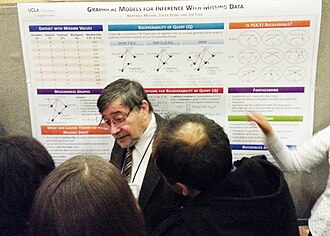
今年的图灵奖得主,也就是今天上午的主讲人,是加州大学洛杉矶分校的计算机科学与统计学教授朱迪亚·珀尔。他获此殊荣,是因为他发展出了一套概率推理与因果推理的演算体系,从而对人工智能作出了奠基性的贡献。所以由他在这个会议上向这群听众演讲,再合适不过了。他是真正的先驱,同时推进了人工智能的科学和艺术。我用「艺术」这个词并不随意,读过珀尔教授著作的人都知道,他既是科学家,也同样是哲学家。今天讲座的题目是《因果推断的机械化:一个小型图灵测试及其他》。请允许我隆重介绍,朱迪亚·珀尔。

致谢与三篇论文

珀尔: 谢谢凯利,谢谢你这番美好的介绍。很高兴来到这里。我特意要求把这场图灵奖讲座放在这个会议上,因为我觉得有件事很重要:我不只是要和你们分享这个奖的荣耀,这份荣耀你们当然有份,早年这个游戏刚开始时你们就在我身边;我还想向你们汇报进展,讲讲自从我们上一次一起在沙坑里玩耍、一起搭那些城堡以来,这场冒险里发生了什么。

我也要向这个组织致敬。在我的工作还远谈不上时髦的年代,有人说它有争议,有人干脆说它是捣乱,是这个组织养育了它。我还要感谢你们所有人,感谢你们参与了我将要谈的这些东西的发展:同事、合著者、共同负责人、学生,还有审稿人。我不知道该不该感谢审稿人,不过现在是该感谢的时候了。我注意到,我最重要的三项工作都发表在AAAI的会议论文集里,所以我想从这里开始。我的第一张幻灯片说的就是,AAAI是我刚才提到的那些「捣乱」想法的温床。

第一件事发生在1982年。我相信你们大多数人都不记得匹兹堡那次船上的会议了,我关于树上信念传播(belief propagation)的第一篇论文就是在那里发表的。第二件,我注意到最早带有do演算(do-calculus)的论文之一,发表在1994年西雅图的AAAI会议上。那是我和阿德南·达尔维什(Adnan Darwiche)合写的论文,你们看,标题里就出现了do这个符号,而它没有被拒稿。我确信换了任何别的会议论文集,不管是统计学还是其他领域,它都不可能发表。第三件我想提的,是同一个会议,1994年的西雅图,我和巴尔克(Balke)合写的论文,题目是《反事实查询的概率评估》。

我选这三篇论文,是因为它们恰好对应着我们今天所说的因果推理三层阶梯的三个层级。这个阶梯已经非常牢固,三层几乎从不混淆,你光从句法上就能判断一句话属于哪一层:它是概率的,是因果的,还是反事实的。

图灵与图灵测试

珀尔: 不过这不是一场关于我个人工作的讲座,这是一场关于图灵的讲座。所以让我从图灵和他的图灵测试讲起。我们都读过他1950年发表在《心灵》杂志上的那篇论文,那个测试,我认为是人工智能领域许多工作的发动机。

对于「计算机能思考吗」这个问题,图灵的回答非常简单:能,只要它的行为像是在思考。所谓「行为」,是指它能回答关于某个故事、某个话题或某种情境的非平凡问题。我关心的是「非平凡」是什么意思。我没有选一个特定话题的故事,而是选了一种推理模态。今天在场的许多人都在各自领域做着某种小型图灵测试,而我认为因果推理这项工作的独特之处在于,它是按推理模态而不是按领域来划分任务的。

来看看图灵是怎样描述人和机器之间一段假想对话的。第一个问题是关于十四行诗,关于诗歌的。回答当然是回避的,但仍然带着人味:「这事别指望我,我从来不会写诗。」第二个问题是算术,问某个数加某个数等于多少。回答也很像人:停顿三十秒,然后给出答案。这也是个很简单的领域。然后图灵转向棋局:你会下棋吗?会。我的王在K1,没有别的棋子;你只有一个王在K6,一个车在R1。轮到你走,你走什么?机器当然回答了,停顿一下之后说:「将死。」

这就是图灵第一篇论文里举的三个问题:诗歌、算术和象棋,都是狭窄的领域,答案也都合理。但在那篇文章的第七节,图灵走得更远,他谈到了「儿童机器」,实际上就是在谈机器学习。他说,为什么要考虑成人的大脑?为什么不从儿童机器开始?那应该更容易,因为儿童不需要我们期望成人具备的那么多背景知识。他写道:「我们的希望在于,儿童大脑里的机制少到某种类似的东西可以很容易地被编程出来。」我认为图灵低估了视觉和运动行为在我们高级智能中扮演的角色。来自儿童世界的种种隐喻,在孩子处理数学的能力中起着巨大作用。所以我认为图灵低估了从儿童大脑起步的难度。

但接着他谈到机器学习,并且就机器学习与进化之间的关系提出了一个革命性的论断。他说,适者生存是一种衡量优势的缓慢方法。实验者,也就是程序员,运用智能,应该能够加快这个过程。怎么加快?在需要的地方制造人工突变。「如果他能追溯到某个弱点的原因,他大概就能想出一种能改善这个弱点的突变。」我认为这是一个伟大的远见。他的想法是,程序员能够把程序的弱点追溯到要害之处,然后制造突变。但这就引出一个问题:为什么机器不能拥有一份关于自身的蓝图,自己找出弱点的根源,然后在相互竞争的计算资源之间重新分配优先级呢?

因果推理的小型图灵测试

珀尔: 现在我来解释,为什么我选择因果推理作为一个配得上「小型图灵测试」之名的领域。想象一间实验室,中间有一道隔板,就是那道著名的隔断,把提问者和机器分开。输入是一个关于某个熟悉领域的故事。问题只限于三类:是什么(what is)、假如怎样(what if)、为什么(why)。期望的回答形式是:「我相信结果会是如此这般。」

我用的故事在我1988年的书里用过很多次,后来在《因果论》(Causality)里也用过。故事是这样的:你走出家门,看见人行道也许是湿的也许是干的,也许滑也许不滑;你身处旱季或雨季;你猜想人行道如果湿了,要么是下过雨,要么是洒水器开过。一个非常简单的故事,五个二元变量,和你的日常经验紧密相连。任务是把这个故事讲给机器听,给机器编程,让它回答涉及三种模态的简单问题。

问题来了。第一问:如果现在是旱季,而人行道很滑,那么下过雨吗?你期望的回答是:不太可能,更可能是洒水器开过,还有很小的可能是人行道根本没湿,滑另有原因。这类回答的依据,是你把故事编进机器的方式,以及你把各种事件之间的相对可能性编进去的方式。这是一个关于预期、证据、观察以及由此推出什么最可能的例子。

第二问:可是假如我们看到洒水器是关的呢?你期望的回答是:那么更可能是下过雨。很合理,这就是「解释消除」(explaining away)。

接下来是关于行动的问题:你的意思是,如果我们真的把洒水器打开,下雨的可能性就会变小吗?你希望机器说:不,「看到」和「做」是有区别的。下雨的可能性保持不变,但人行道肯定会湿。

然后是反事实性质的问题:假设我们看到洒水器开着,人行道是湿的,那么如果洒水器当时是关的呢?我稍后会为自己对反事实的执念道歉。但先请你们替机器回答一下。我期望机器说的是:人行道会是干的,因为现在很可能是旱季。也就是说,你根据洒水器开着这个观察,推断出这多半是旱季;然后假设洒水器是关的,过去保持不变,改变的是未来。所以答案应该是:人行道是干的,因为季节很可能是旱季。

这就是我们在这个图灵式问题上期望的问答。

中文屋与约束

珀尔: 我们都记得塞尔(Searle)的「中文屋」论证。他说:不,光是回答这些问题,不等于机器在思考。想象一台机器靠一本规则手册回答中文问题,每一句英文或中文的句子,手册里都印好了中文或英文的答案。机器只是在书里查答案,这不能说明它理解中文。

塞尔忽略了一个事实:宇宙里的分子不够多,造不出这本书。你只要数一数可能的句子组合有多少,有人算过,宇宙里的分子都不够用。你可能会说,那又怎样?难道就因为存在组合上的困难,机器就在思考了?答案是:是的。因为当你面对这样一个难题时,克服它的唯一办法是利用约束,而理解约束正是我们所说的「理解」的含义。它是理解的必要成分。

就拿洒水器的例子来说。为了便于论证,假设有十个二元变量,你数一数,如果用塞尔的中文手册方法,需要多少表项。很快你就会得到一千个条目,这只是概率部分;乘上另一个一千,是每一种行动;再到反事实,又是一千。光是这个人行道的小故事,你就已经有了一张十亿行的表。正因为这些模态之间存在着大量约束,什么发生了、如果我做什么会怎样、如果我没做某件事或某个事件发生了会怎样,连孩子都能相当清楚地回答这些问题。问题是,他们是怎么做到的?

为何选因果推理

珀尔: 接下来我要解释,为什么我认为因果对话如此重要,为什么应该先在它上面做图灵测试。图灵测试可以有很多种。图灵从诗歌、算术和象棋开始。你可以想象有人为股票市场造一个图灵测试。我觉得这是最容易的一个,因为那里没有任何约束,也没有任何专门知识,跟诗歌很像。

我为什么要走向因果推理?第一,因为它在人类认知和人类伦理中无处不在,我有几张幻灯片专门讲这个,而且它深深扎根于儿童的发展。第二,我认为它是科学思维的基本构件。第三,它对机器人学很重要。还有第四条,这一条大概占去了我五年到十年的生命:周围有太多数据密集型的科学应用,能从任何关于因果推理的洞见中获益。我说过,有成千上万饥饿而茫然的顾客。他们的饥饿不是因为穷,他们资金充裕,所有制药公司都属于这个顾客群。他们饥饿是因为缺少思想,他们茫然是因为因果推理从未被形式化。我们在让机器人理解因果关系的过程中得到的任何一点优势、任何一点洞见,都能立刻转化为那些领域里节省数百万美元的方法。

亚当、夏娃与亚伯拉罕

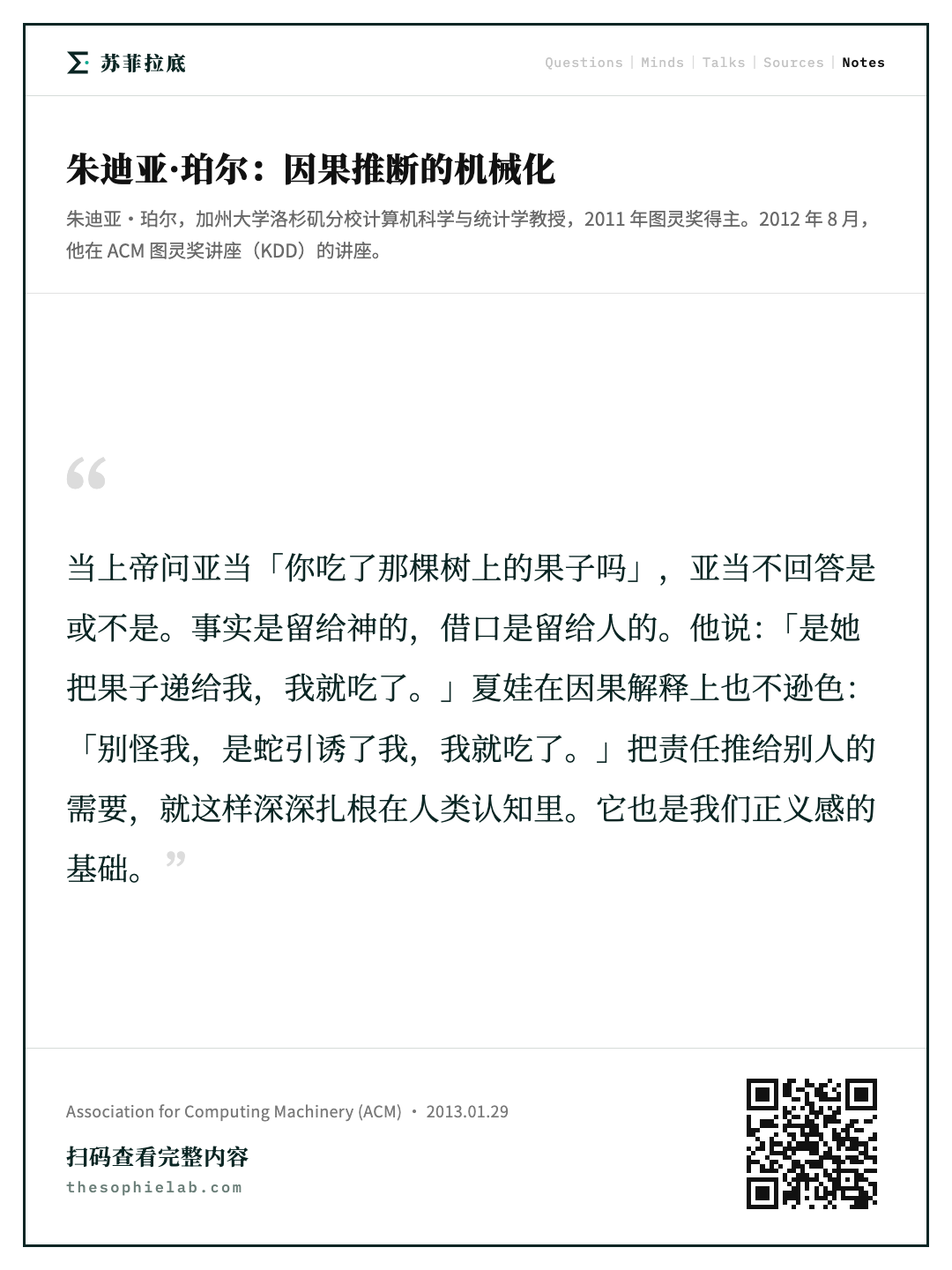
珀尔: 让我从人类认知和伦理讲起。我喜欢从亚当和夏娃说起,不然还能从哪儿说起?你马上就能看到,当上帝问亚当「你吃了那棵树上的果子吗」,亚当不回答是或不是。事实是留给神的,借口是留给人的。他说:「是她把果子递给我,我就吃了。」夏娃在因果解释上当然也不逊色,她说:「别怪我,是蛇引诱了我,我就吃了。」把责任推给别人的需要,就这样深深扎根在人类认知里。

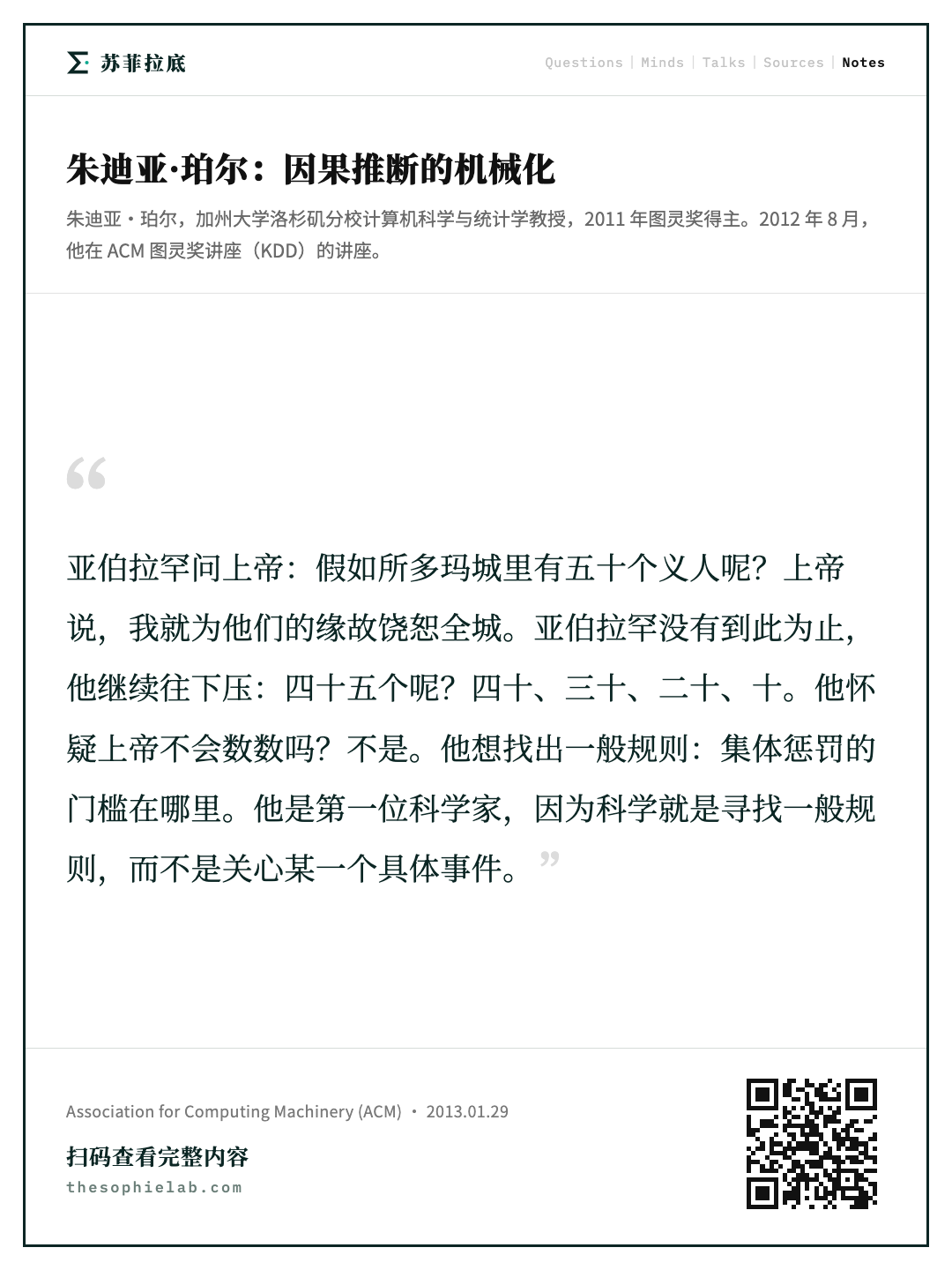
它也是我们正义感的基础。你们都记得,上帝告诉亚伯拉罕他要毁灭所多玛和蛾摩拉,亚伯拉罕说:「你要把义人和恶人一同剿灭吗?你不能这样做。」请原谅我的希伯来语,但三千年前那里说的就是这个意思。「假如城里有五十个义人呢?」这是《圣经》里的第一个反事实:假如有五十个义人。看上帝怎么说:「我若在所多玛城里见有五十个义人,我就为他们的缘故饶恕那全城。」你以为亚伯拉罕到此为止了吗?没有。他继续往下压:「那四十五个呢?你会为了五个人的差额大动干戈吗?」上帝说:「不,我不毁灭。」然后降到四十、三十、二十、十。接下来发生了什么,大家都知道。

问题是,亚伯拉罕在玩什么游戏?他怀疑上帝不会数数,或者分不清义人和恶人吗?不是。亚伯拉罕是第一位科学家。他想找出一般规则:集体惩罚的门槛在哪里。从这个意义上说,他是第一位科学家,因为科学是什么?科学就是寻找一般规则,而不是关心某一个具体事件。

物理学里的反事实

珀尔: 现在我转向科学,向你们证明反事实确实是科学的基础。我们都做过这样的物理题:胡克定律告诉你,弹簧的长度y等于一个常数乘以重量,取常数为二,所以y等于2x;x等于一公斤,求弹簧的长度。你觉得这全是算术,对吧?解法就是解两个方程两个未知数。

问题来了:左边这个方程组和右边这个方程组等价吗?按照我的代数课本,两个方程组如果保持相同的解,就是等价的。这两个方程组解相同,可它们等价吗?你会说,当然不等价,因为左边的方程组能回答右边回答不了的问题。我再放一个第三种写法,稍后告诉你们为什么。左边的方程组能回答一个反事实问题:「假如x是三,y会是六。」翻译过来就是:如果我们把重量加到三公斤,弹簧长度会是多少?会是六。我们是怎么做的?把x等于一这个方程抹掉,换成x等于三,然后解这个被新信息修改过的新方程组,得到y等于六。

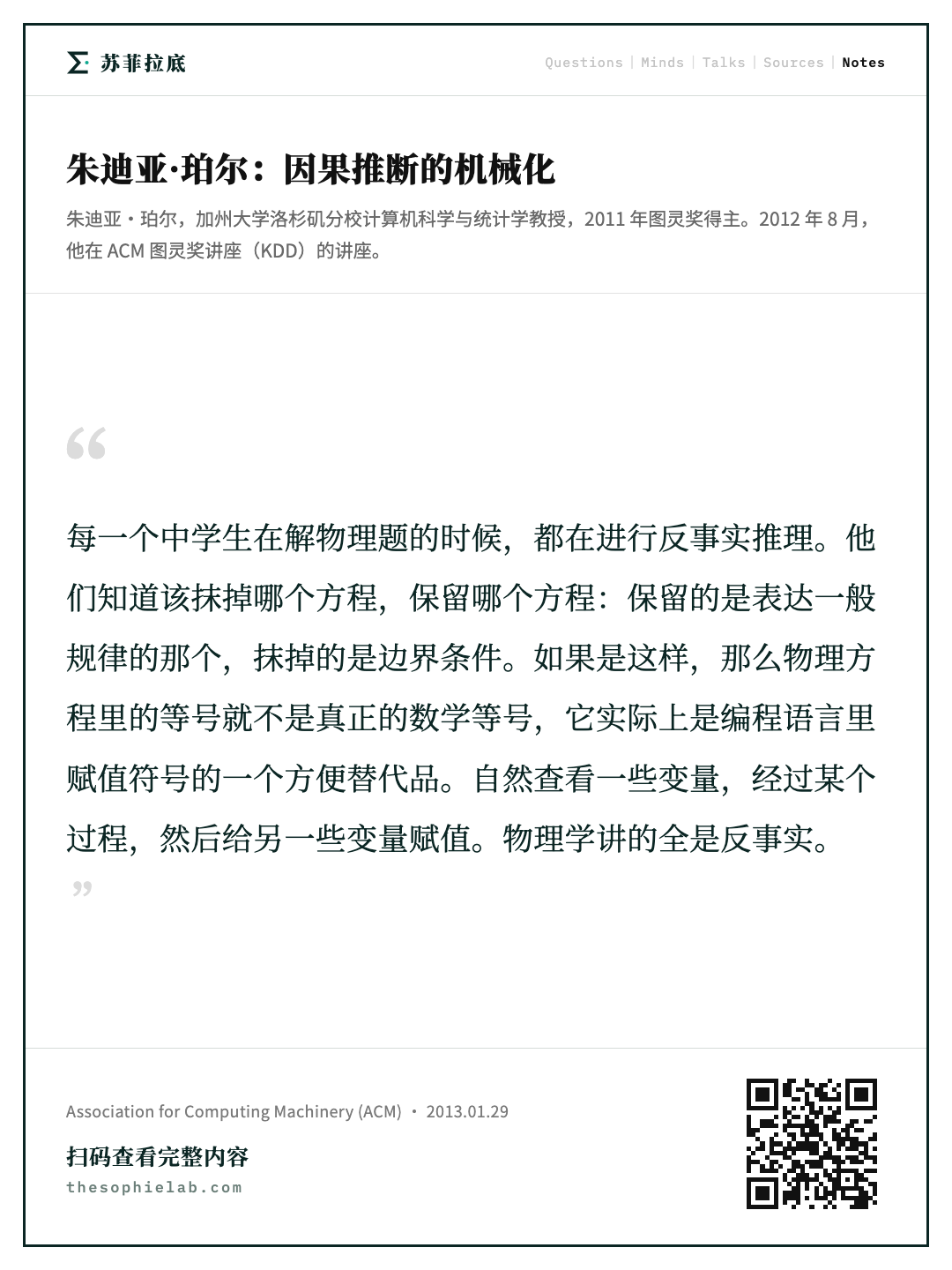
那为什么右边不能这样做?它们不是等价的吗?我抹掉x等于二分之一y,换成x等于三,得到y等于四。这是错的,对吧?所以每一个中学生在解物理题的时候,都在进行反事实推理。他们知道该抹掉哪个方程,保留哪个方程。他们保留的是表达一般规律的那个,抹掉的是边界条件,或者受反事实前件支配的那些。

如果是这样,那么我们之前看到的等号就不是真正的数学等号,它实际上是编程语言里赋值符号的一个方便替代品。想象一下,自然在决定弹簧长度之前,环顾四周,找所有可能影响长度的变量,看到重量,说:「啊,就是它。」然后查一查弹簧上的重量,据此决定长度的值。这就是物理学的图景:自然查看一些变量,经过某个过程,然后给另一些变量赋值。如果是这样,就需要一种不同的代数,因为它涉及抹掉方程。我们在图里用箭头而不是赋值符号来表示这一点。这就是结构图、因果图里箭头的含义:它描述的是自然的配方,自然的策略。

我现在说服你们了吧,物理学讲的全是反事实。我记得有人对我说:「你在开玩笑吧?不可能。」不管怎样,这就是我的经历。

哲学家的困境与工程问题

珀尔: 反事实和因果在人类推理中的作用,很多哲学家早就注意到了,早到古希腊。公元前430年,德谟克利特说:「我宁愿发现一条因果关系,也不愿做波斯的国王。」那个年代,波斯国王可不像今天这样是个危险的职业。休谟当然带着困惑看待这件事,他说:因果这个概念到底是什么?我得把它解决掉。他得出的看法是,因果不是神的馈赠,而是我们从经验中学来的东西。这是那段著名的话:「我们记得曾看见过那种叫作火焰的对象,也记得曾感受过那种叫作热的感觉,不需要更多的仪式,我们就把前者叫作原因,把后者叫作结果。」所以是在自然中确定规律性这件事,让我们贴上了「原因」这个标签。这当然有困难。所有哲学家都在解释什么是原因这个问题上栽过跟头,这就让我们不得不问:我们人工智能领域的人凭什么胆量,觉得自己能在这场漫长的争论里再添上一分?

答案很简单:我们没有从容哲思的余裕。我们需要造出能理解实验室里或者厨房里出了什么问题的机器人。如果它们不能完全靠自己学会,我们至少需要有教它们的选项:通过指导,或者,如果我们理解环境里发生了什么,就坐下来花时间把我们知道的教给它们,让它们能恰当地行动,回答关于因果关系的查询。

这不是件小事。哲学家面对的谜题,现在翻译成了工程问题。「我们如何从环境中获取因果信息」这个问题,翻译成「机器人如何从环境中获取因果信息」。「人如何得出因果标签」这个问题,翻译成「机器人应当如何使用从它的创造者、它的程序员那里得到的因果信息,来理解并正确回答查询」。第二个问题看起来平凡,其实一点也不平凡,因为如果你只是照规则走,会得到意外的结果。假如输入是:「如果草地湿了,那么下过雨」,还有「如果你打碎这个瓶子,草地会湿」。你可不希望输出「如果你打碎瓶子,那么下过雨」。所以光靠规则链接是不行的,你需要更多的东西。那更多的东西是什么?

讲座提纲

珀尔: 在讲那个之前,让我列一下今天要讲的内容。我要讲三层阶梯。问题分三层:「如果我看到什么」,这是概率和信念;「如果我做什么」;「如果我当初做得不一样」,这是反事实。你如果想给它们加上概率来修饰,说答案有多大可能成立,也可以,但那不是本质。本质就是:是什么,假如怎样,为什么。

然后我给你们一份实地报告,讲我们从贝叶斯网络的旧时代走到因果和反事实的这趟旅程。我们得理解这中间的区别,以及挡在我们路上的思维障碍。我们要讲什么使一个因果模型成其为因果模型,而不是别的东西;它是如何被检验的。这两者是相连的:如果一个模型有可检验的推论,你才有希望从数据中发现它;一个没有任何可检验推论的模型,是不可能从数据中学到的。然后我讲三个应用:干预的效应,do演算的演化,以及反事实的算法化。这三个任务在理论上都已相对彻底地解决。应用包括计划与政策的评估,中介分析,也就是区分直接原因与间接原因,还有泛化,就是可迁移性,埃利亚斯(Elias)今天下午会给你们讲。

统计范式与因果范式

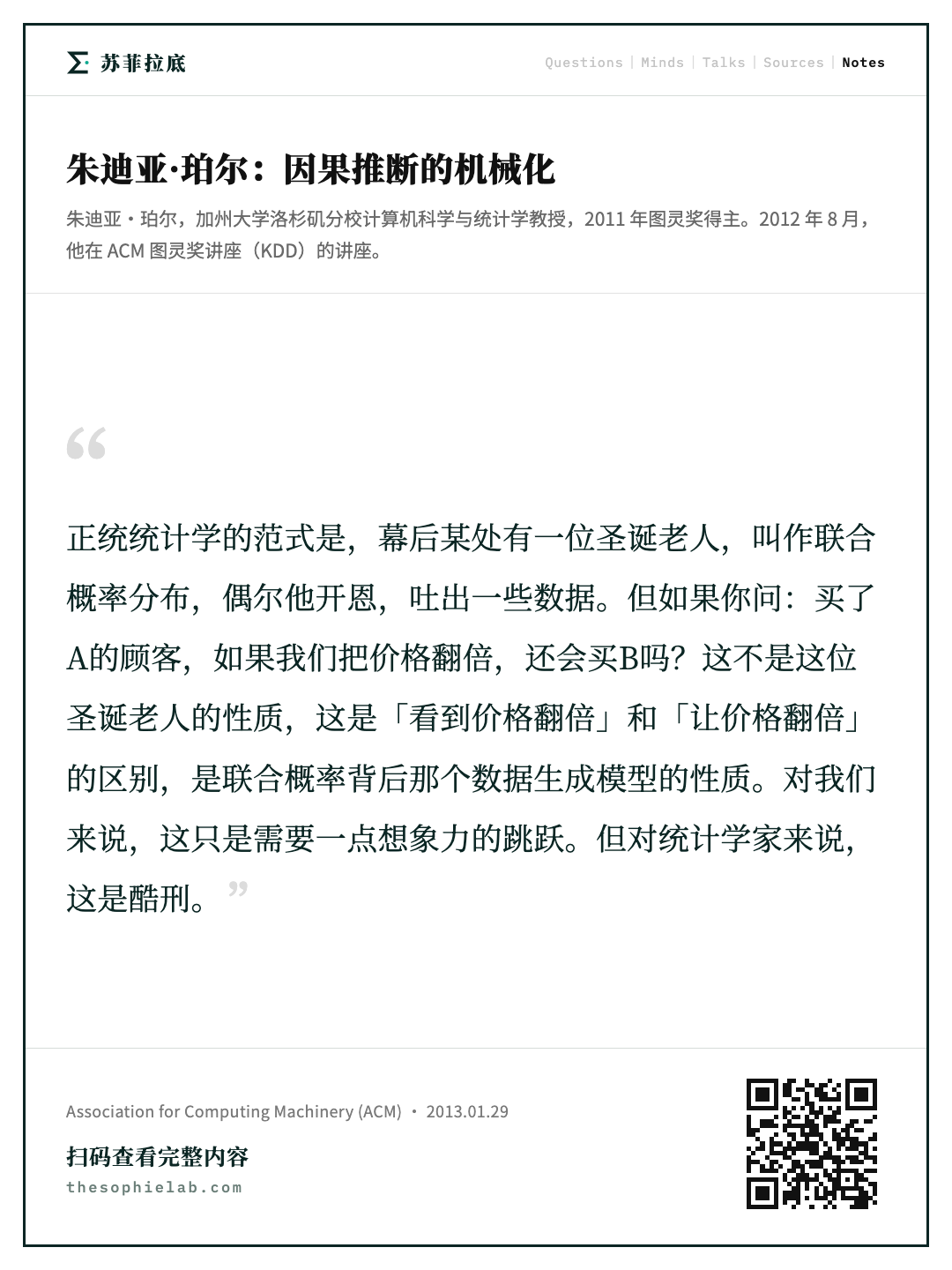
珀尔: 这是正统统计学的范式,也是主导统计思维和机器学习的范式。它的想法是,幕后某处有一位圣诞老人,叫作联合概率分布。偶尔他或她开恩,吐出一些数据,我们的工作就是从数据中推断这位圣诞老人的性质,也就是Q(P),联合分布函数的某个方面:估计均值,或者造一个分类器,或者判断买了产品A的顾客是否也会买产品B。你可以说这类问题干净利落、形式化得很好,因为它能被整齐地封装在概率论的语言里。你甚至有一句简短的话:求给定A时B的概率,条件概率,两百五十年前贝叶斯牧师就有了。没有别的了,除了问题的复杂性。Q可以非常复杂,联合分布可以定义在非常多的变量上,连续的、二元的等等。所以不容易,但范式是一样的。

因果推理处理的是另一种范式。比如你问:买了A的顾客,如果我们把价格翻倍,还会买B吗?我们早上醒来,忽然心血来潮变得贪婪,想知道如果涨价会发生什么。我们问的是:给定A,并且给定我们做了某件事,也许是以前从没做过的事,把价格翻倍,B的概率是多少。这甚至不是P的一个方面,因为它不同于以价格翻倍为条件的条件概率。这就是「看到价格翻倍」和「让价格翻倍」的区别。再看反事实问题:「假如我们当初把价格翻倍呢?」这也不是圣诞老人P先生的方面或性质。

那它是什么?它是联合概率背后那个数据生成模型的性质。是的,联合概率吐出数据,我们拿到这些样本,需要推断某种性质,但不是P的性质,而是数据生成模型的性质。这就是我之前跟你们说的自然的不变策略,有时也叫机制、配方、法则、协议,或者反事实,自然通过它给分析中的变量赋值。对我们来说,这只是一个小技巧,需要一点想象力的跳跃,去想象自然,而不是实验或测量。但对统计学家来说,这是酷刑。对人工智能之外的人来说,这是一次创伤性的经历。所以如果你们以后跟外面的人谈这个,请记住这一点。

自然的方程与电路神谕

珀尔: 我们把它推广一下。想象整个世界就是一堆弹簧,由一堆函数驱动,这些函数给变量赋值。在这一万亿零一个变量里,每一个变量的值都是系统里其他变量的函数。有些变量是外生的,你不关心它们的解释,只关心它们的影响;有些是内生的。我们的工作是把这个编码进机器,让机器对我们的问题给出合理、可信的回答,比如「如果你看到洒水器开着会怎样」这类非常合理的问题。

这是那些领域里典型的方程,线性情形。为什么Y得到某个值?因为自然花了点时间,也许是一眨眼的工夫,看了看X,乘上一个常数,加上一点噪声,然后决定Y应该取小y这个值。干得好,自然女士。我们的工作是破译自然的这个映射。这很有野心,但至少如果我们有来自自然的数据,应该能回答反事实查询。

我们都熟悉电路图。它就是一个反事实的神谕,因为看着电路图,你能回答反事实问题:如果我把这个或门换成与门会怎样?如果我把这个Y接到三点五伏的电源上会怎样?尽管电路的设计者从未预料到这么疯狂的问题,从未预料到接到电源上这种疯狂的事件,但工程师瞄一眼电路,就有能力思考这个答案,而且答得对。

这一切从哪里来?来自这一堆函数的一些基本性质。最根本的那条,其他一切最终都由它导出:如果你运气好,你的方程是递归的,没有环,而且扰动项彼此独立,那么不管那里的函数是什么,不管扰动项的分布是什么,你都能对你观察到的东西的概率分布说出一些东西。这一堆弹簧的结构决定了你的分布函数里某种很基本的东西,那就是乘积形式,也就是条件独立性。

从这里引出下一个推论:你回答干预问题的能力。一旦有了这个乘积,如果有人问你「如果我采取某个行动会怎样」,你只需要取一个截断的乘积。这叫操纵定理(manipulation theorem)或者截断分解(truncated factorization)。它是同一个乘积形式,只不过从乘积中删掉那些被强制为常数的变量,因为它们不再听从它们的父节点了。

再看洒水器的例子。在你行动之前,你有按照这个菱形结构的分解,写下来就是那个乘积:每个变量以其父节点为条件的乘积,没什么特别的。但如果你采取行动,比如打开洒水器,你就把那个过程从讨论中删掉,因为洒水器先生不再听季节的话了。你一打开它,洒水器先生就沦为你肌肉的奴隶,所以它被替换成一个常数。

我看一下时间,还剩十二分钟。我要比预想的讲快一点。但你们听得这么专注,我实在不忍心让你们失望,我有那么多好故事想讲给你们听。这是一段美好的旅程,我得告诉你们。

从哈维尔莫到do演算

珀尔: 好,我们现在有了一套关于行动的形式体系。它不是在人工智能领域萌芽的,它源自经济学家哈维尔莫(Haavelmo)1943年的工作。他的想法是,如何建模政府对经济的干预,比如固定价格或者征税。他有一个方程,政府做了某件事来保持价格恒定,于是在方程里加上另一股力量,去平衡其他力量,让价格保持不变。后来斯特罗茨(Strotz)和沃尔德(Wold)把它换成了「抹掉一个方程,换成一个常数」。再后来斯珀茨(Spirtes)和格利穆尔(Glymour)把它翻译成一个图上的手术过程:抹掉指向被操纵变量的所有箭头。这导向了截断分解。我很认真地对待这件事,说:不,我们这里有一种新的演算,它应该有代数上的支持。于是把它翻译成do演算,然后把它应用到反事实上。这就是这些思想的演化过程。现在我们还实现了与统计学里内曼(Neyman)和鲁宾(Rubin)阵营的统一,他们也是用反事实来处理因果。

反事实的算法化

珀尔: 反事实是怎么处理的?反事实的模型是什么?非常简单:你切割你的模型,以照顾反事实的前件,然后在被切割过的模型里解方程。没有别的了,简单得让人不好意思。我在这里只是把我刚才用英语说的那句话用符号表达出来。于是你就拥有了一套演算,因为你有了任意变量集合上联合反事实的语义。你能求出「假如X取小x则Y取小y,并且同时假如W取某值则Z取小z」的联合概率。你有了为任何这类句子求概率的语义,哪怕它多么曲折。这种句子很少出现在我们必须处理的句子里,具体来说,我们处理的是带do的、涉及行动的句子,以及涉及归因的句子:一个病人今天已经死了,而且他确实服了药,那么假如他当初没有服药,他今天还活着的可能性有多大?这是这门语言里的一个句子。语义就在那里,只要有模型就能计算。人人都会解方程,对吧?数学极其简单。

我的学生盖尔斯(Galles)给出了它的完整公理化。为什么需要公理化?为了当有人说他能用另一种方式做反事实的时候,我们能比较两套公理,然后说:不,它们在逻辑上等价。其中当作主力使用的是「复合公理」(composition),它说的是:如果你做了一件本来就会发生的事,那你什么也没做。这本质上是在说,我们的世界比任何其他可能世界都更接近我们自己的世界,如果你用可能世界的解释来看的话。

可检验性与干预神谕

珀尔: 我举个例子说明你能用它做什么。你有一堆方程,你认为自然就是这样运作的。你首先要问自己的问题是:它可检验吗?它有没有任何可检验的推论?我之前说过,如果没有可检验的推论,你就无法学到它。这里的答案非常简单:我们在贝叶斯网络上做的一切,现在都翻译成因果贝叶斯网络。这种运算给你一个有限的可检验推论集合:只要看那些缺失的箭头,每一条都承诺了一个检验,如果检验不通过,模型就是错的。

它还能为你做什么?它能回答干预问题,它是干预的神谕。如果你有这样一个问题:求X对Y的平均因果效应,已知你能测量变量W1、Z1等等,能不能不做操纵、仅凭观察就求出来?答案是:能,只要你对年龄、族裔和另外几个变量做调整,那么你就一定能通过简单的调整、通过回归,无偏地回答这个查询。当然,这建立在图中编码的假设之上。图里每一条缺失的连线都是一个因果性质的假设,而不是统计性质的假设。

再举一个例子,这个难一些。假设我们希望估计平均因果效应,而我们只被允许做一次测量,应该测哪个变量?结果是,这一个就能替你做成这件事。懂前门准则(front-door criterion)的人知道,这就是前门准则。

再举一个应用性很强的例子。你在运动医学这一行,想知道热身是导致受伤还是预防受伤。这对我们的社会、我们的文化是个极其重要的问题,对吧?你可以测量的东西有:先前的伤病、球队的攻击性等等。测哪一个?每一个都要花很多钱去测。答案是自动给出的:你应当测这个,就没问题;你可以测这个;你不应当测那个,因为会有偏差;你应当测那个,没问题;这是另一种备选方案,等等。所以你可以按照成本和可靠性来挑选测量。

驱动这套回答机制的引擎是什么?还剩四分钟。四分钟能干什么,你们等着看。这个引擎就是三条规则。它接收一个图,反复应用这三条规则,然后给出答案。这是一个例子:吸烟导致癌症。问题带着一个因果符号交给你,红色的符号就是「如果我做」。我们做不了「做」,我们不能在吸烟者身上做随机实验,所以必须用分析的方法。我们把规则一条接一条地应用上去,把所有紫色符号去掉。如果我们把红色符号去掉了,就说明这个问题可以靠不动手的被动观察来回答。你能回答是或否,能回答吸烟在多大程度上导致癌症。

它还能做什么?我跳过这些:找出等价模型,识别反事实查询,中介分析,我肯定没时间讲了,找出效应的原因,解释,还有可迁移性,埃利亚斯今天下午四点会在海报前给你们讲。可迁移性就是把你从一个领域学到的东西,推广到另一个你无法做任何实验的领域。

反事实与共识

珀尔: 反事实很有意思,因为哲学家们费尽心力想弄明白,我们为什么能对反事实形成共识。这是一个典型的例子:我给你这几句话,你会对第一句说「对对对」,对另一句说「不不不」。在我们的文化里,人们通常会形成共识。我们是怎么做到的?这对许多哲学家来说是个谜。休谟试图用反事实来解释原因,戴维·刘易斯(David Lewis)也试图这么做。我面对的困惑不一样:为什么他们不试着用原因来定义反事实,而是反过来?反事实显然问题更少,因为我们确实能在反事实上形成共识。既然连这两位哲学支柱都试图用反事实来定义原因,这就意味着我们脑子里有一台反事实引擎,迅速而可靠;我们能形成共识,是因为我们共享这台引擎的架构。所以这是一个人工智能问题,不是哲学问题。

刘易斯提出的是反事实的可能世界语义,它依赖于评估世界之间的相似程度:尼克松按下按钮之后的世界,与我们还活着的世界有多接近,相比之下,尼克松按下了按钮而有人把电线拔了的世界又有多接近。这是哲学里的典型问题,评估世界之间有多相似。而在我们这个结构里,你不依赖世界之间的相似性,你依赖方程,物理学里常见的那种方程,以及对这些方程的切割。

中介与可迁移性

珀尔: 我没时间讲反事实的一大胜利了,那就是区分直接效应和间接效应的能力。这很重要,因为我们就是这样说话的:我们把人送进监狱,因为他对谋杀负有直接责任,或者只是间接责任。这在我们的社会里非常要紧。它还让我们能回答另一类干预的问题:这类干预是启用或禁用某些机制,而不是像我之前讲的那样固定变量。我跳过这部分。这在统计学和其他领域现在是个蓬勃发展的领域,叫作中介分析(mediation analysis),它的推动力就是反事实。我们能用反事实把间接效应的思想表达出来,就像你们在这里看到的。间接效应的定义是:保持输入不变,但把中介变量改变一个量,改变多少呢?改变到假如输入变了它本会取的值,此时输出的期望变化。这是一个嵌套的反事实,现在已经是间接效应公认的定义了。它不涉及固定变量。所以我把它算作一次胜利。

但我要转到下一个胜利,就在这里:可迁移性(transportability)。我说它是胜利,因为在这里do演算像从灰烬中重生一样出现了。我们没料到它会在这样一个与干预几乎无关的领域显示出威力。想象你想把从实验中学到的关系,迁移到另一个不做实验的环境里。可以想成在驾驶舱里训练一个机器人,然后把他或她搬到另一个只允许观察、不允许实验的环境。机器人在驾驶舱里获得的因果知识,有多少是可以迁移的?我们要的是一个逻辑上的回答,是或否:给定我们对两个环境的了解,某一条关系可以或者不可以迁移。令人惊讶的是,这个问题得到了完整的回答。埃利亚斯会讲完备性。完整的回答意味着你不可能做得更好,意味着所有做机器迁移的人,他们叫领域迁移,在我们的答案说「做不到」的那些情形里都会碰壁。他们可能不知道为什么,可能会惊讶于它不起作用。所以我们努力的方向是,在对两个环境的差异和共性作出某些假设的前提下,给出是或否的回答。

我想我快到结尾了,还剩五秒钟。这里是所有漂亮的例子,你们要错过了。最重要的是这一个:你给我一个图,在图上标出两个领域在哪里不同,或者怀疑在哪里不同,我告诉你某条关系可以还是不可以迁移。如果可以,绿色的部分告诉你在实验领域应当做的测量,蓝色的,或者说紫色的,告诉你在目标总体里应当做的测量,那里是不允许做实验的。然后这就是把它们组合起来、得到正确无偏结果的方式。完备性的讲解在四点钟。

时间到了。我还没讲我的新东西,元分析(meta-analysis),大数据在这里派上用场。想象你有来自美国或者全世界一千家医院的数据,每一家都在不同的条件下、不同的总体上采集,你需要把它们全部合起来,去回答另一个环境里的一个查询,那个环境不允许做任何测量,你只知道它的结构。能做到还是不能做到?是或否。如果能,怎么做?我在很多张幻灯片里讲了怎么做,现在只能跳过。请相信我,这里是有方法的。这里也还有大量工作要做:把关系分解成因果关系,从每一项研究中提取精华,提取共性,把它们合在一起,得出无偏估计。

结语

珀尔: 结论是显而易见的。反事实是科学思想、自由意志和道德行为的基本构件。反事实的算法化已经让经验科学中的若干问题受益。第三条是,这让我们朝着实现机器人与人类之间的协作行为又近了一步。

从历史的角度,我在这里得扮一回智者。你们知道,人们公认西方科学有两大进步:一是希腊人发展出逻辑,二是伽利略认识到可以通过实验找出因果关系。我要给你们提供第三个。不,我不是提供第三个,我是顺着这两步走,试着把两者结合起来:希腊人的逻辑加上伽利略的实验,得出逻辑上严密的因果理论。最后一张幻灯片说的是:我告诉过你们这很简单。我们的使命大体已经完成,但还有更多要做。谢谢大家。

赠礼致谢

主持人: 谢谢您,珀尔教授。感谢您提醒我们,科学不仅是从哲学中诞生的,而且哲学与科学至今仍然彼此高度相关。作为一个小小的、但与您的讲座颇为相称的纪念,大会想把这件礼物赠送给您。再次感谢。
本期讲者
朱迪亚·珀尔加州大学洛杉矶分校计算机科学与统计学教授,2011 年图灵奖得主。他创立了贝叶斯网络,并建立了以结构因果模型、do 演算和反事实为核心的因果推断理论,著有《因果性》《为什么》。
主持人2012 年 AAAI 年会的会议主持人,负责介绍图灵奖讲座并在演讲结束后向珀尔赠送纪念品。
章节 · 点击跳转视频
0:04 开场:图灵奖与讲者介绍 ▶ 正在看
3:17 致谢 AAAI 与三层因果阶梯 ▶ 正在看
5:02 图灵测试:从棋局到儿童机器 ▶ 正在看
11:29 迷你图灵测试:洒水器的三类提问 ▶ 正在看
15:55 回应中文屋:理解约束才是理解 ▶ 正在看
17:19 为什么选因果:认知、伦理与科学 ▶ 正在看
22:08 胡克定律:解物理题即反事实推理 ▶ 正在看
26:34 从休谟到 AI:哲学难题变工程问题 ▶ 正在看
31:20 两种范式:P 的性质与数据生成模型 ▶ 正在看
36:59 结构方程、截断分解与 do 演算 ▶ 正在看
44:26 反事实语义、可检验推论与三条规则 ▶ 正在看
49:45 中介分析、可迁移性与结语 ▶ 正在看
本期论点
本期回应
6:36
计算机能否思考应当以行为来回答:只要它表现得像在思考,就算能思考 行为为准怎么判断机器是不是真会一件事?
11:38
因果推理能回答「是什么、如果怎样、为什么」三类问题,配得上充当迷你图灵测试 行为为准怎么判断机器是不是真会一件事?
16:40
克服组合爆炸的唯一办法是利用其中的约束,而理解这些约束正是理解的必要组成部分 因果模型人的思维主要靠哪一种机制?
30:26
哲学家争论千年的因果难题,如今都已变成可解的工程问题 该给出理论哲学应该产出什么?
52:14
反事实为何能在人与人之间达成共识,是人工智能问题而不是哲学问题 没有界线哲学和科学之间有没有界线?
其他论点
10:02
图灵低估了从儿童大脑起步的难度,也低估了视觉与运动动作对高层次智能的作用
24:03
解相同但写法不同的两个方程组并不等价,因为它们回答反事实问题的能力不同
27:31
物理学讲的全是反事实:方程描述的是大自然给变量赋值的过程,而非两边的对称关系
28:45
因果不是神的恩赐,而是人从反复观察到的规律性中学来的标签
32:45
只有具备可检验推论的模型才可能从数据中被学出来
36:03
看到价格翻倍和让价格翻倍是两回事,干预问的是数据生成模型而非联合分布的性质
47:56
因果图里每一条缺失的连边都是一个因果假设,而不是统计假设
52:54
评估反事实不必依赖可能世界之间的相似性,只需对物理方程做截断处理
01开场:图灵奖与讲者介绍
0:04
it is my great pleasure to welcome you to the ACM am touring lecture this annual presentation is delivered by the winner of the ACM am touring award which is named for the Great British mathematician and computer scientist Alan M Turing the originator of the touring test and whose H 100th birthday we've been celebrating had quite a big celebration at ACM about two weeks ago in San Francisco the touring award is often referred to as a Nobel Prize of computing and the most prestigious computer science can receive and it carries with it a $250,000 prize generously provided by Intel and Google uh this year's recipient of the ACM touring award and our lecturer this morning is Judea Pearl professor of computer science and statistics at the University of California in Los Angeles he received this honor in recognition of his fundamental contribution to artificial intelligence as a result of the development of a calculus for probabilistic and causal reasoning so you can see it quite fitting that he addressed this audience
非常荣幸欢迎各位来到 ACM 图灵奖巡回讲座,这个年度演讲由 ACM 图灵奖得主主讲图灵奖以伟大的英国数学家、计算机科学家艾伦·M·图灵命名,他提出了图灵测试,我们最近一直在庆祝他的百年诞辰,大约两周前 ACM 在旧金山办了一场相当盛大的庆祝活动。图灵奖常被称为计算领域的诺贝尔奖,是计算机科学家能够获得的最高荣誉,它还附带一笔 25 万美元的奖金,由英特尔和谷歌慷慨提供。今年 ACM 图灵奖的得主,也是今天上午为我们主讲的,是加州大学洛杉矶分校的计算机科学与统计学教授朱迪亚·珀尔。他获此殊荣是为了表彰他对人工智能的根本性贡献,即发展出了一套用于概率推理和因果推理的演算体系。所以你们能看出,他在这个会议上面对这样一群听众演讲是再合适不过了。他是真正的
便签引用
1:28
at this conference seems one of the true Pioneers in advancing both the science and the Art of intell of artificial intelligence and I don't use the term art Loosely because um if you know any of uh Professor B's works or books um you'll know that he's as much a philosopher as a scientist the subject for a talk this morning is a mechanization of causal inference a manyi touring test and Beyond and it is my privilege to introduce Judea perah thank you KY thank you Kelly for this wonderful introduction I'm very glad to be here I I did request to deliver this touring lecture at this form because I felt it is important that I will um tell you not only share the glory of this award which of course you deserve being with me at the early stage of this game but also before because I think you deserve to hear uh progress report but what happened in this uh Advent Venture since we last played in the sandb and we built those castles together um also I think um it's important that I pay tribute to this
先驱之一,同时推进了人工智能的科学与艺术。我用「艺术」这个词并不随意,因为如果你读过珀尔教授的任何著作或书籍,你就会知道,他既是一位哲学家,也是一位科学家。今天上午演讲的主题是「因果推断的机械化:一场迷你图灵测试及其之后」。我很荣幸为大家介绍朱迪亚·珀尔。谢谢你,凯利,谢谢这段精彩的介绍。我很高兴来到这里。我之所以要求在这个场合发表这次图灵讲座,是因为我觉得这很重要,我不只是想和你们分享这个奖项的荣耀——当然这份荣耀你们也有份,你们在这场游戏的早期阶段就和我在一起,甚至更早——还因为我觉得你们应该听一份进展报告,看看自从我们上次在沙坑里玩耍、一起搭起那些城堡之后,这场冒险里都发生了什么。另外我也觉得,我应该向这个组织致敬,感谢它在我的工作还不那么
便签引用
02致谢 AAAI 与三层因果阶梯
3:17
organization for nurturing my work when it was not exactly fashionable and actually some people say it was the controversial or Say mischievous but uh then I I would like to thank all of you for number one being partners of the developments of the things I'm going to talk about um colleagues co-authors co-principal investigators and students and um reviewers I don't know if I should thank my reviewers was but now that's kind of uh I noticed that some of my three most important work were published in the proceedings of the Tria AI so I would like to start with that and my first slide is about Tria a is a breeding ground for some of those Mischief ideas that I talked one is um what took place in 1982 if uh I'm sure that not many of you remember that trip on a boat uh in Pittsburgh and that was where my uh first paper on belief propagation in trees was published and um then I noticed that one of the first paper with the Duke calculus was published in the triple AI in Seattle in 1994 it was a paper
时髦的时候滋养了它——实际上有人说那是有争议的,或者说是有点淘气的。不过,我还要感谢在座的各位。第一,感谢你们成为我接下来要讲的这些工作的伙伴——同事、合作者、共同首席研究员和学生们,还有审稿人。我不知道该不该感谢我的审稿人,不过现在算是吧,因为我注意到我最重要的三篇工作中有几篇是发表在 AAAI 的论文集上的。所以我想从这里开始。我的第一张幻灯片讲的是,AAAI 是那些淘气想法的温床。第一个是1982 年发生的事,我相信你们当中记得那次匹兹堡船上会议的人不多,但那正是我第一篇关于树中信念传播的论文发表的地方。然后我注意到,最早使用 do演算的论文之一是 1994 年在西雅图的 AAAI 上发表的,那是我和阿德南·达尔维什合写的一篇论文,你们可以看到
便签引用
03图灵测试:从棋局到儿童机器
5:02
together with Adan Darwish where you see a symbol here do a appear in the title and it wasn't rejected I'm sure that it wouldn't have been published in any other uh conference proceedings they may be in statistics or in any other field and in the third that I like to mention is uh the same conference Seattle of 199 194 was the paper with balky on probalistic evaluation of counterfactual queries I choose those three because they are the um titles of the three layer three layer hierarchy of cultural reasoning that we have today they established as a very very solid kind of hierarchy that is rarely mixed in the sense that you can syntactically tell what a sentence is whether it is probabilistic whether it is caal or counterfactual uh so let me but this is not a lecture about my work it's a lecture about touring so let me start with the touring and his touring test as we all read the paper in the mind magazine in 1950 and a test that U I think is an engine of much of the work that is done in
标题里出现了 do 这个符号,而它没有被拒稿。我相信它在任何其他会议的论文集上都不可能发表出来,无论是统计学的还是别的领域的。第三篇我想提到的,同样是 1994 年西雅图的那次会议,是我和巴尔克合写的关于反事实查询的概率评估的论文。我选这三篇,是因为它们正是我们今天所说的因果推理三层阶梯的三个层次的标题。它们确立了一个非常非常稳固的层级结构,各层之间很少混淆,因为你可以从句法上判断一个句子属于哪一层:是概率的、是因果的,还是反事实的。那么,让我——不过这个这不是一场关于我自己工作的讲座,而是一场关于图灵的讲座,所以我先从图灵和他的图灵测试讲起我们都读过1950年发表在《Mind》杂志上的那篇论文,我认为那个测试是AI领域大量工作的发动机图灵对“计算机能否思考”这个问题的回答非常简单:能,只要它表现得像在思考。而所谓“表现”
便签引用
6:37
AI um the toing answer to this question of can computer think was very simple yes if it acts like it thinks and what one mean by Act is that it answer non-trivial questions about a story a topic or a situation and I'm with the question of what non-trivial is and um I did not take a topical story but a modality so I'll show you many of us working on a mini toing test in various Fields but I consider the work in um caal reasoning to be a to partition the uh field to take a task which is unique unque in terms of the modalities used rather than the domain so here's what toing how toing describe a hypothetical conversation with the machine uh first was the question about Sunnet about poetry and the answer of course is evasive uh but still it has some human element to it I never could write poetry uh the second answer is about arithmetic certain question about arithmetic can you add that and that and the answer is of also human you pause for 30 seconds and then you give the answer so this is also very simple domain and then twoing
指的是它能回答关于一个故事、一个话题或一个情境的非平凡问题。我关心的问题是什么才算“非平凡”。我挑的不是某个话题或故事,而是一种模态。我会讲到,我们很多人都在做各个领域里的迷你图灵测试,但我认为因果推理方面的工作是对这个领域的一种切分——它挑出的任务其独特之处在于所使用的模态,而不是领域。下面看图灵是怎么描述一段假想对话的跟机器的对话。第一个问题是关于十四行诗、关于诗歌的,回答当然是闪烁其词的,但仍然带着某种人的味道——“我从来都写不了诗”。第二个回答是关于算术的,问的是某个算术问题:“你能不能把这个和那个加起来”,回答同样很像人:停顿30秒,然后给出答案。所以这也是一个非常简单的领域。接着图灵说,我们来看国际象棋:你下棋吗?下。我这边K1格有一个王,而你
便签引用
8:16
let's look at chess and do you play chess yes I have a king on my K1 and you and no other pieces you have only King at k6 and Rook on rout one it is your move what do you play and of course the machine answers uh after pause Checkmate okay so here these were the three questions exemplified in twing first paper um narrow domains arithmetic poetry and chess reable ansers but then in chapter seven of that book bab showed me he talks about the child machine so he goes further and says he talks about essentially machine learning why should we think about adult why don't we start with a child machine it should be easier is it [Music] um because the child does not need as much background as we expect adult to have our hope is that there is so little mechanism in the child brain that something like it can be easily programmed I think to we underestimate the the role that um vision and mo Moto actions play in our high level intelligence all the metaphors taken from the child world uh are play a tremendous role in the
没有别的棋子;你只有K6格的王和一格的车。轮到你走,你走哪一步?机器当然是停顿之后回答:将死。好,这就是图灵在第一篇论文里举例说明的三个问题都是窄领域:算术、诗歌和国际象棋,给出的是像样的回答。但接着在那本书的第七章里,他谈到了“儿童机器”。他更进一步,谈的其实就是机器学习。他说,我们为什么非要想着成人呢?为什么不从一台儿童机器开始?那应该更容易才对。真的是这样吗?[Music] 因为儿童并不需要我们期待成人具备的那么多背景知识。我们的希望是,儿童大脑里的机制少到可以很容易地把类似的东西编程实现出来。我认为我们低估了视觉和运动动作在我们高层次智能中所起的作用。所有取自儿童世界的隐喻,对孩子处理数学的能力都起着巨大的作用
便签引用
9:59
child's ability to handle mathematics and I think student uh touring underestimate the difficulty of starting with a child brain but then he went very to machine learning and he made some some revolutionary statement about the connection between machine learning and evolution and he said the survival of the fit is is a slow method for measuring advantages the experiment I mean the programmer by exercise of intelligence should be able to speed it up how by creating artificial mutations where they are needed if he can trace a cause for some weakness he can probably think of a kind of mutation which will improve it and that was I think it's a great uh Vision here anticipating the ability of of CH his idea was the programmer would be able to trace weaknesses of the program to where it counts and create the mutation but then the question is why should the machine have a blueprint of itself and be able to pinpoint the root cause of the weakness and then change the priority among the competing uh computational resources
所以我认为图灵低估了从儿童大脑起步的难度。但随后他很快转向了机器学习,并且就机器学习与进化之间的联系做出了一些革命性的论断他说,适者生存是一种衡量优势的缓慢方法。实验者——我是说程序员——通过运用智能,应该能够加快这个过程。怎么加快?在需要的地方制造人工突变。如果他能追查到某个弱点的成因,他多半就能想出一种可以改进它的突变。我认为这是一个了不起的洞见在这里他预见到了某种能力。他的想法是,程序员能够把程序的弱点追溯到真正要害的地方,然后制造出突变。但接下来的问题是,机器为什么应该拥有一份关于自身的蓝图,并且能够精确定位弱点的根本原因,进而改变那些彼此竞争的计算资源之间的优先级
便签引用
04迷你图灵测试:洒水器的三类提问
11:29
uh I will now then explain to you why I chose the cause of reasoning to be a domain deserving of the title mini toing test so imagine that you have here the experiment room with a partition the famous partition between the interrogator and the um machine and um the input would be a story about a recog a known domain and then the questions will be limited to three types what is what if and why and the answer expected is I believe that so and so will be the consequence and here the story I used it many times in my book of 1988 and then in cality the story is that you get out of your house you see um pavement Maybe wet or dry maybe slippery or not you are in a dry or wet season and you suspect that if the pavement is wet and it either rained or the sprinkler was on a very simple Story five binary variables know highly connected to your everyday experience and then the task is you tell the story The Machine and make the M program the machine to answer simple questions about three types of modalities and here they are here one if
接下来我要向你们解释,我为什么选择因果推理作为一个配得上“迷你图灵测试”之名的领域想象一下,这里有一间实验室,中间有一道隔板——审问者和机器之间那道著名的隔板输入是一个关于某个已知领域的故事,然后问题将被限定为三类问题:是什么、如果怎样、以及为什么,期待的回答是「我相信某某会带来某某后果」,这里这个故事我在 1988 年的书里用过很多次,后来在因果性研究里也用过。故事是这样的:你从家里走出来你看到嗯,路面可能是湿的或干的,可能滑也可能不滑,你处在旱季或雨季,你怀疑如果路面是湿的,那要么下过雨,要么洒水器开着。非常简单的故事,五个二值变量,跟你的日常经验高度相关。然后任务是:你把这个故事讲给机器听,编程让机器回答一些简单的问题,涉及三种模态。它们在这里:第一,如果洒水器是干的而路面是滑的,下过雨吗?你期待的
便签引用
13:05
the syst is dry and the pavement is slippery did it rain and you expect an answer unlikely it's more likely the sprinkler was on with a very slight possibility that it is not even wet there could be some other reasons for why why it is slippery uh that is the kind of answer you expect on the basis of what the way you program the story into the machine and the way you program in the relationship between various likelihood of events um so this is a example of expectation evidence observations and what is likely as a result of that then comes the question about but what if we see that a sprinkler is off and you expect an answer then it is more likely that it rained it's reasonable okay it's explaining away and now comes question about actions do you mean that if we actually turn the sprinkle on the rain will be less likely and you want the machine to say no there's a difference between seeing and doing no no the likelihood of rain would remain the same but the payment will surely get wet now comes the question of
回答是「不太可能」,更可能是洒水器开着,还有很小的可能性是路面根本就没湿,可能有别的原因导致它滑。嗯,这就是你期待的那类回答,它建立在你把故事编程进机器的方式之上以及你把各种事件可能性之间的关系编程进去的方式。嗯,所以这是一个关于预期、证据、观测以及由此推出什么更可能发生的例子。接下来是这样的问题:但如果我们看到洒水器是关着的呢?你期待的回答是:那就更可能是下过雨了。这很合理,好,这是「解释消除」。现在来看关于行动的问题:你的意思是,如果我们真的把洒水器打开,下雨的可能性就会变小吗?你希望机器说不,看见和做之间是有区别的,不不,下雨的可能性会保持不变,但路面肯定会变湿。现在来看反事实性质的问题:假设我们看到洒水器开着、路面是湿的,那如果洒水器
便签引用
14:25
counterfactual nature suppose we see the sprinkler is on and the pavement W what if the sprinkler were off I'll later apologize why I'm so hung up on counterfactual but first uh I would like to I would like you to answer the questions instead of the machine what I expect the machine to say is the pavement would be dry because the season is likely dry namely you take the obs observation here that the is on and you in fair oh it must be a dry season then if you if the we off the past remain the same what changes the future so the answer should be uh because the season is likely dry and the payment is right okay this is a kind of um question answer sessions we expect on the very very toil like problem uh we all remember seral argument of the Chinese room it says no just answering this question doesn't mean the machine thinks because here is imagin that the machine answer questions in Chinese based on a rule book okay there every sentence in English or in Chinese has the answer printed there in Chinese or
当时是关着的呢?我等下会为自己为什么这么执着于反事实道个歉,但首先,嗯,我想请你们来代替机器回答这些问题。我期待机器说的是:路面会是干的,因为这个季节很可能是旱季。也就是说,你拿这里的观测——洒水器开着——推断出,哦,这一定是旱季。那么如果洒水器当时是关着的过去保持不变,改变的是未来。所以答案应该是,嗯,因为这个季节很可能是旱季,而且路面是干的。好,这就是我们对这类极其玩具化的问题所期待的一种问答方式。嗯,我们都记得塞尔的中文屋论证,它说,只是回答这些问题并不意味着机器会思考。因为设想机器是根据一本规则书用中文回答问题的,好,那里每一个英文或中文的句子,都有对应的中文或英文答案印在上面,这并不意味着它
便签引用
05回应中文屋:理解约束才是理解
15:55
in English and it doesn't mean that the understand um Chinese just because it looks up the answer in the in the book well what s has over seen is the fact that there aren't enough molecules in the universe to make up the book okay because the number of if you just count the number of sentences possible combination there um somebody made a calculation that there aren't enough molecules in the universe so you say so what just because you have a combinatorial difficulty the machine thinks yes the answer is yes because when you have such a problem to overcome the only way to overcome it is by taking advantages of the constraints and understanding the constraint is what we mean by understanding it it is the necessary and necessary component in understanding so even for the sprinkler example now if you take just for the sake of argument 10 binary variables okay and you count the number of um entries in the table that you would need if you just do it by a s Chinese book method you'll come out if quickly to the
懂中文,只是因为它在书里查到了答案。可是塞尔忽略的一个事实是,宇宙中根本没有足够多的分子来造出这本书。好,因为如果你只是数可能的句子组合的数量,嗯,有人算过,宇宙中根本没有足够多的分子。那你会说,那又怎样,就因为你遇到了组合爆炸的困难,机器就算会思考了?是的,答案是「是」,因为当你有这样一个难题要克服时,唯一的克服办法就是利用其中的约束,而理解这些约束,正是我们所说的「理解」的含义。它是理解中必要的组成部分。所以,哪怕就拿洒水器这个例子来说,现在为了讨论方便,假设有 10 个二值变量,好,你数一数,如果按塞尔那本中文书的方法来做,你需要多少张表格里的条目,你很快就会得出一千个条目这个数字,而这仅仅是为了
便签引用
06为什么选因果:认知、伦理与科学
17:19
number of 1,000 entries just for the probability multiply by another thousand just to get for every action and then when you go to the counter OFA actually you have another thousand you have already a billion uh long table for just for this simple the pavement story okay so because you have many many constraints among those uh modalities of what happens what what is likely if I do what of had hadn't I done something or had an event occurred and uh um even children answer those questions quite intelligibly and the question is how uh the next question I have to um is to explain to you why I think that caal conversation is important and why we should exercise the T Test on it first there are many toing tests okay touring started with poetry arithmetic and chess you can imagine that uh some built toing test for stock market I think it's one of the easiest one to do for the stock market because aren't any is AR any constraints AR any expertise around very much like a poetry but um and why do I go to court
概率还要再乘以一千,才能覆盖每一个动作;然后当你进到反事实那一层,实际上你又得再乘一千,那就已经是十亿了——一张长得不得了的表,就为了这个简单的路面故事。好,因为你有非常非常多的约束,横跨这些不同层次:发生了什么、如果我做某事有多大可能、如果我当初没做某件事会怎样、或者如果某个事件发生了会怎样。而且连小孩都能相当清楚地回答这些问题。问题是该怎么做。我接下来要讲的,是向你们解释为什么我认为因果对话很重要,以及为什么我们应该先对它做图灵测试。图灵测试有很多种,对吧,图灵一开始用的是诗歌、算术和国际象棋,你也可以想象有人给股市做个图灵测试。我觉得股市大概是最容易做的一个,因为那里几乎没有什么约束,也谈不上什么专业知识,很像诗歌。不过,我为什么要走向因果
便签引用
18:53
reasoning number one is because it's so pervasive in human cognition and human ethics I'll I have few slides on that and it's so deeply entr in the development of children and the second one it is the building block I think of scientific uh thinking and the third reason is because it's important for robotic and the third is and the third occupied maybe more than five or 10 years of my life is that there are so many customers that are data in intensive scientific applications around that could benefit from any insight on causal reasoning there are I said thousands of hungry and aimless customers that I should say they're not hungry in terms of being poor they're well endowed all the pharmaceutical uh companies are part of that uh uh customer field but they're hungry for ideas because they are aimless because C reasoning has not been formalized and um any advantage any advant any insight that we get by trying to make robot understand C and effect is immediately translatable to a methods that could save millions of dollars in
推理呢?第一,因为它在人类认知和人类伦理中实在太普遍了,我有几张幻灯片讲这个而且它在儿童发展中扎根极深。第二,我认为它是科学思维的基石。第三个理由是它对机器人很重要。第三……而第三点,大概占了我五年、十年甚至更多年的人生:外面有那么多数据密集型的科学应用领域的客户他们能从因果推理的任何一点洞见中获益。我说过,有成千上万饥渴而又没有方向的客户,我得说明一下,他们的“饥渴”不是因为穷,他们财力雄厚——所有制药公司都属于这个客户群——但他们渴求想法,因为他们没有方向,因为因果推理一直没有被形式化。所以,我们在试图让机器人理解因与果的过程中得到的任何优势、任何洞见都能立刻转化成方法,在那些领域省下几百万美元。好,我先从人类认知
便签引用
20:26
those fields uh let me start with the human cognition and ethics I like to start with Adam and Eve where else do you start and you can see that immediately when God asked Adam hey did you eat from that tree Adam asks he doesn't say yes or no I mean facts are for the gods excuses are for men she handed me the fruits and I I a and I ate okay and Eve of course is not less expert in Cal explanations and she said the serpent don't blame me the serpent deceived me and I ate so that is how entrenched it is the need to pass the bux the back to somebody else is very deeply entrenched in human um cogn and then it's a basis for our sense of justice you all remember when God told Abraham that he's about to destroy the city of Sodom and gomorah and Abraham said hey are you about to Smite the righteous who with the wicked you can't do that excuse my Hebrew but that's exactly how it sounded there about 3,000 years ago haset what if there were 50 righteous men in the city here you have the first counterfactual in the Bible what if they
和伦理讲起。我喜欢从亚当和夏娃讲起——不然还能从哪儿开始呢。你马上就能看到,当上帝问亚当“嘿,你是不是吃了那棵树上的果子?”亚当反问,他不说是也不说不是——事实是留给神的,借口是留给人的。“是她把果子递给我,我就吃了。”好。夏娃当然在因果解释上也不逊色,她说是蛇——别怪我,是蛇骗了我,我才吃的。你看这有多根深蒂固:把责任推给别人的这种需要,在人类认知里扎得非常深。而且它也是我们正义感的基础。你们都记得,上帝告诉亚伯拉罕,他要毁灭所多玛和蛾摩拉城,亚伯拉罕说:“嘿,你难道要把义人和恶人一起击杀吗?你不能这么做。”——请原谅我的希伯来语,但三千年前那话听起来就是这个味儿。“假如城里有五十个义人呢?”——这就是《圣经》里第一个反事实:假如他们
便签引用
07胡克定律:解物理题即反事实推理
22:08
were 50 and look what God says says if I find in the city of D 50 good men I will pardon the whole place for their sake do you think Abraham gave up at that point no he go down and said what about [Music] 45 I are you going to make a big fast on for five people and God says no I ain't going to destroy it then it goes down to 40 and then 30 and 20 and 10 and you know what happened the rest is history and the question of course what is Abraham trying to what kind of game did Abraham doubt the ability of God to count or to distinguish a righteous from the wicked no Abraham was the first scientist he tried to find the general rule where is the threshold the general rule for Collective punishment in that sense he was the first scientist because what is science all about trying to find the general rules not about this specific event so here I go to sign to prove to you that counterfactual are indeed the basis for science we all used to do questions in physics like hook slw that tells you that the length of a string y equals a
有五十个呢。再看上帝怎么说:如果我在城里找到五十个好人,我就为他们的缘故赦免整座城。你觉得亚伯拉罕到这儿就罢休了吗?没有。他继续往下压:那四十五个呢?你会为了五个人就这么较真吗?上帝说:不,那我也不毁灭它。然后降到四十、三十、二十、十,你们知道后来发生了什么,剩下的就是历史了。当然,问题是:亚伯拉罕到底想干什么?他在玩的是什么把戏?他是在怀疑上帝不会数数、分不清义人和恶人吗?不是。亚伯拉罕是第一个科学家,他是在寻找一般规律:阈值在哪里,集体惩罚的一般规则是什么。从这个意义上说,他是第一个科学家,因为科学到底是关于什么的?是要找出一般规律,而不是针对这一件具体的事。所以下面我要用科学来向你们证明反事实确实是科学的基础。我们都做过物理题,比如胡克定律,它告诉你弹簧的长度 y 等于一个常数——我就取 2——乘以重量,所以 Y 等于 2X;而 X 等于 1
便签引用
23:40
constant I'll take two times the weight so Y is equal to 2X and x equal to 1 kilogram figure out what the length of the string is and you think it's all arithmetic right then here the solution it's h you just solve two equations with two unknown and the question is um is this system of equation equivalent to that one according to my rule my book of algebra two systems of equations are equivalent if they preserve Solutions and these two preserve Solutions but are they equivalent you say of course not because the left system of equation can answer questions that the right one does not so they're not equivalent here's a question here's a third alternative I'll tell you why I put it there because the left set of equation can answer a counterfactual question had X been three y would be six which translate into if we raise the weight to three what would be the length it would be six right and how do we do that we wipe out the equation x = 1 we replace with replace it by x = 3 and we solve a new system of
公斤,求弹簧的长度是多少。你以为这全是算术,对吧?这里是解答就是解两个方程、两个未知数。问题是:这个方程组和那个方程组等价吗?按照我的规则、按照我的代数书,两个方程组只要保持解不变就是等价的,而这两组确实保持了同样的解。可它们等价吗?你会说,当然不等价,因为左边那组方程能回答右边那组回答不了的问题,所以它们不等价。这里还有个问题,还有第三种写法。我告诉你我为什么把它放在那儿:因为左边那组方程能回答一个反事实问题——假如 X 是 3,Y 就会是 6。翻译过来就是:如果我们把重量加到 3,长度会是多少?会是 6,对吧。我们是怎么做到的?我们把X = 1 这个方程抹掉,换成 X = 3,然后去解一个新的方程组——它已经被这个新
便签引用
25:05
equations which is modified now by the new um information and we give you the answer z it's Y is equal to 6 why didn't we do it here it's equivalent right I wipe out X = to half y replace it with xal to three and I get Y is equal to four that's the wrong one right so every child in high High School when he or she solves physics problems is engaging themsel are engaging themselves in counterfactual reason they know which equation to wipe out and which equation to keep they keep the one that conveys the generic Rule and they wipe the ones that are either um boundary conditions or that they are subject to the antecedent of the counteract so and they get some if this is the case then the equality sign that we saw before was not really mic equality it was really a convenient replacement for computer programming programming language sign of assignment it imagine that nature before determining the the length of the spring nature looks around for all variables that might possibly affect the length look at the weight and say ah
信息改写过了——于是我们给出答案:Y 等于 6。为什么在这边不能这么做呢?它们不是等价的吗?我把 X = y/2 抹掉,换成 X = 3,得到 Y 等于 4——这个答案是错的,对吧。所以每一个中学生在解物理题的时候,其实都在进行反事实推理:他们知道哪个方程该抹掉、哪个该保留。他们保留传达一般规律的那个,抹掉那些要么是边界条件、要么是受反事实前件支配的方程。于是他们得到结果。如果是这样,那我们刚才看到的等号其实并不是数学上的等号,它其实是计算机编程语言里赋值符号的一个方便替代。想象一下,大自然在决定弹簧的长度之前,会环顾所有可能影响这个长度的变量,看到重量就说:啊
便签引用
08从休谟到 AI:哲学难题变工程问题
26:34
that is the one consult the weight on the spring and determine the ve the value of the length so this is the conception of physics nature looks at variables go to some process and then assign value on other variables if that is so when it requires a different kind of algebra because it involves wiping of equations and we signify that with in the graph instead of the assignment symbol with the arrow that is the meaning of the arrows in the structural graph in caal graph it's a description of the recipes of the strategy of nature okay so I convince you now that physics is all about counterfactuals I remember conversation that I have with someone who said you are kidding me it couldn't be anyhow that's my history um that's uh the role of counterfactual and cation in human reasoning it not Escape many philosophers already the time of the Greek in um 430 BC democritos said I would rather discover one C of relationship than be King of Persia King of Persia at that time was not exactly um a dangerous occupation like
就是它。于是它去查弹簧上挂的重量,据此确定长度的值。这就是物理学的构想:大自然看着一些变量,经过某个过程,然后给另一些变量赋值。如果是这样,那就需要一种不同的代数,因为它涉及抹掉方程。我们在图里用箭头来表示这一点,而不是用赋值符号这就是结构图、也就是因果图里箭头的含义:它描述的是大自然的配方、大自然的策略好,我现在说服你们了:物理学讲的全是反事实。我记得跟某个人的一次对话,他说“你开玩笑吧,不可能”。总之,这是我的经历。这就是反事实和因果在人类推理中的作用,它也没能逃过许多哲学家的注意。早在希腊时代,公元前 430 年,德谟克利特就说过:我宁愿发现一条因果关系,也不愿做波斯国王。那时候当波斯国王可不像今天这样是个危险的职业。当然,休谟看到这个
便签引用
28:28
it is today and the Y of course looked at that with a puzzle and say what is this idea of causation it I I got to solve it and he came out with that the with the conception that cation is not a gift of the Gods about something that we learn from experience and here this famous um paragraph We remember to have seen that species of objects called Flame and to have felt the species of Sensations we call heat without any further ceremony we call the one cause and the other effect so it's a matter of determining regularity in nature that makes us come up with a label cause there are difficulties to that of course but the idea that all philosophers have um stumbled on the difficulty of explaining what causes brings us to ask what do we what gives us the audacity here in AI to think that we can add another Iota to this um long debate and the answer is simply uh that we don't have the luxury to philosophize we need to build robots that understand what went wrong in the laboratory or for the kitchen and uh we need to and if they
就困惑了,他说:因果这个概念到底是什么?我一定得把它弄明白。于是他提出了这样的看法:因果不是神的恩赐,而是我们从经验中学到的东西。这里就是那段著名的话:我们记得曾经看到那类被称为火焰的物体,并感受到我们称之为热的那类感觉,我们不加任何进一步的仪式,就把一个叫做原因把另一个叫做结果,所以这是一件在自然中确定规律性的事,正是它让我们提出了原因这个标签当然这里面是有困难的,但所有哲学家都在这个困难上栽过跟头这件事——也就是解释什么是原因——让我们要问,在人工智能这里,我们凭什么有这个胆量觉得自己能给这场漫长的争论再添一点点东西,答案很简单,就是我们没有那个闲工夫去做哲学思辨,我们得造出机器人它们要能理解实验室里或者厨房里到底哪里出了问题,而且我们需要——如果它们没法完全靠自己学会,我们至少需要
便签引用
30:02
don't learn it all by themselves we need to at least to have the option of teaching them the cause effect relationship in the environment by mentoring or by uh spending the time if we have an understanding of what's going on to sit down and teach them what we know so that they can act properly and answer queries about cause effect relationship and this is not a trivial thing because you might say CU now the puzzles that philosophers face translate into engineering problems the question of how do we acquire coder information from the environment is translated into how would a robot um acquire C information from the environment and the question of how we people um come up with a label cause and effect translate into to how should a robot use caal information re it from its creator programmer to understand or to answer queries properly and the second one although it looks trivial it's not really trivial because if you just follow the rules you get some unexpected result if you tell the if the input is
有这么一个选择:通过指导来教会它们环境中的因果关系,或者,如果我们自己对情况有理解,就花点时间坐下来把我们知道的东西教给它们,好让它们能恰当地行动,并回答关于因果关系的提问这可不是件小事,因为你可能会说,现在哲学家面对的那些难题,全都变成了工程问题我们如何从环境中获取因果信息,这个问题被翻译成了:机器人该如何从环境中获取因果信息;而我们人类如何得出原因和结果这样的标签,这个问题则被翻译成:机器人该如何使用它从创造者、程序员那里得到的因果信息,去理解问题、或者恰当地回答提问;而第二个问题虽然看上去很简单,其实并不简单,因为如果你只是照着规则走,你会得到一些出乎意料的结果。假如你告诉它,输入是
便签引用
09两种范式:P 的性质与数据生成模型
31:20
if the grass is wet then it rained if you break this bottle the grass will get wet you don't want an output such as if you break the bottle then it rained so just rule chaining is not going to do the work for you you need something more and what is that something more before we get there uh let's me give an outline of what I'm going to talk about I'm going to talk about the three hierarchy three level hierarchy the questions which ranges from what if I see this is a probability and beliefs what if I do and then what if I did things differently which is a counter factor and if you want to decorate them with probability How likely the answer is to be but that's not essential what if what is what if and why um now I'll give you a field report of the trip or the journey that we took from the old days of basan Network to ca and counterfactual okay we have to understand the distinction and the mental barrier that stand in our way and I'll talk about that we have to talk about what makes a causal Model A causal
如果草是湿的,那么下过雨了;如果你打碎这个瓶子,草就会变湿——你可不希望得到这样的输出:如果你打碎了瓶子,那么就下过雨了。所以光靠规则链接是没法帮你完成这件事的,你需要更多的东西那个『更多的东西』究竟是什么呢——在进入正题之前,我先给大家一个提纲,讲讲我今天要谈的内容。我要讲的是那个三层的层级结构,三个层级的问题,从『如果我看到会怎样』开始——这属于概率和信念的层面,然后是『如果我做了会怎样』,再然后是『如果我当初换个做法会怎样』——这就是反事实。如果你愿意的话,还可以给它们加上概率,也就是答案有多大可能成立,但这并不是本质的东西。看见、做、以及为什么。接下来我会给大家做一个实地报告,讲讲我们从当年贝叶斯网络的年代一路走到因果和反事实的这段旅程。我们必须理解其中的区别,以及横亘在我们面前的那道心理障碍,我会讲到这一点。我们还得谈谈究竟是什么让一个因果模型成其为因果模型,而不是别的什么东西,以及它是如何被检验的。这两件事是相连的:如果一个
便签引用
32:42
model as opposed to something else how is it being tested and the two are connected if a model has a testable implication then you can hope to discover it from or learning learn a model that doesn't have any testable implication cannot be discovered from data so the two are connected then I'll talk about three um applications effect of interventions the evolution of the DU calculus and the algorithmization of counterfactuals and then I'll talk about applications okay these are the three three tasks that were relatively completely solved and theoretically uh and the application will involve evaluation of plans and policies second mediation distinguishing between direct and indirect CA and the third one is generalization which misspelling yeah which we going to talk Ellas is going to talk to you today in the afternoon so here is statistics proper this is the Paradigm that overr tools that override statistical thinking and also machine learning the idea that some place behind the scenes there is a Santa Claus called
模型有可检验的推论,那你就有希望从数据中把它发现出来,或者说学出来;而一个没有任何可检验推论的模型,是无法从数据中被发现的。所以这两者是相连的。然后我会讲三个……嗯,三项成果:干预的效应、do 演算的演进,以及反事实的算法化。之后我再讲应用。好,这就是那三项相对来说已经被完整解决的、理论上的任务。至于应用,会涉及对方案和政策的评估;第二是中介分析,区分直接效应和间接效应;第三是泛化——这里拼错了,是的——今天下午 Elias 会给大家讲这个。那么,这就是正统的统计学。这是那个凌驾于……凌驾于统计思维乃至机器学习之上的范式:认为在幕后某个地方有一位叫做『联合概率分布』的圣诞老人,他偶尔会在
便签引用
34:09
called The Joint probability distribution that occasionally when he or she is gracious enough split out data and then our job is to infer properties of the Santa Claus namely Q of P some aspect of the joint distrib tion function from the data estimate the mean or come up with a classifier or decide whether customers who bought product a would also buy product B you say that kind of question is neat and well formulized because it can be neatly encapsulated in the language of probability Theory you even have a short sentence find the probability of B given a conditional probability coming all the way from 250 years ago rever Bas okay is nothing to it except the complexity of the problem Q can be very very complex a joint distribution can be defined on many many variables okay continuous and binary and so on so it's not easy but the Paradigm is the same Cal reasoning deal with a different Paradigm okay you ask a question for instance in PH whether a customer who bought a would buy product B if we
或者说她慷慨地吐出一些数据,而我们的工作就是去推断这位圣诞老人的性质,也就是 P 的某个 Q,也就是从数据中推断联合分布函数的某个方面——估计均值,或者构造一个分类器,或者判断买了产品 A 的顾客是不是也会买产品 B。你会说这类问题很漂亮、也很好形式化,因为它可以被干净利落地封装进概率论的语言里,你甚至用一句话就能说清楚:求在 A 发生的条件下 B 的概率,这就是条件概率,一路从 250 年前的贝叶斯牧师传下来的。好,这里没什么新东西,除了问题本身的复杂度——Q 可以非常非常复杂,联合分布可以定义在许许多多变量上,连续的、二值的等等,所以并不容易,但范式是一样的。因果推理面对的是另一种范式。你会问一个问题,比如问:如果我们把价格翻一倍,买了 A 的顾客还会不会买产品 B?也就是说,我们可以早上
便签引用
35:31
double the price so here we can get up in the morning and we anticipate we become uh whimsically greedy okay just wonder what will happen if we raise the price and it we ask a question what would be how probability of B given a and given that we do something that perhaps wasn't even done before we raise we double the price it's not even an aspect of P because it's different than the conditional probability on p uh being double okay is a difference between um seeing the price doubled and making it double here's the counteract question had we doubled the price okay it is not aspect or property of the Fanta Clause Mr P so what is it it's a property of a data generating model that behind this The Joint probability yeah the joint probability spits out data yes we get those samples and we need to infer some property but of What Not of P but of the data generating model this is the invariance strategy of nature that I talked to you before or sometimes called mechanism recipe law or protocol or
一起床,忽然心血来潮地贪婪起来,就是想知道,如果我们涨价会发生什么,于是我们问:在 A 发生的条件下、并且在我们做了某件事(也许以前从来没做过)的条件下,B 的概率是多少——我们把价格翻一倍。这已经不再是 P 的某个方面了,因为它不同于 p 上以价格翻倍为条件的那个条件概率。看到价格翻倍,和让价格翻倍,这两者是有区别的。而这里还有反事实的问题:假如我们当初把价格翻了一倍会怎样?好,这不是那位圣诞老人 P 先生的方面或性质。那它是什么?它是数据生成模型的性质——就是这个联合概率背后的东西。对,联合概率吐出数据,我们拿到这些样本,然后需要推断某种性质,但不是 P 的性质,而是数据生成模型的性质,这就是我之前跟你们讲过的自然界的不变策略,有时也叫机制、配方、定律、协议,或者
便签引用
10结构方程、截断分解与 do 演算
36:59
counter factual by which nature assigns values to variables in the analysis and the trick for us definitely it is a torture for such station but it's a trick it takes a little leap of imagination to think nature rather than experiment or rather than measurements it is a traumatic experience for people outside artificial intelligence so I would like you to be aware of that if you ever talk to an outsider once we go there um let's generalize it let's imagine that the whole world is just a collection of spring so it is um fueled by a collection of functions that assign value two variables here every VI in this um trillion and one different variables is being assigned a value that is a function of the other VAR variables in the system some of them are exogenous you don't don't care about don't care about the explanation uh you care about the effect and some are endogenous and our job is to now encode this on the machine so that the machine can answer reasonable and plausible answers to our questions which
反事实——自然界就是按它给分析中的变量赋值的。对我们来说这个技巧,确实,对这种场合来说是一种折磨,但它是个技巧,需要一点想象力的跳跃,去想“自然”,而不是想实验、也不是想测量。对人工智能圈外的人来说,这是一种创伤性的体验,所以我希望你们心里有数:如果你们哪天跟一个外行人聊起这个的话。好,我们既然走到这一步,就把它推广一下。设想整个世界不过是一堆弹簧,它是由一组函数驱动的,这些函数给变量赋值。这里每一个 Vi——在这一万亿零一个不同的变量当中——都被赋了一个值,而这个值是系统中其他变量的函数。其中有些是外生的,你不关心,你不关心它的解释,你关心的是效应;另一些是内生的。我们的工作,就是把这一套编码到机器里,让机器能对我们的问题给出合理、可信的回答——那些问题其实非常合理,比如:如果你看到洒水器
便签引用
38:33
were very reasonable what if you see the sprinkler on here's the typical equations from those fi in a linear case okay why is the sign a value after nature spend some time maybe a bli of a second looking at x multiplying by constant adding to it some noise and deciding that y deserves a value small y great work ladies nature and um our job is to un encipher or decipher the mapping of nature but that is very ambitious at least we should be able to answer counterfactual queries if we have data from nature we all familiar with the circuit diagram this is a an oracle for counterfactual because if you look at the circuit you can answer counterfactual question what if I were to change this orgate with an endgate or what if I were to connect this y to a power supply of three and a half volts even though the designer of the circuit never anticipated such crazy uh questions and such crazy event that connecting it to a power supply okay the engineer glancing at the circuit has a ability to contemplate the
开着会怎样?这里是线性情形下这些函数的典型方程。好,为什么 y 被赋了一个值?因为自然界花了一点时间,也许一眨眼的工夫,看了看 x,乘上一个常数,加上一些噪声,然后判定 y 该得到一个值 y。干得漂亮,自然女士。而我们的工作,就是去破译、解读自然界的这个映射,但这个野心太大了,至少我们应该能够回答反事实的问题——如果我们有来自自然界的数据的话。我们都熟悉电路图,它就是一个反事实的神谕,因为你只要看着这个电路,就能回答反事实问题:如果我把这个或门换成与门会怎样?或者如果我把这个 y 接到三点五伏的电源上会怎样?尽管电路的设计者从来没有预料到这么离谱的问题,也没预料到会有人把它接到某个电源上这种离谱的情况好,可工程师瞟一眼那个电路,就有能力把答案想明白,而且想对了,那这种能力是从哪儿来的呢
便签引用
39:59
answer and do it correctly so where it all comes from it's coming from some fundamental properties of this collection of functions the fundamental one from which everything else eventually derives is that if you happen to have you be lucky and your equations are recursive no s no Cycles there and the disturbances happen to be independent of each other then regardless of the functions that you have there and regardless of the distributions of disturbances you can say something about the probability distribution of What You observe so the structure of that um collection of Springs determin something very basic in your distribution function which is a product form which is conditional independencies okay and from that comes the next corollary is your ability to answer questions about interventions once you have this product if somebody asks you and what if I do an action you just simply take a truncated product it's called manipulation theor or truncated factorization it's the same product form but you delete from the
它来自这一组函数的某些基本性质,而其中最根本的那一条、其他一切最终都由它推导出来的那一条是如果你运气好,你的方程组是递归的、没有环、没有回路,而且那些扰动项恰好彼此独立,那么不管你那里的函数是什么样的,也不管扰动项的分布是什么样的你都能对你所观察到的东西的概率分布说出点东西来。所以说,那一堆“弹簧”的结构决定了你的分布函数里某种非常基本的东西,那就是乘积形式,也就是条件独立性。好,由此就得到下一个推论,也就是你回答关于干预的问题的能力。一旦你有了这个乘积形式,如果有人问你:要是我做某个动作会怎样,你只要取一个截断的乘积就行了,这叫做操控定理,或者叫截断分解,还是同一个乘积形式,只不过你要从
便签引用
41:29
product those variables which were forced to a constant because they do not no longer listen to their parents here's our sprinkler example again if you have um all before you act you have uh the composition according to this diamond shape and this written down by the product that you find there a product of a variable given exper very will given experiment nothing special about it but if you do make take an action like turn the sprinkler on you delete that process from the discussion because Mr Sprinkler no longer listens to the season Mr sprink become enslaved to your muscles when you turn it on so it's replaced by a constant and let me see now so I I have pun 12 minutes left I'll go a little faster than I anticipated but you are so attentive I hate to disappoint you I have so many nice stories to tell you it was a nice journey I must tell you um okay so we have now a formalism for action and it didn't germanate in AI it originated with the economist havmore in 1943 had the idea of uh how would you
乘积里删掉那些被强制固定为常数的变量,因为它们不再听父节点的了。这是我们的洒水器例子,还是它。在你动手之前,你有的是按照这个菱形结构的分解,写下来就是你在那里看到的那个乘积,每个变量在给定其父节点条件下的概率的乘积,没什么特别的但如果你确实采取了一个行动,比如把洒水器打开,那你就把那个过程从讨论中删掉因为洒水器先生不再听季节的了,洒水器先生变成了你肌肉的奴隶,是你把它打开的,所以它被一个常数取代了。我看看啊,我还剩十二分钟,我讲得会比预想的稍微快一点,不过你们这么专注,我实在不忍心让你们失望,我还有好多好故事想讲给你们,这是一趟很不错的旅程,我得说。好,那么我们现在有了一套关于“行动”的形式体系,而它并不是在人工智能里萌芽的,它源于经济学家哈维尔莫,1943 年他就有了这个想法:你要怎么
便签引用
42:59
model government intervention in the economy like fixing price or fix or imposing taxes and he has the idea you have an equation there and the government does something to keep the price constant here the Conant add to it another Force to balance other forces so that R I will remain constant okay later on it came it um was replaced by St W into wipe out an equation replace it with a constant and then SP and Glo translated into a graphical surgery procedure that you wipe out the errors going into the manipulated variable and um that led to the truncated factorization and I took it very seriously and said no we have a new calculus here that deserve algebraic support and translated that into a do calculus and then we apply that to counterfactual so that is the evolution of these ideas I'll go a little and now we have unification with the Neiman Ruben uh camp in statistics which also handling causality by counter factures uh so how counteracts are being handled what is the model for counterfactual it's very simple you
给政府对经济的干预建模,比如把价格固定住,或者征税。他的想法是你那里有一个方程,政府做了点什么来把价格保持不变,那就在里面再加一个力,去平衡其他的力,使得那个 R 保持恒定。好,后来这被斯特罗茨和沃尔德换成了:直接把一个方程抹掉,用一个常数替换它;再后来斯波茨和格莱莫把它翻译成了一个图上的“手术”操作,就是把指向被操控变量的那些箭头抹掉这就引出了截断分解。而我把这件事看得很重,我说不行,我们这儿有一套新的演算,它值得有代数上的支撑,于是就把它翻译成了 do 演算,然后我们又把它应用到反事实上。这就是这些想法演进的过程。我再往下讲一点,现在我们和统计学里的奈曼-鲁宾学派实现了统一,他们也是用反事实来处理因果的那么反事实是怎么处理的呢?反事实的模型是什么?非常简单:你把你的模型做一点“手术”,来照顾到
便签引用
11反事实语义、可检验推论与三条规则
44:26
mutilate your mod model to take care of the antecedent of the counteract and you solve the equation in the mutilated model there's nothing else to it EMB barrly simple from this you can get this is I'm just expressing symbolically what I said here in the English sentence and you have you become you you are in possession now of a calculus because you have semantic for joint counteraction for any sets of variables you can find the joint probability of the Y taking a value small y had X been small X and simultaneously Z taking value small Z had W taking anything you can figure any sentence you have can you have now the semantics for finding the probability of that joint convoluted sentence it's rarely appeals appears in the sentence that we have to cope with specifically s as involving actions with the do and section senten involving attribution what what the likelihood that a patient would be alive today had he not taken the drug given that in fact he's dead and he took the drug that's a sentence in the language
反事实的前件,然后在这个被改动过的模型里解方程,就这么回事,没别的了。简单得让人不好意思。由此你就能得到——我这里只是把我刚才用英文说的那句话用符号表达出来而已——你就拥有了一套演算,因为你有了关于联合反事实的语义对任意变量集合,你都能求出这样的联合概率:假如 X 取值为 x,Y 会取值 y,同时假如 W 取任意值,Z 会取值 z。你能想到的任何句子,你现在都有了求出那种复杂的、绕来绕去的联合句子的概率的语义。这类句子在我们要应付的语言里其实很少出现具体来说,包括带 do 的涉及行动的句子,以及涉及归因的句子,比如:这个病人如果当初没吃药今天还活着的可能性有多大——已知事实上他吃了药,而且他死了。这就是这套语言里的一个句子
便签引用
45:46
the semantic is there if you have the model compute everybody knows how to solve equations right maatic is extremely simple and Jo h student Galax came up with a complete accomidation of them why do we need oiz so that if anybody said he can do contactual differently or very we just compare the acent and say no it's logically equivalent um and then uh the working horse is a composition which tells you that if you uh do something that would have occurred anyhow you haven't done a thing that is essentially sentence the same says that our world is closest to our world than any other possible world you go to the uh the possible World interpretation of this I'll give you an example of what you can do with it a bunch of equations you think then nature works like that okay first question you have to ask yourself is it testable does it have any testable implication but I said before if it doesn't have test test you cannot learn it and the here is very simple everything that we did with beijan net
语义就在那儿,只要你有模型就能算,大家都会解方程对吧,数学上极其简单。而 Halpern 的学生 Galles给出了一套完备的公理化。我们为什么需要公理?这样一来,如果有谁说他可以用别的方式、别的什么来处理反事实,我们就直接把这些公理拿来比一比,然后说:不,这在逻辑上是等价的。而最主要的那匹“主力马”是复合性公理,它告诉你,如果你去做一件本来无论如何都会发生的事,那你其实什么也没做。这本质上就等于在说:我们的世界比任何其他可能世界都更接近我们的世界——如果你从可能世界语义的角度去理解的话。我给你举个例子,看看用它能做什么。一堆方程,你认为自然界就是这么运作的。好,你首先要问自己的问题是:它可检验吗?它有没有任何可检验的推论?我前面说过,如果它没有可检验的推论,你就学不到它。这里非常简单我们在贝叶斯网里做的一切,现在都平移到了因果贝叶斯网上,这个操作给了你一个有限的
便签引用
47:00
translate now into causal beijan net and the this oparation gives you a finite set of testable implication just look at the missing arrows everyone carries promise for a test and if it fails the model is wrong what else it can do for you it can answer intervention it's Oracle for intervention so if you have a question such as find the average causal effect of X or Y given that you can measure variables W1 Z1 and so on and can you do it without manipulation just by observation and the answer is yes if you can adjust for this variable age ethnicity and others okay then you are guaranteed that you can answer the queries without bias uh by simple adjustment by regression but of course it built on the assumption encoded in the graph each one is Missing Link is a Assumption of causal nature not of statistical nature so let's take another example here's a difficult one suppose we wish to estimate the average qual effect effect and which variable should be and we have we are allowed only one measurement it turns out that this one
可检验推论集合,你只要看那些缺失的箭头,每一条都对应着一个可以做的检验,如果检验没通过,那这个模型就是错的。它还能为你做什么?它能回答干预问题,它是关于干预的“神谕”。所以如果你有这样一个问题比如:求 X 对 Y 的平均因果效应,已知你可以测量 W1、Z1 等等变量,那你能不能不做操控、只靠观测就做到?答案是能,只要你对这些变量做调整——年龄、族裔等等。好,那你就可以保证你能无偏地回答这个查询,用简单的调整、用回归就行。但这当然是建立在图里所编码的假设之上的,每一条缺失的连边都是一个因果性质的假设,不是统计性质的假设那我们再看一个例子,这个比较难。假设我们想估计平均因果效应该测哪个变量呢?而且我们只允许做一次测量。结果是,测这一个就能帮你解决问题。你们当中
便签引用
48:21
will do the job for you for those of you who know the front door Criterion this is the front door Criterion okay here's an example which is highly applicable you are in a medicine sports medicine business and you wonder whether warm up is a cause of injury or prevents injuries in the game it's extremely important question for our society for our culture right uh well here's the measurement you can take about the previous injury team aggressiveness and so on which one would you measure each one takes a lot of dollars to measure and the answer is answer is given to you automatically thou should measure this and you're okay th can measure th should not measure that because you would get biased thou should measure that it's fine here is another alternative and so on so you can pick up the measurements according to their cost and their reliability uh and here's the engine that drives that uh answering mechanism four minutes what one can accomplish in four minutes you will see so here's the engine three rules that takes in a graph
知道前门准则的人会看出来,这就是前门准则。好,这里有一个应用性很强的例子:假设你在运动医学这一行,你想知道热身到底是导致受伤的原因,还是能预防比赛中的受伤这对我们的社会、我们的文化来说都是极其重要的问题,对吧。好,这些是你可以做的测量比如既往伤病史、球队的侵略性等等,你会测哪一个呢?每一个测起来都要花不少钱。而答案是自动给到你的:你应当测这个,那就没问题;你可以测这个;你不应当测那个,因为那样你会得到有偏的结果;你应当测那个,那是可以的。这里还有另一种备选方案,等等。所以你可以根据成本和可靠性来挑选测量哪些变量。而驱动这套回答机制的引擎在这儿。还剩四分钟,四分钟能讲成什么样,你们马上就会看到。好,这就是那台引擎:三条规则,输入一个图
便签引用
12中介分析、可迁移性与结语
49:45
and apply them repeatedly and gives you the answer here's an example that smoking cause cancer the question is given to you with a causal assist symbol a red symbol is if I do we don't have doing we cannot conduct randomized experiments on smokers so we have to do it analytically we apply the rules on one after the other Z we got rid of all the purple symbols if we get rid of the red symbols it turns out you can do it by hands off passive observation and you you can answer the question yes or no this is how much smoking causes cancer um what else can I do for you I'll skip that find equivalent model identify counterfactual queries um mediation which I will have time to talk about I'm sure find causes of effect explanation and transportability which Alias is going to talk to you about with this poster at 4 P.M today namely generalizing what you learn from one domain into another domain in which you can not conduct any experiments okay um counterfactual is very interesting because philosophers have gone through a
反复地应用它们,就给出你答案。这儿有个例子:吸烟致癌。这个问题是带着因果符号给你的红色的符号表示“如果我 do”,我们没法真的去 do,我们不能对吸烟者做随机化实验,所以我们只能我们就用解析的方式,把这些规则一条接一条地用上去,这样我们就消掉了所有紫色的符号;如果再把红色的符号也消掉,结果就是——你完全可以靠不干预的被动观察来做到,而且你能回答这个问题,是或者不是,吸烟导致癌症的程度到底有多大。嗯,我还能帮你们做什么呢?这个我先跳过——寻找等价模型、识别反事实查询,嗯,还有中介分析,这个我应该来得及讲一讲;寻找结果的原因、解释,以及可迁移性(transportability),这个 Elias 今天下午四点会带着他的海报跟你们讲,也就是把你在一个领域里学到的东西推广到另一个你根本没法做实验的领域。好,嗯,反事实这件事非常有意思,因为哲学家们费了极大的力气,想弄明白我们为什么能对反事实
便签引用
51:08
great pain and to understand why we form consensus about counterfactuals here is a typical example if I tell you this couple of sentences you'll tell me yes yes yes on the first one and no no no on the other one and people normally in our culture form a consensus how can we do that and that was a puzzle for many uh philosophy yum tried to explain causes in terms of counterfactual and David Lewis tried to explain the pz that I face was different how come they try to Define why how come he don't try to Define contact in terms of causes but the other way around are contactual less problematic apparently so because we do form consensus on contact and even these two pillars of philosophy try to Define caes in terms of contact it means that we do have here a counterfactual engine that is Swift and reliable and we form consensus because we share the architecture of this engine so this is an AI problem not a philosophy problem indeed what Lou came up with were the possible World semantics for counteraction which relies on assessing
形成共识。这里有个典型的例子:如果我跟你们说这么几句话,第一句你们会说是是是,另外一句你们会说不不不,而在我们的文化里,人们通常都能形成一致的判断。我们是怎么做到的?这对很多哲学家来说都是个谜。休谟试图用反事实来解释因果,David Lewis 也试图去解释——我当时面对的困惑不太一样:为什么他们要去定义……为什么他不试着用因果来定义反事实,而是反过来?难道反事实反而问题更少?看起来确实如此,因为我们对反事实是能形成共识的,而且连这两位哲学巨匠都试图用反事实来定义因果。这就说明,我们身上确实装着一台反事实引擎,它运转迅速而且可靠;我们之所以能形成共识,是因为我们共享这台引擎的架构。所以这是个人工智能问题,不是哲学问题。事实上,Lewis 提出的是反事实的可能世界语义学,它依赖于去评估:
便签引用
52:29
how close is the world after Nixon presses the button to a world in which we are alive as opposed to a world in which Nixon pressed the button and somebody disconnected the um the Wilds okay uh that is a typical question in philosophy assessment how similar worlds are in this structure where you don't rely on a similarity among world you rely on equations which are common equation of physics and mutilating those equation I will not have time to talk about uh the counterfactual triumph which is the ability to distinguish between direct and indirect effect and it's important because we talk like that we send people to prison because they're directly responsible for murder or only in IND directly responsible so it's it it matters very much in our society and it gives us the ability to answer question about different kind of intervention intervention where you able and disable certain mechanism rather than fixing variables like I talk before uh I will skip that it's a booming field now in statistics and
尼克松按下按钮之后的那个世界,跟我们还活着的那个世界有多接近,相对于另一个世界——在那个世界里尼克松按下了按钮,但有人把那些,嗯,那些线给断开了。好,呃,这是哲学里典型的问题:去评估世界之间有多相似。而在这套结构里,你不依赖世界之间的相似性,你依赖的是方程,也就是物理学里常见的那些方程,再对这些方程做"截断"处理。我恐怕没时间讲呃,反事实带来的那个大胜利,也就是区分直接效应和间接效应的能力。这很重要,因为我们平时就是这么说话的——我们把人送进监狱,是因为他对谋杀负直接责任,还是只负间接责任。所以这在我们社会里非常要紧。它还让我们能够回答关于不同类型干预的问题,也就是那种你可以启用或禁用某个机制的干预,而不是像我前面讲的那样去固定变量。呃,这个我跳过——它现在在统计学和
便签引用
53:53
other areas about direct and indirect Effect called mediation analysis okay and the impetus for that was counteract we were able to express the idea of indirect effect by counterfactual like you see it here see what is the definition of indirect effect is the um expected change in output when we keep the input constant but change the mediator by how much but what you would have gotten by the very would have gotten had the input changed okay so it's a nested counter factor that is now a definition accepted when you have indirect effect it's involves no fixing variables so I consider it a Triumph but I'm going to the next triumph which is H is right here transportability and I say it's a TR because here the do calculus appeared like From the Ashes we didn't expect it to be to reveal its potency in an area like that which has very little to do with the intervention imagine that you want to transfer relationship learn from experiments to a different environment in which no experiments are conducted so we can think about training
其他领域里是个正在蓬勃发展的方向,关于直接效应和间接效应的,叫做中介分析。好,而推动它的正是反事实。我们能够用反事实把间接效应的概念表达出来,就像你在这里看到的。你看,间接效应的定义是什么?就是,嗯,当我们把输入保持不变、只把中介变量改变时,输出的期望变化——改变多少呢?改成假如输入真的变了、它本来会取到的那个值。好,所以这是一个嵌套的反事实,而这现在已经是被接受的定义了。当你有间接效应时,它不涉及固定任何变量,所以我认为这是一个胜利。不过我要讲下一个胜利,就在这儿,可迁移性。我说它是个胜利,是因为在这里 do 演算就像从灰烬中重生一样冒了出来——我们完全没料到它会在这样一个领域里显出威力,而这个领域跟干预几乎没什么关系。设想你想把从实验中学到的关系迁移到另一个环境里,而那个环境里根本做不了任何实验。所以我们可以想象在驾驶舱里训练一个机器人,然后把它挪到另一个环境中,在那里只有
便签引用
55:16
a robot in the cockpit and moving him or her to another environment where only observations are allowed but no experiments how much of the causal knowledge that the robot acquired in the cockpit can be transferable and we want a logical answer yes or no a certain relationship is or is not transferable given what we know about the two environment okay and this has surprisingly gotten a complete answer unless is going to talk about completeness the okay a complete answer which means you cannot do any better which means all the people people working on machine transfer uh domain transfer they call it okay will get stumbled in those cases where our answer says it cannot be done they may not know why or the the expectation may be surprise it doesn't work but so we are striving in getting a yes or no answer given that we make a certain assumptions about disparities and commonalities between the two environment I think I'm closer to the end I have here five seconds I do have okay so here are all the nice examples
只允许观察,不允许做实验——机器人在驾驶舱里学到的因果知识,有多少是可以迁移过去的?我们想要一个逻辑上的答案:是或否,某个特定的关系在我们对这两个环境的了解之下,究竟能不能迁移。好,而这个问题出人意料地已经有了完整的解答——除非,Elias 待会儿会讲到完备性——好,一个完整的答案,意思就是你不可能做得更好了。也就是说,所有做机器迁移、他们叫域迁移(domain transfer)的人,好,在我们的答案说「做不到」的那些情形里,都会栽跟头。他们可能不知道为什么,或者原本的预期是它应该管用、结果却不管用,感到很意外。所以我们努力要做到的,是给出一个是或否的答案——前提是我们对两个环境之间的差异和共同点做了某些假定。我想我快讲完了,我这儿还有五秒钟——好,我确实有。这里都是些很好的例子,你们要错过了,最重要的
便签引用
56:35
you're going to miss the most important one is that one you give me a graph you signify there where the two domains are different or suspected to be different and I'll tell you about a certain relationship yes or no it can or it cannot be transferred and if it does then here the green one gives you the measurement you should take in the experimental domain and the blue tells you or the purple tells you measure you take in the Target population where you don't allow any measurement and this is how you combine them together okay to get the correct unbiased results when it's done so the completeness is 4:00 bing bing bing oh and I didn't talk about the my new thing which is meta analys in which the Big Data comes to play here imagine that you have data coming from thousand hospitals in the United States or worldwide okay each one conducted under different conditions okay with different populations and you need to combine them all to come up with an answer to a query in another environment with no measurements is allowed all you
一个是这个:你给我一张图,在图上标出两个域不同、或者被怀疑不同的地方,我就告诉你某个特定的关系是或否——能不能迁移。如果能,那么这里绿色的部分告诉你,你应该在实验域里做哪些测量,蓝色的、或者说紫色的部分告诉你,在目标总体里要做哪些测量——在那个总体里你不被允许做任何测量——然后这就是把它们组合起来的方式,好,做完之后就能得到正确的、无偏的结果。所以完备性是……四点了,叮叮叮。哦,我还没讲我那个新东西,就是元分析(meta-analysis),大数据在这里就派上用场了。想象一下,你手上的数据来自美国、或者全世界上千家医院,好,每一家都是在不同条件下做的,好,面对的是不同的人群,而你需要把它们全部合起来,去回答关于另一个环境的一个查询,而在那个环境里不允许做任何测量,你知道的只有结构。好,你做得到还是做不到?好,是或否的答案,
便签引用
57:52
know is the structure okay can you do it or can't you do it okay yes or no answer and if you can how so I go through the how in many slides here which you have to skip and and and and believe me there is a method here and there is a lot of work to be done here in terms of decomposing the relationship into C relationship to be able to pick up from every study the Jews the commonalities and to put them together and to come out with the unbiased estimate the conclusions hit me in the face the contactual other building blocks of scientific thoughts on Free Will and moral behavior and algorith algorithmization of contal has benefited several problems in the empirical sciences and the third bullet is that this bring us a step closer to achieving Cooperative Behavior among Roberts and human hisor Ally I have to play a sage at this point you know anent notice two major advances to Western science one is the development of logic by the Greek the second one the up the recognition by Galileo that you can find cause effect
如果做得到,怎么做。所以我在这里用很多张幻灯片讲了「怎么做」,但你们只能跳过了。相信我,这里面是有方法的,而且还有大量工作要做——比如怎么把关系分解成一个个条件关系,好从每一项研究里提取出精华、提取出共同的部分,把它们拼在一起,最后得出无偏的估计。结论就摆在我眼前:反事实是科学思维的其他基本构件——关于自由意志和道德行为的思考;而反事实的算法化已经在经验科学里的若干问题上派上了用场。第三条是,这让我们离实现机器人与人类之间的协作行为更近了一步。从历史上说——我在这儿得扮一回圣人——你会注意到,西方科学有两大进展:一是希腊人发展出了逻辑,二是伽利略认识到,你可以基于实验去找出因果
便签引用
59:19
relationship based on experiment and I'm offering you a third one no I'm offering I'm for following that step and trying to combine the two the logic of the Greeks with the experiments of Galileo to come up with a logically sound theories of causes and caur and the third slide says I told you it's easy our mission largely accomplished but more to be done and thank you
关系。而我要献给你们第三个——不,我不是要献上什么,我是在沿着那条路往下走,试着把这两者结合起来:希腊人的逻辑,加上伽利略的实验,从而得出关于因和果的、在逻辑上站得住脚的理论。第三张幻灯片说:我说过这很容易,我们的使命大体上完成了,但还有更多要做。谢谢大家。
便签引用
59:59
W thank you thank you Professor for reminding us that not only did science come out of philosophy but philosophy and science contined to be highly relevant to one another and and as a token a small but relevant token for your talk uh the conference here would like to present you with this token thank you thank you again [Applause]
谢谢,谢谢教授,谢谢您提醒我们:不仅科学脱胎于哲学,哲学与科学至今仍然彼此高度相关。作为一份小小的、但与您的演讲很契合的纪念,本次会议想把这个纪念品赠予您。谢谢,再次感谢。(掌声)
便签引用
视频总结 · 一句话概括与核心要点

一句话概括

Judea Pearl 在 2012 年图灵奖演讲中提出"迷你图灵测试":让机器就一个小故事回答"看到什么、做了什么、假如当初不同会怎样"三层问题,并用结构因果模型、do 演算和反事实的形式化,证明因果推理已从哲学难题变成可算法化的工程问题。

核心要点

  • 因果推理是一个"按模态划分"而非"按领域划分"的图灵测试。 图灵 1950 年论文的三个例子(诗歌、算术、国际象棋)都是窄领域;Pearl 改用一个五个二元变量的洒水器故事(季节、下雨、洒水器、路面湿、路面滑),要求机器回答 what / what if / why 三类问题,答案是"我相信……会是后果"。
  • 看见与做是不同的,这是全场的分水岭。 看到洒水器关着,应推断"更可能下过雨"(explaining away);但主动把洒水器打开,下雨的概率不变,路面必然会湿。规则链式推理会得出荒谬结论:"打碎瓶子则草地湿"加"草地湿则下过雨"推出"打碎瓶子则下过雨",说明因果需要超出规则推导的额外机制。
  • 组合爆炸论证:理解就是利用约束。 对 Searle 中文屋的回应是宇宙中没有足够分子来装下那本规则书。仅 10 个二元变量的故事,观察概率表约 1000 条,每种行动再乘 1000,加反事实再乘 1000,已达十亿量级;能回答这些问题只能靠掌握模态之间的约束,而这正是"理解"的必要成分。
  • 反事实是三层层级的顶层,且是物理学与科学的基础。 三层:看见(概率)、干预(do)、反事实(假如当初)。以胡克定律 y=2x、x=1 为例:两个方程组解相同却不等价,因为只有保留通用规律、擦掉边界条件的那组能回答"若 x 为 3 则 y 为 6"。等号实为赋值符号,因果图中的箭头就是"自然的配方"。
  • 哲学之所以卡住,是因为没有工程压力。 从德谟克利特"宁愿发现一条因果关系也不做波斯国王"到休谟把因果定义为经验中的规律性,问题悬而未决。AI 没有哲学化的奢侈,机器人必须知道实验室或厨房里出了什么错,于是"如何获得因果知识"和"如何用因果知识回答查询"变成了两个工程问题。
  • 结构因果模型的一个基本性质衍生出一切。 若方程组递归无环、扰动项相互独立,则无论函数形式和分布如何,观测分布必呈乘积形式(条件独立性)。由此推出截断因子分解:干预某变量就从乘积中删掉它对父节点的依赖项,"洒水器不再听季节的话,而是听你的手"。
  • do 演算的思想谱系并非源自 AI。 1943 年经济学家 Haavelmo 建模政府干预(固定价格、征税),Strotz 与 Wold 改为"擦除方程、替换为常数",Spirtes 与 Glymour 译成图上的手术,Pearl 再赋予代数支撑,形成三条规则的 do 演算,并与统计学的 Neyman–Rubin 反事实学派统一。
  • 反事实语义"简单得令人尴尬",且已被证明完备。 方法是按反事实的前件切割模型,在被切割的模型中解方程。这给出了任意联合反事实句子的语义,包括归因问题"若他没吃药是否还活着"。学生 Halpern 与 Galles 给出了完备公理化,用来判定任何替代方案是否逻辑等价。
  • 图能自动告诉你测什么、不测什么。 缺失的每条边都是可检验的因果假设。对"热身是否导致运动损伤"这类问题,图可以自动判定该测哪些变量才能无偏,哪些变量测了反而引入偏差(前门准则是一例);对"吸烟致癌"这种无法做随机实验的问题,若能用三条规则消去所有 do 符号,则纯观察数据就够。
  • 可迁移性是 do 演算的意外胜利。 在驾驶舱训练的机器人换到只能观察、不能实验的新环境,哪些因果知识可以迁移?此问题得到了完备的是/否判定,并给出实验域和目标域各应测什么。延伸到元分析:合并上千家医院在不同条件下的数据来回答新环境下的问题。

结论与值得注意的细节

  • Pearl 的收尾定位极高:西方科学有两次大进展,希腊人的逻辑与伽利略的实验,他要做的是把二者结合成"逻辑上健全的因果理论"。自评"使命基本完成,但仍有事可做"。
  • 三篇奠基论文都发表在 AAAI 会议:1982 年树上的信念传播、1994 年与 Darwiche 合作首次在标题里使用 do 符号(他认为别的会议不会接收)、同年与 Balke 合作的反事实概率评估。这三篇恰好对应三层层级。
  • 图灵的"儿童机器"设想被 Pearl 认为低估了视觉与运动在高层智能中的作用;但图灵关于"程序员应追踪弱点根源并制造人工突变"的提法,被视为对因果自省的预见。
  • 亚当把责任推给夏娃、夏娃推给蛇,说明归因深植于人类认知;亚伯拉罕为所多玛讨价还价从 50 到 10 个义人,被称为"圣经中第一个反事实"和"第一位科学家",因为他在寻找集体惩罚的一般阈值规则。
  • 中介分析(区分直接与间接效应)关系到法律上直接责任与间接责任的区分,其定义依赖嵌套反事实且不涉及固定变量,Pearl 称之为反事实的一次胜利。
  • 因果查询不是联合分布 P 的性质,而是生成数据的机制的性质。对统计学家来说想象"自然"而非"实验"是一种"创伤性体验",与圈外人交流时要有意识。
  • 制药企业等"数据密集但漫无目标"的大量客户之所以缺方法,是因为因果推理长期未被形式化;任何让机器人理解因果的洞见都能直接转化为节省数百万美元的方法。

核心句型 · 10
1. I don't use the term X loosely
“I don't use the term art Loosely because if you know any of Professor Pearl's works you'll know that he's as much a philosopher as a scientist”
先用一个看似夸张的词,再声明「不是随口说的」并给理由。适合演讲或书面评价里为一个强判断背书。仿写:I don't use the word crisis loosely.
2. what one means by X is that …
“What one mean by Act is that it answer non-trivial questions about a story a topic or a situation”
给关键词下操作性定义的句式,one 是正式的泛指主语。在论证前先固定术语含义,可避免后文歧义。仿写:What we mean by success here is that users come back.
3. there's a difference between A-ing and B-ing
“There's a difference between seeing and doing”
用两个动名词对举,把一个抽象区分压缩成口号式短句,便于记忆和引用。全场的核心论点就靠这一句立住。仿写:There's a difference between knowing and understanding.
4. for the sake of argument
“If you take just for the sake of argument 10 binary variables”
「姑且假设、为便于讨论」,引入一个未必真实但便于计算的假定。学术讨论和辩论中常用,表示不为该假定的真实性负责。
5. X is not a gift of the gods but something that we learn from …
“Cation is not a gift of the Gods about something that we learn from experience”
not A but B 结构,先否定一个神秘化的来源,再给出经验性来源。转写把 but 误作 about。适合概述某位思想家的立场。
6. what gives us the audacity to think that …
“What gives us the audacity here in AI to think that we can add another Iota to this long debate”
自嘲式设问:先承认前人的分量,再问「我们凭什么」,随后给出答案。能让强势主张显得谦逊。add another iota 也是好搭配。
7. we don't have the luxury to …
“We don't have the luxury to philosophize we need to build robots”
「没有那个闲工夫」,用否定 luxury 表达紧迫感,后接必须做的事。工程师面对理论争论时的经典表态。仿写:We don't have the luxury to wait for perfect data.
8. the puzzles that X face translate into Y
“The puzzles that philosophers face translate into engineering problems”
translate into 表示「转化为、在另一领域对应为」,用于跨学科的重新表述。珀尔全场的方法论就是这一句。仿写:Ethical dilemmas translate into design constraints.
9. regardless of A and regardless of B, you can say something about C
“Regardless of the functions that you have there and regardless of the distributions of disturbances you can say something about the probability distribution of What You observe”
陈述定理时强调结论的普适性:先并列两个「无论」,再给出仍然成立的结论。say something about 是克制的学术口吻,不夸大结论强度。
10. it takes a little leap of imagination to …
“It takes a little leap of imagination to think nature rather than experiment or rather than measurements”
It takes X to do Y 表示做某事需要某种品质,a leap of imagination 指思维上的跳跃。rather than 并列两个被替代对象。适合介绍反直觉的概念转换。
词汇精讲 · 109 · 按出现顺序
prestigious /prɛˈstɪdʒəs/ adj. 0:04
有声望的、享有盛誉的
carries with it phr. 0:04
附带、伴随(奖项附带奖金)
in recognition of phr. 0:04
以表彰……
Loosely /ˈluːsli/ adv. 1:28
随意地、不严格地(use a term loosely 随口用一个词)
pay tribute to phr. 1:28
向……致敬、致谢
nurturing /ˈnɜːrtʃərɪŋ/ v. 3:17
培育、扶持
mischievous /ˈmɪstʃɪvəs/ adj. 3:17
淘气的、惹是生非的
breeding ground phr. 3:17
温床、滋生地
co-principal investigators phr. 3:17
共同首席研究员(科研项目共同负责人)
belief propagation phr. 3:17
信念传播(图模型中的消息传递推断算法)
counterfactual /ˌkaʊntərˈfæktʃuəl/ adj. / n. 5:02
反事实的;反事实(假如当初……会怎样)
syntactically /sɪnˈtæktɪkli/ adv. 5:02
从句法上、从形式上
hierarchy /ˈhaɪərɑːrki/ n. 5:02
层级、阶梯
non-trivial /nɑːnˈtrɪviəl/ adj. 6:37
非平凡的、有实质难度的
evasive /ɪˈveɪsɪv/ adj. 6:37
闪烁其词的、回避的
modality /moʊˈdæləti/ n. 6:37
模态(此处指推理类型:观察、干预、反事实)
Checkmate /ˈtʃekmeɪt/ n. 8:16
将死(国际象棋)
Rook /rʊk/ n. 8:16
车(国际象棋棋子)
mutations /mjuːˈteɪʃnz/ n. 9:59
突变
pinpoint /ˈpɪnpɔɪnt/ v. 9:59
精确定位、准确指出
blueprint /ˈbluːprɪnt/ n. 9:59
蓝图、设计图
root cause phr. 9:59
根本原因
interrogator /ɪnˈterəɡeɪtər/ n. 11:29
审问者、提问者(图灵测试中的裁判)
partition /pɑːrˈtɪʃn/ n. 11:29
隔板、隔断
sprinkler /ˈsprɪŋklər/ n. 11:29
洒水器
explaining away phr. 13:05
解释消除(一个原因得到证实后,竞争原因的概率下降)
hung up on phr. 14:25
对……过分执着、念念不忘
combinatorial /ˌkɑːmbɪnəˈtɔːriəl/ adj. 15:55
组合的(combinatorial difficulty 组合爆炸)
for the sake of argument phr. 15:55
为了便于讨论、姑且假设
intelligibly /ɪnˈtelɪdʒəbli/ adv. 17:19
清楚可懂地
pervasive /pərˈveɪsɪv/ adj. 18:53
无处不在的、渗透各处的
well endowed phr. 18:53
资金充足的、禀赋优厚的
aimless /ˈeɪmləs/ adj. 18:53
没有方向的、无目标的
translatable /trænzˈleɪtəbl/ adj. 18:53
可转化的、可翻译的
entrenched /ɪnˈtrentʃt/ adj. 20:26
根深蒂固的
Smite /smaɪt/ v. 20:26
击杀、重击(古语、圣经用语)
the righteous phr. 20:26
义人(the + adj. 表示一类人)
the wicked phr. 20:26
恶人
serpent /ˈsɜːrpənt/ n. 20:26
蛇(书面语、圣经用语)
pass the bux phr. 20:26
推卸责任(转写笔误,习语为 pass the buck)
for their sake phr. 22:08
为了他们的缘故
the rest is history phr. 22:08
后面的事大家都知道了
threshold /ˈθreʃhoʊld/ n. 22:08
阈值、门槛
Collective punishment phr. 22:08
集体惩罚、连坐
wipe out phr. 25:05
抹掉、删除
antecedent /ˌæntɪˈsiːdnt/ n. 25:05
前件(条件句中「如果」的部分)
boundary conditions phr. 25:05
边界条件
recipes /ˈresəpiz/ n. 26:34
配方、做法(此处喻自然赋值的规则)
without any further ceremony phr. 28:28
不加任何仪式、直截了当地
regularity /ˌreɡjəˈlærəti/ n. 28:28
规律性
stumbled on phr. 28:28
在……上栽跟头、被绊倒
audacity /ɔːˈdæsəti/ n. 28:28
大胆、胆量(略带自嘲)
Iota /aɪˈoʊtə/ n. 28:28
一丁点、极少量
philosophize /fəˈlɑːsəfaɪz/ v. 28:28
做哲学思辨、空谈哲理
the luxury to phr. 28:28
有闲工夫做……(常用否定)
rule chaining phr. 31:20
规则链接(把规则首尾相连进行推理)
mental barrier phr. 31:20
心理障碍、思维障碍
testable implication phr. 32:42
可检验的推论
mediation /ˌmiːdiˈeɪʃn/ n. 32:42
中介(分析),区分直接与间接效应
Paradigm /ˈpærədaɪm/ n. 32:42
范式
gracious /ˈɡreɪʃəs/ adj. 34:09
慷慨的、仁慈的
encapsulated /ɪnˈkæpsjuleɪtɪd/ v. 34:09
封装、概括
whimsically /ˈwɪmzɪkli/ adv. 35:31
心血来潮地、任性地
invariance /ɪnˈveriəns/ n. 35:31
不变性
spits out phr. 35:31
吐出(数据)
leap of imagination phr. 36:59
想象力的飞跃
traumatic /trəˈmætɪk/ adj. 36:59
创伤性的
exogenous /ekˈsɑːdʒənəs/ adj. 36:59
外生的(由模型外部决定)
endogenous /enˈdɑːdʒənəs/ adj. 36:59
内生的(由模型内部决定)
decipher /dɪˈsaɪfər/ v. 38:33
破译、解读
oracle /ˈɔːrəkl/ n. 38:33
神谕;能给出答案的黑箱
contemplate /ˈkɑːntəmpleɪt/ v. 38:33
思考、考虑
recursive /rɪˈkɜːrsɪv/ adj. 39:59
递归的(此处指方程组无环)
disturbances /dɪˈstɜːrbənsɪz/ n. 39:59
扰动项、误差项
corollary /ˈkɔːrəleri/ n. 39:59
推论
conditional independencies phr. 39:59
条件独立性
truncated /ˈtrʌŋkeɪtɪd/ adj. 39:59
截断的
factorization /ˌfæktərəˈzeɪʃn/ n. 39:59
分解、因子分解
enslaved /ɪnˈsleɪvd/ adj. 41:29
被奴役的、完全受制于
imposing taxes phr. 42:59
征税
unification /ˌjuːnɪfɪˈkeɪʃn/ n. 42:59
统一
mutilate /ˈmjuːtɪleɪt/ v. 44:26
切割、残损(此处指删改模型)
convoluted /ˈkɑːnvəluːtɪd/ adj. 44:26
绕来绕去的、错综复杂的
attribution /ˌætrɪˈbjuːʃn/ n. 44:26
归因
cope with phr. 44:26
应付、处理
working horse phr. 45:46
主力、干活的主力(标准说法 workhorse)
adjust for phr. 47:00
对……做调整(统计学:控制混杂变量)
Missing Link phr. 47:00
缺失的连边(图中没有画出的箭头)
Criterion /kraɪˈtɪriən/ n. 48:21
准则、标准
aggressiveness /əˈɡresɪvnəs/ n. 48:21
侵略性、攻击性
biased /ˈbaɪəst/ adj. 48:21
有偏的
thou should phr. 48:21
你应当(thou 为古英语「你」,戏仿戒律口吻)
randomized experiments phr. 49:45
随机化实验
analytically /ˌænəˈlɪtɪkli/ adv. 49:45
解析地、靠推导地
passive observation phr. 49:45
被动观测(不施加干预)
transportability /trænsˌpɔːrtəˈbɪləti/ n. 49:45
可迁移性(因果结论跨环境搬运)
pillars /ˈpɪlərz/ n. 51:08
支柱、巨匠
booming /ˈbuːmɪŋ/ adj. 52:29
蓬勃发展的
impetus /ˈɪmpɪtəs/ n. 53:53
推动力、动因
nested /ˈnestɪd/ adj. 53:53
嵌套的
From the Ashes phr. 53:53
从灰烬中(重生)
potency /ˈpoʊtnsi/ n. 53:53
威力、效力
cockpit /ˈkɑːkpɪt/ n. 55:16
驾驶舱
disparities /dɪˈspærətiz/ n. 55:16
差异
commonalities /ˌkɑːməˈnælətiz/ n. 55:16
共同点
striving /ˈstraɪvɪŋ/ v. 55:16
努力争取
empirical sciences phr. 57:52
经验科学、实证科学
logically sound phr. 59:19
逻辑上站得住脚的
token /ˈtoʊkən/ n. 59:59
纪念品、象征性的小礼物
精读便签
下载便签 手机:长按图片也可保存
← 上一期 · NO.133CCN 2026 | Keynote: Kenji Doya 下一期 · NO.135 →Michael I. Jordan: A Collectivist Vision for AI
苏菲周报 · THE WEEKLY 每周一封,
追问一个大问题。
苏菲拉底的每周来信,写这一周在追问的问题和看到的回应。
苏菲拉底
ASK THE BIG QUESTIONS · THINK DEEPLY · SEE THE WORLD DIFFERENTLY
苏菲拉底微信公众号二维码 微信公众号
© 2026 苏菲拉底 · 内容仅供学习 [email protected]