视频库 / NO.107ASK THE BEST MINDS THE BIG QUESTIONS
视频库 / NO.107
字幕 字幕位置
--:--
点击播放,这里会跟随视频显示当前句的中英字幕。

What can Mary Shelley's classic, Frankenstein, teach us today?

节目发布 2018-04-04
章节 · 点击跳转视频
0:00 工学院院长开场:Intersections 系列缘起 ▶ 正在看
1:19 电影片段:科学越界的经典警示 ▶ 正在看
3:12 节目开场:技术是救世主还是灾难 ▶ 正在看
4:53 手机与社交媒体算不算「怪物技术」 ▶ 正在看
7:25 写作、《我的奋斗》与技术的责任归属 ▶ 正在看
8:38 如何要好处不要坏处:改变激励结构 ▶ 正在看
10:16 《黑镜》实地报道:机器狗、意识与VR ▶ 正在看
17:29 对谈 Persis Drell:核武阴影下的乐观主义 ▶ 正在看
24:38 资本主义能否平衡创新与社会责任 ▶ 正在看
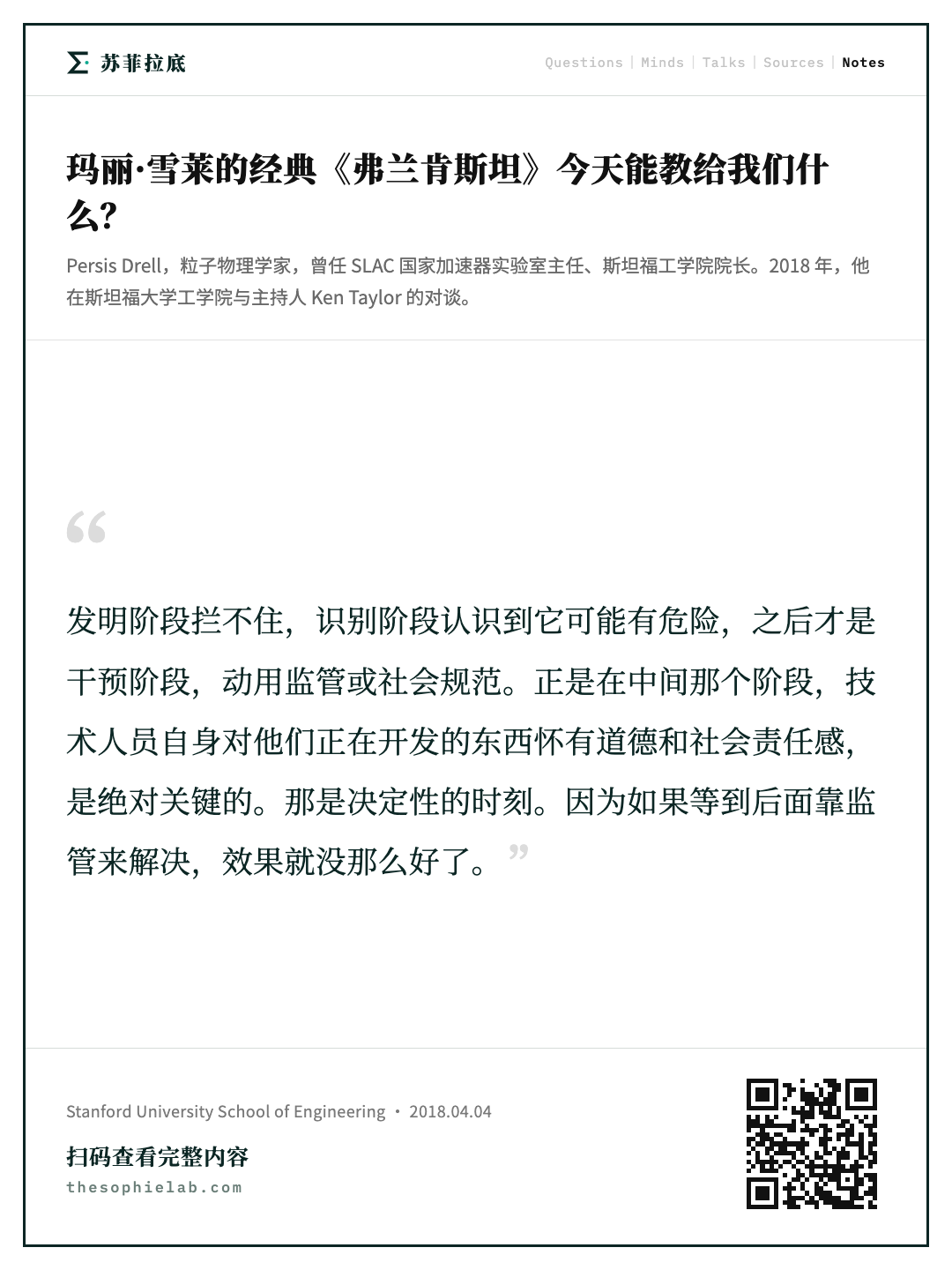
31:51 发明不可阻止,关键在识别危险的中间阶段 ▶ 正在看
35:26 观众提问:多样性、股东模型与AI失业 ▶ 正在看
47:26 技术鸿沟与互联网的民主化两面 ▶ 正在看
50:27 工程师必须接受人文教育:培养非工具的人 ▶ 正在看
54:57 经济学家反驳:增长、生产率与被替代的司机 ▶ 正在看
58:52 自动驾驶、AI意志与巨头公司的守门人权力 ▶ 正在看
67:43 未来学位:社会科学加计算素养,做「双料人」 ▶ 正在看
72:02 尾声:60秒哲学家谈明日的怪物 ▶ 正在看
01工学院院长开场:Intersections 系列缘起
0:00
[MUSIC] Welcome everybody. I'm Jennifer Widom. I'm the Dean of the School of Engineering. We have in the audience today graduate and undergraduate alumni and we have members of the community. I also wanted to mention that we are live streaming to thousands of alumni and friends, all over the world. The School of Engineering has been co-hosting a series that we call Intersections. It brings together faculty from the School of Engineering and from humanities and sciences to share insights on a common theme or idea.
[音乐] 欢迎大家。我是 Jennifer Widom。我是工学院院长。今天到场的观众里有研究生和本科生校友,也有社区的成员。我还想提一句,我们正在向全世界成千上万的校友和朋友进行直播。工学院一直在与他人共同举办一个系列活动,我们称之为 Intersections(交汇)。它把工学院以及人文与科学学院的教师聚到一起,围绕一个共同的主题或想法分享见解。
便签笔记
0:40
And this, tonight, is the third in that series. We have the series because we recognize the world's most challenging and complex problems need to be addressed not by individuals working by themselves, but by people working together and talking together across disciplines. We also value an understanding of the relationship, the very important relationship, between humanities and technology. And I would say especially today, and urgently into the future. And the themes in the book being discussed this evening are an incredibly dramatic example of why having that understanding is so critical.
今晚这一场,是该系列的第三场。我们举办这个系列,是因为我们意识到,世界上最具挑战性、最复杂的问题,不可能靠个人单打独斗来解决,而需要人们跨越学科一起协作、一起对话。我们同样重视对人文与技术之间关系的理解,那是一种非常重要的关系。而我想说,在今天尤其如此,在可预见的未来更是迫在眉睫。今晚要讨论的这本书所涉及的主题,正是一个极其震撼的例子,说明为什么这种理解如此关键。
便签笔记
02电影片段:科学越界的经典警示
1:19
I'm really pleased that Persis Drell will be the guest tonight. Persis is a colleague, she's a friend, she's the Provost at Stanford, and the former dean of Stanford engineering. She's a scientist, and she someone who's thought very deeply about what we like to call the humanist engineer. >> Don't you see the danger, John, inherent in what you're doing here? Genetic power is the most awesome force the planet has ever seen, but you wield it like a kid that's found his dad's gun. >> Dr. Valman, I learned a great deal from you at the university.
我非常高兴 Persis Drell 将担任今晚的嘉宾。Persis 是同事,是朋友,是斯坦福的教务长,也是斯坦福工学院的前任院长。她是一位科学家,也是一位对我们所说的“人文主义工程师”有过极深思考的人。>> John,难道你看不出你在这里所做的事情本身就潜藏着危险吗?基因的力量是这个星球有史以来最令人敬畏的力量,可你摆弄它的样子,就像一个找到了他爸爸的枪的孩子。>> Valman 博士,我在大学里从您那儿学到了很多东西。
便签笔记
1:56
[MUSIC]
[音乐]
便签笔记
2:26
>> [INAUDIBLE] He's alive! He's alive! He's alive! He's alive! He's alive! In the name of God, now I know what it feels like to be God! [MUSIC] >> Do you read me, Hal? >> Affirmative, Dave. I read you. >> Open the pod bay doors, Hal. >> I'm sorry, Dave. I'm afraid I can't do that. >> I'll tell you the problem with the scientific power that you're using here. You know, you read what others had done, and you took the next step. You didn't earn the knowledge for yourselves, so you don't take any responsibility.
>> [听不清] 他活了!他活了!他活了!他活了!他活了!以上帝之名,现在我知道当上帝是什么感觉了![音乐] >> 你能听到我说话吗,Hal?>> 是的,Dave。我能听到你。>> 打开那个吊舱舱门,哈尔。>> 很抱歉,戴夫。恐怕我不能那么做。>> 我来告诉你,你们在这儿用的这种科学力量,问题出在哪儿。你知道,你们读了别人做过的东西,然后你们迈出了下一步。这些知识不是你们自己挣来的,所以你们不承担任何责任。
便签笔记
03节目开场:技术是救世主还是灾难
3:12
>> Our scientists have done things which nobody has ever done before. >> Yeah, yeah, but your scientists were so preoccupied with whether or not they could they didn't stop to think if they should. [MUSIC] >> Please welcome your Philosophy Talk host to the stage, professors Ken Taylor and Joshua Landy. >> [APPLAUSE] >> [MUSIC]
>> 我们的科学家做到了前人从未做到的事。>> 是啊是啊,可你们的科学家一门心思只想着能不能做到,却没停下来想想该不该做。[音乐] >> 有请《哲学漫谈》的两位主持人上台,肯·泰勒教授和约书亚·兰迪教授。>> [掌声] >> [音乐]
便签笔记
4:17
>> Will new technologies like artificial intelligence and bioengineering be the salvation of human kind? >> Or will they destroy our bodies, our democratic institutions, and even our planet? >> And who is going to control the technologies of the future? >> This is Philosophy Talk. The programmer that questions everything. >> Except your intelligence. I am Josh Landy. >> And I'm Ken Taylor and we are coming to you from Cemex auditorium on the Stanford Campus. >> Continuing conversations that begin at Philosophers' Corner, where Ken teaches philosophy and I direct the philosophy and literature initiative.
>> 人工智能、生物工程这类新技术,会成为人类的救赎吗?>> 还是说,它们会摧毁我们的身体、我们的民主制度,甚至我们的星球?>> 又是谁将掌控未来的技术?>> 这里是《哲学漫谈》。什么都要追问一番的节目。>> 除了你的智商不追问。我是乔什·兰迪。>> 我是肯·泰勒,我们正在斯坦福校园的 Cemex 礼堂为您播出。>> 我们延续的是在“哲学家角”开启的那些对话,肯在那里教哲学,我在那里主持哲学与文学项目。
便签笔记
04手机与社交媒体算不算「怪物技术」
4:53
>> Welcome, everyone, to Philosophy Time. >> [APPLAUSE] >> And let's hear it for our musical guests, the Tiffany Austin Trio. >> [APPLAUSE] >> Today, we're thinking about monstrous technologies as part of Stanford University's Frankenstein@200 project. >> Monstrous technologies, that's a strong word Ken. >> [LAUGH] Josh, come on, look, I love my iPhone. But, gotta admit, smartphones are causing an epidemic of distraction, insomnia, and depression. That seems pretty monstrous, to me. >> That's just techno-panic, Ken.
>> 欢迎各位来到《哲学漫谈》。>> [掌声] >> 也让我们把掌声送给今天的音乐嘉宾,蒂芙尼·奥斯汀三重奏。>> [掌声] >> 今天,我们要聊聊“怪物般的技术”,这是斯坦福大学“弗兰肯斯坦200年”项目的一部分。>> “怪物般的技术”,这词儿够重的啊,肯。>> [笑] 乔什,得了吧,你看,我很爱我的 iPhone。但不得不承认,智能手机正在引发一场注意力涣散、失眠和抑郁的流行病。在我看来,这挺“怪物”的。>> 那只是技术恐慌罢了,肯。
便签笔记
5:48
>> Techno who? >> Look, look, people are always freaking about the latest technological invention. You know, like the printing press, the mechanized loom, newspapers, electricity. It always turns out there was never anything thing to worry about. >> Josh. Come on, tell that to the inhabitants of Chernobyl or Fukushima, or the victims of asbestos poisoning, or all those thalidomide babies. You're a big literary guy. It's just like Mary Shelley says in her novel Frankenstein that we're thinking about, technology can be deadly.
>> 技术什么?>> 你看,人们总是对最新的技术发明大惊小怪。你知道的,比如印刷机、机械织布机、报纸、电力。但最后总会证明,其实根本没什么好担心的。>> 乔什。得了吧,你去跟切尔诺贝利或福岛的居民说说,或者跟石棉中毒的受害者说说,还有那些沙利度胺致畸的婴儿。>> 你可是个文学高手。这就像玛丽·雪莱在她那本我们正在讨论的小说《弗兰肯斯坦》里说的,技术可能是致命的。
便签笔记
6:22
>> Barry, look, you watch too many Frankenstein movies. The novel, the novel's a lot more subtle and sophisticated than you or Hollywood are making it out to be. I mean look, that novel, it's not just some Luddite's read against the horrors of technology. I mean look, it's a philosophical investigation into personal identity. It's a brilliant experiment with literary form, it's an exploration of deeply buried antisocial impulses. I mean, that- >> [CROSSTALK] You're forgetting the main thing, Josh.
>> 巴里,你看,你弗兰肯斯坦的电影看得太多了。这本小说,其实比你或者好莱坞讲的要微妙、要高明得多。我是说,你看,那本小说可不只是某个卢德分子对技术恐怖的控诉。我是说,你看,它是对个人同一性的一场哲学探讨。它是一次出色的文学形式实验,是对深埋心底的反社会冲动的一种探索。我是说,那——>> [两人同时说话] 你把最关键的东西给忘了,Josh。
便签笔记
6:51
It's also about a technological marvel that runs around killing people. [LAUGH] You left that out. >> [LAUGH] Right, fair point. Touche. [LAUGH] But, but remember that great scene in the novel where the creature learns about language. He calls language a godlike science. And writing, writing he says opens up a field for wonder and delight. >> Josh, you're waxing so poetic, big deal. >> Well, not that it's a big deal. Writing is a technology. It's among the greatest technologies ever invented. The novel celebrates that kind of technology and we should, too.
它讲的也是一个到处跑来跑去杀人的技术奇迹。[笑] 这一点你可漏掉了。>> [笑] 好吧,说得有道理。算你说中了。[笑] 不过,不过还记得小说里那个精彩的场景吗,就是那个怪物学习语言的时候。他把语言称作一门神一般的科学。还有写作,他说写作打开了一片充满惊奇与愉悦的天地。>> Josh,你这文绉绉的一大套,说得可真够玄乎。>> 呃,倒也没那么玄乎。写作是一项技术。它是人类有史以来最伟大的技术之一。这本小说赞颂的正是那种技术,我们也应该如此。
便签笔记
05写作、《我的奋斗》与技术的责任归属
7:25
>> Look, Josh. Look, look, look. I love writing, too. I mean, that's why I spent hours and hours writing, myself. It's not just because I have writer's block. Because I love writing. I even love other people's writing! I love reading your writing, Josh. But even a technology as glorious and as powerful as writing has its downside. Look, no writing, no Mein Kampf. No Mein Kampf, no World War II, QED. [APPLAUSE] Technology can be-- Godwin's Law, Ken? Look it's not the technology of writing that was responsible for Mein Kampf.
>> 听着,Josh。你看,你看,你看。我也很喜欢写作。我是说,所以我才会花上好几个小时亲自写作。这不只是因为我犯了写作障碍。而是因为我热爱写作。我甚至喜欢别人写的东西!我很喜欢读你写的东西,Josh。但即使是写作这样辉煌而强大的技术,也有它的负面。你看,没有写作,就没有《我的奋斗》。没有《我的奋斗》,就没有第二次世界大战,证毕。[掌声] 技术可能会——这是戈德温法则吧,Ken?你看,为《我的奋斗》负责的并不是写作这项技术。
便签笔记
8:00
It's the guy who wrote it and it's the people who read it and believed it. I mean you can't blame technology for what people do with the technology. You have to blame the people. >> But you're missing my point Josh. Technology is often designed, explicitly designed, to exploit human weaknesses. Why do you use your iPhone so much? Why? Cuz it's a drug, Josh. And so is social media. And social media, this addictive drug, is driving people to suicide, and it's ruining our democracy. >> Sounds like you don't trust people very much, to handle their own technology.
是写这本书的那个人,是那些读了它并且相信它的人。我是说,你不能因为人们拿技术做了什么就去怪技术。你得怪人。>> 但你没抓住我的重点,Josh。技术常常是被设计出来的,是明确地被设计来利用人性弱点的。你为什么老是玩你的 iPhone?为什么?因为它是一种毒品,Josh。社交媒体也是。而社交媒体,这种让人上瘾的毒品,正在把人推向自杀,也正在毁掉我们的民主。>> 听起来你不太信任人们,不相信他们能管好自己的技术。
便签笔记
06如何要好处不要坏处:改变激励结构
8:38
>> Why should I? >> Well okay, what do you want? You want the government to intervene? I mean, that's paternalism. Look, if I wanna waste my time watching cat videos on Facebook, that's my business. >> No Josh, it's not just your business. My life is impacted by your choices. Their lives are impacted by your choices. Facebook and its addicted addled users, they're destroying our democracy. My democracy. >> Okay, I'm not gonna defend Facebook. >> That's good. >> But the question still remains. How can we prevent all the negative outcomes, the monstrous outcomes?
>> 我凭什么信任?>> 那好吧,你想要什么?你想让政府来干预吗?我是说,那可是家长式作风。你看,如果我想把时间浪费在 Facebook 上看猫咪视频,那是我自己的事。>> 不,Josh,那不只是你自己的事。我的生活会被你的选择影响。他们的生活也会被你的选择影响。Facebook 和它那些上瘾又昏头的用户,正在毁掉我们的民主。我的民主。>> 好吧,我不打算为 Facebook 辩护。>> 那很好。>> 但问题依然存在。我们怎样才能阻止所有那些负面的、可怕的结果?
便签笔记
9:15
Without losing all the benefits. And how can we have the good outcomes without resorting to paternalism and stifling individual freedom? >> That's a good question Josh, good question but I think the answer is kinda obvious. Technology, producers and designers have to take on some other responsibility, they have to do a better job of predicting, compensating for the effects of their inventions. And they have to care. They have to care about more than just creating cool fun gadgets and making a bunch of money, Josh.
同时又不失去所有的好处。我们怎样才能在不诉诸家长式作风、不扼杀个人自由的前提下,得到好的结果?>> 这是个好问题,Josh,好问题,但我觉得答案挺明显的。技术的生产者和设计者必须承担起另一些责任,他们必须更好地预测并弥补自己发明所带来的影响。而且他们得在乎。他们在乎的不能只是造出又酷又好玩的小玩意儿、赚一大笔钱,Josh。
便签笔记
9:46
>> Yeah, and pigs have to fly. >> [LAUGH] Well, look, if producers refuse to regulate themselves, well then the rest of us will just have to make them an offer they can't refuse. >> What? >> Don't take me wrong. I'm talking about changing the incentive structure. >> Okay, so taxes, regulation. >> Or social shaming, maybe. >> Well look, I agree we gotta do something. If we don't do anything, nightmare scenarios may well be around the corner. I agree with you, we're gonna start seeing things like on Black Mirror.
>> 是啊,那猪都能飞了。>> [笑] 好吧,你看,如果生产者拒绝自我约束,那我们其他人就只好给他们一个他们无法拒绝的条件了。>> 什么?>> 别误会我的意思。我说的是改变激励结构。>> 好,那就是税收、监管。>> 或者社会舆论的羞辱,也许吧。>> 好吧你看,我同意我们得做点什么。如果我们什么都不做,噩梦般的情景很可能就在眼前了。我同意你的看法,我们会开始看到像《黑镜》里那样的事情。
便签笔记
07《黑镜》实地报道:机器狗、意识与VR
10:16
>> Yeah, right, that's a great TV show. But how much of that show is pure fiction, and how much of it is future reality? >> Well as it happens Ken, we asked our roving philosophical reporter, Liza Veale, to find out, she files this report. >> So if you've seen the show Black Mirror, you've wondered how crazy is this stuff? Total fantasy 15 years away, ten years away. The interpersonal rating system in this episode seems familiar. >> And that's one rushed swing. [MUSIC] >> You want a cookie with that?
>> 是啊,没错,那部剧很棒。但那部剧有多少是纯粹的虚构,又有多少会成为未来的现实?>> 说来正巧,Ken,我们请了我们的哲学特派记者 Liza Veale,去一探究竟,她发回了这篇报道。>> 如果你看过《黑镜》,你一定想过:这些东西到底有多离谱?完全是幻想?还是十五年后、十年后就会实现?这一集里的人际评分系统看起来挺眼熟的。>> 那一杆挥得太急了。[音乐] >> 要不要配块曲奇?
便签笔记
10:53
It's on the house. >> Sounds awesome. [LAUGH] [MUSIC] See you tomorrow Deejay. >> See you Lacy. >> [LAUGH] Saw your boy in the fire hat just now, so cute. >> Yeah, he's really something. >> [LAUGH] >> Let me introduce someone who takes the technology in Black Mirror very seriously. Dylan Hendricks, he works at the Institute for the Future. It's the oldest foresight institution in the country. They don't predict the future, but they anticipate it. I didn't know this kind of thing existed, but I'm glad it does.
请客。》 听起来太棒了。[笑] [音乐] 明天见,Deejay。》 再见,Lacy。》 [笑] 刚才看到你家小子戴着消防帽,太可爱了。》 是啊,他真是个宝。》 [笑] 》 下面我来介绍一位非常认真看待《黑镜》中技术的人。Dylan Hendricks,他就职于未来研究所(Institute for the Future)。那是美国历史最悠久的前瞻研究机构。他们不预测未来,而是预判未来。我之前都不知道有这种机构,但我很高兴它存在。
便签笔记
11:33
>> We can only achieve the future outcomes that we can envision and so if we can imagine more possibilities then we have more choice in where we go. >> Hendricks says Black Mirror is, and >> He says the show has gotten people thinking about the implications of the technology we're beginning to use. Though it's set in the future it's grounded in very real existing possibilities and liabilities. So how far are we from the futures depicted in Black Mirror, that's what Dylan Hendricks is going to talk about in some cases not far at all.
》 我们只能实现那些我们能够想象到的未来,所以如果我们能想象更多的可能性,我们在选择去向时就有更多余地。》 Hendricks 说《黑镜》是,》 他说这部剧让人们开始思考我们正开始使用的这些技术会带来什么影响。虽然故事设定在未来,但它扎根于非常真实的现有可能性和隐患。那么我们离《黑镜》所描绘的那些未来还有多远,这正是 Dylan Hendricks 要谈的——在某些情况下,一点都不远。
便签笔记
12:05
This episode is pretty straight forward. It's basically 40 minutes of this robot chasing this woman. Henrik says this robot is based on existing one developed by a company called Boston Dynamics. They are quadrupeds with machine learning capabilities, similar to artificial intelligence. >> They actually learn by being in the world, by sort of, actual feedback and experience of the world. So, they're learning how to open doors, how to recognize objects, how to navigate terrain. >> Hendrik says it won't be long before this technology is used by the military, but it also won't be expensive to manufacture for personal, private consumers.
这一集的情节相当直白。基本上就是四十分钟里,这个机器人一直在追这个女人。Hendricks 说这个机器人是以一家叫波士顿动力(Boston Dynamics)的公司开发的现实机器人为原型的。它们是四足机器人,具备机器学习能力,类似于人工智能。》 它们其实是通过置身于真实世界来学习的,靠的是来自现实世界的反馈和经验。所以它们在学习怎么开门、怎么识别物体、怎么在各种地形上行进。》 Hendricks 说,用不了多久这项技术就会被军方使用,而且制造成本也不会高到个人消费者买不起。
便签笔记
12:43
>> That is something that we are gonna have to deal with, in our lifetimes, very likely. Of this idea of sort of guard robots, that are so capable that they're terrifying.
》 那是我们这辈子很可能就得面对的问题,非常有可能。就是所谓的守卫机器人,能力强到令人恐惧。
便签笔记
12:59
control our children more than we ever did. So we face a question. >> Are children allowed to make mistakes? Isn't that a part of growing up? And if you stop them from making mistakes will they make bigger mistakes later? >> The way the mother sees through her daughter's eyes Hendricks says that's the most far-fetched aspect, but it's not crazy. >> I mean it's not impossible actually I will say that there have been studies done of resconstituting sort of memory images from people's brains under CT scans.
比我们以往任何时候都更严密地管控我们的孩子。于是我们面临一个问题。》 孩子被允许犯错吗?犯错不正是成长的一部分吗?如果你阻止他们犯小错,他们以后会不会犯更大的错?》 至于母亲能通过女儿的眼睛看见画面这一点,Hendricks 说那是最天马行空的部分,但也不算离谱。》 我是说,那其实并非不可能,我得说,已经有研究在做这类事情了——在 CT 扫描下从人的大脑中重建记忆影像。
便签笔记
13:31
So the idea that we could eventually sort of capture images directly off of the optical nerve and translate them, and broadcast them. That's not insane, to think that we could do that, at some point. >> In the episode, Be Right Back, a woman uses this service that recreates the consciousness of her deceased partner, based on the digital communications he made while living. Then that consciousness is imbued onto a very life like physical form. Her partner in some way is brought back from the dead.
所以说我们最终有可能直接从视神经捕捉图像、进行转译并传输出去。觉得我们在某个时候能做到这一点,这并不疯狂。》 在《马上回来》这一集里,一个女人使用了一项服务,它能重建她已故伴侣的意识,依据的是他生前留下的各种数字通讯记录。然后这个意识被灌注到一个非常逼真的实体躯壳里。她的伴侣在某种意义上被从死亡中带了回来。
便签笔记
14:02
>> You could have left me some clothes. I mean, talk about an undignified entrance. [SOUND] That's a bit creepy, what you're doing. >> [SOUND] >> Is there at least a towel? I'm dripping everywhere.
》 你本可以给我留几件衣服的。我是说,这出场也太不体面了。[声音] 你这么做有点吓人。》 [声音] 》 至少有条毛巾吧?我浑身都在滴水。
便签笔记
14:33
Hello. >> So when it comes to the idea of creating and imbuing machines with consciousness. >> For me this is always kind of a non-starter because there is actually nothing close to an operational theory of consciousness, that is possessed by anybody in the scientific community, right? Everything around consciousness is philosophical. >> Hendrik says without a theoretical understanding of what consciousness is, there's no ways to theorize a path for creating it. We're stuck. If we're getting any closer, it will be the kind of discovery, on the level of discovering fire, something that changes everything.
你好。》 那么说到创造机器并赋予它们意识这个想法。》 对我来说这向来是个无从谈起的话题,因为目前根本没有任何接近可操作的意识理论,科学界任何人都没有,对吧?围绕意识的一切都还停留在哲学层面。》 Hendricks 说,如果在理论上都不理解意识是什么,就没有办法设想出一条创造它的路径。我们卡住了。如果我们真的更接近了一步,那将是那种堪比发现火的发现,会改变一切的东西。
便签笔记
15:10
What we do have is machine learning, computers can cull enormous quantities of data and learn from them, so they can perform in ways that we don't program them to. But that they've taught themselves to. The effect can appear to us as consciousness. But there's kinda a big difference there. It's a recurring paranoia in Black Mirror that machines or entities will be able to hold consciousness. Ours or their own. It comes up in the episode USS Calister. It's about a virtual reality world that players can control and design.
我们真正拥有的是机器学习,计算机能筛选海量数据并从中学习,从而以我们没有编程设定的方式运作。而是它们自学出来的方式。这种效果在我们看来可能像是意识。但两者之间有很大的差别。《黑镜》里反复出现一种妄想:机器或某种存在能够承载意识。我们的意识,或者它们自己的意识。这在《卡利斯特号》那一集里就出现了。讲的是一个玩家可以操控和设计的虚拟现实世界。
便签笔记
15:42
But and this is a minor spoiler, the people in the simulations are actually sentient. And because this guy's a jerk and he's abusing them the abuse is real. Which is sort of inevitable, because we've already reached a turning point, where they're very compelling. That people will wanna spend more time in simulated environments. >> Hendricks is an optimist. The main bone that he has to pick with Black Mirror is how terrifyingly dystopian it is, as a futurist: >> There's a strong desire for us to have sort of more identification of what are the positive futures, right?
但是——这里有个小剧透——模拟世界里的人其实是有知觉的。而因为这家伙是个混蛋,他在虐待他们,所以那种虐待是真实的。这在某种意义上是必然的,因为我们已经到了一个转折点,这些体验非常有吸引力。人们会想在模拟环境里待更长时间。》 Hendricks 是个乐观主义者。作为一名未来学家,他对《黑镜》最大的意见是它反乌托邦得让人害怕:》 我们非常希望能更多地去指认什么才是积极的未来,对吧?
便签笔记
16:20
What are the things where we use technology to actually solve problems? In a real way. >> So when it comes to virtual reality Hendricks doesn't just see doomsday scenarios. He sees opportunities. Here's one. He says if we can't stop humans from doing bad things to each other in real life then maybe we can channel that anti-social behavior into virtual reality. Here's an example that might be a little hard to swallow. >> That sexual assault in the real world went down because of these kind of simulations existing.
有哪些情况是我们用技术真正解决了问题?实实在在地解决。》 所以说到虚拟现实,Hendricks 看到的不只是末日场景。他看到的是机会。这里有一个例子。他说,如果我们没法阻止人类在现实生活中互相伤害,那也许我们可以把这种反社会行为引导到虚拟现实里去。下面这个例子可能有点让人难以接受。》 假如因为存在这类模拟,现实世界中的性侵案件减少了。
便签笔记
16:53
Is that simulation not then kind of a public good, right. If it turns out we can't fully deter behavior but we could channel it into something where it's less destructive to real people's lives. >> Henrick says this question will only become more pressing. And it doesn't just apply to VR. Does this technology have more potential to encourage impulses towards, anti-social behavior or to mitigate the consequences of it? Hendrix is asking these questions. So are parents, so are some technologists. But who has the final say?
那这种模拟难道不算是一种公共利益吗,对吧。如果事实证明我们没法完全遏制某种行为,但可以把它引导到对真实的人的生活破坏更小的地方去。》 Hendricks 说,这个问题只会变得越来越紧迫。而且它不只适用于虚拟现实。这项技术究竟更有可能助长人们走向反社会行为的冲动,还是更有可能减轻其后果?Hendricks 在追问这些问题。家长们也在问,一些技术专家也在问。但谁说了算?
便签笔记
08对谈 Persis Drell:核武阴影下的乐观主义
17:29
For philosophy talk, I'm Liza Veale. >> [APPLAUSE] >> Thanks Liza for that tour of the dystopian possibilities for the future. I'm Ken Taylor, along with my Stanford colleague Josh Landy, we're coming to you from Cemex auditorium on the Stanford campus as part of the universities Frankenstein at 200 Project. >> Our guest today is a physicist and former dean of the School of Engineering here at Stanford. Who recently became the 13th university provost. Please welcome to the Philosophy Talk stage, Persis Drell.
我是 Liza Veale,为《哲学漫谈》报道。》 [掌声] 》 谢谢 Liza 带我们浏览了未来那些反乌托邦式的可能性。我是 Ken Taylor,和我一起的是我斯坦福的同事 Josh Landy,我们是在斯坦福校园的 Cemex 礼堂为大家进行节目,这是学校“弗兰肯斯坦二百年”项目的一部分。》 我们今天的嘉宾是一位物理学家,曾任斯坦福工学院院长。她最近成为该校第十三任教务长。让我们欢迎 Persis Drell 来到《哲学漫谈》的舞台。
便签笔记
18:05
[APPLAUSE] >> Hi. >> Thank you. >> Welcome, Persis >> [APPLAUSE] >> So first is Josh and I, we're talking earlier about potentially dangerous even monstrous technologies. I know that's been a topic that you've been interested in for a whole, when did you first get interested in these kinds of questions? >> Well I think the right answer as I grew up with it, my father was a theoretical physicist, who spent part of his life pursuing the dream of understanding the natural world, and then spent a lot of his life attempting to preserve the world from the horrors of nuclear war as an arms controller.
[掌声] 》 大家好。》 谢谢。》 欢迎你,Persis 》 [掌声] 》 首先,Josh 和我刚才在聊那些潜在危险、甚至可以说是怪物般的技术。我知道这是你长期以来一直关注的话题,你最早是什么时候开始对这类问题产生兴趣的?》 我想正确的答案是,我是伴着这些问题长大的,我父亲是一位理论物理学家,他一生中有一部分时间在追求理解自然世界这个梦想,然后又用了人生的很大一部分,作为军控专家致力于让世界免于核战争的恐怖。
便签笔记
18:58
And so, it was in the house from when I grew up. >> So where did that leave you? McCan and I were arguing early about whether we should be optimists or pessimists. I mean the threat of nuclear war or something is on the horizon. So do you think that there is now or there is coming up some Victor Frankenstein type who is about to unleash something really deadly on the world? Or do you think basically we're gonna be okay? >> I think there are all these engineering students out there who are working on things that could unleash something terrible on the world, but it could also be something that's wonderful for the world.
所以从我小时候起,这些东西就在家里。》 那这让你形成了什么样的看法?Ken 和我刚才在争论我们该做乐观主义者还是悲观主义者。我是说核战争之类的威胁就摆在眼前。那你觉得现在有没有,或者将来会不会出现某个维克多·弗兰肯斯坦式的人物,即将向世界释放某种真正致命的东西?还是说你觉得我们基本上会没事?》 我认为外面有那么多工程系的学生,他们正在研究的东西可能会给世界带来可怕的后果,但也可能会带来对世界非常美好的东西。
便签笔记
19:34
That's the way technology and discovery works. >> Yet, go ahead. >> Well, I'm just optimistic that the good will win. >> Well, wait. [LAUGH] I mean, I want to take the world at large. Cuz we're focused, we can be focused on the American context. You know if Hitler had won that war, if Stalin had not, you know if Stalin had, well he did prevail for a long time. >> He sure did. >> Visited horror upon horror. Technology in the wrong hands, some terrorist gets a dirty bomb. I mean in total looking at the world in total.
技术和发现就是这样运作的。》 不过,你请说。》 嗯,我只是乐观地相信善的一面会赢。》 等一下。[笑] 我是说,我想放眼整个世界。因为我们的注意力,我们可能会集中在美国的语境里。你知道,如果希特勒赢了那场战争,如果斯大林没有,你知道如果斯大林——嗯,他确实统治了很长时间。》 他确实如此。>> 一个接一个的恐怖场面。技术落到坏人手里,比如某个恐怖分子搞到了脏弹。我是说,从整体上看这个世界。
便签笔记
20:11
What controls technology in the world taken in total? >> People. In the end it has to be people taking responsibility for the technology that they create. The technology is going to be invented no matter what. You can't stop it. >> Can we keep germ warfare, germ weapons, nuclear arms, chemical weapons. Chemical weapons are all over the world. They're the cheap dictator's weapons of mass destruction. Can we keep problematic technology out of the hands of all problematic people. >> We can never do it perfectly.
从整体上看,这个世界上是什么在控制技术?>> 人。归根结底,必须由人来为他们创造出来的技术承担责任。不管怎样,技术总是会被发明出来的。你阻止不了。>> 我们能管住细菌战、生物武器、核武器、化学武器吗。化学武器现在遍布世界各地。它们是廉价独裁者的大规模杀伤性武器。我们能让有问题的技术不落到所有有问题的人手里吗。>> 我们永远做不到十全十美。
便签笔记
20:49
But we've had nuclear weapons since 1945 and they haven't been used since 1945. It's a great example. We have biological weapons that we, so far, have controlled. Does that mean we can stop working at it? Absolutely no. But, you can be, you have reason to be optimistic. >> So you look out at the world. You look out at global warming and all this type of stuff. You look out at the world and you are confident and optimistic. And you don't look at it like those folks on Black Mirror. >> I never watch Black Mirror, so I don't want to speak about Black Mirror.
但我们从 1945 年就有了核武器,而从 1945 年之后就再没用过。这是个很好的例子。我们有生物武器,到目前为止我们也控制住了。这是不是意味着我们可以不用再努力了?绝对不是。但你可以,你有理由保持乐观。>> 那么你放眼这个世界。你看看全球变暖之类的所有这些事。你放眼世界,却依然充满信心、充满乐观。你不像《黑镜》里那些人那样看待它。>> 我从来不看《黑镜》,所以我不想评论《黑镜》。
便签笔记
21:20
>> Your world is more a Star Trek world, not a Black Mirror world. >> [LAUGH] >> We're going out there and solving all the problems. >> But if I wasn't optimistic, where does that leave me? >> Well maybe vigilant, I mean right. [CROSSTALK] >> I believe in being vigilant. >> So okay. So what about you know, things that are on the rise, things that for example, video fabrication technology. I mean it seems like if I understand correctly, we may be on the verge of people being able to make you be saying, on video, anything they want you to.
>> 你的世界更像《星际迷航》的世界,而不是《黑镜》的世界。>> [笑] >> 我们出发去解决所有问题。>> 可如果我不乐观,那我还剩下什么呢?>> 也许是保持警惕吧,对吧。[交叉说话] >> 我相信要保持警惕。>> 那好。那么那些正在兴起的东西呢,比如说视频伪造技术。我是说,如果我理解得没错,我们似乎快要到这样一个地步:别人可以让你在视频里说出他们想让你说的任何话。
便签笔记
21:48
>> Yeah. >> I mean, so who's gonna control that kind of thing? Really good question. >> [LAUGH] [CROSSTALK] >> We'll get to that. So, we'll try to answer that really good question and more really good questions from our audience after this short break. This is Philosophy Talk, coming to you from CEMEX Auditorium on the Stanford campus. Our guest is the Provost of Stanford University, Persis Drell. >> In our next segment, we're gonna talk about how we can balance exciting innovation against social responsibility.
>> 是的。>> 那么,谁来控制这类东西呢?这问题问得真好。>> [笑] [交叉说话] >> 我们待会儿再谈这个。短暂休息之后,我们会试着回答这个非常好的问题,以及来自观众的更多好问题。这里是《哲学谈》,我们在斯坦福校园的 CEMEX 礼堂为您播出。我们的嘉宾是斯坦福大学教务长 Persis Drell。>> 在下一个环节,我们要聊聊如何在激动人心的创新与社会责任之间取得平衡。
便签笔记
22:18
How do we get the upside without the downside? >> Invention, attention, and prevention, along with questions from our technologically savvy audience, when Philosophically Talk continues. >> [APPLAUSE] [MUSIC]
我们怎样才能只要好处、不要坏处?>> 发明、关注与预防,还有来自我们这些精通技术的观众的提问,《哲学谈》稍后继续。>> [掌声] [音乐]
便签笔记
09资本主义能否平衡创新与社会责任
24:38
>> [APPLAUSE] >> Thanks again to our musical guest, the Tiffany Austin trio. This is Philosophy Talk, I'm Josh Landy. >> And I'm Ken Taylor, and our guest is Stanford physicist and Provost, Persis Drell, and we're thinking about monstrous technology. >> So we're singularly taking questions from you folks. So if you have a question, please take a spot in front of one of these microphones at the front of the stage. >> So Persis, okay, I mean, we live in a capitalist society. I think capitalism makes it really hard to balance innovation against social responsibility.
>> [掌声] >> 再次感谢我们的音乐嘉宾,Tiffany Austin 三重奏。这里是《哲学谈》,我是 Josh Landy。>> 我是 Ken Taylor,我们的嘉宾是斯坦福物理学家、教务长Persis Drell,我们正在思考「怪物般的技术」。>> 我们现在专门接受各位的提问。如果你有问题,请到舞台前方的话筒前排队。>> 那么 Persis,我是说,我们生活在一个资本主义社会里。我觉得资本主义让创新与社会责任之间的平衡变得非常难。
便签笔记
25:22
Can we do it? >> Well, I would say we have existence proofs where we've done it in the past. I would say we've done it with nuclear technologies, and we've done it with some of the biological technologies, like recombinant DNA. Where the community has really stepped up and taken some responsibility, and not just pushed technology as far as it could into commercial applications, cuz they recognize there were potential dangers and threats out there. >> Yeah, yeah, I mean, you really are an optimistic person.
我们做得到吗?>> 我会说,我们有过去做到过的实例佐证。我认为我们在核技术上做到了,在一些生物技术上也做到了,比如重组 DNA。在那些例子里,学界社群真的站了出来、承担了一些责任,而没有把技术一味推向尽可能广的商业应用,因为他们意识到其中存在潜在的危险和威胁。>> 是啊,是啊,你真是个乐观的人。
便签笔记
25:52
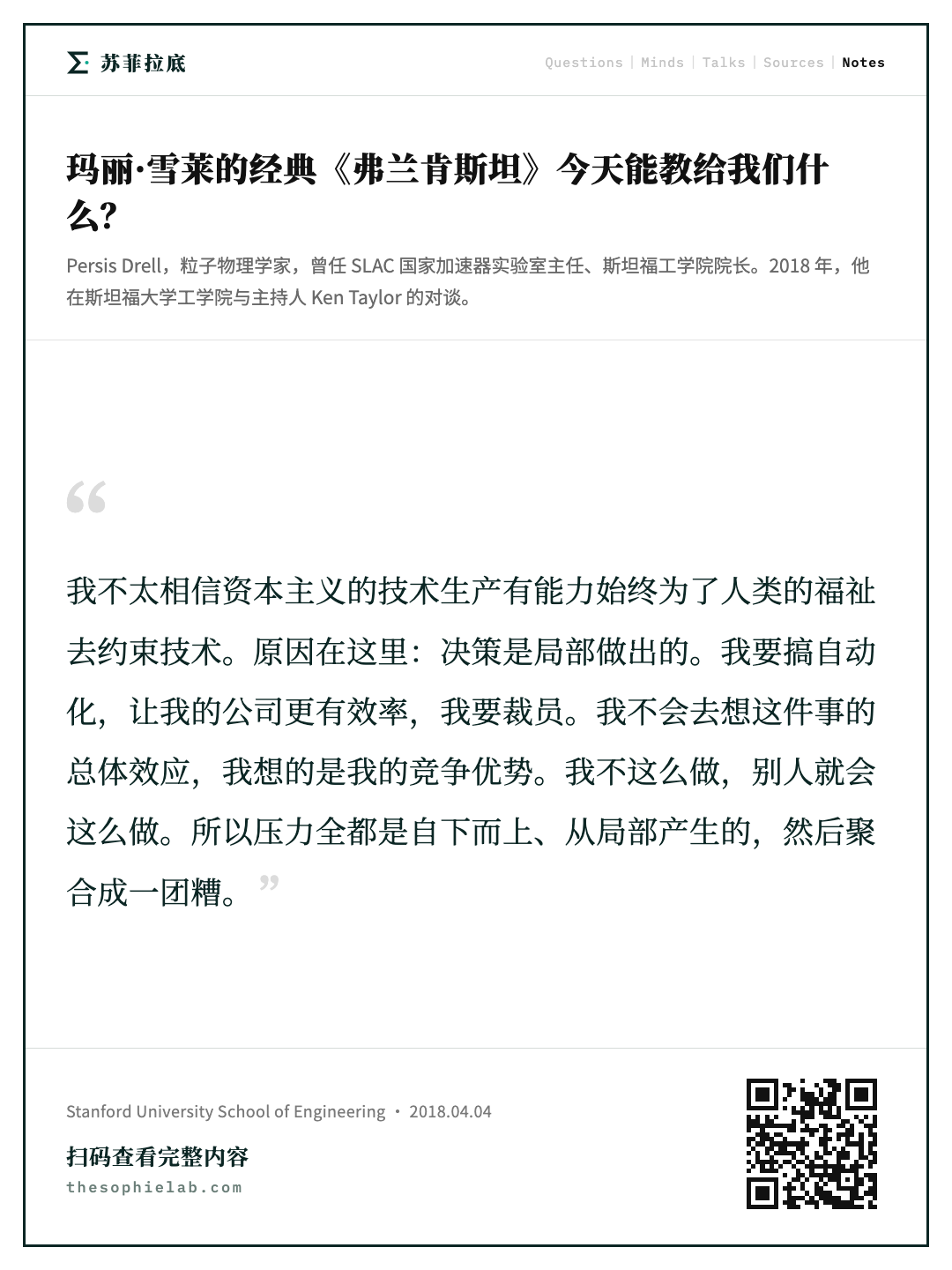
>> [LAUGH] >> I'm glad you're our Provost. I'm glad, we wouldn't want a downer for our Provost. I really wouldn't. Right, I just wouldn't. But I've gotta say, I'm much more of a downer. I just, I'm not sure I believe in the capacity of capitalist production of technology to always regulate technology for the human good, and here's why. Because the decisions are made kinda locally, that is, I'm gonna automate it and make my company more efficient. I'm gonna lay off workers. I don't think about the aggregate effect of that.
>> [笑] >> 我很高兴你是我们的教务长。我很高兴,我们可不想要一个悲观的教务长。真的不想。对,就是不想。但我得说,我要悲观得多。我只是,我不太相信资本主义的技术生产有能力总是为了人类福祉去规范技术,原因如下。因为决策是在局部层面做出的,也就是说:我要把它自动化,让我的公司更高效。我要裁员。我不会去想这样做的总体效应。
便签笔记
26:21
I think about my competitive advantage. This person competing with me, and it's not just within this economy, it's around the world. If I don't do this, so the pressures are all generated bottom-up, locally. But then they aggregate into something, a mess, right? >> I think we saw this in space, with Facebook, right? And Twitter, I mean, the way in which these social media, their profit is driven by clicks, and likes, and shares. And those are driven mostly by controversial news stories, and so conspiracy theories and fake news, well, they're good for the bottom line.
我想的是我的竞争优势。那个跟我竞争的人,而且不只是在这个经济体内部,而是全世界。如果我不这么做——所以压力全都是自下而上、从局部产生的。但这些压力汇总起来就变成了一团糟,对吧?>> 我觉得我们在这方面已经看到了,比如 Facebook,对吧?还有 Twitter,我是说,这些社交媒体的利润是由点击、点赞和转发驱动的。而这些又主要是由有争议的新闻推动的,所以阴谋论和假新闻,对利润来说反而是好事。
便签笔记
26:56
>> So, l think what you're bringing up is a really good point, which is that with the two examples that l gave, the threat was evident early. You knew there was a really serious threat out there. >> l think the threats, and they are very real, and we've seen them acting out, from social media, machine learning, those we didn't realize they were dangerous. And so now we're in a somewhat different situation. I would also say another stark difference, in my view, is that in the cases, again, let me use nuclear weapons or recombinant DNA.
>> 我觉得你提出了一个很好的点,那就是在我举的那两个例子里,威胁很早就显而易见了。你知道那里存在着非常严重的威胁。>> 我认为现在的威胁——它们非常真实,我们也已经看到它们在上演,来自社交媒体、机器学习——这些我们当初并没有意识到它们是危险的。所以现在我们处在一个有些不同的处境里。我还要说,在我看来另一个鲜明的差别在于,在那些案例中,再拿核武器或重组 DNA 来说。
便签笔记
27:32
Though there were leaders of the field who stepped up and led, where are the leaders? >> Well, right, but that's great, I mean, I think the threat from nuclear weapons is you're right, it's stark because people used to think about living in nuclear war and all that sort of stuff. And then all these studies came out about nuclear winter, and it's like, my God, we can't just trust this to the Soviet Union and the Americans fighting it out. It's like, the whole world has a stake in it, right? And I think global warming's the same way, but there's a who goes first problem kind of thing.
当时有领域内的领袖站出来引领方向,可现在的领袖在哪里?>> 对,没错,这说得很好,我是说,核武器的威胁你说得对,它非常鲜明,因为人们过去经常想象生活在核战争之中之类的。然后关于核冬天的各种研究出来了,大家就想,天哪,我们不能把这件事就交给苏联和美国去较量。这就好像,全世界都有利害关系,对吧?我觉得全球变暖也是一样,但这里有个「谁先动手」的问题。
便签笔记
28:08
And the Paris Accords were cool, but look what our current President did, right? I mean, but still, there's a who goes first problem, right? I could free ride off the world during this. So, I just think we don't really have mechanisms that kind of force the balancing of innovation and responsibility. I just think we have precious few mechanisms that do. >> Well, in the case of global warming, I think capitalism will come to our aid, when the economy starts to tank because of the effects. But I'd still go back to the Internet and say the challenge there is I think there is the recognition of the problem is now real.
《巴黎协定》挺好的,可你看看我们现任总统做了什么,对吧?我是说,但仍然存在「谁先来」的问题,对吧?我完全可以在这件事上搭全世界的便车。所以我就是觉得,我们并没有真正能强制平衡创新与责任的机制。我认为这样的机制少得可怜。>> 就全球变暖而言,我觉得资本主义会来帮我们的忙,等到经济因为这些后果开始崩盘的时候。但我还是要回到互联网上说,那里的挑战在于,我认为现在对问题的认识已经是真实存在的了。
便签笔记
28:48
But I'm not yet quite seeing where the leadership is going to come from. If the field itself does not take some leadership, I think that's when regulation comes in in a very heavy-handed way. >> [CROSSTALK] Make them an offer they can't refuse, just like I said in the opening. >> Yeah, I could agree with you now, Ken, on this one. Because when you see what's actually coming out of Facebook now, it seems as though either they're genuinely in denial or they're in some kind of- >> Well, wait a minute, wait a minute.
但我还没太看出领导力会从哪里来。如果这个领域自身不承担起一些领导责任,我想那时候监管就会以非常粗暴的方式介入。>> [交叉说话] 给他们一个无法拒绝的条件,就像我在开场时说的那样。>> 是啊,在这一点上我现在能同意你,Ken。因为当你看到 Facebook 现在实际的表现,似乎他们要么是真的在否认现实,要么就是处在某种——>> 等一下,等一下。
便签笔记
29:15
See, again, but there is the logic of capitalism and we are a capitalist production. And markets are cool things. I don't wanna deny that markets are cool things. And I think Facebook's business model depends on something important, that they're a platform, not a publisher, right? And I think being a platform allows them say, let all comers go and we like that. We like, there's freedom, there's accessibility, if we force them to be a publisher, well, I don't know. And then take on all the liabilities and obligations that a publisher has, that I actually don't know if they'd survive economically.
你看,还是那句话,这里有资本主义的逻辑,我们是资本主义的生产方式。市场是很棒的东西。我不想否认市场是很棒的东西。我认为 Facebook 的商业模式取决于一件很重要的事,那就是他们是平台,而不是出版方,对吧?我认为作为平台让他们可以说:让所有人都来吧,而我们喜欢这样。我们喜欢,这里有自由,有可及性——如果我们逼他们变成出版方,那我就不知道了。然后承担出版方所有的法律责任和义务,我其实不知道他们在经济上还能不能活下来。
便签笔记
29:47
Right, so I think this is non-simple. How was that decision made? >> How was that decision made? That they were- >> To be a platform and not a publisher. How did? >> Because they're good capitalists. Right? >> [LAUGH] >> What's happening to the publishers? They're getting hammered by this new technology. And if they take on to certifying, and verifying and distributing, and being liable and all that stuff. I don't think they get all those investors to invest in them. I don't know, there might be some of them in the audience.
所以我觉得这事儿不简单。那个决定是怎么做出来的?>> 那个决定是怎么做出来的?就是他们——>> 做平台而不做出版方。怎么做的?>> 因为他们是精明的资本家。对吧?>> [笑] >> 那出版商们现在怎么样了?他们正被这项新技术打得抬不起头。如果他们要承担认证、核实、分发、承担法律责任这一整套事情。我觉得他们就没法让那些投资人来投他们了。我不知道,观众里可能就有一些这样的人。
便签笔记
30:20
Would they have gotten all those investors to invest in them if they said our business model is we're going to be a publisher. >> Maybe, but meanwhile, if we're relying on people within those industries to do self-regulation, it seems to me we're just putting the foxes in charge of the hen-house. I'm not sure we're really going to get very far. >> You're giving them competing incentives. >> Right. Exactly. So the incentive structure seems to be wrong. And I don't know whether the process. I love it that you're an optimist, even about global warming.
如果他们说自己的商业模式是做一家出版商,还能拉到那么多投资人来投资吗?>> 也许可以吧,但与此同时,如果我们指望这些行业里的人搞自我监管,在我看来就等于让狐狸去看守鸡舍。我不觉得这样能有多大成效。>> 你等于是给了他们互相冲突的激励。>> 对,正是如此。所以这个激励机制本身似乎就是错的。而且我也不知道这个过程能不能行。我很喜欢你是个乐观主义者,连全球变暖都这么乐观。
便签笔记
30:42
I think you're a little more of an optimist than I am. Maybe capitalism will kick in after everything, it's too late. But anyway, so what do you think? Is there a way that we could, maybe without regulation? Maybe we could sort of change the incentive structure at least at the level of the social and make it uncool to destroy the planet for cash. Stuff like that. >> [LAUGH] >> So are we talking about global warming or are we talking about the Internet? >> Sorry. >> Just so I know which problem I'm talking about here.
我觉得你比我要乐观一些。也许等一切都太迟了,资本主义才会开始起作用。不过不管怎么说,你怎么看?有没有可能,我们也许不靠监管就能做到?也许我们可以在社会层面上改变激励结构,让“为了钱毁掉地球”这件事变得不酷。诸如此类的办法。>> [笑] >> 那我们现在是在谈全球变暖,还是在谈互联网?>> 抱歉。 >> 我得先搞清楚自己在谈哪个问题。
便签笔记
31:08
>> Either one. >> Pick the one you want to talk about. Pick the one you can be optimistic about. >> [LAUGH] >> Optimistic about. Well, they're really very, very different. >> Yeah. >> [LAUGH] I think on the issue of the Internet, I think the threat has become visible in recent years. And I actually see evidence that the thought leaders are starting to think about how to address this. And I'm seeing a lot for example more discussion. Not my field of expertise but let me just put this out there. Around say the subject of machine learning and the dangers of machine learning than we heard say even five years ago or ten years ago around new social media platforms.
>> 哪个都行。 >> 你挑一个想谈的。挑一个你能乐观起来的。>> [笑] >> 能乐观起来的。嗯,这两件事真的非常非常不一样。>> 是的。>> [笑] 在互联网这个问题上,我认为近几年来威胁已经变得可见了。而且我确实看到有证据表明,思想领袖们开始思考如何应对这个问题。我也看到了更多的讨论,比如说。这不是我的专业领域,但我还是想提一下。比如围绕机器学习及其危险的讨论,比五年前或者十年前围绕新兴社交媒体平台的讨论要多得多。
便签笔记
10发明不可阻止,关键在识别危险的中间阶段
31:51
Now that just might be that the threats of machine learning are more obvious. But I actually think it might be that the thought leaders are starting to have much more of a sense of responsibility. The culture of Silicon Valley has been, as I think was articulated in a New York Times article quite recently, build it and ask for forgiveness later. I think we're starting to move away from that. And so I see the, again optimist that I am, the beginnings of that development of social responsibility. We see that among our students here as well.
当然,这也可能只是因为机器学习的威胁更显而易见。但我其实觉得,可能是思想领袖们开始有了强得多的责任感。硅谷的文化一直是——我记得《纽约时报》最近一篇文章里就是这么概括的——先把东西造出来,事后再请求原谅。我觉得我们正开始摆脱这种做法。所以,我这个乐观主义者看到的是,社会责任感开始萌芽。在我们这里的学生身上也能看到这一点。
便签笔记
32:24
>> Right, I'm wanna ask you about the students the next time but I wanna back off to the, I'm gonna ask about the thought leaders and the innovators. I grew up to believe let science and innovation go. You said, innovate, build it, then worry about the consequences. Because if you start out, do you believe we should ever restrain technology and science in advance and say don't go there. Don't go there, don't go there. >> I don't think that works. I think certainly at the basic discovery scientific discovery stage you don't know enough.
>> 对,我下次想问问学生的事,但我想先退回来,我想问问思想领袖和创新者。我从小就相信,应该放手让科学和创新去发展。你说的是,先创新、先造出来,然后再去担心后果。因为如果一开始就……你是否认为我们应该提前对技术和科学加以限制,说别碰那个领域。别碰那个,别碰那个。>> 我不认为那行得通。我觉得在基础发现、科学发现这个阶段,你肯定了解得还不够。
便签笔记
33:04
And then even when you're going into the technology stage, you may discover a biological weapon. You may discover limited nuclear weapons and decide we're not gonna build limited nuclear weapons. But, you know I have to know what could be done there, because somebody else, that bad guy on the other side of the field might not have had the same moral sense of responsibility. So I have to be able to defend myself. >> But since science is about the dissemination. If we are talking science, in university for example, and we are not talking private industry we do not keep discovery a secret we disseminate them, we publish them, right?
然后即便进入了技术阶段,你可能会发明出一种生物武器。你可能会研发出小型核武器,然后决定我们不制造小型核武器。但是,你知道,我必须知道那个领域能做出什么来,因为别人,战场另一边的那个坏人,可能并没有同样的道德责任感。所以我必须有能力保护自己。>> 但既然科学的本质是传播。如果我们说的是科学,比如在大学里,而不是私营企业,我们不会把发现保密,我们会传播、会发表,对吧?
便签笔记
33:41
I suspect, tell me if I'm right about this, probably every college physics student knows how to build a nuclear bomb. >> I hope not. >> No it's actually not that easy but- >> [LAUGH] >> I mean I'm not saying they have the capacity but they know it has to be, or they can figure out what has to be- >> Well, they know they all know the basic physics. >> Right. >> The technology to make it to really have- >> Right, to make it miniature and all that stuff-. >> And to ensure criticality and so forth is hard, but I am told if you search hard enough on the Internet you can find it to make smaller nuclear weapons, so you control the fiscal material.
我猜——你看我说得对不对——大概每个大学物理系的学生都知道怎么造核弹。>> 但愿不是。>> 其实没那么容易,不过—— >> [笑] >> 我的意思是,我不是说他们有那个能力,但他们知道必须——或者说他们能推导出需要什么—— >> 嗯,他们确实都懂基本的物理原理。>> 对。>> 但要把它真正做出来—— >> 对,做成小型化之类的——>> 还要确保达到临界状态等等,这很难,但我听说,如果你在网上足够努力地搜,是能找到怎么制造小型核武器的,所以关键是控制裂变材料。
便签笔记
34:26
>> And take the Iranians who Trump is so worried about and the world is worried about. I mean, they're smart enough. >> Sure. >> They're technologically advanced enough that if they set their mind to it, now the question is will we put a stop to it? But they're technologically advanced enough to do this. >> Right. >> You can't take this knowledge and put it in some bottle. So- >> Right, so that was why so many people worked for so hard on the non-proliferation treaty. And we didn't get it, and that's where the focus now is is in proliferation.
>> 再说说伊朗人,特朗普对他们那么担心,全世界也都在担心。我是说,他们足够聪明。>> 当然。 >> 他们的技术也足够先进,只要下定决心就能做到,现在的问题是,我们会不会去阻止它?但他们的技术已经先进到足以做到这一点了。>> 对。 >> 你没法把这种知识装回瓶子里。所以—— >> 对,所以这就是为什么那么多人为《不扩散条约》付出了那么多努力。而我们没能实现它,所以现在的关注点就落在了扩散问题上。
便签笔记
34:53
It's not so much in mutual destruction and worry about the Soviet Union which doesn't exist anymore. >> So, sounds like there's actually, in a way, three stages here. There's the stage of invention. And I agree with you, we can't stop that. >> Right. >> But then there's the stage of recognizing that it's potentially dangerous. >> Yes. >> And maybe we should be encouraging people to do that. And then potentially down the line, there are interventions that we can use, regulations or social models. >> Right, and I think that's a wonderful separation, Josh.
关注点不再那么集中于相互毁灭,也不再是担心苏联,因为苏联已经不存在了。>> 所以,听起来某种意义上其实有三个阶段。有发明的阶段。我同意你说的,我们无法阻止这个阶段。>> 对。 >> 但接下来有一个阶段,就是意识到它有潜在的危险。>> 是的。 >> 也许我们应该鼓励人们去这样做。再往后,还可能有我们可以采取的干预措施,比如监管或社会模式。>> 对,我觉得这个区分特别好,Josh。
便签笔记
11观众提问:多样性、股东模型与AI失业
35:26
And it's at that middle stage where it's absolutely critical for the technologists themselves to have a sense of moral and social responsibility towards what they see themselves developing. That is the critical moment. Because if it's later and its regulation it's not so good. >> You're listening to Philosophy Talk. We're talking about monstrous technologies in front of a live audience at the Stanford Campus with our guest Persis Drell and we've got questions from that live audience. I'll go from one side to the other of the room, I'll start with you.
而正是在中间那个阶段,技术人员自身对于他们眼中自己所开发的东西,怀有道德感和社会责任感,是绝对关键的。那才是关键时刻。因为如果拖到后面才靠监管,效果就没那么好了。>> 您正在收听的是《哲学漫谈》(Philosophy Talk)。我们正在斯坦福校园,面对现场观众,与嘉宾 Persis Drell 一起谈论“可怕的技术”,现场观众也提了一些问题。我会从会场的一边问到另一边,就从您开始吧。
便签笔记
35:57
Welcome, step forward, tell us your name, where you're from. Don't tell us last name, just first name, cuz there are crazy people out there. >> [LAUGH] >> Welcome to Philosophy Talk, sir. >> Good evening, my name is Jaesh I did my masters here at Stanford. Thank you for having me here. Very quickly, my question is, you made a very good point about not being able to stifle or to stop or slow down the invention phase of technology. But what about the aspect of influencing it? Because there's a lot of discussion around how for example, all these things like Twitter, Facebook, Google were built by a select few of the world.
欢迎,请上前一步,告诉我们您的名字、来自哪里。别说姓,只说名字就好,因为外面有些疯狂的人。>> [笑声] >> 欢迎来到《哲学漫谈》,先生。>> 晚上好,我叫 Jaesh,我在斯坦福读的硕士。谢谢你们邀请我来。我很快地说,我的问题是:您刚才讲了一个很好的观点,就是我们没办法扼杀、阻止或者放慢技术的发明阶段。但影响它这个方面呢?因为现在有很多讨论,比如像 Twitter、Facebook、Google 这些东西,都是由世界上极少数一部分人造出来的。
便签笔记
36:31
And how that's affected the way those technologies have shaped our world. For example Twitter is a great place where people are harassed and bullied all the time. And people have discussed about how it has implications on people's lives both positive and negative. What are your thoughts on how we can sort of change that. How can we add more diversity in both? In terms of the people who are inventing those technologies, as well as the ideas that we use when we do that. >> Got an answer? >> You're looking at me, I was looking at Chuck.
以及这一点如何影响了这些技术塑造我们世界的方式。比如说 Twitter 就是一个人们随时会被骚扰和霸凌的地方。人们也讨论过它对人们的生活既有正面也有负面的影响。关于我们如何去改变这种状况,您怎么看?我们怎样才能在两方面都增加多样性?既包括发明这些技术的人,也包括我们在做这些事情时所依据的理念。>> 有答案吗?>> 你在看我,我刚才在看 Chuck。
便签笔记
37:04
>> I'm looking at you. >> So Twitter, it's a tool that has marvelous benefits. And it used in really negative ways. I ponder a lot if they're a way of ensuring at least some accountability in Twitter. And my understanding is that many companies in these, they actually have rules that they don't even enforce themselves about fake accounts and so forth. So that is a place where, I believe, Twitter let's pick on them. Should actually force a little more accountability in the use of its platform. And along with that it would be great for society to realize that just because Speech is protected doesn't actually mean it's appropriate all the time.
>> 我在看你。>> 关于 Twitter,它是一个有着惊人益处的工具。同时它也被用在非常负面的地方。我经常在想,有没有办法至少让 Twitter 承担一些责任。据我了解,这些公司里有很多其实制定了规则,关于虚假账号之类的,但他们自己都不执行。所以我认为,在这一点上——就拿 Twitter 开刀吧。它其实应该在自己平台的使用上强制推行更多的问责。与此同时,如果整个社会能意识到,言论受保护并不意味着它在任何时候都是恰当的,那就太好了。
便签笔记
37:57
>> Right. >> So what do you think of the following? I think in America we have and I think this is really connected to technology too. Although it may not sound like it at first. We have the wrong model of a corporation. We have a shareholder model of a corporation. A corporation is supposed to serve its shareholders. I think we need to advance to a stakeholder model, of a corporation should serve it's stakeholders. And who is the stakeholders, lots and lots of people. So that the interests of lots and lots of people, are somehow brought to bear.
>> 对。>> 那你觉得下面这个说法怎么样?我认为在美国我们有——我觉得这其实也跟技术很有关系,虽然乍一听可能不像。我们对“公司”的模型是错的。我们用的是公司的股东模型。公司被认为应该服务于它的股东。我认为我们需要推进到利益相关者模型,公司应该服务于它的利益相关者。那利益相关者是谁呢?是很多很多的人。这样一来,很多很多人的利益就能以某种方式被纳入考量。
便签笔记
38:31
I know there's a debate about this in economic theory, and all this sort of stuff. But it seems to me until we make the corporations accountable in a broader way. Either we're gonna have the heavy hand of government or something. I mean what do you think of that? >> I'm a physicist. You're a philosopher. >> [LAUGH] >> We're redesigning the US economy as we speak. I don't know. [LAUGH] >> [LAUGH] >> [LAUGH] >> [APPLAUSE] >> I got another question. Welcome to Philosophy Talk. >> So I'm Carl. For a long time I was at MIT but now I'm here at Stanford.
我知道这在经济学理论里是有争议的,诸如此类。但在我看来,除非我们让公司在更广泛的意义上承担责任,否则我们要么就得面对政府的强力干预,要么就是别的什么。我是说,你觉得这个想法怎么样?>> 我是物理学家。你是哲学家。>> [笑] >> 我们正在这儿重新设计美国经济呢。我也不知道。[笑] >> [笑] >> [笑] >> [掌声] >> 我还有个问题。欢迎收听《哲学漫谈》。>> 我是 Carl。我在 MIT 待了很久,不过现在在斯坦福。
便签笔记
39:06
And it has its advantages here. But anyway we're building the Internet of Traitorous Things where a device is traitorous if it works against the interest of its users. The biggest companies in the valley think that within ten years the majority of the people in this room will be wearing holo glasses. What are we going to do where everything that you do, see and say can be recorded and owned by somebody else. >> Stay home and never go out- >> You don't have to wear the darn glasses. You don't have to give all your information away.
而且它在这方面确实有优势。但不管怎么说,我们正在打造的是「背叛者物联网」——如果一个设备的运作违背了用户的利益,那它就是背叛者。硅谷那些最大的公司认为,十年之内,在座的大多数人都会戴上全息眼镜。当你所做、所见、所说的一切都能被记录下来、并归别人所有时,我们该怎么办?「待在家里,永远别出门——」「你根本没必要戴那个破眼镜。」你没必要把自己的信息全都交出去。
便签笔记
39:45
>> Luddites aren't gonna make it. Do you have a cell phone? >> Yes. >> You're in. [LAUGH] >> [LAUGH] >> You responded to the last set of questions, you said we're philosophers, you're a physicist, here we are redesigning the economy but this is part of my point and I wonder what you think about this. We all have to be into this making and remaking of the world together. And I don't want to train our students and say hey look I'm an engineer, I'm a physicist. >> I totally agree with you. >> Right, so how do we do that?
「勒德分子是活不下去的。」你有手机吗?» 有。 » 那你就算数了。[笑] » [笑] » 你回答上一组问题时说,我们是哲学家,你是物理学家,我们在这里重新设计经济,但这正是我想说的一点,我想知道你怎么看。我们所有人都必须共同参与这个创造和再造世界的过程。我不想这样培养我们的学生,让他们说:嘿,我是工程师,我是物理学家。» 我完全同意你的看法。» 对,那我们该怎么做呢?
便签笔记
40:19
How do we get this conversation to be a broad conversation involving all these people? It seems to me that's what we need, we need the physicist sitting with the philosopher sitting with the politician sitting with the journalist right? >> And the economists. Let's not forget the economists because they actually know what they're doing in this case. >> [LAUGH] Maybe. >> [LAUGH] Maybe [LAUGH]. >> But there are some models. I mean hospitals have ethic boards and they're responsible for certain kinds of- >> Well, aren't we responsible for there being a review boards, human subject, because of some experiments that took place here at Stanford?
我们怎样才能让这场对话变成一场涵盖所有这些人的广泛对话?在我看来这正是我们需要的,我们需要物理学家和哲学家坐在一起,和政治家坐在一起,再和记者坐在一起,对吧?» 还有经济学家。别忘了经济学家,因为在这件事上他们其实很清楚自己在做什么。» [笑] 也许吧。» [笑] 也许吧 [笑]。>> 但确实有一些模式可以借鉴。我是说,医院有伦理委员会,他们要对某些事情负责。>> 那我们不也正是因为斯坦福这里做过的某些实验,才有了审查委员会、人体受试者保护这些东西吗?
便签笔记
41:00
>> The prison experiment? >> Yes. >> Yes, the IRB. >> Right, so it's not as though everything's the wild west. Right and so we just have to throw up our hands it seems to me an have we could shift, we could decide as a society we want to shift some of these areas of technological innovation more in the direction of things that have a little bit of inbuilt policing and responsibility. >> Yes we could. And it wouldn't be that hard to do. The first thing though is to acknowledge the threat. And I think that's really what is just happening.
>> 你是说那个监狱实验?>> 对。>> 对,就是 IRB(机构审查委员会)。>> 是啊,所以并不是说一切都处于蛮荒无序的状态。对,所以在我看来我们不必两手一摊。我们作为一个社会是可以做出选择的,可以把科技创新的某些领域更多地往内建监管和责任机制的方向推动。>> 是的,我们可以这么做。而且做起来并不会太难。但第一步是要承认这个威胁的存在。我觉得这正是眼下正在发生的事。
便签笔记
41:32
So I agree with where you're going but I would point that probably it's unrealistic to think it will all be in place now. Because I did not think until a few years ago, we recognized the magnitude of the threat. >> Welcome to philosophy.net. What's your comment or question? Who are you and what's your comment or question? >> My name Victoria and I'm currently an undergraduate student on campus. So I guess my question is philosophical perhaps in nature. Since structurally the rise of artificial intelligence or by extension the aspiring to develop it and research it.
所以我同意你的方向,但我想指出,指望这一切现在就全部到位大概是不现实的。因为直到几年前,我都不认为我们已经认识到这个威胁的量级。>> 欢迎来到 philosophy.net。你的评论或问题是什么?你是谁,你的评论或问题是什么?>> 我叫 Victoria,目前是校内的一名本科生。我想我的问题也许带有哲学性质。因为从结构上说,人工智能的兴起,或者说人们对开发和研究它的追求,
便签笔记
42:03
Implies the displacement of conventional workforces, so the abilities of computers to start taking on complicated tasks that is beyond the monotony. So we've seen in cases where they're starting to take on diagnosing diseases. Or produce legal documents or even creating a poem, etc. So in that case, of course these abilities got magnified and those workers that are most vulnerable in societies are harmed most. So in that case, do you think there's a moral responsibility of companies or people who participate in AI development to compensate that in forms of taxation or others?
意味着传统劳动力会被取代,也就是计算机开始能承担超出重复性劳动的复杂任务。我们已经看到,它们开始承担诊断疾病的工作。或者起草法律文件,甚至创作诗歌等等。那么在这种情况下,这些能力当然会被不断放大,而社会中最脆弱的那些劳动者受到的伤害最大。所以在这种情况下,你认为参与 AI 开发的公司或个人是否有道德责任,通过征税或其他形式来做出补偿?
便签笔记
42:40
And how do we go about- >> [LAUGH] >> kind of thinking about that conceptually? >> Do you have a view or do you want to punt this one? >> Well I do, but I actually would love to hear from the philosopher first. [LAUGH] >> Well I think this is a really hard question. And I think it's a huge question. Because there are people speaking of the economists I mean there's a disagreement about this. People used to believe that in the old days technology destroyed jobs but it produced compensating jobs. That's actually not as true as you might think.
我们又该如何从概念上去思考这个问题呢?>> [笑]>> 你有看法吗,还是想把这个问题让出去?>> 我确实有看法,不过我其实很想先听听哲学家怎么说。[笑] >> 我觉得这是一个非常难的问题。我认为这是个很重大的问题。因为有些人——我是说经济学家们——对此是有分歧的。人们过去相信,在早年间技术会摧毁一些工作岗位,但同时也会创造出补偿性的岗位。实际上这并不像你想的那么站得住脚。
便签笔记
43:07
That's a complicated thing. But some people believe the day is coming when technology is just the net destroyer of the demand for human labor, and that we could see, in the next ten or 15 years, we can see the demand for human labor decrease 40% in the next century. We can see the demand for human labor almost go away right. How do we live in such a world? Of course there's a moral responsibility but who does it fall on? It's a really hard I mean that is among the hardest questions we face. >> I'm not saying it's an easy question.
这是个很复杂的问题。但有些人相信,那一天正在到来:技术将成为人类劳动力需求的净摧毁者,而且我们可能会看到,在未来十年或十五年里,我们可能会看到未来一个世纪里人类劳动力需求下降 40%。我们可能会看到人类劳动力的需求几乎消失。我们要如何在这样的世界里生活?当然存在道德责任,但这责任该落在谁身上?这真的很难,我是说那是我们面对的最难的问题之一。>> 我并不是说这是个容易的问题。
便签笔记
43:39
But I think we can apply similiar principles here to the ones we apply elsewhere. And just say, look, if there is something that a reasonable person or set of people could predict, then you should be setting about trying to predict it. And if you're not even trying then I think you can be held liable for that. >> So, there's a lot of questions, we got to take a break. We'll start the next segment with a bunch of questions after some more music, but I remind you, you're listening to philosophy talk.
但我认为我们可以在这里套用与其他领域相似的原则。就是说,如果有些事情是一个理性的人或一群人能够预见到的,那你就应该着手去预见它。而如果你连试都没试,那我认为你就该为此承担责任。>> 有很多问题,我们得先休息一下。下一节我们会在更多音乐之后,从一堆问题开始,但提醒各位,你正在收听的是《哲学漫谈》(Philosophy Talk)。
便签笔记
44:07
We're coming to you from Cemex Auditorium on the Stanford campus as part of this university's Frankenstein at 200 project. >> We're thinking about monstrous technologies with Persis Drell, Stanford's new provost. >> In our final segment, we'll ask Persis how she thinks we should train the engineers of the future. >> Educating for responsibility plus more questions from our own audience when Philosophy Talks continues. >> [APPLAUSE] [MUSIC]
我们从斯坦福校园的 Cemex 礼堂为你播出,这是本校“弗兰肯斯坦 200 周年”项目的一部分。>> 我们正在和 Persis Drell 一起思考骇人的技术,她是斯坦福新任教务长。>> 在最后一节里,我们会问问 Persis,她认为我们应该如何培养未来的工程师。>> 为责任而教育,加上现场观众的更多提问,《哲学漫谈》稍后继续。>> [掌声] [音乐]
便签笔记
45:45
[MUSIC]
[音乐]
便签笔记
12技术鸿沟与互联网的民主化两面
47:26
>> [APPLAUSE] >> Thanks once again to our live musical guest, the Tiffany Austin Trio. I'm Josh Landy and this is Philosopy Talk. The program that questions everything. >> Except your intelligence. I'm Ken Taylor. We're thinking about monstrous technologies. With Persis Drell from Stanford University. So, we've got a whole bunch of questions. So why don't we start out with them now. I don't know. I think I was on this side of the room. Welcome to Philosophy Talk. >> Hi, I'm Sarah. I'm an undergraduate here at Stanford.
>> [掌声]>> 再次感谢我们的现场音乐嘉宾,Tiffany Austin 三重奏。我是 Josh Landy,这里是《哲学漫谈》。一档质疑一切的节目。>> 除了你的智商。我是 Ken Taylor。我们正在思考骇人的技术。与来自斯坦福大学的 Persis Drell 一起。我们收到了一大堆问题。那我们现在就从这些问题开始吧。我不知道。我想我刚才是在房间的这一侧。欢迎来到《哲学漫谈》。>> 你好,我是 Sarah。我是斯坦福的本科生。
便签笔记
48:08
And we live in which there are huge socio-economic disparities and as newer technologies become available they're often only available to those of higher socio-economic status. So I was wondering what y'all's opinions were on how inventors and companies can ensure that those disparities don't become so big that they're unable to be overcome? >> The presupposition of her question is that it is the responsibility of the technologists themselves. Do you share that presupposition? Or is that a broader society responsibility?
我们生活在一个社会经济差距巨大的世界里,而随着新技术出现,它们往往只有社会经济地位较高的人才用得上。所以我想知道,你们怎么看:发明者和公司如何才能确保这些差距不会大到无法弥合?>> 她这个问题的预设是,这是技术人员自己的责任。你认同这个预设吗?还是说这是更广泛的社会责任?
便签笔记
48:40
>> I would like to say I think broader society should take responsibility. I like it when technology does take responsibility too, but I would also like to point out in some ways certain technology has been incredibly democratizing. So it has cut both ways but ultimately for me, and this probably reveals a certain amount about my political persuasions. I do believe society should be taking responsibility, to ensure that it is available broadly. >> So, how do we do that? You're not a political person.
>> 我想说,我认为更广泛的社会应该承担责任。我也乐见技术界承担责任,但我还想指出,在某些方面,某些技术其实带来了极大的民主化效果。所以它是双向的,但归根结底对我来说——这大概会暴露出我的一些政治倾向——我确实认为社会应该承担责任,去确保技术能被广泛地获取。>> 那我们该怎么做到呢?你不是搞政治的人。
便签笔记
49:13
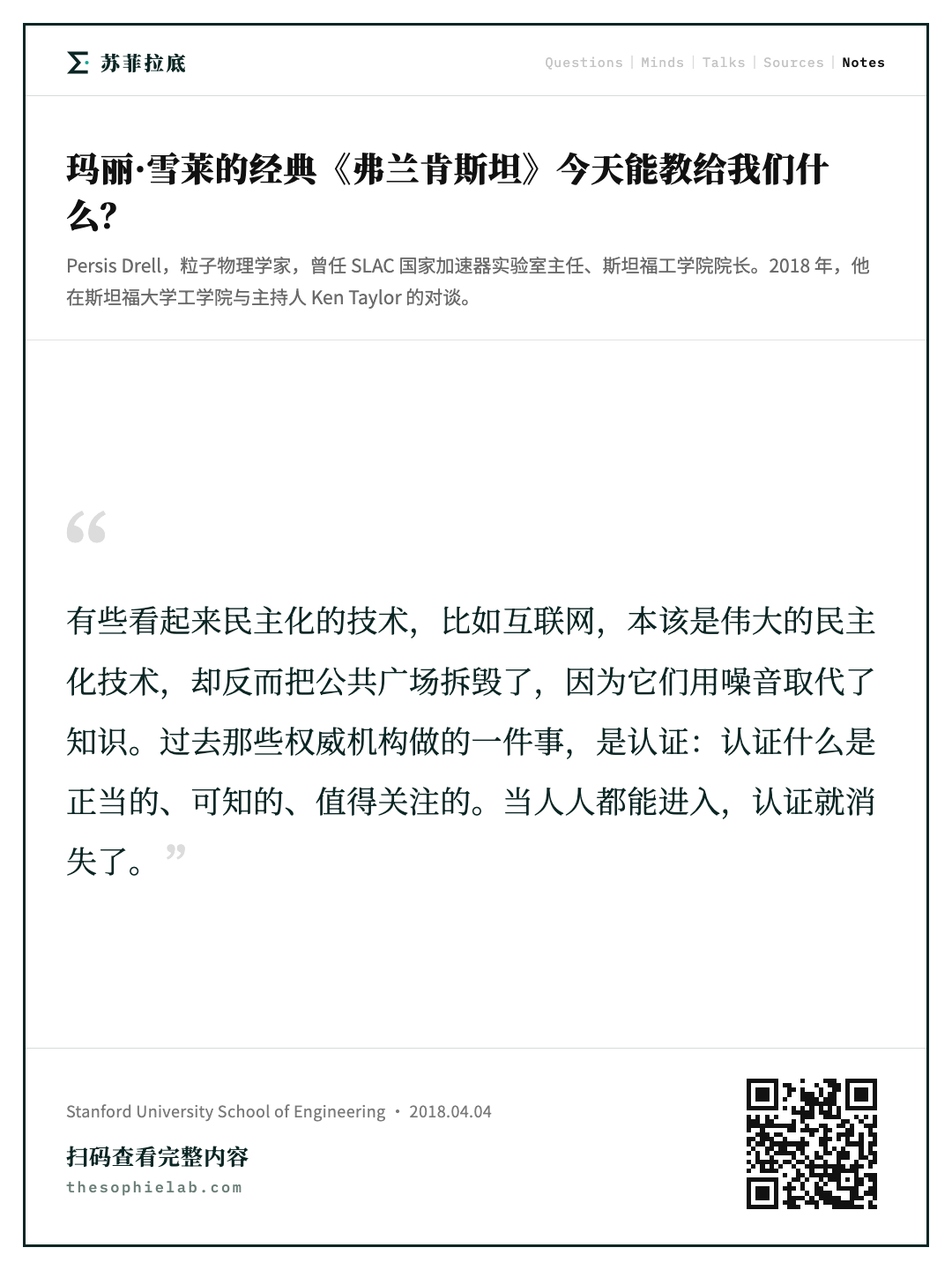
>> [LAUGH] >> I want to ask. >> We could go there, but. >> We make you philosopher king. >> Yeah yeah, but I do want to ask you a question about something you said, now. >> Mm-hm. >> I mean, you said technologies that are democratizing. Sometimes, technologies that look democratizing? So the internet is supposed to be a great democratizing technology, right? Sometimes technology that are democratizing just break down the public square because they substitute noise for knowledge. One of the things that these top authorities did, they certified stuff, as legitimate, as knowable, as worth paying attention to.
>> [笑] >> 我想问。>> 我们可以聊到那儿去,不过。>> 我们让你当哲学王。>> 是啊是啊,不过我确实想就你刚才说的一点问你个问题。>> 嗯哼。>> 我是说,你说有些技术具有民主化作用。有时候,是那些看起来具有民主化作用的技术?比如互联网被认为是一项伟大的民主化技术,对吧?有时候那些具有民主化作用的技术反而瓦解了公共领域,因为它们用噪音取代了知识。这些顶尖权威机构做的一件事,就是为一些东西背书、认证,认定它们是正当的、是可知的、是值得关注的。
便签笔记
49:55
When everybody has access- >> But let me give a very specific example. Theoretical physics used to be if you wanted to do theoretical physics you had to be in one of those pillars like Princeton or Stanford or Harvard, Oxford, and if you wanted to learn about the hottest, latest thing in theoretical physics, you had to write away with a little postcard for a little pre-prepping. That's gone. And now theoretical physics innovation comes from across the world, it's been phenomenal. >> That's true. That's the up side, right?
当每个人都能接触到——>> 不过让我举一个非常具体的例子。理论物理学过去是这样的:如果你想做理论物理,你就必须待在普林斯顿、斯坦福、哈佛这样的重镇,或者牛津;而如果你想了解理论物理最热门、最新的进展,你还得寄一张小明信片去索取预印本。这些都已经不复存在了。如今理论物理的创新来自世界各地,这非常了不起。>> 确实如此。这是好的一面,对吧?
便签笔记
13工程师必须接受人文教育:培养非工具的人
50:27
>> I'm the optimist. >> [LAUGH] >> Welcome to Philosophy Talk, sir. What's your comment or question? >> I'm Wade from Portland, Oregon, and as an aspiring engineer in a very large organization, how do you feel one should navigate these considerations when you're just a tiny cog in maybe a much greater machine? >> Yeah, there you go, Persis. [LAUGH] >> Wow. >> [LAUGH] That's for you. >> Never lose your moral compass no matter what level you are in the organization and hold yourself accountable to it.
>> 我是乐观派。>> [笑] >> 欢迎收听《哲学漫谈》,先生。您的评论或问题是什么?>> 我是来自俄勒冈州波特兰的韦德。作为一个在超大型组织里的工程师新人,你们觉得当你只是一台庞大机器里的一颗小螺丝钉时,应该怎么去权衡这些问题?>> 是啊,这个交给你了,Persis。[笑] >> 哇。>> [笑] 这是问你的。>> 无论你在组织里处于哪个层级,都不要丢掉你的道德指南针,并且要为它对自己负责。
便签笔记
50:57
And it will guide you. >> Okay, so that, those are inspiring words. So this brings me to asking you, are these words enough to inspire the next generation of budding engineers? We've got a room including some current students here. What do we do to try to make sure that the next generation are gonna be helping the world rather than some new Victor Frankensteins? Creating without the proper vigilance. >> So, I'm a huge believer that engineers need to be educated not just in engineering, but they need to be educated broadly.
它会指引你。>> 好的,这些话很鼓舞人心。这就让我想问你,这些话足以激励下一代崭露头角的工程师吗?今天在场的还有一些在校学生。我们该怎么做,才能确保下一代是在帮助这个世界,而不是成为新的维克多·弗兰肯斯坦?在缺乏应有警惕的情况下去创造。>> 我坚信,工程师不能只接受工程方面的教育,他们需要接受广博的教育。
便签笔记
51:33
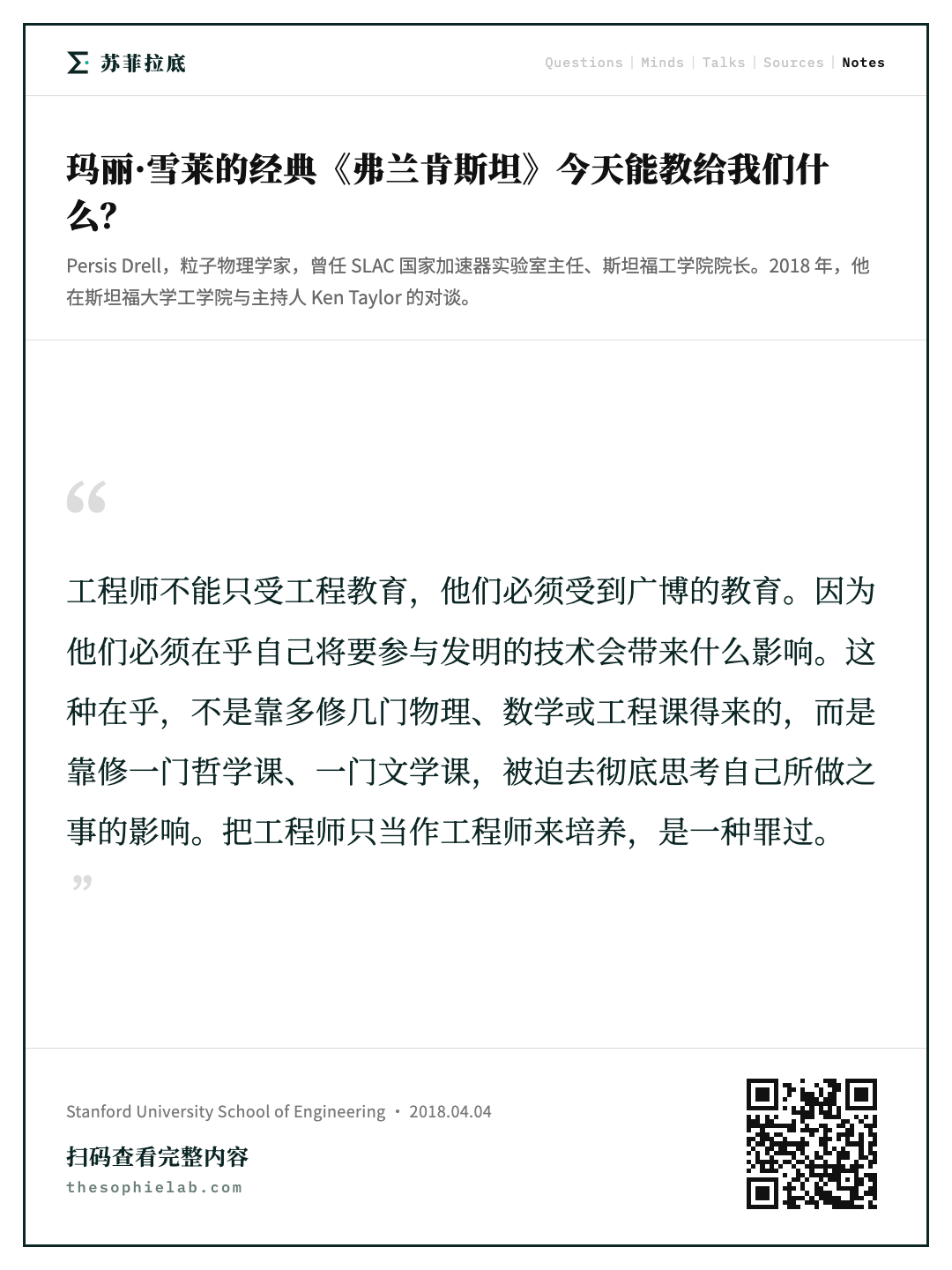
Because they need to care about the impacts of the technologies that they're gonna be involved in inventing. They don't get that by taking more physics classes or more math classes or more engineering classes. They get that by taking a philosophy course or they get that by taking a literature course and being forced to think through the impact of what they're doing. Or, if they're really more directly interested, take a social science course. But, I think that educating engineers to be engineers only is criminal.
因为他们需要在意自己将要参与发明的那些技术会带来什么影响。这不是靠多上几门物理课、数学课或工程课就能获得的。而是通过上一门哲学课,或者上一门文学课,被迫去思考自己所做之事的影响,才能获得。或者,如果他们的兴趣更直接一些,那就去上一门社会科学的课。但我认为,把工程师只培养成工程师,是一种罪过。
便签笔记
52:05
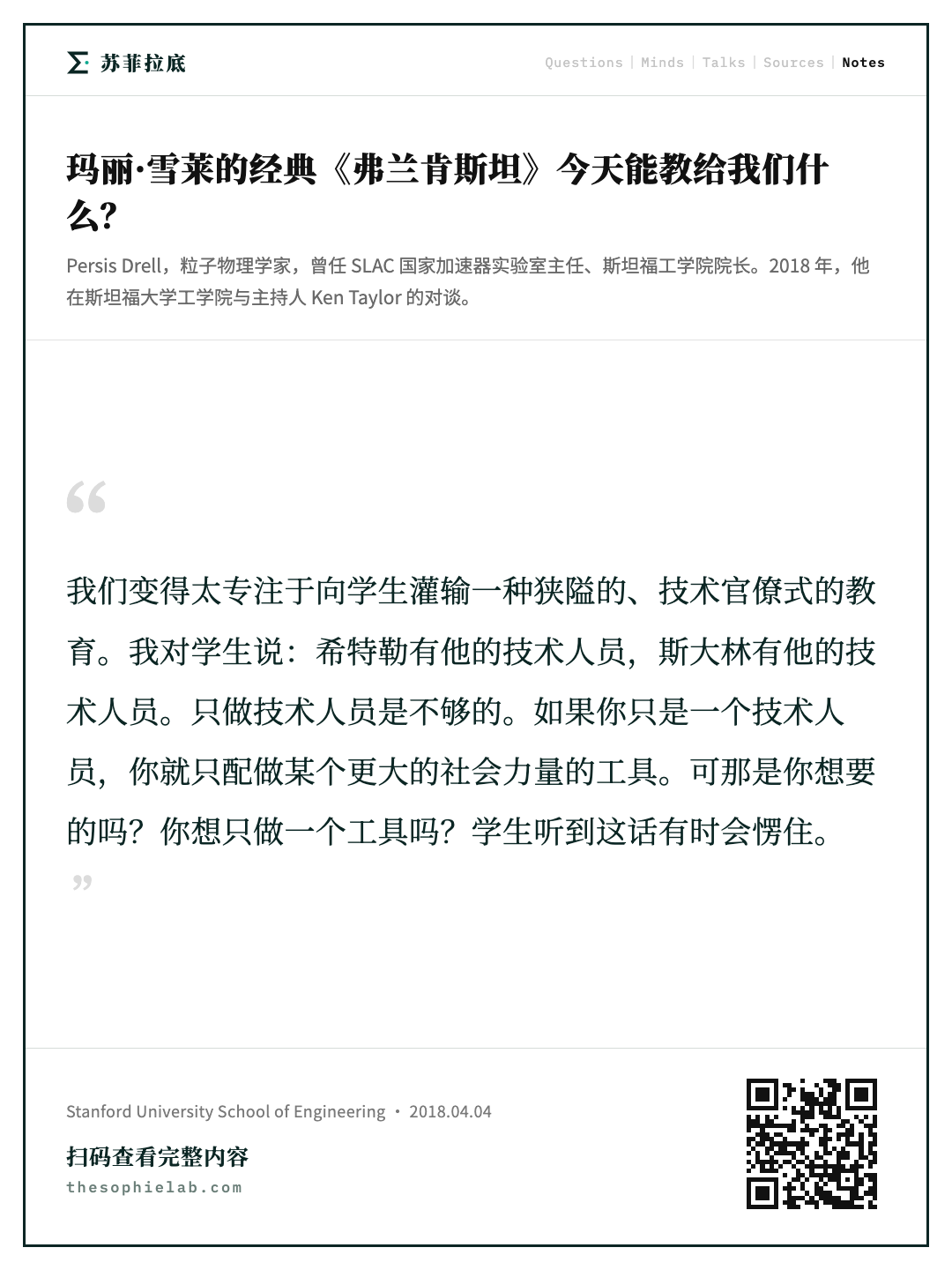
>> I totally agree with you. I say to students, I put it starkly and they sometimes gasp. >> [LAUGH] >> I say, Hitler had his technologists, Stalin had his technologists it's not enough to be at technologist, if you're just the technologist, you're fit to be a tool of some broader social thing, but is that what you want? You wanna just be a tool, and students sometimes are taken aback when- >> [LAUGH] >> I say this, but that brings to how we make them not just be tools how do we educate them to be technology leaders and thinkers.
>> 我完全同意你的看法。我对学生就是这么说的,我说得很直白,他们有时候会倒吸一口凉气。>> [笑] >> 我说,希特勒有他的技术专家,斯大林也有他的技术专家;仅仅当一个技术专家是不够的,如果你只是个技术专家,那你就只配成为某种更大的社会力量的工具,但那是你想要的吗?你只想当一个工具吗?学生们有时候会被吓一跳——>> [笑] >> 当我这么说的时候。但这就引出了:我们怎样才能让他们不只是工具,怎样教育他们成为技术的领导者和思考者。
便签笔记
52:45
I know, I think you think you would like them to take a philosophy course, but you're not gonna force them to take the philosophy course. You're not gonna require them to do that. >> Well I do believe that if you require things, people do them because it's required but if they don't come to subjects willingly, they're not gonna absorb and learn them, and internalize them, and then it's just a waste of time. So, they have to come willingly at Stanford and most other institutions. We have gentle ways of encouraging people to get breadth.
我知道,我想你是希望他们去上一门哲学课,但你不会强迫他们去上哲学课。你不会把它设成必修。>> 其实我确实相信,如果你把某件事定成必修,人们会因为是必修而去做;但如果他们不是心甘情愿地走近这些学科,他们就不会真正吸收、学习、内化它们,那样就只是浪费时间。所以在斯坦福和大多数其他院校,他们必须是自愿而来的。我们有一些温和的方式鼓励大家拓宽知识面。
便签笔记
53:21
They could be a little less gentle in some ways. They could be a little more prescriptive. >> But here's what I think. A university education is and I think it is in a great crisis. I believe we're in a crisis state. And one I think there are two sources of the crisis. But we're focused on one source. I think we have become too focused on imparting into our students a narrow, technocratic education. Right. And partly, our students are demand, want that of us. Because of their parents, and we have this silly reputation as undeserved as Get Rich U and all that sort of stuff.
在某些方面,这些方式其实可以不那么温和。可以更有规定性一些。>> 但我是这么看的。大学教育,我认为它正处在一场巨大的危机之中。我相信我们正处于危机状态。我认为这场危机有两个根源。但我们现在聚焦在其中一个根源上。我认为我们已经过于专注于向学生灌输一种狭隘的、技术官僚式的教育。对吧。而且在某种程度上,我们的学生也在要求、希望我们这么做。这跟他们的父母有关,而且我们还背着一个名不副实的傻名声,什么“致富大学”之类的。
便签笔记
53:57
And they think chase the brass ring, and get the hot job, and all that stuff. And I think we need to address this. And I don't think this is a small thing, I think it's a huge thing. >> Okay, but there's another piece of it. Which is that, I do think we have students majoring in technical subjects computer science whatever, for the wrong reasons and all. And helping them choose the subject they want to major in for the right reasons is obviously part of our responsibility and we could be doing it better.
他们想着去抓住那个金环、找一份热门工作,诸如此类。我认为我们必须正视这个问题。我不觉得这是件小事,我认为这是件大事。>> 好,但这里还有另一个方面。那就是,我确实认为有些学生是出于错误的理由去主修技术类专业的,比如计算机科学之类的。帮助他们出于正确的理由选择自己要主修的专业,显然是我们责任的一部分,而这方面我们本可以做得更好。
便签笔记
54:25
But I also think that, and here I'm going to speak of somebody who was only in the school of engineering for two and a half years. I'm not an engineer. I've never taken an engineering course. But what engineering did and is doing which is very impressive is they actually think a lot about not just what do they need to impart to the students. But what do the students want to learn and how do they want to learn it. >> Right. >> And that focus has helped some of the majors and CS is one of them. Be incredibly attractive and with really good on ramps.
但我也认为——这里我要以一个只在工学院待过两年半的人的身份来说。我不是工程师。我从来没上过一门工程课。但工程学院过去和现在都在做的、非常令人钦佩的一件事是,他们真的会花很多心思去想:不只是他们需要教给学生什么,还有学生想学什么、想怎么学。>> 没错。 >> 这种关注帮助了一些专业,计算机科学就是其中之一。让它们变得极具吸引力,而且有非常好的入门通道。
便签笔记
14经济学家反驳:增长、生产率与被替代的司机
54:57
>> I understand that. >> And I think other subjects certainly my own subject could learn a few lessons from that. >> Yeah. Welcome to Philosophy Talk. What's your comment or question? >> I want to defend some economists now so [LAUGH]. >> [LAUGH] >> I teach economics. My name is Makia. I teach economics, business, and computer information systems. And one of the things I wanna presuppose is that economic growth is good first of all. Can we agree upon that, okay? So free economic is good one of the leading sources just in the principles level economics, I'm quoting Robert Hall and John Taylor.
>> 我明白这一点。>> 我认为其他学科——当然也包括我自己的学科——可以从中学到一些东西。>> 是的。欢迎收听《哲学漫谈》。您的评论或问题是什么?>> 我现在想为经济学家们说几句话 [笑]。>> [笑] >> 我是教经济学的。我叫 Makia。我教经济学、商学和计算机信息系统。我想先设定一个前提:首先,经济增长是好事。这一点我们能达成一致吗?好。所以自由经济是好的。引用基础经济学层面最主要的来源之一,我引的是 Robert Hall 和 John Taylor。
便签笔记
55:30
Because that's the textbook that we use for Principles of Economics. And most of the growth that's taken place in the last 50 years, in the modern world, in the First World, has been due to technological increases. So, increases in productivity, not increases due to more people working or working harder. And that also, that economic growth also brings about good things. We have longer life-expectancy, you can't just say people live longer. But what happens when people live longer, the useful life is a lot longer.
因为那就是我们上《经济学原理》用的教材。而过去五十年里,现代世界、也就是发达国家所出现的增长,大部分都源于技术的进步。也就是生产率的提高,而不是因为更多人在工作、或者工作得更卖力。而且这种经济增长也带来了很多好东西。我们的预期寿命变长了——你不能只说人活得更久。而是当人活得更久,有效的人生也长了很多。
便签笔记
55:59
You have people, I think, probably 50 is the new 30 now. [LAUGH]. >> I'd like to think so. >> Things like that. [LAUGH] >> Let me ask you a question though. Because as an economist, what side are you on? Productivity? One person producing more production per capita or something like that. But what do you think about this debate of whether technology is going to diminish the... decrease the debt demand for human labor? Is that gonna happen or not? >> That's exactly what my next point. One of the things I tell my macroeconomics students is when we're talking about economic growth.
我觉得现在的五十岁大概相当于过去的三十岁。[笑] >> 我也愿意这么想。>> 诸如此类。[笑] >> 不过我想问你一个问题。作为一名经济学家,你站在哪一边?生产率吗?一个人产出更多,人均产量之类的。但你怎么看这场争论:技术会不会削弱……减少对人类劳动力的需求?这会不会发生?>> 这正是我要讲的下一点。>> 我告诉我的宏观经济学学生的一件事是,当我们谈论经济增长的时候——
便签笔记
56:38
Cuz that's a large focus of a macroeconomics class. Is where are people migrating to in the world? Are they migrating to the robots or away from the robots? Where are they migrating to where the factories are? Where the computers are or away from them. So we see that, you know, we have at this point in human history. We probably have more people working as a percentage of the population and especially adult age people with opportunities. And we also have, you know, and you have to say that there are more people being one thing that you have to take a look at is.
因为那是宏观经济学课的一大重点——问题是:世界上的人们正在往哪里迁移?他们是在向机器人靠拢,还是在远离机器人?他们是迁往工厂所在的地方,还是迁往计算机所在的地方,抑或是在远离它们?所以我们看到,在人类历史的这个时点上,按人口比例算,现在工作的人可能是最多的,尤其是有机会的成年人。而且我们还有……你得承认,有更多人——你必须看到的一点是:
便签笔记
57:09
Is people will be displaced, so to a certain degree, technology displaces people. But those are the people who don't, a lot of the times, have the education to adjust. So you have to be malleable. And to a certain degree, machines or robots, I'll just [INAUDIBLE] are substitutes to humans. But to a greater degree, they're complements. So machines and people work together. And that is why you see increasing growth. >> Okay so [CROSSTALK] [LAUGH] [INAUDIBLE] >> That's my question there is why is that bad if we are having technology and its increasing growth and good things are happening why is that bad?
人是会被取代的,所以在一定程度上,技术确实会取代人。但被取代的往往是那些没有受过足够教育、无法做出调整的人。所以你必须有可塑性。在一定程度上,机器或者机器人——我就 [听不清] ——是人的替代品。但在更大程度上,它们是互补品。也就是说,机器和人是协同工作的。这就是为什么你会看到增长在不断提高。>> 好的,那么 [交叉说话] [笑] [听不清] >> 我的问题就是:如果我们有了技术,它带来了增长,好事也在发生,那这有什么不好呢?
便签笔记
57:49
>> Well I'm no economist, I'm no futurist. The fear is, take driverless technology. There are three million people, I think, in this country. Who make their living off driving things, right? And they're gonna be displaced pretty quickly. And that's a good stable middle class job and those people are not malleable. I mean, you could say be malleable but people aren't as malleable. I mean, a 50-year-old truck driver in Pennsylvania who gets displaced, he's just displaced. He's not gonna do anything else.
>> 我不是经济学家,也不是未来学家。人们担心的是,比如说无人驾驶技术。我记得这个国家有三百万人,是靠开车谋生的,对吧?而他们会相当快地被取代。那可是一份稳定的中产阶级好工作,而那些人并没有什么可塑性。我是说,你可以说要有适应力,但人没那么容易适应。我是说,宾夕法尼亚一个50岁的卡车司机被淘汰了,他就是被淘汰了。他不会再去做别的了。
便签笔记
58:24
And how do we deal with that? >> And that's not to mention climate change, right? We're making all of these incremental advances in life expectancy and things like that but this is coming at the cost of future generations and we're not thinking about them. Ultimately all of these advances are just gonna be completely dwarfed by the challenges we're gonna face in the future. >> So you want to respond to that? >> No I just wanted to end on an optimist note. >> [LAUGH] >> That's it. [LAUGH] >> It's all gonna be okay.
我们该怎么应对这个问题?>> 更别提气候变化了,对吧?我们在预期寿命之类的方面取得了一点一点的进步,但这是以牺牲后代为代价的,而我们根本没有考虑他们。最终,所有这些进步都会被我们未来将要面对的挑战彻底压过去。>> 那你想回应一下吗?>> 不,我只是想以乐观的调子收尾。>> [笑] >> 就这样。[笑] >> 一切都会好起来的。
便签笔记
15自动驾驶、AI意志与巨头公司的守门人权力
58:52
>> No, it's not gonna be okay if we don't work at it. >> Right. >> But we have to work at it. >> Right. >> And we cannot give up and cede that responsibility to anyone else. >> Okay so this is what we're gonna do. This is basically the end of the show except there are people standing in line with questions and if you're standing in line with questions we're going to take your questions. I'm going to make a clean break, you probably won't get on the air but you'll get to talk to us anyway. So we'll take these people who are standing in line.
>> 不,如果我们不去努力,就不会好起来。>> 对。 >> 但我们必须努力。>> 对。>> 而且我们不能放弃,不能把这份责任推给别人。>> 好,那我们接下来这么办。这基本上就是节目的尾声了,不过还有人排队等着提问,如果你在排队提问,我们会请你提问。我要做一个干净的收尾,你可能上不了广播,但你还是能跟我们聊上。所以我们请这几位排队的朋友提问。
便签笔记
59:18
Come up to the mikes. And then I'm gonna stop. And then you're gonna say something wise and then we'll say goodbye to you, okay? >> [LAUGH] >> But right now we're gonna take these three people. >> Even wiser than that? >> Yes [LAUGH] >> [INAUDIBLE] >> Okay, he needs a clean break. Welcome to philosophy talk sir, what's your comment or question? >> That one are I know about is self driving cars. And so there is a big push for that and the technlogies that are required is so complex for a lot of people, scientists and engineers are working on this but all the scientists and engineers who are working on this, they don't really ask the future implications of self driving cars.
请到麦克风前来。然后我就打住。然后你说几句有智慧的话,我们再跟你告别,好吗?>> [笑] >> 但现在我们先请这三位。>> 要比刚才那句还有智慧?>> 是的 [笑] >> [听不清] >> 好的,他需要一个干净的收尾。欢迎来到《哲学漫谈》,先生,您的评论或问题是什么?>> 我了解的一个例子是自动驾驶汽车。现在对它的推动力很大,所需要的技术对很多人来说非常复杂,科学家和工程师都在研究这个,但是所有在研究这个的科学家和工程师,他们并没有真正去问自动驾驶汽车会带来什么样的未来影响。
便签笔记
60:01
But a lot of the burden is not on them, it's on the capitalistic system, it's the heads of Google and Ford who are actually want to make a lot of money out of this self driving car business. So who should like, how do you think we should pushback on the self driving cars for example as consumers? >> Mm-hm. Well if we don't like self driving cars, no one is gonna force us to get them. The fact is that if we have self driving cars, it would be extremely attractive. It will make commutes more attractive.
但很大一部分责任并不在他们身上,而在资本主义体制身上,是谷歌和福特的高层真正想从自动驾驶汽车这门生意里赚大钱。那么作为消费者,你觉得我们该如何抵制自动驾驶汽车呢?>> 嗯。如果我们不喜欢自动驾驶汽车,没有人会强迫我们去买。事实是,如果我们有了自动驾驶汽车,它会极具吸引力。它会让通勤变得更有吸引力。
便签笔记
60:37
It will make probably make highways safer. >> No doubt about it. >> So I think you could argue that the technology is good. You worry about the loss of jobs, and that is then a societal responsibility, for either retraining, or slow evolution. I think actually one thing that we can do, I don't know if we will do it, is that I think the transition between every vehicle having a person in it driving actively driving and a fleet of vehicles with no one it is actually a slow transition and so you could do it in an evolutionary way if you really thought about it and planned it.
它很可能会让高速公路更安全。>> 这毫无疑问。>> 所以我认为你可以说这项技术是好的。你担心的是工作岗位的流失,而那属于社会层面的责任,要么是再培训,要么是让它慢慢演进。我其实觉得我们能做的一件事——我不知道我们会不会去做——就是我认为,从每辆车里都有人在主动驾驶,到出现一支完全无人的车队,这中间其实是一个缓慢的过渡,所以你如果真的用心去思考、去规划,是可以以一种渐进演化的方式来推进的。
便签笔记
61:21
>> That's definitely right. I mean I think the deeper point is that we've gotta get past thinking of technology. And I think this, in educating our students, we have to do this too. We have to, thinking of technology and technological innovation as just a thing unto itself. That just, well, we produce it, it changes the world. We, my god. We didn't have any agency in changing the world that way? How does technology changed the world, by being deployed, by human beings in that context,- >> It's probably a much bigger system.
>> 这绝对没错。我是说,我觉得更深层的一点是,我们必须超越那种看待技术的方式。我想这一点,在教育我们的学生时,我们也必须做到。我们必须——不再把技术和技术创新当成一个自足的、独立存在的东西。好像就是,我们把它造出来,它就改变了世界。我们——我的天。难道我们在那样改变世界的过程中没有任何能动性吗?技术是怎么改变世界的?是被人在特定情境中部署使用的,- >> 它很可能是一个大得多的系统的一部分。
便签笔记
61:51
>> Right. >> Right. >> Say again. >> It's port of a much bigger system. >> Yes, and so we have to think about the home systemwide thing, and even a young designer- >> Can do that. >> Can be alive to the fact, that I'm entering a large complicated system, and I'm a thought leader, and I went to a place like Stanford, and I should be reflective, and I should be a citizen, and all that stuff. >> I mean it gets back to Persis' earlier point, so, don't just study your particular field, but learn about human psychology, learn about macroeconomics, learn about- >> Right.
>> 对。>> 对。>> 再说一遍。 >> 它是一个大得多的系统的一部分。>> 是的,所以我们必须从整个系统的层面来思考,甚至一个年轻的设计师—— >> 也能做到这一点。>> 能够意识到,我正在进入一个庞大复杂的系统,而我是一个思想引领者,我上过斯坦福这样的学校,而且我应该善于反思,应该做一个合格的公民,诸如此类。>> 我是说,这又回到了 Persis 之前说的那点,别只研究你自己的专业领域,还要了解人类心理学,了解宏观经济学,了解——>> 没错。
便签笔记
62:24
>> Dance. >> [LAUGH] >> Exactly. >> [LAUGH] >> First thing. >> Welcome to Philosophy Talk. So I'll just back and then we'll have a clean break. >> Okay, good evening. My name is Shelby and I have engineering and business degrees from here at Stanford, and there's two points. I wanna be an optimist. I am an optimist somehow or other, but logic gets in the way. >> [LAUGH] >> And when you talk about people using technology, people being responsible, the problem that I see there is it has to be every person responsible forever.
>> 跳舞。>> [笑] >> 正是如此。>> [笑] >> 首先。>> 欢迎收听《哲学漫谈》。那我往后退一下,这样我们能有个干净的切换点。>> 好的,晚上好。我叫 Shelby,我在斯坦福这儿拿了工程和商科的学位,我有两点想说。我想做个乐观主义者。不知怎的我确实是个乐观主义者,但逻辑总是拦着我。>> [笑] >> 你们谈到人们使用技术、人们要负起责任,我看到的问题是,这需要每一个人永远都负起责任。
便签笔记
63:09
I mean, we've got things going on in North Korea. We got this that, they're doing CRISPR all over the world, and creating stuff, I mean it's just out there, and that's the one thing, and then the other thing is that we have AI. Now AI is a different monster from all the others because it can have a will of its own philosophically, potentially, and we don't know what kind of will it might develop. So those are, now, so what's the question? How can we not be pessimistic even though- >> [LAUGH] >> Yeah, that's one for you, for- >> [LAUGH] >> But I gotta say, AI is coming like gang busters.
我是说,朝鲜正在搞一些事情。还有这个那个的,全世界都在做 CRISPR,在造各种东西,这些就摆在那儿,这是一点;另一点是我们还有人工智能。人工智能和其他所有东西都不一样,因为从哲学上讲,它有可能拥有自己的意志,而我们不知道它会发展出什么样的意志。所以就是这些,那么,问题是什么呢?我们怎么才能不悲观呢——>> [笑] >> 是啊,这个问题交给你,交给——>> [笑] >> 但我得说,人工智能来势汹汹。
便签笔记
64:00
>> Yeah. >> AI is coming like gang busters, and the promise, John McCarthy, our former colleague, or late colleague, they had this meeting back in, when was it, 1950 or something like that. They got together. They go, by 1970 AI. Okay, that was a little premature, right? But AI is coming like gang busters, and the data's coming. What anything a human can do, some AI software will be able to do better. That's just coming. >> I'll take that bet. >> Yeah, I will too. >> No, it's coming. Anything [INAUDIBLE].
>> 是啊。>> 人工智能来势汹汹,还有那些许诺,John McCarthy,我们以前的同事,或者说已故的同事,他们当年开过一次会,那是什么时候来着,1950 年左右吧。他们聚到一起。他们说,到 1970 年就会有人工智能。好吧,那有点操之过急了,对吧?但人工智能确实来势汹汹,数据也来了。凡是人能做的事情,某种人工智能软件都能做得更好。这是必然会到来的。>> 这个赌我接。>> 是啊,我也接。>> 不,它一定会来。任何[听不清]。
便签笔记
64:29
>> I wanna see someone design the software to detect. >> Look, it's already the case. >> [LAUGH] >> And this isn't even a super intelligent AI, it's just think machine learning technique. They can already out-diagnose your average doctor. Right? >> They diagnosis, fine. >> Anything that involves pattern recognition, that involves- >> We do a lot of thing that are beyong pattern recognition. >> [LAUGH] >> I'm talking about today and what's coming next. It's coming. Okay, we'll take a vote. >> If you wanna be- >> [LAUGH] >> Just try Google Translate, then- >> Yeah.
>> 我倒想看看谁能设计出软件来检测这个。>> 你看,现在已经是这样了。>> [笑] >> 而且这还不是什么超级智能的人工智能,只是机器学习技术而已。它们已经能比普通医生诊断得更准了。对吧?>> 诊断,行吧。>> 任何涉及模式识别的事情,任何涉及——>> 我们做的很多事情是超出模式识别范畴的。>> [笑] >> 我说的是今天的情况以及接下来会发生什么。它一定会来。好吧,我们来投个票。>> 如果你想——>> [笑] >> 你去试试谷歌翻译,然后——>> 是啊。
便签笔记
65:02
[LAUGH] >> You'll sleep better. >> [LAUGH] >> But you know how Google, nevermind. >> [LAUGH] >> Welcome to Philosophy Talk, sir. >> Yeah hi. I'd like to just compliment the last speaker because he usurped most of what I wanted to say. >> [LAUGH] >> You talk about technology, but there isn't a technology, and I'd like to at least just have you distinguish, as he was trying to say, like the world of medicine has done magnificent things. You cannot deny that. Yet on the other hand, in areas where they have begun to encroach on truly dangerous things, the world of medicine seems to have taken it seriously and they are doing something about it, and I'm presuming it's because the government has been bothering, it's really a serious issue.
[笑] >> 你就能睡得踏实点了。>> [笑] >> 不过你知道谷歌是怎么,算了。>> [笑] >> 欢迎来到《哲学漫谈》,先生。>> 嗯,你好。我想先赞一下上一位发言的人,因为他把我想说的大部分内容都抢先说了。>> [笑] >> 你们谈技术,但根本不存在单一的“技术”,我至少希望你们能区分一下,就像他想说的那样,医学界做出了非常了不起的成就。这你无法否认。可另一方面,在他们开始触及真正危险的领域时,医学界似乎认真对待了这件事,而且确实在采取行动,我猜这是因为政府一直在过问,这确实是个严肃的问题。
便签笔记
65:51
Somehow the world of technology is focused on kiddy things and so forth, that are fun and so forth, and there is this issue of the fact that I think somebody likes Fowler writes a book, and he's a little obviously extremist, and I haven't finished the book to be truthful. But the reality is that he's saying good things about the fact that the owners of these magnificent six companies or whatever they are, really think they own, they're very God-like, and they are determined to guide our will. I mean, they are the gatekeepers.
而科技界不知怎的就把精力放在那些幼稚的东西上,那些好玩的玩意儿之类的,而且还存在这样一个问题:我记得好像是 Fowler 之类的人写了本书,他显然有点极端,老实说我这本书还没读完。但现实是,他说的有些话很在理:那六家了不起的公司——或者不管是几家——的老板们,真的以为自己拥有一切,他们非常自以为是上帝,而且他们铁了心要左右我们的意志。我是说,他们就是守门人。
便签笔记
66:31
We learn what we wanna learn from them, they can model it, they can modify. It's a dangerous issue and if you think that they're going to ultimately come forth and say, well, we're gonna drop all of this and, forget it. I mean, to be pessimistic is one thing, but to do something about it is going to require, I think, ultimately that there's a stand up sort of thing, sort of like Florida youngsters getting up and saying enough already. There's gonna have to be some groups stand up and get some action out of a congress or some place that says, look, you can't let this go on.
我们想学什么,都得从他们那里学,他们可以塑造它,也可以修改它。这是个危险的问题,如果你以为他们最终会站出来说,好吧,我们把这些都放弃了,算了吧。我是说,悲观是一回事,但要真正采取行动,我觉得最终还是得有人站出来,就像佛罗里达那些年轻人站出来说,够了。必须得有一些团体站出来,去推动国会或者别的什么机构采取行动,说,听着,不能再这样下去了。
便签笔记
67:08
You've created the a division of labor, I mean a division of the money that's unacceptable, you've created the ability take everybody's privacy and destroy it. I mean, you have, that's what they were saying. You have no privacy. You own a phone, you have no privacy. I mean, it's just- >> Okay, Persis, this just goes back to where are the grown-ups, right? >> Yeah, it goes back to where are the grown-ups. >> Right. >> [APPLAUSE] >> What I think is, it will be fascinating when the history of this is written, because I'm not sure even the owners of those companies had a clue what was going to be coming.
你们造成了一种劳动分工,我是说一种让人无法接受的财富分配,你们还制造出了能把每个人的隐私拿走并毁掉的能力。我是说,你们确实有,他们就是这么说的。你毫无隐私可言。你有一部手机,你就没有隐私。我是说,这简直就是—— >> 好吧,Persis,这又回到那个问题:大人们都去哪儿了,对吧?>> 是啊,这又回到了大人们都去哪儿了。>> 没错。 >> [掌声] >> 我觉得,等这段历史被写下来的时候会非常有意思,因为我不确定就连那些公司的老板们,当初有没有一点概念,知道后面会发生什么。
便签笔记
16未来学位:社会科学加计算素养,做「双料人」
67:43
They have a choice to start taking some responsibility, or government regulation will come in and break them up the way AT&T was broken up. I mean, there is an ultimate authority there, we think. But, I'm not sure that's the right answer. So, I actually do hope the grown-ups stand up and start working at it. >> Okay, the last question. >> Thanks. I wanted to ask about the discussion you had about encouraging humanities education. My husband and I are both alumni here. He was a philosophy major and I was an engineering major, and we discuss this a lot about our own children now where he hopes they get a strong humanities education.
他们可以选择开始承担一些责任,否则政府监管就会介入,像当年拆分 AT&T 那样把他们拆掉。我是说,我们认为,那里终究还有一个最终的权威在。但是,我不确定那是正确的答案。所以,我其实真的希望大人们能站出来,开始着手解决这件事。>> 好,最后一个问题。>> 谢谢。我想问一下你们刚才关于鼓励人文教育的那段讨论。我和我丈夫都是这里的校友。他当年主修哲学,我主修工程,现在我们经常为我们自己的孩子讨论这个问题,他希望孩子们能接受扎实的人文教育。
便签笔记
68:21
>> And you? >> And I say absolutely. It's good to get some, but they better major in- >> [LAUGH] >> Engineering. It goes back to, I find it's employable to get the engineering degree, and I do believe you're a better person for having a humanities education, but then what happens after they get out of college? They need to pay for their rent. They need to do all these things. So, I mean, how do we close the gap there, and encourage more of that? >> I take it that Persis wasn't necessarily recommending that people major in a humanities subject.
>> 那你呢? >> 我说当然要有。学一点是好事,但他们最好还是主修—— >> [笑] >> 工程。这又回到那一点:我发现拿个工程学位比较好就业,而且我确实相信,接受人文教育会让你成为更好的人,但等他们大学毕业以后呢?他们得付房租。他们还得应付所有这些事情。所以我想问,我们怎么弥合这中间的落差,怎么去鼓励更多这样的教育?>> 我理解 Persis 并不是一定在建议大家去主修人文学科。
便签笔记
68:57
>> [LAUGH] >> No. >> Right? >> But so- >> So the thought could all just be, look, if you're gonna be an engineer, also learn some other things. I think that's a good compromise. >> Well, but I think, if I were to lay my bet on the table of the degree of the future, it is not the pure engineering degree, it's going to be a social science degree with computational literacy, because you need to know the questions to ask, and there are these huge societal challenges and I do believe the social sciences helps you understand what questions to ask, but you can't understand them without computational literacy.
>> [笑] >> 不是。>> 对吧? >> 但是—— >> 所以整个想法也许就是,听着,如果你要当工程师,那也去学点别的东西。我觉得那是个不错的折中。>> 嗯,不过我觉得,如果要我押注未来的学位是什么,那不会是纯粹的工程学位,而会是一个具备计算素养的社会科学学位,因为你需要知道该问什么问题,而现在有这些巨大的社会挑战,我确实相信社会科学能帮你搞清楚该问哪些问题,但没有计算素养你又理解不了这些问题。
便签笔记
69:30
So I really think that's the magic combination that I would put my money on. >> So if you really want your kids to get a job- >> So, look, the degree of the future- >> I have that parental inference. >> [LAUGH] >> This isn't going on the radio, so I can say this. >> [LAUGH] >> This is the Stanford audience. The degree of their future is the Symbolic Systems degree at Stanford- >> [LAUGH] And with that, [LAUGH] >> It's dance, dance, is the degree of the future. >> [LAUGH] >> I want to address this, I want to address this briefly and then I'll give you a clean break, David.
所以我真的认为那是神奇的组合,我愿意押注在那上面。>> 所以如果你真的想让孩子找到工作—— >> 听着,未来的学位—— >> 我有那种当家长的推断。>> [笑] >> 这段不会在广播里播出,所以我可以这么说。>> [笑] >> 这是斯坦福的听众。他们未来的学位就是斯坦福的符号系统(Symbolic Systems)学位—— >> [笑] 说到这儿, [笑] >> 是舞蹈、舞蹈,才是未来的学位。>> [笑] >> 我想回应一下这个,我想简短回应一下,然后就把话干净利落地交给你,David。
便签笔记
70:04
We are educating the makers of the world, the remakers of the world. Human society is constantly making and remaking itself. And these Stanford students that we have, they're going to play a role in making, and remaking the world. And we need to educate them, in multiple things. We need to turn out excellent students. We need to turn out the great engineers, great scientist, great artist, great literary thinkers, great philosophers, great social scientists. But, we also need them each to understand that making and remaking the world is a deeply collaborative thing that requires multiple disciplinary talent.
我们培养的是这个世界的塑造者,是这个世界的再造者。人类社会一直在不断地塑造和再造自身。而我们这些斯坦福的学生,他们将会在塑造和再造这个世界的过程中发挥作用。我们需要在多个方面教育他们。我们需要培养出优秀的学生。我们需要培养出伟大的工程师、伟大的科学家、伟大的艺术家,伟大的文学思想家、伟大的哲学家、伟大的社会科学家。但我们也需要他们每个人都明白,塑造和再造世界是一件极具协作性的事情,需要多个学科的才能。
便签笔记
70:46
There is no competition. We have this stupid thing that's happened. The students say, well, are you a techy or a fuzzy? You better be both. >> Right. >> [LAUGH] >> You better be a te-fuzzy or a fu-techy, or whatever that is. >> [LAUGH] >> Okay. [LAUGH] >> Because if we don't produce people in whom all of these things live simultaneously, then the making and remaking of the world will be a disaster. Well, and the very- >> It requires a moral compass. >> [LAUGH] >> Of course it does. >> Are you training for that or not?
这中间没有竞争关系。我们这里出现了一种很蠢的现象。学生们会问,你是理工男(techy)还是文科生(fuzzy)?你最好两样都是。>> 没错。 >> [笑] >> 你最好当个“理文人”或者“文理人”,随便叫什么吧。 >> [笑] >> 好吧。 [笑] >> 因为如果我们不能培养出让这一切同时并存于其身上的人,那么塑造和再造世界就会是一场灾难。嗯,而且非常——>> 这需要道德指南针。 >> [笑] >> 那当然需要。>> 你们有在为此进行培养吗?
便签笔记
71:11
It wasn't on the list I heard you just recite. >> Yeah, I'm deeply committed to that. I'm deeply, deeply committed to that. Yeah, okay, so now we're gonna pretend none of that happened, Devon. >> [LAUGH] >> So what I'm gonna say is, Persis, you got one last bit of wisdom for us, right? So, okay. >> Uh-oh. >> So he needs a clean break. >> The pressure is on. >> So Persis, you got one last bit of wisdom for us? >> I think we have to hold on to our optimism, despite the challenges ahead. >> Well, on that optimistic note, I'm going to thank you for joining us.
我刚才听你列举的那串清单里可没有这一条。>> 是的,我对此有极深的承诺。我对此有非常非常深的承诺。好吧,那现在我们就假装刚才那些都没发生过,Devon。>> [笑] >> 所以我要说的是,Persis,你还有最后一点智慧要送给我们,对吧?那么,好的。>> 哎呀。>> 他需要一个漂亮的收尾。>> 压力来了。>> 那么 Persis,你还有最后一点智慧要送给我们吗?>> 我认为,尽管前方挑战重重,我们还是必须守住我们的乐观。>> 好,就以这句乐观的话作结,我要感谢你来参加我们的节目。
便签笔记
71:44
>> [LAUGH] >> It's been a great conversation. >> Thank you. >> [APPLAUSE]
>> [笑] >> 这是一次非常精彩的对话。>> 谢谢。>> [掌声]
便签笔记
17尾声:60秒哲学家谈明日的怪物
72:02
>> Our guest has been Persis Drell, former dean of the Stanford School of Engineering and recently appointed as our university's 13th provost. Now this conversation continues at Philosopher's Corner at our online community of thinkers. Where our motto is, Cogito ergo blogo, I think, therefore I blog. And you can become a partner in that community just by visiting our website PhilosophyTalk.org. >> And if you have a question that wasn't addressed in today's show, either here or on the radio, we'd love to hear from you.
>> 我们的嘉宾是 Persis Drell,斯坦福工学院前院长,最近被任命为我校第十三任教务长。这场对话会在我们的线上思想者社区“哲学家角”继续下去。我们的口号是:Cogito ergo blogo——我思故我博客。你只要访问我们的网站 PhilosophyTalk.org,就能成为这个社区的一员。>> 如果你有问题在今天的节目里没有得到解答,无论是在现场还是在广播里,我们都很想听听。
便签笔记
72:32
Email your question to us at [email protected], and we may feature it on our blog. Now let's hear from a man of monstrously rapid speech, it's Ian Shoales, the 60 Second Philosopher. >> Ian Shoales, at the time Mary Shelley created Frankenstein, a barbette, kind of, Galvani had just made a dead frog's leg twitch with electricity, allegedly. And grave robbers were digging up bodies for medical students to use in their anatomy classes. All of which, kind of, provided the juice as it were for her novel.
把你的问题发邮件到 [email protected],我们可能会把它放到博客上。现在让我们听听一位语速快得吓人的男士,他是“60 秒哲学家”Ian Shoales。>> 我是 Ian Shoales。在玛丽·雪莱创作《弗兰肯斯坦》的那个年代,差不多就在那前后,据说伽伐尼刚刚用电流让一只死青蛙的腿抽动了起来。而盗墓者们正在挖出尸体,供医学生在解剖课上使用。所有这一切,可以说给她的小说提供了“电力”。
便签笔记
73:04
One of the reasons body snatching was so reviled was the widespread Christian belief that come judgement day we would be resurrected whole. Cutting up bodies might make such a resurrection a little more problematic. I don't know what the deal was on amputees or guillotine victims. Though headless ghosts, again, you might recall, were a bit of a literary trope for a long while there. Also about ten years after the writing of Frankenstein, two enterprising grave robbers named Burke and Hare. Took anatomy research a step further by murdering people to provide cadavers for her anatomy's lectures.
盗尸之所以如此为人痛恨,一个原因是当时普遍存在的基督教信念:到了审判日,我们会以完整之身复活。把尸体切开,可能会让这样的复活变得有点麻烦。我不知道截肢者或者断头台的受害者该怎么算。不过你大概还记得,无头幽灵在很长一段时间里可是文学里常见的套路。另外,在《弗兰肯斯坦》写成大约十年之后,有两个很有“进取心”的盗尸贼,叫伯克和黑尔。他们把解剖学研究又推进了一步——直接杀人,为解剖学讲座提供尸体。
便签笔记
73:32
16 and all is believed their unique method of strangulation became known as burking. Just as Galvani's name wound up describing frog leg twitching. And the name of Frankenstein came to be known as the monster, not the creator of the monster. What's up with that? The whims of legend often trump the facts of history as we all know. The recent passing of the Reverend Billy Graham is certainly proof of that. I recall his being regardless of somewhat relatively liberal figure in the Evangelical world.
据信一共有十六人;他们独特的勒杀手法后来被称作“burking”。就像伽伐尼的名字最后被用来形容青蛙腿抽动一样。而“弗兰肯斯坦”这个名字后来变成了怪物的名字,而不是怪物创造者的名字。这是怎么回事?众所周知,传说的心血来潮常常胜过历史的事实。最近比利·葛培理牧师的去世无疑就是一个证明。我记得他在福音派世界里,相对来说算是个比较自由派的人物。
便签笔记
73:56
Certainly ecumenical, dining with Popes and talk show hosts and Presidents, and a preacher who eschewed fire and brimstone. Had a nice haircut, wore tailored suits, and did not sweat or storm about. But when he died, my, my, my, there was a torrent of ill-wishers glad he was dead because of anti-Semitism. And he had lunch with Kissinger. Same guy, but now he's a monster. We have seen the reputations of Darwin, Freud, and Marx go up and down, but Darwin and Marx sometimes achieving monstrousness, along with misapprehension.
当然也很有普世精神,跟教皇、脱口秀主持人、总统们共进晚餐,而且是个不讲地狱烈火与硫磺的传道人。发型清爽,穿定制西装,不会大汗淋漓,也不会咆哮激动。但等他一死,天哪天哪,涌出一大堆恶意者,为他的死叫好,理由是反犹主义。还有他跟基辛格一起吃过午饭。同一个人,但现在成了怪物。我们见过达尔文、弗洛伊德和马克思的名声起起落落,其中达尔文和马克思有时还被当成怪物,外加各种误解。
便签笔记
74:22
And Freud achieving more and more irrelevance as drugs replace therapy. And psychotherapists wander the streets carrying their sad little signs, will reveal your unconscious processes for food. >> [LAUGH] >> The monsters of tomorrow are being stitched together today with gene splicing, artificial intelligence application, autonomous cars, global warming fears and the tyranny of the algorithm. [COUGH] These could be real monsters are just topics for the blockbusters of tomorrow like cloning dinosaurs for instance.
而弗洛伊德则越来越无关紧要,因为药物取代了心理治疗。心理治疗师们在街上游荡,举着他们那些可怜的小牌子,上面写着:揭示你的潜意识过程,只求一餐。>> [笑] >> 明天的怪物,今天正在被缝合起来:基因剪接、人工智能应用、自动驾驶汽车、对全球变暖的恐惧,还有算法的暴政。[咳嗽] 这些可能是真正的怪物,也可能只是明天大片的题材,比如克隆恐龙。
便签笔记
74:49
It is proven to be not so much a threat to humanity as a never ending money machine, without once achieving reality. As for the Frankenstein monster himself, the dissection does not hold the appeal it once did although artificial limbs abound along with hearing aids, eye glasses, mood enhancing drugs, endurance enhancing drugs, strength enhancing drugs that can serve to make any of us an ugly psychotic monster with predator natural abilities. No Frankenstein creator needed. Right off the shelf. Eliminate the middle-man.
事实证明,那与其说是对人类的威胁,不如说是一台永不停歇的赚钱机器,而且从未真正变成现实。至于弗兰肯斯坦的怪物本身,解剖已经不像当年那样有吸引力了,尽管假肢随处可见,还有助听器、眼镜、改善情绪的药、提升耐力的药、增强力量的药——这些都足以把我们任何一个人变成一个丑陋的、有掠食者般能力的精神变态怪物。不需要弗兰肯斯坦这样的创造者。直接从货架上就能买到。把中间商省了。
便签笔记
75:13
Also with advanced post-Freudian counseling techniques we can embrace our new selves. The stray limbs we acquired legally. Assimilated into a new, post-human whole. And should we choose to run amock under medical supervision, of course, and then escape to the Arctic, global warming will assure that we are not fleeing from pursuers, leaping from ice float to ice float, but relaxing. On the newly warm and placid sea on a floatation device, catching up with the latest fake news on our smartphone. And rubbing sunscreen on our brand new legs.
还有借助先进的后弗洛伊德咨询技术,我们可以接纳全新的自我。那些我们合法获得的散落肢体。被同化进一个全新的、后人类的整体。而如果我们选择撒野胡闹——当然是在医疗监护下——然后逃往北极,全球变暖会确保我们不是在逃离追捕者,从一块浮冰跳到另一块浮冰,而是在放松。在新变暖而平静的海面上,躺在漂浮装置上,用智能手机刷着最新的假新闻。还往我们崭新的双腿上涂着防晒霜。
便签笔记
75:40
>> [LAUGH] >> A little R and R and then back to DC to lobby for the trans-human movement, Hacked Lives Matter. Won't you please give? I gotta go. >> [LAUGH] [APPLAUSE] [MUSIC]
>> [笑声] >> 稍作休息放松,然后回到华盛顿特区,为跨人类运动游说,「被黑客改造的生命也是命」。您愿意慷慨解囊吗?我得走了。>> [笑声] [掌声] [音乐]
便签笔记
76:24
>> Philosophy Talk is a presentation of KALW local public radio San Fransisco and the trustees of Leland Junior Stanford University. Copyright 2018. >> Our executive producers are David and Matt Martin. Special thanks to the Stanford School of Engineering, the Symbolic Systems Program, the Department of Philosophy, and the Program. >> Thanks also to Sun Lee, Emily King, Dan [INAUDIBLE] and our musical guest Adam Schulman on piano, David Uhl on the bass, and the one and only Tiffany Austin on vocals.
>> 《哲学漫谈》由旧金山 KALW 地方公共广播电台与小利兰·斯坦福大学董事会联合呈现。版权所有 2018。>> 我们的执行制作人是 David 和 Matt Martin。>> 特别感谢斯坦福大学工程学院、符号系统项目、哲学系,以及该项目。>> 同样感谢 Sun Lee、Emily King、Dan [听不清],以及我们的音乐嘉宾——钢琴手 Adam Schulman、贝斯手 David Uhl,还有独一无二的主唱 Tiffany Austin。
便签笔记
77:01
>> [APPLAUSE] >> The senior producer of philosophy talk is Devon Strolovitch. Laura Maguire is our Director of Research. And our marketing director is Cindy Prince Baum. >> Support for Philosophy Talk comes in various groups here at Stanford University and the partners in our online community of thinkers. >> The views expressed or misexpressed on this program do not necessarily represent the opinions of Stanford University or our other funders. >> Not even when they're true and reasonable. >> [LAUGH] The conversation continues on our website philosophytalk.org, where you too can become a partner in our community of thinkers.
>> [掌声] >> 《哲学漫谈》的高级制作人是 Devon Strolovitch。Laura Maguire 是我们的研究总监。我们的市场总监是 Cindy Prince Baum。>> 《哲学漫谈》的支持来自斯坦福大学的多个团体,以及我们线上思想者社区的伙伴们。>> 本节目中表达或误表达的观点,未必代表斯坦福大学或其他资助方的立场。>> 哪怕这些观点是真实而合理的,也不代表。>> [笑声] 对话将在我们的网站 philosophytalk.org 上继续,在那里你也可以成为我们思想者社区的一员。
便签笔记
77:46
I'm John Landy. >> And I'm Ken Taylor. Thank you for listening. >> And thank you for thinking. >> That's a wrap. >> [APPLAUSE]
我是 John Landy。>> 我是 Ken Taylor。感谢您的收听。>> 也感谢您的思考。>> 到此结束。 >> [掌声]
便签笔记
78:09
[MUSIC]
[音乐]
便签笔记
78:47
>> [APPLAUSE]
>> [掌声]
便签笔记

这期还没有生成总结。

这期还没有生成核心句型(制作精读 PDF 时会一并生成)。

这期还没有生成词汇表(制作精读 PDF 时会一并生成)。

这期还没有生成自测题(制作精读 PDF 时会一并生成)。

精读便签
下载便签 手机:长按图片也可保存
← 上一期 · NO.106Peter Singer Lecture - 'Animal Liberation: Past, Present and Future' 下一期 · NO.108 →Superintelligence | Nick Bostrom | Talks at Google
订阅苏菲周报 每周一封:本周入库的精读、一个值得带走的问题、一条苏菲按。免费,随时退订。
免费 · 每周一封 · 一键退订
苏菲拉底 THE SOPHIE LAB · ASK THE BEST MINDS THE BIG QUESTIONS 内容仅供学习 · thesophielab.com