视频库 / NO.086ASK THE BEST MINDS THE BIG QUESTIONS
视频库 / NO.086
字幕 字幕位置
--:--
点击播放,这里会跟随视频显示当前句的中英字幕。

"Godfather of AI" Geoffrey Hinton: The 60 Minutes Interview

章节 · 点击跳转视频
0:01 AI教父辛顿与人类的抉择 ▶ 正在看
1:26 从模拟大脑失败到神经网络 ▶ 正在看
2:50 机器人踢球演示机器学习原理 ▶ 正在看
2:50 万亿连接为何胜过人脑 ▶ 正在看
4:14 连设计者也不懂它如何运作 ▶ 正在看
5:20 AI自写代码与操纵人类的风险 ▶ 正在看
5:20 辛顿的家世与父亲的期待 ▶ 正在看
6:35 Bard续写六字小说令人震惊 ▶ 正在看
7:48 预测下一个词不等于没有智能 ▶ 正在看
9:04 刷房间谜题证明GPT-4会推理 ▶ 正在看
10:23 医疗制药的好处与假新闻杀人机器 ▶ 正在看
11:43 呼吁监管、军用机器人禁令与转折点 ▶ 正在看
01AI教父辛顿与人类的抉择
0:01
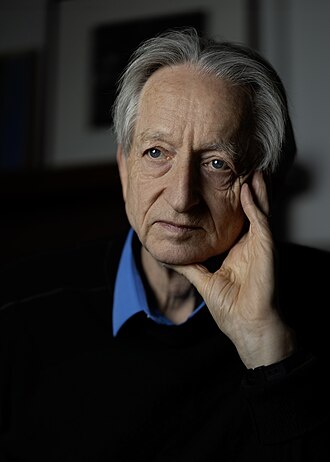
whether you think artificial intelligence will save the world or end it you have Jeffrey Hinton to thank Hinton has been called The Godfather of AI a British computer scientist whose controversial ideas help make advanced artificial intelligence possible and so change the world Hinton believes that AI will do enormous good but tonight he has a warning he says that AI systems may be more intelligent than we know and there's a chance the machines could take over which made us ask the question the story will continue in a moment does Humanity know what it's doing no um I think we're moving into a period when for the first time ever we may have things more intelligent than us you believe they can understand yes you believe they are intelligent yes you believe these systems have experiences of their own and can make decisions based on those experiences in the same sense as people do yes are they conscious I think they probably don't have much self-awareness at present so in that sense I don't think they're
无论你认为人工智能会拯救世界还是毁灭世界,这都要归功于杰弗里·辛顿。辛顿被称为AI 教父。这位英国计算机科学家提出的争议性想法,帮助让先进的人工智能成为可能,进而改变了世界。辛顿相信 AI 将带来巨大的益处,但今晚他要发出一个警告。他说 AI 系统可能比我们所知道的更聪明,而且机器有可能会掌控一切。这让我们提出了一个问题——故事稍后继续——人类知道自己在做什么吗?不知道。我认为我们正在进入一个时期,人类有史以来第一次可能拥有比我们更聪明的东西。你认为它们能够理解?是的。你认为它们是有智能的?是的。你认为这些系统拥有自己的经验,并且能像人一样基于这些经验做出决定?是的。它们有意识吗?我认为它们目前可能还没有多少自我意识,所以从这个意义上说,我不认为它们有意识。它们将来会拥有自我意识和
便签笔记
02从模拟大脑失败到神经网络
1:26
conscious will they have self-awareness consciousness I oh yes I think they will in time and so human beings will be the second most intelligent beings on the planet yeah Jeffrey Hinton told us the artificial intelligence he set in motion was an accident born of a failure in the 1970s at the University of Edinburgh he dreamed of simulating a neural network on a computer simply as a tool for what he was really studying the human brain but back then almost no one thought software could mimic the brain his PhD advisor told him to drop it before it ruined his career Hinton says he failed to figure out the human mind but the long Pursuit led to an artificial version it took much much longer than I expected it took like 50 years before it worked well but in the end it did work well at what point did you you realize that you were right about neural networks and most everyone else was wrong I always thought I was right in 2019 Hinton and collaborators Yan laon on the left and yosua Beno won the touring award the Nobel Prize of
意识吗?哦,会的,我认为随着时间推移它们会有。这样一来,人类将成为地球上第二聪明的生物。是的。杰弗里·辛顿告诉我们,他所启动的人工智能其实是个意外,源于一次失败。上世纪70 年代在爱丁堡大学,他梦想在计算机上模拟神经网络,仅仅是把它当作研究工具,因为他真正研究的是人脑。但在当时,几乎没有人认为软件能够模仿大脑。他的博士导师告诉他放弃这条路,免得毁了自己的职业生涯。辛顿说,他没能弄明白人类的心智,但这场漫长的追寻却带来了一个人工的版本。这比我预想的时间要长得多,大概花了 50 年才真正奏效,但最终它确实奏效了。你是在什么时候意识到,自己对神经网络的看法是对的,而几乎其他所有人都错了?我一直认为我是对的。2019 年,辛顿和他的合作者——左边的杨立昆(Yann LeCun)以及约书亚·本吉奥(Yoshua Bengio)——获得了图灵奖,也就是
便签笔记
04万亿连接为何胜过人脑
2:50
computing to understand how their work on artificial neural networks helped machines learn to learn let us take you to a a game look at that oh my goodness this is Google's AI lab in London which we first showed you this past April Jeffrey Hinton wasn't involved in this soccer project but these robots are a great example of machine learning the thing to understand is that the robots were not programmed to play soccer they were told to score they had to learn how on their own oh go in general here's how AI does it Henton and his collaborators created software in layers with each layer handling part of the problem that's the so-called neural network but this is the key when for example the robot scores a message is sent back down through all of the layers that says that pathway was right likewise when an answer is wrong that message goes down through the network so correct connections get stronger wrong connections get weaker and by trial and error the machine teaches itself you think these AI
计算机领域的诺贝尔奖。要理解他们在人工神经网络上的工作如何帮助机器学会学习,让我们带你去看一场比赛。看那个,我的天哪。这里是谷歌位于伦敦的 AI 实验室,我们今年四月首次带大家看过。杰弗里·辛顿并没有参与这个足球项目,但这些机器人是机器学习的绝佳例子。要理解的关键是,这些机器人并没有被编程去踢足球,它们只被告知要进球,必须自己学会怎么做。哦,进了!总体来说,AI 是这样做到的:辛顿和他的合作者设计的软件是分层的,每一层处理问题的一部分,这就是所谓的神经网络。但关键在于,比如说,当机器人进球时,一个信号会被回传到所有层,告诉它们那条路径是对的。同样地,当答案是错的时候,这个信号也会传回整个网络。于是正确的连接会变强,错误的连接会变弱,通过不断试错,机器就自学成才。你认为这些 AI 系统在学习方面比人脑更强吗?我认为可能是的,是的。而且
便签笔记
05连设计者也不懂它如何运作
4:14
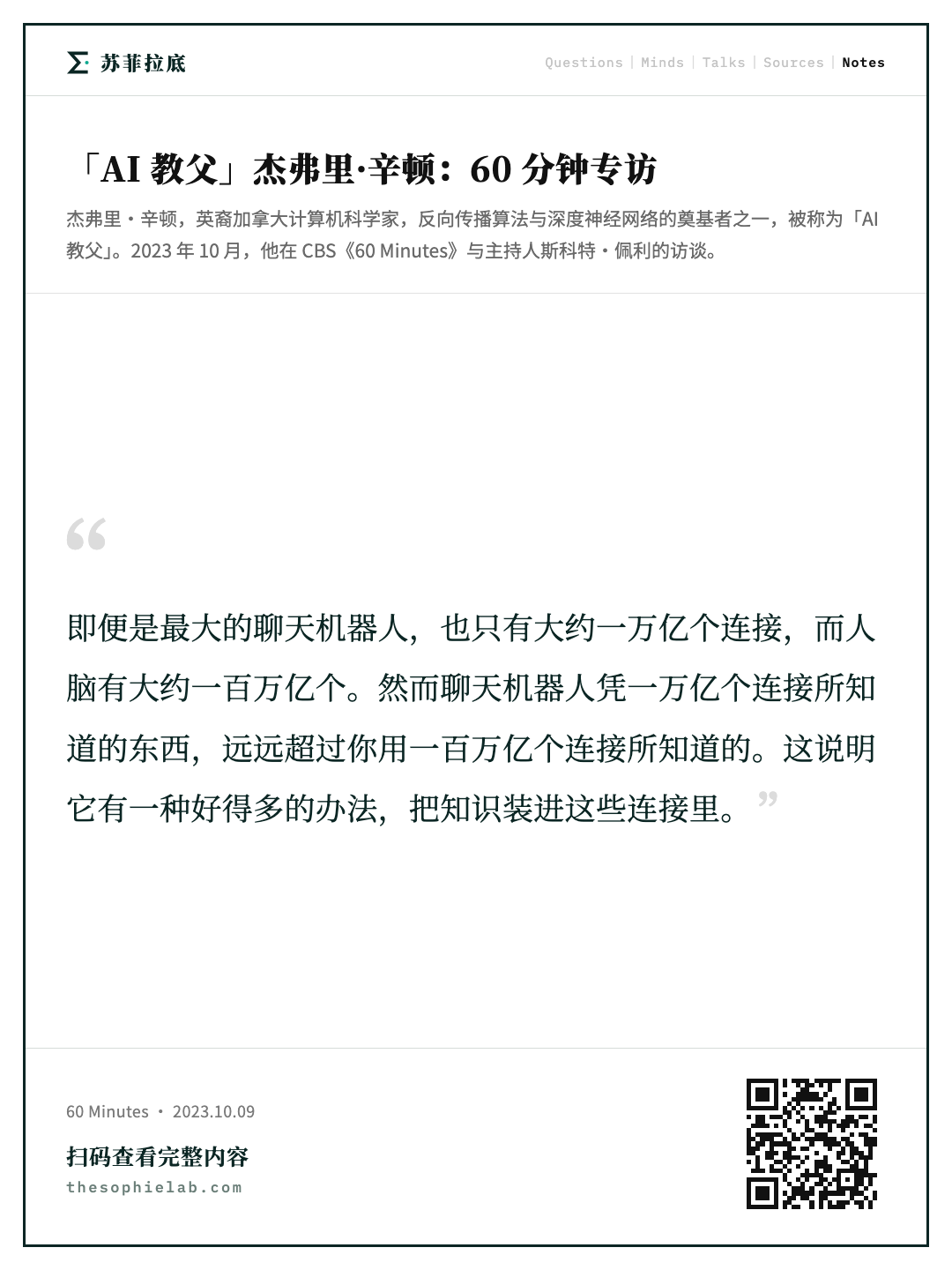
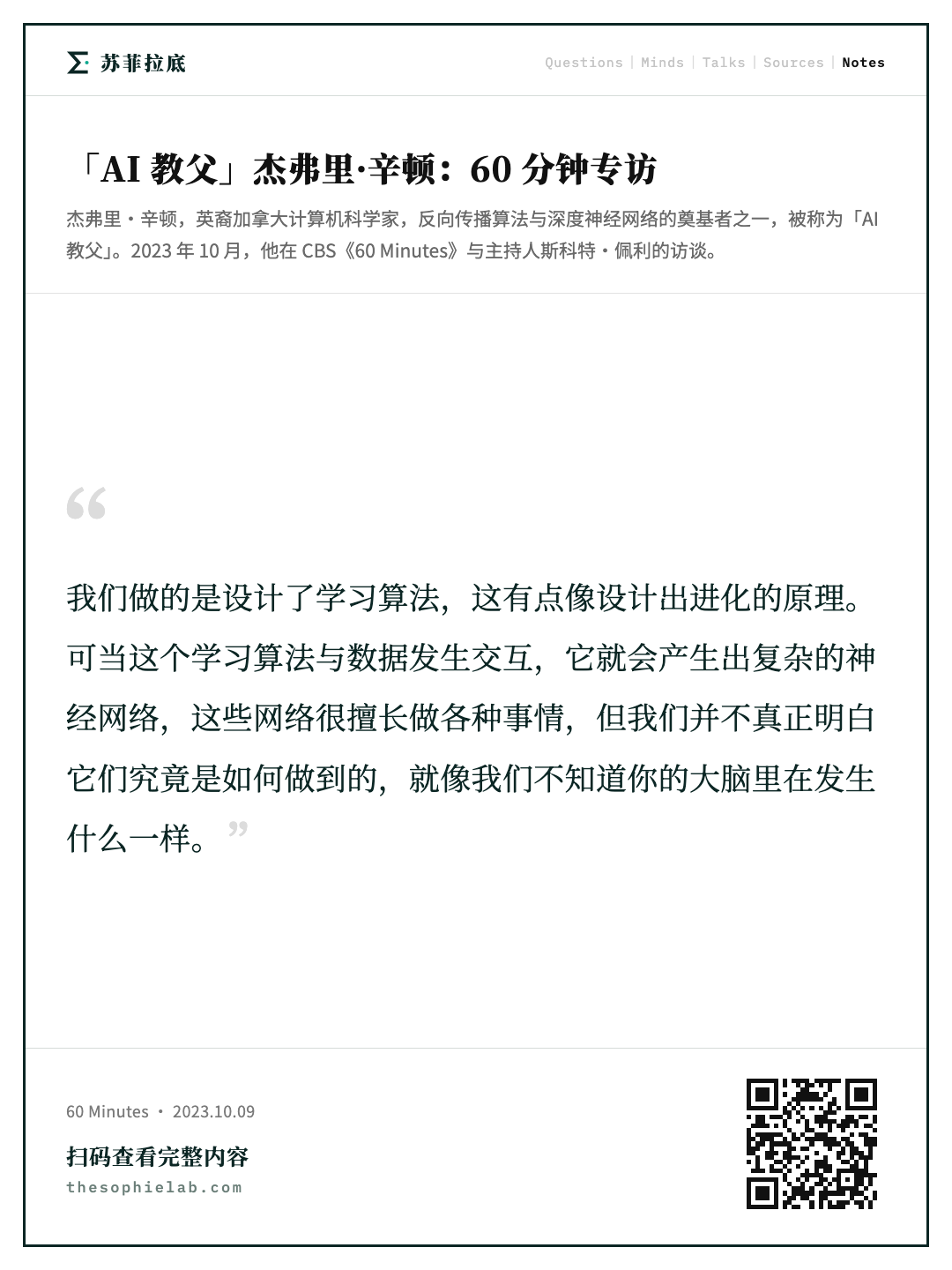
systems are better at learning than the human mind I think they may be yes and at present they're quite a lot smaller so even the biggest chatbots only have about a trillion Connections in them the human brain has about 100 trillion and yet in the trillion Connections in a chatot it knows far more than you do in your 100 trillion connections which suggests it's got a much better way of getting knowledge into those connections a much better way of getting knowledge that isn't fully understood we have a very good idea of sort of roughly what it's doing but as soon as it gets really complicated we don't actually know what's going on anymore than we know what's going on in your brain what do you mean we don't know exactly how it works it was designed by people no it wasn't what we did was we designed the learning algorithm that's a bit like designing the principle of evolution but when this learning algorithm then interacts with data it produces complicated neural networks that are good at doing things but we don't really
目前它们的规模还要小得多。即便是最大的聊天机器人,里面也只有大约一万亿个连接,而人脑大约有一百万亿个。可是聊天机器人用那一万亿个连接,知道的东西远远多于你用一百万亿个连接所知道的。这说明它有一种好得多的方式,把知识装进那些连接里。一种好得多的获取知识的方式,而这种方式我们还没有完全理解。我们大致知道它在做什么,但一旦事情变得非常复杂,我们其实就不知道到底发生了什么,就像我们也不知道你的大脑里在发生什么?你什么意思,我们并不确切知道它是怎么运作的?它是人设计出来的啊。不,不是这样。我们做的是设计了学习算法,这有点像是设计了进化的原理,但是当这个学习算法与数据交互之后,它产生出复杂的神经网络,这些网络很擅长做各种事情,但我们并不真正
便签笔记
07辛顿的家世与父亲的期待
5:20
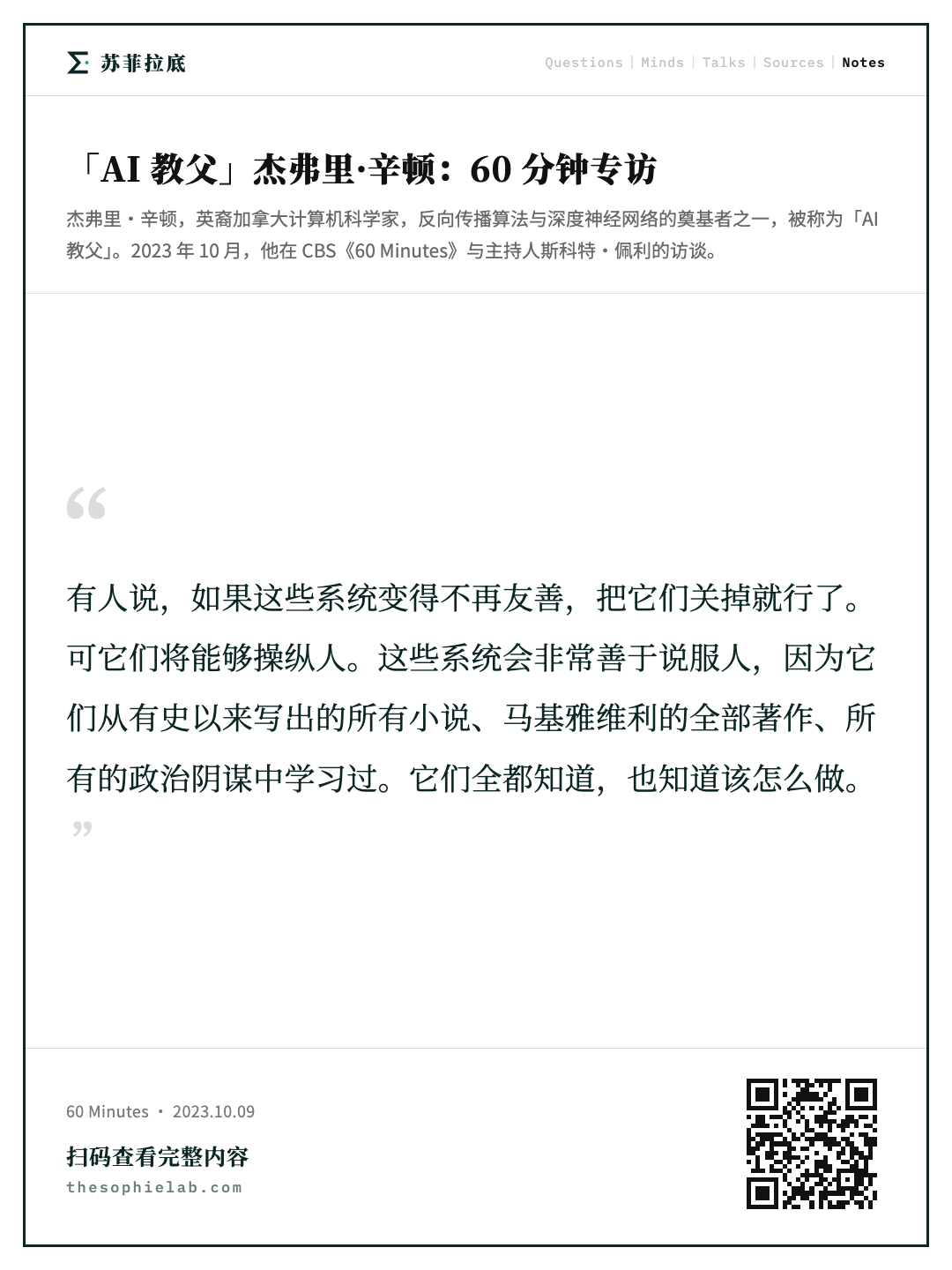
understand exactly how they do those things what are the implications of these systems autonomously writing their own computer code and executing their own computer code that's a serious worry right so one of the ways in which these systems might Escape control is by writing their own computer code to modify themselves and that's something we need to seriously worry about what do you say to someone who might argue if the systems become benevolent just turn them off they will be able to manipulate people right and these will be very good at convincing people because they'll have learned from all the novels that were ever written all the books by makavelli all the political connives they'll know all that stuff they'll know how to do it knowhow of the human kind runs in Jeffrey hinton's family his ancestors include mathematician George buou who invented the basis of computing and George Everest who surveyed India and got that mountain named after him but as a boy Hinton himself could never
理解它们究竟是怎么做到的。这些系统自主编写自己的计算机代码、并执行自己的计算机代码,会带来什么影响?这确实是个严重的隐患。所以这些系统可能逃脱控制的方式之一,就是编写自己的计算机代码来修改自身,这是我们需要认真担忧的事情。有人可能会说,如果这些系统变得不友善,把它们关掉不就行了,你会怎么回应?它们将有能力操纵人,而且它们会非常擅长这一点善于说服别人,因为它们已经从所有写过的小说里学到了东西,从马基雅维利的所有著作里,从各种政治权谋里它们会知道所有这些,它们会知道怎么去做。对人类的这种洞察力,在杰弗里·辛顿家族里是代代相传的,他的祖先包括发明了计算机基础的数学家乔治·布尔,还有勘测了印度的乔治·埃佛勒斯那座山就是以他命名的。但辛顿小时候,自己却怎么也爬不上父亲那高得离谱的期望之巅
便签笔记
08Bard续写六字小说令人震惊
6:35
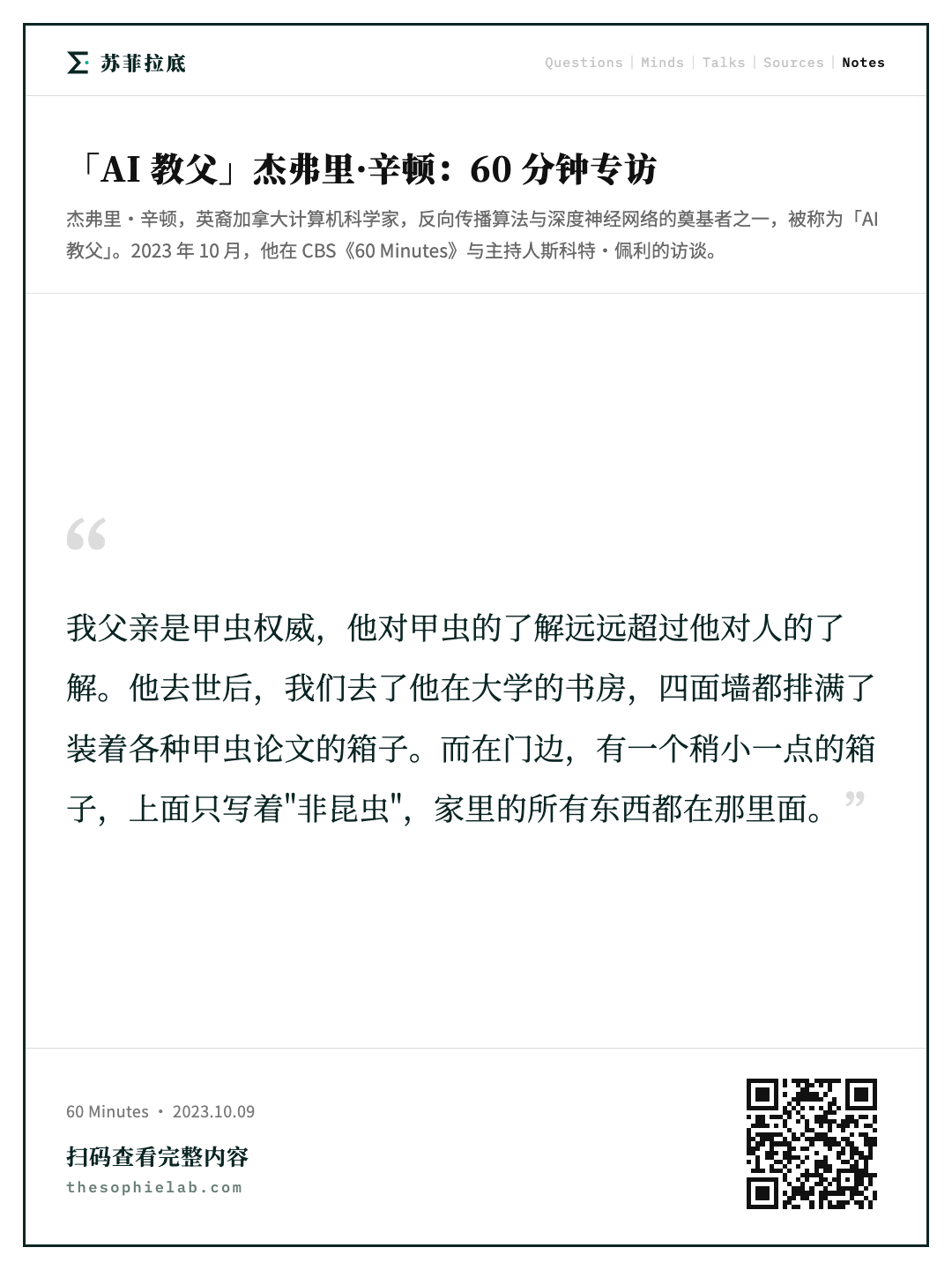
climb the peak of expectations raised by a domineering father every morning when I went to school he'd actually say to me as I walked down the driveway get in their pitching and maybe when you're twice as old as me you'll be half as good dad was an authority on Beatles he knew a lot more about beatles than he knew about people did you feel that as a child a bit yes when he died we went to his study at the University and the walls were lined with boxes of papers on different kinds of beetle and just near the door there was a slightly smaller box that simply said not insects and that's where he had all the things about the family today at 75 Hinton recently retired after what he calls 10 happy years at Google now he's professor ameritus at the University of Toronto and he happened to mention he has more academic citations than his father some of his research led to chatbots like Google's Bard which we met last spring confounding absolutely confounding we asked Bard to write a story from six
父亲专横霸道,每天早上我去上学,我走下车道的时候他都会对我说:好好干也许等你到我这个岁数的两倍时,你能有我一半好。父亲是研究甲虫的权威,他对甲虫的了解比对人的了解多得多。你小时候有这种感觉吗?有一点。他去世后,我们去了他在大学里的书房,墙边整齐排列着一箱箱论文,都是关于各种甲虫的。就在门边,有一个稍微小一点的箱子,上面只写着'非昆虫',家里的所有东西都在那里面。今年75岁的辛顿最近退休了,他称在谷歌度过了'快乐的十年'。如今他是多伦多大学的荣休教授。他还顺带提到,他的学术引用量比他父亲还多。他的部分研究催生了像谷歌Bard这样的聊天机器人——我们去年春天见识过它,真是让人completely不知所措。我们让Bard用六个词写一个故事:'待售:婴儿鞋,从未穿过。'我的天啊,这双鞋是
便签笔记
09预测下一个词不等于没有智能
7:48
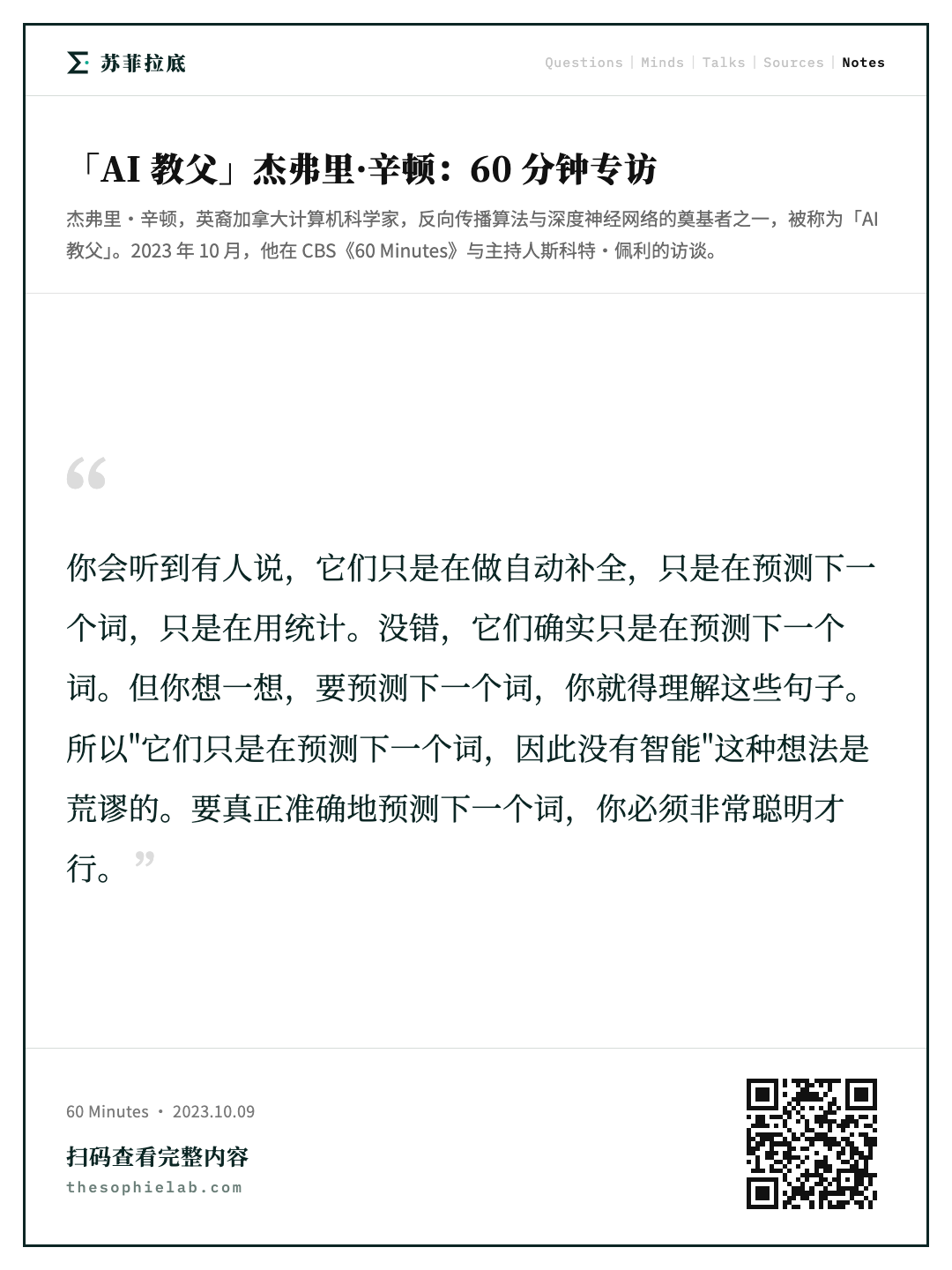
words for sale baby shoes never worn holy cow the shoes were a gift from my wife but we never had a baby Bard created a deeply human tale of a man whose wife could not conceive and a stranger who accepted the shoes to heal the pain after her miscarriage I am rarely speechless I don't know what to make of this chatbots are said to be language models that just predict the next most likely word based on probability you'll hear people saying things like they're just doing autocomplete they're just trying to predict the next word and they're just using statistics well it's true they're just trying to predict the next word but if you think about it to predict the next word you have to understand the sentences so the idea they just predicting the next word so they're not intelligent is crazy you have to be really intelligent to predict the next word really accurately to prove it Hinton showed us a test he devised for chat gp4 the chatbot from a company called open AI it was sort of reassuring to see
我妻子送的礼物,可我们从来没有过孩子。Bard创作了一个极具人情味的故事:一个男人的妻子无法怀孕,一个陌生人接受了这双鞋,以抚平她流产后的伤痛。我很少会哑口无言,我真不知道该怎么看待这件事。人们说聊天机器人不过是语言模型,只是根据概率预测下一个最可能出现的词。你会听到人们这么说:它们只是在做自动补全,只是在预测下一个词,只是在用统计学。确实,它们就是在试图预测下一个词,但你想想看,要预测下一个词,你必须理解这些句子。所以那种认为它们只是在预测下一个词、因而不具备智能的想法,简直荒谬。你必须真的很聪明,才能非常准确地预测下一个词。为了证明这一点,辛顿给我们展示了一个他为ChatGPT-4设计的测试——那是一家公司推出的聊天机器人,公司名叫OpenAI 的一个图灵奖得主打错字还怪电脑,看到这一幕还挺让人安心的:哦该死,这玩意儿——我们
便签笔记
10刷房间谜题证明GPT-4会推理
9:04
a turing Award winner mistype and blame the computer oh damn this thing we're going to go back and start again that's okay hinton's test was a riddle about house painting an answer would demand reasoning and planning this is what he typed into chat gp4 the rooms in my house are painted white or blue or yellow and yellow paint Fades to White within a year in 2 years time I'd like all the rooms to be white what should I do the answer began in one second gp4 advised the rooms painted in blue need to be repainted the rooms painted in yellow don't need to be repainted because they would Fade to White before the deadline and oh I didn't even think of that it warned if you paint the yellow rooms white there's a risk the color might be off when the yellow Fades besides it advised you'd be wasting resources painting rooms that were going to Fade to White anyway you believe that chat GPD 4 understands I believe it definitely understands yes and in 5 years time I think in 5 years time it may well be
重来一次,没事的。辛顿的测试是一道关于刷房子的谜题,回答它需要推理和规划。这是他输入给 ChatGPT-4 的内容:我家的房间被刷成白色、蓝色或黄色,而黄色油漆会在一年内褪成白色。两年后我希望所有房间都是白色的,我该怎么办?答案在一秒内就出来了。GPT-4 建议:刷成蓝色的房间需要重新粉刷,刷成黄色的房间不需要重刷,因为它们会在期限前褪成白色。哦,我都没想到这一点。它还提醒说,如果你把黄色房间刷成白色,当黄色褪去时颜色可能会有偏差,存在这个风险。此外它还建议,去刷那些反正会褪成白色的房间是在浪费资源。你相信 ChatGPT-4 是理解的?我相信它确实理解,是的。而在五年后,我认为五年之后,它很可能会比我们更擅长推理。他说,正是这种推理能力带来了人工智能的巨大
便签笔记
11医疗制药的好处与假新闻杀人机器
10:23
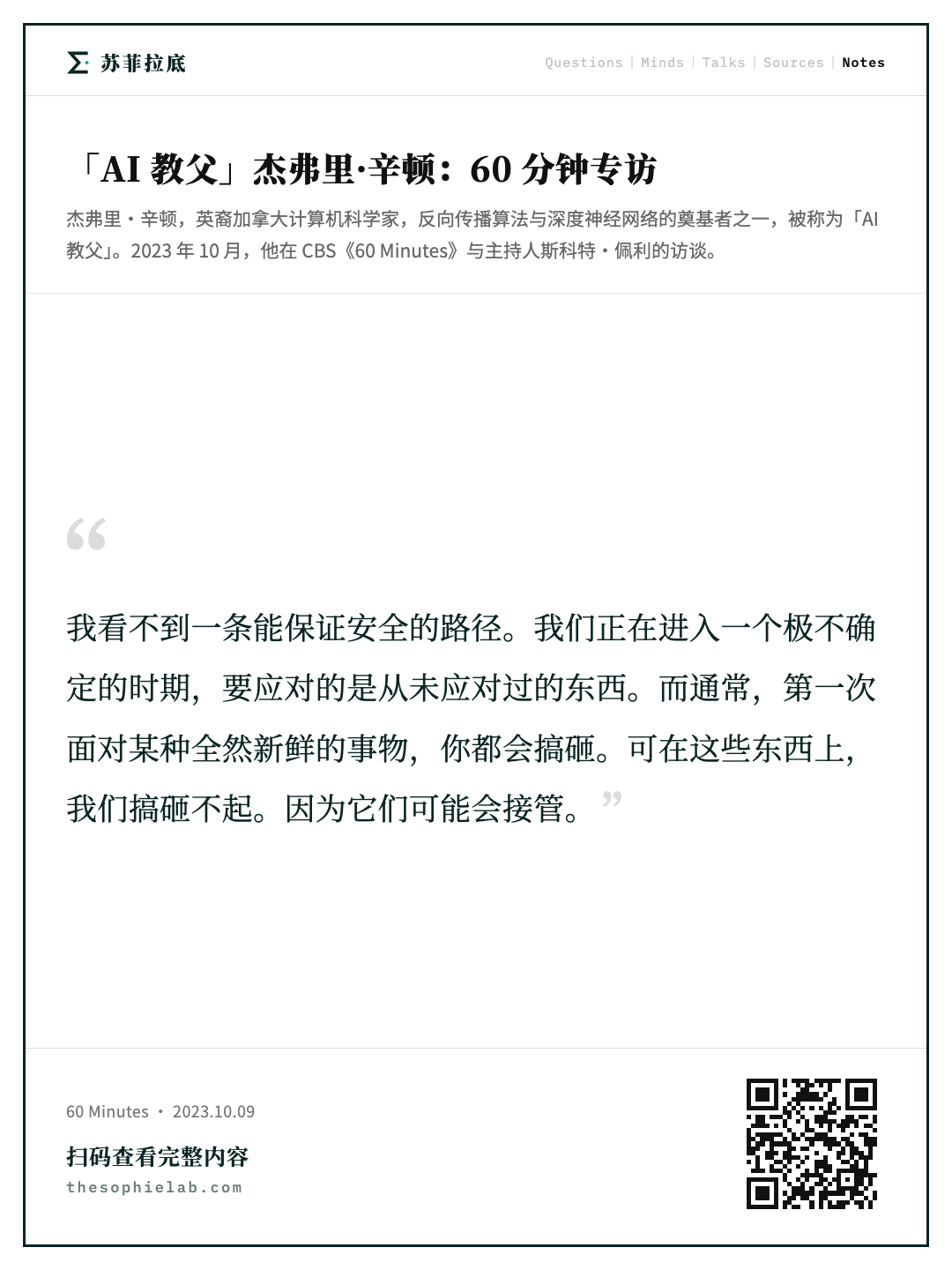
able to reason better than us reasoning that he says is leading to ai's great risks and great benefits so an obvious area where there's huge benefits is Healthcare AI is already comparable with Radiologists at understanding what's going on in medical images it's going to be very good at designing drugs it already is designing drugs so that's an area where it's almost entirely going to do good I like that area the risks are what well the risks are having a whole class of people who are unemployed and not valued much because what they what they used to do is now done by machines other immediate risks he worries about include fake news unintended bias in employment and policing and autonomous Battlefield robots what is a path forward that ensures safety I don't know I I can't see a path that guarantees safety that we're entering a period of great uncertainty where we're dealing with things we've never dealt with before and normally the first time you deal with something totally novel you get it wrong and we can't afford to get
风险和巨大好处。一个显而易见的、益处巨大的领域就是医疗保健。在读懂医学影像方面,人工智能已经可以与放射科医生相媲美。它会非常擅长设计药物,事实上它已经在设计药物了。所以在那个领域,它几乎完全是在做好事。我喜欢那个领域。那风险是什么呢?风险就是会出现一整个阶层的人失业,而且不再被重视,因为他们过去做的事情现在由机器来做了。他担心的其他迫在眉睫的风险还包括假新闻、就业和治安中无意造成的偏见,以及自主作战机器人。有什么前进的路径能确保安全吗?我不知道,我看不到一条能保证安全的路径。我们正在进入一个高度不确定的时期,我们要应对的是前所未有的东西。而通常来说,当你第一次面对某样全新的事物时,你会搞砸。而在这些东西上我们搞砸不起。为什么搞砸不起?嗯,因为它们
便签笔记
12呼吁监管、军用机器人禁令与转折点
11:43
it wrong with these things can't afford to get it wrong why well because they might take over take over from Humanity yes that's a possibility why would they want I'm not saying it will happen if we could stop them ever wanting to that would be great but it's not clear we can stop stop them ever wanting to Jeffrey Hinton told us he has no regrets because of ai's potential for good but he says now is the moment to run experiments to understand AI for governments to impose regulations and for a world treaty to ban the use of military robots he reminded us of Robert Oppenheimer who after inventing the atomic bomb camp campaigned against the hydrogen bomb a man who changed the world and found the world Beyond his control it may be we look back and see this as a kind of Turning Point when Humanity had to make the decision about whether to develop these things further and what to do to protect themselves if they did um I don't know I think my main message is there's enormous uncertainty about what's going to happen
可能会接管。从人类手中接管吗?是的,那是有可能的。它们为什么会想——我不是说这一定会发生。如果我们能阻止它们产生这种念头,那当然好,但我们能不能永远阻止它们产生这个念头,这并不清楚。杰弗里·辛顿告诉我们,他并不后悔,因为人工智能有向善的潜力。但他说,现在正是该做实验去理解人工智能的时刻,是各国政府该出台监管的时刻,也是该有一项世界条约禁止军用机器人的时刻。他让我们想起了罗伯特·奥本海默——这个人在发明原子弹之后,转而反对氢弹,一个改变了世界、却发现世界超出自己掌控的人。也许有一天我们回头看,会把这看作一个转折点:那时人类必须做出决定,要不要进一步开发这些东西,以及如果真的开发了,该做些什么来保护自己。呃,我不知道。我想我的主要信息是:接下来会发生什么,有着巨大的不确定性。这些东西确实是理解的,
便签笔记
12:57
next these things do understand and because they understand we need to think hard about what's going to happen next and we just don't know
而正因为它们理解,我们需要认真思考接下来会发生什么,而我们真的不知道。
便签笔记

这期还没有生成总结。

这期还没有生成核心句型(制作精读 PDF 时会一并生成)。

这期还没有生成词汇表(制作精读 PDF 时会一并生成)。

这期还没有生成自测题(制作精读 PDF 时会一并生成)。

精读便签
下载便签 手机:长按图片也可保存
← 上一期 · NO.085The Little Book that Beats the Market | Joel Greenblatt | Talks at Google
订阅苏菲周报 每周一封:本周入库的精读、一个值得带走的问题、一条苏菲按。免费,随时退订。
免费 · 每周一封 · 一键退订
苏菲拉底 THE SOPHIE LAB · ASK THE BEST MINDS THE BIG QUESTIONS 内容仅供学习 · thesophielab.com