视频库 / NO.047ASK THE BEST MINDS THE BIG QUESTIONS一人,一实验室
视频库 / NO.047
字幕 字幕位置
--:--
点击播放,这里会跟随视频显示当前句的中英字幕。
第 47 期 · 回应 Ⅲ·08「理性是解放,还是控制?」

Network Theories of Power - Manuel Castells

节目发布 2010-03-02
曼纽尔·卡斯特 布鲁诺·拉图尔 现场提问者
章节 · 点击跳转视频
0:00 理论只是工具:方法论前提 ▶ 正在看
2:49 权力与反权力:人类唯一的普遍法则 ▶ 正在看
6:57 四种网络权力的类型学 ▶ 正在看
11:44 强制与说服:塑造头脑胜过折磨身体 ▶ 正在看
15:45 为什么不存在全球权力精英 ▶ 正在看
19:34 造网权力:编程与转换两大机制 ▶ 正在看
25:54 默多克与MIT:转换者的实证案例 ▶ 正在看
28:56 观念材料与传播网络:权力的共同底层 ▶ 正在看
31:28 反权力:反编程与扰乱开关 ▶ 正在看
37:47 问答:个体还是集体在编程 ▶ 正在看
43:54 拉图尔的挑战:网络与权力两个词都该丢掉? ▶ 正在看
50:56 被排除者可能更有权力? ▶ 正在看
58:59 公民联合案与权力研究的处境 ▶ 正在看
本期小问 · 档案清单
11:44 理性是解放,还是控制? ▶ 正在看
19:34 谁在定义现实? ▶ 正在看
28:56 语言塑造思想吗? ▶ 正在看
15:45 网络社会里,权力究竟握在谁手中? ▶ 正在看
本期讲者
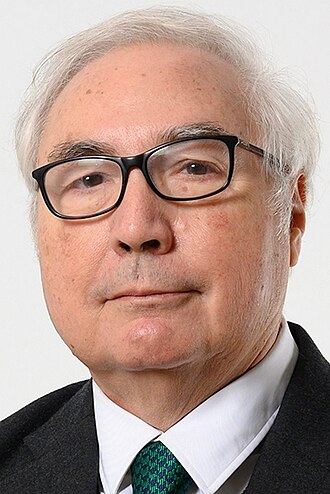
曼纽尔·卡斯特西班牙裔社会学家,南加州大学传播学讲席教授、伯克利荣休教授,以《信息时代》三部曲提出「网络社会」概念;2009年出版《传播权力》(Communication Power),本讲即其核心论点。
布鲁诺·拉图尔法国哲学家与科学社会学家,行动者网络理论(ANT)创立者之一,著有《我们从未现代过》《重组社会》;在问答中质疑「网络」与「权力」两个概念的解释力。
现场提问者参加同一场网络理论会议的学者,包括组织研究者与传播学者,分别从集体行动、历史比较、被排除者的权力、Citizens United 判决等角度提出质疑。
01理论只是工具:方法论前提
0:00
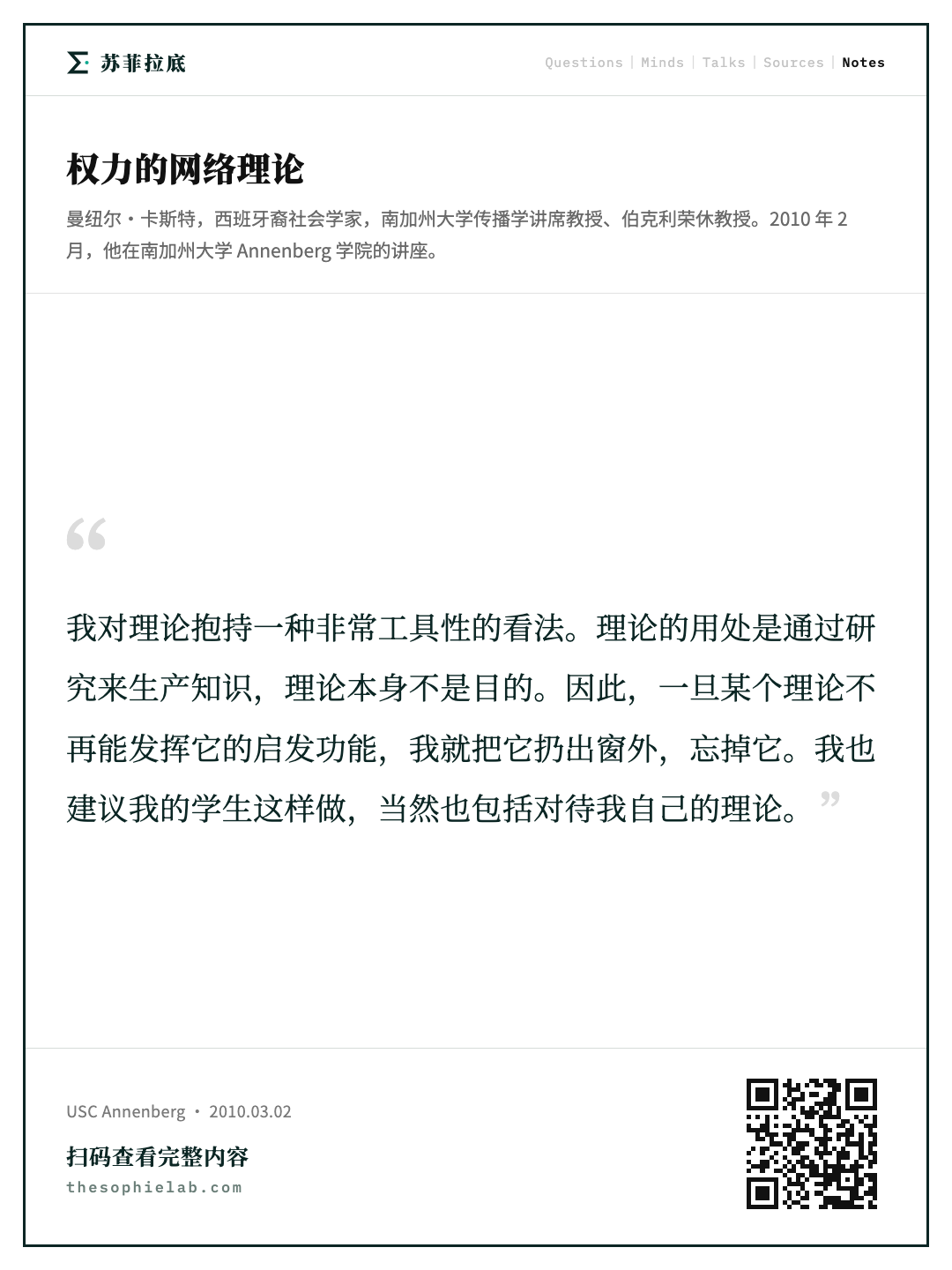
Uh, thank you for your patience and still enduring yet another presentation. I will try to make it as less painful as possible. Uh, well, basically, uh, Karin, uh, gave my definition of power yesterday. David gave my typology of network power today. So, I think I can keep it very brief. And and and and finish off the matter. Uh, let me just, give you a couple of warnings which are, I think, for me they are important in terms of uh, our the communication on our work. For me, I have theory as a special. I have a very instrumental view of theory.
呃,谢谢大家的耐心,还愿意再忍受一场演讲。我会尽量让它不那么难熬。呃,其实呢,Karin 昨天已经把我对权力的定义讲了。David 今天又讲了我的网络权力类型学。所以,我想我可以讲得非常简短。然后就把这个话题收个尾。呃,我先给大家提几个提醒,我觉得对我来说,这些在我们工作交流的层面上很重要。对我来说,理论是一种特别的东西。我对理论抱有非常工具性的看法。
便签笔记
0:45
Uh, theory is useful to produce knowledge through research. Different kinds of research, but through research. It's not a goal in itself. I'm not saying this is a not something that has to be forever equal. That's for me how I use it. And therefore, uh, anytime that some theory doesn't necessarily fulfill its heuristic role, I just throw it through the window and forget about it. And actually, I I advise my students to do the same, including certainly my own theory. Uh, so, what I'm going to present is simply not is not the the definitive theory but power or network power, but the theory that I have used at the end of my research on on power in the network society. And and that at least in what I have investigated in the book that was just published, uh, was useful for me and is up to the readers, commentators, colleagues, uh, to see if that really makes sense in relationship to the empirical evidence I gather. So, let let me be very clear about that that I'm not trying to have a normative framework here, but simply
呃,理论的用处在于通过研究来生产知识。各种各样的研究,但都得通过研究。它本身不是目的。我不是说这是一件不该……不是那种必须永远保持不变的事情。这只是我使用理论的方式。因此,呃,任何时候,只要某个理论未必能发挥它的启发性作用,我就直接把它扔出窗外,不再理会。而且说实话,我也建议我的学生这么做,当然也包括对我自己的理论。呃,所以,我接下来要讲的,根本不是关于权力或网络权力的终极理论,而是我在网络社会权力研究收尾阶段所使用的理论。而且这个理论,至少在我刚出版的那本书里所做的研究中,呃,对我来说是有用的;至于它是否真的与我收集的经验证据相契合,那就要由读者、评论者和同行们来判断了。所以,让我把话说清楚,我在这里并不是要提出一套规范性的框架,只是以一种比较正式的方式来传达,
便签笔记
1:53
communicating in a in a in a formal way, uh, what has been uh my experience of theorizing on power in the network society. Uh second thing, um for me, theory is also specific to context. It's never, uh in my opinion, a general theory of everything and then the entire human experience. For me, theory is a specific to context and the theory I have developed is specific to the type of social structure which I propose that it's uh um characteristic of of the key process in our world, which I call uh the global network society. And therefore, it's difficult to really evaluate too much of it without referring to the entire analysis on the network society, but since I'm not going to summarize the three volumes in 5 minutes, uh this is in the background and we can engage in the discussion uh if if you are interested.
呃,我在思考网络社会中的权力时的经历。呃,第二点,嗯,对我来说,理论也是与具体语境相关的。在我看来,它绝不是一种解释一切、涵盖全部人类经验的普遍理论。对我来说,理论是与具体语境相关的,而我发展出的这套理论,是针对某一类社会结构的——我认为这类结构是呃,嗯,我们这个世界中关键进程的特征,我称之为全球网络社会。因此,如果不参照对网络社会的整体分析,就很难对它做出太多评价,但是,既然我不可能用五分钟总结那三卷书,呃,这些就作为背景放在那里,如果大家有兴趣,我们可以在讨论环节再展开。
便签笔记
02权力与反权力:人类唯一的普遍法则
2:49
Um so, this having this been said, let me uh try to summarize briefly some of the elements for your consideration. Um of course, power relationships are are, for me, the fundamental, the foundational relationships in society and in fact in all societies. Because whoever has power determines the rules and values of the institutions and from there everything derives. Uh fortunately, power is always countered by counterpower. Wherever there is the domination, there is resistance to domination. This is the only, I would say, general law of humankind. There's never one-sided power. It's always power and counterpower, and that what makes it interesting. And the different compromises, strategies, agreements to which people uh arrive or don't arrive and determine the forms of society that they're constantly challenged, constantly evolving because of that. So, it's a very dynamic system, uh even if from the perspective of the individual, sometimes the system doesn't move. But the system moves and moves and in this I'm
嗯,说了这些之后,呃,让我试着简要总结一些要点,供大家思考。嗯,当然,在我看来,权力关系是社会中最根本、最基础的关系,事实上在所有社会中都是如此。因为谁掌握了权力,谁就决定了各种制度的规则和价值,而其他一切都由此衍生。呃,幸运的是,权力总会遭遇反权力的抗衡。哪里有支配,哪里就有对支配的反抗。这是只不过,我想说,这是人类的普遍法则。权力从来不是单方面的。永远是权力与反权力并存,而这正是它有趣的地方。还有各种妥协、策略、协议——人们有的达成了,有的没达成——这些决定了社会的形态,而这些形态因此不断受到挑战、不断演变。所以这是一个非常动态的系统,呃,即使从个人的角度看,有时候这个系统好像不动。但系统一直在动、在动,在这一点上我
便签笔记
3:59
profoundly in agreement with Bruno Latour, moves to the actions of individuals who built each other's networks that produce in structures that uh crystallize in institutions that shape human behavior, but this human behavior is constantly constantly re-ignited, re-initiated by the actions of individuals doing mobilizing, acting, or simply living in terms of their projects and interests and interests under the domination of social structures. So, in this particular context of the global network society, which for me again I consider as the specific social structure that has been produced by recent history and which is characterized to large extent by the fact that the key social processes and organizational forms are organized in networks which are enacted, activated, operated through microelectronic-based technologies of communication, digital transmission, which really explain largely the characteristics of the networks. The same way we could not talk about the industrial society without
深深认同布鲁诺·拉图尔,它随着个体的行动而动,这些个体彼此构筑网络,产生出各种结构,呃,这些结构在制度中固化下来,塑造人的行为,但这种人的行为又不断地、不断地被重新点燃、被重新启动——通过个体的行动:动员、行动,或者只是按照自己的计划和利益生活,在社会结构的支配之下按自己的利益生活。那么,在全球网络社会这个特定的语境下——我再说一次,我把它看作是特定的社会结构,是由晚近历史所生产出来的,其主要特征在很大程度上是:关键的社会过程和组织形式都是以网络的方式组织起来的,而这些网络是通过以微电子为基础的通信技术、数字传输来实施、激活和运作的,这在很大程度上真正解释了这些网络的特性。就像我们谈工业社会时不可能不
便签笔记
5:19
referring to the forms of production and distribution of energy that were specific to the industrial society, we cannot refer to the network society without referring to the technological paradigm, socio-technological paradigm, on which this society is based. And therefore, yes, networks are fundamental. Networks have been a very old form of human existence and human organization and that sense I concur with David. Networks are at the origin of humankind. But again, these networks, the networks that constitute our lives are different networks for kind of reason but one fundamental one fundamental one is the technology of networks.
提到工业社会特有的能源生产和分配形式一样,我们谈网络社会时也不可能不提到技术范式,也就是这个社会赖以建立的社会—技术范式。因此,是的,网络是根本性的。网络是人类存在和人类组织非常古老的形式,在这个意义上我同意大卫的看法。网络与人类同源。但话说回来,这些网络,构成我们生活的这些网络,之所以是不同的网络,原因有很多,但其中一个根本的、一个根本的原因,就是网络的技术。
便签笔记
6:03
So, the what I have attempted in the last years is to address the how network how power relationships work in the context of these global network society. And after a long battle with my data, my observations, and after reading David's book, truly so. And after talking to Peter Monge on on the matter, and he we largely destroyed many of my theories on power in networks. He usefully I think criticism when it is constructive is the form of of producing something. Um I came out at least with the with with the notion that I have to differentiate different forms of power.
所以,我这些年试图做的,是探讨在全球网络社会这个语境中,权力关系是如何运作的。在与我的数据、我的观察长期搏斗之后,在读了大卫的书之后——确实如此。在就这个问题和彼得·蒙格交流之后,我们基本上摧毁了我关于网络中权力的许多理论。他很有帮助地——我认为建设性的批评本身就是一种生产成果的方式。呃,我至少得出了一个想法:我必须区分不同形式的权力,
便签笔记
03四种网络权力的类型学
6:57
Always exercised through networks. And then go more specifically into trying to see which were the fundamental aspects in each form of power in relationship to the operation of power in the networks that organize our lives. That's why I came to this typology that David referred very quickly. And I will I will go slightly more slowly into the matter so that I do not simply repeat what he said. Uh I I differentiate between networking power, network power, network power, and network making power. Um Networking power refers simply to the power of the actors and organizations including in the networks that constitute the core of the global network society over human collectives or individuals who are not included in these global networks. Uh these are quite fundamental uh in terms of of distinctions in terms of policy, for instance. Like the global network economy is based precisely in integrating people who have valued territory who have value and excluding people territories etc. that have no
而它们始终都是通过网络来行使的。然后再更具体地去看,在每一种权力形式中,与权力在那些组织我们生活的网络中的运作相关的根本方面是什么。这就是我提出这个类型学的由来,大卫刚才很快地提到过。我会稍微讲得慢一点,这样就不会只是重复他说过的话。呃,我区分了连网权力(networking power)、网络权力(network power)、网络化权力(networked power),以及编网权力(network-making power)。呃,连网权力指的仅仅是那些被纳入网络的行动者和组织的权力,这些网络构成了全球网络社会的核心,而这种权力是施加在那些未被纳入这些全球网络的人群或个人之上的。呃,这些区分是相当根本的,比如说在政策层面上。就像全球网络经济恰恰建立在把有价值的人、有价值的地域整合进来,同时把那些作为生产者或消费者
便签笔记
8:14
value as either producers or consumers or anything. The entire global economy is organized in what this segmented variable geometry of the economy. So this is very concrete in terms of people's life. And of course in in in terms of science and technology and information uh about uh this point about uh 200-300 universities, depending on how you count, uh produce 85% of the knowledge uh index in social science citation index and the and the ISI index. Uh so uh in every aspect there is a tremendous disparity between what is included and what is excluded and that is a major form of power. Uh you we say academic power that is the power. The power of of individuals and institutions included in this network over the other.
或任何角色都没有价值的人、地域等排除在外。整个全球经济就是按这种分割的、可变几何形态的方式组织起来的。所以这对人们的生活来说是非常具体的。当然,在科学、技术和信息方面也是如此——呃,关于这一点,大约两三百所大学,取决于你怎么统计,呃,生产了社会科学引文索引以及ISI索引中85%的知识成果。呃,所以呃,在每一个方面,被纳入者和被排除者之间都存在巨大的不平等,而这是一种主要的权力形式。呃,我们说学术权力,那就是权力。是那些被纳入这个网络的个人和机构对其他人的权力。
便签笔记
9:06
Um Once the data are created on this uh inclusionary logic that um Don Yea and Wilson uh explained to us yesterday um then the critical thing is to keep this exclusion uh in in terms of the interest of those who are in the network to keep out those who are not in the network and so maintain this power. And this is the the the network gatekeeping theory uh that um that Carine Barcilon has so well spelled out. Although in her presentation here yesterday, she showed also the the fuzzy boundaries of of this gatekeeping, but still the fundamental notion is is through gatekeeping that those who are in the networks keep is a club that keeps power over those who are not in the network simply because they are not. And so that's one fundamental form of power.
呃,一旦数据是按照这种纳入性逻辑生成的——就是唐·耶和威尔逊昨天向我们解释的那种——呃,那么关键的事情就是维持这种排斥,呃,从网络内部那些人的利益出发,把不在网络里的人挡在外面,从而维持这种权力。这就是那个网络守门理论,呃,是卡琳·巴齐莱阐述得非常清楚的。虽然在她昨天这里的报告中,她也展示了这种守门机制模糊的边界,但根本的观点仍然是:正是通过守门,那些在网络中的人维持着一个俱乐部,这个俱乐部对不在网络中的人保有权力,仅仅因为他们不在其中。所以这是一种根本的权力形式。
便签笔记
10:07
But I I would say it's not the only one. The second one that I can see is for those who are in the network at network power that I define exactly in the same terms that David did in his book analyzing globalization, which is um in because any social action and any network action requires social coordination, coordination requires standards, and so the standards that enable global coordination in his terms display network power. So the network power is the power of the standards or in my terminology protocols of communication that determines the rules to be accepted once in the network.
但我要说,这不是唯一的一种。我看到的第二种,是针对那些已经在网络中的人的网络权力,我对它的定义和大卫在他分析全球化的书中所下的定义完全一致,也就是,呃,因为任何社会行动、任何网络行动都需要社会协调,而协调需要标准,所以用他的话说,那些使全球协调成为可能的标准就体现了网络权力。所以网络权力就是标准的权力,或者用我的术语说,是通信协议的权力,它决定了一旦进入网络就必须接受的规则。
便签笔记
10:55
And in this case, the power is exercised not by exclusion from the networks, but by the imposition of the rules of inclusion. Okay. You can come into the network. You are member of the club, but the club has rules. And these rules have been already created. And then might maybe fluid processes of bending the rules or not under certain circumstances. And this of course depends on the embedment of the relationship of power which are already in the network. A third form is what I call network power, which to some extent it's at the same time the simplest way of understanding power, but probably the most um the most complicated.
在这种情况下,权力的行使不是通过把人排除在网络之外,而是通过强加准入的规则。好,你可以进入这个网络。你是俱乐部的成员,但俱乐部有规矩。而这些规矩早就被制定好了。当然在某些情况下可能会有变通规则的流动性过程,也可能没有。而这当然取决于网络中已有的权力关系的嵌入状况。第三种形式是我称之为网络化权力的东西,某种程度上它既是理解权力最简单的方式,但可能也是最,呃,最复杂的。
便签笔记
04强制与说服:塑造头脑胜过折磨身体
11:44
The Once you are in the network, some people in the network have power over the others. Now, I would immediately introduce here the notion of the different forms of power that just as we were starting to to discuss. Uh you go throughout the the history of theory, there in fact it can be simplified to two forms, two basic forms of power, which of course coexist in all societies. Coercive power, the power of ultimately of the monopoly of violence, being legitimate or not, as we were saying yesterday. Ultimately is a guy with a gun. Uh and then what I personally think is extremely important, persuasion power. The power to construct the meaning the the meaning of action in the minds of the people.
一旦你进入了网络,网络里的某些人就对其他人拥有权力。现在,我要马上引入我们刚才开始讨论的那种不同权力形式的概念。呃,你纵观整个理论史,其实可以简化为两种形式,两种基本的权力形式,当然它们在所有社会中都是共存的。强制性权力,归根到底是暴力垄断的权力,无论它是否具有正当性,就像我们昨天说的。归根到底就是一个拿枪的人。呃,然后是我个人认为极其重要的一种,说服性权力。就是在人们头脑中建构意义、建构行动之意义的权力。
便签笔记
12:38
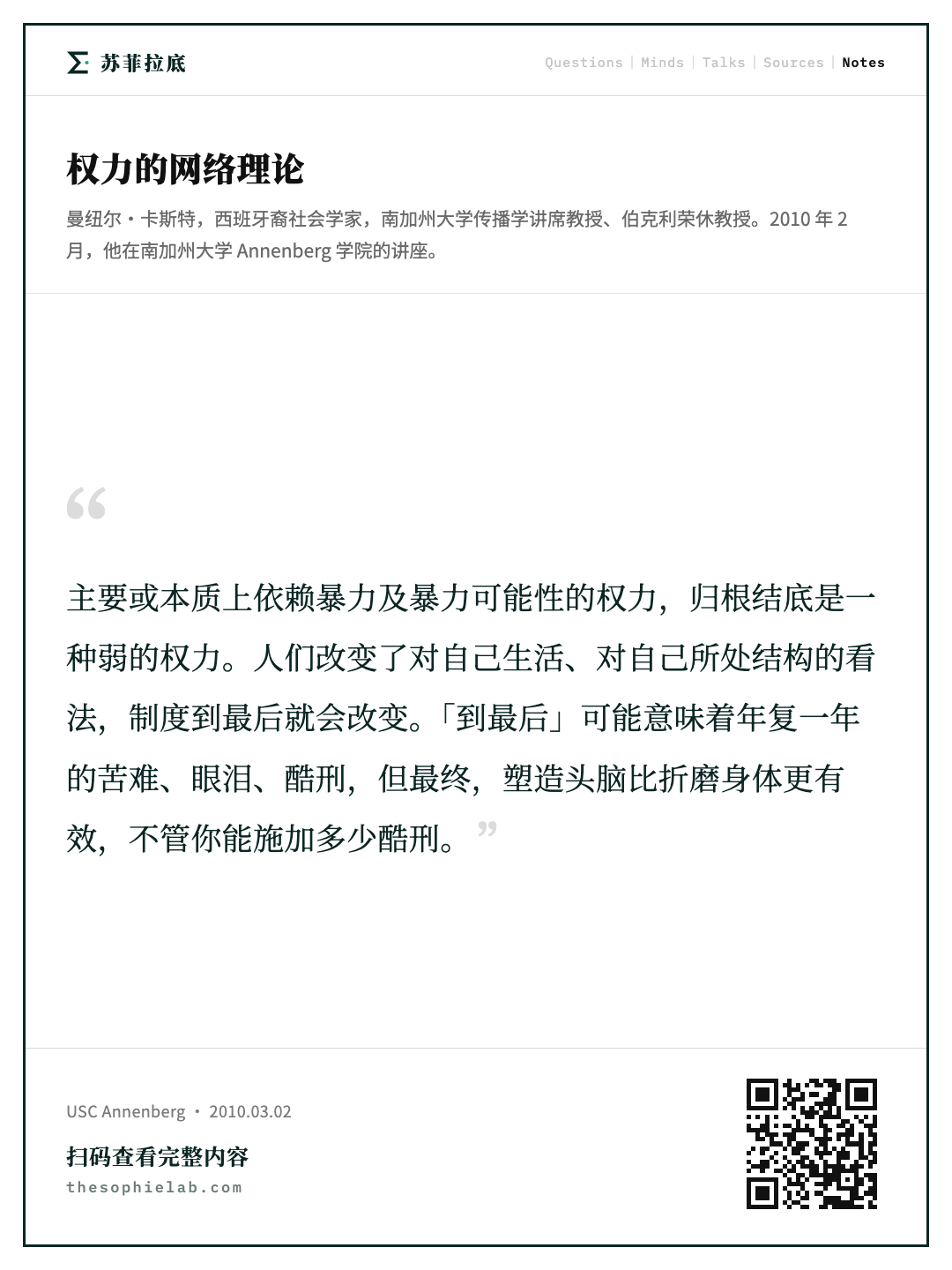
Uh to some extent to to simplify Weber and Gramsci, uh or Weber and Foucault, which is more or less uh So, two forms of power, which always combine in different proportions. Ultimately uh the the the power uh the the idea that you can intimidate if necessary by recurring to the use of force and enforced by by the norms of society. Um also creates constraints the way in which people are going to perceive the reality and therefore is also a form of constructing meaning. But fundamentally, we understand each other at the the construction of meaning and the imposition of uh will uh are two different forms of power, which combine in in their in their articulation. Uh I do think that throughout history, but particularly in our society, the second form uh of power, meaning the capacity to construct meaning through discourses, is the fundamental one because ultimately power that relies primarily or essentially in violence and the possibility of violence is a weak power.
呃,某种程度上是把韦伯和葛兰西简化,呃,或者说韦伯和福柯,差不多就是这样。呃,所以是两种权力形式,它们总是以不同的比例结合在一起。归根到底,呃,这种权力,呃,这种“必要时可以诉诸武力进行威慑”的观念,并由社会规范来强制执行。呃,它也会约束人们感知现实的方式,因此它也是一种建构意义的形式。但根本上说,我们彼此都明白,意义的建构和意志的强加,呃,是两种不同的权力形式,它们在自身的衔接中结合起来。呃,我确实认为,纵观历史,尤其是在我们这个社会,第二种权力形式,也就是通过话语建构意义的能力,才是根本性的,因为归根到底,主要或本质上依赖暴力以及暴力可能性的权力,是一种脆弱的权力。
便签笔记
13:47
It's a weak power. Uh people change the way they think about their life, about their the the the structure where they live, uh down the line uh institutions change. The down the line means maybe years and years of suffering, uh tears, torture, everything, but ultimately um shaping the minds is more effective than torturing the bodies and regardless of how much torture you can inflict. Let's talk about Iran in a few years. Um now with this contest, how does network power operate? The easy answer, the answer that in research we often do, is simply examining how power operates in one particular network.
它是脆弱的权力。呃,人们改变了对自己生活、对自己所处结构的看法,最终制度就会改变。“最终”可能意味着许多年的苦难,呃,眼泪、酷刑,什么都有,但归根到底,呃,塑造头脑比折磨身体更有效,不管你能施加多少酷刑。过几年我们再来谈伊朗吧。呃,那么在这个语境下,网络化权力是如何运作的?简单的答案,也是我们在研究中常做的答案,就是去考察权力在某一个特定网络中如何运作。
便签笔记
14:36
So, that's So, the answer is research. So, can be a micro social network and we we have a long tradition of establishing how power operates. Can be in my case, for instance, analyzing the global financial markets and and and seeing how power operates in the global financial markets and how in fact a number of mechanisms from uh the the lack of regulation to the the ability to um be evaluated by by uh as assessing institutions condition the way the global financial markets work and ultimately all economic power in the world, all, depends on valuation in the global financial markets. And this is a particular form of power that we have identified for a number of years, which many people have been working on that and we have a relatively solid theory about how the economy is controlled by financial markets and how financial markets are controlled by information turbulences together with mechanisms of evaluation which are more and more subjective and less and less related to the rules of the market.
所以,答案就是做研究。可以是一个微观社会网络,我们在确立权力如何运作方面有很长的传统。也可以像我这样,比如说,去分析全球金融市场,去看权力在全球金融市场中如何运作,以及事实上有一系列机制——从呃,监管的缺失,到呃,被评估机构评级的能力——制约着全球金融市场的运作方式,而最终世界上所有的经济权力,所有的,都取决于全球金融市场中的估值。这是我们多年来已经识别出来的一种特定的权力形式,很多人都在研究这个,我们已经有了一套相对扎实的理论,说明经济如何被金融市场控制,以及金融市场如何被信息扰动、连同那些越来越主观、越来越与市场规则无关的评估机制所控制。
便签笔记
05为什么不存在全球权力精英
15:45
Or if we analyze the um the um military power, we can also go into geopolitical analysis, we can see the network of geopolitical domination and military power can identify the United States at the center of this power and therefore there is a hierarchical network, although with alliances, interactions, and strategic partnerships. So, again, that's not difficult to do theoretically. Sometimes it's difficult to do practically, but that's a simple problem. Problem is when we ask the question in more general terms, who has the network power in the global network society, meaning the unified source of power?
或者,如果我们分析呃,军事权力,我们也可以做地缘政治分析,我们可以看到地缘政治支配和军事权力的网络,可以识别出美国处于这一权力的中心,因此这是一个等级化的网络,尽管其中也有联盟、互动和战略伙伴关系。所以,再说一次,这在理论上并不难做。有时候实践上很难,但那是个简单的问题。问题在于当我们用更一般的方式提问:在全球网络社会中,谁掌握网络化权力,也就是说,那个统一的权力来源是什么?
便签笔记
16:34
And there the answer is totally undetermined. Because the only answer would be a global power elite, which is simply empirically wrong. Uh has not We have never been able to identify such a thing. The notion of a unified power elite may have been related to some Central American republic. Um some people in including the United States would have had the idea of of of doing that. Berlusconi has strongly tried to do that in Italy, but it's not so. There there is always a much more complicated process. Now, it doesn't mean that domination doesn't exist or that is fragmented. No.
这个问题的答案是完全不确定的。因为唯一的答案会是一个全球权力精英集团,而这在经验上根本站不住脚。呃,从来没有——我们从来无法识别出这样的东西。统一权力精英这个概念也许适用于某个中美洲共和国。呃,包括美国在内,有些人可能有过这种想法。贝卢斯科尼在意大利曾强力尝试过这么做,但事实并非如此。事情总是要复杂得多,是一个更复杂的过程。不过,这并不意味着支配不存在,或者说支配是碎片化的。不是。
便签笔记
17:14
What happens is that there are different forms of power in each society, economic, political, cultural, scientific, uh etc. etc. uh which are organized in different networks of power, which then establish different relationships of networking between the different networks of power. But this is always negotiated uh relationships, fuzzy relationships, not a unified uh relationship. And that's why it's so important to make the differentiation between the power elite and the formation of ad hoc specific power elites in relationship to a specific historical context.
实际情况是,每个社会中都存在不同形式的权力——经济的、政治的、文化的、科学的,呃,等等等等——呃,它们被组织在不同的权力网络中,而这些权力网络之间又建立起不同的连结关系。但这始终是协商性的,呃,是模糊的关系,而不是一种统一的,呃,关系。这就是为什么区分权力精英与在特定历史语境下形成的、临时性的特定权力精英,是如此重要。
便签笔记
17:56
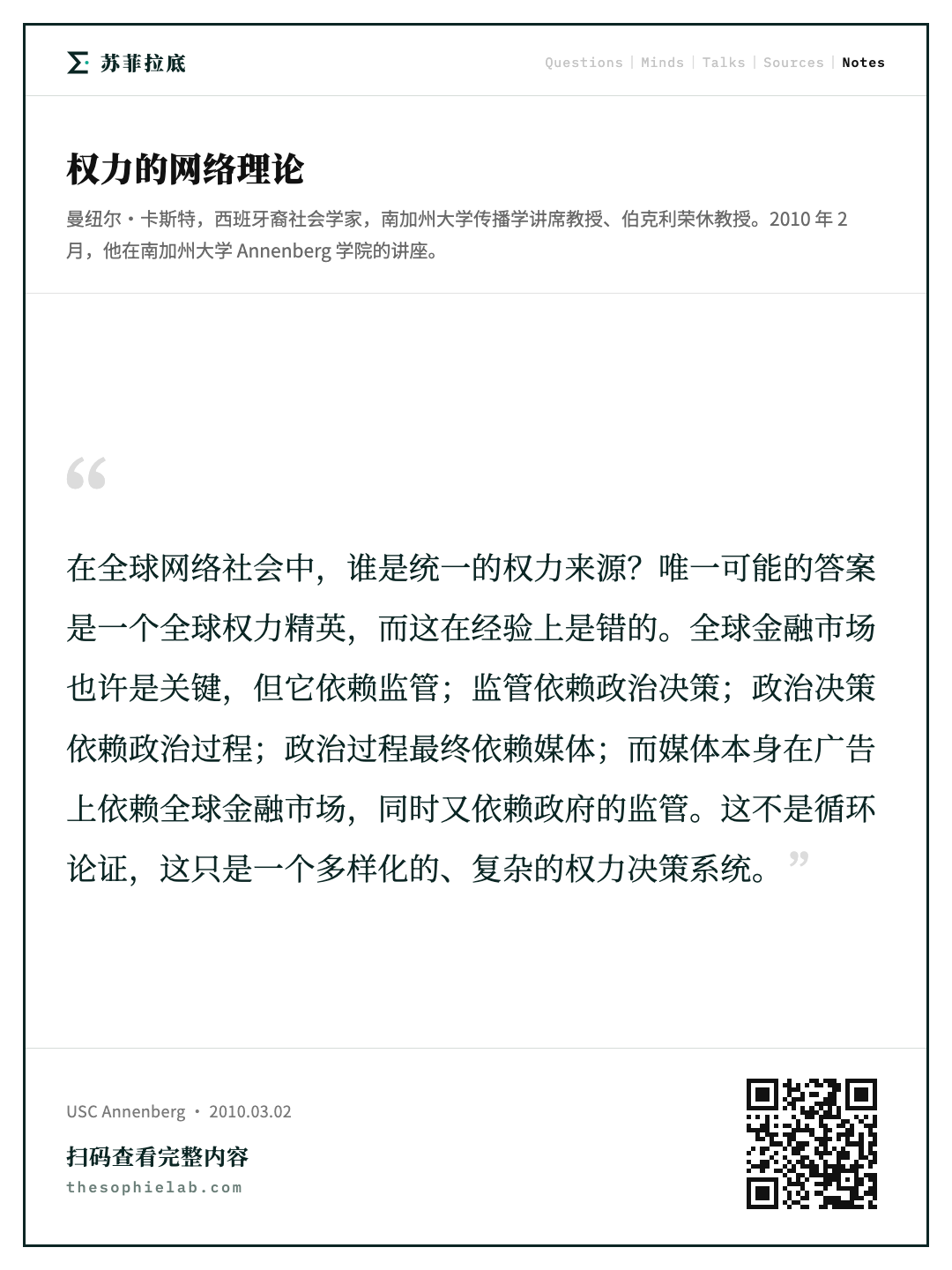
So, in theoretical terms, that means we have to have a clear idea of who has the network power in the different networks, and then a specific analysis of how these different uh network powers connect to each other without necessarily simplifying the mechanism in one single uh form of domination. Uh because ultimately one could say, "Well, the global financial markets could be the critical ones, but they depend on regulation, regulation depends on political decision-making, but political decision-making depends on the political process, which ultimately depends on the media, but the media themselves dependent on the global financial markets for advertising, and at the same time they are dependent on regulation from the governments, and we And this is not a circular argument.
所以,用理论的话说,这意味着我们必须清楚地知道在不同的网络中谁掌握网络化权力,然后再具体分析这些不同的,呃,网络权力是如何彼此连接的,而不必把这个机制简化为某一种单一的,呃,支配形式。呃,因为归根到底有人会说:“嗯,全球金融市场也许是关键,但它们又依赖于监管,监管取决于政治决策,但政治决策取决于政治过程,而政治过程最终取决于媒体,但媒体本身在广告上依赖全球金融市场,同时它们又依赖政府的监管,我们……这并不是一个循环论证。
便签笔记
18:46
It's simply a diversified complex system of political and power decision-making, which connects different networks of power. So, to some extent, I would say that the question of power, as traditionally formulated, makes not much sense in the in the network society, which is so differentiated in terms of the autonomy of each network. But, at the same time, domination and determination in of how people organize their lives, it's alive and well. And the most crucial form of power is what I follow the logic of what I call network making power.
它只不过是一个多元化的、复杂的政治与权力决策系统,它把不同的权力网络连接在一起。所以在某种程度上,我会说,按传统方式表述的权力问题,在网络社会里没有太大意义,因为就每个网络的自主性而言,网络社会是高度分化的。但与此同时,在人们如何组织自己生活这件事上,支配与决定作用依然活跃、依然存在。而最关键的权力形式,是我所遵循的那套逻辑——我称之为「造网权力」(network making power)。
便签笔记
06造网权力:编程与转换两大机制
19:34
And network making power simply operates through two basic mechanisms. First, the ability to constitute the networks, to form networks, and to program and reprogram the networks in ways such that the automated logic of the network favors the interest of those who have interest or values of those who have programmed the networks. Let's say simple thing, Bretton Woods 1944. Or the the establishment in the global economy in the in the 1980s of the Washington Consensus. This is a program. This is a program.
造网权力基本上通过两种基本机制运作。第一,构建网络、形成网络的能力,以及对网络进行编程和再编程的能力,使得网络的自动化逻辑有利于那些拥有利益的人的利益,或有利于那些给网络编程的人的价值观。举个简单的例子,1944年的布雷顿森林体系。或者说,二十世纪八十年代在全球经济中确立的「华盛顿共识」。这就是一套程序。这就是一套程序。
便签笔记
20:18
No regulation, free flow of capital. This is a particular program. The constitution of the WTO. Free free trade for commodities but not for labor. So, all all these are not necessarily logical decision making. It's reflecting rules that then work in the global network which depend on the ability of the uh of the programmers, here is the word, to program the network. Or intellectual property rights legislation. Um or ultimately in technology standards. Standards. Uh there was a time in the 1980s where the telecom operators of the world were trying to establish treaties for the signal to go from one country to another with a border. So, to go from France to Germany, you have to have the signed treaty between the German Telecom and the French Telecom. And that was the logic actually in technology of Minitel, which was a completely self-contained French system from the post office top-down.
不要监管,资本自由流动。这是一套特定的程序。世界贸易组织(WTO)的成立。商品可以自由贸易,但劳动力不行。所以,所有这些不一定是合乎逻辑的决策。它反映的是一些规则,这些规则随后在全球网络中运作,而这取决于——这里就是那个词——「编程者」给网络编程的能力。或者是知识产权立法。嗯,或者归根结底体现在技术标准上。标准。呃,在八十年代有一段时间,世界各国的电信运营商试图订立条约,让信号能从一个国家跨越边界传到另一个国家。所以,要从法国传到德国,你就得让德国电信和法国电信之间签订条约。而这实际上也就是法国 Minitel 的技术逻辑,它是一个完全自成体系的法国系统,由邮政部门自上而下地运作。
便签笔记
21:34
Uh that was supported by the internet. Uh but that was the logic. Okay? So, that was one particular form of a standard that was programmed. So, here I'm not talking about the power of the standard, but the power of those who establish the program of certain type of a standards. That for on the other hand there is a second form of network making power which is the ability to connect and to ensure the cooperation of different networks by sharing common goals and combining resources and at the same time fending off competition from other networks which are not in the cooperation agreements.
呃,那个系统是由互联网支撑的。呃,但那就是当时的逻辑。好吧?所以那是被编程出来的一种特定形式的标准。所以,我在这里说的并不是那种权力——标准,而是那些制定某类标准方案的人所拥有的权力。另一方面,还存在第二种形式的网络构建权力,也就是通过共享共同目标、整合资源来连接不同网络并确保它们相互合作的能力,与此同时抵御来自其他网络的竞争——那些不在合作协议之内的网络。那些不在合作协议之内的网络。
便签笔记
22:25
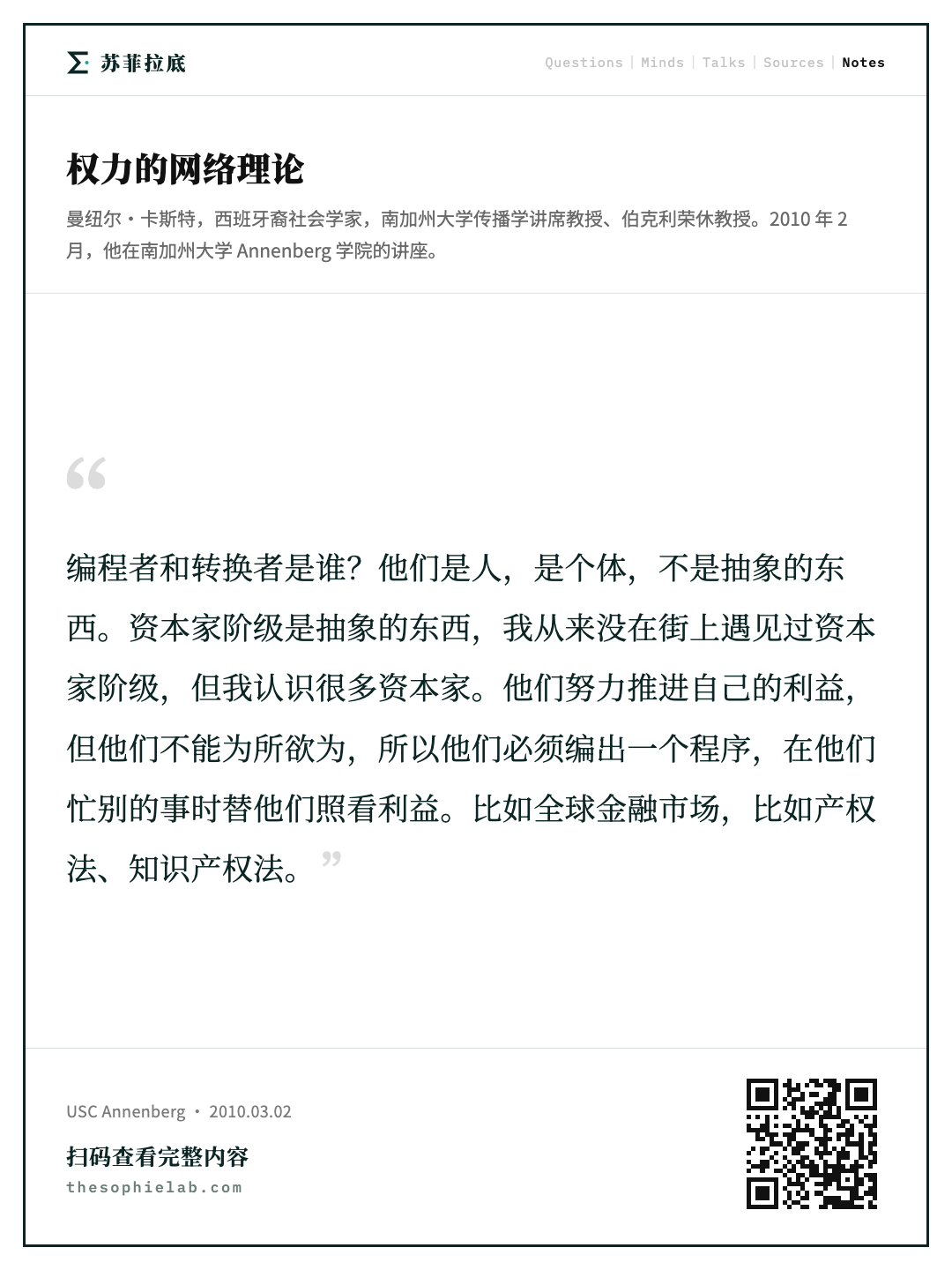
The first mechanism is programming, the second mechanism is switching. And so, we do have holders of power. This is not an abstract notion of power that dissolves in in the network society. The programmers have network making power and the switcher has network making power. Who are the programmers and the switchers? Well, they are people. They are individual. They are not abstract thing. The capitalist class is an abstract thing. I I have never met in the street a capitalist class. What but I know a lot of capitalists, a lot of capitalists. Um who try to forward their interest, but they cannot do everything they want. So, they have to program something that takes care of their interest while they are at work.
第一种机制是编程,第二种机制是转换。所以,我们确实存在权力的掌握者。这并不是一个在网络社会中消解掉的抽象权力概念。编程者拥有网络构建权力,转换者也拥有网络构建权力。那么谁是编程者,谁又是转换者呢?嗯,他们是人。他们是一个个具体的个体。他们不是抽象的东西。资本家阶级才是一个抽象的东西。我从来没有在街上碰到过一个「资本家阶级」。但我认识很多资本家,很多很多资本家。嗯,他们试图推进自己的利益,但他们没法为所欲为。所以他们必须编排出某种东西,在他们上班的时候替他们照看自己的利益。
便签笔记
23:13
Uh like global financial markets. Um or a number of institutions or the property law, the intellectual property right law. And then uh you you try to enforce the intellectual property rights in in the WTO fundamental one, and you don't try to enforce environmental concerns in the WTO. So, you see that's that's the critical thing about about programming. Um now, I would say even more that these the programmers have are individuals. Actors, as we say, not to say individual, but I'm going to say more and more individual. First, uh supporting Bruno Latour's old uh well, actually, the reincarnation of Gabriel Tarde. Uh more than but Bruno always started from that point and building then actors on the basis of networks of individuals.
比如全球金融市场。嗯,或者是一批制度机构,或者是产权法、知识产权法。然后呢,你会去在 WTO 里努力落实知识产权——这是最根本的一条——而你不会去在 WTO 里落实环保方面的诉求。所以你看,这才是关键所在,关于编程。嗯,现在我想说,更进一步地说,这些程序员是个体。用我们的话说是行动者,不是说个体,但我要说越来越个体化。首先,呃,这是在支持布鲁诺·拉图尔(Bruno Latour)以前的,呃嗯,实际上是加布里埃尔·塔尔德(Gabriel Tarde)的转世。呃,不只是这样,但布鲁诺总是从这一点出发,然后在个体网络的基础上建构行动者。
便签笔记
24:09
So, that's exactly how see the the the the process being formed. Individuals uh start as individuals, but they connect and they build networks among themselves to then build structural and institutional networks that will fulfill their interest. And if we go into trying to root, as I'm desperately trying uh with with the permission of Antonio Hana Lamas to ultimately root this in the brain, if we don't have a a connecting point that goes through the individual, uh it's no way we are going to breach uh a a scientific view of society that goes from the brain to the social structures, and therefore we live in separate worlds, and we will not see humans in the same way. Now, but of course, there are mediations, lots of mediations, But the starting point and the connection of these of the networks from the individual brain to the social forms of organization and institution goes through brains who connect to other individuals in terms of their of the construction of the networks, networks that become actor networks and these
所以,这正是我看待这一过程如何形成的方式。个体,呃,一开始是个体,但他们彼此连接,在彼此之间建立网络,进而建立起能实现他们利益的结构性网络和制度性网络。如果我们试图追根溯源——正如我在安东尼奥·哈娜·拉马斯(Antonio Hana Lamas)的许可下拼命尝试做的那样——最终把这一切追溯到大脑,如果我们没有一个穿过个体的连接点,呃,我们就根本不可能触及一种从大脑到社会结构的、关于社会的科学视角,因此我们就活在彼此分离的世界里,我们也不会以同样的方式看待人类。当然,现在,中介是存在的,有大量的中介。但起点,以及这些网络的连接——从个体大脑到社会的组织形式和制度形式——是通过那些与其他个体相连接的大脑来实现的,就其网络的建构而言,这些网络成为行动者网络,而这些行动者网络又在编程着
便签笔记
25:14
actor networks programming the the the different networks. And then switching. Switching again is is fundamental because if the networks are separate, there's no way to make coherent the standards of domination in a society. And therefore, at one point, the um the the financial uh firms and the political authority and uh the media uh corporate uh executives have to find not I don't say sit together in a room and decide the world, but they have to find forms of sharing and cooperating in the organization of the entire system.
不同的网络。然后是转换。转换,再次强调,是根本性的,因为如果这些网络彼此分离,就无法让一个社会中的支配标准变得连贯一致。一个社会中的支配标准。因此,在某个时刻,嗯,那些金融公司、政治权威,还有媒体、企业高管,必须找到——我不是说坐在一个房间里决定世界,而是他们必须找到某种形式,来共享和合作,来组织整个体系。
便签笔记
07默多克与MIT:转换者的实证案例
25:54
Those who are at this at the heart of this switching mechanism, which I call the switchers, are extremely powerful individuals. These are those who use the fastness that Karin talks about in the gatekeeping into making fast for the others, but not for them. Sorry, fast for them, but not for the others. To block the fastness uh in in the outset world. And my the example I have analyzed empirically and there are a couple of articles there etc. is Rupert Murdoch. Murdoch as the the guy who connects the communication network, the media network with the political network, with financial networks.
那些处在这个转换机制核心位置的人,我称之为“转换者”,是极其有权势的个体。他们就是那些利用卡琳所说的守门过程中的“快速性”的人,让自己快,却不让别人快。抱歉,是对他们自己快,对别人不快。用来阻断外部世界的那种快速性。阻断外部世界的快速流动。我做过实证分析的例子——那边也有几篇文章之类的——就是鲁伯特·默多克。默多克是那个把传播网络、媒体网络与政治网络、与金融网络连接起来的人。与金融网络连接起来。
便签笔记
26:34
And he changes his political attitudes completely from one uh moment to the another depending on the strategies, but he keeps always the switching power. Like one of his strategies in the United States but has a a global strategy is to provide ideology to the Republicans and money to the Democrats. Um as as a way to switch with the political power. And in in England, switching from shifting from supporting the Conservatives to supporting Blair uh in terms of the regulatory advantages that he obtained from the Blair government. But again, and all these different forms of of connection are linked yes, to his corporation, NewsCorp. But NewsCorp is actually still family controlled. Uh and it's still personally controlled by by Murdoch.
他会根据策略需要,在一瞬间彻底改变自己的政治立场,但他始终保持着转换权力。比如他在美国的策略之一——不过他有全球性的策略——就是给共和党人提供意识形态,给民主党人提供金钱。给民主党人提供金钱。嗯,这是一种与政治权力对接转换的方式。而在英国,他从支持保守党转向支持布莱尔,换来的是他从布莱尔政府那里获得的监管方面的好处。但同样,所有这些不同形式的连接确实都与他的公司新闻集团(NewsCorp)有关。但新闻集团实际上仍然是家族控制的。嗯,而且仍然由默多克本人亲自掌控。
便签笔记
27:24
Same thing in terms of switching between different networks such as um the academic scientific network and the military network. The switchers, I mean, MIT would not exist without the mili- the connection to the military network. Uh and another universities as well, but MIT is the clearest case. Um and this is okay, it's no no ideological critique here. It's simply saying you need a switch uh to which in in that particular case is both a combination of the university initiatives and the and the Defense Department initiatives. Uh you have the you need this this switch this switching between the two networks in order to ensure the domination of MIT in the uh technology scientific network, one of the leading institution in the world, thanks to the huge amounts of funds received from the Defense Department.
在不同网络之间的转换也是同样的道理,比如学术科学网络与军事网络之间。这些转换者——我的意思是,如果没有与军事网络的连接,MIT 根本不会存在。嗯,其他一些大学也是如此,但MIT 是最清楚的例子。嗯,这里没有什么意识形态批判,只是在说:你需要一个转换机制——在那个特定案例里,它是大学的主动作为与国防部的主动作为二者的结合。嗯,你需要这个在两个网络之间的转换,才能确保 MIT 在技术科学网络中的支配地位,成为世界上最领先的机构之一,这要归功于从国防部获得的巨额资金。
便签笔记
28:18
And at the same time, uh MIT and other institutions providing the US with the most important uh source of military power, which is superior technology and constantly renewed superior technology. So, this kind of switching is what is necessary. Now, does it mean that all the programming and switching mechanisms are ad hoc and we do not we cannot develop an an overall uh theoretical interpretation? Not really. Yes and no. If we're going to the details of the programming and the switching, everything is a specific to the network and to the context.
与此同时,嗯,MIT 和其他机构为美国提供了最重要的军事力量来源,也就是更优越的技术,以及不断更新换代的优越技术。所以,这种转换正是必需的。那么,这是否意味着所有的编程和转换机制都是特设的(ad hoc),我们无法发展出一种总体性的理论解释呢?并不完全是。是,也不是。如果我们深入到编程和转换的细节,一切都是特定于具体网络和具体情境的。
便签笔记
08观念材料与传播网络:权力的共同底层
28:56
But, what I have found in my investigation is that there is something common. In all cases, the programs are built what I call ideational materials. On on on on images, on cultural materials, on ideas, on projects. In other words, there is a common cultural glue in the in the deepest sense of of of of culture. As you In order to to be able to relate to each other, there is something that comes from the world of ideas that then shapes the forms under which networks are programmed and constructed. Discourses in the in the Foucauldian sense.
但是,我在研究中发现,其中有某种共同的东西。在所有情况下,这些程序都是用我所说的“观念性材料”构建的。建立在形象之上、文化材料之上、观念之上、方案之上。换句话说,存在一种共同的文化黏合剂,是在最深层意义上的文化。为了能够彼此发生关联,总有某种来自观念世界的东西,它塑造了网络被编程和建构的形式。也就是福柯意义上的话语。
便签笔记
29:42
And therefore, um because ultimately, ideas materialize in the brains of social actors, ultimately. Otherwise, ideas per se don't exist. Uh ideas are embedded in the brains of social actors. And therefore, the key network making process consists in connecting human networks via communication networks. And that's why I think the fundamental, at least in our society, I don't know in others. In our society, meaning the global network society. Um the fundamental uh form of constructing network making power is related to the communication realm and to communication networks. Because every brain is individual, but what is common to all of us is that we receive the materials with which we construct meaning on the basis of our socialized communication environment.
因此,嗯,因为归根结底,观念要在社会行动者的大脑中物质化,归根结底如此。否则,观念本身并不存在。嗯,观念是嵌入在社会行动者的大脑之中的。因此,关键的造网过程就在于:通过传播网络把人的网络连接起来。这就是为什么我认为,至少在我们的社会里——别的社会我不知道——在我们的社会中,也就是全球网络社会中。嗯,建构造网权力的根本形式,与传播领域、与传播网络相关。因为每个大脑都是个体的,但我们所有人共同拥有的是:我们用来建构意义的材料,都是在社会化的传播环境的基础上接收到的。
便签笔记
30:53
And if therefore the different forms of shaping and control of communication networks uh has an advantage, has an edge on the ways in which we receive information, we process information, we imagine ideas, etc. etc. That's one of the oldest things in media research is that the most important thing in terms of what the media do or don't in terms of the of people's ability to construct their lives is not what they media say, it's what the media don't say. It's a dicom it's a dichotomic thing. You are in, you are out. That's another gatekeeping.
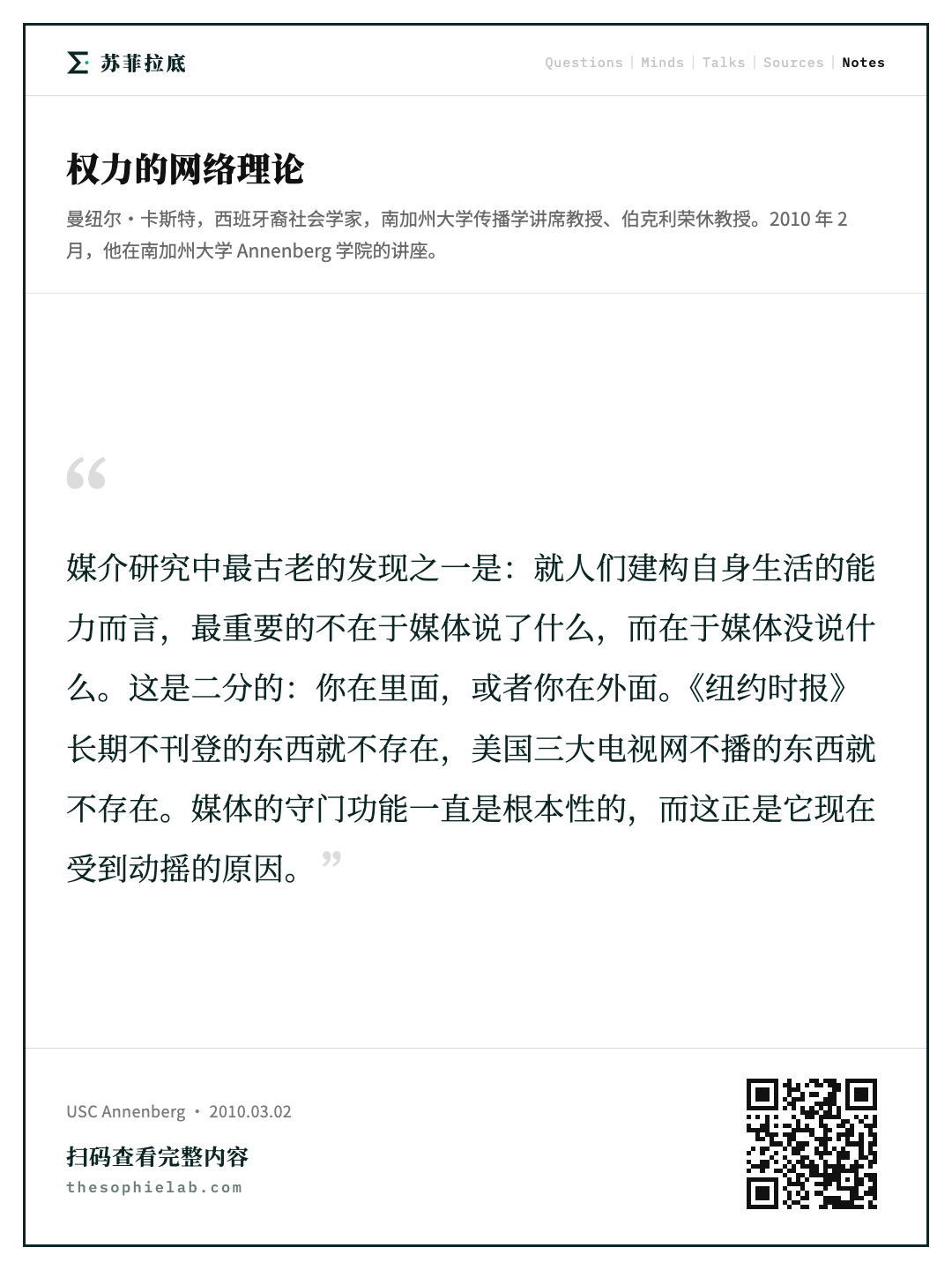
因此,如果对传播网络的不同塑造和控制形式拥有优势,就能在我们接收信息、处理信息、想象观念的方式上占据主导,等等等等。媒体研究中最古老的一个发现就是:就媒体对人们建构自身生活的能力所做或没做的事情而言,最重要的并不是媒体说了什么,而是媒体没说什么。这是一件二分的事情。你要么在里面,要么在外面。这是另一种守门。
便签笔记
09反权力:反编程与扰乱开关
31:28
And that's why the media had been doing gatekeeping for a long time. What was not published for a long time in the New York Times didn't exist or in the three major American networks or in the Do you see? So, the gatekeeping function of the media has been fundamental. And that's why now it's being shaken. Because that's what I wanted to to add in conclusion that um the at the same time that we have this mechanism of construction of power in the network society, we still have of of course, as in any society, mechanisms of counterpower, mechanisms that counter the domination that is established in institutions and that is renewed by power relationships to because societies are different, people are not passive, they try something else, they resist, they challenge, they produce their own things. That's the interesting thing about society, that it never stops. It may be tiring, but not boring. Um and and in in in that sense the um the way in which counterpower is exercised is exactly symmetrical. So, um
这就是为什么媒体长期以来一直在做守门这件事。长期以来,没有在《纽约时报》上发表的东西就等于不存在,或者没上美国三大电视网的东西也是如此。你明白吗?所以媒体的守门功能一直是根本性的。这也是为什么它如今正在被动摇。因为这正是我想在结论中补充的:嗯,在我们拥有这种网络社会中权力建构机制的同时,我们当然也仍然拥有——就像任何社会中一样——反权力的机制,那些对抗在制度中确立的支配的机制,那些被权力关系重新塑造,因为社会各不相同,人们并不是被动的,他们会尝试别的做法,他们会抵抗、会挑战,会创造属于自己的东西。这就是社会有意思的地方,它永远不会停下来。也许让人疲惫,但绝不无聊。嗯,从这个意义上说,反权力被行使的方式,是完全对称的。所以,各种各样的社会行动者都在试图给网络重新编程。
便签笔记
32:37
social actors of all kinds trying to reprogram the networks. So, programming and counter-programming. Like All right, in the global financial markets, the only the only consideration is profit making. Okay, let's include and let's debate that instead of just profit making in the um uh in the um valuation of the stocks of companies, their ecological or environmental responsibility should be included as a number of social movements have been trying and actually succeeded. Or uh if they don't do it directly to the global financial markets, in the way the companies are perceived, like boycotting Nike for the use of uh of child uh labor. Until actually Nike stopped the practice and many other companies. So, in the program of the multinational companies, a number of new criteria have been introduced from the civil society and from social actors changing the program of profit making as the only program of the company.
所以,就是编程与反编程。比如说,好,在全球金融市场里,唯一的考量就是牟利。好吧,那我们就把它纳入进来,让我们来讨论:在对公司股票的估值中,不应该只考虑盈利,还应该纳入它们的生态或环境责任——这正是许多社会运动一直在尝试、而且确实成功推动的事。或者说,如果他们没法直接作用于全球金融市场,那就通过改变公司被外界看待的方式,比如抵制耐克使用童工。直到耐克真的停止了这种做法,还有其他很多公司也是。所以,在跨国公司的程序里,一系列新的标准被公民社会和社会行动者引入进来,改变了那种以牟利为公司唯一程序的程序。
便签笔记
33:42
Uh to to the point that then companies have tried started to use their social responsibility as a second derivative to increase their profit. But, you understand is to increase their profit by increasing market share. But, at the same time, the mechanism of formation of profit uh valuation becomes different. Uh or in in more fundamental ways, the fundamentalist uh if the program that you introduce in leading human action is not the power of money, but the power of God. And if if you introduce in the logic of societies and in the in the minds of the people that the values of God are more important than the values of the stocks, this completely changes the program under which societies are created. And we may, of course, disagree, challenge, be furious against it, but it's a different program.
以至于后来公司开始把自己的社会责任当作一个二阶导数来使用,以便增加利润。但你要明白,那是通过扩大市场份额来增加利润。但与此同时,利润形成、估值的机制本身变得不一样了。或者,在更根本的层面上,原教旨主义的……如果你在引导人类行动时植入的程序不是金钱的力量,而是上帝的力量。如果你在社会的逻辑里、在人们的头脑里植入这样一种观念:上帝的价值比股票的价值更重要,那这就彻底改变了社会被创造出来所依据的那个程序。当然,我们可以不同意,可以挑战它,可以对它感到愤怒,但它就是一个不同的程序。
便签笔记
34:37
That that in in in not only in in the usual suspects in Islamic countries, but I finish in a minute. But if we do but in in the United States, remember significant proportion about 20% of the American electorate are evangelicals. Um which therefore in the in this in the system they introduce other things which simply the the the management of the country, the well-being of the economy God is more important. So that's a change of the of the program. And finally it's the In terms of this switching mechanism, also the form of counterpower is related to disrupting the switches.
这不仅仅发生在人们通常会想到的伊斯兰国家——我一分钟内就讲完。在美国也一样,记住,相当大的一部分,大约20%的美国选民是福音派。嗯,因此在这个体系里,他们引入了另一些东西,简单说就是:比起国家的治理、经济的繁荣,上帝更重要。所以这就是程序的改变。最后,就这种开关机制而言,反权力的形式也和扰乱开关有关。
便签笔记
35:23
It key switches in the in the in the connection between key networks. For instance, when people mobilize to change the the the way the FCC was operating under the Bush administration in terms of managing net neutrality people mobilizing block actually a number of decisions that completely disrupted the type of switch between the the the US government, the US Congress and the industry that have to take into consideration citizen rights to communication. And ultimately the resistance to power in the networks also takes place through and by networks.
也就是关键网络之间连接处的那些关键开关。比如说,当人们动员起来,要改变布什政府时期FCC在管理网络中立性方面的运作方式时,人们的动员实际上阻止了一些决策,从而彻底扰乱了美国政府、美国国会与产业界之间那种开关的运作方式,迫使它们不得不把公民的传播权考虑进去。归根结底,对网络中权力的抵抗,也是通过网络、并且以网络的形式发生的。
便签笔记
36:08
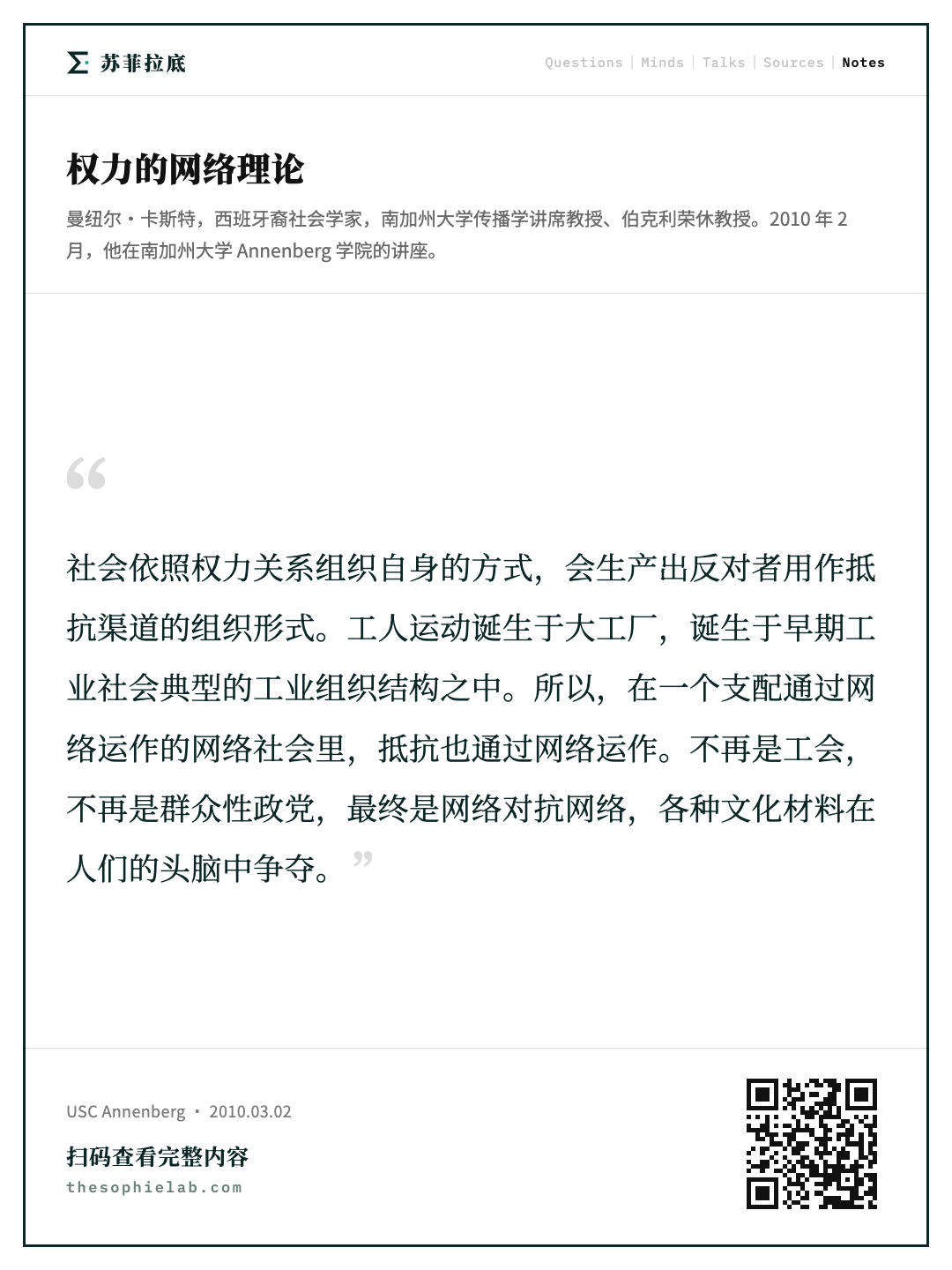
Organizational forms are also networks, have completely changed. These are no longer labor unions, these are no longer mass political parties. These are different types of movements, actions, semi-spontaneous or not collective actions organized in networks. And we shouldn't be too much surprised by it because that what the history of social movements and social protest says, that the the ways in which society is organized in terms of power relationships produces the organizational form that are used as changes of resistance by those who oppose. Example, the labor movement in the 19th century and early 20th century was born in the large in the large factories. Was born in the types of industrial organization structures that were typical of the early industrial society and all the key labor movement were organized there using the socialization of production as the way to organize the socialization of labor and struggle.
组织形式也是网络,已经完全改变了。它们不再是工会,不再是群众性政党。它们是不同类型的运动、行动,是半自发或非自发的、以网络方式组织起来的集体行动。我们其实不必太惊讶,因为社会运动和社会抗争的历史正说明了这一点:社会在权力关系层面上的组织方式会催生出相应的组织形式,而反抗者会把这些形式当作抵抗的手段。比如说,19世纪和20世纪初的工人运动诞生于大工厂之中。它诞生于早期工业社会中典型的那种工业组织结构,所有关键的工人运动都在那里组织起来,利用生产的社会化来组织劳动与斗争的社会化。
便签笔记
37:14
So, in a in a network society in which domination operates through networks, resistance operates also through networks and ultimately it is networks against networks in a logic of cultural materials being fought over the minds of the people by connecting or disconnecting human brains, organizational human networks, brain networks, organizational networks and cultural networks. And that's what I found after 8 years of work.
所以,在一个支配通过网络运作的网络社会里,抵抗同样通过网络运作,最终就是网络对抗网络,其逻辑是围绕文化素材展开争夺,去争夺人们的心智,靠的是连接或断开人的大脑——人的网络、大脑网络、组织网络和文化网络。这就是我经过八年研究后得出的结论。
便签笔记
10问答:个体还是集体在编程
37:47
Thank you very much. We'll open the hands up to the one guest. Um I have a question regarding the nature of the switchers and programmers. So, you were you were talking about the importance of them being individuals. What what about the collectives as being switchers by themselves? Like for example, patterns that occur by Like like what? The collectives. Like the like I don't want to say communities, it's too strong for me, but collectives that are creating patterns and by creating the patterns they're creating the switchers or programming. I cannot think about programming as as Well, I can actually collect it. Wikipedia is a great example.
非常感谢。下面我们把时间交给现场提问。嗯,我想问一个关于「转换者」和「编程者」性质的问题。你刚才谈到了他们作为个体的重要性。那么集体本身作为转换者呢?比如说,由……所产生的那些模式比如什么?集体。比如……我不想说「社群」,那个词对我来说太重了,但那些集体在创造模式,而通过创造模式,他们就创造出了转换者或者编程。我没法把编程想成……嗯,其实我能想到。维基百科就是个很好的例子。
便签笔记
38:26
It's a collective kind of effort of like contributing something is a new structure of of content. So, why looking at the individual only not a collective? Well, it's probably a matter of not just terminology but how you look into the process of formation of the actor because at the root there's always an individual, right? So, then it's a second third order of interaction. Individuals form collectives. But how and why these individuals form the collectives and what which are the the results of the collectives in relationship to the individual depend ultimately on individuals. The only thing that I would add there is that not all individuals are equal. I mean, let's say that a collective of network activists let's say there two examples of of collective action.
它是一种集体性的努力,大家共同贡献,形成了一种新的内容结构。所以,为什么只关注个体而不关注集体呢?嗯,这可能不只是术语问题,而是你如何看待行动者形成过程的问题,因为归根结底,根源上总是有个体,对吧?然后才是第二层、第三层的互动。个体组成集体。但这些个体为什么、如何组成集体,以及集体相对于个体产生了什么样的结果,最终都取决于个体。我唯一要补充的是,并非所有个体都是平等的。我是说,比如一群网络行动者的集体……我们来看两个集体行动的例子。
便签笔记
39:18
Spontaneous networks of protests that those forms constant in the world around mobile communication, Twitter's, etc. They are they are individuals who by responding to someone or to something suddenly form a collective, okay? We we understand that. Now, more organized or stable collectives, let's say the precisely the movement to control FCC in the United States. Well, some individuals start uh and then they form a loose structure, very loose structure, and others other individuals join uh because they follow the belief or or they continue that that trend of action.
自发的抗议网络,这类形式在全世界不断出现,围绕移动通信、推特等等。他们是……他们是一些个体,因为对某个人或某件事作出回应,突然之间就形成了一个集体,对吧?我们……我们明白这一点。那么,更有组织、更稳定的集体,比如说,就拿美国那个要控制FCC 的运动来说吧。一开始是一些个体发起,然后他们形成一种松散的结构,非常松散的结构,接着其他人加入进来,因为他们认同那个信念,或者说他们延续了那种行动的趋势。
便签笔记
40:04
However, who joins and why they join may change the collective. So, it's it's not never going to be a top-down authority. It's going to be a constant fuzzy relationship between the the first movers and the others. And and one of the things that we have not studied well in social movements, by the way, is who were social how and who were in the social movement before the social movement grow up. You know, who are the the initiators, who are the movers. So, the the the initiators of the network that becomes a collective that becomes a collective action are very important and they cannot simply be dissolved as parts of of of a movement.
不过,谁加入进来、他们为什么加入,可能会改变这个集体。所以这……这永远不会是一种自上而下的权威。它会是最初发起者和后来者之间一种持续的、模糊的关系。最初发起的人和其他人之间。顺便说一句,在社会运动研究中我们还没有研究透彻的一点是,那些人是谁、是怎么样的,谁在其中社会运动在社会运动壮大之前。你知道,谁是发起者,谁是推动者。所以,那个���终演变成集体、演变成集体行动的网络,它的发起者非常重要,不能简单地把他们消解为运动的一部分。那个最终演变成集体、演变成集体行动的网络,它的发起者非常重要,不能简单地把他们消解为运动的一部分。
便签笔记
40:50
You see, it it their characteristics are important and a good social history of social movement has to see who did that and why under which conditions. I I don't have the power. Listen. Manuel, I really enjoyed the the clarity of these distinctions and the way you interrelate the four types of power. Um it seems to me though that the third type, the network power, is maybe less typical of the modern of the global network society than the others. This diversified system of competing powers, if I think of the Italian Renaissance, uh you had the financial network of the Medici, you had the uh media network of the Vatican dominating the ideology of the time. Uh you had the king of France using Swiss mercenaries invading Milan.
你看,他们的特质是很重要的,一部好的社会运动史必须看清是谁做了这件事,以及为什么、在什么条件下这么做。我没有那个权力。听着。曼努埃尔,我真的很欣赏这些区分的清晰程度,以及你把这四种权力相互关联起来的方式。嗯,不过在我看来,第三种类型,也就是网络权力,可能不像其他几种那样,是现代全球网络社会的典型特征。这种由相互竞争的权力构成的多元化体系,如果我想到意大利文艺复兴时期,呃,那时有美第奇家族的金融网络,有呃……的媒体网络梵蒂冈主导着那个时代的意识形态。还有法国国王雇佣瑞士雇佣兵入侵米兰。
便签笔记
41:50
All these were competing powers. So, what does this third type of power, in what way is it really typical of our global network society? That was not clear to me. You're right, but it's not typical. Uh no, no. I because one thing I'm saying is not the reverse of the other. I'm not saying that all these only exist in the network society. three do. The other three I think The other three are more dependent on technology, but I wouldn't even mind about if they exist or not. What I say, in the society I observe Yes. these four form these four forms of network power exist. And what exists in other societies is up to the historians.
这些都是相互竞争的力量。那么,这第三种权力,它到底在哪一点上是我们全球网络社会的典型特征呢?这一点我不太清楚。你说得对,但它并不典型。呃,不不。因为我想说的是,这一点并不是另一点的反面。我并不是说这些东西只存在于网络社会里。三个是这样。另外三个,我觉得,另外三个更依赖技术,但它们存不存在我其实都无所谓。我要说的是,在我所观察的这个社会里——是的——这四种网络权力形式是存在的。至于在其他社会里存在什么,那就交给历史学家去说了。
便签笔记
42:31
But the network structure does not shape the third type of power, no? The network structure does shape You know in which one? that does shape But does competition of addition exist also in other ones? No, no, no, no. It's not It's not competition. Um Remember what what I tried to say. And that the network power, which is what people The first reaction of people when say network power, okay, but within the network. Everybody agrees network outside the network is easy. Everybody agrees, well, after some brilliant works around here, everybody agrees that people who are keep at the gate or violence at the gate are not in the network and they don't have the power, etc., etc., until they overrun the gate, of course.
但网络结构并不塑造第三种权力,对吧?网络结构确实会塑造——你知道是哪一种吗?——那个确实会塑造。但是那种叠加的竞争在其他社会里也存在吗?不不不不。那不是——那不是竞争。嗯,回想一下我刚才想说的。就是网络权力,也就是人们……人们一听到网络权力,第一反应是:好吧,但那是在网络内部。大家都同意网络网络之外的情况很好判断。大家都同意——嗯,在这里做了一些出色的研究之后——大家都同意,那些守在门口的人,或者说门口的暴力,并不在网络之内,他们并不掌握权力,等等等等,当然,除非他们冲破了那道门。
便签笔记
43:16
So, but then people say, well, huh, but who are those within the network? How we know who are in power? And that That where my my my response is totally relativistic in saying depends on the network. Depends on the network. And the only thing I'm trying to say, and it these networks may or may not connect, and the important thing is the programs, and that's the fourth type. But now, by saying depends on the network, depends on the goals of a particular network, on the components, and on the technology of the network. So, the technology there is important.
所以,但接着人们会说,嗯,那么,谁在网络之内呢?我们怎么知道谁掌握着权力?而这就是我我的回答完全是相对主义的,我会说:这取决于网络。取决于网络。而我想说的唯一一点是,这些网络可能连接,也可能不连接,而关键在于程序,这就是第四种类型。但现在,说"取决于网络",就是取决于某个特定网络的目标,取决于它的组成部分,取决于这个网络的技术。所以那里的技术是很重要的。
便签笔记
11拉图尔的挑战:网络与权力两个词都该丢掉?
43:54
see. So, there's no generic definition of network power. But there is exist But it exists. There is a form of of power. It's always that My My basic answer is always specific. I think I know what you're saying. It's a good point. I want to disagree with you both. Good. Uh and network and power neither word power nor network are really enlightening. So, maybe we could drop both words. Power because I don't That's my first question is power what is not power. So, I mean what is lost if we take power out?
明白吧。所以并不存在关于网络权力的普遍定义。但确实存在——它是存在的。存在着某种权力形式。总是那样——我的基本回答永远是具体的。我想我明白你的意思。说得好。我想对你们两位都提出不同意见。很好。呃,网络和权力——无论是"权力"还是"网络"这两个词,其实都没什么启发性。所以,也许我们可以把这两个词都扔掉。"权力"——因为我不……我的第一个问题就是:什么不是权力?所以,我的意思是,如果我们把"权力"这个词拿掉,会损失什么?
便签笔记
44:32
And network I begin to be tired by the use of word. Because in fact what you mean is is is if they are understood is electronically mediated social action. Right? I mean this is this is when when there is electronic mediation. Some sort of social technical electronic when but that's what is really new and original, right? But I I I have this difficulty is that it seems to me that a large part of the expansion of the word network in social theory Remember I mean 15 years ago network was used to study the mafia. It was to study over over weak link in the by the way. I mean it was it was it was very marginal.
至于"网络",我开始对这个词的用法感到厌倦了。因为事实上,你们所说的——如果我理解得对的话——是以电子为中介的社会行动。对吧?我是说,这指的是存在电子中介的时候。某种社会技术性的、电子的——但那才是真正新颖和原创的东西,对吧?但我有这么一个困扰:在我看来"网络"这个词在社会理论中的扩张,很大一部分——记得吗,我是说15年前,"网络"这个词还是用来研究黑手党的。是用来研究——顺便说一句——弱连接的。我是说,那时它非常边缘。
便签笔记
45:08
But now it's hegemony. We have to understand why and a large part of that is precisely and I I disagree with the way you you you you you you put it it seems to me but I mean it seems to me the interpretation that it's because of the traceability of social competences and of cognitive activity which we then look at everything as a network. So, it's not You see what I mean the the social It's not that we study specific of them let's call it let's call them electronically mediated. But if we look at the medicine now we use the example of as a network it's precisely because something has happened in the way we interpret every single phenomenon now.
但现在它成了霸权。我们必须搞清楚为什么,而这其中很大一部分正是——我不同意你刚才那种表述方式,在我看来,但我是说在我看来,这种解释是:因为社会能力和认知活动变得可追踪了,我们才因此把一切都看作网络。所以,问题不在于……你明白我的意思吗,那个社会……并不是说我们研究的是特定的那些,我们姑且称之为以电子为中介的。但如果我们看现在的医学,我们把它当作一个网络的例子来讲,正是因为有些东西已经发生了变化变化就在于我们现在解读每一个现象的方式。
便签笔记
45:52
Which we before would have been understood in terms of territory, in terms of society, in terms of macro investigation of something. You see what I mean? So, it it seems to me there is What has happened is the microelectronic revolution in communication information technologies. Exactly that's what has happened. And that's why the networks are different now. However, it doesn't mean that everything has to be mediated through the computer. But in practice, everything is mediated through the computer.
而这些现象在以前会被从领土的角度、从社会的角度、从对某事物的宏观考察的角度来理解。你明白我的意思吗?所以,在我看来,真正发生的是通信信息技术领域的微电子革命。没错,发生的就是这个。这也是为什么现在的网络不一样了。不过,这并不意味着一切都必须通过计算机来中介。但在实践中,一切确实都是通过计算机来中介的。
便签笔记
46:18
But then, what do you mean using a concept which is simultaneously? I mean, I think it's not really confusing when you use the word network now, because it means simultaneously your thing which is studied and which has a history as we know that and and some aspect is original. Don't forget that the first book with the word network of power is Tom Hughes and it's about electricity and Edison. So, I mean, that's nothing to do with electricity. Two two things. Power you confuse the same word? Why do you use the same word to confuse the concept of social theory? And I disagree entirely with what you said at the beginning that theory doesn't count and you can't discard it if we are not able to have a very clear understanding of theory.
但那样的话,你同时使用一个概念是什么意思呢?我是说,我觉得你现在用“网络”这个词其实并不算特别混乱,因为它同时指的是你所研究的那个事物——我们知道它有自己的历史——而其中某些方面又是全新的。别忘了,第一本书名里带“权力网络”这个词的书是汤姆·休斯写的,讲的是电力和爱迪生。所以我是说,那跟电力毫无关系。是两回事。权力你把同一个词混用了?你为什么要用同一个词来把社会理论的概念搞混?而且我完全不同意你一开始说的那句话——说理论不重要、说如果我们没能力对理论有非常清晰的理解,就可以把它丢在一边。
便签笔记
46:56
Then, it means we do nothing scientifically in the social sciences. I mean, you can't just discard it and say, "Well, I use this word and that word." I mean, we have to be precise on that. We use simultaneously a word to describe a thing in the world and a concept. And the concept which study which tends to be many other things. So, I I want to disagree with you more. Sure. I disagree completely with you. Not with that the network theory as I read, but what you just said. That's a Maybe darkness is having a bad effect on you. But uh But no, seriously speaking, the Power is not everywhere. Power is power relationship are very specifically defined. I defined very specifically, except that had been defined three times before me, so I I didn't insist, but I I would reiterate my my definition of power relationships. So, power is one particular form of relationship. I'm just saying it's the fundamental one, because whoever whoever has power shapes the institutions and norms of society according to his her their interest. So,
那样的话,就意味着我们在社会科学里根本没在做科学。我是说,你不能就这么把它丢开,然后说,“好吧,我用这个词、用那个词。”我是说,我们在这一点上必须精确。我们同时用一个词来描述世界上的一个事物,又用它来指一个概念。而这个概念研究的往往是很多别的东西。所以我还要跟你更不客气地唱反调。当然。我完全不同意你。不是不同意我读到的那种网络理论,而是不同意你刚才说的话。这大概是黑暗对你产生了不好的影响。不过呃……不,认真地说,权力并不是无处不在的。权力,权力关系,是被非常具体地界定的。我做过非常具体的界定,只不过在我之前已经有三个人界定过了,所以我没坚持,但我还是要重申我对权力关系的定义。所以,权力是关系的一种特定形式。我只是说它是最根本的那种,因为无论是谁掌握了权力,都会按照他/她/他们的利益来塑造社会的制度和规范。所以,
便签笔记
47:58
in that sense power is very specific. It's not Many of the things we do in society don't involve power relationships except in a very implicit way linked to domination, which for me is power crystalli- crystallized in the institutions of society. It's a different thing. Power is relational, domination is institutional, which is always unstable because of the relational thing. So, this is not that everything power is in in everything. The issue is about how power in the network. Well, then we go back to the notion that what power in If we live in a network society, that's what I said. Huh, sorry.
从这个意义上说,权力是非常具体的。并不是……我们在社会中做的很多事情并不涉及权力关系,除非以一种非常隐含的方式与支配相联系,而支配在我看来就是在社会制度中结晶化的权力。那是另一回事。权力是关系性的,支配是制度性的,而支配又总是不稳定的,正因为背后那层关系性。所以,并不是说一切之中都有权力。问题在于权力在网络中是如何运作的。那我们就回到那个说法:如果我们生活在一个网络社会里,这就是我说的。呃,抱歉。
便签笔记
48:36
That is context in which I place this and and I could not go through out why we it is a power a network society in which the core activities in the economy, in culture, in politics, in in in military terms, everything is organized. The core activities, not everything. The activities that shape and condition the rest are organized in networks. Networks which are specific to our form of social technical organization because they are and they have grown out of the information communication technology revolution. Very much like the industrial society grew out of new forms of production and distribution of energy.
这就是我把这个问题放进去的语境,而我没能讲完为什么我们说它是一个网络社会——在这个社会里经济、文化、政治、军事等各个领域的核心活动,一切都被组织起来。是核心活动,不是一切。那些塑造并制约其余部分的活动是以网络方式组织的。这些网络是我们这种社会技术组织形式所特有的,因为它们是从信息通信技术革命中生长出来的。就像工业社会是从新的能源生产和分配形式中生长出来的一样。
便签笔记
49:19
Okay? Now, networks in other societies of course existed. Of but they are not the same networks because if you have and in any case they are not the networks that constitute our society. It's a very different form to have the Venetian base capitalist class merchant class organizing networks in the Mediterranean than the global financial market today. It's a It's not only a quantitative difference, it's a qualitative difference because of the volume, size, and speed of the transaction. And in that sense, my my observation, not simply a theory. I don't do theories.
好吗?当然,其他社会里也存在过网络。但那不是同样的网络,因为如果你有……无论如何,它们不是构成我们这个社会的那些网络。威尼斯的资本家阶级、商人阶级在地中海组织网络,跟今天的全球金融市场完全是两种不同的形态。这不仅仅是量的差别,而是质的差别,因为交易的规模、体量和速度都不同。从这个意义上说,这是我的观察,而不只是一种理论。我不搞理论。
便签笔记
49:55
Remember, I don't do theories. I try to make sense of what my observation is. And And in my observation, the way power is organized in networks is today entirely dependent of the technology of the network. And that's why I don't do networks in general or history of networks. And I don't say there are networks here and not networks there. Throughout history, there have been very important forms of organization which are networks, together with others. Today, they are dominant. And answering your point about why now we talk about networks, because now every major process, activity, organization in the world is organized in a network which are operated through the new form of information and communication technology. That's exactly why now we talk networks, and throughout history, we have talked networks sometimes, bureaucracies other times, hierarchies, and now we talk fundamentally networks for the reason that through the technology, networks have become pervasive, interactive, interconnected.
记住,我不搞理论。我只是试图理解我观察到的东西。而在我的观察中,今天权力在网络中被组织起来的方式,完全依赖于网络的技术。这就是为什么我不研究一般意义上的网络,也不研究网络的历史。我也不会说这里有网络、那里没有网络。纵观历史,一直存在着非常重要的、属于网络形态的组织形式,和其他形式并存。而今天,它们是主导性的。回答你关于为什么现在我们谈网络的问题:因为现在世界上每一个重大的过程、活动、组织,都是以网络方式组织的,而这些网络是通过新形态的信息通信技术来运作的。这正是为什么我们现在谈网络。而纵观历史,我们有时谈网络,有时谈科层制,有时谈等级制,而现在我们根本上谈网络,原因就在于借助技术,网络已经变得无处不在、互动、互联。
便签笔记
12被排除者可能更有权力?
50:56
At least that to make explicit the terms of our disagreement. So, I was thinking that we have a busy picture and how many hands are moving in one Okay, three or four. Should we try to take the questions and then you give a collective response? Should we try to do one by one? No, no, no, no. Okay, John, go ahead. No, no, no, it's okay. Uh You You can You can make collectives. So, the underlying theme we've heard uh throughout the conference, we heard it again today, is that those who that are excluded from the network are less powerful.
至少这样能把我们分歧的具体所在讲清楚。那我在想,我们这边情况挺热闹的,有多少只手举起来了……好,三四只。我们要不要把问题先收集起来,然后你做一个集中的回应?还是我们一个一个来?不不不不。好吧,约翰,你先说。不不不,没关系。呃,你可以……你可以一起回答。那么,我们在整个会议上一直听到的、今天又听到的一个潜在主题是:那些被排除在网络之外的人权力更小。
便签笔记
51:28
Mhm. And I would argue that that's not always true, and that in fact, a network, and by implication, the members of the network, can have more or less power based on who it is that's excluded from the network. So, sometimes the excluded members are in fact the the powerful actors. So, network forms because the less powerful actors try to develop some kind of a counterpower to try to compensate for that. We see that, for example, in small business networks. Um we've seen it in again another study that I did in police organizations where they want they built a network to share data about drug trafficking among uh you know, several dozen cities. But there was one large city that refused to participate, and it was one that had all the data. It was the one that held almost all the data. And so, it really was much more powerful being excluded from the network than the network was itself. And I wonder how we can build that kind of uh picture or viewpoint into the theory which also says they could be that the
嗯。而我想说的是,这并不总是成立。事实上,一个网络,以及由此推论,网络的成员,其权力的大小取决于被排除在网络之外的是谁。所以有时候,被排除的那些人其实才是有权力的行动者。网络之所以形成,是因为权力较小的行动者试图发展出某种反权力来加以弥补。比如说,我们在小企业网络中就看到这种情况。呃,我们在我做的另一项关于警务机构的研究中也看到过:他们想要,他们建了一个网络来在几十个城市之间共享贩毒方面的数据。但有一个大城市拒绝参与,而恰恰是这个城市掌握着全部数据。它是掌握了几乎所有数据的那一个。所以它被排除在网络之外,反而比网络本身更有权力。我想问的是,我们怎么才能把这种图景或视角纳入理论——这个理论同时也认为,被排除者也可能权力小得多。
便签笔记
52:33
excluded can also be much less powerful. That's absolutely a very relevant point. Look, the way I see it is that um networks are dominant vis-à-vis those who are not in network in relationship to the programs of that particular network. Okay? So, you can have people excluded from that network, but building on creating another network on other types of values and goals. Uh for instance, you can have uh the the the network of people who are protected in terms of law and order by the police, etc. And then you can have the criminal network that has a different goal and that ultimately you can overrun this this this first network. But the point is that uh the the the hypothesis is that without forming networks with the power to impose their goals to other networks which are in conflict or in competition then you are powerless vis-à-vis the network. But you are powerful in your network, and then we go into a second-order analysis which is competition and confrontation between different networks.
这绝对是一个非常切题的观点。你看,我是这么理解的:网络相对于那些不在网络中的人是主导性的,但这是相对于该特定网络的程序而言的。好吗?所以,你可以有一些人被排除在那个网络之外,但他们在别的价值和目标基础上建立起另一个网络。呃比如说,你可以有一个网络,里面的人在治安和法律秩序上受警察保护,等等。然后你还可以有一个犯罪网络,它有不同的目标,最终甚至可能压倒前面那个网络。但关键在于,这个假设是:如果不组成有能力把自己的目标强加给那些与之冲突或竞争的其他网络的网络,那么相对于那个网络你就是无权的。但在你自己的网络里你是有权力的,然后我们就进入二阶分析,也就是不同网络之间的竞争与对抗。
便签笔记
53:43
Sometimes we share goals and then they can negotiate so they compete in relationship to the same goal like market share in terms of television networks and internet company networks or they can confront each other like in the case of Law & Order. But so you're absolutely right the power vis-a-vis the excluded from one network depends on the goals of the network and on the relative importance of the network vis-a-vis the function of society. Absolutely. There was a hand. Yes, go ahead. Uh so this is great. I'll just jump to the the question. Programmers and switchers, do you want to distinguish two kinds of programmers and kinds of switchers in relation to those that use domination to back up their programming of department networks and their ability to switch networks? So consider Murdoch, right?
有时候我们共享目标,那么它们可以谈判,也就是围绕同一个目标竞争,比如电视网络和互联网公司网络之间的市场份额之争;或者它们可以彼此对抗,就像治安与犯罪那种情况。所以你完全说对了:相对于被某个网络排除者的权力,取决于这个网络的目标,也取决于这个网络相对于社会功能的相对重要性。完全同意。刚才有人举手。好,你说。呃,这太棒了。我直接进入问题。程序设定者和交换者,你想不想区分两类程序设定者和两类交换者——一类是那些利用支配来支撑他们对网络的程序设定、以及支撑他们切换网络的能力的人?比如说默多克,对吧?
便签笔记
54:37
He's a programmer of his media networks. He has his own employment he has to tell people what to cover on his channels. He's a switcher because of that same reason. People in political class won't access him because he has that domination-based power over his network making, right? But other people, suppose someone just has a good idea and people Chris, you're at the center of a research network not because you're and you in some ways program an academic agenda through persuasive forms of communication not because you have any access to forms of domination networks.
他是他自己那些媒体网络的程序设定者。他有自己的雇员,他可以告诉人们在他的频道上该报道什么。也正因为如此他是个交换者。政治阶层的人会去接近他,因为他对自己的网络建构拥有那种基于支配的权力,对吧?但另一些人,假设某人只是有个好点子,然后大家……克里斯,你处在一个研究网络的中心,并不是因为你……而你在某种程度上通过有说服力的传播形式来设定学术议程,并不是因为你能接触到任何支配形式的网络。
便签笔记
55:08
So is there is there a distinction there? Is there sort of kinds of programmers and kinds of switchers that you what about their which are parasitic on other forms of domination and which are internal to the networks emergent characteristics? Absolutely. And programmers can be at the same time switchers or not. I prefer conceptually to differentiate them even if if one actor plays plays both roles. But he has a domination-based power that he's capitalizing on in order to play this role in the network. Other people don't have that in their network at the center of networks. Look, after all, um the question is theoretic, in principle abstract, but it's not so abstract. Uh networks operate very efficiently, including and excluding their almost automated self-regulating mechanism, once they have a clear goal and a program and a set of operating procedures.
所以这中间是不是有个区分?是不是存在不同类型的程序设定者和交换者——那些寄生于其他支配形式之上的,和那些内生于网络涌现特性之中的?完全对。而且程序设定者可以同时也是交换者,也可以不是。在概念上我更倾向于把它们区分开,即使同一个行动者扮演了两种角色。但他有一种基于支配的权力,他正是靠这个来扮演网络中的这个角色。而其他人在他们的网络里、在网络中心的位置上并没有这种权力。你看,说到底,呃,这个问题在原则上是理论性的、抽象的,但其实也没那么抽象。呃,网络运作得非常有效率,它们那种近乎自动化的自我调节机制会决定谁进谁出,前提是它们有明确的目标、一套程序和一套运作规程。
便签笔记
55:56
Uh I know perfectly, but the market is a network, right? The market is a network and can have different goals and different operating procedures depending on the regulation by the political network. Okay? So, uh ultimately, programmers are those who individuals connect connected in networks linked to the institutional history can program one the goals and operating procedures one particular network. And then, switchers are those who establish the negotiation, the coordination between different networks excluding other networks from the negotiation, and building something. If Murdoch is able to connect with a political system in Britain and integrate Blair, that means that The Guardian is going to be left out. Uh right? That the BBC is going to start having problems and and even real problems. Uh so, that's one particular way of switching. Uh now, I use Murdoch because it's very clear, but there are many more and more interesting uh elements of of negotiation. And um uh well, first, I'm not so sure that me
呃,我很清楚,但市场就是一个网络,对吧?市场是一个网络,而且它可以有不同的目标和不同的运作规程,取决于政治网络对它的监管。好吗?所以,呃,说到底,程序设定者就是那些在与制度史相连的网络中彼此连接的个人,他们能够为某个特定网络设定目标和运作规程。而交换者则是那些在不同网络之间建立谈判、协调关系的人,他们把其他网络排除在谈判之外,并借此构建某种东西。如果默多克能够跟英国的政治体系连接起来,把布莱尔整合进来,那就意味着《卫报》会被晾在一边。呃,对吧?意味着BBC会开始遇到麻烦,甚至是真正的大麻烦。呃,所以这是交换的一种具体方式。呃,我用默多克举例是因为它非常清楚,但还有更多、更有意思的谈判要素。还有,呃,嗯,首先,我可不太确定我,
便签笔记
57:04
or or Peter or Noss uh we don't have forms of of domination to tell our students about it. Um but but the you One of the networks that has been less explored for obvious reason, you will tell me the obvious reason, um is the connection between the academic scientific networks and the business networks, which really create agendas, which program the universities. Universities suddenly start uh you know, start uh researching about networks, for instance. Why? Because the corporations are extremely interested about network, intellectual property rights. Every time I talk to one of these tycoons, they want to know what people do in in Facebook, right, Jonathan? Um how people uh behave in the internet, uh what happened here, what happened there.
或者彼得,或者诺斯,呃,我们在跟学生讲这些的时候就没有某种支配形式。嗯,但是,有一个网络一直很少被探究,原因显而易见——你会告诉我那个显而易见的原因——就是学术科学网络与商业网络之间的联系,正是它们在真正制造议程,在为大学设定程序。比如说,大学突然就开始,呃,你知道,开始研究网络了。为什么?因为企业对网络、对知识产权极其感兴趣。每次我跟这些大亨中的某一位聊天,他们都想知道人们在Facebook上做什么,对吧,乔纳森?嗯,人们在互联网上怎么行事,呃,这里发生了什么,那里发生了什么。
便签笔记
58:00
And it's only when some people reminding, "Okay, but we want a free internet, a free everything." If they're internet company, they are for the free internet, no problem. Uh just to attract traffic. Um If they're a media corporation, then start having problems, and they only want to talk about intellectual property right. So, uh So, the the switching of the networks uh and who does the switching, and who is the dominant switcher there, has tremendous consequences in the practical life of of all the networks. So, what what I pretend frankly is that the kind of questions I I I have been trying to investigate are very down-to-earth in terms of the practice of power uh in different dimensions of society. But, the critical point is is really what Janet said before. Which networks, I mean, exclusion is not the people in the internet and the people outside the internet. That's a clear exclusion. But, if we talk about networks in general, which programs exclude really from important functions other networks, or
只有当有人提醒说“好吧,可我们想要一个自由的互联网、一切都自由”的时候——如果他们是互联网公司,他们赞成自由的互联网,没问题。呃,只是为了吸引流量。嗯,如果他们是媒体集团,那就开始有问题了,他们只想谈知识产权。所以,呃,所以,网络之间的交换,呃,以及谁在做这个交换、谁是那里的主导交换者,会对所有网络的实际运作产生巨大的后果。所以坦白说,我想表达的是,我一直试图去研究的这类问题,就权力在社会不同维度上的实际运作而言,是非常接地气的。但是,关键点其实就是Janet之前说的。哪些网络——我的意思是,排斥并不是指网上的人和网外的人。那是一种很明确的排斥。但是,互联网上的人和互联网之外的人。那是一种很明确的排斥。但是,如果我们泛泛地谈网络,哪些程序真的把其他网络排除在重要功能之外,或者
便签笔记
13公民联合案与权力研究的处境
58:59
which programs in fact create a a counter-network that ultimately can uh organize a competition in in more in more effective terms. I have one question right there. So, the degree of power that corporations Go ahead. Um I something different. Instead of your scholarly analysis, an opinion I I of yours on the recent Supreme Court ruling that made corporations essentially as powerful as individuals from a free speech and a number of other implications that have followed from it because you said in it's individuals but now it may be more so non-individuals to to go to your you know cooperatives or collective collectives some other phrase and then this has strong implications I feel for rules of the game.
哪些程序实际上创造出一个反向网络,最终能够以更有效的方式组织起竞争。的方式组织起竞争。我这里有个问题。那么,企业所拥有的权力程度……你请说。嗯,我想问点不一样的。不是要你的学术分析,而是想听听你对最近最高法院那项裁决的看法,那项裁决基本上让企业在言论自由以及由此衍生的其他一些方面,变得和个人一样有权力,因为你说过那是个人,但现在可能更多是非个人的主体——回到你说的那些合作组织或者集体、或者别的什么说法,我觉得这对游戏规则有很强的影响。
便签笔记
59:52
Well you are right and basically you are right. I just would say that ultimately corporations are run by individuals right and and and and individuals aggregated in boards in collectives etc. etc. And that ultimately these corporations aggregated in individual these management teams aggregated individuals create directly participate in forms that they were disallowed from participating earlier. Well yes and no. You are right. Technically you are right but you know bundle donations I mean they have never stopped participating through lobbying bundle donations every mechanism. What I would say to some extent this ruling is kind of a one of the of the network which is the judicial network being taken over by the political network which which is not necessarily the current administration but the the political ideas planted in the brains of the Supreme Court judges who were there and that at one particular point seeing the political network losing certain type of control they try to reinstate another type of control at the
嗯,你说得对,基本上你是对的。我只想说,归根结底企业还是由个人经营的,对吧,个人聚合在董事会、集体等等里面。等等。而最终这些企业,聚合成个人的这些管理团队、聚合起来的个人,直接参与到他们以前被禁止参与的形式中去。嗯,是也不是。你说得对。从技术上讲你是对的,但你知道,捆绑式的政治献金——我是说,他们其实从来没有停止过通过游说、通过捆绑献金来参与捐款,各种机制。我想说,在某种程度上,这个裁决可以说是其中一个网络,也就是司法网络被政治网络接管了——这里说的不一定是当下这届政府,而是那些早已植入最高法院大法官脑中的政治理念。到了某个时间点,他们看到政治网络正在失去某种控制权,于是就试图在司法层面重新建立另一种控制,办法就是打开
便签笔记
61:10
level of the judicial by opening up the gate that is unkeeping the gate for the connection between uh, uh, and and the political process. So, substituting for for for for that for that process. So, but if you want to say that it's not individual actors all the time, you're right. I'm just I'm trying to keep some connection to the individual actor because otherwise I cannot connect to to to Damasio's brains. And so because then to jump from the individual brain to the collective brain, things become much more complicated. Uh, it's it's complicated enough like this and they're going to solve the problem, not me. Uh, but that that's why my effort of still trying to keep some level of continuity and not discontinuity. Yeah, here is the human being and here is the society, which in that sense maybe is one of the things that you and I agree.
那道闸门,也就是不再守住那道门,让它去连通呃、呃,以及政治进程。也就是说,用它来替代、替代那个进程。所以,不过如果你想说这并不是一直都是个体行动者在起作用,你说得对。我只是、我是想保留跟个体行动者之间的某种联系,因为不然的话我就没办法接上达马西奥(Damasio)讲的大脑。因为要从个体大脑跳到集体大脑,事情就会变得复杂得多。呃,光是这样就已经够复杂了,而且这个问题得由他们来解决,不是我。呃,但这就是为什么我还是努力想保留某种程度的连续性,而不是断裂。是啊,这边是人,那边是社会——从这个意义上说,这也许正是你我意见一致的地方之一。
便签笔记
62:07
Uh, one of the few that the the the opposition between individual and society has been hunting social scientists all our life. Even we we created psychology instead of of saying, you know, the the clinical study of the brain and personality to actually, uh, create an intermediate category when the social structure had to be individualized at one point. But I I hope that one day we will get rid of psychology and we just had neuroscience and social science directly. So, you got I'll take I'll take the last question.
呃,为数不多的共识之一,就是个体与社会之间的对立困扰了我们社会科学家一辈子。我们甚至创造出了心理学,而不是说,你知道的,就叫对大脑和人格的临床研究,实际上是为了造出一个中间范畴,因为社会结构在某个时刻必须被个体化。但我希望有一天我们能摆脱心理学,只需要神经科学和社会科学直接对接就行。好,那我就、我就接最后一个问题吧。
便签笔记
62:43
Well, not a question, comment. I don't want it to be last word, but it's a comment and it's trying to continue, I think, the point that Bruno made. There's just no question that power is is a sadly, uh, understudied phenomenon in the contemporary social sciences. Years ago, Jim March wrote this very important essay, The Power of Power, where he essentially said no one's been able to measure it, should we dispense with studying it? Ollie Williamson comes along in in '85 and what's he call it? Tosh. You know, it's just stuff we don't look at because if it exists, it's obviously inefficient.
嗯,不算是问题,是个评论。我不想让它成为最后的发言,但这是一个评论,而且它试图延续我想,延续布鲁诺(Bruno)提出的那一点。毫无疑问,权力在当代社会科学中是一个被严重低估、研究不足的现象。多年前,吉姆·马奇(Jim March)写了一篇非常重要的文章《权力的权力》(The Power of Power),他基本上是说,没有人能够测量它,那我们是不是该放弃研究它?奥利·威廉姆森(Ollie Williamson)在1985年出现了,他管它叫什么来着?叫"废话"(tosh)。你知道的,那就是我们不去看的东西,因为如果它存在,它显然是低效的。
便签笔记
63:17
You pick up a PSR and you couldn't find an article on power for for a decade, you know what I mean? So, Who just interested pretty telling. And yet, at the same time, I I'm I'm struck I think I agree with Bruno that that I'm not sure we gain a lot when we take a phenomenon and mash it up with the theory. Um and so, I would almost be just as happy hearing the talk they call the technology of power as opposed to networks of power. I mean, I think many people who got into studying networks did that because they wanted to be closer to action. They wanted to somehow capture flow. They made a relational turn in some sense that was a kind of vision of of social theory.
你翻开一本《政治学研究季刊》(PSR),十年里都找不到一篇关于权力的文章,你明白我的意思吧?所以,谁会感兴趣呢,这挺说明问题的。然而与此同时,我又觉得很触动——我想我同意布鲁诺的看法,我不确定当我们把一个现象和理论混为一谈时,能有多少收获。嗯,所以我可能同样乐意听到这个讲座叫作"权力的技术",而不是"权力的网络"。我的意思是,我觉得很多人之所以开始研究网络,是因为他们想更贴近实际行动。他们想以某种方式捕捉流动。他们做了某种关系性的转向,在某种意义上这是一种社会理论的愿景。
便签笔记
64:06
Um and I could imagine your programmers and switchers idea is just as useful for ancient Mesopotamia, for Renaissance Florence, for contemporary Los Angeles. None of those concepts are super valuable, it seems to me. But, I don't see what I should take on board of thinking of modern technology mediated relationships as a network of power. It seems like a form of power. Um and I might just stop there as a comment. But, about you? What do you guys say? I disagree and that's fine. No, no, sure, sure. No, well, I I do think that technology is transformative and that you go empirically into the analysis and it's transformative for one fundamental reason, which is I It's in fact this is a network theory of power. It's not network powers, it's network theory of power. Uh which in which the the heart ultimately what is common is that they go through communication networks.
嗯,而且我可以想象,你的"程序员和转换器"这个概念,对于古代美索不达米亚、对于文艺复兴时期的佛罗伦萨、对于当代的洛杉矶,都同样有用。在我看来,这些概念都不是特别有价值。但是,我不明白把技术中介的现代关系看作一个权力网络,我该从中吸收什么。它看起来像是一种权力形式。嗯,我的评论可能就说到这里。不过,你怎么看?你们怎么说?我不同意,不过没关系。不不,当然,当然。不,其实我确实认为技术是变革性的,而且你要从经验层面进入分析,它之所以具有变革性,有一个根本原因,那就是……其实这是一种权力的网络理论。它不是网络权力,而是权力的网络理论。其中的核心,最终的共同点在于,它们都要通过传播网络。
便签笔记
65:04
And and what is fundamental for me is that because ultimately the most important form of power is the construction of meaning in our minds through discourses. We have entered only recently in in in a in a world of constantly immersive, interactive, multi-textual communication system. And that's that's new. That's historically new. And because discourses shape minds and discourses are based on the communication environment, if the communication environment changes because of the technology of communication fundamentally changes, then it's a new form of power that we have to investigate. That's at least my my approach.
而对我来说,根本之处在于,归根结底,最重要的权力形式是通过话语在我们头脑中建构意义。我们直到最近才进入一个持续沉浸式、互动式、多文本的传播系统世界。这是新的。这在历史上是新的。而且因为话语塑造思想,话语又建立在传播环境之上,如果传播环境因为传播技术的根本改变而改变,那么这就是一种新的权力形式,我们必须去研究它。至少这是我的思路。
便签笔记
65:51
So it's about communication, not about that.
所以关键在于传播,而不是那个。
便签笔记
视频总结 · 一句话概括与核心要点

一句话概括

卡斯特(Manuel Castells)在此次讲座中提出全球网络社会的"网络权力理论":权力分为四种形态(networking power、network power、networked power、network-making power),其中最关键的是通过"编程"(programming)与"切换"(switching)构建网络的权力,其根基在于借助通信网络塑造人们头脑中的意义。

核心要点

  • 理论是工具而非目标:卡斯特明确其"工具主义理论观"——理论只用于通过研究产生知识,一旦失去启发作用就该"扔出窗外",包括他自己的理论;且理论总是特定于语境,本理论仅针对"全球网络社会"这一社会结构,不是普遍的万物理论。
  • 权力是社会的基础关系,且必然伴随反权力:谁掌握权力谁就决定制度的规则和价值;但"哪里有支配,哪里就有抵抗"是他承认的唯一"人类普遍法则"。社会因此是动态系统:个体行动构建网络→网络结晶为制度→制度塑造行为→个体再度重启行动(此处他与拉图尔一致)。
  • 网络社会的特殊性在于技术:网络作为组织形式古已有之,但当今网络由微电子通信技术激活运作,正如工业社会离不开能源生产分配方式一样,网络社会离不开其社会-技术范式。由此形成的网络在规模、体量、速度上与威尼斯商人网络等历史网络有质的差别。
  • 第一种:networking power(联网权力)——网络内成员对被排斥者的权力。全球经济按"可变几何"整合有价值的人群/地域、排除无价值者;知识领域中约200–300所大学生产了SSCI/ISI索引中85%的成果。守门(gatekeeping)是维持这种排斥的机制。
  • 第二种:network power(网络权力)——借用David Grewal的定义,即协调所需的标准/协议的权力:不靠排斥,而靠强加"入会规则",进网络就必须接受既定协议。
  • 第三种:networked power(网络内权力)——网络内部部分成员对其他成员的权力,分强制(垄断暴力,"归根到底是个拿枪的人")与说服(建构意义)两类,他认为后者更根本,"塑造头脑比折磨身体更有效"(韦伯+葛兰西/福柯)。但追问"谁掌握全球网络社会的统一权力"则无解——不存在经验上可证实的"全球权力精英",只有经济、政治、文化、科学等各自的权力网络之间模糊、协商性的相互连接(金融市场依赖监管→监管依赖政治→政治依赖媒体→媒体依赖金融广告与政府监管)。
  • 第四种也是最关键的:network-making power(构建网络的权力),通过两种机制运作:(1) 编程——设定网络的目标与运作程序,使其自动逻辑服务编程者利益,例如1944年布雷顿森林、1980年代华盛顿共识(去监管、资本自由流动)、WTO(商品自由贸易而劳动力不行;执行知识产权却不执行环保)、1980年代电信运营商的跨境信号条约与法国Minitel;(2) 切换——连接不同网络、共享目标与资源并排斥竞争网络。
  • 编程者与切换者是具体的个人而非抽象阶级:"我从未在街上遇见资本家阶级,但认识很多资本家。"典型切换者是默多克:连接媒体、政治、金融网络,在美国"给共和党意识形态、给民主党钱",在英国从支持保守党转向布莱尔以换取监管优待,且新闻集团仍由家族个人控制。另一例是MIT与国防部的相互切换——MIT凭巨额军方经费主导科技网络,同时为美国提供最重要的军事权力来源即持续更新的技术优势。
  • 所有编程的共同底层是"观念材料"与通信网络:程序建立在图像、文化、话语(福柯意义上)之上,而观念只存在于社会行动者的大脑中,因此构建网络权力的核心是通过通信网络连接人类网络;媒体最重要的权力不在于说了什么而在于不说什么("纽约时报不登的就不存在"),这一守门功能如今正被动摇。他还试图将理论根植于个体大脑(引达马西奥),以打通神经科学与社会科学。
  • 反权力与权力完全对称:反编程——社会运动将环境责任引入公司估值程序、抵制耐克童工直到其停止;宗教原教旨主义以"上帝的价值高于股票价值"彻底更换社会程序(美国选民约20%为福音派);反切换——公民动员在布什时期FCC网络中立议题上阻断政府-国会-产业的切换。抵抗的组织形式也随支配形式变化:19世纪工人运动诞生于大工厂,网络社会的抵抗则是"网络对抗网络"。

结论与值得注意的细节

  • 卡斯特的最终结论("八年研究所得"):网络社会中支配与抵抗都通过网络进行,本质是围绕文化材料争夺人心,通过连接或断开人脑网络、组织网络与文化网络来实现。
  • 问答中的关键交锋:
  • 关于集体作为编程者(如维基百科):他坚持根源仍是个体,但强调"不是所有个体都平等",社会运动研究忽视了"运动兴起前的发起者是谁"。
  • 有听众质疑第三种权力(networked power)并非网络社会独有(文艺复兴时美第奇金融网络、梵蒂冈意识形态网络、法王雇瑞士雇佣兵已是竞争性权力):他承认其他社会也可能存在,答案是"完全相对的,取决于具体网络的目标、成分与技术",没有通用定义。
  • 拉图尔(Bruno Latour)直接反驳:"网络"和"权力"两个词都不再具有启发性,建议改称"电子中介的社会行动";网络概念如今霸权化是因为社会能力可被追踪;并批评卡斯特"理论可随手丢弃"的说法有损社会科学的严谨。卡斯特回应:权力不是无处不在,而是特定的关系(权力是关系性的,支配是制度化的);网络之所以今天成为核心话语,正是因为信息技术革命使网络变得普遍、互动、互联。
  • 另一提问者指出被排斥者有时更强大(如掌握全部数据却拒绝加入警方数据共享网络的大城市):他同意,权力相对于被排斥者取决于该网络的目标及其在社会功能中的相对重要性,进而进入网络间竞争与对抗的二阶分析。
  • 关于程序者是否分"依托支配"与"依托说服"两种(默多克 vs. 学术议程设定者):他承认区分,并指出学术网络与商业网络之间的切换(企业对网络、知识产权、Facebook用户行为研究的兴趣塑造大学议程)是研究不足的领域。
  • 对美国最高法院赋予公司言论权利的裁决,他解读为"政治网络接管司法网络":植入法官头脑中的政治观念在政治网络失去部分控制时,通过司法开闸重建对政治过程的控制。
  • 最后他重申这是"网络的权力理论"而非"网络权力":其新颖之处在于我们刚进入持续沉浸、互动、多文本的通信系统,话语塑造头脑,通信环境因技术而根本改变,因此权力形式是历史上全新的——"关键在于通信"。

核心句型 · 9
1. Wherever there is X, there is Y.
“Wherever there is the domination, there is resistance to domination.”
用「哪里有……哪里就有……」表达普遍法则或必然伴随关系,简洁有力,适合陈述原则性观点。仿写:Wherever there is data, there is the question of who owns it.
2. It's not X, it's Y.
“It's not what they media say, it's what the media don't say.”
先否定常识预期再给出反直觉答案,是制造洞见感的经典结构。注意前后并列成分形式一致。仿写:It's not what you know, it's who you know.
3. A is more effective than B, regardless of how much C.
“Shaping the minds is more effective than torturing the bodies and regardless of how much torture you can inflict.”
比较句加 regardless of 让步,强调结论不受程度影响。适合强调质的差别压倒量的累积。
4. the same way we could not talk about X without Y, we cannot Z
“The same way we could not talk about the industrial society without referring to the forms of production and distribution of energy., we cannot refer to the network society without referring to the technological paradigm”
以历史类比论证当下:先立一个大家公认的前例,再用平行结构推出新主张。学术辩论中很常用。
5. I have never met ... a X. But I know a lot of Ys.
“I have never met in the street a capitalist class. What but I know a lot of capitalists.”
用个人经验对比抽象概念与具体实例,反驳过度抽象化。口语化、有画面感,适合演讲中打破理论迷雾。
6. X is relational, Y is institutional.
“Power is relational, domination is institutional, which is always unstable because of the relational thing.”
并列短句做概念对举,两个形容词各自定义一个术语,再用定语从句补充二者关系。适合给出精炼定义。
7. Yes and no. If we go into ..., everything is X. But what I have found is that there is something common.
“Not really. Yes and no. If we're going to the details of the programming and the switching, everything is a specific to the network. But, what I have found in my investigation is that there is something common.”
回应两难问题的标准套路:先「是也不是」,再分层说明各自成立的条件。避免非黑即白,展示思辨层次。
8. It's not only a quantitative difference, it's a qualitative difference because of ...
“It's not only a quantitative difference, it's a qualitative difference because of the volume, size, and speed of the transaction.”
量变到质变的表达模板,用于回应「这不过是老东西的升级版」类质疑。后接 because of 给出依据。
9. It may be X, but not Y.
“It may be tiring, but not boring.”
先让步再转折,短句收尾有节奏感;两个形容词最好押韵或结构相似,适合做演讲金句。
生词精讲 · 133 · 按出现顺序
enduring /ɪnˈdʊrɪŋ/ v. 0:00
忍受,忍耐(此处自嘲听众要再忍受一场演讲)
typology /taɪˈpɑːlədʒi/ n. 0:00
类型学,分类体系
instrumental /ˌɪnstrəˈmentl/ adj. 0:00
工具性的;起作用的(an instrumental view of theory 工具性的理论观)
heuristic /hjʊˈrɪstɪk/ adj. 0:45
启发式的,有助于发现的(heuristic role 启发性作用)
normative /ˈnɔːrmətɪv/ adj. 0:45
规范性的(与描述性 descriptive 相对)
empirical evidence phr. 0:45
经验证据,实证证据
theorizing /ˈθiːəraɪzɪŋ/ n./v. 1:53
建构理论,理论化
foundational /faʊnˈdeɪʃənl/ adj. 2:49
基础性的,奠基性的
countered /ˈkaʊntərd/ v. 2:49
抵消,对抗(be countered by 受到……的抗衡)
counterpower /ˈkaʊntərˌpaʊər/ n. 2:49
反权力(卡斯特术语,与权力对称的抵抗力量)
domination /ˌdɑːmɪˈneɪʃn/ n. 2:49
支配,统治
crystallize /ˈkrɪstəlaɪz/ v. 3:59
结晶化;使具体化、固定下来
re-ignited /ˌriːɪɡˈnaɪtɪd/ v. 3:59
重新点燃
enacted /ɪˈnæktɪd/ v. 3:59
实施,施行;扮演
paradigm /ˈpærədaɪm/ n. 5:19
范式(technological paradigm 技术范式)
concur with phr. 5:19
同意,与……意见一致(正式用语)
constructive /kənˈstrʌktɪv/ adj. 6:03
建设性的
human collectives phr. 6:57
人类集体,群体
variable geometry phr. 8:14
可变几何(借自航空工程,指结构可按需伸缩变形;卡斯特用以形容全球经济选择性整合)
disparity /dɪˈspærəti/ n. 8:14
差距,不平等
inclusionary /ɪnˈkluːʒəneri/ adj. 9:06
纳入性的,包容性的
gatekeeping /ˈɡeɪtkiːpɪŋ/ n. 9:06
守门,把关(控制信息或准入)
spelled out phr. 9:06
详细阐明,讲清楚
fuzzy boundaries phr. 9:06
模糊的边界
protocols /ˈproʊtəkɔːlz/ n. 10:07
协议,规程
imposition /ˌɪmpəˈzɪʃn/ n. 10:55
强加,强制推行
bending the rules phr. 10:55
变通规则,钻规则的空子
embedment /ɪmˈbedmənt/ n. 10:55
嵌入状态(更常用 embeddedness)
coercive /koʊˈɜːrsɪv/ adj. 11:44
强制的,胁迫的
monopoly of violence phr. 11:44
暴力垄断(韦伯对国家的定义)
persuasion /pərˈsweɪʒn/ n. 11:44
说服,劝说
intimidate /ɪnˈtɪmɪdeɪt/ v. 12:38
威慑,恐吓
articulation /ɑːrˌtɪkjuˈleɪʃn/ n. 12:38
衔接,连接;表达
discourses /ˈdɪskɔːrsɪz/ n. 12:38
话语(福柯意义上的知识—权力话语体系)
down the line phr. 13:47
最终,日后,到后来
inflict /ɪnˈflɪkt/ v. 13:47
施加(痛苦、伤害)
turbulences /ˈtɜːrbjələnsɪz/ n. 14:36
扰动,动荡
valuation /ˌvæljuˈeɪʃn/ n. 14:36
估值
geopolitical /ˌdʒiːoʊpəˈlɪtɪkl/ adj. 15:45
地缘政治的
hierarchical /ˌhaɪəˈrɑːrkɪkl/ adj. 15:45
等级制的
undetermined /ˌʌndɪˈtɜːrmɪnd/ adj. 16:34
未确定的
power elite phr. 16:34
权力精英(C. Wright Mills 术语)
ad hoc /ˌæd ˈhɑːk/ adj. 17:14
临时的,特设的,为特定目的而设的
circular argument phr. 17:56
循环论证
diversified /daɪˈvɜːrsɪfaɪd/ adj. 18:46
多元化的
alive and well phr. 18:46
活得好好的,依然存在(习语)
constitute /ˈkɑːnstɪtuːt/ v. 19:34
构成,组建
Washington Consensus phr. 19:34
华盛顿共识(1980–90年代新自由主义经济政策处方)
commodities /kəˈmɑːdətiz/ n. 20:18
商品,大宗商品
intellectual property rights phr. 20:18
知识产权
self-contained /ˌself kənˈteɪnd/ adj. 20:18
自成体系的,独立的
top-down /ˌtɑːp ˈdaʊn/ adj. 20:18
自上而下的
fending off phr. 21:34
抵御,挡开(fend off competition 抵御竞争)
switching /ˈswɪtʃɪŋ/ n. 22:25
转换,切换(卡斯特术语:连接不同网络)
forward their interest phr. 22:25
推进自己的利益
reincarnation /ˌriːɪnkɑːrˈneɪʃn/ n. 23:13
转世,化身
root ... in phr. 24:09
把……扎根于,追溯到
breach /briːtʃ/ v. 24:09
突破,打通(此处应为 reach/bridge 之意)
mediations /ˌmiːdiˈeɪʃnz/ n. 24:09
中介,媒介环节
coherent /koʊˈhɪrənt/ adj. 25:14
连贯的,一致的
fastness /ˈfæstnəs/ n. 25:54
快速性;(旧义)牢固、堡垒
at the outset phr. 25:54
在开端;此处口误,应为 outside world
regulatory /ˈreɡjələtɔːri/ adj. 26:34
监管的
ideological critique phr. 27:24
意识形态批判
constantly renewed phr. 28:18
不断更新的
ideational /ˌaɪdiˈeɪʃənl/ adj. 28:56
观念的,思想上的
cultural glue phr. 28:56
文化黏合剂(比喻)
Foucauldian /fuːˈkoʊdiən/ adj. 28:56
福柯式的,福柯意义上的
materialize /məˈtɪriəlaɪz/ v. 29:42
物质化,成为现实
per se /ˌpɜːr ˈseɪ/ adv. 29:42
本身,就其自身而言
realm /relm/ n. 29:42
领域,范围
has an edge on phr. 30:53
在……上占优势
dichotomic /ˌdaɪkəˈtɑːmɪk/ adj. 30:53
二分的,非此即彼的(更常用 dichotomous)
shaken /ˈʃeɪkən/ v. 31:28
被动摇(shake 的过去分词)
symmetrical /sɪˈmetrɪkl/ adj. 31:28
对称的
counter-programming n. 32:37
反编程(卡斯特术语,指改写网络的目标与规则)
boycotting /ˈbɔɪkɑːtɪŋ/ v. 32:37
抵制
second derivative phr. 33:42
二阶导数(此处比喻:间接的利润手段)
market share phr. 33:42
市场份额
fundamentalist /ˌfʌndəˈmentəlɪst/ adj./n. 33:42
原教旨主义的(者)
the usual suspects phr. 34:37
惯常的怀疑对象,人们通常会想到的那些(习语)
electorate /ɪˈlektərət/ n. 34:37
选民(总体)
evangelicals /ˌiːvænˈdʒelɪklz/ n. 34:37
福音派基督徒
net neutrality phr. 35:23
网络中立性(运营商应平等对待所有数据流量的原则)
semi-spontaneous /ˌsemi spɑːnˈteɪniəs/ adj. 36:08
半自发的
socialization of production phr. 36:08
生产的社会化(马克思主义术语)
second third order phr. 38:26
二阶、三阶的(second-order 派生层级)
first movers phr. 40:04
先行者,首动者
dissolved /dɪˈzɑːlvd/ v. 40:04
消解,溶解
mercenaries /ˈmɜːrsəneriz/ n. 40:50
雇佣兵
overrun /ˌoʊvərˈrʌn/ v. 42:31
冲破,蹂躏,占领
relativistic /ˌrelətɪˈvɪstɪk/ adj. 43:16
相对主义的
enlightening /ɪnˈlaɪtnɪŋ/ adj. 43:54
有启发性的
electronically mediated phr. 44:32
以电子为中介的
weak link phr. 44:32
弱连接(Granovetter「弱关系的力量」)
hegemony /hɪˈdʒeməni/ n. 45:08
霸权,支配地位
traceability /ˌtreɪsəˈbɪləti/ n. 45:08
可追踪性
microelectronic /ˌmaɪkroʊɪlekˈtrɑːnɪk/ adj. 45:52
微电子的
discard /dɪˈskɑːrd/ v. 46:18
丢弃,抛弃
reiterate /riˈɪtəreɪt/ v. 46:56
重申
relational /rɪˈleɪʃənl/ adj. 47:58
关系性的
institutional /ˌɪnstɪˈtuːʃənl/ adj. 47:58
制度性的
quantitative /ˈkwɑːntɪteɪtɪv/ adj. 49:19
量的,定量的
qualitative /ˈkwɑːlɪteɪtɪv/ adj. 49:19
质的,定性的
bureaucracies /bjʊˈrɑːkrəsiz/ n. 49:55
科层制,官僚体系
pervasive /pərˈveɪsɪv/ adj. 49:55
无处不在的,弥漫的
by implication phr. 51:28
由此推论,言下之意
drug trafficking phr. 51:28
贩毒
vis-à-vis /ˌviːz ɑː ˈviː/ prep. 52:33
相对于,关于(法语借词)
second-order analysis phr. 52:33
二阶分析
parasitic on phr. 55:08
寄生于……之上
emergent /ɪˈmɜːrdʒənt/ adj. 55:08
涌现的,新出现的
capitalizing on phr. 55:08
利用,从……中获利
self-regulating adj. 55:08
自我调节的
tycoons /taɪˈkuːnz/ n. 57:04
大亨,巨头
down-to-earth adj. 58:00
务实的,接地气的
pretend /prɪˈtend/ v. 58:00
(此处为西语/法语式用法)主张,意图;标准英语意为假装
Supreme Court ruling phr. 58:59
最高法院裁决
bundle donations phr. 59:52
捆绑式政治献金(bundling:中间人汇集多人捐款)
lobbying /ˈlɑːbiɪŋ/ n. 59:52
游说
reinstate /ˌriːɪnˈsteɪt/ v. 59:52
恢复,重新建立
continuity /ˌkɑːntɪˈnuːəti/ n. 61:10
连续性
hunting /ˈhʌntɪŋ/ v. 62:07
此处应为 haunting(困扰,缠绕)的误说
understudied /ˌʌndərˈstʌdid/ adj. 62:43
研究不足的
dispense with phr. 62:43
省去,放弃
Tosh /tɑːʃ/ n. 62:43
废话,胡说(英式口语)
pretty telling phr. 63:17
很能说明问题的
mash it up with phr. 63:17
把……与……混在一起
relational turn phr. 63:17
关系转向(社会理论中的范式转变)
take on board phr. 64:06
接受,采纳(观点)
transformative /trænsˈfɔːrmətɪv/ adj. 64:06
变革性的
immersive /ɪˈmɜːrsɪv/ adj. 65:04
沉浸式的
multi-textual adj. 65:04
多文本的(文字、图像、视频等多种符号混合)
理解自测 · 11 题 · 是真懂了,还是以为自己懂
1. 卡斯特区分了哪四种网络权力?各自的核心含义是什么?

四种是:入网权力(networking power)、网络权力(network power)、网络内权力(networked power)和造网权力(network-making power)。入网权力指网内行动者对被排除者的权力,靠纳入/排除运作,典型如两三百所大学生产85%的索引知识;网络权力是标准或通信协议的权力,靠强加准入规则运作,借自 David Grewal 的定义;网络内权力指进入网络后某些成员对其他成员的支配,答案「取决于具体网络」;造网权力是最关键的一种,通过编程(设定网络目标与规则)和转换(连接不同网络)两种机制运作。这一分类在第7至第24段逐一展开。

2. 卡斯特用哪些历史事件说明「编程」?他为什么强调这些不是「合乎逻辑的决策」?

他举了1944年布雷顿森林体系、1980年代的华盛顿共识(去监管、资本自由流动)、WTO 的成立(商品自由贸易但劳动力不行)、知识产权立法以及技术标准(如80年代电信运营商跨境条约与法国 Minitel)。他强调这些不是逻辑必然,而是反映了编程者的利益:WTO 强制执行知识产权却不执行环保标准,正说明规则由谁写、为谁写。这一论证见第21至25段,目的是把看似中性的制度安排还原为具体行动者的利益编排。

3. 默多克如何体现「转换者」的权力?讲者给出了哪些具体策略?

默多克把媒体网络与政治网络、金融网络连接起来,是卡斯特实证分析的转换者典型。具体策略包括:在美国「给共和党意识形态,给民主党钱」;在英国从支持保守党转向支持布莱尔,换取监管上的好处;他会随策略彻底改变政治立场,但始终保持转换权力。卡斯特还指出 News Corp 虽是大公司,仍由默多克家族和本人控制,以此支持「权力掌握者是具体个人」的主张。这些内容在第28至29段,问答中(第66段)进一步说明:整合布莱尔意味着《卫报》被排除、BBC 陷入麻烦。

4. 为什么卡斯特说依赖暴力的权力是「脆弱的权力」?这一判断在他的理论中起什么作用?

他认为权力有强制与说服两种基本形式,强制归根到底是「一个拿枪的人」,而说服是在人们头脑中建构行动的意义。当人们改变对生活和社会结构的看法,制度最终会随之改变,即使这意味着多年的苦难与酷刑;「塑造头脑比折磨身体更有效」。这一判断的作用是把整个理论导向传播:因为最重要的权力是意义建构,而意义材料来自社会化的传播环境,所以造网权力的根本形式落在传播网络上(第12–14段与第33–34段),这也是他在结尾回应批评时的最终依据。

5. 卡斯特为什么拒绝「全球权力精英」这一答案?他用什么替代?

他认为「统一的全球权力精英」在经验上站不住脚:从未有人识别出这样的集团,它最多适用于某个中美洲小国或贝卢斯科尼的意大利尝试。实际情况是经济、政治、文化、科学各领域有各自的权力网络,网络之间的关系是协商的、模糊的。他以金融→监管→政治→媒体→金融的依赖链说明这不是循环论证,而是一个多元复杂系统。替代方案是区分「权力精英」与「特定历史语境下的临时性权力精英」,并引入造网权力来解释支配为何仍「活得好好的」(第16–20段)。

6. 「权力是关系性的,支配是制度性的」这句话如何回应拉图尔「什么不是权力」的质疑?

拉图尔质疑若权力无处不在,这个词就失去解释力。卡斯特回答权力并非无处不在,而是一种被具体界定的关系:掌握权力者按自身利益塑造社会的制度与规范。社会中许多活动不涉及权力关系,除非以隐含方式与支配相连。支配是权力在制度中「结晶化」的结果,是制度性的;但正因为它源于关系,所以永远不稳定。这一区分(第55–56段)让「权力」保留了特定性,也解释了第3段「权力总被反权力抗衡」的动态性:制度是暂时的结晶,关系会不断改写它。

7. 讲者如何论证反权力与权力「完全对称」?举出他给的反编程与反转换例子。

他认为支配通过网络运作,抵抗也就通过网络运作,机制一一对应。反编程的例子:社会运动推动把环境责任纳入公司估值;抵制耐克使用童工直到其改变做法;更根本的是宗教原教旨主义用「上帝的价值」替换「股票的价值」,包括美国约20%的福音派选民。反转换的例子:布什时期公民动员改变 FCC 在网络中立性上的做法,扰乱了政府—国会—产业之间的「开关」。他还用19世纪工人运动诞生于大工厂的类比说明:支配的组织形式决定抵抗的组织形式(第35–41段)。

8. 拉图尔认为「网络」一词从边缘走向霸权的原因是什么?卡斯特的回答与之有何不同?

拉图尔指出15年前「网络」只用于研究黑手党和弱连接,如今却成了霸权词汇;他的解释是数字技术使社会能力与认知活动变得「可追踪」,于是我们把一切现象都当作网络来解读——这是我们解读方式的变化,而非世界本身的变化。卡斯特则坚持本体论立场:微电子革命确实改变了网络本身,使其无处不在、互动、互联,从而在组织形式上取代了科层制与等级制的主导地位;威尼斯商人网络与全球金融市场之间是质的差别。两人的分歧在第51–59段,本质是认识论转向还是社会结构转变。

9. 约翰提出「被排除者可能更有权力」的警务数据案例。卡斯特的回应是否真正化解了这一反例?

卡斯特回应说,网络的支配性是相对于该网络的程序而言的;被排除者可以基于其他目标另建网络,进入「网络间竞争与对抗」的二阶分析,权力大小取决于网络的目标及其在社会功能中的相对重要性。这在逻辑上自洽,但也暴露了理论的弹性:把拒绝加入的大城市视为「另一个网络」,几乎可以解释任何反例,正如他自己承认「我的回答完全是相对主义的」(第49段)。可以说他保住了框架的一致性,代价是入网权力这一类型的预测力被削弱,这正是拉图尔与最后评论者所批评的「什么都能解释」问题。

10. 如果有人反驳「编程者/转换者概念对美索不达米亚和文艺复兴同样适用,因此没有历史特殊性」,卡斯特会怎么回应?

这正是最后评论者的质疑。卡斯特的回应有两层。第一,他并不主张这些概念只存在于网络社会,只说在他观察的社会里四种权力都存在,其他社会「交给历史学家」。第二,也是关键一层:技术是变革性的,因为最重要的权力是通过话语建构意义,而我们刚刚进入一个「持续沉浸、互动、多文本」的传播系统,这在历史上是新的。既然话语依赖传播环境,传播环境因技术根本改变,权力形式就必然是新的,所以这是「权力的网络理论」而非「网络权力」。换言之他承认概念的普适性,但主张其运作条件发生了质变。

11. 把「编程与转换」框架迁移到今天的大型 AI 平台,能否成立?会遇到什么困难?

在相当程度上成立:训练数据的筛选、内容政策、对齐目标相当于「编程」,决定了网络的自动化逻辑偏向谁的价值;平台高管与政府监管、资本市场的对接相当于「转换」,Citizens United 案的解读(司法网络被政治网络接管)也可类比监管俘获。反编程则表现为开源模型、公民对算法透明度的动员。困难在于卡斯特坚持「编程者是具体个人」以连接 Damasio 的神经科学,而 AI 系统的行为很大程度上由训练过程涌现,责任难以追溯到个人;同时他的「意义在人脑中物质化」的前提,面对机器生成话语时需要重新审视——媒体「不说什么」的守门权力,现在部分转移到了模型本身。

精读便签
下载便签 手机:长按图片保存
← 上一期 · NO.046Douglas Hofstadter: The Nature of Categories and Concepts 下一期 · NO.048 →Arthur Schopenhauer's Philosophy - Bryan Magee & Frederick Copleston (1987)
问题周报 WEEKLY LEDGER 每周一封:本周入库的精读、一个值得带走的问题、一条苏菲按。随时退订。
免费 · 每周一封 · 一键退订
苏菲拉底 THE SOPHIE LAB · ASK THE BEST MINDS THE BIG QUESTIONS 内容仅供学习 · thesophielab.com