视频库 / NO.054ASK THE BEST MINDS THE BIG QUESTIONS一人,一实验室
视频库 / NO.054
字幕 字幕位置
--:--
点击播放,这里会跟随视频显示当前句的中英字幕。
第 54 期

Ludwig Wittgenstein's Philosophy - John Searle & Bryan Magee (1987)

节目发布 2023-08-24
章节 · 点击跳转视频
0:00 维特根斯坦:最后一位公认的大哲学家 ▶ 正在看
0:00 从工程学转向数学哲学的求学之路 ▶ 正在看
0:38 两本书两种哲学:一生的思想断裂 ▶ 正在看
3:13 《逻辑哲学论》的图像论意义理论 ▶ 正在看
6:09 逻辑常项不作图:否定与基本命题 ▶ 正在看
7:31 可说与不可说:伦理宗教的沉默边界 ▶ 正在看
9:03 从图像隐喻转向工具与用法隐喻 ▶ 正在看
11:06 家族相似性:游戏并无共同本质 ▶ 正在看
15:10 语言游戏:无需外部根据的规则活动 ▶ 正在看
18:22 无法跳出语言游戏审视实在 ▶ 正在看
20:15 宗教话语:描述而非评判其成败 ▶ 正在看
23:38 遵守规则与私人语言论证 ▶ 正在看
27:30 意义依赖生活形式与社会训练 ▶ 正在看
29:16 格言体写作风格的成因与代价 ▶ 正在看
32:07 跨学科影响:社会科学与文学批评 ▶ 正在看
33:52 塞尔的批评:反理论倾向与宗教含混 ▶ 正在看
37:36 塞尔的评价:语言哲学与反笛卡尔贡献 ▶ 正在看
39:55 行动先于理论:我们就是这样做的 ▶ 正在看
02从工程学转向数学哲学的求学之路
0:00
In philosophy, as in most other fields of human activity, the merits of the living are much more controversial than those of the dead. If you took a worldwide poll today among professors of philosophy on the question, who is the best living philosopher, I'm pretty sure no candidate would get an overall majority. So, any list of the so-called great philosophers can only end with the latest of the generally acknowledged dead. And today, for us, that is Wittgenstein. Ludwig Wittgenstein was born in Vienna in 1889. His father, from whom he was to inherit a fortune, was the biggest steel magnate in Austria.
在哲学领域,就像在人类活动的大多数其他领域一样,在世者的成就要比逝者的成就更具争议性。如果今天在全世界的哲学教授中做一次民意调查,问谁是在世的最伟大哲学家,我敢肯定没有哪位候选人能获得总体上的多数票。所以,任何一份所谓伟大哲学家的名单,都只能截止到公认已故者中最晚近的那一位。而今天对我们来说,那个人就是维特根斯坦。路德维希·维特根斯坦1889年生于维也纳。他的父亲是奥地利最大的钢铁大亨,后来他继承了一笔财产。
便签笔记
03两本书两种哲学:一生的思想断裂
0:38
Wittgenstein was fascinated by machinery from boyhood, and his education was strongly weighted in the direction of mathematics, physics, and engineering. After studying mechanical engineering in Berlin, he spent 3 years at Manchester University as a postgraduate student in aeronautics. During this period, he became absorbed in fundamental questions about the nature of mathematics. Bertrand Russell's book, Principles of Mathematics, inspired him to give up engineering and go to Cambridge to study the philosophy of mathematics under Russell himself. He soon learned all that Russell had to teach and went on to do the original research that was to produce his first book, the Tractatus Logico-Philosophicus, published in 1921, and usually referred to just as the Tractatus.
维特根斯坦从小就着迷于机械,他所受的教育也明显偏重于数学、物理和工程。在柏林学习机械工程之后,他在曼彻斯特大学度过了三年,攻读航空学研究生。在这段时期,他开始全神贯注于有关数学本质的根本问题。伯特兰·罗素的《数学原理》一书启发他放弃工程学,转赴剑桥,师从罗素本人研究数学哲学。他很快就学完了罗素所能教的一切,接着开始做原创研究,最终写成了他的第一本书《逻辑哲学论》,该书出版于1921年,通常简称为《逻辑哲学论》。
便签笔记
1:28
Wittgenstein genuinely believed that in this book he had solved the fundamental problems of philosophy. So, he turned away from philosophy and did other things. Meanwhile, the Tractatus acquired enormous influence, stimulating further developments in logic at Cambridge, and on the continent becoming the most admired text among the famous group of logical positivists known as the Vienna Circle. But Wittgenstein himself came to feel that it was fundamentally in error. So, he went back to doing philosophy after all. In 1929, he returned to Cambridge, where in 1939, he became Professor of Philosophy.
维特根斯坦真心认为,自己在这本书里已经解决了哲学的根本问题。于是他离开了哲学,去做别的事情。与此同时,《逻辑哲学论》产生了巨大影响,推动了剑桥逻辑学的进一步发展,在欧洲大陆则成为被称作维也纳学派的那群著名逻辑实证主义者中最受推崇的文本。但维特根斯坦本人后来觉得这本书根本上是错的。于是,他终究还是回到了哲学。1929年,他重返剑桥,并于1939年成为那里的哲学教授。
便签笔记
2:06
During this second period at Cambridge, he developed a completely new approach, quite different from his earlier one. During the rest of his life, its influence spread only through personal contact, since apart from one very brief article, he published nothing more before his death in 1951. However, in 1953, his book Philosophical Investigations came out posthumously and proved to be the most influential work of philosophy that's appeared since the Second World War, at least in the English-speaking world.
在剑桥的第二个时期里,他发展出了一套全新的方法,与他早期的思路截然不同。在他余生中,这套思想只通过个人接触传播开来,因为除了一篇非常简短的文章之外,直到1951年去世前他再没有发表过任何东西。然而,1953年,他的《哲学研究》一书在他身后出版,并被证明是最具影响力的著作自二战以来出现的哲学,至少在英语世界里是这样。
便签笔记
2:37
So, here we have a most remarkable phenomenon, a philosopher of genius producing two incompatible philosophies at different stages of his life, each of which influenced a whole generation. These two philosophies, although incompatible, do have some basic features in common. Both are focused on the role of language in human thinking and human life, and both are centrally concerned to demarcate between valid and invalid uses of language, or as someone once put it, to draw the lines at which sense ends and nonsense begins.
所以,我们在这里看到一个极其非凡的现象:一位天才哲学家在人生的不同阶段提出了两种互不相容的哲学,而每一种都影响了整整一代人。这两种哲学虽然互不相容,但确实有一些基本的共同点。二者都聚焦于语言在人类思维和人类生活中的作用,而且二者的核心关切都是划清语言的有效使用与无效使用之间的界限,或者像有人曾经说过的那样,划出意义终止、胡话开始的那条线。
便签笔记
04《逻辑哲学论》的图像论意义理论
3:13
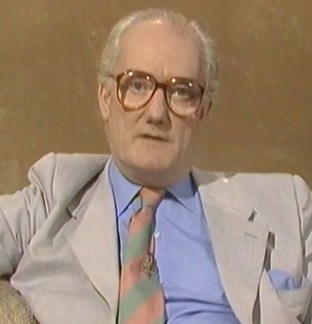
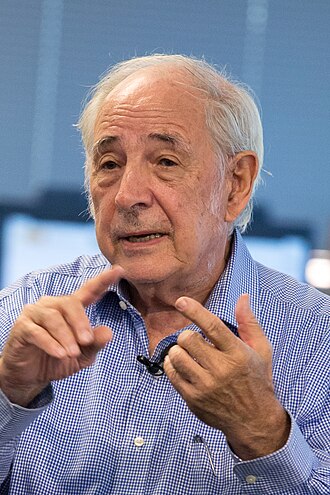
For me, the earlier of Wittgenstein's two main books, the Tractatus, remains hauntingly readable. But, it has to be said that it's the later one, the Philosophical Investigations, that has made him a cultural figure of international significance during the period since his death. Here to discuss Wittgenstein's work with me is John Searle, Professor of Philosophy at the University of California in Berkeley. Professor Searle, since Wittgenstein himself repudiated his early philosophy, and since in any case it's now the later philosophy that's far and away the more influential, I don't think we ought to spend too much of our discussion on the early work. What is it about that that we really need to know?
对我来说,维特根斯坦两本主要著作中较早的那本《逻辑哲学论》,至今读来仍萦绕心头。但不得不说,真正让他在去世之后的这段时期成为具有国际意义的文化人物的,是后来的那本《哲学研究》。今天来和我一起讨论维特根斯坦著作的是约翰·塞尔,加州大学伯克利分校哲学教授。塞尔教授,既然维特根斯坦本人否定了他的早期哲学,而且无论如何,如今影响力遥遥领先的是后期哲学,我想我们不应该在讨论中花太多时间谈早期著作。关于早期著作,我们真正需要了解的是什么?
便签笔记
3:54
Well, I think the key to understanding the Tractatus is the picture theory of meaning. Wittgenstein felt that if language was to represent reality, if sentences were to represent states of affairs, then there had to be something in common between the sentence and the state of affairs. And he saw the way to describe that on the analogy with the way that pictures represent states of affairs. He thought there had to be some structural similarity that just as the sentence was made of a sequence of words that stood for things, names, so the arrangement of words in the sentence pictured or mirrored the arrangements of objects in the fact.
嗯,我认为理解《逻辑哲学论》的关键在于意义的图像论。维特根斯坦觉得,如果语言要表征实在,如果句子要表征事态,那么句子和事态之间就必须有某种共同的东西。而他找到的描述方式,是类比于图像表征事态的方式。他认为二者之间必须有某种结构上的相似性:正如句子是由一串代表事物的词、也就是名称构成的,句子中词的排列就描画或映现了事实中对象的排列。
便签笔记
4:34
Now, this gave him a a remarkable sort of lever of a metaphysical kind where he could then read off, he thought, the structure of reality from the structure of language because he thought that the structure of reality had to determine the structure of language. Unless language mirrored reality in some way, it would be impossible for sentences to mean. So, the crucial point here is that we are able to talk about reality not just because we use words that stand for things, but because those words have a relationship to each other within the sentence that corresponds to the relationship that things have to each other in the world.
这就给了他一个相当了不起的形而上学式的杠杆——他认为,他由此可以从语言的结构中读出实在的结构,因为他认为实在的结构必定决定了语言的结构。除非语言以某种方式映现实在,否则句子就不可能有意义。所以这里的关键在于,我们之所以能谈论实在,不仅仅是因为我们使用了代表事物的词,而是因为这些词在句子中彼此之间的关系,对应于事物在世界中彼此之间的关系。
便签笔记
5:14
Right. Now, So, that's what he called the the logical structure. Right. And the world and sentences have that structure in common. Right. But it's important to emphasize now that we're not talking about ordinary language of the sort that you and I are discussing, which he thought concealed the logical structure. He thought if we took ordinary sentences and did an analysis of how they mean, we would get down to the ground floor sentences, what he called the elementary sentences. And there there would be this strict picturing relation between the structure of the sentence and the structure of the fact. Now, he he inherits from Frega the idea that the fundamental unit of meaning isn't the word, but the word only functions, the name only means in the context of the sentence. And as you said, it's the concatenation of the words in the sentence that is itself a fact that enables the sentence to picture the structure of facts in the world.
对。那么,这就是他所说的逻辑结构。对。而世界和句子共有这种结构。对。但现在要强调的是,我们所说的并不是你我此刻交谈时用的那种日常语言,他认为日常语言掩盖了逻辑结构。他认为,如果我们拿日常句子来分析它们如何具有意义,我们就会一直分析到最底层的句子,也就是他所说的初等命题。而在那里,句子的结构和事实的结构之间就存在这种严格的描画关系。他从弗雷格那里继承了一个观念:意义的基本单位不是词,词只有在句子的语境中才起作用,名称也只有在句子的语境中才有所指。而正如你所说,正是句子中词的连结本身构成一个事实,才使句子能够描画世界中事实的结构。
便签笔记
05逻辑常项不作图:否定与基本命题
6:09
Now, I think people will see quite easily how that can be the case when a sentence is picturing a true fact. I mean, if I say there's a cat on the mat and there is a cat on the mat, I think the that relationship is easily understandable. But suppose I say there is no cat on the mat. How can that sort of sentence be said to be picturing something? Well, Wittgenstein thought that words like not and and and or and if, the so-called logical constants, that they actually didn't picture. They were not part of the picturing relationship. As he says, "My fundamental idea is that these logical constants don't themselves represent. They're ways we have of stringing pictures together." And it's not so unrealistic if you think about it.
我想,当一个句子描画一个真实的事实时,人们很容易看出这是怎么回事。我是说,如果我说垫子上有只猫,而垫子上确实有只猫,我想这种关系不难理解。但假设我说垫子上没有猫,这样的句子又怎么能说是在描画什么呢?嗯,维特根斯坦认为,像“非”“与”“或”“如果”这类词,也就是所谓的逻辑常项,它们其实并不描画。它们不属于描画关系。正如他所说:“我的基本思想是,这些逻辑常项本身并不表征。它们是我们把图像串联起来的方式。”而且仔细想想,这并不那么不合实际。
便签笔记
6:53
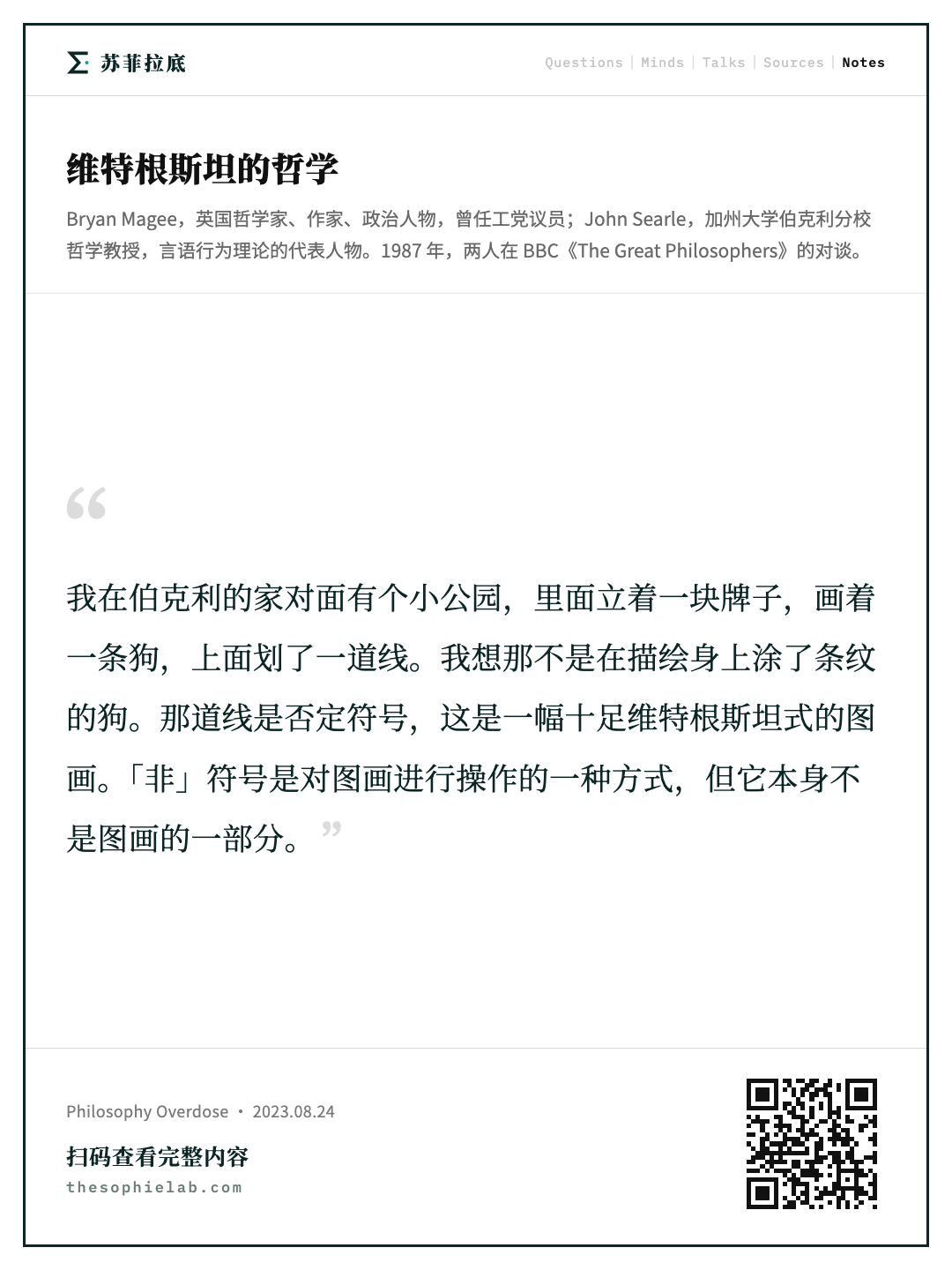
For example, across the street from my house in Berkeley, there's a little park and there's a picture of a dog with a line through it. Now, I take it that's not supposed to pick dogs that have stripes painted on them. The the line is the negation sign and that's a it's a Wittgensteinian sort of picture. That is the the not symbol there is a way of operating on the picture, but it isn't itself part of the picture. So, he thought that what we say about the world can be analyzed down into basic sentence structures, basic sentences, which picture the world and are linked together uh or negated by particular operators.
比如说,在伯克利我家对面有个小公园,那儿有一幅狗的图像,上面画了一道斜杠。我想那并不是指身上被画了条纹的狗。那道杠是否定符号,这就是一种维特根斯坦式的图像。也就是说,那里的“非”这个符号是一种作用于图像的方式,但它本身并不是图像的一部分。所以他认为,我们关于世界所说的话,可以分析成基本的句子结构、基本的句子,它们描画世界,并通过特定的算子被连结起来或被否定。
便签笔记
06可说与不可说:伦理宗教的沉默边界
7:31
By the by the so-called logical constants. constants which have this function. Now, in my introduction to this discussion, I said that throughout his career Wittgenstein was concerned to demarcate talk that made sense from talk that didn't make sense. How was that demarcation done in the early philosophy? Right. Well, in the early philosophy, in the in the Tractatus, Wittgenstein that Wittgenstein thought that the only language which strictly speaking made sense was this fact-stating language. Now, unlike the positivists, he didn't relish that. He didn't think that was wonderful. He thought that the really important things were unsayable, were unstatable. He thought that ethics, religion, aesthetics were in the realm of the unsayable. And he once said about the Tractatus that the really important part of the Tractatus is the part that's left out, the part that's not there at all. So, he he made a strict demarcation of meaningful language as fact-stating language. And the other parts of language, those parts of language that
通过所谓的逻辑常项。通过具有这种功能的常项。那么,在我为这次讨论所作的引言中,我说过维特根斯坦终其一生都致力于划分有意义的言说和无意义的言说。在早期哲学中,这种划分是怎么做的?好。在早期哲学中,也就是在《逻辑哲学论》中,维特根斯坦认为,严格说来唯一有意义的语言就是这种陈述事实的语言。不过,和实证主义者不同,他并不为此感到欣喜。他并不觉得这很美妙。他认为真正重要的东西是说不出来的,是无法陈述的。他认为伦理学、宗教、美学都属于不可说的领域。他曾经谈到《逻辑哲学论》说,这本书真正重要的部分是被略去的那一部分,是根本没有写出来的那一部分。所以他严格地把有意义的语言划定为陈述事实的语言。而语言的其他部分,那些不用来陈述事实的部分,他认为
便签笔记
8:31
are not used to state facts, he thought were strictly speaking nonsense, and we couldn't really say anything. So, although they might I mean, although ethics, religion, the arts, and so on are of fundamental significance in life, we can't actually ever do them justice in language. As far as the Tractatus is concerned, they are even It isn't that we can't do them justice. Our attempt to do them justice is meaningless. We can't say anything meaningful about them. Now, you've made the point very clearly that the central to the early Wittgenstein is this picture theory of meaning.
严格说来是胡话,我们其实什么也说不了。所以,尽管伦理、宗教、艺术等等在生活中具有根本性的意义,我们却永远无法在语言中真正把它们说清楚。就《逻辑哲学论》而言,甚至不是我们说不清楚的问题。我们试图把它们说清楚的努力本身就是无意义的。我们无法对它们说出任何有意义的话。你已经很清楚地说明了,早期维特根斯坦的核心是这种意义的图像论。
便签笔记
07从图像隐喻转向工具与用法隐喻
9:03
How did the later Wittgenstein depart from that? Well, again, though the Wittgenstein's ideas are very complex, there's a rather simple answer to that question. He moved away from the picture metaphor of the nature of meaning to the tool or use metaphor as the correct conception of meaning. He says, "Think of words as tools, and the way to understand language, the way to to get a a correct conception of how language functions is to look at how words are used." He says, "For most cases, not all, but for nearly all cases, the meaning of a word is just its use in the language. Now, this, just as the Tractatus gave him a certain metaphysical conception of the world derived from language, so by changing from the picture metaphor to the tool metaphor, he turns that metaphysics upside down. Now, instead of saying that the structure of reality determines the structure of the language, now what he says is that the structure of the language determines what we think of as reality. We can't think of the world. We
那么后期维特根斯坦是如何背离它的?嗯,虽然维特根斯坦的思想非常复杂,但这个问题有一个相当简单的答案。他从把意义的本性比作图像,转向了把它比作工具或用法,认为这才是对意义的正确理解。他说:“把词看作工具吧。”要理解语言,要正确把握语言如何运作,办法就是去看词是怎么被使用的。他说:“在大多数情况下——不是全部,但几乎在所有情况下——一个词的意义就是它在语言中的用法。”而正如《逻辑哲学论》从语言出发给了他某种关于世界的形而上学观念,通过从图像隐喻转向工具隐喻,他把那套形而上学整个颠倒了过来。现在,他不再说实在的结构决定语言的结构,而是说语言的结构决定了我们所认为的实在。我们无法思考世界,我们
便签笔记
10:10
can't discuss the world. We can't have a conception of the world independent of the conceptual apparatus that we use for that purpose. Now, you've raised a lot of very fundamental concepts here, and I think we ought to take them one at a time for the sake of clarity. Let's Let's begin where you began, with the distinction between a picture theory of meaning and a tool theory of meaning. The later Wittgenstein is no longer saying that a that that words or sentences picture what they're about. He's saying that a word or a sentence is like a tool, and what it means is what you can do with it. So that, in fact, the meaning of a term is the sum total of its possible uses. Now, it's in the nature of a picture that it can picture that it does in fact picture only one thing. Pictures an object or a state of affairs. But it's in the nature of a tool that it has many uses, perhaps an indefinite number of uses. Now, that applies to his view of language, doesn't it? It's a tool.
无法谈论世界,我们无法脱离我们为此所使用的概念框架而拥有关于世界的任何观念。你在这里提出了许多非常根本的概念,我想为了清楚起见,我们应该一个一个来谈。就从你开始的地方说起吧,也就是意义的图像论和意义的工具论之间的区别。后期维特根斯坦不再说词或句子描画它们所谈论的东西。他说,一个词或一个句子就像一件工具,它的意义就是你能用它做什么。因此,一个词项的意义其实就是它一切可能用法的总和。而图像的本性在于,它实际上只能描画一样东西:描画一个对象或一个事态。但工具的本性在于它有许多用途,也许是数不清的用途。这也适用于他关于语言的看法,对吧?语言就是工具。
便签笔记
08家族相似性:游戏并无共同本质
11:06
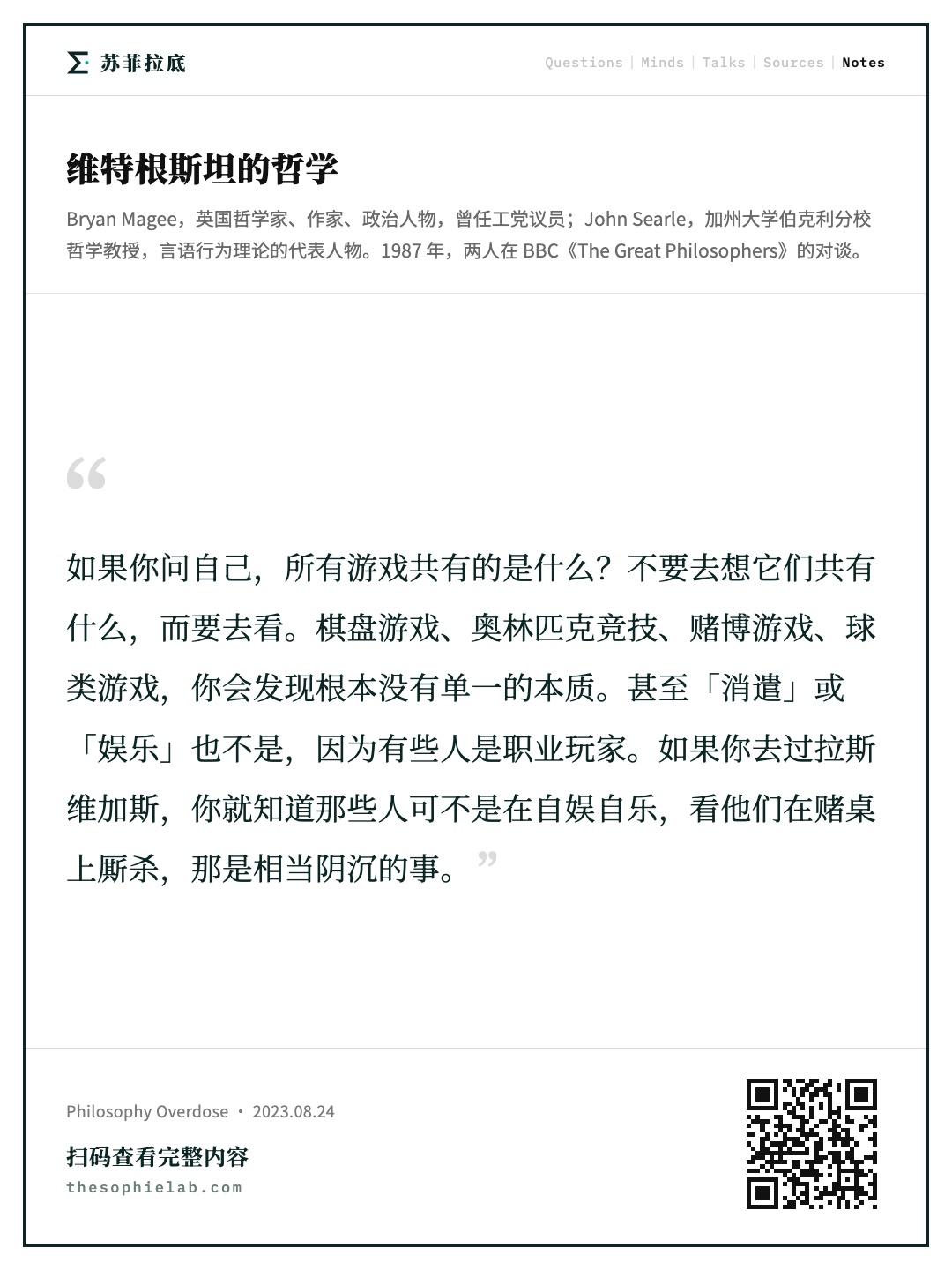
Yes. Yes, let me say a little bit more about that. Lan- Wittgenstein is anxious to insist in the Investigations that language is indefinitely extendable, and that there isn't any single thing that binds all uses of language together, that there isn't any single essence that runs through all of language. And indeed, for particular words, there needn't be any particular essence that marks the definition of that word. That he says words have a family resemblance of their uses. So that I mean he gives the example of game. He says if you ask yourself what is it that all games have in common? And he he keeps insisting don't think what they all have in common, but look and see if you can find anything. And then he says if you consider board games, Olympic games, gambling games, games played with balls on fields and so on.
是的。是的,让我再多说几句。维特根斯坦在《哲学研究》中急于坚持的是,语言是可以无限扩展的,并不存在某种唯一的东西把语言的一切用法维系在一起,并不存在贯穿整个语言的某种唯一本质。而且实际上,对于具体的词来说,也不必存在某种特定的本质来标示这个词的定义。他说,词的各种用法之间具有家族相似性。他举的例子是“游戏”。他说,如果你问自己:一切游戏共同具有的是什么?他一再坚持说:别去想它们的共同点是什么,而要去看,看你能不能找到什么。然后他说,如果你想想棋类游戏、奥林匹克竞技、赌博游戏、在场地上用球玩的游戏等等,
便签笔记
11:56
What you find is that there isn't any single essence. There isn't any single thing that all games have in common. There's Not not even the fact that they're pastimes or diversions because some people play them professionally. If you've been to Las Vegas, say it isn't that those people are are just amusing themselves. It's a pretty grim business to watch them at the gaming as they're called tables. But the idea is is that the strength of the words derives not from some underlying essence, but from the fact that they there's a series of crisscrossing relationships, similarities. And he compares that to the way that the various members of a family resemble each other. And he calls this a family resemblance relation.
你会发现,并不存在什么唯一的本质。并不存在一切游戏都共同具有的某一样东西。甚至连“它们都是消遣或娱乐”这一点也不成立,因为有些人是靠玩它们为职业的。如果你去过拉斯维加斯,你会明白那些人并不只是在自娱自乐。看着他们坐在所谓的赌桌旁,那是相当严酷的营生。但要点在于,词的力量并非来自某种潜在的本质,而是来自它们之间存在着一系列交错重叠的关系和相似之处。他把这比作一个家庭的不同成员彼此相像的方式,并把这称为家族相似关系。
便签笔记
12:40
Now it might seem like Wittgenstein was just saying sort of obvious points here. But remember he is militating against a very powerful philosophical tradition. He's militating first against the idea of his own that words get their meanings by standing for objects. And then secondly, an even older tradition that says words get their meanings by being associated with ideas in the head. And he's militating against the tradition that says, and this goes back to Plato, that in order for a word to have a meaning there must be some essence.
现在看来,维特根斯坦好像只是在讲一些显而易见的道理。但要记住,他是在反对一个非常强大的哲学传统。他首先反对的是他自己曾经的观点——词是通过代表对象而获得意义。其次,他反对一个更古老的传统——词是通过与头脑中的观念相联系而获得意义。而且他还反对这样一个传统,这个传统可以追溯到柏拉图:一个词要有意义,就必须有某种本质。
便签笔记
13:12
There must be some essential trait that the word marks. So the interest of his remarks about language derives a lot from their revolutionary or radical attack on a pre-existing tradition. He he uses the term family resemblance so often that I think it's worth saying just a word or two about that. When we talk of a family, the different members of a family having a marked family resemblance to each other, it need not be the case that there's one single feature that they all have in common. It need not be the case that they all have the same nose or all have the same chin, but that there's no single feature that they all have in common, just an overlapping and crisscrossing set of uh features from which they all draw as it were. Now, Wittgenstein is saying that this is true of language and meaning. That if we look at a term or a word, it's a great mistake to look for the one thing that it means, because there is no one thing that it means. The meaning of a word is like family resemblance in
必须有某种本质性的特征被这个词所标示。所以他关于语言的这些论述之所以引人入胜,很大程度上来自它们对既有传统的革命性或激进的攻击。他非常频繁地使用“家族相似”这个词,我想值得为此多说一两句。当我们说一个家族、说这个家族的不同成员之间有明显的家族相似时,并不需要存在某一个他们全都具有的特征。并不需要他们都有同样的鼻子或同样的下巴,而是并不存在他们全都具有的某个单一特征,只有一组相互重叠、彼此交错的特征,他们都从中分有一些,可以这么说。而维特根斯坦说,这一点对语言和意义也成立。也就是说,如果我们看一个词项、一个词,去寻找它所意谓的那一样东西,是个大错误,因为并不存在它所意谓的某一样东西。在这种情况下,一个词的意义就像家族相似一样。
便签笔记
14:18
that case. Namely, a word has several different meanings like the several different members of a family. There may be a crisscrossing and overlapping set of relationships between those different meanings, but there's no one thing that the meanings all have in common, which is as it were the essence of that word. That's That's that's That's right. That's what he's saying. Now, he doesn't say that this is true for every word in the language. No doubt there are words that have strict definitions, but he thought that this was crucial for philosophers to see because a lot of the words that trouble us, especially in philosophy, I mean in ethics and aesthetics, words like good and beautiful, uh which he was very suspicious of these words, but he thought that our part of our failure was we were looking for some essence of beauty or essence of goodness, whereas he insists just look at the various resembling crisscrossing similarities in the use of these words.
也就是说,一个词有好几种不同的意义,就像一个家族的好几个不同成员。这些不同的意义之间可能存在一组交错重叠的关系,但并不存在这些意义全都共有的某一样东西,仿佛那就是这个词的本质。对,对,就是这样。这正是他要说的。当然,他并没有说这对语言中的每一个词都成立。无疑有些词是有严格的定义,但他认为这一点对哲学家来说至关重要,因为很多让我们困扰的词——尤其是在哲学里,我是说在伦理学和美学里,比如“善”和“美”这样的词,呃他对这些词非常怀疑——他认为我们的失败之处在于,我们总想去寻找某种美的本质或善的本质,而他坚持说,只要去看这些词在使用中那些彼此相似、交叉重叠的相似性就够了。
便签笔记
09语言游戏:无需外部根据的规则活动
15:10
So, he's saying, for example, that we have all sorts of different kinds of talk. There's scientific talk, religious talk, music talk, everyday talk, philosophical talk such as you and I are now having. And in each of these areas of discourse, language is characteristically used in different ways, and the same words will be used in different ways. So, don't ask yourself, you know, what is the specific meaning of this term? Ask yourself, how is this term being used in that particular area of discourse?
所以他是说,比方说,我们有各种各样不同的言说方式。有科学的言说、宗教的言说、音乐的言说、日常的言说,还有像你我现在这样的哲学言说。而在每一个这样的话语领域里,语言的使用方式都各有其特点,同一个词也会有不同的用法。所以,别去问自己这个词的具体意义是什么,而要问自己:这个词在那个特定的话语领域里是怎么被使用的?
便签笔记
15:41
was one of his slogans. Don't ask for the meaning, ask for the use. And at this point, he introduces another metaphor. Indeed, I it's one of his few technical terms. He introduces the notion of a language game. And the idea he has is that we should see speaking a language on analogy with playing a game in that it characteristically it's rule governed. We aren't ourselves entitled to lay down the rules. Not everything is determined by the rules, so there is a great deal of slack, room for interpretation. But nonetheless, we're engaged in rule governed forms of activity.
这是他的口号之一。别追问意义,去追问用法。而在这一点上,他引入了另一个隐喻。事实上,这是他为数不多的技术性术语之一。他引入了“语言游戏”这个概念。他的想法是,我们应该把说一门语言类比为玩一场游戏,因为它通常是受规则支配的。我们自己无权制定这些规则。并非一切都由规则决定,所以其中有很大的余地,有解释的空间。但尽管如此,我们仍然是在从事受规则支配的活动形式。
便签笔记
16:17
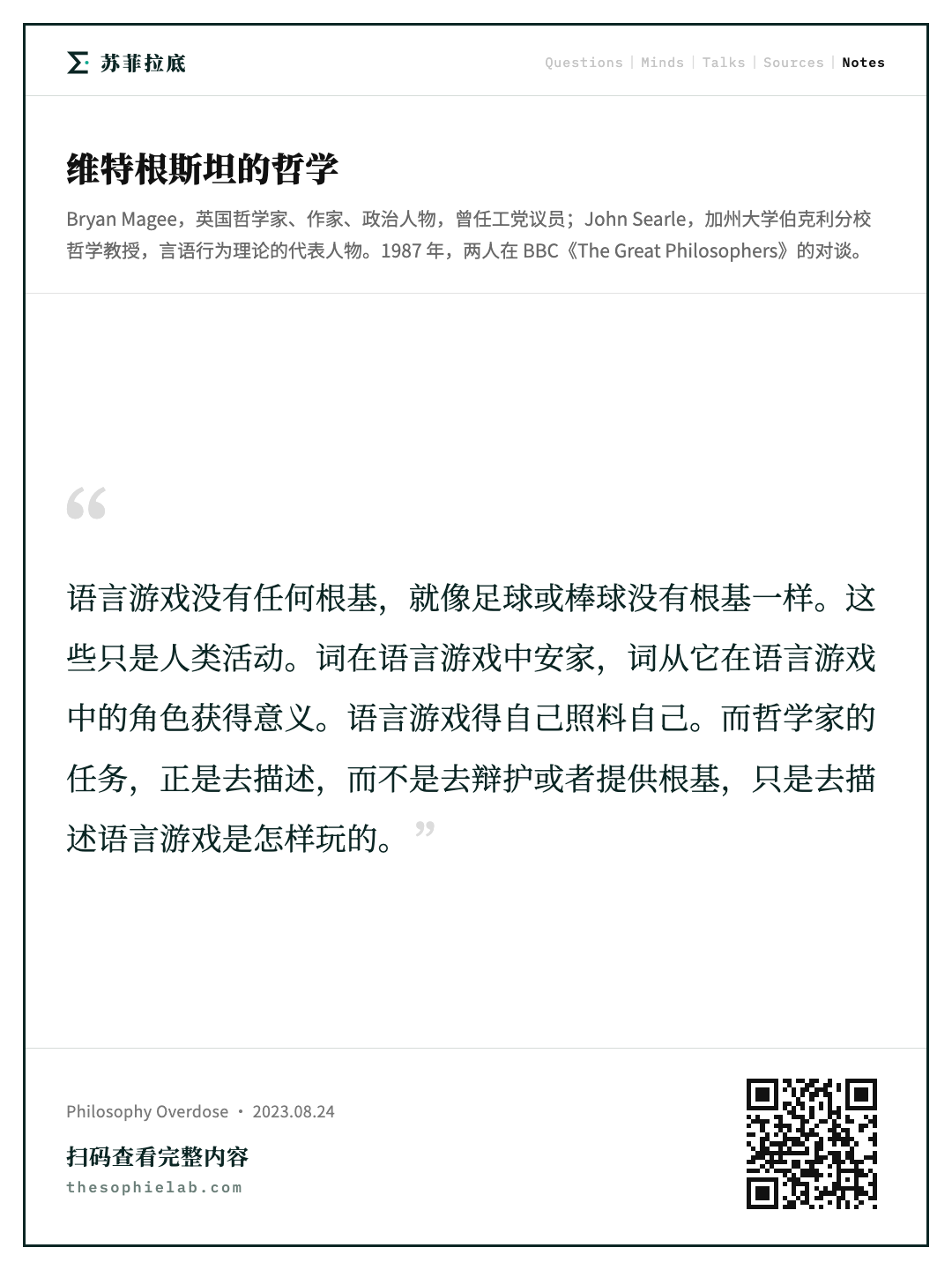
Now, this again is a disconcerting idea for a lot of philosophers because he wants to insist that there isn't any foundation for the language games, any more than there's a foundation for football or baseball. These are just human activities. And so, he wants to get out of the idea that these language games, where the word has its home, where words get their meaning from their role in the language games, he wants to get out of the idea that there must be some transcendental justification or foundation for the language game. No, the language game has to look after itself. We play a language game of ethical discourse, of aesthetic discourse, of fact stating discourse, a language game with the word cause, a language game of identifying spatial and temporal relations. So, he's anxious to insist that there are these sequences and series of human activities where the use of words is tied up with the rest of our lives in a regular, ordered, but not in any way predetermined fashion. And that's really the task of the
这对很多哲学家来说又是一个令人不安的想法,因为他坚持认为,语言游戏并没有任何根基,正如足球或棒球也没有什么根基一样。这些不过是人类的活动罢了。所以他想要摆脱这样一种想法:这些语言游戏——词语在其中安家的地方,词语从它们在语言游戏中的角色获得意义的地方——他想要摆脱这样一种想法:语言游戏背后必定有某种先验的辩护或根基。不,语言游戏必须自己照顾自己。我们玩伦理话语的语言游戏、美学话语的语言游戏、陈述事实的语言游戏、使用“原因”这个词的语言游戏、指认空间和时间关系的语言游戏。所以他急于强调,存在着这样一系列、一连串的人类活动,在其中词语的使用同我们生活的其余部分紧密交织在一起,以一种有规律、有秩序、但绝不是预先决定好的方式。而哲学家真正的任务就是去描述,而不是去
便签笔记
17:21
philosopher is to describe, not to justify or give a foundation for, but to give just a description of how the language game is played. I must say I think it's something of a disaster that he fastened on this term language game because it sounds as if what he's talking about is something frivolous. And in fact, it even feeds a certain prejudice against philosophers that exists outside philosophy. They're they're all just playing with words or that they're somehow superficially concerned with with language. This isn't so at all.
辩护或提供根基,只是去描述语言游戏是怎么玩的。我得说,我觉得他抓住“语言游戏”这个词多少是个灾难,因为它听上去好像他谈的是某种轻浮的东西。事实上,它甚至助长了哲学之外对哲学家的某种偏见,觉得他们不过是在玩弄词句,或者说他们只是肤浅地关心语言问题。其实完全不是这样。
便签笔记
17:52
If you use the word game for serious intellectual reasons. Right. And let me just hammer home the reasons for the analogy. First of all, it's an activity. It isn't something sublime that just goes on in our heads and it isn't an abstract set of relationships. It's an ongoing human activity. And secondly, it's conventional. It's regular. There are rules involved and those are the features that he wanted to to get that we should look at language in action and we should see it as part of regular rule-governed behavior.
如果你是出于严肃的思想理由才使用“游戏”这个词的话。对。让我把这个类比的理由讲透。首先,它是一种活动。它不是某种只在我们头脑中进行的崇高之物,也不是一套抽象的关系。它是一种正在进行的人类活动。其次,它是约定俗成的、有规律的。其中包含规则,而这些正是他想要传达的特征——我们应该看语言在行动中的样子,应该把它看作有规律、受规则支配的行为的一部分。
便签笔记
10无法跳出语言游戏审视实在
18:22
But there I mean and that sounds I think pretty uncontroversial, at least to us, but there is a more radical aspect of this that I want to bring out and that is Wittgenstein thought that there isn't any point of view outside of language where we can so to speak stand back and appraise the language game from a non-linguistic point of view. He thought there wasn't any any Archimedean point from which we could get away from operating inside a language game, stand back and appraise the success or failure of language in representing reality. He thought that was impossible. We're always operating within the language game. We're always operating within some language game or other. There's no conception that we have of appraisal or of getting at the world apart from operating within a language game.
不过我是说,这听上去我觉得挺没有争议的,至少对我们来说是这样,但这里还有一个更激进的方面我想点出来,那就是维特根斯坦认为,并不存在任何语言之外的视角,让我们可以所谓地退后一步,从一个非语言的立场去评判语言游戏。他认为不存在任何阿基米德点,能让我们跳出在语言游戏内部的运作,退后一步去评判语言在再现实在方面的成败。他认为那是不可能的。我们总是在语言游戏之内运作。我们总是在某个语言游戏之内运作。离开在语言游戏内部的运作,我们就没有任何关于评判、关于把握世界的构想。
便签笔记
19:11
Part of what he's saying is that for me to be able to see this as a hand or that as a table, I must be in possession of the concepts hand and a table. And therefore, what I see reality as being is constituted by a whole conceptual structure that I have, which can be articulated in language. That's That is a great deal of it, but I think in a way it goes even deeper than that for Wittgenstein. Wittgenstein really thinks Wittgenstein is part of the movement in the past 100 years. It is part of It's a characteristic feature of the 20th century that we no longer can take language for granted. Language has become immensely problematic to us, and it has moved into the center of philosophy, and Wittgenstein is one of the great leaders in that movement. So, he would certainly agree with what you just said, namely that reality divides up the way we divide it, that because we call we we can only think of this as a hand or that as a table because we've got the relevant concepts, the relevant words. But, the point is deeper than
他的部分意思是说,我要能把这个看成一只手、把那个看成一张桌子,我就必须掌握“手”和“桌子”这些概念。因此,我所看到的实在是什么样子,是由我所拥有的整套概念结构构成的,而这套结构可以用语言表达出来。这确实是很大一部分,但我觉得对维特根斯坦来说,某种意义上它比这还要更深一层。维特根斯坦真正认为——维特根斯坦是过去一百年那场运动的一部分。这是二十世纪的一个典型特征:我们再也不能把语言当作理所当然的了。语言对我们来说变得极其成问题,并且已经移到了哲学的中心位置,而维特根斯坦是这场运动的伟大领袖之一。所以,他肯定会同意你刚才说的,也就是说,实在是按照我们划分它的方式被划分的;我们之所以只能把这个想成一只手、把那个想成一张桌子,是因为我们拥有相关的概念、相关的词语。但他的论点比这更深。他想说的是,根本不存在所谓脱离语言的思维这回事。
便签笔记
11宗教话语:描述而非评判其成败
20:15
that. The point he wants to make is there isn't any such thing as thinking. There isn't even any such thing as experience as human beings have adult full full-grown human being experiences, that cannot exist apart from language. Language permeates that at every point. Now, a moment ago you were saying that every language game has to be understood from the inside. One consequence of this is as follows, isn't it? Whereas the old logical positivists who'd been influenced by Wittgenstein's early philosophy were extremely dismissive of all religious talk, for example, and they thought that if I'd said something like God exists, that was just meaningless noise, exhaust. The later Wittgenstein would have not been intolerant in the same way. He would not have dismissed religious talk as being empty of meaning, what he would have said is, "Well, let's first of all examine how words are used in a religious concept context, how they function, and let's look at their use.
甚至也不存在所谓脱离语言的经验——就人类作为成年的、发育完全的人所拥有的那种经验而言,它不可能脱离语言而存在。语言在每一点上都渗透其中。刚才你说,每一个语言游戏都必须从内部去理解。由此得出的一个结果是这样的,对吧?从前那些受维特根斯坦早期哲学影响的逻辑实证主义者,比方说,对一切宗教言说都极为不屑,他们认为如果我说了一句像“上帝存在”这样的话,那不过是毫无意义的噪音、废气罢了。而后期的维特根斯坦不会以同样的方式那么不宽容。他不会把宗教言说斥为空无意义,他会说:“好,我们先来考察一下这些词在宗教语境中是怎么用的,它们起什么作用,我们来看看它们的用法。
便签笔记
21:19
Let's as it were get inside the religious language game, as he would have put it, and see how these terms are being used, and then we can judge whether they're being used legitimately, not legitimately, or whatever it might be." Well, you have to be very careful you about that last bit. You see, because what Wittgenstein would say is it's not our task as philosophy to appraise the success or failure of the religious language game. All we can do is describe how it's played, and the important thing is to see that it isn't played like the scientific language game. It's ridiculous, he thinks, that we should take religious utterances as if they were sort of second-rate scientific utterances for which there was inadequate evidence. He was always anxious to insist, "Well, we ought to look at the role that religion and religious utterances play in people's lives." That's the meaning of these utterances, to see how what sort of a role they actually play in people's lives. And he he disliked the idea that
让我们可以说是进入宗教的语言游戏内部——用他的话说——看看这些词是怎么被使用的,然后我们才能判断它们的用法是否正当、不正当,或者别的什么。”嗯,最后那部分你得非常小心。你看,因为维特根斯坦会说,评判宗教语言游戏的成败并不是我们哲学的任务。我们所能做的只是描述它是怎么玩的,而重要的是看到它玩的方式不同于科学的语言游戏。他认为,把宗教的话语当作某种二流的、证据不足的科学论断来看待,是很荒谬的。他总是急切地坚持:“我们应该看看宗教和宗教话语在人们生活中所起的作用。”那就是这些话语的意义所在——看看它们在人们生活中实际扮演什么样的角色。他很不喜欢这样一种想法:
便签笔记
22:16
we should over-intellectualize this and make it into some kind of a theoretical enterprise where what we were concerned to was to criticize this and see if the evidence for the existence of God was up to snuff by scientific standards. He didn't like that. He looked W. G. Grace once jumped on a chair in a meeting and said something Wittgenstein really approved of. He thought this was wonderful. He Grace said something like this. He said, "God doesn't want a head. Any old cabbage will do for a head. What God wants is a heart." Now, Wittgenstein liked that cuz he thought that was the language game in action. That was not trying to get outside it and and do some sort of sign pseudo-scientific appraisal.
我们把这件事过度理智化,把它变成某种理论事业,好像我们关心的就是批判它,看看上帝存在的证据按科学标准够不够格。他不喜欢那样。他看重的是——W. G. 格雷斯有一次在一个集会上跳到椅子上,说了一句维特根斯坦非常赞赏的话。他觉得这话妙极了。格雷斯大概是这么说的。他说:“上帝要的不是脑袋。随便一颗白菜都能当脑袋。上帝要的是一颗心。”维特根斯坦喜欢这话,因为他觉得那就是语言游戏在行动中的样子。那不是试图跳到它外面去,做某种伪科学的评判。
便签笔记
23:00
didn't take a sort of anything goes attitude. I mean, he did think that philosophical puzzlement is characteristically caused by our using the terms from one language game as if they belong to another. By, for example, trying to judge, as you I think you just said, trying to judge, say, moral talk or religious talk as if it was scientific talk. And that we got our we having got ourselves into these puzzles and problems, the way to get ourselves out of them was to pay very strict attention to the way the words that we were using normally functioned in actual human discourse.
他并没有采取一种“怎么都行”的态度。我是说,他确实认为哲学困惑的典型成因,是我们把一个语言游戏里的词当作属于另一个语言游戏来使用。比方说,就像我想你刚才说的那样,试图把道德言说或宗教言说当作科学言说来评判。而当我们把自己陷入这些困惑和难题之后,摆脱它们的办法就是极其严格地留意我们所用的这些词在实际的人类话语中通常是怎么起作用的。
便签笔记
12遵守规则与私人语言论证
23:38
and I he does have various ways that he summarizes this. He says, "Philosophical problems characteristically arise when we take the word out of the language game where it's at home and then try to think of it as something sublime. We we don't want to inquire into the nature of the good, the true, or the beautiful instead of just looking at how these words are actually used in the language game where they get their meaning." minutes ago we were talking about this analogy that Wittgenstein makes between games and the use of language.
而且他确实有各种方式来概括这一点。他说:“哲学问题的典型产生方式,是我们把一个词从它安家的语言游戏里抽出来,然后试图把它想成某种崇高的东西。我们不该去追问善、真或美的本质,而应该只看这些词在赋予它们意义的语言游戏中实际是怎么用的。”几分钟前我们谈到维特根斯坦在游戏和语言使用之间所作的这个类比。
便签笔记
24:06
There was one important aspect of it that we didn't take up cuz you we can't talk about everything at once. Um a game is a rule-governed activity and language is a rule-governed activity and has to be because if I didn't follow certain linguistic rules, what I said would be unintelligible and wouldn't communicate or perform any of the functions I wanted it to perform. So, I have to follow certain rules. Now, Wittgenstein argued that because that was so, there could be no such thing, even in theory, as a private language.
其中有一个重要的方面我们还没谈到,因为我们没法同时把什么都说完。嗯,游戏是一种受规则支配的活动,语言也是一种受规则支配的活动,而且必然如此,因为如果我不遵守某些语言规则,我说出来的话就会无法理解,就不能传达信息,也无法完成我想让它完成的任何功能。所以我必须遵守某些规则。那么,维特根斯坦论证说,正因为如此,哪怕在理论上,也不可能存在所谓的私人语言。
便签笔记
24:38
And his argument to this effect has become one of the most controversial aspects of his philosophy. Can you say a word about sure has. Well, I I I would be glad to. In a way I'm reluctant to get into this hassle because there's so much junk written about the private language argument. But just let me say a little bit about it. First of all, you got to say something about rules. We've been talking as if the notion of a rule for Wittgenstein was unproblematic, but it wasn't. His notion of a rule is it is itself one of his important contributions to philosophy.
而他为此提出的论证已经成为他哲学中最有争议的方面之一。你能不能讲几句——确实如此。好的,我很乐意。某种意义上我不太愿意卷进这场纷争,因为关于私人语言论证写了太多垃圾东西。不过还是让我稍微讲一点吧。首先,得先谈谈规则。我们一直说得好像“规则”这个概念对维特根斯坦来说是没有问题的,但其实不是。他关于规则的观念本身就是他对哲学的重要贡献之一。
便签笔记
25:09
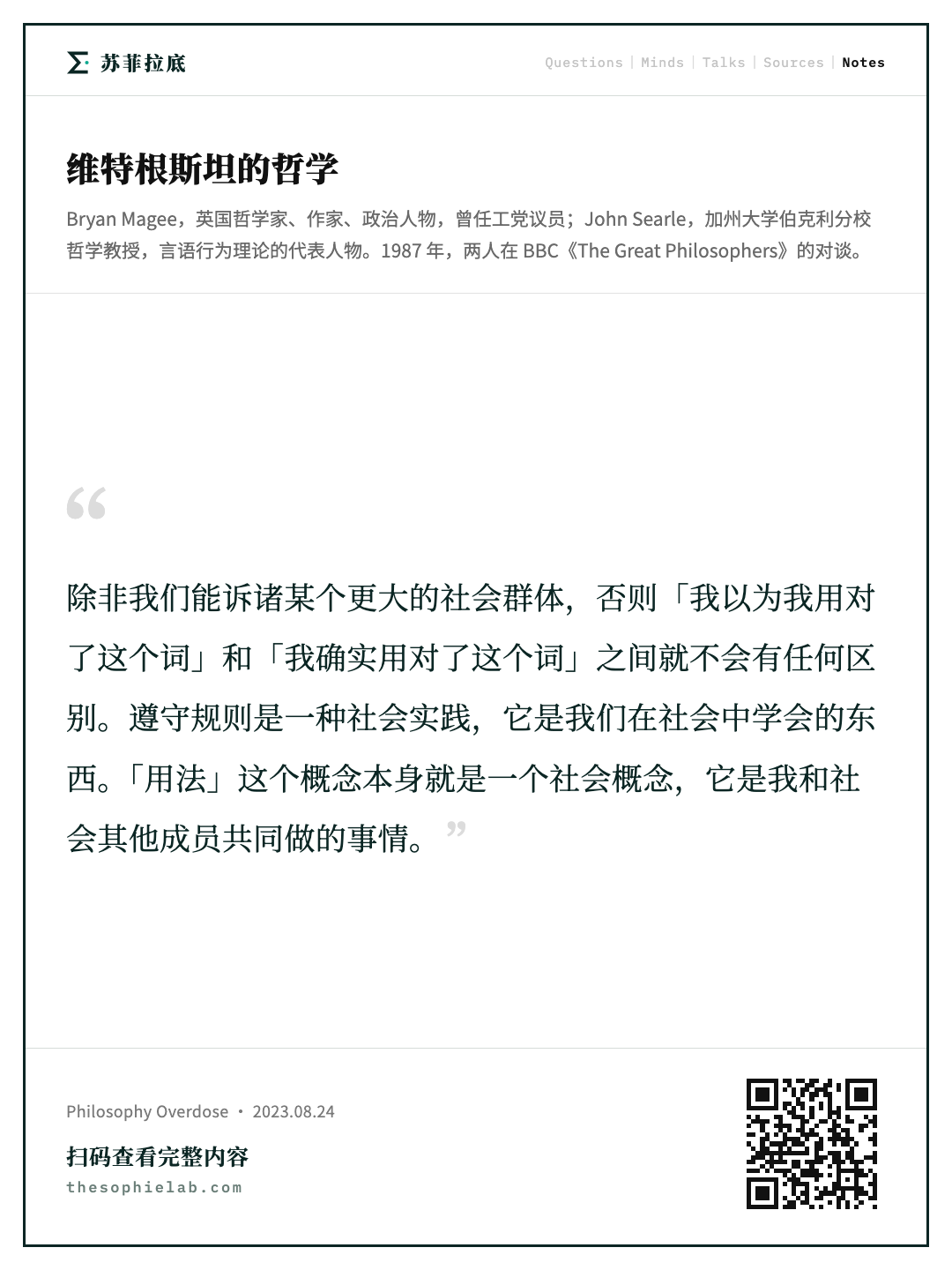
What he thought was first of all, that rules don't block off all eventualities. That language isn't everywhere bounded by rules. Nothing is everywhere bounded by rules. There are always lots of gaps left open by any system of rules. He uses the example of throwing a tennis ball when you serve. There's no rule how high you have to throw it. But I suppose if somebody could throw the thing 5 mi high and we had to wait all day, they'd make a rule. I mean, there the rules are never final. Now, another thing he said about rules is that rules are always subject to different interpretations. And if you've ever been through the income tax laws, you know this. I mean, the American history of it is a series of different interpretations. So, it looks to Wittgenstein as if there's a kind of skepticism that arises here because if anything can be made to conform to the rule by some fancy interpretation, then anything can be made to conflict with it and you wouldn't get either accord nor conflict. The rule would then seem to
他首先认为,规则并不能堵死所有的可能情况。语言并不是处处都由规则划定边界的。没有任何东西是处处都由规则划定边界的。任何规则系统都会留下大量的空隙。他用了发球时抛网球的例子。并没有规则规定你必须把球抛多高。不过我想,如果有人能把球抛到五英里高,害我们等上一整天,他们大概就会立个规则了。我是说,规则从来都不是最终定死的。关于规则他还说了一点:规则总是可以有不同的解释。如果你研究过所得税法,你就明白这一点。我是说,美国这方面的历史就是一连串不同的解释。所以在维特根斯坦看来,这里似乎会冒出一种怀疑论,因为如果通过某种花哨的解释可以让任何东西都符合规则,那么也可以让任何东西都与之冲突,这样你就既得不到相符也得不到冲突。规则似乎就变得无关紧要而被排除掉了。他对此的解决办法是说:遵守规则是一种社会实践。
便签笔记
26:05
drop out as irrelevant. Now, his solution to that is to say obeying the rule is a social practice. It's something we learn in society. Society just has ways of making people and training people to conform to rules. Now, he applies that to this whole private language problem. The problem of the private language is could there be a language where I just named my own private sensations in a way that no one else could understand it. Now, the reason for all the fuss is that a lot of people in the history of philosophy has have thought that must be the basic use of language in the whole Cartesian must name inner experience.
它是我们在社会中学会的东西。社会自有其办法让人们服从规则、训练人们服从规则。接着他把这一点应用到整个私人语言的问题上。私人语言的问题是:会不会存在一种语言,我在其中只是给自己的私人感觉命名,而别人根本无法理解?之所以引起这么大的争论,是因为哲学史上有很多人认为,那必定是语言最基本的用法——在整个笛卡尔式的传统里,语言必须命名内在经验。
便签笔记
26:47
that we get to the real world, to the external world by starting from our inner experiences, by starting from inside and working outward. Now, Wittgenstein wants to say two things about that. First of all, that isn't how the words for our inner experiences actually function. They don't name private objects, rather they're used in conjunction with public criteria, behavior, situations. So, we're not in fact speaking a private language when we use sensation language. But secondly, and more controversially, he says we couldn't in fact speak a private language. We couldn't give a private ostensive definition where we just sort of point inwardly to some private experience and name that experience.
我们是从内在经验出发,由内向外,才达到真实世界、达到外部世界的。而维特根斯坦想就此说两点。首先,我们表示内在经验的那些词实际上并不是那样起作用的。它们并不命名私人对象,而是与公共的标准、行为、情境结合起来使用的。所以当我们使用感觉语言时,我们事实上并不是在说一种私人语言。但其次,而且更有争议的是,他说我们事实上不可能说一种私人语言。我们无法给出一种私人的实指定义,好像我们可以向内指着某种私人经验,然后给那个经验命名。
便签笔记
13意义依赖生活形式与社会训练
27:30
Because he said, "Unless we can appeal to some larger social gathering, there won't be any difference between my thinking I'm using the word right and I'm actually using it right." So, his discussion of the rules and the and the social character of rules is really what underlies his rejection of the idea of a private language. And it's important for him to reject the idea of a private language, as you say, because he's reacting against a whole tradition of philosophy that goes back to I suppose Descartes, but certainly includes Locke, Berkeley, Hume, the the empiricist philosophers who say that we start by cognition of essentially private states of mind and infer the world or build up a conception of the world from that. Now, the later Wittgenstein seems to me to be saying this, that because the sum total of a word's possible uses constitute its meaning, in the end, what language means and what words mean, depend on forms of life, on the social contexts within which they are used. And in fact, he uses that phrase "forms of
因为他说:“除非我们能诉诸某个更大的社会共同体,否则我以为自己用对了这个词和我实际上用对了这个词之间就毫无区别。”所以他对规则、以及规则的社会性所作的讨论,才是他拒斥私人语言这一想法的真正根据。正如你所说,拒斥私人语言这一想法对他很重要,因为他是在反对整个一条哲学传统,这条传统我想可以追溯到笛卡尔,但肯定包括洛克、贝克莱、休谟,也就是那些经验主义哲学家,他们说我们的出发点是对本质上私人的心灵状态的认识,然后由此推论出世界,或者从中构建出对世界的一种理解。那么,在我看来,后期的维特根斯坦所说的是这样一点:既然一个词全部可能用法的总和构成了它的意义,那么归根到底,语言的意义、词的意义,就取决于生活形式,取决于使用它们的社会语境。而且事实上,他大量使用了"生活形式"这个说法。所以,意义的一切最终标准都不是
便签笔记
28:40
life" a great deal. So, that all the ultimate criteria of meaning are not personal, are not private at all. They are essentially social, are they not? That's right. And the And the It's important to emphasize that the notion of use is itself a social notion. It's something that I do in conjunction with other members of a society, and it's only because I'm trained to respond in certain ways that we avoid this skepticism that says, "Well, anything I do can be made to seem to be in accord with some rule or other, or I could always interpret the rule in such a way that would come out in accord with it."
个人的,根本不是私人的。它们本质上是社会性的,不是吗?没错。而且……而且……有一点很重要,必须强调:"用法"这个概念本身就是一个社会性的概念。它是我与社会中其他成员共同去做的事情;正因为我被训练成以特定方式作出反应,我们才避免了那种怀疑论——那种说法是:"好吧,我做的任何事都可以被说成是符合某条规则的,或者我总可以把规则解释成让我的行为正好符合它。"
便签笔记
14格言体写作风格的成因与代价
29:16
And he does emphasize the idea that a language is a form of life, that we can't sort of carve off the language and look at it apart from the human activities where it actually has its meaning. When people pick up Wittgenstein's books to read them, I think they're often struck and surprised uh straight away by what they find, because these books are not written in the way that ordinary books are. They're not written in continuous prose. They're written in separate paragraphs, and each paragraph is given a number.
而且他确实强调这样一个观点:语言就是一种生活形式,我们没法把语言切割出来,脱离它真正获得意义的那些人类活动去看待它。我想,人们拿起维特根斯坦的书来读的时候,往往一上来就会被眼前所见弄得震惊和意外,因为这些书不是按普通书的写法写的。它们不是连贯的散文体。它们是由一个个独立的段落构成的,每一段还都编了号。
便签笔记
29:46
And very often it's not clear what the relationship is between a paragraph and the other two on either side of it. And usually there isn't much in the way of connected argument, either. You get these uh brilliant metaphors, brilliant examples, brilliant similes, so that the writing is wonderful, and yet it's difficult usually to see what it is he's saying. Now, why did he write like that? Well, several reasons. But uh first of all, I do want to say I entirely agree with you about the character of the prose, and it is both entrancing and exasperating. I know I felt that when I was uh preparing for this program. I went and reread acres of Wittgenstein, and there just is a huge amount. And And it is enthralling. You You begin to start thinking that way yourself. You begin to address your wife in Wittgensteinian aphorisms, which can be very exasperating.
而且很多时候,一个段落跟它前后两段之间到底是什么关系,也并不清楚。同时,通常也没有多少连贯的论证。你看到的是一些绝妙的隐喻、绝妙的例子、绝妙的明喻,文字写得非常精彩,可你通常又很难看出他到底在说什么。那么,他为什么要那样写呢?嗯,原因有好几个。不过首先我想说,关于他文字的特点,我完全同意你的看法:那些文字既让人入迷,又让人恼火。我知道,我在为这期节目做准备时就有这种感觉。我又去重读了一大堆维特根斯坦,量真的非常大。而且确实引人入胜。你会开始不由自主地照那样去思考。你会开始用维特根斯坦式的格言跟你太太说话,那可是很让人抓狂的。
便签笔记
30:33
Fair enough. Also, you have this feeling that when you take up one of these books and and read it, it's a bit like getting a a a kit for a model airplane with no instructions as to how you're supposed to put all these pieces together. And that can be extremely frustrating. It's a sort of do-it-yourself book. But why did he write like that? Well, first of all, I think it was the only way he found natural. I mean, he's often says what a torture it is for him to try even to put these paragraphs together consecutively, much less to write conventional prose of articles and books.
这倒也是。另外你还会有这么一种感觉:当你拿起这样一本书来读,那有点像是拿到了一套模型飞机的组件,却没有任何说明书告诉你这些零件该怎么拼起来。那真的会让人极其沮丧。这算是一种"自己动手"的书。可他为什么要那样写呢?首先,我想那是他唯一觉得自然的方式。我是说,他常常说,光是把这些段落连贯地排在一起对他都是一种折磨,更别说去写文章和书那种传统散文了。
便签笔记
31:04
But secondly, I think there is an element almost of arrogance in this. Wittgenstein wanted it to be different from the standard ways of doing philosophy. He hated uh the sort of standard articles that appear in journals and standard books that are written to be read by undergraduates in philosophy. By the way, he would have hated the kind of thing you and I are now doing, two professional philosophers discussing his views on television. But he he did want to be deliberately different from other people. And then there's a a third aspect of this is that he honestly and sincerely was struggling to say something new and different. And he always had the feeling that he hadn't said what he really meant, that he was struggling to find a mode of expression and that he never really succeeded. And then lastly, I think we need to say for for uh English uh uh speaking viewers that this though it looks strange uh to the English eye to uh see this books written in this way, it's not all that unusual in German. There is a tradition
但其次,我认为这里面几乎带有一种傲慢的成分。维特根斯坦希望自己与做哲学的标准方式不同。他讨厌那种发表在期刊上的标准论文,也讨厌那种写给哲学系本科生读的标准著作。顺带说一句,他一定会很讨厌你我现在做的这种事——两个职业哲学家在电视上讨论他的观点。但他确实是有意要与别人不同。然后还有第三个方面,那就是他确实真诚地在努力说出某种新的、不同的东西。而他总觉得自己还没有把真正想说的说出来,觉得自己一直在寻找一种表达方式,却从未真正成功。最后一点,我想我们得对讲英语的观众说明一下:虽然这在英国人眼里显得很奇怪——看到书是这么写的——但在德语里这并不算稀奇。德国哲学
便签笔记
15跨学科影响:社会科学与文学批评
32:07
in German philosophy of writing aphoristically. Uh you see it in Nietzsche, uh it's in Schopenhauer and Lichtenberg, just to mention a few. And the writing is at its best wonderful. I think we do him a justice for It seems a great He's a great stylist, and some of the sentences stay in your mind for the rest of your life after you've read them. Yes. In my introduction to this discussion, I mentioned the fact that in the last I don't know in a how long one ought to say, 10 years, 15 years, probably not much more than that.
有用格言体写作的传统。你在尼采那里能看到,叔本华、利希滕贝格那里也有,这只是举几个例子。而且这种写作在最好的时候是极为精彩的。我觉得我们应该给他一个公道——他是个了不起的文体家,有些句子在你读过之后会伴随你一辈子。是的。在这场讨论的开场白里,我提到过一个事实:在过去——我也不知道该说多久,十年、十五年吧,大概不会比这长多少。
便签笔记
32:38
Uh he has become uh an international figure of importance quite outside philosophy. When one reads books and articles and journalism that have nothing to do with philosophy, one is beginning now over and over again to come across Wittgenstein's name. Can you say just a little about the fields outside philosophy in which he is important and and indicate at least what kind of an influence he appears to be having? Well, at present I think it's like it's a kind of name dropping. It's an okay name and he's certainly mentioned in a lot of fields, but I think he would feel himself that he has not been adequately understood and indeed has not been adequately understood in philosophy. But some of these fields are uh literary criticism and aesthetics generally.
他已经成为一个在哲学之外也举足轻重的国际性人物。当你读一些跟哲学毫无关系的书、文章和新闻报道时,现在会一次又一次地碰到维特根斯坦的名字。你能不能稍微谈一谈他在哲学之外有影响的那些领域,并且至少说明一下他似乎在产生什么样的影响?嗯,目前我觉得这有点像是在拉名人抬身价。这是个拿得出手的名字,他确实在很多领域被提到,但我想他自己会觉得,他并没有被充分理解,而且实际上在哲学内部也没有被充分理解。不过这些领域中有一些是文学批评,以及广义上的美学。
便签笔记
33:20
Wittgenstein is now often referred to and I think will become more influential. Um there is a great deal of mention of Wittgenstein in social sciences, particularly anthropology, because he thought of himself as doing a kind of anthropology. Uh there is a uh uh books written about the importance of Wittgenstein for political theory. So it's what the the French would call the sciences of man that Wittgenstein has been most influential. Paradoxically in a way cuz he wrote so much about the philosophy of mathematics, but most of his influences now are in outside of philosophy, are in the social sciences.
维特根斯坦现在经常被引用,我认为他还会更有影响力。嗯,在社会科学里,尤其是人类学,提到维特根斯坦的地方非常多,因为他自己就认为他做的是某种人类学。呃,还有一些书专门讨论维特根斯坦对政治理论的重要性。所以正是在法国人所说的"人的科学"这个领域里,维特根斯坦的影响最大。这在某种意义上很吊诡,因为他写了那么多关于数学哲学的东西,但他现在的影响大多在哲学之外,在社会科学里。
便签笔记
16塞尔的批评:反理论倾向与宗教含混
33:52
the structuralists who are so fashionable or have been fashionable for so long seem to be claiming Wittgenstein for their own, do they not? Well, it's the post-structuralists I think that probably misunderstood him the worst, but that's another program. Yes, yes. Well, right, well then then we won't get into that, but I think the point is worth making that for example, if you read serious literary criticism now, you are going to come across constant reference to Wittgenstein. What is your personally evaluation of of of of all this, of Wittgenstein as a philosopher?
那些流行了很久、或者说一直很时髦的结构主义者,似乎也在把维特根斯坦据为己有,不是吗?嗯,我想大概是后结构主义者把他误解得最厉害,不过那是另一期节目的话题了。是的,是的。那好吧,我们就不深入这个话题了,但我觉得有一点值得指出,比如说,你现在要是去读严肃的文学批评,就会不断碰到对维特根斯坦的引用。那么你个人对这一切、对作为哲学家的维特根斯坦是怎么评价的?
便签笔记
34:21
Well, I actually I feel so strongly about this that I've been restraining myself all along just trying to say what the guy meant and not what I actually think about it. But let me start out negatively and then I get to end on the on the more uh cheerful note. There is a kind of exasperating feature of Wittgenstein that I want to highlight. I want to emphasize and that is the anti-theoretical bent in Wittgenstein. The idea that we mustn't have a theory, that we can't have a theory of language. We can't have a general theory of language or of the mind.
嗯,其实我对这件事感受太强烈了,以至于我一直在克制自己,只想说清楚这个人的意思是什么,而不说我自己到底怎么看。不过让我先从否定的方面说起,然后再以比较愉快的调子收尾。维特根斯坦身上有一点让人恼火的特征,我想突出出来,我想强调一下,那就是维特根斯坦身上的反理论倾向。那种认为我们不可以有理论、我们不可能有语言理论的想法。我们不可能有关于语言或心灵的一般理论。
便签笔记
34:53
Now, when somebody says to me, when some guy says you can't have a general theory of speech acts or you can't have a general theory of intentionality, of how words or how the thought how thoughts relate to reality, my natural instinct is to go out and write a general theory. We'll just see if we can't have a general theory. And in fact, I have tried to make general statements in both of these fields. I think it's premature of Wittgenstein to say we can't have general theories of language of a philosophical sort or general theories of how the mind functions. We won't know if we don't try. And the the sheer diversity of the phenomena should not by themselves discourage us. I mean, think of physics.
那么,当有人对我说,当某个人说你不可能有关于言语行为的一般理论,或者你不可能有关于意向性、关于词语如何、或者说思想如何与实在发生关联的一般理论时,我的本能反应就是去写一个一般理论出来。我们倒要看看能不能有一个一般理论。而事实上,我在这两个领域里都试着作出过一般性的论述。我认为维特根斯坦说我们不可能有哲学意义上的语言一般理论,或者关于心灵如何运作的一般理论,这话说得为时过早。不试试我们怎么知道呢。而且现象本身的多样性不应该就此让我们气馁。我是说,想想物理学吧。
便签笔记
35:35
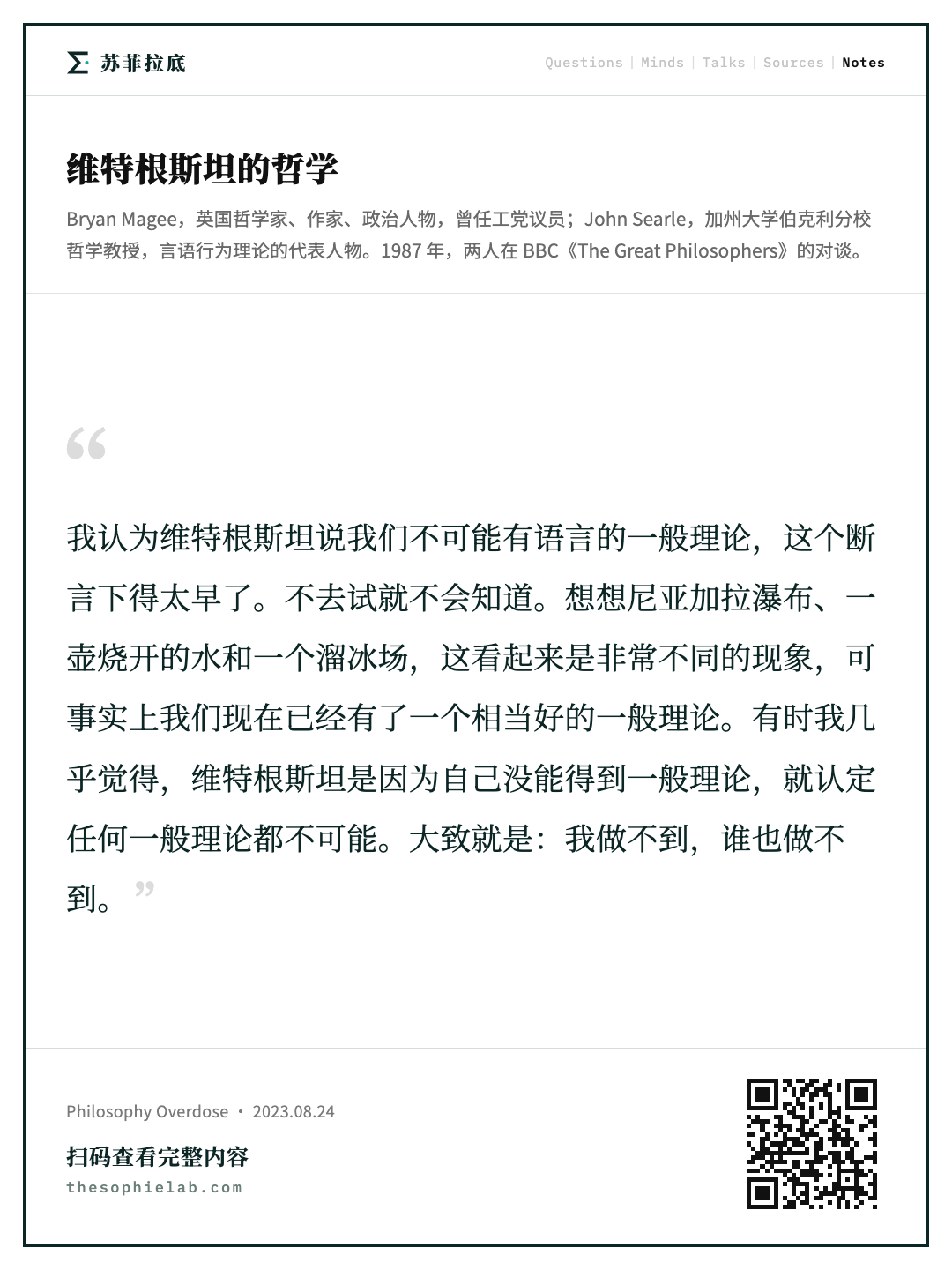
If you think of Niagara Falls and a pot of water boiling and an ice skating rink, it looks like very diverse phenomenon. We could go on and on with the diverse forms that water takes. But in fact, we've now got a pretty good general theory that it can account for all of that. And I don't see why we shouldn't seek general theories in philosophy, in in particular in the philosophy of language and the philosophy of mind. I almost think sometimes that Wittgenstein thought since he had failed to get a general theory, since the Tractatus failed, then any general theory must be impossible.
如果你想到尼亚加拉大瀑布、一锅烧开的水和一个溜冰场,它们看起来是非常不同的现象。我们还可以一直举下去,说水能呈现出多少种不同形态。但事实上,我们现在已经有了一个相当好的一般理论,能够解释所有这些。所以我看不出为什么我们不该在哲学中、特别是在语言哲学和心灵哲学中去寻求一般理论。我有时候几乎觉得,维特根斯坦是因为自己没能得出一个一般理论、因为《逻辑哲学论》失败了,就认定任何一般理论都必定是不可能的。
便签笔记
36:08
Roughly speaking, if I can't do it, nobody can. And a lot of people a lot of his Probably what he actually believed. of his disciples have said to me, oh well, since you reject this anti-theoretical this anti-theoretical bent of the investigation, you must believe in the Tractatus, as if those were the only two options. And I I to suggest there are lots of other options. Now, tied in with this uh aversion to theory is a kind of waffling that goes on in certain crucial areas. Let's take religious discourse just as an example of this. We were mentioning this earlier.
粗略地说就是:我做不到,别人也做不到。而且很多人,很多他的……这大概正是他真正相信的。很多他的门徒对我说,哦,既然你拒斥《哲学研究》里这种反理论的倾向,那你一定是信奉《逻辑哲学论》了——好像只有这两个选项似的。而我想指出的是,还有很多别的选项。那么,与这种对理论的反感相关联的,是在某些关键领域里的一种含糊其辞。我们就拿宗教话语来当例子吧。我们前面提到过这个。
便签笔记
36:41
See, Wittgenstein himself obviously had a deep religious hunger. I mean, he it wasn't this sort of a middle-class English attitude about religion that it's just something for Sunday mornings. No, he really had a religious hunger. There is constant references to God and getting himself right with God. And yet, I think most people would say that he was an atheist. Now, he in a way you feel almost that he wants to have it both ways, that he wants to be able to say things like, "Well, we just need to know the role that religious discourse plays in people's lives." But of course, you won't understand that role unless you see that religious discourse refers beyond, that the only reason that people pray is because they think there's a God up there listening. And it's And that's not whether or not God is listening is not part of the language game. The language game of religion can only be played the way it is because people think there's something outside the language game that gives it sense. Okay,
你看,维特根斯坦本人显然有一种深切的宗教渴求。我是说,他不是英国中产阶级那种对宗教的态度——好像那只是星期天上午的事。不,他是真的有一种宗教渴求。他不断地提到上帝,提到要让自己在上帝面前站得住。然而,我想大多数人会说他是个无神论者。那么,你几乎会感觉他在某种意义上想要两头都占,他想能够说出这样的话:"嗯,我们只需要知道宗教话语在人们生活中所起的作用。"但当然,你没法理解那种作用,除非你看到宗教话语指向语言之外的东西——人们之所以祈祷,唯一的理由就是他们认为有一个上帝在上面听着。而上帝到底听不听,这并不是语言游戏的一部分。宗教的语言游戏之所以能以现在这种方式进行,正是因为人们相信在语言游戏之外有某种东西赋予它意义。好,
便签笔记
17塞尔的评价:语言哲学与反笛卡尔贡献
37:36
now that's for the bad part. Let me say what I think is really terrific in Wittgenstein. Well, first of all, I think most philosophers that what I'm going to say right now is kind of contemporary orthodoxy. Most philosophers would agree with this. He has made terrific contributions in the philosophy of language and in the philosophy of mind. His contribution in the philosophy of language is that he really amounted devastating attacks on the idea that words get their meaning by standing for things or by being associated with some introspective process, by standing for some mental thing in the mind. And he does knock those views pretty effectively. And also, he is pretty good one I think of the most powerful, not the only one, but certainly one of the most powerful expressions of the view that speaking a language ought to be seen as a form of human activity, that words are also acts. Words are deeds, and that is an important line of investigations.
以上是不好的一面。现在让我说说我认为维特根斯坦真正了不起的地方。嗯,首先,我接下来要说的这些,大多数哲学家会认为算是当代的正统看法。大多数哲学家会同意这一点:他在语言哲学和心灵哲学上都作出了极其重要的贡献。他在语言哲学上的贡献在于,他对这样一种观念发动了毁灭性的攻击:词语之所以有意义,是因为它们代表着某些事物,或者因为它们与某种内省过程相关联,代表着心灵中的某个心理对象。他确实相当有效地击倒了那些看法。而且,他也很出色地表达了——我认为是最有力的表达之一,不是唯一的,但肯定是最有力的表达之一——这样一种观点:说一门语言应当被看作一种人类活动,词语同时也是行动。言即是行,而这是一条重要的探究路线。
便签笔记
38:31
Now, in a way, his discussion in the philosophy of mind is just as important as his work in the philosophy of language, and it's a very effective attack on the Cartesian tradition, on the idea that we really live in two worlds, a mental world and a physical world. But, his attack on Cartesianism is so powerful precisely because he doesn't mistake the doesn't make the mistake of most anti-Cartesians of thinking, "Yeah, you just have to reject the mind. Just say there isn't any such thing as mental phenomena."
那么,在某种意义上,他在心灵哲学中的讨论和他在语言哲学中的工作同样重要,而且那是对笛卡尔传统的一次非常有效的攻击,针对的是那种认为我们其实生活在两个世界里、一个心灵世界和一个物理世界的观念。但他对笛卡尔主义的攻击之所以如此有力,恰恰是因为他没有犯大多数反笛卡尔主义者所犯的错误,即认为"对啊,你只要否定心灵就行了。就说根本不存在心理现象这种东西。"
便签笔记
39:02
What he does is a painstaking analysis of a whole lot of psychological concepts, belief and fear and hope and expecting, and he goes through these, and what he shows you is that the deep grammar of these expressions is quite different from what you would think just looking at the surface, where we have nouns like mind and body, and where it looks like there are these two different things, minds and bodies. What he does is, by carefully describing these language games, he gets you to see that things like hope and fear and expectation and belief are grounded in situations, that we actually use these words in such a way where we're not inclined to think there must be some deep Cartesian divide. We say things like, "He's been groaning and in pain for the past 2 hours," and we don't feel there, "Oh my gosh, he's mixed categories, the physical groaning and the mental pain."
他所做的是对一大批心理学概念——信念、恐惧、希望、期待——作出细致入微的分析,他逐一考察这些概念,而他向你揭示的是,这些表达式的深层语法,跟你仅仅看表面时所以为的很不一样。在表面上我们有"心灵"和"身体"这样的名词,看起来好像存在着两类不同的东西,心灵和身体。而他所做的,是通过仔细描述这些语言游戏,让你看到,希望、恐惧、期待、信念这类东西是扎根于情境之中的,我们实际使用这些词的方式,并不会让我们倾向于认为其中必定有某种深刻的笛卡尔式鸿沟。我们会说这样的话:"他这两个小时一直在呻吟,一直很痛苦。"我们并不会觉得,"天哪,他把范畴混淆了——身体上的呻吟和心理上的疼痛。"
便签笔记
18行动先于理论:我们就是这样做的
39:55
It's a perfectly natural way of talking, and he shows us that our natural way of talking does not lead to any kind of Cartesianism. However, the most powerful part of Wittgenstein, from my own personal point of view, is not his work in the philosophy of language and mind, but it's an idea that really begins to acquire momentum in his last work. It's also appears in his earlier work, but in his very last work that he wrote when he was dying, on certainty. And that's it's a rather subtle idea, but it's this.
这是一种完全自然的说话方式,而他向我们表明,我们自然的说话方式并不会导向任何形式的笛卡尔主义。不过,从我个人的角度看,维特根斯坦最有力的部分并不是他在语言哲学和心灵哲学上的工作,而是一个在他最后的著作中才真正开始积聚力量的想法。这个想法在他早期作品里也出现过,但是在他临终前写下的最后那部作品《论确定性》里最为突出。这是个相当微妙的想法,大致是这样的。
便签笔记
40:26
We have in the Western intellectual tradition, going back to Plato, we have the idea that any meaningful human behavior must somehow be the expression of a theory, an implicit theory that we hold. That if you understand me and I understand you, it can only because we each have a theory of the other. you say, an implicit theory. An implicit theory. Chomsky thinks this, that there's an unconscious theory of language. And artificial intelligence is based on this presupposition that there are these unconscious theories. Now, there's some truth in that, but Wittgenstein is anxious to emphasize that a great deal of what we do both is both socially and biologically primitive. It's a way of responding.
在西方思想传统中,一直可以追溯到柏拉图,我们抱有这样一种观念:任何有意义的人类行为,必定在某种意义上是某种理论的表达,是我们所持有的某种隐含理论的表达。也就是说,如果你理解我、我理解你,那只可能是因为我们各自对对方持有一套理论。你说的是,一种隐含的理论。一种隐含的理论。乔姆斯基就是这么认为的,认为存在一种无意识的语言理论。而人工智能也建立在这样一个预设之上,即存在这些无意识的理论。那么,这里头确实有几分道理,但维特根斯坦急于强调的是,我们所做的很多事情,无论在社会层面还是生物层面,都是很原始的。那是一种反应方式。
便签笔记
41:09
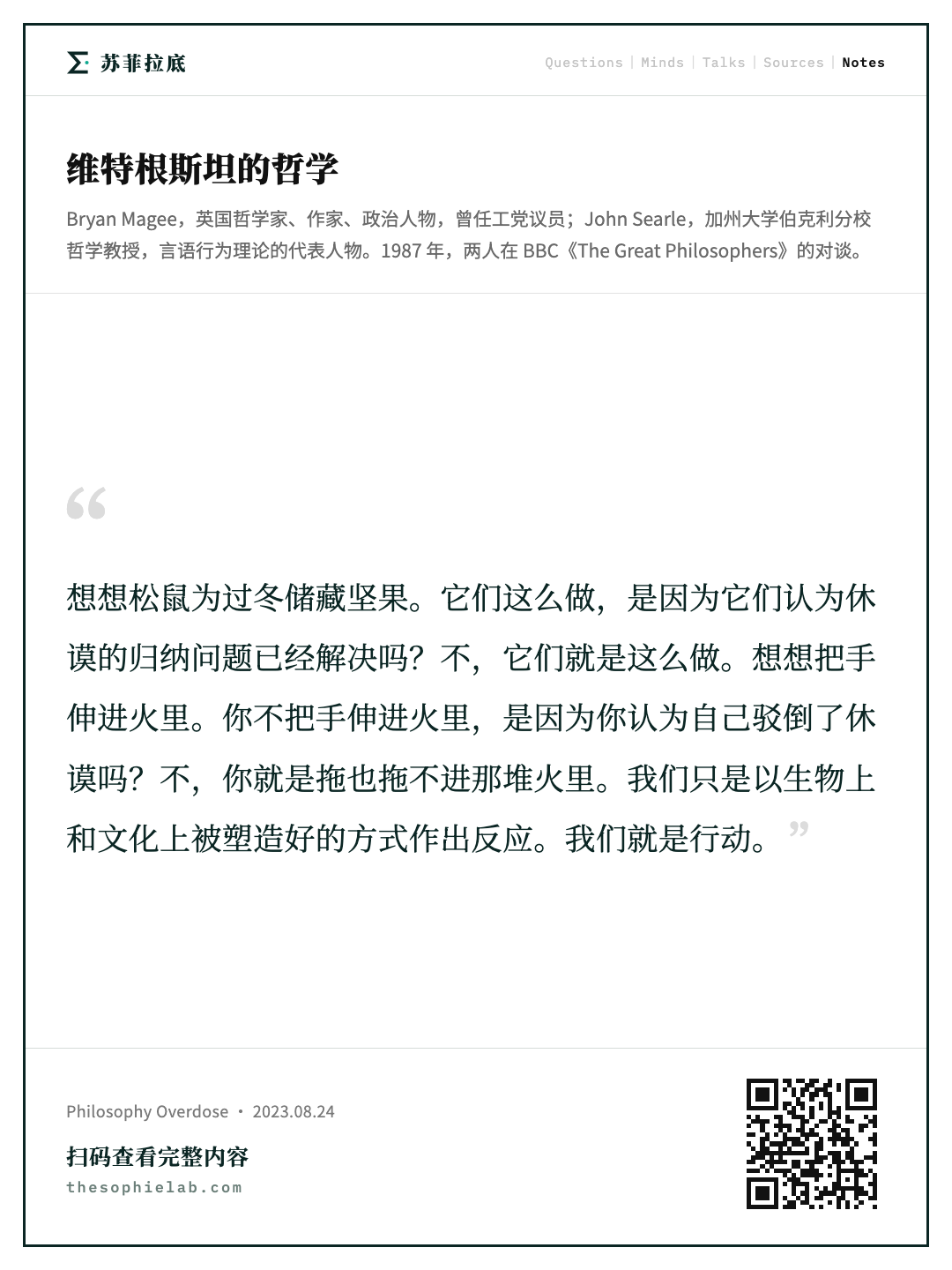
It's a way of acting. We just act. We don't need to appeal to the idea that there's some implicit theoretical structure that enables us to act. And he as usually gives a very good similes. He says, "Look, think of squirrels storing nuts for the winter. Now, do they do that because they think Hume's problem of induction has been solved and we now know that the future resembles the past? No, they just do it. Now, he says, "Think of yourself and putting your hand in the fire. Is the reason you don't put your hand in the fire, is it because you think you've refuted Hume or you think you've got very good inductive evidence?" No, you just don't do it. You you couldn't be dragged into that fire. And he says a great deal of our human activity has to be seen like that. We're just responding in ways that are both biologically and culturally conditioned. But his ground floor statement, he keeps repeating this, he is, "We just act. That's the way we do it." And this goes against a whole tradition where we try to think,
那是一种行动方式。我们就是那样做了。我们不需要诉诸这样一种想法,说存在某种隐含的理论结构使我们能够行动。而且他照例给出了非常好的比喻。他说:“你看,想想松鼠为过冬储存坚果。那么,它们那样做,是因为它们认为休谟的归纳问题已经解决了,我们现在知道未来会像过去一样吗?不是,它们就是那么做了。”接着他说:“想想你自己,想想把手伸进火里。你不把手伸进火里的原因,是因为你觉得自己已经驳倒了休谟,或者你觉得自己掌握了非常好的归纳证据吗?”不是,你就是不会那么做。你就是被拖也不肯进那火里。他说,我们人类的很多活动都得这样来看待。我们只是在以既受生物条件制约、又受文化条件制约的方式作出反应。但他最底层的那句话,他反复重复的那句话,就是:“我们就是这么做的。我们就是这么干的。”而这与整个一种传统背道而驰——在那个传统里我们总想着:“嗯,我们之所以能做我们所做的事,是因为我们有一种隐含的理论。”
便签笔记
42:09
"Well, it we can only do what we do because we've got an implicit theory. Do you think there's still a lot of juice in this, or do you think that Wittgenstein himself has made all of the really important, the creative and constructive use of these ideas that can be made? Oh, no. I think there's a great deal more to be said on this. I I To put it very bluntly, I think Wittgenstein only scratched the surface. Thank you very much, Professor Searle.
你觉得这里面还有很多可挖掘的东西吗?还是说你认为维特根斯坦本人已经把这些想法中真正重要的、富有创造性和建设性的运用都做完了?哦,不。我认为在这个问题上还有很多话可说。我……说得直白点,我认为维特根斯坦只是触及了皮毛。非常感谢您,塞尔教授。
便签笔记

这期还没有生成总结。

这期还没有生成核心句型(制作精读 PDF 时会一并生成)。

这期还没有生成生词表(制作精读 PDF 时会一并生成)。

这期还没有生成自测题(制作精读 PDF 时会一并生成)。

精读便签
下载便签 手机:长按图片保存
← 上一期 · NO.053Douglas Hofstadter • The Deep Interconnectedness of Human Souls 下一期 · NO.055 →Wittgenstein's Two Philosophies Explained: Anthony Quinton Interview (1977)
问题周报 WEEKLY LEDGER 每周一封:本周入库的精读、一个值得带走的问题、一条苏菲按。随时退订。
免费 · 每周一封 · 一键退订
苏菲拉底 THE SOPHIE LAB · ASK THE BEST MINDS THE BIG QUESTIONS 内容仅供学习 · thesophielab.com