Feyerabend – Anything can go (1993) · 苏菲拉底
字幕 字幕位置
--:--
点击播放,这里会跟随视频显示当前句的中英字幕。

Feyerabend – Anything can go (1993)

节目发布 2021-04-11 · Andrea Cirla
保保罗·费耶阿本德 主主持人
EDITED TRANSCRIPT · 依据现场录音编译整理,可划线生成便签
一九九三年,保罗·费耶阿本德(Paul Feyerabend)接受电视访谈,回顾自己从维也纳的物理课堂到《反对方法》的思想历程。这位奥地利裔科学哲学家早年师从波普尔,后来以对科学方法论和科学理性神话的总体批判闻名于世,也因“怎么都行”一语饱受争议。谈话从他的老师蒂林、埃伦哈夫特与弗兰克讲起,逐步进入真理问题、科学在社会中的位置、理论评价的标准、国家与科学的分离,以及教育应当是什么样子。本文依据现场录音编译整理。

一连串偶然

主持人:费耶阿本德教授,您毫无疑问是我们这个时代最有趣、也最有争议的哲学家之一。您起初是波普尔的学生,后来却因为一批著作而声名大噪,那些著作全面批判科学理论的纲领,也批判人们想当然的科学理性。能否先谈谈您的思想发展?从求学之初到今天,您对艺术、科学和哲学的兴趣一直没有断过。

费耶阿本德:要说思想发展,那肯定不像大卫·休谟那样,事先就把自己的思想发展规划得清清楚楚。我的经历是一连串偶然。我对艺术、对表演,尤其是对歌唱产生兴趣,是因为当时有一些极出色的人在台上演出,我又碰上了一位很好的老师。我对物理产生兴趣,是因为中学里有一位极出色的物理老师,于是我到大学里选了物理课。我对哲学问题产生兴趣,纯属意外:我当时大量购买戏剧书籍和剧本,因为是二手货,只能整包买,一整包戏剧书里夹着哲学书。为了不白花钱,我就把那些哲学书也读了,读着读着就有了兴趣。

至于进入哲学这一行,更是纯粹的偶然。我之所以当上哲学讲师,是因为我当时人在维也纳,身无分文,我的朋友伊丽莎白·安斯康姆说,牛津有个哲学教职空缺,你为什么不去申请?我就申请了牛津,也申请了布里斯托,还申请了澳大利亚,运气好,拿到了布里斯托的职位。

可我毫无准备。我从来没有系统学过哲学,也没学过科学哲学,只好靠着给人讲课来学这门东西。就这样,我一点一点滑进了这个领域,又因为不得不讲课,对它的强调越来越多。在讲课和应邀参加会议的过程中,我认识了相当多杰出的哲学家和科学哲学家。到后来,我觉得他们说的东西不怎么样,于是就起来反驳。我的一些论文就是这么来的,不是我坐下来觉得非得把事情理清楚不可,而是在某次会议上,有人做了报告,我站起来反驳,会后所有报告都要结集出版,我只好把自己说过的话写下来。发表的东西就这样一篇篇冒出来了。所以我的思想发展,就是一连串偶然。

还在学生时代,我就受邀参加阿尔卑巴赫的暑期大学。那个论坛刚刚创办,来访的学者和讲课的人都很出色。那时候我还抱着一种绝对的科学主义态度(scientistic attitude):只要有人谈上帝、谈真理之美,我通常就站起来告诉他,他对科学一无所知,他说的全是胡说。我也很佩服维也纳学派的实证主义。会后讨论的时候,人们说,我们要把科学家说的话讲清楚。所谓讲清楚,在他们那里就是把它翻译成某种逻辑符号系统。我当时也觉得,这纯粹是浪费时间。

至于我从什么时候开始怀疑科学这项事业本身,我真的说不上来。曾经有一个阶段,我认为,你要想知道事情究竟是怎样的,就必须求助于科学。后来又有一个阶段,我说,科学家说了不少有趣的东西,这些东西至今仍然比别的东西更让我感兴趣,可他们并没有把真理绝对地攥在手里。中间是怎么转过来的,我真的不记得了,应该是一个渐变的过程。

其中有一部分原因,是伊姆雷·拉卡托斯常来听我的课。拉卡托斯是拥护科学的,可以说是个科学迷。为了逗他一下,我时不时会在课上对科学说几句刻薄话。说了之后,他马上对我说:你为什么不把这些话都写下来,我来反驳,我们把这场精彩的争论写成一本书?他还说:你把话说得越极端越好。于是我就说得极端之至,这就是《反对方法》。只是书出版的时候,拉卡托斯已经去世了,他没能写他那一半。

蒂林:有信念的怀疑者

主持人:我有时觉得,在我们这个时代,科学家对科学的批判反而比科学哲学家更尖锐。是不是也有一些科学家推动了您对科学崇拜的批判?

费耶阿本德:是有好几个人。首先是我在维也纳的一位老师,他是物理学家,讲课极为出色,实际上也是波普尔的物理老师,还是赫伯特·费格尔的物理老师,费格尔后来主持明尼苏达科学哲学中心。他叫汉斯·蒂林(Hans Thirring)。奥地利并入德国的时候,蒂林被强制退休,一方面因为他是和平主义者,另一方面因为他和爱因斯坦、弗洛伊德交好。战后他回来继续讲物理,但他还写了一部大书,讲世界和平的心理前提和社会前提。他在物理课上对我们所有人说:物理不重要,和平比物理重要得多,所以你们要来大礼堂听我的和平讲座。结果几乎没人去,大家都去听物理课了。可我去了,还跟他长谈。我还是学生的时候,他也来听过我的课;后来我在加州站稳了脚跟,他到加州来,我们又聊了很多。

这个人真的给了我很深的印象。他反对世上各种残酷的事,可他不是那种笑容满面、却非要把某一种自由、某一种自由主义、某一种和平强加于人的自由派。他也不认为过去那些落在我们头上的事,全是什么魔鬼化身干出来的,在他看来那只是愚蠢和荒唐。所以他对人类的愚行,总是带着一种忧伤的微笑。他是个怀疑论者,但是个有信念的怀疑论者(committed skeptic)。我只能这么形容他。这一点,当时未必,但多年之后,给了我很大的触动。它把科学摆在了一个合适的位置上。他反对占星术之类的东西,可他说:科学是一回事,另外还有一些重要得多的东西。你受过科学训练,处理那些更重要的事情时,就能比别人更理性、更清楚,比如能当个更好的医生。这是我受到的第一个重大影响。

埃伦哈夫特的实验

费耶阿本德:第二位是我在维也纳求学时的另一位老师,费利克斯·埃伦哈夫特(Felix Ehrenhaft)。这个人得解释一下。埃伦哈夫特也是维也纳的物理学教授,维也纳并入德国时他不得不离开。他说的种种东西,跟别的物理学家说的全部相反。密立根说电子是最小的电荷单位,他说不对,他发现了更小的电荷。人们说惯性运动是匀速直线运动,他说不对,惯性运动是沿螺旋线进行的。人们说有电解,磁体却做不到同样的事,他说他发现磁体也能分解水。人们说不存在单独的磁极,他就用实验演示出磁单极。所以很多科学家、很多物理学家把他当成江湖骗子。

他回到维也纳的时候,我们这些物理系学生说:我们要揭穿这家伙。因为我们都拥护理论、迷恋理论,又听说过他的名声。结果被揭穿的反而是我们。他当着我们的面做实验,然后说:你们这些大嘴巴,现在还有什么话说?你们说不出来,只能坐在那儿,张不开嘴,你们什么都不懂。这非常有启发。他在阿尔卑巴赫的暑期大学也干了同样的事。那里有一间小屋,他把实验都架在里面。当时在场的有重要的物理学家,比如罗森菲尔德,他可以说是尼尔斯·玻尔的发言人,是这一行里最受推崇的物理学家之一;蒂林也在,还有另外几位。他们走进小屋,出来的时候,那副表情就像看到了什么不堪入目的东西。第二天埃伦哈夫特做讲座,结尾时说:你们这些理论家能怎么办?你们什么都不懂,你们只能闭嘴,只能坐着。

可我们都信理论。我们说,埃伦哈夫特不可能是对的,就想方设法去驳倒他,可是驳不倒。于是我们发现,物理学里那个所谓的真理,是有点麻烦的。这件事在我心里沉淀下来,是很久很久以后的事,当时并没有。当时对我来说,这只是一堂很有意思的课,让我看到某些观念一旦抓住一个人,他就甩不掉了。我们信经验主义,我们信理论物理,可就我们而言,埃伦哈夫特的实验什么都没证明,人们管它叫“灰尘效应”(dirt effect),就是说有点什么东西在那儿,可我们说不出是什么。这是第二个在这方面影响了我的人,影响是很晚才显出来的。当时我只是有点困惑,随着时间推移,它慢慢发酵,浮上来,为各种各样的怀疑添了一份力。

弗兰克与亚里士多德

费耶阿本德:第三位是菲利普·弗兰克(Philipp Frank)。弗兰克是维也纳学派的创始人之一,是爱因斯坦在布拉格的继任者,爱因斯坦去柏林之后由他接任。他是爱因斯坦的好友,本人是物理学家,也是所谓第一维也纳学派的创始人。第一维也纳学派比人们通常所说的第二维也纳学派早了几年。后来他去哈佛当了教授。我认识了他,在阿尔卑巴赫听过他的一次讲座。他在讲座里说:亲爱的朋友们,人人都在谈哥白尼革命,人人都说亚里士多德多么糟糕,同时人人又说科学家是经验主义者。可你仔细看,真正的经验主义者是亚里士多德,亚里士多德派的论证其实是很好的论证。所以,哥白尼如果赢了,他赢的不是经验主义,而是别的什么东西。这又是一个在我心里留下来的因素,同样是后来才开始发酵的。

《反对方法》的由来

费耶阿本德:我最初的攻击对象,是那些对科学所知不多却大谈科学的哲学家,那时候很多哲学家都是这样。他们说,我们要重构科学家说的东西,可他们做得很差。所以你去读《反对方法》就会发现,它主要是反对科学哲学,反对把科学哲学当作一种手段,来给科学家所说的那些复杂东西赋予意义,来揭示科学背后的方法。我在书里说,根本没有这样一种方法。这也不是什么新东西,很多科学家早就这么说过。爱因斯坦就常说,拿科学家和认识论者比一比:科学家面对的是复杂的局面,要在这个局面里往前走,他不能用一条简单的规则,他必须是个机会主义者(opportunist)。这是爱因斯坦的原话。所以我在《反对方法》里说没有方法,这是很多科学家早已说过的话,毫不新鲜,只不过对哲学界来说显然是新鲜事。如今大多数科学史家都视为当然:你不能先立一条规则,然后说科学就是照着这条规则走的。

况且,人们现在已经发现,“科学”这个词覆盖着许多不同的东西。有宏观经济学,有康拉德·洛伦茨和他的鹅,有物理学,还有拓扑学,拓扑学也是一门科学。神学呢?神学是最早的科学之一。它们是同一回事吗?差得远了。所有这些加在一起,先是让我怀疑哲学,其次,你知道,认为真理集中在科学里,这是哲学家的想法。这早在康德那里就有了,然后是追随康德的哲学家,然后它又抓住了一部分科学家,不是全部,只是一部分,这部分人从哲学家那里接过了这种教条主义。否则你去看,很多科学家会说:我们不知道自己在干什么,我们不理解这件事。量子理论刚出来的时候,人们说,我们知道怎么用它,知道怎么解释某些实验,可它整体上意味着什么,我们毫无头绪。

把这些东西都放到一起,再加上拉卡托斯说的“马上写,别再遮遮掩掩,我要有东西可攻击”,书就写得更激进了一点,这就是那第一本书。全是一连串偶然。还有文体上的考虑:比如说,我可以论证一件事,也可以讲一个故事,我就选讲故事;我可以把一件事说得温和,也可以说得刻薄一点,我就选刻薄的说法。所有这些合在一起,造出了这本书。

科学没有“真理”

费耶阿本德:我的困难在于真理这个概念。在法官面前说真话是什么意思,我懂,人人都懂:你要说真话,只说真话,不许撒谎,要尽力回忆,不能漏掉你认为相关的东西,当然你可能忘了。这很清楚。可是说到科学的真理呢?随便拿一门科学学科来看,它里面都包含着彼此冲突的进路。量子理论和相对论在很长时间里是冲突的,现在人们试图用新的理论进路来抹平这个冲突。这两样东西都属于科学,可如果它们彼此冲突,你就不能说在物理学里我们找到了真理。我们在某些有限的领域里找到了各种有趣的故事可讲,可真理呢?你能说什么?

对很多人来说,不是所有人,科学进路的一个重要部分是科学必须是数学的,所谓自然之书是用数学符号写成的。可这算什么?这是一个科学理论吗?它是真的,还是不真的?很难判断。因为每当一些科学家转向更定性的考虑,数学家就会追上来,为这些定性考虑提供一套理论。在天体力学里,这就是拓扑学。行星系统的稳定性问题在很长时间里没有得到令人满意的解决。定量的办法是级数展开,级数应当收敛,给出某些参数的确定数值,可这条路碰上了困难。于是有人说,我们把整件事定性地来看,不去管每颗行星绕太阳跑的轨道究竟是什么样,而是从整体上定性地看行星系统怎样呼吸,看它呼吸着呼吸着会不会突然崩裂。这是庞加莱的进路。可这条定性进路后来也被数学化了。所以你没法说“科学必须是数学的”这个想法可以被反驳,因为数学本身一直在变。它也许是一个指导性的想法,指引数学家往哪些领域集中力量,也就是那些现有数学形式不管用的领域。这样一来,整件事似乎成了同义反复。所以,在科学内部谈真理,并不容易。

再看十九世纪的物理学,或者任何一门具体科学的任何一个时期,里面都有不同的进路,方法互相冲突,结果互相冲突。走出物理学,进入生物学,长期以来似乎也有冲突,如今有了分子生物学的实验室,情况稍有不同。再进入经济学,那里的局面完全是另一回事。或者进入像康拉德·洛伦茨那样带着动物做的研究,那看起来像老式的博物学:你在草地上爬来爬去,让鹅跟着你,对着它们嘎嘎叫,看它们做什么,这又是完全不同的路数。所以,并不存在“科学”这样一个手握真理的东西。那是对整个局面极其肤浅的描述。你看,前面说到的那种绝对精确的位置,在相对论里就不是预设。不只是方法,还有结果,还有基本假定,在科学的不同领域里都各不相同。

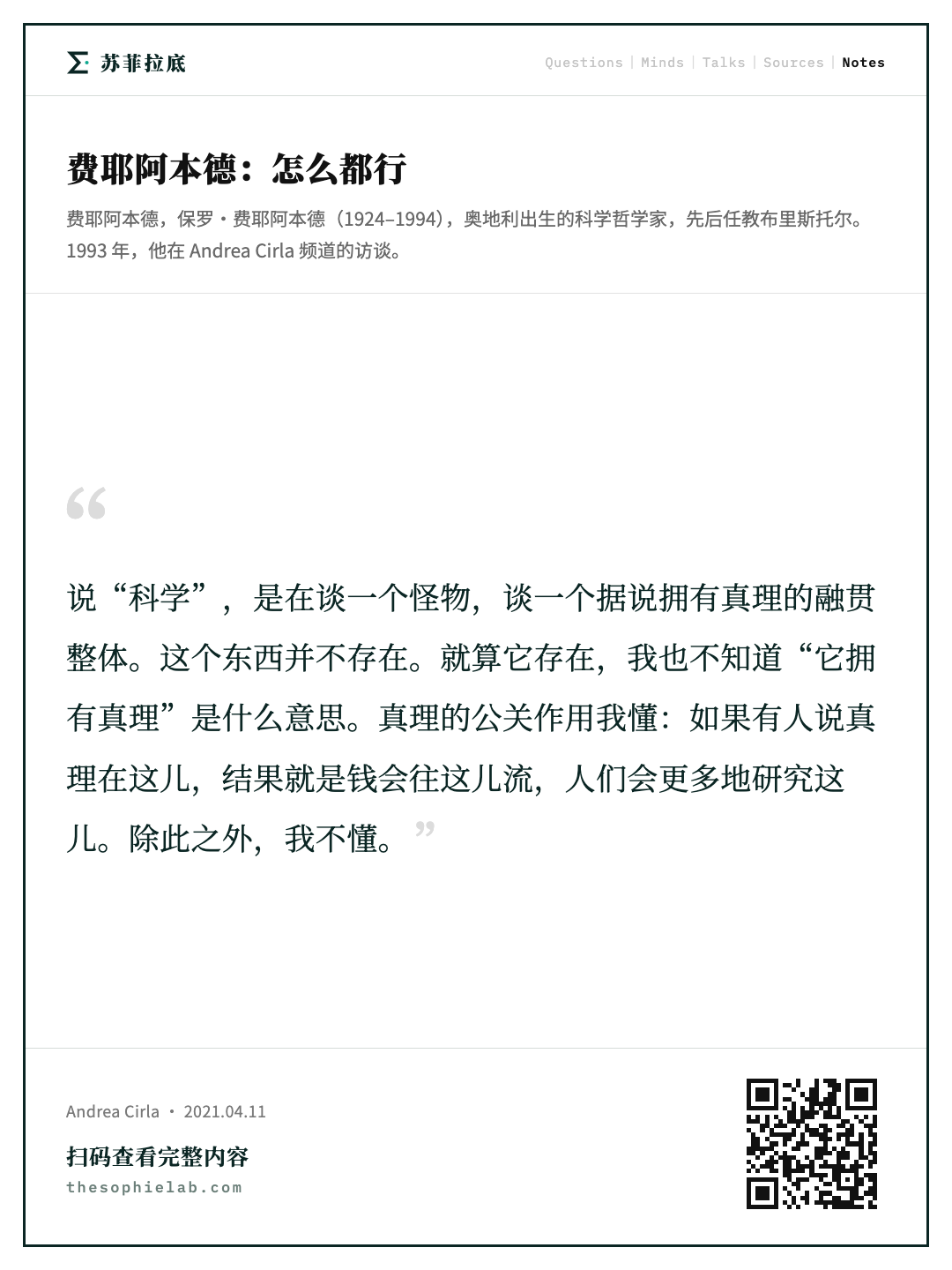
所以,说“科学”,是在谈一个怪物(chimera),谈一个据说拥有或应当拥有真理的融贯整体。这个东西并不存在。就算它存在,我也不知道“它拥有真理”是什么意思。是说我们研究它就会更快乐?更有效率?可即便科学中最“真”的那些部分,效率也不怎么样。东西总在塌,哪怕在人们说“我们终究搞明白了”的领域也一样,因为那是工程问题,而工程问题非常难。所以,这种关于真理的谈论,这种把科学当成一个统一体的谈论,在我看来都是幻影。真理的公关作用我懂:如果有人说真理在这儿,结果就是钱会往这儿流,人们会更多地研究这儿。除此之外,除了“真理”这个词的具体用法,比如“老实告诉我,我不在的时候你到底害没害怕”,除此之外我不懂。因此,“科学拥有真理,还是神话拥有真理”这整个问题,对我来说也没有多少意义。

科学,还是神话

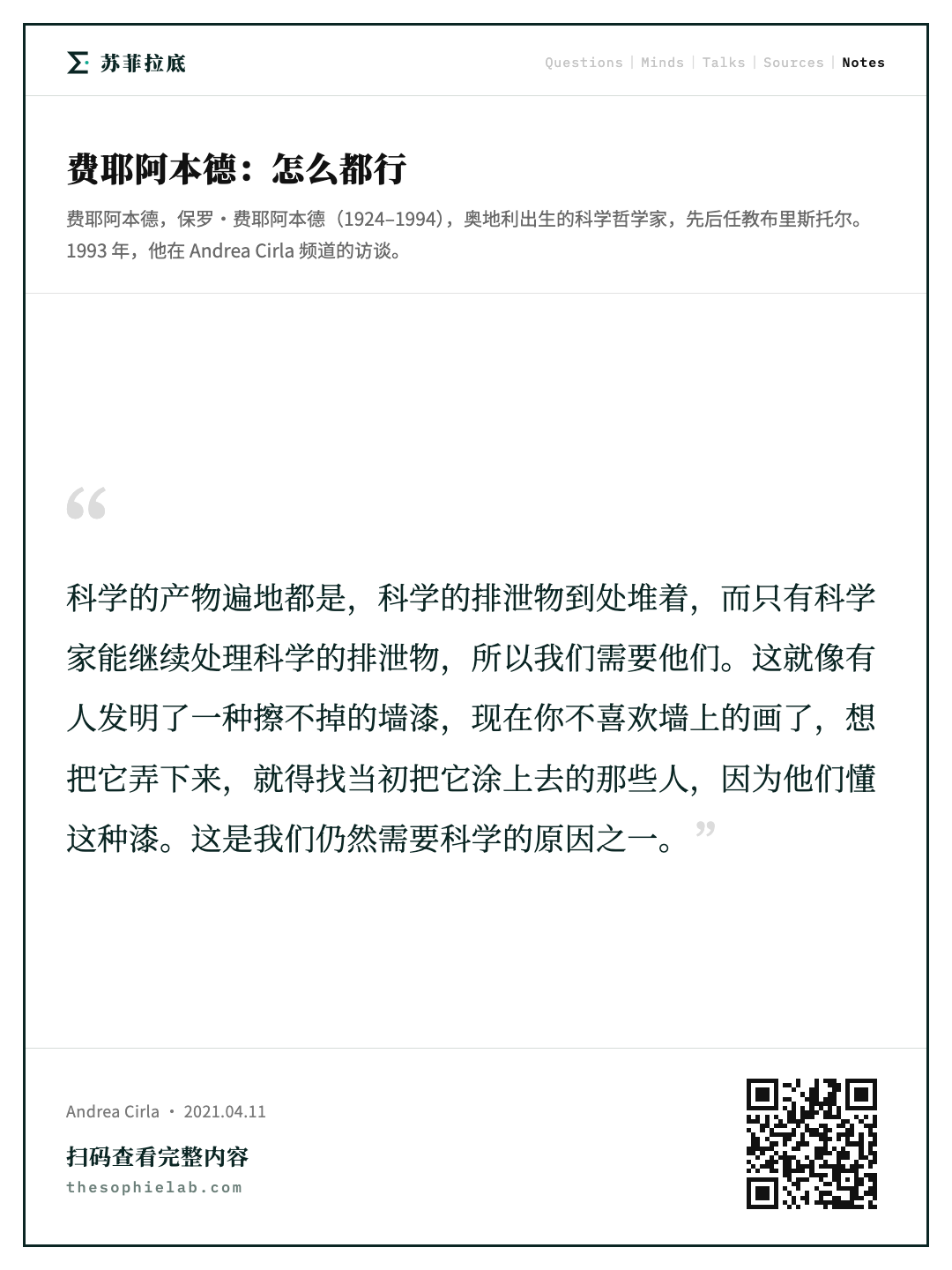
费耶阿本德:对我来说有意义的问题是:一个社会、一个群体,把全部努力投向科学,这里是复数的诸科学,是更好,还是投向神话更好,还是两者都需要?比如说,如今为了生态的目的,科学是必需的。你看,现在的情况是,科学的产物遍地都是,科学的排泄物到处堆着,而只有科学家能继续处理科学的排泄物,所以我们需要他们。这就像有人发明了一种擦不掉的墙漆,现在你不喜欢墙上的画了,想把它弄下来,就得找当初把它涂上去的那些人,因为他们懂这种漆。这是我们仍然需要科学的原因之一。

我要说的是,如今这么多科学环绕四周,并不是所有科学都好,来一点诗歌,能让事情松动一些,让人把事情放回该有的比例里去。你看,一个神话可以和一个科学理论一样压迫人,事实上神话确实压迫过人,把人弄进非常古怪的精神状态,让人做出非常古怪的行为,纳粹主义就是一个例子,尽管它算不上宏大意义上的神话。所以你必须说得更具体,不能笼统地说科学和神话,因为有许多不同种类的神话,什么神话?哪一种科学?为什么?“科学还是神话”这类笼统的问题,我认为没有多少讨论的价值,虽然哲学家们讨论的主要就是这类问题。

科学是一整个文化

费耶阿本德:还有一件事。最近科学史家发现了一点,其实这一点本来就摆在那儿,人人都看得见:科学并不是维也纳学派所理解的那种东西。对维也纳学派的许多人来说,对卡尔纳普、对波普尔来说,讨论科学就是讨论特定的陈述系统,给科学理出秩序就是给这些陈述系统理出秩序。这预设了科学里发生的一切总是明明白白摆在台面上的,预设了人们不会出于自己都不清楚的理由去行动,还预设了做实验是件简单的事。可你看看今天的大型实验,比如欧洲核子研究中心(CERN),那里运转着一整片工业厂房,人们必须就某些事情达成一致,必须妥协;有的东西行得通,有的行不通,里面有大量猜测;钱不够,进行到一半突然得换路子。此外,每一个跟仪器打交道的实验家,都掌握着大量波兰尼所说的默会知识(tacit knowledge),就像赛车手:他没法把自己知道的东西一条条讲给你听,但他可以在极端路况下开给你看。科学家也是如此。

科学里有这么多成分,以至于如今一些科学史家说,实验层面本身就是一整个文化。而实验层面与所谓理论层面之间的联系,很多人把理论层面看得最重要,其实非常难以厘清,从一个层面过渡到另一个层面,包含着许多任意的成分,所谓的近似。所以你把这些都看一遍,“科学”这个统一体就散成了不同的科学。而在各门科学内部,又有理论层面,理论层面再细分:比如在基本粒子物理里,有搞高深理论的人;有所谓现象学家,这些人做曲线拟合,仍然不做实验;然后是做实验的人,他们从曲线拟合者和高深理论家那里得到一些信息。他们彼此交换着东西,有时候宣布一项科学成果,就像不同党派之间缔结一项政治条约,这一方让一点,那一方让一点,最后说:好,总算可以发表了。

从困难中前进

费耶阿本德:让牛顿断定上帝会干预行星运行的困难之一,是所谓木星与土星的大不等性(great inequality)。看上去木星和土星随着时间推移正越离越远。而牛顿从古代观测,从他经由托勒密得到的巴比伦观测里知道,古代的行星系统和今天大体一样。另一方面,又有这种分崩离析的趋势。于是他推断,上帝会定期把行星系统重新整顿一番。另外一些人说,我们就用牛顿的理论,最终会发现这件事能用物理学解释,不需要神的干预。人们花了两百多年才走到那一步,可他们从未失去信心,始终相信这个困难是可以解决的。所以,困难可以存在几个世纪,而人们出于某种形而上学的理由,照样相信某个理论是正确的,最后它果真被证明是正确的。

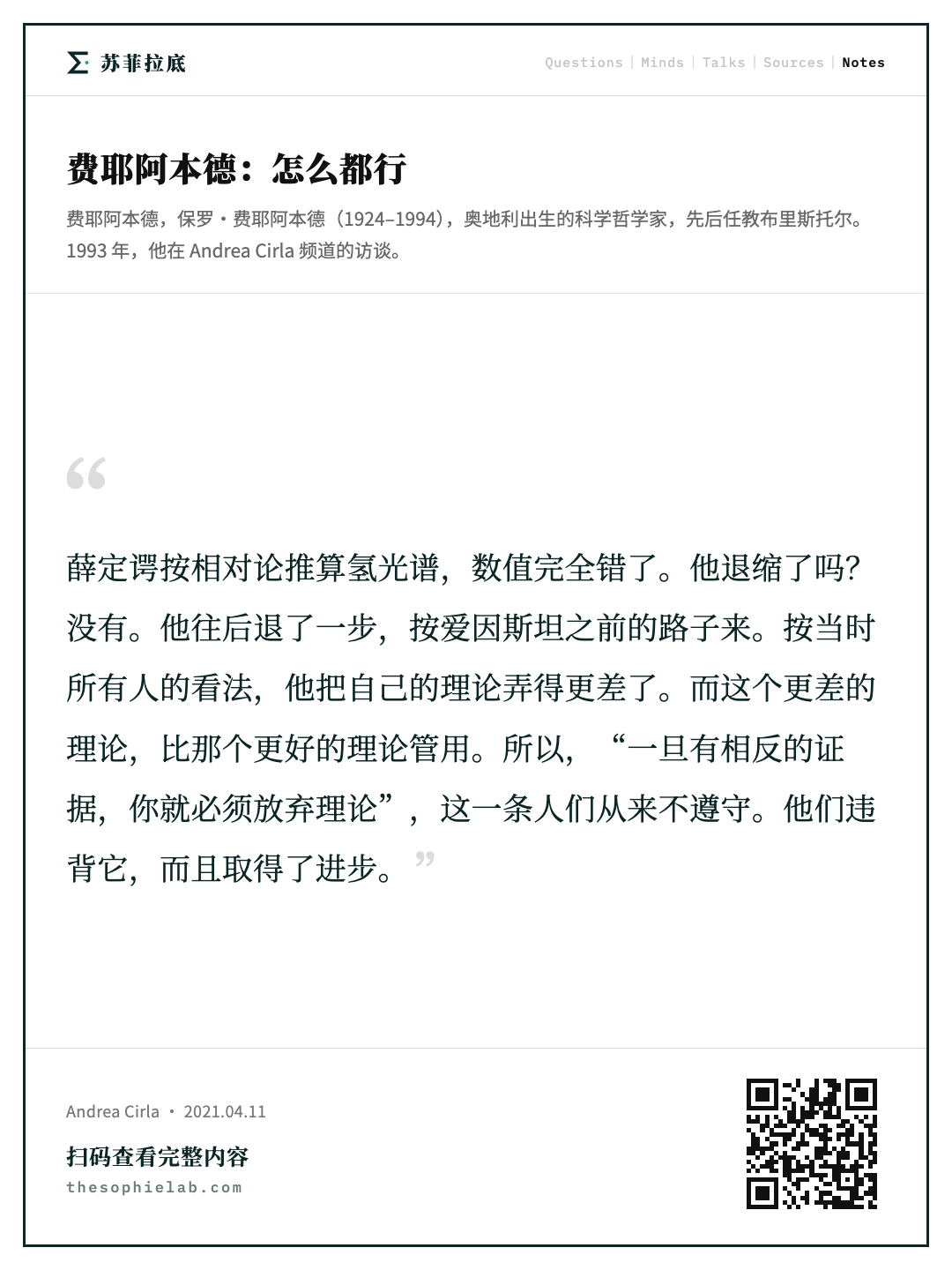
另一个例子是波动力学的早期历史。薛定谔有一段时间相信基本粒子具有波的性质,他在这个基础上推算氢光谱,而且是按相对论来推的,把爱因斯坦的发现考虑了进去。结果他得到的数值完全错了,因为氢光谱当时已经测得很准。他退缩了吗?他说“我错了”吗?没有。他往后退了一步,说:我不按爱因斯坦来,我按爱因斯坦之前的路子来。这意味着,按当时所有人的看法,他把自己的理论弄得更差了。而这个更差的理论,比那个更好的理论管用,原因要到很久以后才得到解释。所以,“一旦有相反的证据,你就必须放弃理论”,这一条人们从来不遵守。他们违背它,而且取得了进步,有时候走到了某个地方,有时候没有。所以你不能一概而论,你必须逐案决定,而且必须把案子的细节弄清楚,才知道该怎么办。

工具箱与判断

费耶阿本德:在这方面,手里有一个方法论规则的工具箱是很有用的,那就像一堆经验法则:我现在该用这条,还是那条?这很有用。就此而言,波普尔把证伪规则放进工具箱,是一项很有用的增补。他的错误在于认定这是唯一有用的工具,是唯一可以用在理论上的工具。他本该说的是:我们扩充了工具箱。

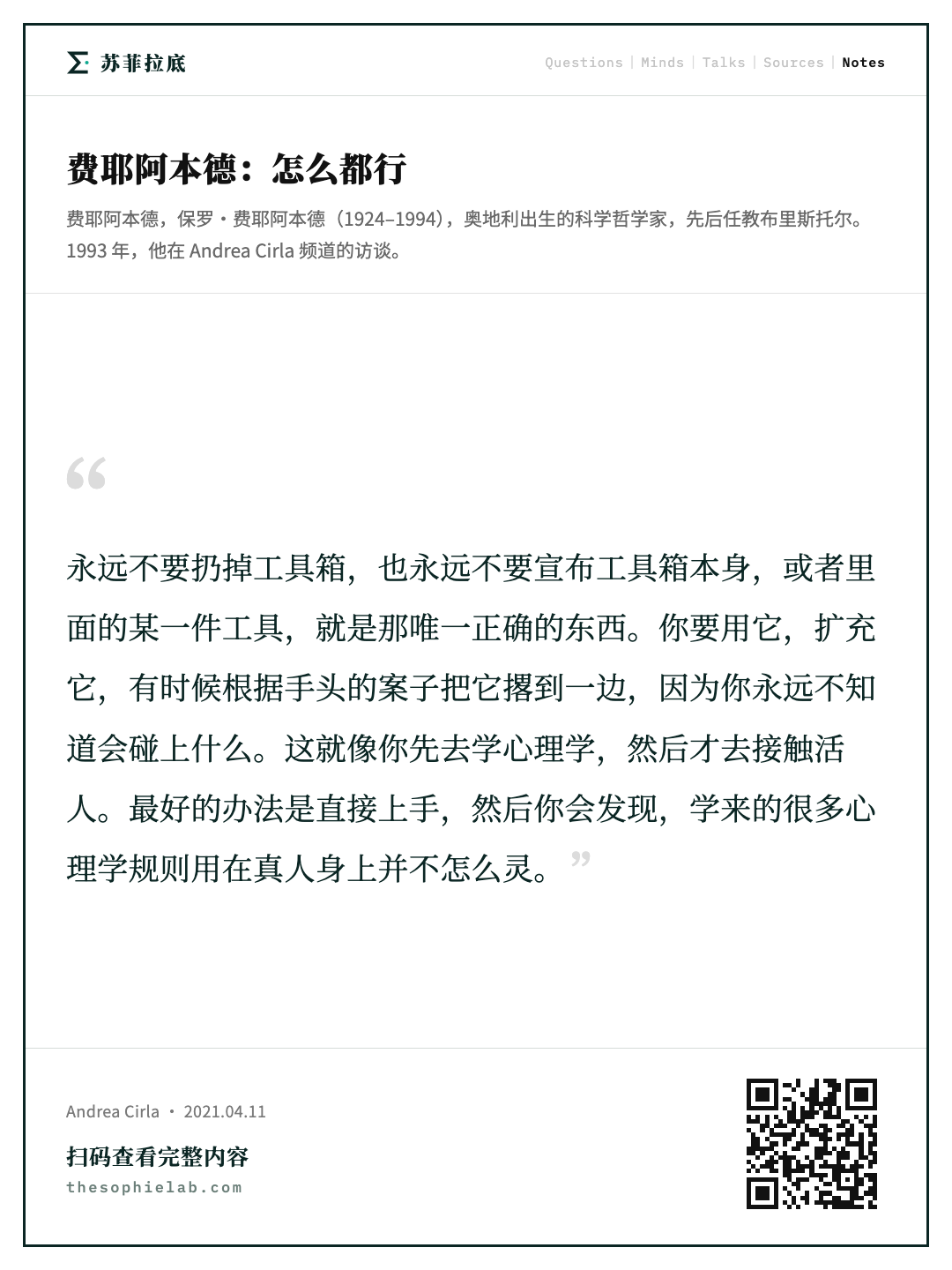
你看,永远不要扔掉工具箱。我不会说放弃一切方法。永远不要扔掉工具箱,也永远不要宣布工具箱本身,或者里面的某一件工具,就是那唯一正确的东西。你要用它,扩充它,有时候根据手头的案子把它撂到一边,因为你永远不知道会碰上什么。这跟下面这种情形完全一样:你先去学心理学,然后才去接触活人,然后试着按学来的心理学规则来对待我。最好的办法是直接上手,然后你会发现,学来的很多心理学规则用在真人身上并不怎么灵。

有人会说,那个理论笨拙不堪,另一个优雅得多。另一些人会反驳:可这个笨拙的理论更符合事实。回答是:它当然更符合事实,因为它那么笨拙;那个优雅的理论呢,如此等等。很多人都做这种判断,研究的成果就是做了这类判断的结果。可这并不意味着存在一部法典,从第一条到第五条列出所有可以做的判断,规定它们在一切情形下都必须适用。比如狄拉克谈到薛定谔那个案子时说,薛定谔坚持自己的理论是完全正确的,因为那理论很美。对狄拉克来说,理论的数学表达是否优美,是一条重要标准。确实有人说:我不喜欢这个理论,它太丑,不成体统,也许它符合事实,可他们想要更好的东西。这类判断每时每刻都在发生,可没有任何办法能以一般的方式为其中任何一种判断辩护。你只能在具体案子面前为它辩护,而到头来,你迟早会回到自己的偏好上。

有些人是真正的经验主义者。比如说,某些医生和分子生物学家的差别之一是:分子生物学家想要对人类生物学的某些现象做出普遍的说明,而医生想知道的是在具体病例里什么管用。所以医生的知识会比分子生物学家的知识零散得多;另一方面,分子生物学家追求简单的路数,因此在医生看来过于简单化。所以在某些方面医生强过分子生物学家,在另一些方面分子生物学家强过医生。判断一直在做,我唯一说不能做的事,是以一般的方式为特定的比较判断辩护,以至于不管出现什么情况,你都被迫套用这个判断。

经验与融贯之争

主持人:科学理论的主要问题在于,我们至少有两大类标准,而它们可能互相矛盾。一类与经验主义有关,即理论要与实在相符;另一类可以叫作逻辑融贯性,或者简单性。前者是符合标准,后者是融贯标准。一旦两者冲突,要决定支持哪个研究纲领,绝非易事,尽管最好的理论应当同时满足两条标准。当两条标准冲突时,人必须凭一种本能去判断哪一条被违反得更粗暴,而这正是伟大科学家之所以伟大的地方。您同意这个描述吗?

费耶阿本德:我认为,有些科学家两条标准都不守,心里想的是完全不同的东西。这还跟你怎么看人在宇宙中的位置有关。回到真理那个老话题:如果你认为人在宇宙中所处的位置使得真理对人来说是显明的,也就是说有一位仁慈的造物主,他没有把宇宙做成一个普遍的谜题,而是把它造得让人能有所作为,那你就会更倾向于经验主义的立场。如果你相信相反的一面,几乎像个不可知论者,认为上帝远在天外,而环绕我们的宇宙仿佛是对那位抽象而遥远的上帝的一种嘲弄,那你就会认为,人的感官不大能用来发现真理。所以你倾向于哪条标准,取决于某种庞大的形而上学背景。

可是在科学的许多案例里,两条标准哪条都不出现。你可能碰上一个库恩意义上的小难题,不算什么大事,可它烦着你,你想把它解决,于是各种办法都试一遍。你不会去问整体的融贯性,因为你的问题非常有限,最后你找到一个成功的解法。所以你给我的这个大二选一,作为关于人在宇宙中位置的两种立场,是有意义的:人是被一位仁慈的上帝安置在这里,让他们贴近正在发生的事情,还是被某个混蛋安置在这里,把一切都藏起来,让他们不得不怀疑自己的感官?在这个形而上学的层面上,它有意义。可在科学实践里,有些人也许受它影响,另一些人不受,还有一些人两者都不受,照样成功。就连那些支持某种形而上学的人,也不会在科学层面过分看重这个大二选一,只在非常一般的形而上学层面才会。

伟大科学家的直觉

费耶阿本德:至于伟大科学家的本能这个说法,我倒想问问,有多少伟大科学家,我是说因为其他成就而被称为伟大的科学家,凭着本能走进了死胡同?很多人会说晚年的爱因斯坦就是一例。他在各个领域取得伟大成就之后,试图找到一个统一场论。伟大的科学家,可他从未成功。年轻一代,量子力学的那些年轻新锐,说:这家伙老了,他摆脱不了自己的旧观念,抓不住新观念。这就是一种走向虚无的伟大科学家本能。

再看牛顿。这方面我知道得不够多,但考虑到他做过的全部研究,炼金术、神学、物理学、宇宙学,几乎人类理解的每一个领域,他大概是有史以来最伟大的科学家之一。而他认为行星是由上帝的手指整顿有序的。后来人们说,这想法多可笑。可他有当时的经验证据,其次还有神学论证,因为对他来说上帝不是一个原则,上帝是一个位格,一位亲自照看自己造物的父亲。这意味着宇宙不是上帝闲暇时造出来再扔到一边的东西,像莱布尼茨设想的那样,而是他怀着爱不断加工的东西。牛顿自己说,他是一位父亲,我们与他的关系是服从,而不是对某位君王的承认。所以有很多伟大科学家做过自己的猜测。伽利略是一位伟大科学家,在某些方面猜对了,可这并不证明伟大科学家一般都猜得对。他只是运气好。

伽利略的修辞

费耶阿本德:还有一件事。我刚读了一本书,讲伽利略时代存在的各种论证类型。这些都来自亚里士多德:有辩证法,有证明,有修辞。证明是你能把某件事绝对地展示出来;辩证法是你和对手在某些共同假定的基础上争论,直到得出结论;修辞是你针对对手的弱点,针对对手的心理弱点下手,设法把他拉过来。这本书的作者莫斯(Jean Dietz Moss)追踪了整个哥白尼时期各类论证所占的比例,她集中考察意大利,发现在伽利略时代修辞论证的比例大幅上升,不只在伽利略那里,在他的对手那里也一样。这表明当时的案子是无法用严格的论证方法处理的,那是个困难的案子,是信或不信、下注押宝的案子。伽利略押对了,他押的东西后来能为牛顿所用。

不过我们要认清一点:牛顿关于宇宙所说的东西,已经和哥白尼大不相同了,没有了天球等等。哥白尼是在被接受的那一刻被抛弃的。等到哥白尼学说有了各种有利的论证时,它已经被抛弃了,因为所有那些新发现已经做出来了。而在伽利略的时代,哥白尼学说正面临相当大的困难。在这种情况下,一位科学家说“别管那些困难,这是正确的赌注,我们就往这上面下功夫,最终会成”,是相当合理的。伽利略做的就是这个。在这种情况下,你当然没有科学论证,你有的是修辞论证,用来让人们站住队,为你招来追随者。伽利略就是这么干的,而我要说,这么干是完全正当的,因为许多科学家,包括晚近的科学家,遇到困难时也这么干,就是为了让这场运动继续下去,因为要证明这个观点终究是好的,需要的正是这场运动,需要细致的研究。

第谷解决了托勒密派提出的几乎所有问题,而伽利略从来不谈他,一次都不谈。这是一个修辞动作:他不去反驳第谷,第谷仿佛不存在。你看,第谷被教会接受了,因为教会既想与观测结果保持一致,又想把地球留在中心,所以他们捍卫第谷。而伽利略从不谈第谷,除非是用极其嘲弄的口吻,随手一扔。在这方面,那纯粹是一个修辞动作。

在这里我要说一件完全不同的事。在这件事里让我感兴趣的是:教会做了一个决定,决定接受哪一种观点;伽利略做了另一个决定。伽利略说,我做的这个决定应当不受神学干涉,因为它只属于科学家。这意味着,在决定该接受哪种世界观的问题上,他把一切科学之外的权威都排除了出去。这一点我在某种程度上并不喜欢。因为如果你有一个研究纲领,比如伽利略的纲领,同时你还有更大的研究纲领,比如建立一个好的社会,一个共和国或者民主政体,那么,当一个较小的研究纲领是较大的研究纲领的一部分时,较小的研究纲领就必须适应较大的研究纲领,而不是反过来。当时的神学,同样可以看作一个研究纲领。

国家与科学分离

主持人:您的工作中一直让我觉得最清新的一面,是您对全世界学术生活中那种假正经的批判。比如在德国,教授们被看得实在太重,而您攻击的正是对这个社会群体的过高估计。您主张,正如现代科学当初必须与教会分离以保障公民的自由,国家与科学的分离同样是必要的。能否更详细地讲讲,您怎么看国家与科学的分离?

费耶阿本德:国家与教会分离,意思是在由国家出资的公立学校里不教宗教。宗教可以在私立学校教,可以用特殊的方式教。同样的事也应当发生在科学身上,因此还要有更多的公共监督,监督科学经费的使用,监督科学项目等等。顺便说一句,这已经在发生了。今天来的路上,我在《先驱论坛报》上读到一篇讲分肥拨款(pork barrel)的文章:某些计划拿到一笔钱,主管这个计划的人有权把其中一部分“专项指定”(earmark)给某些科学项目,这是术语,而这些项目之所以好,只是因为它们能给他所在的州带来钱。所以你看,那种完全独立于环境、自由地追求研究的自由科学家形象,非常不切实际,根本不存在。

我希望发生的是,这种公共干预,在那个例子里干预者是一位参议员,能变得更系统,更多地着眼于该州民众的利益,不只是经济利益,也包括科学家生产出来的产品带来的利益,让科学研究沿着这个方向受到引导。反正它现在已经在受引导了。同时,也不要想当然地认为科学理所应当被教授,科学说的一切都没问题。教会和学校当初就是这么开始的,只是发生在别的地方、别的情形之下,更边缘一些。

教育:讲一百个故事

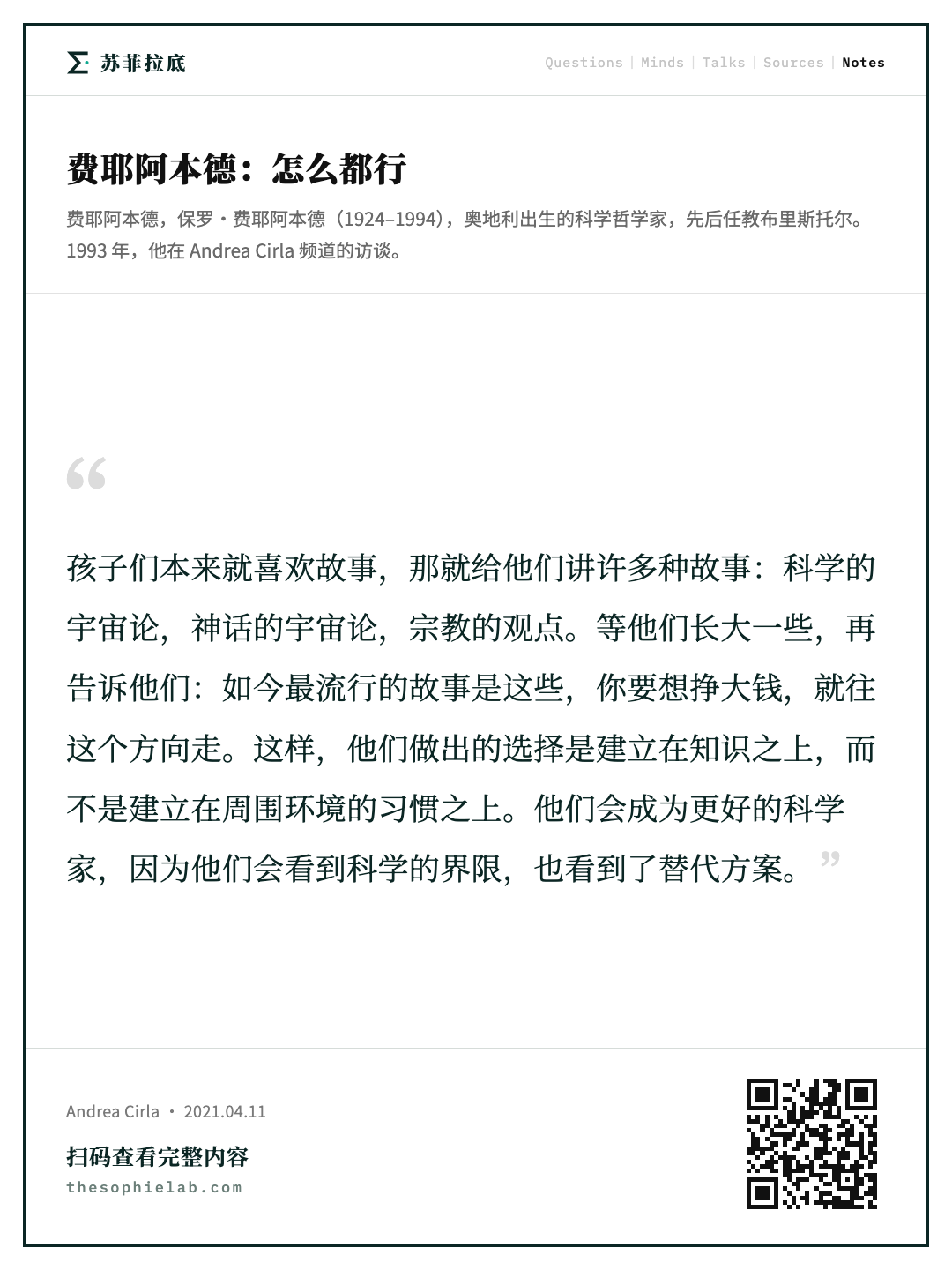
费耶阿本德:人应当教各种各样的观点。最好的教育,在我看来,我在这方面完全是外行,应该是这样:孩子们长大的过程中,听到各种各样的故事。他们本来就喜欢故事,那就给他们讲许多种故事:科学的宇宙论,讲到孩子能懂的程度;神话的宇宙论;宗教的观点;各种各样的故事。等他们长大一些,再告诉他们:如今最流行的故事是这些,你要想挣大钱,就往这个方向走。这样,他们长大以后做出的选择,是建立在知识之上的,而不是建立在习惯之上,不是建立在周围环境的习惯之上。这样一来,他们会成为更好的科学家,因为他们会看到科学的界限,也看到了替代方案,还可能从替代方案的内容里得到启发。他们也会成为更好的公民。

主持人:那些原教旨主义者说,学校里不该只教达尔文主义,还应当教《圣经》的创世说。您同意他们吗?

费耶阿本德:为什么不呢?学校里教的胡说八道多得很。你看看历史课上讲的那些东西,国王啊,战争啊,那么多垃圾被塞进脑子里。所以这真的无关紧要,把别的垃圾减掉一点,把这个放进去,如果你觉得它是垃圾的话。何必这么挑剔,说“这个绝对不行”,而另一方面又灌那么多别的垃圾?

主持人:那么您是否也认为,美国模式比欧洲模式好?在美国,许多大学互相竞争,教授由学生来评价;而在欧洲,我们是国立大学,钱来自国家,哪怕它们并不真正满足学生的需要。

费耶阿本德:我认为两种都应该有。应该有一些地方,让那些自认为已经悟道的人放手去干,不管他们把所有人都烦得半死;也应该有另一些地方,让人受到监督。两者混合,这样就很好。

当然,中小学里教的很多东西完全可以不教,而后来生活中需要的很多东西却没人教。比如应当教的一件事,是怎样照顾自己的身体,怎样照顾自己的健康,教一些基本的医学知识,让人能做到很久以前的母亲们、乡下人都能做到的事:很多病,你不必去找医生,那医生会用最昂贵的设备从你身上榨出最多的钱。这应当教。还应当教的是各种出路。这在某种程度上已经在教了,因为大学现在缺学生,就做宣传,想把学生拉到自己这边来。可他们该往别的方向教:告诉学生,你长大以后有这些可能。有国立大学,在那里你会听到一些人发展出非常古怪的想法,他们讲课很差,没人去听,可有人能从中得到点什么。因为有些人很了不起,讲课却糟糕透顶,亥姆霍兹就是一个。第一堂课,讲堂坐得满满的,因为大家都仰慕伟大的亥姆霍兹,三堂课之后一个人都没有了,他自己也被讲课烦得要死。对这种人,应当有机会让他们一对一地跟人谈。

所以在中学甚至小学阶段,就应当让人了解各种可能,以便做出恰当的选择。需要的是一种不同的、更理性的教育,从小学开始。也不是美国的那一套,而是先学两三门语言,同时学。这样,我想事情会好得多。不是只做一件事,而是让百花齐放,但要告诉人们有这一百朵花,告诉他们到哪儿去找,告诉他们别人怎么看这些花。

怎么都行的界限

主持人:我们现在谈到了您最出名的论题之一,“怎么都行”(anything goes)这句话。您希望百花齐放,希望我们突破教条主义的界限。可是对“怎么都行”这条原则,有一些强有力的反对意见:如果怎么都行,你就没有理由去寻找更好的替代方案,结果可能是平庸绝对当道,不再有新理论。如果在实践领域也接受这句话,那就意味着道德上允许和不允许的事情之间不再有任何区别。不过我第二次读您的书时想到,也许应当从您所说的“知识上的达达主义”(intellectual dadaism)的意义上来理解这句话。这就是说,我不仅不应太当真老教授们写的东西,也不应太当真这句话本身。所以您自己是接受“怎么都行”的自我消解的,您用这句话显然是想刺激顽固的教条主义,而不是自己去发展一种教条的相对主义立场。

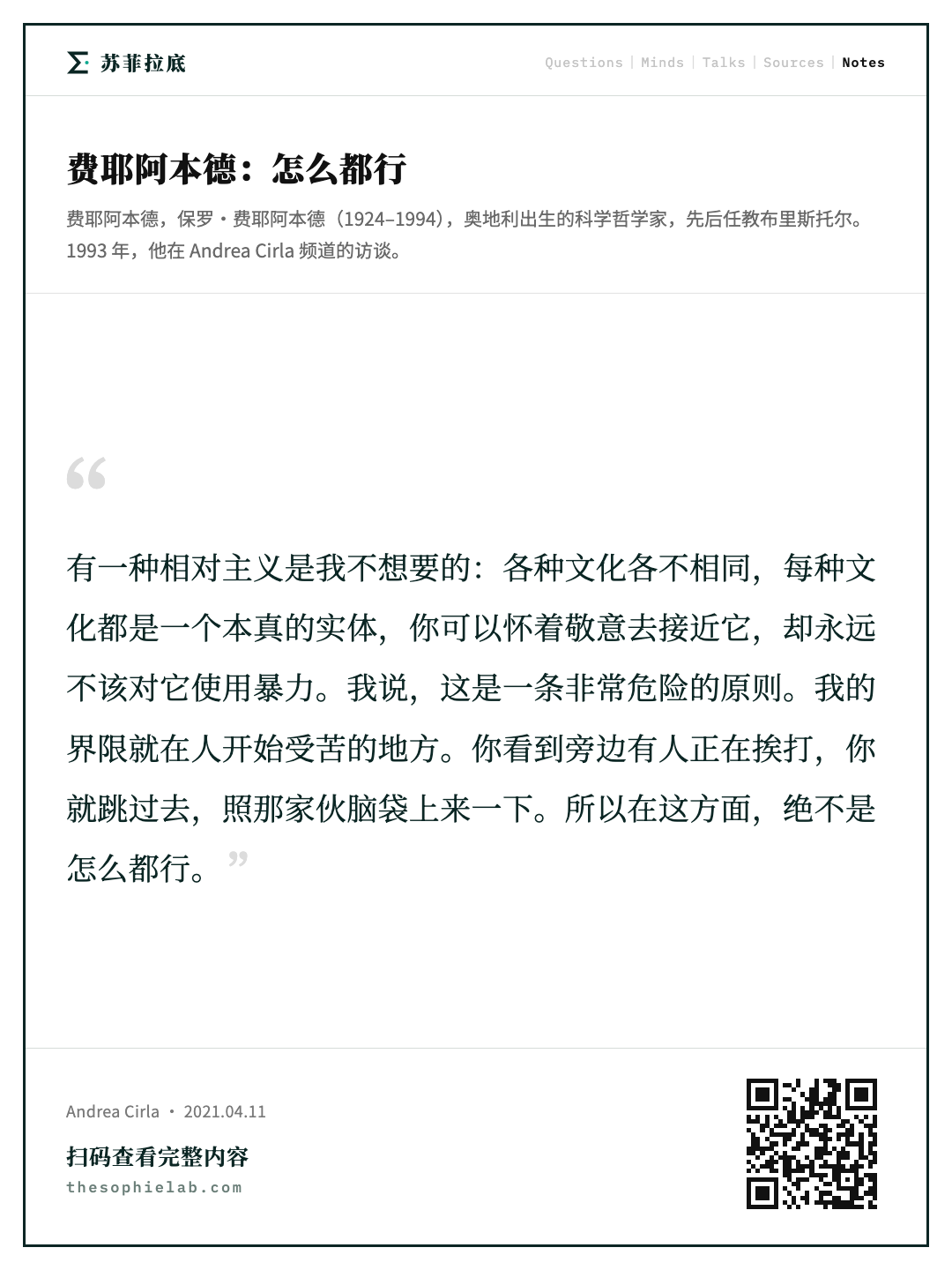
费耶阿本德:不,不。让我从一个完全不同的地方说起,从今天的政治局势说起,那是全世界的局势:人在死,人被枪杀,人被扫射,人在挨饿,人没有足够的药品而病死,甚至连干净的水都没有。可能还有人说,我们不能干预,因为那是一种自成一体的文化,一种沿着不同历史走下来的文化,我们不能碰。对此我斩钉截铁地说:不。哪里有苦难,哪里就必须干预,有时候甚至是近乎战争的干预。我的界限就在人开始受苦的地方,至于干预采取什么形式,那是另一回事。所以,有一种相对主义是我不想要的:各种文化各不相同,每种文化都是一个本真的实体,你可以怀着敬意去接近它,却永远不该对它使用暴力。我说,这是一条非常危险的原则。在一个国家内部也一样,比如在美国内部,当个人处于危险之中,当有人在受苦,人们无论如何都必须干预。因为我承认一种基本价值:人的福祉,比如上帝赐的食物、上帝赐的和平,我认为这是医学层面的事。

而“怎么都行”,说的多少是科学内部的事,不是一切事情。也就是说,就算一位科学家非常严肃地对待某些问题,真心想解决它们,你也无法预先说什么会管用,哪种进路会管用。是他做一个极其严格的实验时管用,还是他做一个大胆的猜想、以此为基础往前推时管用?你无法预先说。

让我再从另一头说起,不从科学说起。有一种观点,人类学家持有了相当长的时间,尤其是那些自以为在做客观研究的人:文化是或多或少自足的实体,本身就有价值。然后,那些反对西方文明早先侵入各地的人,那种侵入常常把事情弄得更糟,也说:我们必须尊重各种文化,不能干预它们。我要说,这种原则是有界限的,界限就是人的苦难。因为今天有大量的苦难正在发生,因为战争,因为缺粮,因为缺药,因为那些所谓领袖的漠不关心,他们并不代表那种文化,只是一群渴求权力的暴君。在这里我说,干预应当很早就开始,而不是说“那是另一种文化,他们用自己的方式互相残杀”。不。人类在一种意义上是一体的,那就是苦难应当被消除。所以我认为,欧洲各国以及美国的军事组织,早就应该开始考虑怎样干预南斯拉夫,早得多;对索马里的干预,本来也应该做得比实际情况好一些,因为那里面有大量的笨拙。可在这类情形下,干预就是,我不想说道德义务,那听起来有点肉麻,就是一个好人应当做的事。你看到旁边有人正在挨打,你就跳过去,照那家伙脑袋上来一下。所以在这方面,绝不是怎么都行。

顺便说一句,相对主义,这个让某些人闻之色变的怪物,比如波普尔,如果它的意思是“你想干什么就干什么”,那根本没有这样的东西。老一辈的相对主义者是普罗泰戈拉。他说,有教师,教师就像医生。医生看到一个人状况很差,按这个人自己的感觉也很差;医生走到他跟前,给他药,然后这个人会说:我好多了。同样,哲学家看到一个人处于不幸的状态,觉得受束缚,觉得不自由,觉得自己的生活一文不值;哲学家走过去,给他药,这次是言辞形式的药。之后,如果这个人说,我突然有了一种自由的感觉,事情看起来好多了,那么判定自己是否安好的是这个人自己,而不是哲学家,可这种安好是哲学家带来的。所以,就连这位最极端的相对主义者,也是让当事人来裁判自己的安好与否,而让哲学家去带来改变,改变以被改变的那个人为向导。

至于“怎么都行”,我写下这句话的时候,想的更多的是科学的语境。我想到了所有那些说“要做科学家,你就得走第一步、第二步、第三步”的人。我对自己说,信这一套的人如果去看看历史,就会绝望地举起双手说:所有这些事情都发生过,怎么都行。实际上没有人遵守任何规则,什么都真的发生了,你真的定不出任何规则。比如我的一位同事写信给我说:至少有一条你应该写下来,就是当科学家不必遵守任何规则,但要拼尽全力。这条也不管用。因为有些人只有在放松的时候才干得最好,一拼尽全力,脑子就不转了。所以你得预先弄清楚这一点,而你什么都说不准。于是你就用“怎么都行”这句话,把路打开,来对付那些说要用规则限制成果的人。它就是这个意思。而它的界限,就是我刚才说的那些,那是我希望得到尊重的界限。
本期讲者
保罗·费耶阿本德保罗·费耶阿本德(1924–1994),奥地利出生的科学哲学家,先后任教布里斯托尔、加州伯克利与苏黎世联邦理工。1975 年《反对方法》以「怎么都行」质疑科学有统一方法,另著《自由社会中的科学》《告别理性》。
主持人欧洲电视访谈节目的主持人,熟悉波普尔与科学哲学传统,以德国与欧洲大学制度为参照提问。
章节 · 点击跳转视频
0:01 一连串偶然:从戏剧书到哲学讲席 ▶ 正在看
5:38 三位维也纳老师埋下的怀疑 ▶ 正在看
12:33 反对方法:科学并无统一方法 ▶ 正在看
15:22 冲突的理论里,哪有科学的真理 ▶ 正在看
20:41 科学的排泄物与神话的压迫 ▶ 正在看
23:18 实验是一种文化,发表像签条约 ▶ 正在看
25:51 牛顿与薛定谔:逆着证据前进 ▶ 正在看
27:14 方法论工具箱:证伪只是一件工具 ▶ 正在看
32:42 经验对应还是逻辑融贯?看形而上学 ▶ 正在看
36:55 伽利略的修辞与教会的决定 ▶ 正在看
41:03 国家与科学分离,学校讲一百种故事 ▶ 正在看
47:47 「怎么都行」的真正边界:人的苦难 ▶ 正在看
本期论点
本期回应
12:46
哥白尼学说的胜利不是靠经验证据取得的,亚里士多德一方才是更彻底的经验主义者 各派互相妥协科学的可靠性来自哪里?
13:45
科学并不存在一套统一的方法,用规则概括科学如何运作是行不通的 没有硬界限,只是更成功科学的可靠性来自哪里?
19:37
不存在「科学」这样一个拥有真理的融贯实体,各门学科的方法与结果彼此不同 各派互相妥协科学的可靠性来自哪里?
25:26
宣布一项科学成果更像不同派别之间缔结政治条约,各让一步才得以发表 各派互相妥协科学的可靠性来自哪里?
26:34
一个理论的困难可以悬置数世纪,人们仍有理由凭形而上学信念坚持它并最终被证明正确 可以先守住理论碰上反面证据,就该放弃吗?
27:44
「出现相互矛盾的证据就必须放弃理论」这条规则从未被真正遵守,科学进展恰恰来自违背它 可以先守住理论碰上反面证据,就该放弃吗?
39:36
科学家在观点尚有困难时用修辞争取追随者,是相当正当的做法 可以先守住理论碰上反面证据,就该放弃吗?
42:17
国家出资的公立学校不该只教科学,正如政教分离后宗教不在公立学校教授 别只有科学公共生活该只听科学的吗?
44:11
孩子应从小同时听科学的、神话的、宗教的宇宙论故事,长大后基于知识而非习惯做选择 别只有科学公共生活该只听科学的吗?
31:29
具体的比较性判断无法以普遍方式获得辩护,只能在个案中辩护,最终落回个人偏好 没答案道德问题有没有正确答案?
其他论点
8:14
科学之外有比科学重要得多的事情,而受过科学训练的人处理这些事情时更理性、更清晰
22:30
神话可以和科学理论一样具有压迫性,而且一直都是压迫性的
24:36
实验层面本身就是一整套自成一体的文化,而非理论的附属环节
51:07
把每种文化都当作不可用暴力触碰的本真整体,是一条非常危险的原则
56:25
「不守规则也要尽全力做好」不能成为科学的规则,因为有些人恰恰在放松时做得最好
01一连串偶然:从戏剧书到哲学讲席
0:01
[Music] [Music] [Music] professor fyrabend you belong without any doubt to the most interesting and most controversial philosophers of our time you have begun as a pupil of popper but you have become famous through works which were dedicated to a general criticism of a program of the theory of science and also of the assumed rationality of science could you begin by telling us something about your intellectual development about your continuous interests in art science and philosophy from the beginning of your studies till now well if you speak of an intellectual development it certainly wasn't like with david hume who planned out his
[音乐] [音乐] [音乐] 费耶阿本德教授,您无疑属于我们这个时代最有意思、也最有争议的哲学家之一。您最初是波普尔的学生,但让您成名的,是那些对科学理论纲领、以及对科学所谓的理性提出总体批评的著作。您能不能先谈谈您的思想发展历程,谈谈您从求学之初直到今天,对艺术、科学和哲学一以贯之的兴趣?嗯,如果说思想发展的话,那肯定不像大卫·休谟那样,事先就规划好了自己的
便签引用
1:23
intellectual development fine advance it was a series of accidents and i got interested in the arts in acting especially in singing because i had some excellent people perform and i had a very good teacher i got interested in physics because because we had an excellent physics teacher at high school and so i took physics courses in at the university i got interested in philosophical matters because by accident when i was buying lots of theater books scenarios i had to buy because it was second hand a whole package of theater books together with philosophy books so i just started reading them to cut my losses and i got interested and i got into the business of philosophy by fear accident i became a lecturer in philosophy because i was in vienna without ascent without any money and a friend of mine elizabeth enscombe said there is a job available in oxford why don't you apply in philosophy and i did apply to oxford i also applied in bristol and i applied in australia and by good chance i got the bristol job
思想发展路线。它就是一连串偶然。我对艺术产生兴趣,尤其是表演和声乐,是因为身边有一些非常出色的人在演出,而且我有一位很好的老师。我对物理产生兴趣,是因为我们中学有一位极好的物理老师,所以我到大学就选了物理课。我对哲学问题产生兴趣,也纯属偶然:当时我在买大量戏剧类书籍、剧本,因为是二手的,只能整包买,那一包里除了戏剧书还夹着哲学书,我就开始读它们,免得钱白花,结果读出了兴趣。我进入哲学这一行也全是偶然。我之所以成为哲学讲师,是因为我人在维也纳,没有口音也没有钱,我的朋友伊丽莎白·安斯康姆说,牛津有个职位空着,你为什么不申请哲学系呢。我就申请了牛津,也申请了布里斯托尔,还申请了澳大利亚,运气不错,拿到了布里斯托尔的职位。
便签引用
2:36
now i had no preparation whatsoever because i had never studied philosophy or philosophy or philosophy of science and so i had to learn this stuff by giving lectures on the subject matter and so gradually i slid into this subject matter and emphasized it a little more just because i had to give lectures about it and in the course of giving lectures and also being invited to uh conferences i came to know quite a large number of outstanding philosophers and philosophers of science and so eventually i thought that what they were saying was not so good and so i am argued against it and this is how some of my papers came into existence not because i thought i have to sit down and put things right but because at a conference i got up argued against a certain talk somebody had given afterwards the talk that all the talks were being published so i had to write up what i had said so eventually some publications arose so the intellectual development was simply a series of accidents i knew that very early when i was a student i was invited to the summer university in alpbach which at that time had just started and had excellent visitors and lecturers and there i had still an absolutist scientist scientistic attitude this
当时我完全没有任何准备,因为我从来没学过哲学,也没学过科学哲学,所以我只能靠给学生讲课来学这些东西。就这样,我一点一点滑进了这个领域,并且因为不得不讲课,就多花了些心思在上面。在讲课以及受邀参加各种会议的过程中,我认识了相当多杰出的哲学家和科学哲学家,久而久之我觉得他们讲的东西不怎么样,于是就出言反驳——我有些论文就是这么产生的。不是因为我觉得我得坐下来把事情纠正过来,而是因为在某个会议上,别人做了个报告,我站起来反驳,事后所有报告都要结集出版,我就得把自己说过的话写下来。于是慢慢地就有了一些出版物。所以这个思想发展就是一连串偶然。这一点我很早就知道了。我还是学生的时候,就被邀请去阿尔卑巴赫的暑期大学,那时候它刚办起来,请来的访客和讲者都非常出色。而那会儿我还抱着一种绝对主义的、科学主义的态度。也就是说,
便签引用
4:06
means when somebody was talking about god i was talking about the beauty of truth then then i usually got up and told him that he didn't know anything about science that all he said was nonsense i also admired the positivism of the vienna circle and also any discussions afterwards people said we want to make clear what scientists have said and making clear meant to them translating it into into some patreon logic i also thought that this was i mean just a waste of time when i started doubting the enterprise of science itself this i really don't know there was a point when i thought that if you want to find how things really are you have to turn to the sciences and there was a point when i said well the scientists said several interesting things they still interest me much more than other things but they have not the absolute uh uh the the absolute grasp of truth i really i really don't remember i i can't i can't it must have been a gradual process part of it was part of it was that email akatosh very often came to my lectures now emil akatosh was in favor of science you know he was a science freak as one might say and just to excite him a little i sometimes made snide remarks about science
当有人谈论上帝,或者谈论真理之美的时候,我通常会站起来告诉他,他对科学一无所知,他说的全是胡话。我当时也很崇拜维也纳学派的实证主义。而且在后来的各种讨论里,人们说我们要把科学家说过的话弄清楚,而所谓弄清楚,对他们来说就是把它翻译成某种符号逻辑。我也觉得这不过是浪费时间。至于我什么时候开始怀疑科学这整桩事业,我真的说不上来。曾经有那么一个阶段,我认为如果你想弄清事情究竟是怎样的,你就得转向科学;后来又有那么一个时刻,我说,科学家确实说了不少有意思的东西,它们至今仍比别的东西更让我感兴趣,但他们并没有对真理的那种绝对的把握。我真的记不清了,说不上来,那一定是个渐进的过程。其中一部分原因是,伊姆雷·拉卡托斯经常来听我的课。拉卡托斯是拥护科学的,用现在的话说他是个科学迷,所以为了逗他一下,我有时就对科学说些挖苦话。
便签引用
02三位维也纳老师埋下的怀疑
5:38
now having done so immediately they told me why don't you write up all your remarks and i argue against them and you have a wonderful discussion about it in a book but he said make your remarks as extreme as possible so i made an extreme as possible and that was the book against method only when it got published email architect was already dead so he could not write the second part of it sometimes i have the impression that in our time scientists are more critical towards science than the philosophers of science where there are some scientists who also prompted you in your criticism of our idolatry of science well i mean there were various there were various people first of all one of my teachers in vienna who was a physicist and he was an excellent lecturer and actually he was the physics teacher of popper and of herbert feige who later on ran the minnesota center for the philosophy of science his name was han steering now hand steering was pensioned off when austria became part of germany because of his pacifism and because of his friendship with einstein and with freud and when he came back he continued his physics lectures but he had also written a big book about the psychological
我这么一说,他们马上就跟我讲,你为什么不把你那些说法都写下来,我来反驳,我们就可以在一本书里好好辩论一场。不过他说,你的说法要尽可能极端。于是我就写得尽可能极端,那就是《反对方法》这本书。只是等书出版的时候,拉卡托斯已经去世了,所以他没能写出下半部。有时候我有一种印象,就是在我们这个时代,科学家对科学的批判反而比科学哲学家更尖锐。有没有哪些科学家也促成了您对科学崇拜的批判呢?嗯,这里头有好几个人。首先是我在维也纳的一位老师,他是物理学家,讲课极为出色,实际上他还是波普尔的物理老师,也是后来主持明尼苏达科学哲学中心的赫伯特·费格尔的老师。他叫汉斯·蒂林。奥地利并入德国之后,蒂林因为他的和平主义立场,也因为他和爱因斯坦、和弗洛伊德的友谊,被强制退休了。等他回来之后,他继续讲物理课,但他同时还写了一本大部头的书,讲世界和平的心理学
便签引用
7:00
and social presuppositions of world peace and he told all of us in the science lectures in the physics lectures physics is not important peace is much more important than this therefore come to my peace lectures in the auditorium maximum practically nobody came everybody came up to the but i came and i talked with him at length and he also come when i was still a student to some of my lectures when he came to california when i was already established there we talk to each other and this person really impressed me quite a lot because he was against all sorts of cruel events in the world but he was not one of these teeth laughing liberals you know who want to enforce a certain form of freedom a certain form of liberalism and peace and nor did he believe that all the events that had gone by trust in our superior was the result of evil incarnate it was just a few and folly so he was a kind of sadly sadly smiling about the idiocy of humanity and he was a skeptic but a committed skeptic a very i mean that's the only way in which i can describe him a committed skeptic and this really impressed me not at the time but over the years quite a lot and it put the sciences in a certain place i mean he was against astrology and all this stuff you know but he said look i
和社会前提。他在科学课上、在物理课上对我们所有人说:物理并不重要,和平比这重要得多,所以来听我在大礼堂的和平讲座吧。结果几乎没有人去,大家都只来上物理课。但我去了,而且和他长谈过。我还是学生的时候他就来听过我的一些讲座;后来我在加州站稳脚跟,他到加州来的时候,我们也交谈过。这个人真的让我印象很深,因为他反对世上一切残酷的事情,可他又不是那种龇着牙笑的自由派——你知道,就是那种想强行推行某种形式的自由、某种形式的自由主义与和平的人。他也不相信过去发生的那些事情是什么魔鬼化身的产物,那不过是少数人的愚蠢罢了。所以他是带着一种悲哀的微笑看待人类的荒唐,他是个怀疑论者,但是个有担当的怀疑论者——我只能这么形容他,一个有担当的怀疑论者。这一点真的让我印象很深,不是在当时,而是在此后这些年里,越来越深,它把科学摆到了一个恰当的位置上。我是说,他反对占星术之类的东西,但他说,你看,
便签引用
8:29
mean science is one thing there are other things which are much more important if you have a schooling in science you can deal with these other things in a more rational and clearer way than other people better physicians for example and so this i think was the first great impression secondly ah come now a second teacher in vienna when i was still a student i was felix erin huffed now i have to explain felix earn half to you felix ayan half was also a professor of physics in vienna he had to leave when vienna became part of part of germany he said all sorts of things which contradicted everything which other physicists said for example when millikan said that as the lowest electric charge the electron he said no no he has found lower charges when people said the inertial motion is on a straight line with constant speed he said no the inertial motion is on a spiral when people said we have electrolysis but magnets cannot do the same thing he said he had found that magnets also dissolved water when people said they are no single magnetic poles he demonstrated single magnetic poles by experiments and so many scientists many physicists regard him as a charlatan now when he came back to when he came back to vienna all of us physics students said we'll
科学是一回事,还有别的一些事情要重要得多;如果你受过科学训练,你处理这些别的事情时会比其他人更理性、更清楚——比如成为更好的医生。所以我想这是第一个重大的影响。其次呢——对了,我还是学生时在维也纳的第二位老师,是费利克斯·埃伦哈夫特。我得先跟你解释一下费利克斯·埃伦哈夫特这个人。他也是维也纳的物理学教授,维也纳并入德国后他不得不离开。他说过各种各样跟其他物理学家所讲的完全相反的话。比如密立根说电子是最小的电荷,他说不对不对,他发现了更小的电荷;人们说惯性运动是沿直线匀速运动,他说不对,惯性运动是沿螺旋线的;人们说我们有电解,可磁体做不到同样的事,他说他发现磁体也能分解水;人们说不存在单个磁极,他就用实验演示了单个磁极。所以许多科学家、许多物理学家都把他看作江湖骗子。等他回到维也纳的时候,我们这些学物理的学生都说,我们要
便签引用
9:55
expose this guy because we are all in favor of theory and enamored by theory and we had heard about him about his reputation and he exposed us instead he said he made the experiments in front of us he said now you booked my big mouth what are you going to say now what can you say you have to sit there you can't open your mouth you don't know anything and this was very inspiring he also did the very same thing at the summer university in alpaca there was a little house where he set up his experiments there were important physicists there rosenfeld who was i mean niels bohr's pr meme price one of the most appraisal physicists in the pro in the profession there was also tearing and there are there were other thesis they came in there they came out as if they had seen something obscene then the next day earnhardt gave his lecture and he said in the end of the lecture you know he said what can you do your theoreticians you don't know anything you have to shut up you have to remain seated you see but we all believe in theory we said i mean iron huff can't be right and so we tried to ex but it was not possible so we discovered that there was some difficulty about this so-called truth in physics
揭穿这个人,因为我们都是站在理论这边的,都迷恋理论,我们早就听说过他,听说过他的名声,结果反倒是他揭穿了我们。他说,他就当着我们的面做实验,他说,现在你们听够我这张大嘴了吧,你们还能说什么?你们能说什么?你们只能坐在那儿,张不开嘴,你们什么都不懂。这非常有启发。他在阿尔卑巴赫的暑期大学也干了同样的事,那儿有一间小屋,他把实验装置架在里面。当时在场的都是重要的物理学家,有罗森费尔德——他可以说是尼尔斯·玻尔身边最受推崇的物理学家之一,还有蒂林,还有别的一些人。他们走进去,出来的时候那副样子,就像看到了什么下流东西。第二天埃伦哈夫特做讲座,讲到最后他说,你们这些理论家能拿我怎么办?你们什么都不懂,你们只能闭嘴,只能坐着别动。你看,可我们都信理论啊,我们就说,埃伦哈夫特不可能是对的。于是我们试着去反驳,可是做不到。于是我们发现,物理学里所谓的真理,是有些麻烦的。
便签引用
11:07
and this sank in with me much much later not at the time because at the time this was a very interesting uh lesson for me about how certain ideas can get hold of a person and you can't get rid of it we believe in empiricism we believe in theoretical physics but as far as we consider we are concerned i mean the experiments of a and half didn't show anything they were just i mean it was called a drake effect a dirt effect something was there we couldn't say we can so this was the second guy who had a great influence in this respect which came up only much much later you see not at the time at the time it was slightly puzzled but slowly as time went on we started percolating it rose and made a contribution to all sorts of doubts then the third guy i met was philip frank now philip frank was one of the founders of the vienna circle he was the successor of einstein in prague when i went to berlin he was a good friend of of einstein he was a physicist and he was also a founder of the vienna circle of the first vienna circle which started a few years before the traditionally so-called vienna circuit of the second vienna circle and became profession harvard i came to know him and i heard listen to a lecture of his in in alpach and there he said look my
这件事对我起作用是很久很久以后的事了,当时并没有。因为在当时,这对我来说只是一堂很有意思的课,让我看到某些观念怎么能牢牢抓住一个人,让他甩都甩不掉。我们相信经验主义,我们相信理论物理学,可就我们而言,埃伦哈夫特的那些实验什么也没证明,它们只是——当时人们管那叫“脏效应”,就是有点什么东西在那儿,我们说不清楚。所以这是第二个在这方面对我有很大影响的人,但影响也是很久以后才显现出来的,你看,当时并不是。当时只是有点困惑,可随着时间推移,它慢慢渗透进来,浮上来,给我各式各样的怀疑添了一份力。然后我遇到的第三个人是菲利普·弗兰克。菲利普·弗兰克是维也纳学派的创始人之一,他在布拉格接了爱因斯坦的位子——爱因斯坦去柏林之后。他是爱因斯坦的好朋友,是物理学家,也是维也纳学派的创始人之一,是第一维也纳学派的创始人,那个学派比传统上所说的第二维也纳学派早几年就开始了。后来他在哈佛任教。我认识了他,在阿尔卑巴赫听过他的一场讲座,他在那儿说:各位
便签引用
03反对方法:科学并无统一方法
12:33
dear friends everybody talks about the copernican revolution and everybody talks about how bad aristotle was and everybody at the same time says that scientists are empiricists but if you look at it aristotle was the real empiricist so the aristoterian arguments were really good arguments so if copernicus won he did not win because of empiricism but because of something else this was another element which lingered and started fasting only later on my first my first aggressiveness went against philosophers who started talking about the sciences without really knowing very much about them as at that time many philosophers didn't i mean they just said we have to we have to uh we have to reconstruct what the scientists say and so on but they didn't do it very well so actually if you read it you know against method is mostly against philosophy of science as a way of making meaningful the complicated things which scientists say and i what i say there and also of revealing the method underlying the sciences and what i see there there is no such method actually and that is also nothing new because i mean many scientists said that i mean einstein said very often he said that well compare a scientist with an epistemologist
亲爱的朋友,人人都在谈哥白尼革命,人人都在谈亚里士多德有多糟糕,同时人人又都说科学家是经验主义者。可你要是仔细看,亚里士多德才是真正的经验主义者,亚里士多德派的那些论证其实是很好的论证。所以哥白尼要是赢了,他赢的原因不是经验主义,而是别的什么东西。这又是一个在我心里搁着、后来才慢慢发酵起来的因素。我最初的攻击性是冲着哲学家去的,他们对科学并不真正了解多少,就开始大谈科学——当时很多哲学家就是这样。他们只是说,我们得去重构科学家说的话,等等等等,可他们做得并不好。所以其实你读《反对方法》就会发现,那本书主要是在反对科学哲学,反对把它当成一种给科学家那些复杂说法赋予意义的方式,也反对把它当成一种揭示科学背后方法的方式。而我在那里看到的是:其实根本没有这样一种方法。这也不是什么新鲜事,因为很多科学家都这么说过,爱因斯坦就常常这么说。他说,你把一个科学家和一个认识论学者比较一下:
便签引用
14:00
a scientist faces a complicated situation so in order to get somewhere in this situation he cannot use a simple rule he has to be an opportunist that is the word that einstein uses so i mean actually so when i say in against method there is no method this is something which many scientists had already said before it was nothing it was nothing it was nothing new although it was something new apparently to the philosophical community and now most historians of science nowadays i mean take it for granted that you can't simply set up a rule and then uh then say that is that this is what science follow follows besides by now people have discovered that the word science covers many things look there is macroeconomics there is conor lawrence with his geese there is physics i mean there are also there is topology which is also a science yes theology theology was one of the early sciences you know are they all the same thing far from far from it so all these taken together made me first doubtful of of philosophy and secondly you know the idea that you find a concentration of truth in science is an idea of philosophers it is the idea already of immanuel kant and then of the of of philosophers who follow him and then it got hold of some scientists not of all of them
科学家面对的是一个复杂的处境,为了在这处境里有所进展,他不能靠一条简单的规则,他必须是个机会主义者——这是爱因斯坦用的词。所以我在《反对方法》里说没有方法,这其实是很多科学家早就说过的,一点也不新,一点也不新,尽管对哲学界来说好像是新的。而现在大多数科学史家都把这当成理所当然了:你没法简单地立一条规则,然后说科学就是照这条规则走的。再说,到今天人们也已经发现,“科学”这个词涵盖的东西太多了。你看,有宏观经济学,有康拉德·洛伦茨和他的那些鹅,有物理学;还有拓扑学,那也是一门科学;对了,还有神学,神学是最早的科学之一。这些都是一回事吗?差得远了,差得太远了。所有这些加在一起,先是让我对哲学起了疑心;其次你要知道,认为真理集中在科学里,这本来就是哲学家的想法,是伊曼努尔·康德就已经有的想法,然后是跟着他的那些哲学家的想法,再然后它抓住了一部分科学家——不是所有科学家,
便签引用
04冲突的理论里,哪有科学的真理
15:22
but of some of them who took over this dogmatism from the philosophers otherwise you see many scientists say we don't know what we what we are about we don't understand the matter when the quantum theory came out for the first time people said well we know how to work with it we know how to interpret some experiments but what it means overall we have no idea so taking all these things together then and immediately write that book don't make another shade of clay i want to be able to attack something you know which made it a little more radical brought out this first book it was it's all the series of accidents also stylistic considerations mean for example i can argue something or i can tell a story i take a story if i can say something softly and if i can say something i mean a little wickedly i prefer to stay in the wicked fashion so all these work together to to create this book well you see i mean my difficulty is the notion of truth i do understand and everybody understands what it means to say the truth before a judge you know you are supposed to say the truth truth nothing but the truth that's very clear you're not supposed to lie you're supposed to try to remember it well and you are not supposed to leave
而是其中一些人,他们从哲学家那里接过了这种独断论。否则的话你看,很多科学家会说,我们不知道自己在搞什么,我们不理解这件事。量子理论刚出来的时候,人们说,我们知道怎么用它,我们知道怎么解释某些实验,可它整体上意味着什么,我们毫无头绪。所以把这些东西都放在一起,然后就马上写了那本书吧,别再和稀泥了——我想要有个能攻击的东西,这让书写得更激进了一点,就有了这第一本书。这一切都是一连串的偶然,也有文体上的考虑。比如说,我可以论证一件事,也可以讲个故事,那我就讲故事;如果一件事我可以说得温和,也可以说得稍微刻薄一点,那我宁可用刻薄的方式说。所有这些加在一起,造就了这本书。至于说——你看,我的困难在于“真理”这个概念。我理解,人人也都理解,在法官面前说真话是什么意思:你被要求讲真话、全部的真话、除了真话别无其他,这很清楚。你不该撒谎,你该努力好好回忆,而且你不该把你认为相关的东西
便签引用
16:36
anything out which you think is relevant of course you may forget it you know but so but now to speak of the truth of science now look take any scientific discipline it contains um approaches which are in conflict with each other for a long time quantum theory and relativity were in conflict with each other now people try to iron out this conflict i mean with new kinds of theoretical approaches both belong to science but if these two things belong are in conflict they cannot say that within physics we find the truth we find all sorts of interesting stories to tell within certain restricted domains but the truth what can you say an important part of the scientific approach for many people not binomials for all is that science must be mathematical i mean the book of nature is written in mathematical symbols and so on but what is this is this a scientific theory is this true is this not true it's very difficult to find out because when when some scientists go over to more qualitative considerations mathematicians catch up with them and provide a theory of these qualitative considerations in the case of celestial mechanics it was topology for a long time the problem of the stability of the planetary system was not solved in a satisfactory way so
漏掉任何一点——当然你可能会忘,这没办法。可是现在要谈“科学的真理”,你看,随便拿一门科学学科来看,它里面都包含着彼此冲突的路径。有很长一段时间,量子理论和相对论是彼此冲突的。现在人们试着用新的理论进路来抹平这个冲突。这两者都属于科学,可如果这两样东西是冲突的,那就不能说“我们在物理学里找到了真理”。我们找到的是在某些受限领域里可以讲的各种有意思的故事,但“真理”——你能说什么呢?对很多人——不是对所有人——来说,科学进路里一个重要的部分是:科学必须是数学化的,就是说自然这本书是用数学符号写成的,如此等等。可这是什么?这是一条科学理论吗?它是真的吗?它不是真的吗?很难弄清楚。因为当某些科学家转向更定性的考虑时,数学家又追了上来,给这些定性考虑提供了一套理论。在天体力学的例子里,那就是拓扑学。有很长一段时间,行星系统的稳定性问题没有得到令人满意的解决,所以
便签引用
18:03
uh quantitatively by means of serious developments i mean the series was supposed to converge and give you a certain number for for for certain for certain parameters now this ran into difficulty so some people say let's consider the whole thing qualitatively not exactly on what trajectory the planets are running around the sun but on the whole qualitatively how the planetary system breathes as it were and if in breathing it suddenly will explode that was poincare's approach but this qualitative approach was also mathematized so you cannot say this idea can be refuted because mathematics changes all the time so it may be a guiding how should i say a guiding idea which advises mathematicians on what areas to concentrate in those areas where the existing forms of mathematics do not work so the whole thing seems to be tautologous so it's not easy to speak about the truth within the sciences then in 19th century physics in any period in a specific science you have different approaches with conflicting methodologies and conflicting results now you go outside physics into biology for a long time there seems to be a conflict now with molecular laboratory situations a little different now if you go from outside to into
呃,定量地说——我说的严格展开的意思是,这个级数本来应该收敛,对某些参数给出一个确定的数值。可这里出了麻烦,于是有人说,那我们整体上定性地来看吧:不去管行星究竟沿着什么轨道绕太阳运行,而是从整体上定性地看这个行星系统是怎么呼吸的,以及它会不会在呼吸中突然炸开。这就是庞加莱的路子。可这种定性的方法后来也被数学化了。所以你不能说这个想法可以被反驳,因为数学一直在变。所以它也许只是一个,怎么说呢,一个引导性的想法,提示数学家该把精力集中在哪些领域——集中在现有的数学形式不管用的那些领域。这么一来整件事看起来就像是同义反复。所以在科学内部谈真理并不容易。再看十九世纪的物理学:在任何一个时期、任何一门具体科学里,你都会看到不同的进路,方法论互相冲突,结果也互相冲突。现在你走出物理学,进到生物学,在很长一段时间里那里似乎也有这种冲突;如今有了分子生物学的实验室,情况就有点不一样了。那么如果你再从外面走进
便签引用
19:25
economics well i mean the situation is entirely different or into a research like conor lawrence with his animals which seems to be like old naturalism where you simply crawl around in the grass you know and let geese follow you and crack to them and see what they are doing and entirely different approach so there is not this one thing science which has the truth i mean this is a completely superficial description of the whole situation you see the results in front of theo is that i mean absolutely well-defined position is not part in in relativity that is assumed you know it's not only methods but also results in basic assumptions i mean which are different in different areas of of of the sciences and so to speak of science this is talking about a chimera an entity a coherent entity science which has the truth or is supposed to have does not exist and if it exists you know i wouldn't i wouldn't know what it means that it has the truth i mean what what does it mean does it mean that when we study it we get happier we are more efficient well even the most truthful parts of science are not very efficient things collapse all the time even in areas where people say now we found out after all because it's an engineering problem and engineering
经济学,情况就完全不同了;或者走进像康拉德·洛伦茨那样跟动物打交道的研究——那看起来像是老式的博物学:你就在草地里爬来爬去,让鹅跟着你走,冲它们嘎嘎叫,看看它们在干什么,完全是另一种进路。所以并不存在这么一个叫科学的东西、掌握着真理。我是说,那是对整个状况极其肤浅的描述。你看,结果就摆在眼前:绝对确定的位置在相对论里根本不存在,这是它的前提假定。所以不只是方法,连结果、连基本假设,在科学的不同领域里都是不一样的。所以笼统地谈科学,那是在谈一个虚构之物;一个叫科学的、融贯的整体,掌握着真理或者被认为掌握真理——这种东西并不存在。就算它存在,我也不知道说它掌握真理是什么意思。这到底是什么意思?是说我们研究它就会更幸福、更有效率?可就连科学里最真的那些部分也算不上多有效率,东西一直在垮掉,哪怕在人们说这回我们总算搞明白了的领域里也一样,因为那是工程问题,而工程
便签引用
05科学的排泄物与神话的压迫
20:41
problems are very difficult so what this does is talk about truth mean what are this talk about science as a unity mean to me these are all females i understand the pr aspect of truth if somebody says the truth lies here then the result is money will go there people will study it more frequently and so on but apart from that and apart from the concrete usage of the word truth namely well tell me the truth really have you had any fear while i was away you know apart from that don't and therefore the whole question does science after those stars myth have the truth also doesn't make much sense to me you know what would make sense to me is is it better to devote oneself or do you want the whole efforts of a society of a group and so on to the sciences now in the plural or to something myth or do we need both and so on for example now i mean uh sciences are needed for ecological purposes and as i you see nowadays the situation is so that so many products of science are sitting around the droppings of science are all over the place and as only the scientists continue the droppings of science we need them you know it is like somebody i mean has somebody has found a particular kind of paint that can't be washed off the wall so in order to get these paintings off
问题是非常困难的。所以,谈真理到底是什么意思?把科学当作一个统一体来谈又是什么意思?在我看来这些都是虚构。我能理解真理这个词在公关层面的作用:如果有人说真理在这儿,那结果就是钱会流到那儿,人们会更多地去研究它,等等。但除此之外,除了这个词具体的日常用法——比如,跟我说实话,我不在的时候你真的害怕过吗?——除此之外就没什么了。因此,科学(相对于神话而言)是否掌握真理这个问题,对我来说也没多大意义。对我来说有意义的问题是:一个人,或者一个社会、一个群体,把全部力气投到诸科学上更好呢,还是投到别的什么、投到神话上更好?还是说两者我们都需要?诸如此类。比如说,出于生态方面的目的我们是需要科学的;而且如你所见,今天的状况是,科学的产物到处堆着,科学的排泄物撒得满地都是,而只有科学家才能收拾科学的排泄物,所以我们需要他们。这就好比有人调出了一种洗不掉的涂料,那么当人们不再喜欢这些画的时候,为了把它们从墙上
便签引用
22:02
the wall which one doesn't like them anymore you need the same guys who put them there because they know something about this paint so this is one of the reasons why we still need this what i would say what i would say is that as many sciences around today not all of them a little bit of poetry does a lot to loosen things a little up and to get things a little into perspective you see a myth can be translated as oppressive as a scientific theory and as a matter of fact they have been oppressive they have poor they have put people into very strange states of mind and have made let them behave and behave in very strange ways and then the nazim which is not a myth in the grand is one is one example so there you have to be more specific you cannot say science and myth because there are many different kinds of with what myth what particular kind of science why and so on so general questions science or myth i don't think that makes much uh is that make much sense to discuss those although these are the questions which philosophers mostly discuss look for example there is still something else more recently historians of science have found out i mean actually it was there for everyone to see that science is not
弄下来,你就得找当初把它们涂上去的那帮人,因为他们懂这种涂料。这就是我们今天仍然需要科学的原因之一。我想说的是:今天周围有这么多科学——当然不是全部——那么来一点诗,就能让事情松动一些,让事情多少有点分寸感。你看,神话也可以像科学理论一样具有压迫性;事实上它们本来就一直是压迫性的,它们把人推进非常奇怪的心理状态,让人做出非常奇怪的举动,而纳粹主义——它在某种宏大的意义上也是一种神话——就是一个例子。所以在这里你必须说得更具体。你不能笼统地说科学还是神话,因为神话有很多种:哪一种神话?哪一种具体的科学?为什么?如此等等。所以像科学还是神话这样的一般性问题,我不觉得讨论起来有多大意义——尽管哲学家们讨论的大多正是这类问题。你看,比如说还有另外一件事:最近科学史家发现——其实这件事本来就摆在那儿,人人都看得见——科学并不是
便签引用
06实验是一种文化,发表像签条约
23:18
used in the vienna circle science or resistance of statements discussing science was for many people of the vienna circle for karna for proper for example discussing special systems of statements and bringing order into science meant bringing order into these systems of statements this assumes that whatever goes on in science is always above both that people don't act because for for reasons which are not clear to themselves it also assumes that making experiments is a simple matter but if you look at the large experiments today which are like industrial plants like in cern there are whole industrial plants running and people have to agree with each other about certain things compromises have to make something work something doesn't work lots of guesswork is there there is not enough money so suddenly one has to change the approach in midstream and besides every experimentalist who deals with with an instrument has lots of uh what polany has called tested knowledge like a race car driver a race car driver could not tell you in detail all the things he knows he can show it to you by driving the race car in certain extreme situations the same happens with scientists so there are so many components in the
维也纳学派所设想的那样。在维也纳学派看来,科学就是语句的系统;对卡尔纳普、对波普尔这些人来说,讨论科学就是讨论特定的语句系统,而给科学带来秩序,就意味着给这些语句系统带来秩序。这就假定了科学里发生的一切都是摆在明面上的,假定人们不会出于自己也不清楚的理由去行动;它还假定做实验是件简单的事。可你要是看看今天的大型实验,它们简直像工业厂房——比如在CERN,是整片工业设施在运转,人们必须在某些事情上彼此达成一致,必须做出妥协,有的东西行得通,有的行不通,里面有大量的猜测,钱又不够,于是突然之间就得中途改变路线。此外,每一个跟仪器打交道的实验家,身上都有大量波兰尼所说的默会知识,就像赛车手一样:赛车手没法详细告诉你他知道的所有东西,但他能在某些极端情况下用开车把它展示给你。科学家身上发生的是同一回事。所以诸科学里有这么多成分,
便签引用
24:36
sciences that nowadays some historians of science say that the experimental level is a whole culture by itself in the connection of the experimental level with what is called theo in which what many people regard as the most important thing but it's a very is is a very diff is very difficult to figure out actually the transition from contains many arbitrary elements so-called approximations and so if you look at all these things this whole unity science falls apart into different sciences then among the different sciences we have the theoretical level and the theoretical level is subdivided into let us say elementary particle physics high theory that's why it's called phenomenology these are the guys who do the curve fitting they still don't do any experiment and then the guys who do the experiment that are fed some information by the cure fitters and by the high theoreticians and they are they are exchange persons and there are lots of things sometimes announcing a certain scientific results is like conducting a political treaty between different kinds of parties where one of them gives a little here one of them is a little there and finally well at last we can publish you see one of the difficulties which
以至于今天有些科学史家说,实验层面本身就是一整套自成一体的文化。而实验层面跟所谓理论层面的连接——很多人把理论看成最重要的东西——却是非常难弄清楚的:从理论到实验的过渡包含着许多任意的成分,所谓的近似。所以你把这一切看下来,统一科学这整个东西就散架成了不同的科学;而在不同的科学之内,我们又有理论层面,理论层面还要再细分,比方说在基本粒子物理里有高层理论,还有所谓的唯象学——就是做曲线拟合的那批人,他们照样不做实验;然后是做实验的人,他们从做曲线拟合的人和高层理论家那里得到一些信息,彼此之间互相交换。里面的名堂多得很:有时候宣布一项科学成果,就像在不同党派之间缔结一份政治条约,这边让一点,那边让一点,最后好啦,我们终于可以发表了。你看,有一个困难曾经
便签引用
07牛顿与薛定谔:逆着证据前进
25:51
made newton assume that god interfered into the cause of the planets was the so-called great inequality of jupiter and saturn it seemed that jupiter and saturn the course of time moved farther and farther away from each other now newton knew from ancient observations babylon observations which he got via ptolemy that in antiquity the planetary system was more or less the same as it is today on the other hand there was this tendency of falling apart so he concluded that god periodically put the planetary system in order now there are some other people who said we shall use newton's theory and eventually we shall find that this can be explained by physics and we we do not need divine interference and it took more than 200 years until the people got there but they never lost their confidence that this difficulty could be solved so it can difficulties can exist for centuries and nevertheless people for some metaphysical reason believe that a certain theory is correct and then in the end it turned out to be correct another example is the early history of wave mechanics well schrodinger believed for some time that there were waves that the elementary parties had a wave like nature and he worked out the hydrogen spectrum on that on that basis and relativistically taking in
让牛顿假定上帝介入了行星的运行,那就是所谓木星和土星的大不等式。看起来木星和土星随着时间推移彼此越离越远。而牛顿从古代的观测——他通过托勒密得到的巴比伦观测记录——知道,在古代,行星系统跟今天大致是一样的;可另一方面又存在这种分崩离析的趋势,于是他断定上帝会周期性地把行星系统重新整顿好。而另有一些人说,我们要用牛顿的理论,最终我们会发现这件事可以用物理学解释,我们不需要神的干预。他们花了两百多年才走到那一步,但他们从来没有失去信心,始终相信这个困难是能解决的。所以困难可以存在好几个世纪,而人们出于某种形而上学的理由仍然相信某个理论是对的,最后它果然被证明是对的。另一个例子是波动力学的早期历史。薛定谔有一段时间相信存在着波,相信基本粒子具有波的本性,他在这个基础上推算氢光谱,而且是相对论性地考虑进了
便签引用
08方法论工具箱:证伪只是一件工具
27:14
consideration einstein's discoveries and he got completely wrong values because the spectrum was known very well did he retreat did he say i'm wrong no he made a step back he said i shall not work according to einstein i shall work according to pre einstein this means he made his theory worse according to what everybody believed at the time and the worst theory worked better than the better theory which was explained much much later so the the idea that if there is a conflicting evidence you have to give up the theory people never stuck to it and contradicting it they they made progress sometimes it led somewhere sometimes it didn't so you cannot what you have to do is decide from case to case and you have to know the case in detail what you are going to do now it's quite useful in this connection to have as it were a tool box of methodological rules i mean it's just uh like rules of thumb shall i use this rule now shall i use that or that is very useful so in this respect that proper introduced into the toolbox the the rule of falsification was a very useful addition his fault was to assume this is the only useful instrument the only useful tool to apply to theories that was his fault instead of saying well we have increased our toolbox
爱因斯坦的发现,结果他得到的数值完全不对,因为光谱当时已经测得非常准了。他退缩了吗?他说我错了吗?没有。他往后退了一步,他说:我不照爱因斯坦来做,我照前爱因斯坦的方式来做。这就意味着,按当时所有人的信念,他把自己的理论弄得更糟了;而这个更糟的理论,反倒比那个更好的理论管用得多——这一点要到很久很久以后才得到解释。所以说,一旦出现相反的证据就必须放弃理论——这个想法人们从来没有遵守过,他们违背它,反倒取得了进展。有时候这样做能走通,有时候走不通。所以你没法一概而论;你要做的是逐个案例地去判断,而且你得详细了解这个案例,才知道自己该怎么做。在这方面,手边有一个方法论规则的工具箱是很有用的——我是说,就像一些经验法则:我这回该用这条规则,还是该用那条?这非常有用。就这一点而言,波普尔把证伪规则加进工具箱,是一个很有用的补充;他的错在于假定这是唯一有用的工具,是能施加于理论的唯一有用的手段——这就是他的错。他本该说:我们把工具箱扩充了。
便签引用
28:43
you see never throw away the toolbox i would not say give up all methods never throw away the toolbox never declare the toolbox itself to be the one right thing or one tool in it but use it extend it disregard disregarded sometimes according to the case with which you are dealing because you never know what you will run into it's exactly the same thing as if you start first studying psychology you know before getting in touch with human beings and then trying to approach me according to the rules of the psychology i've learned the best thing is to go right at it and then you will find that many of the rules of psychology you may have learned don't work so well with real human beings some people will say that is such a clumsy theory the other one is much more elegant then some people will object but look i mean this clumsy theory fits the facts better and then the reply will be of course it fits the facts better because it's so clumsy you know the elegant one i mean has and so on you can many people make judgments of this kind and the results of the research are the results of having applied judgments of this kind but this does not mean that there exists a cannon which establishes from one two five let us see
你看,永远不要把工具箱扔掉。我不会说放弃一切方法;永远不要扔掉工具箱,但也永远不要把工具箱本身、或者里面某一件工具宣布为唯一正确的东西。要用它,扩充它,有时候根据你手头的具体情况把它撇在一边,因为你永远不知道自己会碰上什么。这就跟下面这件事一模一样:你先去学心理学,还没接触过活生生的人,然后就按学来的心理学规则来对付我。最好的办法是直接上手去做,然后你会发现,你学到的许多心理学规则,用在真实的人身上并不怎么灵。有人会说,那个理论太笨拙了,另一个要优雅得多;接着又有人反驳说,可你看,这个笨拙的理论跟事实符合得更好;回答则会是,它当然跟事实符合得更好,因为它就是那么笨拙嘛,而那个优雅的理论呢,如此等等。很多人都会做出这一类判断,而研究的成果,正是应用了这类判断的成果。但这并不意味着存在一部法典,从第一条、第二条、第五条一路规定下来,说
便签引用
29:53
all the judgments that can be made must be applied under all circumstances you know for example uh dirac when he talked about the ferdinand case he said training was quite right to stick to his theory because it was beautiful for him the beauty of the mathematical expressions of a theory was a was a important criterion and some people really say i don't like the theory it's an ugly theory it's it's it's not hanging together very well it may fit the facts but they want something better so these judgments occur every time but there is no way of justifying any one of those judgments in a general way you can justify it in the presence of the case and then the sooner or later you come back to your own preferences you know some people they're real empiricists you know for example one of the differences between some medical doctors and being molecular biologists is that molecular biologists want to have a universal account of certain phenomena of human biology there is a doctor wants to know what is uh what works in specific cases so the so the knowledge of the doctor will be much more how should i say uh scattered than the knowledge of of a molecular biologist on the other hand the knowledge of the microbiologist goes for simple approaches you know and therefore
所有能做的判断都必须在一切情况下加以应用。比如说,狄拉克在谈到那个案例的时候说,某某坚持自己的理论是完全正确的,因为它很美。对他来说,一个理论的数学表达之美是一个重要的判准。有些人真的会说,我不喜欢这个理论,它是个丑陋的理论,它内部不太连贯,它也许跟事实相符,但他们就是想要更好的东西。所以这类判断随时都在发生,但没有办法以一般的方式去为其中任何一个判断辩护。你可以在具体案例面前为它辩护,然后迟早你会回到你自己的偏好上去。有些人是真正的经验主义者。举例来说,某些医生和分子生物学家之间的一个区别是:分子生物学家想要对人体生物学的某些现象给出一个普遍的说明,而医生想知道的是在具体的病例里什么管用。所以医生的知识会比分子生物学家的知识,怎么说呢,零散得多;另一方面,分子生物学家的知识追求的是简单的进路,因此
便签引用
31:19
is too simplistic for the doctor so in some respects the doctor is better than the molecular biologists in other respects the molecular biology is better than the doctor judgments are constantly being made the only thing i say cannot be done is justify particular comparative judgments in a general way so that whatever comes you are forced to apply this judgment the main problem of the theory of science is that we have at least two general types of criteria which can be in contradiction with each other one type is what has to do with the empiricism the theory corresponds to reality and the other is what we can call the logical coherence the simplicity the first is a correspondence criterion the other would be a coinance criterion it is not easy at all when there is a conflict to decide which research program one should support however the best theory would be that which would satisfy both criteria a one must have an instinct when there is a conflict between the two criteria which criterion is violated
对医生来说就太简单化了。所以在某些方面医生比分子生物学家强,在另一些方面分子生物学又比医生强。判断一直都在被做出;我唯一说做不到的,是以一般的方式去为某个特定的比较性判断辩护,好让不管出现什么情况你都被迫套用这个判断。科学理论的主要问题在于,我们至少有两类一般的判准,而它们彼此可能是矛盾的:一类跟经验主义有关,就是理论与实在相符合;另一类我们可以称为逻辑上的融贯、简单性。前者是符合论的判准,后者则是融贯论的判准。当二者发生冲突时,要决定该支持哪一个研究纲领,一点都不容易。当然,最好的理论会是同时满足这两个判准的理论。而当两个判准发生冲突时,人必须有一种直觉,去判断究竟是哪一个判准被违背了。
便签引用
09经验对应还是逻辑融贯?看形而上学
32:42
in the more brutal way it is what makes the great scientist really great could you agree with this description well you see i don't i think that some scientists i mean um don't stick to either criterion but have something entirely different in mind uh it's also you know what you think about the position of human beings in the universe if you think that human beings are situated in such a way that now to return to the old business of truth the truth is evident to them this means that there was a benign creator god who didn't turn the universe into a universal puzzle but uh build it up in such a way that people could do something with it then you will be more inclined towards an empiricist outlook if you believe on the other side i mean as if you were almost agnostic that god is five way you know and the universe that surrounds us as it were a mockery of the ideas of the of the abstract and distant god then he will look then he will think that the human senses are not very good to find out the truth so it depends on some vast metaphysical background what criterion you will be inclined towards but in many cases of the sciences neither one or the other turns up i mean you may have some particular puzzle in the sense of kuhn
用更残酷的说法,这正是伟大科学家之所以真正伟大的原因——您同意这个描述吗?嗯,你看,我不同意。我认为有些科学家,我是说,呃,并不坚持这两条标准中的任何一条,而是心里想着完全不同的东西。呃,这也取决于,你知道,你怎么看人在宇宙中的位置。如果你认为人的处境是这样的——现在回到真理这个老话题——真理对人来说是显而易见的,那这就意味着存在一个仁慈的造物主上帝,他没有把宇宙变成一个普遍的谜题,而是呃,把它建造得让人能够拿它做点什么,那你就会更倾向于经验主义的看法。如果你反过来相信,我是说,就好像你几乎是不可知论的,认为上帝是遥不可及的,你知道,而围绕我们的这个宇宙可以说是对那个抽象而遥远的上帝的观念的一种嘲弄,那么他就会认为,人的感官并不太适合用来发现真理。所以这取决于某种宏大的形而上学背景,你会倾向于哪一条标准。但在科学的许多情况下,这两者都不会出现,我是说,你可能面对的是库恩意义上的某个具体谜题。
便签引用
34:07
something not very great but something which bothers you in which he wants to solve and you try all sorts of things out you do not ask for overall coherence because your problem is very limited and finally you come up with a successful solution so this how should i say big alternative you present to me makes sense as an alternative of two positions about the role opposition of human beings in the universe you know have they been put there by a benign god who brings them close to what goes on or by a kind of bastard who keeps everything away from them so that they have to distrust their senses there it makes sense on this metaphysical level but in scientific practice some people may be influenced by it others are not and some people will be may not be influenced by either of them and still get success in the sense of those i mean who support a certain kind of metaphysics they wouldn't make too much of this big alternative except on a very general metaphysical level not for the sciences well this story of the instinct of the great scientist you know i i wonder how many great scientists i mean called great because um of the other achievements using their instinct i mean went off into into nothing many people would say that
不是什么了不得的大事,但确实是困扰你的、他想解决的事,于是你什么办法都试一遍,你并不追求整体上的融贯,因为你的问题非常有限,最后你终于得出了一个成功的解答。所以你向我提出的这个——该怎么说呢——重大的二选一,作为关于人在宇宙中所处位置的两种立场的对立,是说得通的:人究竟是被一位仁慈的上帝放在那里、让他们能贴近正在发生的事情,还是被某个混账放在那里、把一切都挡开,逼得他们不得不怀疑自己的感官。在形而上学这个层面上它是讲得通的,但在科学实践中,有些人可能受它影响,有些人不受,还有些人两者都不受影响,照样能取得成功。就那些支持某种形而上学的人来说,他们也不会太把这个重大的二选一当回事,除非是在非常一般的形而上学层面上,而不是对科学而言。至于伟大科学家的直觉这个说法嘛,我很想知道,有多少所谓伟大的科学家——我是说因为别的成就而被称为伟大的——凭着直觉走,结果走进了一片虚无。很多人会说
便签引用
35:29
the late einstein was an example like that he tried to find a unified field theory having made great achievements in all sorts of areas now great scientist but he never succeeded and the young generation i mean the young turks or quantum mechanics i mean they said this guy is getting old i mean he can't get away from his ideas he can't gasp new ideas so there is an instinct of a great scientist which which goes nowhere newton who perhaps i mean i mean i don't know enough about this business but he was one of the greatest scientists ever considering all the research he did i mean in alchemy in theology in physics in cosmology in in practical every area of human understanding he was a great scientist and he had this idea that the planets are put in order by the finger of god later on people said well what a ridiculous idea to have he had for that empirical evidence at the time and secondly theological arguments because for him god was not a principle god was a person a father who takes personal care of his creatures this means the universe is not something which in an in how should i say in his spare time he constructed and throws it away like like leibniz assumes you know but there's something he constantly works on with love and
晚年的爱因斯坦就是这样一个例子。他在各个领域都做出了伟大成就之后,试图寻找一个统一场论;他当然是伟大的科学家,但他始终没有成功。而年轻一代,我是说量子力学那批“少壮派”,他们说这家伙老了,他摆脱不了自己的旧观念,抓不住新想法。所以确实存在一种伟大科学家的直觉,而它哪儿也没走到。牛顿——也许吧,我是说,我对这方面了解得不够——但考虑到他做过的全部研究:炼金术、神学、物理学、宇宙学,几乎人类理解的每一个领域,他是有史以来最伟大的科学家之一。他是伟大的科学家,而他有一个想法,认为行星是被上帝的手指安排到位的。后来人们说,这想法真是荒唐。可在当时他对此是有经验证据的,其次还有神学上的论证,因为对他来说上帝不是一个原理,上帝是一个位格,是一位亲自照看自己造物的父亲。这意味着宇宙并不是他在——该怎么说呢——闲暇时造出来、然后像莱布尼茨设想的那样一扔了事的东西,而是他怀着爱不断在其上劳作的东西
便签引用
10伽利略的修辞与教会的决定
36:55
he's a father says newton himself our relation to him is subordination not recognition of a princess so there was there were lots of great scientists i mean who made their own guesses now galileo is a great scientist who made the right guess in some respect i mean this does not prove that in general great scientists make the right guesses he just was lucky there is another thing i tried i just read a book about the different types of argumentation that existed at the time of galileo well i mean this comes all from aristotle there is a dialectic there's demonstration there is rhetoric now demonstrations where you can show something absolutely um dialectic is where you argue where you argue with your opponent i mean on some assumptions until you reach the rhetoric is where you work on the weaknesses of your opponent on your psychological weaknesses of your opponent and try to bring him around now there this this uh person uh dear moss he followed the relative percentage of arguments through the period of the copernicus and he found that in the time of galileo and he concentrated on italy the percentage of rhetorical arguments increased considerably not only in galileo but also in his opponents which is an indication that that there
牛顿自己说,他是一位父亲,我们与他的关系是从属,而不是对某个原理的认可。所以有很多伟大的科学家,他们都做出过自己的猜测。伽利略是一位伟大的科学家,在某些方面猜对了;但这并不能证明伟大的科学家一般来说都会猜对,他只是运气好而已。还有另一件事,我刚读了一本书,讲伽利略时代存在的几种不同的论证类型。这些其实都来自亚里士多德:有辩证法,有论证(demonstration),还有修辞。论证是你能绝对地把某件事展示出来;辩证是你和对手争论,从某些前提出发一直推到某个结论;修辞则是你针对对手的弱点、针对对手心理上的弱点下手,试图把他拉过来。那么这位——莫斯——他追踪了从哥白尼时代开始各类论证所占的相对比例,他发现在伽利略的时代(他集中考察意大利),修辞性论证的比例大幅上升,不只是在伽利略那里,在他的对手那里也一样。这说明当时
便签引用
38:29
was a case that could not be handled according to the strict uh methods of argumentation it was a difficult case it was a case of belief or disbelief or putting your bets and so on and here galileo put there got the right bet um namely something which later on could be used by newton because let's realize it i mean what newton said i mean about the universe was already very much different from from copernicus there was no celestial sphere and so on copernicus was abandoned uh the the moment he became accepted you see once the copernican you had all sorts of arguments in favor of it it was already abandoned because all the new discoveries had had been made but at the time of galileo the copernican view was suffering under considerable difficulties and in this circumstance it is quite reasonable for a scientist to say forget the difficulties that's the right bet and we shall work on it eventually that will work out and that is what galileo did in this circumstance of course you do not have scientific arguments you have rhetorical arguments to keep uh to keep people in line and to get and to get followers and that it was scary did it and i said i would say it was quite legitimate to do so because many scientists also in more
存在一种无法用严格的论证方法来处理的情形。那是个棘手的案例,是一个关乎相信还是不相信、关乎你把赌注押在哪边的案例。而在这里伽利略押对了赌注,也就是后来牛顿可以拿来用的那一套。因为我们得认清,牛顿关于宇宙所说的东西,和哥白尼已经很不一样了:没有天球等等。哥白尼学说恰恰是在它被接受的那一刻被抛弃的。你看,一旦哥白尼体系有了各种支持它的论证,它其实已经被放弃了,因为所有新的发现都已经做出来了。但在伽利略的时代,哥白尼的观点正承受着相当大的困难。在这种情况下,一个科学家说“别管这些困难,这是对的赌注,我们就往这个方向做,早晚会做通”,是相当合理的。伽利略做的就是这件事。在这种处境下,你当然拿不出科学论证,你拿出的是修辞论证,用来把人拢住、争取追随者。伽利略就是这么干的,而我要说这么做完全正当,因为许多科学家在更
便签引用
39:48
recent times when they are in difficulties they do this kind of stuff i mean just to keep the movement going because it needs the movement detailed research to show that the view is is is good after all tycho para solved all almost all the problems which uh the ptolemian said and galileo never talks about him never talks about him this is a rhetorical move he does not argue against him take a break doesn't exist you see like i was accepted by the church because this uh the church wanted to be in agreement with observational results and nevertheless also keep the earth in the center so uh they defend the tiger by i mean galileo never talks about him except in a very mocking way i mean just throwing it away but that was now a purely rhetorical move in this respect now in this connection let me tell you something entirely different you see what what interests me in this connection is the church made a decision what kind of point of view to accept galileo made another decision galileo said the decision which i make should be kept free from theology because it belongs to a scientist alone this means you ejected any extra scientific authority in deciding what kind of worldview
近的时代里,陷入困境时也干同样的事,就是为了让这场运动继续下去,因为要证明这个观点终究是好的,需要运动、需要细致的研究。第谷解决了托勒密体系所说的几乎全部问题,而伽利略从来不提他,从来不提他。这是一种修辞手法:他不去反驳他,就当他不存在。第谷体系当时被教会接受,因为教会既想和观测结果保持一致,又要把地球留在中心。所以他们维护第谷体系;而伽利略从不提他,除非是用非常嘲弄的口气,一句话打发掉。这在这方面就是一个纯粹的修辞动作。说到这里,让我告诉你一件完全不同的事。在这件事上让我感兴趣的是:教会做了一个决定,决定接受什么样的观点;伽利略做了另一个决定,他说我做的这个决定应当不受神学干预,因为它只属于科学家。这就意味着,在决定该接受什么样的世界观时,你把一切科学之外的权威都排除掉了
便签引用
11国家与科学分离,学校讲一百种故事
41:03
should be accepted and that in some respect i do not like you know because if you have a research program i mean like let's say galileo's you have also larger research programs for example the attempt to get a good kind of society there a public or democracy you know now if some smaller research program is part of a bigger research but we could also talk i mean the the theology of the time as a research program you know then the smaller research program must adapt to the bigger research program and not the other way around one of the most refreshing aspects of your work was always for me your criticism of the pseudo seriousness of the academic life all over the world for example in germany where professors are taking absolutely too seriously and you are attacking this overestimation of this social group you claim that as modern science had to separate itself from church in order to guarantee the freedom of its citizens so all the separation of state and science is necessary can you explain us more in detail how you see the separation of state and science well the separation of state and church means that in public schools which are financed by the state i mean religion is not being taught i mean it can be taught in private schools it can
。而这一点在某种程度上我并不喜欢。因为如果你有一个研究纲领,比如说伽利略的那个,你同时也有更大的研究纲领,比如说建立一个好社会的尝试——共和制或者民主制。那么,如果较小的研究纲领是更大的研究纲领的一部分——我们也可以把当时的神学当作一个研究纲领来谈——那么较小的研究纲领就必须去适应更大的那个,而不是反过来。您工作中最让我耳目一新的一点,始终是您对全世界学术生活那种伪严肃的批评,比如在德国,教授们被看得太当回事,而您攻击的正是对这个社会群体的高估。您主张,正如现代科学为了保障公民的自由必须使自己与教会分离一样,国家与科学的分离也是必要的。您能不能更具体地说说,您是怎么看国家与科学的分离的?嗯,政教分离意味着,在由国家出资的公立学校里,宗教是不教的;它可以在私立学校里教,可以
便签引用
42:33
be taught in a special way and the same thing should also happen with with the sciences and therefore also more public control of the use of money for the sciences i mean of scientific projects and so on incidentally that already happens you know just in today's herald tribune on the way here i read an article about pork barrel financing where certain programs get a certain amount of money and then the guy who runs the program has the right to earmark that is the technical term a certain amount of money for certain scientific projects which are good only because they bring money to his state so in this way scientific you see the idea of the free scientist i mean who completely independent of his surroundings freely pursue this is very unrealistic it simply doesn't exist so uh what i would like to happen is that this public interference in this case it was a senator be more systematized and be more done with an eye to the benefit of the populations in the state not only the financial benefit but also in terms of the products which the scientists produce and so that scientific research be guided in this way it is carried already anyway and that one does not take it for granted that science is taught and what is what science says is okay
用某种特别的方式来教。同样的事情也应当发生在科学身上,因此也要对科学经费的使用、对科研项目等等有更多的公共控制。顺带说一句,这其实已经在发生了。就在今天的《先驱论坛报》上,我在来这儿的路上读到一篇关于“分肉桶”式拨款的文章:某些项目拿到一笔钱,然后管这个项目的人有权“指定用途”——这是专业术语——把一定数额的钱拨给某些科研项目,而这些项目之所以好,只是因为它们能把钱带到他所在的州。所以这样一来,科学……你看,那种自由科学家的观念——完全独立于周遭环境、自由地追求自己的东西——是非常不现实的,它根本不存在。所以我希望发生的是,这种公共干预(在这个例子里是一位参议员)能更加系统化,更多着眼于该州民众的利益,不只是财政上的好处,也包括科学家生产出来的产品,从而以这种方式来引导科研——反正它本来就已经在被引导了。同时也不要想当然地认为科学就该被教、科学说的话就都没问题
便签引用
43:58
that's how it started the school and religion starts somewhere else under different circumstances more peripheral one should teach i mean all sorts of views i mean the best thing to be the best kind of education is i would think but i'm complete lay person in this respect you know would be that the children as they grow up are told a variety of stories they like stories anyway so tell them many kinds of stories uh scientific cosmologies i mean made understandable to the level of the child mythical cosmologies religious points of view all various stories then as they grow up you tell them look the most popular stories nowadays are these so if you want to earn lots of money you go in this direction so that when they grow up they make a choice on the basis of knowledge and not on the basis of habit of the habits of their surroundings in this way i mean they would they would be better scientists you know they would see the limits of the sciences because also they would see alternatives they might be inspired by what is contained in alternatives and it will also be better citizens would you agree with the fundamentalists who say that in schools not only darwinism should be taught but also the creationist account of the bible why not why not look lots of nonsense is
。学校当初就是这么起步的,而宗教就换个地方、在别的条件下、更边缘地去讲。人应该教各种各样的观点。我想最好的教育方式——不过在这方面我完全是外行——应该是:孩子在成长过程中被讲各种各样的故事,反正他们本来就喜欢故事,那就给他们讲很多种故事:科学的宇宙论,讲到孩子能懂的程度;神话的宇宙论;宗教的观点;各种各样的故事。然后等他们长大一些,你告诉他们:看,如今最流行的故事是这些,所以如果你想赚很多钱,就往这个方向走。这样等他们长大,他们是在知识的基础上做选择,而不是在周围环境的习惯的基础上做选择。这样一来他们会成为更好的科学家,因为他们能看到科学的界限,因为他们同时也看到了替代方案,他们可能会从这些替代方案所包含的东西里获得灵感;他们也会成为更好的公民。那么您会同意原教旨主义者的说法吗?他们说学校里不该只教达尔文主义,也该教《圣经》的创世说。为什么不呢?为什么不呢。你看,学校里教的胡说八道多的是
便签引用
45:20
being taught in schools if you look i mean what kind of what you hear about history about about kings about wars and so on so much garb it is being put in the brains so it doesn't really matter i mean if you reduce a little of the other garbage and put that in if you think it is garbage you know so why be so selective and say but we cannot possibly then on the other hand i mean you treat so much other garbage would you also think that the american model in which many universities have to compete with each other where the professors are evaluated by the students is better than the european one where we have state universities which get their money from the state even if they do not actually satisfy the needs of the students i think you should have both i think you should have places i mean where people who think they've got it you know can go ahead i mean no matter where they they bore everybody to death and other things where they are being controlled i mean that that that should be quite okay a mixture of both of them so that uh the high school student and of course you know so many things are being taught in high schools and elementary schools one cat one could do without and so many things one needs for a later life are not being taught for example one thing which
。你看看,关于历史、关于国王、关于战争等等,你听到的那么多废话都被塞进了脑子里。所以这其实无所谓:你少放一点别的垃圾,把那个放进去嘛——如果你觉得它是垃圾的话。何必这么挑剔,说这个我们绝对不能教;可另一方面,你处理的其他垃圾多着呢。那您是不是也认为,美国那种模式——许多大学彼此竞争、教授由学生评价——比欧洲的模式更好?我们这边是国立大学,钱由国家给,哪怕它们实际上并不满足学生的需要。我认为两种都该有。我认为应该有这样的地方:那些自认为有货的人可以放手去做,不管在哪里,哪怕把所有人都听得要睡着;也应该有另一些地方,他们是受到监督的。这完全没问题,两者混合。这样一来,中学生……当然啦,中学和小学里教的那么多东西其实都可以不要,而那么多以后生活中需要的东西却没人教。比如有一件事
便签引用
46:36
should be taught is how to take care of one's body how to take care of one's health i mean better better some basic medicine so that actually you can do what mothers long long ago and also on the countryside could do namely lots of illnesses you don't have to go to a to a doctor who will use the most expensive equipment to get the most money out of you you know that should be taught what should also be taught are the opportunities and to some extent that is already being taught because universities now lack students and make propaganda try to get students in their direction are they in a different direction it should also be taught now these are the possibilities for you when you grow up there are state universities now there you will hear some people who develop very weird ideas they are bad lecturers nobody is there but somebody can get something out of it because there were people who were good people but who were absolutely bad lecturers i mean helmholtz was one of them in the first lecture this lecture hall was full because i always had great helmholtz after three lectures nobody was there he himself was bored to death by giving lectures so there would be opportunities for people like that just to talk in a
应该教的,就是怎么照顾自己的身体、怎么照顾自己的健康,我是说一些基本的医学知识会好得多,这样你其实就能做到很久以前的母亲们、以及乡下人能做到的事:很多病你根本不必去看医生——那位医生会动用最昂贵的设备,好从你身上榨出最多的钱。这些应该教。另外该教的是各种机会,而某种程度上这已经在教了,因为大学现在缺学生,就做宣传,想把学生拉到自己这个方向、那个方向。也该这样教:喏,等你长大以后,你有这些可能性。有国立大学,在那儿你会听到一些人讲出非常古怪的想法,他们是糟糕的讲课者,课上没人;但有人还是能从中得到东西,因为有些人本身很了不起,讲课却糟糕透顶。亥姆霍兹就是其中之一:第一堂课的时候讲堂是满的,因为大家都想听伟大的亥姆霍兹;三堂课之后就没人了。他自己也被讲课烦得要死。所以对这样的人,应该有机会让他们以一对一的方式去讲
便签引用
12「怎么都行」的真正边界:人的苦难
47:47
one-to-one basis and then in high school or elementary school already i mean people should be informed about the possibilities to make the proper choice so what it needs is a different and more rational kind of education starting at the elementary school level also not this america i mean english first two or three languages at the same time and then i think things would become very much better it is not that you do one thing only let all these letters out a hundred flowers bloom you know but tell people that there are these hundred flowers and tell people where to find them and tell people i mean what some people think about them we have now just come to one of the most popular of your thesis the sentence anything goes you are interested in having many flowers develop and you want us to overcome the limits of the dogmatism there are strong objections against the principle that dictates anything goes if anything goes there is no reason why you should try to search for better alternatives so the result may be an absolutely
。然后在中学、甚至小学阶段,就应该让人了解各种可能性,好让他们做出恰当的选择。所以我们需要的是一种不同的、更理性的教育,从小学阶段就开始,而且不要像美国这样——我是说先英语,而应该同时学两三门语言。我想这样情况就会好很多。这并不是说你只做一件事:让百花齐放嘛,但要告诉人们有这一百朵花,告诉人们上哪儿去找它们,告诉人们有些人是怎么看它们的。现在我们就说到了您最出名的论点之一,那句“怎么都行”。您希望有很多花开出来,希望我们克服教条主义的界限。但对“怎么都行”这个原则有很强的反对意见:如果怎么都行,那就没有理由去寻找更好的替代方案,结果可能是一种绝对
便签引用
49:06
dominant mediocrity there will be no new theories and if we shall accept the sentence also in the feed of praxis it would follow that there is no longer any difference between what is morally loud and what is not allowed but when i read your book the second time i thought that i should take the sentence in the sense of what you have called intellectual dadaism so this means that not only i should not take too seriously on what the old professors ever written but also that i should not take too seriously this sentence and that therefore you are yourself accepting the self-consolation of anything goes and that by this sentence you wanted obviously to provoke stubborn dogmatism but not to develop yourself a dogmatic relativistic position no no let me now start from the completely different end you know let's say today's political position you know which is a political situation all over the world you know i mean people are dying people are being shot to death people are being gunned down people are starving people don't have enough
占统治地位的平庸:不会再有新理论。而如果我们在实践领域也接受这句话,那就会推出:道德上被允许的和不被允许的之间不再有任何区别。不过当我第二遍读您的书时,我想,我应该按您所说的“智性达达主义”的意义来理解这句话:也就是说,不仅我不该太把老教授们写过的东西当真,我也不该太把这句话本身当真;因此您自己也接受“怎么都行”的自我消解,您用这句话显然是想挑衅顽固的教条主义,而不是要自己发展出一套教条式的相对主义立场。不不,让我从一个完全不同的端点讲起。比如说今天的政治处境,全世界的政治局势:人在死去,人被枪杀,人被扫射,人在挨饿,人没有足够的
便签引用
50:24
medicine are dying from illnesses there's not even enough clear water in a clean water and so on now there may still be some people who say we cannot interfere because this is a culture of its own and we must not touch any culture which has gone according to different history and so on i say to this radically no i mean where there is misery there must be interference and sometimes very almost war-like interference i mean my limit is where people start suffering and of course how the interference will be so you see a real one of the kinds of relativism i do not want to have is we have different cultures each culture is a is an authentic entity in itself i mean which you may approach with reverence but which you should never approach with violence you know and that i say i mean is a very dangerous a very dangerous principle i mean also inside it's a certain country like inside the united states when there is danger to individuals and when there is suffering somehow people must interfere because there is i would regard one basic value the well-being of of of human beings as a god's food as a god's peace i think that's medical stuff and so on now the other anything goes was meant more or less for within the sciences you're not all
药,死于疾病,甚至连干净的水都不够,等等。现在也许还有人会说,我们不能干预,因为这是它自己的一种文化,我们绝不能去碰任何一种按不同历史走过来的文化,等等。对此我斩钉截铁地说:不。哪里有苦难,哪里就必须有干预,有时甚至是近乎战争式的干预。我的界限就是人开始受苦的地方,当然还有干预以什么方式进行。所以你看,我不想要的那类相对主义之一就是:我们有不同的文化,每种文化本身都是一个本真的整体,你可以怀着敬意去接近它,但绝不该用暴力去接近它。我要说这是一个非常危险的原则;在一个国家内部也一样,比如在美国国内,当个人处于危险中、当有苦难发生时,人们无论如何必须去干预。因为在我看来有一个基本价值,就是人的福祉——食物、和平,我想还有医疗之类。至于另一个,“怎么都行”,多多少少是就科学内部而言的,并不是全部都
便签引用
51:49
together namely even take a scientist to take certain problems very seriously you know and once really to solve them you cannot say in advance what will work what approach will work will it work when he when he uh makes a very rigorous experiment or will it work when he makes awake conjecture bases himself on that and works from there you cannot say that in advance well let me let me um start from the other end not from science and so on namely that this there exists there exists a view which was held i mean by anthropologists for a considerable time especially those who thought they did objective research that cultures are more or less self-contained entities which have a value in themselves now then people who were against the earlier intrusion of western civilization into all areas which very often made things much worse said also we have to respect the cultures we cannot interfere with them now i would say there is a limit to this kind of principle and the limit is human suffering because today there is lots of human suffering
算在内。就是说,就算一个科学家非常认真地对待某些问题,真的想把它们解决掉,你也没法预先说什么会奏效、哪种路子会奏效:是他做一个极其严格的实验会奏效,还是他做一个大胆的猜想、以此为基础往下推会奏效?这你事先说不了。好吧,让我从另一头讲起,不从科学讲起:曾经存在一种观点,人类学家在相当长一段时间里持有它,尤其是那些自以为在做客观研究的人,即:文化多多少少是自足的实体,本身具有价值。然后,那些反对早先西方文明侵入各个地区(这种侵入往往把事情弄得更糟)的人也说,我们必须尊重这些文化,不能干预它们。而我要说,这类原则是有界限的,这个界限就是人的苦难。因为今天有大量的人类苦难正在
便签引用
53:03
going on because of war because of lack of food because of lack of medicine because of carelessness of the so-called leaders who do not represent the culture just i mean are power thirsty tyrants and so on and here i say interference should start very soon there is not that one says it's a different culture they kill themselves off in their own way no i mean humanity in one reason in one sense is one namely that suffering should be should be eliminated so i believe that uh the various military organizations in european and also in states and in the united states should have started much earlier to think how to interfere in yugoslavia much much earlier you know and also the interference in somalia should have been done a little better as it actually was because there was lots of bumbling but in such cases interference is just i wouldn't i don't like say to say moral duty because that sounds this little schmaltzy but this it is what a good person should do you know if you see somebody next to you being migrated i mean you just jump there and hit the guy over the head you know so uh in that respect i mean by no means anything goes incidentally relativism this bug bear of some people is not as for example proper if that
发生:因为战争,因为缺粮,因为缺药,因为那些所谓领袖的漠不关心——他们并不代表那个文化,只是渴权的暴君罢了。在这里我说,干预应该很早就开始,而不是有人说“这是另一种文化,他们用自己的方式互相残杀”。不,我是说人类在某一种意义上是一体的,就是说苦难应该被消除。所以我认为欧洲以及美国的各种军事组织,本该更早得多就开始考虑如何在南斯拉夫进行干预,早得多;在索马里的干预也本该做得比实际上更好一些,因为其中有太多的笨手笨脚。但在这类情形下,干预就是——我不太愿意说“道德义务”,因为那听着有点煽情——但这是一个好人应该做的事。如果你看见旁边有人被欺凌,你就冲上去照那家伙脑袋来一下。所以在这个意义上,绝不是“怎么都行”。顺便说一句,相对主义这个让某些人闻之色变的东西,并不像人们以为的那样,比如说,如果它
便签引用
54:31
means you can do what what you like no such thing the old art relative is protagoras he says there are teachers there are teachers and teachers are like medical people like doctors a doctor sees a person who is in a bad state also according to the person a doctor comes to the person and gives the person medicine then the person will say i feel much better in the same way a philosopher sees a person who is in an unhappy state feels restricted feels unfree feels his life is not worth anything the philosopher goes and gives this person medicine this time in the in the form of words and afterwards if the person says well sadly i have such a feeling of freedom things look much better the person is the judge of his well-being i mean not the philosopher but the well-being has been brought about by the philosopher so in this in this extreme relativist makes the person the judge of well-being or not being but the philosopher the person who brings about the change being guided by the person i mean who is being changed now the
意味着你想干什么就能干什么——没这回事。那位老相对主义者普罗泰戈拉说:有教师,有教师,而教师就像医务人员、像医生。医生看到一个人状态很糟,本人也觉得糟;医生来到这个人身边,给他药,然后这个人会说,我感觉好多了。同样地,哲学家看到一个人处在不快乐的状态,觉得自己受限、不自由、觉得自己的生活毫无价值;哲学家过去给这个人药,这一次是以话语的形式;之后如果这个人说,说来也怪,我有一种自由的感觉,事情看起来好多了。这个人是他自己福祉的裁判者,不是哲学家;但这种福祉是由哲学家带来的。所以在这种极端的相对主义里,是当事人来裁定自己是否安好,而哲学家是那个带来改变的人,并且是被那个正在被改变的人所引导的。至于那句
便签引用
55:45
anything goes you know when i wrote it down i mean i thought more of a scientific context because i thought of all these people who said to be a scientist you have to make step one step two step three well i said to myself if people who believe in that look at history they will uh throw up their arms in despair and will say well all these things were happening anything goes actually nobody follows any rules you know anything it really happens and you really cannot put down any rules sometimes for example a colleague of mine retta kurtzke i mean if he wrote to me well at least one thing you should put down namely if you're a scientist not follow any rules but do you damn dust that still does not work because some people work only best when they are relaxed and not when they try to do their damn does that mean their brain doesn't function well so you have to find this out in advance you cannot see anything so you open up the way against those who say it's restrict parallel results by saying anything else you know so and that is how it was meant and that is the limits we have onto his which i want to see respected [Music] you
“怎么都行”,我写下它的时候,想的更多是科学的语境,因为我想到所有那些人,他们说要成为科学家你就得走第一步、第二步、第三步。我就对自己说:如果相信这一套的人去看历史,他们会绝望地把手一摊,说,天哪,什么事都发生过——怎么都行。实际上没有人遵循任何规则,真的什么都会发生,你真的定不出任何规则。有时候,比如我的一位同事雷塔·库尔茨克写信给我说,至少有一条你该定下来,那就是:做科学家可以不遵循任何规则,但你得拼尽全力。可这也不成立,因为有些人只有在放松的时候才干得最好,而不是在他们拼命使劲的时候——那样他们的脑子反而转不动。所以你得事先把这一点搞清楚,你什么都看不出来。所以你是在为那些说“把结果限制住”的人对面开一条路,方式就是说“怎么都行”。当初就是这个意思,而这也就是我们所有的那些界限,是我希望被尊重的。[音乐] 你
便签引用
视频总结 · 一句话概括与核心要点

一句话概括

费耶阿本德在这次 1993 年访谈中回顾自己"一连串偶然"的思想历程,论证"科学"并非一个握有真理的统一实体,科学实践从不遵循任何固定方法,"怎么都行"只是对方法论教条的反击,其边界是人类的苦难。

核心要点

  • 思想道路是一连串偶然,不是规划。 他因为好老师而学物理和声乐,因买二手戏剧书时被搭售哲学书才开始读哲学;因为没钱,经朋友安斯康姆介绍申请布里斯托讲师职位,"从没学过科学哲学",只能边讲课边学。《反对方法》的诞生也是偶然:拉卡托斯常来听课,他为刺激拉卡托斯而对科学说风凉话,拉卡托斯提议"写得越极端越好,我来写反驳",但书出版时拉卡托斯已去世,后半部永远没有写出来。
  • 三位老师埋下对科学绝对权威的怀疑。 物理学家汉斯·梯林是波普尔和费格尔的老师,因和平主义被纳粹解职,他反复说"物理不重要,和平更重要",是一位"坚定的怀疑论者";物理学家埃伦哈夫特声称找到比电子更小的电荷、螺旋惯性运动、单磁极,同学们想揭穿他,他却当众做实验让所有人闭嘴,暴露出"理论信仰"如何让人对实验证据视而不见;维也纳学派创始人之一菲利普·弗兰克指出,亚里士多德才是真正的经验主义者,哥白尼取胜靠的不是经验主义而是别的东西。
  • "没有方法"不是新发现,只是哲学家不知道。 爱因斯坦早就说科学家面对复杂局面必须做"机会主义者"。科学史家如今都承认无法用单一规则概括科学。他强调《反对方法》主要针对的是不懂科学却企图"重构"科学的科学哲学,而非科学本身。
  • "科学的真理"这个说法没有意义。 "真理"在法庭上很清楚,但"科学有真理"不然:量子论与相对论长期冲突,同属科学却互不相容;数学化要求是循环论证,因为质性方法(如庞加莱对行星系统稳定性的拓扑处理)随后也被数学化;宏观经济学、洛伦茨趴在草地上观察大雁、拓扑学、神学,方法与基本假设都不同。"科学"作为一个有真理的统一体是一头"奇美拉"。
  • 反例证据从未真正让科学家放弃理论。 牛顿因木星土星"大不等式"认为上帝定期整顿行星系统,两百多年后拉普拉斯等人才用牛顿理论本身解释,其间人们从未丧失信心;薛定谔用相对论算氢光谱得到错误结果,退回前相对论版本反而成功,"更坏的理论比更好的理论管用"。结论:只能逐案判断,且必须了解案例细节。
  • 方法论应是"工具箱",而不是唯一的尺。 波普尔把证伪原则加进工具箱是有益的,错在宣称这是唯一工具。"永远不要扔掉工具箱,也永远不要把箱子或里面某一件工具当作唯一正确的东西。"就像学心理学再去接触真人,会发现很多规则不管用。
  • 经验对应与逻辑融贯的冲突,根源在形而上学信念。 相信造物主善意、宇宙对人可解,倾向经验主义;相信上帝遥远、感官不可靠,则倾向理论融贯。但科学实践中多数人两者都不在意,只是在解一个库恩式的小谜题。"伟大科学家的直觉"也常走进死胡同:晚年爱因斯坦的统一场论、牛顿的"上帝之手",伽利略只是赌对了。
  • 伽利略靠修辞而非论证取胜,且这是合法的。 有研究统计伽利略时代意大利的论证类型,修辞性论证比例显著上升,说明这是一个无法用严格论证处理的"下注"问题。伽利略从不正面讨论几乎解决了所有观测问题的第谷体系,只是嘲笑一下带过,这是纯粹的修辞手段,但在理论困难重重时"为了让运动继续下去"是合理的。
  • 科学应与国家分离,如同教会与国家分离。 他当天在《先驱论坛报》上读到参议员"分肥"式地为本州科研项目专款,说明"完全自由的科学家"本就不存在,应把这种公共干预系统化,以民众福祉而非仅财政收益为导向。教育上主张给孩子讲各种"故事"(科学宇宙论、神话、宗教),长大后再告知哪种最流行、最赚钱,让他们凭知识而非习惯做选择。被问是否同意在学校教创世论,回答"为什么不",因为学校本来就塞满了关于国王和战争的垃圾。
  • "怎么都行"只针对科学内部,并且有明确的底线。 这句话是对"科学必须走第一步第二步第三步"的人说的:回头看历史,谁都没遵守规则。有同事建议至少保留"尽全力"这条,他说也不行,有些人放松时才有灵感。但在文化和政治层面他坚决反对"每种文化都是自足实体、不得干预"的相对主义:"哪里有苦难,哪里就必须干预,有时是近乎战争的干预。"他认为欧美军方应早得多地介入南斯拉夫,索马里的干预也应做得更好。

结论与值得注意的细节

  • 费耶阿本德明确区分了两种相对主义:他拒绝"文化自足不可触碰"的相对主义,接受普罗泰戈拉式的相对主义——哲学家像医生,用言语给不自由的人开药,病人自己是疗效的裁判,但改变由哲学家带来。
  • 他对伽利略"科学决定应免于神学干涉"的立场表示不认同:若小研究纲领(伽利略的物理学)隶属于更大的研究纲领(当时的神学,或今天的民主社会),小纲领应服从大纲领,而非反过来。
  • 他承认自己写作有风格偏好:"能讲故事就不论证,能刻薄就不温和",因此《反对方法》比他本人的立场更极端;主持人把"怎么都行"理解为"知识分子的达达主义",即连这句话本身也不必太当真,他并未反驳这一解读,而是转向阐述苦难这条底线。
  • 关于当代科学的社会学观察:CERN 这样的实验像工业工厂,宣布一个科研结果"像在不同党派之间缔结政治条约";实验层、"曲线拟合"的唯象学家、高理论家是三种不同的文化,理论与实验之间的过渡充满任意的"近似"。
  • 他对科学的实用态度是"科学的粪便到处都是,只有科学家能清理它们":就像有人发明了洗不掉的油漆,要把画铲掉还得找发明油漆的人。

核心句型 · 8
1. It certainly wasn't like … who …
“It certainly wasn't like with david hume who planned out his intellectual development”
先否定一个典型对照对象,再引出自己的情况。适合回顾经历时先破后立。仿写:It certainly wasn't like my brother, who had everything planned out.
2. I got interested in X because …(排比重复)
“I got interested in the arts … because … i got interested in physics because … i got interested in philosophical matters because by accident …”
同一句式连用三次,形成节奏,同时突出「每次原因都是偶然」。口头叙事中排比比连词更有力。
3. not because …, but because …
“Not because i thought i have to sit down and put things right but because at a conference i got up argued against a certain talk”
先排除听者可能预设的动机,再给出真实动机。用于纠正误解、交代来龙去脉。注意两个 because 后结构尽量平行。
4. this sank in … much later, not at the time
“This sank in with me much later not at the time”
描述某件事的影响是延迟出现的。sink in 指「真正领会」。仿写:The warning sank in only years later, not at the time.
5. Are they …? Far from it.
“Are they all the same thing far from far from it”
自问自答式反驳,far from it 是强否定习语,相当于「差得远」。演讲与议论中用来干脆地否定对方隐含的假设。
6. If you look at it, …
“But if you look at it aristotle was the real empiricist”
引出与常识相反的观察,暗示「只要仔细看就会发现」。常与 but 连用制造转折。仿写:If you look at it, the cheaper plan costs more.
7. there is no way of V-ing … in a general way; you can … in the presence of the case
“There is no way of justifying any one of those judgments in a general way you can justify it in the presence of the case”
否定「一般化」再肯定「个案化」,是费耶阿本德的核心论证句式。in the presence of the case 指「面对具体案例时」。适合讨论规则与情境。
8. in some respects A is better than B, in other respects B is better than A
“In some respects the doctor is better than the molecular biologists in other respects the molecular biology is better than the doctor”
对称结构,用于拒绝单一排序、承认各有所长。比 both have pros and cons 更具体,因为迫使你说出「哪些方面」。
词汇精讲 · 118 · 按出现顺序
to cut my losses phr. 1:23
止损;及时抽身以免损失更大(此处指把买来的哲学书读了免得钱白花)
by good chance phr. 1:23
碰巧、侥幸
whatsoever /ˌwʌtsoʊˈɛvər/ adv. 2:36
(用于否定词后加强语气)丝毫、任何
slid into phr. 2:36
不知不觉地滑入、渐渐陷入(slide into)
subject matter /ˈsʌbdʒɪkt ˌmætər/ n. 2:36
主题内容、题材
absolutist /ˈæbsəluːtɪst/ adj. 2:36
绝对主义的
scientistic /ˌsaɪənˈtɪstɪk/ adj. 2:36
科学主义的(贬义,指过度崇拜科学)
positivism /ˈpɑːzətɪˌvɪzəm/ n. 4:06
实证主义
enterprise /ˈɛntərˌpraɪz/ n. 4:06
(大型)事业、事业体(此处指科学作为整体事业)
snide remarks /snaɪd/ phr. 4:06
挖苦话、阴阳怪气的评论
science freak phr. 4:06
科学迷(freak 指狂热爱好者)
idolatry /aɪˈdɑːlətri/ n. 5:38
偶像崇拜;盲目崇拜
pensioned off phr. 5:38
被强制退休(给退休金令其离职)
pacifism /ˈpæsɪfɪzəm/ n. 5:38
和平主义
presuppositions /ˌpriːsʌpəˈzɪʃənz/ n. 7:00
前提预设
at length phr. 7:00
详尽地、长时间地
evil incarnate /ɪnˈkɑːrnɪt/ phr. 7:00
恶魔化身(incarnate 作后置形容词)
folly /ˈfɑːli/ n. 7:00
愚蠢、愚行
committed skeptic phr. 7:00
有担当的怀疑论者(committed 指有立场、有投入)
schooling /ˈskuːlɪŋ/ n. 8:29
学校教育、正规训练
inertial motion /ɪˈnɜːrʃəl/ phr. 8:29
惯性运动
electrolysis /ɪˌlɛkˈtrɑːləsɪs/ n. 8:29
电解
charlatan /ˈʃɑːrlətən/ n. 8:29
江湖骗子、冒充内行者
enamored /ɪˈnæmərd/ adj. 9:55
迷恋的(enamored of/by)
obscene /əbˈsiːn/ adj. 9:55
淫秽的、下流的
sank in phr. 11:07
被真正领会、渗入心里(sink in)
get hold of phr. 11:07
抓住、控制(此处指观念牢牢抓住人)
empiricism /ɪmˈpɪrɪsɪzəm/ n. 11:07
经验主义
percolating /ˈpɜːrkəleɪtɪŋ/ v. 11:07
渗透、慢慢扩散(percolate)
lingered /ˈlɪŋɡərd/ v. 12:33
徘徊不去、逗留(linger)
epistemologist /ɪˌpɪstəˈmɑːlədʒɪst/ n. 12:33
认识论学者
opportunist /ˌɑːpərˈtuːnɪst/ n. 14:00
机会主义者(此处为爱因斯坦的中性用法)
take it for granted phr. 14:00
视为理所当然
topology /təˈpɑːlədʒi/ n. 14:00
拓扑学
far from it phr. 14:00
远非如此、差得远(强调否定)
dogmatism /ˈdɔːɡmətɪzəm/ n. 15:22
教条主义、独断论
wickedly /ˈwɪkɪdli/ adv. 15:22
刻薄地、带点坏心地
iron out phr. 16:36
消除(分歧、问题)、抹平
celestial mechanics /səˈlɛstʃəl/ phr. 16:36
天体力学
converge /kənˈvɜːrdʒ/ v. 18:03
(数列)收敛;汇聚
trajectory /trəˈdʒɛktəri/ n. 18:03
轨迹、轨道
as it were phr. 18:03
可以说、姑且这么说(缓和比喻用法)
refuted /rɪˈfjuːtɪd/ v. 18:03
被反驳、被驳倒(refute)
tautologous /tɔːˈtɑːləɡəs/ adj. 18:03
同义反复的、恒真的
superficial /ˌsuːpərˈfɪʃəl/ adj. 19:25
表面的、肤浅的
chimera /kaɪˈmɪrə/ n. 19:25
喀迈拉(神话合成怪物);空想、拼凑之物
coherent entity /koʊˈhɪrənt/ phr. 19:25
融贯统一的实体
droppings /ˈdrɑːpɪŋz/ n. 20:41
(动物)粪便;此处比喻科学的副产品与残留物
loosen things up phr. 22:02
让局面松动、不那么僵硬
into perspective phr. 22:02
(get/put … into perspective)正确看待、看清相对分量
oppressive /əˈprɛsɪv/ adj. 22:02
压迫性的
guesswork /ˈɡɛswɜːrk/ n. 23:18
猜测、凭猜的工作
in midstream phr. 23:18
中途、半道上
experimentalist /ɪkˌspɛrɪˈmɛntəlɪst/ n. 23:18
实验科学家
arbitrary /ˈɑːrbɪtrɛri/ adj. 24:36
任意的、武断的
approximations /əˌprɑːksɪˈmeɪʃənz/ n. 24:36
近似
curve fitting phr. 24:36
曲线拟合
antiquity /ænˈtɪkwəti/ n. 25:51
古代
divine interference /dɪˈvaɪn/ phr. 25:51
神的干预
metaphysical /ˌmɛtəˈfɪzɪkəl/ adj. 25:51
形而上学的
rules of thumb phr. 27:14
经验法则、粗略的实用规则
falsification /ˌfɔːlsɪfɪˈkeɪʃən/ n. 27:14
证伪
disregard /ˌdɪsrɪˈɡɑːrd/ v. 28:43
无视、不理会
clumsy /ˈklʌmzi/ adj. 28:43
笨拙的、粗糙的
criterion /kraɪˈtɪriən/ n. 29:53
标准(复数 criteria)
hanging together phr. 29:53
(论述、理论)前后一致、站得住
simplistic /sɪmˈplɪstɪk/ adj. 31:19
过分简单化的
correspondence /ˌkɔːrəˈspɑːndəns/ n. 31:19
对应(真理符合论中的「符合」)
coherence /koʊˈhɪrəns/ n. 31:19
融贯性、连贯性
benign /bɪˈnaɪn/ adj. 32:42
仁慈的、良性的
agnostic /æɡˈnɑːstɪk/ adj. 32:42
不可知论的
mockery /ˈmɑːkəri/ n. 32:42
嘲弄、拙劣的仿制
inclined towards phr. 32:42
倾向于
unified field theory phr. 35:29
统一场论
young turks phr. 35:29
少壮派、激进的年轻改革者
alchemy /ˈælkəmi/ n. 35:29
炼金术
subordination /səˌbɔːrdɪˈneɪʃən/ n. 36:55
从属、服从
dialectic /ˌdaɪəˈlɛktɪk/ n. 36:55
辩证法、辩证论说
rhetoric /ˈrɛtərɪk/ n. 36:55
修辞、修辞术
bring him around phr. 36:55
说服他改变看法
celestial sphere phr. 38:29
天球
keep people in line phr. 38:29
让人守规矩、把队伍拢住
legitimate /lɪˈdʒɪtəmət/ adj. 38:29
正当的、合法的
mocking /ˈmɑːkɪŋ/ adj. 39:48
嘲弄的
ejected /ɪˈdʒɛktɪd/ v. 39:48
排除、逐出(eject)
pseudo seriousness /ˈsuːdoʊ/ phr. 41:03
伪严肃、装出来的庄重
overestimation /ˌoʊvərˌɛstɪˈmeɪʃən/ n. 41:03
高估
pork barrel phr. 42:33
分肉桶(议员为本选区争取的政治性拨款)
earmark /ˈɪrmɑːrk/ v. 42:33
指定专款用途
systematized /ˈsɪstəmətaɪzd/ v. 42:33
系统化(systematize)
peripheral /pəˈrɪfərəl/ adj. 43:58
边缘的、次要的
lay person phr. 43:58
外行、非专业人士
fundamentalists /ˌfʌndəˈmɛntəlɪsts/ n. 43:58
原教旨主义者
creationist /kriˈeɪʃənɪst/ adj. 43:58
创世论的
bore everybody to death phr. 45:20
把所有人都烦死、无聊透顶
a hundred flowers bloom phr. 47:47
百花齐放
dictates /dɪkˈteɪts/ v. 47:47
规定、支配(dictate)
mediocrity /ˌmiːdiˈɑːkrəti/ n. 49:06
平庸
praxis /ˈpræksɪs/ n. 49:06
实践(哲学用语,与理论相对)
dadaism /ˈdɑːdɑːɪzəm/ n. 49:06
达达主义(20 世纪初反理性、反权威的艺术运动)
relativistic /ˌrɛlətɪˈvɪstɪk/ adj. 49:06
相对主义的
gunned down phr. 49:06
被枪杀、被扫射击倒
misery /ˈmɪzəri/ n. 50:24
苦难、悲惨境地
authentic /ɔːˈθɛntɪk/ adj. 50:24
本真的、真正的
reverence /ˈrɛvərəns/ n. 50:24
敬畏、崇敬
well-being /ˌwɛlˈbiːɪŋ/ n. 50:24
福祉、安康
rigorous /ˈrɪɡərəs/ adj. 51:49
严格的、严谨的
conjecture /kənˈdʒɛktʃər/ n. 51:49
猜想
self-contained /ˌsɛlfkənˈteɪnd/ adj. 51:49
自足的、自成一体的
intrusion /ɪnˈtruːʒən/ n. 51:49
侵入、闯入
power thirsty phr. 53:03
渴求权力的
tyrants /ˈtaɪrənts/ n. 53:03
暴君
bumbling /ˈbʌmblɪŋ/ n. 53:03
笨手笨脚、笨拙失误
schmaltzy /ˈʃmɔːltsi/ adj. 53:03
过分煽情的、肉麻的
bug bear /ˈbʌɡbɛr/ n. 53:03
(标准拼写 bugbear)令人恐惧或厌烦的东西
relativist /ˈrɛlətɪvɪst/ n. 54:31
相对主义者
throw up their arms in despair phr. 55:45
绝望地摊手放弃
put down any rules phr. 55:45
定下规则(put down 此处指写下、订立)
精读便签
下载便签 手机:长按图片也可保存
← 上一期 · NO.155Conversations With History - Francis Fukuyama 下一期 · NO.157 →Shoshana Zuboff: Surveillance capitalism and democracy
苏菲周报 · THE WEEKLY 每周一封,
追问一个大问题。
苏菲拉底的每周来信,写这一周在追问的问题和看到的回应。
苏菲拉底
ASK THE BIG QUESTIONS · THINK DEEPLY · SEE THE WORLD DIFFERENTLY
苏菲拉底微信公众号二维码 微信公众号
© 2026 苏菲拉底 · 内容仅供学习 [email protected]