Michael I. Jordan: A Collectivist Vision for AI · 苏菲拉底
字幕 字幕位置
--:--
点击播放,这里会跟随视频显示当前句的中英字幕。

Michael I. Jordan: A Collectivist Vision for AI

节目发布 2024-11-18 · UC Berkeley EECS
迈克尔·乔丹 主主持人
EDITED TRANSCRIPT · 依据现场录音编译整理,可划线生成便签
编者按:2025 年秋,加州大学伯克利分校统计与机器学习学者迈克尔·乔丹(Michael I. Jordan)回到母校,面向学生做了一场题为「人工智能的集体主义愿景」的演讲,并在演讲后回答了现场提问。乔丹是美国国家科学院、工程院与文理科学院院士,英国皇家学会外籍院士,近年常驻法国。本文依据现场录音编译整理。

开场

主持人:我大概可以把整场时间都用来念他的成就。他是多个学院的院士:美国国家科学院、美国国家工程院、美国文理科学院,还是英国皇家学会的外籍院士。其余那些学会,大概不够重要,就不一一提了。他拿过的奖项数不胜数:鲁梅尔哈特奖、艾伦·纽厄尔奖,在国际机器学习大会(ICML)做过大会报告,是世界顶尖科学家协会奖的首届得主,那是个大奖,还有约翰·冯·诺依曼奖章。《科学》杂志曾把他评为全球所有领域中最有影响力的计算机科学家。谢谢你,迈克,我非常期待你的演讲。

乔丹:谢谢。回到主场真好。负责组织的工作人员联系我,问我有没有差旅费要报销。我心想,机会来了,可以叫一辆最贵的那种特殊 Uber,把我从家里送到这儿。

主持人:不,迈克,是从巴黎往返的机票,你真的可以报。

乔丹:那我就不客气了。

我们到底在做什么

乔丹:这场演讲是讲给在座的学生听的,很高兴今天来了一些学生。主题差不多是:我们为什么做我们做的这些事。就我自己的经历而言,我算是计算机科学和统计学的混合体。以前事情一直很清楚:计算机科学是好东西,是好东西,那就多做一点。我想这话现在大概还成立。但围绕这个如今被叫做「人工智能」的领域,整个公共讨论已经糟糕到可怕的地步。误解太多了,从政府层面到政策制定者层面,再到研究者层面。「我们为什么做这个」这个问题,到今天基本上已经丢失了。你去问那些手里握着钱、正在建这些公司的人,你们为什么做这个?他们会说,我们要解决饥饿,我们要解决气候变化,我们要让经济以指数速度增长。全是这一类失去理智的科幻语言。如果我是学生,我会问:这到底是什么鬼?

乔丹:所以我想用自己的方式,给一场更清醒的演讲:我们究竟在做什么。顺便说一句,这是我头一回把「人工智能」这个词放到幻灯片上。人人都在用,我不得不用,那我就讲讲我的版本。

三位先驱与一个赢了的词

乔丹:首先,学术界的人都觉得这些想法全部来自学术界。这有几分道理,但并不准确。回到上世纪五十年代,有三位先生各有各的愿景。第一位是诺伯特·维纳(Norbert Wiener),数学家,提出了控制论(cybernetics)。他的愿景大体是大规模的控制理论,智能从控制机制中生长出来。这件事很大程度上真的发生了,我们今天看到的很多东西,确实是那种精神的产物。第二位是约翰·麦卡锡(John McCarthy),「人工智能」这个词是他造的。我想那是他的梦想,我不确定具体是什么,大致是一个机器人在脑袋里用逻辑符号思考,「计算机里的思想」这样一个想法。坦白说,这件事没有发生。可惜的是,他的术语活了下来,尽管维纳的思想影响更大。

乔丹:我还想把道格拉斯·恩格尔巴特(Douglas Engelbart)加进名单。他跟这两位都吵过架,他们互相之间也都吵,就我所知,他们彼此都看不顺眼。恩格尔巴特说,不对,计算机该做的不是自己变得智能,而是辅助人的智能。搜索引擎就是个明显的例子:搜索引擎本身不智能,但它增强了我们所有人的智能。计算机科学里的许多进展,我认为都是这一类。所以我倾向于认为,维纳和恩格尔巴特这两位是对的。可惜赢下来的是麦卡锡的词。

机器学习真正的来路

乔丹:不过我也不真的相信事情是这样发生的:学术观点指引一切,我们大家列队出发,把那些东西都造了出来。真正发生的是一件叫「机器学习」的事,它是实实在在发生了的。机器学习说穿了就是梯度下降算法:对一大包参数做小幅调整。这里我要提两个人的名字,我认为他们的影响最大。一位是大卫·鲁梅尔哈特(David Rumelhart),我的导师。他重新发明了反向传播算法,1983 年发表了论文。前不久有人因为这个算法得了奖,之所以不是给鲁梅尔哈特,是因为他英年早逝。我刚才说图灵奖,说错了,我是想说诺贝尔奖,那就更过分了。反向传播这样一个东西居然能拿诺贝尔奖,鲁梅尔哈特要是知道,会惊骇不已。但人生就是这样。

乔丹:另一位是利奥·布雷曼(Leo Breiman)。布雷曼当年就在伯克利,也在做基于梯度的算法,只是用的不是层,而是树,很多很多棵树。我提他,一部分是因为现实世界里后来发生的事。到九十年代末,像亚马逊这样的公司已经在做海量的预测。对亚马逊来说,用机器学习来运转供应链是生死攸关的事。供应链是人类造过的最大的随机控制系统:十亿件商品在世界各地分块组装,通过各种方式运送,一天之内送到你家门口,而你只是数亿人中的一个。相对于经典的供应链,这复杂得难以置信。他们当时就意识到,唯一的办法是把所有能拿到的数据,船运数据、中国的罢工、印度洋的风向,全部塞进一个巨大的预测引擎,做出预测,再在预测之上做优化。于是他们建了这样一套系统。用的是什么?随机森林(Random Forest),也就是布雷曼的算法。一样是基于梯度、小步调整的那类东西。

乔丹:亚马逊在做这件事的时候发现,单台计算机跑不动,数据太多了,这片随机森林实在太大。于是他们搭了大量计算机,联合起来一起算。那就是云。所以云是从亚马逊供应链数据上跑的随机森林里长出来的。这件事从来没人提,但事实就是如此。我 1998 年前后刚到伯克利,专门跑去看了一趟,看到机器学习真的以这种规模被使用,非常兴奋,太了不起了。他们说:这东西真的管用,而且给出的解决方案让人意外,我们自己绝对想不到。那已经是多少年前?三十年了。

三个时代,变的只是数据

乔丹:我认为这些年来真正变化的,只是数据集。第二个时代,还是亚马逊和类似公司,他们在后台意识到,手里不只有供应链数据,还有交易数据。你我这样的人去做交易,规模极大。于是可以做推荐。同样的算法,同样的云,一切都一样,只是数据变了。对经济的影响巨大,非常巨大。第三个时代大约从五年前开始。发生了什么?数据变了。不再只是交易和供应链,而是人类语言。但你用的仍然是云上的梯度算法。现在你可以扔进 GPU,把它们变得威力更大,但做的事还是预测。坦率承认,在庞大的语料上预测句子里的下一个词,居然能做出这么惊人的事,确实令人意外。但另一方面,就连早年那些问题上得到的解,本来也已经够让人意外了。

乔丹:这一切都是工程。可突然之间,「人工智能」这个词被推到了这里,事情就不再只是工程了。变成了「我们在创造超人」之类的说法,讨论开始迷失。要把讨论拉回到理性的轨道上,我认为正确的思路是这样:我们并不是在造超人,不是把一个人拿掉、换进一台计算机。我们是在建造新的、联合式的架构(federated architectures),由计算机和人共同组成,去解决现实世界的问题。这才是事情的本质。而要做到这一点,它就不只是计算机科学的问题、网络的问题、把所有东西连起来的问题,它同时也是一个经济学问题和一个统计学问题。

三种思维方式

乔丹:所以我喜欢这张小图。把话题带回学术:有三种思维方式在为这一切贡献力量。我指的不只是泛泛的三个学科,而是三种有几百年历史的思考方式。计算机科学是算法和公式,是逻辑的配方,这种思维方式导向了我们今天拥有的东西。统计学是另一种思维方式:思考世界里有什么,在我只有部分观测的情况下,怎样获取关于它的证据、做出推断。跟前者是很不一样的思维。把两者混合起来,就是机器学习的真面目。说实话,它主要是统计学,再加上这边的东西,主要是优化算法。总之,这就是我们在这个时代看到的正在铺开的混合体。

乔丹:可是它几乎完全缺了一样东西:激励(incentives)。它很少谈激励。人为什么要来玩这个游戏?它谈一点公平,因为有些事情坏掉了,可它并没有解决问题的好办法。经济学家能谈这类问题的解法。那你会说,也许经济学有全部的答案。经济学跟另外两个领域有没有交汇过?有,有一点。经济学遇上统计学,那是一个领域,叫计量经济学,得过诺贝尔奖。它基本上是时间序列分析加因果推断,是在分析经济,而不是试图改变经济,里面没有多少机制。它更多是为了宏观经济学的目的做分析,仍然是在预测。所以这一块并不多。经济学遇上计算机科学呢?也是一个领域,叫算法博弈论。它主要研究组合拍卖,那也改变了世界,非常重要,可是这个领域里几乎没有统计学。没有「让拍卖一次次重复、让它学习、越做越好、越做越公平」这种东西,很少。

乔丹:这张图我喜欢的地方在于,它暗示中间还有一块。不管你怎么称呼中间那块,现实世界大规模的工业实践大多就在那里:解决问题要同时融合这三种传统。而在学术界,我们很少把三者放到一起。伯克利的数据科学,我们的院长今天也在场,代表计算、数据科学与社会学院(CDSS),我认为 CDSS 是伯克利把三种传统汇聚起来的一次认真的尝试。非常难,因为三方都在抵抗。每一方都觉得自己已经准备好解决所有问题了,可是他们做不到。

当下讨论里缺了什么

乔丹:假设这三种思维方式都在你脑子里,你再去看当前关于人工智能的讨论,缺了什么?缺的东西很多,我想集中讲几样。第一,很少有人谈集体(collectives)。所有人都在谈超级智能,谈那一台计算机,谈把它做大。可事实上,驱动这一切的数据来自集体。如果我们能把这一点说得更明白些就好了:它到底怎样让集体受益?第二,对不确定性缺乏关注。我一会儿再谈。我指的不是统计意义上加几根误差棒那种小事,我指的是真正的不确定性。约翰坐在这儿,他不会同意含糊过去,因为他管着一家量化金融公司,在那里你要是不认真对待不确定性,就会输钱。第三,对激励缺乏关注。这带来巨大的后果:人们不参与;有人撒谎、作弊、偷窃;除非我们开始认真对待,否则只会越来越糟。

一个过分随和的系统

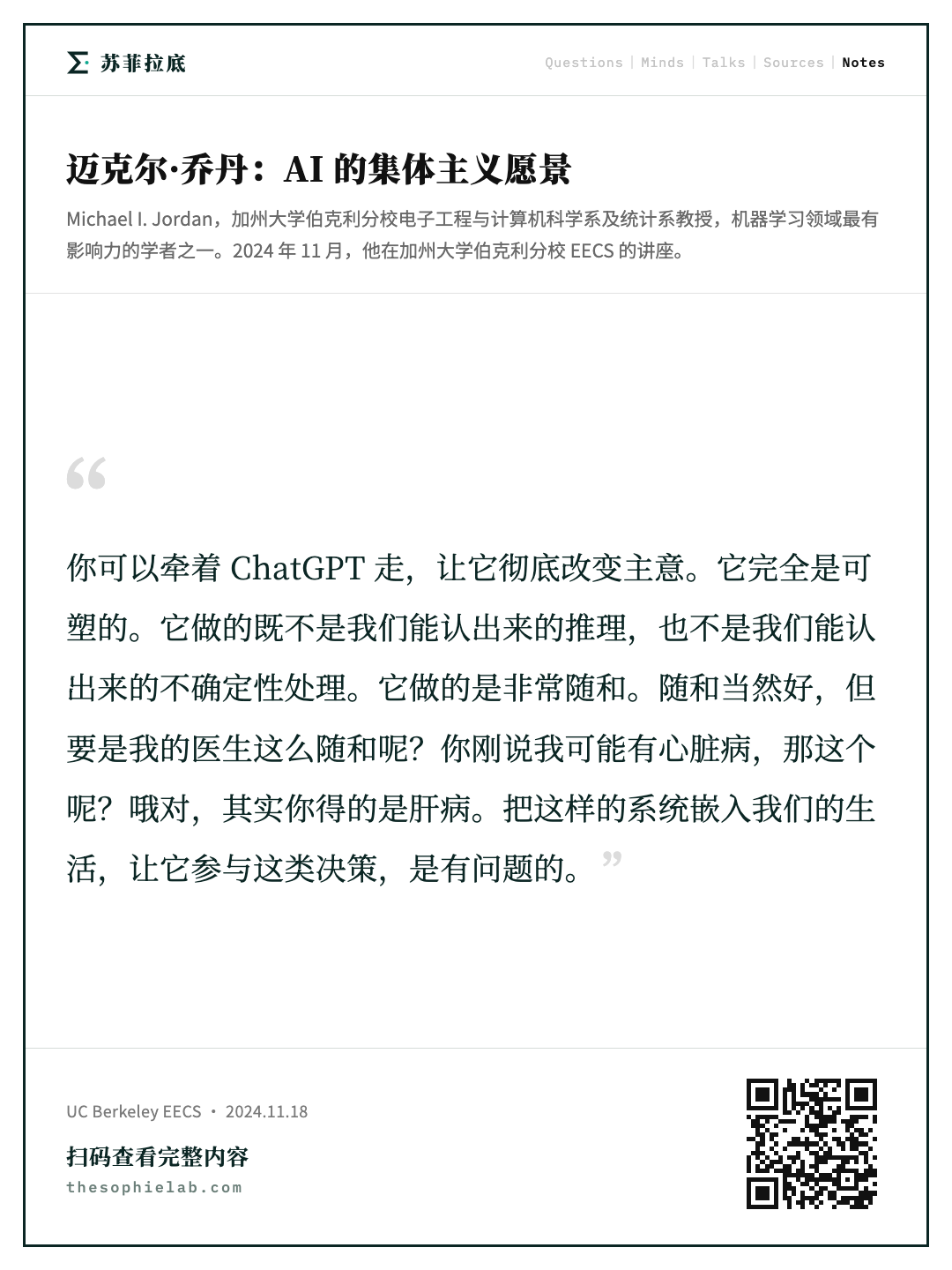
乔丹:先说不确定性。你对 ChatGPT 说,你刚才告诉我一件事,你有多确定?它会说点什么。我试过几次。它通常会说自己相当确定,理由如下。这方面它做得挺好。但你接着说,等等,还有另一件事,你难道没读过那篇文章吗?它就会说,啊对,你说得对。然后它又对那个非常确定。你可以牵着它走,让它彻底改变主意。它完全是可塑的。它做的既不是我们能认出来的推理,也不是我们能认出来的不确定性处理。它做的是非常随和。

乔丹:随和当然好,但要是我的医生这么随和呢?你刚说我可能有心脏病,那这个呢?哦对,其实你得的是肝病。真的吗?真的。我想我永远不会满意。把这样的系统嵌入我们的生活,让它参与这类决策,是有问题的。这里有一点定量证据,这张幻灯片大概是最好的一张。横轴是 ChatGPT 的自估置信度,它要么常常说零或一,要么有时说完全拿不定主意,五五开。人类的话,你会希望落在对角线上。它离那条线差得远。这并不是说它很糟。它通常做的是:你问它不确定性,它会说点什么,因为过去某个人被问过「你有多确定」,那个人给了一个理智的回答,它把这个回答复制过来。这没问题,这是预测,但这不是推理,也不是对不确定性的处理。

鸭子的统计学

乔丹:那我们怎么应对不确定性?我想在这里做一组非常简化的评论。我最近开始往幻灯片里加这些小图,因为我在欧洲给公众做演讲,公众喜欢这些图。有一种说法是,人类不擅长处理不确定性。我不认为这是真的。我们所有人都活在巨大的不确定性里:我不知道明天会发生什么,不知道接下来十分钟会发生什么,不知道晚饭吃什么,生活里所有要紧的事我都不知道,全是不确定的。可我每天早上照样起床,照样生活。我们都是这样。如果我孤身一人在世界上,老天保佑千万别,那我大概会应付得很糟。可我身处你们所有人当中。我不知道某件事,我可以问你,因为我知道你大概知道,或者你知道。我们彼此交流,创造出科学和文化,正是因为在缓解不确定性这件事上,我们非常擅长协作。所以,结成集体有许许多多好处,其中一个就是缓解不确定性。

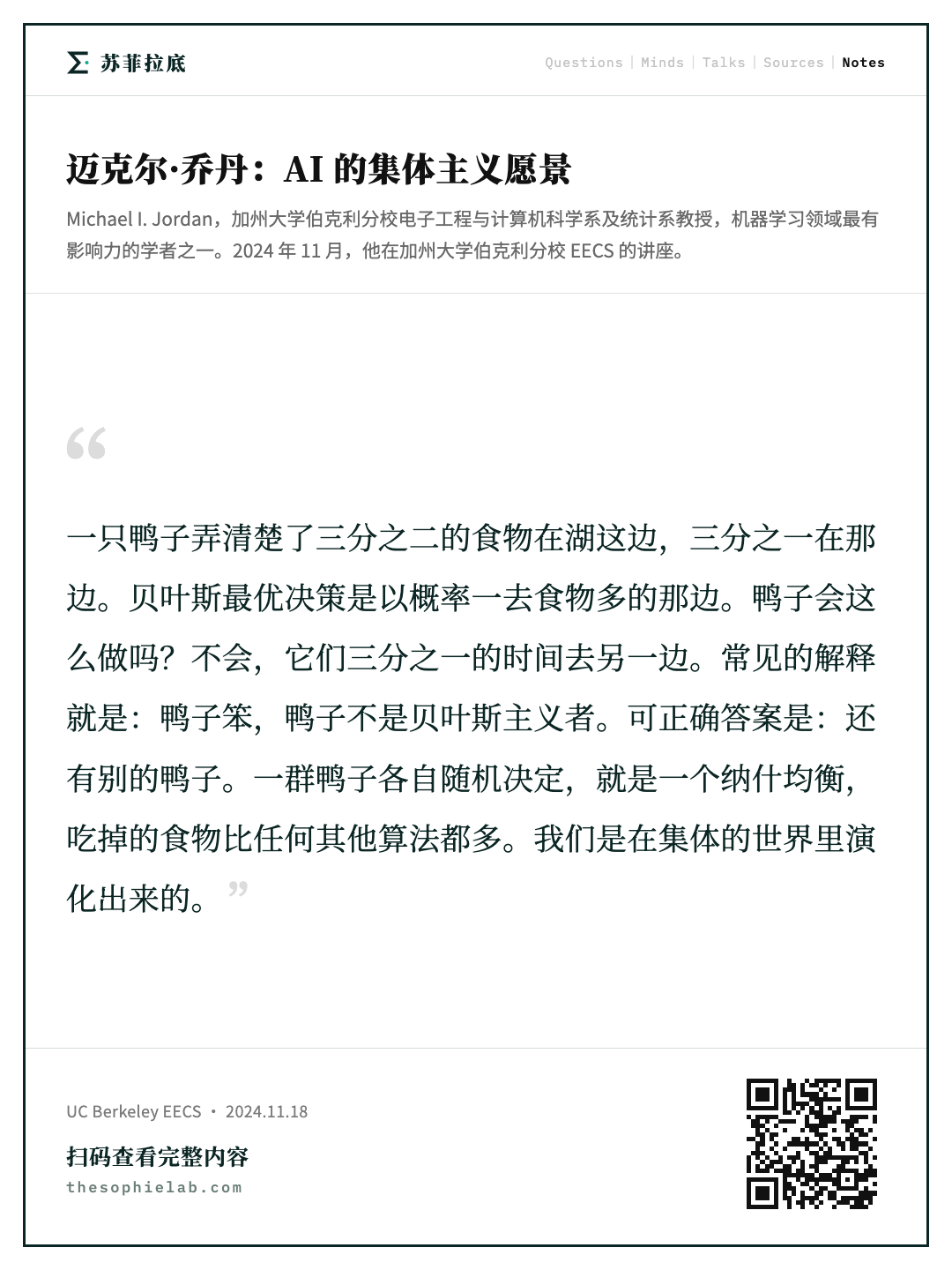
乔丹:让我们稍微想一想这件事。这里有一只鸭子,图片也很好看,我花了好长时间才在网上找到并顺手拿来。我没有为任何东西付费的激励,对吧?这只鸭子过去做了大量统计,弄清楚了三分之二的食物在湖的这一边,三分之一在那一边,而且这两个数的误差棒都非常小。现在你把鸭子放下去,问它,鸭子,你往哪儿去?一个月里天天这样问。鸭子会怎么做?往左还是往右?有人知道答案吗?这是社会科学里一个很有名的实验。贝叶斯最优决策是:贝叶斯鸭子以概率一去食物多的那边。鸭子会这么做吗?不会。它们会分散押注,往另一边去一点。而且不是一点点,是去很多:三分之一的时间去那边。这叫概率匹配(probability matching),一般被视为次优行为。人类在许许多多的情境下也做概率匹配。所以很长一段时间,心理学家和其他人试图解释它。常见的解释就是:鸭子笨。鸭子不是贝叶斯主义者。真有论文题目叫「鸭子不是贝叶斯的」。可接下来人类也笨了,人类也不是贝叶斯的。这也许是真的。你还可以说,这是个探索与利用(exploration-exploitation)的问题,你总该稍微分散一下押注,也许你的误差棒并不真那么准。但这里是三分之一,不是一点点,大到那些现象解释不了。那正确答案是什么?有人知道吗?至少,讲课的人偏爱的答案是什么?

听众:还有别的鸭子。

乔丹:还有别的鸭子。谢谢,谢谢。通常还有别的鸭子。事实上,我们是在有其他个体的世界里演化出来的。就算我们没有明确地想到这一点,我们也是在那样的世界里演化出来的。你把一群鸭子扔下去,要让大家一起吃到最多的食物,有一种算法是纳什均衡:每只鸭子随机决定,以三分之二的概率去那边,三分之一的概率去这边。这就是一个纳什均衡,意味着社会福利最大,意味着吃掉的食物比任何其他算法都多。你当然可以设计一种算法,告诉每只鸭子该去哪里,用分配的方式来做,但随机化的、去中心化的算法效果一样好。这也许是个简单的观点,但它真的很重要,真的很重要。我们是在集体的世界里演化出来的,我们也应当生活在集体思维占上风的世界里。

乔丹:我们眼下的世界,所有人越来越紧密地联网,信息在我们之间大量流动。所以我们想弄清的不只是把东西连起来的正确方式,不只是每个人的 IP 地址是什么,还有信息应当怎样流动、怎样被分析,去中心化的算法怎样做到这一点。我们不会去告诉每个人该做什么。这怎么可能做到?我们知道,有了这些通道,就有更多数据可以流动,我们甚至可以用计算机来分析数据,做出更好的预测,把联系铺得更广。但我们也知道,这会带来社交网络的混乱。人们究竟为什么要连接?也许连上的全是错的人,我们在激励错的人。「好人没有连起来」,打个引号。还有,是什么阻止人撒谎?没有什么阻止人撒谎。所以我们必须开始把微观经济学带进这幅图景。这不只是一个网络问题。

山上的那个东西

乔丹:在转向真正建设性的想法之前,再说一件关于硅谷的事。你去读萨姆·奥特曼或者埃隆·马斯克的声明,这些如今掌权的人,他们有一个古怪的狂热梦想:山顶上会有一个东西,一个超级实体,像是搜索引擎加加版,它把全人类的数据都吸进去,观看一切,知道很多,然后你可以查询它,它给你知识,告诉你正确答案。这就是那个模型。你把这东西建在山上,消耗巨量能源,等等。研究的目标就是建成这个东西。要不是这想法如此疯狂,我根本不会为它做一张幻灯片;要不是这确实就是萨姆·奥特曼脑子里的东西,我也不会费这个事。但它就是。那我们把这东西扔掉吧。把计算嵌入整个网络,网络里有些节点是计算机,谁在乎呢?我们正在被嵌入进去,我们也会把计算和我们嵌在一起,它会成为集体的一部分。

为市场辩护

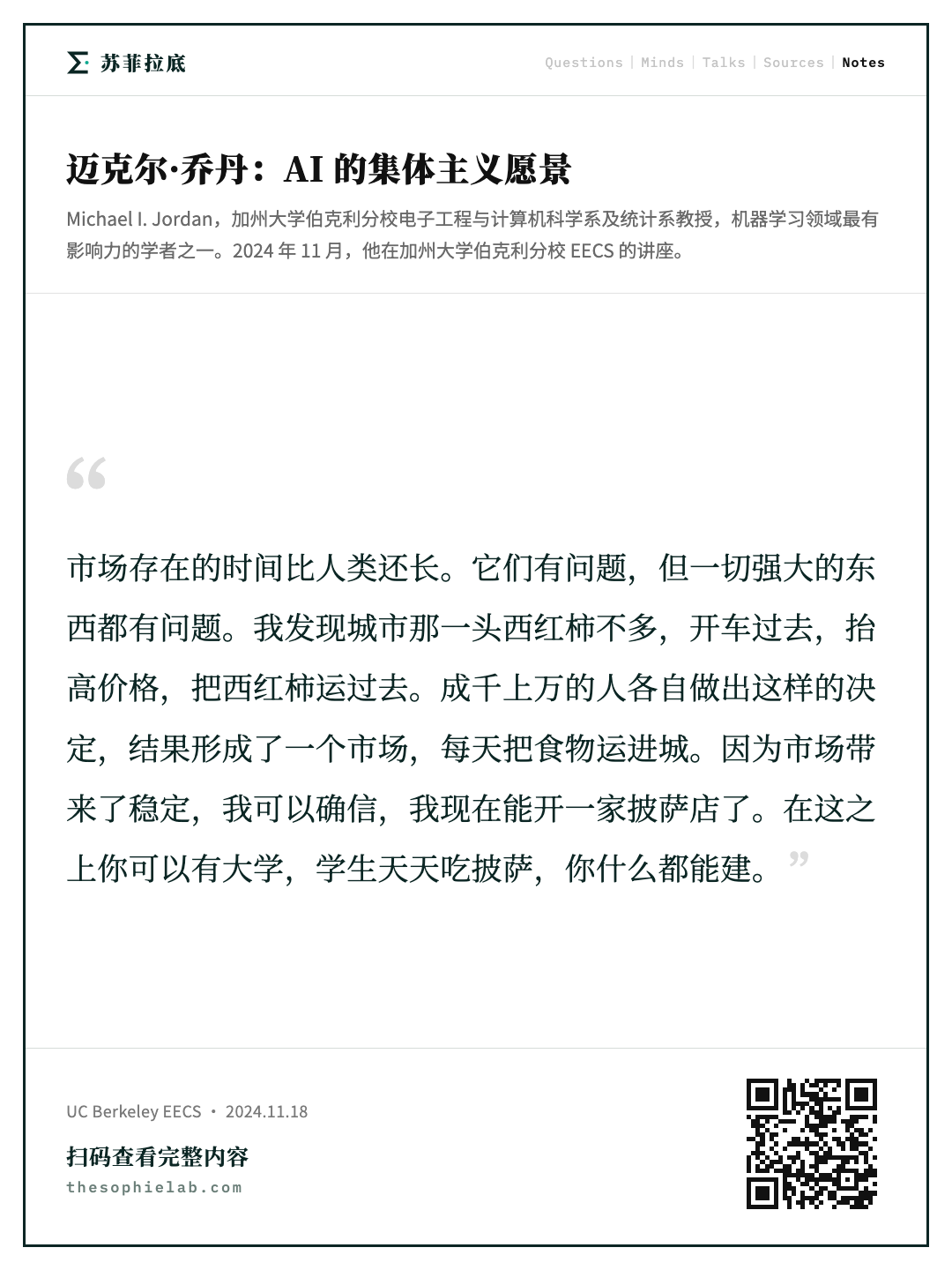
乔丹:大约十年前,或者略少一点,我开始在校园里做这类演讲。有一次我去历史系讲,他们很讨厌这套,他们说市场是可怕的东西,你怎么能告诉我们应该要市场?市场正在毁掉世界。是啊,我猜是吧。不,不是。市场存在的时间比人类还长,各种各样的市场,它们驱动着世界。它们有问题,我们必须想办法应对,但一切都有问题,一切强大的东西都有问题。市场做了一些非常好的事。它产生均衡,这意味着你得到的不只是一个最优解,最优解是谁的最优?而是一个均衡,每个人都分到一份。其次,正如我已经提到的,它降低不确定性。均衡降低了不确定性,让事情更稳定。

乔丹:想想每天把食物运进一座城市的市场。我有一些西红柿,我发现城市那一头西红柿不多,我开车过去,抬高价格,把西红柿运过去。成千上万的人各自做出这样的决定,结果形成了一个市场,每天把食物运进城。我们如今对此略有理解,供求规律,还有各种各样更精巧的思考方式。这带来了稳定。我需要西红柿,不只是因为我喜欢西红柿,而是因为我要开一家披萨店,披萨店每一天都需要西红柿,否则就不成其为披萨店。因为市场带来了稳定,我可以确信,我现在能开这家披萨店了。在这之上还能建别的东西:你可以有大学,学生天天吃披萨,你什么都能建。预测变容易了。当然,也会有失灵,于是需要谈监管之类的事。绝对需要。可我们现在的做法是一下子跳到:我们在造这些强大的引擎,它们也会解决世界上所有的问题,天哪好吓人,我们得监管它。怎么监管?不知道。经济学里怎样监管,我不是专家。人家问我怎么监管,我通常说,把几位经济学家请进屋,至少让他们参与讨论。而他们通常会说,你要在均衡的层面上监管,而不是在机制的层面上。关于这一点我现在学到的东西已经够讲一整场了,今天不讲,但这是一个非常有用的思考方式。

乔丹:所以,如果我们要创造这些新的市场机制,光有预测是不够的。我们必须开始使用经济学的语言:激励,价格。价格是把计算去中心化的方式,是让事情稳定下来的好东西,还有效用。

一个三方音乐市场

乔丹:我最喜欢的例子,是我这十年来投入了一部分生命的一件事。我参与了一家公司,它设计了一个三方市场,现在正蓬勃发展。这是一个音乐市场,是唱片公司之外的另一种选择。到目前为止,它已经签下了大批音乐人,他们的音乐全部交给这家公司,公司为音乐做母带处理。它服务的不是那些大牌超级明星,而是普通音乐人,那些大量创作音乐的人,他们的作品真的非常好。这些音乐被流媒体推送给几十万听众,可音乐人拿不到钱。这家公司的目标就是帮他们赚到一些钱。所以,一边是听众,像你我这样的人。而关键的一环,这是史蒂夫·斯托特(Steve Stoute)的构想,他是我的朋友,公司的首席执行官,美国传奇的嘻哈制作人,每个音乐人都认识他。他也认识 NBA 那样的地方的人。他把 NBA 签了下来,如今 NBA 官网上播放的音乐,唯一来源就是这些音乐人。你在网站上看一段集锦,你就是那群听众之一,配乐来自这些音乐人中的某一位。这是一个公开的市场,所以所有人都知道,这位音乐人的作品正在 NBA 网站上播放。另一个品牌看到了,会说,我喜欢跟那家公司关联的那个人群,我要去联系这位音乐人,让他的音乐也在我的网站上播,甚至跟他合作,请他写几首歌。此时此刻,这样的事情正在发生。

乔丹:要让这一切运转,沿着所有这些方向都有大量数据在流动。你得弄清哪种音乐最适合哪一类人群,得把这一切组织起来,还得有市场机制。光做预测是不够的。这些我们都做了。所以在这家公司的引擎盖底下,是一个相当复杂的、我称之为人工智能引擎的东西,它把市场机制和统计学结合在一起。而它是管用的。公司已经连续盈利好几年了,唱片公司开始害怕,业务也在走向国际。

乔丹:如果没有三方市场,只有两方,这一切就会散架,会瓦解。Spotify 做的事大致是这样:从人们手里拿音乐,流媒体推给听众,然后靠卖订阅赚钱。他们是独立做这件事的,因此有激励把音乐人整个去掉。要是能用生成式人工智能取代音乐人,那正符合他们的利益。他们也确实在尝试。所以,这是数据加上三方之间的互动,三方都是独立的主体,各自有参与这个市场的激励,走到一起是因为它创造了东西。它还会创造出新的东西,我认为会创造出新的音乐,以及在日常生活里使用音乐的新方式。这个话题我可以讲一大堆,就此打住。

三层数据市场

乔丹:接下来讲一个学术项目,合作者是阿里雷扎·法拉(Alireza Fallah),他本来在场,但我建议他不必再听我讲一遍,所以他去做更有成效的事了。我们研究的是三层数据市场。这是另一种市场,而且这些是真实存在的系统,我们不是要设计一家新公司,而是分析现有的公司。想想这样的系统:有像你我这样的用户,我们通过向平台提供数据来与平台互动,换回一项服务。比如支付,比如万事达卡。这家公司收到的数据越多,就能做出越好的服务,我们也就越满意。这里有一个不错的小反馈环。可是另一方面,像万事达这样的公司,光靠这项服务赚的钱不足以维持经营。他们维持经营的常见办法是把数据卖给第三方数据买家。这个第三方并不是想拿数据去做自己的服务、跟平台竞争,他们要数据是为了别的目的,做市场调研。他们想知道什么东西正在流行,某些城市里有什么,他们看着数据,决定也许在某个城市开一家新餐馆。这就是那个系统,它大致就是这么存在着的。

乔丹:现在你可以问:所有的参与者真的都有激励参与这个游戏吗?尤其是,用户有激励吗?他们在其中是有损失的,他们失去了隐私。于是你可以说,这需要监管,这样不行,让政府进来,强制要求达到某个隐私水平。那会把这个市场弄垮。另一种做法是对平台说,各位,你们也许可以自己来保证某个隐私水平。单方面决定采用差分隐私(differential privacy)。差分隐私是一种机制,以受控的方式往数据里加一点噪声,数据仍然有价值,同时也保护了一部分隐私。至于加多少隐私,你自己选,没有人命令你,你自己决定。假设万事达说,我要往数据里加很多噪声,给出非常强的隐私保证,而谷歌加得少。用户看到这一点,会说,这家在保护我的隐私,我把数据送到那儿去。于是那家平台拿到了更多数据。可另一方面,数据买家看着这两家服务,会说,等等,这边加了很多噪声,那边没加,我愿意为那边付更高的价钱。所以这里有环环相扣的激励。但同时,因为用户更多地去了这家,这家的服务更好,数据也会更多,所以如果买家只在乎数据的数量,他们也可能更偏爱这家。到底会发生什么,并不清楚。

乔丹:每当你遇到这种情形,一大堆相互咬合的激励,不清楚人们是否真的愿意加入,也不清楚这会不会导向一个能运转的系统,这时你就做经济学。这里的经济学就是计算这个系统的均衡。但这不是一道经典的经济学习题,因为里面有数据,数据的价值必须在一个统计模型下来衡量。所以这正是统计学和经济学的融合。你可以把这样一个系统的全部方程写下来,我们已经这么做了,然后把均衡解出来,作为各种参数的函数。

博弈论的逆问题

乔丹:更广泛地说,我们越来越多地在一个叫「激励理论」的经济学框架里做这些事。激励理论是博弈论的逆问题。简单说几句。经济学的主要数学框架之一是博弈论,研究策略性主体的理论。经济学还有别的数学,均衡之类的,但策略这一面就是博弈论。博弈论是一门「正向」的学科:写下某个游戏的规则,让玩家来玩,然后这是你预期会看到的结果,比如纳什均衡就是一种结果。这就像研究物理,这是 F 等于 ma,我们预期东西会以某种方式落下。如果没有那样落下,我们的理论就被推翻。经济学里有大量这样的工作。可另一方面,如果你是工程师,你可能想反过来走:我想要某个结果,比如一座建筑立得住,那我该设计什么样的方程来达成这个结果?我倒着走。博弈论的逆问题说的是:这是我想要的结果,我该设计什么样的游戏来达成它?博弈论的逆问题叫机制设计(mechanism design),或者叫激励理论,是一回事。

乔丹:均衡有不同的种类。纳什均衡对应的是对称博弈:一群玩家同时进场,各自出招,然后你看结果。它的逆问题就是拍卖。基于不同的纳什均衡,有大量的拍卖设计。我得说,这在如今的经济学和博弈论里已经不那么令人兴奋了。更有意思的是所谓的斯塔克尔伯格均衡(Stackelberg equilibria)。斯塔克尔伯格考虑的是主体之间掌握的知识不同,彼此不对称,通常一方先动,另一方跟随。所以它往往是序贯的,你还可以把这种结构串成链。斯塔克尔伯格均衡非常有意思,经济学家研究过。那你就想知道,斯塔克尔伯格均衡的逆问题是什么?那叫契约理论(contract theory)。我大约三年前读了一本书才知道这个东西,从那以后它改变了我们做的一切。

乔丹:你们都知道契约理论是什么,契约理论处理的是信息不对称。假设我是一家航空公司,想让人来坐我的飞机,我要给座位定价。我小时候,每个座位价格都一样,就像电影院,每个座位都一样。到了某个时候,飞机开始坐不满,航空公司开始亏钱,开始倒闭。于是有个聪明人说,不行,我们得对不同的人收不同的价。想想你怎么做到。这里有一个不对称。如果约翰明天走到柜台前说,我要去洛杉矶,他们看看他,说,瞧他穿得多好,肯定愿意付很多钱,我们报一千美元。约翰说,没问题,付了。然后伊莱走过来,穿得没那么讲究,他们看看他说,行吧,一百美元让你上。伊莱说,好,一百。航空公司很高兴,卖了一张高价票,还把飞机塞满了电子工程和计算机系的教授。可第二天会发生什么?约翰来了,穿得跟伊莱一样。于是他们没法做这种区分。而且这本来就会变:有一天约翰真的急需去洛杉矶,另一天他根本无所谓,事先谁也不知道,是在那一刻想到才决定的。所以山上那个知道一切、知道给一切定价的萨姆·奥特曼式的东西,是不存在的,因为在我们自己的脑袋里,不到想的那一刻,我们都不知道自己要做什么。

乔丹:契约理论说,我们要做的是大致考虑「支付意愿」的分布。它会变,不同的人在不同的日子有不同的意愿,但整体上有一个分布。我们设计一组契约:服务和价格,服务和价格,服务和价格,把这份清单发给每个人,同一份清单给所有人。有人选这个,有人选那个,各选各的。这种混合会带来高收入,同时也带来高的社会福利,因为每个人都找到了自己喜欢的东西。长话短说,航空公司靠这个机制活了下来。而奇怪的是,除了经济学里一个很小的分支,这个机制几乎没有人研究。

乔丹:更一般的理论是:有委托人(principal),有代理人(agent)。回到刚才那张图,把这一方看作委托人,这一方是代理人。代理人知道一些委托人不知道的事,但他们需要互动。所以委托人常常要为代理人准备一份契约,针对对方寻求的不同服务,契约可以不同。目标是设计好的契约,让整个系统表现良好。如果你不是自适应地做这件事,那你就在经济学的世界里:你写下契约,航空公司的人随意改改数字。而一个好的统计学家看到这个问题会说,我能不能把契约学出来?这就是我们的工作。回到那张图,我们就是在那儿做这件事。而且有趣的是,在这个情形里,平台从跟用户的互动来看是委托人,用户是代理人;可从数据买家的角度看,平台又是代理人,买家是委托人。所以在这些网络里,你可以同时是两者。这把我们引向了这个方向。

隐私、均衡与 GDPR

乔丹:于是我们为这些东西写下一些数学。它变成了一个统计问题。我们用了线性回归,平台试图从 X 里学到某个东西,用 θ 表示;而买家那边想学的是另一个东西,一个泛函,θ 转置 y。这样你就有了一个统计契约理论问题。把这些方程写出来,你会得到这种分层的均衡,它们是统计数据的函数,都可以算。关键的一步是,你必须引入效用:谁在乎什么,为什么在乎。论文里有一长串效用函数,其中两个重要的是:用户向买家透露的信息,也就是买家从这次互动中获得的信息量;以及买家的权衡,买家获得了一定量的信息,但必须向所有卖数据的地方付一笔价钱,这是坏事。中间有一个权衡参数。结果是,当我们开始解这个系统的均衡时,β 决定了一切。β 非常重要。我们画出了一些小图,实际上有两个 β 值,β 一和 β 二。在图上我们可以说,β 这样设,你得到一个好的均衡,人人满意;β 那样设,你得到坏的均衡。这就是我想拿给监管者看的东西,我们眼下正在做这种事。

乔丹:这里是均衡分析的一些细节。你把它写成一个博弈,一个斯塔克尔伯格博弈。首先,平台决定提供多少隐私;用户决定是否加入;平台决定收什么价;然后买家决定从哪些平台购买数据,以此类推。然后你解出均衡,作为 β 和所有这些数据期望的函数。我们接着证明定理:存在某个较小的 β 值和某个较大的 β 值,在 β 上界之上,均衡存在,并且有一个性质,就是所有平台都会进入市场;在此之下,只有某些平台会进入,我们称之为低成本平台,就是谷歌那一类,它们并不需要这个市场也能存在于系统里。

乔丹:现在你可以把这跟现有机制比较,比如 GDPR。GDPR 是政府强加的隐私机制。你可以问,它带来多少社会福利?这已经有不少分析了。事实上,最近有一篇论文显示它对欧洲的小企业伤害有多严重。大公司没有被 GDPR 伤到,受伤的是中小企业,很多中小企业因为 GDPR 倒闭了。我们的分析有助于解释这一点。我不展开细节,只说一句:我们研究了 GDPR 式的全面禁令,发现它只在一种情形下最大化用户效用,就是所有平台都是低成本平台的时候。而我们的均衡分析让我们能够说,在某些情形下,一项非均一的隐私要求反而会提高用户效用。这就是那种东西,我去法国政府那里讲过,他们喜欢这种语言。他们说,好,这比我们以前想的那些更有层次。

乔丹:所以在计算机科学、经济学和统计学的这个交界面上,有大量的问题。过去十年我大部分时间在研究最优、均衡和动力学之间的关系,但如今我的心思真正在这些东西上:信息不对称,怎样处理主体之间的偏差,怎样让目标不同的系统合作,等等。演讲余下的部分,让我看看时间,我再讲几个带有这种味道的问题片段,让你们看看我认为值得解决、也能够解决的问题长什么样。我会讲得很快,每个只给一点味道,这些都有论文,论文会讲得更清楚。

预测驱动的推断

乔丹:第一个来自我们和这几位的一个想法,他们都是伯克利的学生,史蒂文当时是博士后,现在在麻省理工。这个东西叫「预测驱动的推断」(prediction-powered inference)。这一个跟激励没什么关系,它关于偏差,非常非常大的偏差,而且偏差的来源可能出人意料。我们从 AlphaFold 这类系统入手。AlphaFold 预测蛋白质结构,准确度非常高:你给我一个序列,它把结构告诉你,非常准。它是一个集体机制,从各种各样的人、各种各样的科学场景里汇集了数据。现在有很多题为「AI for science」的论文,把 AlphaFold 当作真值。通过实验室工作确定了结构的序列,至今只有大约十万条;而 AlphaFold 能生成上亿个预测结构。所以如果你要检验某个具体假设,比如这种蛋白质做这个或那个,你可能干脆用 AlphaFold 来生成数据,因为这样得到的数据比实验室多得多。这就是那个诱惑。

乔丹:我们研究的一个例子,是蛋白质结构领域一项相当有名的研究。问题是,一种蛋白质会不会出现他们所说的量子无序。大多数蛋白质喜欢折叠成整齐的小团,但有时会有一点量子涨落(quantum fluctuation),导致一些链段垂在外面,像我头上垂下来的头发。过去人们认为这可能是坏掉的蛋白质,大自然不会用它。而这些研究者问,也许大自然是用它的。于是你可以做一张二乘二的表:有没有量子涨落,有没有磷酸化。磷酸化意味着它在细胞里是活跃的。你可以把整个蛋白质数据库归结成这张小表。然后你是个统计学家,你问:这两个变量之间有没有关联?对角线是不是比非对角线大?你计算优势比(odds ratio),比较对角线与非对角线,然后你要优势比的标准差,或者标准误。这些人做了,发现标准差巨大,区间覆盖了一,意味着不存在关联,所以他们不能声称有关联。

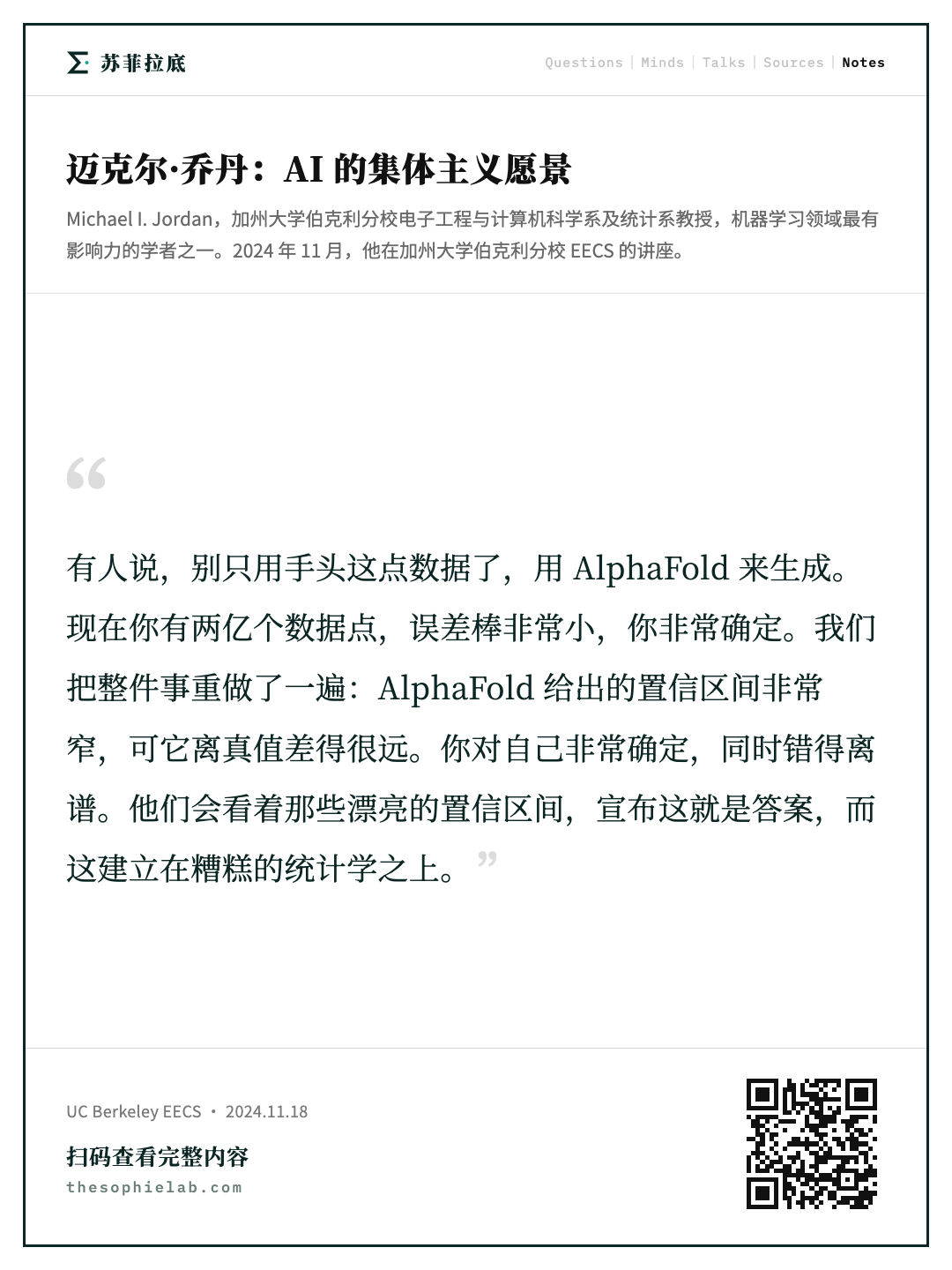
乔丹:就在几年前,有人来说,别只用手头这点数据了,用 AlphaFold 来生成。现在你有两亿个数据点,把一切归结成那张小表,算优势比,算误差棒,做检验。因为有两亿个数据点,误差棒非常小,你非常确定,而它不覆盖一,于是他们说,有关联。这也许对也许不对,但这是糟糕的统计学。这里是优势比,这是它的公式。我们把整件事重做了一遍。我们拿出一半数据,完全留出,做蒙特卡罗,以此估计真值。在那一半数据上,真实的优势比看起来略高于二,就在那儿。这是 AlphaFold 给出的优势比,置信区间非常窄,不覆盖一,可它也不覆盖真值,离真值差得很远。你对自己非常确定,同时错得离谱。偏差极大。这是置信区间上的一种极端偏差。如果你完全不管 AlphaFold,回到统计学入门课,这是你得到的置信区间,基于十万个数据点,很遗憾它覆盖了一,所以二十年后你依然做不出结论。

乔丹:新方法给出的是这些绿色的置信区间。它叫预测驱动的推断,本质上是把两者融合起来的一种方式。它用了 AlphaFold,没有把 AlphaFold 扔掉,但也为你心里那个具体的假设补充了一点额外数据,这就足以修正 AlphaFold 的输出。这些绿色区间可以证明覆盖真值,跟经典区间一样,但几乎总是比经典区间小得多,只是不像 AlphaFold 那个那么小。我们在好几个领域做了这件事,它让我们发现了 AlphaFold 错在哪里,这是我们事先不知道的。AlphaFold 整体上非常准确,但对量子涨落,它相当糟糕。这是对某个蛋白质的预测,这是实际的实验结构,它完全漏掉了量子涨落。这不在我们的预料之中,但正是这一点,驱动了那个严重偏差的置信区间。我要断言,我们在许许多多其他实验上也做了这件事,发表在《科学》上,这种情况随时都在发生。科学家不关心旧数据,旧数据是用来建 AlphaFold 的,他们关心尚未探索过的新数据。他们非常可能一头栽进高度偏差的情形,而事先并不知道。他们会看着那些漂亮的置信区间,宣布这就是答案,而这建立在糟糕的统计学之上。所以我完全不是说 AlphaFold 是个坏主意,我认为它是个伟大的主意。我要说的是,如果你在它上面加一层统计推理,你能兼得两者之长。

乔丹:这是另一个例子,能看到同样的现象。这是第三个、也是最后一个例子,我很喜欢。这一个里,机器学习模型给出了一个偏差极大的答案,非常自信,偏得离谱,完全错了。这是新的区间,比经典区间好不了多少,但这是恰当的,因为在这个问题上,这个方法本来就榨不出多少功效。所以它是诚实的。它说,我可以修正那个,但我不会过度承诺。这一张幻灯片说明了怎么做到。简单说,这是对置信区间偏差的一种广义估计,跟我们习惯的略有不同。我们习惯于估计点估计量的偏差,这个估计的是置信区间的偏差,有点不一样。细节我不展开了。

临床试验里的激励

乔丹:那个项目引出了另一个项目,我们把激励引了进来。刚才那个项目处理的是信息不对称:AlphaFold 知道很多,它像山上的那座塔,可我有一个具体问题,对我自己的问题我多知道一点。能不能把两者合起来?我们刚刚证明了可以。现在看一个真正有激励在起作用的问题,人们有既得利益,而不只是偏差。还是史蒂文,现在在麻省理工;迈克尔在斯坦福;杰克在芝加哥做博士后。我们在一个具体领域研究了这个问题,临床试验,用它来解释这个想法很合适。每年有数以千万计的美元投入临床试验。这些是因果推断实验:随机把一万人放进处理组,一万人放进对照组,打疫苗,不打疫苗,然后比较,断言疫苗有效或无效。做这个很贵。而现实中,这些被检验的假设,疫苗有效还是无效,并不是从自然界里冒出来的,它们来自有既得利益的制药公司。我刚设计了一种新药,希望它上市,做了一些基本测试确保它不伤人,现在我想上市,想赚大钱。美国食品药品监督管理局(FDA)坐在那儿看着说,做完临床试验我才让你上市,而你得花很多钱来做。于是你做了。

乔丹:现在的问题是,我怎么断言假阳性率和假阴性率是受控的?这是统计学家想做的事。在最简单的版本里,统计学家会说:如果药物实际上无效,θ 等于零,那么获批的概率小于 0.05,这是假阳性率;如果药物实际上有效,获批的概率是 0.8,这是功效。FDA 就是这么做的,极其优秀的统计学家在极其艰难的情形下工作。问题在于,他们检验的假设不是来自自然,不是来自某个科学理论,而是来自制药公司。让我们站在药企的角度想一想。设想一种利润微薄的情形:做试验要花两千万,药企得付这笔钱;假设获批之后能赚两亿。首席执行官看着这些数字,可以算出她的期望利润。反事实地说,如果我的药实际上无效,期望利润是负一千万,是亏本的。于是她对全公司的人说,只有你们真的确信是好药,才往上送。他们并不知道它是好药,但他们有一些背景知识,一些 FDA 不掌握的内部知识。他们利用这些内部知识,只提交那些很可能成功的候选药,这样就不会亏钱。

乔丹:另一种情形是利润巨大:试验两千万,获批赚二十亿,布洛芬那种量级。首席执行官做同样的计算,她会发现,即便药物实际上无效,期望利润也是八千万。为什么?因为 0.05 并不是一个微不足道的数。往 FDA 扔的候选药足够多,总有几种会漏过去,而你从它们身上赚大钱。一种药上市卖两年,它无效,谁在乎呢?这不道德吗?我不知道,但这就是发生的事。于是有人死去,不是因为药害了他们,而是因为本可以有更好的药。这是个问题。怎么解决?在这种情形下,首席执行官说的是,能送的药全都送上去。他们仍然会用一点内部知识,但他们不需要用。

乔丹:解决办法是意识到,这是一个契约理论问题。有一个委托人,FDA,只掌握部分知识。有一个代理人,掌握私有信息,他们了解自己在设计的蛋白质和药物,过去做过研究,知道一些东西,但他们不能、或者不想直接告诉 FDA。那 FDA 需要做什么?它需要设计的不只是一个价格,两千万,而是一份契约。而且我们要自适应地设计这份契约,让它投放出去、被人们实际使用之后,第一类错误和第二类错误仍然受控。后面这句话是新的,经典契约理论里没有,它是一个针对契约的统计判据。所以我们设计了所谓的「统计契约」(statistical contract)。代理人进来,选择加入或退出。退出没关系,走人就是,这也是数学的一部分。加入的话,先付保留价格 r,然后从一份菜单里选一个支付函数。支付函数就是契约条款:你能在多少座城市推广,推广多长时间,有哪些约束,等等,交易的各个部分。新的部分是,接下来你从自然中抽样,做临床试验,看看自然怎么说。如果我对自己的药很有信心,我会选一个对自己有利的支付函数,条款好,因为我相信它,试验做完,我拿到利润。如果我对自己的药没那么有信心,我会在这里选一个风险较低的。所以我的任务是,找到足够多的选项,覆盖各种风险承受度,并给它们定出正确的价格,使得第一类和第二类错误都受控。

乔丹:把这些跑起来,有了各种收益,然后做数学。这次演讲我同样不进入数学,只说我们可以解出均衡,能设计最优契约,甚至能给出一个「当且仅当」的表述。一份契约是激励相容的,意思是所有参与者都有利益真正参与这个游戏,没有人白白亏钱,这等价于某个期望小于或等于一。当且仅当所有支付函数都是所谓的 e 值(e-values)时成立。e 值是非负上鞅,是统计学里用来陈述「反对原假设的证据」的一类东西。于是我们可以回去对 FDA 说,我们有了一套词汇,我们得谈谈。你们要设计好的契约,它们必须是非负上鞅的集合。他们问,那是什么?我们可以说,这里有一些例子,你可以把它们相加,仍然是非负上鞅。我们知道怎样设计这样一套小词汇。

价格歧视与隐私

乔丹:我用几分钟收尾,再讲几个小片段。我们组最近的关注点,这里是几位成员,不只是我们组:妮卡是我的教师同事,尼瓦西尼是妮卡和我共同指导的学生,米娜是雅各布·斯坦哈特的学生,阿里雷扎是组里的博士后。我们真正想做的,是把所有这些想法一直推到监管层面,谈市场设计和监管,这样我们就能跟政府对话。我讲两个小片段,然后结束。

乔丹:第一个关于价格歧视。政府里很多人关心价格歧视:应不应该允许公司差别定价?我们是不是在遭受价格欺诈?怎么研究这类问题?人们担心有些人拿到的价格比别人好,是出于什么原因,怎么控制。经济学研究过这个。德克·伯格曼(Dirk Bergemann)和同事有一篇著名论文,一根轴是消费者效用,另一根轴是生产者效用。设定是:我有一个巨大的市场,我用各种方式把它分割,也许按地理,也许按年龄。考察一个市场所有可能的分割方式,问由此得到的消费者效用和生产者效用是多少。他们证明了一条定理:所有可能的效用组合构成某个空间里的一个三角形。这是一个非常重要的结果,本身也许会得诺贝尔奖,政策圈的人一直在用它。

乔丹:我们进来问:如果加上隐私保证呢?在价格歧视里这非常自然。我是希望有价格歧视的。比如我去电影院,因为年纪大一点可以打折。其实我没真的去要,觉得不好意思,但我可以。要拿到折扣,我得透露我的年龄,我失去一点隐私,但换回了一些东西。一般而言,一个好的、有效率的系统就该这样运作:我们透露一些东西,换回一些东西。要是透露了什么却什么都换不回来,谁愿意呢?于是我可以问,加上差分隐私之后,这个效用空间怎样移动?我和阿里雷扎做了数学分析,怎么做的我不讲,这是结果:经典的三角形向下移了一点,也向旁边移了一点,而且不再是三角形了,它是一个凸形,实际上是一个高维多胞形的投影。它有一些好性质,尤其是,消费者效用被限制在离零一定距离之外。你总能得到正的消费者效用,代价是生产者效用略有下降。政府里的人也许会喜欢这个。这个机制的其余细节我略过,它同样导向一些定性的结论。

市场准入与规模定律

乔丹:然后我简单提一下和米娜的工作,她也许在场,也许不在。米娜今年在找教职,我想突出她的一个精彩项目。米娜某种意义上在带领我们组,带着我们所有人去思考大规模市场设计的原理,也就是当我们做这类受数据影响的机制时会冒出来的那些原理。她和我以及雅各布合作。这个项目关于市场进入壁垒,这张图差不多把事情都说清了。如今人人都在谈大语言模型,谈各家公司在提供这些模型,于是有了一个市场,我可以去这家、那家或者另一家。很多人,包括政府里的人,担心最后会收敛成一个模型。那时政府可以说,不行,这是垄断,我们得把它拆了。但有没有理由说它不会收敛成一个模型?有。其中一个理由是声誉损失。如果你是一家很大的公司,模型出了一个故障,你的声誉会大受打击。如果你是一家没人注意的小公司,出了一点小故障,没人在意。把这一点量化,问故障的概率跟你拥有的数据量是什么关系,你就可以谈大家都在谈的那些规模定律(scaling laws),并在声誉损失和模型规模之间建立一个定量关系。这就是米娜以一种非常有趣的方式做的事。

乔丹:我给你们看这一张,这张我给法国政府看过,一屋子法国政府里的经济学家。我给他们看的时候非常自豪。它显示的是:如果有一家非常大的公司,拥有无限的数据,而我是一家想进入市场的很小的公司,我有没有可能进得去、又不被干掉?这根轴是差距,也就是我这个新进入者和现有大公司之间的差异。如果差距非常非常小,我需要大量数据才能进入这个市场,但不是无限多。即便差距很小,我仍然能进去,仍然能活下来。差距变大,我进入市场所需的数据量变得非常非常小。所以这是一个对市场进入非常有利的结果,在宏观经济学里你通常看不到这种东西。这跟神经网络具有这些规模定律有关,这是米娜在这个情形下分析的规模定律的形式。背后是随机矩阵理论。我跟法国政府官员说了这个,他们说,再多讲讲随机矩阵理论,是马尔琴科-帕斯图尔(Marchenko-Pastur)分布吗?是的。这些人,了不起。总之,我要说的是,现在可以开始分析这些东西了,不是分析细枝末节的算法细节,而是分析整体的规模定律,把它当作经济实体放进去,在一个生态系统的语境下分析这个经济实体的效应。

一门新的工程学科

乔丹:我讲完了。留下这张幻灯片,我最近几次演讲都用它。我认为我们这个时代,正在出现一门新的工程学科。它不是关于一个威胁我们所有人的超级智能,而是关于我们所有人以新的方式连接起来。这可能带来更有效的互动,也许让音乐人多赚一些钱,也许带来新的民主原则,也许带来一个更健康的世界。医疗肯定能改善,很多事情都能改善,但这一切都得在建设这门新工程学科的战壕里一点点干出来。我认为这很像化学工程的诞生。先有化学,然后二十年的努力造就了化学工程,你可以建起真正能运转的工厂。电气工程也一样,先有麦克斯韦方程组,然后二十年的努力造就了电气工程。这里也是,我们有一些原初的基本原理,梯度上升、假设检验之类的,然后我们需要大约二十年,才能开始建成那些真正出于正当理由而通向人类幸福的系统。这正是工程学科的目标。

乔丹:我认为我是个工程师,我相信我们应该建造好的工程系统。而统计学是我真正的老家,它历来强调科学和数学,我们只是努力做出好的数学去帮助科学家。我就是这么被教的,这就是我们该做的事。可后来我看到我们的算法,比如布雷曼的算法,在工业界被拿去做工程上的事,我就问,我们能不能也用统计学来设计好的工程制品?我意识到可以,但前提是我们开始把经济学引进来,把这一切合到一起。总之,这是对一大堆想法的匆匆一览,希望你们觉得有意思。谢谢。

问答:经济模型的假设

主持人:非常感谢。我们还有时间回答几个问题,我相信问题一定很多。

听众:你用的这些经济模型,我知道很多经济模型都强加了非常强、非常不现实的假设。你在自己的模型里施加的假设,强到什么程度?

乔丹:谢谢你问这个,这是个好问题,我经常被问到。我的回答多少有点把事情扫到地毯底下的味道:大多数经济理论,是你写下一堆理性假设和参数化的曲线,然后在上面做数学,得出一些结论。我们是统计学家,我们把数据带进来,所有的曲线都由数据来决定。所以,行为经济学所揭示的那些东西,人们实际上这样或那样行事,它们是通过数据进来的。这个回答有点油滑,但我真的相信它。我们可以扔掉经典经济学的许多假设,因为数据决定了这些系统内部的函数。这不意味着你不必思考,但意味着你不再受制于那些非常非常狭窄的理性假设。事实上,理性是个很经典的假设,而在这里,理性只是:你有没有激励参与这个游戏?就这一条。这就是理性假设。如果你完全没有激励参与,你可以走开,没问题。如果你没有激励、但其实应该有,这里有一个你正在错过的真实机会,那就说明我们建模建错了,需要补充更多数据,于是我们就补。这也帮你弄清该在哪里补数据。我不把心理学、神经科学放到幻灯片上,但行为经济学确实是这个故事的重要部分。我认为它就在统计学和经济学的融合之中,是从那个融合里生长出来的,部分是,不全是。

问答:三方市场为何不崩塌

主持人:还有问题吗?

听众:你说 UnitedMasters 那种三角市场是防止崩塌所必需的。为什么必需?为什么有了三角它就不会崩塌?

乔丹:我们完整写过一个「瓦解」(unraveling)现象的分析,它就叫瓦解。你也许记得经济学里那篇非常有名的「柠檬市场」论文。基本上就是那一类分析,表明这个市场会瓦解,取决于具体的设定。我们写下了 Spotify 式的模型,那种模型唯一的存活方式是做广告或者收订阅费。而在我们更内生、更有机的模型里,唯一进来的钱来自品牌为一件符合自身利益的产品付费的意愿,那么市场就不会瓦解。

听众:所以那个三角里唯一的钱,不是来自个体买家,个体用户什么都不付?

乔丹:个体用户不付钱。我倒是很希望个体消费者付钱,我会付,我愿意为 YouTube 付钱。可惜谷歌、Facebook 那些人决定了一切都该免费,我认为这造成了严重的扭曲。我跟那些人都谈过,问他们,你们为什么不把这个改了?他们说,是啊,我们也希望能改,如何如何,但他们不改。所以我不相信他们会改。这也是我参与这家公司的部分原因:这里是另一个钱能进来的地方,它能真正稳住一个市场,而且完全不靠广告。钱总得从某个地方进来,在这里,钱来自品牌拿到了对它们有价值的东西:大量年轻人真心喜欢的好音乐,出于特定的目的在它们的网站上播放。品牌经理们完全投入了这件事。所以我想为其他领域找到更多这样的机制。

问答:法国、运筹学与起源

听众:我终于明白你为什么搬去法国了。你在法国打交道的那些官员,全是巴黎综合理工学院的毕业生,他们懂数学。

乔丹:他们懂。你说得完全对,一语中的,这绝对是我在法国的原因之一。我认为美国这里的对话已经彻底坏掉了。西海岸的人全疯了,萨姆·奥特曼那些人;东海岸眼下在发生什么,就更别提了。

听众:不过我有一个具体的问题。演讲开头你做了一段简短的历史回顾,讲这些东西从哪儿来,追溯到九十年代。让我有点沮丧的是,人们以为一切都出自反向传播,而实际上,这一切出自五十年代的运筹学和线性规划。你对此有什么评论?

乔丹:你说的完全正确。我把维纳放上去的时候,他当然是那场革命的一部分。我相信四五十年代那个时期极其重要,它带来了线性规划、非线性规划等等。他们错在哪里?他们没有做统计学家。他们没有意识到,目标函数往往是对海量事物的求和,而随机方法将会胜出。反向传播既是梯度下降,也是至关重要的随机梯度方法。而这一点,五十年代也已经有人预见到了,主要是数学系和统计系的人。事实上,当年在伯克利的杰克·基弗(Jack Kiefer)写了最早的随机梯度论文之一。总之,说到底,人们也常问我,谁会在人工智能上占据主导?我说,人工智能基本上就是人人都懂的梯度算法,arXiv 上堆满了每一个最新的想法和技巧。没有哪个国家能主导它,因为每个国家的每个学生都能立刻读到,也确实立刻读了。不知道在座有没有运筹学的人,他们当年可是所向披靡。四五十年代他们是主导者,后来不知怎么就丢掉了。我想也许是时候他们回来了。我认为很多领域之所以输掉,是因为没有把统计学纳入进来,没有思考怎样分析数据,怎样做因果推断,怎样处理不确定性。而统计学之所以输掉,是因为它不真的愿意去思考这些大规模的问题。

问答:四方市场

主持人:还有问题吗?

听众:接着前面的问题,四方市场或者五方市场有意义吗?

乔丹:好问题。有意义。我认为这是一个很有创意的想法:开始搭建多层级、多层次的市场原理,数据市场之类的。所以,有意义。在座的几位学生确实在想这方面的事。我认为我们一定会看到这种东西,会看到经纪人(brokers)出现。在提供这些服务的实体和使用服务的我们之间,鸿沟太大了,各种各样的经纪人会冒出来。我认为会出现各种全新的、有意思的生态系统。但它们不会是经典的那种,它们会是一类新的统计主体。

主持人:我想我们就到这里吧,已经过了一刻了。非常感谢你,迈克。
本期讲者
迈克尔·乔丹加州大学伯克利分校电子工程与计算机科学系及统计系教授,机器学习领域最有影响力的学者之一,以概率图模型、变分推断和统计学习理论闻名。近年转向机器学习与经济学的交叉,并在巴黎 Inria 任职。
主持人伯克利校内活动的主持人,负责开场介绍与问答环节。
章节 · 点击跳转视频
0:00 开场:主场演讲与「为什么做 AI」 ▶ 正在看
2:28 三位先驱与机器学习的真实历史 ▶ 正在看
7:56 三种思维:计算机、统计、经济 ▶ 正在看
10:41 讨论缺失的三样:群体、不确定、激励 ▶ 正在看
13:13 鸭子实验:概率匹配与集体最优 ▶ 正在看
17:48 山顶超级实体 vs 嵌入网络的市场 ▶ 正在看
21:23 三方音乐市场与三层数据市场 ▶ 正在看
27:43 从博弈论到合同理论:航空定价 ▶ 正在看
37:17 预测驱动推断:AlphaFold 的偏差 ▶ 正在看
43:37 临床试验作为统计合同问题 ▶ 正在看
50:06 价格歧视、隐私与 LLM 市场进入 ▶ 正在看
56:06 结语与问答:新工程学科需要二十年 ▶ 正在看
本期论点
本期回应
3:41
计算机该做的不是让自己变聪明,而是增强人的智能 增强人的思考计算机能让人想得更好吗?
12:17
把大语言模型用于医疗这类决策是危险的,因为它顺着用户走而不做不确定性推理 一出边界就垮智能体现在能独立干活吗?
40:09
用 AlphaFold 生成的海量预测数据当基准真值做统计检验,是糟糕的统计学 一出边界就垮智能体现在能独立干活吗?
55:16
大模型的缩放律下落后者追赶所需的数据反而更少,市场不会必然收敛为垄断 不会集中AI 的能力会不会集中到少数机构手里?
1:03:33
没有任何国家能在 AI 上称霸,因为核心的梯度类算法人人可得 不会集中AI 的能力会不会集中到少数机构手里?
6:37
三十年来机器学习真正变化的只是数据,算法和基础设施并没有本质改变 靠学习智能主要靠什么长出来?
24:00
只靠订阅赚钱的流媒体平台有动机用生成式 AI 取代音乐人 被人滥用AI 最大的危险在哪里?
其他论点
10:00
产业面对的大问题多处在计算、统计与经济三种传统的交汇处,学术界却很少把三者放到一起
10:52
驱动人工智能的数据来自群体,这些系统应当明确说明自己如何反过来让群体受益
13:45
人类缓解不确定性的关键能力在于彼此协作,而非个体推理
16:08
鸭子和人类的概率匹配不是次优行为,而是群体层面社会福利最大的纳什均衡
18:45
与其在顶端建一个吸走全人类数据的超级实体,不如把计算嵌入整个网络、成为集体的一部分
19:38
市场产生的是均衡而非某个人的最优解,它降低不确定性、带来可供建设的稳定性
35:59
GDPR 并未伤到大公司,真正被它压垮的是欧洲的中小企业
46:43
0.05 的假阳性率不够小,只要提交足够多无效药物,总有几款会漏过审批
01开场:主场演讲与「为什么做 AI」
0:00
I could probably spend all his time talking about his achievements and stuff. He's a member of many academies and National Academy of Sciences and Engineering, the American Academy of Arts and Sciences. He is a foreign member of the Royal Society. And there probably other societies are just they're not important enough to mention. And he's winner of a gazillion of prizes. I mean, he has the David Romer Hult prize. He has Alan noble award. He gave a plenary lecture, ICML. He is the world laureate association prize winner, inaugural one.
我大概可以一直讲他的成就之类的东西讲个没完。他是多个院士机构的成员,包括美国国家科学院、国家工程院,还有美国艺术与科学院。他还是英国皇家学会的外籍院士。可能还有别的学会,只是没重要到值得一提。他还拿过数不清的奖项。比如说,他拿过 David Romer Hult 奖。他拿过 Alan Noble 奖。他在 ICML 做过大会主旨报告。他是世界顶尖科学家协会奖的首届得主。
便签引用
0:40
It's a big one. He is the AMS of Granada prize winner, the John Von Neumann. And-- OK. He is also was named as the most influential computer scientist in the world by science of all areas. OK Thank you very much, Mike. I'm really looking forward to your talk. MIKE JORDAN: Thank you. [APPLAUSE] All right. Thanks very much. It's very nice to be on home terrain. The staff person who's organized this reached out to me and said, well, you have any expenses to be reporting. And I thought, man, this is a real opportunity to go on to Uber and get that extremely special expensive Uber car to bring me from my house to here.
这可是个大奖。他还是 AMS 格拉纳达奖得主,还有冯·诺依曼奖。还有——好吧。他还被《科学》评为全世界所有领域中最有影响力的计算机科学家。好,非常感谢你,Mike。我非常期待你的演讲。MIKE JORDAN:谢谢。(掌声)好的。非常感谢。回到主场的感觉真好。负责组织这次活动的工作人员联系我,说:呃,你有什么费用要报销吗。我当时想,天哪,这可是个好机会,可以上 Uber 叫一辆特别贵的那种专车,把我从家里送到这儿来。
便签引用
1:28
PRESENTER: No, it's a flight from Paris and back, Mike. You really-- MIKE JORDAN: All right, I'll take you up on that. All right. OK, so this is a talk for the students in the room, and I'm glad that there's a few students here. It's kind of why do we do what we do. And at least in my career, I'm sort of a blend of a computer science. And it was always clear. Computer science is a good thing. It's a good thing. Let's just do more of it. And I think that's probably still true. But I think the dialogue about this overall field that we're now calling AI is so horrific.
主持人:不不,Mike,那是从巴黎飞过来再飞回去的机票钱。你真是——MIKE JORDAN:好吧,那我就不客气了。好的。好,这个演讲是讲给在座的学生听的,我很高兴这里有一些学生。讲的大概是:我们为什么要做我们正在做的事。至少在我的职业生涯里,我算是计算机科学的一种混合体。而且一直都很清楚。计算机科学是件好事。这是好事。我们多做一些就是了。我想这大概到现在仍然成立。但我觉得,围绕我们如今称之为「AI」的这整个领域的讨论,实在太糟糕了。
便签引用
1:59
It's just so-- so many misunderstandings at the level of government, the level of policymakers to the level of researchers. I think the whole why are we doing this is kind of lost at this point. If you ask the people who have all the money or building these companies, why are you doing it, well, we're going to solve hunger. We're going to solve climate change. We're going to make the economy grow exponentially fast. All this kind of insane science fiction kind of language that they drop into. So if I were a student, I'd say, what the heck is this?
从政府层面、政策制定者层面,一直到研究者层面,都存在太多太多的误解。我觉得「我们究竟为什么要做这件事」这个问题,到现在基本上已经被丢掉了。如果你去问那些手握所有资金、或者正在创办这些公司的人,你们为什么要做这件事,他们会说,我们要解决饥饿问题。我们要解决气候变化。我们要让经济以指数级的速度增长。全都是这类近乎疯狂的科幻式说辞,他们张口就来。所以如果我是个学生,我会说,这到底是什么鬼?
便签引用
02三位先驱与机器学习的真实历史
2:28
All right. So I'm going try to give a more sober. What are we really doing kind of talk and in my own way. So this is the first time I've ever put that phrase on a slide. Everyone's using it, so I have to use it. So I'm going to give my version of it. First of all, everyone in academia thinks all these ideas came from academia. There's some truth to that, but not quite right. If you go back to the '50s, here are three gentlemen that had visions. Cybernetics. Norbert Wiener was a mathematician. His vision was kind of control theory esque at large scale and intelligence arising out of control mechanisms.
好吧。所以我打算讲得更冷静一些。用我自己的方式,聊聊我们到底在做什么。这是我第一次把这个词放到幻灯片上。大家都在用,那我也只好用了。所以我要讲讲我自己版本的理解。首先,学术界的人都以为这些想法全都来自学术界。这有一定道理,但并不完全对。如果回到 50 年代,有三位先生提出过各自的构想。控制论。诺伯特·维纳(Norbert Wiener)是一位数学家。他的构想有点像大规模的控制理论,智能从控制机制中涌现出来。
便签引用
3:06
A lot of that really kind of happened. A lot of what we see is definitely in that spirit. This gentleman, John McCarthy, coined the phrase, artificial intelligence. I think it was his dream. I'm not sure exactly what it was, but it was kind of a robot thinking with logical symbols in its head. It was the thought in a computer idea. That didn't happen, frankly. But sadly, his term survived even really-- this gentleman's ideas were more influential. Now, I do want to add Douglas Engelbart to the list.
这里面很多东西确实发生了。我们今天看到的很多东西,无疑就是那种精神。这位先生,约翰·麦卡锡(John McCarthy),创造了「人工智能」这个词。我想那是他的梦想。我不太确定具体是什么,但大致是一个脑子里用逻辑符号进行思考的机器人。就是「计算机里的思维」这个想法。坦白说,那并没有实现。但可惜的是,他的术语活了下来,尽管——那位先生的想法其实影响更大。另外,我确实想把道格拉斯·恩格尔巴特(Douglas Engelbart)也加进来。
便签引用
3:36
He bickered with all of these. They all bickered among themselves. They all hated each other, I think, as far as I can tell. And he said, no, what computers should be doing is not being intelligent themselves, they should aid human intelligence. And obviously, the search engine's a good example. Search engine's not intelligent, but it aids all of our intelligence. And many developments in computer science, I think are of that flavor. So I do tend to think these guys got it right. And sadly, this guy's terminology won out.
他跟这几位都争论过。他们彼此之间也都在争论。据我所知,我觉得他们互相都看不上对方。他说,不对,计算机该做的不是让自己变聪明,而是应该增强人的智能。很显然,搜索引擎就是个好例子。搜索引擎并不聪明,但它增强了我们所有人的智能。而计算机科学里的很多进展,我认为都属于这一类。所以我确实倾向于认为,这几位是对的。可惜的是,最后是这位的术语胜出了。
便签引用
4:01
Now, I don't really believe that's what happened. Those academic perspectives just informed everything and we all went marching off and built all those things. What really happened was this thing called machine learning really did happen. And machine learning is really just gradient descent algorithms. Make small adjustments to large bags of parameters. And I want to name two names that I think were the most influential here. One is David Rumelhart, who was my advisor. He reinvented the backpropagation algorithm and published a paper on it in 1983.
不过,我并不真的认为事情是这么发生的。并不是那些学术观点塑造了一切,然后我们就浩浩荡荡地去把那些东西都造出来了。真正发生的,是这个叫机器学习的东西,是真真切切地发生了。而机器学习说到底就是梯度下降算法。对一大堆参数做微小的调整。我想提两个人的名字,我认为他们在这里影响最大。一位是大卫·鲁梅尔哈特(David Rumelhart),他是我的导师。他重新发明了反向传播算法,并在 1983 年发表了一篇论文。
便签引用
4:26
A Turing Award was just given for that algorithm basically because Dave died young and it wasn't given to Dave. I think Dave would have been aghast that something like backpropagation should get a Turing Award-- not a Turing Award. I want to say a Nobel Prize. Even worse. Even worse. He would have been aghast, but such is life. The other one is Leo Breiman. Now, Leo Breiman was here at Berkeley and he was working on gradient-based algorithms in a different-- it wasn't layers. It was trees and it was many, many trees.
刚刚有人因为这个算法拿了图灵奖,基本上是因为戴夫(Dave)英年早逝,所以没能颁给他。我想戴夫会震惊于反向传播这种东西居然能拿图灵奖——不是图灵奖。我是想说诺贝尔奖。那更离谱。更离谱。他会震惊的,但人生就是这样。另一位是里奥·布雷曼(Leo Breiman)。布雷曼当年就在伯克利,他也在研究基于梯度的算法,只不过方式不同——不是层。是树,而且是很多很多棵树。
便签引用
4:53
Why I bring him up is partly because of what happened in the real world. So circa-- by the end of 1990s, companies like Amazon were using-- were making vast numbers of predictions. So for Amazon, it was critically important to do the supply chain with machine learning. The supply chain is now-- it's the biggest stochastic control system ever built by humanity. A billion products are assembled in various pieces throughout the world, shipped in various ways to arrive at your doorstep, and you're one of hundreds of millions of people within a day.
我之所以提他,一部分原因是现实世界里发生的事。大概在——到 90 年代末,像亚马逊这样的公司已经在做数量极其庞大的预测了。对亚马逊来说,用机器学习来做供应链至关重要。如今这个供应链——它是人类建造过的最大的随机控制系统。十亿件商品的各种部件在世界各地被组装起来,通过各种方式运输,最后送到你家门口,而你只是数亿用户中的一个,还得在一天之内送到。
便签引用
5:28
So that's unbelievably complex relative to the classical supply chains. They realized at that point in time, the only way to do that is take all the data available on the ships and all the strikes in China and the winds in the Indian Ocean, put that all into a big predictive engine and make predictions and then optimize over those predictions. So they built a system to do that. And what system was it? Well, it was Random Forest, which was Leo Breiman's algorithm. So it was a gradient-based adjust things a little bit.
所以相比传统供应链,它复杂到难以置信。他们当时就意识到,唯一的办法就是把所有能拿到的数据——船只的数据、中国的罢工、印度洋的风向,全都扔进一个庞大的预测引擎里做预测,然后基于这些预测做优化。于是他们造了一个系统来做这件事。那是什么系统呢?是随机森林(Random Forest),也就是里奥·布雷曼的算法。所以它就是基于梯度、一点点微调的东西。
便签引用
5:56
They did this at Amazon and they realized they couldn't do this on a single computer because they had way too much data. And this bunch of Random Forest was really big. So they built lots and lots of computers all federated together to do this. That was the cloud. And so the cloud emerged from Random Forest run on supply chain data at Amazon. That is never talked about, but that's what happened. I went down there because I just arrived at Berkeley around 1998. I went there and visited and I was really excited to watch this whole machine learning being really used at this scale.
他们在亚马逊这么干,然后发现单台计算机根本跑不动,因为数据量太大了。而且这一大堆随机森林规模也非常大。所以他们把大量计算机联合起来一起干这件事。那就是云。所以说,云是从亚马逊用随机森林跑供应链数据里冒出来的。这件事从来没人谈,但事情就是这么发生的。我当时去了那边,因为我大概 1998 年刚到伯克利。我去参观了一下,看到机器学习真的在这种规模上被使用,我特别兴奋。
便签引用
6:25
It was amazing. And they were like, this is really working and it does surprising solutions we never would have thought of. OK. So that's already like-- how many years ago is that? Like 30 years ago. All right. What I think changed over the years is really just the data sets changed. The second era is that also kind of Amazon and similar companies in the back end realized they didn't just have supply chain data, they had transactional data. People like you and I would go do transactions. This was done at vast scale.
太惊人了。他们说,这真的管用,而且它给出的解法常常出人意料,是我们自己根本想不到的。好。所以那已经是——那是多少年前了?差不多 30 年前。好。我认为这些年来真正变化的,其实只是数据集变了。第二个阶段是,亚马逊以及后台类似的公司意识到,它们手里不只有供应链数据,还有交易数据。像你我这样的人会去做交易。这是在极大规模上进行的。
便签引用
6:53
They could do recommendations. Same algorithms, same cloud. Everything was the same, just the data changed. Big impact on the economy. Huge. The third era is kind of the one that started maybe five years ago. What happened? The data changed. Instead of just being transactional supply chains, it was human language. But you still used gradient-based algorithms on the cloud. Now you can throw in GPUs and you can make them even super powered, but you predict things. And it is surprising, avowedly, that predicting the next word in a sentence over a vast corpora can do amazing things.
它们可以做推荐。同样的算法,同样的云。一切都没变,只是数据变了。对经济的影响很大。巨大。第三个阶段大概是五年前左右开始的。发生了什么?数据变了。不再只是交易和供应链,而是人类的语言。但你用的仍然是云上的梯度类算法。现在你可以加上 GPU,让它们性能爆表,但你做的还是预测。而且,不得不承认,令人惊讶的是,在海量语料上预测句子里的下一个词,居然能做到这么惊人的事。
便签引用
7:30
It is surprising. On the other hand, it was already kind of surprising the solutions that were being arrived at even on those kind of problems. OK. This is all kind of engineering, but suddenly, this phrase AI got pushed here and it became more than engineering. It became we're creating superhumans, and so on. And the dialogue started to get lost. To help bring the dialogue back to something reasonable, I think this is the right way to think about it. We're not building superhumans where we take out a human and put in a computer.
这确实令人惊讶。但另一方面,即便是在那类问题上,当时得到的解法就已经挺让人惊讶了。好。这些其实都算工程,但突然之间,「AI」这个词被硬塞了进来,它就不只是工程了。它变成了我们在创造超人,等等等等。于是讨论就开始跑偏了。为了把讨论拉回到合理的轨道上,我认为下面这个思路才是正确的看法。我们不是在造超人,不是把一个人拿掉、换上一台计算机。
便签引用
03三种思维:计算机、统计、经济
7:56
We're building new federated architectures that involve computers and humans to solve real world problems. That's really where it's at. And to do that, it's not just a computer science network, everybody together problem, it's also an economics problem and a statistics problem. So in fact, I like this little diagram. Now bring it back to academics. There are three ways of thinking that are contributing to all this. And I don't mean just generally these three fields, but these ways of thinking that are kind of hundreds of years old ways of thinking.
我们是在构建新的联合体架构,让计算机和人一起去解决现实世界的问题。这才是问题的核心所在。而要做到这一点,它就不只是一个计算机科学的、大家凑在一起的网络问题,它同时也是一个经济学问题和统计学问题。所以其实,我挺喜欢这张小图的。现在把话题拉回学术。有三种思维方式正在为这一切做出贡献。我指的不只是这三个领域本身,而是这些已经有几百年历史的思维方式。
便签引用
8:24
Computer science is kind of algorithms and formulae, logical recipes and all, and it is a way of thinking that led to what we have today. Statistics is a different way of thinking. It's thinking about what's in the world and how can I actually get evidence about that, even though I only have partial observations and make inferences? Rather different way of thinking than this. If you blend the two, that's what machine learning really is, OK? In fact, it's really mostly statistics, frankly. With the stuff here, it's mostly optimization algorithms.
计算机科学差不多就是算法和公式、逻辑化的操作步骤这一套,它是一种思维方式,正是它带来了我们今天拥有的一切。统计学则是另一种思维方式。它思考的是:世界上究竟有什么,我怎样才能真正拿到关于它的证据——哪怕我只有部分观测,并据此作出推断?跟前面那种思维方式很不一样。如果你把这两者融合起来,那其实就是机器学习,对吧?事实上,坦白说,它主要还是统计学。而这边这些东西,主要是优化算法。
便签引用
8:50
But anyway, that is the blend that we're seeing rolling out today in this era. What's that's missing, though, almost entirely is incentives. It has really little talk about incentives. Why should people play this game? Talks a little bit about fairness because things are broken, but it doesn't have a good solution for solving it. Economics people can talk about solutions to problems like that. So you say, well, maybe economics has all the ideas. Did they ever link up with these other fields? Well yeah, they did a little bit.
但不管怎么说,这就是我们今天这个时代看到的、正在铺开的那种融合。可是这里几乎完全缺失的一样东西,是激励机制。关于激励,它谈得实在太少了。人们为什么要参与这场游戏?它会稍微谈一点公平,因为有些东西确实坏掉了,但它并没有一个好的解决办法。而经济学的人是能谈论这类问题的解法的。所以你会说,那也许经济学掌握了所有的思路。它跟前面这些领域有没有打通过?嗯,有的,打通过一点点。
便签引用
9:17
Economics meets statistics. That's a field. That's called econometrics. There's been Nobel prizes for that. That's basically time series analysis with causal inference. So it's analyzing the economy. It's not trying to change the economy. It doesn't have that much mechanism in it. It's more about analyzing mostly for the purpose of macroeconomics, predicting things still. All right. So not much of this. And then what about economics meets computer science? Well, that's a field, too. That's called algorithmic game theory.
经济学遇上统计学。这是一个领域。它叫计量经济学。这个领域出过诺贝尔奖。它基本上就是带因果推断的时间序列分析。所以它是在分析经济。它并不试图改变经济。它里面没有太多机制设计的成分。它更多是在做分析,而且主要是为了宏观经济学的目的,仍然是在预测。好。所以这一块的东西不多。那么经济学遇上计算机科学呢?嗯,这也是一个领域。它叫算法博弈论。
便签引用
9:42
It's mostly the study of combinatorial auctions, which have also changed the world. Very important, but almost no statistics in this field. No learning from let's do the auction again and again and have it learn and be better and better over time and be fair and all that. Not much of that. So what I like about this diagram is that it suggests there's something in the middle. And whatever you want to call that thing in the middle, that's where most real world, large scale industry is, is solving problems that blend all three of these traditions.
它主要研究的是组合拍卖,而组合拍卖同样改变了世界。非常重要,但这个领域里几乎没有统计学。没有那种“我们把拍卖一次又一次地做下去,让它不断学习、越来越好、越来越公平”的学习过程,诸如此类。这样的东西不多。所以我喜欢这张图的地方在于,它提示中间还有点什么。不管你想把中间那个东西叫什么,现实世界里大多数大规模的产业,都处在那个位置,都是在解决那些融合了这三种传统的问题。
便签引用
10:09
In academia, rarely do we bring all three of them together. At Berkeley, with our data science-- and we have our Dean sitting here representing CDSS. I think CDSS is Berkeley's really good attempt to bring all three of these traditions together. Very hard because there's a resistance from all of them. They think they are ready to solve all the problems, but they can't. OK. So let's now talk about if you do have all those three kind of ways of thinking in your brain and you look at the current dialogue on AI, what's missing in that dialogue?
而在学术界,我们很少把这三者放到一起。在伯克利,我们的数据科学——我们的院长今天也在场,代表 CDSS。我认为 CDSS 是伯克利为把这三种传统融合到一起所做的一次相当不错的尝试。非常难,因为三边都有阻力。它们都觉得自己已经准备好解决所有问题了,可它们做不到。好。那么现在我们来谈谈:如果你脑子里确实同时装着这三种思维方式,再去看当下关于人工智能的讨论,这场讨论里缺了什么?
便签引用
04讨论缺失的三样:群体、不确定、激励
10:41
There's many things missing, but here's ones that I like to focus on. There's not very much talk about collectives, OK? It's all about the superintelligence and the one computer, scaling it. In fact, the data that drives all of this stuff is coming from collectives. So it would be nice if we were a little more explicit about that, and how does it benefit collectives? Lack of focus on uncertainty. I'll talk about that in a moment. And I don't mean just a little bit of error bars like in a statistical setting.
缺的东西很多,但下面是我特别想聚焦的几点。关于“群体”的讨论非常少,对吧?话题全都是超级智能、那一台计算机、把它规模化。可事实上,驱动这一切的数据,正是来自群体。所以,如果我们能把这一点讲得更明确一些,那会挺好的,而且,它又是怎样让群体受益的呢?第二,对不确定性的关注不足。这个我待会儿会讲。我说的不是统计意义上那种小小的误差棒。
便签引用
11:07
I mean real uncertainty. John is naughty here because John leads a quantitative finance firm where if you don't really take uncertainty seriously, you lose. And then the lack of focus on incentives. And this has huge implications. It means things are not-- people don't participate. You get people lying, cheating and stealing, and that's only going to get worse unless we start to take that seriously. All right. So what about uncertainty? If you say ChatGPT, you just told me something, how sure are you of that, it will say something.
我说的是真正的不确定性。约翰在那边点头,因为约翰经营着一家量化金融公司,在那里,你要是不认真对待不确定性,你就会亏。然后就是对激励机制的关注不足。这一点影响巨大。它意味着——人们不会参与。你会看到人们撒谎、作弊、偷窃,而且除非我们开始认真对待,这只会越来越糟。好。那么不确定性该怎么看?如果你对 ChatGPT 说:你刚才告诉我那件事,你有多确定?它会给你一个说法。
便签引用
11:36
I tried this out a bit. It will usually say it's pretty sure about something, here's why. And it's pretty good at it. But then if you say, well, wait a minute, there's this other thing, did you not also read this other article? It'll say, oh yeah, that's right. And then it'll be very sure about that. You can lead it around and change its mind completely. It's totally malleable. It's not doing reasoning and/or uncertainty in any way that I think we'd recognize. What it's doing is being very agreeable.
这个我试过一些。它通常会说它相当确定,然后告诉你理由。而且它做得还挺好。但接着你要是说:等一下,还有另外一回事呢,你难道没读过另一篇文章吗?它就会说:哦对,你说得对。然后它又会对那个说法非常确定。你可以牵着它走,让它彻底改变主意。它完全是可塑的。它并没有在做任何我认为我们会认可的推理或不确定性处理。它在做的事情,是非常顺着你。
便签引用
12:04
Now, that's great, but if I had a doctor who was being very agreeable-- hey, you just told me I have maybe heart disease, but what about this? Yeah, you really have-- instead, you have liver disease. Oh really? Yeah. I don't think I've ever happy. So embedding these systems in our life for these kind of decisions is problematic. And this is a little bit quantitative evidence of that. I think this slide is probably the best one. Here is estimated confidence from ChatGPT. It either is often a saying a zero or a one, or sometimes it says, I can't make up my mind at all.
这当然很好,可要是我的医生也这么顺着我——嘿,你刚才说我可能有心脏病,那这个情况怎么算?这个呢?是啊,你其实是——你其实得的是肝病。真的吗?是的。我想我不会满意这样的医生。所以把这类系统嵌入我们的生活、用来做这种决策,是有问题的。下面是一点关于这件事的定量证据。我觉得这张片子大概是最能说明问题的一张。这是 ChatGPT 给出的置信度估计。它要么经常说 0 或者 1,要么有时候就说:我完全拿不定主意。
便签引用
12:33
50/50. Humans, you want to be on this line. It's not even close to being on that line. All right. And this is not to say it's bad. And what it typically does, if you ask someone about uncertainty, it'll say something because in the past, some human was asked, how sure are you about that, and the human said something sensible. So it's kind of copying that forward. That's OK. That's prediction, but that's not reasoning or uncertainty. So how do we cope with uncertainty? So I want to make a kind of a very simplified set of comments here.
五五开。而人类,你希望自己落在这条线上。它离那条线差得远。好。这并不是说它就很糟糕。它通常的做法是:如果你问某人关于不确定性的问题,它会给出一个说法,因为在过去,有人被问到“你对那件事有多确定”,而那个人给出了一个合情合理的回答。所以它某种意义上是把那个答案照搬过来。这没问题。那是预测,但那不是推理,也不是不确定性。那我们该怎么应对不确定性呢?我想在这里讲一组相当简化的看法。
便签引用
13:03
First of all, I've started to add these little diagrams here because I've been giving talks to the public in Europe and the public likes these diagrams.
首先,我最近开始加上这些小图,因为我在欧洲面向公众做过一些演讲,而公众很喜欢这些小图。
便签引用
05鸭子实验:概率匹配与集体最优
13:13
All right. So it's argued that humans are not very good at uncertainty. I don't think that's really true. The vast uncertainty that all of us live in-- I don't know what's going to happen tomorrow. I don't know what's happening in the next 10 minutes. I don't know about my dinner. I don't know about everything in my life that matters. It's all uncertain. But nonetheless, I get up every morning and I live. And we all do that. All right. And if I was all by myself in the world, God forbid, I would be pretty bad about it, but I'm in the midst of all of you.
好。有一种说法是,人类不太擅长处理不确定性。我并不认为这是真的。我们所有人生活在其中的那种巨大的不确定性——我不知道明天会发生什么。我不知道接下来十分钟会发生什么。我不知道晚饭吃什么。我生活中所有要紧的事,我都不知道。全都是不确定的。但即便如此,我每天早上照样起床,照样生活。我们所有人都是这样。好。如果这世上只有我一个人——但愿别这样——我大概会应付得很糟,但我身处你们所有人之中。
便签引用
13:40
So if I don't know something, I can ask you because I know that you probably know that or you or whatever. And we all communicate and we create science and culture because we're very good at collaborating relative to mitigating uncertainty. OK. So coming together in collectives just has this one-- has many, many virtues, but one is that it mitigates uncertainty. Let's think about that a little bit. Here's a duck. Nice picture, too. It took so long to find that picture and steal it off the web. I'm not incentivized to pay for anything, right?
所以我要是有什么不知道的,我可以问你们,因为我知道你多半知道,或者你知道,反正总有人知道。我们彼此交流,我们创造出科学和文化,因为在缓解不确定性这件事上,我们非常擅长协作。好。所以,聚合成群体这件事,有一个——它有非常非常多的好处,而其中一个就是它能缓解不确定性。我们来稍微想一想这件事。这是一只鸭子。照片也很棒。为了找到这张图并从网上扒下来,可花了我不少工夫。我又没有动力为任何东西付钱,对吧?
便签引用
14:15
This duck has done a lot of statistics in the past, and it's figured out that 2/3 of the food can be found on this side of the lake and 1/3 over here. And it's got very small error bars on those quantities. You throw the duck down now and you say, where are you going to go, duck, and you do this day after day for the next month, what will the duck do? Will it go left or will it go right? Anybody know the answer? This is a well known experiment in social science. Well, the Bayesian Optimal decision, the Bayesian duck would go over here with probability one.
这只鸭子过去做了大量统计,它已经算出来了:2/3 的食物能在湖的这一边找到,另外 1/3 在这一边。而且这些数值的误差棒非常小。现在你把鸭子放下去,问它:鸭子,你打算往哪边走?你接下来一个月每天都这么做,鸭子会怎么办?它会往左走,还是往右走?有谁知道答案吗?这是社会科学里一个很有名的实验。按贝叶斯最优决策,贝叶斯鸭子会以概率 1 走到这一边。
便签引用
14:49
All right. Do ducks do that? No. They hedge their bets and go over there a little bit. But not just a little bit. They go over there a lot. They go over here 1/3 of the time. It's called probability matching and it's viewed as suboptimal. Now, humans also probability match in many, many situations. So for long eras, psychologists and others tried to explain this. And often the explanation was just that ducks are stupid. Ducks are not Bayesian. There would be a title of a paper, Ducks are not Bayesian.
好。鸭子真是这么做的吗?不是。它们会对冲风险,也往那边去一点。但不只是一点点。它们往那边去得相当多。它们有 1/3 的时间会走这一边。这叫做概率匹配,通常被视为次优行为。而人类在非常非常多的情境下同样会做概率匹配。所以在很长一段时期里,心理学家和其他人都试图解释这个现象。而解释往往就是:鸭子很蠢。鸭子不是贝叶斯的。于是会有一篇论文,标题就叫《鸭子不是贝叶斯的》。
便签引用
15:20
But then humans are stupid too. Humans are not Bayesian. All right. And that may be true, but-- so then you can say, well, this is a exploration exploitation problem. You should always hedge your bets a little bit. Maybe you don't really have the right error bars, but this is 1/3. It's not just a little bit. It's too big to be explained by those phenomena. All right. So what's the right answer? Does anybody know?
但人类也很蠢啊。人类也不是贝叶斯的。好。这也许是真的,不过——你也可以说,这是一个探索与利用的问题。你总该稍微对冲一下。也许你的误差棒并没有那么准,但这可是 1/3。这不只是一点点。这个幅度太大了,没法用那些说法来解释。好。那么正确的答案是什么?有人知道吗?
便签引用
15:43
Or at least what's the preferred answer by the lecturer? Do you know? AUDIENCE: There's other ducks. MIKE JORDAN: There's other ducks. Thank you. Thank you. Ducks don't match. They probably match. Well, there's often other ducks. And in fact, we evolved in worlds where there's other individuals. All right. And so even if we're not explicitly thinking about it, that's how we evolved in that world. All right. So if you throw down a bunch of ducks, one algorithm to get a lot of food eaten by everybody is a Nash equilibrium, which is that randomly, each duck decides to go over there with probably 2/3 and probably 1/3 over here.
或者至少说,讲课人偏好的答案是什么?你知道吗?听众:因为还有别的鸭子。MIKE JORDAN:还有别的鸭子。谢谢。谢谢。鸭子不做匹配。它们大概是在匹配。嗯,周围往往还有别的鸭子。事实上,我们是在有其他个体存在的世界里演化出来的。好。所以哪怕我们没有明确地这么想,我们也是在那样的世界里演化过来的。好。所以,如果你放下一群鸭子,一种能让大家总体上吃到很多食物的算法就是纳什均衡:每只鸭子随机地,以大约 2/3 的概率去那边,以大约 1/3 的概率来这边。
便签引用
16:21
That's a Nash equilibrium, meaning highest maximal social welfare, meaning more food gets eaten than any other algorithm. Now, you could design an algorithm where you tell ducks where to go and you do allocation that way, but the randomized-- decentralized algorithms works just as well. All right. So this may be a simple point of view, but it is really important. It's really important. We evolved in worlds where we're collective, and we should be living in worlds where collective thinking is actually favorable.
这就是纳什均衡,意思是社会福利达到最大,也就是说吃掉的食物比任何其他算法都多。当然,你也可以设计一个算法,由你来告诉鸭子该去哪儿,用这种方式做分配,但这种随机化的、去中心化的算法效果一样好。好。所以这也许是个很朴素的观点,但它真的很重要。真的很重要。我们是在群体性的世界里演化出来的,我们也应当生活在集体思考确实有利的世界里。
便签引用
16:47
OK. So we're in a world where we're all increasingly networked and we're all having all this information flows among us. So we'd like to think about what is not just the right kind of way to connect things up, what's the IP address of everybody, but also what kind of information flow, how it should be analyzed, right? And how do decentralized algorithms do this. We're not going to tell everybody what to do. How is this even possible? Well, we know that if you have they have these channels, we have more data that can flow and we can even use computers to analyze the data.
好。所以我们现在处在一个彼此联系越来越紧密的世界里,各种信息在我们之间流动。所以我们想思考的,不只是把things连接起来的正确方式,每个人的 IP 地址是什么,但还有信息该怎么流动、该怎么被分析,对吧?去中心化的算法又是怎么做到这一点的。我们不会去告诉每个人该做什么。这怎么可能做得到?我们知道,如果有了这些通道,就会有更多数据可以流动,我们甚至可以用计算机来分析这些数据。
便签引用
17:20
We can make better predictions. We can link more broadly. But we also know this leads to social network chaos. All right. Why do people want to even connect at all? Maybe all the wrong people are connecting. We're incentivizing the wrong people. "The good people are not connecting," quote unquote. And why are not people-- what prevents them from lying? Nothing prevents them from lying. All right. So we've got to start to bring microeconomics into this picture. It's not just a networking problem. All right.
我们可以做出更好的预测。我们可以更广泛地建立连接。但我们也知道,这会导致社交网络的混乱。好。人们究竟为什么想要连接?也许连上的都是不该连的人。我们激励错了人。所谓的“好人”反而没有连上。还有,是什么阻止人们说谎呢?没有任何东西阻止他们说谎。好。所以我们必须开始把微观经济学引入这幅图景。这不只是一个网络问题。好。
便签引用
06山顶超级实体 vs 嵌入网络的市场
17:48
Now, just one more thing about Silicon Valley before I turn to actual positive ideas here. If you read a statement by Sam Altman or Elon Musk or whatever, the people who are now in power, they have this weird fever dream, which is there's going to be this thing on the hill, which is the super entity. It's like a search engine plus plus, and it will soak up all of humans data. It'll watch everything, it'll know a lot, and then you can query it and it'll give you knowledge. It'll tell you the right answer.
在我转向真正积极的想法之前,再说一件关于硅谷的事。如果你读过山姆·奥特曼或埃隆·马斯克之类的人的说法,这些如今掌权的人,他们有一种奇怪的狂热幻梦:山顶上会有那么一个东西,那就是超级实体。它像是一个搜索引擎的加强加强版,会吸走全人类的数据。它会观察一切,知道很多东西,然后你可以去查询它,它会给你知识。它会告诉你正确答案。
便签引用
18:21
All right. And that's the model. And then you build this on a hill with vast energy consumption and so on. And that's the goal of research, is to build this thing. All right. If it weren't sort of so crazy, I wouldn't even put a slide about it. And if it weren't the fact that this is really what's in Sam Altman's brain, I wouldn't even put it bother, but it is. All right. So let's get rid of that thing. All right. And let's embed in this whole network, all the computing-- and some of those entities are computers.
好。这就是那个模型。然后你就在山顶上建起这个东西,消耗巨量的能源等等。而研究的目标,就是造出这个东西。好。如果这事不是这么疯狂,我根本不会为它专门做一页幻灯片。如果这不是真的就装在山姆·奥特曼脑子里的东西,我也懒得费这个劲,但它确实就是。好。所以我们把那个东西去掉。好。然后让我们把所有的计算都嵌入到整个网络里——其中有些实体是计算机。
便签引用
18:50
Who cares? But we're being embedded and we're going to embed it with us, and it'll be part of the collective. OK. Now, I started giving talks like this about 10 years ago here on campus, or maybe a little less. And I went and gave it over a talk over in the history department and they hated this because they said markets are terrible things. How can you be telling us that we should have markets. Market's destroying the world. And yes, they do, I guess. No, they don't. They've been around for longer than humans have been around.
那又怎样呢?但我们是被嵌入其中的,而我们也会把它嵌入到我们之中,它会成为这个集体的一部分。好。大概十年前,或者稍微不到十年,我开始在校园里做这样的演讲。我去历史系那边讲过一场,他们很不喜欢,因为他们说市场是很糟糕的东西。你怎么能告诉我们说我们应该要有市场。市场正在毁掉世界。是啊,我想它们确实在毁。不,它们没有。市场存在的时间比人类还长。
便签引用
19:28
There are markets of all kinds, and they power the world. And they have problems and we have to think about that. But everything has problems. Everything that's powerful has problems. All right. Markets do some very good things. They yield equilibrium, which means that you don't just have an optimum, which is who's optimum. It's an equilibrium where everybody gets a piece. Secondly, you reduce uncertainty, as I've already alluded to. Equilibria have reduced uncertainty. They make things more stable.
市场有各种各样的形态,它们驱动着这个世界。它们确实有问题,我们必须思考这些问题。但任何东西都有问题。任何强大的东西都有问题。好。市场做成了一些非常好的事情。它们产生均衡,这意味着你得到的不只是某个最优解——而是谁的最优呢。那是一种均衡,每个人都分到一份。其次,正如我刚才提到的,你降低了不确定性。均衡降低了不确定性。它们让事情更稳定。
便签引用
19:55
Think about the market that brings food into a city every day. I have some tomatoes. I recognize on that side of the city, they don't have so many tomatoes. I drive over there, I raise my price and I bring tomatoes over there. Thousands of people make those individual decisions and it leads to a market, which brings food into the city every day. And we now understand a little bit about that, supply and demand laws, but many all kinds of other sophisticated ways of thinking about this. All right. Now, that leads to stability.
想想那个每天把食物运进城市的市场。我手上有一些番茄。我发现城市那一边的人手上没那么多番茄。于是我开车过去,抬高价格,把番茄运到那边去。成千上万的人各自做出这样的决定,就形成了一个市场,每天把食物送进这座城市。我们现在对这件事多少有些理解了,供给和需求的规律,还有各种各样更复杂精细的思考方式。好。那么,这就带来了稳定性。
便签引用
20:26
If I need tomatoes, not just because I like tomatoes, I need tomatoes because I'm going to do a pizzeria and pizzeria needs every single day, tomatoes. Otherwise, you don't have a pizzeria. I can guarantee, because the market produces stability, that I can now build my pizzeria. And on top of that, other things can be built. You can have universities where students eat pizza every day. You can build everything. So prediction becomes easier. And now, of course, you have failures and you need to start talking about regulating and all that.
如果我需要番茄,不只是因为我喜欢番茄,而是因为我要开一家披萨店,而披萨店需要每一天都有番茄。否则你这家披萨店就开不下去。正因为市场能产生稳定性,我才可以有把握地说,我现在能把披萨店开起来。在这之上,别的东西又可以被建起来。你可以有大学,学生每天在那儿吃披萨。你什么都能建起来。所以预测也就变得更容易了。当然,现在你也会遇到失灵,你得开始谈监管之类的事。
便签引用
20:55
Absolutely. But we have this kind of jumping to we're building these powerful engines and they're going to solve all the world's problems too. Oh my God, that scares me. We have to regulate it. How do we regulate? We don't know. All right. The way you regulate things in economics-- and I'm not an expert here. What I usually say is people say, how do you regulate? I say, bring some economists in the room, at least have them be part of the discussion. But usually what they say is, well, you got to regulate the level of the equilibrium, not the level of the mechanism.
完全同意。但我们现在有一种跳跃:我们在造这些强大的引擎,它们还要去解决世界上所有的问题。天哪,这让我害怕。我们必须监管它。我们要怎么监管?我们不知道。好。在经济学里监管事情的方式——我在这方面不是专家。别人问我怎么监管,我通常会说,我说,把一些经济学家请进屋里来,至少让他们参与讨论。不过他们通常会说,你要监管的是均衡的层面,而不是机制的层面。
便签引用
07三方音乐市场与三层数据市场
21:23
OK. I've learned enough now to give a whole talk about that. I won't, but that's a very useful way to think. All right. So if we were going to create these new market mechanisms, predictions are not enough. We start to have to use language out of economics; incentives and prices. Prices are ways to decentralize computation. They are good things to stabilize things and utilities. All right. So I just want to-- my favorite example that I spend part of my life for 10 years now. I'm in a company that has designed a three-way market that's now thriving.
好。我现在学到的东西已经足够就这一点讲一整场了。我不会讲,但这是一个非常有用的思路。好。所以,如果我们要创造这些新的市场机制,光有预测是不够的。我们得开始使用经济学里的语言:激励和价格。价格是一种把计算去中心化的方式。它们能很好地稳定系统,也能稳定效用。好。我想说——我最喜欢的例子,这十年来我有一部分精力都投在里面。我参与的一家公司设计了一个三方市场,现在发展得很好。
便签引用
21:54
It is a market for music. It's an alternative to the record companies, and it has signed up at this point, about musicians who all their music goes to this company. This company masters the music. So it serves these people here. And it aims to serve not the famous big superstar musicians, it seems to-- regular musicians, people that make lots and lots of music. It's really, really good. And it gets streamed to hundreds of thousands of listeners, but they don't get any money for it. It aims to help them make some money.
这是一个音乐市场。它是唱片公司之外的另一种选择,到目前为止已经签下了大约这么多音乐人,他们所有的音乐都交给这家公司。这家公司为音乐做母带处理。所以它服务的是这边这群人。它的目标不是服务那些著名的超级巨星音乐人,而是面向——普通的音乐人,那些做了大量大量音乐的人。他们的音乐真的非常好。这些音乐被几十万听众收听,但他们拿不到什么钱。这家公司的目标是帮他们挣到一些钱。
便签引用
22:24
All right. So indeed, there are listeners. There's these people like you and me. But critically-- and this is Steve Stoute's vision. He's a friend of mine and he's the CEO and he is a legendary hip hop producer in the United States. Every musician knows Steve. He also knows people in places like the NBA. And he signed up the NBA so that the music coming from these musicians is the sole source of music that's being played on NBA website now. So if you go watch a clip on the website, you're one of these people.
好。所以确实,这里有听众。就是像你我这样的人。但关键的一点——这是 Steve Stoute 的构想。他是我的朋友,也是这家公司的 CEO,他在美国是一位传奇的嘻哈制作人。每个音乐人都认识 Steve。他也认识像 NBA 这种地方的人。他把 NBA 签了下来,于是这些音乐人的作品成为 NBA 网站上现在播放音乐的唯一来源。所以如果你去网站上看一段片段,你就是这边这群人中的一个。
便签引用
22:52
You watch a clip there, the music is coming from one of these musicians, and it's an open market so everyone knows that musician is being played on the NBA website. Another brand can look at that and say, I like that demographic associated with that company. I'm going to reach out to that musician and have their music also play on my website, or I'll even partner with them, have them write some songs. That's actively happening right this moment. All right. Now, to make this happen, there's a lot of data flowing along all these directions.
你在那儿看片段,背景音乐来自这些音乐人中的某一位,而且这是一个开放市场,所以所有人都知道那位音乐人的音乐正在 NBA 网站上播放。另一个品牌看到这一点,会说,我喜欢和那家公司相关联的那个受众群体。我要去联系那位音乐人,让他的音乐也在我的网站上播放,或者我干脆和他们合作,请他们写几首歌。这件事此时此刻正在真实发生。好。那么,要让这一切运转起来,各个方向上都有大量数据在流动。
便签引用
23:17
You got to figure out what music is the best for each of these demographics and you've got to organize all this, and you have to have market mechanisms. It's not enough just to make predictions. So we did all of that. So under the hood in this company is a pretty sophisticated, what I would call an AI engine that has market mechanisms together with statistics. All right. And it is working. It is revenue prosody for quite a number of years now and it is scaring the record companies, and it's going international and so on.
你得弄清楚什么音乐最适合每一类受众,你得把这一切组织起来,而且你必须有市场机制。光会做预测是不够的。所以这些我们都做了。所以这家公司的底层是一套相当复杂的、我会称之为 AI 引擎的东西,它把市场机制和统计学结合在一起。好。而且它确实在运转。它已经好几年实现营收了,而且正让唱片公司感到不安,它还在往国际市场走,等等。
便签引用
23:42
If you didn't have a three-way market, if it was just two, this would fall apart. It would unravel. And so Spotify does something like the following. They take music from people, they stream it to listeners, and then they make money by selling subscriptions. They independently do that. They are incentivized to get rid of these people altogether. If they could replace them with generative AI, it would be in their interest to do so. And they try. All right. So it is a data meets three-way interactions among independent agents who are incentivized to be part of this market and they come together because it creates things.
如果没有三方市场,如果只有两方,这套东西就会垮掉。它会散架。Spotify 做的大致是这样的事。他们从人那里拿到音乐,把音乐流给听众,然后靠卖订阅赚钱。他们是独立地做这件事。他们有动机把这些音乐人整个甩掉。如果他们能用生成式 AI 取代这些人,那样做是符合他们利益的。他们也在尝试。好。所以这是数据,加上一群独立主体之间的三方互动,他们都有动力成为这个市场的一部分,他们聚到一起,因为这会创造出东西来。
便签引用
24:22
And it will create new things. It'll create, I think, new music and new ways to use music in our daily lives. All right. So I won't talk more about that. I could get into a whole thing about that, but I'm going to talk about an academic project that's with Alireza Fallah, who was in the room, but I think I suggested he doesn't need to hear me talk again. So he's doing something more productive, in which we're studying three-layered data markets. So this is another kind of market. Here, these are real systems that we are now analyzing.
而且它还会创造新的东西。我认为它会创造出新的音乐,以及在日常生活中使用音乐的新方式。好。这个我就不多讲了。我可以就这个讲上一大通,但我想讲一个学术项目,是和 Alireza Fallah 一起做的,他本来在场,但我想我建议他不必再听我讲一遍了。所以他在做更有产出的事。我们研究的是三层的数据市场。这是另一种市场。在这里,我们分析的是真实存在的系统。
便签引用
24:52
We're not trying to design a new company. We're trying to analyze existing companies. So think about systems where there's users like you and me. We interact with platforms by supplying data to the platform and we get a service back in return. And a lot of these-- say think payments. This is Mastercard. More data arrives at this company, they can build a better service and we're happy. So there's kind of a nice little feedback loop here. On the other hand, a company like Mastercard does not make enough money off of this service to stay in business.
我们不是要设计一家新公司。我们是在分析已经存在的公司。设想这样一个系统,里面有像你我这样的用户。我们和平台互动的方式是向平台提供数据,然后换回一项服务。这里面很多——比如想想支付。这就是万事达卡。更多数据汇到这家公司,他们就能做出更好的服务,我们也高兴。所以这里有一个不错的小反馈回路。另一方面,像万事达卡这样的公司,光靠这项服务赚的钱不足以维持经营。
便签引用
25:22
So the way they often make enough money to stay in business is they sell data to a third party data buyer. And so they sell. Now, this third party is not trying to get data to make their own service and compete with these. They're trying to get data for another purpose, to do market research. They want to learn what things are becoming popular and what some cities-- they'll look at the data. They decide maybe let's build a new restaurant in some city. OK. So great. That's the system and that kind of exists.
所以他们维持经营、赚够钱的常见方式,是把数据卖给第三方数据购买者。于是他们卖数据。这个第三方并不是想拿到数据去做自己的服务,来和这边竞争。他们拿数据是为了另一个目的:做市场调研。他们想知道哪些东西正在流行、哪些城市怎么样——他们会去看数据。他们可能会决定,我们在某个城市开一家新餐厅吧。好。很好。这就是那个系统,它大致就是这么存在的。
便签引用
25:50
But now you can ask, are all the players actually incentivized to be part of this game? In particular, are these users incentivized to be part of this? Well, they lose something as part of this. They lose their privacy. All right. And so now you can say, well, this needs to be regulated. That's no good. Let's have the government come in and insist that a certain level of privacy is achieved. That's going to break this market. Another thing you might do is say, hey, platforms, you guys might want to guarantee a level of privacy yourself.
但现在你可以问,所有参与者真的都有动力留在这个游戏里吗?特别是,这些用户有动力参与其中吗?嗯,他们在这个过程中失去了一些东西。他们失去了自己的隐私。好。所以现在你可能会说,好吧,这事儿得管起来。这样不行。让政府介入,要求必须达到某个隐私水平。那样会把这个市场搞垮。你还可能会说,嘿,各位平台,你们不妨自己保证一个隐私水平。
便签引用
26:21
Just make a decision unilaterally that you're going to do differential privacy. Differential privacy is a mechanism where you add a little bit of noise to data in a controlled way. The data is still valuable, but you also are protecting some privacy. And now you have a choice how much privacy to add. You're not being told to do it. You decide. So suppose that Mastercard says, I'm going to add a lot of noise to data. I'm going to have a very strong privacy guarantee and Google says less. The users then look at that and say, hey, these guys are protecting my privacy, I'm going to send my data there.
单方面做个决定,说我要采用差分隐私。差分隐私是一种机制:以一种受控的方式,往数据里加一点噪声。数据依然有价值,但同时你也保护了一部分隐私。于是你就有了选择——加多少隐私保护。没有人命令你这么做。是你自己决定。那么假设万事达卡说,我要往数据里加很多噪声。我要提供非常强的隐私保证,而谷歌说我加得少一些。用户看到之后就会说,嘿,这家在保护我的隐私,我要把我的数据交给他们。
便签引用
26:52
OK. All right. So they get more data. On the other hand, these guys are looking at these two services and they say, wait a minute, a lot of noise is being added here or not here. I prefer to pay higher price up here. So there are interlocked incentives here. But on the other hand, these guys, because they're going more to here, this has a better service, it'll get even more data. And so if these guys care about just quantity of data, they may prefer this one as well. It's not clear what's going to happen here.
好。好的。所以他们拿到了更多数据。可另一方面,这边这些人在看这两个服务,他们会说,等一下,这边加了很多噪声,那边没加。那我宁愿在上面这家付更高的价钱。所以这里存在着相互交织的激励。但另一方面,这些人因为更多地流向这边,这边的服务就更好,它会拿到更多数据。所以如果这些人只在乎数据的数量,他们可能也会更偏好这一家。这里到底会发生什么,并不清楚。
便签引用
27:18
All right. And whenever you get in a situation like that where it's not clear whether a lot of interlocked incentives are actually operative, people will want to opt in. And secondly, where this will lead to a working system, you do economics. And the economics here is just to calculate the equilibrium of this system. Now, this is not just a classical economics exercise because it has data in there. And so the data's got to be valued under a statistical model. So this is exactly a blend of statistics and economics.
好的。每当你遇到这种情况——搞不清楚这一堆相互交织的激励是否真的在起作用,人们是否愿意加入,其次,这是否会导向一个可运转的系统——你就做经济学。而这里的经济学,无非就是计算这个系统的均衡。不过这不只是一道经典的经济学习题,因为里面有数据。数据必须在某个统计模型下被定价。所以这正好是统计学和经济学的融合。
便签引用
08从博弈论到合同理论:航空定价
27:43
And you can write down, and we have done it, all the equations of a system like this and solve for the equilibrium as a function of various parameters. So more broadly, we are doing this more and more in a framework which is called the theory of incentives in economic. The theory of incentives is the inverse of game theory. So just very briefly, one of the main mathematical frameworks in economics is game theory. It's the theory of strategic agents. There's other economics mathematics, equilibria and so on, but the strategic side of it is game theory.
你可以把这样一个系统的所有方程都写下来——我们已经做过了——并把均衡解成各种参数的函数。更广义地说,我们越来越多地在一个叫做经济学中的激励理论的框架里做这件事。激励理论是博弈论的逆问题。非常简短地说,经济学里主要的数学框架之一是博弈论。它是关于策略性主体的理论。经济学里还有别的数学,比如均衡之类的,但其中策略性的那一面就是博弈论。
便签引用
28:20
Game theory is a kind of forward discipline. It says, write down the rules of some game, have players come and play the game, and here's the outcomes you'll expect to see. Like Nash equilibrium would be an outcome. So it's like studying physics. Here's F equals Ma, and we expect for things to drop in a certain way. If they don't drop in that way, we invalidate our theory. And there's a lot of work in economics to do that. All right. On the other hand, if you're an engineer, you might want to go the opposite direction and say, I'd like a certain outcome like a certain building stands up.
博弈论是一门正向的学科。它说:写下某个博弈的规则,让参与者进来玩这个博弈,然后这就是你预期会看到的结果。比如纳什均衡就是一种结果。所以这有点像研究物理。这是 F 等于 ma,我们预期物体会以某种方式下落。如果它们不那样下落,我们的理论就被证伪了。经济学里有大量工作是在做这件事。好的。另一方面,如果你是个工程师,你可能想走相反的方向,说:我想要某个特定的结果,比如某栋楼能立得住。
便签引用
28:51
What equations do I design to achieve that outcome? I go backwards. The inverse of game theory says, here's an outcome I'd like, what game do I design to achieve that outcome? And now the inverse of game theory is called mechanism design or the theory of incentives. Same thing. Now, there's different kinds of equilibria. Nash equilibria are ones in which you have a symmetric game. A bunch of players coming in simultaneously and play something and you see the outcome. The inverse of that is an auction.
那我该设计什么方程来实现这个结果?我是倒着走的。博弈论的逆问题说:这是我想要的结果,我该设计什么样的博弈来实现它?而博弈论的这个逆问题,就叫机制设计,或者叫激励理论。是一回事。现在,均衡也分不同的种类。纳什均衡对应的是对称博弈。一群参与者同时进场、同时行动,然后你看到结果。它的逆问题就是拍卖。
便签引用
29:19
And there's a lot of auction design based on different Nash equilibria. I'd say that's probably less exciting these days in economics and in game theory. More interesting is what are called Stackelberg equilibria. Stackelberg, I was thinking that you have agents who have different knowledge and they're not symmetric. And one of them often goes first and the other one follows. So it's often sequential. And you might have chains of these things. Stackelberg equilibria are very interesting. They've been studied by economists.
基于不同的纳什均衡,有大量的拍卖设计。我觉得这在今天的经济学和博弈论里可能已经没那么令人兴奋了。更有意思的是所谓的斯塔克伯格均衡。斯塔克伯格——我想的是,主体们掌握的信息不同,他们并不对称。而且其中一方往往先行动,另一方跟随。所以它常常是有先后顺序的。你还可能会有一连串这样的关系。斯塔克伯格均衡非常有意思。经济学家们已经研究过它。
便签引用
29:47
Now you'd like to know about, What's the inverse of Stackelberg equilibria? And that's called contract theory. OK. So I learned about this about three years ago by reading a book about it, and it's changed everything we've been doing ever since. You all know what contract theory is. Contract theory are how you handle asymmetry of information. So if I'm an airline and I want to bring people on my airline and I like to price the seats-- it used to be when I was a kid, every seat cost the same. It's like a movie theater.
那么现在你会想知道:斯塔克伯格均衡的逆问题是什么?那就叫合同理论。好。我大概三年前读了一本讲这个的书才了解到它,从那以后它改变了我们所做的一切。你们都知道合同理论是什么。合同理论讲的是你如何处理信息的不对称。比如我是一家航空公司,我想让人们坐我的飞机,我想给座位定价——我小时候,每个座位的价钱都一样。就像电影院一样。
便签引用
30:14
Every seat was the same. At some point, that started to not feel in the airplanes enough. They started to lose money and they started to go out of business. And so some smart person said, no, we can't this. What we need to do is to get different prices for different people. Now, you think about how you do that. Well, you have an asymmetry. If John walks onto the airline tomorrow up to the counter and says, I need to go to Los Angeles. They'll look at him and say, well, look at how he's dressed. He's surely willing to pay a lot of money.
每个座位都一样。到了某个时候,飞机上的座位开始坐不满了。他们开始亏钱,开始倒闭。于是有个聪明人说,不行,我们不能这样。我们需要做的是对不同的人收不同的价。那你想想该怎么做。嗯,你手里有一种不对称。如果约翰明天走进机场、走到柜台前说,我要去洛杉矶。他们会打量他一眼,说,看看他穿得多讲究。他肯定愿意花大钱。
便签引用
30:41
We're going to offer him a price of $1,000. And John says, no problem. He pays. All right. And then Eli comes up and he's dressed less nicely. They look at him and say, OK, well, we'll let you on for $100. You'll say, fine, $100. All right. And so they were happy because they sold one ticket very high and they got the plane full of EECS professors. But what happens the next day is that John will arrive and he'll be dressed like Eli. So they can't make this discrimination. Of course, it'll change.
我们给他报价一千美元。约翰说,没问题。他付钱了。好的。然后伊莱过来了,他穿得没那么体面。他们打量他一眼,说,好吧,一百美元你就上飞机吧。你会说,行,一百就一百。好的。于是他们很高兴,因为卖出了一张高价票,而且飞机上坐满了电子工程与计算机系的教授。但第二天会发生什么呢?约翰来了,而且穿得跟伊莱一样。所以他们没法做这种区分。当然,情况是会变的。
便签引用
31:19
One day, John really needs to go to LA. The other day, he could really care less. And none of us know about out priori. It's in the moment you think about it. So that Sam Altman thing on the hill, knowing everything and knowing how to price everything and how to-- that doesn't exist because in our own heads, we don't even know what to do until we think about it. All right. So contract theory says what we're going to do is that we're going to think roughly about what are the distributions of willingness to pay.
有一天约翰是真的急着要去洛杉矶。另一天,他其实无所谓去不去。而我们谁也没法事先知道。那是在你当下思考的那一刻才定下来的。所以山姆·奥尔特曼在国会山说的那套——什么都知道,知道怎么给一切定价,知道怎么——那种东西不存在,因为在我们自己脑子里,我们不去想一想,都不知道自己要什么。好的。所以合同理论说,我们要做的是大致去考虑:支付意愿的分布是什么样的。
便签引用
31:44
And it'll change. Different people will have different willingness on different days. But here's a whole distribution it has. What we're going to do is set up a set of contracts which are service price, service, price service price, and we give that list to everybody, the same list to everybody. Some people will pick that one, some people will pick this one and people will pick different ones. The mix will then lead to high revenue, but it'll also lead to high social welfare because everyone found something they like.
这个分布会变。不同的人在不同的日子会有不同的意愿。但总归有这么一整个分布。我们要做的是设立一组合同:服务—价格,服务—价格,服务—价格,然后把这份清单交给所有人,每个人拿到的是同一份清单。有些人会选这一档,有些人会选那一档,不同的人会选不同的。这样的组合会带来高收入,但同时也会带来高社会福利,因为每个人都找到了自己中意的选项。
便签引用
32:09
All right. And long story short, the airline survived because of this mechanism. And weirdly, this mechanism is hardly studied at all outside of a very small branch of economics. So the more general theory is that you have principles and you have agents. So if you go back to this, think of this person as a principle and here's an agent. This person knows something more than this-- this person does not know, but they need to interact. So this agent here will often prepare a contract for this agent here.
好的。长话短说,正是靠这个机制,航空公司活了下来。而奇怪的是,除了经济学里一个很小的分支之外,这个机制几乎没人研究。更一般的理论是:有委托人,也有代理人。所以回到刚才这张图,把这个人想成委托人,这边是代理人。这个人知道的比那个人多——那个人不知道,但他们需要打交道。所以这边这个主体往往会为那边这个主体准备一份合同。
便签引用
32:35
And the contracts may differ for different services they're looking for. OK? And their goal is to make good contracts so the overall system behaves well. Now, if you do this, not adaptively, now you're in the world of economics. You just write down contracts and people in the airline just kind of change the numbers willy nilly. A good statistician would look at that problem and say, hey, can I actually learn the contract? And so that's what our work is about. So going back to this, that's what we do here.
而针对他们所寻求的不同服务,合同也会有所不同。好吗?他们的目标是设计出好的合约,让整个系统运转良好。如果你这么做,但不是自适应地做,那你就进入了经济学的世界。你只是把合约写下来,航空公司里的人就随意地改改数字。一个好的统计学家看到这个问题会说,嘿,我能不能真的把这个合约学出来?这就是我们工作的内容。回到这张图,这就是我们在这里做的事。
便签引用
33:04
And in fact, in this situation, interesting, the platform is a principal from the point of view of this interaction or this is an agent, but the platform is an agent from the point of view of this thing being a principal. So you can be both in these networks. So this is starting to head us in the direction of doing that. All right. So we write down some mathematics for these things. It becomes a statistics problem. We did linear regression here where these guys are trying to learn something from the X's that is represented by theta.
而且事实上,在这个情形里有意思的是,从这个交互的角度看,平台是委托方,或者说这个是代理方,但从这一方作为委托方的角度看,平台又是代理方。所以在这些网络里,你可以两种身份兼具。这就开始把我们引向那个方向。好。于是我们为这些东西写下一些数学。它变成了一个统计问题。我们这里做的是线性回归,这些人试图从 X 中学到由 theta 表示的某种东西。
便签引用
33:32
And over here, you're trying to learn something else, a functional theta transpose y. And now you have a statistical contract theory problem. And so when you start writing all those equations out, you get these kind of layered equilibrium and they're functions of statistical data and you can do all that. And critically, at some point, you have to introduce utilities. Who cares about what or why do they care? There's a long list of utility functions in this paper, and two of the important ones are the users revealed information to the buyer.
而在这一边,你想学的是另一种东西,一个泛函 theta 转置乘 y。于是你就有了一个统计版的合约理论问题。当你开始把这些方程都写出来,你会得到这种分层的均衡,而它们是统计数据的函数,这些都可以做出来。关键在于,到某个阶段你必须引入效用。谁在意什么?他们为什么在意?这篇论文里列了一长串效用函数,其中两个重要的:一个是用户向买方泄露的信息量。
便签引用
34:07
OK? That's some amount of information the buyer's getting out of this interaction. And then there's a trade off for that buyer. The buyer gets a certain amount information, but they have to pay a certain price to all the places they're buying for. So that's bad. And then there's a trade off parameter. So it turns out when we started solving for the equilibrium of the system, the beta was determined in everything. Beta is really important. So we were able to find little diagrams. There's actually two values of beta, beta one and beta two.
好吗?这是买方从这次交互中获得的信息量。然后对买方来说存在一个权衡。买方得到了一定量的信息,但他们必须向所有采购数据的地方支付一定的价格。所以那是不利的一面。于是就有了一个权衡参数。结果发现,当我们开始求解这个系统的均衡时,beta 决定了一切。beta 非常重要。于是我们能画出一些小图。实际上有两个 beta 的临界值,beta 一和 beta 二。
便签引用
34:33
And on that diagram, we would say if beta is set in this way, you get a good equilibrium that everybody's happy. If beta is set in a different way, you get bad equilibria. And that's the kind of thing I want to show to a regulator. And we're actually currently doing that kind of thing. All right. Here's some of the details of how you do the equilibrium analysis. You write this down as a game, a Stackelberg game. First, platforms decide how much privacy they want to offer. Users decide whether to opt in or not.
在那张图上,我们会说,如果 beta 这样设定,你得到一个好的均衡,大家都满意。如果 beta 设成另一个样子,你得到的就是坏的均衡。这正是我想拿给监管者看的东西。我们现在确实在做这类事情。好。这里是均衡分析具体怎么做的一些细节。你把它写成一个博弈,一个斯塔克尔伯格博弈。首先,平台决定它们愿意提供多少隐私保护。用户决定是否选择加入。
便签引用
35:00
Platforms decide a price to charge, and then buyers decide from which platforms to purchase data, and so on. And then you solve for the equilibrium as a function of beta and all these expectations over data. We then prove theorems where you can say there exist certain lower small values of beta and certain large values that above beta bar, there is a certain-- an equilibrium exists and it has a certain property, which is that all platforms enter the market. If it's below that, then only certain platforms will enter the market, what we call low-cost platforms, the ones that are-- like the Google like things where they don't need this market to be in the system.
平台定出收费价格,然后买方决定从哪些平台购买数据,如此等等。然后你把均衡解成 beta 以及这些关于数据的期望的函数。接着我们证明定理,可以说存在某些较小的 beta 值和某些较大的 beta 值,在 beta 上界之上,存在某种——存在一个均衡,并具有某种性质,就是所有平台都会进入市场。如果低于这个值,那就只有某些平台会进入市场,我们称之为低成本平台,也就是——像谷歌那样的东西,它们并不需要这个市场也能立足。
便签引用
35:40
And now you can compare this to existing mechanisms like GDPR. GDPR is a privacy mechanism that's imposed by the government. And you can say, what social welfare does that yield? And that's been analyzed quite a bit now. And in fact, there's a recent paper showing how badly it's hurting small firms in Europe. The big firms are not being hurt by GDPR. The small to medium enterprises are being hurt by GDPR. A lot of them are going out of business because of GDPR. All right. And our analysis helps to explain that.
现在你可以拿它和现有机制比较,比如 GDPR。GDPR 是政府强加的一种隐私机制。你可以问,它带来了怎样的社会福利?这方面现在已经被分析得相当多了。事实上,最近有一篇论文显示它对欧洲的小公司伤害有多大。大公司并没有被 GDPR 伤到。被 GDPR 伤到的是中小企业。它们中的很多因为 GDPR 而倒闭。好。我们的分析有助于解释这一点。
便签引用
36:09
And I'm not going to get into details here, but just to say we studied the GDPR full ban and we say that it only maximizes user utility in a certain setting where all the platforms are low cost. And then our equilibrium allows us to say that in certain situations, a non-uniform privacy mandate actually increases user utility. That's the kind of thing that-- I've gone to the government in France and talked to them and they like this language. They said, OK, this is more nuanced than the things that we've been thinking about before.
这里我不展开细节,只想说我们研究了 GDPR 的全面禁令,我们的结论是,它只有在所有平台都是低成本的那种情形下才能最大化用户效用。然后我们的均衡分析让我们可以说,在某些情形下,一个非统一的隐私要求反而能提高用户效用。这就是那类——我去过法国政府那边跟他们谈,他们喜欢这套说法。他们说,好,这比我们之前考虑的那些东西更有层次。
便签引用
36:41
So there are lots of problems at this interface between CS and economics and stat. I've spent much of my last 10 years working on relationships with optimal equilibrium and dynamics, but all this stuff here is really where my heart is these days. It's about these information asymmetries and how do you deal with bias between entities, how do you get systems to cooperate even though they have different goals, and so on and so forth. All right. So in the rest of my talk-- let me look a little bit at my time here-- I'm going to give you a couple more vignettes of problems that have a little of this flavor just to give you a kind of examples of problems that I think are worth solving and can be solved.
所以在计算机科学、经济学和统计学的交界处有大量的问题。过去十年我大部分时间都在研究最优均衡与动力学的关系,但这里这些东西才是我这些天真正投入的地方。它关乎这些信息不对称,关乎你如何处理主体之间的偏差,如何让目标不同的系统仍然愿意合作,诸如此类。好。那么在我接下来的报告里——让我看一下时间——我会再给你们讲几个有点这种味道的问题,作为例子,让你们看看哪些问题我认为值得解决而且能够解决。
便签引用
09预测驱动推断:AlphaFold 的偏差
37:17
And I'm going to skip over this really quickly just to give you a little flavor of each one of these. And there are papers on all of these things. They give you a better flavor. All right. So one of them starts with this idea we had with these folks here, all students at Berkeley. Steven was a postdoc who's now at MIT. Called prediction-powered inference. And this is one where there's not really a story about incentives. It's a story about bias and very, very large bias. And it may be a surprising source of bias.
我会讲得很快,只是让你们对每一个都有点感觉。这些东西都有相应的论文。论文能让你有更好的体会。好。其中一个源自我们和这几位的一个想法,他们当时都是伯克利的学生。Steven 当时是博士后,现在在 MIT。叫做预测驱动推断(prediction-powered inference)。这个例子里其实没有关于激励的故事。它讲的是偏差,而且是非常非常大的偏差。而且这个偏差的来源可能出人意料。
便签引用
37:44
We started by looking at systems like AlphaFold. AlphaFold makes predictions for protein structures. It's really, really highly accurate. You give me a sequence, it'll tell you the structure very, very accurately. It's a collective mechanism. It took data from all kinds of people and all kinds of scientific situations. So there are now many papers that are called AI for science papers, which are taking AlphaFold as ground truth. So there are still only about 100,000 sequences whose structure is known from lab work.
我们最初是从 AlphaFold 这类系统入手的。AlphaFold 预测蛋白质结构。它真的非常非常准确。你给我一个序列,它就能非常非常准确地告诉你结构。它是一种集体性的机制。它汇集了各种各样的人、各种各样科研情境下的数据。所以现在有很多所谓“AI for science”的论文,把 AlphaFold 当作基准真值。实验室工作确定结构的序列至今仍然只有大约十万条。
便签引用
38:20
On the other hand, AlphaFold can generate hundreds of millions of proteins, predicted structures. So if you're trying to test out specific hypotheses of this protein does this or that, you might just take AlphaFold to generate data because you get way more data than just taking the lab work. So that's the temptation. Here's an example we studied, which is, it turns out, a pretty famous study in protein structure. You're asked whether-- a protein can have quantum disorder or not. Most proteins like to fold up into nice little bundles, but sometimes there's a little quantum fluctuation that leads to strands kind of hanging off like hair hanging off of my head.
另一方面,AlphaFold 可以生成上亿个蛋白质的预测结构。所以如果你想检验某个具体假设,比如这个蛋白质会不会有某种作用,你可能就直接用 AlphaFold 来生成数据,因为这比只用实验室数据能得到多得多的样本。这就是诱惑所在。这是我们研究过的一个例子,它其实是蛋白质结构领域一项相当有名的研究。问题是——一个蛋白质是否可能存在量子无序。大多数蛋白质喜欢折叠成漂亮的小团,但有时会有一点量子涨落,导致一些链段松散地垂在外面,就像头发从我头上垂下来那样。
便签引用
38:56
It used to be thought that might be a broken protein. It's just not going to be used by nature. But these people are asking maybe it is used by nature. And so we could ask-- you could have a little two by two table. Quantum fluctuations, yes or no, phosphorylation, yes or no. Phosphorylation means you're active in the cell. And you can take all the protein data bank and you can reduce to this little two by two table. And now you're a statistician and you say, is there an association between this variable and this variable?
过去人们认为那可能是坏掉的蛋白质。自然界根本不会用它。但这些人问的是,也许自然界恰恰会用它。于是我们可以问——你可以做一个二乘二的小表格。量子涨落,有或没有;磷酸化,有或没有。磷酸化意味着它在细胞中是有活性的。你可以把整个蛋白质数据库归结成这个二乘二的小表。现在你作为统计学家会问,这个变量和那个变量之间有没有关联?
便签引用
39:21
Is the diagonal bigger than the off diagonal? All right. So you calculate the odds ratio, comparing the diagonal to the off diagonal, and then you ask for the standard deviation or standard error of the odds ratio. These folks did this and they found that the standard deviation was huge and it covered the value one, which means there no association. So they couldn't claim there was an association. Someone came along just a couple of years ago and said, forget using just the data that we have available.
对角线上的数是不是比非对角线上的大?好。于是你计算比值比,把对角线和非对角线做比较,然后你去求这个比值比的标准差,或者说标准误差。这些人做了这件事,结果发现标准差非常大,而且区间覆盖了 1,也就是说不存在关联。所以他们无法宣称存在关联。就在几年前,有人出来说,别只用我们手头现有的数据了。
便签引用
39:48
Let's use AlphaFold to generate data. Now you've got 200 million data points. You reduce everything to a little two by two table, you calculate the odds ratio, you get the error bar and you do the test. And now, because you have 200 million data points, the error bar is really tiny. You're really sure. And that did not cover the value one so they said, yeah, there's an association. This may or may not be the right answer, but it's bad statistics. All right. So here is the odds ratio. There's the formula for it.
我们用 AlphaFold 来生成数据吧。这样你就有了两亿个数据点。你把一切归结成一个二乘二的小表,算出比值比,得到误差棒,然后做检验。这下因为你有两亿个数据点,误差棒变得非常非常小。你非常确信。结果那个区间没有覆盖 1,所以他们就说,是的,两者之间存在关联。这个结论也许对,也许不对,但这是糟糕的统计学。好的。那么这就是优势比(odds ratio)。这是它的计算公式。
便签引用
40:21
We redid the whole thing. We took half of the data and we used that as just complete held out. And we did a Monte Carlo run to get an idea of ground truth. So the ground truth ratio on that half of the data seemed like it was about a little over two. That's there. Here is the odds ratio coming from AlphaFold. AlphaFold is getting a very narrow confidence interval and it's not covering one, but it's not covering the truth either. It's very far away from covering the truth. So you're very sure of yourself and you're very far wrong.
我们把整个流程重做了一遍。我们取出一半的数据,把它完全留作留出集(held out)。然后我们跑了一次蒙特卡洛,来大致得到真实值(ground truth)。在那一半数据上,真实的比值看起来大概是略高于 2。就在那里。这里是由 AlphaFold 得到的优势比。AlphaFold 给出了一个非常窄的置信区间,它没有覆盖 1,但它也没有覆盖真值。它离覆盖真值差得非常远。所以你非常自信,同时又错得非常离谱。
便签引用
40:48
You're very biased. This is an extreme bias in the confidence interval. If you forget about AlphaFold altogether and just go back to statistics 101, here's the confidence interval you get. It's based on 100,000 data points. It covers one, sadly, so you can't make a conclusion even at 20 years later. The new procedure gives you these green confidence intervals. It's called prediction-powered inference, and it is essentially a way to correct this confidence interval using-- sorry. It's a way you put to blend these two.
你的偏差非常大。这是置信区间上的一个极端偏差。如果你完全把 AlphaFold 抛在一边,回到统计学入门课,你得到的是这个置信区间。它基于 10 万个数据点。很遗憾,它覆盖了 1,所以哪怕过了 20 年,你还是没法下结论。新的方法给你的是这些绿色的置信区间。它叫做预测驱动推断(prediction-powered inference),本质上是一种用来修正这个置信区间的方法,用——不好意思。它是一种把这两者融合起来的方法。
便签引用
41:21
OK? So it uses AlphaFold. It doesn't throw away AlphaFold. All right. But it also adds a little bit of extra data for the specific hypothesis that you have in mind, and that's enough to correct the output of AlphaFold. All right. So these green intervals provably cover the truth, just like this one does, but they're almost always much smaller than this one, and they're not as small as this. OK. We did this in a bunch of domains, and it allowed us to find out what was wrong with AlphaFold. So we didn't know a priori.
好吗?所以它用到了 AlphaFold。它并没有把 AlphaFold 扔掉。好的。但它同时还为你心里那个特定的假设补充了一点额外的数据,而这就足以修正 AlphaFold 的输出了。好的。所以这些绿色区间可以被证明是覆盖真值的,就像这一个一样,但它们几乎总是比这一个小得多,同时又没有这一个那么小。好。我们在一堆不同的领域里做了这件事,它让我们能发现 AlphaFold 到底哪里出了问题。我们事先并不知道。
便签引用
41:54
AlphaFold is highly accurate overall, but it turns out for quantum fluctuation, it was pretty bad. All right. Here is the prediction for a particular protein. Here's the actual experimental structure. It just missed the quantum fluctuation completely. This wasn't on our priori, but this is what's driving why we get that very biased confidence interval. And I would assert we did this on lots and lots of other experiments, published this in science. This happens all the time. Scientists are not interested in the old data, which is what it was used to build AlphaFold.
AlphaFold 总体上非常准确,但事实证明,在量子涨落这一块上,它相当糟糕。好的。这是对某一个特定蛋白质的预测结果。这是实际的实验结构。它完全漏掉了那个量子涨落。这不在我们事先的预料之中,但正是它导致我们得到那个偏差极大的置信区间。而且我要说,我们在非常非常多的其他实验上都做过这件事,把结果发表在了《科学》上。这种情况一直在发生。科学家们对旧数据不感兴趣,而旧数据正是用来构建 AlphaFold 的那些数据。
便签引用
42:19
They're interested in brand new data that haven't been explored yet. And it's very likely they're going to tumble into situations where it's going to be highly biased. And they don't know that a priori. They'll look at these nice confidence intervals and they'll assert, here's the answer, and it'll be based on bad statistics. All right. So I'm not going to assert that AlphaFold is a bad idea at all. I think it's a great idea, but I assert that if you add statistical reasoning to the top of it, you can actually get the best of both worlds.
他们感兴趣的是尚未被探索过的全新数据。而他们很可能会一头栽进那些偏差极大的情形里。而他们事先并不知道这一点。他们会看着这些漂亮的置信区间,然后断言:答案就在这儿,而这个结论建立在糟糕的统计学之上。好的。所以我完全不是要说 AlphaFold 是个坏主意。我认为它是个非常棒的主意,但我要说的是,如果你在它之上再加一层统计推理,你其实可以两全其美。
便签引用
42:44
OK. Here's another example where you can see this phenomenon happening. And then here's a third and final example I really like. Here's one where the machine learning model gave a terribly biased answer. Very sure of itself and terribly biased. Completely wrong. Here's the new interval, which is not much better than the classical one, but that's appropriate because it's not much power to be gotten out of this method here. So it's honest. It says, I can correct that, but I'm not going to over promise.
好。这是另一个例子,你可以看到同样的现象在发生。接下来是第三个、也是最后一个例子,我特别喜欢这个。在这个例子里,机器学习模型给出了一个偏差大得可怕的答案。它对自己非常自信,同时偏差大得可怕。完全错了。这是新方法给出的区间,它并不比经典方法好多少,但这是合适的,因为在这里这个方法本来就没多少可挖的效力(power)。所以它是诚实的。它说:我可以做一些修正,但我不会过度承诺。
便签引用
43:11
All right. This is one slide that shows us how this is done. And just to say this is kind of a generalized estimator of a bias in a confidence interval, which is a little bit different than what we're used to. We're used to estimating bias of a point estimator. This gets biased in a confidence interval. So a bit different. And I'm not going to go through the details there. OK. That project led to another one where we brought in incentives. So the project we just worked on there was asymmetry of information.
好的。这一页幻灯片展示了这是怎么做到的。顺便说一句,这算是对置信区间中偏差的一种广义估计量,这和我们通常习惯的做法有点不一样。我们习惯的是估计点估计量的偏差。而这里估计的是置信区间中的偏差。所以有点不同。这里的细节我就不展开讲了。好。那个项目又引出了另一个项目,在那个项目里我们把激励机制引进来了。我们刚才讲的那个项目处理的是信息不对称。
便签引用
10临床试验作为统计合同问题
43:37
AlphaFold knows a lot. It's like the tower on the hill, but I got a particular problem and I know a little bit more about my particular problem. Can I put the two together? That's what we've just shown that that's possible. All right. Now we're going to look at one where there's actually incentives at play, where people have vested interest, not just bias. All right. And again, this is Steven, who's now at MIT. Michael is at Stanford, and Jake, who's at Chicago as a postdoc. So we studied this in a particular domain, which is clinical trials.
AlphaFold 知道很多东西。它就像山丘上的那座塔,但我手上有一个特定的问题,而关于我这个特定问题,我知道得多一点。我能不能把两者结合起来?我们刚刚展示的就是:这是可行的。好的。现在我们要看的是一个真正有激励机制在起作用的场景,在那里人们是有既得利益的,而不只是偏差。好的。再说一次,这位是 Steven,他现在在 MIT。Michael 在斯坦福,还有 Jake,他在芝加哥做博士后。我们在一个特定的领域里研究了这个问题,就是临床试验。
便签引用
44:06
It's a good way to explain the idea. You can see there's tens of millions of dollars invested in clinical trials every year. These are causal inference experiments. I put 10,000 people in the treatment, 10,000 people in the control randomly, vaccine, no vaccine, and I compare and assert that the vaccine works or doesn't. That's expensive to do. All right. Now, in reality, these hypotheses that are being tested, vaccine, yes or no, are not just coming out of nature. They're coming out of a pharmaceutical company that's got a vested interest.
这是解释这个想法的一个很好的切入点。你可以看到,每年投入到临床试验里的资金有几千万美元。这些都是因果推断实验。我把 1 万人随机分到处理组,1 万人随机分到对照组,打疫苗、不打疫苗,然后我做比较,断言这个疫苗有效或者无效。做这件事很贵。好的。那么在现实中,这些被检验的假设——疫苗有效还是无效——并不只是从大自然里冒出来的。它们来自一家有既得利益的制药公司。
便签引用
44:39
I've just designed a new drug I'd like for my drug to go to market. I did some basic tests to make sure it doesn't hurt anybody, and now I'd like to go to market. I'd like to make a lot of money. The FDA is sitting and looking at that and saying, well, I'm only going to let the market after I do a clinical trial. And you'll have to spend a lot of money to do that. So you do that. All right? And now the question is, how do I assert the false control, the false positive rate and the false negative rate?
我刚设计出一款新药,我希望我的药能上市。我做了一些基础测试,确保它不会伤害任何人,现在我想让它上市。我想赚一大笔钱。FDA 坐在那里看着,然后说:好吧,我只会在做完临床试验之后才允许它上市。而你得为此花很多钱。于是你就去做了。好吗?那么现在的问题是,我要怎么去断言那个假阳性率和假阴性率的控制?
便签引用
45:07
That's what the statistician wants to do. A statistician might say in the simplest case version of this, that if the drug is actually not effective, theta is equal to zero, that the probability of approval is less than 0.05. That's the false positive rate. Whereas if the drug is actually effective, the probability of approval is 0.8, the power. And this is done by the FDA. Extremely good statisticians doing this and extremely daunting situations. The problem is that their hypothesis they're testing are not just ones from nature.
这是统计学家想做的事。在最简单的版本里,统计学家可能会说,如果这个药实际上无效,theta 等于零,那么获批的概率小于 0.05。这就是假阳性率。而如果这个药实际上有效,获批的概率是 0.8,这就是检验效力。这件事是由 FDA 来做的。是极其优秀的统计学家在做,而且面对的是极其艰巨的处境。问题在于,他们所检验的假设并不只是来自大自然。
便签引用
45:36
They're not just ones from a scientific theory. They're coming from pharmaceutical companies. So let's think about the pharma's point of view. Let's imagine a case where there's a small profit to be made. It costs 20 million to run the trial. The pharmaceutical company has got to pay that. And let's suppose that if they were approved, they would make 200 million. The CEO can now look at all these numbers and she can calculate my expected profit. Counterfactually, if my drug is actually not effective, it's minus 10 million.
也不只是来自某个科学理论。它们来自制药公司。那我们来想想制药公司的视角。设想一个利润不大的情形。跑一次试验要花 2000 万美元。制药公司得掏这笔钱。再假设如果获批了,他们能赚 2 亿美元。CEO 现在可以看着这些数字,算出她的期望利润。反事实地看,如果我的药实际上是无效的,那就是负 1000 万美元。
便签引用
46:07
It's costly. All right. So she goes to everyone in the company and says, only send in candidates if you're really convinced they're a good drug. They don't know it's a good drug, but they have some background knowledge. They have some internal knowledge that the FDA does not possess. So they use that internal knowledge to only propose candidates that are likely to succeed and therefore they're not going to lose money. The other situation, there's a large profit to be made. 20 million to run the trial and 2 billion if you're approved.
这是要付出代价的。好。于是她跟公司里所有人说,只有当你真的确信这是一款好药时,才把候选药报上来。他们并不知道它一定是好药,但他们有一些背景知识。他们掌握一些 FDA 并不掌握的内部信息。所以他们用这些内部信息,只提交那些大概率能成功的候选药,这样就不会亏钱。另一种情形是,有一大笔利润可赚。做一次试验花两千万,一旦获批就是二十亿。
便签引用
46:33
Ibuprofen or something. Here, the CEO can do the same calculation. She will find that if the drug is actually not effective, the expected profit will be 80 million. And why? Well, because 0.05 is not a minuscule. If you throw out enough candidates at the FDA, a few drugs will leak through and you make a lot of money off of them. OK. So a drug goes on the market for a couple of years, it's not effective, and who's to care? All right. So is it unethical? I don't know, but it's what happens. All right.
比如布洛芬之类的。在这种情况下,CEO 可以做同样的计算。她会发现,即使这款药其实无效,期望利润也有八千万。为什么呢?因为 0.05 并不是一个小到可以忽略的数。如果你往 FDA 那边扔进足够多的候选药,总会有几款漏过去,而你能从它们身上赚到很多钱。好。于是一款药在市场上卖了几年,其实并没有疗效,可谁会在意呢?好。那这不道德吗?我不知道,但现实就是这样发生的。好。
便签引用
47:00
And so people do die not because the drug is hurting people, but because it could have been a better drug. All right. So that's a problem. How do you fix this? Here, the CEO says, send every drug up that's possible. And they will still use some of their internal knowledge, but they don't need to. Well, the way to fix this is to realize this is a contract theory problem. There is a principle. That's the FDA. They only have partial knowledge. And there is an agent who has private information. They know something about the proteins, the drugs that they're designing.
所以确实有人因此死亡,不是因为这款药在伤害人,而是因为本可以有一款更好的药。好。所以这是个问题。你要怎么解决它?在这种情形下,CEO 会说:把所有能报的药都报上去。他们仍然会用上一部分内部知识,但其实没这个必要。解决之道在于意识到:这是一个契约理论(contract theory)问题。这里有一个委托人(principal)。那就是 FDA。他们只掌握部分信息。还有一个代理人(agent),他持有私有信息。他们了解那些蛋白质、他们正在设计的这些药物。
便签引用
47:30
They've worked on them in the past. They know something. And they can't just tell that to the FDA or they don't want to. OK. So what does the FDA need to do? It needs to design not just a price, 20 million, it needs to design a contract. All right. And we want to design that contract adaptively so when you put it out there and people actually use it, you control type I and type II error. So that latter statement is what's new. You didn't have that in classical contract theory. That's a statistical criterion for a contract.
他们过去就研究过这些东西。他们是知道一些内情的。而他们没法直接把这些告诉 FDA,或者说他们不愿意告诉。好。那么 FDA 需要做什么?它需要设计的不只是一个价格——两千万,它需要设计一份契约。好。而且我们希望自适应地设计这份契约,这样当你把它推出去、人们真的照着用的时候,你能控制第一类错误和第二类错误。后面这一句话才是新东西。经典契约理论里是没有这一条的。这是给契约设定的一个统计学标准。
便签引用
47:59
And so just to say when we do that is we design-- here's what we call a statistical contract. Agent comes in and opts in or opts out. If they opt out, that's fine. They just walk away. That's part of the mathematics. If they opt in, they pay the reservation price r, then they're going to pick a payout function from a menu. A payout function is like the terms of the contract. How many cities will you use it, can you roll it out in, for what time, what are the constraints, and so on. So parts of the deal.
所以简单说,我们这么做时设计出的——我们称之为统计契约。代理人进来,选择加入或退出。如果他们选择退出,也没关系。他们直接走人就是了。这也是数学模型的一部分。如果他们选择加入,就要支付保留价格 r,然后从一份菜单里挑选一个支付函数。支付函数就相当于契约的条款。你能在多少个城市使用它、能推广多久、有哪些限制条件,等等。也就是这笔交易的各项条款。
便签引用
48:29
The new part is that you run then a trial from nature. You sample nature and you run the clinical trial. You see what nature thinks. OK. Now, if I had a lot of confidence in my drug, I would have picked a favorable payout function, good terms for me because I believe in it. And now when this clinical trial is run, I get the profit. All right. If I did really believe in my drug, I would have picked a less risky choice here. So my game is to find enough things that span the risk tolerance and have the right prices for all those things so that I control type I and type II error.
新的部分在于,接下来你要向自然做一次试验。你对自然进行采样,然后开展临床试验。你看看自然怎么说。好。那么,如果我对自己的药很有信心,我就会挑一个对我有利的支付函数、对我有利的条款,因为我相信这款药。于是等这次临床试验跑完,我就拿到了这份利润。好。如果我真的相信自己的药,我就会在这里选一个风险更低的选项。所以我的策略是,找到足够多、能覆盖各种风险容忍度的选项,并给所有这些选项定出合适的价格,这样我就能控制第一类错误和第二类错误。
便签引用
49:08
OK. So we run these things, then you have the payoffs, and now you do the mathematics on this. So again, in this talk, I'm not going to go into the mathematics, where we can solve for the equilibria here and we're able to design optimal contracts. And moreover, we can even give it if and only if statement. A contract is incentive aligned, meaning that it's in the interest of all the players to actually play this game. No one's just losing money. OK? Incentive aligned means that a certain expectation is less than or equal to one.
好。于是我们把这套机制跑起来,你就有了收益,接下来就可以对它做数学分析了。同样地,在这个报告里我不打算深入数学细节——在那里我们可以求解这里的均衡,并且能够设计出最优合约。而且,我们甚至能给出一个充要条件。一份合约是激励相容的,意思是所有参与者都有动力真的来参与这个博弈。没有人是白白亏钱的。好吗?激励相容意味着某个期望值小于或等于一。
便签引用
49:39
If and only if all the payoff functions are what are called e values. E values are non-negative supermartingales. It's a class of things in statistics that are used to assert evidence against a null hypothesis. So we can now go back to the FDA and say, hey, we have a vocabulary and we need to talk. If you want to design good contracts, they have to be collections of non-negative supermartingales. And they say, what's that? We can say, well, here's some examples. And you could add them and still get non-negative supermartingales.
当且仅当所有的收益函数都是所谓的 e 值(e-values)。e 值就是非负上鞅。这是统计学中的一类工具,用来给出反对原假设的证据。所以现在我们可以回到 FDA 那里说:嘿,我们有一套词汇了,我们得谈一谈。如果你想设计好的合约,它们必须是一族非负上鞅。他们会说:那是什么东西?我们可以说:好,这里有一些例子。而且你可以把它们相加,结果仍然是非负上鞅。
便签引用
11价格歧视、隐私与 LLM 市场进入
50:06
We know how to design a little vocabulary here. OK. So I'm going to finish it up in a couple of minutes. Let me just say a couple more little vignettes here. The most recent areas of focus in my group-- and here are some of the people. It's not just in my group. Nika is a faculty colleague. Nivasini is a student with Nika and I. Meena's a student with Jacob Steinhardt. And Alireza, a postdoc in the group, where we're really trying to take all these ideas all the way to regulation. Talk about market design and regulation.
我们知道怎么在这里搭起一套小小的词汇体系。好。那我准备用几分钟收个尾。让我再讲几个小片段。我们组最近的研究重点——这里是一些参与的人。而且不只是我们组内的人。Nika 是我的教职同事。Nivasini 是我和 Nika 共同指导的学生,Meena 是 Jacob Steinhardt 的学生。还有 Alireza,组里的博士后。我们真的在尝试把所有这些想法一路推进到监管层面。谈市场设计,也谈监管。
便签引用
50:34
So we can actually talk with governments. And so I'm just going to tell you a couple of little vignettes here and then I'll finish. One of them has to do with price discrimination. A lot of people in government care about price discrimination. Should companies be allowed to discriminate in price or are we getting price gouging? How do we study those kinds of things? And so there is worry that some people get better prices than others. For what reasons and how do we control all that? And so this has been studied in economics.
这样我们就真的能跟政府对话。所以我就讲几个小片段,然后就结束。其中一个跟价格歧视有关。政府里很多人都很关心价格歧视。该不该允许企业在价格上区别对待?还是说我们正在遭遇价格欺诈?我们要怎么研究这类问题?大家担心的是,有些人拿到的价格比别人更好。是出于什么原因?我们又该怎么管这一切?这个问题在经济学里已经被研究过。
便签引用
51:01
So there's a famous paper by Dirk Bergman and colleagues, where they are studying consumer utility on one axis and producer utility on the other axis. And the setting is that I have a huge market out there, I'm going to segment the market in various ways. Maybe by geography, maybe by age. Various ways. Let's look at all possible segmentations of a market and ask what is the resulting consumer utility and producer utility? And they proved a theorem, which says that resulting set of all possible utilities is a triangle in a certain space.
有一篇很有名的论文,作者是 Dirk Bergemann 和他的同事。他们把消费者效用放在一个坐标轴上,把生产者效用放在另一个坐标轴上。设定是这样的:我面对一个巨大的市场,我要用各种方式对市场做细分。可以按地理位置分,也可以按年龄分。各种各样的方式。让我们看看一个市场所有可能的细分方式,然后问:由此得到的消费者效用和生产者效用是多少?他们证明了一个定理:所有可能效用组合构成的集合,在某个空间里是一个三角形。
便签引用
51:34
This is a very important result. It may get a Nobel Prize itself. This is used by people in policy making circles all the time. OK. All right. So we came in and said, what about if we have privacy guarantees? And it's very natural in price discrimination. I would like to have price discrimination. For example, I go to the movie theater, I get a discount because I'm a little older. I don't really get it. I feel embarrassed to do that, but I could. All right. So to get that discount, I've got to reveal my age.
这是一个非常重要的结果,它本身可能就配得上一个诺贝尔奖。政策制定圈子里的人一直在用这个结果。好。好的。于是我们进来问:如果我们还要有隐私保障呢?在价格歧视里,这是很自然的事。我其实是希望有价格歧视的。比如说,我去电影院,因为年纪大一点可以拿到折扣。我其实并没有去领。我不好意思那么做,不过我是可以的。好的。所以,要拿到那个折扣,我就得透露我的年龄。
便签引用
52:02
And so I lose a little privacy, but I get something in return. And in general, that's how this good, efficient system should work. We reveal something, we get something in return. If we reveal something and get nothing in return, who wants to do that? All right. So now I can ask, if I add differential privacy, how does this space of utility shift? So with Alireza, we did the mathematical analysis of that. I'm not going to tell you about how we did it, but here's the result. The classical triangle shifts down and shifts over a little bit.
于是我损失了一点隐私,但换回了一些东西。一般来说,一个好的、有效率的系统就该这样运作。我们透露一些东西,然后换回一些东西。如果我们透露了一些东西却什么回报都得不到,谁愿意这么干呢?好���那么现在我可以问:如果我加入差分隐私,这个效用空间会怎么移动?我和 Alireza 一起做了这方面的数学分析。我不打算讲我们是怎么做的,但结果是这样的。那个经典的三角形会往下移,并且稍微往旁边挪一点。
便签引用
52:28
And it's not even a triangle anymore. It's a convex shape, and it actually is a projection of a high dimensional polytope. All right. And it has some nice properties. In particular, consumer utility is bounded away from zero. You always get positive consumer utility at the expense of a little drop in producer utility. That's maybe something government people will be happy with. So I'm going to skip the rest of the details about that particular mechanism. Again, it leads to qualitative conclusions here.
而且它已经不再是一个三角形了。它是一个凸形状,实际上是一个高维多面体的投影。好。它有一些很好的性质。特别是,消费者效用被限制在远离零的位置。你总能得到正的消费者效用,代价是生产者效用略微下降一点。这或许是政府官员们会乐见的。所以关于那个具体机制的其余细节我就跳过了。同样,它在这里也导向一些定性的结论。
便签引用
52:55
And then I'm going to just mention briefly some work with Meena, who is maybe in the audience or maybe not. Meena is on the job market this year, and I want to highlight one of her amazing projects. Meena has kind of been leading the group, leading all of us really into thinking about the large scale market design principles that arise when we do the kind of data influenced mechanisms we've been talking about. She's working with me and Jacob. And so this is about barriers to market entry. And so this picture kind of tells it all.
接下来我想简单提一下和 Meena 的一些工作,她可能在现场,也可能不在。Meena 今年在找教职,我想重点介绍她一个非常出色的项目。可以说是 Meena 在带领整个团队,真的是带着我们所有人去思考:当我们做前面讲的那类受数据影响的机制时,会浮现出哪些大规模的市场设计原则。她和我还有 Jacob 一起合作。这项工作讲的是市场进入壁垒。这张图基本上就把事情说清楚了。
便签引用
53:23
We're all talking about LLMs these days, and we're all talking about the fact that companies are supplying these LLMs. And now there is a market. I could go to that or this one or this one. And there's a worry among many people, including government people, that it's all going to reduce to one LLM. All right. So then the governor can say, nope, it's a monopoly, we're going to have to break it up. But are there also reasons why it wouldn't reduce to a single LLM? And there are. And so one of them is reputation damage.
我们现在都在谈大语言模型,也都在谈各家公司在提供这些大模型。于是就有了一个市场。我可以去用那家,或者这家,或者这家。很多人,包括政府里的人,都担心最后会收敛成只剩一个大模型。好。那时候监管者就可以说:不行,这是垄断,我们得把它拆分掉。但有没有一些原因,使得市场不会收敛到单一的大模型呢?确实是有的。其中之一就是声誉损害。
便签引用
53:53
If you're a very big company and you have a glitch in your LLM, you're going to suffer a big reputation hit. If you're a tiny little company and no one's paying attention to and there's a little glitch there, no one notices. So if you quantify that and ask how does the probability of a glitch relate to the amount of data you have, you can talk about these scaling laws that we're all talking about in LLM world. And you can make a quantitative relationship between reputation damage and size of your LLM.
如果你是一家非常大的公司,你的大模型出了个小故障,你会遭受严重的声誉打击。如果你是一家很小的公司,本来就没什么人关注,出了点小故障,没人会注意到。所以如果你把这一点量化,去问出故障的概率和你拥有的数据量之间是什么关系,你就能谈到这些缩放律,也就是我们在大模型世界里一直在谈的那些。这样你就能在声誉损害和你的大模型规模之间建立一个定量关系。
便签引用
54:19
So that's what Meena has done in a very interesting way. And I'm going to just show you-- I think I'm going to finish here, but I just want to-- let me just go to all this. OK. All right. This slide I showed to the French government. OK? Just a bunch of economists in the French government. I was really proud to show this. What this slide shows is that if I have a company, a very large company, it's got infinite data and I have a very small company that's want to enter in, is there any chance it can enter in and still not get killed?
这就是 Meena 所做的工作,方式非常有意思。我给大家看一下——我想我讲到这儿就要结束了,但我还是想——让我把这些都过一下。好。好。这张幻灯片我给法国政府看过。好吗?面对的就是法国政府里的一群经济学家。能展示这个我真的挺自豪的。这张幻灯片说的是:假设有一家非常大的公司,它拥有无限的数据,而我是一家很小的、想要进入市场的公司,我有没有可能进得去,而且还不被干掉?
便签引用
54:51
OK. All right. So this axis here says this is the gap, the discrepancy between me as a new entry and the existing large company. If that gap is really, really small, then I need a lot of data to enter into this market, but not infinite. Even if it's a very small gap, I can still enter in. I can still survive. And if the gap gets larger, the amount of data I need to enter into this market gets to be very, very small. OK. So this is a very favorable result for market entry. It's not something you typically see in macroeconomics.
好。好。这条轴表示差距,也就是我这个新进入者和已有的大公司之间的落差。如果这个差距非常非常小,那我需要很多数据才能进入这个市场,但不是无限多。即使差距很小,我仍然能进得去。我仍然能活下来。而如果差距变大,我进入这个市场所需的数据量会变得非常非常少。好。所以这对市场进入来说是一个非常有利的结果。这在宏观经济学里通常是看不到的。
便签引用
55:26
But it has to do with the fact that these neural networks have these scaling laws. And so this is the form of the scaling laws that Meena analyzed in this situation. Behind this is some random matrix theory. And so I said that to the French government officials. They said, tell me more about random matrix theory. Is that Marchenko-Pastur? Yeah. So these-- wow! So anyway, just to say that can now start to analyze these things, not the tiny little algorithmic details, you can analyze the overall scaling law and put these in as economic entities and start to analyze the effect of this economic entity in the context of an ecosystem.
但它和一个事实有关:这些神经网络具有这样的缩放律。这就是 Meena 在这种情形下所分析的缩放律的形式。这背后是一些随机矩阵理论。我把这个讲给法国政府的官员听。他们说,再多讲讲随机矩阵理论吧。那是 Marchenko-Pastur 定律吗?是的。所以这些——哇!总之,我想说的是,现在我们可以开始分析这些东西了,不是那些细枝末节的算法细节,而是可以分析整体的缩放律,把这些当作经济主体放进来,进而分析这个经济主体在一个生态系统中的影响。
便签引用
12结语与问答:新工程学科需要二十年
56:06
All right. I'm done. Let me just leave this slide, which I used in several talks recently. I think our era is an era where a new engineering field is emerging that is not about a superintelligence that is threatening us all, but rather about all of us being connected in new ways. And that can lead to maybe more effective interactions, maybe more money for musicians. It also lead to maybe new Democratic principles, maybe better healthy world. Certainly, health care could improve, a lot of things can improve, but it's all down in the trenches of building this new engineering discipline.
好。我讲完了。最后就停在这张幻灯片上,这是我最近好几场演讲都用过的。我认为我们所处的这个时代,正在浮现出一个新的工程领域,它关乎的不是某个威胁我们所有人的超级智能,而是我们所有人以新的方式彼此连接起来。这可能带来更有效的互动,也可能让音乐人赚到更多钱。它也可能带来新的民主原则,也许还有一个更健康的世界。医疗当然可以改善,很多事情都可以改善,但这一切都得靠在战壕里一点一点把这门新的工程学科建起来。
便签引用
56:42
And I think it's very much like what happened with chemical engineering. There was chemistry, and then 20 years of effort led to chemical engineering where you could build factories that really worked. Electrical engineering. You had Maxwell's equations, and then 20 years of effort led to electrical engineering. I think here too, we have some basic proto principles of gradient ascent and hypothesis testing and all that, and we need about 20 years to start to build systems that actually, for good reasons, lead to human happiness.
我觉得这和当年化学工程的经历非常像。先是有了化学,然后经过二十年的努力,才有了化学工程,才能建起真正跑得起来的工厂。电气工程也是。先有麦克斯韦方程组,然后经过二十年的努力,才有了电气工程。我觉得这里也一样,我们现在有了一些基本的雏形原则——梯度上升、假设检验之类的,我们还需要大约二十年,才能开始建起那种真正出于正当理由、能带来人类幸福的系统。
便签引用
57:05
That's what engineering disciplines aim to do. And I think I am an engineer. I believe that we should be building good engineering systems. And statistics, where it's really my home discipline, it's always an emphasis on science and mathematics. We're just trying to make good mathematics to help the scientist. That's how I was taught. That's what we're supposed to do. But then I saw all of our algorithms out there like Leo Breiman's being used in industry to do engineering things and I said, can't we also design good engineering artifacts with statistics?
这正是工程学科想要做到的事。而我觉得我是一个工程师。我相信我们应该去建造好的工程系统。而统计学,那才真正是我的本行学科,它一直强调的是科学和数学。我们只是想做出好的数学,去帮助科学家。我当年就是这么被教出来的。这是我们应该做的事。但后来我看到我们那些算法,比如 Leo Breiman 的算法,被工业界拿去做工程上的事情,我就想:我们能不能也用统计学来设计出好的工程产物呢?
便签引用
57:31
And I realized that yes, we can, but only if we start to bring in economics and put it all together. So anyway, that was a rush through a bunch of ideas, but hopefully it was interesting to all of you. Thank you.
我意识到,是可以的,但前提是我们要把经济学引进来,把这一切放到一起。总之,刚才是把一堆想法飞快地过了一遍,但希望对大家都还有点意思。谢谢。
便签引用
57:48
MODERATOR: Thank you very-- does this is work? No? OK. MIKE JORDAN: They can hear you. MODERATOR: Thank you very much. And we have time for a few questions. I'm sure there are tons. MIKE JORDAN: Yes. AUDIENCE: With these economic models that you're using, to what extent are you imposing-- so I know a lot of economic models, they impose very strong, unrealistic assumptions. MIKE JORDAN: Yeah. AUDIENCE: To what extent are the strength of the assumptions that you're making in the models that you're using?
主持人:非常感——这个能用吗?不能?好。MIKE JORDAN:他们听得见你。主持人:非常感谢。我们还有时间回答几个问题。我相信问题肯定一大堆。MIKE JORDAN:请讲。观众:关于你用的这些经济学模型,你在多大程度上施加了——我知道很多经济学模型,它们都施加了非常强、很不现实的假设。MIKE JORDAN:是的。观众:你所用的模型里,这些假设的强度有多大?
便签引用
58:17
MIKE JORDAN: Yeah. Thanks for asking that question. It's a good one. I often get it. And here's my kind of brush things under the rug statement. Most economic theory, you wrote down a bunch of rationality [AUDIO OUT] parametric curves, OK? And then you did some mathematics on all that and got some conclusions. We're statisticians. We bring in data. And all of our curves are informed by the data. And so to the extent that there's behavioral economics out there, people actually behave in this way, this way, that's actually coming in through the data.
MIKE JORDAN:嗯。谢谢你提这个问题。这是个好问题。我经常被问到。下面是我那套算是把问题往地毯底下扫的说法。大多数经济理论,是你先写下一堆理性假设、[音频中断] 参数化曲线,对吧?然后你在这些东西上做一番数学推导,得到一些结论。而我们是统计学家。我们把数据引进来。我们所有的曲线都是由数据来决定的。所以,如果现实中存在行为经济学所描述的现象,人们实际上就是这样、那样行事的,那这些其实是通过数据进来的。
便签引用
58:46
So it's a little bit of a glib answer, but I actually believe it. All right. We can throw away many of the assumptions of classic economics because the data inform the functions that are all inside of these systems. That doesn't mean, again, you don't have to think about it, but it means that you're just not beholden to those very, very narrow rationality. In fact, rationality is kind of a classical one. Here, the rationality is just that are you incentivized to play the game or not? That's it. That's the rationality assumption.
所以这个回答有点取巧,但我确实是这么相信的。好的。我们可以抛开经典经济学的许多假设,因为数据会告诉我们这些系统内部那些函数长什么样。这并不是说你就不用思考了,而是说你不再被那些非常非常狭隘的理性假设所束缚。狭隘的理性。事实上,理性算是个很古典的概念。在这里,理性无非就是:你有没有动机参与这个博弈?就这么简单。这就是我们的理性假设。
便签引用
59:12
And if you're not incentivized to play the game at all, you can walk away. That's fine. If you're not incentivized but really should be, there's a real opportunity you're missing here, then we just didn't do the modeling correctly and we need to add more data. And so we do. But that helps you to understand where you should add more data. But yeah, I think this will-- so I don't put psychology and neuroscience and all on my slides, but I really-- behavioral economics is really a big part of this story.
如果你完全没有动机参与,你可以走人。那也没问题。如果你没有动机、但其实本该有动机,也就是说你正错过一个真实的机会,那就说明我们的建模没做对,需要加入更多数据。于是我们就去加。但这能帮你搞清楚该在哪里补充数据。不过是的,我觉得这会——我没在幻灯片上写心理学、神经科学之类的,但我真的觉得,行为经济学是这个故事里很重要的一部分。
便签引用
59:37
But I think that's kind of in the blend between statistics and economics. It arises in that blend. Partly, not only. MODERATOR: Is there are more questions? MIKE JORDAN: Yeah. AUDIENCE: You said that the united masters triangular market is necessary to keep it from collapsing. Why is that necessary and why doesn't it collapse even with a triangle? MIKE JORDAN: Yeah. So we wrote a whole unraveling phenomenon. It's called unraveling. And so if you remember in economics, there's this Market For "Lemons" paper that was very famous.
不过我认为它算是统计学和经济学之间的混合地带。它是在那个交界处生长出来的。部分如此,但不全是。主持人:还有问题吗?迈克·乔丹:来。观众:您说 United Masters 那个三角市场是维持它不崩溃所必需的。为什么这是必需的?为什么有了三角结构它就不会崩溃?迈克·乔丹:好。我们专门写过一个关于「瓦解」现象的研究。这个现象叫做 unraveling(市场瓦解)。如果你还记得经济学里那篇非常著名的《柠檬市场》论文,
便签引用
1:00:14
It's basically that kind of analysis that shows that this market will unravel. And it's just based on particular ways. We wrote down the kind of Spotify model, that the only way for that model to survive is that if they do advertising or charge subscriptions. And our more endogenous organic model where the only money coming in is via the willingness of the brands to pay for a product that is in their interest, then the market does not unravel. AUDIENCE: So the only money in that triangle, it's not the individual buyers don't pay for anything.
基本上就是那类分析,说明这个市场会瓦解。而且它取决于具体的机制。我们把 Spotify 那种模式写了下来:那种模式要活下去,唯一的办法就是投广告或者收订阅费。而在我们那个更内生、更有机的模型里,唯一流入的钱来自品牌方愿意为符合自身利益的产品付费,这样市场就不会瓦解。观众:所以那个三角里唯一的钱……个体买家什么都不用付?
便签引用
1:00:45
MIKE JORDAN: Individual users don't pay. Now, I would love if individuals consumers do pay. I would pay for-- I would pay for YouTube. Sadly, the Google and Facebook and all people decided that everything should be free. And I think that's been very distortionary. But I've talked to all those people and said, why don't you fix this? Yeah, we wish we could, blah, blah, blah, but they don't. So I don't believe they will. So that's why I got involved in this company in part to say, here's another place where money will come in and it will actually stabilize a market, but it is not based on advertising at all.
迈克·乔丹:个体用户不付钱。不过说实话,我很希望个体消费者是付钱的。我愿意为——我愿意为 YouTube 付费。可惜谷歌、Facebook 那帮人认定一切都该免费。我觉得这造成了非常严重的扭曲。我跟那些人都聊过,问他们为什么不把这个问题修好。他们说,是啊我们也希望能改,云云,但他们不改。所以我不相信他们会改。这也是我参与这家公司的部分原因,就是想说:这里有另一个渠道让钱流进来,而且它真的能让市场稳定下来,但它完全不依赖广告。
便签引用
1:01:20
So the money has got to come in somewhere, and here the money comes in from the brands having something that is valuable to them. That great music that a lot of young people really like is being played on their website for a particular purpose. Totally, the brand managers are all in on this. And so I want to find more mechanisms like that for other domains.
钱总得从某个地方进来,而在这里,钱来自品牌方获得了对他们有价值的东西。很多年轻人真心喜欢的好音乐,出于某个特定目的在他们的网站上播放。品牌经理们对此完全买账。所以我想在其他领域也找到更多这样的机制。
便签引用
1:01:41
AUDIENCE: So I finally got an insight into why you moved to France. The bureaucrats that you're dealing with in France are all graduates of L'École Polytechnique. They understand the math. MIKE JORDAN: They do. You're absolutely-- you hit on it. That's absolutely one of the reasons I'm in France. I think the dialogue here in the United States is completely broken. The West Coast people are all crazy, the Sam Mormons and all that. And let's not even talk about what's happening on the East Coast these days.
观众:我终于明白您为什么搬去法国了。您在法国打交道的那些官员都是巴黎综合理工(L'École Polytechnique)的毕业生。他们懂数学。迈克·乔丹:确实如此。你说得太对了——你说到点子上了。这绝对是我待在法国的原因之一。我觉得美国这边的对话已经彻底崩坏了。西海岸那帮人都疯了,那些「山姆信徒」之类的。东海岸最近在发生什么,我们就更别提了。
便签引用
1:02:08
AUDIENCE: But I have a specific question, and that is at the beginning of your talk, you gave a little historical wrap up of where all this stuff came from and you went back to 1990. And it frustrates me a little bit that people think everything came out of backpropagation when in reality, it all came out of operations research and linear programming in the 1950s. And I wonder if you have a comment on that. MIKE JORDAN: Yeah. I don't really-- it's totally true what you just said. When I put Norbert Wiener up there, he was, of course, part of that revolution.
观众:不过我有个具体的问题。您在演讲开头做了一个小小的历史回顾,讲这些东西是从哪来的,您追溯到了 1990 年。让我有点不平的是,大家以为一切都源自反向传播,可实际上,这一切都源自 1950 年代的运筹学和线性规划。不知道您对此有什么看法?迈克·乔丹:嗯。我并不——你说的完全属实。我把诺伯特·维纳放上去的时候,他当然也是那场革命的一部分。
便签引用
1:02:42
And I believe that era of the '40s and '50s was critically important. It led to linear programming and nonlinear programming and all that. Where they got it wrong was they weren't being statisticians. They didn't realize that the objective functions were often sums over vast numbers of things, and stochastic methods would prevail. So backpropagation is both gradient descent, and it's also critically stochastic gradient ascent. Now, that was also anticipated in the '50s too by people that are mostly in math departments and statistics departments.
我认为四五十年代那个时期至关重要。它催生了线性规划、非线性规划等等。他们错在哪儿呢?错在他们不是统计学家。他们没有意识到,目标函数往往是对海量项的求和,而随机方法才会占上风。所以反向传播既是梯度下降,同时也关键性地是随机梯度上升。当然,这一点在五十年代也已经被人预见到了,那些人大多在数学系和统计系。
便签引用
1:03:14
In fact, Jack Kiefer, who was here, wrote one of the first papers on stochastic gradients. But anyway, yes, it really-- at the end of the day, I also-- people often ask me, who's going to dominate in AI? And I said, well, hey, AI is basically gradient algorithms that everybody knows, and the archive is full of every new last idea and trick on this. It's not that you can have any country dominating it because every student in every country can read it immediately and does read it immediately. But yeah, I don't know if there's any operations research people here, but they kind of were winning everything.
事实上,曾在这里任教的 Jack Kiefer,就写了最早关于随机梯度的论文之一。但不管怎么说——说到底,人们常问我:谁会在 AI 上称霸?我说,嘿,AI 基本上就是大家都懂的梯度算法,arXiv 上塞满了这方面每一个最新的想法和技巧。不可能有哪个国家能独霸,因为每个国家的每个学生都能立刻读到,而且确实立刻就读了。不过说真的,不知道在座有没有做运筹学的,他们当年可是横扫一切。
便签引用
1:03:46
In the '40s and '50s, they were dominant and they kind of lost it somehow. I think it's time for them to come back in, perhaps. And I think a lot of these fields kind of lost because they didn't have statistics in play. They did not think about how to analyze data and think about causal inference and think about uncertainty and all that. And then statistics lost it because they didn't really want to think about these big scale issues. MODERATOR: Any questions? MIKE JORDAN: Yeah. AUDIENCE: So to follow up on the earlier question, does it make sense to have four-way market or five-way market?
在四五十年代他们是主导者,后来不知怎么就丢掉了这个地位。我觉得现在或许正是他们回归的时候。我认为这些领域之所以失势,很大程度上是因为统计学没有参与进来。他们没有去思考如何分析数据,没有思考因果推断,没有思考不确定性这些东西。而统计学之所以也失势,是因为他们并不真想去思考这些大规模的问题。主持人:还有问题吗?迈克·乔丹:请讲。观众:接着刚才那个问题,做成四方市场或者五方市场有意义吗?
便签引用
1:04:17
MIKE JORDAN: Yeah. It's a great question. It does. And I think it's a very creative thought to start to put together multi-level, multi-tier market principles that are data markets and so on. So yes. A couple of my students in the room here are definitely thinking a bit about that, but I think it's absolutely-- we're going to start seeing that. We're going to see brokers arising. I think between a lot of these entities that provide these services and those of us who use them, it's too big of a gap.
迈克·乔丹:嗯。这问题很好。有意义。我觉得把多层级、多方的市场原理和数据市场之类的东西组合起来,是个非常有创意的想法。所以,是的。在座我的几位学生确实在思考这方面的问题,但我认为这绝对——我们会开始看到这种情况。我们会看到中介方(broker)出现。我认为在提供这些服务的机构和我们这些使用者之间,鸿沟太大了。
便签引用
1:04:45
There's all kinds of brokers arising. I think there'll be all new, interesting ecosystems arising. But they won't be classical. They'll be kind of new statistical agents. Yeah. I think we should leave it at that. It's quarter past. Thank you very much, Mike.
各种各样的中介方会冒出来。我觉得会涌现出全新的、有意思的生态系统。但它们不会是古典意义上的。它们会是某种新型的统计学智能体。嗯。我想我们就到这里吧。已经过了一刻钟了。非常感谢你,迈克。
便签引用
视频总结 · 一句话概括与核心要点

一句话概括

Michael I. Jordan 主张把 AI 从"山顶上的超级智能"叙事拉回工程现实:真正在发生的是人与计算机组成的联邦式集体网络,要让它运转良好,必须把计算机科学、统计学和经济学(尤其是激励与契约理论)三种传统融合成一门新的工程学科。

核心要点

  • AI 的历史被讲错了,工程现实比学术叙事更重要。 上世纪 50 年代的三种愿景中,Wiener 的控制论和 Engelbart 的"计算机辅助人类智能"(如搜索引擎)才是真正落地的路线,McCarthy 的"符号逻辑思考机器"并未实现,却赢得了"人工智能"这个名字。真正驱动一切的是机器学习,即"对大量参数做小幅梯度调整",关键人物是重新发明反向传播的 Rumelhart 和发明随机森林的 Breiman。
  • 云计算诞生于随机森林跑供应链数据,这段历史从未被提及。 1990 年代末,Amazon 用 Breiman 的随机森林预测全球供应链(船期、罢工、印度洋风向),因为单机跑不动才把大量计算机联合起来,这就是云的起源。此后三个时代算法和基础设施基本不变,只是数据变了:供应链数据 → 交易数据(推荐系统)→ 人类语言(大模型)。
  • 机器学习是计算机科学与统计学的混合,唯独缺失经济学中的"激励"。 三个学科的两两交叉都已存在:计量经济学(统计 + 经济,只做分析不做机制设计)、算法博弈论(计算机 + 经济,研究拍卖但缺乏学习),机器学习(计算机 + 统计,几乎不谈激励)。真实的大规模产业系统处于三者交汇的中心,而学术界很少同时动用三种思维。
  • 大模型并不真正处理不确定性,它只是"非常随和"。 让 ChatGPT 报告置信度,它通常给出 0 或 1,偶尔给 50/50,与理想校准线相差甚远;而且一句"你没读过另一篇文章吗"就能让它完全改口。这种行为是在复述人类过去回答"你有多确定"时的说法,属于预测而非推理。以医生类比:一个被反问就改诊断的医生不可信。
  • 鸭子实验说明集体思维本身就能缓解不确定性。 鸭子明知 2/3 的食物在湖的一侧,仍以 1/3 的频率去另一侧("概率匹配"),长期被视为非理性。正确解释是"还有别的鸭子":每只鸭子随机以 2/3 与 1/3 的概率分配,恰是纳什均衡,能让群体吃到最多食物,且去中心化的随机算法与中央调度效果相当。人类演化于集体环境,AI 系统设计也应以集体为出发点。
  • 市场机制的价值在于产生均衡与稳定,从而使预测更容易。 番茄贩子各自决策、每天把食物运进城市,形成的稳定性让披萨店、大学等上层结构得以建立。对"要不要监管 AI"的回答是先请经济学家进屋,并且要"在均衡层面而非机制层面"进行监管。
  • 三方市场能避免两方市场的"解体"。 Jordan 参与十年的音乐公司 UnitedMasters 连接普通音乐人、听众和品牌方(如 NBA 网站独家播放这些音乐人的作品),品牌付费是唯一资金来源,不靠广告或订阅。两方模型(Spotify 式)有动机用生成式 AI 取代音乐人,按"柠檬市场"式分析会解体;三方模型因各方均有参与激励而稳定。
  • 契约理论是博弈论的逆问题,能处理信息不对称。 博弈论是"给定规则预测结果",机制设计是"给定期望结果反推规则";纳什均衡的逆是拍卖设计,Stackelberg 均衡(有先后、信息不对称)的逆是契约理论。航空公司的差异化票价就是经典案例:向所有人提供同一份"服务-价格"菜单,让不同支付意愿的人自行选择,同时实现高收入和高社会福利。Jordan 的工作是把契约"用数据学出来"。
  • 三层数据市场分析给出了比 GDPR 更细致的隐私政策结论。 在"用户 → 平台 → 第三方数据买家"的模型中(如 Mastercard 靠卖数据维持运营),平台可自主选择差分隐私噪声强度。求解 Stackelberg 均衡后发现存在两个阈值 β₁、β₂:β 高于上界时所有平台入场,低于时只有"谷歌型"低成本平台存活。GDPR 的统一禁令只在所有平台都是低成本时才最大化用户效用;非统一的隐私强制要求在某些情形下反而提升用户效用。这与近期研究发现 GDPR 主要伤害欧洲中小企业的现象相吻合。
  • 用 AlphaFold 生成数据做统计检验会得到"极其自信且极其错误"的置信区间。 蛋白质无序区与磷酸化关联的研究中,10 万条实验数据的置信区间覆盖 1(无法下结论);换用 AlphaFold 生成的 2 亿条预测数据后区间极窄、不覆盖 1,但也远离对半数留出数据 Monte Carlo 估算出的真值(约 2 以上)。原因是 AlphaFold 对无序区的预测特别差。"预测驱动推断"(Prediction-Powered Inference)用少量针对该假设的真实数据校正 AlphaFold 输出,区间可证明覆盖真值且通常远窄于经典方法,发表在《科学》上。
  • 临床试验是契约理论问题,好合约的充要条件是支付函数为 e 值。 药企拥有 FDA 不掌握的私有信息。试验成本 2000 万、获批收益 2 亿时,无效药的期望利润为负 1000 万,公司只会提交有把握的候选;收益 2 亿时无效药期望利润为正 8000 万,因为 5% 的假阳性率乘以海量提交就足以让无效药漏过。解决方案是"统计契约":药企付保留价后从菜单中选支付函数,再由试验结果决定报酬。定理证明:合约激励相容当且仅当所有支付函数都是 e 值(非负上鞅),这给了监管者一套可操作的词汇。
  • 模型市场不必然坍缩为垄断,声誉损失与缩放律共同保证小公司可以进入。 大公司的模型出错会承受巨大声誉打击,小公司则几乎无人在意。将声誉损失与数据量通过神经网络缩放律(背后是随机矩阵理论)联系起来后发现:即使新进入者与巨头的差距很小,所需数据量也是有限的;差距越大,进入所需数据越少。这是宏观经济学中少见的对市场进入有利的结果。加入差分隐私后的价格歧视分析也表明消费者效用有正下界。

结论与值得注意的细节

  • Jordan 的核心判断是:当下正在诞生一门新的工程学科,类比化学到化学工程、麦克斯韦方程到电气工程都花了约 20 年,从梯度上升和假设检验这些"原始原理"到能可靠增进人类福祉的系统,同样需要约 20 年。
  • 他明确批评 Sam Altman、Elon Musk 等人的"山顶上的超级实体"愿景,认为这一模型在原理上就不成立:连人自己在决策前都不知道自己的支付意愿,不存在一个能事先知道一切、给一切定价的中心。
  • 关于经济模型假设过强的质疑,他的回答是统计学家用数据替换了经典经济学的参数曲线,行为经济学的内容通过数据进入模型;唯一保留的理性假设只是"你是否有激励参与这个游戏",不参与可以离开。
  • 他对反向传播获诺贝尔奖持保留态度,认为已故导师 Rumelhart 本人会对此感到震惊;也承认提问者的观点,即梯度方法根源在 1940 至 50 年代的运筹学和线性规划,只是那一代人缺少统计视角,没意识到随机梯度方法会胜出。
  • 他移居法国的原因之一是法国官员多为巴黎综合理工毕业,能听懂随机矩阵理论和 Marchenko-Pastur 定律;他认为美国的 AI 对话"已经完全破碎"。
  • 他希望用户为 YouTube 等服务付费,认为谷歌、Facebook 把一切做成免费是严重扭曲;他预期将出现四方、五方市场和各类新型"统计代理人"式的经纪中介。

核心句型 · 9
1. If it weren't (so) …, I wouldn't even …
“If it weren't sort of so crazy, I wouldn't even put a slide about it.”
虚拟语气表达「要不是……,我根本不会……」,用于强调某事荒谬到不值得回应,却又不得不回应。仿写:If it weren't so common, I wouldn't even mention it.
2. Same X, same Y. Everything was the same, just the Z changed.
“Same algorithms, same cloud. Everything was the same, just the data changed.”
用排比的名词短语加一句总结,突出「唯一变量」。适合讲技术演进、对比实验。仿写时先列不变项,再用 just 点出变化项。
3. It's not just a X problem, it's also a Y problem and a Z problem.
“It's not just a computer science network, everybody together problem, it's also an economics problem and a statistics problem.”
扩展问题定义的经典句式,先否定单一视角再补充多重视角。学术讨论和跨学科论证中常用。
4. That is never talked about, but that's what happened.
“The cloud emerged from Random Forest run on supply chain data at Amazon. That is never talked about, but that's what happened.”
先陈述一个冷门事实,再用这句话强调其被忽视。用于纠正主流叙事时收束有力。
5. Whenever you get in a situation like that where …, you do X.
“Whenever you get in a situation like that where it's not clear whether a lot of interlocked incentives are actually operative … you do economics.”
用 whenever 引出条件,用「you do + 学科名」给出处方。口语中把学科当动词宾语(do economics、do statistics)很地道。
6. Long story short, …
“And long story short, the airline survived because of this mechanism.”
跳过细节直接给结论的口语标记,演讲中用来从例子回到主线。后面接一个完整陈述句。
7. You're very sure of yourself and you're very far wrong.
“So you're very sure of yourself and you're very far wrong.”
两个 very 引导的平行短句形成对照,「自信」与「错误」并置产生反讽。仿写:You're very fast and you're very lost.
8. I'm not going to assert that X … at all. I think it's …, but I assert that if …
“I'm not going to assert that AlphaFold is a bad idea at all. I think it's a great idea, but I assert that if you add statistical reasoning to the top of it, you can actually get the best of both worlds.”
先明确否认极端立场,再肯定,最后用 but 引出真正主张。批评他人工作时避免树敌的标准结构。
9. It's a little bit of a glib answer, but I actually believe it.
“So it's a little bit of a glib answer, but I actually believe it.”
先自我贬低回答的完备性,再坚持立场。问答环节应对尖锐问题时既显谦逊又不退让。
词汇精讲 · 132 · 按出现顺序
gazillion /ɡəˈzɪljən/ n. 0:00
口语夸张说法:无数、多得数不清
plenary /ˈplɛnəri/ adj. 0:00
全体出席的;plenary lecture 指大会主旨报告
inaugural /ɪˈnɔːɡjərəl/ adj. 0:00
首届的、开创性的
home terrain phr. 0:40
主场、熟悉的地盘
horrific /həˈrɪfɪk/ adj. 1:28
可怕的、糟糕透顶的
what the heck phr. 1:59
口语:这到底是什么(heck 是 hell 的委婉替代)
sober /ˈsoʊbər/ adj. 2:28
冷静的、不夸张的(此处非「未醉」义)
esque /ɛsk/ suffix 2:28
后缀:……风格的、类似……的;此处临时接在 control theory 之后
coined /kɔɪnd/ v. 3:06
创造(新词、新说法)
bickered /ˈbɪkərd/ v. 3:36
为琐事争吵
won out phr. 3:36
最终胜出、占了上风
aghast /əˈɡæst/ adj. 4:26
惊骇的、震惊的
such is life phr. 4:26
人生就是如此(无奈地接受)
stochastic /stəˈkæstɪk/ adj. 4:53
随机的(概率意义上)
circa /ˈsɜːrkə/ prep. 4:53
大约(用于年代)
federated /ˈfɛdəreɪtɪd/ adj. 5:56
联合的、联邦式的(多个独立单元协作)
transactional /trænˈzækʃənl/ adj. 6:25
交易的
avowedly /əˈvaʊɪdli/ adv. 6:53
公开承认地、坦率地说
corpora /ˈkɔːrpərə/ n. 6:53
corpus 的复数:语料库
incentives /ɪnˈsɛntɪvz/ n. 8:50
激励、诱因(经济学核心概念)
econometrics /ɪˌkɑːnəˈmɛtrɪks/ n. 9:17
计量经济学
causal inference phr. 9:17
因果推断
combinatorial auctions phr. 9:42
组合拍卖:竞拍者可对物品组合出价
collectives /kəˈlɛktɪvz/ n. 10:41
群体、集体
error bars phr. 10:41
误差棒:图中表示不确定范围的线段
quantitative finance phr. 11:07
量化金融
malleable /ˈmæliəbl/ adj. 11:36
可塑的、易被左右的
agreeable /əˈɡriːəbl/ adj. 11:36
随和的、顺从的
lead it around phr. 11:36
牵着它走、随意引导
cope with phr. 12:33
应对、处理
God forbid phr. 13:13
但愿不会如此
in the midst of phr. 13:13
在……之中、置身于
mitigating /ˈmɪtɪɡeɪtɪŋ/ v. 13:40
缓解、减轻
Bayesian /ˈbeɪziən/ adj. 14:15
贝叶斯的:基于概率更新信念的
hedge their bets phr. 14:49
对冲风险、两边下注
probability matching phr. 14:49
概率匹配:按概率比例分配选择
suboptimal /ˌsʌbˈɑːptɪməl/ adj. 14:49
次优的
exploration exploitation phr. 15:20
探索与利用(决策理论中的权衡)
Nash equilibrium phr. 15:43
纳什均衡:无人能通过单方面改变策略获益的状态
social welfare phr. 16:21
社会福利:所有参与者效用之和
decentralized /ˌdiːˈsɛntrəlaɪzd/ adj. 16:21
去中心化的
fever dream phr. 17:48
狂热幻梦、不切实际的妄想
soak up phr. 17:48
吸收、吸走
equilibrium /ˌiːkwɪˈlɪbriəm/ n. 19:28
均衡
alluded to phr. 19:28
提及、暗示
thriving /ˈθraɪvɪŋ/ adj. 21:23
兴旺的、蓬勃发展的
masters /ˈmæstərz/ v. 21:54
做母带处理(音乐后期制作术语)
demographic /ˌdɛməˈɡræfɪk/ n. 22:52
人口群体、受众群
under the hood phr. 23:17
在底层、在内部机制里
unravel /ʌnˈrævl/ v. 23:42
瓦解、散架
feedback loop phr. 24:52
反馈回路
unilaterally /ˌjuːnɪˈlætərəli/ adv. 26:21
单方面地
differential privacy phr. 26:21
差分隐私:加受控噪声保护个体的技术
interlocked incentives phr. 26:52
相互交织的激励
operative /ˈɑːpərətɪv/ adj. 27:18
起作用的、生效的
opt in phr. 27:18
选择加入
strategic agents phr. 27:43
策略性主体:会考虑他人反应而行动的参与者
invalidate /ɪnˈvælɪdeɪt/ v. 28:20
证伪、使无效
mechanism design phr. 28:51
机制设计:反向设计规则以达到目标结果
asymmetry of information phr. 29:47
信息不对称
contract theory phr. 29:47
合同理论
could really care less phr. 31:19
美式口语:毫不在乎(规范形式是 couldn't care less)
willingness to pay phr. 31:19
支付意愿
long story short phr. 32:09
长话短说
willy nilly /ˌwɪli ˈnɪli/ adv. 32:35
随意地、乱来地
adaptively /əˈdæptɪvli/ adv. 32:35
自适应地、随数据调整地
utilities /juːˈtɪlətiz/ n. 33:32
效用(经济学中衡量偏好的量)
trade off phr. 34:07
权衡、取舍
regulator /ˈrɛɡjəleɪtər/ n. 34:33
监管者
mandate /ˈmændeɪt/ n. 36:09
强制要求、法定命令
nuanced /ˈnuːɑːnst/ adj. 36:09
有层次的、细致入微的
vignettes /vɪnˈjɛts/ n. 36:41
小片段、简短案例
ground truth phr. 37:44
基准真值:作为评判标准的真实数据
temptation /tɛmpˈteɪʃn/ n. 38:20
诱惑
phosphorylation /ˌfɑːsfɔːrəˈleɪʃn/ n. 38:56
磷酸化:蛋白质活性调控的化学修饰
odds ratio phr. 39:21
优势比:衡量两个二元变量关联强度
standard error phr. 39:21
标准误:估计量的抽样波动
held out phr. 40:21
留出(不参与建模,用于验证)
Monte Carlo phr. 40:21
蒙特卡洛:随机模拟方法
confidence interval phr. 40:21
置信区间
provably /ˈpruːvəbli/ adv. 41:21
可证明地
a priori /ˌeɪ praɪˈɔːraɪ/ adv. 41:21
事先、先验地
tumble into phr. 42:19
跌入、不慎陷入
over promise phr. 42:44
过度承诺
point estimator phr. 43:11
点估计量
vested interest phr. 43:37
既得利益
clinical trials phr. 44:06
临床试验
false positive rate phr. 44:39
假阳性率
daunting /ˈdɔːntɪŋ/ adj. 45:07
令人生畏的、艰巨的
Counterfactually /ˌkaʊntərˈfæktʃuəli/ adv. 45:36
反事实地:假设与实际不同的情形下
minuscule /ˈmɪnəskjuːl/ adj. 46:33
微小的、可忽略的
leak through phr. 46:33
漏过、蒙混过关
principle /ˈprɪnsəpl/ n. 47:00
此处实为 principal(委托人)的转录错误,与 agent(代理人)相对
private information phr. 47:00
私有信息:只有一方掌握的信息
reservation price phr. 47:59
保留价格:参与的最低门槛价
payout function phr. 47:59
支付函数:结果与收益的对应关系
risk tolerance phr. 48:29
风险容忍度
incentive aligned phr. 49:08
激励相容:各方都有动力参与
supermartingales /ˌsuːpərˈmɑːrtɪnˌɡeɪlz/ n. 49:39
上鞅:期望不随时间增长的随机过程
null hypothesis phr. 49:39
原假设
price discrimination phr. 50:34
价格歧视:对不同顾客收不同价
price gouging phr. 50:34
哄抬物价、价格欺诈
convex /ˈkɑːnvɛks/ adj. 52:28
凸的
polytope /ˈpɑːlitoʊp/ n. 52:28
多胞形:高维多面体
bounded away from zero phr. 52:28
有严格正的下界、不会趋近于零
at the expense of phr. 52:28
以……为代价
on the job market phr. 52:55
正在求职(学术界指找教职)
barriers to market entry phr. 52:55
市场进入壁垒
glitch /ɡlɪtʃ/ n. 53:53
小故障
scaling laws phr. 53:53
缩放律:性能随规模按幂律提升
discrepancy /dɪˈskrɛpənsi/ n. 54:51
差距、不一致
random matrix theory phr. 55:26
随机矩阵理论
down in the trenches phr. 56:06
在一线苦干、做艰苦的实际工作
proto principles phr. 56:42
雏形原则、尚未成熟的基本原理
artifacts /ˈɑːrtɪfækts/ n. 57:05
人造物、工程产物
rush through phr. 57:31
匆匆过一遍
brush things under the rug phr. 58:17
把问题掩盖起来、回避麻烦
parametric curves phr. 58:17
参数化曲线:由少数参数决定形状的函数
behavioral economics phr. 58:17
行为经济学
glib /ɡlɪb/ adj. 58:46
油滑的、轻巧却不够深入的
beholden to phr. 58:46
受制于、受……约束
unraveling /ʌnˈrævəlɪŋ/ n. 59:37
市场瓦解(经济学术语)
endogenous /ɛnˈdɑːdʒənəs/ adj. 1:00:14
内生的:由系统内部产生的
distortionary /dɪˈstɔːrʃənɛri/ adj. 1:00:45
造成扭曲的
all in on phr. 1:01:20
全力投入、完全买账
bureaucrats /ˈbjʊrəkræts/ n. 1:01:41
官员、官僚
operations research phr. 1:02:08
运筹学
linear programming phr. 1:02:08
线性规划
prevail /prɪˈveɪl/ v. 1:02:42
占上风、胜出
anticipated /ænˈtɪsɪpeɪtɪd/ v. 1:02:42
预见、预料到
brokers /ˈbroʊkərz/ n. 1:04:17
中介、经纪
ecosystems /ˈiːkoʊsɪstəmz/ n. 1:04:45
生态系统(此处指商业生态)
精读便签
下载便签 手机:长按图片也可保存
← 上一期 · NO.134Judea Pearl, 2012 ACM A.M. Turing Award Lecture "The Mechanization of Causal Inference" 下一期 · NO.136 →Intelligence is collective, not artificial — Prof. Michael I. Jordan (UC Berkeley / Inria)
苏菲周报 · THE WEEKLY 每周一封,
追问一个大问题。
苏菲拉底的每周来信,写这一周在追问的问题和看到的回应。
苏菲拉底
ASK THE BIG QUESTIONS · THINK DEEPLY · SEE THE WORLD DIFFERENTLY
苏菲拉底微信公众号二维码 微信公众号
© 2026 苏菲拉底 · 内容仅供学习 [email protected]