Herbert Simon : September 19, 1979 : Complete Talk · 苏菲拉底
字幕 字幕位置
--:--
点击播放,这里会跟随视频显示当前句的中英字幕。

Herbert Simon : September 19, 1979 : Complete Talk

节目发布 2021-12-06 · CMU Robotics Institute
赫伯特·西蒙
EDITED TRANSCRIPT · 依据现场录音编译整理,可划线生成便签
1979 年 9 月 19 日下午,赫伯特·西蒙在卡内基梅隆大学计算机科学系为研究生开设的系列讲座上,介绍自己当时正在进行的研究。西蒙同时任教于计算机科学系与心理学系,一年前刚获得诺贝尔经济学奖,此时正与约翰·麦克德莫特、吉尔·拉金及夫人多萝西娅·西蒙合作研究物理学中专家与新手的解题差异。本文依据现场录音编译整理。

开场:一天四场课

我的表说现在是三点二十九分,有人看的时间不一样吗?把大家的时间加起来取个平均就行。这块表要是不摇一摇,有时候干脆就不走了,这也算是给排课理论与实践添的一条注脚。今天我遇到的第一桩灾难完全是自找的:我给自己一天排了四场不同性质的课,我想这是二战以来我在一天之内做过的最多的教学。第二桩灾难是本地的排课系统似乎有某种不确定性,把这场讲座的开始时间在三点和三点半之间来回摆。不管怎样,现在人都到了,时间是三点半,我们都认为该开始了,那就开始吧。

我想这类讲座的一个主要功能,是让教师谈谈自己手头的研究,谈谈自己在忙些什么,好让你们对这所学校里研究的范围有个大致了解。你们多数人知道,我大半时间待在心理学系那边。说得更准确些,我几乎整个人生都在心理学系,因为我的秘书在那儿。在这边我也有一间办公室,可以躲进去。下周的二十七号,还有十月五号,另外两场讲座由约翰·安德森主持,他也来自心理学系,也是两系合聘的教师。这两场讲座出现在日程表上,本身就说明了我们这里对人工智能与现代认知心理学之间关系的看法。

两个学科为何互为需要

我们认为,这两个学科离了对方都活不好。持这种看法的人似乎越来越多,多到已经成立了一个认知科学学会(Cognitive Science Society)。这个学会把人工智能的人、认知心理学家、心理语言学家、几位走散的神经生理学家,再加上一些哲学家之类,全都收进了自己的边界之内。这个学会能不能把一个人工智能学会该做的事都做了,眼下还不清楚,我听说还没有定论。

无论如何,人工智能与认知模拟之间的密切关系已经有二十五年的历史了。所谓人工智能,我的定义是让计算机做聪明的事;所谓认知心理学,我的定义是弄清楚人是怎样做聪明的事的,有时也包括人是怎样做蠢事的。事实证明,至少在一部分时候,虽然不是所有时候,当你想让计算机做某件聪明的事时,先弄清人是怎么做这件事的,看看有没有什么想法可以借用,是个好主意。反过来,当你想弄清人是怎么做某件聪明的事时,看看周围有没有计算机在做这类事,再看看计算机是用一种特别计算机化的方式在做,还是程序里的某些想法与人做这件事的方式有关联,也常常很有用。

举个例子。我们发展出了一套启发式搜索(heuristic search)理论,讨论的是智能系统如何在巨大的空间里找到稀少的目标,又不至于无休止地找下去。这套理论对人工智能系统显然高度相关,最成功的人工智能系统内部几乎都嵌着某种形式的启发式搜索。但它对心理学同样高度相关,因为人常常发现自己身处极其庞大的问题空间之中,能走到田野另一头的唯一办法,就是某种高度选择性的启发式搜索。这就是两个领域有充分理由待在一起的一个例子。

我们已经知道的部分

在决定某个时刻该研究什么的时候,当然这也随时在变,一个好问题是:眼下的大问题、悬而未决的问题是什么?可有些人对人工智能会倾向于反过来问:已经解决的问题是什么?我们究竟知道些什么,如果真的知道什么的话?我认为我们知道得很多。我认为人工智能领域的人太爱说自己的坏话了。这毛病比五年前好了些,但我们对自己做的事还是过于谦虚,至少领域里有些人过于谦虚。

我认为,对于那些不需要处理海量任务专属信息的领域,我们对问题求解已经知道得相当多了。谜题类的问题就是这样的领域。我认为我们对解谜题类问题懂得非常多,倒不是说我们总能解得好,而是说我们已经有了一个相当完整的理论结构,其中一部分你们可以在尼尔森(Nilsson)的教科书里找到。那本书现在有点旧了,但新的正在陆续出来。

我说“一套理论”,是在什么意义上说的?这里面没有多少定理。这有时会让数学家不高兴,因为数学家总把这两个词搞混,理论(theory)和定理(theorem)拼法差不多,可理论并不一定是定理。世界上关于经验现象的理论多得很,形式化的程度各不相同。我想不得不承认,信息稀疏领域的问题求解理论,在这个意义上并不是高度形式化的。关于搜索算法我们有几条定理,比如叫 A 和 B 的最佳优先算法,我们对它们知道一些东西,甚至能证明几条性质。但我认为我们的进展和知识的核心并不在这些定理里,不管它们多有用。核心在于:我们对这些领域中问题求解与智能的本质已经了解得足够多,能实际造出有时确实能解决问题的系统。大体上说,这就是人工智能领域检验知识的方式。

这种检验有时会骗人,因为我们想要的是能迁移到新问题上的知识。除非特别留心,否则总有一种危险:我们造了这个系统,造了那个系统,又造了另一个系统,每个都能跑,可到造第四个时,又得从头学一遍系统究竟靠什么才跑得起来。不过我认为我们已经不至于糟到那个地步了。今天任何人造一个新的解题系统,都不可能不知道也不设法利用这样一些事实:有一种东西叫最佳优先搜索(best-first search),有一种东西叫手段目的分析(means-ends analysis),日子实在难过的时候,你总可以退回到生成与检验(generate and test),看看它能不能帮上忙。我们至少有了一套问题求解方法的分类体系。我相信你们任何一个人都能出去造一个内嵌某种手段目的分析的系统,或许这话我该等一周再说,不过就算你现在还不会,到这学期末也会了。

记忆组织与语言

关于记忆组织和语言,我们也知道一些东西,知道有哪些可选的路子。记忆你想怎么组织都行,但只要你在写人工智能程序,最后总会变成某种表结构记忆(list structure memory),别名语义网络,别名有向图,同一个基本想法大概有十六个不同的名字,而这个想法已经存在很久了。我们学到的是:如果你要给一个系统组织记忆,这个系统将不得不在各种它自己预料不到的情形下行动,将不得不存入各种它事先无法预知种类的信息,那你多半会以这样一种记忆告终。

关于语言,我想我们相应地学到的是:我们想要的是某种表处理语言和产生式系统(production system)语言的结合。我不是说这两者互相排斥,它们并不排斥。但这是人工智能研究中涌现出的两个核心思想。这话得说得小心些:产生式系统当然不是从人工智能研究里出来的,表语言才是。但凡打算造智能系统的人,都知道这两个核心思想。

语义丰富领域的表示与控制

当我们转向需要处理多得多的信息的领域,也就是语义丰富的领域,标准的例子是医学诊断问题。象棋属于这一类还是前一类,可以谈上很久,但就我们今天为它编程序的方式来看,象棋大概最好也算作语义丰富的领域。到了这里,我们碰上另一组问题,学到了不少,但要学的还多得多。

第一个问题还是:在系统里表示知识有哪些方式?我们是给这个系统建一个模型,一个可以实际运行、看它会怎么走的模型?还是把信息放进某种关系网络?还是像某些诊断系统那样,试着对系统里各条知识之间的关系做因果分析,建起某种因果网络?还是别的什么?我们至少对其中不算太窄的一批表示方式有过经验,知道它们各自在哪里好用、在哪里不好用、能派什么用场。

关于控制结构,我们知道一些,但远不如需要的那么多。我们知道,至少就模拟人在丰富领域里能做的那类事情而言,传统编程格式那种层层堆叠的封闭子程序的层级控制结构,往往有点不够灵活。这不是说有什么事情这种结构做不了,我们不是在争论图灵机那种论证。而是说,事实证明,这种结构不太有利于写出那种能相当灵活、开放地回应不断变化的环境的程序。

所以过去五年里,人们至少认真尝试过使用与产生式系统相关联的控制结构。在早期的产生式系统里,控制结构非常简单:你把所有指令排成一个产生式列表,然后哪一条先举手,也就是哪一条的条件先被满足,就先触发哪一条,接着是下一条。这么做结果并不完全令人满意。于是现在有了别的想法,例如嵌在 OPS5 系统里的那些,你们在这里会接触到它。关于产生式系统中该由什么决定产生式触发的优先级,我们有了别的想法。但这些系统仍然比我们过去写的那种更自由、更松散,就我们在编程时有意识地、刻意地施加多少控制而言是这样。你们大概看出来了,我是按我们的无知程度往下排的,知道得最多的先讲,最无知的最后讲。

自然语言与灌入知识的难题

在语义丰富的领域里,出于种种理由,我们经常想用自然语言跟人交流。有时想用口语交流,Hearsay 和 HARPY 做的就是这件事。即便只用书面交流,我们也想用自然语言。周围有各种各样的系统能处理自然语言的一小块一小块。我不认为此刻有谁声称自己的系统能直接处理像我现在嘴里说出来的这种随意英语。这似乎仍有些超出现有技术的水平,因此自然语言理解仍是一个非常活跃、非常多产的研究领域。我每年见到的语法分析器都比前一年好一点。马克,这话现在还对吧?它们还不是我们想要的全部,但正在往前走。

再往下是更开放的问题。我想,在人工智能领域,我们都深深感到把人类知识搬进计算机这副担子的沉重。我不确定我们这种反应有多少道理。想想看,把人类知识搬进人类自己,这个过程也实在算不上高效。我就不问在座各位上了多少年学了,但你们知道,那是一个很长很长的过程。我怀疑世上有没有哪台计算机处于输入模式的小时数,比得上你们这辈子坐在课堂里听讲和读书的小时数。所以,指望有某种不费力的办法把信息灌进计算机,把它变成比方说优秀的医学诊断专家,我们也许是不切实际的。而如果真有一种不那么费力的办法,我们认为这办法就是用自然语言,那我们恐怕更是在自欺。

只要能像我现在跟你们说话这样跟计算机说话,计算机就会一下子变得有智慧,这个想法可能是个陷阱和幻觉。我相信你们会变得有智慧,计算机我可不敢说。尽管如此,人工智能界仍有一种强烈的感觉:我们应该能跟自己的计算机说话。在我看来,这跟任何别的理由一样,足以支持自然语言理解研究继续以良好的速度推进。

让机器像人一样学习

我本来还想在这里补一点,不是关于自然语言理解的研究,而是关于计算机如何在某些人类学习的意义上学习。因为你读一本教科书的时候,我希望你不是把句子收进来、分析一下、存起来就完了。那样做糟糕透顶。我认识一些这么干的学生,他们大多从卡内基梅隆退学了。读书时另有某种过程在发生,另有某种更有效的存储方式。当你从读到的内容里存入信息时,你同时也在存入通向这些信息的各种访问路径。事实上,你阅读的效果,取决于你在阅读时重组信息、存入访问路径的策略,远甚于取决于你一小时能翻多少页、扫多少眼。

所以我们不仅希望能用自然语言跟计算机交流,还希望当自然语言像一本教科书那样呈现给计算机时,它能做一些聪明人做的那种智能加工,把信息存起来,不是存成能死记硬背地吐出来的东西,而是存成能用来解决问题、应对各种偶然情形的东西。学习在我看来是一个非常重要的题目。稍后我会多谈一些,因为这正是我和心理学系的其他人眼下在做的研究领域之一,而且我认为它对人工智能同样相关。

机器人学:感官比思考难

最后,过去的计算机在多个方面都处于感官剥夺的状态。想想就知道,它们跟外部世界的接口实在少得可怜。它们没有眼睛,没有耳朵。它们确实有一台电传打字机,可打字机真的替代不了眼睛和耳朵。它们也不能作用于世界,没有运动器官。它们通常只能告诉你该做什么,自己做不了。当你试图造一个真正与世界互动的计算系统时,一整批新问题就冒出来了,而这在我理解就是机器人学(robotry)的全部内容。在我的词典里,机器人是这样一种系统:它有某种感觉器官,有某种运动器官,二者之间又有足够的脑子,能完成需要手眼协调的智能动作,或者说需要运动器官与感觉器官之间协调的动作。

我把它单列出来,是因为我认为机器人学涉及某些研究分支,在人工智能研究的其他方面至少不以显著的形式出现。头一条是,你必须直面这样一个问题:造出能满足特定任务要求的感觉器官和运动器官。如果说过去二十五年我们学到了什么,那就是模拟人的感觉与运动部分,比模拟两耳之间的那部分难得多。说得最赤裸一点:模拟一位大学教授,比模拟一个推土机司机容易得多。在模拟思考、解题这些好东西上,也就是我猜大学教授干的那些事上,我们取得的进展远远大于模拟与粗糙环境的互动,感知那个环境,再控制某种装置。不只是开推土机,光是走过一片崎岖的田野,就足以当例子了。为什么会这样,我可以给你们各种各样的解释,但在眼下的语境里那不重要。重要的是事实如此,因此机器人学为人工智能研究提供了一些极具挑战性的问题。

这些问题目前正在工业场景里以非常有限的方式得到处理。工业机器人眼下热得很,各种人给我们报数,某某国家某某月有多少台,数字如今已经上千了。可工业机器人仍是一种非常有限的装置,感知能力有限,效应器有限,而且在连接传感器与效应器时,人工智能的已知技术通常用得很少。我认为现有的机器人更多来自反馈控制系统、伺服机构的技术,而不是人工智能的技术。也许这就是这头野兽的本性,也许永远如此,但我表示怀疑。我认为总有一天,而且这一天正在到来,我们会希望机器人足够聪明,聪明到它们需要的不只是模拟计算机和反馈控制来充当大脑的替代品,而是真正需要做一些复杂的处理。你们有些人知道,这个方向当然已经有过研究,斯坦福那台令人惋惜的、已经故去的 Shakey 就是很好的早期例子。Shakey 干的事算不上伟大,但它至少是一个爱思考的系统,去哪儿之前总先把路线规划好。你们有多少人至少看过 Shakey 的电影?不多啊。我们这儿有没有片子可以找个时间放一放?大概有吧。也许现在已经有更先进的系统了,通用汽车有一套系统。

除了这些话,我就不再谈机器人学了。我只是想强调,接下来这一个小时我要讲的题目,也就是我目前大部分研究精力所在的题目,并不一定是人工智能里唯一令人兴奋的研究课题,虽然我认为它们确实令人兴奋,否则我也不会做。对那些对这些题目不感兴趣的人,还有别的选择。顺便说一句,欢迎打断、评论、插话,也欢迎提问,只要别太难。到现在为止大家还跟得上吧?

专家与新手的出声思维

现在转到我的兴趣上来,或者说不只是我的兴趣,而是主要分布在心理学系、在计算机科学系这边也有些据点的几组人的兴趣。在语义丰富的领域,也就是必须掌握大量知识才能有所作为的领域,我们想知道的事情之一是:专家和新手的区别是什么?专家为什么是专家,新手为什么是新手?我们现在有一个大项目,研究物理学中专家与新手的问题求解。我们不打算去找胶子,而是在比较温和的层次上活动,大学一年级物理,或者高中高年级物理之类。参与的人有约翰·麦克德莫特、吉尔·拉金、我妻子和我,还有其他几位相关的人。这个领域可以说明当今人们探索人类认知过程的一种典型方式,不是唯一的方式,但是典型的一种。

这个策略很简单,但至少在一定程度上管用。你先抓来一些新手和一些专家,让他们坐下来解题,解题的时候打开录音机,并请他们在解题时把想法说出来。关于“说出来”是什么意思,你要故意含糊其辞,因为你不希望被试给你一套关于他自己解题过程的理论。那会很失体统,就像一台盖革计数器在美国物理学会的年会上站起来发表演说一样。弄清现象背后的理论是心理学家的活儿,被试的活儿只是做眼前的任务,解眼前的题。多数人在解题时是能说话的。我们当中有些人独自解题时也会自言自语,只是有旁人在场时会有点害羞。但多数人能说出不少东西,从中你能得到大量关于人们所用过程的信息,尤其是他们在解决复杂问题的路上经过了哪些阶段。这类证据的性质以及怎样使用它,我稍后再回头谈。眼下只需说,我们手上的数据,是一些人解一些题时的出声思维记录(thinking-aloud protocol),其中有些人是新手,有些人是专家。

与此同时,我们试着写一个或几个同样能解这些题的计算机程序。不是要把计算机做得尽可能聪明,而是尽我们所能判断,让程序使用我们认为新手和专家被试正在使用的那类过程。让我举个例子,把这一切说得具体些,只要我别把自己绕进去。

运动学:正向与逆向

我们可能有一道关于落体的题。我主要谈运动学的题。就拿最简单的来说:一个物体从四十米高的悬崖上落下,问要多长时间。一个相当简单的系统就能解这道题,而且我们相信,被试解这样的题用的也是相当简单的系统。他们在记忆里存着一组物理方程,代表运动学定律。其实你只需要三四个方程,三个就够用;多数教科书会在方程形式上变来变去,给你七八个,其中有些我从没见过,或者不记得见过。不管怎样,方程的数量很少。要解这道题,你要做的只是按适当的顺序运用其中适当的几个。而这一点也非常简单:如果你能找到一个含 n 个变量的方程,其中 n 减一个变量的值你已经知道,那解一下这个方程准没坏处,因为你可以再得到一个变量的值。

比方说有一个方程 s = ½at²,其中 a 是已知常数。这道题里我们知道 s,也就是物体要下落的距离,我们想要的是 t,那要做的就是解这个方程。我想你们都能看出怎样造一个产生式系统来做这类事。你只要在产生式的条件里写上方程中出现的变量的名字,触发这条产生式的条件大致是:如果除一个变量外其余变量的值都已知,就触发。事实上,我们的专家差不多就是这样表现的。这是一种众所周知的解题方法,叫做正向推理(working forward):拿你知道的东西,从中推出任何能推出的东西,直到快乐的一天到来,你知道了问题的答案。事情本不必如此,原则上不必如此。但事实证明,在运动学问题以及我们如今考察过的其他一些领域里,这个方案好用极了,解题几乎不费时间。

你也许会问,这个系统要是考虑一下自己的目标,考虑一下自己真正要求的是什么,而不是见到任何只剩一个未知变量的方程就解,不是更好吗?我只能报告一个事实:这些领域太小了,你解上两个、最多三个方程,答案就出来了。对专家来说,这比真正去想自己在干什么更高效。

我们的新手就不这样表现了。我说的新手,是指代数还过得去、也读过这些方程所在章节的人。新手的表现,就好像他或她有一个产生式系统,动作与专家的相同,也是这些方程:位移等于平均速度乘以时间,末速度等于加速度乘以时间,等等。教科书那一章当然只处理匀加速的情形,所以事情比较容易。新手看着题说:我要求什么?我要求 t。然后,至少在新手程序的某些版本里,他会去找一个含 t 的方程,试着解它。如果方程里还有别的未知数,就把它们和原来的变量一起放进待求清单,再去找能解出它们的别的方程。这也是一种众所周知的解题方法,有时叫逆向推理(working backwards),有时叫手段目的分析。你知道自己的目标,问自己:我知道什么能帮我达到这个目标?你试着用它,发现用不了,于是把“用上它”设为目标,再问有什么能帮我达到这个目标,如此下去。这个简单系统的全部内容就是这些。

我觉得有意思的是,我们这辈子老师一直在告诉我们,我肯定也这样告诉过学生:解题的聪明办法是逆向推理,先弄清目标,再从目标出发倒推出一条能达到目标的事件链。可我们现在有了非常清楚的证据:在这类问题领域里,正向推理才是专家的策略。这种研究会带给你意外,我想我们最初发现这一点时也感到意外。到现在我们有了一套解释,甚至能给它加上一些限定。

(听众问及正向推理是否更高效。)大概是吧。眼下我们还不太知道怎样度量这种效率。正向推理往往要多解一两个方程,但我们不知道究竟该怎么度量效率,因为我们在细节层面上不知道哪些过程在耗时间。不过,不必去想自己在干什么,这里面似乎有某种效率,而我目前的模型里还没有把它表示出来。因为逆向推理时,你得把子目标存进某种下推表或类似的东西,把子目标一直留在手边;而正向推理完全不用操心子目标,做顺手的事就行。效率的来源可能就在这里。我们还发现,不是在这个领域,而是在热力学里,专家也是这样正向推理的。但如果你扔给他们一道格外难的题,比他们习惯的更难,让他们真正卯足了劲,他们就切换到逆向推理的模式。所以正向推理模式,与身处一个让你有把握的任务领域有关:你觉得只要收集信息,而正向推理就是收集信息,就能得到问题的答案。

我举这个例子,首先是为了说明这类心理学研究看的是什么。这个例子对人工智能也可能有些意思,因为在构造各种解题程序时,同样的二分法也摆在我们面前。曾经有一个时期,也许这个时期还没有过去,我认为人工智能的解题程序被手段目的分析和最佳优先搜索的想法所主导。最佳优先搜索可以是正向的,但手段目的分析肯定是从目标往回推。而你还可以持另一种观点:解题就是不断收集关于情境的信息,直到答案变得显而易见。近年的某些博弈程序,也许可以解释为体现了这种哲学。汉斯,我这样说有没有冤枉你?我不认为我们对这种策略在哪里好用、在哪里不好用知道得很多,但它确实提示了一种新的看法,至少是一种不同的看法。我不认为它是全新的,我知道至少从 1971 年起就有人在某些情形下这样看了。但这是看待问题求解的另一种方式,可能有些教训能反馈到人工智能研究里去。

它还说明了另一件事:在那些被认为对人类很难的领域,没有多少人抱怨大学物理太容易了,在这些对多数人来说很难的领域,你可以造出相当简单的产生式系统,麻利地完成这些任务。而且,我引入这个题目时把它叫做语义丰富的领域,物理学里要知道的东西确实很多。可如果你真去分析教科书各章的内容,你会发现物理学,而且只要玩同样的游戏,大概多数别的领域也一样,其实是一个很精瘦的领域。物理学有很多主题,到你读完博士的时候,教科书能摞很高。可如果你只问“我一个学期学到了什么”,或者“我读一章书的这一周学到了什么”,答案是四五件事。不是四五百件,是四五件。你嫌四五这个数目太少,我可以给你一打。总之是相当有限的几件事。我们一直在数,虽然我不太清楚“一件事”究竟是什么,这里的单位该怎么定,我们还有些疑虑。但从那一章里能获取的信息量,并不令人招架不住。

教科书不教何时用规则

做这件事时另一点会变得明显:教科书对某些东西说得非常明确,对另一些东西却很扭捏,几乎像在保密。教科书极擅长告诉你自然规律是什么,却往往极不明确地告诉你某条自然规律什么时候对解题有用,什么时候该用某条规则。这不只是物理教科书如此,代数教科书也如此。在代数课本里学习通过对等式两边同加、同减、同乘、同除一个数来解一元一次方程的那一章,前半章教你这些规则,然后给你两个例子,真的用这些规则解出一个方程。可在我知道的任何教科书里,你都找不到对“你怎么知道该用哪条规则”的任何明确讨论。要是谁能给我举出一个例外,我会很高兴。哪怕像我们刚才给出的那么简单的启发式规则,即要决定用哪个方程,最好先问问手上有哪些已知量、哪个方程能解,通常教科书也不会告诉你。人们似乎迟早都能学会,但学生们常常抱怨:规则他们都知道,就是不知道什么时候用。而他们不明白为什么知道规则还不够,为什么这样不行。

其实他们只要稍微学一点产生式系统,就会明白:他们学到的是产生式的动作端,没学到条件端。教科书就是这样,动作端很强,条件端很弱。要是你们中有谁不久后打算写教科书,我相信你会想办法补上这一课。顺便说一句,这纯属道听途说和信口一猜:我的印象是,有一类教学书在这方面比别的都好得多,就是教身体技能、游戏和运动的“怎么做”手册。好的那些手册更注意告诉你该留意哪些线索。你怎么知道自己挥网球拍的姿势对不对?在这一点上,它们比多数讲学术科目的书好得多。我想过去十五到二十年的一些棋艺著作,从爱德华·拉斯克那本小小的入门书开始,也有不少这方面的内容,但仍有改进的余地,你说呢?你一直觉得它们够用了。好吧。我想你要是仔细看,会发现它们在线索上还是很单薄。

也许这个世界在这个意义上是最优的,但我很怀疑,因为你知道,选了物理课的人里有一大批从来没学会这个。也许的确,聪明人,不管这词是什么意思,聪明人不太需要这些。我愿意相信,这就是汉斯·伯利纳读棋书时不需要多少这类内容的原因。但很可能,我们所说的智力的一个方面,就是人与人之间在找出并补上产生式条件端的能力上的差异。这是个非常大胆的假说。但我不会对教科书在这方面的现状感到安心。过一会儿我会借代数的例子再回到这一点。关于这一点,还有别的评论或问题吗?

直觉是记忆的快速识别

对这些简单的运动学问题以及其他几类问题有了这样的认识之后,我们并不幻想自己已经知道了专家与新手在物理学表现上的全部差别,甚至不敢说知道了多少。我们展开的第二条战线,是试图理解物理学家说“物理直觉”时指的是什么。每个物理学家都有它,没有它就解不了题,或者说,谁解得了题你就会说他有它。它对解物理题似乎非常重要。这并不是物理学家独有的。在任何领域,如果一个专家刚刚飞快地回答了一个问题,你问他是怎么做到的,他会说:“我用的是直觉。”我们正开始抓住一点头绪,因为“直觉”是个很令人不安的词。它属于那种只给现象贴标签而不解释现象的词。不幸的是,这样做的结果通常是让现象在某些人眼里消失了,他们不再为它操心,而他们本该操心。或者,它让人们形成这样一种态度:既然全是直觉,显然就无法解释,那还写什么计算机程序,还试图让人工智能程序做那些直觉的事干什么。(听众说:这是魔法。)对,魔法。我们这些还原论者、反活力论者,以及诸如此类的坏人,我们当中有些人认为,人身上发生的任何事都是通过某个过程发生的。也许这个过程很快,有些直觉过程确实很快,但我们的任务之一应当是设法解释这些过程,而不是仅仅给它们贴标签。你们记得莫里哀的一出戏,我想是《无病呻吟》,里面有个医生,人家问他为什么鸦片能让人入睡,他说:因为鸦片有催眠的功能。这种解释跟“直觉”的解释是一个水平。

那么,直觉是什么?我先谈一般意义上的直觉,再谈物理直觉。在大量据称动用了直觉的场合,我甚至不必说“据称”,就是动用了直觉的场合,证据是这样的:一个问题被摆出来,专家非常快地给出了答案,也许只用了几秒钟。别说“瞬间”,因为人的神经系统里没有什么事是瞬间发生的。那实在是一套很差劲的硬件,靠电化学过程运转。没有什么事在微秒之内发生,更不用说纳秒了。你要是能让它在一百毫秒内做出点什么,就算走运。所以说他“瞬间”做到了,意思是花了一两秒。在我们干计算机这一行的人听来,这可不像是瞬间。

我认为这些现象大多可以解释为识别现象,而在为数不多的几个做过研究的领域里,也确实已经这样解释了。就是说,如果我有一个大记忆库,有一套足够好的索引,有一组足够好的通向这个记忆库的访问路径,而呈现给我的又是一个恰当的刺激,一个这套索引能够识别的东西,那么我就可以有一个非常快的过程,立刻把我指向记忆里存着这件东西的相关信息的位置。举个傻例子,如果我对一位医生提到“白喉”这个词,他能当场,也就是在这一两秒之内,开始滔滔不绝地讲白喉的事,这没有什么可惊讶的。同样,如果他看着我,发现我身上有一堆颜色古怪的斑点,随即叫出一种病的名字,而这甚至可能正是我得的病,这也没有什么更值得惊讶的。

顺便说一句,这种直觉判断并不总是对的。这里又有象棋提供的有趣证据,可以追溯到荷兰心理学家德赫罗特(de Groot)的早期工作。他让阿廖欣等一批相当强的棋手坐在棋盘前,一边选择走法一边把想法说出来。特级大师身上典型的情形是:看棋盘不过几秒钟,大约五秒,他们就有了一个候选走法,而这个走法百分之九十五的时候正是正确的走法。但特级大师当然还会再坐上十到十五分钟,尤其是在锦标赛的对局里,去确认自己的直觉靠得住,也就是确认自己的确辨认出了这个局面里的相关线索,而这些线索把他送到了记忆中说“有这类线索在场时,我该考虑走到王四格”的那个地方。所以,直觉的这些方面看起来不再那么神秘了。显然,任何一个人,或者任何一个系统,只要花了很长时间获取关于许多事物的信息,又把这些信息编好了索引,那么当你问它一个在它信息范围之内的问题时,它就很可能给你一个很快的答案。有时我在 PDP-10 上提出恰当的求助问题,也能得到答案;要是问错了求助问题,它就手忙脚乱,嘟嘟囔囔,什么也不给你。所以,按我在人的情形下所用的同样证据,我不得不说,PDP-10 对于它自己的某些内脏、它记忆里的各类程序等等,表现出了大量的直觉。

物理直觉:先建表征再列方程

不过我想,物理学家说物理直觉时,指的还不止这些。我先诉诸内省的证据。内省证据在心理学里要处理得谨慎一些,因为你希望科学是公开的,希望能核查人们说的话是否属实、是否可信;而如果他们告诉你的是他们自己的内心想法,那能否用通常的科学规则去检验,就有些疑问了。所以我此刻并不是把内省当作证据提出来,但它可以是一个很好的想法来源,然后再用别的实验程序去跟进。

你给专家看这个程序在做什么:它只是拿到题目的陈述,在我描述的这个程序里,陈述其实不是英语,而是一种编码化的英语,不过这无关紧要,陈述说的是“高度是四十米,时间是问号”。是不是英语真的无所谓。系统拿到这个问题,然后只是唤起正确的方程,再解这些方程。专家声称他根本不是这样做的。要是我这里有更难的题,这话会更有说服力。但专家声称,他做的是读题并理解它,理解其中的物理情境,然后写出一些方程来表示这个物理情境。让我说明一下这两种说法的区别。一种是:题目陈述,不管是英语还是某种形式化的东西,直接导向一个方程或一组方程,然后你去解它。另一种是:题目陈述导向对题目所描述情境的某种内部表征,这个表征导向一些方程的构造,方程再导向解。我不想问专家为什么要绕这条弯路而不走直路,至少现在不想问,因为直路看起来比弯路更高效。也可能在非常简单的题上,直路确实就是实际发生的,这一点很难找到正反两方面的证据。但随着题目变难,第二种情形似乎相当明显地在发生,出声思维记录里甚至有一些证据。这意味着,擅长解物理题的人确实有一种或多种表示物理情境的方式,而这些方式并不简单地同构于或者说等价于将要求解的那组方程。

三四年前,得克萨斯的戈登·诺瓦克(Gordon Novak)在博士论文里造了一个系统,我认为它对物理直觉可能是什么,给出了一个很好的提示。诺瓦克的程序碰巧处理的是静力学,专门对付这样的题:一个人站在梯子上,梯子十二英尺长,人离底端两英尺,体重一百八十磅,等等,你们都知道那类题。诺瓦克的程序是怎么解这些题的?首先,它的长期记忆里有一批图式(schema)和定义。梯子被定义为一根杠杆。人呢,看语境,人被定义为一个质量。对人的定义相当简约,但就这个目的而言足够了。站在梯子上的时候,这确实是看待自己的最好方式,千万别把自己想成长了翅膀,那很危险。所以它做的第一件事,是把题目翻译成一组标准对象。第二件事,它有一些图式,知道杠杆之类的东西该有哪些部件:杠杆该有支点,杠杆上该有作用力,诸如此类;质量该有作用点;杠杆该有与水平面的夹角。这些图式,你们在别的程序里都见过类似的东西,无非是一组槽位,说明对某类对象该预期些什么。然后有一个小程序做两件事。第一,为这道题里出现的对象把这些图式实例化。第二,把适当的一组图式连接起来,表示这道具体的题:它拿实例化了的“人”的图式和实例化了的“梯子”的图式,把人放到梯子上,表示出支点,表示出两者的接触点,等等。我想我们会倾向于主张,这个中间的图示,与物理学家说他在写方程之前先形成了对问题的物理表征时所指的东西,大概相差无几。

而且,在我刚才描述的这种题里,他为什么要这样做,也相当清楚。如果只有一个情境、一组与之相关的变量,那么从对它的文字描述直接走到一组方程,说说是可以的。但当你有一堆彼此相关的对象等等时,你就得有某种办法把方程所要表示的整套关系组装起来,而经过这个形成物理表征的中间步骤,看来是组装的一个好办法。我们现在正在造做这件事的程序。吉尔·拉金有一个相当有意思的通用程序,有时间的话我想说几句,看看什么时候有时间吧。我们正试着更详细地了解这些物理表征的性质:它们有多抽象、多具体,专家手头得有多大范围的图式,他又是怎样运用这些图式的。在这件事上,总的来说,写计算机程序把这些东西表示出来、模拟出来,比直接取得关于人所用图式的性质的证据要容易。后者非常难以捉摸,因为你不能直截了当地问一个人“你是怎么表征那个情境的”,还指望得到一个理智的回答。首先,答案得用语言说出来,而这可能牵涉一场相当可怕的翻译:从一个非语言的、肯定不与词串同构的结构翻译成语言。所以,关于怎样从人类被试那里取得关于他们所用物理表征的性质的任何证据,我欢迎现在或以后提出建议。

锯木板题的三类被试

我们能得到一些间接证据。几年前我们用下面这类代数题做过实验。你们有些人听这个例子已经听到腻烦了,但我还是再用一次。一个人有一块木板,他把它锯成两段。第一段是整块木板长度的三分之二,第二段比第一段长四英尺。问木板有多长。你们都算出来了?(听众:这题不成立,前后不自洽。)不成立?哪里不成立?好,我再说一遍:一个人有一块木板,锯成两段,第一段是木板长度的三分之二,第二段比第一段长四英尺,问木板多长。我可以为它写一个方程:2/3x + 2/3x + 4 = x。我料到你们要说什么。这个方程哪里不自洽?就方程本身而言,没有任何内部矛盾。它是和我们记忆中关于真实木板的另外一些信息相矛盾。这就是证据。

我们把这道题给数学、物理等等各种熟练程度的被试做,被试相当一致地分成三组,而且在一整套题上都是这样。我们只要求被试写出方程,不要求解。第一组被试会写出上面那个方程。第二组被试对这样的题会写出另一个方程:他们写的是减号而不是加号。第三组被试的反应和你们一样,说这题有矛盾。这就给了你关于内部过程的很强的证据。它说明第一组被试完全是在句法上操作:他们拿到那句话,把它翻译成一个代数方程,就像你把英语翻译成法语那样。第二组被试呢,他们的语法不那么好。他们一定是形成了某种物理表征,然后填进去了在那个表征里最说得通的代数符号。所以他们一定有一个语义表征。要么他们就是在瞎猜。不过在我们做过的这类题里,凡是有人改了方程,改的方向总是从物理上不可能的形式改成物理上可能的形式,我想没有过例外,我们也从没见过反方向的改动。第三组被试显然做了仔细的句法分析,也构造了物理表征,并发现了两者之间的矛盾。所以,关于物理表征,你可以得到这类间接的信息。我们的被试样本不够大,接下来这句话本不该说,但从很小的样本外推,结果是物理学家和工程师属于第二类或第三类,他们要么写减号,要么提出异议;而纯数学家写的是那个原方程。

(听众问是否要求被试解题。)没有,没有要求他们解。因为我们想给他们做一系列这样的题,担心第一道做完,把戏就穿帮了。其实也不一定第一道做完就穿帮,但我们不想冒这个险。所以没有要求他们解。
本期讲者
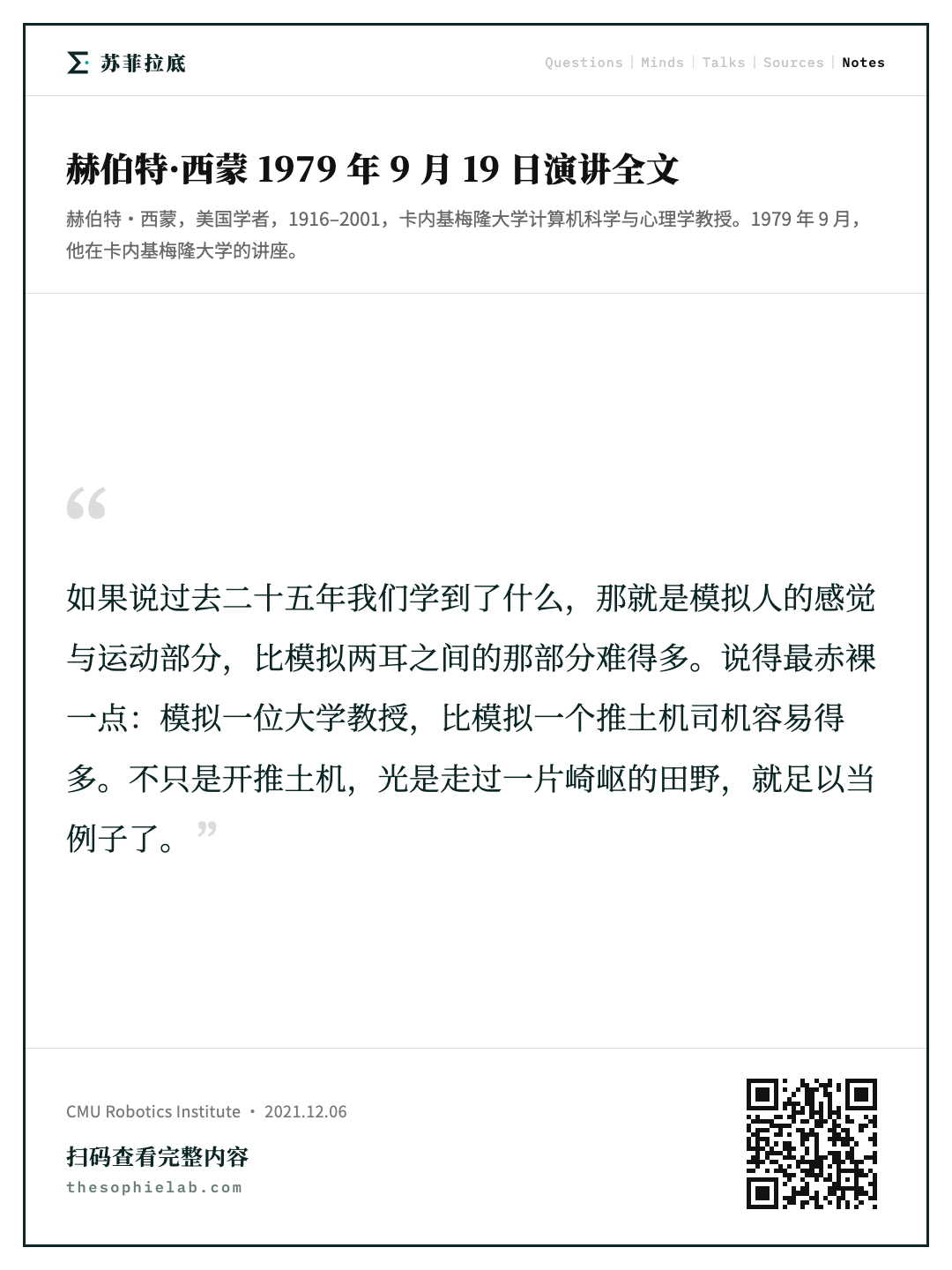
赫伯特·西蒙美国学者,1916–2001,卡内基梅隆大学计算机科学与心理学教授,人工智能与认知科学的奠基人之一,与纽厄尔合写了「逻辑理论家」与「通用问题求解器」。1975 年获图灵奖,1978 年因「有限理性」与组织决策研究获诺贝尔经济学奖。
章节 · 点击跳转视频
0:06 开场与研讨会定位 ▶ 正在看
2:00 AI 与认知心理学互相依存 ▶ 正在看
5:20 AI 已知什么:搜索、记忆与语言 ▶ 正在看
10:50 语义丰富领域的未解难题 ▶ 正在看
15:05 知识输入的负担与机器学习 ▶ 正在看
18:46 机器人学:感知运动难于思维 ▶ 正在看
24:29 专家与新手:出声思考研究法 ▶ 正在看
30:35 正向推进为何是专家策略 ▶ 正在看
37:39 精简的物理学与教科书的缺失 ▶ 正在看
44:00 直觉即识别:拆解「物理直觉」 ▶ 正在看
51:54 物理表征:诺瓦克的图式程序 ▶ 正在看
58:48 木板难题:三类被试的间接证据 ▶ 正在看
本期论点
本期回应
34:19
教学传统推崇的逆向推理并非专家策略,专家解这类问题用的是正向推进 要有规律可学的积累直觉可以当作判断的依据吗?
47:27
专家的直觉本质上是识别:线索经索引触发记忆,快速取出相关信息 要有规律可学的积累直觉可以当作判断的依据吗?
53:29
擅长解物理题的人拥有与待解方程组并不同构的物理情境表征方式 要有规律可学的积累直觉可以当作判断的依据吗?
4:00
要让计算机做聪明的事,一个好办法是先弄清人类是怎么做的 该照着人造机器该不该照着人来?
27:37
认知建模的目标不是让计算机尽可能聪明,而是复现人类实际使用的那类过程 该照着人造机器该不该照着人来?
8:11
用「系统能否跑起来」检验人工智能知识具有欺骗性,它未必带来可迁移的知识 看它怎么错怎么判断机器是不是真会一件事?
16:29
以为能用自然语言与计算机对话它就会因此变得有智慧,这是一种幻觉 还差得远机器能真的理解吗?
41:20
教科书擅长讲清楚规则本身,却几乎从不明说什么时候该用哪条规则 教不出来出色的本事从哪里来?
其他论点
4:58
最成功的人工智能系统内部都嵌有某种形式的启发式搜索
11:21
就现有象棋程序的构造方式而言,国际象棋是语义丰富领域而非语义贫乏领域
12:38
层层嵌套、分层封闭的子程序式编程结构,写不出响应环境变化的灵活开放程序
17:52
阅读的效果更多取决于重组信息与建立访问路径的策略,而非单位时间翻过的页数
20:38
模拟人的感觉与运动能力,比模拟人的思维能力困难得多
38:30
物理学看似内容庞杂,实际是非常精简的领域,一章书能提取的信息量相当有限
43:32
人的智力差异有一面在于能否自己找出并补上产生式的条件端
01开场与研讨会定位
0:06
Now they are, okay. We'll get My watch says 29. Anybody have another time? What Add them all up and average them. 27?
现在有了,好。我们来看看——我的表显示29分。还有人有别的时间吗?把它们全加起来求个平均吧。27分?
便签引用
0:37
Uh if I don't shake it, sometimes it doesn't go at all and that could be the addition to theory and practice of scheduling. The first disaster that happened to me today is that I And it's all my own fault. I scheduled myself for four separate uh sessions of one kind or another, which I think is the most teaching I've done in one day since World War II. And secondly, there seems to be a certain indeterminacy about the local scheduling system that made it fluctuate between 3:00 and 3:30. Anyway, here we all are and it's 3:30 and we all think that's the time to begin, so I will.
呃,要是我不晃一晃,它有时候干脆就不走了,这大概可以算作调度理论与实践的一点补充。调度。我今天遇到的第一个灾难是,我——而且全是我自己的错。我给自己安排了四场呃各式各样的活动,我觉得这是二战以来我在一天里讲得最多的一次。其次呢,本地的日程安排系统似乎有某种不确定性,让开始时间在3点和3点半之间来回摇摆。总之,大家都到齐了,现在是3点半,我们都认为该开始了,那我就开始。
便签引用
1:11
Uh I think a major function of these sessions is for faculty members to talk about their current research uh what kinds of things they are up to so you can get some acquaintance with the range of research that goes on in this institution. As uh most of you know, I spend a good part of my life over in the psychology department. Practically mo- most of my life in the psychology department since my secretary is there. Um and I have an office over here that I can hide out of. And on the 27th, which I guess is a week from today, uh we're going to have another session uh which John Anderson is uh taking charge of, also from psychology, also a joint member of both departments.
呃,我觉得这类活动的一个主要作用,是让教师们讲讲自己当前的研究,呃,他们在忙些什么,这样你们就能对本校所做研究的范围有个大致的了解。呃,你们大多数人都知道,我人生的很大一部分时间是在心理系那边度过的。基本上我——我大部分时间都在心理系,因为我的秘书在那儿。嗯,我在这边也有间办公室,可以躲进去。还有27号,我想就是一周后的今天吧,呃,我们还会有一场活动,由John Anderson,呃,负责主持,他也来自心理系,也是两个系的双聘成员。
便签引用
02AI 与认知心理学互相依存
2:00
And I see You're right. I knew that, too. Right. Yeah, okay. On the 5th of October. Another session that uh John Anderson will chair. I think the presence of these two sessions on the program uh illustrates what we think around here about the relation between artificial intelligence on the one hand uh and modern psychology, modern cognitive psychology on the other hand. Uh we think that they can't really live very well without each other. And there seem to be increasing number of other people who share that view uh to the point that uh there has even been formed a uh society of cognitive science. What's its official name?
我看到——你说得对。这我也知道。对。嗯,好。10月5号。还有一场活动,呃,也由John Anderson主持。我觉得日程上出现这两场活动,呃,正说明了我们这里怎么看待人工智能这一边,呃,和现代心理学、现代认知心理学那一边之间的关系。呃,我们认为这两者缺了对方都活不太好。而且似乎有越来越多的人认同这个看法,呃,以至于,呃,甚至成立了一个,呃,认知科学学会。它的正式名称是什么来着?
便签引用
2:50
Do you know? Cognitive Science Society. That was pretty close. Uh which uh bundles up uh in its uh boundaries uh AI types, uh cognitive psychologists, psycholinguists, few stray physiologists, I guess, neurophysiologists. Um some philosophers and think right and so on. It's not quite clear whether that society will do all the things that an artificial intelligence society needs to do and I gather that's still up for grabs. All right. But at any rate, there's a long history now, a 25-year history, uh of very close relation uh between AI and cognitive simulation. That is to say, between people who are interested in getting computers to do smart things, which is the way I would define AI, and people are who are interested in finding out how human beings do smart and sometimes dumb things, uh which I would define as the task of cognitive psychology.
你知道吗?认知科学学会(Cognitive Science Society)。我刚才说得挺接近了。呃,这个学会把,呃,在它的范围内囊括了,呃,搞AI的人、呃,认知心理学家、心理语言学家,还有零星几位生理学家,我想是神经生理学家。嗯,还有一些哲学家,以及,对,等等。目前还不太清楚,那个学会会不会去做一个人工智能学会该做的所有事情,我想这个还悬而未决。这一点还有待观察。好的。但不管怎么说,如今已经有很长的历史了,25 年的历史,呃,人工智能和认知模拟之间关系非常密切。也就是说,一边是那些有兴趣让计算机做聪明事情的人,我会把这定义为人工智能;另一边是那些有兴趣搞清楚人类如何做聪明事、有时又做蠢事的人,呃,我会把这定义为认知心理学的任务。
便签引用
3:55
And it's just turned out that some of the time at least, not always, some of the time when you want to get a computer to do smart things, it's a good idea to first find out how human beings do those things and see if there are any ideas you can borrow. And similarly, some of the time when you want to figure out how human beings do smart things, it's useful to look around and see if there are any computers doing those kinds of things and see whether the computers are doing them in peculiarly computer-like ways or whether some of the ideas uh used in the computer programs are related to the way in which human beings do those things.
结果发现,至少有些时候——并不总是如此——有些时候,当你想让计算机做些聪明的事情时,一个好办法是先弄清楚人类是怎么做这些事情的,看看有没有什么想法可以借鉴。同样地,有些时候,当你想弄明白人类是怎么做聪明的事情时,四处看看会很有帮助,看看有没有哪些计算机在做类似的事情,再看看计算机是不是在用一种特别「计算机式」的方式来做,或者说计算机程序里用到的某些想法,是不是跟人类做这些事情的方式有关联。
便签引用
4:34
And so we've had the development, for example, of of a theory of uh heuristic search, which has to do with how intelligent systems find rare objects in large spaces without looking interminably. And this theory of heuristic search appears to be both highly relevant to artificial intelligence systems and most successful artificial intelligence systems uh have embedded in them heuristic search of one sort or another. But it's also turned out to be highly relevant to psychology because it turns out that uh human beings often find themselves in enormous problem-solving spaces and the only way they ever get to the other side of the field is by some kind of highly selective heuristic search.
于是我们就有了一些发展,比如说,启发式搜索的理论,这与智能系统如何在庞大的空间中找到稀有目标、而又不至于无休止地搜索下去有关。而这套启发式搜索理论,似乎既与人工智能系统高度相关——最成功的人工智能系统里头都内嵌了某种形式的启发式搜索。但它同时也被证明与心理学高度相关,因为事实证明,人类常常发现自己身处极其庞大的问题空间中,而他们能走到问题的另一头,唯一的办法就是靠某种高度选择性的启发式搜索。
便签引用
03AI 已知什么:搜索、记忆与语言
5:20
So here's an example where the two fields have had good reason to stay together. In deciding what one should be researching about at any given point of time, and of course changes from time to time, I guess a good question to ask is what are the big open research questions? Well, some people would be inclined to ask about artificial intelligence, what are the closed questions? What uh what if anything do we know? I think we know a great deal. Um I think we do a lot of bad-mouthing of ourselves in artificial intelligence.
所以这就是一个例子,说明这两个领域有充分的理由继续走在一起。在决定某个时间点上应该研究什么的时候——当然这会随时间变化——我想有个不错的问题可以问:有哪些重大的、尚未解决的研究问题?嗯,有些人可能更愿意反过来问人工智能:哪些问题是已经解决的?我们究竟知道些什么?我认为我们知道的相当多。嗯,我觉得我们在人工智能领域里没少自我贬低。
便签引用
5:57
It's not so bad as it was about 5 years ago, but we still are a little too modest about what we do. Some people in the field are modest about what they do. Um I think we know a great deal about how problem-solving can be done in domains uh where there isn't a large amount, there isn't an enormous amount of task- specific information that has to be handled and processed. Uh that's the domain of puzzle-like problems, for example. I think we know an awful lot about solution of solving puzzle-like problems, not that we always do it well, uh but in the sense that I think we have uh a good structure of theory uh about it, uh part of which you can find in a book like uh Nilsson's uh textbook. It's a little old now, but others coming along.
情况没有五年前那么糟了,但我们对自己做出的成果还是有点过于谦虚。这个领域里有些人对自己做的事情很谦虚。嗯,我认为关于问题求解如何进行,我们已经知道得相当多了——在那些不需要处理和消化大量任务专属信息的领域里。呃,比如说,那属于谜题类问题的领域。我认为关于如何求解谜题类问题,我们已经知道了非常多的东西,倒不是说我们总能做得很好,呃,而是说我认为我们已经有了一套不错的理论框架,呃,关于它的理论,其中一部分你可以在像尼尔森(Nilsson)的教科书那样的书里找到。那本书现在有点旧了,不过还有别的书陆续出来。
便签引用
6:55
You can find a body of theory. In what sense a body of theory? Well, there aren't very many theorems. And that makes mathematicians sometimes unhappy because mathematicians somehow are confused those two words. They are spelled almost alike, but uh theories aren't necessarily theorems. There are awful lot of theories around the world of empirical phenomena that are formalized to varying degrees of of formality. And I think one would have to say that that the theory of problem-solving in information-sparse domains is not highly formalized in that sense. We've got a a few theorems about search algorithms.
你能在里面找到一套理论体系。所谓一套理论体系,是在什么意义上说的呢?嗯,其实里面并没有多少定理。这有时候会让数学家们不太高兴,因为数学家不知怎的常常把这两个词搞混。这两个词拼写几乎一样,但是呢,理论(theories)未必就是定理(theorems)。在经验现象的世界里,存在着大量的理论,它们被形式化的程度各不相同。而我想我们不得不承认,在信息稀疏领域中的问题求解理论,在那个意义上并不是高度形式化的。我们确实有那么几条关于搜索算法的定理。
便签引用
7:34
There are some things called A* and B* best-first algorithms. Um and we know a few things about them and we can even prove a few things about them. But I think the heart of the progress and the heart of our knowledge uh does not reside in those theorems, however useful they may be. The heart of our knowledge resides in the fact that we know enough about the nature of problem-solving and intelligence in these domains that we can actually build systems that sometimes solve problems. And by and large, that tends to be the the test uh of our knowledge in the field of artificial intelligence. Now that can be um a deceptive test sometimes because uh we would like knowledge that can be transferred to new problems.
有一些东西叫做 A*、B* 这样的最佳优先算法。嗯,我们对它们了解一些,我们甚至能证明关于它们的一些结论。但我认为,进展的核心、我们知识的核心,呃,并不在那些定理里面,不管它们多么有用。我们知识的核心在于:我们对这些领域中问题求解和智能的本质了解得足够多,以至于我们真的能造出有时候能解决问题的系统。而总体来说,这往往就是我们在人工智能这个领域里检验知识的方式。不过这有时候嗯,可能是一种带有欺骗性的检验,因为呃,我们想要的是能够迁移到新问题上的知识。
便签引用
8:21
And there's always a danger, unless we pay particular attention to the issue, there's always a danger that we'll build this system, we'll build that system, we'll build the other system, and each one will run. And when we build the fourth system, we'll have to learn all over again what it is that makes a system run. Well, I don't think we're quite as badly off as that anymore. I don't think anybody who builds a new system now for solving problems will do so without being aware of and trying to make use of the fact that there is something called best-first search or there is something called means-ends analysis uh or that if life gets very difficult, you can always fall back on generate and test to see whether that will do anything for you. We have at least a taxonomy of problem-solving methods. We know how any one of you, I trust, uh maybe I ought to wait a week before saying this.
而且总是存在一种危险——除非我们特别留意这个问题——总是存在这样的危险:我们造了这个系统,又造了那个系统,再造了另一个系统,每一个都能跑起来。而当我们造第四个系统的时候,我们还得从头再学一遍:到底是什么让一个系统跑得起来。嗯,我觉得我们现在已经不至于糟糕到那个地步了。我不认为今天还有谁在造一个新的问题求解系统时,会不知道、也不试图去利用这样一些事实:有一种东西叫最佳优先搜索,有一种东西叫手段—目的分析,呃,或者说,如果日子实在难过,你总还可以退回到生成与测试,看看它能不能帮上你什么忙。我们至少有了一套问题求解方法的分类学。我们知道——我相信你们中任何一位——呃,也许我该等一个星期再说这句话。
便签引用
9:08
Uh any one of you could go out and build a system that had some form of means-ends analysis embedded in it and so on, or if you couldn't, you will by the end of this semester. So we have that uh uh we we do know something about that. Uh we also know something about the range of alternatives that are open to us with respect to memory organization and with respect to languages. Uh you can organize memory in any way you want, but if you're writing an artificial intelligence program, it'll always turn out to be some kind of a list structure memory, uh alias a semantic network, uh alias a directed graph, uh there are about 16 different names for what is basically the same idea, an idea that's been around for a very long time. And we've learned that uh that uh if you're trying to organize a memory for a system that's going to have to behave under all sorts of unexpected circumstances, unexpected to it, uh and it's going to have to store away all sorts of information where it can't predict in advance what kinds of
呃,你们中任何一位都可以出去造一个内嵌了某种形式的手段—目的分析之类东西的系统;就算现在还不会,到这个学期结束的时候你也会了。所以我们有这些,呃,我们确实对那方面知道一些东西。呃,我们对于在记忆组织方面、以及在语言方面向我们敞开的各种可选方案,也知道一些东西。呃,你想怎么组织记忆都行,但如果你在写一个人工智能程序,最后它多半会变成某种表结构的记忆,呃,别名叫语义网络,呃,别名叫有向图,呃,同一个基本想法大概有十六种不同的名字,而这个想法已经存在很久很久了。而且我们已经明白了,呃,如果你要为一个系统组织记忆,而这个系统必须在各种各样它意想不到的情形下运作,呃,而且它还得把各种各样的信息存起来,却又无法事先预知自己将要存储什么类型的信息,那你最后很可能就会得到这样一种
便签引用
10:16
information it's going to store, you're probably going to end up with a memory like that. And correspondingly, I think we've learned about languages uh that uh uh uh we want some combination of uh a list processing language and a production system language. I'm not suggesting these are mutually exclusive, which they are not, uh but uh uh these are two of the central ideas that have emerged from artificial intelligence research. I don't know. Should be careful. Production systems, of course, didn't come out of artificial intelligence research. List languages did.
记忆结构。相应地,我认为在语言方面我们也学到了,呃,我们想要的是某种表处理语言和产生式系统语言的结合。我并不是在暗示这两者互相排斥,它们并不排斥,呃,但这是从人工智能研究中浮现出来的两个核心思想。我不知道。应该小心一点。产生式系统当然不是从人工智能研究里出来的。表处理语言才是。
便签引用
04语义丰富领域的未解难题
10:50
Uh but they're two of the central ideas that everybody knows who's going to build an artificial intelligence uh intelligence system. When we move to problem solving in domains where there's much more information to be processed, uh semantically rich domains, uh standard example, the medical diagnosis problem. Um We could talk a long time about about chess, whether it belongs in this category or the previous one, but I think chess is probably best regarded as being a semantic rich domain today in the way in which we go about building programs for that.
呃,但它们是两个核心思想,任何一个要造人工智能系统的人都知道它们。当我们转向那些需要处理的信息多得多的领域中的问题求解时,呃,也就是语义丰富的领域,呃,标准的例子就是医学诊断问题。嗯,关于国际象棋我们可以谈很久,它到底属于这一类还是前一类;但我认为,就我们今天构造象棋程序的方式而言,象棋大概最好被看作是一个语义丰富的领域。
便签引用
11:30
Uh then we get into another set of problems uh that we have learned a good deal about, but still have much to learn about. One is, again, what are the ways of representing knowledge in a system? Um Do we model the system? Do we build a model of it so we can actually run the model and see how it uh would go? Uh do we put the information in as some sort of a relational network? Uh do we uh uh do we uh try to construct some sort of causal analysis of the relations among the pieces of knowledge in the system and build up some kind of a causal network as some of the diagnostic systems have?
呃,于是我们就进入了另一组问题,呃,我们对它们已经学到了不少,但还有很多要学。其中一个仍然是:在一个系统里表示知识有哪些方式?嗯,我们要不要给这个系统建模?我们要不要造一个模型,好让我们真的能跑这个模型,看看它呃会怎么演变?呃,我们要不要把信息以某种关系网络的形式放进去?呃,我们要不要,呃,试着对系统中各块知识之间的关系做某种因果分析,然后像某些诊断系统那样,构建起某种因果网络?
便签引用
12:12
Uh or what? We've had experience with at least a modest range of these representations, know something about where they're good and where where they aren't good, and what they can be uh used for. We know something, but not as much as we need to, about control structures. Uh we know that at least for simulating the kinds of things human beings can do in rich domains, that the control structure of of uh pyramided hierarchical closed subroutines, the traditional programming format, uh tends to be a little bit inflexible. Not that they you can't do anything that can be done uh with such uh structures. We're not arguing the Turing machine argument, but that uh it turns out in fact to be not very conducive to programs that are fairly flexible and open in responding to uh environments that are changing all the time.
呃,还是别的什么?我们对这些表示方式中至少一小部分有过经验,对它们在哪些地方好用、哪些地方不好用、能用来做什么,都知道一些。关于控制结构,我们知道一些,但还远不够我们所需要的。呃,我们知道,至少就模拟人在丰富领域中所能做的那类事情而言,那种呃层层嵌套的、分层的、封闭子程序式的控制结构,也就是传统的编程格式,呃,往往有点不够灵活。倒不是说用这种结构就做不成任何能做的事——我们不是在争论图灵机那套论证,而是说,呃,事实证明它并不太有利于写出那种相当灵活、开放的程序,来响应呃那些不断变化的环境。
便签引用
13:07
And so there's been at least a good college try over the past 5 years uh at using control structures associated with production systems. In the primitive production systems, those were very simple control structures. All you did was to line up all your instructions as a list of productions, and then you fired the first one that that waved its hand, that had its condition satisfied, and then the next one. Well, that didn't turn out to be completely satisfactory. And so now we have other ideas uh embedded, for example, in the OPS5 system, which uh you'll get acquainted with around here.
所以在过去五年里,呃,至少有过一番认真的尝试,去使用与产生式系统相关联的控制结构。在早期原始的产生式系统里,那些控制结构非常简单。你要做的就是把所有指令排成一张产生式的列表,然后触发第一个举手的、也就是条件被满足的那一条,接着是下一条。嗯,这后来证明并不完全令人满意。所以现在我们有了别的想法,呃,比如体现在 OPS5 系统里,这个系统你们在这儿会接触到。
便签引用
13:40
We have other ideas about uh what should determine the priority of productions firing in a production system. But still, systems that are freer and looser than the kind that we used to write with respect to how much of the control we impose consciously and deliberately at the moment we are programming them. Uh I'm sort of going down the list in the order of our ignorance, that is, most knowledge first and most ignorance last, as you can see, I think, from the uh Uh in semantically rich domains, we very frequently want to be able, for a variety of reasons, to communicate with human beings in natural language.
关于在产生式系统中应该由什么来决定产生式触发的优先级,我们有了别的想法。但这些系统仍然比我们过去写的那类系统更自由、更松散——就我们在编程当下有意识地、刻意地强加多少控制而言。呃,我大致是按我们无知的程度往下排列的,也就是说,知道得最多的放最前面,最无知的放最后,我想你们从呃……呃,在语义丰富的领域里,我们经常出于种种原因,希望能够用自然语言和人交流。
便签引用
14:20
Sometimes we want to communicate orally, and that's what Hear'Say and HARPY were all about. But even if we want to communicate in writing, we want to communicate in natural language. And there are all sorts of systems around which will handle various uh little chunks of natural language. I don't think anybody at the moment is claiming to have a system around which just handles free English as it's coming out of me now, for example. Uh that still seems to be a [clears throat] little bit beyond the state of the art, and for that reason, natural language understanding uh remains a uh very active and a very productive area of uh research. The kinds of parsers that I see around each year are a little better than the ones last year. That's still true, Mark?
有时候我们希望用口头交流,Hear'Say 和 HARPY 讲的就是这件事。但即使我们只想用书面方式交流,我们也希望用自然语言来交流。现在到处都有各种各样的系统,能处理呃自然语言的各种小片段。我认为目前还没有人敢说自己有一个系统,能直接处理像我现在这样脱口而出的自由英语。呃,那似乎仍然〔清嗓子〕稍微超出了现有技术水平,也正因为如此,自然语言理解,呃,仍然是一个非常活跃、非常有产出的研究领域。我每年看到的那类句法分析器,都比去年的稍微好一点。这话现在还成立吗,Mark?
便签引用
05知识输入的负担与机器学习
15:05
Oh, it isn't your problem so much as the I don't see Kosiar around here. Um but they aren't all that we want, but uh but they are coming along. Now getting to still more uh open problems, uh we feel very heavily, I think, in artificial intelligence, the burden of transferring human knowledge into the computer. I'm not sure that our reaction here is at all justified. After all, if we look at the process of transferring human knowledge into human beings, that's really not one of the more efficient processes that exist. I won't ask all of you how many years you've been going to school.
哦,这与其说是你的问题,不如说是……我在这儿没看到 Kosiar。嗯,它们还达不到我们想要的水平,但是呃,它们在往前走。现在说到更加悬而未决的问题,呃,我想在人工智能里,我们非常沉重地感受到把人类知识转移到计算机里的负担。我不太确定我们在这件事上的反应是不是站得住脚。毕竟,如果我们看看把人类知识转移到人身上的那个过程,那真算不上是现存的更高效的过程之一。我不会问你们各位上了多少年学。
便签引用
15:50
Uh but you know, it's been a long, long process. I wonder whether there's any computer which has been in intake mode for as many hours as you've sat just sat in lectures or read books in the course of your lives. So maybe we're we're uh unrealistic when we think that somehow or other there should be a painless way of getting information into computers in order to turn them, say, into good medical diagnosticians or something like that. And we may be kidding ourselves even more in thinking that if there is a more painless way, a less painful way, that that way is to use natural language.
呃,但你们知道,那是个很长很长的过程。我怀疑有没有哪台计算机,在它的输入模式下待过的小时数,能比得上你们一辈子坐在课堂上、或者读书所花的时间。所以,也许我们是有点呃不切实际——我们总以为不知怎么就该有一种毫不费力的办法,能把信息灌进计算机里,好让它们变成,比方说,优秀的医学诊断专家之类的东西。而如果我们认为,就算真有一种更省力、更不痛苦的办法,那办法就是使用自然语言——那我们可能是在更进一步地自欺欺人。
便签引用
16:29
That may be a snare and a delusion, the idea that if we could just talk to the computer the way I'm talking to you, suddenly it would become a wise computer. I'm sure you will become wise, but I'm not sure about computer. Um Nevertheless, there is a strong feeling in the artificial intelligence community that we [clears throat] ought to be able to talk to our computers. And that seems to me as good a reason as any for uh continuing a good pace of natural language uh understanding research. Sorry, I I I intended to make an additional point of that. Not on natural language understanding research, but research on how the computer can learn in some of the senses in which human beings learn.
那也许是个圈套和幻觉:以为只要我们能像我现在跟你们说话这样跟计算机说话,它就会突然变成一台有智慧的计算机。我相信你们会变得有智慧,但我对计算机没那么有把握。嗯,尽管如此,人工智能界还是有一种强烈的感觉,觉得我们〔清嗓子〕应该能够跟我们的计算机说话。在我看来,这和别的理由一样,都足以成为呃继续大力推进自然语言理解研究的理由。抱歉,我我我本来是想借此再提一点。不是关于自然语言理解的研究,而是关于计算机如何在人类学习的某些意义上进行学习的研究。
便签引用
17:20
Because uh when you read a textbook, I hope, you don't just uh take in the sentences and parse them and store them. That'd be a terrible thing to do. Uh known students who did that, well, most of them flunked out of Carnegie Mellon. Uh there's some other process going on. There's some other more effective mode of storage. At the time that you're storing information from what you're reading, you are also storing various kinds of uh of access routes to that information. And in fact, the effectiveness of your reading depends much more on the strategies you have for reorganizing information as you read, and for storing access routes, than it does on how many pages an hour you can turn over uh and glance at.
因为呃,当你读一本教科书的时候,我希望,你不是只把那些句子接收进来、做个句法分析、然后存起来。那样做就太糟糕了。呃,我认识这么做的学生,嗯,他们大多数都从卡内基梅隆退学了。呃,还有别的过程在发生。还有另一种更有效的存储方式。在你把读到的内容存进去的同时,你也在存储通向这些信息的各种呃访问路径。事实上,你阅读的效果,更多地取决于你在读的过程中重新组织信息的策略,以及存储访问路径的策略,而不是取决于你一小时能翻过、扫过多少页。
便签引用
18:09
So not only would we like to be able to communicate with the computer by natural language, uh but it'd be very nice if the computer, when natural language were presented to it like a textbook, if the computer would do some of the intelligent intelligent processing that a clever person does, uh and would store that information, not just as something that could be spewed out at wrote by rote, but would store that information uh in such a way that it could use it then to solve problems and and deal with various contingencies. So learning seems to me to be a very uh important uh topic.
所以我们不仅希望能够用自然语言和计算机交流,呃,而且如果当自然语言像教科书那样呈现给计算机时,计算机能做一些聪明人所做的那种智能处理,那就非常好了;呃,并且能把那些信息存起来——不是存成可以死记硬背地照搬吐出来的东西,而是以一种它随后能用来解决问题、应对各种意外情况的方式存起来。所以在我看来,学习是一个非常呃重要的课题。
便签引用
06机器人学:感知运动难于思维
18:46
[clears throat] And I'm going to say more about that, because that's one of the areas in which I and others in the psychology department are currently engaged in in research that I think is also relevant to AI. Uh finally, uh computers are of the past have been sensorially deprived in a variety of ways. They really had very little uh interface with the outside world, if you come to think of it. They don't have eyes, don't have ears, and in a real sense, they have a teletype, but they're a typewriter, but that's not really a substitute for eyes and ears.
〔清嗓子〕关于这一点我还会多说一些,因为这正是我和心理学系的其他人目前正在从事研究的领域之一,我认为这些研究对人工智能也是有意义的。呃,最后,呃,过去的计算机在各种意义上都是感官被剥夺的。它们真的几乎没有什么呃跟外部世界打交道,你要是仔细想想的话。它们没有眼睛,没有耳朵,而且从真正的意义上说,它们有一台电传打字机,也就是一台打字机,但那并不能真正代替眼睛和耳朵。
便签引用
19:22
Uh and uh they can't act on the world. They don't have motor organs. All they can do is to tell you what to do. They can't do it themselves, typically. Now a whole new spate of problems arises when you try to build a computing system that will really interact with the world, and that's what I understand the term robotry to be all about. Uh in my lexicon, a robot uh is a system which um uh which has some kind of sensory organs uh which has some kind of motor organs uh and which has enough brains in between those two so that it can perform intelligent acts that require hand-eye coordination or the equivalent of that coordination between the motor organs and the sensory organs.
呃,而且呃,它们没法对这个世界采取行动。它们没有运动器官。它们能做的只是告诉你该怎么做。它们自己做不了,一般来说是这样。那么,当你试图造出一个真正能与这个世界互动的计算系统时,一大批全新的问题就冒出来了,而这正是我所理解的“机器人学”这个词所指的东西。呃,在我的词汇里,机器人呃是这样一个系统,嗯呃,它有某种感觉器官,呃有某种运动器官,呃而且在这两者之间有足够的脑子,使它能完成需要手眼协调、或者说需要运动器官和感觉器官之间那种等价协调的智能行为。
便签引用
20:11
Uh and uh I mention that as a separate topic because I think that there are some branches of research that are involved in robotry which really don't come up in any salient form at least uh in other aspects of artificial intelligence research. Uh the first is that you really have to face up to the problem of building sensory organs uh and motor organs that will meet certain task demands. And if there's anything we've learned in the last 25 years, it's that that it's a good deal harder to simulate the sensory and motor parts of a human being than it is uh what's between the ears. Put in its most uh uh in its starkest form, it's much easier to simulate a college professor than a bulldozer driver.
呃,我把它作为一个单独的话题提出来,是因为我认为机器人学里有一些研究分支,这些东西在人工智能研究的其他方面至少不会以那么突出的形式出现。呃,第一点是,你必须真正面对一个问题:造出能满足特定任务要求的感觉器官和运动器官。如果说过去二十五年我们学到了什么,那就是:模拟一个人的感觉和运动部分,要比模拟他两耳之间的东西难得多。用最直白的说法就是,模拟一个大学教授,要比模拟一个推土机司机容易得多。
便签引用
20:58
Uh we've made much more progress on simulating thinking, problem solving, all those good things which I guess is what college professors do uh than we have in simulating this interaction with a rough environment, uh sensing that environment, and controlling some sort of a device. Not only a bulldozer driver, just walking across to rough field uh would be a good enough example. I could give you all sorts of rationalizations why that's so, but that isn't very important in the present context. What's important I think is that it is so and that therefore uh robotry offers some uh very challenging uh problems in artificial intelligence research. They are being addressed now in very limited ways in industrial settings.
呃,在模拟思维、问题求解,以及所有那些好东西——我想那大概就是大学教授干的事——方面,我们取得的进展要比模拟与粗糙环境的这种互动大得多,呃,也就是感知那个环境、控制某种装置。不光是推土机司机,就说走过一片崎岖的野地,也已经是个足够好的例子了。我可以给你们讲出各种各样的理由来解释为什么会这样,但在眼下这个语境里那并不太重要。我觉得重要的是,事实就是如此,因此呃机器人学在人工智能研究中提供了一些呃非常有挑战性的呃问题。现在人们已经在以非常有限的方式着手处理它们,在工业场景里。
便签引用
21:42
Industrial robots are a great rage at the moment and various people give us counts of how many there are in various countries in various months and the numbers are in the thousands by now. But a robot is still an industrial robot is still a very limited device um which has limited sensory powers and limited effectors and uh in which very little of the known techniques of artificial intelligence are typically used in making the connections between the sensors and the effectors. I think existing robots uh derive much more from the technology of uh feedback control systems, of servo mechanism systems, than they do of uh artificial intelligence technology. Now, maybe that's in the nature of the beast. Maybe that will always be so, but I doubt it.
工业机器人眼下非常热门,各种各样的人给我们统计在不同国家、不同月份到底有多少台,到现在数字已经是几千台了。但机器人——工业机器人——仍然是一种非常受限的装置,嗯,它的感知能力有限、执行机构也有限,呃而且在把传感器和执行器连起来的过程中,通常几乎用不上什么已知的人工智能技术。我认为现有的机器人呃更多地来自反馈控制系统、伺服机构系统的技术,而不是来自呃人工智能的技术。当然,也许这就是这类东西的本性。也许永远都会是这样,但我怀疑并非如此。
便签引用
22:33
I think a time will come when and the time is arriving when we will want robots to be sufficiently uh sufficiently uh uh bright so that they'll need something more than analog computers and and uh feedback controls in there as a substitute for brains when they'll really need to be able to do some sophisticated uh processing. Now, as some of you know, there's already of course been research in that direction which Stanford's uh uh regretted late uh Shakey was a very good early example. And Shakey didn't do great things, but at least it was a thoughtful uh it was a thoughtful system that always planned out where it was going before it was going. How many of you have seen at least a movie of Shakey?
我觉得会有那么一天——而且那一天正在到来——我们会希望机器人足够呃足够呃呃聪明,聪明到光靠模拟计算机和呃反馈控制来当脑子已经不够了,那时它们就真的需要能做一些相当复杂的呃处理。那么,你们有些人知道,其实这个方向上已经有了研究,斯坦福那台呃呃令人惋惜的、已经作古的呃 Shakey 就是一个很好的早期例子。Shakey 并没有做出什么了不起的事,但至少它是个有想法的呃系统,它总会在动身之前先规划好自己要去哪儿。你们有多少人至少看过 Shakey 的影片?
便签引用
23:16
Oh, not very many of you. Do we have a movie around that will be shown at sometime? Probably so. Um I don't know, maybe there's a more state-of-the-art system by now, but um There's a system at General Motors called the contact.
哦,没几个人啊。我们这儿有没有影片,找个时间能放一放的?大概是有的。嗯,我也不清楚,也许现在已经有更先进的系统了,不过嗯,通用汽车那边有个系统叫 the contact。
便签引用
23:37
Well, except for those remarks, I'm not going to say anything about robotry. I just wanted to to emphasize that the particular topics I'm going to be talking about in the next hour uh which are the things that most of my research energy is going into now uh are not necessarily the only exciting processes uh only exciting topics that uh are available for research in AI, although I think they're exciting topics or I wouldn't be doing them. Uh but there are other alternatives for people to whom these don't appeal.
好吧,除了这几句话之外,关于机器人学我就不多说了。我只是想强调,接下来这一个小时里我要讲的那些具体话题,呃也就是我现在把大部分研究精力投进去的东西,呃未必是唯一令人兴奋的过程,呃未必是人工智能研究中唯一令人兴奋的课题,尽管我确实觉得它们是令人兴奋的课题,不然我也不会去做。呃,但对那些不喜欢这些方向的人来说,还有别的选择。
便签引用
24:10
Well, let me Oh, by the way, uh I would welcome interruptions, comments, this and that. Questions even if they're not too hard. Uh how are we doing so far?
好,那我——哦,顺便说一句,呃我欢迎大家打断我、发表意见,诸如此类。提问也行,哪怕问题不算太难。呃,到目前为止我们讲得还行吧?
便签引用
07专家与新手:出声思考研究法
24:29
And I turn now to my interests, or not just my interests, but interests of various groups of people located mainly in psychology, but also with some outposts here in in computer science. Um One thing we would like to know in semantically rich domains, that is domains where you have to have a lot of knowledge in order to perform one of the things we'd like to know is what is the difference between an expert and a novice? Why is an expert expert and why is a novice a novice? And we now have a major project going on on expert and novice problem solving in physics.
现在我转到我的兴趣所在——也不只是我一个人的兴趣,而是好几拨人的兴趣,他们主要待在心理学界,不过在这边的计算机科学里也有一些前哨。嗯,在语义丰富的领域里——也就是那种你必须掌握大量知识才能有所作为的领域——我们想知道的一件事是,我们想弄清楚的一件事是:专家和新手之间的差别到底是什么?为什么专家之所以是专家,新手之所以是新手?我们现在正在做一个大项目,研究物理学中专家和新手的问题求解。
便签引用
25:10
Um we're not going to try to find the glue on, but we're operating in the more temperate levels of uh college first-year college physics or even advanced high school physics, something like that. The people involved uh uh in this um are John McDermott, uh Jill Larkin, my wife and I plus various other associated people. And this field will illustrate uh one of the typical ways, not the only way, but one of the typical ways in which people are going about exploring human cognitive processes these days.
嗯,我们不打算去啃那些最尖端的东西,而是在比较温和的层次上做,也就是大学一年级的物理,或者高中的高级物理课程之类的。呃呃参与这个项目的嗯有 John McDermott,呃 Jill Larkin,我太太和我,还有其他各种相关的人。这个领域可以说明呃一种典型做法——不是唯一的做法,但是当下人们探索人类认知过程时的一种典型做法。
便签引用
25:53
Uh it's a very simple strategy, but it seems to work to some degree at least. The strategy is you first capture some novices and some experts and you set them to work solving some problems and you turn on a tape recorder while they're doing it uh and you got a Well, you ask them if they will please uh talk aloud while they're doing it. You are purposefully vague about what you mean about talking aloud because what you don't want is a subject uh a subject uh giving you a theory of his problem solving processes. That would be as undignified as a Geiger counter getting up at a meeting of the American Physical Association and making a speech.
嗯,这是个非常简单的策略,但至少看起来在某种程度上是管用的。这个策略是:你先找来一些新手和一些专家,让他们去解决一些问题,然后在他们做题的时候打开录音机,嗯,你还要——好吧,你请他们在做题的时候尽量把想法说出来。你要故意含糊其辞,不去说明「说出来」到底指什么,因为你不希望被试,呃,被试呃,给你讲一套他自己解题过程的理论。那就好比一台盖革计数器跑到美国物理学会的会议上去发表演讲一样不成体统。
便签引用
26:33
Uh You know, it's the psychologist's job to find out what the theory is of the phenomena. It's the subject's job to simply do the task in front of him, to solve the problem in front of him. But most people when they're solving problems can talk. Some of us even when we're by ourselves while we're solving problems do talk. Uh we're sometimes a little shy about doing it when others are present. But most of us can talk a good deal and you get a great deal of information uh about the processes that people are using and particularly about the stages they go through on the way to solving a complex problem. Now, I'll come back a little later and talk about the nature of that evidence.
呃,你知道,弄清楚现象背后的理论是心理学家的事。被试的事就是老老实实做眼前的任务,解决眼前的问题。但大多数人在解决问题的时候是能一边说话的。我们中有些人哪怕独自一人解题时也会自言自语。呃,有别人在场的时候我们有时会有点不好意思。但我们大多数人都能说上不少,而你就能获得大量信息,呃,关于人们正在使用什么样的过程,尤其是关于他们在解决一个复杂问题的路上会经过哪些阶段。稍后我会回过头来谈谈这类证据的性质,
便签引用
27:13
Um and how you use that evidence. But for the moment, let's just say that the data we have is a thinking-aloud protocol of some people who've been solving some problems. Some of these are novices and some of them are experts. At the same time, we try to write uh one or several computer programs that are also capable of solving those problems. Uh not trying to make the computer as clever as possible but trying to as nearly as we can tell uh make use making use of the uh trying to make use uh of the kinds of processes that we think our novice and expert uh subjects uh are using. Let me give an illustration to make all of this more concrete.
嗯,以及怎么使用这类证据。但眼下,我们就先说,我们拿到的数据是一份出声思考的口语报告,来自一些解过一些问题的人。其中有些是新手,有些是专家。与此同时,我们试着编写,呃,一个或几个同样能解决这些问题的计算机程序。呃,我们并不想把计算机做得尽可能聪明,而是尽我们所能地去使用——去利用那些,呃,我们认为我们的新手和专家被试,呃,正在使用的那类过程。让我举个例子,把这些都说得更具体一点。
便签引用
27:59
If I don't hang myself process. Uh we might have a problem that involves a falling body. Uh I'll talk mostly about kinematics problems. Uh we have a falling body. Uh a body uh I'll take the simplest sort of thing we could have. A body falls down a cliff 40 m high uh and uh the question is uh how long does it take? [clears throat] Well, uh fairly simple system will do that problem and in fact, we believe that our subjects have fairly simple systems for doing that uh doing a problem like that. Uh they have stored in memory uh a set of physics equations which represent the laws of kinematics.
但愿我别把自己绕进去。呃,我们可以拿一个涉及自由落体的问题来说。呃,我主要会讲运动学的问题。呃,我们有一个下落的物体。呃,一个物体——呃,我就取我们能想到的最简单的情形。一个物体从一处40 米高的悬崖上落下,呃,问题是,呃,它要落多久?(清嗓子)嗯,呃,一个相当简单的系统就能解决这个问题,而事实上,我们相信我们的被试也是用相当简单的系统来做这个——呃,来做这类问题的。呃,他们在记忆里存着,呃,一组表示运动学定律的物理公式。
便签引用
28:56
And actually, you only know need three or four cuz you can get by with three. Uh most textbooks will give you seven or eight by playing changes on the forms of the equation. Uh some I've never seen or never remembered ever having seen. Um but anyway, a very small number uh of uh equations. And now, all you have to do in order to solve that problem is to apply the appropriate ones of those equations in an appropriate order. Uh and that turns out to be very simple, too. Uh and that is uh that if you can find an equation which has n variables in it of which you already know the variable the values of n minus one then it wouldn't be a bad idea to solve that equation cuz then you can get the value one more variable.
实际上,你只需要三四个,因为三个就够用了。呃,大多数教科书会给你七八个,无非是把方程的形式变来变去。呃,有些我从来没见过,或者说从来不记得自己见过。嗯,不管怎么说,方程的数量非常少。现在,要解决那个问题,你要做的就是按适当的顺序、把这些方程里合适的那几个用上。呃,而这一点其实也非常简单。呃,那就是,如果你能找到一个含有 n 个变量的方程,而其中 n 减 1 个变量的值你已经知道了那么去解这个方程就不失为一个好主意,因为这样你就能再得到一个变量的值。
便签引用
29:53
Um so, we could have an equation like s equals 1/2 at squared where a is a known constant. Uh and in this problem we know that we have uh s, that's the distance the thing's going to fall, and we know we want t, so the thing to do is to solve it. Well, I think you can all see uh how to build a a production system that will do things like that. All you do is to put in the conditions of your your [clears throat] productions, the names of variables whose values uh which appear in the equation in question.
嗯,比方说我们可以有一个方程,s 等于二分之一 a t 平方,其中 a 是已知常数。呃,在这个问题里我们知道 s,也就是那个东西下落的距离,而且我们知道我们要求的是 t,所以该做的事就是把它解出来。嗯,我想你们都能看出来,怎么构造一个产生式系统来做这类事情。你要做的就是在你的产生式的条件部分里,放进出现在相关方程中的那些变量的名字。
便签引用
08正向推进为何是专家策略
30:35
And the condition for executing the instruction the uh production might be something like uh if uh values are known for all but one of the va- variables, fire the production. In fact, that's pretty much the way our experts behave. And this is a well-known method of problem solving known as working forward. You take what you know and simply infer from it anything else you can infer until happy day you reach the point where you know the answer to your problem. Now, it needn't be so. In principle, it needn't be so. But it just turns out that with kinematics problems and a number of other domains we've looked at now, uh in such domains, it turns out that uh this scheme works just great. You solve problems in almost no time at all.
而执行这条指令、也就是这条产生式的条件,可能是类似这样的:如果这些变量里除了一个之外,其余的值都已知,那就激发这条产生式。事实上,我们的专家们基本上就是这么做的。这是一种众所周知的解题方法,叫做正向推理(working forward)。你拿你已知的东西,然后从中推出任何能推出来的东西,一直推下去,直到某个美好的时刻,你得出了你这个问题的答案。当然,本不必如此。原则上讲,本不必如此。但事实证明,在运动学问题以及我们目前考察过的其他一些领域里,呃,在这类领域中,事实证明这个方案效果好得很。你几乎不费什么时间就把问题解出来了。
便签引用
31:36
A system organically solves problems in all Uh you might ask, well, uh isn't that wouldn't it be better if it took account of what its goal was, what it was really was really trying to solve for, rather than just saying, "I'll solve any equation where I know the values of all the variables but one." Uh I simply report the fact that uh these domains are so small that uh after you solve two or at most three equations, you'll have the answer. And for the expert, this turns out to be more efficient than really thinking about what he's doing.
一个系统就这样自然而然地把问题都解出来了。呃,你可能会问,那么,呃,如果它考虑一下自己的目标是什么、它真正想求解的到底是什么,而不是只说“只要一个方程里除了一个变量之外其他值我都知道,我就去解它”,这样不是更好吗?呃,我只想陈述这样一个事实:这些领域太小了,呃,你解上两个、最多三个方程,答案就出来了。而对专家来说,事实证明这比真的去琢磨自己在做什么更有效率。
便签引用
32:11
Now, our novices do not behave this way. By novice, I mean somebody who can do algebra reasonably well uh and who has studied the chapter in which these equations occur. Uh the novice in fact behaves as though he or she had a production system with these same possible actions, the equations. Uh s equals average velocity times time. Terminal velocity equals acceleration times time so on. Where uh the chapter in the in the textbook only deals with constant accelerations, of course. So, things are kind of easy.
那么,我们的新手并不是这样做的。我说的新手,是指代数学得还不错、并且学过这些方程所在那一章的人。呃,新手实际上表现得就好像他或她拥有一个产生式系统,里面有着同样这些可能的动作,也就是这些方程。s 等于平均速度乘以时间。末速度等于加速度乘以时间,等等。教材里这一章当然只处理匀加速的情形。所以事情算是挺容易的。
便签引用
32:52
The novice looks at that problem and says, "What do I want to solve for? Well, I want to find t." Then, at least in some forms of the novice program, then looks for an equation with a t in it and tries to solve that equation. If there are other unknowns in the equation, those are put on the want list along with this original variable, and you look for other equations in which you might solve those. Now, this is also a well-known problem solving method uh known sometimes as working backwards, sometimes as means-ends analysis.
新手看到那道题会说:“我要求的是什么?嗯,我要求出 t。”然后,至少在新手程序的某些版本里,他会去找一个含 t 的方程,试着解那个方程。如果方程里还有别的未知量,就把它们和原来那个变量一起放进待求清单,然后再去找别的方程,看能不能把那些量解出来。这其实也是一种很有名的解题方法,有时叫逆向推进(working backwards),有时叫手段-目的分析(means-ends analysis)。
便签引用
33:37
You know what your goal is. You ask yourself, "Do I know anything that might help me to that goal?" You try to use that. You find you can't use it. So, you set up the goal of using it, and then you ask, "Is there anything that can help me get to that goal?" and so on. That's all that's involved in this uh in this simple system. Now, it's kind of interesting, I guess, at least I find it interesting. Uh it's kind of interesting that all our lives teachers have been telling us, I'm sure I've told students this, that uh the intelligent way to go about solving problems is to work backwards.
你知道自己的目标是什么。你问自己:“我知道什么东西能帮我达到那个目标吗?”你试着用它,却发现用不上。于是你就把“用上它”设成新的目标,然后再问:“有什么能帮我达到这个目标?”如此往复。这个简单系统里所涉及的就这么多。这挺有意思的,我想,至少我觉得挺有意思。有意思的地方在于,我们一辈子老师都在告诉我们——我肯定也这么跟学生说过——解决问题的聪明办法是从后往前推。
便签引用
34:09
Figure out what your goal is and then start setting up a a chain of events that will uh get you to that goal working backwards from that goal. And yet, we've now got very clear-cut evidence that that uh in these kinds of problem domains, working forward is the expert uh strategy. So, this kind of research can lead you to surprises, and I guess when we first found that, we were surprised. By now, we have a rationalization of it, and we can even qualify it a little bit. Rich? Probably. We don't quite know how to measure that efficiency at the moment. Uh often the working forward, you solve more equations.
先弄清楚你的目标是什么,然后开始搭起一连串能把你送到那个目标的环节,从那个目标一路往回倒推。然而现在我们有了非常明确的证据:在这类问题领域里,正向推进才是专家的策略。所以这类研究会带给你意外,我想我们最初发现的时候也很吃惊。到现在,我们对它有了一套解释,甚至还能稍加限定。Rich?大概是吧。我们眼下还不太清楚该怎么衡量那个效率。正向推进的时候,你往往要多解几个方程。
便签引用
34:50
You in fact solve an extra equation or two. But uh uh we don't know exactly how to measure the efficiency because we don't know at a detailed level what processes are the ones that are taking the time. So, uh don't know. There seems to be a certain efficiency in not having to think about what you're doing, and I don't have that represented in the models uh at present. Um cuz in this you do have to stash away on some kind of a push-down list or something equivalent. You have to stash away your subgoals and keep around subgoals. Whereas this thing, you don't worry about subgoals at all. You just do what comes naturally.
事实上你会多解一两个方程。但我们并不确切知道该怎么衡量效率,因为我们在细节层面上并不知道究竟是哪些过程真正在耗时间。所以,不知道。似乎不必去想自己在干什么,这本身就带来某种效率,而目前我在模型里还没有把这一点表示出来。因为在那种做法里,你确实得把东西存到某种下推表之类的地方。你得把子目标存起来,还得一直留着这些子目标。而另一种做法,你根本不用操心子目标,你只管顺其自然地往下做就行。
便签引用
35:34
Uh and that may be the source of the efficiency. Now, we do find we found this not in this domain, but in thermodynamics, we found experts doing the same thing, working forwards. But if you threw a extra hard problem at them, harder than they've been used to and were really gung ho for uh then they switched to working backwards mode. So, the working forward mode has something to do with being in a task domain where you feel a certain assurance that if you just gather information, which is what working forward is, you just gather information, you'll get the answer to your problem.
这也许就是效率的来源。我们确实发现——不是在这个领域,而是在热力学里——我们发现专家也在做同样的事,正向推进。但如果你扔给他们一道格外难的题,比他们习惯的、也比他们真正得心应手的更难,那他们就会切换到逆向推进的模式。所以正向推进这种模式,跟你身处一个让你有某种把握的任务领域有关——你觉得只要去收集信息,正向推进就是这么回事,你只管收集信息,就能得到问题的答案。
便签引用
36:13
Uh well, I mentioned this first as an illustration of what one looks at in this kind of psychological research. This particular example might have some interest uh in artificial intelligence because we have that same that same dichotomy presented to us in building problem solving programs of various kinds. Uh there was a time when uh I think, well, and maybe the time is not over, but I think AI problem solving programs were dominated by the idea of means-ends analysis and best-first search. Uh well, best-first search can be working forward, but means-ends analysis is certainly working backwards from a goal.
我先讲这个,是想举例说明这类心理学研究都在看些什么。这个具体的例子在人工智能里可能也有点意思,因为我们面对的正是同样的二分对立,它就出现在构建各种解题程序的过程中。曾经有那么一段时间——我想,也许这段时间还没过去——但我认为,AI 的解题程序当时被手段-目的分析和最佳优先搜索这两个想法主导着。最佳优先搜索可以是正向推进,但手段-目的分析肯定是从目标往回倒推。
便签引用
36:54
Uh and there is another viewpoint you can have. And that is that you solve problems by gathering information about the situation until the answer is obvious. And perhaps some of the more recent uh game-playing programs can be interpreted as as exhibiting this philosophy. Am I am I doing you any justice uh Hans? Uh now, I I don't think we know very much about where this kind of tactic works and where it it doesn't work, but it does suggest a uh a new way of looking or a different way at least. I don't think it's completely new. I think uh I know people have been looking this way some cases at least since 1971.
还有另一种看法。那就是:你靠不断收集关于当前局面的信息来解决问题,直到答案变得显而易见。也许最近一些下棋程序可以被解读为体现了这种理念。我这么说对你公道吗,Hans?现在,我不觉得我们很清楚这类做法在什么地方管用、在什么地方不管用,但它确实提示了一种新的看法,至少是一种不同的看法。我不觉得它是全新的。我知道有人这么看至少在某些情况下从 1971 年就开始了。
便签引用
09精简的物理学与教科书的缺失
37:39
But uh here's another way of looking at problem solving and may have some lessons that could feed back into uh AI research. Um it also is an illustration of the fact that uh in domains that are regarded as difficult for human beings. There aren't very many human beings who complain that college physics is too easy for them. Uh that in domains that are difficult for most human beings, uh you can build rather simple production systems uh that will perform those tasks expeditiously. Furthermore, uh I talked about this when I introduced it as a semantically rich domain.
但这是看待解题的另一种方式,也许有些心得可以反馈到 AI 研究里。这也说明了一点:在那些被认为对人类来说很难的领域里。抱怨大学物理对自己来说太简单的人可没几个。在那些对大多数人来说都很难的领域里,你却能造出相当简单的产生式系统,把这些任务麻利地完成。另外,我在介绍它的时候说过,这是一个语义丰富的领域。
便签引用
38:18
Uh there are a lot of things to know about physics. But if you actually analyze the the uh content of textbook chapters, uh it turns out that physics, and probably most other domains if you will play the same game, is a very lean domain. That uh well, there are a lot of topics in physics and lots of textbooks by the time you pile them up uh uh to the end of your doctoral degree. But nevertheless, if you just ask, "What do I learn in a semester?" or what do I learn in one week when I'm studying one chapter of a book, the answer is four or five things.
呃,物理学里要知道的东西有很多。但如果你真去分析教科书各章的内容,呃,结果会发现物理学——如果你对别的领域也玩同样的游戏,多半也是如此——是一个非常精简的领域。当然,物理学里的题目很多,教科书也很多,等你念到博士学位的时候,那些书能堆成一摞。但即便如此,如果你只是问:“我一个学期学到了什么?”或者,我花一周读完书里的一章,学到了什么,答案是四五样东西。
便签引用
38:58
Not four or five hundred things, but four or five things. I'll give you a dozen if you don't like four or five as a number. Uh a rather modest number uh of uh of things. And we've been doing this counting it. I don't know what a thing is exactly. We need we have some worries about what the units ought to be here. But um uh the amount of information to be gleaned from that chapter is not overwhelming. Another thing that comes apparent when you do this is that textbooks are very explicit about certain things and very coy about telling you about other things.
不是四五百样,就是四五样。如果你嫌四五这个数字太少,我可以让给你,说十来样。算个数字吧。呃,是相当有限的一些东西。我们一直在做这种清点。我也说不准“一样东西”到底是什么,我们对这里的计量单位该怎么定还有些顾虑。但是呃,从那一章里能提取出来的信息量,并没有多到压倒人。做这件事时还会看出另一点:教科书对某些事情讲得非常明白,对另一些事情却讲得非常含糊,躲躲闪闪。
便签引用
39:35
Very secretive almost about telling you about other things. Textbooks are great on telling you what the laws of nature are, but they tend to be very inexplicit in telling you when a particular law of nature will be useful for solving a problem. When to apply a particular rule. That's true not only physics textbooks, that's true of algebra textbooks. In the chapter in the algebra textbook in which you learn to uh solve a linear algebraic equation in one unknown by adding, subtracting, multiplying, or dividing both sides by the same number.
几乎可以说,它们对另一些事情是保密的。教科书很擅长告诉你自然定律是什么,但在告诉你某一条自然定律什么时候能用来解题这件事上,往往非常不明确。解一道题。也就是什么时候该用哪条规则。这不只是物理教科书如此,代数教科书也一样。代数书里有一章,教你怎么解一元一次方程——两边同加、同减、同乘或同除以一个数。
便签引用
40:09
In the chapter where you learn that, you learn those rules in the first half of the chapter. And then, you'll be given a couple of examples which actually solve an equation by applying those rules, but you will not find in any textbook that I know. I'd be pleased if somebody could produce an exception for me. Uh I You cannot find in any textbook that I know any explicit attention to how you know which of these rules to apply. Uh and I'll get back to that. But, you know, even as as uh simply heuristic as the one we've been given here that in order to decide which equation to apply, you better ask uh uh what givens you have and which equation you can solve. Even some advice like that is not usually given in the textbooks. People seem to acquire it sooner or later, but uh students are not without their complaints very frequently that they they know the rules, but they don't know when to apply them.
在教这个的那一章里,规则都放在前半章讲。然后会给你几个例题,实际用这些规则解出方程,但是你不会在我所知的任何一本教科书里找到——要是有谁能给我举出一个例外,我会很高兴。呃,在我所知的任何一本教科书里,你都找不到明确讲“你怎么知道该用这几条规则里的哪一条”。呃这一点我待会儿再说。不过你知道,哪怕像我们这里给出的那种简单启发式——要决定用哪个方程,你最好先问问自己手上有哪些已知量、哪个方程解得出来——连这样的建议,教科书里通常也不会给。人们似乎迟早都能自己摸索出来,但学生们常常抱怨,说他们知道规则,却不知道什么时候该用。
便签引用
41:07
And they don't understand why that isn't enough. And that's inadequate. Well, if they just study production systems a little bit, they'll see that what they've learned are the action sides of the production systems, but they haven't learned of the condition sides of the production systems. And that's typical of textbooks. Textbooks are strong on action sides and very weak on condition sides. Trust if one of you gets around to writing a textbook uh shortly that you will you'll see do something about remedying this.
而且他们不明白,为什么光知道规则还不够。这是不够的。其实他们只要稍微学一点产生式系统,就会明白:他们学到的是产生式系统的动作端,却没学到条件端。而这正是教科书的典型问题。教科书在动作端很强,在条件端非常弱。但愿你们当中要是有人不久之后去写教科书,能想想办法把这个毛病补上。
便签引用
41:33
Uh produce an ex- By the way, it's my impression I'm This is all anecdotal and horseback. It's my impression that there's one class of instructional books that are much better than anything else in this respect, and that is how-to books for physical skills, games, sports, and so on. That they pay more attention, the good ones do. They pay more attention to telling you what clues you should look for. Uh How do you know you're swinging the tennis racket right? Uh they're much better on this uh than uh most of the books on academic subjects.
呃,举个例——顺便说一句,这只是我的印象,全是道听途说和拍脑袋。我的印象是,有一类教学用书在这方面比其他任何书都好得多,那就是讲身体技能、游戏、体育之类的“如何做”的书。它们更注意这一点——好的那些是这样。它们更注意告诉你该留意哪些线索。呃,你怎么知道自己网球拍挥得对不对?呃,在这一点上,它们比大多数讲学科知识的书要好得多。
便签引用
42:11
Uh I guess some of the chess literature of the last 15 or 20 years uh starting with Edward Lasker's little introductory book have a fair amount of this, but they still could be improved, would you say? I always thought them adequate You always thought them adequate. Yeah. Yeah. Well, that's Yeah, I think if you if you look at them, I think you would find they're very lean on on the cues. Yeah. Yes.
呃,我猜近十五二十年的一些国际象棋著作——从爱德华·拉斯克那本小册子入门书算起——在这方面做得还不错,但仍有改进余地,你觉得呢?我一直觉得它们够用了。——你一直觉得够用。嗯。嗯。嗯,这个嘛……我想如果你去看看,会发现它们在“线索”这方面其实很单薄。是的。是的。
便签引用
43:08
Well, maybe the world is is optimal in that sense, but I really doubt it because, you know, large numbers of people never learn how to do this who take physics courses. Now, it is probably true that uh uh bright people, whatever that means, uh that bright people don't need very much of that. Prepared to believe that's why Hans Berliner doesn't need very much in his chess books. Uh but uh it may well be that uh that uh one of the aspects of what we call intelligence is an individual difference in the ability to search out and add the condition sides of production. That's a very wild hypothesis. But I I I would not be complacent about the state of textbooks in this respect. I'll I'll come back to that with respect to the algebra example uh after uh after a little while.
嗯,也许这个世界在那个意义上是最优的,但我很怀疑,因为你知道,有大量修物理课的人始终没学会怎么做这件事。当然,有一点大概是对的:呃,聪明人——不管这词到底指什么——呃,聪明人不太需要这些东西。我愿意相信,这就是汉斯·柏林纳的国际象棋著作里不太需要这些的原因。呃,但也很可能,呃,我们所谓智力的一个方面,恰恰是个体在“找出并补上产生式的条件端”这种能力上的差异。这是个非常大胆的假设。但我不会对教科书在这方面的现状感到心安理得。过一会儿我会回到代数那个例子,再谈这一点。
便签引用
10直觉即识别:拆解「物理直觉」
44:00
Are there other comments or questions on this point? Now, uh having learned this about these simple kinematics problems and a few other kinds we have, we're under no illusion that we know uh everything or even very much about the difference between expert and novice performance in physics. A second front on which we are operating is to try to understand uh what it is that physicists mean when they talk about physical intuition. Um every physicist has it. I mean, couldn't solve problems or you'd say he has it.
关于这一点,还有别的意见或问题吗?那么,呃,在这些简单的运动学问题以及我们做过的另外几类问题上学到这些之后,我们并不幻想自己已经了解了专家与新手在物理表现上的全部差别,甚至连大部分都谈不上。我们推进的第二条战线,是试图弄清楚:物理学家谈到“物理直觉”时,他们指的到底是什么。嗯,每个物理学家都有这种直觉。我是说,要么解不出题,要么你就会说他有这个东西。
便签引用
44:37
Um and uh seems to be very important for for uh solving physics problems. Now, this is not peculiar to physicists. In every field uh if you ask an expert who has just made a very rapid answer to a question, you ask an expert how he did it, he will say, "Well, I used my intuition." Uh we're beginning to get some hold on that because that's a very alarming term. It's one of those terms which labels a phenomenon without explaining it. And unfortunately, uh the result of that usually is that it makes the phenomenon go away for certain people, and they don't worry about it anymore when they should be worrying about it.
嗯,而且这一点对解物理题来说似乎非常重要。那么,这并不是物理学家独有的。在任何领域,如果你去问一位刚刚对某个问题给出极快回答的专家,你问他是怎么做到的,他会说:“嗯,我用的是直觉。”我们开始对这件事有一点头绪了,因为“直觉”是个很令人警觉的词。它属于那类只给现象贴个标签、却不解释它的词。不幸的是,这样做的结果通常是:对某些人来说,这个现象就此消失了,他们不再为它操心,而其实他们本该为它操心。
便签引用
45:19
Um or it creates in people the attitude that if it's all due to intuition, obviously you can't explain it, and therefore why write computer programs or try to get artificial intelligence programs to do those intuitive things. Uh I think Pardon? It's magic, right. I think some of us who are reductionists and anti-vitalists and all those bad things, uh some of us think that if anything happens in a human being, it happens through a process. And maybe the process is rapid as some of the intuitive processes are, but one of our tasks should be to try to explain those processes and not simply to label them.
或者,它会让人产生这样一种态度:既然一切都归于直觉,那显然就没法解释了,那又何必去写计算机程序、何必去让人工智能程序来做那些直觉性的事情呢。呃,我想——你说什么?是魔法,对。我想,我们当中有些人是还原论者、反活力论者,还有诸如此类那些“坏”标签,我们当中有些人认为,人身上发生的任何事情,都是通过某个过程发生的。也许这个过程很快,就像某些直觉过程那样,但我们的任务之一,应该是设法解释这些过程,而不是简单地给它们贴标签。
便签引用
45:58
Uh you remember there was the physician uh in one of Molière's plays, I guess in Le Malade Imaginaire, uh who when asked uh uh why opium put people to sleep, he said because it has a dormitive faculty. That's an explanation on the par with the uh with the intuition explanation. Well, what is intuition? First, let me talk about intuition in general and then physical intuition. Uh in a large number of cases where intuition has allegedly been exercised, I won't even have to say allegedly, has been exercised.
你还记得莫里哀某部剧里的那位医生吧,我想是《无病呻吟》,当被问到鸦片为什么让人入睡时,他说:因为它有一种“催眠的效能”。这种解释,跟“直觉”那种解释是一个水平的。那么,直觉到底是什么?我先讲一般意义上的直觉,然后再讲物理直觉。在大量所谓运用了直觉的情形里,其实我连“所谓”都不必说,就是运用了直觉。
便签引用
46:34
Intuition has been exercised, the evidence for it is that a problem was presented and the expert came up with an answer to that problem very rapidly. Uh maybe in a few seconds. Don't say instantly cuz nothing happens in the human nervous system instantly. It's a really a very poor collection of hardware operating by electrochemical processes. Nothing happens in microseconds, much less nanoseconds. You're lucky if you can get it to turn over in 100 milliseconds to do anything. So, um so when you say he did it instantly, you mean in a couple of seconds.
直觉被运用了,其证据就是:给出一个问题,专家很快就给出了这个问题的答案。也许几秒钟。别说“瞬间”,因为人的神经系统里没有任何事情是瞬间发生的。它实在是一套很糟糕的硬件,靠电化学过程运作。没有什么事情是以微秒计的,更别说纳秒了。能让它在 100 毫秒里转一圈做点什么,你就该偷着乐了。所以,当你说他是瞬间做到的,你其实是说在几秒钟之内。
便签引用
47:10
That That doesn't That doesn't sound like instantly to us in the computer business. Okay. Uh I think that most of these phenomena can [clears throat] be explained and in a few domains where there has been research done on the subject have been explained as recognition phenomena. That is to say that if I have a big memory and an adequate index to that memory and an adequate set of access routes to that memory, and if I'm presented an appropriate stimulus, something which that index is capable of recognizing, then uh I can have a very fast process which will immediately point me to the place in memory where information about that thing is available.
这个——这个在我们搞计算机的人听来,可一点也不像“瞬间”。好。我认为这些现象大多是可以解释的,而在少数已经有人做过研究的领域里,它们已经被解释为一种识别现象。也就是说,如果我有一个很大的记忆库,有一套足够好的索引,还有一套足够好的通往这个记忆库的访问路径,而且如果给我一个恰当的刺激,一个这套索引能够识别的东西,那么我就可以有一个非常快的过程,它会立刻把我指向记忆中存放着关于那个东西的信息的位置。
便签引用
47:59
And there should be nothing terribly surprising that uh if I mention a word like diphtheria uh to a doctor, take a silly example, if I mention a word like diphtheria to a doctor, that he should be able to start right then, that is within these couple of seconds, uh spewing out information about diphtheria. Or it shouldn't be much more uh much more surprising that if he looks at me and sees some peculiar collection of spots on me of a unusual color, uh that he calls out the name of a disease which might even turn out to be the disease I actually have.
而且这一点不该有什么特别惊人的:如果我对一位医生说出“白喉”这样一个词——举个傻例子——如果我对一位医生说出“白喉”这个词,他应该能当场就开始,也就是在这几秒钟之内,滔滔不绝地说出关于白喉的种种信息。或者说,同样也不该有多惊人:如果他看着我,看到我身上有一些奇怪的、颜色不寻常的斑点,他就叫出某个病名,而那甚至可能真的就是我得的病。
便签引用
48:36
Uh by the way, uh these intuitive judgments are not always right. Uh there's some interesting evidence from chess again. Uh evidence going way back to work of a Dutch psychologist named de Groot, uh who had some pretty good chess players like Alekhine and others uh sit in front of a board and and think aloud while he chose a move. And one of the typical things that happened with grandmasters was that within a couple of seconds, 5 seconds or so of looking at the board, they had a candidate move. And 95% of the time that turned out to be the right move.
顺便说一句,这些直觉判断并不总是对的。还是有一些来自国际象棋的有趣证据。这些证据要追溯到一位荷兰心理学家德赫罗特的工作,他让一些相当不错的棋手,比如阿廖欣等人,坐在棋盘前,在选择走法时出声思考。对大师们来说,一个典型现象是:在看到棋盘后的几秒钟、五秒左右,他们就有了一个候选走法。而其中 95% 的情况下,那就是正确的走法。
便签引用
49:14
But of course, the grandmaster, especially if he were in a tournament game, would sit for another 10 or 15 minutes making sure that his intuitions were sound, namely, that he had in fact recognized the appropriate cues in that position which sent him to his memory which said, "Gee, uh when cues like that are around, I ought to consider going to king fourth." So, uh those aspects of intuition no longer seem to be very very mysterious. Uh clearly, anybody who spent a long time, or any system that spent a long time acquiring information about a lot of things, uh if you ask it and adequately index the information, if you ask it a question that's within its range of information, it's apt to give you a very fast answer. Sometimes I can even get answers to questions on the PDP-10 by asking the appropriate help question.
但当然,大师,尤其是在比赛对局里,还会再坐上十到十五分钟,确认自己的直觉是可靠的,也就是确认自己确实识别出了那个局面里恰当的线索,是这些线索把他引向记忆,记忆说:“嘿,出现这类线索时,我应该考虑走王四路。”所以,直觉的这些方面看起来已经不那么神秘了。显然,任何一个花了很长时间的人,或者任何一个花了很长时间去积累大量事物信息的系统,只要你向它提问、并且信息被恰当地索引,只要你问的问题在它的信息范围之内,它多半会给你一个非常快的回答。有时候我在 PDP-10 上问对了 help 问题,甚至也能得到答案。
便签引用
50:08
If I ask the wrong help question, it flounders around and mutters and won't do anything for you. Um So, I'd have to say, by the same evidence I use in the human case, I'd have to say that the PDP-10 uh exhibits a lot of intuition with regard to some of its own innards and the kinds of programs it has in its memory and so forth and so on. Well, I think physicists mean something more about than that by physical intuition. [clears throat] Uh first I'll appeal to introspective evidence. Introspective evidence is it has to be handled a little cagily in psychology because you want science to be public and you want to be able to check up as to whether things people say are really true, are really veridical, and if they're what they're telling you about are their own their own inner thoughts, there might be some questions as to whether you can test that by the usual rules of of science. So, I'm not proposing this as [clears throat] as introspection as evidence at the moment, but it might be a good source of
如果我问错了 help 问题,它就会瞎折腾、嘟囔一通,什么也不给你做。所以我不得不说,按照我在人类身上用的同一套证据标准,我不得不说 PDP-10 也表现出大量的直觉,那是关于它自己的一些内部构造、它记忆中有哪些程序等等等等。不过我想,物理学家说“物理直觉”时,指的还不止这些。我先诉诸内省的证据。内省的证据在心理学里得小心处理,因为你希望科学是公共的,你希望能够核查人们说的东西是不是真的、是不是如实的,而如果他们告诉你的是他们自己内心的想法,那就可能存在一些疑问:你能否用通常的科学规则去检验它。所以我此刻并不是把内省当作证据提出来,但它仍然可能是一个不错的想法来源,之后可以用别的实验
便签引用
51:14
ideas nevertheless, which can be followed up by other experimental procedures. Uh if you ask the expert, "See what this program is doing?" uh is it's simply taking the problem statement, which actually in this program I'm describing here wasn't in English, but in a sort of a codified English, but it didn't matter. It said "The height is 40 m and the time is {question mark}." Uh whether it was in English or not doesn't matter really. But the uh system was taking that question and then was he simply evoking the right equations and solving those equations.
方法去跟进。如果你问那位专家:“看到这个程序在做什么了吗?”它无非是拿起题目陈述——实际上在我这里描述的这个程序里,题目不是用英语写的,而是一种编码化的英语,但那没关系。它写着“高度是 40 米,时间是{问号}”。是不是英语其实无所谓。但这个系统拿到那个问题之后,他是不是就只是唤出正确的方程,然后解这些方程呢。
便签引用
11物理表征:诺瓦克的图式程序
51:54
The expert alleged that he wasn't doing that at all. Uh the expert alleged, this would be more convincing if I had more difficult problems up here. But the expert alleged that what he was doing was reading the problem and understanding it, understanding the physical situation, then writing some equations to represent the physical situation. Now, let me indicate what I mean by those two different ways of talking. The one is a problem statement, I don't care whether it's in English or in some formalized form, leads to an equation or a set of equations, which then you try to solve.
那位专家声称,他根本不是这么做的。专家声称——如果我这里摆的是更难的题,这一点会更有说服力。但专家声称,他做的是读题、理解题,理解那个物理情境,然后写下一些方程来表示这个物理情境。现在,让我说明我说的这两种不同讲法是什么意思。一种是:题目陈述,我不在乎它是用英语还是某种形式化的形式,导出一个方程或一组方程,然后你去解它。
便签引用
52:39
The other is a problem statement, leads to some kind of an internal representation of the situation being described in the problem statement. That leads to the construction of some equations, and that leads to a solution. Again, I don't want to ask why the expert would go this circuitous route rather than the other route, at least I don't want to ask it right now, since this would seem to be more efficient than that. And it may be that on very simple problems, in fact, this does happen. Uh very hard to get any evidence one way or the other.
另一种是:题目陈述,导出某种对题目所描述情境的内部表征。这又导出一组方程的构造,然后导出解。同样,我不想问专家为什么要走这条绕远的路而不走另一条——至少我现在不想问,因为后者看起来比前者更有效率。而且很可能在非常简单的题目上,事实上确实就是这样。要拿到支持或反对的证据都很难。
便签引用
53:21
But as problems get more difficult, it seems pretty evident and there's even some evidence in the protocols that the second thing is happening. And that implies that people who are expert in doing physics problems do have, in fact, one or more ways of representing physical situations that are not simply the isomorphic to or or equivalent to, in some sense at least, uh the set of equations that are to be uh solved. Now, uh Gordon Novak in Texas three or four years ago in his doctoral thesis uh built a system which I think gave a very good suggestion as to what this physical intuition might all be all about.
但随着题目变难,这一点似乎相当明显,而且在有声思考记录里甚至有一些证据表明,发生的是第二种情况。这就意味着,那些擅长做物理题的人确实拥有一种或多种表征物理情境的方式,而这些方式并不只是——至少在某种意义上——与那组要解的方程同构或等价。那么,三四年前在得克萨斯,戈登·诺瓦克在他的博士论文里建了一个系统,我认为它对这种物理直觉究竟是怎么回事给出了非常好的提示。
便签引用
54:04
Uh Novak's program happened to deal with the subject of statics, and it was great for problems where a man is standing on a ladder and the ladder's 12 ft long and the man is 2 ft from the bottom. He weighs 180 lb and the ladder, well, you know all those kinds of problems. Um it did problems of that sort. And how did Novak's program do those problems? Well, first of all, there were in his long-term memory uh a bunch of schemas schemas and definitions. A ladder was defined as a lever. A man was defined, well, depending on context, a man was defined as a mass.
诺瓦克的程序恰好处理的是静力学这个题材,它很擅长这类题:一个人站在梯子上,梯子长 12 英尺,人离底端 2 英尺,体重 180 磅,而梯子——好吧,那类题你们都知道。它做的就是这类题。那么诺瓦克的程序是怎么做这些题的呢?首先,在它的长时记忆里有一批图式,图式和定义。梯子被定义为杠杆。人被定义为——嗯,视上下文而定——人被定义为一个质量。
便签引用
54:46
Yeah, kind of minimal definition of a man, but all right for that purpose. Standing on ladders, that's the best way to think of yourself. Certainly don't think of yourself as having wings. Very dangerous. Um So, the first thing it did was some translation into a standard set of objects. The second thing it did is it had some schemas which knew all about things like levers and the parts they ought to have. So, levers ought to have fulcrums or pivots and levers ought to have uh forces applied to them, uh things of that sort.
是啊,对人的定义相当低限,但用在这里没问题。站在梯子上的时候,这就是想象自己的最好方式。可千万别把自己想成长着翅膀。那很危险。所以,它做的第一件事是把题目翻译成一套标准的对象。第二件事是,它有一些图式,这些图式知道关于杠杆之类东西的一切,以及它们应该具备哪些部件。比如杠杆应该有支点或转轴,杠杆应该有施加在它上面的力,诸如此类。
便签引用
55:21
Masses ought to have points of application. Uh levers ought to have angles to the horizontal. So, there were these schemas, which were, you're all familiar with similar things in other programs, simply a set of slots as to what to expect with the particular set of objects. And then a little program which did two things. First, it instantiated those schemas for the objects that were around in the particular problem. And secondly, uh it hooked up a appropriate collection of schemas to represent that specific problem.
质量应该有作用点。杠杆应该有与水平方向的夹角。所以就有了这些图式,你们对别的程序里类似的东西都很熟悉,它无非就是一组槽,规定对某一类对象该期待些什么。然后是一个小程序,它做两件事。第一,针对具体题目里出现的那些对象,把这些图式实例化。第二,它把一组恰当的图式挂接起来,用来表示那道具体的题。
便签引用
55:58
Uh it took the the uh instantiated schema, which was the man, and the instantiated schema, which was the ladder, and it set the man on the ladder and and uh represented the pivot point uh the point of of contact between the two of them, uh and so on. And I think we would be inclined to argue that this intermediate diagram is probably not very different from what the physicist means when he says he forms a physical representation of the problem before writing the equation. Furthermore, in a problem like the one I've just been describing to you, it becomes pretty apparent why he'd want to do that.
它拿起那个已经实例化的图式,也就是那个人,再拿起那个已经实例化的图式,也就是那把梯子,把人放到梯子上,并且表示出那个支点,也就是两者之间的接触点,等等。我想我们会倾向于认为,这个中间图示,很可能与物理学家所说的、在写方程之前形成对问题的物理表征,并没有太大差别。此外,在我刚才给你们描述的这类问题里,为什么他会想那样做,就变得相当明显了。那样做。
便签引用
56:43
If you just have a single situation with uh single set of variables relating to that situation, it's all very well to talk about going directly from a verbal description of it to a set of equations. But when you have a bunch of objects in relation to each other and so forth and so on, then you're going to have to some way of assembling the whole set of relations that have to be represented by the equations, and going through this intermediate step of forming a physical representation seems to be a good way of doing that.
如果你面对的只是单一情境、只有一组跟那个情境相关的变量,那么谈论从文字描述直接跳到一组方程,这当然没问题。从这个情境的文字描述直接得出一组方程。但当你面对的是一堆彼此有关系的对象等等,你就必须有某种办法把方程要表示的那一整套关系组装起来,而经过形成物理表征这个中间步骤,似乎是个不错的办法。经过形成物理表征这个中间步骤,似乎是个不错的办法。
便签引用
57:12
Uh we are now building programs which do that. Uh Jill Larkin has a rather interesting program, a general one, which I might say a word about if I have time. Well, let's see when I have time. Um and we're trying to learn more now in detail about the nature of those physical representations, how abstract or concrete they are, uh what range of schemas the the uh expert has to have around and how he makes use of those uh schemas. In this particular case, it has proved to be, on the whole, uh easier to write computer programs representing these things or simulating these things than it has to get direct evidence uh of uh the nature of the schemas that human beings use.
呃,我们现在正在编写做这件事的程序。呃,Jill Larkin 有一个挺有意思的程序,是个通用的程序,如果时间够的话,我可以稍微讲两句。嗯,看看我时间够不够吧。嗯,我们现在正试图更细致地了解那些物理表征的性质:它们有多抽象、有多具体,呃,专家手头得备着多大范围的图式,以及他是怎么运用这些图式的。在这个具体问题上,事实证明,总的来说,呃,写出表示或模拟这些东西的计算机程序,比直接拿到关于人类所用图式性质的证据要容易。
便签引用
58:00
It's very elusive. Um because you you can't you can't ask a human being outright, "Well, how are you representing that situation?" and expect to get a sensible answer. The answer, first of all, has to be in words, uh and that may involve a rather horrendous translation from a structure which isn't verbal and which certainly is not isomorphic to a verbal string. So, uh I guess I would welcome suggestions now or later as to how one gets any kind of evidence from human subjects as to the nature of the physical representations they are using. We get some kind of indirect evidence. Uh a few years back we ran the following problem on algebra, uh the following kinds of problems.
这非常难以捉摸。嗯,因为你没法直接问一个人:“那你是怎么表征那个情境的?”还指望得到一个像样的回答。首先,回答必须用语言给出,呃,而这可能牵涉到一次相当可怕的翻译——从一个非语言的、而且肯定跟语言串不同构的结构翻过来。所以,呃,我想我很欢迎大家现在或之后提点建议:怎样才能从人类被试身上拿到任何形式的证据,来说明他们所使用的物理表征是什么性质。我们能拿到某种间接证据。呃,几年前我们做过下面这道代数题,呃,下面这类题目。
便签引用
12木板难题:三类被试的间接证据
58:48
Um Some of you've heard this to the point of nausea, I'm sure, but I'll use the example again. Uh a man uh had a board which he sawed into two parts. Uh the first part was two thirds the length of the board, the second part was 4 ft longer than the first. How long was the board? You all got the answer? It takes no good. No good. Okay. What's no good about it?
嗯,你们有些人大概已经听到腻了,但我还是再用这个例子。呃,有个人有一块木板,他把它锯成了两段。呃,第一段是木板长度的三分之二,第二段比第一段长 4 英尺。那么这块木板有多长?你们都算出答案了吗?这题不成立。不成立。好的。哪里不成立?
便签引用
59:23
Not self-consistent. Well, let me say it again. A man had a board which he cut into two parts. First part was two thirds the length of the board. Second part was 4 ft longer than the first. How long was the board? I can write an equation for that. The equation will be 2/3 x + 2/3 x + 4 = x. And I'll anticipate you. What's What's considered inconsistent about that? All right. So, what's There's nothing internally inconsistent about this. It's inconsistent with additional information we have in memory about real boards. So, here's some evidence.
不自洽。那我再说一遍。有个人有一块木板,他把它切成了两段。第一段是木板长度的三分之二。第二段比第一段长 4 英尺。木板有多长?我可以为它写一个方程。方程就是 2/3 x + 2/3 x + 4 = x。我先替你们说了。这里头哪儿算不自洽?好。那么这里面本身并没有什么不自洽的地方。它是跟我们记忆里关于真实木板的额外信息不自洽。我们记忆中的额外信息。那么,这就提供了一些证据。
便签引用
1:00:04
Now, when we gave this to subjects at various levels of proficiency in math, physics, etc., etc. We Our subjects fell into three groups and rather consistently over a whole set of problems. One set of subjects or we were asking to write the equations but not to solve them, okay? One set of subjects would write this equation. Another set of subjects would write for a problem like this this equation. They'd write a minus sign instead of a plus sign. And a third set of subjects would respond as you did and say there's an inconsistency.
当我们把这道题给数学、物理等等各种熟练程度的被试做时,我们的被试分成了三类,而且在一整套题目上表现得相当一致。有一类被试——我们要求他们只写方程、不用解,好吧?有一类被试会写出这个方程。另一类被试,对于这样一道题,会写出这个方程。他们会写成减号,而不是加号。还有第三类被试的反应跟你们一样,说这里有不自洽的地方。
便签引用
1:00:39
Now, that gives you some very strong evidence about what's going on. It says that the first set of subjects were uh were proceeding purely syntactically. They took that sentence and they translated into an algebraic equation with the way you might translate English into French. The second set of subjects well, they weren't quite so good with their grammar. Uh they must have formed some sort of a physical representation and then put in whichever algebraic sign did the most good there. So, they must have had a semantic representation.
这就给了你很强的证据,说明发生了什么。它说明第一类被试呃,完全是在按句法来处理的。他们拿过那个句子,就把它翻译成一个代数方程,就像你可能把英语翻译成法语一样。第二类被试呢,他们的语法没那么好。呃,他们一定形成了某种物理表征,然后填进去了在那儿最说得通的那个代数符号。所以他们一定有某种语义表征。
便签引用
1:01:16
Or else they were guessing. Although on a large number of these problems where we've done this, where people have changed the equation, they've always changed it from a physically impossible form to a physically possible form. I don't think we've had any exceptions to that. And we never see the reverse action. And then the third set of subjects evidently did a careful job of parsing and constructed a physical representation and found this inconsistency between the two. So, uh you can get this kind of indirect in- information about um physical representations. We did not have a big enough uh uh sample of subjects for me to say what I'm going to say next but uh extrapolating from tiny samples, uh it turns out that physicists and engineers uh belong to the second or third classes. They either write a minus sign here or they object.
要么就是在猜。不过在我们做过的大量这类题目里,凡是有人改动方程的,他们总是把它从物理上不可能的形式改成物理上可能的形式。我想我们没碰到过例外。而且我们从没见过反过来的情况。然后第三类被试显然认真做了句法分析,构建了物理表征,并发现了这两者之间的不自洽。所以,呃,你可以通过这种方式拿到关于物理表征的间接信息。我们的被试样本量不够大,呃,不足以支撑我接下来要说的话,不过呃,从很小的样本外推来看,呃,结果是物理学家和工程师呃属于第二类或第三类。他们要么在这儿写个减号,要么提出异议。
便签引用
1:02:07
Uh whereas pure mathematicians uh write that.
呃,而纯数学家呃写的是那个。
便签引用
1:02:19
No. No. Oh, we didn't ask them to solve it. Because we wanted to give them a series of these. We thought the game would be up after the first one. Not clear that the game would have been up after the first one, but we didn't want to take the chance. Yeah. No, we didn't ask them to solve it.
不是。不是。哦,我们没让他们去解。因为我们想给他们一连串这样的题。我们觉得做完第一道游戏就穿帮了。其实不清楚第一道之后是不是真会穿帮,但我们不想冒这个险。是的。不,我们没让他们解。
便签引用
视频总结 · 一句话概括与核心要点

一句话概括

赫伯特·西蒙 1979 年在卡内基梅隆的这场讲座,以 AI 与认知心理学"谁也离不开谁"为主线,盘点了 AI 已知与未知的知识版图,并用物理问题求解的专家—新手研究揭示两个反直觉发现:专家"向前推"而非"向后推",所谓"物理直觉"其实是可以被程序化的识别与表征过程。

核心要点

  • AI 与认知心理学互为方法论来源。 西蒙把 AI 定义为"让计算机做聪明的事",认知心理学定义为"弄清人如何做聪明的事和有时做蠢事"。二者 25 年来紧密相依,启发式搜索是典型例证:它既嵌入几乎所有成功的 AI 系统,也解释了人如何在巨大问题空间中不"无休止地找"就到达彼岸。刚成立的认知科学学会把 AI、认知心理学、心理语言学、神经生理学、哲学打包在一起,正是这一共识的体现。
  • AI 界过度自谦,其实在信息稀疏领域已有成体系的知识。 西蒙按"从最了解到最无知"的顺序排列:谜题类问题已有理论骨架(Nilsson 教科书、A*、B* 等),但知识的核心不在定理,而在"能造出真正解题的系统"。已形成问题求解方法的分类学(最佳优先搜索、手段—目的分析、生成—测试),记忆组织殊途同归为表结构/语义网络/有向图("同一个想法有 16 个名字"),语言上则收敛于表处理语言加产生式系统。
  • 语义丰富领域的未解问题依次是表征、控制结构、自然语言与学习。 知识表征在模型、关系网络、因果网络之间尚无定论。传统封闭子程序的层级控制结构对变化环境太僵硬,5 年来的尝试是产生式系统,从"第一条条件满足的就触发"进化到 OPS5 的优先级机制。自然语言解析器"每年比去年好一点",但没人敢说能处理自由英语。
  • "对计算机自然语言说话就能让它变聪明"可能是陷阱。 西蒙反问:人类把知识灌入人类也极其低效,没有哪台计算机的"输入模式"时长比得上你们一辈子上课读书的小时数。真正的差别在于人读教科书时不是逐句解析存储,而是同时建立访问路径、重组信息。所以 AI 该研究的是让计算机像聪明学生那样"学习",而不只是"听懂"。
  • 模拟大学教授比模拟推土机司机容易得多。 25 年最清楚的教训是:模拟感知与运动比模拟"两耳之间"的思考难得多。当时工业机器人数以千计,但本质上是伺服反馈控制系统的产物,几乎不用 AI 技术。西蒙预言这只是暂时的,未来机器人需要真正的规划能力,Shakey 是"走之前先想好"的早期范例。
  • 专家在运动学问题上"向前推",新手才"向后推"。 方法是让专家和新手边解题边出声思考并录音,同时编写模拟程序。专家的产生式规则极简:哪个方程 n 个变量里已知 n-1 个就解它,两三个方程后答案自然出现,不需要维护子目标栈。新手则从"我要求 t"出发,找含 t 的方程,把新未知数压入"想要清单",即典型的手段—目的分析。这颠覆了老师们一辈子教的"聪明人从目标倒推"。热力学实验补充了边界条件:专家遇到超出熟悉范围的难题时会切回向后推,说明向前推依赖对"只要收集信息就能得解"的领域信心。
  • 教科书只教产生式的"动作侧",不教"条件侧"。 西蒙统计发现一章物理内容真正要学的只有四五件事,不是四五百件。但教科书擅长陈述自然定律,却对"何时该用哪条规则"几乎保密,代数书教了加减乘除两边的变换规则却从不说怎么选。这正是学生"知道规则却不知何时用"的根源。他观察到运动、棋类等技能类"how-to"书籍在提示线索方面反而做得更好,并提出一个大胆假设:所谓智力差异,部分就是自行补全条件侧的能力差异。
  • "直觉"是标签不是解释,大部分直觉就是识别。 他引莫里哀笔下医生说鸦片催眠是因为"有催眠属性"来类比。人的神经系统靠电化学过程运转,"瞬间"其实是一两秒,100 毫秒才能翻转一次。德赫罗特对阿廖欣等棋手的出声思考研究显示,特级大师看盘 5 秒内就有候选着法,95% 情况下是正确的,随后 10 到 15 分钟只是在验证。大记忆加充分索引加访问路径,就能产生这种"快答",PDP-10 的 help 命令按同样标准也算有直觉。
  • 物理直觉的额外成分是"物理表征"这一中间层。 专家自述不是直接从题面调方程,而是先理解物理情境,再据此写方程。诺瓦克在得州的博士论文程序处理静力学题时,把梯子定义为杠杆、人定义为质量,用带槽位的图式实例化并拼接成情境图,再生成方程。多物体问题中这一中间层显然是组织全部关系的必要手段。西蒙坦言直接从人身上取证极难,因为表征本身不是言语的。
  • 锯木板题揭示三类被试的表征方式。 一块木板锯成两段,第一段是全长的三分之二,第二段比第一段长 4 英尺,求全长。被试分成三组:照字面写出 2/3x + 2/3x + 4 = x 的纯句法翻译者;把加号改成减号的,说明他们建了物理表征后选了"最说得通"的符号,而且从未见过反向修改;直接指出题目物理上不可能的。小样本外推显示物理学家和工程师属于后两类,纯数学家属于第一类。

结论与值得注意的细节

西蒙的整体判断是:AI 的核心难题不在推理引擎本身,而在知识如何进入系统、如何被表征、以及系统如何像人一样学习。他反复强调反直觉的经验发现优于教条,例如向前推的专家策略正在被新一代博弈程序体现为"收集信息直到答案显而易见"的哲学,这一思路可反哺 AI。

值得注意的细节包括:出声思考实验刻意不告诉被试"出声"的确切含义,以免被试提供自己的理论而非行为,他比喻这如同盖革计数器在物理学会上发言一样失体;西蒙承认向前推为何更高效尚无法度量,因为不知道哪些过程在消耗时间;他在物理专家新手项目中的合作者包括约翰·麦克德莫特、吉尔·拉金和他的妻子;锯木板实验只让被试列式不求解,是担心第一道题就"暴露把戏"。讲座本身以他一天排了四场教学、"二战以来最多"的自嘲开场,且自称大部分时间待在心理学系。

核心句型 · 8
1. It's just turned out that …
“And it's just turned out that some of the time at least, not always, some of the time when you want to get a computer to do smart things, it's a good idea to first find out how human beings do those things”
用「结果发现」引出经验事实而非先验推断,语气克制。仿写时可在 that 从句里插入 at least / not always 这类限定,显得谨慎可信。
2. not that …, but in the sense that …
“Not that we always do it well, but in the sense that I think we have a good structure of theory about it”
先排除一种误读,再说明自己真正的意思。适合澄清「我说的 X 不是指 A,而是指 B」,学术讨论中常用。
3. There's always a danger, unless …, that …
“Unless we pay particular attention to the issue, there's always a danger that we'll build this system, we'll build that system, we'll build the other system, and each one will run.”
指出风险并附带条件,unless 插入句中作让步。适用于提醒同行某种做法的隐患,比 we must 更委婉。
4. Put in its starkest form, it's much easier to A than B
“Put in its most in its starkest form, it's much easier to simulate a college professor than a bulldozer driver.”
先用 put in its … form 预告要说一句极端概括,再给对比句。让金句有铺垫,仿写时 A、B 要具体可感。
5. That would be as undignified as [a ridiculous image]
“That would be as undignified as a Geiger counter getting up at a meeting of the American Physical Association and making a speech.”
用荒诞类比说明「角色错位」。as … as 后接一个画面感很强的名词短语,讲道理时增加幽默与记忆点。
6. X is one of those terms which labels a phenomenon without explaining it
“It's one of those terms which labels a phenomenon without explaining it.”
批评伪解释的经典句式。one of those … 暗示这是一类常见现象,可套用于任何「起了名字就以为懂了」的概念。
7. We're under no illusion that …
“We're under no illusion that we know everything or even very much about the difference between expert and novice performance in physics.”
表达清醒的自我限定,比 we don't think 更书面。适合在汇报成果后主动划定边界,避免过度宣称。
8. I'd be pleased if somebody could produce an exception for me
“But you will not find in any textbook that I know. I'd be pleased if somebody could produce an exception for me.”
做出全称断言后主动邀请反例,既坚持观点又留出余地。学术演讲中可用来处理「据我所知」类的强判断。
词汇精讲 · 106 · 按出现顺序
indeterminacy /ˌɪndɪˈtɜːrmɪnəsi/ n. 0:37
不确定性;不可确定的状态
acquaintance /əˈkweɪntəns/ n. 1:11
了解,熟悉;get some acquaintance with 对……有所了解
up for grabs phr. 2:50
尚无定论,悬而未决;人人可争取
psycholinguists /ˌsaɪkoʊˈlɪŋɡwɪsts/ n. 2:50
心理语言学家
stray /streɪ/ adj. 2:50
零星的,离群的(此处指少数几位)
heuristic /hjʊˈrɪstɪk/ adj. 4:34
启发式的(依靠经验法则而非穷举)
interminably /ɪnˈtɜːrmɪnəbli/ adv. 4:34
无休止地,没完没了地
bad-mouthing /ˈbædˌmaʊθɪŋ/ v. 5:20
说……的坏话,贬损
task-specific adj. 5:57
任务专属的,特定任务相关的
theorems /ˈθiːərəmz/ n. 6:55
定理(与 theory 理论对比)
best-first adj. 7:34
最佳优先的(搜索策略:优先扩展评估值最好的节点)
by and large phr. 7:34
总的来说,大体上
deceptive /dɪˈseptɪv/ adj. 7:34
带有欺骗性的,容易误导的
means-ends analysis n. 8:21
手段—目的分析(比较当前与目标的差异,选择缩小差异的操作)
fall back on phr. 8:21
退而求助于,作为后备手段依靠
taxonomy /tækˈsɑːnəmi/ n. 8:21
分类学,分类体系
alias /ˈeɪliəs/ adv. 9:08
又名,别名为
directed graph n. 9:08
有向图
mutually exclusive phr. 10:16
互相排斥的,不能兼容的
semantically rich phr. 10:50
语义丰富的(需要大量领域知识的)
causal network n. 11:30
因果网络
subroutines /ˈsʌbruːˌtiːnz/ n. 12:12
子程序,子例程
conducive /kənˈduːsɪv/ adj. 12:12
有助于……的,有利于……的(conducive to)
a good college try phr. 13:07
一番认真的尝试(美式习语,常作 give it the old college try)
impose /ɪmˈpoʊz/ v. 13:40
强加,施加(控制、限制)
parsers /ˈpɑːrsərz/ n. 14:20
句法分析器,解析器
state of the art n. 14:20
当前最高技术水平
kidding ourselves phr. 15:50
自欺,自我安慰
a snare and a delusion phr. 16:29
圈套与幻觉(固定搭配,指诱人却虚假的想法)
flunked out /flʌŋkt/ phr. v. 17:20
因成绩不及格而退学
access routes n. 17:20
访问路径(通向记忆内容的线索)
by rote /roʊt/ phr. 18:09
靠死记硬背地
contingencies /kənˈtɪndʒənsiz/ n. 18:09
意外情况,偶发事件
sensorially deprived phr. 18:46
感官被剥夺的,缺乏感觉输入的
teletype /ˈtelɪtaɪp/ n. 18:46
电传打字机(早期计算机终端)
spate /speɪt/ n. 19:22
一大批,大量涌现(a spate of)
lexicon /ˈleksɪkɑːn/ n. 19:22
词汇;in my lexicon 按我的用语
hand-eye coordination n. 19:22
手眼协调
salient /ˈseɪliənt/ adj. 20:11
显著的,突出的
face up to phr. v. 20:11
正视,勇敢面对
starkest /stɑːrkɪst/ adj. 20:11
最直白的,最赤裸的(stark 的最高级)
rationalizations /ˌræʃənələˈzeɪʃənz/ n. 20:58
合理化解释,事后找的理由
effectors /ɪˈfektərz/ n. 21:42
执行器,效应器(机器人的动作部件)
servo mechanism n. 21:42
伺服机构(用反馈校正位置或速度的控制系统)
in the nature of the beast phr. 21:42
事物的本性使然,天生如此
outposts /ˈaʊtpoʊsts/ n. 24:29
前哨,边远据点(喻指分支)
temperate /ˈtempərət/ adj. 25:10
温和的,适度的(此处指难度不高)
purposefully vague phr. 25:53
故意含糊其辞
undignified /ʌnˈdɪɡnɪfaɪd/ adj. 25:53
有失体统的,不庄重的
thinking-aloud protocol n. 27:13
出声思考记录(被试解题时口述想法的逐字记录)
kinematics /ˌkɪnəˈmætɪks/ n. 27:59
运动学
get by with phr. v. 28:56
靠……勉强应付,用……就够了
working forward n. 30:35
正向推进(从已知条件出发推导)
terminal velocity n. 32:11
末速度
working backwards n. 32:52
逆向推进(从目标倒推)
clear-cut /ˌklɪr ˈkʌt/ adj. 34:09
明确无误的,界限分明的
qualify /ˈkwɑːlɪfaɪ/ v. 34:09
限定,附加条件(对论断加以修饰)
stash away phr. v. 34:50
存放起来,藏起来
push-down list n. 34:50
下推表,即栈(后进先出)
gung ho /ˌɡʌŋ ˈhoʊ/ adj. 35:34
劲头十足的,干劲满满的
dichotomy /daɪˈkɑːtəmi/ n. 36:13
二分法,对立的两分
doing you any justice phr. 36:54
公正地表述你(的观点);do sb. justice 不辜负
expeditiously /ˌekspəˈdɪʃəsli/ adv. 37:39
迅速而高效地
lean /liːn/ adj. 38:18
精简的,没有多余内容的
gleaned /ɡliːnd/ v. 38:58
(费力地)收集、提取(信息)
coy /kɔɪ/ adj. 38:58
遮遮掩掩的,不肯明说的
inexplicit /ˌɪnɪkˈsplɪsɪt/ adj. 39:35
不明确的,含糊的
givens /ˈɡɪvənz/ n. 40:09
已知条件,已知量
remedying /ˈremədiɪŋ/ v. 41:07
纠正,补救
anecdotal /ˌænɪkˈdoʊtl/ adj. 41:33
轶事性的,基于个别见闻而非系统证据的
horseback /ˈhɔːrsbæk/ adj. 41:33
(美俚)即兴的、未经核实的(判断)
complacent /kəmˈpleɪsnt/ adj. 43:08
自满的,心安理得的
under no illusion phr. 44:00
不抱幻想,清楚地知道
alarming /əˈlɑːrmɪŋ/ adj. 44:37
令人警觉的,令人担忧的
reductionists /rɪˈdʌkʃənɪsts/ n. 45:19
还原论者(主张复杂现象可归结为基本过程)
anti-vitalists /ˌænti ˈvaɪtəlɪsts/ n. 45:19
反活力论者(否认生命或心智需要超物理的力量)
on the par with phr. 45:58
与……同一水平(标准说法为 on a par with)
electrochemical /ɪˌlektroʊˈkemɪkl/ adj. 46:34
电化学的
recognition phenomena n. 47:10
识别现象(凭记忆索引快速认出刺激)
spewing out /spjuːɪŋ/ phr. v. 47:59
大量喷出,滔滔不绝地说出
candidate move n. 48:36
候选着法(棋类术语)
sound /saʊnd/ adj. 49:14
可靠的,站得住脚的
apt to /æpt/ phr. 49:14
倾向于,容易(做某事)
flounders /ˈflaʊndərz/ v. 50:08
挣扎,不知所措地乱撞
innards /ˈɪnərdz/ n. 50:08
内部构造,内脏(口语)
cagily /ˈkeɪdʒɪli/ adv. 50:08
谨慎地,小心提防地
veridical /vəˈrɪdɪkl/ adj. 50:08
如实的,与事实相符的(心理学术语)
codified /ˈkɑːdɪfaɪd/ adj. 51:14
编码化的,规范化的
alleged /əˈledʒd/ v. 51:54
声称,断言(未经证实)
circuitous /sərˈkjuːɪtəs/ adj. 52:39
迂回的,绕远的
isomorphic /ˌaɪsəˈmɔːrfɪk/ adj. 53:21
同构的,结构一一对应的
statics /ˈstætɪks/ n. 54:04
静力学
schemas /ˈskiːməz/ n. 54:04
图式(带槽位的知识结构)
fulcrums /ˈfʊlkrəmz/ n. 54:46
支点
instantiated /ɪnˈstænʃieɪtɪd/ v. 55:21
实例化(给抽象结构填入具体值)
pivot point n. 55:58
枢轴点,支点
elusive /ɪˈluːsɪv/ adj. 58:00
难以捉摸的,难以捕捉的
outright /ˌaʊtˈraɪt/ adv. 58:00
直截了当地
horrendous /hɔːˈrendəs/ adj. 58:00
可怕的,糟糕透顶的
to the point of nausea /ˈnɔːziə/ phr. 58:48
(听)到令人作呕的地步,听腻了
self-consistent adj. 59:23
自洽的,内部无矛盾的
proficiency /prəˈfɪʃnsi/ n. 1:00:04
熟练程度,精通
syntactically /sɪnˈtæktɪkli/ adv. 1:00:39
从句法上,仅按语法结构地
semantic representation n. 1:00:39
语义表征(对意义而非形式的内部表示)
extrapolating /ɪkˈstræpəleɪtɪŋ/ v. 1:01:16
外推,由已知推断未知
the game would be up phr. 1:02:19
把戏会被识破(the game is up 事情败露)
精读便签
下载便签 手机:长按图片也可保存
← 上一期 · NO.139Jeff Dean (Google): Exciting Trends in Machine Learning 下一期 · NO.141 →Melanie Mitchell - Abstraction and Analogy: The Keys to Robust Artificial Intelligence
苏菲周报 · THE WEEKLY 每周一封,
追问一个大问题。
苏菲拉底的每周来信,写这一周在追问的问题和看到的回应。
苏菲拉底
ASK THE BIG QUESTIONS · THINK DEEPLY · SEE THE WORLD DIFFERENTLY
苏菲拉底微信公众号二维码 微信公众号
© 2026 苏菲拉底 · 内容仅供学习 [email protected]