
Why AI Demand Is Outrunning Compute Supply · 苏菲拉底
字幕 字幕位置
--:--
点击播放,这里会跟随视频显示当前句的中英字幕。

Why AI Demand Is Outrunning Compute Supply

节目发布 2026-08-31 · a16z
DDavid George 加文·贝克
EDITED TRANSCRIPT · 依据现场录音编译整理,可划线生成便签
本文是科技股投资人加文·贝克(Gavin Baker,Atreides Management 创始人兼首席投资官)今年夏末在美国西海岸录制的一场长谈,话题从「找不到一个变差的数据点」说起,一路谈到实验室的算力分配与回本期、需求扩散的早期程度、数据中心的政治处境、轨道算力与星舰复用,以及英伟达的生态位。录音中的采访者被称作大卫,谈话里多次以 a16z 的投资组合为例,与节目单所列主持人姓名不符,本文因此统一标注为「主持人」。全文依据现场录音编译整理,仅删去口语枝节与重复,论点与例证悉数保留。

找不到一个变差的数据点

主持人: 加文,你整个夏天都待在西海岸,到处找人给你讲空头逻辑,想让自己的情绪更悲观一点。找到了吗?

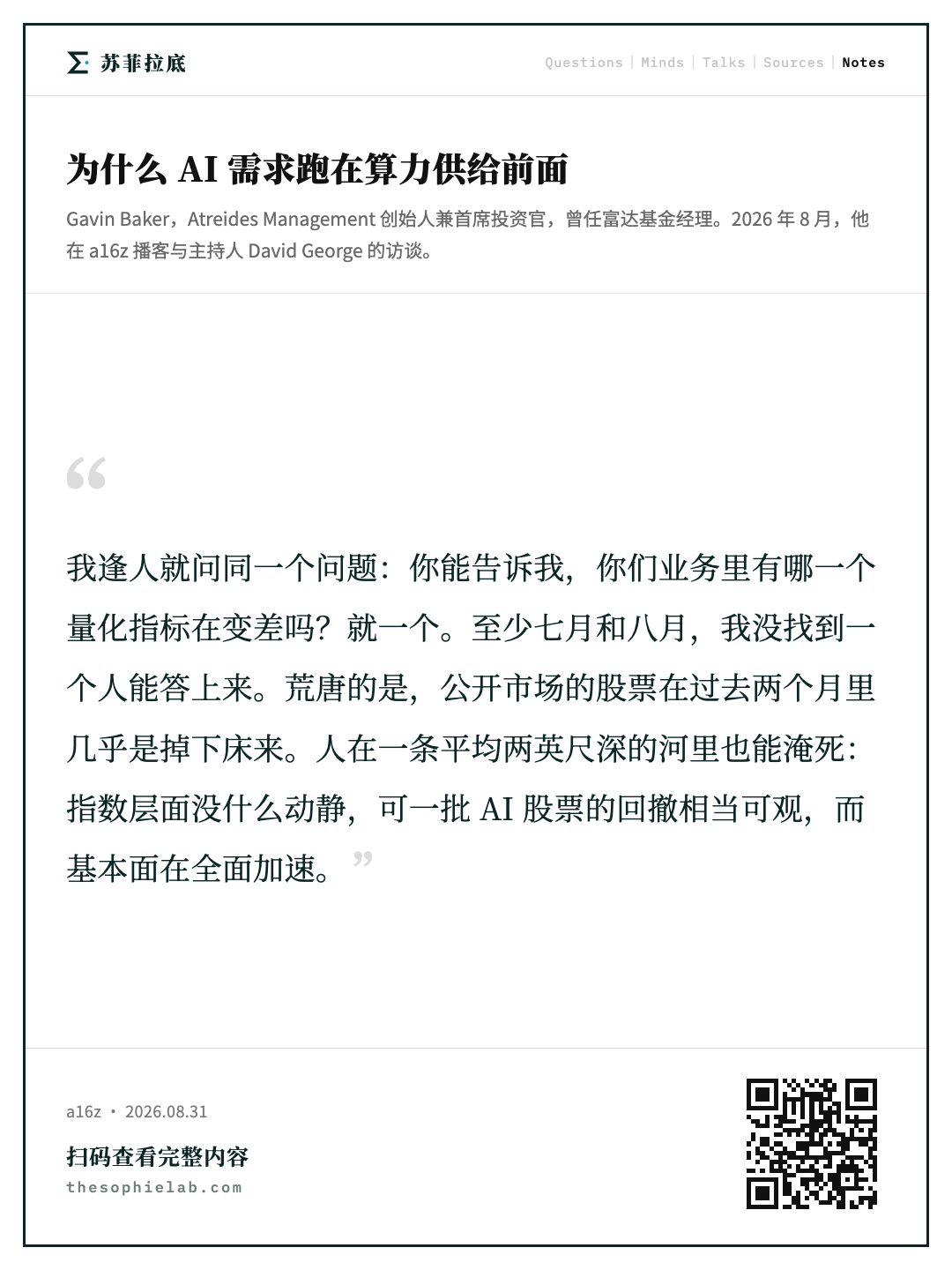
贝克: 没有。我逢人就问同一个问题:你能告诉我,你们业务里有哪一个量化指标在变差吗?就一个。至少七月和八月,我没找到一个人能答上来。说句实在话,Anthropic 正处在静默期,也许他们放缓了一点,但世界上其他人都在加速。OpenAI 显然在加速,开源阵营我看加速得更厉害,Grok 在 Grokbot 推出之后更是有相当猛的一轮加速。

所以 AI 这个行业整体上七月在加速,八月在加速。当然不可能永远这样加速下去,但荒唐的是,公开市场的股票在过去两个月里几乎是「掉下床来」。人在一条平均两英尺深的河里也能淹死:指数层面没什么动静,可一批 AI 股票的回撤相当可观。八月反弹了一点,回撤依然很深,而基本面在全面加速。

我们的朋友埃里克·维什里亚(Eric Vishria)在帕特里克·奥肖内西(Patrick O'Shaughnessy)的播客上说过一句话:也许大家都会赢。Anthropic 赢,OpenAI 赢,SpaceX 赢,Meta 赢,谷歌靠卖大量 TPU 也赢,开源赢,新云厂商(NeoCloud)赢,架在新云之上的推理云也赢。

主持人: 应用公司也赢。

贝克: 对,未必是所有应用,但那些执行到位、能在这个环境里穿行的应用公司会赢。在我看来这是很可能的局面,而这个世界上零和思维实在太多了。

说到 Anthropic,我的假设是这样:第一,他们大概把会计口径清理和校准了一遍。

主持人: 是,肯定的。

贝克: 那么现在你和 OpenAI 就在同一个基准上了。

主持人: 在新增收入的定义上可比了。

贝克: 对,基准重设之后,他们做了上市前的「试水」(testing the waters)。既然他们执行得不错,我猜下一次披露就是重新加速。前沿模型公司之间还有一场很好玩的游戏:每家手里总有更先进的检查点(checkpoint)压着没发。Anthropic 显然在等 OpenAI 发布 Astra。

主持人: 没错。

贝克: 然后第二天,「这是 Fable 5.1」。

主持人: 很神奇,恰好在 Astra 发布几小时后就可用了。

贝克: 所以我觉得他们走向 IPO 的过程是深思熟虑的,而所有人都在朝他们开火。

主持人: 所有人都在朝他们开火,他们在静默期里,还不能还手。

Anthropic 上市前的博弈

贝克: 这里面有很多博弈的成分。但我确实认为,OpenAI 和 Anthropic 成为上市公司对市场是好事。它们的影响力太大了,现在很多公开市场投资者的做法是:萨拉·弗莱尔(Sarah Friar)在全员会上说了句什么,登上《华尔街日报》头版,好,我们把这句话塞进模型里。让它们上市,对它们自己也更好。

不过有件事让我略微不安。Anthropic 现在的文化面试会问一句:如果你的股权归零,你会怎么想?

主持人: 因为他们要找的是与使命对齐的人。

贝克: 使命型而非雇佣兵型。

主持人: 对。

贝克: 这很好,我们要的是传教士,但我们也希望人们赚到钱。说到底,股权一旦归零,你就买不起完成使命所需要的算力了。我不是专家,但这一点我相当确定。

主持人: 他们像是一家「意外成为企业级公司」的公司。

贝克: 当然,他们几乎是「意外成为一切」的公司。

主持人: 企业业务只是使命的副产品,是通往那个终极目标的路上顺带长出来的。相比之下,OpenAI 更商业化一些,SpaceX 显然也更商业化。

训练与推理的算力分配

贝克: 但所有这些公司都面临同一个问题。假设一家实验室手里有 10 吉瓦电力,8 吉瓦分给推理,推理每吉瓦每年变现 600 亿美元,那就是年收入 4800 亿美元。

主持人: 按收入口径,这相当于一年回本,还不是按毛利算。

贝克: 对,按收入算。我已经尽量用保守的数字了,外界似乎认为 Anthropic 和 OpenAI 现在每吉瓦都能变现 1000 亿美元。现在假设他们取得了一项重大研究突破,判断把推理 8 吉瓦、训练 2 吉瓦的分配倒过来,改成训练 8 吉瓦,对长期更有利。那你的年化收入就从 4800 亿掉到 1200 亿。我真的认为他们会这么做。

主持人: 会做出这个决定。这是公开市场必须去习惯的事。

贝克: 正如你说的,OpenAI 可能是另一种动物。而且现实是,每家公司对怎么经营都有自己的理想,等到上了市,股价一波动,员工士气、招聘、留人全都受影响。所以真要砍得这么狠,我会很意外。但他们相当一部分收入确实掌握在自己手里:发布哪个检查点,在帕累托曲线(Pareto curve)上的哪个位置定价,训练和推理之间怎么分配。Meta 和谷歌这类互联网公司,股价再怎么震荡,基本面本身是平滑的。

主持人: 因为它们在服务收入的成本和基础设施之间,从来不需要做这种重大取舍,两边是完全分开的。

贝克: 完全正确。

主持人: 这很有意思。回到埃里克那个「大家都会赢」的观点,我认为说得很对。我的说法不太一样。我和出资人(LP)反复聊过这个,你那边估计也一样:每一次 LP 谈话都以「这一切会怎么崩」开场。什么会崩?大模型公司是不是要被开源干掉了?我说,这个问题问错了,这不是「或」的关系,是「和」的关系。前沿模型会做得很好,落后一代(N 减一)的模型会做得很好,开源会做得很好,会有一批应用公司做得很好,云厂商大概率也没问题,可能会做得很好。

贝克: 五家实验室大概率都会很好。

主持人: 而英伟达在这一切的中心。

贝克: 是的,他们大概会相当好。过去二十六年教会我一件事:不要和黄仁勋对赌。

主持人: 他现在的位置确实不错,这个我待会儿想再回来谈。你刚才关于训练和推理的观点很有意思。在我看来,实验室会把所有增量利润,甚至远超利润的钱,长期投进训练里。你觉得这么说公平吗?这和云厂商很不一样:互联网公司和云厂商最终由供需驱动,产生大量利润,还能保持一定增长,但除了 Meta 也许是个例外,它们没有那种要多年之后才见回报的长期豪赌。

实验室不追自由现金流

贝克: 我觉得这里要说得精确一点。我确信它们短期内不会产生自由现金流。它们会产生大量经营现金流,然后拿去买 GPU、XPU,管它叫什么。或者,它们会拿去重度补贴。我们知道实验室正在这么做。

主持人: 补贴什么?

贝克: 补贴自家的第一方产品,也就是第一方产品的代币(token)消耗。

主持人: 所以他们一边做研究,在数据和算力上花大钱,一边对自家产品重度补贴。

贝克: 对。所以实际上是 8 吉瓦推理,2 吉瓦内部研究,再加 2 吉瓦真正的训练。

主持人: 大概还包括后训练里消耗的推理。

贝克: 是的。考虑到他们对扩展定律(scaling laws)的共同信念,而扩展定律也确实一直成立,我不认为他们中的任何一家会把重心放在产生自由现金流上。我们已经看到萨提亚(Satya Nadella)眨了一下眼。

主持人: 而且他很后悔。

贝克: 我觉得是。去年达沃斯那个很精彩的采访,问到资本开支,他说「我的 800 亿我认了」,然后他们确实退缩了一点,放慢了脚步,事后很后悔。达里奥(Dario Amodei)也有一段有名的话,他上播客说:有些人在花钱上极不负责任,这是个艰难的决定,花得不够会丢掉很多份额,花得太多可能破产,两者都糟糕,但破产比丢份额更糟,所以我宁可保守。他确实保守了。

而 OpenAI 激进,现在 OpenAI 又回到了牌桌上。

主持人: SpaceX 也激进。

贝克: SpaceX 也激进。这些投资的回报率之高是明摆着的,与眼下的供需错配无关。无论短期还是长期,激进显然是正确的决定。

不到一年的回本期

主持人: 完全同意。我们算过,Nebius 和 CoreWeave 都给了一些有意思的披露。以 Nebius 为例,大致可以算出 9 到 10 个月的回本期:上线 1 吉瓦要花 500 亿美元,客户可以预付其中的 50% 到 60%。

贝克: 所以你实际垫付的是 250 亿到 300 亿,再拿去现货市场变现。

主持人: 现货市场的回本期恐怕比 9 到 10 个月快得多。

贝克: 那得假设一个平滑后的价位,比如每卡每小时两三美元,即便如此也很快。现在能拿到 5 美元甚至 8 美元。

主持人: SpaceX 的情况更进一步,他们建的是超大集群,而且有个很关键的点:上线快。

贝克: 对。

主持人: 所以回本更快,变现价格也更高。我已经尽量转成按兆瓦而不是按 GPU 来想定价,因为世界就在往这个方向走。SpaceX 的回本期明显在一年以内。

贝克: 我做投资这么多年,很少遇到这样的机会:一家公司能投出几百亿、上千亿美元,回本期不到一年。

主持人: 这事本身就很疯狂。还有一点该说:尤其是买英伟达 GPU,TPU 稍逊一些,你可以用融资来买。

贝克: 而且融资市场非常成熟,今天的资金成本非常低。

主持人: 大家都在为「循环融资」(circularity)焦虑,我倒不这么看。我认识很多黑石、KKR、阿波罗的聪明人,出钱的是他们。

贝克: 而且资金成本相对低。我认为一个原因是,设备的使用寿命一直在延长。模型越来越好,每单位代币支出的回报在上升,每吉瓦的变现率在上升。所以真正的股权回本期可能远远不到一年。

主持人: 没错。而且还可以论证,所有这些东西的价格其实会涨,那供给侧的经济账会更好看。供给侧今天就是这个状态,市面上有大把数据点证明回本期在一年以内。

需求侧才刚起步

主持人: 我觉得需求侧也值得想一想。通常的质疑是:每个周期都会过度建设,然后把供给侧的经济账毁掉。今天的需求侧是什么样?这些公司加起来大约 800 亿美元的收入,靠的是多少真正重度付费、真正拿到价值的用户?我说的是开发者这类人,算三千万吧。

贝克: 三千万我可能会押「少于」。

主持人: 我们在自己投的公司里看到的情况是这样:花钱买代币的公司呈幂律分布,老牌银行大概花薪酬的 1%,技术前沿的公司花到高个位数。但再看这些公司内部的工程师,花得最多的工程师是中位数工程师的 10 倍,有时是 100 倍。所以三千万肯定高估了,可能不到一千万。那问题就是:我们在扩散曲线上走到哪了?全世界有十五亿知识工作者。感觉需求侧连起点都没到,而供给已经严重不足。

贝克: 我很好奇,a16z 的投资组合里,最好的那些公司每月在代币上的花费相对于人力薪酬是多少?大致范围?

主持人: 高个位数,有些到 10%,AI 原生的公司在 10% 以上。老经济公司里做得好的大概 1%。所以我看供需两边的特征,供给侧有人问「这可持续吗」,可是和需求侧放在一起看,答案就很具体了。扩散进实体经济的速度也许会让我们失望,但拉长到十年看,我们还在起点。

贝克: 绝对还在起点。Atreides 内部的代币消耗,从三月到八月涨了 100 倍。我们刚拿到 Grokbot Enterprise,只有两个人在用,看这个势头,代币支出一个月内可能再涨 10 到 20 倍。

主持人: 从八月的基数上再涨。

贝克: 而且这些花费极有价值。我们这里有几个 Grokbot 重度用户,用得非常高效,不是在浪费代币。

Grokbot 与个人生产力

贝克: 我承认我在非常努力地用。我每次用 AI,都会想起当年劝我父母换 iPhone 和 iPad 的情形,他们其实适应得不错,我给他们很高的分数。但我 50 岁了。大卫你多大?

主持人: 42。

贝克: 42。你看那些 23 岁的孩子用 AI 的方式,流利、自然,就像母语。我觉得无论我多努力,可能永远达不到那个程度,而我真的很努力。我们拿到 Claude Code 之后,我搭了一些东西,很酷的东西。然后我花三分钟敲了几个 Grokbot,得到的是我此前做的每一样东西的更好版本。

我五个月前上帕特里克的播客说,我很喜欢自己那个播客摘要器,所有人都问怎么做的,我说用 AI 做就行了。

主持人: 很简单。

贝克: 在 Grokbot 里 10 秒钟就好,而且好得惊人。然后是 Substack 摘要器、X 摘要器、针对话题和股票的 X 情绪追踪器。这些用 Claude Code 每个都要花我几小时,用 Grokbot 每个 7 到 12 秒,还更好。所以至少对我来说,Grokbot 像是又一个「ChatGPT 时刻」。Claude Code 很强,我能从数据里看到,我用它做了些很酷、很有赋能感的事情,比如家庭日历应用。但现在是 10 秒钟,效果还远超我当初做的。

主持人: Claude Code 显然是编程领域的转折。我们最老练的工程师,AI 写的代码占比从 20% 左右涨到 90% 以上。但你刚才说的、用 Claude Code 或 Codex 做出来的那些东西,本质上还是被动式的。

贝克: 还是被动式的。

主持人: 摘要器、准备材料,都是增强你的知识,这是你工作的一部分,但它没有替你把活干了。现在你有了一个 Grokbot,它会说:今天有哪些建议的行动?

贝克: 对,根据其他所有机器人今天学到的东西,给我提建议。这才是真的不一样了,而且搭起来太容易了。

主持人: 我现在也有。我在让它们赛马:Grokbot 在做,Codex 在做,所有这些「行动型」的东西。我的要求只是:让我把工作做得更好,看看我做的每件事,告诉我你能替我自动化什么。我们投的一家公司 Town 也在做,做得很好。

贝克: 而且我们已经算是在做这些事的最前沿了。

主持人: 等所有人都开始这么做,等我们真的点下「好,去把这个自动化」的那一刻。

贝克: 那看起来就是无穷无尽的代币消耗。

泡沫史与物理约束

贝克: 不过我们也得承认金融市场的历史。从南海泡沫算起,每一次变革性的新技术出现,都会带来泡沫。我曾在播客上说南海泡沫和经度的发明、远洋航行有关,后来发现不是,那次更像郁金香狂热。但汽车、电视、广播、互联网、个人电脑、铁路、钢铁厂,每一次真正深刻的新技术都会催生泡沫,因为市场太兴奋,跑到了前面。估值过高,过高的估值导致过度建设。尤其是用债务去建的时候。今天这轮建设的大部分资金仍来自经营现金流,我认为这非常关键:债务融资的建设要求立刻见到回报,等不了三年。

主持人: 对,时间上不能错。

贝克: 我更关心的是另一件事。我和贾兹(Jazz)、帕特里克聊过,瓦特和晶圆(watts and wafers)是根本约束。这轮建设的规模之大、我们所处的阶段之早,已经在冲击很多行业的原始产能。现在做铜的人人手一份「AI 论点」。如果我们刚才谈的只兑现 10%,只有几百万人在用就已经造成了严重的全球算力短缺,变成五亿人会怎样?要新建多少座铜矿才能撑住?

主持人: 这是个疯狂的念头。这些根本约束确实在拖慢我们。

贝克: 我倒认为这是好事,对社会是好事。现在我会说,约束是利率和监管。实际利率在上升,这很正常,因为我们在大举投资,实际利率上升说得通。至于监管,我对美国正在发生的事感到震惊。

主持人: 我们的处境很糟。

AI 行业要自己讲真相

贝克: 上周末我在 X 上和 Anthropic 的肖尔托(Sholto Douglas)、达里奥有一番交流。达里奥说,我不认为自己一直在唱衰,我写了两篇文章,一篇正面,一篇负面。可是一半负面,而且负面的那一半是恐怖片式的。

主持人: 生存级别的。

贝克: 生存级别的负面,所有人可能都会失业,那个尤德科夫斯基(Eliezer Yudkowsky)说「如果我们把它造出来,所有人都会死」。换个说法呢:如果我们把它造出来,我们要治愈癌症,我们都会长生不老。达里奥说过的最好的一句话是,我们该停止谈论治愈癌症,去真正治愈癌症。

主持人: 真正治愈癌症,做出真正的突破。

贝克: 我最喜欢的一句《圣经》是「真理必叫你们得自由」。但唯一能讲出 AI 行业真相的,只有 AI 行业自己。他们必须开始讲真话。你反对数据中心?好,可数据中心恐怕是美国工薪阶层遇到过的最好的事。

主持人: 完全正确。

贝克: 现在读大学的净现值可能是负的,因为你可以去学电工、管道工、暖通技师,赚到离谱的钱。这对美国工薪阶层是天大的好事。我们已经有大量数据,尤其是配自建电源(behind-the-meter)的项目:一座数据中心落地,就改变一个镇子。税收不是翻倍,是翻十倍。它正在让全美国那些奄奄一息的小镇活过来。至于环境问题,我们做得越来越好,数据中心一般用天然气,这是很清洁的燃料。

主持人: 水耗那套说法早就被彻底戳穿了,根本不算什么。

贝克: 所以数据中心是好东西,正在给世界带来实实在在的正面影响,这还没算上治愈癌症那些。但得有人把这个故事讲出来。

主持人: 现在的问题是,举证责任已经落在我们头上:不是治愈癌症,而是拿出普通美国人每天能感受到的好处,而不只是用 ChatGPT 或 Grok 回答问题、替代搜索引擎。感觉我们离这一步很近了。

贝克: 确实很近。顺便说一句,有一个说法正确但没用,就是「我们必须领先中国」。这是真的,我是个爱国者,我信这个。但对普通美国人来说太抽象了。

主持人: 没人担心中国会入侵美国。

贝克: 对,海洋很宽。人们在乎的是生活成本,是这东西会让我的日子变好还是变坏。

主持人: 其实有非常直接的影响可以说。我最喜欢的例子是弗吉尼亚州劳登县(Loudoun County),它是全美人均收入最高的县。

贝克: 也是数据中心密度最高的县。

主持人: 他们从数据中心拿到巨额税收。我们应该到处都这么干。

贝克: 有件事很好笑。一个强烈反对数据中心的人说:你支持数据中心?那我倒想看看把它们建在收入最高的邮编区、收入最高的县里。结果呢,全美收入最高的邮编区和收入最高的县,恰恰是数据中心人均密度最高的地方。我们已经这么干了,效果非常好。

主持人: 「别拿细节烦我,我要讲下一个论点了。」

数据中心重新工业化美国

贝克: 那些论点说起来都很悲哀。我认为美国国内存在一场有组织的、由中共出资的反数据中心运动,很多经由 TikTok 洗白传播。悲哀之处在于,同时发生的另一件事是,这一切正在让美国重新工业化。霍尔木兹海峡关闭,对美国反而是天大的好事:美国的天然气两三美元。

主持人: 欧洲和亚洲现在是 25 美元。

贝克: 20 美元也好,25 美元也好。天然气是电价的重要投入,电价又是几乎所有制造流程的重要投入。所以我们在这项基础投入上有了巨大的成本优势,再叠加数据中心的建设热潮。我们正在让美国重新工业化,这太棒了。两党多年来想要的不就是这个吗?

主持人: 把工业带回来。

贝克: 那些被钢厂关闭抛下的小镇,数据中心正在把它们带回来。

主持人: 但得有人把这个真相讲出来。我每期播客都在讲,可我只是个普通人。

贝克: 而且你的听众是科技圈,本来就信这一套,你是在对唱诗班布道。我觉得 Meta 大概是讲这个故事讲得最好的。

主持人: 看起来是。

贝克: 我认为这已经写进了 Meta 的基因。他们上市后最早做的一件事,我记不清是不是第一次财报电话会,谢丽尔·桑德伯格(Sheryl Sandberg)会一口气讲十到十五家具体的小企业,讲它们用了 Meta 的广告产品,以及对生意的影响。

主持人: 得梅因有家蛋糕店,两位单身母亲自己干起来的,用了 Meta 之后开到十五家店,雇了五十个人。

贝克: 对得梅因是好事,对她们是翻天覆地的改变。每一次都这么讲。我很想看到整个 AI 行业都这么做:SpaceX、Anthropic、OpenAI、谷歌、Meta 站出来说,这是真实的企业、真实的美国人,能点名就点名,得到许可就说名字,否则就匿名,讲这件事给他们生活带来的正面影响。

主持人: 已经很具体了。

贝克: 英伟达、AMD、博通也一样,一家一家讲具体的例子。真理必叫你们得自由,前提是你得把它说出来。

供给短缺与算力不平等

主持人: 照这个事实格局和眼下的宏观状况看,更可能发生的是供给侧建设不足。

贝克: 对,至少到 2028 年都是。而且到 2028 年为止所有已规划的建设,产能已经全部没有余量了,考虑到眼下的政治形势,这些建设恐怕还要延期。

主持人: 所有人都在担心供给过剩。

贝克: 我更担心的是严重的供给不足。

主持人: 如果是这个剧本,那你可能会看到获取智能的价格大幅上涨。

贝克: 这和所有人预期的方向正好相反。德瓦克什(Dwarkesh Patel)说过一个很狂的观点,大意是每个代币的成本可能涨十倍。

主持人: 听着疯狂,但我们毕竟活在一个供需世界里。需求如果大幅上升,这完全可以想象。而且眼下这一切的前提,就是正在产生巨大的消费者剩余(consumer surplus)。为什么人们明明可以用便宜的代币完成大多数任务,却偏偏选前沿代币?原因很多,最大的一个是,即便用前沿代币,剩余仍然巨大。那如果出现严重的供给短缺呢?

贝克: 我觉得那会是一个颇为讽刺的后果:这些「数据中心去增长派」会造成真正的算力不平等,大公司和有钱人买得起算力,其他人买不起。两年后他们又会拿这个说事,而事实是,这正是你们造成的。

主持人: 因为你们不让我们建数据中心。

贝克: 而且我们见过这种事。把低成本产品送到大众市场消费者手里的路径是广告,而广告业务需要很长时间才能建起来。

主持人: 我们这些年投的消费互联网公司都是这样。

贝克: 所以中间可能有一段脱节期,你根本没法提供那种低成本产品。

主持人: 那会是一个可怕的结果。

贝克: 对世界是可怕的结果,没人想要。所以我们得建大量数据中心。

开源代币同样烧算力

主持人: 算力不平等的未来对谁都不好,这也是开源如此重要的另一个原因。

贝克: 我让 Grok 给我做了张三头龙的梗图,其中一个头对各种愚蠢的 AI 空头叙事一脸困惑。人们有一种错觉,以为开源代币是免费的。其实其他条件相同的情况下,模型规模相当,产出一个开源代币和产出一个前沿代币消耗的算力完全一样。当然有不少细节差异,但大体上是对的。

主持人: 区别只在于上面加多少利润率。即便如此,Kimi 的许可协议有一条很多人没注意到:要分走 30% 的收入。

贝克: 所以 Kimi 拿走了在它之上产生的所有收入的 30%。这是因为它是开放权重(open weights),不是开源。

主持人: 而且它极其耗代币。按代币计价看着便宜,按任务计价效率低得多,成本其实很高。

贝克: 我一直觉得黄仁勋是个伟大的爱国者、伟大的美国人。有他和马斯克,我们太幸运了。等到写二十一世纪的历史时,就像曾经有个维多利亚时代,我认为这段会叫「马斯克与黄仁勋的时代」。因为他们正在从根本上改变人类社会和文明的肌理:AI,SpaceX 让人类成为多行星物种,星链(Starlink)把低成本互联网带到世界上最穷的社区。这一点没人谈,但你刚才说消费者剩余,这就是惊人的剩余。

主持人: 那些地方从来不存在建互联网的经济理由,成本太高,支付意愿太低,现在可以了。

贝克: 而且今后地球上任何新增的互联网容量,都不会再以传统方式建设,它会来自太空。这是巨大的解锁。我们都该感激他们,他们在把未来变得尽可能激动人心。

轨道数据中心的账

贝克: 既然我们处在算力紧缺里,那就说说 SpaceX,这显然是我们俩都放在心上的公司。每次谈到轨道数据中心,我先要说的是,那不是漂在太空里的大楼。更准确的想象是一架飞机的大小。

主持人: 人们想象的是死星或者五角大楼在天上飘,完全不是那样。

贝克: 就是飞机那么大,装一个 72 颗芯片的机架,机架本身大概相当于我们五个人站在一起。

主持人: 两侧是太阳能翼。

贝克: 然后把它放在太阳同步轨道上。

主持人: 让散热器永远处在机架的阴影里,这就是散热方式。

贝克: 我很难和某些人争论。X 上一堆人说,我是物理学博士,这不可能。我有个朋友,也是投资人,真的是物理学博士,和我吵了很多次,说我是博士,这不可能。后来他去了 SpaceX 的开放日,和工程师聊完,说,我错了。所以,就算你是天体物理学博士,才华横溢,智商比我高一百,你为这个问题想过一小时吗?想过五小时、十小时吗?SpaceX 有一万名世界上最聪明的工程师,每人在这上面花了几百甚至几千小时,再加上非常精密的工程工具。在他们那里这是已经解决的问题。在他们看来,这比星链卫星简单得多,因为星链卫星要装相控阵天线,还要机动。

主持人: 好,假设你是对的,物理上没有理由说这行不通。成本上看着很吓人,但马斯克旗下公司的历史就是成本曲线急剧改善。我们最初投 SpaceX 时,星链还没有商业化,我们对它的经济性怎么演进有一大堆疑问。火箭发射是这样,Model 3 也是这样。我只能认为成本问题会被解决,再加上地球上会出现自己造成的严重供给不足。在我看来,至少它会成为调峰产能(swing capacity)。

贝克: 假以时日也许会更大。这笔账其实很简单。关于轨道算力,人们真正该问的问题只有一个,就是星舰(Starship)的复用性。

主持人: 没错。

贝克: 算法是这样:每吉瓦 500 亿美元,其中 350 亿是 IT 设备。这部分上天也一样,也许因为进太空还会涨一点。剩下的 150 亿是电力、散热、人工等等,太空里全都不需要,因为你有太阳能板和大散热器。而这 150 亿在地球上大概率是通胀性的。

主持人: 因为人工从根本上就在里面,我们刚说了电工的薪酬在怎么涨。

贝克: 材料也一样,铜的多头盯着铜短缺,所有东西都要涨。所以这 150 亿是通胀性的,要拿来和发射成本比。星舰实现复用之后,发射成本降到 10 亿美元以下,经济账瞬间翻转。当然,训练永远会在地球上做,GPU 挨在一起总有优势,光速是硬约束,延迟很重要。地面数据中心哪儿也不会去,我认为它们会一直非常有价值。但全球算力中在轨道上的比例会越来越高。马斯克说他和黄仁勋共同设计了一个 Rubin 机架。

主持人: 计划 2027 年四季度发射。

贝克: 就算他晚了两个季度。

主持人: 那就是 2028 年。

贝克: 还是很快。正如布拉德·格斯特纳(Brad Gerstner)说的,没人在关注这件事,它就在光天化日之下发生。这在我看来解决了一个问题:SpaceX 今天的 AI 收入是中个位数的十亿美元。

主持人: 这还只是维持份额不变,没算 Grokbot 带来的份额。

贝克: 从 30 亿的基数往上,我大概会押「多于」。

主持人: 从我自己的用量和碰到用量上限的人数看,这个数字每天都在变。Grokbot 已经时不时提示「服务器过载」,而他们手上的算力可不少。

贝克: 所以,你不想争论轨道数据中心?没问题。星链移动(Starlink mobile)有清晰可信的方案,无线通信是八九千亿美元的市场,移动加宽带接近两万亿。再加上快速增长的 AI 和年度经常性收入。

主持人: AI、年度经常性收入,还有云业务。

贝克: 所以你不信轨道算力,没关系。

主持人: 我们甚至不需要它。只看今天地面算力上发生的事:Cursor、Grok、Grokbot。顺便说,我们有遥测数据,X 的广告也在增长。

贝克: 我预计某个时候你会看到「星链加 Grokbot 加 X 广告」的打包销售。谷歌当年建云业务的办法之一就是把云和广告捆在一起卖。现在也许是把广告和 AI 捆在一起,为什么不呢?

主持人: 我喜欢他们在 AI 上的位置,正面赢反面也赢。第一方业务增长很快,而且他们非常快地追上了前沿。

贝克: 为此他们做了非常激进的算力投资。

主持人: 这是「正面赢」。「反面赢」是:假设他们建的算力超过了自己推理和训练所需,在供给极度稀缺的环境下,算力本身的回本期不到六个月。这是非常好的局面。

贝克: 之前有一种空头逻辑:在「OpenAI 和 Anthropic 极大化」的世界里,只有这两家,它们还自研芯片,别人还有什么空间?可是它们短期内不会有可复用的星舰和多个发射场。如果算力的经济性越来越指向轨道,因为星舰是通缩性的,而地面的散热和电力是通胀性的,那么即便他们的第一方 AI 应用掉了球,他们依然有一个庞大的基础设施业务。

星舰、星港与小行星

主持人: 我对路易斯安那的星港(Starbase)兴奋极了。

贝克: 等不及要去看看。

主持人: 我昨晚在读相关材料,他们现在有了支持每年数千次发射的基础设施。

贝克: 最终我认为你会看到星港出现在多个地方,多个海岸,遍布全球。中东某处大概会有一个,当时官僚气最少的那个欧洲国家会有一个,日本或韩国也许会有一个。

主持人: 每年五千次发射的能力,听着非常未来。

贝克: 确实疯狂。SpaceX 在 IPO 期间反复强调一个区别:复用性和中国。中国确实回收了一枚火箭,用的是一套颇为讽刺的、用钢索临时拼凑的系统。

主持人: 那个方案是 SpaceX 的 Reddit 社区提出来的。

贝克: 在猎鹰火箭第一次着陆之前,十多年前。中国显然在密切关注 SpaceX 的 Reddit 板块。但那和星舰要做的事完全不同:助推器被机械臂接住,移走,星舰接住,堆叠,加注,直接再发。一天两次,每个发射台。

主持人: 这些数字累加起来很快。

贝克: 而且我认为发射台的设计能力不止一天两次。

主持人: 一天两次是保守假设。好,SpaceX 我们聊过很多。关于 SpaceX,你想到的最有未来感的事是什么?十年尺度上的。我们一起参加过一个会,一小群公开市场投资人在争论谁会是第一家十万亿美元的公司,你说:我不知道谁是第一家十万亿,但我知道谁是第一家二十万亿。所以,SpaceX 最有未来感的产品、市场或技术是什么?

贝克: 听着疯狂,但小行星采矿会成为非常真实的事。有一颗小行星叫灵神星(Psyche),它含有的金、银、铂,每一种贵金属都比地壳里的总量还多。到某个时候,尤其是有了星舰,也许还需要一个月球基地,你就能捕获这些小行星,把它们拖到某个美国所有的太平洋环礁上空的稳定地球同步轨道,方圆五十英里没有人类,由 Optimus 机器人干活。

主持人: 由机器人干活。

贝克: 然后运回地球是免费的,当然一部分会在大气层里烧掉。我认为这会发生。贝索斯说过一句很有意思的话:未来地球会被划为住宅区。大约十五年前有人问他什么意思,他说,所有重工业都会在外太空进行。这就解决了污染问题,解决了一切。人们总是担心还能不能看见星星。

主持人: 人脑很难理解太空有多大。

贝克: 在那上面我们不必太担心排放。这大概是最有未来感的经济应用。另外,我确实认为未来几年会有一支星舰舰队登陆火星。几年是多久?最多说八年。它们会登陆火星,一条小坡道从那个「PEZ 糖果盒」里伸出来,那是一艘改装过的星舰,火星殖民运输船。Optimus 机器人举着美国国旗走下来,铺开太阳能板、电池和成排的算力机架,一路投放星链。也许轨道力学不允许,但他们会想办法把带宽解决掉。想想我们当年看「探路者号」和那些火星车传回的画面,而将来是遍布火星的 Optimus 机器人传回的 4K 视频。再之后,人类会住上去。

主持人: 想想都疯狂。

贝克: 那会是美国的伟大时刻。

主持人: 想想登月。

贝克: 这个要大一点。

主持人: 这个好,外面没多少人谈这个。

贝克: 但我认为它大概率会发生。

微软与多模型未来

主持人: 你提到了微软。他们下的那个赌注,如果说苹果是「押未来不会来」的极端版本,微软算是中间的某个梯度。你对他们的决策怎么看?

贝克: 我认为世界对他们的策略变得友好多了。他们显然试过做前沿模型,失败了。萨提亚说过「我们会有自己极具竞争力的模型」,大概是十八个月前说的,现在他们并没有。但你正在看到的是,未来是一个模型集合(ensemble)。这是一条帕累托曲线,没有哪一个模型在所有事情上都最好。对全球最大的一万家公司来说,未来的做法是拿最好的开源模型,而我认为很快那会是一个英伟达的模型。

主持人: 实验室自己做 ASIC,给了各方进入彼此地盘的动机。

贝克: 也给了黄仁勋动机。大家都问,开源赢了的话,谁来出钱训练?芯片公司可以出钱训练。对黄仁勋来说,一次五百亿到一千亿美元的训练跑是小事。我甚至怀疑这是不是谷歌的超长期打法:他们似乎暂时退出了前沿竞赛,转为高价变现算力、对外卖 TPU,这能产生大量现金流,而开源离前沿越来越近。最终的赢家可能就是谁的现金流最多、最能供得起这些大规模训练。我认为由英伟达领头的美国开源会逼近前沿。他们收购 Poolside 是有原因的,Poolside 有一批很好的美国开源人才。

这对微软是大好事,在某种程度上对几乎所有应用软件公司也是。因为现在你可以拿一个基础模型,Nemotron 到目前为止没做多少后训练,基本是一个不错的预训练模型,随你处置。你拿一个很好的预训练基础模型,然后不再把你的企业上下文,也就是你真正的知识产权、你公司的真正价值、嵌在你全部数据里的那些东西,交给一家前沿实验室。把这些交出去,可能有损你的财务健康。

主持人: 尤其是零数据保留(ZDR)政策变了之后。

贝克: 对。你拿一个能力很强的开源模型,用自己的数据做大量强化学习和监督微调,你拥有它,它是你的模型。如果智能是你业务的一项极重要投入,你就会想拥有并控制你的智能,它的能力、它的成本。我们已经在很多公司看到这种做法。据我了解,Grokbot 背后是 Gemini 3.7 Flash。

主持人: Grok 4.6。

贝克: 还有一些 Opus。

主持人: 都放在一个路由器后面。

贝克: 当然,马斯克一定在全力推动尽快全部换成 Grok。但我认为这些公司会这么做:在自己的数据上有自己的模型,再搭配一两个前沿模型,互相校验,对你是透明的:最前沿的模型负责规划,执行交给成本更低的其他模型。这在我看来是非常可能的未来,而且比「只有两家前沿模型主宰」的未来对微软友好得多。而且加上 Grok,看起来至少有三家。我认为也要给 Meta 很高的评价。

主持人: 他们做得很棒。

贝克: 他们出了局,又回到了局里,这很惊人。一年前 Gemini 如日中天的时候,谁能想到今天这个局面?

主持人: Gemini 甚至都不在讨论范围里了。

贝克: 而 Muse 和 Meta 在能力上明显领先于它。这是有史以来赌注最高的一盘企业棋局。有人走了臭棋,有人走了妙手,有人退出,有人回来。但那种未来,叫多模型也好、混合模型也好,我不知道世界最终会用什么词,我认为那就是未来。

我其实有点意外,除了 Grokbot、Cursor,以及 Harvey 做的一些很酷的事之外,今天这种模式最完整的实现是 Fireworks 的 Nexus 产品。

主持人: 你可以选前沿模型。

贝克: 你想用哪个开源模型都行,我们替你做强化学习,用你的数据,给高盛、摩根士丹利、摩根大通、富达、a16z 各做一个。你的数据都在你手里,你控制自己的智能,我们把它透明地放在路由器后面。

主持人: 我认为这是很可信的未来,Fireworks 的乔琳(Lin Qiao)是第一个这么说的,后来亚历克斯·卡普(Alex Karp)和萨提亚也各有自己的版本。

贝克: 萨提亚那篇讲「专门化智能」的文章,我认为很有道理。

主持人: 但这事非常难做。

贝克: 说起来容易。

谁来做智能的抽象层

主持人: 描述起来容易。我对人的说法是:谁能成为组织和用户面向智能的抽象层?这是商业史上你能想象的最有价值的位置。

贝克: 毫无疑问。谁来做全球企业、可能也包括消费者的智能仲裁者。我以前是零售分析师。人人都觉得经营一家大型连锁很容易,其实门道很多。在美国任何品类开一家零售商都「很容易」,因为美国太大了,几乎任何品类都值五百亿美元以上。你只需要在气候和消费偏好截然不同的五十个州开一千家店,每家店在对的时间、以对的价格备好适合当地的商品,配上友善、懂行、不偷东西的员工。

主持人: 而且员工一年流失率 100%。

贝克: 至少 100%。店要干净明亮。做到这些,五百亿到手。美国商业史上做到的公司,一只手数不完,但也用不了几只手。真的很难。做这个抽象层,让它跑起来、无缝衔接,我认为比人们想的难得多。

关于 Cursor 我有个看法很想听你的意见。实验室圈子里的其他人都在讲「我们在创造数字神明」,AGI、ASI。Cursor 那帮人只是说,我们要做很好的产品。

主持人: 完全正确。说来奇怪,前沿阵营里,Cursor 大概是最以产品为中心的。

贝克: 现在他们是 SpaceX 的一部分了,这和马斯克的思维方式非常契合:把它当工程问题,建模型工厂,然后做出一个真正好的产品。特斯拉的车就是这样,我不知道你开不开,它哪儿都能开。

主持人: Cursor 想明白的是,他们的终局愿景和那些人差不多,只是路径不同:务实,在客户所在的地方接住客户,在技术所在的位置用技术。他们已经证明了自己能从那个起点一路引领到自主化。而且编程在所有知识工作里是独一份的,这一点其实支持「微软位置很好」的论点。

贝克: 因为编程可验证、有完整文档。

主持人: 企业里其他任何东西都不是既可验证又有完整文档的。所以会很混乱,而混乱恰恰导向像微软这样的抽象层的多头逻辑。

贝克: 前提是他们执行得出来。要把这件事做得真正简单非常难:点一下我的 Copilot,连上我所有的东西,训练一个模型。

主持人: 在我们的数据上训练,说服我你不会分享给别人,放在一个对我无缝的路由器后面,还要持续升级那个开源模型。

贝克: 这不是什么中间件,非常难做。

主持人: 而且他们要竞争的不只是实验室。

贝克: 还有 Databricks。

主持人: Palantir,推理服务商,应用公司。Harvey 在这方面做得非常出色,法律领域已经起飞了,我认为他们看得到怎样成为那个抽象层、把活干了。但法律也是特例,文档完备,一定程度上可验证。税务可能也是。真正诱人的那十五亿知识工作者,拿下来会非常混乱。

贝克: 不过我总觉得,Harvey 和 Legora 内心深处大概在想:如果我们解决了这个问题,我们就能成为所有人的抽象层。Cognition 大概也这么想。这个品类已经得到了巨大的验证:凯易律师事务所(Kirkland & Ellis)说要花五亿美元自己建。首先,祝你好运,这会非常难。

主持人: 但这恰恰说明蛋糕非常大。

贝克: 巨大。而且我相信他们有很聪明的 AI 负责人,可这不是一次性花五亿建完的事。模型要持续更新,要换底层基础模型,所有这些还得对用户透明。所以我认为会有一场大碰撞:Fireworks Nexus 这类产品、法律智能体、编程智能体、微软这样的大公司。

主持人: Databricks。

贝克: Databricks,追上来的 Snowflake,Salesforce,Workday,所有这些公司都会扑上去。最后就看谁执行得最好。

主持人: 以及谁的成本最低。

贝克: 对。但长期看,如果你不做垂直整合,你必须好到极致才能成为那个抽象层。

主持人: 做低成本供应者非常难。

贝克: 从很长期看,你不做垂直整合、不拥有自己的算力,就不可能是低成本供应者。这也是我越来越用「企业价值除以净固定资产」(EV to net PP&E)来看超大规模云厂商的原因。

主持人: 因为净固定资产就是算力。

贝克: 它反映的就是市场认为你这批算力能变现到什么程度。这样一看,有些低效之处相当明显。

主持人: AI 版的市净率。

贝克: 我喜欢这个说法。

英伟达的生态位

主持人: 你提到了黄仁勋。我和你感受一样,他在拖着整个行业往前走。谈谈你对英伟达的看法。

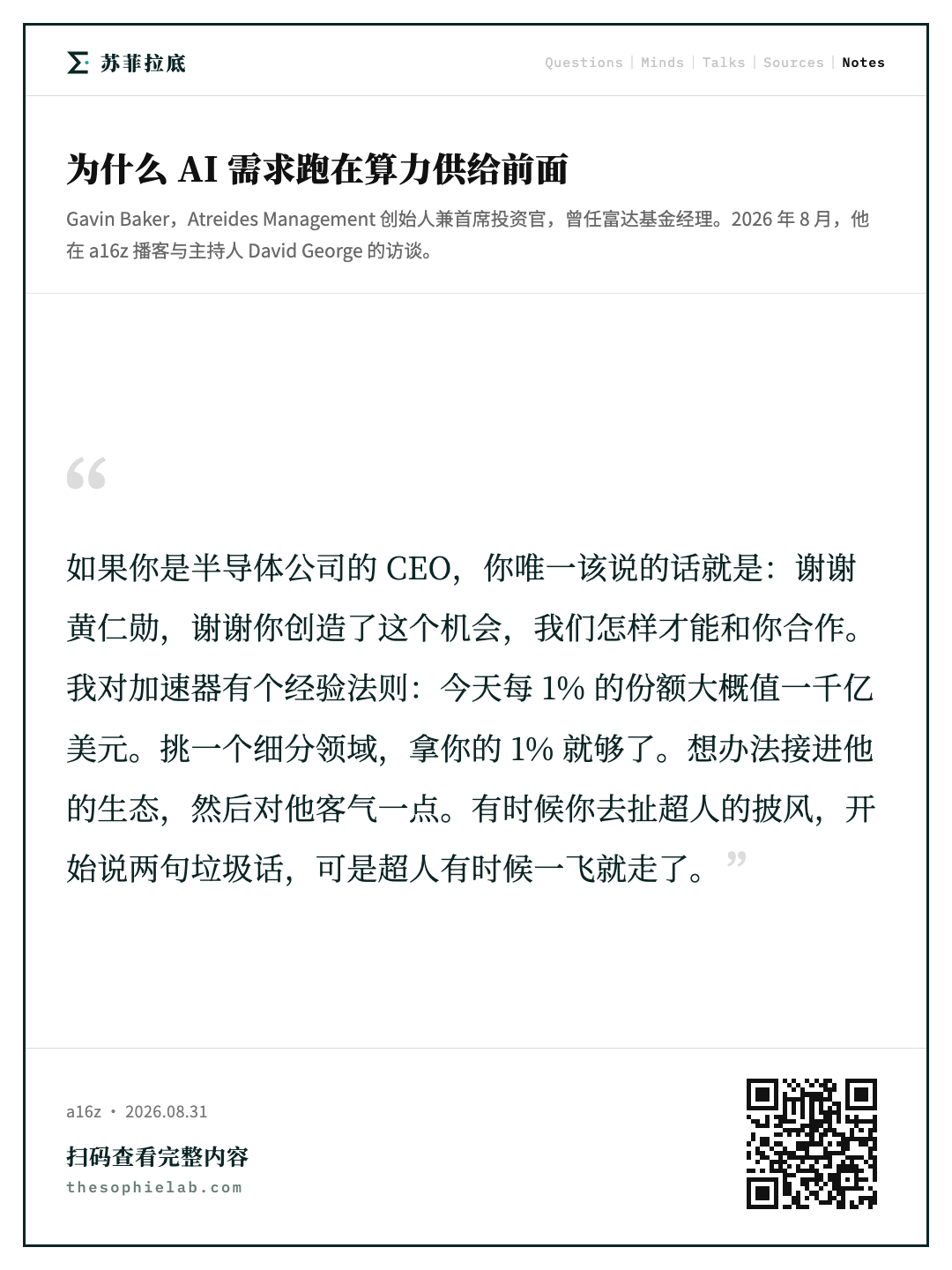
贝克: 我认为他处在极好的位置,策略是垂直整合但横向开放。假设出现了某种非常非常好的加速器,几乎可以肯定,它如果能接入英伟达的生态会更好。我知道你投了一家加速器公司,所以我的头条建议是:如果你是半导体公司的 CEO,你唯一该说的话就是「谢谢黄仁勋,谢谢你创造了这个机会,我们怎样才能和你合作,我们想成为你的助力」。当然,我们会在边缘上和你竞争。我对加速器有个经验法则:今天每 1% 的份额大概值一千亿美元。

主持人: 所以没必要正面硬碰英伟达。

贝克: 挑一个细分领域,拿你的 1% 就够了。他有九款芯片:多种加速器,CPU,以太网交换机,两种 GPU。网络从只有横向扩展(scale out),到纵向扩展(scale up)、跨域扩展(scale across),现在又有了内部扩展(scale in)。想办法接进他的生态。

主持人: 这并不稀奇,他最大的客户手里都有和这九款芯片之一竞争的产品。

贝克: 对,想办法接进去,然后对他客气一点。要客气。这些事都是个人化的。你有没有看过公牛队的比赛录像:乔丹在常规赛第五十场,有点无聊,公牛领先分区第二名八个胜场,他有点走神。然后某个年轻人决定,我们正赢着他呢,我要冲他说两句垃圾话。然后他抬眼一看。

主持人: 那是我最爱的桥段。

贝克: 《最后之舞》大家都看过。

主持人: 别干那种事。

贝克: 「嘿迈克尔,能和你同场我太高兴了。」这才是正确姿势。而这件事特别重要的原因在于,黄仁勋的数据中心是可融资的。

主持人: 回到刚才那笔账:一个 500 亿美元的英伟达数据中心,你需要 150 亿的股权出资。

贝克: 剩下 350 亿可以融资。这不是循环融资,我对我见过的黑石、KKR、阿波罗的人非常尊重。

主持人: 他们对每一笔都做承销。

贝克: 然后由他们放款。再加上一个残值担保(residual value guarantee,RVG)。只要这个残值担保低于他卖进这个数据中心的芯片带来的毛利,对他来说就是净现值极高、风险极低的事。他还能拿一份收入分成。他的数据中心是最可融资的。

主持人: 往好里说,TPU 大概是第二可融资的。

贝克: 股权出资至少要翻倍,其余部分的利率也更高。所以资金成本是巨大的优势,这就是你要待在他的生态里的原因。你可以看到他有这些芯片,现在还在收购土地、电力和壳公司,再给它们撮合承购协议。我认为他做这些残值担保的一个原因是,如果他不做,这就会是一个 Anthropic 和 OpenAI 主宰的世界,因为它们能为算力出最高的价。他实际上是在帮其他人和这两家竞争。

主持人: 就像他当初扶起新云厂商一样。

贝克: 这是算力的民主化,对世界是好事。他是个爱国的美国人,而他的利益也和这个方向一致。

主持人: 碎片化。

贝克: 碎片化,不出现一个主宰一切的 AI。这一点特别好,因为他是个冷酷无情的竞争者,而他在 AI 碎片化、模型碎片化、权力碎片化上的激励,和美国的利益完全一致。再回到开源:我实在受不了有人一边认为黄仁勋是世界上最大的开源倡导者,一边认为开源是他生意的巨大风险。

主持人: 开源对他的生意是大好事。

贝克: 简直太好了。因为这意味着用英伟达 GPU 产出的代币上面,加的不再是 90% 的利润率,也许是 40%。于是更多代币会被消耗,于是需要更多算力。

主持人: 在一个供给受限的世界里。

贝克: 在一个供给受限的世界里。他锁定了全球供给的多少?

主持人: 70% 到 80%,在这个区间。

贝克: 说的还是晶圆厂产能。

主持人: 全部。因为他比所有人都更早看到了这一切。

贝克: 还有整个系统供应链。晶圆厂产能锁定了,DRAM 产能锁定了,NAND、激光器、电容,造机架需要的一切。十五年前他说:我每两年下一注二三十亿美元的赌注,而且我动作非常快。现在他下的是几千亿美元的赌注,把供应链一起带上,把融资也一起带上:把它标准化,让黑石、KKR、阿波罗、高盛、摩根士丹利、摩根大通那些聪明人容易放款。

主持人: 这很难与之竞争。

造芯片有多难

贝克: 我的公司 Atreides 有一个相当大的半导体私募组合。马斯克说过,很多人会在硬件上学到惨痛的教训。我只能说,我在半导体投资上学到了很多惨痛教训。你可以押最好的团队,流片(tape out)的时候大家感觉很好。

主持人: 而且现在流片比以往任何时候都快。

贝克: 仿真和模拟越来越好,你感觉很好。然后芯片从工厂回来了,CEO 给你打 FaceTime,他们把它插上电。

主持人: 有时候它就是不工作。

贝克: 就是这样。

主持人: Cerebras 就出过两次这种事,对吧?他们硬扛过来了,做得很好。

贝克: 我觉得 Cerebras 的每一代芯片都是能工作的,只是前两代没找到产品市场契合,芯片没问题,是产品没有着落。他们现在做得很好。

主持人: 说得对。

贝克: 这和「插上电完全不工作」是两回事。完全不工作,你可能就得回到绘图板,再要几亿、十亿美元,「我们吸取了教训,两年后下一次一定能行」。

主持人: 前提是还融得到钱。

贝克: 前提是融得到钱。半导体很难,真实世界很难,硬件很难。而他以那样的规模和速度在做,还把所有东西一起带上,因为土地和电力得跟上,整个供应链得跟上,融资得跟上。既然他已经拿了七八成的供给,你就该接进他的生态。

主持人: 这也是马斯克做出那个决定的部分原因。

贝克: 那是一步很高「等级分」(Elo)的棋。其他所有人都试过自研 ASIC,站到台上,有时还说些关于黄仁勋或英伟达的负面话,放几枪。昨晚的 Jalapeño 团队我倒觉得很聪明,功劳该归谁就归谁:Jalapeño 是我见过的除 TPU 和 Trainium 之外,第一款真正好的自研 ASIC,而且用时相当短。

主持人: 相当短,令人印象深刻。他们的团队确实好。

贝克: 团队很好,也占了很多优势。如果你是实验室,模型在你手里,你看得见研究的方向,这对设计自己的芯片是很大的优势。但英伟达和所有人合作。所有人都以为架构会标准化,可你看三大中国开源模型,DeepSeek、Kimi、Qwen,走的是截然不同的演化路线。它们都能跑在通用芯片、GPU 上,而你要是专用化了,面对这种演化,至少还是得有通用芯片。所以我很高兴,他作为 CEO 的激励与美国的利益完全一致。

主持人: 记得叮嘱你的半导体公司,别对迈克尔·乔丹说垃圾话。

贝克: 对 MJ 客气点。有时候你去扯超人的披风,你有了自信,开始说两句垃圾话。可是超人有时候一飞就走了,TPU 团队就遇到过这种事。Jalapeño 现在也在扯一下超人的披风。

主持人: 走着瞧。不过 Jalapeño 做到了那些大公司都没做到的事,这挺惊人的。

贝克: 这是我见过的最有竞争力的自研芯片。但它只是和他九款芯片中的一款竞争。

主持人: 九款中的一款,他们还会继续紧密合作。

贝克: 所以,很好,你做成了一件事。可要在系统层面真正和他竞争,你还需要另外八款芯片。SemiAnalysis 的迪伦(Dylan Patel)说他是 AI 的银行、AI 的中央银行、AI 的美联储。所以我认为马斯克很聪明,他没有去和一个与自己利益完全一致的人竞争。我相信历史会评判这是明智的决定。

交易结构看客户偏好

贝克: 在一个供应链如此受限的世界里,其实很难看清客户的真实偏好。

主持人: 因为你一出货,他们什么都要。老掉牙的 H100 价格还那么坚挺,就说明了这一点。

贝克: 只要你有台积电的产能配额,你就会卖光。尤其是能配到 DRAM 的话,一定卖光。所以真实偏好很难推断。我认为观察真实偏好最好的办法之一,是看客户和芯片公司签的是什么样的交易。大致分几档。第一档是芯片公司投资客户,TPU 和 Trainium 就是这样,亚马逊和谷歌投了 Anthropic。这对它们是巨大的好处,不仅帮了业务,也让那两款芯片真正升级,因为芯片得有人用,存在冷启动问题。在这种结构里,只要你投出去的钱少于毛利,你就不会亏。第二档是残值担保,由黑石、阿波罗、KKR、高盛这些机构放款。只要残值担保真的低于你的毛利,你不会亏,而且大概率还有一份收入分成作为上行空间。第三档是送认股权证,但绑定一个固定的每百万代币价格。只要你芯片的性能跑赢你股票的表现,你就不吃亏。而如果只是白送认股权证,那可能是负净现值,因为对方做得越好,价值越是被对方拿走。所以顺着这个交易层级,你能推断出一些客户真实偏好。

主持人: 这很有意思。所以英伟达做的交易相当不错。

贝克: 我认为聪明的人在投他们的交易,是有原因的。

主持人: 加文,谢谢你。和你聊总是很开心。

贝克: 谢谢,大卫。这次聊得很好。
本期讲者
David Georgea16z 成长基金负责人,主导该基金对 SpaceX 等后期公司的投资。本场以主持人身份提问并补充 a16z 投资组合的一手数据。
加文·贝克Atreides Management 创始人兼首席投资官,曾任富达基金经理,长期研究半导体与科技股。本场承担主要观点输出,涉及算力经济账与英伟达生态。
章节 · 点击跳转视频
0:00 片头精华:短缺、泡沫与再工业化 ▶ 正在看
0:59 找不到看空理由:七八月全面加速 ▶ 正在看
5:38 十吉瓦账本:训练与推理的取舍 ▶ 正在看
11:35 供给侧:一年内回本的经济账 ▶ 正在看
14:12 需求侧:扩散曲线尚在起点 ▶ 正在看
20:24 泡沫史、债务与物理约束 ▶ 正在看
23:00 讲真话:数据中心与工薪阶层 ▶ 正在看
29:18 供给不足与算力不平等的风险 ▶ 正在看
32:54 轨道数据中心的物理与成本账 ▶ 正在看
43:53 小行星采矿与火星船队 ▶ 正在看
47:32 微软与企业智能抽象层之争 ▶ 正在看
1:00:10 黄仁勋生态:融资、份额与客户偏好 ▶ 正在看
本期论点
本期回应
30:01
如果算力供给持续不足,获取智能的价格会大幅上涨而非下降 会变贵用 AI 会越来越便宜吗?加文·贝克
37:17
星舰可复用把发射成本压到十亿美元以下后,轨道算力的经济账会优于持续通胀的地面建设 推倒重做算力提升还能从哪里来?加文·贝克
38:15
训练永远会留在地球上,光速带来的延迟让 GPU 紧挨在一起始终有优势 靠小改叠加算力提升还能从哪里来?加文·贝克
48:40
全球最大的一万家公司的未来,是拿最好的开源模型在自有数据上训练成归自己所有的模型 几乎追平中美的 AI 差距在拉开还是在缩小?加文·贝克
1:05:35
开源压低单 token 毛利、刺激更多 token 消耗从而拉高算力需求,对英伟达有利 会变便宜用 AI 会越来越便宜吗?加文·贝克
13:49
设备可用寿命拉长与模型变好推高每吉瓦变现率,会让算力投资的股权回本周期远不到一年 需求撑得住AI 的钱是不是投过头了?加文·贝克
15:41
全球有 15 亿知识工作者,而 AI 付费重度用户不足千万,需求侧远未起步 需求撑得住AI 的钱是不是投过头了?David George
21:01
每当出现真正深刻的新技术,市场都会兴奋过头、把东西高估,进而导致过度建设 已经过热AI 的钱是不是投过头了?加文·贝克
29:34
AI 算力的问题不是供给过剩而是严重不足,至少到 2028 年都建得不够 需求撑得住AI 的钱是不是投过头了?加文·贝克
3:14
AI 不是零和,模型公司、云、开源与执行好的应用层能同时赢 会被翻掉已经领先的人会被换掉吗?加文·贝克
24:13
如今上大学的净现值可能严重为负,去做电工、水管工、暖通技师反而更赚钱 学手艺面对技术冲击,人该学什么?加文·贝克
30:50
反对建数据中心最终会造成算力不平等:只有大公司和有钱人用得起算力 监管有害技术公司该怎么被约束?加文·贝克
其他论点
0:34
大规模建数据中心是工薪阶层美国人遇到过的最好的事情,它正在重新工业化美国 加文·贝克
21:34
靠债务融资的算力建设要求立刻见到回报,比用经营性现金流融资更危险 加文·贝克
1:00:35
英伟达的最佳策略是垂直整合但横向开放,让外部加速器接入体系而非正面竞争 做法加文·贝克
01片头精华:短缺、泡沫与再工业化
0:00
when the history of the 21st century is written, you know, there was like the Victorian age. I think this will be like [music] the age of Elon and Jensen because they are fundamentally altering the fabric of human society and civilization. >> What happens if there's like a massive supply shortage? >> Every time you've had a real profound new technology, you get a bubble because the markets get really excited and they get ahead of themselves. Things get overvalued. That overvaluation leads to an overbuild. One of the things that I think has been correct but ineffective is this idea that we need to stay ahead of China.
当 21 世纪的历史被写下来的时候,你知道,就像曾经有过维多利亚时代一样。我觉得这个时代会被叫做[音乐] 埃隆和黄仁勋的时代,因为他们正在从根本上改变人类社会和文明的结构。>> 如果出现大规模的供应短缺会怎么样?>> 每一次真正深刻的新技术出现,都会形成泡沫,因为市场变得极度兴奋,然后跑得太超前了。东西被高估。而这种高估会导致过度建设。我觉得有一种说法方向是对的、但没什么效果,就是我们必须领先中国这个想法。
便签引用
0:31
>> You're opposed to data centers. Well, you know what? It's probably the best thing that has ever happened to workingass Americans. We are re-industrializing America and it's awesome. >> Assume that you're right. There's not a physics reason why this can't work. >> An increasing fraction of the world's compute is going to be in orbit. This sounds crazy, but asteroid mining is going to be a very real thing. It has more gold, silver, platinum, every [music] precious metal in it that exists in the earth's crust.
>> 你反对建数据中心。可你知道吗?这大概是工薪阶层美国人遇到过的最好的事情。我们正在重新工业化美国,这太棒了。>> 就假设你是对的。从物理上讲,没有理由说这行不通。>> 世界上越来越大比例的算力会被放到轨道上。这听起来很疯狂,但小行星采矿会成为非常现实的事情。它里面含有的黄金、白银、铂金,以及各种[音乐]贵金属,比地球地壳里存在的还要多。
便签引用
02找不到看空理由:七八月全面加速
0:59
>> Every LP conversation that we have starts with like, how's this all going to go wrong? >> Gavin, uh, you've been out here hanging out on the West Coast over the summer and you've been talking about the fact that you're like trying to find someone to make you to give you like a a bearish case, like to make your sentiment more negative. Um, have you found anybody? >> No. And I ask everyone, my standard question is, can you tell me one quantitative data point in your business that's getting worse? Just one. That's my standard question. And it's at least in July and August, I haven't been able to find a single person. Now, if we're being honest, you know, Anthropic is um, you know, in a quiet period, so maybe they've slowed down a little bit, but I do think the rest of the world has accelerated. You know, OpenAI is clearly accelerated. Open source, I think, has accelerated more. And then I do think Grock, particularly after Grockbot, has had a pretty experience, has had a pretty dramatic acceleration.
>> 我们和每一个 LP 的对话,开头都是:这一切会怎么出问题?>> Gavin,呃,你整个夏天都待在西海岸这边,你一直在说一件事,就是你在到处找人,想让人给你讲讲看空的理由,好让你的情绪更悲观一点。嗯,你找到这样的人了吗?>> 没有。我问每个人的标准问题是:你能不能告诉我,你业务里有哪怕一个正在变差的量化数据点?就一个。这是我的固定问题。至少在七月和八月,我一个人都没找到。当然,说实话,你知道,Anthropic 嗯,你懂的,处在静默期,所以也许他们节奏稍微慢了一点,但我确实认为世界上其他人都在加速。你看 OpenAI明显在加速。开源,我觉得加速得更多。然后我确实觉得 Grok,尤其是在 Grok 那个机器人之后,经历了相当戏剧性的一次加速。
便签引用
2:04
And so AI overall, it accelerated in July. It accelerated in August, and it can't keep accelerating forever, but it's just kind of wild that, you know, public stocks have kind of fallen out of bed over the last, you know, two months. And I mean, you know, it's uh that, you know, they you can you can drown crossing a river that's on average 2 ft deep. And so, you know, there's not a lot of action at the index level, >> right? >> But some of these AI names are in pretty significant draw downs. And they b they bounced a little bit um in August, but still pretty big draw downs and things are broadly accelerating.
所以整体来看,AI 在七月加速了,在八月也加速了,它不可能永远这样加速下去,但有点离谱的是,你知道,公开市场的股票在过去大概两个月里跌得挺惨。我的意思是,你知道,就是那句话,一条平均水深两英尺的河,你照样可能淹死在里面。所以说,你知道,指数层面看不出什么大动静,>> 对吧。>> 但有些 AI 相关的标的回撤幅度相当大。它们在八月稍微反弹了一点,但回撤依然很大,而基本面却在全面加速。
便签引用
2:41
>> Yeah. >> It's um you know, our friend Eric Fishery did a podcast with Patrick Oanessy and he said maybe everyone wins. >> Yeah. you know, Anthropic wins, OpenAI wins, SpaceX wins, Meta wins. Um, you know, Google wins by selling a lot of TPUs. Um, open source wins, NeoClouds win, inf you know, inference cloud, uh, the inference clouds win on top of the Neoclouds. Um, >> applications win. >> Yeah. Every Yeah. And that kind probably maybe not all applications applications that I think execute well and navigate this but that feels like a very possible scenario to me and there's so much zero someum thinking in the world and by the way on anthropic what is my hypothesis would be if you're anthropic one I think they probably tred up and cleaned up some accounting >> yes definitely >> you would you'd rather do Yes.
>> 是啊。>> 嗯,你知道,我们的朋友 Eric Vishria 和 Patrick O'Shaughnessy 录了一期播客,他说也许所有人都会赢。>> 是啊。你知道,Anthropic 赢,OpenAI 赢,SpaceX 赢,Meta 赢。嗯,你知道,Google 靠卖大量的TPU 赢。嗯,开源赢,NeoCloud 们赢,推理,你知道,推理云,呃,建在 NeoCloud 之上的推理云也赢。嗯,>> 应用层赢。>> 是啊。每一个……对。可能不是所有应用,是那些我认为执行得好、能驾驭这一切的应用。但这在我看来是个很有可能的情景,而这个世界上有太多零和思维了。顺便说一句,关于 Anthropic,我的假设是,如果你是 Anthropic,第一,我觉得他们大概把一些会计口径梳理干净了。>> 是的,肯定的。 >> 你会宁愿这么做。对。
便签引用
3:39
>> So you rebased and now you're comparable to OpenAI. >> Yeah. In terms of revenue added, like in terms of the definition and now I think kind of revenue added. >> Exactly. So you kind of rebased and then they you know they did their testing the waters. Um [clears throat] and then you know I would hypothesize because they've executed well probably the next disclosure is a reaceleration. And then there's always this kind of funny game between the frontier model companies. They always have more advanced checkpoints. Anthropic is clearly waiting for OpenAI to release Astra.
>> 所以你重新定了基准,现在你和 OpenAI 就可比了。>> 对。就收入口径而言,比如在定义上,现在我觉得是那种“净增收入”的口径。>> 没错。所以你等于重设了基准,然后他们,你知道,做了一轮试水(testing the waters)。嗯 [清嗓子]然后,你知道,我的假设是,因为他们执行得不错,下一次披露大概率会是一次再加速。然后前沿模型公司之间总有这种好玩的博弈。他们手里永远有更先进的 checkpoint。Anthropic 显然在等 OpenAI 发布 Astra。
便签引用
4:16
>> Yes. >> And then it's like the next >> the next day. >> Here's Fable 5.1. >> Yes. Exactly. >> Magically and just happened to be available several hours after Astra. >> Yeah. >> So I think they're being thoughtful um and you know heading heading into this IPO and everyone is shooting at them. >> Yes. everybody's shooting at them and they're in a quiet period so they can't really shoot back. Um, and so it's, you know, there's a lot of gamesmanship, but I do think having OpenAI anthropic be public companies is going to be helpful for the market just cuz it's, you know, it's such a uh powerful force and a lot of public investors, you know, you hear, oh, you know, Sarah Frier said this at an all hands meeting and it's on the cover Wall Street Journal. Okay, we're going to put that into our model.
>> 是的。>> 然后就是下一个 >> 就是第二天。>> “这是 Fable 5.1。”>> 对,没错。>> 就那么神奇地,刚好在 Astra 之后几个小时就能用了。>> 是啊。>> 所以我觉得他们是有考量的,嗯,你知道,在走向这次 IPO 的过程中,所有人都在朝他们开火。>> 是的。所有人都在朝他们开火,而他们处在静默期,没法真的还击。嗯,所以,你知道,这里面有很多博弈技巧。但我确实认为,让 OpenAI、Anthropic 成为上市公司对市场是有帮助的,因为它,你知道,是一股非常强大的力量,而很多公众市场投资者,你知道,你会听到,哦,Sarah Frier 在全员会上说了这个,然后上了《华尔街日报》头版。好,我们把这个放进我们的模型里。
便签引用
5:01
>> Yeah. And it's just a lot I think it'll be better for them to be public. I am a little um you know Anthropic is now in their culture interviews saying how would you feel if the equity went to zero? >> Yeah. >> Because we're looking for people who are mission aligned. >> Yeah. Mission not mercenary. Yeah. >> And and that's great. We we want we want missionaries, but we also want people to make money. And at the end of the day, you can't afford the compute you want for your mission if you go if the equity goes to zero. Like I'm no expert, but I'm pretty sure on that >> in that I do think they are >> they're like the accidental enterprise company.
>> 对。而且我觉得他们上市总体上会更好。我稍微有点,嗯,你知道,Anthropic 现在在他们的文化面试里会问:如果股权归零,你会作何感想?>> 是啊。>> 因为我们要找的是认同使命的人。>> 对。要使命感,不要雇佣兵心态。对。>> 这很好。我们要传教士型的人,但我们也希望大家能赚到钱。说到底,如果股权归零,你就买不起为使命所需要的算力。我不是专家,但这一点我还是挺确定的。 >> 在这一点上,我确实觉得他们是 >> 他们像是“无心插柳”的企业级公司。
便签引用
03十吉瓦账本:训练与推理的取舍
5:38
>> Oh, for sure. Oh, yeah. They're kind of like the accidental everything. >> Enterprise is just a byproduct of like the the the mission, the objective at the end. Yeah. Whereas I think open eye is a little more commercial and obviously SpaceX a little more commercial. But all of these companies like let's just let's let's just say um let's just say they have 10 gigs of power and they're allocating eight to inference and let's just say they're monetizing that inference at you know whatever um you know 60 60 billion a year. Um, so $480 billion a year in revenue, >> which is like a on a revenue payback basis would be like a one-year payback on a revenue basis, not a gross profit basis.
>> 那当然。哦,对。他们简直是“无心插柳”地成了一切。>> 企业级业务只是那个使命、那个终极目标的副产品。对。而我觉得 OpenAI要更商业化一些,SpaceX 显然也更商业化一些。但所有这些公司,我们就假设,嗯,我们就假设他们有 10 吉瓦的电力,其中八吉瓦分配给推理,再假设他们把这些推理变现的水平是,你知道,随便说,嗯,比如一吉瓦一年 600 亿。嗯,那就是一年 4800 亿美元的收入,>> 这在收入回本的口径下,相当于一年就回本——是按收入算,不是按毛利算。
便签引用
6:20
>> Yeah. On a revenue basis. Yeah. Yeah. >> Um, and I've tried to use conservative numbers. You know, people seem to think and open are both monetizing at hundred billion dollars a gigawatt today. >> Yeah. Let's say they have a big research breakthrough and they decide, "Wow, it is to our long-term advantage to go from eight gigs allocated to inference, two gigs allocated to training to 8 gigs on training and then your revenue just went from 480 to 120." And I think they your annualized revenue and I actually think they would do that >> make that decision.
>> 对。按收入算。对,对。>> 嗯,而且我已经尽量用保守的数字了。你知道,大家似乎认为,(Anthropic)和 OpenAI 今天的变现水平都在每吉瓦一千亿美元。>> 是啊。假设他们有个重大的研究突破,然后决定:“哇,从长期看,把八吉瓦分给推理、两吉瓦分给训练,改成八吉瓦用于训练,对我们更有利。”那你的收入就一下子从 4800 亿掉到 1200 亿。我觉得他们……你的年化收入。而且我其实认为他们会那么做 >> 会做出那个决定。
便签引用
6:55
>> Yeah. And this is just something that like public markets are going to really have to get used to. >> Yeah. >> It as you say, open AI may be a different animal. And I do think like the realities, you know, everybody everybody has these ideals about how they're going to manage their business, then they go public and the stock is volatile and it really impacts, you know, employee morale, recruiting, retention. So, I'd be surprised if they did such a dramatic cut, but a lot of the revenue is kind of under their control based on what checkpoint they release.
>> 对。而这正是公众市场必须去适应的东西。>> 是啊。>> 就像你说的,OpenAI 可能是另一种物种。而且我确实觉得,现实是,你知道,每个人都有关于如何经营自己业务的理想,然后一上市,股价一波动,就会实实在在地影响,你知道,员工士气、招聘、留存。所以如果他们真做出那么剧烈的削减,我会挺意外的。但很大一部分收入其实是在他们掌控之中的,取决于他们发布哪个 checkpoint。
便签引用
7:31
>> Yeah. >> Where they price um along this, you know, kind of paro curve and then how much they allocate between training and inference. So, it's just it's going to be, you know, Meta and Google and these kind of internet companies. It was just it was pretty smooth fundamentally even if the stocks were volatile. >> Well, there was no like massive trade-off they had to make in terms of the cost or infrastructure to serve revenue side. Like they were totally separate >> 100%. >> Yeah. It's it's fascinating. Um so, you know, if you go back to Eric's point of like it's all going to work like I actually think that's a great point.
>> 对。>> 取决于他们在这条,嗯,你知道,帕累托曲线上怎么定价,以及在训练和推理之间怎么分配。所以这会……你知道,Meta、Google 这类互联网公司,它们的基本面其实相当平滑,哪怕股价是波动的。>> 是啊,它们并没有那种在成本或支撑收入的基础设施上必须做的巨大取舍。它们完全是分开的。 >> 百分之百。>> 是啊。这真的很有意思。嗯,所以你看,如果回到 Eric 刚才那个观点,就是说这些东西最后都会成立——我其实觉得那是个特别好的观点。
便签引用
8:08
Like I I I describe it differently. I've had this conversation with LPs a lot cuz every LP conversation that we have it's probably the same for you starts with like how's this all going to go wrong >> and it's like what's what's going to crash and I'm like this is the this is the and like oh are the are the large models screwed or the labs screwed because of open source and I'm like this is this is this is all wrong like this is not an or thing it's an and thing right like this is an and thing um Frontier is going to work really well like N minus one models are going to work really well open source is going to work really well um there's going to be a bunch of application companies that work really well. Like the clouds are probably going to be fine. They're probably going to work really well.
我我我会换个说法来描述。我跟 LP 聊过很多次这个话题,因为我们跟每个 LP 的对话,你那边估计也差不多,开场都是这一套:这一切会怎么崩掉?>> 就是说,什么东西会垮掉?我就想,这个这个……然后又是,哦,大模型是不是要完了?实验室是不是要完了?因为开源的关系。我就说,这这这全错了,这不是一个「或」的问题,这是一个「和」的问题,对吧,这是「和」的问题。嗯,前沿模型会做得非常好,次一代(N-1)模型也会做得非常好,开源也会做得非常好,嗯,还会有一大批应用层公司做得非常好。云厂商大概也不会有事,它们大概也会做得挺好。
便签引用
8:45
>> Like the five lab companies are probably going to do really well. >> Yeah. And Nvidia is at the center of all of it. >> Yes. Yes. They're probably going to do pretty well. >> Yeah. The last um 26 years have taught me not to bet against Jensen. >> Yeah. He's he's he's in a pretty good position here. Um I want to come back to that. The the point that you made about training verse inference is an interesting one. It seems to me like the labs will decide to take all incremental profits and probably much more than their profits and invest them in training for a long period of time.
>> 那五家实验室公司大概也会做得相当不错。>> 是啊。而英伟达处在这一切的正中心。>> 对,对。它们大概会过得挺好。>> 是啊。过去这 26 年教会我一件事:别赌 Jensen 会输。>> 是啊。他他他现在的位置相当不错。嗯,我想回到刚才那点。你说的关于训练和推理的那个观点很有意思。在我看来,实验室会选择把所有增量利润——而且很可能远超它们的利润——在很长一段时间里都投进训练里。
便签引用
9:22
Would you think that's fair? Like this is very different than like the clouds, you know, cuz like the the cloud like the internet companies and the clouds, they just end up being supply demand driven and they generate tons of profit and they can still grow a certain amount like but they don't have some maybe with the exception of Meta like some big long-term bet that's like a multi-year payoff. >> Yeah, I think it's important to kind of be precise. They I for sure I don't think they will generate free cash flow anytime soon. I think they're going to generate a lot of operating cash flow and then they'll use that to buy a lot of, you know, GPUs, um, XPUs, whatever, whatever we're going to call them. Um, or maybe they subsidize heavily. Like we do know that that's happening at the labs.
你觉得这么说公平吗?这跟云厂商很不一样,你知道,因为云厂商、还有那些互联网公司和云,它们最后就是由供需驱动的,产生大量利润,还能保持一定增速,但它们没有那种——也许 Meta 算个例外——那种要好几年才见效的长期大赌注。>> 是的,我觉得这里得说得精确一点。我我基本可以肯定,它们短期内不会产生自由现金流。我觉得它们会产生大量经营性现金流,然后拿这些钱去买大量的GPU、嗯、XPU,随便我们以后管它叫什么。嗯,或者它们会做大额补贴。我们确实知道实验室那边正在发生这种事。
便签引用
10:08
>> Subsidize what heavily >> their first party products. So token consumption of their first party products. So like they're doing all this research and they're spending a lot on data on compute >> and the first products that are like a heavy subsidy >> products today, right? >> Yeah. So it's 8 gigs of inference and two gigs is for internal research and then you know two gigs is actually training. >> Yeah. Exactly. >> Um and you know including probably the inference that goes into post- training.
>> 大额补贴什么?>> 它们的第一方产品。也就是第一方产品的 token 消耗。就是说它们在做这么多研究,在数据和算力上花了很多钱 >> 而第一方产品今天基本上就是重补贴的产品,对吧?>> 对。所以是这样:推理占 8 个单位,其中两个是内部研究用的,然后你知道,还有两个其实是训练。>> 对,正是。>> 嗯,而且这里面大概还包括进入后训练环节的那部分推理。
便签引用
10:35
>> Yeah. I don't I I think given the belief systems that they all seem to have about scaling laws which continue to hold I don't think any of them are going to be that focused on generating free cash flow and you've seen right we saw Satcha blink. >> Yes. >> And Satcha really regrets that I think. >> Yeah. Yeah. um you know he kind of blinked I think it was last year you know he gave that great interview for Davos and they asked him about all the capex and he said I know I'm good for my 80 billion >> right >> and and I think they blinked a little they slowed down they regret that and then Daario famously he went on a podcast and he made and he said listen some people are being super irresponsible with their spending and it's a hard decision because if you don't spend enough you could lose a lot of shares But if you spend too much, you could go bankrupt. And like those are both bad things, but bankruptcy is worse than losing shares. So I'd rather be conservative. And he was conservative.
>> 对。我不……我觉得考虑到它们似乎都持有的那套关于 Scaling Law 的信念体系——而且这些规律还在持续成立——我不认为它们当中有谁会把重心放在产生自由现金流上。你也看到了,对吧,我们看到 Satya 眨了一下眼。>> 是的。>> 而且我觉得 Satya 非常后悔那么做。>> 对,对。嗯,你知道他算是退缩了一下,我记得是去年,他在达沃斯做了那个很精彩的访谈,人家问他关于资本开支的事,他说我知道我那 800 亿是稳的 >> 对 >> 然后我觉得他们确实有点退缩了,放慢了脚步,后来很后悔,接着 Dario 有个很出名的说法,他上了一档播客,他说,听着,有些人在花钱这件事上极其不负责任,这是个很难的决定,因为如果你花得不够,可能会丢掉很多份额;但如果你花得太多,你可能会破产。这两件事都不好,但破产比丢份额更糟。所以我宁愿保守一点。他确实保守了。
便签引用
04供给侧:一年内回本的经济账
11:35
And OpenAI was aggressive. And now OpenAI is back in the game. >> And SpaceX was aggressive. >> And SpaceX was aggressive. >> And so, you know, like there are clear high ROIs on those independent of supply demand mismatches that are happening. Like clearly that seems to be the right decision short-term and long-term. >> Yeah, absolutely. I mean, we we calculate, you know, Nebius um and Corweave both gave some interesting disclosures, but you can kind of get to a 9 to 10 month payback for Nebius because you know, okay, you bring on a gig, it costs 50 billion. You get you can get an upfront payment for 50 to 60% of that for customers. Yeah.
而 OpenAI 很激进。现在 OpenAI 又重新杀回来了。>> 而 SpaceX 也很激进。>> SpaceX 也很激进。>> 所以你看,撇开正在发生的供需错配不谈,这些投入本身就有明显很高的 ROI。显然,无论短期还是长期,这看起来都是对的决定。>> 是的,绝对是。我是说,我们算过,你知道,Nebius 和 CoreWeave 都披露了一些挺有意思的数据,你大致可以算出Nebius 的回本周期是 9 到 10 个月,因为你想,好,你上线一吉瓦,成本 500 亿。你可以从客户那里拿到其中 50% 到 60% 的预付款。对。
便签引用
12:13
>> So now, you know, you're talking about 25 or 30 billion and then you can monetize it if you put it into the spot market. >> The spot. Yeah. at a spot spot paybacks are probably much faster than nine or 10 bucks. >> Yeah, you got to assume like a smoothed out level like two two bucks, three bucks even with that. It's very very Now you can get like five bucks or eight bucks and Yeah. >> And then SpaceX cuz they build these really big clusters and and I think at a really important point is they bring them on fast.
>> 所以现在你面对的就是 250 亿或 300 亿,然后如果你把它投进现货市场,就可以做变现。市场。>> 现货。对。按现货价算,回本周期大概比 9 到 10 个月快得多。>> 对,你得假设一个抹平之后的水平,比如两个月、三个月,即便这样也已经非常非常……现在你甚至能做到五个月或者八个月,对吧。>> 然后是 SpaceX,因为他们建的是这种超大集群,而且我觉得一个非常关键的点是,他们上线得很快。
便签引用
12:40
>> Yes. >> They have an even faster payback and they can monetize at you know higher. I I have tried to shift um you know to think of pricing and you know per megawatt rather than per GPU because it seems like it's where where the world >> world is but like SpaceX the payback feels well inside of that. >> Yes. >> And I just in my career as an investor there haven't been that many opportunities where you have companies that could deploy tens hundreds of billions of dollars and get sub one-year paybacks.
>> 是的。>> 他们的回本更快,而且能以更高的价格变现。我我一直试着转变思路,嗯,去按每兆瓦而不是每张 GPU 来考虑定价,因为这看起来才是世界正在走向的方向>> 的世界,但像 SpaceX 这种,回本周期感觉远远短于那个。>> 是的。>> 而且在我做投资人的整个职业生涯里,真没遇到过几次这样的机会——有些公司能投出去几十亿、几百亿美元,而且回本周期不到一年。
便签引用
13:14
>> Yes. And it's kind of crazy. And then also like we should also talk if particularly if you're buying Nvidia GPUs to a lesser extent TPUs, you can finance these. >> Yes. >> And there's a very sophisticated, you know, >> Yeah. very low cost of capital to finance them today. >> Yeah. And everybody's, you know, worked up about, you know, circularity and it's like, well, I don't know. Um, I know a lot of smart people who work at Blackstone and KKR and Apollo and they're the ones that are financing >> the ones who are financing it at a relatively low cost >> at a relatively low cost. And I think one reason that's happening is useful lives just keep getting extended and has these models get better and better and better and the ROI on token spend goes up, you know, the monetiz monetization rate per gigawatt goes up. So, I mean, the true equity payback like might be way inside of a year.
>> 是啊。这其实挺疯狂的。另外我们也该聊聊,尤其是如果你买的是英伟达的 GPU,其次是 TPU,这些东西你是可以做融资的。>> 对。>> 而且现在有一套非常成熟的、>> 是的。资金成本极低的方式来给它们融资。>> 对。大家现在都在纠结所谓的"循环交易"问题,我倒觉得,嗯,我不知道。我认识很多在黑石、KKR、阿波罗工作的聪明人,出钱的正是他们 >> 就是那些以相对低成本出钱的人 >> 以相对低的成本。我觉得会出现这种情况,一个原因是设备的可用寿命在不断被拉长,而且随着这些模型越来越好、越来越好,花在 token 上的投资回报率也在上升,也就是说每吉瓦的变现率在上升。所以我的意思是,真正的股权回本周期可能远远不到一年。
便签引用
05需求侧:扩散曲线尚在起点
14:12
>> Yeah. Exactly. Exactly. Yeah. And look, there's a case you could make that the prices actually of all the stuff go up, which could make the the supply side economics even more compelling, right? Like, you know, so on the supply side, like that's the dynamic today. Like, it just is what it is. Like, there's a ton of data points out there that paybacks are within a year. >> Yep. Um I think it's actually interesting to think about the demand side too because the knock would be well in all these cycles you get some overbuild and then that you know destroys the economics of the supply side. The demand side today like what are we monet like the monetization of these companies which are doing call it 80 billion of revenue or something in that direction um is on the back of what like 30 million actual heavy paying users like re getting real value. I'm talking about like developers like >> I might take the under on 30 million >> so call it yeah actually what we see inside our companies is you know
>> 对。完全正确,完全正确。而且你看,你甚至可以论证说这些东西的价格其实还会涨,那样一来供给侧的经济性会更有吸引力,对吧?就是说,在供给侧,今天的动态就是这样。事实就摆在那儿。有大量数据点都表明回本周期在一年以内。>> 没错。嗯,我觉得需求侧其实也很值得想一想,因为常见的质疑是:在所有这类周期里,总会出现一定程度的产能过建,然后就把供给侧的经济性给毁了。而今天的需求侧,我们到底在变现什么?这些公司的变现——姑且说它们的收入大概是 800 亿美元左右——背后靠的是什么?大概三千万真正付费的重度用户,真正获得价值的那种。我说的是像开发者这样的人 >> 三千万这个数我可能还要往下押 >> 那就说,是啊,其实我们在自己投的公司里看到的是,显然存在一个幂律分布:有些公司在 token 上花很多,比如老牌银行大概只花 1%,
便签引用
15:09
obviously there's a power law in which companies are spending a lot on tokens like old banks are probably spending 1% very techforward companies are spending high single digits but if you actually look at the sort of the the power law of what's happening of the actual engineers in those companies the highest spending engineers are spending 10 or sometimes is 100x more than the median engineer. And so, yeah, your 30 million is probably way overstated. It might be sub 10. And so, there's this question of like where are we at in diffusion?
非常技术前沿的公司会花到接近两位数的百分比;但如果你真去看这些公司里具体工程师层面的幂律分布,花得最多的那批工程师,用量是中位数工程师的 10 倍,有时候甚至是 100 倍。所以,是的,你说的三千万可能大大高估了,实际可能不到一千万。于是就有了这个问题:我们在扩散曲线的哪个位置?
便签引用
15:41
There's one and a half billion knowledge workers. Like, it feels like we're nowhere on the demand side and we're massively supply constrained. >> And what are I'm just curious across the A6Z portfolio if what are your best companies spending on tokens per month relative to human compensation? What rough range? >> Oh, high single digits, some at 10%, like some of the very AI native ones like 10% plus. And so, you know, and and then old economy companies are spending the ones that are probably doing a good job like 1%. So, it feels to me like when I look at the supply demand characteristics, it's like supply stuff people say, is that sustainable? Well, like when you pair it with the demand stuff, I it feels it feels specific.
全球有 15 亿知识工作者。感觉在需求侧我们还完全没起步,而且供给受到极大约束。>> 我只是好奇,在 a16z 的整个投资组合里,你们最好的那些公司每月在 token 上的花费,相对于人力薪酬是多少?大致什么区间?>> 哦,接近两位数的百分比,有些到 10%,那些非常 AI 原生的公司会超过 10%。所以,你知道,然后老经济的公司里,做得比较好的那些大概是 1%。所以在我看来,当我去看供需的特征时,供给侧那些说法,大家会问:这可持续吗?可是当你把它和需求侧放在一起看,感觉是站得住的。
便签引用
16:27
Like there could be things that disappoint us in terms of like diffusion into the real economy, but it feels like over a 10-year stretch, like we're nowhere. >> Yeah. Absolutely nowhere. And I just >> my So at a trade is our internal token consumption has gone up 100x from the month of March. March through August. 100x our token spend. And we just got access to uh Grockbot Enterprise and with two people using it like it looks like it token spend might 10 or 20x in a month. >> Yes. >> From August.
当然,在向实体经济扩散这件事上,可能会有让我们失望的地方,但放到十年的跨度看,我们感觉还完全在起点。>> 是啊,完全在起点。我只是 >> 我们公司内部的 token 消耗量,从三月份到现在涨了 100 倍。从三月到八月。token 花费涨了 100 倍。而且我们刚拿到 Grokbot 企业版的使用权限,就两个人在用,看起来一个月内 token 花费可能还会再涨 10 倍或 20 倍。>> 是的。>> 从八月算起。
便签引用
17:04
>> Yes. >> Like like I >> But but it's actually extremely valuable. Like we have some heavy Grockbot users here and like it is very productive use. Like this is not like wasteful tokens, but >> yeah, I was and and listen like I I try super hard. I you know I always when I use AI, I just remember when my parents like I was trying to get them to shift to an iPhone and an iPad and like you know get them used to it and like you know and they did a good job. I give them loads of credit and but you know I'm 50 years old you know like how old are you David?
>> 对。>> 就像我 >> 但这其实极有价值。我们这儿有几个 Grokbot 的重度用户,用得非常高产。这不是那种浪费掉的 token,而是 >> 是啊,我当时——听我说,我真的非常努力。我每次用 AI 的时候,都会想起我爸妈,我当时想让他们改用 iPhone 和 iPad,让他们慢慢习惯,他们其实做得不错,这点我给他们很高的评价。但你知道,我五十岁了,你多大来着,David?
便签引用
17:40
>> 42. 42 and you see these like 23-y old kids and just the way they use AI, they're just fluent and native in it. I just feel like maybe in a way that no matter how hard I try, I will never be and I'm trying really hard. But, you know, like we got cloud code, I try I you know, I built some stuff, did some cool stuff and in like I don't know three minutes of type creating Grock bots, I had much better versions of everything I created, you know. You know, so I went on this Patrick Oannessy pod podcast like 5 months ago and I said, you know, like I love having a podcast summarizer. Everybody's like, "How'd you do it?" I was like, "Well, just use AI and do it."
>> 42 岁。42 岁,然后你看那些二十三岁的年轻人用 AI 的方式,他们就是流利、原生的。我就觉得,也许不管我多努力,我都永远达不到那种程度,而我真的在很努力。但你知道,我们用上了 Claude Code,我试着自己做了些东西,做出一些挺酷的成果;结果在——我也说不好——大概三分钟里,靠创建 Grokbot,我做出来的东西每一样都比我之前做的好得多。你知道吗,大概五个月前我上了 Patrick O'Shaughnessy 的播客,我说我特别喜欢有个播客摘要工具。大家都问:"你怎么做出来的?"我说:"就用 AI 做啊。"
便签引用
18:19
>> Yes. Pretty simple. >> It takes 10 seconds and Grockbot. >> Yes. >> It's amazing and it's so good. >> Yeah. >> And then, you know, a Substack summarizer, an X summarizer, um an Xs sentiment tracker for topics and stocks. >> Yeah. And like that all of those would have taken me I don't know hours working with cloud code and they each took 7 to 12 seconds with Grockbot and it's better. >> Yeah. >> So to to me Grockbot does feel like another um at least for me like kind of chat GPT moment because Claude code >> like I can see in the data was it was powerful. I did some really cool stuff with it that was like empowering and this is neat.
>> 是的,很简单。>> 用 Grokbot,十秒钟的事。>> 对。>> 太神奇了,真的非常好用。>> 是的。>> 然后呢,还有一个 Substack 摘要器、一个 X 摘要器,嗯,还有一个针对话题和股票的 X 情绪追踪器。>> 是啊。而且这些东西,如果我用 Claude Code 做,估计得花上好几个小时吧,可用 Grokbot 每个只要 7 到12 秒,而且做得更好。>> 对。>> 所以对我来说,Grokbot 确实感觉像是又一次,嗯,至少对我而言,算是一种 ChatGPT 时刻。因为 Claude Code>> 我从数据里能看出来,它很强大。我用它做了一些挺酷的事,让人觉得很有掌控感,挺妙的。
便签引用
19:04
>> Um >> you know like family calendar apps, things like that. >> Yeah. >> Um but this is just 10 seconds and it's way better than what I was able to do. >> Yeah. Yeah. Yeah, the cloud code thing like was obviously the shift in coding and you know our our most sophisticated engineers you know were doing whatever 20% of their code you know with with with AI to like you know whatever 90 plus% and so now I think everything you described in what you built with cloud code or codec >> is still kind of reactive >> in a way right like it's it's still you know it's like summarizers yeah preparation it's all like knowledge enhancing which is part of your job, but it's not actually doing the work for you.
>> 嗯 >> 你知道的,比如家庭日历应用之类的东西。>> 是啊。>> 嗯,但这个只要 10 秒,而且比我自己能做出来的好太多了。>> 对对对。Claude Code 那件事显然是编程方式的转折,你知道,我们最资深的那批工程师,原来大概 20% 的代码是靠 AI 写的,现在变成了 90多个百分点。所以我觉得,你刚才描述的那些用 Claude Code 或 Codex 做出来的东西 >> 某种程度上还是被动的>> 从某个角度看,对吧?它们还是,你知道,就是摘要器啊、准备工作啊,都属于知识增强的范畴,这是你工作的一部分,但它并没有真正替你把活儿干了。
便签引用
19:48
>> Yeah. And now you have a Groc bot that says, "What are the recommended actions?" Yes. Exactly. >> Based on everything the other bots have learned today. >> Yeah. >> What recommendations do you have for me today? And that for sure is like >> and it it was so easy to build. Um I now have it. So I'm I'm like horse racing all these which is like I have uh uh Crockbot doing it, Codeex doing it. All the like action taking for just I want to know >> make me better at my job. Look at everything I do. Give me give me recommended automations you can do. I have Town doing it as well which is one of our companies very good at it.
>> 是的。而现在你有一个 Grok bot 会说:"推荐你采取哪些行动?" 对,没错。>> 基于其他所有 bot 今天学到的一切。>> 对。>> "今天你有什么建议给我?"这个确实是 >> 而且搭起来太容易了。嗯,我现在已经有这个了。所以我就像在赛马一样,把这些都拉出来比:我让 Grokbot 做一遍,让 Codex 做一遍。所有那种主动执行的活儿,就为了我想知道 >> 让我把工作做得更好。看看我做的所有事,给我,给我你能做的自动化建议。我也让 Town 在做,那是我们投的一家公司,在这方面很厉害。
便签引用
06泡沫史、债务与物理约束
20:24
>> Um but and we're like kind of on the bleeding edge of trying to do this stuff. >> Just wait till everyone does this stuff >> and then and then when we actually click like yes go just automate this. >> Yeah. It feels like that's sort of endless token >> and but I do we should acknowledge like the the history of financial markets, >> you know, dating kind of back to like the South Sea bubble is whenever you get this transformational new technology. Um, I actually went on a podcast, I said I thought the South Sea bubble was connected to like the invention of longitude and the ability to sell. Turns out it was not. [laughter] It was just it was kind of like a more of a tulip episode. But like every time you've had a real, you know, profound new technology, you know, whether it's the automobile, the TV, the radio, internet, the PC, um, railroads, >> steel mills, you get a bubble because the markets get really excited >> and they get ahead of themselves. Things get overvalued. That overval
>> 嗯,不过,我们算是走在尝试这些东西的最前沿。>> 等着吧,等所有人都开始这么干 >> 然后,然后当我们真的点下"好,去吧,把这个自动化"的时候。>> 是啊。感觉那就是无穷无尽的 token 消耗 >> 但我们确实应该承认,金融市场的历史,>> 你知道,往回追溯到南海泡沫那会儿,每当出现这种变革性的新技术。嗯,我之前上过一个播客,我说我以为南海泡沫跟经度的发明、跟由此带来的销售能力有关。结果并不是。[笑] 那其实更像是郁金香那一类的事件。但是,每当你遇到一项真正深刻的新技术,你知道,不管是汽车、电视、广播、互联网、个人电脑,嗯,铁路,>> 钢铁厂,你都会看到泡沫,因为市场会变得非常兴奋 >> 而且会跑到前头去。东西被高估。这种高估会导致过度建设。然后,尤其是当你用债务来给它融资的时候,
便签引用
21:21
overvaluation leads to an overbuild. And then particularly if you're funding it with debt um and and even today a majority of this is still being funded out of operating cash flow which I think is really helpful. Um you know debt funded built buildouts they demand immediate ROI not an ROI in three years. >> Yeah. You can't be off in the time. You can't be off off on the time, but I'm just more, you know, like I um, you know, I talked to Jazz about how Watson wafers Jazz I guess and Patrick Watson wafers are these fundamental constraints and just that the buildout is so big and we're so early that we are it's like impacting the raw productive capacity of so many industries. you know, now you know, everybody in everybody in copper, there's like an AI thesis and like we're going to have to like think about it to like fill the, >> you know, if if >> 10% of what we just talked about comes true, you know, we're in this acute shortage with, I don't know, several million people are driving a crazy
嗯,而且即便到今天,这里头大部分资金仍然来自经营性现金流,我觉得这一点很有帮助。嗯,你知道,靠债务融资的建设,它们要求立刻见到回报,而不是三年后的回报。>> 是啊。你在时间上不能判断错。时间上不能判断错,但我更多是,你知道,我,嗯,我跟 Jazz 聊过,聊 Watson 晶圆,我想是 Jazz 和 Patrick,Watson 晶圆是那种根本性的约束,还有就是这轮建设规模太大,而我们又太早期,我们其实是在挤占那么多行业的原始产能。你知道,现在,铜行业里的每一个人,都有一套 AI 的投资逻辑,而且我们得开始琢磨怎么把这个缺口填上,>> 你知道,如果 >> 我们刚才说的那些哪怕只有 10% 成真,你知道,我们现在就已经处在这种严重短缺里,也就,我不知道,几百万人在推动一场疯狂的全球算力短缺。那如果变成 5 亿人会怎样?而且你知道,
便签引用
22:23
global compute shortage. What happens when that's 500 million? And you know, how many copper mines do we need to build to like support this? Yeah, >> it's kind of a wild thought. And so like these fundamental constraints, I think, are slowing us down. >> And I >> and I think that's good. I actually think that's good for society. And I would now say rates and regulation, you know, real rates are going up. Yes. >> And it just is what it is, which makes sense because we're like investing a lot. So it makes sense um that real rates are going up. And then regulation, man. It's it is like I'm kind of shocked at what's happening in America.
我们得建多少座铜矿才撑得住这个?是啊,>> 想想挺离谱的。所以我觉得,这些根本性的约束,正在拖慢我们的速度。>> 而我 >> 而我觉得这是好事。我其实认为这对社会是好事。而我现在还要加上利率和监管,你知道,实际利率在往上走。对。>> 而这就是现实,这也说得通,因为我们在大举投资。所以实际利率上升是合理的。然后是监管,天哪。这,我对美国正在发生的事情有点震惊。
便签引用
07讲真话:数据中心与工薪阶层
23:00
>> We're in a really bad place. >> Yeah. [clears throat] And just, you know, I had this exchange with with um Schulto for from Anthropic and and and Daario on X last weekend. You know, Daario said, "Hey, I don't think I've been negative. You know, I've written I've written two essays. One was positive, one was negative." So being 50% negative and particularly when it's like a terrifying negative >> like an existential >> an existential negative everybody might be out of out of a job like that Eleazar Yukowski guy says if we build it everyone will die and it's like how about if we build it like we're going to cure cancer we're all going to live forever. I thought one of the best things Dario said was like what we need to do is stop talking about curing cancer and actually cure cancer.
>> 我们的处境真的很糟。>> 是啊。[清嗓子] 而且你知道,上周末我在 X 上跟 Anthropic 的 Sholto,还有 Dario,有过一次交流。你知道,Dario 说:"嘿,我不觉得我一直在唱衰。你知道,我写过两篇文章,一篇是正面的,一篇是负面的。"那就是 50% 在唱衰,尤其当那种负面是很吓人的负面 >> 像是一种生存层面的>> 一种生存威胁式的负面,所有人可能都会失业,就像那个 Eliezer Yudkowsky 说的,如果我们造出来,所有人都会死。可你也可以说,如果我们造出来,我们会治好癌症,我们都能长生不老。我觉得 Dario 说过的最好的一句话是:我们该做的是别再谈治愈癌症,而是真的去治愈癌症。
便签引用
23:45
>> Actually cure cancer and actually make breakthroughs like >> but just somebody like that my favorite line in the Bible is the truth shall set you free. >> Yes. But the only person who can the only group that can tell the AI industry's truth is the AI industry. They need to just start telling the truth. Hey when we Okay, you're opposed to data centers. Well, you know what? It's probably the best thing that has ever happened to workingclass Americans. >> Yeah, exactly. >> You know, it's like going to college might be significantly NPV negative now because you can go learn how to be an electrician, a plumber, an HVAC tech, and make ungodly amounts of money. Yeah.
>> 真的去治愈癌症,真的做出突破,>> 但就是,像那样的人,我最喜欢的一句圣经里的话是:真理必叫你们得以自由。>> 对。但唯一能说出、唯一能讲出 AI 行业真相的群体,就是 AI 行业自己。他们得开始讲真话了。嘿,当我们——好,你反对数据中心。那你知道吗?这可能是发生在美国工薪阶层身上最好的一件事。>> 对,没错。>> 你知道吗,现在上大学的 NPV(净现值)可能是严重为负的,因为你完全可以去学做一个电工、水管工、暖通空调技师,然后赚得盆满钵满。是啊。
便签引用
24:26
>> So, this has been amazing for working-class Americans. We now have a lot of data that particularly with behind the meter power generation, when a data center goes in, it transforms a town. like tax revenue, it doesn't double. It like 10xes and it is re revitalizing all of these like dying small towns all over America. And listen, we're getting we're getting much better at addressing the environ environmental stuff. Generally, they use natural gas, which is a pretty clean fuel. >> The the water the water consumption thing is totally debunked. It's totally debunked. Yeah.
>> 所以这对美国的工薪阶层来说太棒了。我们现在有大量数据,尤其是在配套自建发电(behind the meter)的情况下,当一个数据中心落地,它会彻底改变一个小镇。比如税收,它不是翻一倍,而是直接翻十倍,而且它正在让全美这些正在凋敝的小镇重新焕发生机。还有听着,我们在处理环保问题上已经越来越好了。一般来说他们用的是天然气,这是一种相当清洁的燃料。>> 那个用水量的说法完全被证伪了。彻底被证伪了。是的。
便签引用
25:01
>> It's nothing. It's nothing. So these are like really really really good and they're having a really positive impact on the world. That's without even considering things like curing cancer, but somebody needs to tell that story. >> It's now and and I think the problem with it now is like the burden of proof is on not curing cancer, but actually delivering some real tangible everyday American benefits beyond using chat, you know, or Grock to like answer your questions or substitute >> for a search engine, right? It it does feel like we're pretty close to that. Um yeah, it does. And and by the way, like one of the things that I think has been correct but ineffective is this idea that we need to stay ahead of China.
>> 根本不算什么。根本不算什么。所以这些东西真的非常非常好,它们正在对世界产生非常积极的影响。这还没算上治愈癌症这类事情,但得有人把这个故事讲出来。>> 就是现在——我觉得现在的问题在于,举证责任不在于治愈癌症,而在于真正拿出一些实实在在、普通美国人每天都能感受到的好处,而不只是用聊天机器人、或者用 Grok 来回答你的问题、或者替代 >> 搜索引擎,对吧?确实感觉我们离那一步已经挺近了。嗯,是的,确实。另外顺便说一句,我觉得有一件事方向是对的、但没什么效果,就是“我们必须领先中国”这个说法。
便签引用
25:43
>> Like it's like it is true. Like I'm very much like I'm a patriot. Like I believe that. But it's way too abstract. Yeah. The abstract for the average American. Like >> nobody's worried about China invading America. >> Yeah. Exactly. Like they ocean is really big. >> Yeah. like affordability and like how is this going to change my life for the better or worse, right? And so >> I think there's a pretty immediate impact you could feel like I my favorite is, you know, Lowden County, Virginia, which is like the highest uh highest per capita income uh zip code in the US or county in the US >> and it has the highest density of data centers.
>> 这话确实没错。我本人非常爱国,我是相信这一点的。但它太抽象了。是啊。对普通美国人来说太抽象了。就像 >> 没人真的担心中国会入侵美国。>> 对,没错。海洋实在太大了。>> 是啊。大家关心的是生活成本负担,是这东西会让我的生活变好还是变坏,对吧?所以>> 我觉得有些影响是你能很快感受到的。我最喜欢举的例子是弗吉尼亚州的劳登县,它是全美人均收入最高的邮编区、或者说最高的县 >> 而且它拥有全美最高密度的数据中心。
便签引用
26:17
>> Yeah. >> And they and they make a tremendous amount of tax revenue from data centers. Like we should we should do this everywhere. >> Yeah. It was actually very funny. a someone very opposed to data centers said, "Oh, you're for data centers. I'd like to see them put in the highest income zip code and the highest, you know, income county." And they're like, "Actually, the highest income zip code in America and the highest income county has the highest per capita concentration of data centers." So, we've done that [laughter] >> and it worked out really well.
>> 是的。>> 而且他们从数据中心那里获得了极其可观的税收。我们真应该在所有地方都这么干。>> 是啊。其实有件事挺好笑。有个非常反对数据中心的人说:“哦,你支持数据中心,那我倒想看看把它们建到收入最高的邮编区、收入最高的县去。”然后大家就说,“其实呢,全美收入最高的邮编区和收入最高的县,人均数据中心的密度恰恰是最高的。”所以我们已经这么干了[笑] >> 而且效果非常好。
便签引用
26:42
>> Yeah. But, you know, hey, don't bother me with the details. I'm on to my next talking point. >> That's good. That's good. >> And all those talking points, it's tragic. Like there is an organized CCP funded campaign. I think against data centers here in America like I think a lot of it gets laundered through Tik Tok and it's just tragic because the other thing that's happening is this is re-industrializing America. The combination of having the straight of foremost closed which is amazing for America. You know natural gas here is two or three bucks.
>> 是啊。但你懂的,“别拿细节烦我,我要说下一个论点了”。>> 说得好。说得好。>> 而所有那些论调,真的很可悲。我认为存在一场有组织的、由中共出资的运动,专门针对美国这边的数据中心。我觉得其中很多是通过 TikTok 洗出来的。这真的很可悲,因为另一件正在发生的事情是,这正在让美国重新工业化。再加上霍尔木兹海峡被封锁——这对美国来说反而是件大好事。你知道,美国这边的天然气才两三美元。
便签引用
27:09
>> It's now 25 bucks >> in Europe and Asia or 20 bucks or whatever it is. And natural gas is an you know important input to the cost of electricity which is an important input to almost all manufacturing processes. And so we have a huge cost advantage for that basic input now. >> And you have that happening and you have this kind of data center boom happening. We are re-industrializing America. And it's awesome. This is what everyone in both parties has wanted for a long time. >> Yeah. Exactly. >> Like bring industry back. small towns that were left behind by the steel mills closing. Well, data centers are bringing them back.
>> 而现在在欧洲和亚洲要 25 美元 >> 或者 20 美元之类的。而天然气是电力成本一个很重要的投入项,而电力又是几乎所有制造流程的重要投入项。所以我们现在在这项基础投入上有巨大的成本优势。>> 一边是这件事在发生,一边是这种数据中心热潮在发生。我们正在让美国重新工业化。这太棒了。这正是两党所有人长久以来都想要的事。>> 对,没错。>> 让产业回流。那些因为钢厂关闭而被时代抛下的小镇——现在数据中心正把它们带回来。
便签引用
27:47
>> Yeah. But somebody has to tell that truth. I mean, I try to do it on every podcast, but like I'm just a dude. >> Yeah. And like your audience is the tech audience that that already believes you're you're preaching the choir, if you will. Um, but yeah, the story the story I met Meta is probably doing the best job of telling that story, I would think. >> Yeah, it seems. >> You know, and I think one reason it's really wired into Meta's DNA. So, one of the first things they started doing as a public company I don't remember if it was on their first attorney's call, but Cheryl would run through Cheryl Samberg would run through 10 or 15 very specific small businesses that had started using Meta's advertising products and the impact it had on that business.
>> 是啊。但得有人把这个真相讲出来。我是说,我每次上播客都试着讲,可我只是个普通人而已。>> 是的。而且你的听众是科技圈的听众,他们本来就信这一套,可以说你是在对着唱诗班布道。嗯,不过说到讲这个故事,我觉得 Meta 大概是讲得最好的,我是这么认为的。>> 是啊,看起来是。>> 你知道,我觉得一个原因是这已经深深写进 Meta 的基因里了。他们上市后最早开始做的一件事——我不记得是不是在他们第一次财报电话会上——谢丽尔会一条条地讲,谢丽尔·桑德伯格会一条条讲十个或十五个非常具体的小企业,它们开始使用 Meta 的广告产品,以及这对它们的生意带来了什么影响。
便签引用
28:29
>> Yeah. you know, this cake bakery in De Moines started, you know, worked with Meta and, you know, it was it was it was two women who were single mothers working by themselves and now they have 15 locations. They employ 50 people. >> Yeah. >> And this has been amazing for De Moine and it's been transformative for them. >> Yeah. >> And they would just run through that every time. And and I do think the entire AI industry um like I'd love to see, you know, everybody SpaceX, Enthropic, OpenAI, Google, Meta say, "Hey, >> here are real businesses and real Americans and like either name the business or get permission to if you can name the American or anonymize it." This is a really positive thing it did it it had on their life.
>> 是的。比如得梅因的这家蛋糕烘焙店,跟 Meta 合作之后——当时就是两位单亲妈妈自己在做,现在她们有 15 家门店,雇了 50 个人。>> 是的。>> 这对得梅因来说太好了,对她们来说更是彻底改变了人生。>> 是的。>> 而她们每次都会把这些一条条讲一遍。我确实觉得整个 AI 行业——我特别希望看到大家,SpaceX、Anthropic、OpenAI、谷歌、Meta 都站出来说,“嘿,>> 这里是真实的企业和真实的美国人”——要么点名这家企业,要么在拿到许可的前提下点名这个人,或者做匿名处理。这是它给他们的生活带来的非常正面的改变。
便签引用
08供给不足与算力不平等的风险
29:18
>> Already very tangible. Yeah. >> Yeah. Same. Nvidia, AMD, Broadcom, all of them. >> Yeah. just run through specifics because the truth will set you free but only if you tell it. >> Yeah. Exactly. Exactly. Yeah. So it seems more likely than given that fact pattern if you go back to just the sort of macro situation that we're in that we we underbuild on the supply side. >> Oh yeah. For for like through 28. And and by the way like there's no capacity available with all the forecast builds that will happen through 28 which are probably now going to be delayed given the political dynamics they have. So, um, >> everybody's worried about over supply.
>> 已经非常具体可感了。是的。>> 对,一样。英伟达、AMD、博通,全都可以这么做。>> 是啊,就把具体案例一条条讲出来,因为真相会让你自由——但前提是你得把它说出来。>> 对,没错,没错。是的。所以看起来,基于这样的事实格局,如果回到我们所处的那种宏观处境来看,我们在供给侧建得不够,这种情况反而更有可能。>> 哦是的。至少到 2028 年都是这样。而且顺便说,即便算上预测中所有会在 2028 年前建成的产能,也依然没有余量可用——而考虑到现在的政治动态,这些建设很可能还会被推迟。所以,嗯,>> 大家都在担心供给过剩。
便签引用
29:54
I'm like more worried about >> massive massively under supply. Yeah, exactly. Which, which Okay. So, then if that's the scenario, like you could see a scenario where you see, you know, big price increases actually to access the intelligence. Yeah. >> Which is the opposite direction of where everybody thinks this is going to go. >> Yeah. Well, Dorcash had a wild point. I forget what it was, but he was positing >> um I forget the >> like the cost of a token could go up 10x or something like that. Yes. Yeah, >> which is crazy, but like we do live in a supply demand world.
我反而更担心 >> 供给严重、严重不足。是的,没错。这个……好吧,那如果是这种情形,你就能看到一种可能:获取智能的价格其实会大幅上涨。是的。>> 而这和所有人以为的方向正好相反。>> 是啊。Dwarkesh 提过一个很疯狂的观点。我忘了具体是什么,但他假设 >> 嗯我忘了 >> 好像是 token 的成本可能会涨 10 倍之类的。是的。对,>> 这听起来很疯狂,但我们确实活在一个供需的世界里。
便签引用
30:21
>> Like it's conceivable if the demand goes massively. And by the way, the whole premise of this that's happening so far is that there's a massive amount of consumer or user surplus being generated, right? So like why do people select the frontier tokens when they could use the cheaper tokens to do most tasks? There's many reasons why, but like the biggest one is because there's a tremendous amount of surplus even if you're using the frontier tokens, right? Absolutely. And so yeah, what happens if there's like a massive supply shortage?
>> 如果需求爆炸式增长,这完全是可以想象的。而且顺便说,目前这一切发生的整个前提是有巨量的消费者或用户剩余被创造出来,对吧?比如说,为什么人们在大部分任务上明明可以用更便宜的 token,却还是选择前沿模型的 token?原因有很多,但最大的一个是,即便你用的是前沿 token,你依然能获得巨大的剩余,对吧?完全同意。所以是的,如果出现大规模的供给短缺会怎样?
便签引用
30:50
Well, I think that would be the, you know, kind of funny the consequence of like the these like data center degrowthers um may be like real compute inequality where big companies and wealthy people can afford compute and then you know two years from now they'll be on about that and it's like well that happened because of you. Yeah. >> You know that happened because you wouldn't let us build data centers. >> Yeah. And by the way, we've we've seen this, right? Like the path to a lowcost product delivered to consumers in a mass market is advertising. It takes a long time to build an advertising business.
我觉得那结果会挺讽刺的——这些反对数据中心的“去增长派”,带来的后果可能是真正的算力不平等:只有大公司和有钱人才用得起算力,然后两年后他们又会开始抨击这件事,而事实是,这就是拜他们所赐。是啊。>> 你知道,这是因为你们当初不让我们建数据中心。>> 是的。而且顺便说,我们已经见过这个模式了,对吧?要把低成本产品送到大众市场的消费者手里,路径就是广告。而建立一门广告生意需要很长时间。
便签引用
31:30
>> Yeah. >> Um as we've seen with all the, you know, consumer internet businesses that we've invested in over the years. >> Um and so there may be a disconnect in the period where you can't actually offer that. >> Yeah. >> And that would be a terrible outcome. >> That'd be a terrible outcome for the world. Nobody wants that. So we need to build a lot of data centers. >> Yeah. Exactly. Exactly. Yeah. like a compute in inequality like future that's that's not a good that's not a good future for anyone which is another reason open source is so important [gasps] and just one of the things um you know I you know I had uh Grock make me make me like a meme of that like three-headed dragon and one of the heads is like kind of confused about like all of the really like stupid >> bearish AI narratives but people have this idea that open- source tokens are free they're And it's like it takes the exact same amount of compute.
>> 是的。>> 嗯,就像我们这些年投过的所有消费互联网公司所展现的那样。>> 嗯,所以中间可能会出现一段你根本没法提供那种低价产品的断层期。>> 是的。>> 那会是个很糟糕的结果。>> 那对世界来说会是个很糟糕的结果。没人想要那样。所以我们需要建大量的数据中心。>> 对,没错没错。是啊,一个算力不平等的未来,那对谁来说都不是个好未来。这也是开源为什么这么重要的另一个原因。[倒吸气]还有一件事,我之前让 Grok 给我做了一个梗图,就是那种三头龙,其中一个头有点困惑地看着所有那些特别蠢的 >> 唱衰 AI 的说法。人们有个观念,觉得开源的 token 是免费的,可实际上它消耗的算力是完全一样的。
便签引用
32:20
>> Yeah. >> All else equal to make an open source token as a you know Frontier token for a comparably sized model. Now there's a lot of nuances there but that's broadly true. >> It's just a question of what are the margins that are charged on top of that. And even then, the Kimmy license, something that I don't think a lot of people appreciate is the Kimmy license stipulates a 30% um share of any revenue. >> Yeah. Yeah. Yeah. >> So like Kimmy has taken a 30% cut of all the revenue generated on its and this is because it's open weights, not open source.
>> 是的。>> 在其他条件相同的情况下,对同等规模的模型来说,生成一个开源 token 和一个前沿 token 的算力是一样的。当然这里面有很多细微差别,但大体上是这样。>> 只是在这之上加多少毛利的问题。而且就算这样,Kimi 的许可协议——我觉得很多人没意识到——Kimi 的许可协议规定要分走 30% 的收入。>> 对对对。>> 所以 Kimi 等于是从基于它产生的所有收入里抽走了 30%,而这是因为它是开放权重,而不是开放源代码。
便签引用
09轨道数据中心的物理与成本账
32:54
>> Yeah. Exactly. Yeah. >> Yeah. But it's also extremely token hungry too, right? So it's more it's it's far even we're talking on a token basis, but on a task basis, it's far more inefficient. So it's very costly. >> Yeah. And I just always like Jensen, he's a great patriot, great American. Like we're so lucky to have we're lucky to have him and Elon like and I think like you know kind of when the when the history of the 21st centurion 21st century is written you know there was like the Victorian age I think this will be like the age of Elon and Jensen.
>> 对,没错。是的。>> 是啊。但它同时也极其消耗 token,对吧?所以它更……我们刚才是按 token来说的,但如果按任务来算,它的效率要低得多。所以它其实非常贵。>> 是的。还有我一直觉得,黄仁勋是个了不起的爱国者、了不起的美国人。我们真的很幸运能有他和马斯克。我觉得,等到 21 世纪的历史被写下来的时候——就像历史上有过维多利亚时代一样——我觉得这个时代会被称为马斯克与黄仁勋的时代。
便签引用
33:24
>> Yeah. because they have they they are fundamentally altering kind of like the fabric of human society and civilization with AI SpaceX making humanity multilanetary Starlink you know bringing lowcost internet access to the poorest communities in the world which is amazing um which is you know something that people don't talk about but it's like an amazing you know you talked about consumer surplus that is an amazing surplus >> there was never there there was never going to be an economic case to build internet access in those places because of the cost >> and the willingness to pay and now you could >> without and any incremental internet capacity like is not going to be built in a traditional sense on Earth. It's going to come from space and so like that is a huge that is a huge unlock. I agree.
>> 是的。因为他们从根本上改变了人类社会和文明的结构,用 AI,用 SpaceX 让人类成为跨行星物种,用星链把低成本互联网接入带给世界上最贫穷的社区,这真的了不起。这是大家平时不怎么谈的事,但它真的非常了不起。你刚才说到消费者剩余——那才是惊人的剩余。>> 那些地方本来永远不可能有经济上说得通的理由去建设互联网接入,因为成本 >> 和支付意愿的问题。而现在你可以了 >> 不需要……任何新增的互联网产能不会再以地球上传统的那种方式建起来了,它会来自太空,所以说这是一个巨大的、巨大的突破。我同意。
便签引用
34:09
>> It's a good thing but like we're you know we're like you know we should we should all be grateful for them because I do think that you know they're you the they're making the future as exciting and inspiring as possible. say we are in this supply crunch. Um it's so funny when whenever I talk about SpaceX and it's it's obviously near and dear to both our hearts. Um you know I I say like first of all the orbital data center stuff it's not like big buildings in space like it's helpful to actually think of it's like the size of an airplane.
>> 这是好事,但我们,你知道,我们其实都应该感谢他们,因为我确实觉得,他们正在把未来做得尽可能激动人心、鼓舞人心。就说我们现在处在这种供给紧张里吧。嗯,很好玩的是,每次我聊到 SpaceX——它显然对我们俩来说都格外亲切。嗯,我会说,首先,轨道数据中心这件事,并不是在太空里盖大楼,其实把它想成一架飞机那么大,会更好理解。
便签引用
34:40
>> People are picturing like the Death Star like or the Pentagon floating around in space. That's not what it is at all. >> Yeah. It's a It's you know whatever the size of an airplane, right? Rack of 72 whatever chips. >> Yeah. It's it's like five of us standing together is kind of roughly >> is like the wings solar wings. >> Yeah. >> And then you keep it in a suns synchronous orbit. >> So you have the radiator always in the shadow of the rack. >> That's how you cool it. >> And it's I like I can't it's very hard for me to engage. you know, there's all these people on X and they're like, I am a physics PhD and I this is impossible.
>> 大家脑补的是死星,或者五角大楼漂在太空里。完全不是那么回事。>> 对。就是,差不多一架飞机那么大,对吧?一个装 72 颗芯片之类的机柜。>> 对。大概就是我们五个人并排站着那么大 >> 那些翼就像太阳能翼一样。>> 对。>> 然后你把它放在太阳同步轨道上。>> 这样散热器就一直处在机柜的阴影里。>> 你就是这么散热的。>> 而且,我实在很难去参与讨论。你知道,X 上一堆人说,我是物理学博士,这不可能实现。
便签引用
35:22
Um, [laughter] and actually there's there's there's a friend who's another investor who actually is a physics PhD who had many um arguments with him and he's like, I am a PhD and this is impossible. And then he goes to the SpaceX day and you know he talks to the SpaceX engineers. He's like, well, I was wrong. And so like if let's say you're an astrophysics PhD, you are brilliant. You're hanging 100 IQ points on me. Have you thought about this for an hour? Have you thought about it for 10 hours? Have you thought about for five hours? Cuz you have 10,000 of the world's smartest engineers at SpaceX who've thought about this each for hundreds if not thousands of hours.
嗯,[笑] 其实有个朋友,也是投资人,他真的是物理学博士,跟他吵过很多次,他一直说,我是博士,这不可能。然后他去参加了 SpaceX 的开放日,跟 SpaceX 的工程师聊了聊。他就说,好吧,我错了。所以说,就算你是天体物理学博士,你很聪明,智商比我高 100 分。但你想过这个问题一个小时吗?想过 10 个小时吗?想过五个小时吗?因为 SpaceX 有一万名全世界最聪明的工程师,每个人在这件事上都想了几百甚至上千个小时。
便签引用
36:01
And the sum of that working with like very sophisticated, you know, engineering tools is it's a solved problem. And in their minds, it's dramatically simpler and easier. >> Yeah. >> Than a Starlink satellite cuz a Starlink has to have the phased arrays and move around. >> I think it's like So, okay. So, assume that you're right. I say it's like physics. There's not a physics reason why this can't work. Costwise, it seems really imposing, but kind of the history of the Elon companies is the cost curve gets dramatically better. Like when we first invested in SpaceX, you know, Starlink like was not commercially available and like we had all these questions about how the economics would proceed over time. The same on the launch side, the same with the Model 3.
这些加在一起,再配上非常成熟的工程工具,这就是一个已解决的问题。在他们看来,这比 Starlink 卫星>> 对。>> 简单容易得多,因为 Starlink 得有相控阵,还得转来转去。>> 我觉得,好吧,那就假设你是对的。我说这就是物理问题。从物理上没有理由说这行不通。成本上看着确实吓人,但 Elon 那些公司的历史就是成本曲线会大幅改善。比如我们最早投 SpaceX 的时候,Starlink 还没有商业化,我们当时对经济模型会怎么演变有一堆疑问。发射端也一样,Model 3 也一样。
便签引用
36:51
Like I I I just have to think that that will get solved paired with the fact that we're going to have massive under supply self-inflicted on Earth. >> Uh it feels clear to me at a minimum it will be swing capacity. >> Yeah. >> And you know in the fullness of time maybe it will be larger. >> Well no it's really simple like if we use 50 and it is the people the question people should be asking about orbital compute which is the one SpaceX is focused on is Starship reusability. >> Yes. Because the math is like let's let's just say it's 50 billion a gig and let's just say 35 of that is it. Yep. So that's the same and maybe it grows a little because it's it's going into space. The rest is power, cooling, labor, all sorts of things that you don't need in space because you have the so you have the solar panel and the big radiator. Um [clears throat] and that call that's 15 billion and that's probably inflationary here on Earth.
所以我只能认为这个问题会被解决,再叠加上我们在地球上会有巨大的、自己造成的供给不足。>> 呃,对我来说很清楚,它至少会成为调峰产能。>> 对。>> 而且随着时间推移,也许它的比重会更大。>> 不,其实很简单,如果我们用 50 这个数——大家真正该问的关于轨道算力的问题,也就是 SpaceX 在做的这件事,是星舰的可复用性。>> 是的。因为账是这么算的:假设每吉瓦 500 亿美元,其中 350 亿是设备本身。对。所以这部分是一样的,可能还会稍微涨一点,因为要送上太空。剩下的是电力、散热、人工,各种在太空里你根本不需要的东西,因为你有太阳能板和那个大散热器。嗯 [清嗓子],这部分算 150 亿,而这 150 亿在地球上很可能是通胀的。
便签引用
37:46
>> Yeah. Because [clears throat] labor fundamentally feeds into that. We just talked about what's happening to, you know, electrician. Um, >> yeah. Comp. Yeah. >> Yeah. Electrician >> materials are all going to go. >> Yeah. All of it. Yeah. We're going to have Yeah. We're going to run out of co, you know, we're we're the the copper bulls are, you know, focused on like copper shortages. All of it. >> Yeah. So that 15 billion is inflationary. And so what you have to compare it to is the cost of launch. And with Starship reusability, that goes to under a billion. So the economics just instantly flip. Now, you're always going to train on Earth. There will always be advantages to having, you know, GPUs right next to each other. Like there are, you know, speed of light limitations are a real thing. Latency matters. So, data centers on Earth, they're not going anywhere. I think they're going to continue to be very, very valuable. But an increasing fraction of the world's compute is going to be in orbit. And you know, Elon said
>> 对。因为 [清嗓子] 人工从根本上就摊进去了。我们刚才才聊过,电工的行情在发生什么。嗯 >> 对,薪酬。对。>> 对。电工 >> 材料价格也都会涨。>> 对。全都会。对。我们会用光铜,你知道,看多铜的人现在都盯着铜短缺。所有东西都是。>> 对。所以那 150 亿是通胀的。那你要拿它去对比的就是发射成本。而有了星舰的可复用性,这块会降到10 亿以下。所以经济账一下子就翻过来了。当然,训练永远还是会在地球上做。让 GPU紧挨在一起永远都有优势。你知道,光速限制是真实存在的,延迟很重要。所以地球上的数据中心不会消失,我认为它们会继续非常非常有价值。但全世界算力中会有越来越大的一部分放到轨道上。而且 Elon 说过,
便签引用
38:43
that he and Jensen have co-designed a Reuben rack >> and they're it's gonna launch in the fourth quarter of 27. >> Yeah. >> And let's just say let's just say he's off by two quarters. >> Yeah. >> I mean, that's that's 2028. >> Yeah. That's still okay. That's pretty soon >> that, you know, as Brad Gersonner says, like nobody's really paying attention to this and it's like kind of happening in plain sight. And it kind of to me solves for something, you know, mids single just billions today, >> which by the way, you know, is like that's just like keeping share constant.
他和黄仁勋一起联合设计了一个 Rubin 机柜 >> 而且会在 27 年第四季度发射。>> 对。>> 那我们就假设,假设他晚了两个季度。>> 对。>> 我是说,那就是 2028 年。>> 对。那也还行。已经挺快了 >> 就像 Brad Gerstner 说的,就好像没人真的在关注这件事,它就这么明晃晃地发生着。而且对我来说,这也解决了某种东西,你知道,今天大概是几十亿的中位数——>> 顺便说一句,这还只是假设份额保持不变。
便签引用
39:15
>> Yeah. Exactly. >> You know, of like what's happening with >> not presumably taking any share on on Grockbot. >> Yeah. Yeah. From from three billion. And by the way, man, I would just I'd probably take the over with Grockbot. Yeah. >> I bet it's like >> changing by the day just based on my own usage and the number of people who are hitting their usage limits. And then you are starting to get from you know Grockbot like hey we're servers are overloaded every once in a while and like they have a lot of compute. Um so it's just like okay you don't want to debate orbital data centers >> no problem. Well like Starlink mobile like they have a pretty clear credible plan >> for how that's going to work and that you know wireless is you know call it another 8 900 billion of revenue that they address. So your yeah your mobile plus your broadband whatever it's call it like close to two trillion of a market >> and [snorts] then you have a really rapidly growing AI AR base.
>> 对,没错。>> 你知道,就是说 Grockbot 那边大概还没抢到任何份额。>> 对,对。从三十亿起步。而且说实话,我大概会赌 Grockbot 会超出预期。是啊。>> 我打赌它是 >> 每天都在变,就凭我自己的使用情况,还有那么多人在触碰使用上限。然后你开始时不时收到 Grockbot 那种提示,说什么服务器过载了之类的,而他们的算力可不少。嗯,所以就是说,好吧,你不想争论轨道数据中心 >> 没问题。那比如 Starlink 移动业务,他们有一套相当清晰可信的方案 >> 说明这事怎么跑通,而且你知道,无线业务大概还有另外八九千亿美元的收入是他们能触及的。所以你的——对,你的移动加上宽带,怎么算都接近两万亿的市场 >> [吸鼻子]然后你还有一块增长非常快的 AI 年度经常性收入基础。
便签引用
40:10
>> Yeah. AI AR you've got the cloud you know the sort of the cloud business. >> Yeah. Um so I don't think great you're an orbital computic no problem. It doesn't matter. >> Yeah. Exactly. >> We don't even need to. We could just look at things that are happening today with terrestrial compute, with cursor, with Grock, with Grockbot. By the way, I think X ads are, you know, we have telemetry. >> They're also growing. >> You know, I would expect at some point you'll have like a Starlink Grockbot um Xadvertising [clears throat] bundle. You know, kind of one of the ways Google built their cloud business as they bundled it with ads and like, hey, we're, you know, maybe you're bundling the ads with AI, but why not do that?
>> 对。AI ARR,还有云,你知道,那块云业务。>> 对。嗯,所以我觉得,行,你说轨道计算——没问题,无所谓。>> 对,没错。>> 我们甚至都不需要谈那个。我们完全可以只看今天正在发生的事:地面算力、Cursor、Grock、Grockbot。顺便说一句,我觉得 X 的广告——你知道,我们有实时数据。>> 它们也在增长。>> 你知道,我预计到某个时候会出现 Starlink 加 Grockbot 加 X 广告的[清嗓子]打包套餐。你知道,谷歌当年建云业务的一个办法就是把它和广告捆在一起,就是那种嘿,我们这儿,也许你是把广告和 AI 捆一起,但为什么不呢?
便签引用
40:51
>> Yeah. Yeah. I actually like the AI position that they're in because it's like heads you win, tails you win in the sense that their first party business is growing very fast and they they caught up to the frontier like very quickly. Yeah. >> Um and so they've made the very aggressive compute investments to enable that first party work. >> Um and that's the kind of heads you win and like tails you win. Say they overbuilt their capacity for what they need for inference or training. they have a very compelling sub six month payback on the compute side um you know with like massive scarcity supply and so I think that's a really good setup >> and there was a bare case that hey okay well in in a in the open AI anth anthropic maximalist view where they're the only two companies and they're designing their own chips then like where what's the room for anyone else well like I don't think they're going to have a reusable starship and multiple spaceports anytime soon and if the economics of computer such that orbital
>> 对,对。我其实挺喜欢他们在 AI 上的处境,因为这就是正面你赢、反面你也赢,意思是他们的第一方业务增长非常快,而且他们很快就追上了前沿水平。是啊。>> 嗯,所以他们做了非常激进的算力投入,来支撑这块第一方业务。>> 嗯,这就是正面你赢的部分。而反面你也赢——就算他们在推理或训练上把产能建过头了,他们在算力这块的回本周期很有说服力,不到六个月,你知道,在供给极度稀缺的情况下。所以我觉得这是个非常好的局面 >> 之前有个看空的说法,说好吧,在那种 OpenAI 和 Anthropic 通吃的设想里,他们是仅有的两家公司,还自己设计芯片,那别人还有什么空间?可我觉得他们短期内不会有可复用的星舰,也不会有多个发射场。而且如果算力的经济账算下来,轨道会越来越成为合理的选择,
便签引用
41:51
is where it makes sense increasingly going forward because Starship should be deflationary, you know, terrestrial cooling, you know, power should be inflationary. Well, like even in in a world where they fumble the ball with their first party AI applications, like they do still have >> they're a massive infrastructure business. >> Yeah. Yeah. I I'm I'm so fired up about the uh the Starbase Louisiana. Uh >> Oh, yeah. >> I can't wait to visit, man. >> So cool. Yes. >> Uh I was reading about it last night and uh yeah, it's sort of like it's now the they now have the infrastructure for you know thousands of launches a year.
因为星舰应该是通缩的,你知道,地面的冷却、电力,应该是通胀的。那么,就算在一个他们把第一方 AI 应用搞砸了的世界里,他们仍然拥有 >> 他们是一门体量巨大的基础设施生意。>> 对,对。我我我对那个路易斯安那的星舰基地特别兴奋。呃 >> 哦,是啊。>> 我等不及要去看看了,老兄。>> 太酷了。是啊。>> 呃,我昨晚在读相关的东西,呃,是啊,那基本上就是说,他们现在有了一年上千次发射所需的基础设施。
便签引用
42:26
>> Yeah. And eventually I think you will see like these star bases in multiple places, multiple coasts all over the world. >> Yeah. >> Like you know at some point you'll probably see one somewhere in the Middle East. You'll see >> you know whatever European country is like the least bureaucratic at the time. You'll see one there. You know, you'll for I think you'll see probably one in, you know, whether it's Japan, South Korea, who knows? >> Yeah. Yeah. Yeah. Yeah. Yeah. It's pretty exciting. >> Yeah.
>> 对。而且我觉得最终你会看到这样的星舰基地开在多个地方、多条海岸线、遍布全世界。>> 是啊。>> 比如说,到某个时候你大概会在中东某处看到一个。你会看到 >> 你知道,看当时哪个欧洲国家官僚主义最少,你就会在那儿看到一个。你知道,我觉得大概还会有一个在,你知道,不管是日本、韩国,谁说得准呢?>> 对对对对对。挺让人兴奋的。>> 是啊。
便签引用
42:52
>> Yeah. The uh the capability to do to call it, you know, whatever 5,000 launches a year, like that feels very futuristic. >> Yeah. I mean, it's wild. And I do think a distinction that um you know, SpaceX really tried to kind of hammer home during their their IPO is there's a difference between reusability and and China. They did catch kind of a rocket using this um it was actually kind of ironic. It was this kind of juryrigged system of kind of wires. Yeah. >> That had actually been suggested on the SpaceX subreddit.
>> 是啊,那种呃,那种一年能做,怎么说,五千次发射的能力,感觉非常科幻。>> 是啊。我是说,这太疯狂了。而且我确实觉得,嗯,你知道,SpaceX 在 IPO 的时候真的很想把一个区别讲透:可复用性和中国那边做的事是两码事。他们确实接住过一枚火箭,用的是那个——其实还挺讽刺的。那是一套临时凑出来的钢丝系统。对。>> 那办法其实是有人在 SpaceX 的 subreddit 上提过的。
便签引用
43:24
>> Yes. >> Like seven or eight or n or no no it was before they landed the first Falcon. So it's like more than 10 years ago >> and like China's clearly paying close attention to the SpaceX subre subreddit. But that's very different catching that thing from what they're trying to do with Starship where you know the uh the booster gets caught with the things and then it gets moved and then the Starship gets caught and then it gets stacked, it gets fueled and just sent right back. Yeah. Two a day. Two a day per pad.
>> 是的。>> 大概七年八年还是——不不,那是在他们第一次成功回收猎鹰之前。所以是十多年前的事了。>> 而且中国显然在密切关注 SpaceX 的那个 subreddit。但用那种方式接住那个东西,和他们要用星舰做的事完全不同。你知道,呃,那个助推器被机械臂接住,然后被挪走,接着星舰被接住,然后完成堆叠、加注燃料,直接再送上天。嗯。一天两次。每个发射台一天两次。
便签引用
10小行星采矿与火星船队
43:53
>> Like those numbers add up pretty fast. >> And there and I do think I think they're engineering the pads for more than two a day if I >> Yeah. I think that's a conservative I think that's a conservative assumption. Yeah. >> Yeah. Um but I mean >> Yeah. What's the Okay, so SpaceX, like again, you and I have talked a ton about SpaceX. What's like the most futuristic thing that you think about with SpaceX? Like the 10-year Okay, so you and I were at this conference together and there was this whole debate about um among a small group of public investors of like what's going to be the the first 10 trillion company. And uh I think what you said was like I have no idea, but I know which one's going to be the first 20 trillion dollar company. Uh, so like what's the most futuristic like product or market or technology thing about SpaceX that that you can think of?
>> 这么算下来数字涨得挺快的。>> 而且我确实觉得,他们设计这些发射台的目标是一天两次以上,如果 >> 是啊。我觉得那是个保守的,我觉得那是个保守的假设。是啊。>> 是啊。呃不过我是说 >> 对。那个……好,说回 SpaceX,你我之前聊过太多次 SpaceX 了。关于 SpaceX,你能想到的最有未来感的事情是什么?比如十年后的……好,那次你我一起参加了一个会议,当时有一小群公开市场投资者在争论,谁会是第一家十万亿美元市值的公司。我记得你当时说的是,我不知道谁是第一家十万亿的,但我知道谁会是第一家二十万亿美元的公司。所以,关于 SpaceX,你能想到的最有未来感的产品、市场或者技术是什么?
便签引用
44:41
>> Look, I mean this sounds crazy, but asteroid mining is going to be a very real thing. We're going to capture, you know, there's asteroid psyche. It has more gold, silver, platinum, you know, every precious metal in it that exists in the Earth's crust. At some point, particularly with Starship, you will be, you know, and we may need that um lunar base to make this happen. You'll be able to cap capture these asteroids. You'll bring them into a stable kind of geocynchronous orbit over some, you know, Americanowned atal in the middle of the Pacific. Um, you know, no humans within whatever 50 miles. you'll, you know, you can imagine like Optimus robots, you know, um doing doing the work. Yeah.
>> 听着,我知道这听起来很疯狂,但小行星采矿会真的成为现实。我们会去捕获,你知道有一颗叫「灵神星」(Psyche)的小行星。它里面的黄金、白银、铂金,各种贵金属,比整个地壳里存在的还要多。到某个时候,尤其是有了星舰之后,你就能——我们可能还需要那个月球基地才能做到这件事。你将能够捕获这些小行星,把它们带进一个稳定的地球同步轨道,位置就在太平洋中部某个美国拥有的环礁上空。呃,方圆五十英里之内没有人。你可以想象,比如让 Optimus 机器人去干去干这些活儿。对。
便签引用
45:25
>> Yeah. Doing the work. Um and then, you know, delivery to Earth is free and for sure some of it's going to burn up, >> but I think that's going to happen. And [clears throat] I always think um Jeff Bezos said something very interesting. He said, "I think in the future Earth is going to be zoned residential." And you know, somebody asked him, this is like 15 years ago, what do you mean by that? He's like all heavy industry will take place in outer space. And then this addresses the pollution concerns. It addresses everything.
>> 对。去干活儿。然后呢,运回地球是免费的,当然肯定会有一部分在大气层里烧掉,>> 但我觉得这事一定会发生。而且【清嗓子】我总会想起杰夫·贝索斯说过的一句很有意思的话。他说:「我觉得未来地球会被规划成住宅区。」当时有人问他,那大概是十五年前,你这话什么意思?他说,所有重工业都会搬到外太空去。这样就解决了污染问题。什么问题都解决了。
便签引用
45:55
>> You know, people always get like really worried about, oh, you know, we still be able to see the stars. >> And it's just like I think it's hard for like the human mind to understand how big space is, how big outer space is, >> you know, it's >> we don't have to worry so much about emissions up there. Yeah. >> Yeah. Yeah. So I think that is um that's probably the most futuristic thing. >> But in terms of an economic application, but it does um [clears throat] I mean I I do think in the next few years you're going to have a fleet of starships land on Mars. Next few years I mean I don't know let's just say at the outside this is eight years away.
>> 你知道,大家总是特别担心,哦,我们还能不能看得见星星啊。>> 但我觉得,人的大脑其实很难真正理解宇宙有多大,外太空有多大,>> 你知道,那 >> 在那上面我们真的不用太担心排放问题。对。>> 对。对。所以我觉得那大概就是最有未来感的事情了。>> 但如果说经济上的应用,不过它确实【清嗓子】我是说,我确实认为未来几年里你会看到一支星舰船队降落在火星上。未来几年——我是说,我也说不准,往最保守了讲,大概八年之后吧。
便签引用
46:37
>> Yeah. They're going to land on Mars. Going to have like, you know, a little ramp's going to come out of the PEZ dispenser and it's going to be a modified Starship, the Mars colonial transporter, and it's going to be wild. You're going to have Optimus robots holding American flags like walk down and then, you know, they're going to pull out a bunch of solar panels and batteries and racks of compute and they're going to set all of that up. they'll be dropping Starlinks, you know, and maybe the orbital mechanics don't allow this, but I think, you know, they'll they will figure out a way to have, you know, capacity. So, just think how crazy it is to watch like the views from Pathfinder, >> you know, or, you know, whatever these different, you know, Mars um >> rovers and stuff, >> rovers are and like, you know, 4K video through Optimus robots all over Mars and then after that there will be humans >> who can inhabit it. Yeah. Yeah. Yeah.
>> 对。它们会降落在火星上。然后会有个小坡道从那个「糖果分发器」里伸出来,那会是一艘改装过的星舰,火星殖民运输船,那场面会疯狂到爆。你会看到 Optimus 机器人举着美国国旗走下来,然后它们会搬出一大堆太阳能板、电池,还有一排排算力机架,把这些全都架设起来。它们还会部署星链,你知道,也许轨道力学上不允许这么干,但我觉得他们总会想出办法搞定容量问题。所以,你想想看,光是看「探路者」传回来的画面就已经够疯狂了,>> 你知道,或者别的那些各种火星 >> 探测车之类的,>> 那些探测车,而现在是通过遍布火星的 Optimus 机器人传回 4K 视频,再往后就会有人类>> 可以住在那儿了。对。对。对。
便签引用
11微软与企业智能抽象层之争
47:32
That is crazy to think about. >> And that that's going to be an amazing moment for America. >> Yeah. >> Oh, I mean, think about the moon landing. [laughter] >> This is a little bit bigger. Yeah. >> Yeah. >> Yeah. >> Um, so that seems cool. Um, [clears throat] >> that's a good one. That's That's a good That's a good one. Yeah. Not a lot of chatter about that one out there. Yeah. But I think it's highly likely to happen. >> Yeah. Yeah. Yeah. So, you mentioned Microsoft. >> Yeah. and the bet that they made which is like a little bit of you know like Apple's the extreme kind of bet against the future kind of bet they made and like Microsoft is kind of a gradient of that.
想想都觉得不可思议。>> 而那对美国来说会是一个了不起的时刻。>> 是啊。>> 哦,你想想登月那一刻。【笑】>> 这个还要更大一点。对。>> 是啊。>> 对。>> 嗯,那听起来挺酷的。呃,【清嗓子】>> 这个答案好。这个……这个很好,这个答案很好。对。外面基本没什么人在聊这件事。对。但我觉得它极有可能发生。>> 对对对。那,你刚提到微软。>> 对。还有他们下的那个赌注,有点像,你知道,苹果是那种极端的、赌未来不会发生的赌注,而微软算是介于中间的一种渐变。
便签引用
48:06
>> Yeah. >> Like what's your what's your outlook for their decisions? >> Well, I do think the world has gotten a lot friendlier for their strategy. Um you know they clearly tried to make a frontier model. They failed. >> Yeah. >> You know Satia said we're going to have our own models that are very competitive. Like I think he said that 18 months ago. they don't have their own models that are competitive, but what you're seeing with um I think the future is an ensemble of models. You know, there's a paro curve. No one model is going to be the best at everything. And I think the future for certainly, you know, kind of the global, you know, 10,000 biggest companies is you're going to take whatever the best open source model is, I think probably in the in the very near near future that's going to be an NVIDIA model.
>> 对。>> 那你怎么看他们的这些决策?>> 嗯,我确实觉得这个世界对他们的战略已经友好多了。你知道,他们显然试过做一个前沿模型。失败了。>> 对。>> 你知道萨提亚说过,我们会有自己的、非常有竞争力的模型。我记得那是十八个月前说的。他们并没有自己有竞争力的模型,但你现在看到的是——我认为未来是模型的集成。你知道,这里有条帕累托曲线。没有哪一个模型能在所有事情上都最好。而我认为,至少对全球最大的那一万家公司来说,未来是:你会拿最好的那个开源模型,我觉得在很近的将来,那大概率会是一个英伟达的模型。
便签引用
48:52
>> Yep. The labs making AS6 create very interesting >> incentives for to get into each other's business >> incentives for Jensen and everybody's well oh in a world where open source wins who funds the training well this the chip companies could fund the training yeah >> it's trivial to do a 50 to$100 billion training run uh you know for Jensen and maybe soon I do wonder if this is kind of Google's like super long-term play like they they they seem to like maybe have opted out of the frontier race for now um We're going to monetize our compute at high rates and we're going to um sell TPUs externally, but that generates so much cash flow and open source is getting closer and closer and closer to the frontier. And it just may be the winner is ultimately just who has kind of the most cash flow to to fund these big training runs. But I do think you're going to see American open source led by led by Nvidia get really close to the frontier like they paid that poolside acquisition was made for a
>> 是。这些实验室做 AS6 会制造出非常有意思的 >> 让大家互相闯进对方地盘的动机 >> 对黄仁勋和所有人来说的动机是啊,在一个开源获胜的世界里,谁来出钱做训练?嗯,芯片公司可以出钱做训练,对吧>> 对黄仁勋来说,花五百亿到一千亿美元跑一次训练太轻松了,而且可能很快……我确实在想,这是不是谷歌那种超长线的打法——他们好像暂时选择退出了前沿模型的竞赛,呃,我们要高价把算力变现,我们还要对外卖 TPU,而这能产生巨额现金流,与此同时开源离前沿越来越近、越来越近。到最后赢家可能就是谁手里现金流最多、能供得起这些大规模训练。但我确实觉得你会看到美国的开源力量,由英伟达带头,非常接近前沿——他们收购 Poolside 是有原因的,Poolside 手里其实有一批
便签引用
49:53
reason. Poolside actually had a lot of really good American open source talent. I they're they're you know they're doing a lot of smart things but that that is really good for Microsoft and at some level almost every application software company because what you can do now is you can take a base model and Neatron to date has not had a lot of post-raining. It's kind of been a good pre-trained model that you could do with what you want. So if you take a really good pre-trained base model and then instead of sharing your own kind of enterprise context that's truly your IP that's truly the value you know of your company is like you know the context embedded in all of your data and like sharing that with a frontier lab you know that may be hazardous for your financial health.
非常优秀的美国开源人才。他们……你知道,他们做了很多聪明的事,而这对微软来说真的是好事,某种程度上对几乎所有应用软件公司都是好事。因为你现在可以拿一个基础模型——Nemotron 到目前为止并没有做太多后训练。它一直是个不错的预训练模型,你拿去怎么用都行。所以如果你拿一个非常好的预训练基础模型,然后,不是去把你自己那套企业语境交出去——那才是真正属于你的知识产权,是你公司真正的价值所在,也就是嵌在你所有数据里的那些语境——把那些东西共享给一个前沿实验室,那对你的财务健康来说可能是有害的。
便签引用
50:38
Yeah, certainly with like the shift in the ZDR policy like Yes. >> Yes. And so you take a really capable open source model and you do a lot of RL and supervised fine-tuning on your own data. So you own it and it's your model. >> Yeah. >> And then if intelligence is like a super important input into your business, you want to own and control your intelligence, its capabilities, its cost. And then what we've seen from a lot of companies and you know Grockbot my understanding is you know I think it's Gemini 3.7 flash >> um Grock 4.6 >> and some Opus >> y >> and what you and behind a router >> and you will um >> and I'm sure Elon is very focused on having it all grow as soon as possible.
是啊,尤其是在零数据留存政策发生转变之后。是的。>> 是的。所以你拿一个能力很强的开源模型,在你自己的数据上做大量强化学习和监督微调。这样它归你所有,它就是你的模型。>> 对。>> 而如果智能是你业务里一个极其重要的输入,你就会想拥有并掌控你的智能——它的能力、它的成本。然后我们从很多公司身上看到的,比如 Grokbot,据我了解,我想里面用的是 Gemini 3.7 Flash >> 呃 Grok 4.6 >> 还有一部分 Opus >> 嗯 >> 而且都放在一个路由器后面>> 而且你会 >> 我也相信马斯克非常希望尽快把它全部换成自家的。
便签引用
51:29
>> Yeah. Yeah. Of course. Um but I think what you'll see these companies do is they'll have their own model on their data and it will work with one or two other frontier models. Um not not you know necessarily but just you know checking each other it'll be kind of transparent to you the the most frontier for planning and then have execution run by everything else that's lower costed. Yeah, absolutely. And so I think that feels like a very likely future to me. And that's a that is a much Microsoft friendlier future than one in which there's just only two dominant frontier models. And it certainly looks like there's going to be at least three with Grock. I do think you got to give Meta a lot of credit.
>> 对。对。那当然。呃,但我觉得你会看到这些公司的做法是:在自己的数据上训自己的模型,然后再搭配一两个其他的前沿模型。呃,不是说非得,而是让它们互相校验,这对你来说会是透明的——最前沿的那个负责规划,然后让成本更低的其他模型去执行。对,完全同意。所以我觉得这在我看来是一个非常可能的未来。而这个未来对微软要友好得多,比起那种只有两家占绝对主导的前沿模型的世界。而且现在看起来,加上 Grok,至少会有三家。我觉得你还得给 Meta不少肯定。
便签引用
52:11
>> They've done a great job. >> Yeah. And I mean they were out of the game and they got back in the game. And it's just it's kind of amazing. Who could have imagined a year ago, you know, when it was like Gemini was ascendant exactly that this is the scenario >> Gemini wouldn't even be in the conversation >> and Muse and Meta would be significantly ahead of them from a capability perspective. >> Um, so it's just, you know, this is >> kind of like the highest stakes game of like corporate chess ever played.
>> 他们干得很棒。>> 对。我是说他们本来已经出局了,结果又杀了回来。这真的挺惊人的。谁能想到一年前,当时 Gemini 正如日中天,会出现现在这种局面:>> Gemini 甚至都进不了讨论 >> 而 Muse 和 Meta 在能力上会大幅领先它们。>> 呃,所以这就是,你知道,这 >> 差不多是有史以来赌注最大的一盘商业棋局。
便签引用
52:38
>> And, you know, people, you know, some people have made bad moves, they've made good moves. You seem some people come out of the game, others come back in. Um, but a future where that future where it's a, you know, I don't know if we're going to call it multimodel, a hybrid model, you I don't know what terminology the world is going to settle on, but I think that's the future. >> Yeah. >> And I'm actually surprised. I think the best broad instantiation of that today outside of Grockbot, outside of cursor, outside of you know like Harvey's done some cool things with that >> where they've done it is actually just the Fireworks Nexus product.
>> 而且,有些人走了臭棋,有些人走了好棋。你会看到有人出局,有人又杀回来。呃,但那种未来——我不知道我们会管它叫多模型还是混合模型,我不知道最后世界会用哪个说法,但我觉得那就是未来。>> 对。>> 而且我其实挺意外的。我觉得今天这件事做得最广泛落地的,除了 Grokbot、除了 Cursor、>> 除了 Harvey 在这方面做的一些很酷的东西之外,真正做到了的其实就是 Fireworks 的 Nexus 产品。
便签引用
53:14
>> Yeah. >> Where you can Yeah. You can >> choose your frontier model. Let us take whatever open source model you want, RL it for you, for your data for Gold Coleman Sachs, for Morgan Stanley, for JP Morgan, for Fidelity, for A16Z. You have all your own data. you control your intelligence and we make it transparent behind a router. >> Yeah, >> I think that is like a very plausible future and that's clearly what um Lynn from Fireworks, she was the first one to say it and then Alex Karp and Satia, they both kind of like >> Yeah, they've they've taken their own version of it. Yeah.
>> 对。>> 在那里你可以,对,你可以 >> 挑选你的前沿模型。把你想要的任何开源模型交给我们,我们帮你做强化学习,用你的数据——给高盛、给摩根士丹利、给摩根大通、给富达、给 A16Z。你拥有自己全部的数据。你掌控你的智能,而我们在路由器后面把这一切做得透明。>> 对。>> 我觉得这是一个非常靠谱的未来,而这显然就是 Fireworks 的 Lin 所说的,她是第一个这么讲的,然后 Alex Karp 和萨提亚,他们俩也差不多 >> 对,他们各自拿出了自己版本的说法。对。
便签引用
53:49
>> Yeah. But you know, Satia's essay of specialized intelligence, like I think it's very plausible, >> but this stuff is really hard to do. Like that that sounds easy. >> I was it sounds easy to describe like the way I describe it to people is like who gets to be the abstraction layer to the organization and the users with intel like of of intelligence. It's like the most whatever vi after space or position that you could imagine in business like in the history of business. >> Yeah, for sure. >> Right. I think it's like the answer is and again.
>> 对。不过你知道,萨提亚那篇讲专用智能的文章,我觉得是很有可能实现的,>> 但这些东西真的很难做。>> 说起来好像很容易。>> 我当时……描述起来很容易,我跟别人是这么说的:谁能成为面向组织和用户的那一层智能抽象层。这就像是继太空之后最……不管叫什么的在商业里、甚至放到整个商业史上,你能想象到的最好的位置。>> 是啊,绝对是。>> 对。我觉得答案就是……我再说一遍。
便签引用
54:20
>> Yeah. Yes. And for sure it's Yeah. Who's the arbiter of intelligence for global enterprises and probably consumers? I was a retail analyst and um you know everybody kind of thinks running one of these big chains is easy and there's a lot into it and it's like well it's really easy to start an American retailer in any category cuz America's so big it's worth over $50 billion almost any category. >> Yeah. All you have to be able to do is have a fleet of a thousand stores in 50 different states that have very different climates, consumer preferences.
>> 嗯。是的。这肯定是……对。谁来当全球企业、甚至消费者的『智能裁判』?我以前是做零售分析师的,你知道,大家都觉得经营这种大连锁很容易,其实里面门道特别多,就像在美国做零售,随便挑个品类起步都很容易,因为美国太大了,几乎任何一个品类都值 500 亿美元以上。>> 对。你要做的无非就是在 50 个州开出一千家门店,而这些州的气候、消费者偏好都非常不一样。
便签引用
54:59
You need to have them stocked with the right products at the right time for that region at the right prices. They need to be staffed by friendly and knowledgeable employees who don't steal from you >> who turn over at 100% a year. >> Turn over at least 100% a year. The stores need to be clean and well lit. And if you can do that, presto, $50 billion dollars. Yeah. >> And like in the history of American business, like you can I mean it's more than one hand, but you don't have to go through many. >> Yeah.
你得在正确的时间、按当地需求、用正确的价格,把正确的商品铺到货架上。这些店还得配上友善、专业、又不会偷你东西的员工 >> 而且这些人一年流失率 100%。>> 一年至少流失 100%。门店还得干净、灯光明亮。你要是能做到这些,砰,500 亿美元到手。是啊。>> 而且在美国商业史上,你数一数——虽然不止一只手,但也不用数太多家。>> 是啊。
便签引用
55:28
>> It's really hard to do. And >> having that abstraction layer, having it work, having it seamless is, I think, way harder to do than people think. And I do think what something I think is very interesting about cursor, I'd love your opinion on this is like everybody else in the lab space, you know, had this like we're creating a digital deity, you know, and AGI and ASI like we're >> and the Curser guys were just like we want to make great product. >> Yes. Exactly. in a in a strange way o of everybody at the frontier. Um probably Kerser and it was the most product focused.
>> 这真的很难做到。而 >> 要做出那一层抽象层、让它真正跑起来、还要做到无缝,我觉得比大家想象的难太多了。我觉得 Cursor 有一点特别有意思,我很想听听你的看法:实验室圈子里的其他人,你知道,都是那种『我们在创造一个数字神明』,AGI、ASI 之类的 >> 而 Cursor 那帮人就是:我们想做出好产品。>> 是的,正是。某种奇怪的意义上,在所有前沿玩家里,可能 Cursor 是最以产品为中心的。
便签引用
56:11
>> Yes. >> Yeah. I'd say in you know now they're part of SpaceX but that suits Elon and his mindset really really well. >> Yeah. >> Let's make it an engineering problem. You know create the model factory and then we need to have a really good product. >> Yeah. >> You know the you know the the the Tesla cars they're amazing. I mean it's I don't I don't know if you drive one but it drives >> everywhere. Yeah. Yeah. But like the what cursor figured out is >> they're they had I would say a similar instate vision as what those others guys had.
>> 对。>> 嗯。我想说,现在他们已经并进 SpaceX 了,但那其实非常契合马斯克的思路。>> 对。>> 把它变成一个工程问题。你知道,先建起模型工厂,然后我们得有一个真正好的产品。>> 对。>> 你知道,特斯拉的车真的很棒。我不知道你开不开,但它到哪儿都能开 >> 是啊,是啊。但 Cursor 想明白的是 >> 他们其实和那些人有着我觉得很相似的终局愿景。
便签引用
56:43
>> It was just a different path to get there and it's sort of like a practical meet the customer with what with where they are meet the technology where it is. >> Um and I think you know they'll sort of they have already demonstrated that they kind of led their way up into autonomy from from that starting point. um coding is unique compared to everything else in knowledge work. This this would be like in support of the point that Microsoft is in a good position >> because it is verifiable and perfectly documented and like nothing else in enterprise >> is verifiable and perfectly documented and so it will be messy like that that leads you to a good you know bullcase for something like Microsoft that abstraction layer >> if they execute but it's really really hard to make it really simple for >> oh you know click my co-pilot link to all my stuff train a model yeah >> on our data convince me that you're not going to share it with anyone else and then put it behind a router that's seamless for
>> 只是走了一条不同的路径,有点像是很务实地——客户在哪儿你就去哪儿接住他,技术到哪一步你就用到哪一步。>> 嗯,我觉得他们已经证明了,从那个起点出发,他们一路把自己带到了自主性(autonomy)这一层。嗯,写代码这件事跟知识工作里的其他所有事情都不一样。这一点恰好能支持『微软处在很好的位置』这个判断 >> 因为它是可验证的、文档极其完备的,而企业里几乎没有别的东西 >> 是可验证、文档完备的,所以那些场景会很混乱——这反而给了微软这种做抽象层的公司一个不错的多头逻辑。>> 前提是他们执行得好,但要把这件事做得足够简单真的太难了 >> 就是那种『点一下我的 Copilot,把它连到我所有的东西上,训练一个模型』——对 >> 用我们的数据训,还要让我相信你不会把它分享给别人,然后把它放到一个对我完全无感的路由后面,并且持续升级那个开源模型。
便签引用
57:35
me and continuously upgrade that open source model. >> Yeah. It's not just some middleware like it's very hard to do. Yeah. And and by the way, they're going to compete they're going to be competing with not only the labs to be that abstraction layer >> but data bricks. So like >> Palunteer um the inference the inference providers um the application companies right so like Harvey has done an incredible job of this and you know like legal has sort of in take off and um and and I think they can see the future of how to be that abstraction layer um and do the work um but like legal is also unique because it's very documented and it's somewhat verifiable tax we'll see that we see see things like that but like the the one and a half billion the really appealing brought by is going to be very messy to go get.
>> 对。这不只是一层中间件,这件事非常难做。是啊。而且顺带一提,他们要竞争的对象不只是那些实验室 >> 还有 Databricks。还有 >> Palantir,还有推理服务提供商,还有应用层公司。比如 Harvey 就做得非常出色,你知道法律这块算是起飞了,而且我觉得他们能看到怎么成为那个抽象层,并且真的把活干了。但法律也是个特殊领域,因为它文档极其完备,而且某种程度上可验证;税务我们再看看,我们会看到类似的东西。但那一块 15 亿、那块真正诱人的蛋糕,拿下来会非常混乱。
便签引用
58:22
>> Yeah. Although I do always think and um you know I think probably in their heart of hearts Harvey and Lora think oh if we solve this >> we could be that abstraction layer for everyone. >> I think probably in their heart of hearts cognition thinks something like that too. >> I think everybody thinks and by the way there's like massive validation of the category because Kirkland Ellis said >> we're going to spend 500 million bucks to build this ourselves. Like first of all you know like good luck that's going to be very hard. Yes.
>> 是啊。不过我总觉得,你知道,在内心深处,Harvey 和 Lora 大概都会想:如果我们把这个解决了 >> 我们就能成为所有人的抽象层。>> 我觉得 Cognition 在内心深处大概也是这么想的。>> 我觉得每家都这么想。而且顺带说,这个赛道得到了巨大的验证,因为 Kirkland & Ellis 说>> 我们要花 5 亿美元自己把这东西建出来。首先,祝他们好运,这会非常难。是的。
便签引用
58:49
>> Um, but that actually tells you that the pie is really big, right? Huge. >> Yeah, it's massive. >> And that's it's and you know, just um and I'm sure they have a very smart head of a head of AI, but it's not like a $500 million onetime build. That model has to be continuously updated, switching out the base model. Then all of that has to happen transparently. But I think you're going to have this huge collision between, you know, products like Fireworks Nexus, these legal agents, coding agents, big companies like Microsoft, >> Data Bricks, >> Data Bricks, Snowflake coming up, >> you know, for sure. Um, you know, Salesforce, I think, is going to, you know, Salesforce and Workday and all these companies. This is like everybody's going to go after it. It's just going to come down to who executes the best and >> and this is just you know who has the lowest costs.
>> 但这其实说明了这块蛋糕真的很大,对吧?巨大。>> 对,体量巨大。>> 而且,你知道,我相信他们请了一个非常聪明的 AI 负责人,但这不是那种花 5 亿美元一次性建完就完事的东西。那个模型必须持续更新,底层模型要不断替换,而且这一切还得对用户透明地发生。但我觉得接下来会有一场巨大的碰撞:像 Fireworks、Nexus 这样的产品,这些法律智能体、编程智能体,还有微软这样的大公司,>> Databricks、>> Databricks、Snowflake 也在往上打 >> 那肯定的。还有,你知道,Salesforce,我觉得 Salesforce、Workday 这些公司都会来抢。所有人都会去抢这块蛋糕。最后就看谁执行得最好 >> 还有就是看谁的成本最低。
便签引用
59:40
>> Yes, exactly. >> But it's going to be very hard I think over time unless you're re if you're not vert vertically integrated you have to be so good to emerge as that abstraction layer. >> Yeah. Yeah. To be the lowcost provider very hard >> because yeah we you're just simply not going to be the lowcost provider if you're not vertically integrated if you don't own your own compute over the very long long term. Um and you know it's that's another reason like I um you know I increasingly look at these hyperscalers on EV to net PP&E.
>> 是的,正是。>> 但我觉得长期看会非常难,除非你是垂直整合的;如果你不是垂直整合的,你就必须做得极其出色才能成为那个抽象层。>> 对,对。要当成本最低的供应商非常难 >> 因为,是啊,如果你不垂直整合、如果你在非常非常长的周期里不拥有自己的算力,你根本不可能成为成本最低的那家。而且,你知道,这也是另一个原因——我现在越来越用 EV / 净 PP&E(企业价值/净固定资产)来看这些超大规模云厂商。
便签引用
12黄仁勋生态:融资、份额与客户偏好
1:00:10
>> Yes. >> Because net PP& is compute and that is just what the market thinks you're going to monetize your fleet of compute at and you can kind of look at them and there's some pretty obvious inefficiencies too. >> Yeah. Yeah. Yeah. >> Yeah. Kind of an AI version of price to book. >> Yeah. I like the price to book. Okay. [laughter] >> Um so okay you you mentioned Jensen. you know, I I'd share your sentiment like he's like carrying this industry forward. Like tell me your thoughts on Nvidia. >> So, um I think he's in a very very good position and his strategy of being vertically integrated but horizont horizontally open and it's like okay like let's just say um you know let let's say there's some accelerator that emerges that is really really really really good. almost certainly it will be better if it can plug into and this is why like I know you have an accelerator investment my number one thing is if you're a semiconductor CEO the only thing you should ever say is thank you Jensen thank you for creating this opportunity
>> 对。>> 因为净 PP&E 就是算力,而这个比值就是市场认为你能把这批算力变现到什么程度,你这么一看,会发现有一些相当明显的低效之处。>> 对,对,对。>> 对。算是 AI 版的市净率。>> 对,我喜欢这个市净率的说法。好。[笑声] >> 嗯,好,你刚提到了黄仁勋。你知道,我很认同你的感受,他像是在扛着整个行业往前走。说说你对英伟达的看法。>> 嗯,我觉得他处在一个非常非常好的位置,他的策略是垂直整合但在横向上保持开放。就是说,好,假设出现了某个加速器,做得真的非常非常非常好——几乎可以肯定,如果它能接进他的体系,它会更好。这也是为什么,我知道你投了一家做加速器的公司,我最想说的是:如果你是一家半导体公司的 CEO,你唯一该说的话就是『谢谢你黄仁勋,谢谢你创造了这个机会,
便签引用
1:01:13
thank you how can we work with you we want to enable you sure we're going to compete with you on the edges >> but you know my rule of thumb for accelerators every 1% share today is probably worth a hundred billion Yes. >> So there's no need to go head on with Nvidia. >> Yeah. >> Um just pick a niche, get your 1%. Make sure that you know >> is very big. >> He has he has nine chips. Yeah. >> Um you know he's got he's got multiple flavors of accelerators. He's got CPUs. >> He's got you know Ethernet switches. He has two kinds of GPUs. You know he's got you know we've gone from just um scale out networking being a thing. We have scale up scale out scale across now scale in.
谢谢,我们怎么才能跟你合作,我们想成为你的助力,当然我们会在一些边缘地带跟你竞争』>> 但你知道,我对加速器的经验法则是:今天每 1% 的份额大概值一千亿美元。是的。>> 所以根本没必要跟英伟达正面硬刚。>> 对。>> 嗯,挑一个细分领域,拿下你那 1%。前提是确保那个市场 >> 足够大。>> 他有九种芯片。是啊。>> 嗯,你知道,他有好几种口味的加速器,他有 CPU,>> 他还有以太网交换机,他有两类 GPU。你知道,我们已经从只有 scale out(横向扩展)网络这一件事,走到了现在的 scale up、scale out、scale across,现在还有 scale in。
便签引用
1:01:53
>> Yeah. So just try to find a way to plug into his ecosystem. >> By the way, this is not foreign. Like his biggest customers all have competing products with various of those nine chips. >> Yeah. And just try to find a way to plug in, but just be nice to him. Be nice. Be nice. It's all personal. Yeah. You know, and it's just like sometimes like, you know, you hear some of these and it's like, have you ever seen game tape of the Chicago Bulls when Jordan was is, you know, it's game 50 of the season.
>> 对。所以就想办法接进他的生态。>> 顺带说,这并不稀奇。他最大的那些客户,手上都有跟这九种芯片里某几种直接竞争的产品。>> 对。想办法接进去就行,但对他客气点。要客气。要客气。这一切都是很个人化的。是啊。你知道,有时候你听到一些人说话,就会想:你有没有看过公牛队的比赛录像,乔丹那个年代,那种赛季第 50 场比赛。
便签引用
1:02:25
>> Yeah. >> And he's a little bored. >> Yeah. >> And the Bulls are down cuz, you know, they're up eight games. You know, they're up eight games over the number two person in their conference. >> And he's a little bored. And then somebody >> somebody talks >> Somebody who's you who's who's kind of young decides, I'm going to talk to him because we're beating him. And then he just looks >> and it's like >> and it's like >> it's the best. Those are my favorite. >> It's amazing. Yeah. Yeah. You We've all seen, you know, whatever the last dance.
>> 嗯。>> 他有点无聊。>> 嗯。>> 而公牛落后,因为你知道,他们领先八个胜场。你知道,他们比同区第二名领先八个胜场。>> 他有点无聊。然后有个人 >> 有人开口了 >> 某个挺年轻的家伙决定:我要跟他垃圾话几句,因为我们正领先。然后他就那么一看 >> 然后就 >> 然后就 >> 那真是最精彩的。那种时刻是我的最爱。>> 太厉害了。是啊,是啊。我们都看过,你知道,《最后一舞》之类的。
便签引用
1:02:50
>> Just don't do that. >> Yeah. Exactly. >> You know, just just like, "Hey, Michael. Man, I'm so happy to be on the court with you." Like that's that's to that's that's the move. But the reason it's particularly important is because Jensen's data centers are financable. >> Yes. And it goes back to that point like let's say it's $50 billion um for an Nvidia data center you need a $15 billion equity check. >> Yeah. >> Okay. You can finance the other 35 billion. >> Yeah. >> And it's not circular financing. I have a lot of respect for the people I have met from Blackstone and KKR and Apollo.
>> 千万别那么干。>> 对,正是。>> 你知道,就该说:『嘿,迈克尔。老兄,能和你同场我太开心了。』这才是正确操作。但之所以这一点特别重要,是因为黄仁勋的数据中心是可融资的。>> 是的。这又回到刚才那点:假设一个英伟达数据中心要 500 亿美元,你需要 150 亿美元的股权资金。>> 对。>> 好,剩下的 350 亿你可以去融资。>> 对。>> 而且这不是循环融资。我对我见过的黑石、KKR、阿波罗的那些人非常尊重。
便签引用
1:03:28
Yeah. >> And they're underwriting each of those. >> Yeah. and they finance it. And then there's a residual value guarantee, which as long as that residual val value guarantee is less than the gross profit dollars he's getting from selling the chips into that data center, >> it's like essentially it's super NPV positive with very little risk for him. >> Um, and then he, you know, he gets a revenue share. So if you're um and his data centers are the most financable. >> Yes. In I like let's just say a good case for probably TPUs are the second most financable.
是啊。>> 他们会给每一笔做承销。>> 对,然后他们出钱。接着还有一个残值担保,只要那个残值担保金额小于他把芯片卖进那个数据中心所赚到的毛利额,>> 那本质上对他来说就是净现值极度为正、风险极小的事。>> 嗯,然后他还能拿一份收入分成。所以如果你是……而且他的数据中心是最容易融到资的。>> 是的。我想说,比较好的情况下,TPU 大概是第二好融资的。
便签引用
1:04:07
>> It probably takes I don't know double the equity check at least. Yeah. >> And then the rates on the rest of it are higher. >> Yeah. Exactly. >> And so cost of capital is a huge advantage and that's why you just want to be part of his ecosystem. And you can see he's he's he has all these chips. He's acquiring land power and shell companies now matchmaking them with offtake agreements. I think one reason he's doing these RVGs is if he doesn't do them, it's kind of an anthropic and open AI dominated world because they can pay the most for compute. He can effectively help other people >> compete with anthropic and open AI.
>> 大概至少得多出一倍的股权出资吧,我也说不准。是的。>> 而且剩下那部分的利率也更高。>> 是的,没错。>> 所以资本成本是个巨大的优势,这就是为什么你会想进入他的生态。你可以看到,他手上有这么多芯片。他现在在收购土地、电力和空壳公司,再把它们和包销协议撮合起来。我觉得他做这些 RVG 的一个原因是:如果他不做,这基本上就是一个由 Anthropic 和 OpenAI 主导的世界,因为它们出得起最高的算力价格。而他可以实际上帮别的公司 >> 去和 Anthropic、OpenAI 竞争。
便签引用
1:04:46
>> Yeah. In the same way that he stood up the neo clouds in the first place. Yeah. >> It's just democratizing compute which is good for the world. Again, I think he's a patriotic American. His his interests are aligned with that though with with with the patriotic American ones, right? Fragmentation, right? >> Fragmentation, no dominant AI. Exactly. Which is which is really good because he's like a he is a ruthless competitor. And it's awesome that his incentives around fragmentation of AI, fragmentation of models, and you know, fragmentation of power um are completely aligned with what's good for America.
>> 是的。就像他当初一手扶起那些 neocloud(新型云厂商)一样。对。>> 这就是在让算力民主化,这对世界是好事。再说一次,我觉得他是个爱国的美国人。他的利益和这一点是一致的——和爱国美国人的利益是一致的,对吧?碎片化,对吧?>> 碎片化,没有一家独大的 AI。没错。这真的很好,因为他是个非常凶悍的竞争者。而妙的是,他在 AI 碎片化、模型碎片化,还有权力碎片化上的动机,和对美国有利的方向完全一致。
便签引用
1:05:18
And just going back to open source, just like I I just can't take it that people think that Jensen is like the world's biggest advocate for open source and it's somehow the a giant risk to his business. >> Yeah, exactly. No, it's great for his business. It's great for his business. >> It's amazing for his business because it means that instead of, you know, having a 90% margin on top of a token made with an Nvidia GPU, >> maybe it's a 40% margin. So more of those tokens are going to be consumed which means you need more compute.
再说回开源,我实在受不了有人以为黄仁勋是全世界最大的开源鼓吹者、而开源不知怎么就成了他生意的巨大风险。>> 是啊,没错。不,这对他的生意太好了。对他的生意太好了。>> 这对他的生意好得不得了,因为这意味着:在用英伟达 GPU 生成的 token 上,原本是 90% 的毛利,>> 现在也许只有 40% 的毛利。于是这些 token 会被消耗得更多,也就意味着你需要更多算力。
便签引用
1:05:50
>> Yeah, exactly. >> Um >> in a supply constrained world >> in a supply constrained world and you know let's just what percentage of the world's supply has he locked up? >> 70 80 somewhere in there. And then um >> you're talking about fab capacity. >> All of it. All of it. You know it's just because he's saw this coming before everybody else. >> Yeah. And all the system supply chain. >> Yeah. He's got he's got the fab capacity. Yeah. locked up. He's got DRAM capacity locked up. He's got NAND capacity. He's got laser capacity. He has capacitor capacity. He has, you know, what you need to make the racks.
>> 对,没错。>> 呃 >> 在一个供给受限的世界里 >> 在一个供给受限的世界里,那我们来算算,全世界的供给他锁定了多大比例?>> 百分之七八十吧,差不多。然后呢 >> 你说的是晶圆代工产能。>> 全部。全部都锁了。你知道,这就是因为他比所有人都更早看到了这一天。>> 是的。还有整个系统供应链。>> 对。他把晶圆代工产能锁死了,对。他把 DRAM 产能锁死了。他有 NAND 产能。他有激光器产能。他有电容产能。他把做机柜所需要的东西都拿下了。
便签引用
1:06:27
And it's just like he, you know, he used to say, if I go back, >> you know, 15 years, he'd say, "Listen, I'm making a two or three billion dollar bet every two years, and I'm moving really, really fast." >> Yeah. Now he's making these multiundred billion dollar bets, bringing the supply chain alongside him. He's bringing the financing alongside him by kind of standardizing it, making it easy for the very smart people at Blackstone, KKR and Apollo and Goldman Sachs and Morgan Stanley, JP Morgan to finance >> and like that is hard to compete with.
就好像他——你知道,他以前常说,如果往回看,>> 15 年前,他会说:“听着,我每两年下一个二三十亿美元的赌注,而且我动作非常非常快。”>> 是的。现在他下的是几千亿美元级别的赌注,还把整条供应链一起带上。他把融资也一起带上了,方式是把它某种程度上标准化,让黑石、KKR、阿波罗、高盛、摩根士丹利、摩根大通那些非常聪明的人容易出钱 >> 这一点真的很难与之竞争。
便签引用
1:07:00
>> Yeah. And you know it is um we um my firm trades we have a pretty big portfolio private portfolio companies uh that are semiconductors and it's just um you know Elon said a lot of people are going to learn a hard lesson in hardware and like I will just say I've learned a lot of hard lessons in semiconductor investing like you can you can bet on the best team and you tape the chip out you feel great okay we've taped it out and it and that's happening happening faster than ever right now. >> Yeah, it's happening faster than ever.
>> 是的。你知道,我们——我的公司做交易,我们有一个相当大的私募组合,里面有不少半导体公司,而且,你知道马斯克说过,很多人会在硬件上吃到惨痛的教训。我只想说,我在半导体投资上吃过很多惨痛教训。你可以押注最好的团队,然后把芯片流片出去,你感觉特别好,好,我们流片了,而且现在流片这件事比以往任何时候都快,就是现在。>> 对,比以往任何时候都快。
便签引用
1:07:32
You feel great about it and we're getting really good with the emulation and the simulations and you feel great about it [clears throat] and then um you know you'll experience this the chip comes back from the lab everybody you get a facetime from the CEO they plug it in. >> Yeah. you know, and like and then sometimes it doesn't work, you know, [laughter] it's just like >> Yeah, this famously happened with Cerebrus twice, right? Like, and they've powered through and like they've done great. >> Well, I don't I think the chip I think each Cerebrris chip worked, it just struggled to find product market fit.
你感觉特别好,我们在仿真和模拟上也做得越来越好了,你感觉特别好,然后呢(清嗓)你会经历这种事:芯片从实验室送回来了,大家都在,CEO 给你打个 FaceTime,他们把芯片插上去。>> 是啊。然后,你知道,有时候它就是不工作,(笑)就是这样 >> 对,Cerebras 就出过两次这种著名的事,对吧?但他们硬扛过来了,而且做得很好。>> 呃,我倒觉得每一代 Cerebras 的芯片本身是能跑的,只是很难找到产品市场契合。
便签引用
1:08:06
>> Yeah. Yeah. Fair. >> For the first two generations, the chip worked. It just didn't have product. And they've done great with it. Yes. >> Yeah. But there's a different thing between you, you plug it in, doesn't work at all. >> And it doesn't work at all. Exactly. And then it's like if it doesn't work at all, you might be back to the drawing board and hey, we need another, you know, hundreds of millions of dollars, billion dollars, and we've we've learned our lesson. It's going to work the next time two years from now.
>> 嗯。对。有道理。>> 前两代芯片是能用的,只是没有产品。而他们后来做得很好。是的。>> 对。但是有一种情况不一样:你插上去,它完全不工作。>> 完全不工作。没错。如果完全不工作,你可能就得从头再来,然后说,嘿,我们还需要几亿美元、十亿美元,我们吸取教训了,两年后的下一次一定能成。
便签引用
1:08:32
>> Yeah. Assuming you can finance it. Yeah. >> As Yeah. Assuming you can get financing. So, it's um you know, semiconductors are hard. Like the real world is hard. Like hardware is hard. and what he is doing at the scale he is doing at and the speed and bringing all of this alongside him cuz you know the land and the power has to come. >> Yeah. >> You know the entire supply chain has to come the financing has to come. >> And so given that he's you know 70 80% whatever we want to say you just want to plug into that ecosystem.
>> 是啊。前提是你还融得到钱。对。>> 呃,是的。前提是你还能拿到融资。所以,你知道,半导体很难。现实世界很难。硬件很难。而他正在做的事,在那样的规模上、那样的速度上,还要把这一切一起带着走,因为土地和电力都得跟上。>> 是啊。>> 你知道,整条供应链得跟上,融资也得跟上。>> 所以既然他占了,你懂的,70%、80%,随便怎么说吧,你就是想接入那个生态系统。
便签引用
1:09:07
>> Yeah. Part of why Elon made the decision he made right. Yeah. >> Yeah. which I also think was like a very high elo move. >> Yeah, totally. >> So, [clears throat] you've had everybody else try and build their own ASIC. >> Yeah, >> they've gotten up on stage. Sometimes they say negative things about, you know, Jensen or Nvidia or take shots. >> Um you I did think it was pretty smart. You know, the jalapeno team last night and we should give credit where credit is due. Jalapeno is the I would say the first good ASIC other than TPU or tranium I have seen from internal >> in a in a what seems to be a pretty short amount of time.
>> 对。这也是马斯克做出那个决定的部分原因,对吧。是的。>> 嗯,我也觉得那是一步 elo 很高的棋。>> 是的,完全同意。>> 那么,[清嗓子] 其他所有人都试着自己做 ASIC。>> 对,>> 他们上台演讲,有时候会说一些针对黄仁勋或者英伟达的负面话,或者放冷箭。>> 嗯,你——我确实觉得那挺聪明的。你知道,昨晚那个 jalapeno 团队,该给的肯定得给。jalapeno 是我见过的,我会说是,除了 TPU 和 Trainium 之外,第一个我从内部看到的好 ASIC >> 而且是在看起来相当短的时间里做出来的。
便签引用
1:09:46
>> Pretty short amount of time. It's impressive. We should give credit where credit is due. >> They do have a good team working. >> They have a good team. Yeah. >> Um so they had a really good team. I think they had a lot of advantages and I do think >> if you are a lab and you have the model and you see the direction of research that's a big advantage for designing your own chip. But then you go back to Nvidia and they work with everyone. >> Yes. >> And everybody, you know, keeps thinking it's going to really standardize. And if you look at the three big, you know, Chinese open source models, Deepseek, Kimmy, Quinn, they're kind of all um evolving in very different ways.
>> 相当短的时间。这很了不起。该给的肯定得给。>> 他们确实有个很好的团队在做。>> 他们有个好团队。是的。>> 嗯,所以他们有一个非常好的团队。我觉得他们有很多优势,而且我确实认为 >> 如果你是一个实验室,你手上有模型,你也看得到研究的方向,那对于设计自己的芯片来说是个很大的优势。但话说回来,你再看英伟达,他们是和所有人合作的。>> 是的。>> 而且大家一直觉得这会真的走向标准化。但如果你看那三个大的,你懂的,中国开源模型——DeepSeek、Kimi、Qwen——它们其实都在朝着非常不同的方向演进。
便签引用
1:10:22
>> Yeah. >> And they can, you know, they can all run on, you know, a more general purpose chip, um, a GPU, but you're going to need, if you want to specialize, >> Yeah. You're going to need general purposes at a minimum for the types of evolution you see from that. Yeah. >> So, um like I think he's I'm very happy his incentives as a CEO are perfectly aligned with what's good for America. >> Yes. >> Um so I just make sure your semiconductor guys do [laughter] not talk trash about Michael Jordan. >> Be nice to be nice to MJ. Be nice to MJ.
>> 是的。>> 而它们都可以跑在,你知道,更通用的芯片上,嗯,也就是 GPU,但如果你想做专门化,你就会需要——>> 对。从那种演进方式来看,你至少也得要通用的东西。是的。>> 所以,嗯,我觉得他——我非常高兴他作为 CEO 的激励和对美国有利的事情是完全一致的。>> 是的。>> 嗯,所以我只想说,务必让你们搞半导体的人 [笑声] 别去说迈克尔·乔丹的坏话。>> 对超人客气点,对 MJ 客气点。对 MJ 客气点。
便签引用
1:10:57
Yeah. Exactly. >> Yeah. And then it's like, you know, sometimes it's like, you know, you tug on Superman's cape and you get confident. >> Yeah. >> You know, you get confident and you start to talk a little bit of trash. Well, you know, Superman sometimes he just flies away like that's what happened to the TPU team. >> Yeah. You know, and you know, Jalapeno, they're tugging on Superman's cape a little bit. >> Yeah. We'll see. >> We'll see. And it is kind of amazing that like >> Jalapeno did something that none of the big >> like I this is as competitive of a chip as I have seen. Yeah.
是啊,没错。>> 对。然后就是,你知道,有时候就像是,你去拽超人的披风,还挺得意的。>> 是的。>> 你懂的,你会变得自信起来,然后就开始放点狠话。不过嘛,超人有时候就那么直接飞走了——TPU 团队就是这样。>> 是啊。而 Jalapeno 呢,他们算是在扯超人的披风。>> 是啊,走着瞧吧。>> 走着瞧。而且挺神奇的是,>> Jalapeno 做到了那些大厂都没做到的事 >> 我是说,这是我见过的竞争力最强的芯片之一。真的很强,是啊。
便签引用
1:11:27
>> But again, it's just competitive with one of his eight or nine chips. >> Yeah. One of his nine. Yeah, of course. >> They'll continue to work closely together. Yes. >> Yeah. They'll continue to work closely together. So, it's like, hey, that's great. You did the one thing. Well, to actually be competitive with him at the system level, you need another eight chips. >> Yeah. Exactly. >> Yeah. >> Um and he is at and you know, Dylan at some analysis talks about how he's the bank of AI. He's like he's the central bank of AI. He's the Federal Reserve of AI. Yeah.
>> 但话说回来,它也只是跟他八九款芯片里的其中一款打得有来有回。>> 是啊,九款里的一款。当然。>> 他们会继续紧密合作的。是的。>> 是啊,他们会继续紧密合作。所以那感觉就像,嘿,太棒了,你做成了这一件事。可是要想在系统层面上真正跟他抗衡,你还需要另外八款芯片。>> 是啊,正是如此。>> 是啊。>> 嗯,而他现在处于……你知道,Dylan 在某篇分析里谈到他就是 AI 界的银行。他说他就是 AI 的中央银行。他是 AI 界的美联储。是的。
便签引用
1:11:56
>> And so I actually think it was really smart for Elon instead of like >> competing, you know, with somebody who is >> fully aligned. >> Yeah. Fully aligned. >> Mhm. >> And I think that history is going to judge that to be a wise decision. In a world that is so supply chain constrained, it's actually really hard to tell what true customer preferences are, right? >> Because like you come out, >> Yeah. they'll take anything. Yeah. This is this is how you know that like very old whatever the price is held up of H100 is very high.
>> 所以我其实觉得,Elon 与其去竞争,不如找一个>> 完全站在同一边的人,这非常聪明。>> 是啊,完全一致。>> 嗯。>> 而且我认为历史会证明这是个明智的决定。在一个供应链如此紧张的世界里,其实很难>> 判断客户真正的偏好是什么,对吧?>> 因为你一推出,>> 是啊,他们什么都会要。是的。这就是为什么你会知道,那些很>> 老的、不管什么价格的 H100 都还撑得住很高的价。
便签引用
1:12:23
>> Yeah. Yeah. And if you have a TSM allocation, you're going to be sold out. Yes. >> Particularly if you can get the DRAM to pair with it. You're going to be sold out. >> So, it's actually kind of hard to infer true customer preferences. And I actually think one of the best ways you can like see true customer preferences is the kind of deals they cut with chip companies. So, broadly speaking, you know, the first deal is where the chip company invests >> Yep. >> in a customer. And you saw TPU and Tranium, Amazon and Google do that with Anthropic. Yep. And that was to their im immense advantage because it really helped their businesses, I think, helped those chips really level up because you kind of need to use a chip. There's a cold start problem.
>> 对。对。而且如果你有台积电的产能配额,你就会被订购一空。是的。>> 尤其是如果你还能配到与之搭配的 DRAM,那你肯定会卖光。>> 所以其实很难推断出客户的真实偏好。我其实觉得,能看出客户真实偏好的最好方式之一,就是看他们和芯片公司签的是什么样的协议。大致来说,第一类协议是芯片公司投资 >> 对。>> 投资到客户身上。你看到 TPU 和 Trainium,亚马逊和谷歌就是这么对 Anthropic 做的。对。而且这对他们的巨大的优势,因为这真的帮到了他们的业务,我觉得也帮那些芯片真正上了一个台阶,因为你多少得先用上这块芯片才行。这里有个冷启动问题。
便签引用
1:13:03
>> And [clears throat] um and in that scenario, as long as the dollars you invest are less than the gross profit, you can't lose money. And then there's a scenario where you do the RVG, Blackstone finances it or whoever, Blackstone, Apollo, KKR, Goldman Sachs finances it. Um, and as long as that RVG is actually less than your gross profit, you can't lose money and you have upside probably through a revenue share on top of it, >> then there are deals where you give warrants away, but they're tied to um like a fixed price per million tokens.
>> 而且【清嗓子】呃,在那种情形下,只要你投进去的钱少于毛利,你就不可能亏钱。然后还有一种情形是你做 RVG,由黑石来出资,或者随便谁来出资,黑石、阿波罗、KKR、高盛来出资。呃,只要那个 RVG 实际上低于你的毛利,你就不可能亏钱,而且你大概率还能通过收入分成拿到额外的上行空间,>> 再就是有些交易里你送出认股权证,但这些权证是跟呃比如每百万 token 的固定价格挂钩的。
便签引用
1:13:35
And as long as the performance of your chip kind of outruns the performance of your stock, >> you're going to do good in that situation. If you just give warrants away, it could be negative NPV because the better the does the more value that's captured by the person. Yeah. >> Yeah. And so you can kind of look at that hierarchy of deals and like infer something about true customer preferences. >> Yes. That's interesting. >> Yeah. >> So Nvidia does pretty good deals. >> Uh like Yeah. I mean there's a reason that people I consider smart are investing in their deals.
只要你芯片的表现能跑赢你股票的表现,>> 在那种情况下你就会做得不错。如果你只是白送认股权证,那可能是负 NPV 的,因为它表现越好,价值就越就是那个人自己抓住的东西。是啊。是啊。所以你可以看看这个交易的层级排序,从中推断出客户真正的偏好。对,这挺有意思的。是啊。所以英伟达的交易做得挺不错的。呃,是啊。我是说,我认识的那些聪明人会去投他们的交易,这是有原因的。
便签引用
1:14:07
>> Yeah, I see it. Gavin, thank you. Fun. Always fun to hang with you. >> Thanks, David. This was great, man.
是啊,我懂。Gavin,谢谢你。很开心。跟你待着总是很有意思。谢谢你,David。这次聊得太棒了,老兄。
便签引用
视频总结 · 一句话概括与核心要点

一句话概括

两位投资人(Gavin Baker 与 a16z 的 David)认为 AI 需求正在远超算力供给:供给侧回本周期不到一年、需求侧渗透率仍接近于零,真正的风险不是过度建设而是严重供给不足,而英伟达、SpaceX(含轨道数据中心)与开源模型是这一格局的核心受益者。

核心要点

  • 找不到任何变差的数据点。 Gavin 整个七八月向每个人问同一个问题:"你业务里有没有一个定量指标在变差?"没有人能回答。OpenAI、开源、Grok(尤其 Grokbot 之后)都在加速,但 AI 相关个股却在过去两个月经历了大幅回撤,指数层面则波澜不惊——"平均两英尺深的河也能淹死人"。
  • 这不是"或"而是"与":所有人都可能赢。 前沿模型、N-1 模型、开源、应用公司、云厂商、推理云、英伟达都可能同时成功。LP 总是先问"这会怎么崩",但零和思维是错的。
  • 实验室的收入高度取决于自身选择,公开市场需要适应。 假设某实验室有 10 GW 电力,8 GW 用于推理、每 GW 年化变现 600 亿美元,即 4800 亿美元年收入(按收入口径约一年回本)。若研究突破促使其把 8 GW 转到训练,年化收入立刻从 4800 亿跌至 1200 亿——而他们真的会这么做。收入还受释放哪个 checkpoint、如何定价影响,与 Meta/Google 那种基本面平滑的互联网公司完全不同。
  • 实验室短期不会产生自由现金流,只会把运营现金流全部砸回算力。 纳德拉去年在达沃斯"眨眼"了("我知道我的 800 亿是够的"),放慢了节奏,如今后悔;Dario 选择保守("破产比丢份额更糟"),OpenAI 和 SpaceX 选择激进,结果激进者赢回了牌局。此外实验室还在重度补贴第一方产品的 token 消费。
  • 供给侧回本期不到一年,且可以低成本融资。 Nebius 数据:上 1 GW 成本约 500 亿美元,客户预付 50~60%,自己只需出 250~300 亿,在现货市场变现后 9~10 个月回本;SpaceX 因集群更大、上线更快,回本更短。英伟达数据中心最易融资:500 亿项目只需 150 亿股权,其余 350 亿由 Blackstone、KKR、Apollo 提供,且有残值担保(RVG)。这不是"循环融资",因为模型持续变好、使用寿命不断延长、每 GW 变现率持续上升,真实股权回本可能远短于一年。
  • 需求侧几乎还没开始。 行业约 800 亿美元收入背后的重度付费用户可能不到 1000 万(远低于常说的 3000 万),因为最高消费的工程师比中位工程师多花 10~100 倍。全球有 15 亿知识工作者;a16z 最好的 AI 原生公司 token 支出已达人力薪酬的 10%+,传统企业约 1%。Gavin 自己公司 3 月到 8 月 token 消费增长了 100 倍,Grokbot Enterprise 两个人试用可能再让支出一个月内增长 10~20 倍——而且是高生产率的使用。
  • 真正的风险是供给不足与"算力不平等"。 到 2028 年前所有预测产能已无空档,且因政治阻力还会延期。若需求爆发,token 价格可能不降反升(Dwarkesh 曾提出 10 倍)。数据中心"去增长派"最终会造成大公司和富人才买得起算力的局面,而广告驱动的低价普及模式需要多年才能建立。
  • AI 行业必须自己讲出真相:数据中心是对美国工薪阶层最好的事。 数据中心落地后小镇税收增长 10 倍,电工、管道工、暖通技师收入飙升,水耗争议已被证伪,天然气 2~3 美元(欧亚 20~25 美元)带来能源成本优势,美国正在再工业化。弗吉尼亚 Loudoun 县既是全美人均收入最高的县,也是数据中心密度最高的县。"领先中国"的叙事正确但太抽象;Meta 讲小企业故事的方式(Sandberg 每次财报讲 10~15 家具体企业)值得全行业效仿。他们还认为存在中共资助、经 TikTok 传播的反数据中心运动。
  • 轨道数据中心是解决地面供给瓶颈的可信路径。 每个单元只有飞机大小(一个 72 芯片机架加太阳能翼),在太阳同步轨道让散热器永远处于机架阴影中,SpaceX 工程师认为它比 Starlink 卫星更简单。经济账:每 GW 500 亿美元中约 350 亿是 IT 设备,剩下 150 亿是电力、冷却、人工——这部分在地面只会通胀,而 Starship 复用后发射成本降至 10 亿美元以下,经济性瞬间反转。训练仍会留在地球(光速延迟),但算力在轨道的比例会持续上升;马斯克称与黄仁勋共同设计的 Rubin 机架将于 2027 Q4 发射,即便延迟两个季度也只是 2028。
  • 未来是"模型集成"而非双寡头,这对微软友好。 微软自研前沿模型失败,但大企业将以最好的开源基座模型(很可能不久后是英伟达的 Nemotron,Poolside 收购即为此)在自有数据上做 RL 和微调,拥有并控制自己的智能,再通过路由器与一两个前沿模型协作(前沿做规划,低成本模型做执行)。Fireworks Nexus 是目前最好的实例。谁能成为企业"智能的抽象层"是商业史上最有价值的位置,但极难做到;微软、Databricks、Palantir、Snowflake、Salesforce、Harvey、Cognition、各实验室都会争夺,长期看不垂直整合就难以成为最低成本供应商。
  • 英伟达:垂直整合但横向开放,"对 Michael Jordan 友善"。 黄仁勋有 9 种芯片(多种加速器、CPU、以太网交换机等),锁定了 70~80% 的晶圆、DRAM、NAND、激光器、电容产能,还在收购土地、电力和壳公司并撮合承购协议。RVG 与 Neocloud 扶持本质是"民主化算力",防止世界被 Anthropic 和 OpenAI 垄断——他对碎片化的利益与美国国家利益一致。开源对他不是威胁而是利好:token 毛利从 90% 降到 40% 意味着消耗更多 token、需要更多算力。芯片创业公司的正确姿态是找一个利基(每 1% 份额约值 1000 亿美元)并接入其生态,而不是正面硬碰。

结论与值得注意的细节

  • 结论: 供给侧回本不到一年、需求侧渗透接近于零,两者叠加意味着到 2028 年前大概率严重供给不足,而非市场担心的过度建设。历史上每次重大技术都会出现泡沫,但目前建设主要由运营现金流而非债务驱动,这是重要的缓冲;真实利率上升和监管阻力是当下最大的减速器。
  • Anthropic 的沉默期: 两人推测 Anthropic 重新梳理了收入口径以便与 OpenAI 可比,下一次披露很可能是再加速;前沿实验室都握有更先进的 checkpoint,Anthropic 明显在等 OpenAI 发布 Astra 后再放出 Fable 5.1。Anthropic 面试里问"股权归零你怎么想"被视为过度理想化——股权归零就买不起使命所需的算力。
  • 开源不是免费的: 生成一个开源 token 与同规模前沿 token 消耗相同算力;Kimi 的许可证要求 30% 收入分成(因为它是开放权重而非开源),且按任务计算它更耗 token。
  • 芯片交易层级揭示真实客户偏好: 在供给受限世界里,什么都卖得掉,难以判断偏好;但可以从交易结构看——芯片商投资客户(TPU/Trainium 对 Anthropic)、RVG 融资、按固定 token 单价绑定的认股权证、纯认股权证——越靠后的结构对芯片商风险越大。
  • 马斯克选择与英伟达合作而非自研 ASIC 被视为"高 Elo 走法";Jalapeño 被认为是 TPU、Trainium 之外第一款出色的内部 ASIC,但只对标英伟达九款芯片中的一款,系统级竞争还需另外八款。
  • 未来展望: 小行星采矿(Psyche 小行星的贵金属超过地壳总量)、贝索斯"地球划为住宅区、重工业上太空"的设想、8 年内 Starship 舰队携 Optimus 机器人登陆火星并搭建算力与 Starlink——被 Gavin 视为"比登月更大的美国时刻"。
  • SpaceX 的"正反都赢": 第一方 AI 业务快速追上前沿;即便过度建设,也能以不到 6 个月的回本期把算力卖出去;即便 AI 应用失败,仍是庞大的基础设施公司。Starbase 路易斯安那基地面向每年数千次发射设计,每个发射台每天两次。

核心句型 · 10
1. Can you tell me one X that's getting worse? Just one.
“Can you tell me one quantitative data point in your business that's getting worse? Just one.”
用「只要一个」把问题压到最低门槛,对方答不上来时论证力极强。适合会议、访谈里核实对方判断。仿写:Name one customer who churned. Just one.
2. You can drown crossing a river that's on average X deep.
“You can drown crossing a river that's on average 2 ft deep.”
借「平均值掩盖分布」的隐喻说明总体平稳但局部惨烈。适合讨论指数与个股、平均值与极端值。仿写时替换河流与深度即可。
3. This is not an or thing, it's an and thing.
“This is not an or thing it's an and thing”
把连词名词化,用来反驳非此即彼的框架。口语中极简洁有力。仿写:It's not a cost question, it's a timing question.
4. The last N years have taught me not to bet against X.
“The last 26 years have taught me not to bet against Jensen.”
用「经验教会我」代替直接下判断,既表达信心又留余地。bet against 是「赌某人输」的固定搭配。仿写:Ten years in this market taught me not to bet against liquidity.
5. Let's just say A, and let's just say B. So that's C.
“Let's just say they have 10 gigs of power and they're allocating eight to inference and let's just say they're monetizing that inference at. 60 billion a year.”
口头建模的标准句式:连续假设几个参数,最后推出结论。适合快速算账、做情景分析。注意 let's just say 表示「姑且假设」,不承诺准确。
6. It's heads you win, tails you win.
“It's like heads you win, tails you win in the sense that their first party business is growing very fast”
改造自 heads I win, tails you lose,表示两种情形都有利。后接 in the sense that 解释两面各自为何赢。适合描述低风险的布局。
7. The truth will set you free, but only if you tell it.
“The truth will set you free but only if you tell it”
在名言后加 but only if 条件从句,赋予旧句新意。这种「引用加转折」是演讲里制造记忆点的常用手法。
8. Have you thought about this for an hour? ... Cuz you have N people who've thought about it for thousands of hours.
“Have you thought about this for an hour? Have you thought about it for 10 hours? Cuz you have 10,000 of the world's smartest engineers at SpaceX who've thought about this each for hundreds if not thousands of hours.”
用连续设问对比投入时间,反驳「凭学历下判断」的权威论证。hundreds if not thousands 是「几百甚至上千」的地道递进结构。
9. I might take the under on X. / I'd take the over with X.
“I might take the under on 30 million”
源自体育博彩的盘口用语,take the under 押低于某数,take the over 押高于某数。金融、科技圈口语里表示「我觉得这个数偏高或偏低」。
10. Give credit where credit is due.
“We should give credit where credit is due.”
在批评或竞争语境里先肯定对手,显得公允。常作插入语,后接具体肯定内容。仿写时可直接整句套用。
词汇精讲 · 147 · 按出现顺序
fabric /ˈfæbrɪk/ n. 0:00
(社会、组织的)结构、根基;the fabric of society 社会结构
overvaluation /ˌoʊvərˌvæljuˈeɪʃn/ n. 0:00
估值过高、高估
overbuild /ˌoʊvərˈbɪld/ n. / v. 0:00
过度建设(产能)
bearish /ˈberɪʃ/ adj. 0:59
看空的、悲观的(金融用语,反义 bullish)
quantitative /ˈkwɑːntəteɪtɪv/ adj. 0:59
量化的、可计量的
quiet period phr. 0:59
(上市前)静默期,公司不得发布前瞻信息
fallen out of bed phr. 2:04
(股价)突然大跌(口语习语)
draw downs n. 2:04
回撤,从高点下跌的幅度(金融术语,通常写作 drawdowns)
zero someum thinking phr. 2:41
零和思维(zero-sum thinking 的口误拼写)
rebased /ˌriːˈbeɪst/ v. 3:39
重设基准、重新定义统计口径
testing the waters phr. 3:39
试水、试探;此处指 IPO 前与投资者的预沟通
reaceleration /ˌriːækˌseləˈreɪʃn/ n. 3:39
再加速(reacceleration)
gamesmanship /ˈɡeɪmzmənʃɪp/ n. 4:16
(不违规但取巧的)博弈技巧、心理战
mercenary /ˈmɜːrsəneri/ adj. / n. 5:01
唯利是图的;雇佣兵
mission aligned phr. 5:01
认同使命的、与使命一致的
byproduct /ˈbaɪprɑːdʌkt/ n. 5:38
副产品、附带结果
payback /ˈpeɪbæk/ n. 5:38
回本、投资回收期
annualized /ˈænjuəlaɪzd/ adj. 6:20
年化的
volatile /ˈvɑːlətl/ adj. 6:55
(价格)波动剧烈的;易变的
morale /məˈræl/ n. 6:55
士气
retention /rɪˈtenʃn/ n. 6:55
(员工)留存
trade-off /ˈtreɪdɔːf/ n. 7:31
权衡取舍
incremental /ˌɪŋkrəˈmentl/ adj. 8:45
增量的、新增的
free cash flow phr. 9:22
自由现金流,经营现金流减资本开支
subsidize /ˈsʌbsɪdaɪz/ v. 9:22
补贴
blink /blɪŋk/ v. 10:35
(对峙中)退缩、动摇;习语 blink first
capex /ˈkæpeks/ n. 10:35
资本开支(capital expenditure 缩写)
mismatches /ˈmɪsmætʃɪz/ n. 11:35
错配、不匹配
upfront payment phr. 11:35
预付款
spot market phr. 12:13
现货市场,按需即时交易而非长约
smoothed out phr. 12:13
抹平(波动)后的、平滑处理过的
circularity /ˌsɜːrkjəˈlærəti/ n. 13:14
循环性;此处指资金在供应商与客户间循环的交易
cost of capital phr. 13:14
资本成本,融资所需付出的回报率
useful lives phr. 13:14
(资产的)可用寿命、折旧年限
compelling /kəmˈpelɪŋ/ adj. 14:12
有说服力的、令人信服的
knock /nɑːk/ n. 14:12
批评、质疑(the knock on X 对 X 的常见指责)
take the under phr. 14:12
押低于某数值(博彩用语,反义 take the over)
power law phr. 15:09
幂律分布,少数个体占绝大部分
diffusion /dɪˈfjuːʒn/ n. 15:09
(技术的)扩散、普及
compensation /ˌkɑːmpenˈseɪʃn/ n. 15:41
薪酬
sustainable /səˈsteɪnəbl/ adj. 15:41
可持续的
stretch /stretʃ/ n. 16:27
一段时期;a 10-year stretch 十年跨度
fluent /ˈfluːənt/ adj. 17:40
熟练流畅的,此处引申为运用自如
sentiment tracker phr. 18:19
情绪追踪器(市场或舆论情绪)
empowering /ɪmˈpaʊərɪŋ/ adj. 18:19
赋能的、让人有掌控感的
reactive /riˈæktɪv/ adj. 19:04
被动响应的(反义 proactive)
bleeding edge phr. 20:24
最前沿(比 cutting edge 更激进、风险更高)
transformational /ˌtrænsfərˈmeɪʃənl/ adj. 20:24
变革性的
get ahead of themselves phr. 20:24
跑得太超前、操之过急
buildouts /ˈbɪldaʊts/ n. 21:21
(基础设施的)大规模建设
acute /əˈkjuːt/ adj. 21:21
严重的、急剧的(shortage、crisis 的常见搭配)
thesis /ˈθiːsɪs/ n. 21:21
(投资)逻辑、论点
real rates phr. 22:23
实际利率,名义利率减通胀
existential /ˌeɡzɪˈstenʃl/ adj. 23:00
关乎存亡的
NPV negative phr. 23:45
净现值为负,即不划算的投资
ungodly /ʌnˈɡɑːdli/ adj. 23:45
(口语)离谱的、惊人的;ungodly amounts 天价
behind the meter phr. 24:26
表后(发电),自建电源不经公共电网
revitalizing /riːˈvaɪtəlaɪzɪŋ/ v. 24:26
使复兴、使重焕生机
debunked /diːˈbʌŋkt/ v. 24:26
被证伪、被揭穿
burden of proof phr. 25:01
举证责任
tangible /ˈtændʒəbl/ adj. 25:01
切实可感的、有形的
affordability /əˌfɔːrdəˈbɪləti/ n. 25:43
(生活成本的)可负担性
per capita phr. 25:43
人均
laundered /ˈlɔːndərd/ v. 26:42
洗(钱);此处引申为把来源洗白、借渠道包装
preaching the choir phr. 27:47
对已认同者布道,白费口舌(标准形式 preaching to the choir)
anonymize /əˈnɑːnəmaɪz/ v. 28:29
匿名化处理
positing /ˈpɑːzɪtɪŋ/ v. 29:54
假定、提出(posit 的现在分词)
conceivable /kənˈsiːvəbl/ adj. 30:21
可以想象的、可能的
premise /ˈpremɪs/ n. 30:21
前提
surplus /ˈsɜːrplʌs/ n. 30:21
剩余;consumer surplus 消费者剩余
degrowthers /diːˈɡroʊθərz/ n. 30:50
去增长派,主张限制经济扩张的人
disconnect /ˈdɪskənekt/ n. 31:30
脱节、断层
stipulates /ˈstɪpjuleɪts/ v. 32:20
(条款)规定
open weights phr. 32:20
开放权重,仅公开模型参数而非训练代码与数据
token hungry phr. 32:54
消耗大量 token 的
multilanetary adj. 33:24
跨行星的(multiplanetary 的拼写变体)
supply crunch phr. 34:09
供给紧缺
near and dear phr. 34:09
珍视的、格外亲切的
suns synchronous orbit phr. 34:40
太阳同步轨道(sun-synchronous orbit)
radiator /ˈreɪdieɪtər/ n. 34:40
散热器
phased arrays phr. 36:01
相控阵天线
imposing /ɪmˈpoʊzɪŋ/ adj. 36:01
令人生畏的、吓人的
self-inflicted /ˌselfɪnˈflɪktɪd/ adj. 36:51
自己造成的
swing capacity phr. 36:51
调峰产能、机动产能
in the fullness of time phr. 36:51
假以时日、到时候
inflationary /ɪnˈfleɪʃəneri/ adj. 36:51
通胀性的、成本趋升的
latency /ˈleɪtənsi/ n. 37:46
延迟
in plain sight phr. 38:43
明摆着、在众目睽睽之下
take the over phr. 39:15
押高于某数值、看超预期
credible /ˈkredəbl/ adj. 39:15
可信的
telemetry /təˈlemətri/ n. 40:10
遥测数据;此处指一手实时数据
bundle /ˈbʌndl/ n. / v. 40:10
打包套餐;捆绑销售
heads you win, tails you win phr. 40:51
正反面都赢,怎么都不亏
maximalist /ˈmæksɪməlɪst/ adj. / n. 40:51
极端派的、通吃论的
fumble the ball phr. 41:51
掉球、搞砸(源自橄榄球)
deflationary /diːˈfleɪʃəneri/ adj. 41:51
通缩性的、成本趋降的
bureaucratic /ˌbjʊrəˈkrætɪk/ adj. 42:26
官僚的
hammer home phr. 42:52
反复强调、把要点讲透
juryrigged /ˈdʒʊrirɪɡd/ adj. 42:52
临时拼凑的(jury-rigged)
geocynchronous orbit phr. 44:41
地球同步轨道(geosynchronous orbit)
atal /əˈtɔːl/ n. 44:41
环礁(atoll)
ensemble /ɑːnˈsɑːmbl/ n. 48:06
集成、组合(多个模型协同)
trivial /ˈtrɪviəl/ adj. 48:52
轻而易举的、微不足道的
opted out phr. 48:52
选择退出
hazardous /ˈhæzərdəs/ adj. 49:53
有害的、危险的
supervised fine-tuning phr. 50:38
监督微调,用标注数据继续训练模型
instantiation /ɪnˌstænʃiˈeɪʃn/ n. 52:38
实例化、具体落地的形态
abstraction layer phr. 53:49
抽象层,屏蔽底层复杂性的中间层
arbiter /ˈɑːrbɪtər/ n. 54:20
裁决者、仲裁者
presto /ˈprestoʊ/ interj. 54:59
变!瞧!(魔术用语,表示轻易达成)
seamless /ˈsiːmləs/ adj. 55:28
无缝的
deity /ˈdeɪəti/ n. 55:28
神、神明
verifiable /ˈverɪfaɪəbl/ adj. 56:43
可验证的
middleware /ˈmɪdlwer/ n. 57:35
中间件
in their heart of hearts phr. 58:22
在内心深处
come down to phr. 58:49
归结为、最终取决于
vertically integrated phr. 59:40
垂直整合的,自有上下游环节
hyperscalers /ˈhaɪpərskeɪlərz/ n. 59:40
超大规模云厂商
rule of thumb phr. 1:01:13
经验法则
head on adv. 1:01:13
正面(对抗)
niche /nɪtʃ/ n. 1:01:13
细分市场
game tape phr. 1:01:53
比赛录像
financable /faɪˈnænsəbl/ adj. 1:02:50
可融资的、容易获得贷款的
equity check phr. 1:02:50
股权出资额
underwriting /ˈʌndərraɪtɪŋ/ v. / n. 1:03:28
承销、承保并评估风险
residual value guarantee phr. 1:03:28
残值担保,承诺资产到期后的最低价值
offtake agreements phr. 1:04:07
包销协议,预先承诺购买产出
democratizing /dɪˈmɑːkrətaɪzɪŋ/ v. 1:04:46
使大众化、使人人可得
ruthless /ˈruːθləs/ adj. 1:04:46
冷酷无情的、凶悍的
fragmentation /ˌfræɡmenˈteɪʃn/ n. 1:04:46
碎片化、分散化
advocate /ˈædvəkət/ n. 1:05:18
倡导者
locked up phr. 1:05:50
锁定(产能、供应)
fab capacity phr. 1:05:50
晶圆代工产能
tape the chip out phr. 1:07:00
流片,把芯片设计送交制造
emulation /ˌemjuˈleɪʃn/ n. 1:07:32
仿真(硬件层面模拟芯片行为)
product market fit phr. 1:07:32
产品市场契合
back to the drawing board phr. 1:08:06
从头再来、推倒重来
take shots phr. 1:09:07
放冷箭、公开攻击
give credit where credit is due phr. 1:09:07
该肯定的就肯定
tug on Superman's cape phr. 1:10:57
扯超人的披风,自找麻烦地挑衅强者
talk trash phr. 1:10:57
说垃圾话、口头挑衅
allocation /ˌæləˈkeɪʃn/ n. 1:12:23
配额、分配
cold start problem phr. 1:12:23
冷启动问题,没有初始用户就难以改进
warrants /ˈwɔːrənts/ n. 1:13:03
认股权证
outruns /ˌaʊtˈrʌnz/ v. 1:13:35
跑赢、超过
hierarchy /ˈhaɪərɑːrki/ n. 1:13:35
层级、等级排序
infer /ɪnˈfɜːr/ v. 1:13:35
推断
精读便签
下载便签 手机:长按图片也可保存
← 上一期 · NO.166Turing Award Winner: Early AI, LLM Predictions, Causality | Judea Pearl 下一期 · NO.168 →How to Speak Clearly & With Confidence | Matt Abrahams
苏菲周报 · THE WEEKLY 每周一封,
追问一个大问题。
苏菲拉底的每周来信,写这一周在追问的问题和看到的回应。
苏菲拉底
ASK THE BIG QUESTIONS · THINK DEEPLY · SEE THE WORLD DIFFERENTLY
苏菲拉底微信公众号二维码 微信公众号
© 2026 苏菲拉底 · 内容仅供学习 [email protected]