视频库 / NO.058ASK THE BEST MINDS THE BIG QUESTIONS一人,一实验室
视频库 / NO.058
字幕 字幕位置
--:--
点击播放,这里会跟随视频显示当前句的中英字幕。
第 58 期 · 核心追问 Ⅱ·07「语言还承载意义吗?」

The Philosophy of Language - John Searle & Bryan Magee (1977)

节目发布 2022-03-27
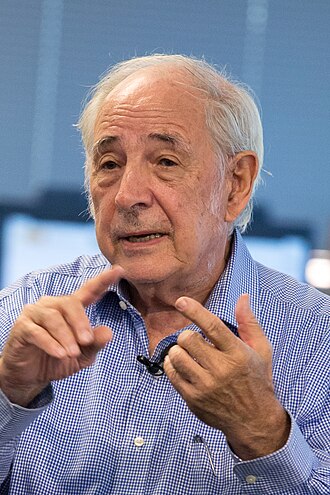
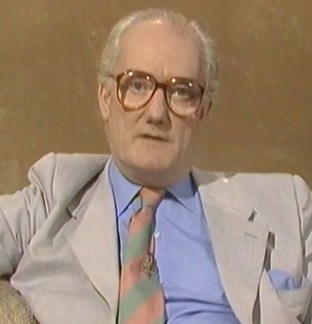
约翰·塞尔 布莱恩·马吉
章节 · 点击跳转视频
0:14 引言:语言为何成为时代议题 ▶ 正在看
2:12 语言分析 vs 语言哲学之辨 ▶ 正在看
4:10 语言进入经验的结构 ▶ 正在看
8:10 语言何以在20世纪变得成问题 ▶ 正在看
10:40 从笛卡尔到弗雷格:意义先于知识 ▶ 正在看
13:06 两条路线与语言学的闯入 ▶ 正在看
17:24 词与物:从图像论到戴维森 ▶ 正在看
22:02 言语行为:从物理到语义 ▶ 正在看
26:07 奥斯汀的施行式与以言行事 ▶ 正在看
30:44 意向性:语言与行动的汇合 ▶ 正在看
36:48 乔姆斯基的贡献与局限 ▶ 正在看
41:15 展望:语言哲学的三条前路 ▶ 正在看
本期小问 · 档案清单
36:48 会说话,就等于理解吗? ▶ 正在看
4:10 语言塑造思想吗? ▶ 正在看
17:24 语言还承载意义吗? ▶ 正在看
10:40 我们真的在理解世界吗? ▶ 正在看
本期讲者
约翰·塞尔美国哲学家,加州大学伯克利分校教授,奥斯汀的学生。1969年出版《言语行为》系统化言语行为理论,后以《意向性》《中文屋论证》《社会实在的建构》闻名。
布莱恩·马吉英国哲学家、作家、广播人,曾任工党议员。主持BBC哲学访谈系列《Men of Ideas》(1978)与《The Great Philosophers》(1987),以清晰的哲学普及著称。
01引言:语言为何成为时代议题
0:14
Bertrand Russell once said that until the second decade of this century -- and remember that, by that time, he was in his forties and had done virtually all the philosophical work for which he's really distinguished -- he regarded language as transparent. That's to say, as a medium, he could simply use without paying particular attention to it. Much the same must be true, I think, not only of other philosophers, but of writers of every kind -- novelists, poets, and so on. It's only in this century that the enormous self-consciousness of language, which we now take for granted, has developed. In fact, it's become one of the most prominent intellectual characteristics of our age.
伯特兰·罗素曾说过,直到本世纪的第二个十年——请记住,到那时他已经四十多岁,几乎已经完成了让他真正卓有声望的全部哲学工作——他都把语言看作是透明的。也就是说,把它当作一种媒介,可以直接拿来用,而不必特别去留意它。我想,这种情况大体上不仅适用于其他哲学家,也适用于各类作家——小说家、诗人等等。直到本世纪,我们如今习以为常的那种对语言的高度自觉才发展起来。事实上,它已经成为我们这个时代最突出的思想特征之一。
便签笔记
0:55
What's involved isn't just a superficial interest in words, but beliefs about absolutely fundamental matters. For instance, it's come to be widely believed that it's, more than anything else, the particular power of abstract thinking, made possible to us by language, that enables us to conceptualize a cope with innumerable aspects of reality which are not present to us, and thus relate ourselves to the world in the way we do. Many believe that it's this more than anything else that differentiates us from the animals.
这里涉及的不只是对词语的浅层兴趣,而是关于一些根本问题的信念。比如说,人们现在普遍相信,最重要的一点在于,语言赋予我们的那种独特的抽象思维能力,使我们能够对无数并不呈现在眼前的现实层面进行概念化并加以应对,从而以我们特有的方式与世界建立关联。许多人相信,正是这一点,比任何其他因素都更能把我们与动物区分开来。
便签笔记
1:28
And for all these reasons, many believe that it's through the acquisition of a language that we become selves. If many of these things are true, then language is fundamental to our humanity and our individuality in ways that were not dreamt of til comparatively recently. And this, I think, is the underlying reason why philosophers have newly come to take such a powerful and, indeed, passionate interest in language. A philosopher of language who has made a reputation on both sides of the Atlantic is the American John Searle. He first started philosophy at Oxford, where he arrived as a Rhodes Scholar in the early 1950s. And he taught at Oxford for some years before returning to the United States.
出于所有这些理由,许多人相信,我们正是通过习得语言才成为自我的。如果这些说法有很多是真的,那么语言就以直到不久前还无人设想过的方式,构成了我们人性与个体性的根基。而我认为,这就是哲学家近来对语言产生如此强烈、乃至热切兴趣的深层原因。有一位在大西洋两岸都享有声望的语言哲学家,就是美国人约翰·塞尔。他最初在牛津开始研究哲学,五十年代初以罗德学者的身份来到那里。回美国之前,他在牛津教了几年书。
便签笔记
02语言分析 vs 语言哲学之辨
2:12
His book called Speech Acts, published in 1969, is something of a recent classic. He's now a professor of philosophy at the University of California in Berkeley. Professor Searle, there's one thing which I think we must get straight right at the beginning. I've been talking about the philosophy of language. But there is another phrase, "linguistic philosophy" or "linguistic analysis," which means something quite different. And this could be very confusing to our viewers unless we make the distinction clear at the outset.
他1969年出版的《言语行为》一书,可以说是近年的一部经典。他现在是加州大学伯克利分校的哲学教授。塞尔教授,有一件事我想我们一开始就必须弄清楚。我一直在谈论语言哲学。但还有另一个说法,“语言哲学(linguistic philosophy)”或者“语言分析”,它指的是完全不同的东西。除非我们一开始就把这个区分讲明白,否则会让观众非常困惑。
便签笔记
2:43
Yes, well, it can be made very simply. "Linguistic philosophy" and "linguistic analysis" are names techniques or methods for solving philosophical problems. The philosophy of language is not the name of a technique, but the name of a subject matter, branch of philosophy. I'll give you a couple of examples. The linguistic philosopher believes that you can solve certain traditional problems, such as problems about skepticism, by examining the ordinary use of words such as "know." You examine the use-- Know, know-- K-N-O-W.
是的,这一点其实可以说得很简单。“语言哲学(linguistic philosophy)”和“语言分析”是解决哲学问题的技巧或方法的名称。而语言哲学(philosophy of language)不是一种技巧的名称,而是一个研究领域、哲学的一个分支的名称。我举几个例子。持语言分析立场的哲学家相信,你可以通过考察诸如“知道”这类词的日常用法,来解决某些传统问题,比如关于怀疑论的问题。你考察这个用法——know,知道——K-N-O-W。
便签笔记
3:14
K-N-O-W-- verbs like "know," "believe," "suppose," "guess." Now, that would be a problem that the linguistic philosopher would work on. The philosophy of language is the name of a subject matter within philosophy. And there, the problems are such things as how do words relate to reality? What is the nature of meaning? What is truth, reference, logical necessity? Those are problems in the subject matter of the philosophy of language. Now, obviously, philosophers of language like yourself regard language as being absolutely fundamental to human life and human thought and so on. I tried to explain just now in my introduction to this discussion some of the reasons why, but I think it would be especially interesting to hear from you, as a professional in the field, your reasons for regarding language as being as central as you clearly do regard it as being.
K-N-O-W——像“知道”“相信”“假定”“猜测”这类动词。这就属于语言分析哲学家会处理的问题。而语言哲学则是哲学内部一个研究领域的名称。在那里,问题是诸如:词语如何与实在相关联?意义的本质是什么?什么是真、指称、逻辑必然性?这些才是语言哲学这一研究领域中的问题。那么显然,像您这样的语言哲学家认为,语言对人类生活、人类思想等等来说是绝对根本的。我刚才在这次讨论的开场白里试着解释了其中的一些原因,但我想,听听您作为这个领域的专业人士的看法,会特别有意思,您为什么认为语言像您显然认为的那样处于如此核心的地位。
便签笔记
03语言进入经验的结构
4:10
Well, I think to begin with, it's almost bound to be central to philosophy. Philosophy is, in an important sense, a conceptual inquiry. But quite apart from philosophy, I think language is crucial, for some of the reasons you were suggesting, crucial to an understanding of human beings and human life. We tend, in a pre-theoretical way, to have the idea that words are, as you said, transparent-- quoting Russell-- and that we can just apply them. We just name our experiences and our social relations. But in fact, when we began to investigate, what I think we find is that those forms of experience and those forms of social relations that we regard as characteristically human would be impossible without language, that language really is what distinguishes us more than anything else from other forms of animal life.
嗯,我想首先,它几乎必然是哲学的核心。从一个重要的意义上说,哲学是一种概念性的探究。但撇开哲学不谈,我认为语言至关重要,部分原因正如您刚才所提示的,它对于理解人类和人类生活是至关重要的。我们往往会以一种前理论的方式认为,词语像您所说的那样是「透明的」——引用罗素的说法——我们只需要把它们套用上去就行了。我们只是给自己的经验和社会关系命名。但事实上,当我们开始探究时,我认为我们会发现,那些被我们视为人类所特有的经验形式和社会关系形式,若没有语言便根本不可能存在,语言确实是把我们与其他动物生命形式区分开来的最主要的东西。
便签笔记
4:58
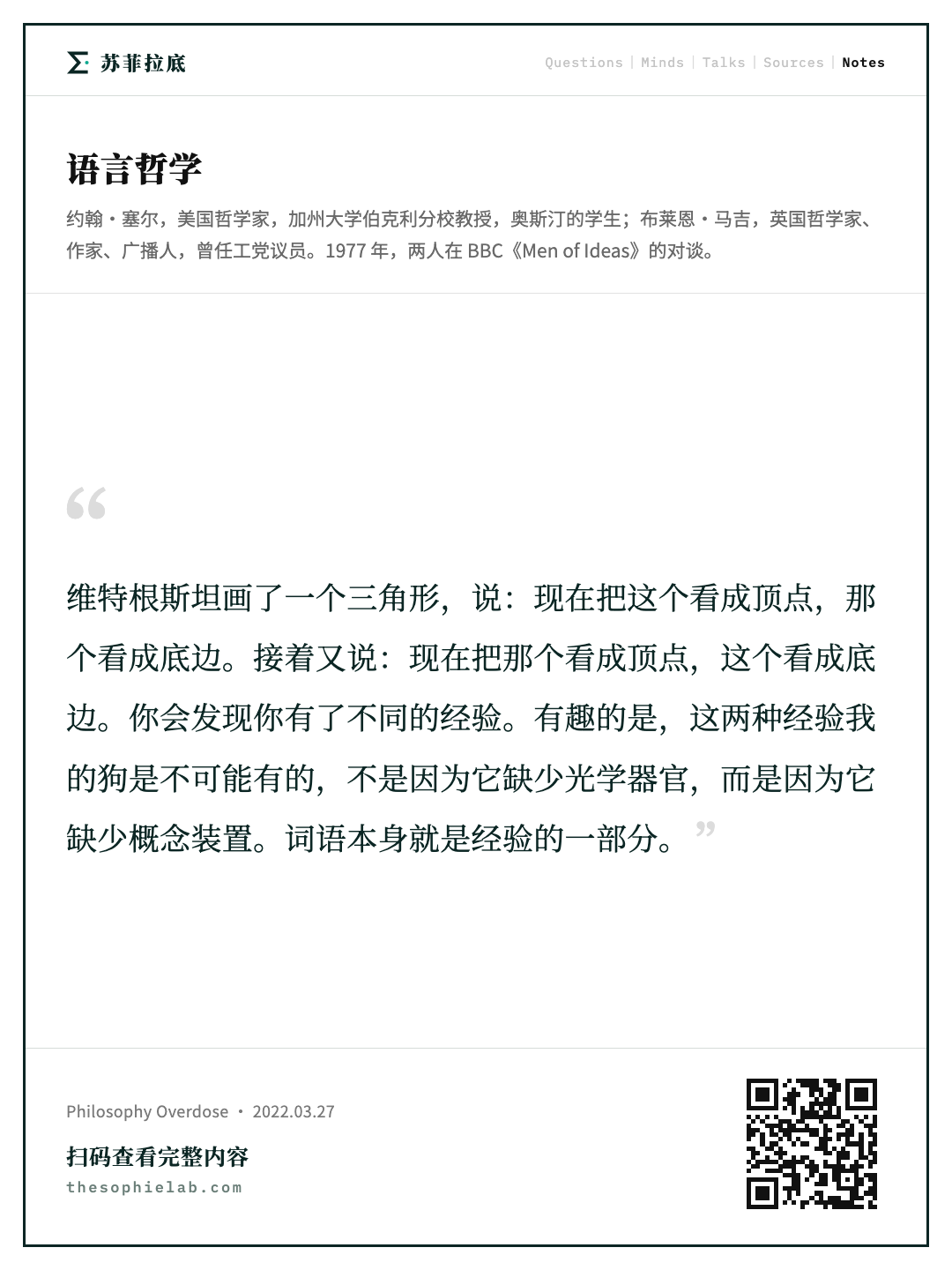
I'll give you a couple of examples. Wittgenstein gave a very simple example to illustrate this about experience. It might seem obvious that our experience has just come to us independently of any language. But what Wittgenstein pointed out was a great many of our experiences would be impossible without language and gives this example. He draws a triangle. And he says, now see this as apex and that as base. And then he says, now see that as apex and that as base. And you'll find you have a different experience. I've named two different experiences that you can have.
我举几个例子。维特根斯坦举过一个非常简单的例子来说明经验这一点。看起来似乎很明显,我们的经验就是这么来到我们面前的,跟任何语言都无关。但维特根斯坦指出,我们的许多经验若没有语言就不可能发生,他举了这样一个例子。他画了一个三角形。然后他说,现在把这个看作顶点,把那条看作底边。接着他又说,现在把那个看作顶点,把那条看作底边。你会发现你有了一种不同的经验。我刚才命名了你可以拥有的两种不同经验。
便签笔记
5:30
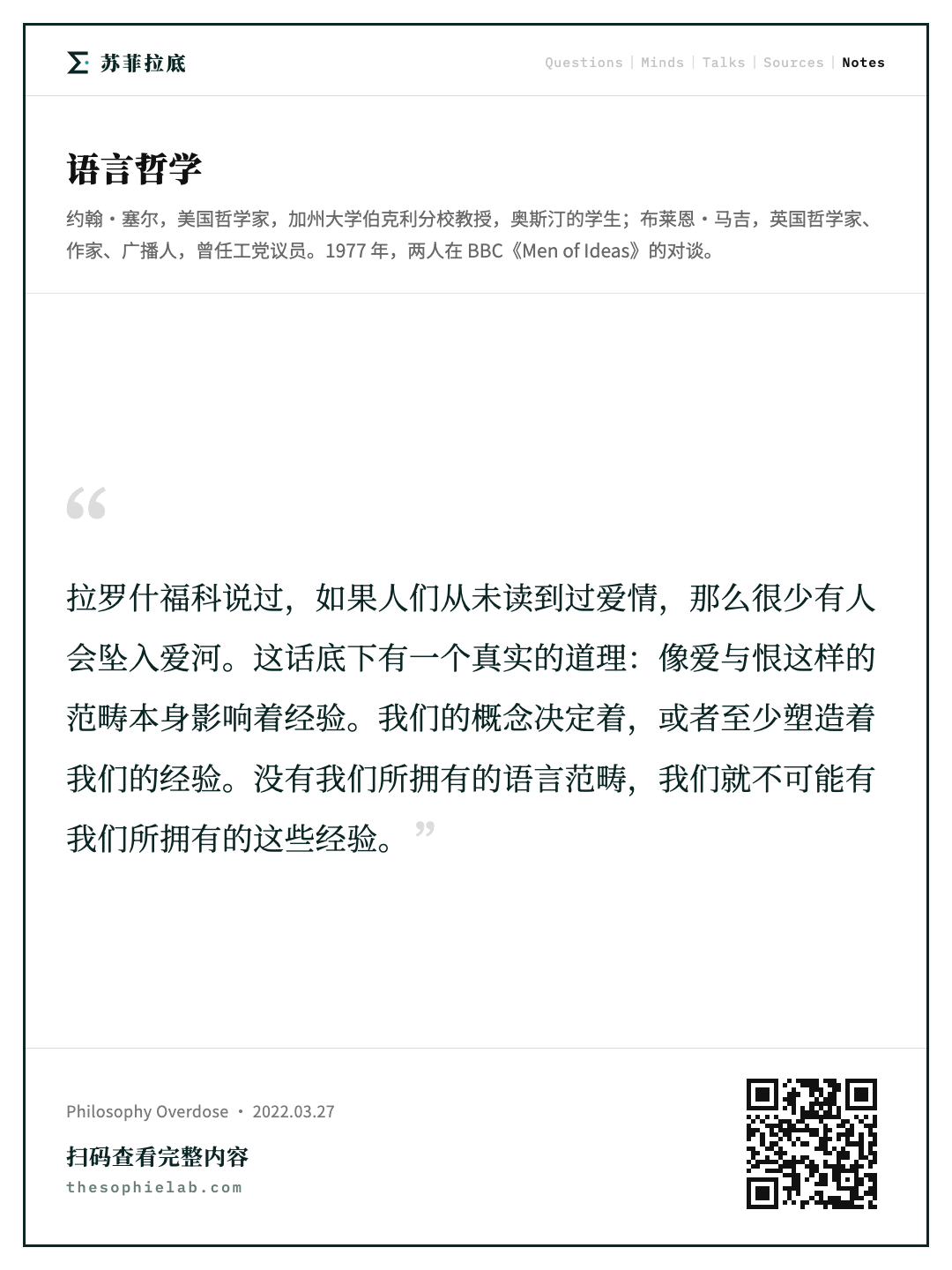
But the interesting thing is, they're not experiences my dog can have, not because he hasn't got the optical apparatus, but because he hasn't got the conceptual apparatus. The words, we want to say, are part of the experience. Now, that's a trivial example. And one can give lots of more grand examples. I mean, just take the following. La Rochefoucauld said-- I forget where-- that very few people would fall in love if they never read about it. And I think there is a real underlying truth in that and that is that categories like love and hate themselves influence the experiences, that our concepts determine or at least shape our experiences, that it would be impossible to have the experiences that we have without the linguistic categories we have.
但有趣的是,这些经验是我的狗不可能拥有的,不是因为它没有相应的视觉器官,而是因为它没有相应的概念装置。我们想说,词语是经验的一部分。当然,这是个不起眼的例子。人们还可以举出很多更宏大的例子。比如说,拉罗什富科曾说过——我忘了出处——如果人们从未读到过爱情,很少有人会坠入爱河。我认为这里面确实有一层真理,那就是像爱与恨这样的范畴本身会影响经验,我们的概念决定、或至少塑造了我们的经验,如果没有我们所拥有的那些语言范畴,我们就不可能拥有我们现在所拥有的经验。
便签笔记
6:14
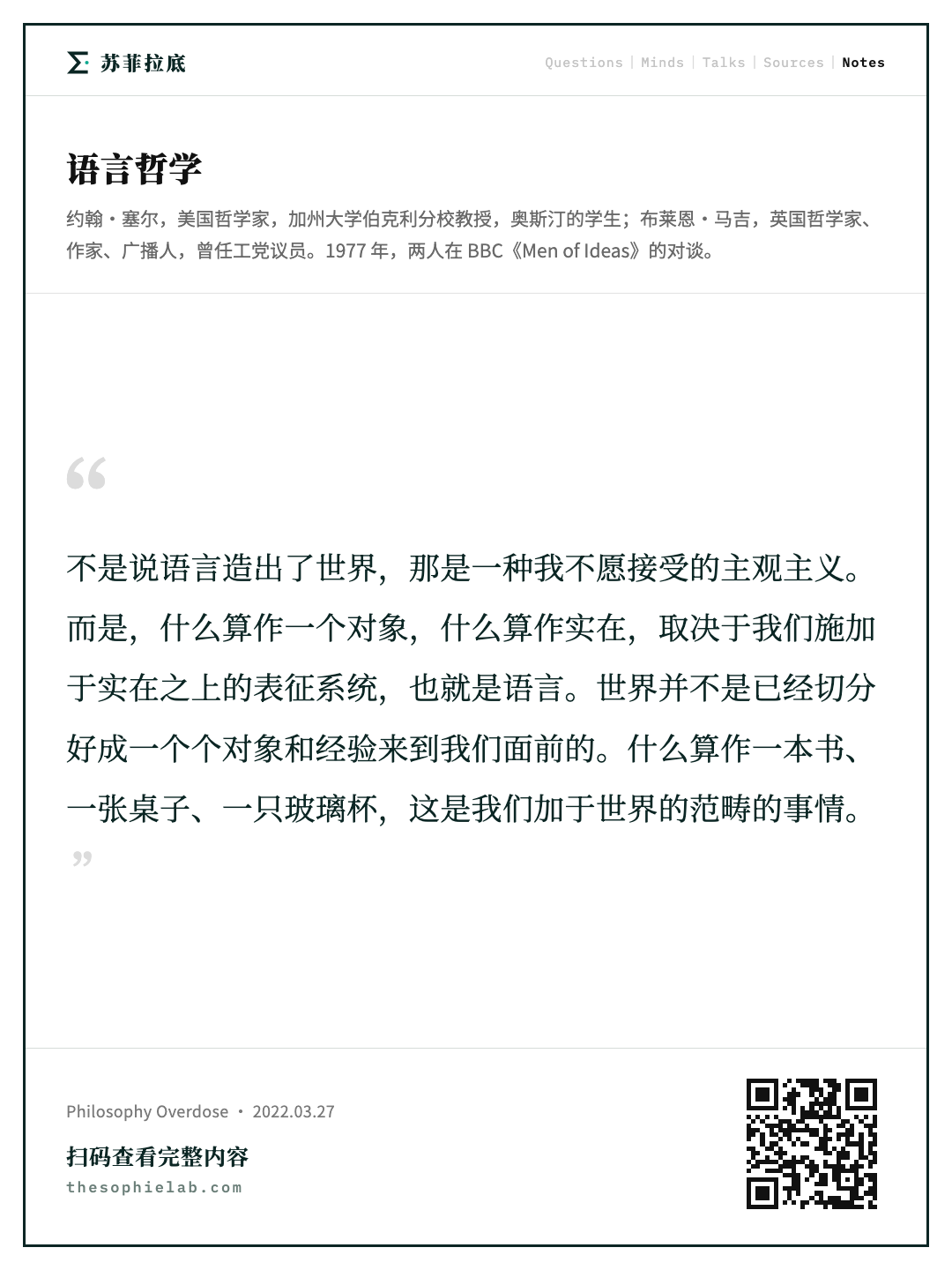
In other words, our experience of the world doesn't consist of the world as a lot of independent objects to which we as human beings then attach the labels of name, i.e. Words. What you're saying is the objects don't exist separately from words, that the words enter into the very structure of our experience. Yes, now let me see if I can say what I think you're driving at. It would be this-- not that language makes the world. That's the kind of subjectivism that I wouldn't want to accept, but rather something like this. What counts as an object, what counts as reality is a function of the system of representation that we bring to bear on reality, namely language.
换句话说,我们对世界的经验并不是这样构成的:世界是一大堆独立的对象,然后我们人类再给它们贴上名称的标签,也就是词语。您的意思是,对象并不是独立于词语而存在的,词语进入了我们经验的结构本身。是的,让我试试能不能把我理解的您的意思说清楚。会是这样——并不是说语言创造了世界。那是一种我不愿接受的主观主义,而是类似这样:什么算作一个对象、什么算作实在,取决于我们用来把握实在的那套表征系统,也就是语言。
便签笔记
6:56
So the world doesn't come to us all sliced up into objects and experiences. What counts as this object or the same object or as a book or a table or a glass, that is a matter of the categories that we impose on the world. And those are linguistic. Would you say this is true of, say, an everyday object? Now, I'm holding here a glass of water. And I'm having the simple experience of seeing a glass of water. Now, for me to have the experience of seeing a glass of water, it's not enough for me simply to be having certain visual data. I've also got to have the concept "glass" and the concept "water."
所以世界并不是已经切分成对象和经验之后才来到我们面前的。什么算作这个对象、算作同一个对象,或者算作一本书、一张桌子、一只杯子,这取决于我们强加给世界的那些范畴。而这些范畴是语言性的。您会说这一点对于日常物件也成立吗?比如说,我手里拿着一杯水。我正在经历「看见一杯水」这样一个简单的经验。那么,要让我拥有看见一杯水的经验,光是接收到某些视觉材料是不够的。我还必须拥有「杯子」这个概念和「水」这个概念。
便签笔记
7:32
Precisely. And I've got to be able to locate this experience as coming under that concept. And, therefore, I couldn't have the experience of seeing a glass of water without some linguistic equipment. That's the point I'm making, precisely that. And, therefore, the language that we have helps to create the very categories in which we experience the world-- the very categories in which we see objects has language built into them, is what you're saying. It's precisely that. Therefore, by investigations in the philosophy of language, we are investigating the very structure of experience and the structure of whole ways of life and ways of viewing the world and so on.
正是如此。而且我必须能够把这个经验归到那个概念之下。因此,如果没有某种语言装备,我就不可能拥有看见一杯水的经验。我要说的正是这一点,一点没错。因此,我们所拥有的语言帮助创造了我们借以经验世界的那些范畴本身——我们借以看见对象的那些范畴本身就内建了语言,您说的是这个意思。正是这样。所以,通过语言哲学的研究,我们其实是在研究经验的结构本身,研究整个生活方式、看待世界的方式等等的结构。
便签笔记
04语言何以在20世纪变得成问题
8:10
And, indeed, that was one of Wittgenstein's great themes, was the idea that a language is a form of life and that we should think of language as inner-penetrating with our life, not as something that stands outside and pictures it, as he once thought. Now, another thing I said in my introduction to this was that this enormous self-consciousness about the use of language is something that characterizes this century. It's very striking that something that is similar is true of the arts as well. For example, in this century, an enormous amount of poetry is being written about the writing of poetry or about how difficult it is to be a poet. We have filmmakers making films about the making of a film. And it's true of plays. And painting has, so to speak, exhibited it's own techniques.
确实如此,这也是维特根斯坦的一大主题,即语言是一种生活形式,我们应当把语言看作与我们的生活相互渗透的东西,而不是像他早年所认为的那样,是站在生活之外去描画它的东西。接下来,我在开场介绍里还说过一点,就是这种对语言使用的高度自觉是本世纪的一个特征。很引人注目的是,艺术领域也有类似的情况。比如在本世纪,有大量的诗是在写「写诗」这件事,或者写当一个诗人有多难。有电影人拍关于拍电影的电影。戏剧也是如此。绘画则可以说是在展示它自己的技法。
便签笔记
8:58
Even musical composition exhibits its own techniques. Art has become its own subject matter. The medium has itself become the object of attention. Now, there's a obvious parallel there with what has happened with language and philosophy. Do you think that these developments are all interconnected? Or do you think it's sheer coincidence? It surely is not sheer coincidence. I mean, I think there are certain features of the 20th century mode of sensibility that makes language seem immensely problematic to us. But let me disagree with one thing you've said. It isn't that philosophers have suddenly discovered language in the 20th century.
连音乐创作也在展示它自己的技法。艺术成了它自己的题材。媒介本身成了关注的对象。那么,这跟语言与哲学领域所发生的事情有一个明显的平行关系。您认为这些发展彼此之间是有关联的呢,还是纯属巧合?这当然不是纯粹的巧合。我认为20世纪的某些感受方式的特征,使得语言在我们看来极成问题。不过我要对您说的一点提出异议。并不是说哲学家们在20世纪才突然发现了语言。
便签笔记
9:35
There's a lot about language in-- Locke devoted a whole book of the Essay to it. There's a theory of language in Hume. And indeed, back to Plato and the Theaetetus there are theories of language. So it isn't something we've recently discovered. But the point I think you're making-- and I entirely agree with it-- is that language has come to seem problematic. It has come to seem-- to use your quotation from Russell-- not a matter of transparency. It isn't something that we can see right through to the world. It is itself a problem.
关于语言的论述有很多——洛克在《人类理解论》中专门用了一整卷来谈它。休谟那里也有一套语言理论。实际上,一直追溯到柏拉图的《泰阿泰德篇》就已经有语言理论了。所以这并不是我们最近才发现的东西。但我想您要说的一点——我完全同意——是语言开始显得成问题了。用您引用罗素的话说,它不再是透明的了。它不再是那种我们可以一眼看穿、直达世界的东西。它本身成了一个问题。
便签笔记
10:05
And I think that has a great deal to do with something like the tremendous loss of confidence, the decline of rationality that occurred at the end of the 19th century. One doesn't know quite how to date the rise of modernism. But it is part of modernism in the arts. And surely, I can't, as you say-- it can't be just coincidental that the same awareness of the complexity and the problematic character of language exists in philosophy. Contrast Mill with the later Wittgenstein. And I think you see the break that I'm talking about now.
我认为这跟19世纪末出现的那种信心的巨大丧失、理性的衰落有很大关系。人们说不太准现代主义兴起的确切时间。但这是艺术中现代主义的一部分。而且确实,正如您所说——同样这种对语言的复杂性和问题性的自觉出现在哲学中,不可能只是巧合。把密尔和后期维特根斯坦对照一下,我想您就能看到我说的那种断裂。
便签笔记
05从笛卡尔到弗雷格:意义先于知识
10:40
You're stressing then that self-consciousness about language, in fact, goes back quite a long way in philosophy, probably further than it does in the arts with poetry and so on. Now, what were the specifically philosophical developments that brought it to a head in this century in the way that it did. Right, right. Well, now, that is a marvelously complicated subject. And let me pick out a couple of strands in that. First of all, there's a historical development. Descartes, over three centuries ago, asked this basic question in philosophy-- what is knowledge? How is knowledge possible?
那么您强调的是,对语言的这种自觉在哲学中其实可以追溯得相当久远,可能比在诗歌等艺术中还要早。那么,究竟是哪些哲学内部的发展,使它在本世纪以那样的方式达到了顶点呢?对,对。这是个极其复杂的题目。让我从中挑出几条线索来讲。首先是一条历史性的发展线索。三个多世纪以前,笛卡尔在哲学中提出了这个根本问题——什么是知识?知识如何可能?
便签笔记
11:14
And I think if you take that question very seriously-- and we have in philosophy. That has been the central question for the centuries after Descartes. Eventually, that leads you to what will, I think, almost inevitably seem a more fundamental question-- namely, how does our mind represent the world at all? The question of what is meaning has come to seem prior to the question, what is knowledge. And there's certain other historical, certain specific historical features that led to that. Particularly, I would say the work of Frege in the 19th century, the German philosopher and mathematician, and the work of Russell in the early 20th century.
我认为,如果你非常认真地对待这个问题——而我们在哲学中确实如此。在笛卡尔之后的几个世纪里,这一直是核心问题。最终,它会把你引向一个我认为几乎不可避免地显得更根本的问题——即我们的心灵究竟是如何表征世界的?「什么是意义」这个问题,开始显得比「什么是知识」更为优先。还有另外一些历史性的、具体的因素导致了这一点。我特别要提到19世纪德国哲学家兼数学家弗雷格的工作,以及20世纪初罗素的工作。
便签笔记
11:53
And both of them were engaged in an investigation of the foundations of mathematics and the nature of mathematical knowledge. And they were led to develop certain theories about the nature of linguistic representation. In order to answer questions about the nature of mathematics and what goes on in mathematical statements, they were led to fundamental questions about the nature of statement making. Well, how? I mean, what is the connection between mathematical knowledge-- which would seem to be purely abstract and carried out in Greek symbols and such-- what is the connection between that and ordinary statements of the kind that philosophers now analyze.
他们两位都在从事对数学基础和数学知识本性的研究。而这把他们引向了关于语言表征本性的某些理论的建构。为了回答有关数学本性以及数学陈述中究竟发生了什么的问题,他们被引向了关于「作出陈述」这件事之本性的根本问题。可这是怎么发生的呢?我是说,数学知识——它看起来纯粹是抽象的,用希腊字母之类的符号进行——它跟哲学家们如今分析的那类日常陈述之间,有什么联系呢?
便签笔记
12:29
Well, there are numerous connections. But one basic connection was, what is the nature of mathematical truth? And both Frege and Russell argued that mathematics was really an extension of logic, that the statements of mathematics were true, in a sense, by definition. And in order to develop that, they needed a theory of truth and a theory of logic. And already now, we're in the philosophy of language when they began to develop that. So in other words, it's investigation into truth which develops into a investigation into meaning and, hence, an analysis of statements, sentences, and so on.
联系有很多。但有一个基本的联系是:数学真理的本性是什么?弗雷格和罗素都论证说,数学其实是逻辑的延伸,数学的陈述在某种意义上是凭定义为真的。而要把这一点展开,他们就需要一套真理理论和一套逻辑理论。一旦他们开始建构这些,我们就已经身处语言哲学之中了。换句话说,是对真理的研究发展成了对意义的研究,进而发展成对陈述、句子等等的分析。
便签笔记
06两条路线与语言学的闯入
13:06
Historically, I think it went that way. How did we get from Russell at the turn of the century to now? I think we can identify several lines of development. And oddly enough, Wittgenstein tends to play a crucial role in more than one of them. There's one line of development that goes from early Wittgenstein through the logical positivists like Carnap-- and I think one would include Russell's work in this line as well-- up to the present day and the works of philosophers like Quine and Davidson. Now, that line is mostly concerned with the relationship between meaning and truth.
从历史上看,我认为过程就是这样的。那么我们是怎么从世纪之交的罗素走到今天的呢?我认为可以辨认出好几条发展路线。而奇妙的是,维特根斯坦在其中不止一条路线里都扮演了关键角色。有一条发展路线是从早期维特根斯坦,经过卡尔纳普这样的逻辑实证主义者——我想罗素的工作也应该算在这条线里——一直延伸到今天,到蒯因和戴维森这样的哲学家的著作。这条路线主要关心的是意义与真理之间的关系。
便签笔记
13:43
And the crucial question tends to be, what are the true conditions of an utterance? They are mostly concerned with conditions for establishing or determining the truth of sentences. And, obviously, this line will be more closely connected with the philosophy of science. Now, another line, which is the later Wittgenstein, and also the work of philosophers like Austin and Grice-- and I think I would include myself in this-- is more concerned with questions of linguistic use, with language seen as a part of human behavior. And the crucial question there is not what is the relation between meaning and truth, but what is the relation between meaning and use or meaning and the intentions with which a speaker makes an utterance? Now, those are two lines that I see developing. And I don't want to give you the impression that they're completely independent. No, they overlap and intertwine and interact in all sorts of ways.
而关键问题往往是:一个话语的真值条件是什么?他们主要关心的是确立或判定句子真假的条件。而且显然,这条路线跟科学哲学的联系会更紧密。另一条路线是后期维特根斯坦,还有奥斯汀、格赖斯这样的哲学家的工作——我想我自己也可以算进去——更关心的是语言使用的问题,把语言看作人类行为的一部分。这里的关键问题不是意义与真理的关系,而是意义与使用的关系,或者意义与说话者作出话语时的意图之间的关系。这就是我看到的正在发展的两条路线。我并不想给您留下它们完全彼此独立的印象。不,它们以各种方式重叠、交织、互动。
便签笔记
14:39
But then there's the third line that has come to seem very prominent in recent years. And that is the science of linguistics of which-- and Chomsky's name is the most prominent among contemporary linguists-- has come to interact with philosophy in ways that were not the case until really quite recently, until after 1957. You've made so many important points at once, Professor Searle, that I think it will be helpful if I sort of, so to speak, recapitulate before we start moving ahead. We're considering language, this amazing phenomenon of words and utterances and noises that is so fundamental to our humanity and to the way we cope with life and see the world and everything. Now, you might say there are two main ends to this process.
不过还有第三条路线,近些年来显得非常突出。那就是语言学这门科学——在当代语言学家中乔姆斯基的名字最为醒目——它开始以直到相当晚近、直到1957年之后才出现的方式与哲学发生互动。塞尔教授,您一口气提出了太多重要的观点,我想在我们继续往下走之前,先做个梳理回顾可能会有帮助。我们正在讨论语言,这个由词语、话语和声音构成的奇妙现象,它对我们的人性、对我们应对生活、看待世界等等都如此根本。那么可以说,这个过程有两端。
便签笔记
15:26
There is the relationship of language to the world, the relationship of language to its objects, to all the things in the world that we talk about. And there is also the relationship of language to the language user. So this gives, as it were, two lines of development in the history of the subject we are considering. One lot of people have concentrated on discussing the relationship of words to their objects. And what that leads them to do is to analyze sentences and statements. It leads them to consider, above all else, the, question of under what conditions can statements be said to be true or false. And that leads them to develop formal criteria of truth and so on. That's one line of development that you mentioned. And you named Russell, the early Wittgenstein, Carnap, and Davidson as being the main-- And Quine.
一端是语言与世界的关系,是语言与其对象、与我们所谈论的世界上一切事物的关系。另一端则是语言与语言使用者的关系。这样一来,在我们所讨论的这门学科的历史上,就有了两条发展路线。一批人集中讨论词语与其对象之间的关系。这促使他们去分析句子和陈述。这促使他们首先去思考这样一个问题:在什么条件下可以说一个陈述为真或为假。而这又促使他们去发展形式化的真理标准等等。这是您提到的一条发展路线。您点名了罗素、早期维特根斯坦、卡尔纳普和戴维森,认为他们是主要的——还有蒯因。
便签笔记
16:15
--and Quine, of course, yes. Now, the other line of development is interestingly different from that. That considers the subjects of language, not the objects of language-- in other words, the human beings using language. And the questions there are about their intentions. What are they using language for? What are their purposes? Well, now, you didn't say who the main people in that line of development were. But I-- No, I did-- a later Wittgenstein, Austin, and I would include [? Grice, ?] and Strawson, and other people as well.
——当然还有蒯因,是的。另一条发展路线则跟这条有着有趣的不同。它考察的是语言的主体,而不是语言的对象——换句话说,是使用语言的人。那里的问题是关于他们的意图的。他们用语言来做什么?他们的目的是什么?那么,您刚才没说这条路线上的主要人物有谁。不过我——不,我说了——后期维特根斯坦、奥斯汀,我还要加上格赖斯、斯特劳森,以及其他一些人。
便签笔记
16:48
Yes, yes. And so those are the two main lines of development of the philosophy of language. And then as a sort of third, you threw in Chomsky in linguistics. I didn't throw it in. It comes charging in. It comes charging in. Well, now, right. Now, we've got that sketch map of the field. Is Now, for clarity's sake, let's take these one at a time. Now, let's start by discussing the school of thought that is interested in the relationship between language and its objects-- in other words, to use the most famous phrase, words and things. Can you unpack that a little?
对,对。那么这就是语言哲学的两条主要发展路线。然后作为某种第三条,您把语言学里的乔姆斯基抛了进来。不是我把它抛进来的。是它自己冲杀进来的。是它冲杀进来的。好,那么,对。现在我们有了这个领域的草图。那么,为了讲清楚,我们一次谈一条。先从对语言与其对象之关系感兴趣的那个学派开始——换句话说,用那个最有名的说法,就是「词与物」。您能稍微展开讲讲吗?
便签笔记
07词与物:从图像论到戴维森
17:24
Well, let me-- should I do it by way of telling you something about the central figures? I think perhaps that's one way to go about it. Yes, yeah. Well, an epoch-making book in this field is Wittgenstein's Tractatus Logico-Philosophicus. And he there articulates a very powerful theory of language, that sentences consistent, for him, as-- it consists of being, in effect, pictures. They are conventionalized pictures of facts, not that they actually look like the fact but that the relation between the way a sentence represents and the way a picture represents is structurally quite close. And then this picture theory of meaning, as it was called, formed the basis of his theory of language.
那么,让我——我是不是该通过介绍几位核心人物来讲?我想那也许是个办法。好的,好。这个领域里一部划时代的著作是维特根斯坦的《逻辑哲学论》。他在书中阐述了一套非常有力的语言理论:在他看来,句子实际上就是图画。它们是事实的约定化的图画,并不是说它们真的看起来像那个事实,而是说句子表征的方式与图画表征的方式在结构上相当接近。然后这个后来被称为「意义的图像论」的理论,构成了他整套语言理论的基础。
便签笔记
18:08
Now, he came to reject that later. But that had a powerful influence-- his book the Tractatus had a powerful influence on a school of philosophers who were known as the logical positivists. And their center was in Vienna between the wars. And they, I think at least partly misunderstanding Wittgenstein, took the question of verification, how do we verify a proposition as the central question in meaning. And their slogan was called the verification principle. And the question that they asked, the crucial question was in order to know what a sentence means, what must we do to find out whether or not it's true.
后来他自己否定了这一理论。但它产生了强大的影响——他的《逻辑哲学论》对一批被称为逻辑实证主义者的哲学家产生了强大的影响。他们的中心在两次大战之间的维也纳。而他们,我认为至少在部分上误解了维特根斯坦,他们把证实的问题,我们如何证实一个命题——这就是意义问题的核心。他们的口号叫作证实原则。而他们提出的问题,那个关键的问题是为了知道一个句子的意思,我们必须做什么才能弄清它是真还是假。
便签笔记
18:50
This was one way of putting the claim that the meaning of a statement is its method of verification. And they accepted the idea that all statements are either analytic or synthetic. Leading figure in this group, and perhaps the leading figure, is Carnap. And Carnap, though his views changed a great deal over the years, I think is primarily famous for this conception of language-- that is, that language primarily consists in statements that are true or false and that their meaning is intimately connected with their method of verification in such a way that we can define meaning in terms of verification.
这是表述“一个陈述的意义就是它的证实方法”这一主张的一种方式。而且他们接受这样一种看法:所有陈述要么是分析的,要么是综合的。这个群体中的一位领军人物,也许可以说是最主要的领军人物,就是卡尔纳普。卡尔纳普虽然观点这些年来变化很大,但我认为他最出名的还是这种语言观——也就是说,语言主要由有真假可言的陈述构成,而它们的意义与其证实方法密切相关,密切到我们可以用证实来定义意义。
便签笔记
19:31
Now then, when we get to more recent times, when we get to Quine, Quine is most famous, his single most famous work was an attack on the analytic-synthetic distinction. That is, he attacks the idea that we can make clear distinction between that truth which is in virtue of meaning and that which is in virtue of matters of fact. And this then lead in his more recent work to what I can only describe as a general rejection of the notion of meaning. Quine adopts a behavioristic conception of language. He sees us as beings who are bombarded by stimuli, verbal and otherwise. And then we make verbal responses. And all that really amounts to meaning is our dispositions to respond verbally. There isn't, in addition to these dispositions to verbal responses, anything called meanings going through our mind.
那么,当我们来到更晚近的时期,来到蒯因这里,蒯因最出名的,他最著名的那篇作品,是对分析—综合之分的攻击。也就是说,他攻击的是这样一种想法:我们可以在凭借意义为真的东西和凭借事实为真的东西之间划出清晰的界限。而这又导致他在后来的著作中走向了我只能称之为对“意义”这一概念的全面拒斥。蒯因采取了一种行为主义的语言观。他把我们看作被各种刺激——言语的和非言语的——轰击的存在物。然后我们做出言语反应。而所谓意义实际上归结起来无非就是我们做出言语反应的倾向。除了这些言语反应倾向之外,并不存在什么在我们心中流转的所谓“意义”。
便签笔记
20:31
So Quine's behaviorism is closely connected with his empiricism. But ironically, it led him to reject what had seemed one of the foundation stones of a earlier generation of empiricists, namely the distinction between analytic and synthetic proposition. His famous article is called "Two Dogmas of Empiricism." " Am I going too fast through these or you want to-- No, no. Shall I go on to Davidson, then? Yes, Davidson is the one person you mentioned that you haven't talked about. Now, Davidson incidentally is remarkably influential in England and, indeed, I would say more influential in England than he is in his home country, but for what perhaps is a very good reason. He's certainly a very powerful philosopher.
所以蒯因的行为主义和他的经验主义紧密相连。但讽刺的是,这却使他拒斥了在上一代经验主义者看来是奠基石之一的东西,也就是分析命题与综合命题的区分。他那篇著名的文章叫《经验主义的两个教条》。我讲这些是不是太快了,还是你想——不,不会。那我接着讲戴维森?是的,戴维森是你提到但还没谈过的那一位。顺带一提,戴维森在英国影响力非常大,说实话,我觉得他在英国的影响力比在他自己国家还要大,不过这大概有个很好的理由。他确实是一位非常有力量的哲学家。
便签笔记
21:15
Davidson argues that there is a more intimate connection between meaning and truth than previous philosophers have been aware of or least have made explicit. And that is this. If we wanted a theory of meaning for a language, the way to get that theory of meaning would be to get a set of principles which would enable us to deduce for any sentence of the language under what conditions it was true, so that, for Davidson, a theory of truth really is a theory of meaning. There isn't any gulf between meaning and truth there in that once we've got a theory that makes clear what are the truth conditions of sentences, that is already a theory of meaning of the sentences of the language.
戴维森论证说,意义和真理之间的联系比以往哲学家所意识到的、或者至少比他们明确说出来的还要紧密。具体是这样的。如果我们想要一种关于某种语言的意义理论,那么获得这种意义理论的办法,就是找到一组原则,使我们能够推导出该语言中任何一个句子在什么条件下为真。所以,对戴维森来说,真理理论其实就是意义理论。意义和真理之间并没有什么鸿沟——一旦我们有了一种理论,能够说清楚句子的真值条件,那它就已经是关于这门语言中句子的意义理论了。
便签笔记
08言语行为:从物理到语义
22:02
Well, I don't think we'll go any further into the work of each of these individuals, Professor Searle. I think we ought to move on now to the second of the main lines of development that you mentioned. And that is the line of development that's concerned with the intentions of speech users. Now, the central notion here is the notion of the speech act, isn't it, which is indeed the title of your famous book. The idea is that sentences don't just kind of exist in limbo. They don't exist all by themselves, autonomously in the universe.
好的,塞尔教授,我想我们就不再深入这几位学者各自的工作了。我觉得我们现在应该转向你提到的主要发展路线中的第二条。那就是关注语言使用者意图的那条发展路线。这里的核心概念是言语行为,对吧,这也正是你那本名著的书名。这个想法是说,句子并不是凭空悬在那里的。它们不是在宇宙中自行其是、独立存在的。
便签笔记
22:33
They are generated by human beings. And they're always generated in actual situations. And they're always generated for a purpose, in order to do something. And the idea is, isn't it, that you can only understand meaning if you understand the intentions of the language user. What is he doing when he utters something? Would you take-- Yes, well, let me go on with that. In the tradition that we're now talking about, it isn't that there is a rejection of the question, what is the relation between language and the world. Rather, that question is put in a larger context.
它们是人产生出来的。而且总是在具体情境中产生的。它们的产生总是有目的的,是为了做某件事。这个想法是不是说,你只有理解了语言使用者的意图,才能理解意义?他说出某句话时是在做什么?你要不要——是的,那我接着往下说。在我们现在谈的这个传统里,并不是说“语言与世界的关系是什么”这个问题被拒斥了。而是说,这个问题被放进了一个更大的语境中。
便签笔记
23:09
The question now becomes, well, what sort of behavior is linguistic behavior? And then the way that that is answered is in such a fashion as to try to explain how the speaker's intentions, how his rule-governed intentional behavior relates language to the world. So the question, how does language relate to reality, which I think is one of the fundamental questions-- perhaps the fundamental question in the philosophy of language-- is assimilated to what I think is the larger question. And that is, what is it about human beings that enabled them to, as you said earlier, make these noises that have such remarkable consequences-- among them is the consequence-- that they do relate to reality?
现在的问题变成了:语言行为究竟是哪一种行为?而回答这个问题的方式,是试图解释说话者的意图、他那受规则支配的意向性行为,是如何把语言与世界联系起来的。所以,“语言如何与实在相关联”这个问题——我认为这是语言哲学中最根本的问题之一,也许就是最根本的问题——被纳入了我认为更大的那个问题之中。那就是:人类身上究竟是什么,使他们能够像你先前说的那样,发出这些具有如此非凡后果的声音——其中一个后果就是,这些声音确实与实在相关联?
便签笔记
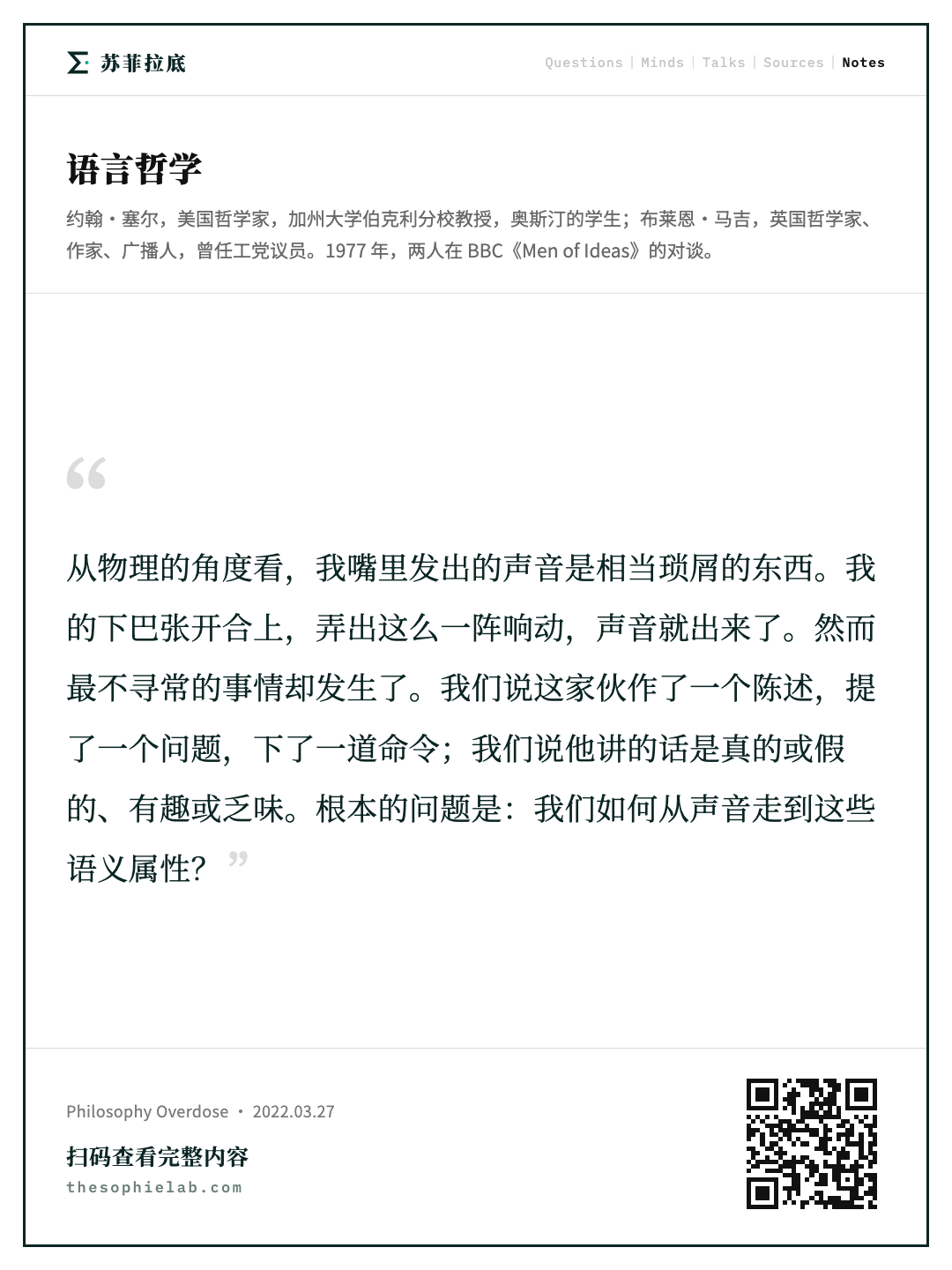
23:52
Look, for me in this tradition, the fundamental question is how is it that we get from the noises that come out of my mouth to all these semantic properties that we attribute to them? After all, from a physical point of view, the noises that come out of my mouth are fairly trivial stuff. I mean, my jaw flaps open and I make this racket. And out it comes. And in linguistics textbooks, there's all this ridiculous stuff in my throat and mouth that enables me to do that. But physically, it's all rather trivial. And yet the most remarkable things occur.
你看,在这个传统里,对我来说最根本的问题是:我们如何从我嘴里发出的这些声音,走到我们赋予它们的所有那些语义属性?毕竟,从物理的角度看,从我嘴里发出的这些声音是相当微不足道的东西。我是说,我的下巴一张一合,弄出这么一阵响声。它就这么出来了。语言学教科书里还写了一大堆关于我喉咙和口腔里那些让我能这么做的可笑玩意儿。但从物理上讲,这一切都相当微不足道。然而最非凡的事情却发生了。
便签笔记
24:23
We say that Chap made a statement or asked a question or gave a command or an order, explanation, that what he said was true or false or interesting or boring or uninteresting. We attribute all these remarkable properties to it. And one set of those properties are those that related to the world. Now, the basic idea behind this second approach is that the way that language relates to the world is a matter of how people do that relating. And the basic term of that, at least in the tradition as I see it, is, as you said, the notion of a speech act. When people do communicate with each other, whether in words or in writing, they perform a series of acts that we have names for such as making statements, asking questions, giving orders, commands, apologies. Austin, incidentally, claimed that he could get a list of about 1,000 such verbs and verb phrases in English.
我们说那家伙做了一个陈述,或提了一个问题,或下了一道命令、一道指令,或作了解释;说他说的话是真的还是假的,是有趣的还是无聊的、乏味的。我们把所有这些非凡的属性都赋予它。而其中一组属性,就是与世界相关的那些属性。那么,第二种进路背后的基本想法是:语言与世界发生关联的方式,取决于人们是如何进行这种关联的。而这一点的基本术语,至少在我所理解的这个传统里,就是你说的言语行为这个概念。当人们彼此交流时,无论是用口头还是书面,他们都在实施一系列我们有名称可称的行为,比如做陈述、提问题、下命令、下指令、道歉。顺带一提,奥斯汀声称他能列出英语中大约一千个这样的动词和动词短语。
便签笔记
25:11
Now, that is the alternative tradition. And I should say Wittgenstein's enormously important role in developing that-- the later Wittgenstein-- but it would be misleading if I said that he would agree with everything that I have said. And I think there's a basic point of disagreement. Wittgenstein, though he was really the person who gave this direction to the philosophy of language, the idea of looking at language as a form of human behavior and language as a form of life, nonetheless, he resisted making general theories of language. He thought any kind of general theorizing was almost about bound to lead to distortion and falsehood when we were doing philosophy. So though I regard myself as, at least in part, inspired by the work of Wittgenstein, I think he would reject the theoretical bent that I personally try to pursue and that Austin, I think, was pursuing.
这就是那个另一种传统。我还得说,维特根斯坦在推动这一发展上起了极其重要的作用——是后期维特根斯坦——但如果我说他会同意我讲的每一点,那就会误导人了。我认为有一个根本的分歧点。维特根斯坦虽然确实是给语言哲学指出这一方向的人,也就是把语言看作人类行为的一种形式、看作一种生活形式,但他仍然抗拒构建关于语言的一般理论。他认为,在做哲学时,任何一般化的理论建构几乎注定会导致扭曲和谬误。所以,尽管我认为自己至少在某种程度上受到维特根斯坦工作的启发,但我想他会拒斥我个人所追求的、以及我认为奥斯汀所追求的那种理论化倾向。
便签笔记
09奥斯汀的施行式与以言行事
26:07
I was going to say, the other really big figure in this tradition, apart from Wittgenstein, the later Wittgenstein, is JL Austin-- now alas dead, he died rather young-- an Oxford philosopher. And, indeed, you were a pupil of-- Yes, I was, indeed. --of Austin, weren't you? Can you say just a lit-- he invented the term "speech act." He didn't quite invent the term. It did exist in certain structural linguists such as Bloomfield in the 1930s. But in its modern meaning, it is Austin's invention. And he arrived at it by quite an interesting route.
我正想说,除了维特根斯坦——后期维特根斯坦——之外,这个传统中另一位真正重量级的人物就是 J.L. 奥斯汀——可惜他已经去世了,走得相当早——他是牛津的哲学家。而且你确实是他的学生——是的,我确实是。——是奥斯汀的学生,对吧?你能不能稍微讲——是他发明了“言语行为”这个术语。严格说他并没有发明这个词。这个词在二十世纪三十年代的一些结构主义语言学家那里就有了,比如布龙菲尔德。但就其现代含义而言,它是奥斯汀的发明。而且他是通过一条相当有意思的路径得出它的。
便签笔记
26:36
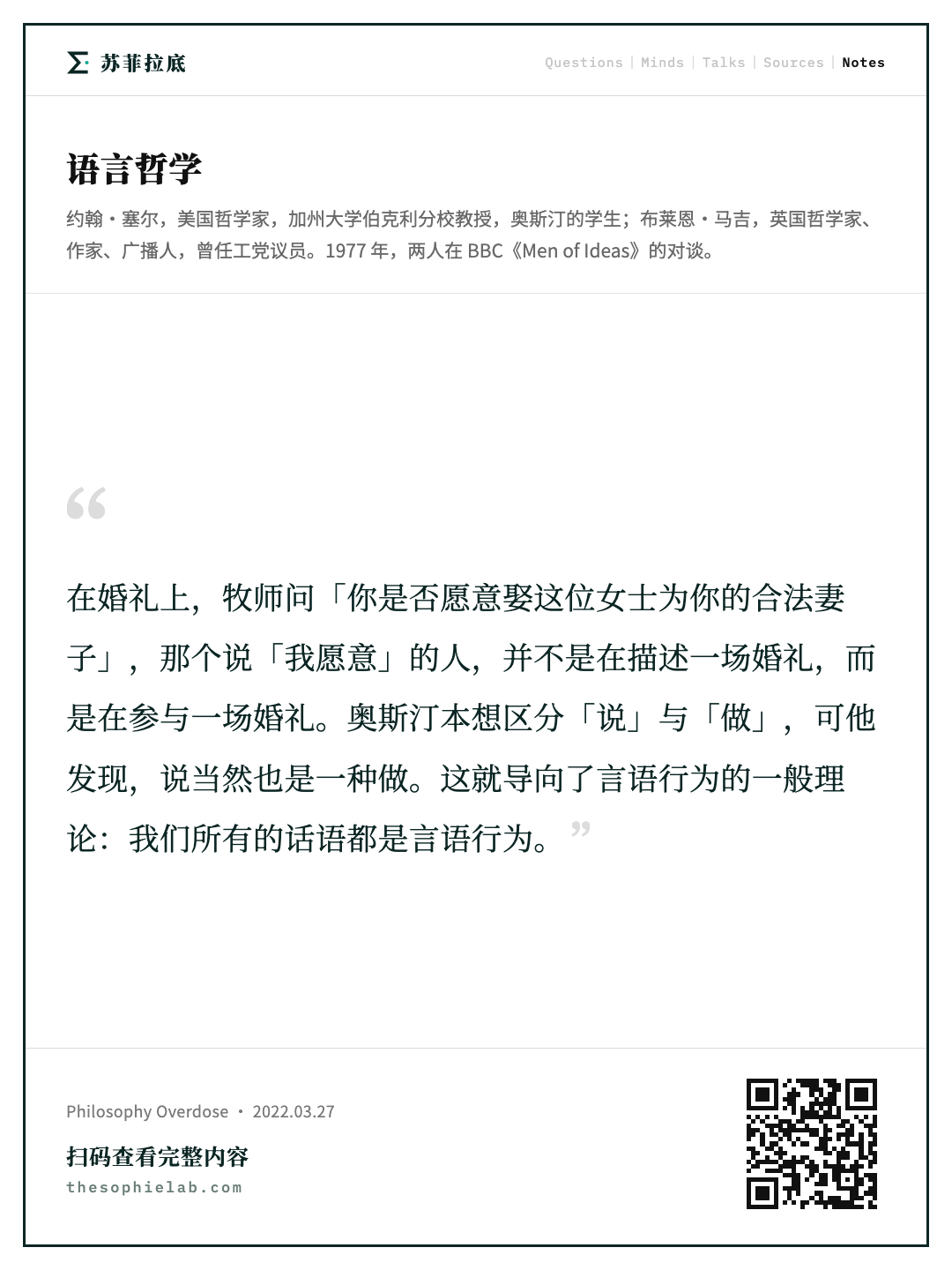
Before Austin, the primary concern of philosophers of language had been with those utterances that are true or false. And indeed, as I was saying earlier, verification loomed large. And there were such questions as whether or not propositions that weren't verifiable could even be said to be meaningful, the logical positivists arguing that they couldn't. Now, Austin made an interesting observation. He observed that there are lots of utterances that don't set out to be true or false, that-- I mean, he gave the following example. He said, in a wedding ceremony and when the preacher says, do you take this woman to be your lawfully wedded wife, and the chap who says I do, according to Austin, is not describing a marriage ceremony. He's indulging in one. That is, his utterance isn't meant to be a description true or false of anything. He's performing an action.
在奥斯汀之前,语言哲学家主要关心的是那些有真假可言的话语。而且正如我先前所说,证实问题占据了很大的分量。当时有这样的问题:不可证实的命题究竟能不能说是有意义的,逻辑实证主义者主张它们不能。那么,奥斯汀作了一个有意思的观察。他注意到,有很多话语根本无意成为真的或假的,比如说——我是说,他举了下面这个例子。他说,在婚礼仪式上,当牧师问:你愿意娶这位女士为你合法的妻子吗?而那位先生说“我愿意”,按奥斯汀的看法,他并不是在描述一场婚礼。他是在参与一场婚礼。也就是说,他的话语并不是要对任何东西作出真或假的描述。他是在实施一个行为。
便签笔记
27:29
And Austin then observed a whole class of these utterances. When I say, I promise or I bet or I apologize or thanks or I congratulate you, these he called performatives. And he then made a distinction between these cases where saying something is doing something, where uttering these phrases, these ritual phrases is doing something. And he contrasted these so-called performatives with what he called constatives, those utterances that did set out to be true or false. But then the theory underwent an interesting sea change. He discovered that he couldn't make the distinction between performative really quite precise. The constative class was supposed to be sayings, and the performative class was supposed to be doings.
接着奥斯汀观察到了一整类这样的话语。当我说“我保证”“我打赌”“我道歉”“谢谢”或“我祝贺你”时,这些他称之为施行式话语。然后他作了一个区分:一边是说某句话就等于做某件事的这些情形,也就是说出这些话、这些仪式性的话语就是在做事;他把这些所谓的施行式话语,跟他称之为记述式的话语对照起来,后者就是那些确实有真假可言的话语。但随后这个理论经历了一次有意思的彻底转变。他发现自己没法把施行式的界线划得真正精确。记述式那一类本该是“说”,而施行式那一类本该是“做”。
便签笔记
28:14
But what he discovered is that, of course, that saying is a kind of doing as well. And that then led to what he called the general theory of speech acts, where all of our utterances are seen as speech acts. And in my own work, I have come to the conclusion that the basic unit of meaning, if I may so speak, is the speech act, that what we are looking for when we ask such things as what did he mean by that is precisely into those intentions with which his utterance was performed. That is to say, what kind of speech act was he performing-- statement, question, command, and so on?
但他发现的是,说本身当然也是一种做。这就引出了他所说的言语行为的一般理论,在这个理论里,我们所有的话语都被看作言语行为。而在我自己的工作中,我得出的结论是:意义的基本单位——如果可以这么说的话——就是言语行为;当我们问“他那句话是什么意思”这类问题时,我们所要探究的正是他实施那句话语时所带的意图。也就是说,他实施的是哪一类言语行为——陈述、提问、命令,等等?
便签笔记
28:49
And then within the speech act, we'll need to distinguish between the kind of speech act is, whether or not it's a statement or a question or an order on the one hand and what its content is. I can both predict that you will leave the room and order you to leave the room or ask whether you will leave the room. Now, in some sense, I want to say all of those have the same content, though they have, what Austin called, different force. And he had a label for this. He called those illocutionary acts-- that is, the basic speech acts where we are saying something and saying it as a statement or question or a command-- as contrasted with those of our utterances that we can describe in terms of the effect they produce on people. Whether or not I convince you or amuse you or bore you or annoy you, those he called perlocutionary acts.
然后在言语行为内部,我们还需要区分:一方面是这是哪一类言语行为,也就是它是陈述、问题还是命令;另一方面是它的内容是什么。我既可以预言你会离开房间,也可以命令你离开房间,还可以问你会不会离开房间。在某种意义上,我想说这些都有相同的内容,尽管它们具有奥斯汀所说的不同的“力量”。他对此有个说法。他把那些称为以言行事行为——也就是那些基本的言语行为,我们在其中说了某句话,并且是以陈述、提问或命令的方式说出的——与之相对的,是那些我们可以根据它对人产生的效果来描述的话语。我究竟是说服了你、逗乐了你,还是让你厌烦、让你恼火,这些他称之为以言取效行为。
便签笔记
29:39
Now, I think that bit of his taxonomy enables us to see that our quarry here, the target of our investigation is the illocutionary act, that large class that includes making statements, asking questions, giving commands, apologies, thanks, congratulations, and so on. And there it seems to me, if we investigate those-- and here, Austin unfortunately didn't live long enough really to do this investigation. But I have been working on it. And other people have tried to work on it. And there the crucial question is what is the structure of the illocutionary act.
我认为他这部分分类学让我们看清了,我们在这里追捕的猎物、我们研究的目标,是以言行事行为,就是那一大类,包括做陈述、提问、下命令、道歉、道谢、祝贺,等等。在我看来,如果我们去研究这些——可惜奥斯汀在这里没能活得足够久,真正把这项研究做完。但我一直在做这件事。别的人也在尝试做。而这里的关键问题是:以言行事行为的结构是什么。
便签笔记
30:11
And that's the form-- and I think this is a derivative from Austin-- that is the form in which the question I was asking earlier has really come to take shape. And that is, if we ask what I said was the question, how do we get from the physics to the semantics, that then is translated into the question, how do we get from the utterance to the illocutionary act? So I think you can see a line of development there from Austin. But again, I want to emphasize that Wittgenstein wasn't like that. He did inspire much of this.
而这就是那种形式——我认为这是从奥斯汀那里派生出来的——就是我先前提的那个问题最终成形的形式。也就是说,如果我们问我刚才说的那个问题:我们如何从物理走到语义,那么它就被转译成这样一个问题:我们如何从话语走到以言行事行为?所以我想你能看到一条从奥斯汀延续下来的发展脉络。但我还是要强调,维特根斯坦不是这个路子。他确实启发了这里的很多东西。
便签笔记
10意向性:语言与行动的汇合
30:44
But he would have thought that to do it in this theoretical way was almost invariably, almost bound to distort the immense complexity and subtlety of language. Now, you yourself have, as it were, taken up this work of Austin's. And you're developing it further. It's already several years since your book Speech Acts was produced. What are you working on now? Well, really I'm trying to carry this investigation into the next stage. If we really take seriously the idea that speaking a language is engaging in a form of behavior, then we're led to ask, well, in what sense of behavior exactly? And what is it about action that seems so crucial here?
但他会认为,用这种理论化的方式来做,几乎无一例外、几乎注定会扭曲语言那种巨大的复杂性和微妙性。那么,你自己可以说是接过了奥斯汀的这项工作,并在进一步发展它。你那本《言语行为》出版已经好几年了。你现在在做什么研究?嗯,我其实是想把这项研究推进到下一个阶段。如果我们真的认真对待这样一个想法:说一门语言就是在从事一种行为,那我们就不得不问:究竟是在哪种意义上的行为?而行动身上究竟是什么东西在这里显得如此关键?
便签笔记
31:28
And this ties in with what, to me, are the two central questions in contemporary philosophy. And I think, in a way, they come together. The two questions are, how does language relate to reality, which all philosophers of language are concerned with the one way or another. And the second is, what is the nature of human action? What is it to perform an action? What is it to explain an action? Why is that the methods of science have not given us the kind of results in the study of human behavior that they've been able to give us elsewhere. Or to put that part more pointedly, why have so much of the social sciences seemed to be a bore and unproductive?
这就和在我看来当代哲学中的两个核心问题联系起来了。而且我觉得,在某种意义上,这两个问题是汇合的。这两个问题是:语言如何与实在相关联——这是所有语言哲学家以这样那样的方式都关心的;第二个是:人类行动的本性是什么?实施一个行动是怎么回事?解释一个行动又是怎么回事?为什么科学的方法在研究人类行为方面,没能给我们带来它在别的领域所能带来的那种成果?或者把这一点说得更尖锐些:为什么社会科学的很大一部分看起来那么无聊、那么没有成效?
便签笔记
32:04
Now, the way those two questions come together, or two families of questions come together, I want to say is in the notion of what philosophers call intentionality. Now, intentionality was a term introduced by Brentano. And it is, itself, a medieval term. And, at least the way I use it, the feature that certain mental states have of being directed at objects and states of affairs in the world is what I call their-- and what the following this tradition I call-- their intentionality. If we think of our beliefs and fears and hopes and desires, they're all, in this sense, intentional. If you believe, you must believe that such and such is the case. Or if you fear, you must fear something. Whereas for pains and tickles and itches, they aren't in that way directed. They are, so to speak, independent. They're not directed at objects and states of affairs in the world.
那么,这两个问题、或者说这两族问题汇合的地方,我想说就在哲学家所谓的“意向性”这个概念上。而意向性这个术语是布伦塔诺引入的。而它本身是一个中世纪的术语。至少按我的用法,某些心理状态所具有的那种指向世界中的对象和事态的特征,就是我所说的——也是沿用这一传统我所说的——它们的意向性。如果我们想想我们的信念、恐惧、希望和欲望,它们在这个意义上都是意向性的。如果你相信,你必定是相信某某情况是如此。或者如果你害怕,你必定是害怕某个东西。而疼痛、发痒、瘙痒之类就不是那样有所指向的。它们可以说是自足的。它们并不指向世界中的对象和事态。
便签笔记
33:00
Now, the way that this notion of intentionality ties in with the philosophy of language is this. The question that we've been posing-- and in philosophy, the way you pose the question is half the battle. If you can get your question raised exactly right, you're well on the way to a solution. The way I want to now repose that question is this. Given that our mental states are, so to speak, intrinsically intentional, they can't help but be directed at objects and states of affairs in the world, the question is, how does the mind impose intentionality on objects that are not intrinsically intentional, because the noises that come out of my mouth, as I was saying earlier, they're just noises.
那么,意向性这个概念与语言哲学的联系是这样的。我们一直在提的那个问题——在哲学里,你怎么提问题就成功了一半。如果你能把问题提得恰到好处,你就离解答不远了。我现在想把那个问题重新表述如下。既然我们的心理状态可以说是内在地具有意向性的,它们不可能不指向世界中的对象和事态,那么问题就是:心灵如何把意向性强加到那些本身并不具有内在意向性的对象上?因为正如我先前所说,从我嘴里发出的那些声音,不过就是些声音。
便签笔记
33:45
The marks that I make on paper, the pictures that hang on the wall of a museum are after all, again, just physical objects, bits of canvas with paint slashed on them or painted on them. And now we want to ask, how is it that these fairly trivial, middle-sized, physical phenomena acquire this remarkable capacity to represent the world and represent it in these different illocutionary modes, to be statements or questions or commands or pictures of Bryan Magee or of the Battle of Hastings? And that, I think, is the point at which the theory of language and the theory of action come together in this problem of intentionality.
我在纸上写下的那些记号,挂在博物馆墙上的那些画,说到底也不过是物理对象,是一块块涂抹或绘上了颜料的画布。现在我们要问的是:这些相当微不足道的、中等尺寸的物理现象获得了这样一种非凡的能力,能够表征世界,并以各种不同的以言行事模式去表征它——成为陈述、问题、命令或图像关于布莱恩·马吉的,或者关于黑斯廷斯战役的?我认为,正是在这一点上,语言理论与行动理论在意向性这个问题上汇合到了一起。
便签笔记
34:31
So you get a kind of double prong with the theory of speech acts. On the one hand, by seeing language as action, by seeing speaking as a form of human behavior, I think you get a deeper insight into language. You see how-- and to use a Wittgensteinian metaphor-- it meshes with the rest of our behavior. But now, by taking this representative feature, this intentionality of language back into your theory of action, you also see how actions themselves have a kind of intentionality, in the sense in which language is meaningful, it isn't such a move to say that actions can also be meaningful, that our intentions are a kind of representation of what we're going to do.
所以言语行为理论会带来一种双管齐下的效果。一方面,把语言看作行动,把说话看作人类行为的一种形式,我认为你能对语言获得更深的洞见。你会看到——借用维特根斯坦式的比喻——它是如何与我们其余的行为咬合在一起的。而另一方面,把语言的这种表征特征、这种意向性带回到你的行动理论中,你也会看到,行动本身也具有某种意向性,就像语言是有意义的那样,说行动也可以是有意义的,说我们的意图是对我们将要做之事的一种表征,其实并不是多大的跨越。
便签笔记
35:17
Now, let me say having said that, that I'm not going back to argue for the ghost in the machine or saying that there are all these mysterious mental events occurring in this queer mental medium. I'm not going back to Descartes. I think it's a big mistake to suppose that the logical features of intentionality-- that is, how it is that the mind can represent the world, either in our mental states, beliefs, hopes, fears, and so on, or perceptions or in our representations of a public kind, in language-- it's a big mistake to suppose that those questions have to be the same as Descartes' questions, namely, well, what's going on in my mind? Is there some queer mental event occurring in my soul when I speak?
不过话虽如此,我要说明,我并不是要回过头去为“机器中的幽灵”辩护,也不是说有各种神秘的心理事件在某种古怪的心灵介质中发生。我不是要回到笛卡尔。我认为,把意向性的逻辑特征——也就是心灵如何能够表征世界,无论是在我们的心理状态、信念、希望、恐惧等等之中,还是在知觉中,或是在语言这种公共性的表征中——把这些问题等同于笛卡尔的问题,是个大错误。笛卡尔的问题是:我心里正在发生什么?我说话的时候,我的灵魂中是不是有某种古怪的心理事件在发生?
便签笔记
36:01
So I want to separate the Cartesian questions, the questions about the nature of consciousness, from what, to me, is the basic question about intentionality, namely how do mental states represent? And how do they have this remarkable capacity to make objects represent? I mean, look at it this way. How can mere things represent? How can a mere object or noise stand for something in the world? So my current research, which is really going a step back from speech acts and into more basic primitive questions, speech acts asked the question, how does language represent the world? Now I'm concerned with the question, how does anything represent anything? And that, I think, is the question about intentionality.
所以我想把笛卡尔式的问题、关于意识本性的问题,和在我看来关于意向性的根本问题区分开来,那个根本问题就是:心理状态是如何进行表征的?它们又怎么会有这种非凡的能力,让对象也具有表征功能?我是说,可以这样看:单纯的事物怎么可能表征?一个单纯的物件或一段声响,怎么就能代表世界上的某样东西?所以我目前的研究,其实是从言语行为往回退一步,进入更基本、更原初的问题。言语行为问的是:语言是如何表征世界的?而现在我关心的问题是:任何东西是如何表征任何东西的?我认为,这就是关于意向性的问题。
便签笔记
11乔姆斯基的贡献与局限
36:48
We've left one loose end in this discussion, Professor Searle, which I want to take up and tie up before we bring the program to an end. When you were earlier on sketching out the whole state of the subject, you mentioned linguistics and, in particularly, the work of Chomsky as being an important feature in the landscape. I think I must ask you before we do finally conclude to say just a little bit briefly about him. Yes. Well, of course, Chomsky, I think it's no exaggeration to say, produced a revolution in linguistics. What he did was take syntax as central to language. Now, that wasn't just the revolution. That had been done before him.
塞尔教授,我们这场讨论里还留了一个未了的线头,我想在节目结束前把它拾起来收好。您先前在勾勒这个领域的整体状况时,提到了语言学,特别是乔姆斯基的工作,说它是这幅图景中的一个重要部分。我想在我们最终作结之前,得请您稍微谈一谈他。好的。当然,我认为说乔姆斯基在语言学中掀起了一场革命,并不算夸张。他所做的,是把句法置于语言的核心位置。不过,这本身还不算革命,在他之前也有人这么做过。
便签笔记
37:29
But he took it in a particular way. He asked the question, how can we get a finite set of rules that will generate all and only the sentences of a language? And then he showed that these rules had to have certain very special logical features. But the impact that this has had on philosophy is quite interesting. And it's in different realms that it's had. One obvious thing is that it's given us new syntactical tools to do studies of language. I mean, in my own case for example, I use some of Chomsky's apparatus to try to show how different speech acts are realized in different syntactical forms in English. And I think one could do similar studies for other languages.
但他采取的方式很特别。他提出的问题是:我们怎样才能得到一组有限的规则,恰好生成某种语言的全部句子而且只生成这些句子?然后他证明了,这些规则必须具备某些非常特殊的逻辑特征。但这对哲学产生的影响相当有意思,而且体现在不同的层面上。一个明显的方面是,它给了我们新的句法工具来研究语言。比如就我自己而言,我用了乔姆斯基的一些工具,试图说明不同的言语行为在英语中如何以不同的句法形式实现。我认为对其他语言也可以做类似的研究。
便签笔记
38:10
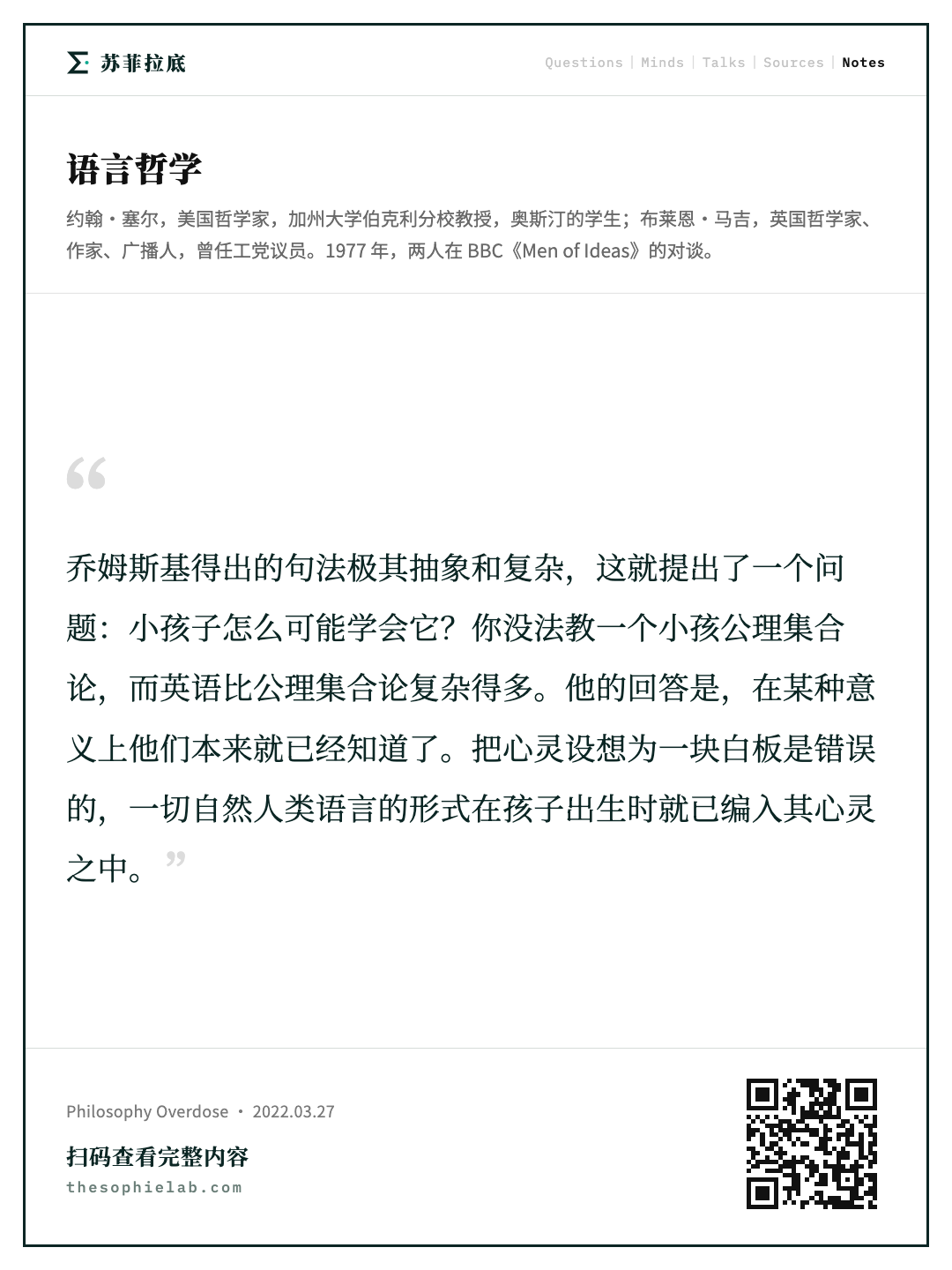
But more importantly I think in Chomsky, he was led to the following conclusion. The syntax that he came up with was extremely abstract and complicated. And that raised the question, how can little kids learn that? I mean, that you can't teach a small child axiomatic set theory. Chomsky showed that English is much more complicated than axiomatic set theory. How is it that little kids can learn that? And his answer was quite interesting. What he said was, in a sense they already know it. It's a mistake to suppose that the mind is a blank tablet.
但我觉得更重要的是,乔姆斯基被引向了下面这个结论。他所得出的句法极其抽象、极其复杂。这就引出一个问题:小孩子怎么可能学会这些?我是说,你没法教一个小孩公理集合论。而乔姆斯基表明,英语比公理集合论复杂得多。那小孩子怎么就能学会呢?他的回答很有意思。他说,在某种意义上,他们本来就已经知道了。认为心灵是一块白板,这是个错误。
便签笔记
38:43
What happens is that the form of all natural human languages is programmed into the child's mind at birth. I mean, in his strongest moments, Chomsky says that the child has a perfect knowledge of universal grammar at birth. And then his exposure to language just triggers this antecedent knowledge. And it's realized in the different natural human languages. Now, there used to be a traditional objection to this idea of a universal grammar. People would say, but languages are so different. English is so different from Chinese.
实际情况是,一切自然人类语言的形式在出生时就已经编程进了儿童的心灵。我是说,在最强的表述里,乔姆斯基说儿童在出生时就完美地掌握了普遍语法。而他接触语言只是触发了这种先在的知识,并让它在不同的自然人类语言中得到实现。过去对普遍语法这个想法有个传统的反驳。人们会说,可是各种语言差别这么大呀,英语和汉语差别这么大。
便签笔记
39:14
Chomsky's answer to that was that though they're different on the surface, they have a common, underlying or deep structure. And it's that which is programmed into the child's mind. Now, that seems to me Chomsky's positive contribution. And I think it really is remarkable. But there are, I think, certain limitations. And those limitations have to do with the present disarray in linguistics. Chomsky sees man as, essentially, a syntactical animal. He never asked such questions as, well, what are these syntactical forms used for? And his notion of syntax is that this theory of the syntax of language must be stated in purely syntactical terms. That is, we're not allowed to say what these forms mean or how people are supposed to use them.
乔姆斯基对此的回答是:它们虽然在表层上不同,却有着共同的底层结构或深层结构。被编程进儿童心灵的正是这个。在我看来,这是乔姆斯基的正面贡献,我认为确实了不起。但我认为也存在某些局限。而这些局限,和语言学目前的混乱状态有关。乔姆斯基把人本质上看作一种句法的动物。他从不追问这样的问题:这些句法形式究竟是用来干什么的?而且他关于句法的观念是,语言句法的理论必须完全用句法的术语来陈述。也就是说,我们不许去说这些形式意味着什么,或者人们该如何使用它们。
便签笔记
40:01
And Chomsky's actually denied what seems to me to be true, namely that the purpose of language is communication. He doesn't think that that's the case. I mean, he thinks that-- He thinks it's expression. Well, that's right. And that language, the essence of language is syntax and that we have the syntax programmed into us, that we are, as I said, syntactical animals. Now, I think that leads to a certain limitation in his research. I think that the most interesting questions about syntax have to do with how form and function interact. And I want to ask the question, what are these syntactical forms for?
而且乔姆斯基实际上否认了在我看来是真的一件事,即语言的目的是交流。他不认为是这样。我是说,他认为——他认为是表达。对,没错。他认为语言的本质是句法,句法被编程在我们身上,我们正如我所说的,是句法的动物。我认为这就导致了他研究上的某种局限。我认为,关于句法最有意思的问题,恰恰在于形式与功能如何相互作用。而我想问的是:这些句法形式是干什么用的?
便签笔记
40:36
Language, for me, is to talk with and to write with. So I want to say that the study of the syntax will always be incomplete, unless we get a study of linguistic use. Now, it's an effectual question. I mean, the research in the end and the long haul, it might show that he was right and I am wrong. But my gut feel is that we will not get an understanding of syntax of language and how language evolved without a conception of what human beings use language to do. And that's back to speech acts. Well, Professor Searle, you've given us an excellent survey, I think, of what the present situation is in the philosophy of language and also how it developed out of the past.
对我来说,语言是用来说话、用来书写的。所以我想说,除非我们对语言的使用也加以研究,否则对句法的研究将永远是不完整的。当然,这是个有待事实检验的问题。我是说,长远来看,研究最终也许会表明他是对的、我是错的。但我的直觉是,如果没有一套关于人类用语言来做什么的构想,我们就无法理解语言的句法,也无法理解语言是如何演化的。而这就又回到了言语行为。好的,塞尔教授,我认为您为我们出色地梳理了语言哲学的现状,以及它是如何从过去发展而来的。
便签笔记
12展望:语言哲学的三条前路
41:15
Would you-- and I put this to you as my very last question-- would you conclude this discussion by hazarding some informed guesses about-- Well, I'll try. --how it's going to develop in the immediate future. Yes, I'll try. Left my crystal ball in Berkeley. But I'll see what I can do without it. First of all, I think linguistics is now such a booming subject, that that's bound to continue, partly because it's so well-funded. And I think linguists and philosophers are going to find each other useful. I mean, we're interacting more than we did in the past. I find myself at linguistics conferences and inviting linguists to come and speak in philosophy conferences.
我想请您——这是我最后一个问题——在结束这场讨论时,冒昧地做一些有根据的猜测——我尽量试试。——关于它在不久的将来会如何发展。好,我试试看。我的水晶球落在伯克利了,不过我看看没有它能说出些什么。首先,我认为语言学如今是个如此蓬勃的学科,这种势头必然会延续下去,部分原因是它的经费非常充足。而且我认为语言学家和哲学家会发现彼此有用。我是说,我们之间的互动比过去多了。我常常出现在语言学的会议上,也会邀请语言学家来哲学会议上发言。
便签笔记
41:50
So I think, though the Chomskyan paradigm has broken down, there isn't the kind of unified development of linguistics as a science that there once seemed in the heyday of Chomsky's paradigm. Though the field is in kind of a mess, it seems to me that is going to continue, that the field will continue to develop. Linguistics will be a source of enormous usefulness for the philosopher of language, even though, of course, the direction of the interest that the linguist and the philosopher has are different.
所以我认为,尽管乔姆斯基范式已经瓦解,语言学不再像乔姆斯基范式全盛时期看上去那样,有着作为一门科学的那种统一的发展路径,尽管这个领域现在有点乱,但在我看来这种势头会延续下去,这个领域会继续发展。语言学将成为语言哲学家极其有用的资源,尽管当然,语言学家和哲学家的兴趣方向是不同的。
便签笔记
42:22
The linguist's interest is factual, empirical. He wants to know what are the facts about language. The philosopher really is more conceptual. He wants to know how is meaning and communication possible at all. His question, to use an old-fashioned jargon, is transcendental. It's not just empirical. So that's one thing that I think will continue. Now, another thing I think is really having a kind of a boom in England and in certain parts of the United States now is the work of Quine and Davidson and especially Davidson's idea that you can get a theory of meaning by way of a theory of truth.
语言学家的兴趣是事实性的、经验性的。他想知道关于语言的事实是什么。而哲学家其实更偏向概念层面。他想知道的是:意义和交流究竟何以可能。用一个老派的行话来说,他的问题是先验的,而不只是经验的。所以这是我认为会延续下去的一件事。另外一件我认为如今在英国以及美国某些地方正相当火热的,是蒯因和戴维森的工作,尤其是戴维森的那个想法:可以通过真理理论来获得意义理论。
便签笔记
42:56
The thing that is so appealing about that is you get well-defined questions. I mean, you get questions that you can state using the apparatus of modern mathematical logic. And you get the sort of questions that Austin liked incidentally, questions where cooperative group effort could produce results. So I think that vein is, by no means, worked out. We're going to see a lot of interesting work done in the Davidsonian tradition. And finally, I want to say that the kind of stuff I'm interested in I think is going to continue to interest people. And I'm quite interested to see that on the European continent, where for so long there seemed really a kind of iron curtain between the way they did philosophy and the way we did philosophy-- I mean, French and German philosophy seem so different from Anglo-American philosophy. They're now getting more and more interested in precisely this aspect of language that we've been talking about.
这一路数如此吸引人的地方在于,你能得到界定明确的问题。我是说,你得到的问题可以用现代数理逻辑的工具来陈述。而且顺带一提,你得到的正是奥斯汀所喜欢的那类问题——那种可以靠合作性的集体努力做出成果的问题。所以我认为这条矿脉远远没有被挖尽。我们会看到戴维森传统中出现大量有意思的工作。最后我想说,我自己感兴趣的这类东西,我认为也会继续引起人们的兴趣。而且我很高兴地看到,在欧洲大陆——那里长期以来在他们做哲学的方式和我们做哲学的方式之间仿佛隔着一道铁幕——我是说,法国和德国哲学看上去和英美哲学如此不同——他们现在对我们一直在谈的语言的这个面向越来越感兴趣了。
便签笔记
43:48
So I see at least these three strands of work going. Post-Chomsky-- and, of course, I'm including Chomsky himself in what I call post-Chomsky-- linguistics will continue to develop. I see more and more work going on in formal semantics of the Davidsonian kind. And I think a lot of useful work is going to be done there. And then I see these problems about language usage and intentionality. That seems to me a very rich field. More and more in the Searlean kind, as well. Thank you very much, Professor Searle.
所以我看到至少有这三股工作的脉络在推进。后乔姆斯基时代——当然,我所说的“后乔姆斯基”里也包括乔姆斯基本人——语言学会继续发展。我看到越来越多的工作是在戴维森式的形式语义学上展开的,我认为那里会做出很多有用的成果。然后我还看到这些关于语言使用和意向性的问题。在我看来那是一片非常肥沃的领域。也会有越来越多塞尔式的工作。非常感谢您,塞尔教授。
便签笔记
44:18
Thank you.
谢谢。
便签笔记
视频总结 · 一句话概括与核心要点

一句话概括

约翰·塞尔向布莱恩·麦基梳理了语言哲学的三条主线——真值条件传统(弗雷格、罗素、维也纳学派、蒯因、戴维森)、言语行为传统(后期维特根斯坦、奥斯汀、塞尔本人)和乔姆斯基语言学——并提出语言如何表征世界的问题最终归结为心灵的"意向性"问题。

核心要点

  • 语言哲学≠语言分析哲学:后者是解决传统问题的方法(如通过考察"know""believe"等词的日常用法处理怀疑论),前者是一个独立的研究领域,核心问题是词与实在的关系、意义、真理、指称、逻辑必然性。
  • 语言构成经验本身而非事后贴的标签:维特根斯坦画三角形,让人"把这个看成顶点、那个看成底边",再反过来看——两种不同经验狗无法拥有,缺的不是视觉器官而是概念装置;拉罗什富科说很少有人会在从未读过爱情的情况下坠入爱河。塞尔明确拒绝"语言创造世界"的主观主义,只主张"什么算作一个对象"取决于我们带入的表征系统。
  • 语言问题化的历史根源在笛卡尔:"知识如何可能"追问到底会变成"心灵如何表征世界",意义问题因此先于知识问题;具体推手是弗雷格与罗素对数学基础的研究——要论证数学是逻辑的延伸、数学命题"依定义为真",就必须先有真理论和逻辑理论,由此进入语言哲学。
  • 第一条主线:意义与真理:《逻辑哲学论》的图像论(句子是事实的约定化图像)影响维也纳学派,后者提出证实原则(陈述的意义即其证实方法)并接受分析/综合二分;蒯因在《经验论的两个教条》中攻击这一二分,进而以行为主义把意义还原为言语反应倾向;戴维森则主张一套能推出每个句子真值条件的原则本身就是意义理论。
  • 第二条主线:意义与使用/意图:奥斯汀发现婚礼上说"我愿意"不是在描述而是在实施行为,提出"施行式"对"记述式",随后发现说本身也是做,二分崩塌,转为普遍的言语行为理论;他估计英语中此类动词约有1000个。
  • 以言行事行为是研究靶心:同一内容可作预测、命令或提问("你会离开房间"),内容相同而"语力"不同;以言行事(陈述、提问、命令、道歉)区别于以言取效(说服、逗乐、惹恼)。塞尔将根本问题重述为"如何从物理学到语义学"——从嘴里发出的琐碎噪音到陈述、真假、命令这些惊人属性。
  • 维特根斯坦是启发者但反对理论化:他开创了"语言是生活形式"的方向,却认为任何一般理论都必然扭曲语言的复杂性;塞尔和奥斯汀走的理论化路线是他不会认可的。
  • 塞尔的新工作:意向性:借用布伦塔诺的中世纪术语,信念、恐惧、欲望都指向世界中的对象或事态,而疼痛、痒则不指向。核心问题从"语言如何表征世界"退一步变成"任何东西如何表征任何东西"——心灵如何把意向性强加于本身无意向性的噪音、纸上的墨迹、画布上的颜料。他强调这不是回到笛卡尔的"机器中的幽灵",意向性的逻辑问题与意识问题应分开。
  • 乔姆斯基的贡献与局限:他问"什么有限规则集能生成一门语言的全部且仅有的句子",发现句法比公理化集合论更复杂而儿童却能习得,于是主张普遍语法生而内置,语言接触只是触发;英语与汉语表层不同、深层结构共通。但塞尔批评他把人视为"句法动物"、否认语言的目的是交流,认为不研究形式与功能如何互动、语言拿来做什么,句法研究永远不完整。

结论与值得注意的细节

  • 塞尔对未来的三点预测:后乔姆斯基语言学因经费充足将持续繁荣(尽管范式已瓦解、领域"一团糟");戴维森式形式语义学因问题定义明确、可用数理逻辑表述、适合团队协作而在英国和美国部分地区走热;言语行为与意向性研究会继续,且欧陆哲学(法、德)正开始对这一问题产生兴趣,打破英美与欧陆之间长期的"铁幕"。
  • 语言学家的兴趣是事实性、经验性的,哲学家的兴趣是概念性、"先验的"(意义和交流如何可能);二者互动日益频繁。
  • 罗素承认直到二十世纪第二个十年(当时他已四十多岁、主要工作已完成)才不再把语言当作"透明"介质;塞尔纠正麦基:对语言的哲学关注并非本世纪的新发现(洛克在《人类理解论》专辟一卷,休谟、柏拉图《泰阿泰德》均有语言理论),新的是语言变得"成问题",这与19世纪末理性信心的衰落和艺术现代主义同源——对比密尔与后期维特根斯坦即可见断裂。
  • 塞尔认为当代哲学两大核心问题——语言如何关联实在、人类行动的本质是什么(顺带解释为何社会科学在方法上不如自然科学多产)——在意向性概念处交汇:语言是行动,行动也像语言一样有表征性,意图就是对将做之事的表征。
  • 戴维森在英国的影响力甚至超过在美国本土;"言语行为"一词在布龙菲尔德等结构主义语言学家那里已有,但现代含义是奥斯汀的发明。

核心句型 · 8
1. It's only in … that …
“It's only in this century that the enormous self-consciousness of language … has developed.”
强调句式,突出时间或条件的独特性。仿写:It's only after failing that we learn what matters.
2. not because …, but because …
“Not because he hasn't got the optical apparatus, but because he hasn't got the conceptual apparatus”
否定一个原因、肯定另一个,用于纠正误解。两侧结构平行,力量集中。适合论证性写作。
3. What counts as X is a function of Y
“What counts as an object, what counts as reality is a function of the system of representation”
学术表达「X取决于Y」。count as 表示「算作」,a function of 表示「是……的函数/取决于」。可用于概念分析。
4. let me see if I can say what I think you're driving at
“Yes, now let me see if I can say what I think you're driving at.”
对话中礼貌地复述对方观点以确认理解,避免误解。driving at 意为「意在说什么」。讨论和面试中极实用。
5. It isn't that …; rather, …
“It isn't that there is a rejection of the question … Rather, that question is put in a larger context.”
先排除一种理解,再给出正确理解。rather 单独起句引出修正。适合澄清立场。
6. X, though Y, nonetheless Z
“Wittgenstein, though he was really the person who gave this direction …, nonetheless, he resisted making general theories”
主语后插入让步从句,再用 nonetheless 转折。句子长但信息层次清楚,适合评价人物或立场。
7. How is it that …?
“How is it that little kids can learn that?”
比 How can … 更强调「这究竟是怎么回事」的惊异感,常用于提出需要解释的现象。
8. It might show that he was right and I am wrong. But my gut feel is that …
“It might show that he was right and I am wrong. But my gut feel is that we will not get an understanding …”
先承认自己可能错,再陈述直觉判断。学术讨论中表达立场而不显武断的地道方式。
生词精讲 · 107 · 按出现顺序
transparent /trænsˈpærənt/ adj. 0:14
透明的;此处指语言像玻璃一样不被注意、直接透过它看世界
self-consciousness /ˌselfˈkɑːnʃəsnəs/ n. 0:14
自觉、自我意识(此处指对语言本身的反思意识)
conceptualize /kənˈseptʃuəlaɪz/ v. 0:55
概念化,形成概念
innumerable /ɪˈnuːmərəbl/ adj. 0:55
无数的,数不清的
acquisition /ˌækwɪˈzɪʃn/ n. 1:28
习得(language acquisition 语言习得)
Rhodes Scholar n. phr. 1:28
罗德学者(赴牛津留学的著名奖学金获得者)
get straight phr. 2:12
弄清楚,澄清
at the outset phr. 2:12
一开始,起初
skepticism /ˈskeptɪsɪzəm/ n. 2:43
怀疑论(哲学)
subject matter n. phr. 3:14
主题,研究对象
logical necessity n. phr. 3:14
逻辑必然性
conceptual inquiry n. phr. 4:10
概念性探究
pre-theoretical /ˌpriːˌθiːəˈretɪkl/ adj. 4:10
前理论的,未经理论反思的
apex /ˈeɪpeks/ n. 4:58
顶点,尖端
optical apparatus n. phr. 5:30
视觉器官(apparatus /ˌæpəˈrætəs/ 装置、器官)
trivial /ˈtrɪviəl/ adj. 5:30
琐碎的、不足道的
driving at phr. v. 6:14
意在说明,想表达(what are you driving at? 你是什么意思?)
subjectivism /səbˈdʒektɪvɪzəm/ n. 6:14
主观主义
bring to bear on phr. 6:14
施加于,运用于
sliced up phr. v. 6:56
切分好的
impose on phr. v. 6:56
强加于
come under phr. v. 7:32
归入(某范畴)
inner-penetrating adj. 8:10
相互渗透的(即 interpenetrating)
sheer coincidence n. phr. 8:58
纯属巧合
sensibility /ˌsensəˈbɪləti/ n. 8:58
感受方式,感性
problematic /ˌprɑːbləˈmætɪk/ adj. 9:35
成问题的,有疑问的
modernism /ˈmɑːdərnɪzəm/ n. 10:05
现代主义
bring to a head phr. 10:40
使达到顶点、使爆发
strands /strændz/ n. 10:40
线索,脉络
prior to phr. 11:14
优先于,先于
foundations of mathematics n. phr. 11:53
数学基础(学科)
by definition phr. 12:29
凭定义,根据定义
logical positivists n. phr. 13:06
逻辑实证主义者
utterance /ˈʌtərəns/ n. 13:43
话语,言语表达
intertwine /ˌɪntərˈtwaɪn/ v. 13:43
交织,缠绕
recapitulate /ˌriːkəˈpɪtʃuleɪt/ v. 14:39
扼要重述,回顾
formal criteria n. phr. 15:26
形式化标准
unpack /ʌnˈpæk/ v. 16:48
展开分析,详细阐释
epoch-making /ˈepək ˌmeɪkɪŋ/ adj. 17:24
划时代的
articulate /ɑːrˈtɪkjuleɪt/ v. 17:24
清楚阐述
conventionalized /kənˈvenʃənəlaɪzd/ adj. 17:24
约定化的,程式化的
verification /ˌverɪfɪˈkeɪʃn/ n. 18:08
证实,验证
proposition /ˌprɑːpəˈzɪʃn/ n. 18:08
命题
analytic /ˌænəˈlɪtɪk/ adj. 18:50
分析的(凭意义为真)
synthetic /sɪnˈθetɪk/ adj. 18:50
综合的(凭事实为真)
in virtue of phr. 19:31
凭借,由于
behavioristic /bɪˌheɪvjəˈrɪstɪk/ adj. 19:31
行为主义的
bombarded /bɑːmˈbɑːrdɪd/ v. 19:31
轰炸;被大量(刺激)冲击
dispositions /ˌdɪspəˈzɪʃnz/ n. 19:31
倾向,秉性
empiricism /ɪmˈpɪrɪsɪzəm/ n. 20:31
经验主义
deduce /dɪˈduːs/ v. 21:15
推导,演绎
gulf /ɡʌlf/ n. 21:15
鸿沟,巨大分歧
in limbo phr. 22:02
悬而未决、悬空状态
autonomously /ɔːˈtɑːnəməsli/ adv. 22:02
自主地,独立地
rule-governed adj. 23:09
受规则支配的
assimilated to phr. v. 23:09
被纳入、被同化到
semantic /sɪˈmæntɪk/ adj. 23:52
语义的
racket /ˈrækɪt/ n. 23:52
喧闹声,噪音
attribute to phr. v. 24:23
把……归于
misleading /ˌmɪsˈliːdɪŋ/ adj. 25:11
误导性的
distortion /dɪˈstɔːrʃn/ n. 25:11
扭曲,歪曲
theoretical bent n. phr. 25:11
理论化倾向(bent 天性、倾向)
alas /əˈlæs/ interj. 26:07
唉,可惜
loomed large phr. 26:36
显得突出、占据重要位置
lawfully wedded adj. phr. 26:36
合法婚配的(婚礼固定用语)
indulging in phr. v. 26:36
沉浸于、参与(此处指实际进行)
performatives /pərˈfɔːrmətɪvz/ n. 27:29
施行式话语(说即做)
constatives /ˈkɑːnstətɪvz/ n. 27:29
记述式话语(有真假可言)
sea change n. phr. 27:29
彻底转变,根本变化
illocutionary /ˌɪləˈkjuːʃəˌneri/ adj. 28:49
以言行事的(说话时所做的行为)
perlocutionary /ˌpɜːrləˈkjuːʃəˌneri/ adj. 28:49
以言取效的(话语对听者产生的效果)
taxonomy /tækˈsɑːnəmi/ n. 29:39
分类法,分类体系
quarry /ˈkwɔːri/ n. 29:39
猎物;追寻的目标
derivative /dɪˈrɪvətɪv/ n. 30:11
派生物
invariably /ɪnˈveriəbli/ adv. 30:44
无一例外地,总是
ties in with phr. v. 31:28
与……相关联、相吻合
pointedly /ˈpɔɪntɪdli/ adv. 31:28
尖锐地,直截了当地
intentionality /ɪnˌtenʃəˈnæləti/ n. 32:04
意向性(心理状态指向对象的特征)
states of affairs n. phr. 32:04
事态
tickles /ˈtɪklz/ n. 32:04
痒感
half the battle phr. 33:00
成功的一半
intrinsically /ɪnˈtrɪnsɪkli/ adv. 33:00
内在地,本质上
slashed on phr. v. 33:45
涂抹上、挥洒上
double prong n. phr. 34:31
双管齐下(prong 叉尖、分支)
meshes with phr. v. 34:31
与……咬合、契合
the ghost in the machine phr. 35:17
机器中的幽灵(赖尔讽刺笛卡尔二元论的说法)
queer /kwɪr/ adj. 35:17
古怪的(旧义)
Cartesian /kɑːrˈtiːʒn/ adj. 36:01
笛卡尔的
stand for phr. v. 36:01
代表,象征
loose end n. phr. 36:48
未了之事,遗留问题
syntax /ˈsɪntæks/ n. 36:48
句法
all and only phr. 37:29
全部且仅有(逻辑学表述)
axiomatic set theory n. phr. 38:10
公理集合论
blank tablet n. phr. 38:10
白板(tabula rasa,经验主义心灵观)
antecedent /ˌæntɪˈsiːdnt/ adj. 38:43
先在的,先行的
universal grammar n. phr. 38:43
普遍语法
disarray /ˌdɪsəˈreɪ/ n. 39:14
混乱,无序
the long haul n. phr. 40:36
长远来看,长期
gut feel n. phr. 40:36
直觉
hazarding /ˈhæzərdɪŋ/ v. 41:15
冒险猜测,斗胆提出
crystal ball n. phr. 41:15
水晶球(喻预测未来)
paradigm /ˈpærədaɪm/ n. 41:50
范式
heyday /ˈheɪdeɪ/ n. 41:50
全盛期
transcendental /ˌtrænsenˈdentl/ adj. 42:22
先验的(康德术语:关于可能性条件的)
vein /veɪn/ n. 42:56
矿脉;(研究)路数
worked out phr. v. 42:56
(矿脉)被采尽;被穷尽
iron curtain n. phr. 42:56
铁幕(喻难以逾越的隔阂)
理解自测 · 11 题 · 是真懂了,还是以为自己懂
1. 塞尔如何区分「语言分析(linguistic philosophy)」与「语言哲学(philosophy of language)」?

前者是方法,后者是研究对象。语言分析主张通过考察「know」「believe」等词的日常用法来解决传统哲学问题(如怀疑论);语言哲学则是哲学的一个分支,研究词与实在的关系、意义的本质、真理、指称、逻辑必然性等问题。这一区分出现在访谈开头(第4–5段),主持人特意要求先澄清,以免观众混淆两个名称相似的概念。

2. 维特根斯坦的三角形例子说明了什么?塞尔为什么说狗不能有这种经验?

三角形例子说明许多经验依赖语言概念:把同一图形「看作」顶点在这边或那边,会产生不同的经验。塞尔说他的狗没法有这种经验,不是因为缺少视觉器官,而是缺少概念装置;词语本身是经验的一部分。他随后引用拉罗什富科「没读过爱情的人很少坠入爱河」把论点扩展到爱与恨等宏大范畴(第7–8段)。

3. 奥斯汀最初把话语分成哪两类?后来这一区分为何被放弃?

施行式(performative,如「我保证」「我愿意」,说即做)与记述式(constative,有真假可言的陈述)。奥斯汀后来发现这条界线无法精确划分,因为「说」本身也是一种「做」,于是转向一般的言语行为理论,把所有话语都视为言语行为。这一「彻底转变」在第39–41段,塞尔据此提出「意义的基本单位是言语行为」。

4. 塞尔预测语言哲学未来会沿哪三条路线发展?

一是后乔姆斯基语言学继续发展,哲学家与语言学家互相借鉴(尽管乔姆斯基范式已瓦解);二是戴维森式的形式语义学,因其问题可用数理逻辑精确陈述、适合集体研究;三是关于语言使用与意向性的研究,即塞尔自己的路线,并注意到欧陆哲学也开始关注这一面向。见第60–64段结尾部分。

5. 塞尔为什么说「什么是意义」的问题变得比「什么是知识」更优先?请重建其历史论证。

笛卡尔以「知识如何可能」为核心问题,主导了此后三百年。但认真追问下去会发现,更根本的问题是心灵如何表征世界,即意义问题。具体推动来自弗雷格和罗素:他们研究数学基础,主张数学是逻辑的延伸、凭定义为真,为此需要真理理论和逻辑理论,于是不得不先分析陈述、指称是什么。真理研究→意义研究→句子分析,语言哲学由此成为第一哲学(第16–19段)。

6. 塞尔说自己「不接受语言创造世界的主观主义」,那他的立场究竟是什么?和主观主义差别在哪?

他的立场是:不是语言创造世界,而是「什么算作一个对象、算作同一对象」取决于我们带入的表征系统即语言。世界并非预先切分好,范畴由我们强加,但被范畴化的东西本身是实在的。主观主义会说世界依赖心灵而存在;塞尔只说对象的个体化方式依赖概念。这一区分在第9–11段,用「一杯水」的例子说明:没有「杯子」「水」的概念,就不能有「看见一杯水」的经验,但水本身不因此消失。

7. 「从物理到语义」是什么问题?塞尔如何把它逐步重述?

口腔发出的声波、纸上的墨迹在物理上微不足道,却被赋予真假、陈述、命令等语义属性,这一鸿沟如何跨越?塞尔先把它译为「从话语到以言行事行为」(第35、44段),即研究言语行为的结构;进而在第48段再重述为意向性问题:心理状态内在地有意向性,声音和记号没有,心灵如何把意向性强加到这些对象上?最终变成「任何东西如何表征任何东西」(第52段),从言语行为退回更原初的层面。

8. 意向性与意识有何不同?塞尔为什么要强调自己「不回到笛卡尔」?

意向性是心理状态「指向」对象和事态的特征——信念必有所信、恐惧必有所惧;疼痛发痒则无此指向。它不等于日常的「意图」,也不等于意识。塞尔强调不回到笛卡尔,是为了避免被理解为主张有神秘心理事件在古怪的心灵介质中发生(赖尔讽刺的「机器中的幽灵」)。他要问的是表征的逻辑结构问题,而非「我说话时灵魂里发生了什么」(第47、51–52段)。

9. 塞尔对乔姆斯基的批评核心是什么?他自己承认了什么不确定性?

核心批评是乔姆斯基把人看作「句法动物」,坚持句法理论只能用句法术语陈述,不许追问这些形式意味着什么、用来做什么,甚至否认语言目的是交流。塞尔认为形式与功能的互动才是最有意思的问题,不研究使用就无法完整理解句法及其演化。但他承认这是实证问题,长远研究可能证明乔姆斯基对而自己错,他只是凭「直觉」站在功能主义一边(第57–59段)。

10. 如果有人反驳「意义就是真值条件,不需要说话者意图」(戴维森路线),塞尔会如何回应?

塞尔不会否认真值条件研究的价值——他在第63段明确说这条矿脉远未采尽、问题界定清晰。但他会指出:真值条件只覆盖有真假可言的陈述,而婚礼上的「我愿意」、承诺、道歉等根本不打算为真为假,却有明确意义;同一命题内容可以作为预测、命令、提问出现,力量不同而真值条件相同。因此真值条件理论至多是言语行为理论的一部分,被放进「语言行为是何种行为」的更大框架中(第33、39、42段)。

11. 把塞尔「意向性由心灵强加于物理对象」的论点放到今天的大语言模型上,会得出什么结论?他的立场是否仍成立?

按塞尔的框架,模型输出的文字与「嘴里的声音」「纸上的记号」一样是物理对象,本身没有内在意向性;其意义要么来自训练数据中人类的言语行为,要么来自读者的解释,属于派生意向性。这与他后来(1980年)的「中文屋论证」一致:句法操作不等于语义理解。反对者可能说,如果一个系统能稳定地实施言语行为并遵循构成性规则,就应承认其意向性。争议的实质在于「内在意向性」是否必须依附于生物心灵——这正是本片第52段留下的开放问题。

精读便签
下载便签 手机:长按图片保存
← 上一期 · NO.057A Conversation with Frank Lloyd Wright (1953) 下一期 · NO.059 →A Conversation with Bertrand Russell (1952)
问题周报 WEEKLY LEDGER 每周一封:本周入库的精读、一个值得带走的问题、一条苏菲按。随时退订。
免费 · 每周一封 · 一键退订
苏菲拉底 THE SOPHIE LAB · ASK THE BEST MINDS THE BIG QUESTIONS 内容仅供学习 · thesophielab.com