The Philosophy of Science - Hilary Putnam & Bryan Magee (1977) · 苏菲拉底
字幕 字幕位置
--:--
点击播放,这里会跟随视频显示当前句的中英字幕。

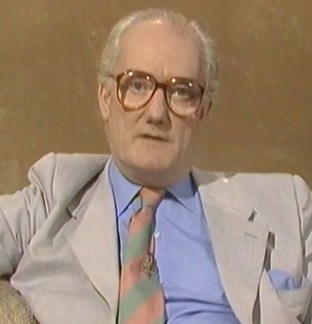
The Philosophy of Science - Hilary Putnam & Bryan Magee (1977)

节目发布 2022-03-26 · Philosophy Overdose
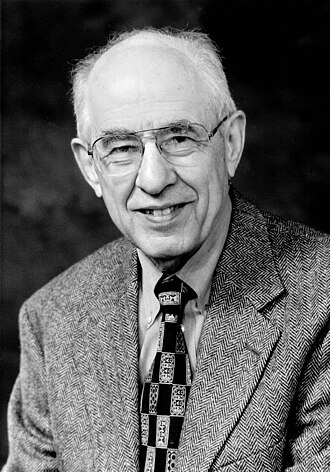
希拉里·普特南 布莱恩·马基
EDITED TRANSCRIPT · 依据现场录音编译整理,可划线生成便签

科学哲学:希拉里·普特南对谈布莱恩·麦基(1977)

一九七七年,英国哲学普及者布莱恩·麦基为BBC主持《思想家》系列访谈,本期请到哈佛大学哲学教授希拉里·普特南,谈科学哲学与数学哲学。普特南兼通两个领域,从科学世界观的兴衰谈到真理观的转变,从量子力学的悖论谈到马克思主义、计算机与亚里士多德的灵魂。本文依据现场录音编译整理。

哲学与数学的百年血缘

麦基: 哲学与数学科学的关系向来极为密切。柏拉图在他的学园门上写着:「不懂几何者勿入。」把基础科学分门别类、定下沿用至今的名称的,是亚里士多德。有些最伟大的哲学家本人就是大数学家,开创过新的数学分支,笛卡尔是显例,莱布尼茨和帕斯卡也是。事实上,大多数伟大哲学家(不是全部,但是大多数)都是从数学或科学走进哲学的。这个趋势一直延续到本世纪:罗素最初受的是数学训练,维特根斯坦最初学的是工程。这种血缘关系为什么经久不衰,我想道理是明摆着的:驱使大多数顶尖哲学家的根本冲动,是想更深地理解世界及其结构,而这也正是有创造力的科学家在做的事。

再者,在过去的大部分时间里,人们都认为数学是人类拥有的最不容置疑的知识,而且极其精确、极其清晰。所以历来都有大批哲学家研究数学,想弄清它到底特殊在哪里,这种特殊性能否搬到别的知识领域去。科学也是一样,人们认为科学同样能给出一种格外可靠、格外确定的知识。科学究竟凭什么让它的结论如此可靠?它的方法(不管那是什么)能不能用到别的领域?对数学和科学所涉及的概念、方法、程序和模型的这类考察,如今被称为数学哲学和科学哲学。本期节目谈的就是这两门学问,以科学哲学为主。好在今天的来宾对两者都是行家:哈佛大学的希拉里·普特南教授。

统治现代世界的科学世界观

麦基: 普特南教授,我想从一个立场谈起,我相信我们的很多观众本来就站在这个立场上。大致是这样:自十七世纪以来,宗教信仰经历了惊人的衰落,在西方尤其如此,在受过教育的人当中尤其如此。对千百万人来说,过去由宗教世界观在生活中扮演的角色,越来越多地被一种以科学为基础的世界观取代,至少是自称从科学推导出来的世界观。这种世界观至今仍然极有力量,它对整个西方人心的支配,恐怕我们每个人都逃不掉。所以我想请你先把这种在现代世界影响巨大的科学世界观勾勒清楚,我们后面要谈的很多东西都以它为底子。

普特南: 请允许我稍微躲一下这个问题:我不谈今天的科学家怎么想,而谈一百年前或者七十五年前许多科学家怎么想。想象一下做填字游戏。做的过程中你也许要改动几处,但到了最后,一切都严丝合缝,而且每次只添上一格。三百年来,科学的进步看上去就是这个样子。一九〇〇年,大数学家大卫·希尔伯特向世界数学家大会提出一份数学问题清单,至今仍然大名鼎鼎。很有意思的是,清单靠前的位置上有一道题,按我们今天的说法根本不算数学问题,那就是:为物理学奠定令人满意的基础。

麦基: 真是个小任务。而且这活儿是派给数学家的,不是派给物理学家的。让他们收拾干净。

普特南: 正是。当时的想法是,牛顿、麦克斯韦、道尔顿这些人已经把故事的各个部分都放进去了,剩下的只是让数学家把逻辑清理一下。

旧图景:累积与归纳法

麦基: 前两天聊天时你把这叫做「宝箱观」,我很喜欢这个比喻。这里有一只大箱子,我们只管往里装。知识是累积起来的,用不着减,用不着往外拿。偶尔出个小差错,但基本上,换个比喻,就像盖金字塔:先铺底层,再盖一层,再盖一层,只往上走。

普特南: 这是一半:知识靠累积而增长。另一半是关于科学为何特别成功的想法。我们叹服的当然是成功,这个文化看重成功,而科学是一门成功的事业。可是旧图景还认定,科学之所以成功,是因为它用了一套特殊的方法。这个想法大概来自科学史,来自这样一个事实:牛顿生在培根之后,受过培根的影响;经验科学是和一样叫「归纳逻辑」的东西一起长大的。于是就有了这样的观念:存在一种方法,即归纳法(inductive method),科学的特征就在于它使用这种方法,而且是明确地、自觉地使用,不像学做菜的人那样不自觉地使用,而是相当有意、相当明白地使用。所以我认为,旧图景的两个要点就是:知识靠累积增长,并且靠一种特殊的方法即归纳法增长。

麦基: 是的。如果让我换个说法来讲同一件事,我大概会这么说。两三百年间,受过教育的西方人把宇宙和宇宙中的一切都看成运动中的物质。除此之外别无他物,从最远的星系一直到我们自己、我们的身体和组成身体的细胞,无不如此。而科学正在用你刚才说的那种科学方法,越来越多地查明这些物质、它的结构和它的运动。人们相信,只要一直做下去,就像你那个填字游戏的比喻,我们终究会把能查明的一切都查明。凭科学方法,我们最终可以完全解释、完全理解这个世界。如今科学家已经放弃了这种想法,对吧?只是这个消息还没传到非科学家那里。还有大批外行照旧以为科学家就是这么想的。可科学家早就不这么想了,是不是?这幅图景开始瓦解了。

康德的转向

普特南: 我认为它开始瓦解了,是从爱因斯坦开始的。请允许我硬把一点哲学史揪进来。康德在哲学里做过一件事,我认为这件事现在开始在科学里发生了。他挑战了一种真理观。康德以前,没有哪个哲学家真正怀疑过真理就是与实在相符合(correspondence to reality)。用词各有不同,有的哲学家说「一致」,但意思都是一种镜子式的知识论。康德说,事情没这么简单,其中有思维着的心灵的一份贡献。当然,真理不是心灵编造的。康德绝不是唯心论者,真理不是一场虚构,不是我们捏造出来的东西。但它也不只是一个摹本。我们所谓的真理,既取决于有什么东西存在、事物是什么样子,也取决于思考者、心灵的贡献。我认为今天的科学家已经走到了一个相当类似的看法:从二十世纪初开始,人们意识到,在我们所谓的真理里有人的一份贡献、心灵的一份贡献,理论并不是单纯由事实向我们口授的。

麦基: 我想请你把这一点展开说说,因为有些观众会觉得这个想法费解。他们会问:什么是真、什么不是真,怎么可能不只取决于事实,还取决于人的心灵?这怎么讲得通?

普特南: 我用视觉打个比方。我们往往以为,看见什么全看外面有什么。可是对视觉研究得越深,不管是作为科学家还是作为画家,就越会发现,所谓看见,包含着大量的解释。我们看成红色的那个颜色,在一天的不同时刻,按波长算并不是同一个颜色。所以哪怕是我们心目中同世界最简单的打交道方式,也就是单纯看一眼,我们也已经在解释了。

麦基: 换句话说,我们带着一大堆东西去面对世界,而且通常意识不到,除非转过身来自我检视。

普特南: 对。我想,中世纪的人抬头望天,把星星想成在上面、我们在最底下,在他眼里世界一定是另一副模样。今天我们朝太空望出去,体验同持中世纪世界观的人是不一样的。

麦基: 你的意思是,我们借以观看世界、解释经验的那些范畴,我们用来组织观察和周围事实的那些观念,都是我们自己提供的。所以科学所构想的世界,一部分来自外部事实,一部分来自人类观察者带来的范畴和看法。

波粒二象与等价描述

普特南: 对。科学里有一个例子,我会讲得过于简单,但基本上不失真,那就是波粒二象的问题。这不是说有个叫电子的东西,不知怎么一半是波、一半是粒子,那样说是没有意义的。而是说,有许多实验可以用两种方式来描述:你可以把电子看成波,也可以把电子看成粒子。而这两种描述,以某种近乎荒唐的方式,都是真的,都是充分的。

麦基: 也就是说,同一个事实有两种不同的描述方式,两种都准确?

普特南: 对。哲学家们已经开始谈「等价描述」(equivalent descriptions),这是科学哲学里的一个术语。

麦基: 可是牛顿之后的两百来年里,受过教育的西方人认为牛顿拿出来的是客观事实,认为他发现了支配世界运行、支配宇宙运行的定律,而这些定律是客观为真的,与我们无关。牛顿和其他科学家是通过观察、打量自然,把这些事实从自然里读出来的。构成科学的这些陈述,就是干脆的真。后来,从十九世纪晚期开始,科学的发展进入了一个时期,人们开始意识到这些陈述并不全然为真,科学并不只是一堆从世界上读下来的客观事实。换句话说,科学是可纠正的(corrigible),科学理论可能出错。这就引出一些极深的问题:如果科学不是对事物本来面目的客观真实描述,那它是什么?如果它不是从观察世界得来的,那它从哪里来?

普特南: 我并不想说它完全不是从观察世界得来的。康德这幅图景本身就包含着一份不属于我们的贡献,外面确实有东西。只是同时还有一份来自我们的贡献。顺带说一句,连康德也认为牛顿科学是不容置疑的,事实上他认为,它的不容置疑正是我们贡献的。超出康德的那一步在于:不仅实在部分地依赖于心灵,而且还存在别的选择;我们加于世界的概念未必是对的,我们可能不得不更换它们。我们的贡献和我们的发现之间,是一种相互作用。

牛顿错在大图景

麦基: 那么,是什么让人们开始意识到,把科学看成客观真理的这套基本观念是错的,科学是可纠正的、可错的?

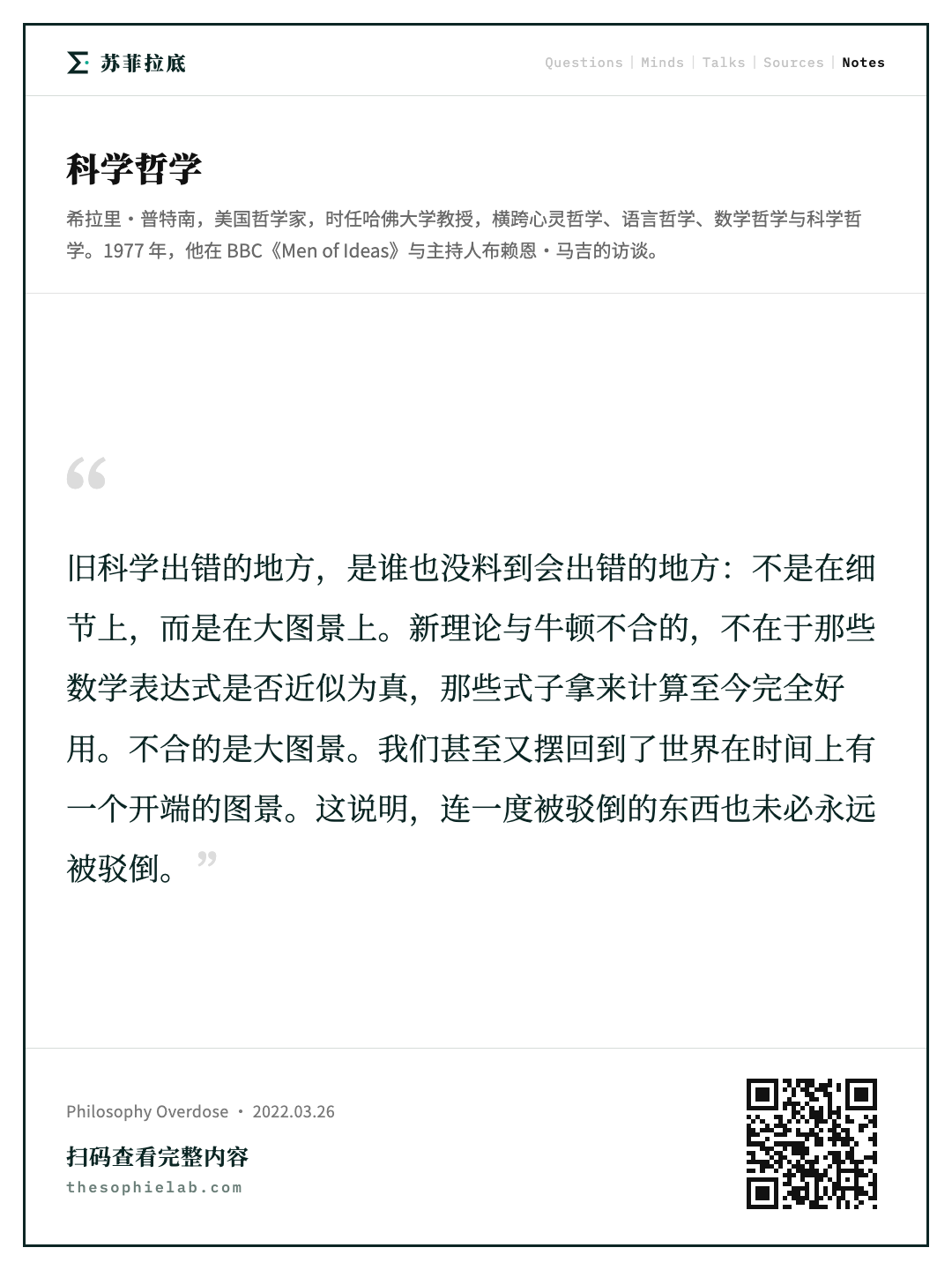
普特南: 我想是因为旧科学出错的地方,是谁也没料到会出错的地方:不是在细节上,而是在大图景上。我们发现的不是,比方说,太阳离地球不是九千三百万英里而只有两千万英里。那种事不会发生。当然,即使在这类事情上有时也会犯错,但那就像弄错房间里有没有椅子一样,是一般意义上的失误。对科学中的数值全盘怀疑,同对任何事情全盘怀疑一样,都是没有道理的。新理论与牛顿不合的地方,不在于牛顿理论中那些数学表达式是否近似为真,那些式子拿来计算至今完全好用。不合的是大图景。我们用四维时空的图景,取代了绝对空间和绝对时间的图景。我们用一个服从欧几里得做梦也想不到的几何学的世界,取代了欧几里得式的世界。我们甚至又摆回到了世界在时间上有一个开端的图景,这实在令人震惊。这说明,连一度被驳倒的东西也未必永远被驳倒。

麦基: 这就意味着,整整一套科学观已经被取代了。过去我们把科学看成一个知识体,靠进一步的科学工作不断往里添加,这整套观念其实已经被丢弃了,对吧?我们现在把科学看成一组理论,而这些理论本身不断被更好的理论取代:更精确的理论,更丰富、更有解释力的理论。就连我们现在拥有的理论,爱因斯坦及其后继者的理论,随着时间推移,多半也会被尚不知名的科学家提出的更好的理论所取代。是这样吧?

普特南: 完全正确。事实上,科学家自己就在做这个预测:二十世纪的两大理论,相对论和量子力学,将让位于另一种理论,由它来解释这两者,而这个过程会永远持续下去。

真理标准随兴趣而变

麦基: 这就引出一个极根本的问题:什么是真理?当我们说某个科学陈述是真的,某个科学理论是真的,在这种新的认识处境下,我们说的「真」还能指什么?

普特南: 康德以来一直有两种看法。一种是旧的符合论,至今仍有信奉者。但我认为越来越占上风的看法是:什么为真,与我们的可断言性标准(standards of assertibility)是什么,二者无法截然分开。我用康德式的说法称之为「真理对心灵的依赖」,它进来的方式就是:什么真、什么假,部分地取决于我们的真假标准是什么。而这又取决于我们的兴趣,兴趣当然又会随时间改变。

麦基: 我想请你就真理问题再多说几句,因为这对外行人来说同样费解。没受过科学或哲学训练的人往往认为,世上有一组确定的事实,而真陈述就是准确描述这些事实的陈述。我想谈谈这里面实际牵涉的一些困难。

普特南: 我认为科学内部最大的困难来自这样一个事实:即使在同一个科学理论之内,对所谓的事实也常常可以给出不同的说法。这是随狭义相对论而来的。当时人们发现,关于同时性的事实,也就是两件事是否同时发生,不同的观察者可以做出不同的描述。一个人可以说「童子军甲比童子军乙先鸣发令枪」,另一个人可以说「不对,是童子军乙比童子军甲先鸣枪」。只要两地距离足够远,远到光信号不超过光速就无法从一处传到另一处,那么两种描述可能都是正确的,都是可以接受的。

麦基: 这当然给理解某些现代科学理论带来了深刻的概念困难。它也让人想到:一个科学理论可以有用、有意义、行得通,哪怕没有人真正弄懂它是什么意思。量子力学不就是这样吗?没有人真正确定量子力学到底意味着什么,可它就是管用。

普特南: 是这样。不过我还是要说,这一点不能推得太远,因为我们并不想把可理解性的标准整个放弃掉。我们要说的是:量子力学管用,而管用这个事实本身就说明它在根本上有对的地方。至于它的可理解性,我们愿意承认,一部分原因也许是我们的可理解性标准错了,我们得改变自己的直觉。但另一部分原因是,这个理论里确实存在真正的悖论。要真正令人满意地化解这些悖论,还有很多工作要做。眼下的局面相当微妙。

既然可错,科学为何有效

麦基: 我想,有些听我们谈话的人,也许头一回接触这些想法,心里会冒出一个念头:要是这一切都成立,科学怎么会管用呢?如果传统的科学理论正在瓦解,如果科学到头来并不是一堆可靠、恒久、牢固、客观的知识,如果每个科学理论都有相当一部分本来就是主观的,因为它是由人的心灵、由观察者、由科学家贡献的,那么在这种情况下,我们怎么还能造桥、开飞机、把火箭送上月球,怎么还能让这一大堆松软、模糊、多变、部分主观的理论替我们干活?不管我们刚才说了什么,它一定在某种非常根本的意义上与世界相符。

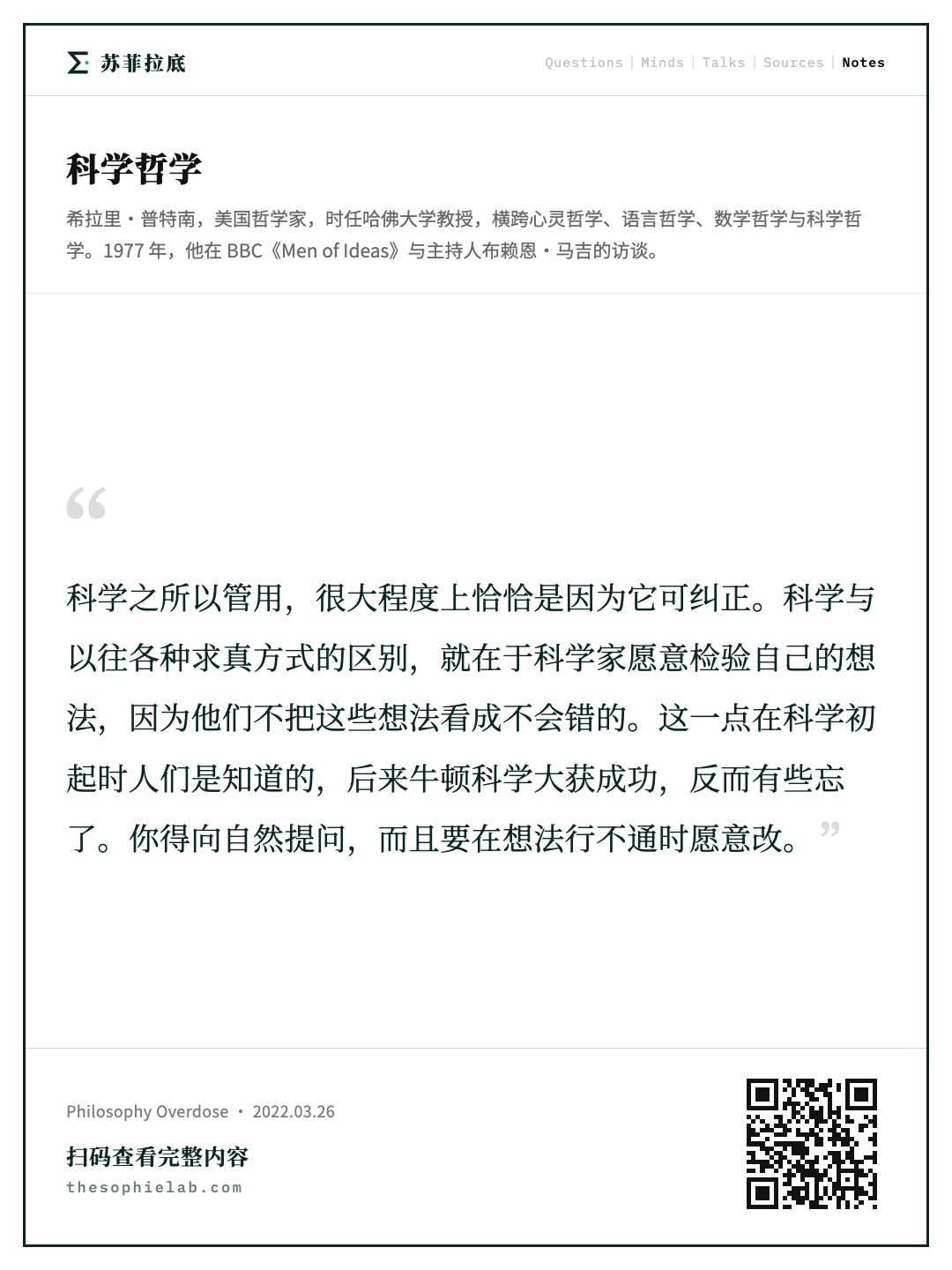
普特南: 这话不错,但我认为「主观」和「与世界相符」的这种对立本身并不恰当。我不是说科学知识是主观的,也不是说怎么都行。我是说,我们处在一种生活中常见的困难处境里:我们认定好的推理和坏的推理之间有区别,却拿不出一条机械的规则。日常生活里,我们用的都是带着兴趣的词。要是没有一整套社会制度,我们不会说「街角站着一个警察」。一个来自没有警察的原始部落的人,可能会说「街角站着一个穿蓝衣服的人」。但「警察」这个概念由我们的兴趣塑造,并不妨碍「街角站着一个警察」可以是客观为真的。此外,正如波普尔教授指出的,科学之所以管用,很大程度上恰恰是因为它可纠正。科学与以往各种求真方式的区别,很大程度上就在于科学家愿意检验自己的想法,因为他们不把这些想法看成不会错的。这一点在科学初起时人们是知道的,后来牛顿科学大获成功,反而有些忘了。我们不得不重新记起培根早就懂得的道理:你得向自然提问,而且要在想法行不通时愿意改。

科学与宗教位置对调

麦基: 从某些方面看,科学与宗教这对老冤家,双方是不是已经互换了位置?我的意思是,如今许多信教的人认为自己拥有关于世界的确定知识:世界是一位叫上帝的存在创造的,他按自己的形象造了我们,赐给我们不朽的灵魂,灵魂将在彼岸延续,如此等等。这些最根本的命题,他们抱着绝对的确信。反倒是科学家认为一切都可能出错,认为世界是一个神秘的所在,我们永远走不到这神秘的尽头。这话是不是有几分道理?

普特南: 也许吧。

麦基: 只是「也许」?

普特南: 我不太确定。

麦基: 那我们就不往下追了。

事实与价值二分的文化危害

麦基: 撇开宗教不谈,有一点我确实想同你讨论。既然几乎所有科学家都已经用你描述的这种全然不同的眼光看待科学,这是不是意味着,科学与非科学的分别已经不是人们一向以为的那样了?换句话说,既然科学如此主观、如此不确定、如此多变,它就不再是一种与其他人类知识、其他人类活动界线分明、性质不同的活动和知识了。

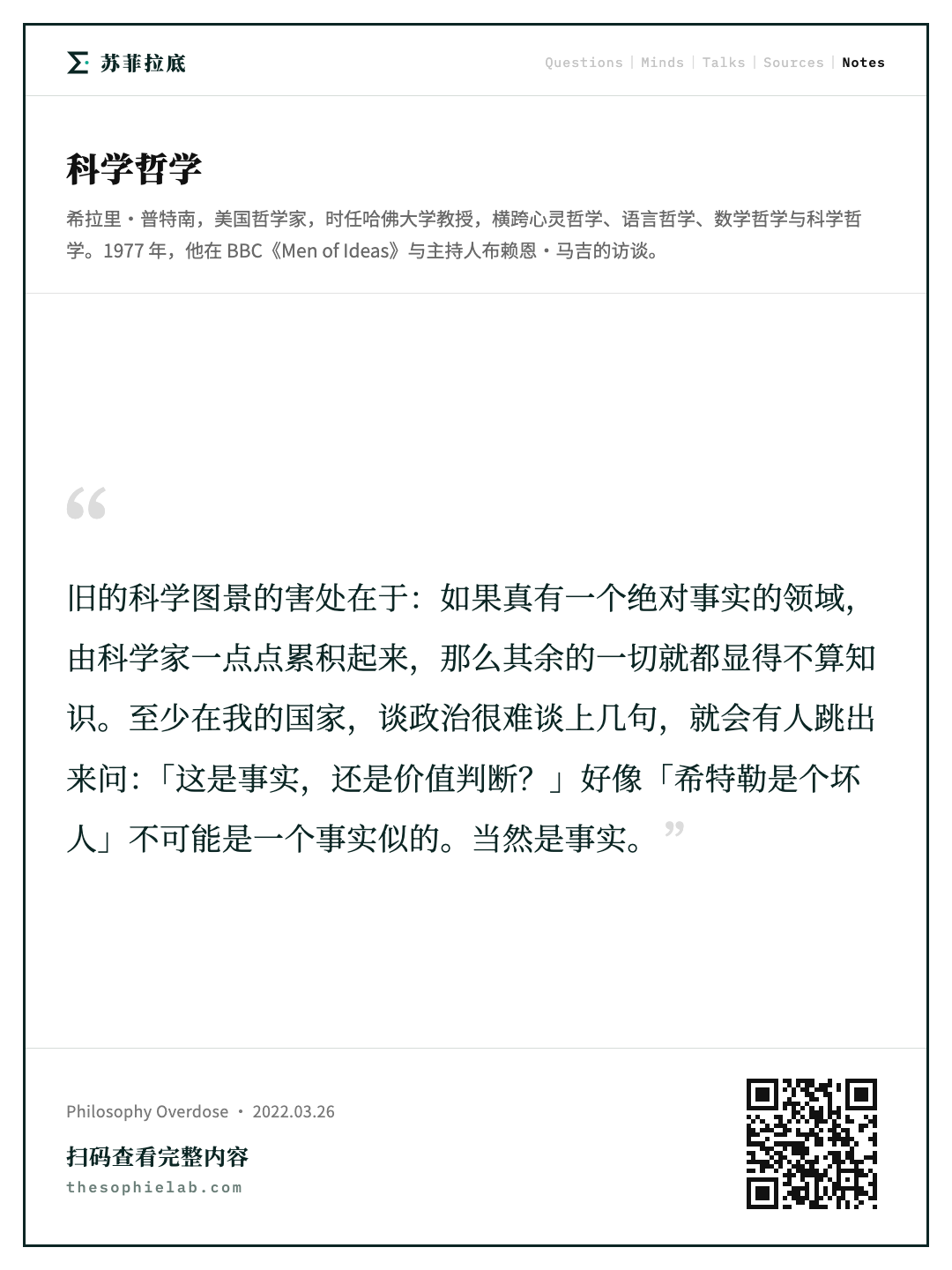
普特南: 我认为这既是事实,在文化上也非常重要。旧的科学图景的害处在于:如果真有一个绝对事实的领域,由科学家一点点累积起来,那么其余的一切就都显得不算知识,显得连「真」「假」这样的词都不能恰当地用在上面。所谓事实与价值的二分(fact-value dichotomy)就是一个很好的例子。至少在我的国家,谈政治很难谈上几句,就会有人跳出来问:「这是事实,还是价值判断?」好像「希特勒是个坏人」不可能是一个事实,「法拉·福塞特·梅杰斯是个美人」也不可能是一个事实似的。

麦基: 你认为「希特勒是个坏人」是一个事实吗?

普特南: 当然是。

麦基: 我也这么认为。可是既然如此,既然过去那么多舒服、分明的区分都要放弃,那继续使用「科学」这个范畴、这个概念、这个词,还有什么意义?它还能把某种东西同其余一切清楚地划分开来吗?

普特南: 我认为划不开了。如果你还持旧观点,认为有一种归纳法,那么区分科学与非科学是很有道理的:一样东西之所以是科学,就因为它用了这种方法,而且用得相当自觉、相当有意。一样东西之所以是非科学,要么因为它完全不自觉地使用这种方法,比如学做菜,你不会有意识地去想归纳逻辑;要么因为它根本不用这种方法,过去人们就指责形而上学根本不用,我认为这指责并不公平。可是你一面说实践知识与科学之间有一条清楚的界线,一面又承认据说划出这条界线的那种方法本身相当模糊,不是我们能够精确陈述的东西。顺便说一句,迄今为止,陈述这种方法的种种尝试都彻底失败了。归纳逻辑没法像演绎逻辑那样编成计算机程序。近一百年来演绎逻辑的发展,加上计算机的出现,非常戏剧性地凸显了两种证明之间的悬殊处境:数学科学中的证明,我们可以为它定下严格的准则;而过去所谓归纳科学中的证明,我们只能给出一些一般的格言,真要应用起来,还得靠直觉、靠通盘的实际本领。

没有唯一的科学方法

麦基: 你刚才描述旧式科学观时用了两个范畴,其中之一就是存在一种特定的科学方法:先观察事实,再根据观察到的实例概括出科学理论,然后用实验来验证,如此等等。这套观念既已放弃,如今还有没有任何一种单一的方法被当作科学方法?

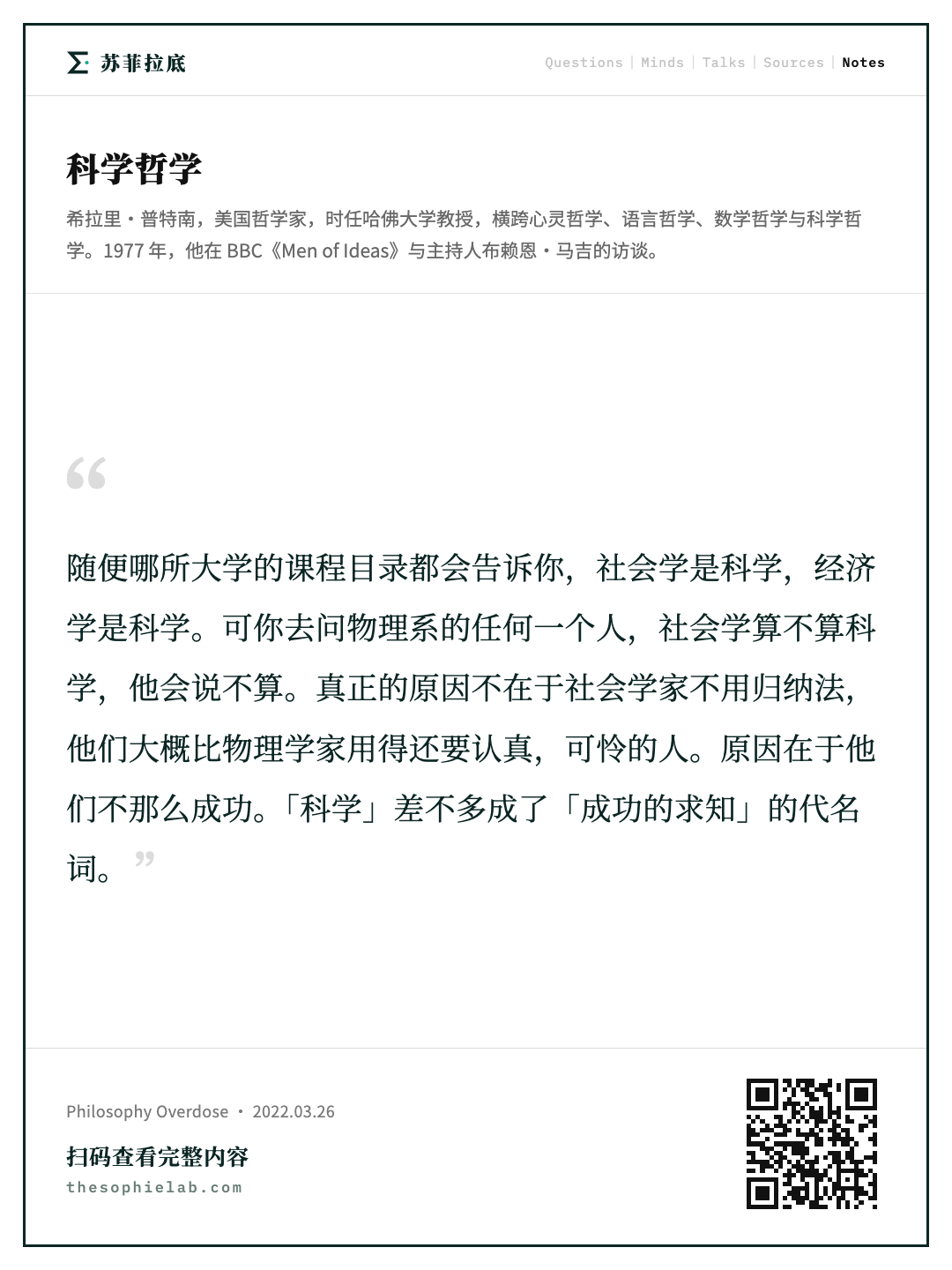
普特南: 我认为不应该有。人们谈论的所谓科学方法,多少是一种虚构。即使在物理学里,你确实能找到同教科书的说法相当吻合的实验和检验,也还有大量的东西不吻合,而且不该吻合。事实上我认为,在这个文化里,什么算科学、什么不算,根本没有共识。随便哪所大学的课程目录都会告诉你,有一类东西叫社会科学,社会学是科学,经济学是科学。可我敢打赌,你去问物理系的任何一个人,社会学算不算科学,他会说不算。

麦基: 他为什么会说不算?这很有意思。

普特南: 我认为真正的原因不在于社会学家不用归纳法。他们大概比物理学家用得还要认真,可怜的人。原因在于他们不那么成功。

麦基: 换句话说,「科学」差不多成了「成功的求知」的代名词?

普特南: 正是。

科学哲学家在做什么

麦基: 好。我认为你把那套古老的科学观在本世纪如何瓦解、如何被某种更流动、也许更难把握的东西所取代,描述得非常清楚。现在能不能在这个背景下谈谈,科学哲学家究竟在做什么?你就是一位科学哲学家。你和你的同行们都做些什么?

普特南: 我们做的事有一部分相当技术化,在这个节目里我就不展开了,那就是对具体科学理论的考察。我们非常仔细地研究量子力学,一方面看看能从中为哲学学到什么,另一方面看看我们作为哲学家能为澄清它的基础做出什么贡献。我们非常仔细地研究相对论,非常仔细地研究达尔文的进化论,等等。这一部分科学哲学为其余部分提供材料。但科学哲学的很大一部分会渐渐融入一般哲学。我想最好的描述方式,就是用我们刚才谈到的那些问题来说明。我们谈过的每一个问题,都把科学哲学家分成不同的阵营。有的科学哲学家持真理符合论,努力证明这种看法可以做得精确,反对意见可以克服,人们仍然可以用旧的方式看待科学;另一些人则试图勾画出另一种真理观会是什么样子。有的哲学家仍然认为存在一种可以严格陈述的归纳法,并致力于归纳逻辑。顺便说一句,我认为有这样的人很重要,因为如果没有人尝试陈述归纳法,这方面就不会有进展。另一些人则更多从文化、从历史的角度看科学的发展。还有像我这样持中间立场的人:科学方法这个概念确有其内容,也有清楚的例子,但它多少是一个连续统,不能把它想成一条机械规则、一种拿来就能产出科学知识的算法。所以我要说,这里的每一个问题都是大问题:真理的本性,科学方法的本性,科学里有没有必然真理,有没有哪种概念贡献是永久的、不受修正的。

科学家的五十年时差

麦基: 那你们这些工作是做给谁看的?我这样问没有不敬的意思,我心里想的是这么一回事。我本人参加过一些活动,试图把科学家和哲学家凑到一起,讨论的恰恰是你刚才提出的这些问题。这些尝试通常都失败了,而且失败的原因总是一样:科学家失去了兴趣。他们回到实验室,接着做更多的科学。在我看来,绝大多数科学家对你谈的这些问题其实没有多大兴趣。引人注目的是,最伟大的科学家是例外。真正开天辟地、开创道路、实际完成了你所说的本世纪这场革命的科学家,爱因斯坦、普朗克、玻尔、玻恩、薛定谔、德布罗意,他们对你提出的这些概念问题兴趣极大。但那是开路的天才。跟在他们身后的成千上万的科学家,把他们的工作付诸实际应用的那些人,似乎并不在意。那么,谁在听你们说话?谁在读你们发表的东西?

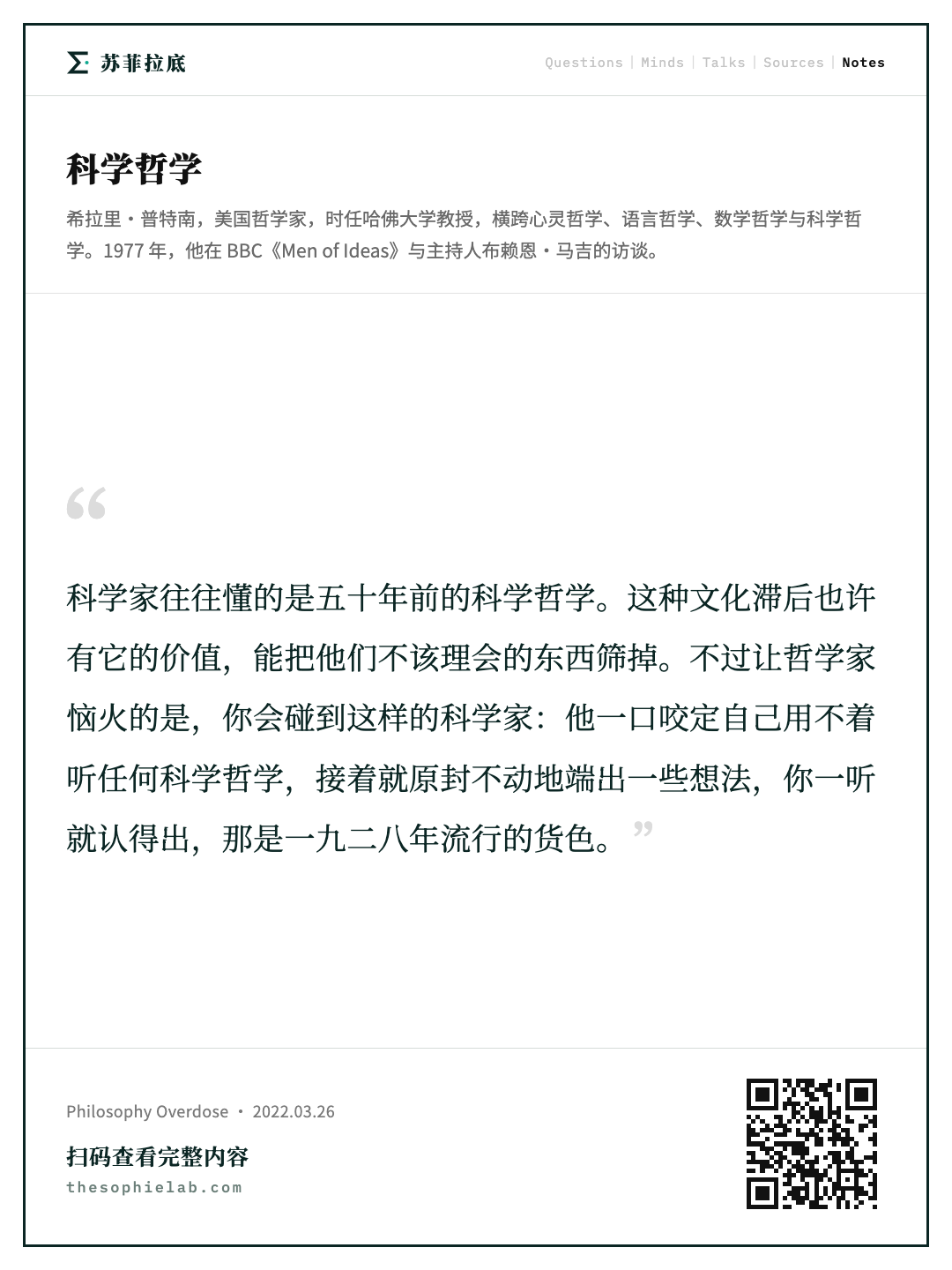
普特南: 首先我要说,我们基本上是写给对哲学有兴趣的普通读者看的,写给哲学读者看的。我不认为科学哲学的任务是直接给科学家出主意,正如我认为道德哲学家要是以为自己在就怎样过日子、议会该通过什么法案提供即时的当下建议,那是想错了。另一方面,我确实认为科学家往往懂的是五十年前的科学哲学。这也许不是坏事。也就是说,这种时间差、这种文化滞后也许有它的价值,能把他们不该理会的东西筛掉。不过让哲学家恼火的是,你会碰到这样的科学家:他一口咬定自己用不着听任何科学哲学,接着就原封不动地端出一些想法,你一听就认得出,那是一九二八年流行的货色。

麦基: 这同经济学家凯恩斯那句名言是不是正好对得上?他说,几乎所有自以为对空泛的经济理论毫不在意的商人,其实都是上一代经济理论家的奴隶。

普特南: 一点不错。

麦基: 我想还可以做另一个类比。普通的语言使用者要是来说明语言是什么、自己是怎么用语言的,说出来的东西一定极其粗浅,因为他们把语言视为当然,从来没有想过。大多数科学家要是来说明自己做科学时到底在做什么,恐怕也是一样。

普特南: 对。以为一个人只要从事某种活动,就能给出关于这种活动的理论,这是一个错误。

生物学、进化论与计算机

麦基: 人们常常批评科学哲学家,说他们泛泛地谈科学,实际上几乎总是在说一门科学,也就是物理学。可是至少在过去二十年里,发展最激动人心的科学恐怕不是物理学而是生物学,这是事实吧?科学哲学家的科学观是不是真的过于以物理学为本,对生物学过于忽视?这种批评站得住吗?

普特南: 我想替我们辩护一下,理由是:生物学的理论固然有重大的科学意义,达尔文的进化论、克里克和沃森关于DNA的工作,都是如此,但大体上说,它们并没有提出物理科学里不曾出现的那类重大方法论问题。我不知道你是否同意这一点。

麦基: 你刚才提到了进化论。在我看来,这是一个发源于一门科学,也就是生物学的概念,而它在相当短的时间里传遍了我们的整个文化。几乎每个人的思考方式都受到进化概念的影响,不只是关于人类的起源,还有关于制度、关于艺术,关于各种各样的事情。进化已经成了西方人思考几乎任何问题时的一个维度。是不是这样?

普特南: 是的,对这个理论的关注也许确实不够。不过我觉得有意思的是,我们心目中生物学式的解释,也就是用功能来解释,而不是用物理、化学、用你是什么材料构成的来解释,这种解释方式的可能性近来受到了更多关注,而这要归功于计算机科学。

麦基: 你说到计算机科学,这正好引出我特别感兴趣的一件事:技术与哲学的相互作用,就计算机而言是如此。不只是科学与哲学,而是技术与哲学。计算机最初是有意识地比照人的心灵造出来的。可随着它们越来越精巧,我们反过来开始从它们身上了解到关于人类心灵的东西。所以我们对计算机的建造,和计算机反过来告诉我们的关于我们自己的东西,似乎是在交互中一同生长的。是不是这样?

普特南: 是的。顺便说一句,这正是哲学家与科学家来往密切的一个领域。今天,语言学、认知心理学、计算机科学、语言哲学这几个领域时时刻刻在互动。人们互相寄论文,不是因为有谁吩咐他们这么做;各路专家开会碰头,也不是因为有谁决定该来一点交叉融合。计算机这个例子有意思的地方在于,人们本来可能以为,计算机的兴起会助长某种粗俗的唯物论:「看吧,我们终究是机器。看吧,我们身上的一切终究都能用物理和化学来解释。」可吊诡的是,计算机对心理学、对心灵哲学的实际影响,反而是这类还原论的退潮。

软硬件之分与亚里士多德

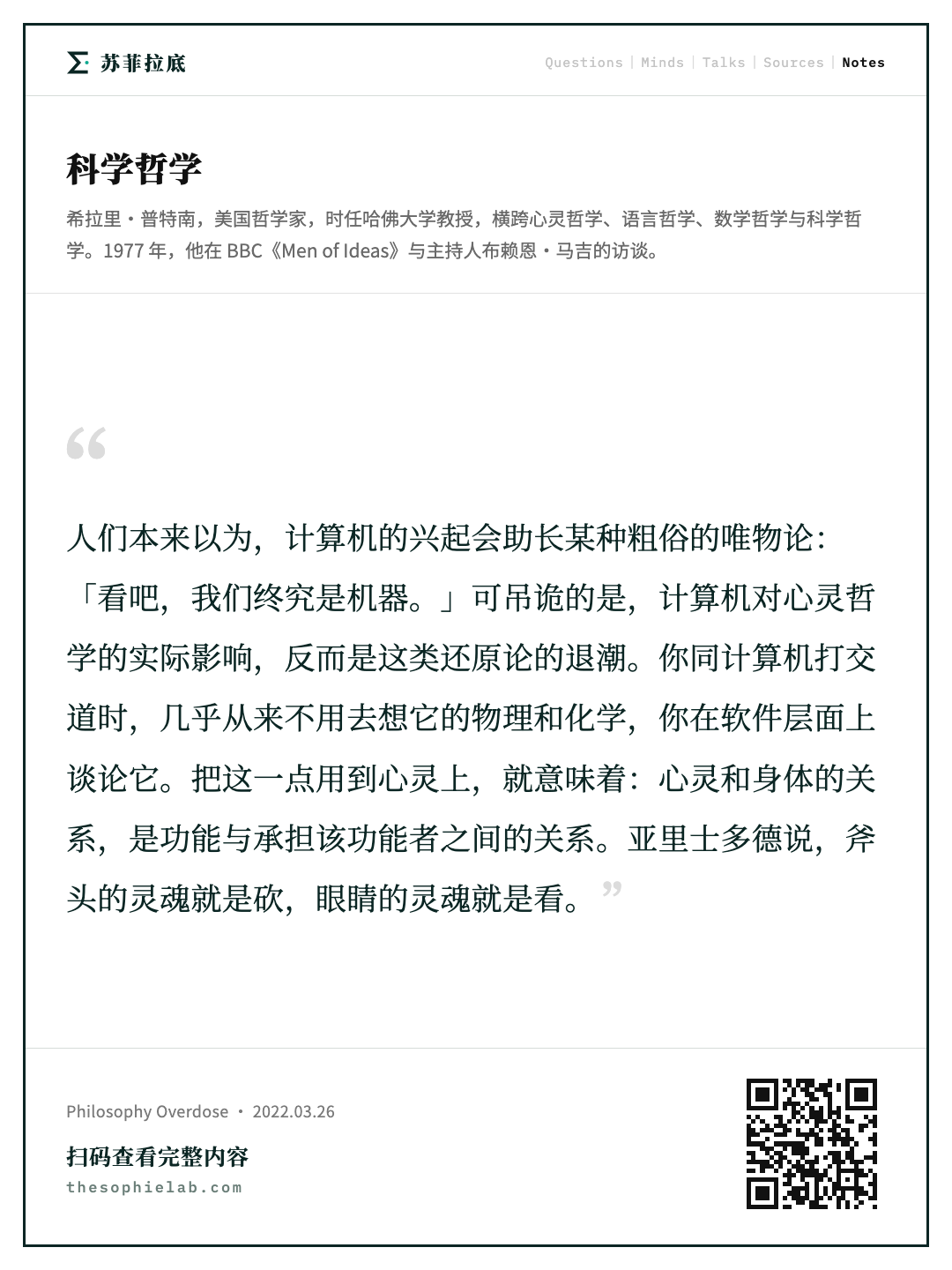
普特南: 计算机的特点在于,你同它打交道时,几乎从来不用去想它的物理和化学。人们把计算机分成两个层面:软件,也就是它的程序、指令、规则、它做事的方式;还有硬件。通常你不理会硬件,你在软件层面上谈论计算机。要是在硬件层面上解释它做的事,你根本没法解释出一个对任何人有用的样子来。这里有一种涌现(emergence),但不是神秘主义式的涌现,它并不违反物理定律。只不过组织层面上的东西,也就是关于组织方式的高层事实,有一种自主性。你会说:它在执行这个程序,这就解释了它为什么这样做,我不需要知道它是怎么造的,只需要知道它能够被造得执行这个程序。把这一点用到心灵上,就意味着回到一种我把它同亚里士多德联系在一起的心灵观:我们不是机器里的幽灵,不是暂时寄居在肉体里的精神;心灵和身体的关系,是功能与承担该功能者之间的关系。亚里士多德说,如果你把「灵魂」这个词用在一把斧头上(他说,当然你不会这么用),你会说斧头的灵魂就是砍。他还说,眼睛的灵魂就是看。他把人看成「一个会思考的东西」。

马克思主义算不算科学哲学

麦基: 你说的这种既非唯物论、又非宗教观的第三条路,立刻让我想起现代世界最重要的唯物论哲学,也就是马克思主义。我们此刻坐在这里谈话的时候,它是全人类约三分之一人口的官方国家哲学。马克思主义自称是科学的,这是它非常要紧的一点。那么,马克思主义对科学哲学有没有重要的贡献?

普特南: 我认为没有什么重要的马克思主义贡献。但我也不认为马克思主义者全都错了。恩格斯是他那个世纪科学知识最渊博的人之一。他弄错了不少事,但他的一般科学知识极为广博。他谈科学哲学的大部头《反杜林论》,虽然含有一些相当古怪的想法(顺便说,其中有些来自黑格尔),但总体上是一本理智的科学哲学著作,此外还谈了别的东西。另一方面,它并没有什么马克思主义的特色。我要说,恩格斯的科学哲学观点,很大程度上受当时标准科学哲学的影响,是一套相当精致的归纳主义说法。

麦基: 那么后来那些也自命为哲学家的马克思主义思想家呢,比如列宁?

普特南: 我认为他们良莠不齐。列宁大概是最差的之一。比如他说,理论是运动的摹本。这就是摹本论,是「科学只是把实在照抄下来」这种看法的最粗糙的版本。毛泽东要精致一些。他深受约翰·杜威的影响,杜威在二十年代的中国读者很多。

麦基: 你认为它对今天的科学哲学实际有过贡献吗?还是谈不上?

普特南: 我认为它有所预见。要是人们在意识形态上没有分裂得这么厉害,它本来也许能做出贡献,因为非马克思主义者本来可以从中学到东西:马克思主义者是最早尝试把实在论的立场同对实践的强调、对可纠正性的强调结合起来的人。他们非常敌视先天真理(a priori truth)的概念,而今天许多主流科学哲学家同样非常敌视先天真理。就现状而言,他们在科学哲学里扮演的角色,多少就像凯恩斯说的马克思在经济学里扮演的角色:凯恩斯把马克思称为他的一位「地下先驱」。

数学如何与世界相符

麦基: 开场时我不仅提到了科学哲学,也提到了数学哲学。结束之前,我想我们无论如何该谈谈数学哲学。我想可以说,数学哲学的核心问题同科学哲学的核心问题恰好平行,都是:它是怎么同世界相符的?科学哲学问的是科学怎么同世界相符,数学哲学问的是数学怎么同世界相符。对吗?

普特南: 对。而且情况更糟。如果你在经验科学里为摹本论、为真理符合论辩护,那么对「我们怎么建立起一幅与实在相符的图景」这个问题,你可以回答说:我们有感官。我前面说过,这不是一个完整的回答,因为单纯的看和听里就包含着大量的解释。可如果谈的是数和集合,有人会问:好,如果数学知识只是数的样子、集合的样子、数学家研究的其他抽象对象的样子的某种摹本,那么,是哪一种感官让我们看见它们的?

麦基: 是啊,数是什么?这是一个极成问题的问题,但仍然是一个重要的问题。

普特南: 对。另一方面,我也不想说反符合论的一方就轻松。在我看来,数学知识是一个真正的谜。我认为哲学家应该比现在更专注于数学哲学,因为这似乎是一个没有任何理论真正说得通的领域。

麦基: 数学与科学之间不是还有另一个重要的平行关系吗?纵观科学史,一直有一种冲突:一方认为科学谈的都是独立于人类经验而存在的世界中的对象,另一方则说,不对,其中大部分是人、是观察者贡献的。而正如你在前面指出的,真相几乎肯定是两者的结合。数学里不是也有一场长期的争论吗?一方认为数学知识可以说是内在于世界结构之中的,我们通过经验和观察从世界中把它推导出来;另一派数学思想则说:不,不,不,数学是人类心灵的创造,我们再把它像一张网格那样罩到实在上面,好比把网格罩到一片风景上。是这样吗?

普特南: 是的。后一种说法之所以吸引人,是因为有感官问题。但它似乎同样行不通,因为看起来我们并不能随心所欲地把任何数学、任何逻辑加到世界上。几乎谁都会承认,至少你得自洽(consistent)。而什么自洽、什么不自洽,并不是我们可以随便编造或者决定的事。当我们强调约定论的、主观的说法时,我们撞上了数学的客观性;当我们强调数学的客观性时,我们又撞上另一堆问题。我认为,在这个领域再往深处走,我们能对人类知识、对科学知识了解到比现在多得多的东西。

下一个热点:改逻辑

麦基: 说到从现在往前走,普特南教授,我想结束这场谈话最有意思的方式,就是请你谈谈你眼中当前最有意思的问题领域,我想这也就是我们讨论的这两门学问,科学哲学和数学哲学,在不远的将来最可能的生长点。

普特南: 好。请允许我把预测限定在不远的将来,因为我们都知道,长期预测总是错的。就不远的将来说,我预计数学哲学会是一个生长点,逻辑哲学也是。我预计物理学哲学在科学哲学中的中心地位会有所下降,尽管其中有一部分同逻辑哲学相通。围绕量子力学,实际上已经有人提出了一个惊人的主张:为了真正理解世界怎么可能是量子力学式的,我们也许不得不改变我们的逻辑,改变我们对真正的逻辑规律是什么的看法。我认为量子力学哲学中同逻辑哲学相通的这一面,会成为热烈讨论的领域。更一般地说,有些领域我们几乎不把它们当作科学哲学,它们正在变成语言哲学和心灵哲学,比如心灵的计算机模型、语言的计算机模型这类问题;还有那些更一般的问题:真理理论,真理的本性,验证的本性,在没有严格科学方法的情况下科学何以还能是客观的。我认为这些问题会一直是这个领域的常备课题。

相对论七十年后仍未普及

麦基: 关于整个这个领域,有一件事让我担心,那就是它同受过教育的普通人的关系,而这场讨论从某种意义上说正是为这些人做的。二十五岁的爱因斯坦发表相对论,到现在已经七十多年了。我相信你会同意,如今受过高等教育、拿了大学学位的人,绝大多数对相对论究竟讲什么仍然几乎一无所知,它对他们世界观的影响微乎其微。现在科学和数学一路狂奔,它们给我们带来的关于我们所居住的宇宙的全新洞见,根本没有渗透到非专业人士那里,或者渗透得远远不够快。这里面是不是有一种危险?

普特南: 确实有这种危险,但这是可以想办法的。比如现在已经有一本狭义相对论教材,叫《时空物理》(Spacetime Physics),是专为大学一年级第一门物理课的头一个月编写的。作者在开头就说,他们期待着这本书有一天能在中学里讲授。

麦基: 你认为那一天真的会来,而且很快就来?

普特南: 我确信如此。

麦基: 我想你是对的,而且我希望你是对的。非常感谢你,普特南教授。
本期讲者
希拉里·普特南美国哲学家,时任哈佛大学教授,横跨心灵哲学、语言哲学、数学哲学与科学哲学。提出功能主义心灵观、「孪生地球」思想实验与内在实在论,参与解决希尔伯特第十问题。
布莱恩·马基英国哲学作家、广播主持人,曾任工党下院议员。以 BBC 哲学访谈系列《思想者》(1978)与《伟大的哲学家》(1987)著称,善于把专业哲学讲给普通观众。
章节 · 点击跳转视频
0:13 哲学与数学科学的历史渊源 ▶ 正在看
3:03 旧科学观:宝箱累积与归纳法 ▶ 正在看
7:03 康德转向:真理含心灵贡献 ▶ 正在看
11:01 科学可修正:大图景被整体替换 ▶ 正在看
14:22 真理是什么:断言标准与等价描述 ▶ 正在看
17:35 主观与相合:科学为何仍管用 ▶ 正在看
20:12 科学与非科学的界线消失 ▶ 正在看
25:12 科学哲学家在做什么、为谁写 ▶ 正在看
30:07 生物学、计算机与功能主义心灵观 ▶ 正在看
35:09 马克思主义对科学哲学的贡献 ▶ 正在看
37:29 数学哲学:数如何与世界相合 ▶ 正在看
41:16 未来热点与公众理解的滞后 ▶ 正在看
本期论点
本期回应
19:06
科学之所以行得通,很大程度上正因为它可修正、不把自己的想法当作不会错 随时准备认错理论碰上反面证据,就该放弃吗?
20:53
科学与非科学之间并不存在人们一向以为的那种界限分明的区别 没有硬界限,只是更成功科学的可靠性来自哪里?
24:47
物理学家不承认社会学是科学,真正原因不是他们不用归纳法,而是没那么成功 没有硬界限,只是更成功科学的可靠性来自哪里?
26:54
科学方法不是套上去就能产出知识的机械规则,而是从严格到宽松的连续谱系 没有硬界限,只是更成功科学的可靠性来自哪里?
21:40
「希特勒是个坏人」是一个事实,而不只是主观态度的表达 有答案道德问题有没有正确答案?
34:45
心灵与身体的关系是功能与承载该功能之物的关系,而非机器中的幽灵 心灵是身体的功能人身上有超出自然的成分吗?
40:13
把数学看作人类心灵的自由创造行不通,因为一致与否并非人可随意约定 本来就在那里数学是被发现的,还是被发明的?
其他论点
7:48
真理既取决于事物本身如何,也取决于思考者心灵的贡献
8:43
看见本身就包含大量解释,最简单地与世界打交道也带着解释
12:30
旧科学理论出错的地方不在细节数值上,而在整体图景上
15:01
「什么是真的」与「我们的断言标准是什么」之间无法彻底切割
17:09
量子力学在实践中管用,这本身就意味着它有某种根本上正确的东西
33:25
计算机对心灵哲学的实际影响是减少还原论,而非助长「人不过是机器」的唯物主义
37:11
马克思主义者最早把实在论立场与对实践、可纠正性的强调结合起来 观察
41:41
要理解世界何以可能是量子力学式的,也许必须改变我们对逻辑规律的看法
01哲学与数学科学的历史渊源
0:13
The connection between philosophy and the mathematical sciences has always been very close. Plato had written over the door of his academy the words, "Let no one enter here who is ignorant of geometry." It was Aristotle who codified the basic sciences into the categories and gave them the names that we use to this day. Some of the greatest philosophers have been themselves great mathematicians who invented new branches of mathematics. Descartes is an obvious example, and so is Leibniz and Pascal.
哲学与数学科学之间的联系向来非常紧密。柏拉图在他学园的门楣上写下这样一句话:“不懂几何者不得入内。”正是亚里士多德把各门基础科学梳理成不同门类,并给它们起了我们沿用至今的名称。有些最伟大的哲学家本身就是伟大的数学家,开创了数学的新分支。笛卡尔就是个显而易见的例子,莱布尼茨和帕斯卡也是。
便签引用
0:45
In fact, most of the great philosophers, not all but most, came to philosophy from mathematics or the sciences. And this tendency is continued into our present century. Bertrand Russell was trained first as a mathematician, Wittgenstein was trained first as an engineer. The reason for this persisting connection is, I think, obvious. And that is that the basic urge, which has driven most of the greatest philosophers, has been the urge to deepen our understanding of the world and of its structure. And this is also what creative scientists are doing.
事实上,多数伟大的哲学家——不是全部,但大多数——都是从数学或科学走进哲学的。这个趋势一直延续到我们这个世纪。伯特兰·罗素最初受的是数学训练,维特根斯坦最初受的是工程学训练。我想,这种联系之所以持续不断,原因是显而易见的。那就是,驱动着大多数最伟大的哲学家的那种根本冲动,一直是想加深我们对世界及其结构的理解。而这也正是富有创造力的科学家们在做的事。
便签引用
1:20
For most of the past, too, people thought that mathematics was the most indubitable knowledge, as well as being utterly precise and clear, that human beings possessed. So there have always been plenty of philosophers examining mathematics to try and find out what was so special about it, and whether this was something that could be applied to the acquisition of other sorts of knowledge. Ditto with the sciences, which were also thought to yield a very specially safe and certain kind of knowledge. What was it about science that made its results so reliable, people asked themselves. And could its methods, whatever these were, be used in other fields?
而且在过去的大部分时间里,人们都认为数学是人类所拥有的最不容置疑的知识,同时也是最精确、最清晰的知识。所以一直有大量哲学家在考察数学,想弄清楚它到底特别在哪里,以及这种特别之处能否被用来获取其他种类的知识。科学也是如此,人们同样认为科学能提供一种特别可靠、特别确定的知识。科学究竟有什么特点,使它的结论如此可靠?人们这样追问自己。而它的方法——不管那些方法是什么——能不能用在别的领域?
便签引用
2:01
These investigations into the concepts, and methods, and procedures, and models that are involved in mathematics and in science have come to be known as the philosophy of mathematics and the philosophy of science. And it's with these that we're going to be concerned in this program. Chiefly with the philosophy of science, though, in fact, we have someone taking part who is expert in both -- Professor Hilary Putnam of Harvard University. Professor Putnam, I'd like to start our discussion from a standpoint which I think a very large number of our viewers occupy anyway. And it's really this. Since the 17th century, I suppose, there's been a spectacular decline in religious belief, especially in the West, and especially among educated people. And for millions, the role that used to be taken in life by a world view based on religion has been increasingly supplanting by a world view based on science or, at least, purporting to be derived from science, anyway. And this is still enormously powerful,
这些针对数学与科学中所涉及的概念、方法、程序和模型的探究,后来就被称为数学哲学和科学哲学。本期节目我们要谈的就是这两者。不过主要还是科学哲学。事实上,今天参与讨论的这位嘉宾在两方面都是专家——哈佛大学的希拉里·普特南教授。普特南教授,我想从一个立场开始我们的讨论,我认为我们很多观众本来就站在这个立场上。大致是这样:我想大概从17世纪以来,宗教信仰出现了惊人的衰落,尤其是在西方,尤其是在受过教育的人群中。对千百万人来说,过去由宗教构建的世界观在生活中所扮演的角色,越来越多地被一种以科学为基础的世界观所取代,或者至少是自称从科学中推导出来的世界观。这种世界观至今仍极其强大,
便签引用
02旧科学观:宝箱累积与归纳法
3:03
and the hold that it has on people's minds throughout the West probably affects all of us. So I think I'd like to start this discussion by getting you to pin down that scientific world outlook which is so influential in the modern world and which will be underlying a lot of what we're going to have to talk about. Let me dodge the question a little bit by talking not about what scientists think now but what many scientists thought 100 years ago, or 75 years ago. Think of doing a crossword puzzle. You might have to change a few things as you go along.
它在整个西方对人们头脑的支配,恐怕影响着我们所有人。所以我想这样开始我们的讨论:请您先界定一下这种在现代世界如此有影响力的科学世界观,它也将是我们接下来许多讨论的底色。请允许我稍微回避一下这个问题,我不谈科学家现在怎么想,而谈许多科学家在100年前、或者75年前是怎么想的。想想做填字游戏。做的过程中,你可能得改动几个地方,
便签引用
3:38
But towards the end everything fits, and things get added on one step at a time. That's the way the progress of science looked for 300 years. In 1900, a famous mathematician, David Hilbert, gave a list of 50 mathematical problems to a world congress of mathematicians, which are still very famous. And it's very interesting that he included one problem which we would not call a mathematical problem, very early in the list. I think it's problem 3, which was to put the foundations of physics on a satisfactory basis.
但到最后一切都严丝合缝,内容是一步一步累加上去的。三百年来,科学的进步在人们看来就是这个样子。1900年,著名数学家大卫·希尔伯特在一次世界数学家大会上提出了一份包含50个数学问题的清单,至今仍非常有名。很有意思的是,他把还有一个问题,我们根本不会把它算作数学问题,而且排在名单很前面。我想是第 3 个问题——为物理学的基础奠定一个令人满意的根基。
便签引用
4:10
Just a small task. And that was for mathematicians. Not for physicists. To tidy it up. That's right. The ideas is, Newton, Maxwell, Dalton, and so on had all put in all the parts of the story, and now it was just for mathematicians to, basically, clean up the logic, as it were. I think, in a conversation we had a couple of days ago, you described this as a treasure chest view and I like that picture. Here's this big chest that we're just filling up. It's an accumulation, and you don't have to subtract, you don't have to take out. Occasionally you make a little mistake, but basically the idea is, when you shift the metaphor, like building a pyramid. You put down the ground floor, then the next floor, then the next floor.
不过是个小任务而已。而且那是交给数学家的,不是给物理学家的。就是把它收拾干净。对。意思是说,牛顿、麦克斯韦、道尔顿等等,已经把这个故事的各个部分都摆进去了,现在只剩下数学家来把逻辑理一理,可以这么说。我记得几天前我们聊天时,你把这叫作“宝箱式”的看法,我很喜欢这个画面。有这么一只大箱子,我们只是不断往里装。这是一种累积,你不用减,不用往外拿。偶尔会犯点小错,但基本上这个想法——如果换个比喻的话——就像盖金字塔。你先打好底层,然后是下一层,再下一层。
便签引用
4:53
It just goes up. That's part of it. The view of knowledge as growing by accumulation. The other part of it is the idea that the special success of the sciences -- and obviously what we're impressed by is success. This culture values success and science is a successful institution. But there is the idea that science owes its success to using a special method. And that comes probably from history of science, from the fact that Newton, for example, lived after Bacon, was influenced by Bacon. And the idea that empirical science has grown up together with something called inductive logic. And this idea that there's a method, the inductive method, and that the sciences can be characterized by the fact that they use this method and use it explicitly and consciously as it were -- not, unconsciously as maybe someone who's learning cooking might be using it, but pretty deliberately and explicitly.
它就这么往上长。这是其中一部分:把知识看成靠累积而增长。另一部分是这样一个想法:科学有它特别的成功——显然让我们佩服的正是成功。这个文化崇尚成功,而科学是一门成功的事业。但有一种想法认为,科学的成功归功于它使用了一种特别的方法。这大概来自科学史——比如说,牛顿生活在培根之后,受过培根的影响。于是就有了这样的观念:经验科学是和某种叫作归纳逻辑的东西一起成长起来的。以及这样一种想法:存在一种方法,即归纳法,而科学的特征就在于它使用这种方法,并且是明确地、自觉地在使用——而不是像某个学做菜的人那样也许不知不觉地在用,而是相当有意识、相当明确地用。
便签引用
5:46
So I think that these two things -- the idea of knowledge as growing by accumulation and growing by the use of a special method, the inductive method, are the key elements of the old view. Yes, and if I were going to put the same thing, I suppose, slightly differently I think I'd say this. For 200 or 300 years, educated Western man thought of the universe, and everything in it as consisting of matter in motion. And that was all there was, whether from the outermost galaxies of the stars into ourselves, and our bodies, and the cells of which we made up, and so on.
所以我认为这两件事——把知识看成靠累积增长,以及靠使用一种特别的方法即归纳法而增长——是那种旧看法的关键要素。是的。如果换我来说同一件事,我大概会这么讲:在两三百年里,受过教育的西方人把宇宙以及其中的一切,都设想为由运动中的物质构成。就只有这些了——从最外围的星系,到我们自身、我们的身体、构成我们的细胞,等等。
便签引用
6:21
And science was finding out more and more about this matter, and its structure, and its motion, by a method which you just characterized as the scientific method. And the idea was that, if we went on long enough, we'd simply -- as you said with the crossword puzzle metaphor -- we'd find out everything there was to find out. We could, eventually, by scientific methods completely explain and understand the world. Now, that has been abandoned by scientists, hasn't it, though in fact this hasn't got through yet to the non-scientists. There are still large numbers of non-scientists who go on thinking that that's how scientists think. But of course they no longer do, do they? I mean, this is starting to break down.
而科学就是在不断发现关于这种物质、它的结构、它的运动的越来越多的东西,凭的正是你刚才称之为科学方法的那种方法。当时的想法是,只要我们干得够久——就像你刚才那个填字游戏的比喻——我们就会把所有能发现的东西都发现出来。我们最终可以用科学方法把这个世界完全解释清楚、完全理解。而现在科学家已经放弃这种看法了,不是吗?虽然这一点其实还没传到非科学家那里。还有大量非科学家一直以为科学家就是那样想的。可他们当然早就不那样想了,对吧?我是说,这套东西已经开始瓦解了。
便签引用
03康德转向:真理含心灵贡献
7:03
I think it's started to break down. I think it started to break down with Einstein. If I can drag in a bit of history of philosophy, screaming, by the hair, Kant did something in philosophy which I think has begun to happen now in science. He challenged a certain view of truth. Before Kant, no philosopher really doubted that truth was simply correspondence to reality. I mean, there are different words, some philosophers spoke of agreement. But the idea is a mirror theory of knowledge. Well, Kant said it isn't so simple. There's a contribution of the thinking mind. Sure, it isn't made up by the mind. Kant was no idealist. It isn't all a fiction. It isn't something we make up. But it isn't just a copy, either. What we call truth depends both on what there is, on the way things are, and on the contribution of the thinker, the mind. I think that today scientists have come to a somewhat similar view. That since the beginning of the 20th century, the idea that there's a human contribution, a mental contribution,
我认为它已经开始瓦解了。我认为是从爱因斯坦开始瓦解的。如果允许我硬把一点哲学史揪着头发、连喊带叫地拖进来:康德在哲学里做了一件事,我觉得现在在科学里也开始发生了。他挑战了某种关于真理的看法。在康德之前,没有哲学家真正怀疑过:真理就是与实在相符。当然说法不同,有些哲学家讲的是“一致”。但那个想法就是一种关于知识的镜子理论。而康德说,事情没那么简单。思维着的心灵也有它的贡献。当然,它不是心灵编造出来的,康德不是唯心论者。它不全是虚构,不是我们编出来的东西。但它也不只是一份摹本。我们所谓的真理,既取决于有什么、事物是怎样的,也取决于思考者、也就是心灵的贡献。我想今天的科学家已经走到了某种类似的看法。也就是说,自 20 世纪初以来,人们开始接受:我们所谓的真理里有一份人的贡献、心灵的贡献,
便签引用
8:09
to what we call truth, that theories aren't simply dictated to us by the facts, as it were. I'd like to ask you to unpack that a little because I think that some of our viewers will find idea a little puzzling. How can it be, some people will ask themselves, that what is and is not true can depend not only on what the facts are, but on the human mind? How can that be? Well, let me use an analogy with vision. We tend to think that's what we see just depends on what's out there. But the more one studies vision, either as a scientist or as a painter, one discovers that what's called vision involves an enormous amount of interpretation. The color we see as red is not the same color, in terms of wavelengths, at different times of the day. So that even in what we think of as our simplest transaction with the world, just looking at it, we are interpreting.
理论并不是由事实直接向我们下达的,可以这么说。我想请你把这一点稍微展开一下,因为我觉得有些观众会觉得这个想法有点费解。有人会问自己:什么是真、什么不是真,怎么可能不只取决于事实是什么,还取决于人的心灵?这怎么可能呢?那我打个视觉上的比方。我们往往以为,我们看到什么只取决于外面有什么。但你越是研究视觉——不管是作为科学家还是作为画家——就越会发现,所谓看见其实包含了大量的解释。我们看成红色的那个颜色,在一天中的不同时刻,按波长来说并不是同一个颜色。所以哪怕在我们认为最简单的与世界打交道的方式里——仅仅是看着它——我们也在做解释。
便签引用
9:01
In other words we bring a whole number of things to the world that we're not directly conscious of, usually, unless we turn inwards and start examining them. That's right. I think the world must've looked different in the Middle Ages to someone who looked up and thought of the stars as up and us at the bottom, for example. Today, when we look out into space, I think we have a different experience than somebody with the medieval world view. And what you're saying is that the very categories in which we see the world and interpret our experience, and the ideas within which we organize our observations and the facts around us and such, are provided by us. So that the world as conceived by science is partly contributed by external facts but also partly contributed by categories and ways of seeing things which come from the human observer.
换句话说,我们带了一大堆东西到我们所面对的世界里,而通常我们并不直接意识到它们,除非我们转向内心去审视它们。对。我想在中世纪,世界在一个人眼里一定不一样——他抬头看,觉得星星在上面,我们在底下。而今天我们望向太空的时候,我想我们的经验和抱着中世纪世界观的人是不同的。你的意思是说,我们借以观看世界、解释经验的那些范畴,以及我们用来组织自己的观察和周围事实等等的那些观念,都是我们自己提供的。所以科学所设想的这个世界,一部分来自外部事实,另一部分也来自那些出自人类观察者的范畴和看事物的方式。
便签引用
9:51
That's right. And an example of that in science -- I'll oversimplify, but it's not basically falsified -- is this wave/particle business. It's not that there's something, an electron, which is somehow half a wave and half a particle -- that would be meaningless -- but that there are many experiments which can be described two ways. You can either think of the electron as a wave, or you can think of it as a particle. And both descriptions are, in some crazy way, true and adequate. They're alternative ways of describing the same fact, and both descriptions are accurate?
对。科学里的一个例子——我会说得过于简化,但基本上不算歪曲——就是波和粒子那回事。并不是说有某个东西、一个电子,它一半是波、一半是粒子——那样讲毫无意义——而是说,有许多实验可以用两种方式来描述。你可以把电子想成波,也可以把它想成粒子。而两种描述都以某种匪夷所思的方式是真的、是够用的。它们是描述同一件事实的两套备选方式,而两种描述都准确?
便签引用
10:25
That's right. Philosophies have started talking of equivalent descriptions. That's a term used in philosophy of science. But now, for a couple of hundred years after Newton, educated Weston man thought that what Newton had produced was objective fact, that he had discovered laws which governed the workings of the world and the workings of the universe. And this was just objectively true independently of us. That Newton and other scientists had read these facts off of nature by observing it, and looking at it, and so on. And these statements, which made up science, were simply true.
对。哲学家们开始谈“等价描述”了。这是科学哲学里用的一个术语。可是在牛顿之后的两三百年里,受过教育的西方人认为,牛顿给出的是客观事实,认为他发现了支配这个世界的运作、宇宙的运作的定律。而这些独立于我们,就是客观为真的。认为牛顿和其他科学家是通过观察自然、盯着它看等等,把这些事实从自然那里读出来的。而构成科学的这些陈述,就是真的。
便签引用
04科学可修正:大图景被整体替换
11:01
Now, there came, didn't there, a period in the development of science, beginning in the late 19th century, when people began to realize that these statements were not entirely true, that this wasn't just a body of objective fact which had been read off from the world. In other words, that science was corrigible, scientific theories could be wrong. And that raises some very profound questions. I mean, if science isn't just an objectively true description of the way things are, what is it? And if we don't get it from observing the world, where do we get it from?
而后来,从 19 世纪末开始,科学的发展中出现了一个时期,不是吗——人们开始意识到,这些陈述并不完全为真,它并不只是一堆从世界那里读出来的客观事实。换句话说,科学是可修正的,科学理论可能是错的。这就引出了一些非常深刻的问题。我是说,如果科学不只是对事物本来面目的客观真描述,那它是什么?如果我们不是从观察世界得到它,那我们是从哪儿得到的?
便签引用
11:36
Well, I don't want to say we don't get it from observing the world at all. Obviously, part of this Kantian image is that there is a contribution which is not us. There's something out there. But that also there's a contribution from us. And even Kant, by the way, thought that Newtonian science was indubitable. in fact he thought we contributed its indubitability. The step beyond Kant is the idea that not only is reality partly mind dependent, but that there are alternatives, and that the concepts we impose on the world may not be the right ones, and we may have to change them. That there's an interaction between what we contribute and what we find out.
嗯,我并不想说我们完全不是从观察世界得到它的。显然,康德式图景的一部分就是:有一份贡献不是来自我们,外面是有点什么的。但同时也有一份贡献来自我们。而且顺带说一句,就连康德也认为牛顿科学是不可置疑的——事实上他认为,这份不可置疑性正是我们贡献的。超出康德的那一步是这样的想法:实在不仅部分地依赖于心灵,而且还存在别的选项——我们施加于世界的那些概念可能并不是对的,我们可能得去改它们。也就是说,我们所贡献的东西和我们所发现的东西之间存在互动。
便签引用
12:17
Now, what was it that made people begin to realize that this basic conception of science as objective truth was wrong, that science was corrigible, that science was fallible? I think it's that the older science turned out to be wrong where no one expected it to be wrong, not in detail, but in the big picture. It's not that we find out that, say, the sun isn't 93 million miles from the earth but only 20 million miles from the earth. That's not going to happen. I mean, sometimes one makes blunders even about things like that. But that's like making a blunder about whether there's a chair in the room.
那么,是什么让人们开始意识到,把科学看成客观真理的这个基本设想是错的,科学是可修正的、科学是会犯错的?我想是因为,旧的科学在没人预料到它会错的地方错了——不是在细节上,而是在大图景上。并不是说我们发现太阳离地球不是九千三百万英里,而只有两千万英里。那不会发生。当然,有时人们连这种事情也会大错,但那就像在“房间里有没有一把椅子”上出错一样。
便签引用
12:57
Wholesale skepticism about whether numerical values are right in science would be as unjustified as wholesale skepticism about anything. But where the newer theories don't agree with Newton is not over the approximate truth of the mathematical expressions in Newton's theory. Those are still perfectly good for calculation. It's over the big picture. We've replaced the picture of an absolute space and an absolute time by the picture of a four dimensional space time. We replaced a picture of a Euclidean world by a picture of a world which obeys a geometry Euclid never dreamed of. We've swung back to the picture of the word as having a beginning in time, which is really a shocker.
对科学中的数值是否正确抱一种笼统的怀疑,就和对任何事情抱笼统的怀疑一样没有道理。而新理论与牛顿不一致的地方,并不在牛顿理论里那些数学表达式的近似真实性上——那些用来计算至今仍然很好用。分歧在大图景上。我们把绝对空间和绝对时间的图景,换成了四维时空的图景。我们把一个欧几里得式世界的图景,换成了一个遵循欧几里得从未梦想过的几何的世界的图景。我们又摆回到世界在时间中有个开端的图景,这实在让人吃惊。
便签引用
13:40
It's not even that things once refuted stay refuted forever. So it means, really, that a whole conception of science has been superseded. Instead of thinking of science as a body of knowledge which is being added to all the time by further scientific work, that whole conception of science has in dispensed with, really, hasn't it? And we now think of it as a set of theories which are themselves constantly being replaced by better theories, by more accurate theories, by richer, more explanatory theories. And even the theories we now have, like those of Einstein and his successors, will probably be replaced, in the course of time, by other, better theories by scientists yet unknown. Isn't that so?
甚至连“被驳倒过的东西就永远被驳倒了”都不成立。所以这其实意味着,一整套关于科学的设想已经被取代了。不再把科学看成一个由后续科研不断往上添加的知识体,那整套关于科学的设想其实已经被弃用了,不是吗?我们现在把它看成一组理论,而这些理论自身也在不断被更好的理论、被更精确的理论、被更丰富更有解释力的理论所替换。而且我们现在拥有的理论,比如爱因斯坦及其后继者的理论,大概也会在时间的进程中,被尚不知名的科学家提出的另一些更好的理论所替换。不是这样吗?
便签引用
05真理是什么:断言标准与等价描述
14:22
That's exactly right. In fact scientists themselves make this prediction, that is, that the main theories of the 20th century -- relativity and quantum mechanics -- will give way to some other theory which will interpret both of them, and so on forever. Now, this raises a very fundamental question, namely, the question, what is truth? I mean, when we say that this or that scientific statement is true, or this or that scientific theory is true, what, in these newly understood circumstances of ours, can we mean by truth?
完全正确。事实上科学家自己就做出这个预言,也就是说,20 世纪的那些主要理论——相对论和量子力学——将会让位给某个能把两者都解释在内的别的理论,如此永远下去。那么,这就引出一个非常根本的问题,也就是:什么是真理?我是说,当我们说某个科学陈述是真的、某个科学理论是真的时候,在我们这种新的理解处境下,我们所说的“真”能是什么意思?
便签引用
14:54
There's still two views that have been since Kant. One is that this old correspondence view still has its adherents. But I think the view that's coming in more and more is that one cannot make a total separation between what's true and what our standards of assertibility are. That the way in which -- what I call using the Kantian picture -- the mind-dependence of truth comes in is the fact that what's true and what's false is in part a function of what our standards of truth and falsity are. And that depends on our interests, which, again, change over time, of course.
康德以来一直有两种看法。一种是那种老的符合论,它至今仍有拥护者。但我想越来越占上风的看法是:人无法在“什么是真的”和“我们的断言标准是什么”之间做出彻底的切割。我用康德式图景所说的那种“真理依赖于心灵”,其进入的方式就在于:什么是真、什么是假,在一定程度上是我们的真假标准的函数。而那又取决于我们的关切,当然,这些关切也是会随时间改变的。
便签引用
15:28
That's right. I'd like you to say a little more about this question of truth because this again, I think, is puzzling to the layman. I think that people who are not trained in science or philosophy are apt to think that there are a certain set of facts, and a true statement is a statement that accurately describes those facts. I'd like to talk a little about some of the difficulties that are actually involved in this. I think the biggest difficulty in science itself comes from the fact that, even within one scientific theory, you often find different accounts can be given the so-called facts. This came in with the special theory of relativity, when it turned out that facts about simultaneity, where the two things happen at the same time, could be described differently by different observers. One could say "Boy Scout A fired a starter's pistol before Boy Scout B,"
对。关于真理这个问题,我想请你再多说几句,因为这个我觉得对普通人来说也是费解的。我想没受过科学或哲学训练的人容易以为:有一组确定的事实,而一个真陈述就是准确描述这些事实的陈述。我想稍微谈谈这里头实际上牵涉的一些困难。我认为科学自身最大的困难来自这样一个事实:即使在同一个科学理论内部,你也常常发现对所谓的事实可以给出不同的说法。这是随狭义相对论一起进来的——结果发现,关于同时性的事实,也就是两件事在同一时刻发生,不同的观察者可以给出不同的描述。一个人可以说“童子军甲比童子军乙先开的发令枪”,
便签引用
16:19
the other could say, "No, Boy Scout B fired a starter's pistol before Boy Scout A," and if the distance is sufficiently large, so that a light signal can't travel from one to the other without exceeding the speed of light, then it may be both descriptions are correct. Both are admissible. Of course, this leads to profound conceptual difficulties in understanding some modern scientific theories. And this prompts the thought that a scientific theory can be useful, and meaningful, and can work even if nobody really quite understands what it means. And this is the case with quantum mechanics, isn't it? I mean, nobody is really sure what quantum mechanics actually means, and yet it works.
另一个人可以说“不对,是童子军乙比童子军甲先开的发令枪”。而如果距离足够远,以至于光信号无法在不超过光速的情况下从一处传到另一处,那么两种描述可能都是正确的,都是可以接受的。当然,这在理解某些现代科学理论时会带来深刻的概念困难。而这也引出一个念头:一个科学理论可以是有用的、有意义的、能起作用的,即使没有人真正弄明白它是什么意思。量子力学就是这种情况,不是吗?我是说,没有人真正确定量子力学到底意味着什么,可它就是管用。
便签引用
17:00
That's right. And, again, I want to say, one shouldn't push that too far, because I think we don't want to give up our standards of intelligibility altogether. We want to say -- quantum mechanics works, and the very fact that it works means that there's something fundamentally right about it. And with respect to its intelligibility, we're willing to say, in part, that may be that we have the wrong standards of intelligibility, that we have to change our intuitions. But in part, there are real paradoxes in the theory. And I think that's more work has to be done to really get a satisfactory resolution of these paradoxes. Things are very ticklish now.
对。而我还是想说,这一点不该推得太远,因为我认为我们并不想完全放弃可理解性的标准。我们想说的是——量子力学管用,而它管用这个事实本身就意味着它有某种根本上正确的东西。至于它的可理解性,我们愿意说,一部分原因可能是我们的可理解性标准不对,我们得改变自己的直觉。但另一部分是,理论里确实有真正的悖论。我认为还需要做更多工作,才能真正令人满意地解决这些悖论。现在的情形非常微妙。
便签引用
06主观与相合:科学为何仍管用
17:35
Yes, I think somebody hearing our discussion to whom, perhaps, some of these ideas are new might find himself thinking -- well, if all this is so, how is it that science works? If traditional scientific theories are breaking down, if science is turning out not to be a body of reliable, permanent, firm, objective knowledge, if a significant portion of every scientific theory is subjective anyway, in the sense that it's contributed by the human mind, by the observed by the scientists, how is it, in these circumstances, that we can actually build bridges, fly airplanes, make rockets go to the moon, and actually make all this soft fuzzy changing partly subjective body of theory work for us. It must fit the world, in some very basic way, in spite of everything that we've been saying.
是的。我想,有人听我们的讨论——其中一些想法对他也许是新的——可能会想:那好,如果这一切都成立,科学怎么还行得通呢?如果传统的科学理论正在瓦解,如果科学到头来并不是一个可靠、恒久、牢固的客观知识体,如果每个科学理论里都有相当一部分终究是主观的,也就是说是由人的心灵、由科学家的观察所贡献的,那在这种情况下,我们究竟怎么还能真的造桥、开飞机、把火箭送上月球,还真让这一整套软绵绵、模糊、不断变化、部分主观的理论为我们所用?不管我们刚才说了些什么,它一定在某个非常根本的层面上与世界相合。
便签引用
18:25
That's true, but I think the contrast between being subjective and fitting the world isn't altogether right. I'm not saying that scientific knowledge is subjective, or that anything goes. I'm saying we're in the difficult position that we often are in in life of thinking there is a difference between good and bad reasoning, but we don't have a mechanical rule. In everyday life, we use interest-loaded terms. We wouldn't say that there's a policeman on the corner if we didn't have a whole network of social institutions. Somebody coming from a primitive tribe which didn't have policemen might say there's a man in blue on the corner. But the fact that the notion of a policeman is shaped by our interests doesn't mean that it can't be objectively true that there's a policeman on the corner. Also, I think science works precisely because of this corrigibility, in large part, as Professor Poppers pointed out.
确实如此,但我认为“主观”和“与世界相合”之间的这种对立并不完全对。我并不是说科学知识是主观的,或者说什么都行。我是说,我们处在人生中常有的那种难处:认为好的推理和坏的推理有区别,但我们没有一条机械的规则。在日常生活里,我们使用带有关切色彩的词。要是没有一整套社会制度,我们不会说“街角有个警察”。一个来自没有警察的原始部落的人也许会说:街角有个穿蓝衣服的男人。但“警察”这个概念是由我们的关切塑造的,这并不意味着“街角有个警察”不能是客观为真的。另外,我认为科学之所以行得通,很大程度上正是因为这种可修正性,就像波普尔教授指出的那样。
便签引用
19:12
The difference between science and previous ways of trying to find out truth is in large part that scientists are willing to test their ideas because they don't regard them as infallible, in a way, that was known at the beginning, and then in the success of Newtonian science, somewhat forgotten. And we've had to be reminded again of what Bacon knew -- that you have to put questions to nature and be willing to change your ideas if they don't work. In some respects, the traditional opposition between science and religion -- the two parties have crossed places, haven't they? I mean, many religious people now believe they have certain knowledge about the world, that it was created by called a god, that he made us in his own image, gave us immortal souls which will survive out there, and so on. Certain very fundamental propositions which they hold with absolute certainty. And it's the scientist who believes that everything is fallible, that the world is a mysterious place that we'll never get to the end of the mystery of, and so on and so forth. Isn't there something in that?
科学与以往那些寻求真理的方式之间的区别,很大程度上在于:科学家愿意检验自己的想法,因为他们不把这些想法看成不可能出错的——这一点在某种意义上一开始就是知道的,后来在牛顿科学的成功中,又多少被忘掉了。我们不得不重新被提醒培根早已明白的道理——你必须向自然提问,而如果你的想法行不通,就要愿意改变它。在某些方面,科学与宗教这对传统对立,双方是不是互换了位置?我是说,现在许多宗教人士相信自己拥有关于世界的确定知识:世界是由所谓的神创造的,他按自己的形象造了我们,赐给我们不朽的灵魂、将在彼处存续,等等。一些非常根本的命题,他们抱着绝对的确定性持守。反倒是科学家相信一切都可能出错,相信世界是个神秘的地方,我们永远走不到那神秘的尽头,如此等等。这里头是不是有点道理?
便签引用
07科学与非科学的界线消失
20:12
Maybe. You say it maybe? I'm not sure. You're not sure. Well, let's not pursue that. But one point I do want to take up with you, leaving even religion aside, is that now science is seen in this entirely different way that you've been describing, by virtually all scientists, doesn't it mean that the difference between science and non-science isn't what it was always thought of as being. In other words, since science is so subjective, indefinite, changing, and so on, it's no longer a clearly-cut and different kind of human activity, and kind of human knowledge, from other sorts of human knowledge and other sorts of human activity.
也许吧。你说也许?我不确定。你不确定。那好,这个我们就不追下去了。但有一点我确实想跟你探讨一下——先把宗教放在一边不谈——就是既然现在科学被看成你所描述的这种全然不同的样子,而且几乎所有科学家都这么看,那这是不是意味着,科学与非科学之间的区别,已经不是人们一向以为的那样了?换句话说,既然科学是如此主观、如此不确定、不断变化等等,它就不再是一种界限分明、与众不同的人类活动,也不再是一种与其他各类人类知识、其他各类人类活动截然有别的人类知识了。
便签引用
20:53
I think that's both true and culturally very important. I think the harm that the old picture of science does is that if there is this realm of absolute fact that scientists are gradually accumulating then everything else appears, somehow, as non-knowledge, something to which even words like true and false can't properly apply. I think that the so-called fact-value dichotomy is a very good example of this. It's hard to have a discussion, on politics for example, without someone very quickly say, at least in my country: "is that a fact or a value judgment?" As though it can't be a fact that Hitler was a bad man, for example, or a factory that Farah Fawcett Majors is a beautiful woman.
我认为这既是事实,在文化上也非常重要。我觉得旧的科学图景带来的危害在于:如果存在这样一个绝对事实的领域,而科学家们正在一点一点把它积累起来,那么其他一切就会显得,某种意义上,像是非知识,像是连“真”“假”这样的词都不能恰当地用在上面的东西。我认为所谓的事实—价值二分法就是一个很好的例子。比如讨论政治问题时,很难不马上有人说——至少在我的国家是这样:“那是事实,还是价值判断?”仿佛“希特勒是个坏人”不可能是一个事实,又比如,“法拉·福塞特·梅杰斯是个美丽的女人”也不可能是一个事实。
便签引用
21:37
And do you think that it is a fact that Hitler was a bad man? Oh yes, I do. I do too. But then, if this is so, if we're abandoning so many of these comfortable, clear-cut, distinctions of the past, what's the point of continuing to use the category, or the notion or the term "science" anyway? I mean, does it any longer clearly demarcate something differentiable from everything else. I don't think it does. I think that if you're going to distinguish science from non-science, that makes a lot of sense if you still have this old view that there's this inductive method. What make something science is that it uses it and uses it pretty consciously and pretty deliberately.
那你认为“希特勒是个坏人”是一个事实吗?是的,我认为是。我也这么认为。可是,如果真是这样,如果我们要放弃过去那么多让人安心的、界限分明的区分,那我们干嘛还要继续使用“科学”这个范畴、这个概念、这个词呢?我是说,它还能清楚地把某种东西同其他一切划分开来吗?我认为不能。我觉得,如果你要把科学同非科学区分开来,那只有在你仍然持有那种旧观点——认为存在一种归纳方法——时才讲得通。让一样东西成为科学的,是它运用这种方法,而且相当自觉、相当有意识地运用它。
便签引用
22:20
And that what makes something non-science is, either it uses it entirety unconsciously, as in learning how to cook -- you're not consciously thinking about inductive logic, or perhaps doesn't use it at all, as metaphysics was alleged not to use it all, I think unfairly. But when you both say that there's a sharp line between, say, practical knowledge and science. And to say that the method which is supposed to draw this line is rather fuzzy, something that we can state exactly -- and attempts to state it, by the way, have been very much a failure, still. Inductive logic cannot be, say, programmed on a computer the way deductive logic can be programmed on a computer.
而让一样东西成为非科学的,则要么是它完全无意识地在运用这种方法,比如学做饭——你并不会有意识地去想归纳逻辑,要么就是它根本不用,就像形而上学被指责为完全不用归纳方法那样——我认为这个指责并不公平。可你既要说实践知识和科学之间存在一条明确的界线,又要说那个据说划出这条界线的方法本身相当含糊,并不是我们能够精确表述的东西——顺带说一句,试图表述它的种种努力,到现在为止基本上都失败了。归纳逻辑没法像演绎逻辑那样被编写成计算机程序。
便签引用
23:01
And I think the development of deductive logic in the last 100 years and the development of the computer have really brought very dramatically just what a different state we are in with respect to proof in the mathematical sciences, which we can state rigorous canons for, and proof in what used to be called the inductive sciences, where we can state general maxims, but you really have to use intuition, general know-how, and so on in applying them. One of the two categories that you described the old-fashioned way of looking at science in terms of was that there was a particular scientific method, that you observed the facts, and, on the basis of these observed instances, you generalized to form scientific theories which you then verified by experiment, and so on. That was the old view.
我认为,过去一百年里演绎逻辑的发展,以及计算机的发展,非常戏剧性地显示出,我们所处的状况有多么不同:一边是数学科学中的证明,我们可以为它陈述出严格的规范;另一边是过去所谓归纳科学中的证明,在那里我们只能给出一些一般性的准则,但在实际应用时,你真的得依靠直觉、依靠总体上的实践本领等等。你刚才描述过看待科学的老式方式包含两类要素,其中一类是:存在一套特定的科学方法,你去观察事实,然后,在这些观察到的实例的基础上,你归纳概括出科学理论,然后再通过实验去验证它,如此等等。这就是旧有的观点。
便签引用
23:54
Now that that has been abandoned, is there any longer any single method which is thought of as being scientific method? I don't think they should be. People talk of scientific method as a sort of fiction. But I think that, even in physics where you do get experiments and tests which pretty much fit the textbooks, there's a great deal that doesn't and a great deal that shouldn't. And I think, in fact, in the culture I don't really believe there's an agreement on what a science and what isn't. Any university will tell you in its catalog that there are things called social sciences and that sociology is as science, and that economics is a science.
既然这种观点已经被放弃了,那还存在某种单一的、被视为科学方法的方法吗?我认为不该有。人们谈论的科学方法其实有点像一种虚构。不过我觉得,即便是在物理学里——那里确实有实验和检验,而且大体上符合教科书的描述——也有大量内容并不符合,还有大量内容本就不该符合。而且我其实认为,在我们的文化里,对于什么是科学、什么不是科学,并没有真正的共识。任何一所大学的课程手册都会告诉你,有一类东西叫社会科学,社会学是一门科学,经济学也是一门科学。
便签引用
24:30
I bet if you ask anyone in the physics department whether sociology is a science, he'll say no. And why will he say no? That's interesting. I think the real reason is not that the sociologists don't use the inductive method. They probably use it more conscientiously, poor things, than the physicists do. I think it's because they're not as successful. So in other words, science has become almost a name for successful pursuit of knowledge? That's right. Well now, I think you've given a very, very good description of the way in which these age-old view of what science was has broken down in our century and been replaced by something much more fluid and perhaps much more difficult to get hold of. But you have, I think, described it very clearly.
但我敢打赌,你要是去问物理系的任何一个人,社会学是不是科学,他会说不是。那他为什么会说不是呢?这很有意思。我认为真正的原因并不是社会学家不使用归纳法。他们用起归纳法来大概比物理学家还要认真,这些可怜人。我认为原因在于,他们没有那么成功。换句话说,科学几乎已经成了“成功地追求知识”的一个代名词?正是如此。那么,我觉得你非常出色地描述了这种关于科学的古老观念在我们这个世纪里如何崩解,又如何被某种远为流动、也许远为难以把握的东西所取代。不过我认为,你把它讲得很清楚。
便签引用
08科学哲学家在做什么、为谁写
25:12
Can we now come, against, this background to what philosophers of science are actually doing. You are a philosopher of science. What do you and your colleagues do? Well, part of what we do which I won't try to describe on this broadcast is fairly technical investigation of specific scientific theories. We look at quantum mechanics very closely, both to learn what lessons we can from it for philosophy and to see what contributions we can make as philosophers to clarifying its foundations. We look at relativity theory very closely. We look at Darwinian evolution very closely, and so on. This is the part of philosophy of science which provides the data for the rest.
那么以此为背景,我们现在能不能来谈谈科学哲学家究竟在做些什么。你是一位科学哲学家。你和你的同行们都做些什么?嗯,我们所做的一部分工作——我在这个节目里就不细讲了——是对具体的科学理论做相当技术性的考察。我们非常细致地研究量子力学,既是为了从中汲取对哲学有用的教益,也是为了看看我们作为哲学家能为澄清它的基础做出什么贡献。我们非常细致地研究相对论。我们非常细致地研究达尔文式的进化论,如此等等。这部分科学哲学为其余的部分提供了素材。
便签引用
25:53
But much philosophy of sciences shades over into general philosophy. And I think that the best way to describe it is in terms of what we've been talking about. That is, each of the issues we've been talking about divides philosophers of science. There are philosophers of science who have a correspondence view of truth and try to show that this can be made precise, that the objections can be overcome, you can still view science, somehow, in the old way. And there are others who try to sketch what another view of truth would come to.
但科学哲学的很大一部分会渐渐过渡到一般哲学。而我觉得,描述它的最好方式,就是用我们一直在谈的这些东西。也就是说,我们一直在谈的每一个议题,都把科学哲学家们分成了不同阵营。有些科学哲学家持真理符合论,并试图表明这种观点可以被精确化,那些反驳可以被克服,你仍然可以以某种方式按老办法来看待科学。另一些人则试图勾勒出另一种真理观会是什么样子。
便签引用
26:24
There are philosophers who still think there is an inductive method that can be rigorously stated and who work on inductive logic. And by the way, I think it's important there should be because we won't make progress to trying to state the inductive method if there aren't. And that there are others who view the development of science more culturally, more historically, and then people like myself who are have a sort of in-between position, that there's something to the notion of a scientific method, there are clear examples, but that it's more or less a continuum. You mustn't think of it as a kind of mechanical rule, an algorithm, that you can apply to get scientific knowledge.
有些哲学家仍然认为存在一种可以被严格表述出来的归纳法,他们从事归纳逻辑的研究。顺便说一句,我认为有这样的人是很重要的,因为如果没有人这么做,我们在表述归纳法这件事上就不会有进展。还有一些人更多从文化的、历史的角度来看待科学的发展;然后还有像我这样的人,处在某种居间的立场上,认为“科学方法”这个概念是有些道理的,也有明确的例子,但它多多少少是一个连续的谱系。你不能把它想成某种机械的规则、某种算法,套上去就能得到科学知识。
便签引用
27:02
So that I'd say each of these issues -- the nature of truth, the nature of the scientific method, whether there's any necessary truth in science, any conceptual contribution which is permanent and can't be subject to revision is a big question. And who are you, plural, doing all this work for? I don't ask that in an irreverent way, but what I have in mind is this. I've myself taken part in attempts to bring scientists and philosophers together for discussions of precisely the issues that you've raised. And these attempts have usually failed and failed to the same reason, namely, that the scientists lose interest. They go back to their laboratories and get on with doing more science. And the great bulk of scientists, it seems to me, don't, in fact, take very much of an interest in the issues that you've been talking about. I think it's conspicuous that the greatest of all scientists are exceptions. I mean, the really block-busting, the path-breaking scientists who've actually made the revolution
所以我要说,这些议题中的每一个——真理的本性、科学方法的本性——科学中是否存在必然真理,是否有某种概念上的贡献是永久的、不可能被修正的,这是个大问题。那么你们——我是说你们这一群人——做这一切工作是为了谁?我这么问并没有不敬的意思,但我心里想的是这个。我自己也参加过一些尝试,想把科学家和哲学家聚到一起,讨论的正是你刚才提到的那些问题。而这些尝试通常都失败了,而且失败的原因都一样,就是科学家失去了兴趣。他们回到自己的实验室,继续做他们的科学。在我看来,绝大多数科学家其实对你所谈的这些问题并没有太大兴趣。我觉得很显眼的一点是,最伟大的那些科学家是例外。我是说,那些真正开天辟地、开辟新路的科学家,那些在本世纪真正做出了你所说的这场革命的人——像爱因斯坦、马克斯·普朗克、尼尔斯·玻尔、
便签引用
28:02
in this century that you've been talking about-- people like Einstein, Max Planck, Neils Bohr, Max Born, Schrodinger, de Broglie, these people were enormously interested in the conceptual questions that's you've raised. But these were the pioneering geniuses. And the great mass of thousands of scientists, who follow on behind them and put their work to its practical application, they don't seem to care so who is listening to you, who is reading the stuff that you publish? Well, I'd say, first of all, I think we are basically writing for the philosophically-interested layman, for the reader of philosophy.
马克斯·玻恩、薛定谔、德布罗意,这些人对你提出的那些概念性问题极感兴趣。但他们是开拓性的天才。而那成千上万跟在他们后面、把他们的工作付诸实际应用的科学家,他们似乎并不在乎。所以,究竟是谁在听你们说话,谁在读你们发表的东西?嗯,我首先要说,我认为我们基本上是写给对哲学感兴趣的普通读者,写给读哲学的人。
便签引用
28:40
I don't view philosophy of science as giving direct advice to scientists, just as I think more philosophers are ill-advised to think that they're giving, at least, immediately current contemporary advice on how to live your life or what bills to pass in parliament. On the other hand, I do think it's scientists tend to know the philosophy of science of 50 years ago. And perhaps this isn't a bad thing. That is, perhaps this time lag, this culture lag has some value in weeding out what they shouldn't pay attention to.
我不认为科学哲学是在给科学家提供直接的建议,就像我认为更多哲学家不该以为自己是在提供——至少是在即时地提供——关于你该怎样过日子、议会该通过什么法案的当下建议。另一方面,我确实觉得科学家往往懂的是五十年前的科学哲学。而这也许不是坏事。也就是说,也许这种时间差、这种文化上的滞后有它的价值,能把他们不该理会的东西筛掉。
便签引用
29:09
It's annoying to a philosopher to encounter a scientist who's both sure that he needn't listen to any philosophy of science, and then who produces verbatim ideas which you can recognize as coming from what was popular in 1928. Is there a direct parallel here between what you're saying about scientists and the economist Keynes' famous remark that nearly all businessman who thought they were indifferent to airy-fairy economic theory were in fact the slaves of the economic theorists of yesterday, of a previous generation?
对哲学家来说,很恼人的一件事是碰到这样的科学家:他既确信自己完全不必去听任何科学哲学,接着又一字不差地说出一些你一听就知道是1928年流行观点的想法。你说科学家的这种情形,和经济学家凯恩斯那句著名的话之间,是不是有直接的相似之处?他说,几乎所有自以为对那些不着边际的经济理论毫不在意的商人,实际上都是昨天、上一代经济理论家的奴隶。
便签引用
29:38
That's exactly true. I suppose another parallel one could make would be to say that the account that ordinary language-users give of language, and their use of language, would be extremely unsophisticated simply because they take it for granted and have never thought about it. That too would probably apply to the account that most scientists would give of what they were doing when they were doing their science. That's right. That is, it's a mistake to think that merely because one practices an activity one can give a theory of it.
完全正确。我想还可以做另一个类比:普通语言使用者对语言、对他们自己使用语言的方式所能给出的说明,会极其粗浅,仅仅因为他们把这一切视为理所当然,从来没想过。这大概同样适用于大多数科学家对自己做科学时到底在做什么所能给出的说明。对。也就是说,以为一个人只要从事某项活动就能对它给出一套理论,这是个错误。
便签引用
09生物学、计算机与功能主义心灵观
30:07
One criticism that's often been made about philosopher of science is that although they talk of science in this general way, what they're nearly always referring to, in fact, is one science namely physics. Now, it's true, isn't it, that the science in which the most exciting developments have probably taken place in the last 20 years, anyway, has been not physics but biology. Are philosophers of science open, genuinely open, to the criticism of being too physics-based in their view of science and having ignored biology too much?
人们常对科学哲学家提出的一个批评是:他们虽然笼统地谈科学,但实际上他们几乎总是在谈一门科学,也就是物理学。那么,至少在过去二十年里,发生了最激动人心的进展的那门科学,不是物理学而是生物学——这一点是真的吧?科学哲学家是否真的、名副其实地要承受这样的批评:他们的科学观太以物理学为本,而太过忽视生物学?
便签引用
30:40
I think I would defend us against that on the grounds that I don't-- although the theories in biology are of great scientific importance-- Darwin's theory of evolution, Crick/Watson on DNA, and so on they don't, by and large, pose big methodological problems of a kind of don't arise in physical science. I mean, I'm not sure whether you're going to agree with that. Well, I mean, you mentioned evolution just now. And it seems to me that here is a concept which originated in one of the sciences, namely biology, and which, over a comparatively short period of time, has spread throughout the whole of our culture.
我想我会替我们辩护,理由是——尽管生物学中的理论有极重要的科学意义——达尔文的进化论、克里克和沃森的DNA等等,它们大体上并没有提出那种在物理科学中不会出现的重大方法论难题。我是说,我不确定你会不会同意这一点。嗯,你刚才提到了进化。在我看来,这是一个起源于某一门科学、也就是生物学的概念,而它在相当短的时间里就扩散到了我们整个文化之中。
便签引用
31:18
So the way almost everybody think is influenced by the notion of evolution. Not only about the origins of man but about institutions, or the arts, all kinds of other things. I mean, evolution has become a dimension of Western man's thinking about almost anything. Is that not so? That's right and perhaps there has not been enough attention to this theory. Though what strikes me as interesting is that the possibility of explanations of what we think of as the biological kind -- explanations in terms of function, rather than in terms of physics and chemistry, what you're made have come under more attention, recently, as a result of computer science.
几乎每个人的思维方式都受到进化这一观念的影响。不只是关于人的起源,还有关于制度、艺术,以及各种别的东西。我是说,进化已经成了西方人思考几乎任何事情的一个维度。不是这样吗?是这样,而且也许对这个理论的关注确实还不够。不过让我觉得有意思的是,我们通常认为属于生物学那一类的解释——也就是用功能而不是用物理和化学、不是用你由什么构成来做的解释——这种解释的可能性,近来由于计算机科学的缘故而受到了更多关注。
便签引用
32:02
Now, this does raise something I'm particularly interested in when you talk of computer Science And that is the interaction between our technology, in the case of computers, and philosophy. Not just science and philosophy, but technology and philosophy. I mean, computers were originally constructed on the basis of a self-conscious analogy with the human mind. But as they became more and more sophisticated we began to learn things from them about the human mind. So our construction of computers and what they, then, tell us about ourselves seems to actually proceed by interactive growth. Isn't that so?
你谈到计算机科学,这就引出了我特别感兴趣的一件事,那就是我们的技术——就计算机而言——与哲学之间的互动。不只是科学与哲学,而是技术与哲学。我是说,计算机最初是基于一种自觉的、与人类心灵的类比而造出来的。但随着它们变得越来越精巧,我们开始从它们身上学到关于人类心灵的东西。所以我们制造计算机,以及计算机反过来告诉我们关于自身的东西,这看起来确实是以一种互动的方式在生长。不是吗?
便签引用
32:40
That's right, and today this is one are, by the way, in which philosophers are in close contact with scientists. That is, the fields of linguistics, cognitive psychology, computer science, philosophy of language, today, interact constantly. People send papers to one another -- not because someone tells them to. There are conferences at which specialists needs to meet together -- again, not because someone decided there should be some cross-fertilization. The interesting thing about the computer case, if I can stick with it for a moment, is, one might have thought that the rise of the computer would encourage a certain kind of vulgar materialism. That is, "so, after all, we are machines. So, after all, everything about us can be explained in terms of physics and chemistry." Paradoxically the real effect of the computer on psychology on philosophy of mind has been a decrease in that kind of reductionism.
对。顺便说一句,这也是今天哲学家与科学家密切接触的一个领域。也就是说,语言学、认知心理学、计算机科学、语言哲学,今天在不断地相互作用。人们互相寄论文——不是因为有谁要求他们这么做。有些会议上各��域的专家会聚到一起——同样,也不是因为有谁决定应该搞点跨学科的交流。关于计算机这个例子,如果我可以再多说一会儿,有意思的是,人们本来也许会以为计算机的兴起会助长某种庸俗唯物主义。也就是:“看吧,我们说到底就是机器。看吧,关于我们的一切都可以用物理和化学来解释。”但吊诡的是,计算机对心理学、对心灵哲学的实际影响,反倒是这类还原论的减少。
便签引用
33:35
See, the thing about the computer is that when you work with computers you very rarely have to think about their physics and chemistry. There's a distinction that people draw between their software -- meaning their program, their instructions, their rules, the way they do things -- and their hardware. And generally, you ignore their hardware. You talk about computers at the software level. And you wouldn't really be able to explain what they do, in a way that would be if any use to anyone, in terms at the hardware level.
你看,计算机的特点是,当你跟计算机打交道时,你极少需要去想它们的物理和化学。人们会区分它们的软件——也就是程序、指令、规则,它们做事的方式——和它们的硬件。而一般来说,你会忽略硬件。你是在软件的层面上谈计算机。而且你其实没法在硬件层面上,以对任何人有用的方式,解释它们在做什么。
便签引用
34:06
There is a kind of emergence here, although it's not a mystical kind of emergence, it's not that they're violating the laws of physics. It's just that the level of organization, that higher-level facts about organization have a kind of autonomy. You'd say this, the fact that it's following this program explains why does this, and I don't need to know how it's built. I only need to know it can be built in such a way that will follow this program.
这里有一种涌现,尽管不是神秘主义意义上的涌现,并不是说它们违反了物理定律。只是说组织的层次,关于组织的那些更高层次的事实,具有某种自主性。你会说,它正在运行这个程序这一事实解释了它为什么这么做,而我并不需要知道它是怎么造出来的。我只需要知道它可以被造成能运行这个程序的样子。
便签引用
34:35
If you apply this to the mind, it suggests a return to view of mind that I associate with Aristotle. It's the view that we are not ghosts in a machine, not spirits which only temporarily in bodies, but that the relation between the mind in the body is a relation of function to what has that function. Aristotle said, "if you use the word soul in connection with an axe-- and of course," he said, "you don't-- you'd say the soul of an axe is cutting." And he said, "the soul of the eye is seeing." And he thought of man as "a thing that thinks."
如果把这一点用到心灵上,它提示我们回到一种我会把它和亚里士多德联系起来的心灵观。这种看法是:我们不是机器中的幽灵,不是只暂时寄居在身体里的精神,而是心灵与身体之间的关系,乃是功能与承载该功能之物之间的关系。亚里士多德说:“如果你把‘灵魂’这个词用在一把斧头上——当然,”他说,“你不会这么用——那你会说,斧头的灵魂就是砍。”他还说,“眼睛的灵魂就是看。”而他把人设想为“一种会思考的东西”。
便签引用
10马克思主义对科学哲学的贡献
35:09
You're talking now of the alternative to materialism and, say, a religious view that this gives us puts me in mind, instantly, of the most significant of all the materialist philosophers in the modern world, namely Marxism, which, after all, is the official state philosophy of about a third of mankind as we sit here discussing this. Marxism claims to be scientific, and this is a very important thing about it. Is there a significant Marxist contribution to the philosophy of science? I don't think there's a significant Marxist contribution. But I don't think that the Marxist were all wrong either. I think Engles was one of the most scientifically learned men of his century. He got a number of things wrong. But he had an immense general scientific knowledge.
你现在谈的是唯物主义和宗教观之外的另一种选择,这立刻让我想到现代世界里最重要的那种唯物主义哲学,也就是马克思主义——毕竟,就在我们坐在这儿讨论的当下,它是大约三分之一人类的官方国家哲学。马克思主义宣称自己是科学的,这一点对它非常重要。马克思主义对科学哲学有没有什么重要的贡献?我不认为有什么重要的马克思主义贡献。但我也不认为马克思主义者全都错了。我认为恩格斯是他那个世纪科学素养最好的人之一。他有不少地方弄错了。但他有极其广博的一般科学知识。
便签引用
35:58
And Anti-Duhring, his big book on philosophy of science -- although it contains some rather strange ideas, some of which he gets from Hegel, by the way -- is, on the whole, a sensible book on philosophy of science, among other things. On the other hand, it's not specifically Marxist. I'd say that Engles views on philosophy of science are, in large part, influenced by the standard philosophy of science of the time. They're a fairly sophisticated inductive account. And what about subsequent Marxist thinkers who also had some pretension to be philosophers, like Lenin, for example?
《反杜林论》,他那本论科学哲学的大部头——尽管里面有些相当古怪的想法,其中有一些顺便说是从黑格尔那里来的——总体上是一本关于科学哲学的(以及其他方面的)明智的书。另一方面,它并不特别是马克思主义的。我会说,恩格斯的科学哲学观点在很大程度上受到当时标准科学哲学的影响。那是一套相当精致的归纳主义说法。那么后来那些也自认为是哲学家的马克思主义思想家呢,比如列宁?
便签引用
36:34
Well, I think they're uneven. Lenin, I think, is one of the worst. He says, for example, that theories are copies of motion. And there you have the copy theory, of science just copying off the reality, in its crudest view. Mao is more sophisticated. Mao is very influenced by John Dewey, who was widely read in China in the 1920s. Do you think it's actually made contribution to the subject as it is today, or not really? I think that it anticipated -- it perhaps might have made a contribution if people have been less ideologically divided, because I think non-Marx's could have learned: the Marxists were among the first people to try to, somehow, combine a realist view with a stress on practice, with the stress on corrigibility. And they were very hostile to the notion a priori truth. And today many mainline philosophers of science are very hostile to a priori truth.
嗯,我觉得他们参差不齐。列宁,我认为是其中最糟的之一。比如他说,理论是运动的摹本。于是你就有了摹本理论,一种最粗糙的、认为科学只是照抄实在的看法。毛更精致一些。毛深受约翰·杜威的影响,杜威在1920年代的中国被广泛阅读。你觉得它对今天这门学科真的有贡献吗,还是并没有?我认为它有所预见——如果人们在意识形态上分歧不那么大,它也许本来能做出贡献,因为我觉得非马克思主义者本可以学到一些东西:马克思主义者是最早尝试把某种实在论立场与对实践的强调、与对可纠正性的强调结合起来的人之一。而且他们对先验真理这个概念极为敌视。今天许多主流科学哲学家也对先验真理极为敌视。
便签引用
11数学哲学:数如何与世界相合
37:29
As it is, they play some of the role in philosophy of science, I think, that Keynes said they play in economics. He described Marx as one of his, sort of, underground predecessors. When I was introducing this program I mentioned not only the philosophy of science but also the philosophy of mathematics. And before we close, I would like us to say something about that anyway. I suppose one can really say that the central problem in the philosophy of mathematics is a direct parallel to the central problem in the philosophy of science, namely, how long does it fit the world? With science it's how does science fit the world? In mathematics it's how does mathematics fit the world. is that right?
照现在的情形看,我认为他们在科学哲学中扮演的角色,有点像凯恩斯说他们在经济学中扮演的角色。他把马克思形容为自己某种意义上的地下先驱之一。我在介绍这期节目时,不仅提到了科学哲学,也提到了数学哲学。在结束之前,我还是想谈谈这一点。我想可以说,数学哲学的核心问题与科学哲学的核心问题是直接对应的,也就是:它如何与世界相合?在科学那里是:科学如何与世界相合?在数学这里则是:数学如何与世界相合。是这样吗?
便签引用
38:10
That's right. And it's even worse, because if you're trying to defend a copy view, a correspondence of view of truth in empirical science, you can answer the question- - well how do we build up this picture in such a way that it corresponds -- by saying we have sense organs. As I mentioned before that's not a total answer because there's a tremendous amount of interpretation involved in simple seeing and simple hearing. But if you are talking about numbers and sets, and somebody says, okay, if mathematical knowledge is simply some kind of a copy of the way numbers are, and the way sets are, and the way other abstract objects that mathematicians study are, the question then, what sense enables us to see how they?
是这样。而且更糟,因为如果你想为经验科学中的摹本观、符合论的真理观辩护,你至少还能回答这个问题——我们究竟怎样постро建立起这样一幅与实在相符的图像——你可以说,我们有感觉器官。正如我前面提到的,这并不是完整的答案,因为哪怕是简单的看和简单的听,其中都包含着大量的解释。但如果你谈的是数和集合,有人就会说:好吧,如果数学知识只是对数是什么样、集合是什么样,以及数学家研究的其他抽象对象是什么样的某种摹本,那么问题就是:靠哪种感官,我们才能看见它们?
便签引用
38:52
Yes, what is a number? A deeply problematic question, but still an important one. That's right. And on the other hand, I don't want to say that the anti-correspondence has it very easy either. It seems to me that mathematical knowledge is a real puzzle. And I think that philosophers should concentrate more on philosophy of mathematics than they do now because it seems to be an area where no theory works very well. Isn't there another very important parallel between mathematics and science? I mean, throughout the history of science one of the conflicts has been between one camp who thought that it was all about objects in the world which existed independent of human experience and another camp which thought, no, it's human beings and observers who actually contribute most of this. And as you pointed out much earlier discussion, the truth is almost certainly a combination of both.
是啊,什么是数?一个极其棘手的问题,但仍然是一个重要的问题。没错。另一方面,我也不想说反对派就很轻松。在我看来,数学知识确实是个难解之谜。我认为哲学家应该比现在更多地关注数学哲学,因为这似乎是一个没有哪种理论行得通的领域。数学和科学之间不是还有另一个非常重要的相似之处吗?我是说,纵观科学史,一直存在的冲突之一,是一派人认为科学讲的全是世界中那些独立于人类经验而存在的对象,而另一派人则认为,不对,其中大部分其实是人类和观察者贡献的。而正如你在前面讨论中指出的,真相几乎可以肯定是两者的结合。
便签引用
39:45
There is a longstanding dispute in mathematics, isn't there, between one body of people who think that mathematical knowledge is something that's, so to speak, inherent in the structure of the world, and we derive it from the world by experience and observation, and another body of mathematical thought that says-- no, no, no, mathematics is a creation of the human mind which we then try to impose on reality like a grid, as it was, on a landscape. Isn't that so? That's right. The latter story's attractive because of the sense organ problem, but it doesn't seem to work either because it seems that we're not free to impose any mathematics or any logic we want. Almost anyone would admit that, at least, you have to be consistent.
数学里也有一场由来已久的争论,不是吗?一派人认为数学知识可以说是内在于世界结构之中的东西,我们通过经验和观察从世界中把它提取出来;另一派数学思想则说——不不不,数学是人类心灵的创造,然后我们试图把它像一张网格那样强加到实在之上,就像盖在一片风景上。不是这样吗?没错。后一种说法很有吸引力,因为它避开了感觉器官的问题,但它似乎也行不通,因为看起来我们并不能随意强加任何数学或任何我们想要的逻辑。几乎所有人都会承认,至少你得保持一致性。
便签引用
40:28
And what's consistent and what isn't isn't somehow something we can just make up or decide. When we try to stress conventionalist accounts, subjective accounts, we come up against the objectivity of mathematics. When we try to stress the objectivity of mathematics we come up against another set of problems. I think we can learn a lot more than we now know about human knowledge and about scientific knowledge by going further into this area. Talking of where we're going from where we are, so to speak, I think the most interesting way in which you could end this discussion, Professor Putnam, would be by talking about what you regard as the most interesting problem areas of the moment, and therefore, I take it, the most-likely growth area for the immediate future in both of the subjects we've been discussing -- philosophy of science and philosophy of mathematics.
而什么是一致的、什么不是,并不是我们可以随便编造或决定的。当我们试图强调约定论的解释、主观主义的解释时,我们就会撞上数学的客观性。而当我们试图强调数学的客观性时,我们又会撞上另一组问题。我认为,如果我们在这个领域再深入一些,就能对人类知识、对科学知识了解得比现在多得多。说到我们从当下要走向何方,我想,普特南教授,结束这场讨论最有意思的方式,是请你谈谈你认为当下最有意思的问题领域是什么,以及由此推想,在我们讨论的这两门学科——科学哲学和数学哲学——中,最有可能在不远的将来成为增长点的领域。
便签引用
12未来热点与公众理解的滞后
41:16
OK, I think that if I'm allowed to confine my prediction to the immediate future -- because we know that long-run predictions are always false. But in the immediate future, I would expect philosophy of mathematics to be a growth area, and philosophy of logic. I would expect philosophy of physics, I think, to decline somewhat from its central place in philosophy of science. Although I think that part of it touches philosophy of logic. The astounding suggestion has actually come forward in connection with quantum mechanics that we may have to change our logic, our view of what the true logical laws are in order to really understand how the world can be quantum mechanical. I think this side a philosophy of quantum mechanics that touches philosophy of logic will be a hot discussion area. But more generally, I think areas which we almost don't think of this philosophy of science, that become philosophy of language and philosophy of mind, like these questions about computer models of the mind, computer models of language,
好的。我想,如果允许我把预测限定在不远的将来——因为我们知道长期预测总是错的。但就近期而言,我预计数学哲学会成为一个增长领域,还有逻辑哲学。我想物理学哲学在科学哲学中的核心地位会有所下降。不过我认为它有一部分触及了逻辑哲学。围绕量子力学,有人提出了一个惊人的建议:为了真正理解世界怎么可能是量子力学式的,我们也许必须改变我们的逻辑,改变我们对真正的逻辑规律是什么的看法。我想量子力学哲学中触及逻辑哲学的这一面,会成为一个热门讨论领域。但更广泛地说,我认为有些领域我们几乎不把它们当作科学哲学,它们变成了语言哲学和心灵哲学,比如关于心灵的计算机模型、语言的计算机模型这些问题,
便签引用
42:14
and these more general questions about theories of truth, the nature of truth, the nature of verification, how science can be objective even though there's not a rigorous scientific method -- I think these questions will continue to be the staples of the field. One thing that worries me about this whole area is its relationship to the educated layman which, in a sense, is the person our discussion has been for. After all, it's not over the 70 years since the 25-year-old Einstein published the theory of relativity. And I'm sure you agree with me that it's true to say now that the great majority of educating people with higher education, university degrees and so on, still have scarcely any idea of what this is all about.
还有那些更一般的问题:真理的理论、真理的本性、验证的本性,以及在没有一套严格的科学方法的情况下科学何以能够客观——我想这些问题会继续是这个领域的主食。这整个领域有一点让我担心,就是它和受过教育的普通人之间的关系,而从某种意义上说,我们这场讨论正是为这样的人而做的。毕竟,距离二十五岁的爱因斯坦发表相对论已经七十多年了。我相信你会同意我的看法,现在可以说,绝大多数受过高等教育的人,有大学学位等等的人,仍然几乎不知道这到底是怎么回事。
便签引用
43:01
And it's done very little to actually influence their view of the world. Isn't there a danger that now science and mathematics are simply racing ahead, and the whole new range and world of insight that it's giving us into the universe in which we live simply isn't filtering through to the non-specialist or not filtering through anything like fast enough? That is a danger, but it's one that something can be done about. There's now, for example, a text of special relativity, called space time physics, which is designed for the first month of the first freshman college physics course. And the authors say, at the beginning, that they look forward to the time when it will be taught in high schools.
而它对他们看待世界的方式其实影响甚微。如今科学和数学一路狂奔,它们为我们所处的宇宙打开的那一整片全新的洞见天地,却根本没有渗透到非专业人士那里,或者远远没有渗透得足够快——这难道不是一种危险吗?这确实是一种危险,但也是可以采取措施应对的。比如现在有一本讲狭义相对论的教材,叫《时空物理学》,它是为大学一年级新生物理课的第一个月设计的。作者在开头说,他们期待有一天它会在中学里讲授。
便签引用
43:42
And do think that time will, in fact, come, and quite soon? Oh, I'm sure of it. Yes, well, I think you're right. And indeed, I hope you are. Thank you very much Professor Putnam.
你真的认为那一天会到来,而且相当快就会到来吗?哦,我对此深信不疑。是的,我想你是对的。而且我确实希望你是对的。非常感谢你,普特南教授。
便签引用
视频总结 · 一句话概括与核心要点

一句话概括

帕特南在 1977 年与麦基的对谈中指出,"知识靠归纳法逐步累积成客观事实"的旧科学观已被爱因斯坦以来的科学史证伪,真理是外部实在与人类概念共同作用的产物,科学与非科学、事实与价值之间不存在清晰分界,而"科学"实际上已成为"成功求知"的代名词。

核心要点

  • 旧科学观由两个信念构成:累积与方法。 帕特南以填字游戏和金字塔作比:三百年来人们相信科学是往"宝箱"里不断添加、无须减去的过程。标志性事件是 1900 年希尔伯特向世界数学家大会提出的问题清单中,第 3 题竟是"为物理学奠定令人满意的基础"——牛顿、麦克斯韦、道尔顿已把故事讲完,剩下的只是让数学家清理逻辑。第二个信念是科学之所以成功,是因为它自觉、明确地使用了一种特殊方法,即培根以来的"归纳法"。
  • 康德式转向:真理不只是镜像,而含有心灵的贡献。 康德之前的哲学家都默认真理即"与实在对应"的镜像论;康德指出真理既取决于事物如何,也取决于思维者的贡献,但他并非唯心论者,不认为世界是虚构。帕特南认为 20 世纪科学发生了类似转变。他用视觉作类比:我们视为"红色"的颜色在一天不同时刻的波长并不相同,即便最简单的"看"也充满解释。中世纪人仰望星空时"上面是星、下面是我们"的体验,与今日望向太空的体验并不一样。
  • 比康德更进一步:我们施加于世界的概念本身可以是错的、可替换的。 康德仍认为牛顿科学无可置疑,甚至认为其不可置疑性正是我们贡献的。新观点则承认存在多种替代概念框架,我们与世界之间是互动关系。科学中的实例是波粒二象性:并非电子"半是波半是粒子"(那毫无意义),而是许多实验可以用两种方式描述且都准确——哲学家称之为"等价描述"。
  • 旧科学被证伪的不是数值细节,而是整体图景。 帕特南强调,太阳距地球 9300 万英里这类数值不会被推翻为 2000 万英里,对数值的全盘怀疑与怀疑房间里有没有椅子一样不合理;牛顿公式至今仍可用于计算。真正被替换的是大图景:绝对空间与绝对时间换成四维时空,欧几里得世界换成欧几里得未曾梦想的几何,甚至"世界在时间上有开端"的观念重新回归——被驳倒的东西未必永远保持被驳倒的状态。科学家自己也预言相对论与量子力学终将被某种统摄二者的新理论取代,"如此永远下去"。
  • 可错性正是科学有效的原因,而非缺陷。 面对"若科学如此软性、可变、部分主观,为何桥能造、火箭能登月"的质疑,帕特南反驳"主观"与"符合世界"的对立本身不成立:他并不主张"怎样都行",而是说存在好推理与坏推理之别,只是没有机械规则。他举"街角有个警察"为例:这一概念依赖整套社会制度,原始部落的人只会说"街角有个穿蓝衣的人",但概念受利益塑造并不妨碍"街角有个警察"客观为真。他援引波普尔:科学与此前求真方式的区别,正在于科学家不视自己的想法为无误,因此愿意检验它们。
  • 同一理论内部也可有多种对"事实"的描述。 狭义相对论表明同时性依赖观察者:一人说童子军 A 先开发令枪,另一人说 B 先开,若两地距离足够远以致光信号无法在不超光速的情况下往返,两种描述都可接受。由此引出:量子力学没人真正懂得它的意义,却能运作——但帕特南警告不可推得太远,其有效性说明它有根本正确之处,而理论中确实存在真实悖论,"目前局势很微妙",仍需更多工作。
  • 科学与非科学的分界随归纳法神话一同瓦解。 只有在相信存在一套可明确陈述的归纳法时,"科学 = 自觉运用该方法、非科学 = 无意识使用(如学做饭)或完全不用(如被指责的形而上学)"才说得通。但陈述归纳法的尝试至今基本失败:演绎逻辑可以编程进计算机,归纳逻辑不能,应用归纳格言必须依靠直觉和一般性技能。帕特南举例:大学目录都说社会学、经济学是科学,但去问物理系任何人,他都会说社会学不是科学;原因不在于社会学家不用归纳法("这些可怜人"用得比物理学家更认真),而在于他们不够成功。麦基总结:科学几乎已成"成功求知"的名称,帕特南表示同意。
  • 旧科学观的文化危害在于制造事实/价值二分。 若科学是逐步累积的绝对事实领域,则其他一切都显得是"非知识",连真假二字都不适用。帕特南举美国政治讨论中"这是事实还是价值判断?"的口头禅为例,认为"希特勒是坏人"可以是事实,"法拉·福赛特·梅杰斯是美女"也可以是事实;麦基追问后他明确表示是。
  • 计算机反而削弱了粗俗还原论,使亚里士多德式心灵观回归。 人们本以为计算机会助长"我们终究是机器、一切可归于物理化学"的庸俗唯物论,实际效果恰恰相反:与计算机打交道几乎不必考虑其物理化学,人们在软件层面谈论它,硬件层面的解释对任何人都无用。这是一种非神秘的"涌现"——不违反物理定律,但高层组织事实拥有自主性。用于心灵,这意味着我们不是"机器中的幽灵",心与身是功能与承担功能者的关系:亚里士多德说斧头的灵魂是砍、眼的灵魂是看,人是"会思考的东西"。语言学、认知心理学、计算机科学与语言哲学如今自发地频繁互动。
  • 马克思主义没有独特贡献,但预见了若干主流立场。 恩格斯是当世科学知识最广博者之一,《反杜林论》尽管有些来自黑格尔的奇怪想法,总体是一部合理的科学哲学著作,但内容是当时标准的、较精致的归纳主义,并非"马克思主义特有"。列宁是最差的,其"理论是运动的摹本"是最粗糙的摹写论;毛更精致,受 1920 年代在中国广为阅读的杜威影响。马克思主义者最早尝试把实在论与对实践、可错性的强调结合,并敌视先验真理,如今主流科学哲学同样敌视先验真理——若非意识形态分裂,非马克思主义者本可从中学习;他们在科学哲学中扮演凯恩斯所说马克思在经济学中的"地下先驱"角色。

结论与值得注意的细节

  • 数学哲学比科学哲学更棘手,且没有任何理论行得通。 经验科学的对应论者还能以"我们有感官"作答,数学对应论者则无法回答"是什么感官让我们看见数与集合"。但反对应论/约定论同样困难:我们并不能随意施加任何数学或逻辑,至少必须一致,而什么一致、什么不一致不是我们能决定的。帕特南呼吁哲学家更多关注这一领域,因为它正是"没有理论表现良好"的地方。
  • 对未来的预测(他自嘲"长期预测总是错的",故只谈近期):数学哲学与逻辑哲学将成长,物理哲学将从科学哲学的中心地位有所衰落;但量子力学哲学中"可能必须改变逻辑本身才能理解量子世界"这一惊人建议会成为热点;语言哲学与心灵哲学(计算机对心灵与语言的模型)以及真理理论、验证理论、"没有严格方法科学何以客观"将继续是本领域的主食。
  • 哲学家为谁写作。 帕特南承认自己写给"对哲学感兴趣的普通读者",不认为科学哲学应直接指导科学家,正如哲学家不宜以为自己在指导如何生活或议会该通过什么法案。科学家通常只知道 50 年前的科学哲学,这种"文化时滞"或许有过滑作用;令哲学家恼火的是有科学家既断言无须听任何科学哲学,又原封不动地复述 1928 年流行的观点。麦基类比凯恩斯名言:自认不理会经济理论的商人,其实是上一代经济学家的奴隶。帕特南补充:仅因从事某项活动并不意味着能给出关于它的理论,正如普通语言使用者对语言的说明极其粗浅。
  • 对"科学哲学过于以物理学为中心、忽视生物学"的批评,帕特南辩护称达尔文进化论、克里克/沃森的 DNA 虽科学意义重大,但大体不提出物理科学中不存在的方法论难题;不过他承认对进化论关注不够,并指出功能性解释近来因计算机科学而重获关注。
  • 科学与宗教立场互换? 麦基提出如今宗教信徒持有绝对确定的知识,而科学家相信一切可错、世界之谜永无终点,帕特南只答"也许,我不确定",并未附和。
  • 科学素养的传播时滞。 麦基担忧爱因斯坦 25 岁发表相对论已逾 70 年,受过高等教育者绝大多数仍几乎不知其为何物。帕特南以《时空物理学》(Spacetime Physics)为例——一本为大学一年级物理课第一个月设计的狭义相对论教材,作者期待有朝一日进入高中课堂——并肯定"我确信那一天会到来"。

核心句型 · 9
1. Let me dodge the question a little bit by talking not about X but about Y
“Let me dodge the question a little bit by talking not about what scientists think now but what many scientists thought 100 years ago”
礼貌地改换问题角度:先承认自己在「回避」,再用 not … but … 指明替代方向。适合演讲、答辩中把大问题转成可操作的小问题。
2. It's not that …, but that …
“It's not that there's something, an electron, which is somehow half a wave and half a particle … but that there are many experiments which can be described two ways”
先排除一种误解,再给出正确理解。两个 that 从句并列,前者否定、后者肯定,是澄清概念时最常用的骨架。
3. Wholesale X would be as unjustified as wholesale Y
“Wholesale skepticism about whether numerical values are right in science would be as unjustified as wholesale skepticism about anything”
用 as … as 把一种极端立场与公认荒谬的立场等同,从而驳回它。wholesale 修饰名词表示「全盘、不加区分」。
4. The fact that X doesn't mean that Y
“The fact that the notion of a policeman is shaped by our interests doesn't mean that it can't be objectively true that there's a policeman on the corner”
承认前提、否认推论。把对方的事实前提放进 the fact that 从句,再用 doesn't mean 切断它与结论的联系,是反驳滑坡论证的标准句式。
5. One might have thought that … Paradoxically, the real effect has been …
“One might have thought that the rise of the computer would encourage a certain kind of vulgar materialism … Paradoxically the real effect of the computer … has been a decrease in that kind of reductionism”
先陈述常识预期,再用 paradoxically 引出相反的实际结果。适合写反直觉发现,两句之间形成张力。
6. It's a mistake to think that merely because …, one can …
“It's a mistake to think that merely because one practices an activity one can give a theory of it”
指出一种常见错误推理。merely because 强调「仅凭」这一条件不足以推出结论,常用于区分「会做」与「能说清」。
7. If I can drag in a bit of …, screaming, by the hair
“If I can drag in a bit of history of philosophy, screaming, by the hair”
幽默地插入题外背景:drag in 表示「硬拉进来」,screaming, by the hair 是拟人化夸张。仿写时可换成 If I can drag in a bit of history / statistics。
8. There came, didn't there, a period when …
“Now, there came, didn't there, a period in the development of science, beginning in the late 19th century, when people began to realize …”
把附加疑问句插在主语与谓语之间,边陈述边求认同,是英式访谈中引导嘉宾确认前提的典型口语结构。
9. Isn't there a danger that …?
“Isn't there a danger that now science and mathematics are simply racing ahead, and … simply isn't filtering through to the non-specialist?”
用否定反问提出担忧,比直接说 There is a danger 更留余地、更引发讨论。适合会议中提出风险或异议。
词汇精讲 · 94 · 按出现顺序
codified /ˈkoʊdɪfaɪd/ v. 0:13
编纂、系统整理(法规、知识)
urge /ɜːrdʒ/ n. 0:45
强烈冲动、驱力
indubitable /ɪnˈduːbɪtəbəl/ adj. 1:20
不容置疑的
Ditto /ˈdɪtoʊ/ adv. 1:20
同上、亦然(口语)
yield /jiːld/ v. 1:20
产出、提供(结果、知识)
supplanting /səˈplæntɪŋ/ v. 2:01
取代、排挤(原文口误,应为 supplanted by)
purporting /pərˈpɔːrtɪŋ/ v. 2:01
声称、自称(常含存疑意味)
hold /hoʊld/ n. 3:03
支配力、控制(the hold X has on Y)
pin down phr. 3:03
明确界定、说清楚
dodge the question phr. 3:03
回避问题
tidy it up phr. 4:10
收拾、整理干净
as it were phr. 4:10
可以说、姑且这么说(缓和措辞)
empirical /ɪmˈpɪrɪkəl/ adj. 4:53
经验的、基于观察的
inductive logic phr. 4:53
归纳逻辑
got through phr. 6:21
传达到、让……明白(get through to 的完成式)
drag in phr. 7:03
硬扯进来、生拉硬拽地引入
correspondence /ˌkɔːrəˈspɑːndəns/ n. 7:03
符合、对应(真理符合论)
idealist /aɪˈdiːəlɪst/ n. 7:03
唯心论者
unpack /ʌnˈpæk/ v. 8:09
展开、详细阐释(观点)
transaction /trænˈzækʃən/ n. 8:09
交道、互动(此处非商业交易)
turn inwards phr. 9:01
转向内心、内省
oversimplify /ˌoʊvərˈsɪmplɪfaɪ/ v. 9:51
过度简化
falsified /ˈfɔːlsɪfaɪd/ v. 9:51
被歪曲的;被证伪的
equivalent descriptions phr. 10:25
等价描述(科学哲学术语)
read these facts off phr. 10:25
从……直接读出(read sth off)
corrigible /ˈkɔːrɪdʒəbəl/ adj. 11:01
可修正的、可纠正的
impose on phr. 11:36
把……强加于
blunder /ˈblʌndər/ n. 12:17
大错、愚蠢的失误
Wholesale /ˈhoʊlseɪl/ adj. 12:57
全盘的、不加区分的
Euclidean /juːˈklɪdiən/ adj. 12:57
欧几里得几何的
shocker /ˈʃɑːkər/ n. 12:57
令人震惊的事(口语)
swung back phr. 12:57
摆回、回摆(swing back 的过去式)
refuted /rɪˈfjuːtɪd/ v. 13:40
被驳倒、被反驳
superseded /ˌsuːpərˈsiːdɪd/ v. 13:40
被取代、被淘汰
dispensed with phr. 13:40
弃用、免去
give way to phr. 14:22
让位于
adherents /ədˈhɪrənts/ n. 14:54
拥护者、信奉者
assertibility /əˌsɜːrtəˈbɪləti/ n. 14:54
可断言性(哲学术语)
layman /ˈleɪmən/ n. 15:28
外行、普通人
apt to phr. 15:28
易于、倾向于
simultaneity /ˌsaɪməltəˈniːəti/ n. 15:28
同时性
admissible /ədˈmɪsəbəl/ adj. 16:19
可接受的、可采纳的
intelligibility /ɪnˌtelɪdʒəˈbɪləti/ n. 17:00
可理解性
ticklish /ˈtɪklɪʃ/ adj. 17:00
棘手的、微妙的
fuzzy /ˈfʌzi/ adj. 17:35
模糊的、不清晰的
anything goes phr. 18:25
什么都行、毫无标准
interest-loaded adj. 18:25
带有关切或利益色彩的
infallible /ɪnˈfæləbəl/ adj. 19:12
不会出错的
crossed places phr. 19:12
互换了位置
take up with phr. 20:12
向……提出并讨论(问题)
realm /relm/ n. 20:53
领域、范围
dichotomy /daɪˈkɑːtəmi/ n. 20:53
二分法、对立
demarcate /dɪˈmɑːrkeɪt/ v. 21:37
划界、划分
metaphysics /ˌmetəˈfɪzɪks/ n. 22:20
形而上学
alleged /əˈledʒd/ v. 22:20
据称、被指称
canons /ˈkænənz/ n. 23:01
准则、规范
maxims /ˈmæksɪmz/ n. 23:01
格言、一般准则
know-how /ˈnoʊhaʊ/ n. 23:01
实践本领、诀窍
catalog /ˈkætəlɔːɡ/ n. 23:54
(大学)课程手册、目录
conscientiously /ˌkɑːnʃiˈenʃəsli/ adv. 24:30
认真尽责地
get hold of phr. 24:30
把握、理解(抽象事物)
shades over into phr. 25:53
渐渐过渡为、与……交融
continuum /kənˈtɪnjuəm/ n. 26:24
连续体、连续谱
irreverent /ɪˈrevərənt/ adj. 27:02
不敬的、不恭的
conspicuous /kənˈspɪkjuəs/ adj. 27:02
显眼的、引人注目的
path-breaking adj. 27:02
开辟新路的、开创性的
ill-advised /ˌɪl ədˈvaɪzd/ adj. 28:40
不明智的、欠考虑的
weeding out phr. 28:40
剔除、筛掉
verbatim /vərˈbeɪtɪm/ adv. 29:09
一字不差地、逐字地
airy-fairy /ˌeri ˈferi/ adj. 29:09
不切实际的、虚无缥缈的(英式口语)
unsophisticated /ˌʌnsəˈfɪstɪkeɪtɪd/ adj. 29:38
粗浅的、不精细的
by and large phr. 30:40
总的来说、大体上
methodological /ˌmeθədəˈlɑːdʒɪkəl/ adj. 30:40
方法论的
cross-fertilization /ˌkrɔːs ˌfɜːrtələˈzeɪʃən/ n. 32:40
跨领域交流、相互启发
vulgar materialism phr. 32:40
庸俗唯物主义
reductionism /rɪˈdʌkʃənɪzəm/ n. 32:40
还原论
emergence /ɪˈmɜːrdʒəns/ n. 34:06
涌现(高层性质不能由低层直接推出)
autonomy /ɔːˈtɑːnəmi/ n. 34:06
自主性
ghosts in a machine phr. 34:35
机器中的幽灵(赖尔讽刺笛卡尔二元论的用语)
puts me in mind phr. 35:09
让我想起
pretension /prɪˈtenʃən/ n. 35:58
自命、自诩
uneven /ʌnˈiːvən/ adj. 36:34
参差不齐的
a priori /ˌeɪ praɪˈɔːraɪ/ adj. 36:34
先验的、不依赖经验的
mainline /ˈmeɪnlaɪn/ adj. 36:34
主流的
predecessors /ˈpredəsesərz/ n. 37:29
先驱、前人
longstanding /ˌlɔːŋˈstændɪŋ/ adj. 39:45
由来已久的
inherent /ɪnˈhɪrənt/ adj. 39:45
内在的、固有的
conventionalist /kənˈvenʃənəlɪst/ adj. 40:28
约定论的
come up against phr. 40:28
遭遇、撞上(困难)
confine /kənˈfaɪn/ v. 41:16
限定、局限
astounding /əˈstaʊndɪŋ/ adj. 41:16
令人震惊的
staples /ˈsteɪpəlz/ n. 42:14
主要内容、主食(比喻)
scarcely /ˈskersli/ adv. 42:14
几乎不
filtering through phr. 43:01
渗透、逐渐传到
精读便签
下载便签 手机:长按图片也可保存
← 上一期 · NO.149Martin Nowak: 'The Evolution of Cooperation' | 2015 ISNIE Annual Meeting 下一期 · NO.151 →Michael Patrick Lynch: The Internet of Us
苏菲周报 · THE WEEKLY 每周一封,
追问一个大问题。
苏菲拉底的每周来信,写这一周在追问的问题和看到的回应。
苏菲拉底
ASK THE BIG QUESTIONS · THINK DEEPLY · SEE THE WORLD DIFFERENTLY
苏菲拉底微信公众号二维码 微信公众号
© 2026 苏菲拉底 · 内容仅供学习 [email protected]