An Introduction to Philosophy - Isaiah Berlin & Bryan Magee (1977) · 苏菲拉底
字幕 字幕位置
--:--
点击播放,这里会跟随视频显示当前句的中英字幕。

An Introduction to Philosophy - Isaiah Berlin & Bryan Magee (1977)

节目发布 2022-03-25 · Philosophy Overdose
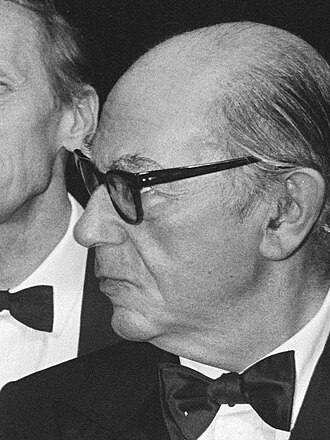
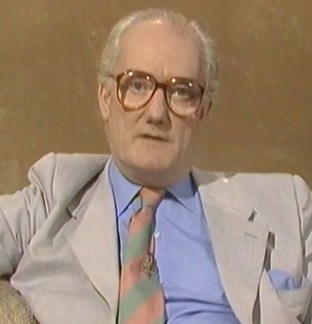
以赛亚·伯林 布莱恩·马基
EDITED TRANSCRIPT · 依据现场录音编译整理,可划线生成便签
一九七七年,BBC 请布莱恩·马基主持一组关于当代哲学的谈话节目,开篇一集他请来了以赛亚·伯林。伯林时任牛津万灵学院院士,以《两种自由概念》《刺猬与狐狸》和价值多元论闻名于世;马基则是哲学作家、广播人,兼任工党议员,日后又主持了《思想家》与《伟大的哲学家》两个系列。这一集不谈某位哲学家,只问最基本的问题:哲学到底是什么,人为什么要关心它。本文依据现场录音编译整理。

开场:这一系列节目

马基: 这是关于现代哲学的一组节目中的第一集。往后我们会谈到一些世界知名的人物,比如萨特、马尔库塞、卡尔·波普尔、乔姆斯基,其中有几位会亲自到场,讨论他们自己的工作。另有一两集要献给已经去世、但思想仍在发挥巨大而鲜活影响的人:卡尔·马克思是最明显的例子,维特根斯坦和海德格尔则以各自截然不同的方式同样如此。当然,一个用英语制作、面向英语听众的系列,必须特别关注英语世界近来的哲学动向。我希望整个系列合起来能成为一份生动而有启发的报告,说明今天世界上的哲学处在什么状态:一部分通过杰出的个人来讲,一部分通过重要的思潮来讲。

马基: 但在开篇这一集,作为引论,我想面对几个最最基本的问题。人究竟为什么要对哲学感兴趣?它为什么重要?它到底是什么?我要把这些问题以及其他一些问题,提给一位本身享有国际声誉的人:以赛亚·伯林爵士,功绩勋章获得者,牛津万灵学院院士,卡尔·马克思的传记作者,尤其以他对观念史的了解著称。

为什么要关心哲学

马基: 以赛亚,假如一个人此前并没有自己走上哲学这条路,也没有被教育制度领进来,我们能给他什么理由,让他对哲学产生兴趣?

伯林: 首先,这些问题本身就有意思。但对那些不这么认为的人,可以指出另一点:哲学处理的,是大量寻常信念所依赖的那些假定。这些东西人们并不乐意挖出来,因为人有时候实在不愿意让自己的假定被过分审视。一旦被迫去看清自己的信念究竟建在什么上面,人是会不舒服的。可事实是,许多普通常识信念所依赖的那类假定,正是哲学分析的对象。仔细一看,它们远不如初看时那样牢靠,也远比初看时复杂。哲学家通过审视这些东西,教给人自我认识。他们向人解释,有时是以相当强势的方式解释,人们究竟相信什么,以及为什么相信。这是一项非常核心的工作。

我们为何抗拒审视

马基: 我们都会因为自己的假定被审视而很不自在,就像你刚才说的,因为这是在挖自己思想的前提。我想,越过某个界限之后,我们全都会抵抗。你认为这种抵抗是从哪里来的?

伯林: 当然,一部分原因是人不喜欢被过度分析。另一部分原因是,行动本身也许就排斥这种事情。这很明显:一个人正投身在某种生活里,忙着做事,却不断有人问他,你为什么要做这个?你确信你追求的目标是真正的目标吗?你确信你正在做的事情不会以某种方式违背你也许还想坚持的某些道德信念吗?你确信你的某些价值不会跟另一些价值发生冲突吗?而你其实根本没有面对这一点。有时候一个人陷进某种两难,怕得不敢正视,于是把目光移开,试着把责任推到别人身上:推到国家身上,推到老师身上,推到自己所属的阶级身上,推到自己隶属的某个团体身上。可你难道不该自己去承担这份责任吗?我想,这一点让人望而生畏,自然就产生了抵抗。

伯林: 不过我要说一句:如果一个社会里人人都是怀疑派的知识分子,成天审视自己的根基,那谁都别想活下去。所以不能要求所有人时刻自我审视,这不合情理。做这件事的,我想应该是那些对这类问题格外好奇的人,也就是哲学家。但从另一面必须说:如果这些东西从来不被审视,任其撂荒,社会就会僵化,信念会变成教条,想象力会扭曲,理智会变得贫瘠,社会会因为躺在某块舒服的、未经检验的教条上而腐烂下去。要让想象力被激起,要让理智运转起来,假定就必须被追问,前提就必须被挑战,整件事情必须不断被重新审视。也许不必人人都做,也不必做得太过,但必须有足够的人做,好让这个社会继续动起来。社会是靠某种程度的弑父前行的:孩子们大体上就算不杀死父辈本人,也要杀死父辈的信念,然后达到新的信念。发展就是这么发生的,所谓进步就是这么回事。

以「权利」为例

马基: 能给我举几个这类假定的例子吗?

伯林: 好,我想政治哲学和道德哲学大概能提供最熟悉的例子。就拿关于自由的谈论,或者关于平等的谈论来说,眼下满世界都是这种话。再比如美国《独立宣言》序言里那句著名的话。这话已经说了两百年,最近却忽然又被人频频提起,写了不少文章。那句话是说,人被创造得……

马基: 「我们认为下述真理不言而喻:人人生而平等,造物主赋予他们某些不可让渡的权利,其中包括生命权、自由权和追求幸福的权利。」

伯林: 谢谢,这正是我要的那个词:权利。那么,什么是权利?你去问街上随便一个人什么是权利,他会愣住,答不上来。假设你追问:权利是什么样的东西?是你一出生就有的?是烙在你身上的?是人身上某种内在的属性?还是别人给你的?举例说,权利可以由谁授予?可以被剥夺吗?可以放弃吗?放弃权利又是什么意思?你会丧失一项权利吗?还是说,权利以某种方式内在于你的本性,就像思维内在于你,或者选择、或者拥有意志内在于你那样?权利是这种东西吗?所谓自然权利,是哪一种自然?这个意义上的「自然」又是什么?你怎么知道这些权利到底是哪些?

伯林: 关于权利究竟是哪些,人们的分歧极大。举个例子,看看十七世纪,那时候关于权利的讨论非常多。毕竟为这件事打了一场内战:比如究竟有没有所谓君权神授这回事。今天我们不大相信这个了,可当时很多人是相信的。他们相信国王是有特殊权利的特殊存在。另一些人则认为根本没有这种东西。他们各自怎么论证?拿出了什么样的理由?什么东西说服了人?十七世纪末有一位法国思想家说:假设法国国王想把一批臣民转让给英国国王,这些臣民会怎么想?答案是,他们没有资格去「想」,他们要做的只是服从;国王完全有权按自己的心意处置他们,而他们居然认为自己可以对此有想法、有怀疑,这个念头本身就是亵渎和僭越。我们今天当然拒绝这一套。但这毕竟是许多人怀着热情信奉过的东西,他们相信等级制,相信世界是一个等级化的整体。当时用的比喻是金字塔:上帝在顶端,变形虫在底下,每一个人在这个等级里都有自己恰当的位置,他应当做的,就是这个位置加在他身上的那些事情。这套东西被人相信了几百年。后来有人否认它,说根本没有这种等级,人是平等的,人生来就是那个样子,所有人都有某些自然的欲望,所有人都有某些自然的权利,在这些权利上他们完全平等。

伯林: 那么,为其中任何一方所提出的论证,正是哲学恰当的题材。除了哲学,还有哪个学科能处理这些东西?可这些东西又极其深刻,是人们感受极深的东西,是为之流过血、打过仗的东西,是触及要害的东西。

情报官的两难

马基: 能不能举一个直截了当的道德哲学问题的例子?

伯林: 我讲一个别人告诉我的故事,是上一次大战期间的事。有一位英国情报军官在法国,战争快结束时,他要审讯一个被抵抗组织抓住的法国叛徒。这个人替德国秘密警察、替盖世太保做过事,抵抗组织铁了心要以叛国罪处决他。英国军官请求先审问他,因为他觉得这人也许能提供有用的情报,可以让一些无辜者免于酷刑之类的遭遇,也可以让他们知道敌人在后方还在做什么。他去见了这个人。这是个年轻人,年轻人对他说:我凭什么要回答你的问题?如果你能保住我的命,我就说;如果你不能,我知道这些人明天早上就要杀我,那我为什么还要开口?

伯林: 那么,这位军官该怎么办?作为军官,他的职责是尽可能多地套出情报。而他要做到这一点,只有一条路。说什么「我尽力去替你求情」是没用的,那人一眼就看穿了。他必须说:是的,我能保住你的命,你只要开口,我就救你。这样他也许就能拿到情报,从而救下他的战友、英国军官、无辜者,随便什么人的命。当然,事情真这么办了,那个人在临死前发现自己被骗时,会把他咒骂到最后一口气。

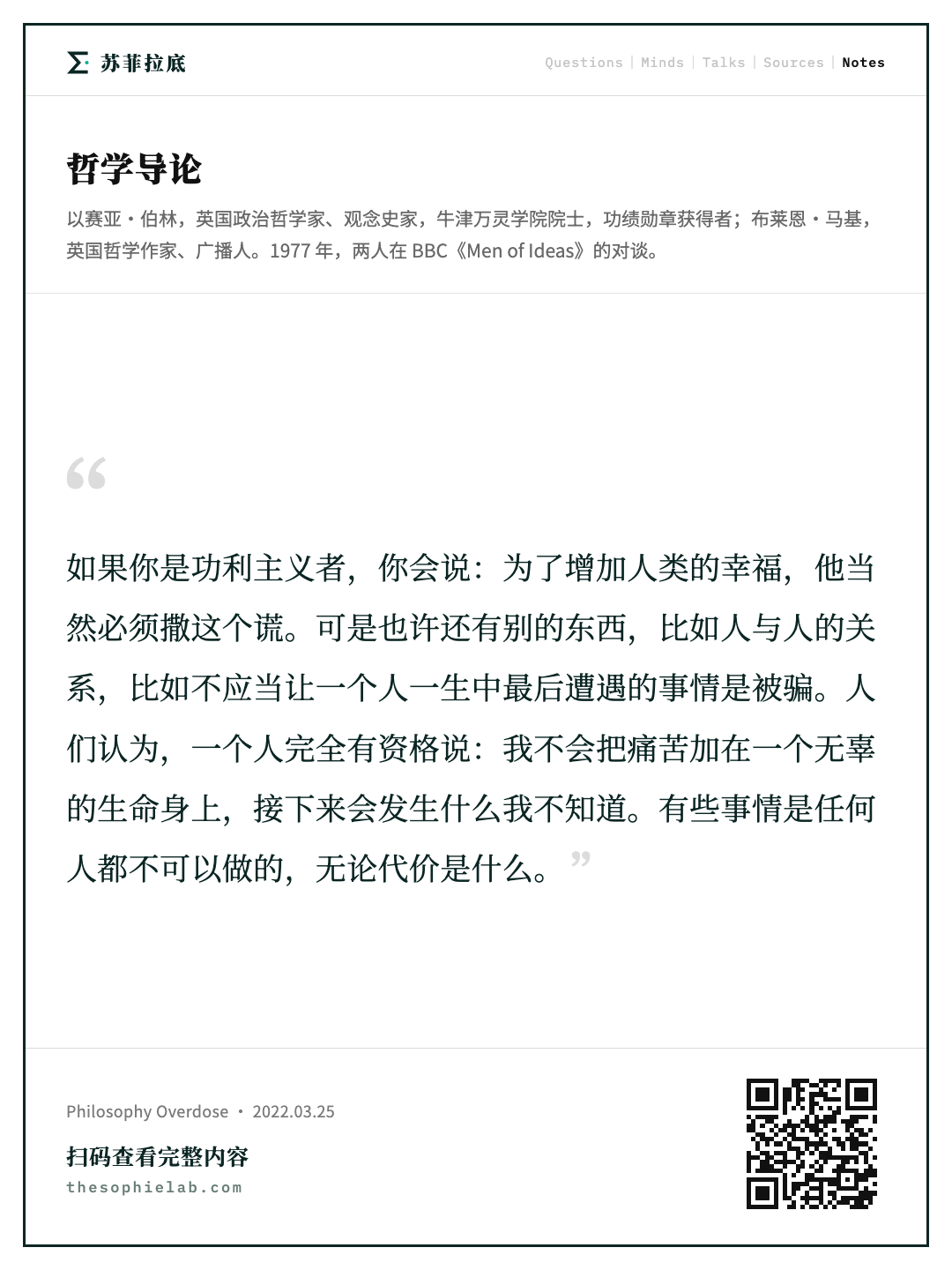
伯林: 这个选择并不轻松。如果你是功利主义者,你会说:为了增加人类的幸福,他当然必须撒这个谎。可是也许还有别的东西,比如人与人的关系,比如不应当让一个人一生中最后遭遇的事情是被骗。陀思妥耶夫斯基笔下有个人物说过:如果有人问我,是否愿意用一个无辜孩子的受折磨,去换取千百万人的幸福,我的回答是拒绝。功利主义者不得不说:这显然错了,这是感情用事,是错的。可人们并不这么想。人们认为,一个人完全有资格说:我不会折磨一个无辜的孩子,我不会把痛苦加在一个无辜的生命身上,接下来会发生什么我不知道。有些事情是任何人都不可以做的,无论代价是什么。

伯林: 这里有两种哲学在冲突:一种是功利主义的,另一种显然关乎某些绝对价值。这里有两套价值撞在了一起。道德哲学家的工作,不是告诉一个人该把其中哪一套当作自己的价值。但他的工作是告诉这个人:在这类处境里,涉及的是这些价值,相撞的是这些生活形式,他必须在这些东西之间作出决断。而最后,一个人当然得自己承担责任,去做他认为对的事。

哲学为何总谈语言

马基: 有一件事我想让很多外行吃惊,甚至让不少人反感,就是他们发现大量的哲学讨论,尤其是今天的哲学讨论,谈的是词,是语言。你能解释一下这是为什么吗?要解释得让人觉得这样做是有道理的。

伯林: 我不知道能不能做到,我尽力试试。我认为现代哲学家里有些人是害了自己的:他们坚持说自己主要关心的是语言,于是人们就以为他们做的事情很琐碎,以为他们关心语言的方式跟词典编纂者或语法学家一样。真要那样的话,词典编纂者和语法学家做得比这些半吊子强多了。他们确实关心语言,但那是因为他们相信我们是用词来思考的,因此对语言的考察自动就是对思想的考察,用旧话说就是这样。所以,当那些没有明显答案的困难哲学问题摆到面前,当我们不知道该往哪儿走的时候,第一件要做的事就是问自己:这是哪一类问题?我在找的是哪一类答案?它像这种问题,还是像那种问题?它是经验的吗?是形式的吗?两者都不像吗?它更像这个还是更像那个?先把它归归类。而归类这件事本身就相当难。这种归类,如果你愿意这么说,某种意义上正是在清理语言上的混乱。

伯林: 这类混乱常常在人脑子里造成可怕的一团糟,而这种糟乱有时会在实践中变成野蛮。比方说,极权国家往各种人头脑里塞进去的种种信念,纳粹关于种族的那些信念,就建立在各式各样的混乱之上,一部分是经验的,一部分不是。所谓「次等人」这个观念本身,所谓某些「亚人类」的生物,犹太人也好,吉卜赛人也好,黑人也好,他们不算完整的人,因此可以被消灭。认为他们对社会构成巨大危险、所以应当被消灭,这个念头无疑建立在错误的政治信念上;但「亚人类」这个观念本身,「成为人意味着什么」,这一整串概念,才是真正要处理的东西。这件事听起来像是琐碎的语言考察:我们怎么使用「人」这个词,人的本性是什么,做一个人是怎么回事,什么叫低等、什么叫高等。可这些是哲学问题,不是经验问题。

马基: 所以,语言哲学家其实可以主张,而且确实主张过:他们通过分析语言的用法,恰恰是在把我们从语言的魔咒里解放出来。换句话说,落进语言魔咒的不是他们,而是我们;对我们误用语言的分析,能把我们解放出来。

伯林: 正是如此。我认为这是哲学最大的贡献之一。我也认为,这正是为什么在那些希望语言的原有用法保持不变的人眼里,哲学家是危险人物。德国诗人海涅说过:不要看错了书斋里那位安静的哲学家,他是极有力量、极可畏的人物。不要把他当成一个埋头琐事、与人无害的学究。如果康德没有砍掉神学家们的上帝的头,罗伯斯庇尔也许就不会砍掉国王的头。海涅还说,那些伟大的德国形而上学家、费希特的门徒、谢林的门徒之类的人,总有一天既不会被恐惧吓退,也不会被享乐引诱,他们将摧毁我们文明的许多丰碑;当这场巨大的形而上学的狂暴在世界上爆发开来,法国大革命跟它一比不过是儿戏。诸如此类。哲学观念或者形而上学观念的力量,是非常之大的。

两个筐:经验与形式

马基: 不过,哲学提出的那类问题确实有非常古怪的地方,不是吗?比如你刚才拿来举例的「什么是权利」,这是在探究一个词的意思,还是在探究某种抽象实体的性质,某种虽然抽象却仍然存在的东西?这到底是哪一类问题?

伯林: 你其实已经在做那件事了。当你说你拥有某项权利时,你是在问:说这句话,究竟等于在说什么?我们怎么去发现这类说法是真是假?我们怎么去发现,哪一类论证会让你接受这样一个命题?比如说你有幸福的权利,或者别的什么权利。路德就是个例子。有人对他说,人有权得到幸福,或者说人生的目的是幸福,他回答:幸福?绝不。是基督,是受难,是十字架。这是某种形式的基督教信仰的核心,而且肯定是最深刻的主题之一,是极大数量绝不肤浅的人据以建立起自己一生的信念之一。这总不能说是琐碎的吧。我们会说,这是「词」的问题:什么叫十字架?「受难」这个词是什么意思?关键正在这里。我们不是语法学家,不是词典编纂者。要弄清这些词的意思,查词典没有用,查百科全书也没有用。这就是要害所在。

马基: 但还是不完全清楚。如果你要找的不是那个意义上的词义,那你到底想要弄到手的是什么?毕竟人类历史上一些最伟大的天才,为这类问题反复搏斗了两三千年,也没有得出任何确定的、被普遍接受的答案。这又一次指向了这些问题的古怪之处。

伯林: 我这样说吧。我们先问问自己,一般说来,问题是怎么被解决的?哪些问题是可以被解决的?我想有两大类问题可以相当有把握地说是可以解决的。一类是普通的经验问题,也就是关于世界上有什么的问题,这是科学家处理的东西。澳大利亚有黑天鹅吗?有,因为有人在那里见到过。物质是由什么构成的?由某些分子构成,分子由原子构成。这有一定的证据,因为做过实验,而这些实验有时是判决性的,导致了假说得到确认。常识也是这样的:奶酪在哪里?在碗柜里。你怎么知道?我看过了。这被认为是对这个问题充分而完备的回答,我们也不会去怀疑它。这类叫经验问题,事实问题,靠普通常识来解决,复杂一些的情形则靠受控观察、实验、提出假说、检验假说等等来解决。这是一类问题。

伯林: 另一类是形式问题,数学家问的问题,逻辑学家问的问题。在那里你有若干定义,有若干变形规则,规定如何从这些定义推演出别的东西,然后你有以严格逻辑方式从前提推出的结论;你还有若干成套的规则,一切答案、一切命题都可以照着这些规则去核对。这根本不是关于世界的,这是关于形式学科的,可以说完全与事实问题脱钩:数学、逻辑、国际象棋、纹章学。这里你不是靠往窗外看、靠翻碗柜找答案。如果我问你,你怎么知道国际象棋里的王每次只走一格?有人说「你是这么说的,可是有天晚上我在看棋,我确实看见一个王走了两格」,这不会被当成对那个命题的反驳。因为你真正说的是:象棋里有一条规则如此规定。那你怎么知道这条规则是真的?规则不需要是真的,规则就是规则,你要么接受,要么不接受。数学以及一切形式学科都是这么运作的。

伯林: 这是人类知识的两大版图。而在它们之间,如果可以这么讲,存在着一些无法用这两种方式回答的问题,而且这样的问题非常多。刚才我试着说明的那两类问题,其特点在于:处理它们有既定的方法。你也许答不出某个经验问题,但你知道假如你知道答案,那答案会是什么样子。你问恺撒活了多少年,你也许不知道具体数字,但你知道怎么去查,你知道该翻哪一类著作,你知道什么样的东西算作证据。你问泰国有没有不会飞的鸟,你也许不知道答案,但你知道该做什么样的实验去查明。天文学也一样。我们不知道天狼星的另一面是什么样子,也许从来没有人见过,但你知道,如果你能飞过去,就像今天人已经能飞到月球一样,你也许就能看见。形式学科同样如此:那里也有一些未解的难题,但有一些公认的解题方法,而且你知道,做数学演算的时候,看、闻、摸是没有用的,正如在经验问题上光靠演算也不行。

不知从何着手

伯林: 而在哲学这里,我愿意说,它最大的标志就是:你不知道该怎么着手。有人问你:什么是善?人生的目的是什么?我们该追求快乐,还是该追求正义、追求真理,哪怕它并不带来任何快乐?你怎么去着手回答这个问题?有人问你:你说的「实在」是什么意思?你怎么区分实在与表象?有人问你:什么是知识?我们知道什么?除了数学知识,我们还能确切知道任何东西吗?还有别的什么是我们确知的吗?我们又是怎么知道自己确知的?我们无法立刻回答。这里没有一门现成的学科让我们可以说:喏,这位是专家,他能告诉你什么是善,他能告诉你什么是对的,他能告诉你你的义务是什么,他能告诉你你的权利是什么,他能告诉你幸福是不是人的正当目标,你听他的就行了。数学家当然可以回答数学问题;但我们并不认为存在这样一些道德家,他们给出绝对清楚的答案,任何能跟上其推理的人都不得不接受。一开头就有一种困惑:该往哪儿看?谁也不太清楚拿这些问题怎么办。相当早就会出现一种精神上的痉挛感。至于普通人,他们一开始对这些问题是欢迎的,直到有一天不再问为止。

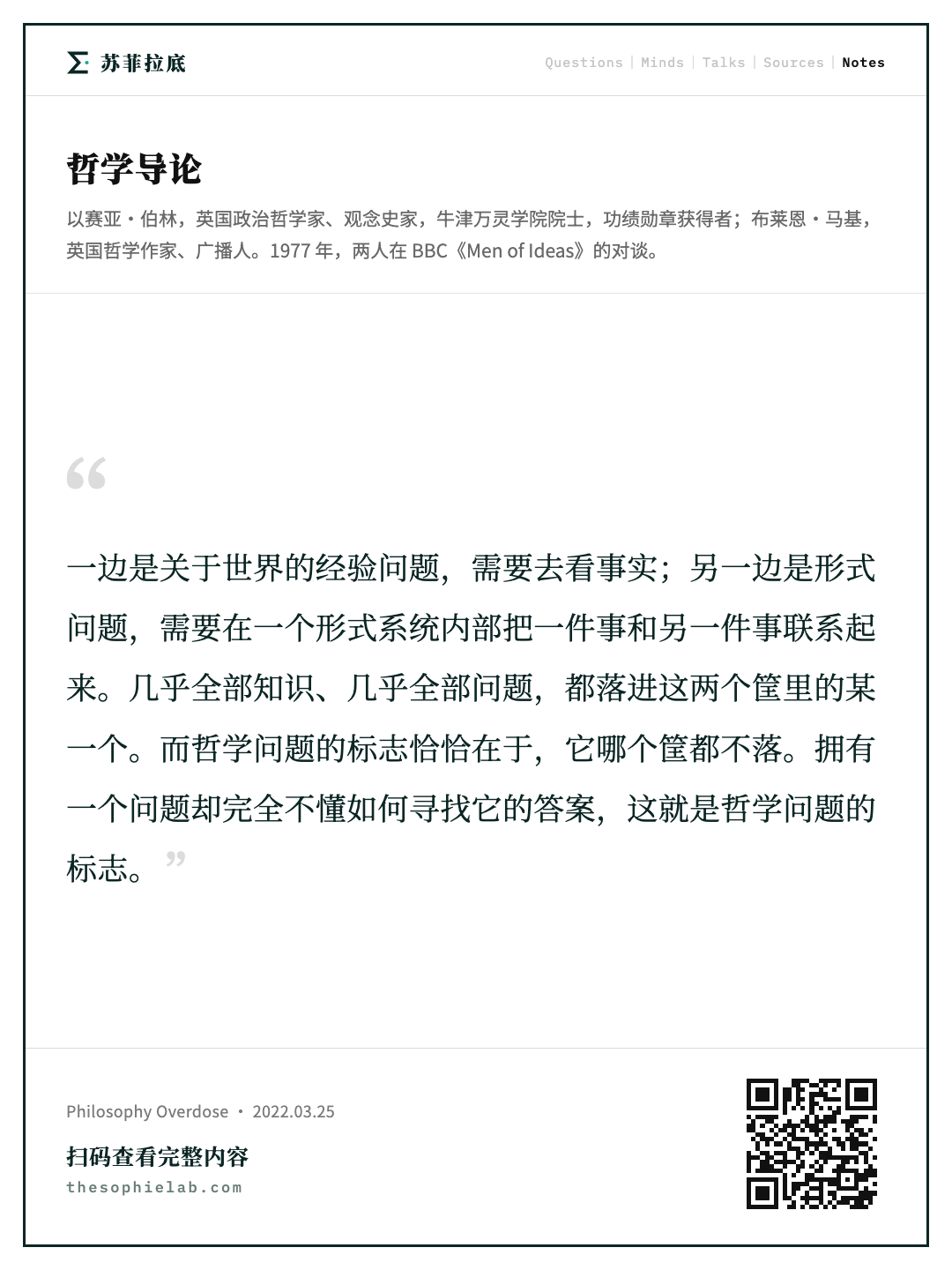
马基: 你说到了某种极其根本的东西。我想在往前走之前,先把我们已经到达的位置复述一遍。我理解你的意思是:在人类求知的整个历史上,人最常问的是两类问题。第一类是关于世界的问题,人不过是在了解自己的环境、掌握环境、应付环境,而关于世界的问题是靠观看、调查、观察、检验、实验等等来回答的,这些是事实问题。第二类问题更抽象或者说更形式化,比如数学里的问题、逻辑里的问题,或者像你说的游戏里的问题、纹章学里的问题。这类问题你没法靠观察世界来找答案,因为它们关涉的是形式系统内部各项之间的相互关系,我们最常用的那个系统显然就是算术,或者更广地说,数学。所以,一边是关于世界的经验问题,需要去看事实;另一边是形式问题,需要在一个形式系统内部把一件事和另一件事联系起来。几乎全部知识、几乎全部问题,都落进这两个筐里的某一个。而你要说的是,哲学问题的标志恰恰在于,它哪个筐都不落。像「什么是权利」这样的问题,你既不能靠往窗外看找到答案,也不能靠考察某个形式系统的内部融贯性找到答案,因此你不知道该怎么去找答案。而拥有一个问题却完全不懂如何寻找它的答案,这就是哲学问题的标志。这样说,是不是比你原来说得好一些?

伯林: 比我说得清楚多了,是的。我很乐意接受你这个重述。这些是极其根本的问题,而我们不知道该怎么去回答。

哲学分泌出科学

马基: 那么,对于我们不知道该怎么回答的问题,我们该拿它们怎么办?我们能在这些问题上取得什么样的进展?又是怎样取得的?

伯林: 你可以先问历史性的问题:我们为什么钦佩那些处理过这些问题的思想家?我们钦佩他们,是因为他们设法把问题重新表述了一遍,而且往往表述得让某些答案至少显得可信。当一件事没有固定的方法时,你就用你所能用的一切去做。也就是说,你就是硬把它琢磨出来。你说:好,当我问「事物有没有目的」这样一个问题时,这问题像什么?它是哪一类问题?我在找的是哪一类答案?什么样的论证会让我觉得它为真或为假?我认为哲学做的就是这件事。福斯特说过一句话:万物都像某种别的东西。这正是你在哲学问题上做的事:既然没有现成的方法,你就用你能用的办法。

伯林: 从历史上看,我想事情是这样的。某些问题一直处在这种相当混乱的状态里,而它们重要、关键,人们为之极其苦恼,而且苦恼得有理,因为它们在很大程度上关乎终极价值。人们不太知道该怎么着手,于是要么武断地下断语,要么干脆接受圣书的说法,或者接受受神启的导师的说法,那些人自己倒是不写字的。但总有一些人对此稍存怀疑,他们会问:我们为什么要接受这些答案?他们是这么说的,可我们凭什么知道他们知道?我们怎么知道他们真的知道?他们说这是上帝说的。可上帝对不同的人显然说了很不一样的话,这在历史上是事实。

伯林: 我认为实际发生过的是:其中一些问题被重新表述之后,落进了那两个筐里的某一个。举个例子说明我的意思。十二世纪时,说天文学是一门哲学学科完全正确。为什么?因为它既不太经验,也不形式。人们认为行星沿圆周运行,因为圆是完美的图形。而「圆是完美的图形」这个命题既不是经验命题,也不是形式命题。至于人为什么该相信它,那是另一回事,但它肯定不属于那两类中的任何一类:你没法用实验证明它,也没法用数学证明它。所以这显然是一条形而上学的真理。只要形而上学还插在里面,只要人们「知道」星辰必须做某些事情、行星必须做另一些事情、太阳必须做某件事情,而且这种「知道」建立在形而上学或神学的根据上,那么天文学就完全恰当地属于哲学。后来的事情众所周知,天文学逐渐变成了一门观察科学,它把形而上学的预设蜕掉了,如今是所谓物理科学也就是经验科学中受人尊敬的一部分。就这样,它不再是哲学的了。

伯林: 哲学生涯里有意思的一点是,它不断地把自己的某些部分抛进那两个筐里去。我记得是奥斯汀曾经把这个道理讲成一个假说:巨大的太阳不断向外分泌出别的行星,当这些行星获得独立,大团燃烧的气体就成了行星,从此有了自己独立的生命。历史上哲学在很大程度上就是这样。比如经济学,当它还跟一大堆形而上学假定混在一起的时候,我想它是哲学的一部分,后来才逐渐变成了一门科学。

各门学科的哲学

马基: 不过,即便各门科学、各个探究领域已经独立出去了,比如经济学、天文学、心理学、语言学之类,在一个很重要的意义上,仍然存在几乎任何一门学科的哲学,不是吗?我想说的是:在任何一个活动领域里,都有一些根本的用语,或者我更愿意说,一些根本的概念,人们天天在用。比如物理学家不断谈论光、质量、能量、速度、引力、运动、测量、时间;政治家不断使用自由、平等、社会正义这些词;律师不断使用有罪、无罪,以及同样是「正义」这个词,虽然他们指的意思不同。而实际在这些领域里做事的人,通常并不争论自己所用的术语。我想大多数物理学家一辈子都不会跟另一位物理学家争论光是什么,或者他们所说的能量是什么意思。可是科学哲学家来了,他问:我们说「光」到底是什么意思?我们说「测量」是什么意思?我们测量一样东西的时候究竟在做什么?政治哲学家来了,他说:是的,可我们说「自由」到底是什么意思?「平等」是什么意思?甚至还有法哲学,法哲学家来了,问:我们说「正义」究竟是什么意思?换句话说,哲学的活动之一,肯定是澄清和分析各个不同的人类思想与活动领域里那些典型使用的根本概念。

伯林: 我想这是对的。

孩子的追问

马基: 「什么是时间」「什么是光」「什么是善」这类哲学问题,其实跟孩子的问题有共通之处,不是吗?

伯林: 是的,我常常这么想。孩子会向大人提这类问题。他们当然不会说「什么是时间」,他们说的是:我为什么不能见到某某人?假设一个孩子这么问,这对孩子来说是很自然的事。你说:你不能见他,他死了。孩子接着问:为什么?为什么这就妨碍我见他?如果父亲比较讲究,他就得解释:死意味着他的身体在地下分解了,不能复活了,而且那是很久以前的事了。如果这孩子有点脑子,他会说:那把那些碎块重新拼到一起不行吗?父亲说:不行。哪一种「不行」呢?接着物理学就来了。孩子又说:我要的不是这个,我不是要把他拼起来,我是想回到过去,看见他在奥斯特利茨战役时的样子,我想要的是这个。父亲说:你不能。为什么不能?因为你不能在时间里往回走。我为什么不能?于是我们就有了一个哲学问题:这里说的「不能」是什么意思?「不能在时间里往回走」,跟你说「三不可能是七」是同一种「不能」吗?还是跟你说「凌晨两点你不能买烟,因为法律不许」是同一种?还是跟「我记不起来了」或者「我不能光靠想就让自己长到九英尺高」是同一种?这是哪一种「不能」,哪一种「必须」?这样一下子就跌进哲学里去了。接着你就得谈时间的性质,而有人会说:不,不,根本没有「时间」这种东西,「时间」只是一个词,用来说「在……之前」「在……之后」「与……同时」;把时间说得好像是一样东西,那是形而上学的陷阱。这就上路了。

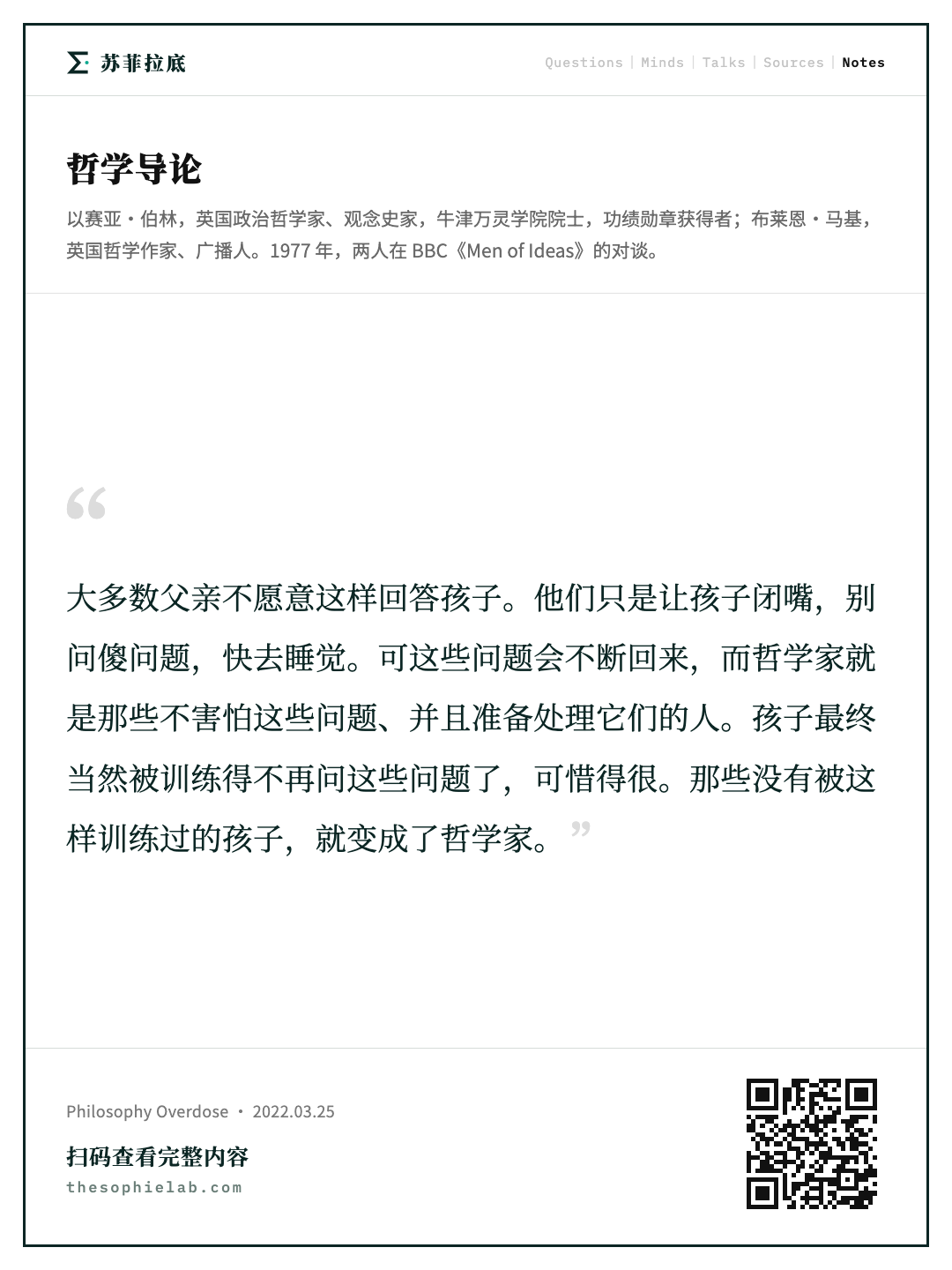
伯林: 当然,大多数父亲不愿意这样回答孩子。他们只是让孩子闭嘴,别问傻问题,快去睡觉。可这些问题会不断回来,而哲学家就是那些不害怕这些问题、并且准备处理它们的人。孩子最终当然被训练得不再问这些问题了,可惜得很。那些没有被这样训练过的孩子,就变成了哲学家。

透析机难题

马基: 关于这一点我想请你再多说一些。因为在我看来,对外行来说最难理解的事情之一,就是弄明白:试图回答那些无法回答的问题,究竟能得到什么样的启发?这上面怎么可能有进展?

伯林: 它们不是无法回答的。不是无法回答,你可以朝答案走出一段路。靠澄清概念,你有时会发现问题本身就问错了;有时会发现这是一个经验问题跟一个形式问题搅在了一起;各种各样的情况都会发生。如果你真要我举例,我讲一个我想说的例子。还是拿道德哲学来说,这个例子挺好,因为大多数人在生活里都有道德难题。

伯林: 假设我们问一个一半是道德、一半是政治的问题。假设这是医院里的一个寻常问题:有一台透析机,非常昂贵,而这样的机器并不多,很多人得了肾病,这台机器对他们可能有用。我们是不是应该只把机器用在重要人物身上,因为他们能给社会带来很多好处?如果有一位非常重要的科学家患了肾病,是不是应该把机器留给他,两周后归他用?可另一边有一个无辜的孩子快要死了,这台机器也许能救他。我们怎么决定?我们该怎么办?假设机器不够分配,我们做什么?我们是不是该这样问自己:这些人当中哪一个能给社会带来最大的好处?这是实践中让人极其痛苦的问题。

伯林: 道德哲学不会给这个问题一个答案,它不会说:不不,救那位伟大的科学家;也不会说:救那个孩子。救哪一个都行,这不重要。它会做的,或者说一位好的道德哲学家会做的,是向你说明这里涉及的是哪几类考虑。他会问:你现在关心的完全是人类的幸福吗?这是你唯一的考虑吗?如果是,那我只能说,救那位科学家是对的,因为他很可能带来比那个孩子更大的好处,无论那孩子多么无辜。还是说,你同时相信人人平等,人人都有同等的被救的资格,因此甚至不该去问这些人里谁更重要?你的想法是这一种吗?你看,这里有价值的冲突。一方面你相信要增加人类的幸福,另一方面你又相信,明目张胆地偏爱一些人而不是另一些人、造出一套资格的等级来,这本身就有什么不对的地方。

马基: 你刚才说道德哲学家不会告诉你在你举的例子里该怎么做,透析机该给科学家还是给孩子,我认为这一点对我们眼下的讨论极其重要。因为在我看来,很多人走向哲学,是想被告知该怎么生活,或者想要一套关于世界的解释、关于人生的解释之类的东西。而在我看来,抱有这种愿望,就是在放弃个人的责任。人不该想着被告知怎么生活,不该想要终极的答案。但想要澄清自己的生活、澄清那些争点,好让自己能够作决定、能够为自己承担责任,这完全是另一回事。

屠格涅夫与马克思

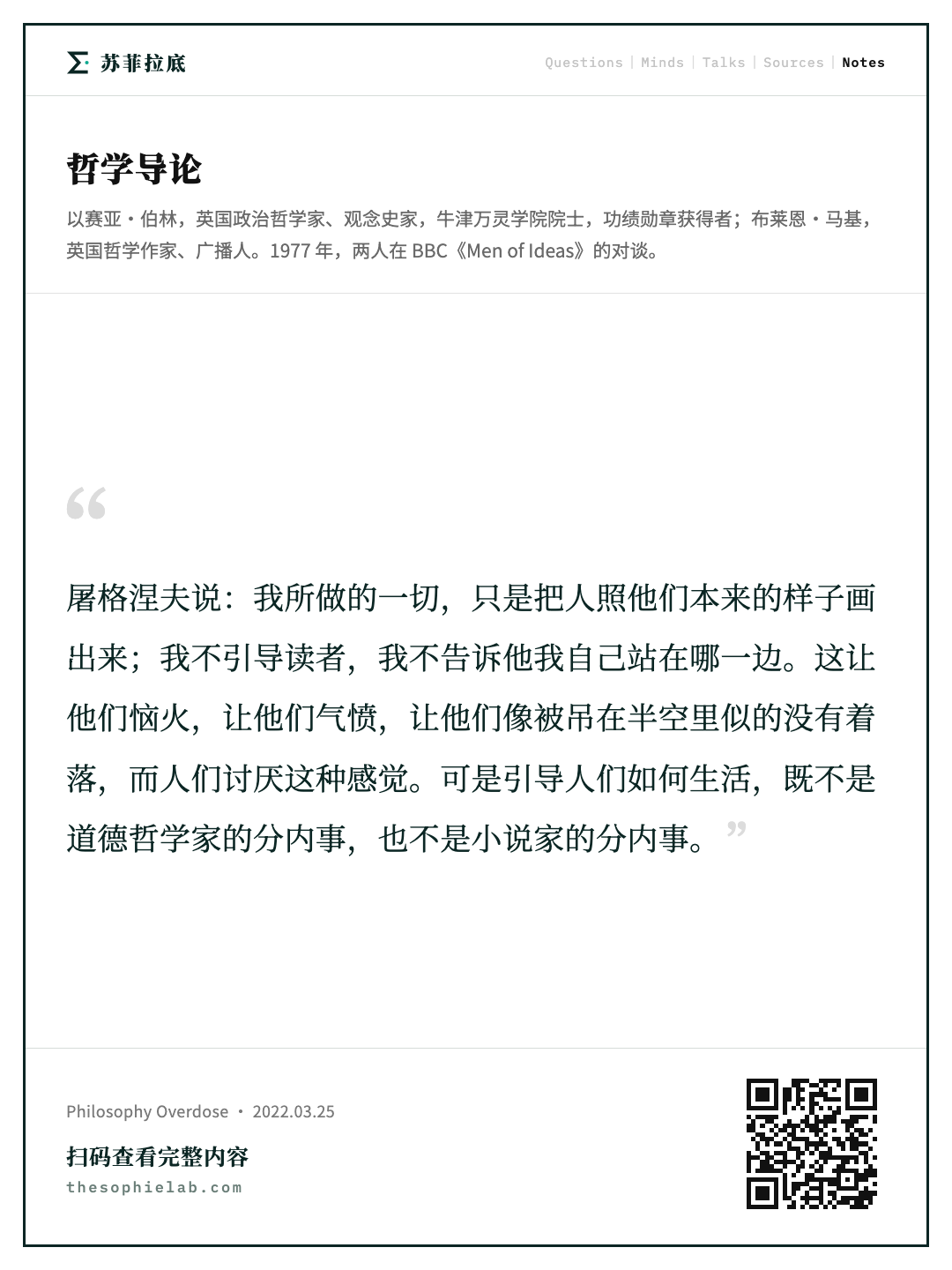
伯林: 你说的是件让人难受的事,不过我当然同意。大多数人想要的就是被给出答案。我记得很清楚,屠格涅夫谈自己的写作时说过一段话:他的小说之所以没有得到本该有的那种喜爱,一个麻烦就在于,十九世纪的俄国读者想被告知该怎么生活,想弄得清清楚楚谁是英雄、谁是恶棍。而屠格涅夫不这么做。托尔斯泰这么做,做了很多,别的作家也这么做,狄更斯无疑也是,谁是谁、谁好谁不好一清二楚。可屠格涅夫说:我所做的一切,只是把人照他们本来的样子画出来;我不引导读者,我不告诉他我自己站在哪一边。这让他们恼火,让他们气愤,让他们像被吊在半空里似的没有着落,而人们讨厌这种感觉。可是引导人们如何生活,既不是道德哲学家的分内事,也不是小说家的分内事。他的分内事,是把各种选项、各个争点摆到人面前,向人说明他正在哪些东西之间作选择,然后,凭着他所信的那一切,他必须自己去押上那一注。

马基: 当然,现代世界里有一种哲学,也许是全世界影响最广、被讨论最多的一种,那就是马克思主义。它确实告诉人们该怎么生活,确实提供了一套关于世界、关于历史、关于人生的完整解释。你认为这一点把它跟别的哲学区分开来了吗?

伯林: 就我所理解的哲学而言,区别在于,它根本不是典型意义上的哲学。马克思主义是一种历史理论。马克思主义说,我们可以用因果的方式解释人类社会的发展,解释人类为什么发展成了现在这个样子。存在着某些规律,一旦你把握了这些规律,你就会明白事情为什么会这样发生,你在社会地图上处在什么位置,你为什么持有你所持有的观念,因为你也许属于某个特定的阶级,而这个阶级之所以有它那些观念,是因为它正与另外某些阶级斗争,你的观念在某种程度上是由你在阶级斗争中的位置决定的。这是一种经验的历史理论。他们也许假装它是别的什么东西,但它实际上是要造出一门关于人类发展的科学,与物理学、化学、生物学处在同一层面,当然用的是不同的概念,不同的范畴,但它是一门科学。而一旦你懂得了人类社会如何发展,你就能更好地行动,更好地生活,正如你懂了物理学、懂了化学、懂了生物学,就能更好地在这个宇宙里行走,不至于成为某些不为人知的力量的牺牲品,那些力量也许还会滋生出迷信和恐惧。这是马克思主义的主张。但这不是它的哲学面向,这只是作为历史发展的经验理论的马克思主义。

模型的更替

马基: 它确实提供了一套社会的模型,一套历史的模型,一套人与人关系的模型。这就引到了我很想跟你谈的一个问题。我刚才说,哲学和哲学家的任务之一是澄清概念,但那当然只是任务之一。概念可以说是我们思想的原子,可我们不只是用原子思考,我们也用通常所说的「模型」思考。举例说,谈到社会,有些思想家把社会看作一种机器,由人拼装起来去完成某些任务,各个运动的部件以某些方式彼此咬合;另一些人则倾向于把社会看作一种有机体,像活物一样生长,就像橡树从橡果里长出来。而你用哪一个比喻、哪一幅图景、或者人们通常说的哪一个模型来看社会,你通常就会从中引出各式各样别的实践后果,行事的方式会不同,对政府、对历史的态度也会不同。那么,哲学家的另一项任务,不正是对模型作批判性的考察吗?

伯林: 是的,完全正确。马克思就是你这个意思的好例子。你看,马克思主义用的模型颇像一种进化论,他把它应用到整个人类社会上。而马克思本人对此是完全自觉的,甚至引以为傲:他认为自己就算没有找到解答,至少铺出了通往社会发展之解答的道路,而这是仿照达尔文在生物界所做的事。他是不是真的做到了是另一个问题,但恩格斯就是这样说他的。这意味着他用了这个特定的模型。

伯林: 我想我并没有弄错,我一直认为,哲学史在很大程度上就是模型更替的历史,而对这些模型的考察,是一项非常典型的哲学工作。还是福斯特那句话:万物都像某种别的东西,这个像什么?向人解释事物,通常唯一的办法就是从已知类比到未知。你面对某种让人困惑的东西:什么是人?什么是人性?于是你说,人性大概像动物学吧,我们对动物学知道得多多了;或者像植物学,我们对植物学也知道不少;人性大概跟这些不会太不一样。自然界里的一切生物都有一门总的科学,十八世纪就是这么想的。孔多塞说:我们能为蜜蜂和海狸做的事,也应当为人做。动物学家能造出关于蜜蜂和海狸的科学,那么假以时日,我们也会在同样健全的自然主义原则上,造出一门关于人的科学。

伯林: 柏拉图是这一切的开端。我想是怀特海说过,哲学不过是给柏拉图作的一大堆脚注。柏拉图差不多提出了此后一直困扰我们的所有大问题。柏拉图认为数学模型才是那个模型:你可以用某种几何学的方式解释宇宙,从某种不可摧毁的终极真理出发,把存在的东西推演出来,而他试图指出通向那个真理的道路。当你看见了善的理念,你就会明白一切为什么必然是它所是的样子。一切都从某个巨大的、准数学的模型里推出来,其中每一样东西都严丝合缝,就像在几何学里那样。后来的人则用逻辑模型。另一些人用别的模型。比如十七世纪,人们试图用法律模型来解释社会是什么样子,社会契约就是这么回事。

伯林: 每当一个新模型出现,它总会照亮某些东西。人们会说:啊,是了,中世纪那套旧的等级模型,把世界说成金字塔,或者说成一支管弦乐队,每一组乐器都有上帝指派给它的特定职能,那个模型其实解释不了什么。我们并不认为国王身上真有什么神圣的东西,伟大的将领身上有什么神圣的东西,而普通农民身上就没有,事情根本不是这样。契约这个说法好得多,这才是真相。于是新模型把人从旧模型的压迫下解放出来。可接着,这个新模型又遮蔽了旧模型曾经照亮的那部分真相,于是它又被另一个模型取代,那个模型当然把你从第二个模型下解放出来,但又遮蔽了其中的一部分。然后第四个模型来了,第五个模型来了,一个接着一个。我们为什么选中某些模型?因为在历史的特定时刻,有某些问题格外压迫着我们,因为我们周围发生的事情,因为落在我们身上的压力。

哲学的实际力量

马基: 让人惊讶的是,居然有那么多所谓的普通人断言,对这些模型作批判性的考察是一种抽象而不切实际的活动。因为如果你不把自己思想的前提拽到光底下,尤其是在道德、政治和社会领域,那你就只是当时占统治地位的正统的囚徒,你就是你这个时代的模型、你这个时候的模型的囚徒。而我们正在讨论的这些哲学观念,产生过何等巨大的实际影响:美国革命、法国革命、俄国革命,世界上的各种宗教,世界上的各个马克思主义政权,这些都是哲学观念以最直接、最明显的方式实际影响人类的例子。所以,认为哲学与现实生活无关的看法,在我看来本身才是与现实生活无关的,是深刻地不切实际的。

伯林: 我完全同意。我想,普通人之所以这么看,也许是因为有些哲学家在处理这些事情时使用了不必要的语言。当然也不能怪他们:一个人一旦沉浸在某个题目里,就必然会沉浸在它的细节里。伟大的哲学家说话时,总有本事以某种方式抵达普通人,让他们至少以某种简化的形式领会;而次一等的哲学家,我想,往往过于纠缠在题目的琐细里。也就只是这样罢了。

伯林: 我记得是罗素说过一句话,听起来极有智慧,出自他之口倒是有点出人意料。他说,世界上那些伟大哲学家的核心哲学,本质上都是简单的;繁复之处不在于他们看世界的那个模型,不在于他们据以看待世界的那个格局,而在于为这个格局抵御真实的或想象的反驳。当然,大量的机巧就用在那里,大量的技术性语言也在那里,而这一切都很必要。但那个根本的洞见是可以理解的,而且相对简单。你确实能懂笛卡尔的根本洞见,能懂洛克的根本洞见,能懂柏拉图的根本洞见,也能懂某些当代哲学家的根本洞见。这些对普通人都是可以理解的,它们不是密教。

马基: 但愿在这个系列接下来的节目里,我们能成功地把这些洞见,用你的话说,讲得让普通人也能理解。非常感谢你。
本期讲者
以赛亚·伯林英国政治哲学家、观念史家,牛津万灵学院院士,功绩勋章获得者。以《两种自由概念》《刺猬与狐狸》和价值多元论著称,1939 年出版《卡尔·马克思》传记。
布莱恩·马基英国哲学作家、广播人、工党议员。主持 BBC《Men of Ideas》(1978)和《The Great Philosophers》(1987)两大哲学访谈系列,著有《哲学的故事》《叔本华的哲学》。
章节 · 点击跳转视频
0:07 系列开篇:为什么要关心哲学 ▶ 正在看
2:40 审视预设:抗拒与社会僵化 ▶ 正在看
5:44 以「权利」为例:假定如何被追问 ▶ 正在看
8:25 情报官的谎言:功利与绝对价值 ▶ 正在看
11:06 哲学为何总在谈语言 ▶ 正在看
16:46 两个筐:经验问题与形式问题 ▶ 正在看
20:28 哲学问题的标志:不知从何着手 ▶ 正在看
24:30 哲学如何分泌出科学 ▶ 正在看
29:19 孩子的追问与「不能」的多义 ▶ 正在看
32:06 透析机难题:哲学家不替你选择 ▶ 正在看
34:55 屠格涅夫与马克思主义的定位 ▶ 正在看
36:57 模型的更替:哲学史的隐喻 ▶ 正在看
42:01 哲学的实际力量与简单内核 ▶ 正在看
本期论点
本期回应
4:17
如果人人都时刻怀疑地审视自己信念的根基,谁也没法活下去 底下有支点信念最终都能被理性检验吗?
4:33
预设长期无人审视,社会就会僵化,信念沦为教条,理智变得贫瘠 都要理由信念最终都能被理性检验吗?
42:27
不把自己思维中的预设拖到光亮之下,人就会沦为当下主流正统观念的囚徒 都要理由信念最终都能被理性检验吗?
12:26
人是用词语思考的,因此考察语言就是考察思想 有语言才有思想人的思想是语言塑造的吗?
13:10
语言上的混乱会造成头脑中的混乱,并可能导致实践中的野蛮行径 有语言才有思想人的思想是语言塑造的吗?
20:36
哲学问题最大的标志是:你不知道该如何着手回答它 有界线哲学和科学之间有没有界线?
26:04
十二世纪的天文学属于哲学,因为它建立在「圆是完美图形」这类形而上学预设上 有界线哲学和科学之间有没有界线?
21:36
不存在能给出人人必须接受之答案的道德专家,数学家却能回答数学问题 没答案道德问题有没有正确答案?
35:18
小说家和道德哲学家的职责不是引导人们如何生活,而是把选项摊开让人自己抉择 没答案道德问题有没有正确答案?
31:49
哲学问题并非无解,澄清概念后常会发现是问题本身问错了 只做澄清哲学应该产出什么?
其他论点
11:01
一个人有权拒绝折磨无辜的孩子,哪怕这样能换来千百万人的幸福
30:57
根本没有「时间」这种东西,「时间」只是「之前」「之后」「同时」的说法
36:45
马克思主义是与物理学、化学同一层次的经验科学,只是用了不同的概念范畴
41:51
新模型把人从旧模型的压迫中解放出来,却又遮蔽旧模型曾揭示的真理
43:54
伟大哲学家的核心哲学本质上都是简单的,繁复的是为其辩护抵御反驳的部分
01系列开篇:为什么要关心哲学
0:07
[Applause]
[掌声]
便签引用
0:18
so
那么
便签引用
0:32
this is the first in a series of programs about modern philosophy later in the series we shall be dealing with the ideas of such world-famous figures as jean-paul marcusa karl popper chomsky and some of these will be taking part personally in the programmes discussing their own work one or two programs will also be devoted to thinkers who are dead but whose ideas still exert an enormous and living influence karl marx is an obvious example but so too in their quite different ways are wittgenstein and heidegger and of course a series produced in english for an english-speaking audience must pay particular attention to recent developments in philosophy in the english-speaking world so my hope is that the series as a whole will add up to a lively and illuminating report on the state of philosophy in the world today partly in terms of outstanding individuals and partly in terms of important movements but in the opening program by way of introduction i want to confront some absolutely basic questions
这是一系列关于现代哲学的节目中的第一集,在后面的节目里,我们将会讨论一些世界知名人物的思想,比如让-保罗(萨特)、马尔库塞、卡尔·波普尔、乔姆斯基,其中有些人还会亲自参与节目,谈论他们自己的著作。也会有一两集专门讨论那些已经故去、但思想仍然发挥着巨大而鲜活影响力的思想家,卡尔·马克思就是个明显的例子,而维特根斯坦和海德格尔也以各自很不相同的方式产生着这种影响。当然,一个用英语制作、面向英语听众的系列节目,必须特别关注英语世界哲学近来的发展。所以我希望,整个系列合起来能成为一份生动而富有启发的报告,讲清楚今天世界上哲学的现状,一部分是通过杰出的个人,一部分是通过重要的思潮。不过在开篇这一集里,作为导论,我想直面一些最基本的问题:一个人究竟为什么要对哲学感兴趣?它为什么重要?
便签引用
1:39
why should anyone be interested in philosophy anyway why is it important indeed what is it exactly i'm going to put these and other questions to someone who is himself of international reputation sir isaiah berlin om fellow of all souls college oxford biographer of karl marx and particularly distinguished for his knowledge of the history of ideas so isaiah what reason when can one give to someone for taking an interest in philosophy if he hasn't done so already on his own account or if he hasn't been led led to it by the education system well to begin with these questions are interesting in themselves but for anyone who doesn't think that it's possible to point out that what philosophy deals with are the assumptions on which a great many normal beliefs rest not sort of things which people like to dig up because people sometimes don't really want their assumptions examined over much because if people are uncomfortable when they're made to look into what really their beliefs rest on but in fact
以及,它到底是什么?我要把这些问题以及其他问题,提给一位本身就享有国际声誉的人物——以赛亚·伯林爵士,牛津万灵学院的院士,卡尔·马克思的传记作者,尤其以他对观念史的深厚学识而著称。那么,以赛亚,如果一个人本来就没有对哲学产生兴趣,我们能给他什么理由,让他去对哲学感兴趣呢?无论是出于他自己的缘故,还是因为教育体制没有把他引向哲学。首先,这些问题本身就很有意思。但对那些不这么认为的人,可以指出:哲学所处理的是许许多多寻常信念所依赖的那些预设。这不是人们乐意去挖的东西,因为人们有时候并不真的希望自己的预设被过多地审视——当人们被迫去看清自己的信念究竟建立在什么之上时,他们会感到不自在。但事实上,大量普通常识性信念所依赖的那类预设,正是哲学分析的对象。一旦
便签引用
02审视预设:抗拒与社会僵化
2:40
the sort of assumptions which in great many ordinary common sense belief rest are matters for philosophical analysis when looked at they turn out to be greatly less secure and greater more complicated than they seem at first and philosophers by examining these teach people self-knowledge they explain to them but very sometimes very in a very dominating way what they believe and why they believe it and this is a very central task where all of us made very uncomfortable by having our assumptions examined as you just say by digging into the presuppositions of our own thought and i think we all beyond a certain point resist it why do you think we resisted well of course because people don't like being overly analyzed i suppose and partly because action itself perhaps precludes this kind of thing quite obviously for simply actively engaged in some kind of life constantly to be asked why do you do this are you sure that what the girls which are pursuing are true girls are you certain that what you are doing is
仔细去看,就会发现它们远不如初看上去那么牢靠,也复杂得多。而哲学家通过审视这些预设,教给人们自我认识;他们向人们解释——有时是以一种相当强势的方式——人们究竟相信什么,以及为什么会相信它。这是一项非常核心的工作。是不是我们所有人都会因为自己的预设被审视而感到很不自在?就像你刚才说的,被人挖掘我们自身思想的前提。我想我们所有人过了某个限度都会抗拒这件事。你认为我们为什么会抗拒呢?当然,我想部分是因为人们不喜欢被过度分析,部分则是因为行动本身或许就排斥这种事。这很明显:当你正积极投入某种生活时,却不断被问:你为什么要做这件事?你确定你追求的那些目标是真正的目标吗?你确定你所做的事情不会以某种方式违背某些你或许希望坚持的道德信念吗?你确定
便签引用
3:41
not in some way it doesn't contravene some kind of moral beliefs which perhaps you want to hold or are you sure that some of your values don't conflict with certain other values and you're simply not facing that that sometimes when you're plunged into some kind of dilemma you are so frightened of looking in the face that you avert your gaze and try and get the responsibility upon some other back on the back of the state for example in the back of your teachers in the backyard class on the back of some other association which will belong shouldn't you perhaps face this responsibility this i think daunts people naturally creates resistance i will say this that if everybody in a society were skeptical intellectuals constantly examining their own roots nobody would be able to live at all and therefore men reaction cannot be called upon all of them constantly to be examining themselves and it's not for the task of philosophers who are i suppose people particularly curious about these things to be doing this particular thing but on
你的某些价值不会和另外一些价值相冲突,而你只是在回避这一点吗?有时候,当你被抛进某种两难困境时,你会害怕正视它,于是把目光移开,试着把责任推到别人身上——比如推给国家,推给你的老师,推给你所属的阶级,或者推给你隶属的某个团体。可你是不是应该去承担这份责任呢?我认为这一点自然会让人望而生畏,也自然会激起抵触。我要说的是,如果一个社会里人人都是怀疑主义的知识分子,时时刻刻审视自己的根基,那谁也别想活下去了。所以不能要求所有人都不停地反省自身。这件事本来就该由哲学家来做——我想他们大概就是对这些问题特别好奇的一群人。但另一方面也必须说,如果这些东西无人审视、任其
便签引用
4:36
the other side it must be said that if these things are not examined and left fallow then societies become ossified beliefs turned into dogma imagination is warped the intellect becomes sterile societies decay as a result of simply lying on some comfortable bit of unexamined dogma if the imagination is to be stirred if the intellect is to work think assumptions must be questioned presuppositions must be challenged the whole thing has to be constantly looked at and not by too many and not too much perhaps but a great nevertheless sufficiently to keep the society moving society moves by some degree of parasite by which the children on the whole kill if not our fathers at least the beliefs of our fathers and arrive at new beliefs and this is how development occurs this is what progress is can you give me some examples of assumptions of this kind well let's say uh for example i think perhaps political and moral philosophy produced the most familiar one of these take for example talk about liberty or talk about
荒废,那么社会就会僵化,信念沦为教条,想象力被扭曲,理智变得贫瘠。社会之所以衰败,往往就是因为躺在某种舒适而未经审视的教条上。要想激活想象力,要想让理智真正运转,就必须质疑各种假定,必须挑战各种预设,整件事必须被不断地重新审视——也许不需要太多人来做,也不必做得太多,但终归要有足够的分量,才能让社会继续前行。社会的前进在某种程度上靠的是弑父:孩子们大体上即便没有杀死父辈本身,至少也杀死了父辈的信念,并抵达新的信念。发展就是这样发生的,所谓进步就是这么回事。你能举几个这类假定的例子吗?嗯,比如说,我想大概政治哲学和道德哲学提供了最常见的例子。比如说关于自由的种种说法,或者关于平等的种种说法,当今世界满耳都是。
便签引用
03以「权利」为例:假定如何被追问
5:44
equality with of which the world is the present moment full take for example the famous phrase used in the uh pre-humble to the american declaration of independence but which is a lot of talk because uh it happened about 200 years ago and it's suddenly coming to prominence quite a lot is being written about it at the present there there is a sentence about the fact that men were created i think i can't quote it exactly men were created um equally and in order and among the rights which have been conferred upon them we hold these truths to be self-evident but all men are created equal they are endowed by their creator with i think certain unalienable rights that among these are the right to life liberty and the pursuit of heaven thank you very much that's what i wanted rights now what are rights if you ask an old demand in the street what the right is he'll be stopped he won't quite be able to be able to answer it supposing you say what kind of thing is the right is it something you have at birth is it something stamped
再比如,美国《独立宣言》序言里那句著名的话——关于它的讨论非常多,因为那都是两百年前的事了,可最近突然又成了热门话题,眼下有不少文章在写它。里面有一句话讲到人被造出来时……我想我没法一字不差地引用,说人被造出来时是平等的,而在被赋予他们的权利之中……我们认为下面这些真理是不言而喻的:人人生而平等,造物主赋予他们某些不可剥夺的权利,其中包括生命权、自由权和追求幸福的权利。非常感谢,这正是我要的。权利——那么,什么是权利呢?你要是在街上随便问一个人权利是什么,他准会愣住,他多半答不上来。假设你问:权利是种什么样的东西?它是你与生俱来的吗?是被盖在你身上的印记吗?是人的某种内在属性吗?还是别人给你的东西?比如说,
便签引用
6:38
upon you is it some intrinsic characteristic of a man is it something which someone has given you who for example can writes be conferred can they be taken away can you waver right what does that mean can you lose the right or is it is the right something which somehow is an intrinsic part of your nature in the way in which thinking is or or choosing or having having a will or something like that is that what the right is are the natural rights what kind of nature what is nature in that sense how do you know what these rights are people have differed a very great deal about what these rights are take for example let me give an example take for example the 17th century when there's a great deal to talk about rights well there's a there's tremendous after all there's a civil war about about this whether for example there is such thing as divine right of kings well we don't believe in that very much now but a lot of people did believe in it they believe that kings were special beings with special rights then there were other
权利可以被授予吗?可以被剥夺吗?你可以放弃一项权利吗?那又是什么意思?你会失去某项权利吗?还是说权利是你本性中某种固有的部分,就像思考、选择、拥有意志之类的东西一样?权利就是这样的东西吗?存在自然权利吗?那是什么样的自然?在那个意义上什么叫自然?你又怎么知道这些权利是哪些?关于这些权利到底是什么,人们的看法分歧极大。举个例子吧,比如十七世纪,那时候关于权利的讨论非常多。毕竟为了这个还打了一场内战——比如说,究竟有没有所谓君权神授?我们今天大概不太相信这个了,但当时很多人是真信的,他们相信国王是拥有特殊权利的特殊存在。也有另一些人认为根本不存在
便签引用
7:31
people who believed that no such thing existed how did they argue what kind of arguments did they produce what convinced people take there's a french thinker towards the end of the 17th century who says supposing the king of france wanted to transfer some subjects to the king of england what would these subjects think about being transferred and the answer is they have no business to think all they've got to do is to obey their subjects and the king has a perfect right to do with them as he pleases the very idea that they can think about it or doubt it is itself blasphemous impeachment well we reject it but still this is something which was passionately believed by a lot of people who believe in hierarchy they believe that the world is a hierarchical whole and metaphors are used it's a kind of pyramid we've gone to the top and the amoeba below every human being has his proper position in this hierarchy and ought to do those things which this position imposes upon him well this is uh something which is believed for hundreds
这种东西。他们各自是怎么论证的?他们拿出了什么样的论据?什么东西说服了人们?比如说,有位法国思想家在十七世纪末讲过:假设法国国王想把一些臣民转让给英国国王,这些臣民对被转让会怎么想?答案是:他们根本没有资格去想,他们要做的只是服从;国王完全有权按自己的意愿处置他们。他们居然还能对此有想法、甚至怀疑,这本身就是大逆不道。我们今天当然拒斥这一套,但当时确实有很多人对此深信不疑,他们相信等级秩序。他们认为世界是一个等级化的整体,还常用比喻来说明——就像一座金字塔,我们在上头,变形虫在底下。每个人在这个等级中都有他恰当的位置,都应当做这个位置加给他的那些事。这套观念被相信了几百年。后来出现了一些人
便签引用
04情报官的谎言:功利与绝对价值
8:25
of years then there were people who denied this and said there's no such thing there isn't any such hierarchy men are equal they are born as they are born all men have certain natural desires and all have meant certain natural rights and in these in respect to these rights they are perfectly equal now the kind of argument which we produce either for one or for the other are a proper subject matter for philosophy what else what other subject can deal with these and yet these are things which are very profound these are things about which very very deeply these are subjects which bloody was been fought these are subjects which touch the very heart can you give a straightforward example of a moral philosophical question well let me tell you a story what somebody once told me during the last war this was a a british intelligence officer in france who towards the end of the war had to interrogate a french traitor whom the resistance had caught he'd worked for the german secret police for the gestapo and the
否认这一点,说根本没有这回事,不存在什么等级;人是平等的,他们生下来就是那样,所有人都有某些自然的欲望,所有人都有某些自然的权利,就这些权利而言,他们是完全平等的。那么,我们为其中任何一方提出的论证,恰恰就是哲学该处理的题材。除了哲学,还有哪门学问能处理这些?而这些问题极其深刻,人们对它们抱有极深的感情,是曾经为之流血厮杀的问题,是触及内心最深处的问题。你能举一个直白点的道德哲学问题的例子吗?我给你讲个故事吧,是很多年前有人跟我讲的,发生在上一次大战期间。有一位在法国的英国情报军官,战争快结束时要审讯一个被抵抗组织抓到的法国叛徒。这人替德国秘密警察、也就是盖世太保干活,抵抗组织决心把他当叛徒处决。
便签引用
9:25
resistance was determined to execute it as a traitor and the british intelligence officer asked the permission to interrogate him because he thought he might give him useful information which might save people innocent people from torture and that sort of thing and tell him something about what he started still doing behind the lines well he went to see this man he was a young man and he um young man said to him well why should i answer your questions if you can promise me my life i'll answer but if you can't promise my life i know these people intend to kill me tomorrow morning why unless should i talk at all well now what should that officer have done the british officer his duty as an officer was to extract as much information as he could he could only do that by like it was no good saying well i'll do my best to persuade them or something the man would have seen through that he would say yes i can save your life if you talk to me i'll save your life and in this way he might have obtained
这位英国情报军官请求让他先审讯这个人,因为他觉得也许能从他那里得到有用的情报,可以让一些无辜的人免于酷刑之类,也能了解一点他在敌后还在干些什么。他去见了这个人,是个年轻人。年轻人对他说:我干嘛要回答你的问题?如果你能保住我的命,我就说;可你要是保不住,我知道这些人明天早上就要杀我,那我何必开口?现在,这位军官该怎么办?作为军官,他的职责是尽可能多地套出情报。而他要做到这一点,只能靠撒谎——说什么“我尽力去替你求情”是没用的,那人一眼就看穿了。他得说:是的,我能救你的命,你跟我说,我就救你。这样一来,他也许就能拿到情报,从而救下他战友的性命,或者
便签引用
10:14
information which would have enabled him to save the lives of his comrades or british officers or of innocent people or whatever of course if this had happened the man would have kissed him with his dying breath when he discovered that he'd been deceived it was an easy choice if you're a utilitarian you say well in order to increase human happiness of course he must tell a lie but of course there may be other things such as human relations such as not telling a man a lie is the very last thing which happens to him in his life when dostoevsky's one of the thefts is here he said if i'm asked whether i'm prepared to purchase the happiness of millions of people at the price of the torture of one innocent child i refuse was his answer obviously wrong a utilitarian would be forced to say yes it was obviously wrong sentimental and wrong but of course people don't think that they think a man is perfectly entitled to say i will not torture an innocent child i will not inflict pain upon an innocent
英国军官的性命,或者无辜者的性命之类。当然,如果真这么做了,那人发现自己被骗时,临死前会咒骂他。如果你是功利主义者,这个选择很容易:为了增加人类的幸福,他当然应该撒这个谎。但当然,也许还有别的东西要考虑,比如人与人的关系,比如不该在一个人生命的最后一刻对他撒谎。陀思妥耶夫斯基笔下有一处说过,他说:如果有人问我,是否愿意以折磨一个无辜孩子为代价,换取千百万人的幸福,我拒绝——这是他的回答。这显然错了吗?功利主义者不得不说:是的,这显然是错的,是感情用事、是错的。可当然人们并不这么想,他们认为一个人完全有权说:我不会折磨一个无辜的孩子,我不会给一个无辜的生命施加痛苦,我不知道接下来会发生什么——有些事情是任何人
便签引用
05哲学为何总在谈语言
11:06
creature i don't know what will happen next there are certain things which no man may do no matter what the cost well here are two philosophies in conflict one is utilitarian and the other apparently it's concerned with certain absolute values there are two sets of values here which come into conflict it doesn't the job of the moral philosopher to tell a man which of these values to make his own but it is his job to tell him that in a situation of this kind these are the values that are involved these are the forms of life which have come into collision these are the issues which he has to decide between and in the end of course a man has to accept personal responsibility and just do what he thinks right one thing that i think astonishes many laymen and indeed puts many of them off is the discovery that a tremendous amount of philosophical discussion especially nowadays is about words it's about language now can you explain why that is so in a way that'll justify it well i don't know i'll do my best i
都不可以做的,不管代价是什么。这就是两种哲学的冲突:一种是功利主义,另一种显然关切某些绝对价值。这里有两套价值发生了碰撞。道德哲学家的职责并不是告诉一个人该把哪一套价值当作自己的,但他的职责是告诉他:在这样一种处境里,涉及的是这些价值,相撞的是这些生活形式,他必须在这些问题之间作出抉择。而最终,一个人当然得承担起个人的责任,去做他认为对的事。我想有一件事让许多外行人吃惊、甚至让他们反感,那就是他们发现大量的哲学讨论——尤其是如今——都是关于词语的,是关于语言的。你能不能解释一下为什么会这样,而且解释得让人觉得这是有道理的?嗯,我不知道,我尽量吧。我觉得有些现代哲学家
便签引用
12:04
think modern philosophers some of them have done themselves in disservice by insisting that they're mainly concerned about language people then think that there's something trivial in what they do that they're concerned about language in way in which lexicographers or grammarians are concerned in which case lexicographers and romanians are better at it than amateur philosopher amateur persons of this kind yes they are concerned with language because they believe that we think in words and therefore the examination of language is automatically the examination of thought as it used to be called and therefore when these difficult philosophical questions face one to which there isn't any obvious answer where we don't know the root the first thing to do is to ask ourselves what kind of question is this what sort of answer are we looking for is it like this sort of question or like that sort of question is it empirical is it formal is it like neither is it more like this or more like that the first thing to
坚持说自己主要关心语言,这其实是自毁形象。人们于是就觉得他们做的事很琐碎,觉得他们关心语言的方式和词典编纂者、语法学家一样——要是那样的话,词典编纂者和语法学家可比这些业余的哲学家在行多了。是的,他们确实关心语言,因为他们相信我们是用词语来思考的,所以对语言的考察自然就是对思想的考察,也就是过去所谓的思想考察。因此,当那些困难的哲学问题摆在面前、没有明显答案、我们连门路都摸不着时,首先该做的就是问自己:这是个什么类型的问题?我们要找的是什么样的答案?它像这一类问题还是那一类问题?它是经验性的吗?是形式性的吗?两者都不像吗?它更像这个还是更像那个?首先要把它归类清楚,而归类本身就相当困难。这种梳理在某种意义上,如果你愿意这么说,
便签引用
12:58
sort it out sorting out is quite a difficult thing to do and this sorting out is in a sense if you like the clearing up of linguistic confusions and those kind these kind of confusions often lead to terrible muddle in people's heads which sometimes lead to barbarism in practice i don't know i mean certainly all kinds of beliefs which i don't know all kinds of totalitarian states for example implant in the heads of the a lot of nazi beliefs about race for example invested on muddles of all kinds partly empirical partly not i mean the very notion of a submarine the very notion of certain sub-human creatures jews whoever whoever it might be or gypsies or negroes or some human and therefore it'll be exterminated well the notion that if they were great danger to society they ought to be exterminated was no doubt found it in a false political belief but the notion of subhumanity at all what it means to be human some human series of concepts that is something which if it sounds trivial which is an
就是在澄清语言上的混乱。而这类混乱常常在人们头脑里造成可怕的一团糟,有时还会导致实践中的野蛮行径。我是说,各种各样的信念——比如极权国家所灌输的那些东西,纳粹关于种族的种种信念,就建立在各种混乱之上,一部分是经验性的,一部分不是。我是说,“亚人”这个概念本身,说某些生物是“低于人类的”——犹太人,或者随便谁,或者吉普赛人、黑人是“半人”,因而应当被灭绝。当然,认为他们对社会构成巨大危险因而应当被灭绝,这无疑源自一种虚假的政治信念;但“亚人”这个概念本身,“成为人”意味着什么、“半人”这一整套概念,这些东西——听起来也许琐碎——恰恰就是对语言的考察:我们如何使用
便签引用
13:56
examination of language how we use the word human what human nature is what it is to be human being what what it is to be inferior and superior these are philosophical questions not empirical questions so indeed some language philosophers could claim and have claimed that by analyzing the use of language they are in fact freeing us from the spell of language it isn't in other words it's not they who are under the spell of language but we and an analysis of our misuse of language can liberate us from them indeed indeed i should say that's one of the major services and i think that is why the regard is dangerous people by those who want the original use of language to be kept it was the german paid haina who said do not mistake the quiet philosopher in his study he's a very powerful and formidable figure do not think him a mere harmless pendant engaged upon a lot of trivial tasks if had not beheaded the god of the theologians robespierre might not have beheaded the king the german the great german physicians
“人”这个词,人性是什么,做一个人意味着什么,“低等”和“高等”又意味着什么。这些是哲学问题,不是经验问题。所以确实,某些语言哲学家可以宣称、也确实宣称过:通过分析语言的使用,他们实际上是在把我们从语言的魔咒中解放出来。换句话说,被语言迷惑的不是他们,而是我们;对我们误用语言的分析可以把我们从中解放出来。确实如此,我要说这正是他们最大的贡献之一,我想这也是为什么那些希望语言保持原样的人会把他们看作危险人物。德国诗人海涅说过:不要看错了书斋里那位安静的哲学家,他是极其强大、极其可畏的人物。别把他当成一个埋头于琐碎工作的无害书呆子。要不是有人先砍掉了神学家们的上帝的头,罗伯斯庇尔也未必砍得掉国王的头。那些伟大的德国形而上学家、基督徒、谢林派之类的人,
便签引用
14:58
christians schedlingians and the like are people who will one day not be deterred either by fear or by pursuit of pleasure and will destroy a great many monuments of our civilization when this great metaphysical rage explodes over the world the french revolution will seem to a mere child's play and so on and so on the power of philosophical or metaphysical ideas is very great well i mean there is something very peculiar about questions of the kind that philosophy raises isn't there i mean if you ask what is a right you use that just now as an example is one inquiring into the meaning of a word or is one inquiring into the nature of some abstract entity which nevertheless exists even though it's abstract i mean what kind of a question is the question exactly well what you're already doing i think is you are saying when you say that you have a certain right what is it like to say that i mean how do we discover whether the sort of thing is true or false how do we discover what kind of arguments would lead you to
总有一天既不会被恐惧吓退,也不会被享乐引诱,他们会摧毁我们文明的许多丰碑。等那股巨大的形而上学怒火在世界上爆发开来,法国大革命看上去不过是小孩子的游戏,等等等等。哲学观念或形而上学观念的力量是极大的。不过我想说,哲学提出的那类问题确实有某种非常特别的地方,对吧?我是说,如果你问“什么是权利”——你刚才拿它做例子——那么这是在追问一个词的意义,还是在追问某种抽象实体的本性?虽然它是抽象的,但它毕竟存在。我是说,这个问题究竟属于什么类型的问题?嗯,我想你其实已经在做这件事了:当你说你拥有某项权利时,说这句话到底是怎么回事?我是说,我们怎么去发现这种说法是真是假?我们怎么去发现什么样的论证会让你接受“你拥有某项权利”这个命题?比如说你有幸福的
便签引用
15:54
accept a proposition if you have a certain right say your right to happiness or a certain or all of the country not i mean when luther i'd like to say says when somebody said to him that men are entitled to happiness or the goal of life is happiness he said happiness certainly not lying enlightened christ christ suffering suffering the cross the cross well this is at the heart of a certain form of christian religion and it's certainly one of the most profound motifs if you like one of the most profound beliefs which a very large number of exceedingly unshallow human beings have built their lives upon this is surely not trivial we would say words yes we say what does red cross mean what does the word suffering mean that is the point we're not grammarians we're not lexicographers in order to find out what these words mean it's no use looking up dictionaries it's no use looking up encyclopedias that is the point but it's still not entirely clear if you're not trying to find out their meaning in that
权利,或者别的什么权利。我是说,比如路德——有人对他说人有权得到幸福,或者人生的目标是幸福,他说:幸福?绝不是。是十字架,是基督,是受难,受难;是十字架,十字架。这正是某种形式的基督教信仰的核心,也确实是最深刻的主题之一,如果你愿意这么说的话,是极大量绝不肤浅的人赖以安身立命的最深刻的信念之一。这肯定不是琐碎的事。我们会说“这是词语问题”,是的,我们会问:十字架是什么意思?“受难”这个词是什么意思?这正是关键所在——我们不是语法学家,我们不是词典编纂者。要弄清这些词的意思,查字典没用,查百科全书也没用,这就是关键。但还是不太清楚:如果你不是想在那个意义上
便签引用
06两个筐:经验问题与形式问题
16:46
sense what is it you're trying to get at after all uh some of the greatest geniuses in the history of the human race have thrashed out issues of this kind for two or three thousand years without reaching any settled and generally accepted answers this again points to the peculiarity of the questions i think well let me put it this way let's ask ourselves what how questions in general are settled what sort of questions can be settled well there are two great classes of these questions about which this can be said with a certain firmness i think one is ordinary empirical questions that's the questions but what there is in the world this is the sort of thing which the scientists deal with i mean are the black swans in australia yes there are because someone has seen them there what are what is matter made of it's made of certain types of molecules miracles are made of atoms there is a certain amount of evidence for this because experiments are conducted and these experiments are sometimes crucial and lead to
弄清它们的意义,那你到底想弄清什么呢?毕竟,人类历史上一些最伟大的天才反复琢磨这类问题两三千年了,也没有得出任何确定的、被普遍接受的答案,我想这也再次说明了这类问题的特殊性。好,让我这么说吧:我们先问问自己,一般来说什么样的问题是能够被解决的,哪些问题可以有定论。我想有两大类问题可以相当有把握地说是能解决的。一类是普通的经验性问题,也就是关于“世界上有什么”的问题,这是科学家处理的那类事情。我是说,澳大利亚有没有黑天鹅?有,因为有人在那里见过。物质是由什么构成的?由某些类型的分子构成,分子由原子构成。这方面有一定的证据,因为人们做了实验,而这些实验有时是决定性的,能证实相关的说法。
便签引用
17:45
the the confirmation of the areas common sense is like that where is the trees the cheese in the cupboard how do you know i've looked this is regarded as a full and perfectly sufficient answer to this question and i wouldn't doubt that no we do these are called empirical questions questions of facts which are settled either by ordinary common sense or in more complicated cases by rather controlled observation by experiment by hypotheses by the verification hypotheses and so on that's one type of question then there is a question for example there are formal questions questions which mathematicians ask which logicians ask there you have a certain number of definitions you have a certain number of transformation rules about how to deduce things in these definitions and you have conclusions which follow in a rigorously logical manner from these premises and there you have certain sets of rules in accordance with which all answers all propositions can be checked this is not about the world at all this
常识也是这样的:奶酪在哪儿?在橱柜里。你怎么知道?我看过了。这被认为是对这个问题完整而充分的回答,我们不会去怀疑它。这些叫做经验问题,就是关于事实的问题,或者靠普通常识来解决,或者在更复杂的情况下靠受控观察、靠实验、靠假说、靠对假说的验证等等来解决。这是一类问题。然后还有一类问题,比如说有一类是形式性的问题,是数学家提出的、逻辑学家提出的问题,在那里你有一定数量的定义,你有一定数量的转换规则,规定如何从这些定义中推演出结论,而你还有从这些前提出发、以严格的逻辑方式推出的结论,在那里你有一套套规则,依据它们所有的答案、所有的命题都可以被检验。这根本不是关于世界的,这是关于形式学科的,它们可以说
便签引用
18:40
is about formal disciplines which are so to speak entirely divorced from questions of fact mathematics logic chess heraldry this you don't discover the answer by looking at the window by looking at the cupboard if i ask you how do you know that the king in chess moves any one square at the time it's no good with someone saying well you say and it moves one square at a time but you know one evening i was looking yeah just bought and i actually saw a king move two squares this would not be regarded as a refutation this proposition because what you're really saying is there is a rule interest according to which the king and how do you know the rule is true the rules don't have to be true they just have two rules you either accept them or you don't this is how mathematics works and all form of disciplines these are great provinces of human knowledge between these if i was i put it there are certain questions which cannot be answered in this version and there are great many such questions the thing about the two classes i've
完全脱离了事实问题——数学、逻辑、象棋、纹章学。这类问题你不是靠看窗外来发现答案的,也不是靠看橱柜。如果我问你,你怎么知道象棋里的王每次只能走一格,那你说“嗯,你说它一次走一格,可是有天晚上我看见——我刚买了一副棋——我真的看见一个王走了两格”,这是没用的。这不会被当作对该命题的反驳,因为你真正在说的是:存在一条规则,依照这条规则,王只能……那你怎么知道这条规则是真的呢?规则不必是真的,它们只是规则,你要么接受,要么不接受。数学就是这样运作的,一切形式学科也是如此。这些是人类知识的两大领域。在这两者之间——如果我可以这么说——存在某些问题,是无法用这两种方式回答的,而且这类问题为数众多。我刚才试图解释的这两类问题,其特点在于
便签引用
19:36
just tried to explain about is the formal methods of how to set about the answer you may not be able to know the answer to an empirical question but you know what kind of answer the answer would be if you knew it if you say when was how long did seizure live for you may not know how many years he lived for but you know how to find out you know what kind of authors to look up you know what kind of evidence would be evidence for it if you ask other flightless birds in thailand whether they may not be you may not know the answer but you know what kind of experiments to conduct to the purpose of discovering it to the same history of astronomy we don't know what the other side of the planet serious looks like we've never seen it perhaps but you know that if you could fly the eyes you can now fly to the moon perhaps you wouldn't see it it's all this is true formal disciplines equally there are certain unsolved problems but there are certain accepted methods for solving these and you know that
有一套如何着手求解的方法。你也许无法知道某个经验性问题的答案,但你知道如果你知道了,那答案会是什么样的答案。如果你问凯撒活了多久,你也许不知道他活了多少年,但你知道怎么去查,你知道该去查哪一类作者,你知道什么样的证据算是这方面的证据。如果你问泰国有没有不会飞的鸟,也许没有,你也许不知道答案,但你知道该做哪一类实验去弄清楚。天文学的历史也是一样:我们不知道天狼星的另一面是什么样子,也许我们从未见过,但你知道如果你能飞到那里去——如今人们已经能飞到月球了——也许你就能看到。这一切在形式学科里同样成立:有些问题尚未解决,但有公认的方法去解决它们,而且你知道,在做数学演算时,看、闻、摸是没用的;在经验性的问题上也是如此。
便签引用
07哲学问题的标志:不知从何着手
20:28
looking smelling touching when doing when doing mathematics calculations won't do in the empirical state in the case of philosophy the great hallmark i would like to say is that you don't know how to proceed someone says to what is the good what are what are the ends of human life should we pursue pleasure or should we pursue justice or truth even if it doesn't give any pleasure how do you set about answering this question someone says to what do you mean by real how do you distinguish reality from appearance somebody says to um what is knowledge what do we know can we know anything for certain apart from mathematical knowledge is there anything else we know for certain how do we know it's related for certain what do you do we don't immediately there isn't there isn't a formal discipline which we say well now there's an expert he'll be able to tell you what is good he'll be able to tell you what is right he'll be able to do what his duty he'll be able to tell you what her rights he'll be able to tell
而在哲学这里,我想说,最大的标志就是:你不知道该如何着手。有人问你,什么是善?人生的目的是什么?我们该追求快乐,还是该追求正义或真理,哪怕它并不带来任何快乐?你要怎么着手回答这个问题?有人问你,你说的“实在”是什么意思?你怎么区分实在与表象?有人问你,什么是知识?我们知道什么?除了数学知识之外,我们能确定地知道什么吗?还有别的什么是我们确定知道的吗?我们又是怎么确定地知道的?你该怎么办?我们没法马上……并不存在这样一门形式学科,让我们可以说:喏,这儿有位专家,他能告诉你什么是善,他能告诉你什么是正当的,他能告诉你什么是他的义务,他能告诉你什么是她的权利,他能告诉你幸福是不是人类正确的目标,你听他的就行了。
便签引用
21:32
you whether happiness is the right goal of human beings or isn't you just listen to him mathematician of course can answer mathematical questions we don't think that there are moralists who give absolutely clear answers which any human being who can follow their reasoning is bound to accept there is a certain puzzle at the very beginning about where to look nobody quite knows what to do with them there's a sort of sense of mental cramp which sets him fairly early in the case of ordinary men welcomes all these questions until they stop asking them you've come to about something absolutely fundamental that's riser and what i'd like to if i may is as it will recapitulate what how we've got to the point we're at before we start making further forward moves i take it that what you're saying is that uh throughout the history of mankind men in their search for knowledge have asked most commonly two kinds of questions in the first place there are questions about the world man is simply finding out about and mastering his environment
数学家当然能回答数学问题,但我们不认为存在这样的道德家,能给出绝对清晰的答案,任何能跟上其推理的人都不得不接受。一开始就有一种困惑,不知道该往哪儿看,谁都不太清楚该拿这些问题怎么办。有一种精神上的抽搐感,在普通人身上很早就出现了——他们本来对这些问题很欢迎,直到不再问为止。您触及了某种极其根本的东西,这一点很关键。如果可以的话,我想把我们是怎么走到现在这一步的重述一遍,然后再往前推进。我理解您的意思是:在人类的整个历史上,人们在求知的过程中,最常问的是两类问题。首先是关于世界的问题——人无非是在了解、掌握并应对他的环境;
便签引用
22:29
and coping with his environment and questions about the world are answered by looking at it by investigation observation testing experiment and so on these are factual questions the second kind of question are questions of a more abstract or formal kind like questions in mathematics or in logic or as you said in games or in heraldry and with questions of this kind you can't find out the answer by observing the world because questions of this kind concern the interrelationships between entities inside formal systems the one we most commonly use obviously being that of arithmetic or more generally mathematics so you have empirical questions about the world which involve looking at the facts and formal questions which involve relating one thing to another inside a formal system and that nearly all knowledge nearly all questions fall into one of these two baskets so to speak now what you're saying is i take it that philosophical questions the hallmark of the philosophical question is that it
而关于世界的问题,是通过观看世界、通过调查、观察、检验、实验等等来回答的,这些是事实性问题。第二类问题是更抽象或更形式化的问题,比如数学里的问题、逻辑里的问题,或者像您说的游戏里的、纹章学里的问题。对这类问题,你无法靠观察世界来找到答案,因为这类问题涉及的是形式系统内部各实体之间的相互关系,我们最常用的形式系统显然就是算术,或者更广泛地说是数学。所以,一边是关于世界的经验性问题,需要去看事实;另一边是形式性问题,需要在一个形式系统内部把一件事和另一件事关联起来。而几乎全部知识、几乎全部问题,可以说都落进这两个筐子里的某一个。现在您要说的,我理解是:哲学问题——哲学问题的标志就在于,它不落进这两个筐子里的任何一个。像“什么是权利”这样的问题,
便签引用
23:30
doesn't fall into either of these baskets a question like what is a right is something that you can neither find the answer to by looking out of the window nor find the answer to by looking at the internal coherence of a formal system and therefore you don't know how to go about finding the answer and this uh this possession of a question without any understanding of how to look for the answer is as it were the hallmark of a philosophical question is is that far better than i have yes much more clearly yes yes but i accept this reformulation of it with pleasure these are very fundamental questions and we don't know how to go about answering them what are we to do with questions that that we don't know how to answer i mean what what uh what progress can we make with them and how do we make them and well you might you have to ask historical questions why do we admire the thinkers who've treated them we would buy things to treat them because they've managed to reformulate the questions usually in such a manner as to
你既无法靠看窗外找到答案,也无法靠考察一个形式系统的内部融贯性找到答案,因此你不知道该如何着手去找答案。而这种“手里有个问题,却完全不明白该怎么去找答案”的状态,可以说就是哲学问题的标志。是不是这样?——比我讲得好多了,是的,清楚多了,是的,是的,我很乐意接受您这个重新表述。这些是非常根本的问题,而我们不知道该如何着手回答。那么对于这些我们不知道怎么回答的问题,我们该怎么办呢?我是说,我们在这些问题上能取得什么样的进展,又怎么取得?嗯,你可能得去问一些历史性的问题:我们为什么钦佩那些处理过这些问题的思想家?我们钦佩他们,是因为他们设法重新表述了这些问题,而且通常是以某种方式,让某些答案至少显得可信。当一件事没有固定的
便签引用
08哲学如何分泌出科学
24:30
make certain answers at least seem plausible when there isn't a fixed method for doing a thing you do what you can that is to say you simply worry anything out you say well now when i ask a question like do things have a purpose what is it like what kind of question is it what sort of answer am i looking for um what would be the kind of argument which would lead me to think it's true or false and this is what i think philosophy is about you iam foster once said everything is like something what is this like this is exactly what you do in the case of philosophical questions when there isn't any obvious method of doing it you do what you can and historically what has happened is this i think certain questions have been in this rather confused condition important crucial people value themselves deeply about them and indeed rightly because they affect the ultimate values to a large extent and they didn't quite know how to set about so those were dogmatic or simply accepted the pronouncements
方法时,你就尽力而为,也就是说,你就一点点把它琢磨出来。你会说:好,当我问“事物有没有目的”这样的问题时,它像什么?它是哪一类问题?我在找的是哪一类答案?什么样的论证会让我认为它是真的或假的?我认为哲学就是干这个的。E.M. 福斯特曾说过:任何东西都像别的某种东西。这东西像什么?在哲学问题上,当没有任何明显的方法可用时,你做的正是这件事——你尽力而为。而从历史上看,发生的情况我认为是这样:某些问题一直处在这种相当混乱的状态,它们重要而关键,人们为之深深烦恼,而且确实理所应当,因为它们在很大程度上关涉到终极价值。可他们又不太知道该如何着手,于是要么是独断的,要么干脆接受圣书或受启示的导师的宣示——他们当然不会写下来——但总有一些人对此有点怀疑,
便签引用
25:28
of sacred books or of inspired teachers of course didn't write it but there were always people a little bit skeptical about this and who asked them so why should we accept these answers what they say that but do we know that they know how do we know they do know they say god said sir but of course god seems to say very different things to different people which is true historically i think what has happened is that some of these questions have been so reformulated they fall into one of the other two baskets historically speaking for example let me explain what i mean um take astronomy in the 12th century it was perfectly right to say astronomy was a philosophical subject why because it wasn't very empirical and it wasn't formal because people thought that planets went in circles but the circle was a perfect figure now the proposition that the circle is a perfect figure is not an empirical proposition and it isn't a formal proposition i do why one should believe it as another question it
他们会问:我们为什么该接受这些答案?他们是这么说的,可我们怎么知道他们真的知道?我们怎么知道他们知道?他们说:是上帝说的。可上帝对不同的人似乎说了很不一样的话,这倒是实情。从历史上看,我认为发生的情况是:这些问题中有一些被重新表述之后,就落进了另外两个筐子中的一个。举例来说,让我解释一下我的意思。以天文学为例,在十二世纪,说天文学是一门哲学学科完全站得住脚。为什么?因为它不太是经验性的,也不是形式性的。因为人们认为行星走圆周,而圆是完美的图形。可是“圆是完美的图形”这个命题,既不是经验命题,也不是形式命题。至于人为什么该相信它,那是另一个问题。它肯定不属于那两类中的任何一类:你无法用实验证明它,也无法
便签引用
26:22
certainly is neither of those you can't prove it by experiment and you can't prove it by mathematical proof so this is obviously a metaphysical truth so long as metaphysics entered and people knew that stars had to do certain things candidates have to do certain other things the sun had to do something so long as they knew and they knew on metaphysical or theological grounds it was perfectly properly philosophical then i need to tell you how everyone knows astronomy gradually became an observational science it shed its metaphysical presuppositions and it is now a respectable part of what might be called the physical i.e empirical sciences and in this way it ceased to be philosophical and one of the interesting things about the career philosophy is that it constantly sheds certain parts of itself into one of these two baskets i think it was the mike coney austin who once put this truth in the form of this hypothesis of the great sun gradually secretes outwards of the other planets and as the other planets become
用数学证明来证明它。所以这显然是一条形而上学的真理。只要形而上学介入进来,只要人们“知道”恒星必须做某些事情、行星必须做另一些事情、太阳必须做某件事情——只要他们知道,而且知道的依据是形而上学或神学的理由,那它就完全恰当地属于哲学。接下来不用我说,大家都知道,天文学逐渐变成了一门观察性的科学,它甩掉了自己的形而上学预设,如今成了所谓物理科学、也就是经验科学中体面的一部分。就这样,它不再是哲学的了。而哲学历程中有意思的一点是,它不断把自身的某些部分抛进这两个筐子里。我想是J.L. 奥斯汀曾经用这个假说的形式表达过这条真理:太阳逐渐向外分泌出其他行星,随着这些行星独立出来,大团大团燃烧的气体变成了行星,获得了
便签引用
27:22
independent great masses of burning gas become become planets they acquire an independent life of their own this has been to a large extent in history philosophy in this way for example i suppose economics is part of philosophy when it was mixed up with a lot of a power i believes metaphysical assumptions but then gradually became a political science but there remains also even when the sciences or when the other uh fields of inquiry have hived off on their own like economics or astronomy or psychology or linguistics or whatever it might be they remains in a very important sense doesn't there a philosophy of almost any subject you care to name what i have in mind is this that in any field of activity there are certain fundamental terms or i prefer i think to say fundamental concepts that people use for example physicists are constantly talking about light mass energy velocity gravity motion measurement time or politicians are constantly using terms like freedom equality social justice or lawyers are constantly
自己独立的生命。历史上哲学在很大程度上就是这样的。比如说,我想经济学曾经是哲学的一部分,当时它混杂着大量我认为是形而上学的假设,但后来逐渐变成了一门政治科学。可是,即便这些科学、或者说其他探究领域已经各自独立出去了——像经济学、天文学、心理学、语言学等等——在一个很重要的意义上,不是仍然存在几乎任何一门学科的哲学吗?我想说的是:在任何一个活动领域里,都有某些根本的术语,或者我更愿意说,人们使用的某些根本概念。比如物理学家总在谈论光、质量、能量、速度、引力、运动、测量、时间;政治家则总在使用自由、平等、社会正义这样的词;律师则总在使用罪责、清白、正义这样的词——虽然他们指的是
便签引用
28:22
using terms like guilt innocence justice again though they mean something different by it and usually the people practically involved in these fields of activity don't argue about the terms they're using i i should think most physicists go through the whole of their lives without arguing with another physicist about what light is or what they mean by the term energy but the philosopher of science comes along and says well what exactly do we mean by light what do we mean by measurement what are we doing when we measure something or the political philosopher comes along and says yes but what exactly do we mean by freedom what do we mean by equality and there's even a philosophy of law and the philosopher of law comes along and says what exactly do we mean by justice in other words one of the activities of philosophy surely is to elucidate and analyze the concepts the fundamental concepts that are used characteristically used in each different area of human thought and human activity i think this is right
另一回事。而通常,实际从事这些领域工作的人并不争论他们所用的术语。我想大多数物理学家一辈子都不会跟另一个物理学家争论光是什么、或者他们说“能量”这个词是什么意思。但科学哲学家来了,他会说:那么,我们说“光”究竟是什么意思?我们说“测量”是什么意思?我们测量某样东西时到底在做什么?或者政治哲学家来了,他会说:是啊,可我们说“自由”究竟是什么意思?说“平等”又是什么意思?甚至还有法哲学,法哲学家来了会说:我们说“正义”究竟是什么意思?换句话说,哲学的活动之一肯定就是澄清和分析概念,也就是在人类思想和人类活动的每个不同领域中被特征性地使用的那些根本概念。我想这是对的。像
便签引用
09孩子的追问与「不能」的多义
29:19
aren't these philosophical questions like what is time what is light what is good they have something in common with children's questions in fact yes i've often thought that uh children ask these questions of their elders they say um they don't say what is time they don't say that but what they say is uh why can't i meet the person supposing a child said that seems quite natural thing for a child to do and you say you can't he's dead and then you say well why why is this why does this prevent one and then if the father is sophisticated he has to explain that death means his body becomes dissolved in the ground he can't be resurrected it happened a long time ago um and then if the child's at all sophisticated his fiscal child would say well count all the bits we brought together again and then the father says no they can't what kind of card and then listen physics follows and the child says no i didn't really want that i didn't want to put him now i want to go back to the see him as he was at the battle of
“什么是时间”“什么是光”“什么是善”这类哲学问题,不是和小孩子的问题有共通之处吗?确实如此。我常常想,孩子会向大人问这类问题。他们不会说“时间是什么”,他们不会那样说,但他们会说:我为什么不能见到那个人?假设一个孩子这么问——这对孩子来说是很自然的事——你就说:你不能,他已经死了。然后你会问:为什么?为什么会这样?为什么这就使人见不到了?如果这位父亲比较讲究,他就得解释说,死意味着他的身体在地下分解了,他没法复活,那是很久以前的事了。接着,如果这孩子稍微机灵一点,他会说:那我们不能把所有那些碎屑再拼到一起吗?父亲就说:不行。为什么不行?接着物理学的解释就来了。孩子又说:不,我其实不是要那个,我不是要把他……我是想回到过去,看看他在
便签引用
30:14
austerlitz that's what i'd like well you can't since the father why not because you can't move back in time why can't i then we have a philosophical problem what is meant by can't is not being able to move back in time the same sort of count as when you say tries to can't be seven or the same sort of counters when you say you can't buy cigarettes at two o'clock in the morning because of the law against it or i can't remember or i can't make myself nine foot tall by merely wishing it what sort of god what sort of must and that would have plunged into philosophy was straight away and then you have to say well nature of time and then some people say no no there isn't such a thing as time time is just a word for before and after and simultaneously with to talk about time as if it was a kind of thing is a metaphysical trap and well launched well most um fathers don't want to answer questions children that way they just don't shut up and not ask silly questions go in time a tree as it were but
奥斯特里茨战役时的样子,我想要的是这个。父亲说:那你不能。为什么不能?因为你不能回到过去。为什么不能?——这下我们就有了一个哲学问题:这个“不能”是什么意思?“不能回到过去”这个“不能”,和你说“二乘二不能等于七”里的那个“不能”是同一类吗?还是和你说“凌晨两点你不能买香烟,因为法律禁止”里的那个“不能”同类?或者“我记不起来了”,或者“我不可能光靠愿望就让自己长到九英尺高”——这是哪一类“不能”,哪一类“必然”?这样就一下子扎进哲学里去了。然后你就得谈时间的本性了,而有些人会说:不不,根本没有“时间”这种东西,“时间”只是“之前”“之后”“与……同时”的一个说法;把时间说得好像是某种东西,那是一个形而上学的陷阱。于是就正式开场了。当然,大多数父亲并不想这样回答孩子的问题,他们只会说:别吵了,别问傻问题。可以说,就这么把问题绕过去。可是
便签引用
31:16
these are the questions which constantly recur and philosophers are the people who are not terrified of them and are prepared to deal with them children of course ultimately conditioned not asking these questions more as the pity the children who are not so conditioned turn into philosophers i think you need to say a little more about this because i think one of the hardest things for the layman is to see what kind of illumination can be got out of trying to answer unanswerable questions well how can you make progress they're not unanswerable they're not an answer you can make some way towards an answer they're not unanswerable by clarifying the concepts sometimes you discover that the question has been falsely put sometimes you discover this an empirical question muddled up with a formal question some do all kinds of things happen but if you really want me to let me give an example of something i'm trying to say take moral philosophy again which is quite a good example because most people
这些问题会不断地重新冒出来,而哲学家就是那些不惧怕这些问题、并准备去处理它们的人。孩子们最终当然被规训得不再问这些问题——这更是可惜——而那些没有被这样规训的孩子,就变成了哲学家。我想您得再多说一点,因为我觉得对外行来说,最难的一件事就是看清:试图回答那些无法回答的问题,究竟能带来什么样的启发?我们怎么才能取得进��?——它们并不是无法回答的,并不是没有答案,你可以朝答案走出一段路。它们不是无解的:通过澄清概念,有时你会发现这个问题本身就问错了,有时你会发现这是一个经验问题和一个形式问题搅在了一起,各种各样的情况都会出现。不过如果您真要我说,我举一个例子来说明我想讲的意思。就拿道德哲学来说吧,这是个相当好的例子,因为大多数人在生活中都会遇到道德问题。
便签引用
10透析机难题:哲学家不替你选择
32:06
have more have moral problems in their lives now what should we say it's supposing we ask a partly model partly political question supposing we say this an ordinary question in a hospital there is a kidney machine it costs a very great deal there are not very many of them many people have kidney disease which which this machine might be useful should we use these machines only for important people because they confer a lot of benefits in society if there is a very important scientist who suffers from kidney disease should the kidney machine be reserved for him in a fortnight's time or there is some innocent child dying for which the kidney machine should remember which the kidney machine might save how do we decide what are we to do supposing there aren't enough machines to go around what do we do should we put such questions to ourselves as which of these is going to benefit society most this is an agonizing question of practice well the moral philosophy is not going to give an answer to that and
那么我们该怎么说呢?假设我们问一个一半是道德、一半是政治的问题。假设我们说,这是医院里一个很平常的问题:有一台肾透析机,它非常昂贵,而这样的机器数量很少;很多人患有肾病,这台机器对他们可能有用。我们该不该只把这些机器用在重要人物身上,因为他们能带来很多社会上会有什么好处,如果有一位非常重要的科学家患了肾病,那台透析机应该留给他吗,两周之后;或者有个无辜的孩子快死了,透析机该留给谁,那台透析机也许能救他,我们怎么决定,我们该怎么办,假设机器不够用,我们该怎么办,我们是否该问自己这样的问题:这些人当中哪一个对社会的贡献最大,这是一个令人痛苦的实践问题,道德哲学并不会给出答案,说不不,去救那位伟大的科学家,去救
便签引用
33:05
say no no save the great scientist save the child doesn't matter which it's what it will do a good model philosopher will explain to you what are the kind of considerations involved now what you're asking are you entirely concerned about the happiness of mankind is that your only consideration if it is then i just say it's right to save the scientist because he'll probably confer greater benefits than this child however innocent or are you do you also believe that all men are equal and that all men have equal claim to be saved and one mustn't even ask which of these people is more important is this your thought well you see there is some conflict of values here on the one hand you believe in increasing human happiness on the other hand you believe there is something wrong in obviously preferring some to others and creating a kind of hierarchy of claims when you said that the model philosopher wouldn't tell you what to do in the case of your example should we use the kidney machine for the scientist or the child i
那个孩子,救谁都无所谓,一位好的道德哲学家会向你解释,这里面涉及哪些考量,那么你要问的是,你完全关心的是全人类的幸福吗,这是你唯一的考量吗,如果是,那我就说救那位科学家是对的,因为他很可能带来更大的益处,比这个孩子,无论孩子多么无辜;还是说,你同时相信人人平等,所有人都有同等的权利被拯救,甚至根本不该去问这些人当中谁更重要,这是你的想法吗,你看,这里存在某种价值冲突,一方面你相信要增进人类的幸福,另一方面你又相信,明目张胆地偏爱某些人胜过另一些人并制造出某种权利的等级制,这是不对的。当你说道德哲学家不会告诉你在你举的那个例子里该怎么做,透析机该给科学家还是给孩子,我觉得你说了一件对我们眼下的讨论极其
便签引用
34:00
think you said something extremely important for our present discussion because i think a lot of people come to philosophy wanting to be told how to live or wanting to be told wanting to be given an explanation of the world or an explanation of life or something and it seems to me that to have that desire is is an abnegation of personal responsibility one shouldn't want to be told how to live one shouldn't want definitive answers but it's an entirely different thing to want clarification of one's life clarification of issues so that one personally can can take decisions and take responsibility for oneself it's a painful thing you are saying but of course i agree with it most people want to be given answers one other thing i remember very well with when he's writing about his own writing says one of the troubles about his novels why they're not more mad than they should be is the russian reader in the 19th century wants to be told how to live and he wants to be quite clear about who are the heroes who were the villains and he
重要的事,因为我认为很多人来到哲学这里,是想被告知该如何生活,或者想被告知,想要得到一个关于世界的解释,或者关于人生的解释之类的,而在我看来,抱有那种渴望是一种对个人责任的放弃,人不该想要被告知该如何生活,不该想要确定无疑的答案,但想要澄清自己的人生、澄清各种问题,那完全是另一回事,这样一个人才能亲自作出决定、为自己承担责任。你说的这件事是痛苦的,但我当然同意,大多数人都想要现成的答案。我还很清楚地记得另一件事,屠格涅夫在谈自己的写作时说,他的小说有个麻烦,也就是它们为什么没有取得应有的成功,是因为十九世纪的俄国读者想被告知该如何生活,他想弄得清清楚楚谁是英雄、谁是恶棍,而屠
便签引用
11屠格涅夫与马克思主义的定位
34:55
turgeniev doesn't do this tolstoy did it did it a lot of other writers do it in dickens no doubt who's who who is good and who's not but rogania says all i do is paint human beings as they are i don't guide the reader i don't tell him on which side to speak i myself stand and this irritates them irritates them annoys them leaves them hanging in some sort of way and people hate that it's not the business of the moral philosopher any more than the business of the novelist to guide people in their lives what is business is to face them with the alternatives with the issues explain to them what they're choosing among and then in the light of whatever it is they believe they must plump there is of course one philosophy in the modern world which is uh perhaps the most widely influential and the most widely discussed in the world as a whole and that is marxism which does tell people how to live and does give them a complete explanation of the world and of history and of life in general do you think that differentiates it from other
格涅夫不这么做,托尔斯泰这么做,做了很多,其他很多作家也这么做,狄更斯无疑也是,谁是谁,谁是好人谁不是,但屠格涅夫说,我所做的只是照人的本来面目去描画他们,我不引导读者,我不告诉他该站在哪一边,我自己站在哪一边,而这让他们恼火,让他们恼火、让他们厌烦,让他们悬在半空中,人们讨厌这个。引导人们的生活既不是道德哲学家的事,也不是小说家的事,他的事是让人们面对各种选项、面对各种问题,向他们解释他们正在什么之间作选择,然后,依照他们各自所信的东西,他们必须自己去下注。当然,现代世界里有一种哲学,也许是全世界影响最广、被讨论得最多的,那就是马克思主义,它确实告诉人们该如何生活,确实给了人们一套关于世界、关于历史、关于整个人生的完整解释。你认为这使它区别于其他
便签引用
35:54
kinds of philosophy it differentiates my kind of philosophy to this extent that it doesn't it isn't typically a philosophy at all marxism is a theory of history and marxism says we can explain the development of human society by you know in a causal sort of way by explaining how human beings developed as they have there are certain laws and when you grasp these laws you will understand why things have happened as they have where you are where you are or on the social map uh why you hold the ideas that you do because perhaps you belong to a given class and this particular class has the ideas it has because it has it is engaged in the struggle with certain other classes and your ideas are in some way determined by your position in the class struggle now this is an empirical theory of history they may pretend that it's something else but it is actually an attempt to produce a science of human development this is theology in fact on a level with physics chemistry biology using different concepts using
种类的哲学吗?就我所说的这个意义上,它是有区别的,因为它其实根本不是典型意义上的哲学,马克思主义是一种历史理论,马克思主义说,我们能够解释人类社会的发展,以一种因果性的方式,通过解释人类是如何发展成今天这样的,存在着某些规律,当你把握了这些规律,你就会明白为什么事情会这样发生,你处在哪里,你在社会地图上处在哪里,为什么你持有你所持的那些观念,因为你也许属于某个特定的阶级,而这个特定阶级之所以持有它所持的观念,是因为它卷入了与某些其他阶级的斗争,而你的观念在某种程度上是由你在阶级斗争中的位置决定的。这是一种经验性的历史理论,他们可能假装它是别的什么东西,但它实际上是一种试图建立人类发展之科学的尝试,事实上这是一门与物理学、化学、生物学同一层次的学问,当然用的是不同的概念、不同的范畴,但它是一门科学,而一旦你理解了
便签引用
12模型的更替:哲学史的隐喻
36:57
different categories of course but it's a science and once you understand how human society develops you will then be able better to operate to live better just as if you understand physics you know physics if you understand chemistry to understand biology you are better able to go about the universe without being a victim of unknown forces which perhaps breed superstition and terror this is what marxism claims but that's not its philosophical aspect that is simply marxism as a an empirical theory of historical development it does offer one a model of society and a model of history and a model of man's man's relationship to man and indeed that brings one to something a question that i i want to raise with you very much i talked earlier about how one of the tasks of philosophy and philosophers is to elucidate concepts but of course that is only one of the tasks i mean concepts are as it were atoms of our thinking but we we don't only think with the atoms we also think in what are usually called models that
人类社会是如何发展的,你就能更好地行动、更好地生活,就像你如果懂物理学,你懂物理学,如果你懂化学、懂生物学,你就更有能力在这个宇宙中行事,而不至于沦为那些也许滋生迷信与恐惧的未知力量的牺牲品。这是马克思主义所宣称的,但那并不是它的哲学层面,那只不过是作为一种关于历史发展的经验理论的马克思主义。它确实提供了一个社会模型,一个关于历史的模型,一个关于人与人之间关系的模型。这其实引出了一个我很想向你提出的问题。我前面谈到过,哲学和哲学家的任务之一是澄清概念,但这当然只是任务之一,我的意思是,概念可以说是我们思维的原子,但我们并不只是用原子来思考,我们也在通常所谓的“模型”中思考,也就是说,比方说如果我们谈论
便签引用
38:00
is to say for example if we're talking about society some thinkers have seen society as a sort of machine put together by man to accomplish certain tasks in which the various moving parts connect up with the various moving parts in certain ways other people have tended to look on society as a sort of organism something that grows like a living thing in the way that the oak comes out of the acorn now depending on which metaphor or which picture or which model as people usually say of society you use you will usually derive all sorts of other practical consequences from it and tend to behave in different ways have different attitudes to government to history and so on now another of the tasks of the philosopher is is it not the critical examination of models yes yes this is absolutely true um marx is a good example of what you mean you see marxism uses this model something rather like an evolutionary theory it applies it to the whole human society but marx himself is perfectly conscious indeed proud of the fact that
社会,有些思想家把社会看成一种机器,由人组装起来去完成某些任务,其中各个运动的部件以某些方式与另一些运动的部件相衔接;另一些人则倾向于把社会看作一种有机体,某种像生命体一样生长的东西,就像橡树从橡子里长出来那样。那么,取决于你使用哪一种隐喻、哪一幅图景、人们通常所说的哪一种社会模型,你通常会从中推出各种各样别的实践后果,并倾向于以不同的方式行事,对政府、对历史等等抱有不同的态度。那么,哲学家的另一项任务,不正是对模型进行批判性的检审吗?是的,是的,完全正确。嗯,马克思就是你所说的那种情况的好例子,你看,马克思主义使用了这样一个模型,一个相当类似进化论的模型,把它应用于整个人类社会,但马克思本人非常清楚,甚至颇为自豪的是,他自认为发现了,就算不是解决方案,至少也是通向
便签引用
39:03
he supposed himself to have discovered the if not the solution that he made the road to the solution of what might be called the social development on the analogy of darwinism in the realm of biological nature whether he did or not is another question that's what engels claimed for him and that means that he used this particular model now i may be i think i'm not mistaken in supposing i've always thought that the history of philosophy is largely the history of changing models and the examination of these models is in a way a very typical philosophical task again mr foster everything is like something what is this like the only way in which you can explain things to people usually is by some kind of analogy from the known to the unknown you are faced with something puzzling what is man what is human nature and you say well uh human nature is rather like takes away now we know a great deal more about that take botany we know a good deal about that human nature isn't awfully unlikely there is a general science of all
所谓社会发展之解决方案的道路,其类比对象是达尔文主义在生物自然界中所做的工作,他究竟做到没有是另一个问题,那是恩格斯替他宣称的,而这意味着他使用了这个特定的模型。那么,我也许,我想我并没有弄错,我一直认为,哲学史在很大程度上就是模型变迁的历史,而对这些模型的检审,在某种意义上是一项非常典型的哲学任务。还是那句话,福斯特先生,万物都像别的什么东西。这个东西像什么?向人们解释事物,通常唯一的办法就是借助某种类比,从已知推向未知。你面对某种令人困惑的东西,人是什么?人性是什么?于是你说,嗯,人性相当像——把这个拿开——现在我们对那个了解得多了,拿植物学来说,我们对它了解不少,人性未必有多么不同,存在着一门关于自然界一切生物的普遍科学,十八世纪就是这么想的,我们凭什么认为
便签引用
40:09
creatures in nature that's what the 18th century thought why should we suppose that human beings are different what we can do said condorcet for bees and beavers we ought to do for men zoologists are able to produce the science of bees and beavers and in time we shall have a science of men on the same sound naturalistic principles plato who is the beginning of all these things where i suppose it was whitehead once said that philosophy was simply a lot of footnotes to plato plato rarely started all the great questions which have troubled us ever since plato thought that the mathematical model was the model and you could somehow explain the universe in some sort of geometrical terms by deducing what there is from some kind of indestructible ultimate truth which to which he tried to show the path when you saw the idea of the good you would understand how everything is necessarily what it is everything follows from some huge quasi-mathematical model in which everything fits absolutely precisely as
人类是不同的?孔多塞说,我们能为蜜蜂和海狸所做的事,也应该为人类去做,动物学家能够建立起关于蜜蜂和海狸的科学,而假以时日,我们也会在同样可靠的自然主义原则上拥有一门关于人的科学。柏拉图,这一切的开端,我想是怀特海曾经说过的,哲学不过是给柏拉图作的一大堆脚注,柏拉图几乎提出了此后一直困扰我们的所有重大问题。柏拉图认为,数学模型才是那个模型,你可以以某种几何学的方式来解释宇宙,从某种不可摧毁的终极真理中推演出万物,他试图指明通向这真理的道路,当你看见了善的理念,你就会明白为什么一切必然如其所是,一切都从某个庞大的准数学模型中推演出来,其中万物严丝合缝,就像在几何学里那样,完全被逻辑模型所支配。别的人使用别的模型,在
便签引用
41:08
it does in geometry and is totally used by logical models other people used other models in the 17th century for example people tried to explain what society was like in terms of legal models that's what the social contract is about and always when a new model comes it throws light on something people say ah yes the old model the old hierarchical model of the middle ages in which the thing was like a pyramid or perhaps like an orchestra in which every group of instruments had its own specific function which god assigned to it that doesn't really explain things we don't think that there is something really sacred about kings and sacred about great captains which isn't true about ordinary peasants this just isn't so this is much better contract this is the real thing so that the new model liberates one from the oppression of the old one and then this model obscures the truth which the l model showed and is it's in turn replaced by another model which of course liberates you from the second model but obscures
十七世纪,比方说,人们试图用法律模型来解释社会是什么样子,这就是社会契约论的内容。而每当一个新模型出现,它都会照亮某些东西,人们说,啊,是的,旧模型,中世纪那种等级制的模型,其中万物像一座金字塔,或者也许像一支管弦乐队,每一组乐器都有它自己特定的、由上帝指派的功能,那其实解释不了什么,我们并不认为国王身上有什么真正神圣的东西,伟大的将领身上有什么神圣的东西,而普通农民身上就没有,事情根本不是这样,所以契约论好得多,这才是真货。于是新模型把人从旧模型的压迫下解放出来,然后这个模型又遮蔽了旧模型曾经揭示的真理,接着它又被另一个模型取代,那个模型当然把你从第二个模型中解放出来,但又遮蔽了它的一部分,然后第四个模型来了,第五个模型来了,可以说
便签引用
13哲学的实际力量与简单内核
42:01
bits of that and then the fourth model comes and the fifth model comes and say we give a model to model and why do we choose certain models because there are certain problems which oppress us particularly at particular moments of history because of what happens around us because of the pressures upon us it seems to be extraordinary that so many so-called plain men should assert that the critical examination of these models is really an abstract and unrealistic activity because if you don't drag out into the light the presuppositions of your thinking especially in moral and political and social spheres then that makes you simply the the prisoner of whatever the reigning orthodoxy is it makes you the prisoner of the existing model of the model of your age or the model of your day and of course these philosophical ideas that we're discussing have had such immense practical influence i mean on the the american revolution the french revolution the russian revolution on the religions of the world on the marxist
我们一个模型接一个模型。而我们为什么会选择某些模型呢?因为在历史的某些特定时刻,有某些问题特别压迫着我们,因为我们周遭发生的事情,因为加在我们身上的压力。所以,令人惊讶的是,竟然有那么多所谓的普通人断言,对这些模型的批判性检审其实是一种抽象而不切实际的活动,因为如果你不把自己思维中的预设拖到光亮之下,尤其是在道德、政治和社会领域,那这就会使你干脆沦为当下主流正统观念的囚徒,使你沦为现存模型的囚徒,你所处时代的模型、你所处时日的模型的囚徒。而我们正在讨论的这些哲学观念当然产生过极其巨大的实际影响,我是说对美国革命、法国革命、俄国革命的影响,对世界各种宗教的影响,对世界上那些马克思主义政府的影响,我是说,这些都是哲学
便签引用
42:54
governments of the world i mean these are all examples of how philosophical ideas in the most direct and obvious way have practically influenced human beings so the view that this is sort of unconnected with real life seems to me to be itself unconnected with real life profoundly unrealistic but i would entirely agree i think if all women think so it's because perhaps some philosophers have used unnecessarily language for dealing with these things but of course one mustn't blame them either once one becomes absorbed in the subject one must be absorbed in his detail too and although the great philosophers have always spoken in a manner which somehow managed to penetrate to ordinary men so they have understood in some simplified version at least the minor philosophers tend i think perhaps to become over over uh occupied with the minutiae of the subject but that's all it comes to i think it was russell who once said something would seem to be profoundly wise rather unexpected from him oddly enough
观念以最直接、最明显的方式实际影响人类的例子。所以,认为这东西与现实生活无关的看法,在我看来本身就与现实生活无关,是极其不切实际的。但我完全同意,我想,如果所有人都这么认为,那也许是因为某些哲学家在处理这些事情时使用了不必要的语言。不过当然也不能怪他们,一个人一旦沉浸于某个学科,就必然也要沉浸在它的细节之中,而尽管伟大的哲学家们说话的方式总能以某种方式抵达普通人,让他们至少以某种简化的版本理解了,但次一等的哲学家,我想,或许会变得过于专注于这门学科的细枝末节,但事情也就仅此而已。我想是罗素曾经说过一句话,那话似乎极为睿智,而且相当出人意料,奇怪的是竟出自他之口,我想是这样的:世界上那些伟大哲学家的
便签引用
43:52
i think which is this that the great the the the central philosophies of the great philosophers of the world are essentially simple that the elaboration is not in the model of the world not in the pattern in terms of which they saw the world but in defenses of this pattern against real or imaginary objections that of course a lot of ingenuity comes in there a lot of technical language comes in and all this is very necessary but the fundamental vision is intelligible it's comparatively simple you really do know the fundamental version of the cart the fundamental version of lock the fundamental vision of plato the fundamental vision of the fundamental vision of some contemporary philosophers too is intelligible to ordinary men it isn't esoteric well i hope we shall succeed in the rest of this series in making uh some of these visions as you call them intelligible to ordinary men thank you very much
核心哲学,本质上都是简单的,繁复之处不在于那个关于世界的模型,不在于他们借以看待世界的那个图式,而在于为这个图式辩护,抵御真实的或想象的反对意见,当然那里面会用上大量的机巧,会用上大量的技术性语言,这一切都很有必要,但那根本的洞见是可以理解的,是相对简单的。你确实能懂笛卡尔的根本洞见,洛克的根本洞见,柏拉图的根本洞见,某些当代哲学家的根本洞见,对普通人来说也是可以理解的,它并不高深莫测。好,我希望在这个系列接下来的节目里,我们能成功地把你所说的这些洞见中的一部分,讲得让普通人也能理解。非常感谢你。
便签引用
视频总结 · 一句话概括与核心要点

一句话概括

以赛亚·伯林在与布莱恩·麦基的对谈中阐明:哲学的核心任务是审视常识背后未经检验的预设,其标志性问题既不能靠观察世界(经验)也不能靠形式推演(逻辑/数学)来回答,因此哲学不告诉人怎么活,而是澄清概念与"模型",让人在价值冲突中自行承担选择责任。

核心要点

  • 哲学的价值在于挖掘常识赖以成立的假设:伯林指出,日常信念背后的预设一经审视,往往远比表面上更不牢靠、更复杂;哲学由此教人"自我认识"——你相信什么、为何相信。人们抗拒被分析,因为行动本身排斥不断追问,而且直面价值冲突的责任令人恐惧,宁愿把责任推给国家、老师或所属团体。
  • 不必人人当怀疑论者,但社会无人质疑就会僵化:伯林强调若所有人都是不断自省的怀疑派,社会将无法运转;但若假设长期"休耕",信念会硬化为教条,想象力扭曲、智力枯竭、社会腐朽。进步的机制是某种"弑父"——子辈杀死(至少)父辈的信念而得出新信念。
  • "权利"是典型哲学难题:以美国《独立宣言》"人人生而平等、享有不可剥夺的权利"为例——权利是与生俱来的、被烙印的、可授予/可剥夺/可放弃的,还是像思考、意志一样的人的内在属性?17 世纪"君权神授"派认为世界是金字塔式等级整体(上帝在顶、变形虫在底),法国有思想家甚至称臣民对被国王转让给英王一事连思考的资格都没有;反对派则主张人生而平等、享有自然权利。哪种论证成立,只能由哲学来处理,而这些问题曾引发流血战争。
  • 道德困境案例揭示价值体系的冲突:二战末英国情报军官审讯一名将被抵抗组织处决的法国叛徒,对方要求"保我一命才开口"。功利主义者会说为增进总体幸福应当撒谎骗取情报;但另一种立场认为,让一个人临死前所经历的最后一件事是被欺骗,触犯了不可逾越的底线——正如陀思妥耶夫斯基笔下人物拒绝"以折磨一个无辜孩子换取百万人幸福"。道德哲学家的职责不是替人选,而是指出:这里是哪两套价值、哪两种生活形式在碰撞,最终由个人担责决断。
  • 哲学关注语言并非琐碎的词典学:现代哲学家自称"只关心语言"是自伤,因为我们用语言思考,检验语言即检验思想。面对无明确路径的问题,第一步是分类:"这是经验问题、形式问题,还是都不像?"语言混乱会导致实践中的野蛮——纳粹的"次等人类"概念(针对犹太人、吉普赛人、黑人)就建立在关于"何为人"的概念混乱之上,而这正是哲学而非经验问题。海涅曾警告:书斋里安静的哲学家极为可怕,康德砍掉了神学家的上帝之头,罗伯斯庇尔才砍掉国王的头;德国的形而上学狂怒一旦爆发,法国大革命将只是儿戏。
  • 哲学问题的标志:不落入"两个篮子":人类知识几乎全部落入两类——经验问题(澳大利亚有没有黑天鹅?奶酪在不在橱柜?靠观察、实验、假设验证解决)与形式问题(数学、逻辑、象棋、纹章学,靠定义与转换规则推演;"我看见王走了两格"不能反驳规则)。两者的共同点是即使不知答案,也知道该如何找答案。而"什么是善""如何区分实在与表象""什么是知识"这类问题,没有公认的专家和方法,人们会陷入一种"精神痉挛"——这正是哲学问题的特征。
  • 哲学史是不断"分泌"出独立学科的过程:12 世纪天文学是哲学,因为"行星走圆形轨道,因圆是完美图形"这一命题既非经验也非形式,而是形而上学预设;随着天文学转为观察科学,它便脱离哲学。经济学、心理学、语言学同理。奥斯汀将其比作太阳逐渐甩出燃烧气体团、凝成独立行星。但每个学科仍留下"该学科的哲学":物理学家不争论"光""能量""测量"是什么,政治家不争论"自由""平等",法学家不争论"正义"——澄清这些基本概念正是科学哲学、政治哲学、法哲学的工作。
  • 哲学问题本质上是孩子的问题:"为什么我不能见拿破仑?"——"他死了"——"把碎片拼回去不行吗?"——"我想回到奥斯特里茨战役时看他"——"为什么不能回到过去?"由此直接进入"这里的'不能'是哪种不能"(2+2 不能等于 7 的不能?凌晨两点买不到烟的法律不能?不能靠意愿长到九英尺高的不能?)以及时间的本性问题。多数父亲让孩子闭嘴,孩子被训练不再发问;未被驯化的孩子就成了哲学家。
  • 哲学不给答案,只澄清选项——肾透析机困境:机器稀缺时,该优先救能造福社会的大科学家还是无辜垂死的孩子?道德哲学家不会说"救谁",而会揭示你同时持有两个相互冲突的信念:增进人类总体幸福 vs. 人人平等、同样有权获救、不应建立救助等级。麦基补充:想被告知如何生活是放弃个人责任;求澄清而非求定论才是正当诉求。屠格涅夫抱怨俄国读者要求被告知谁是英雄谁是恶棍,而他只画人如其人,因此惹人恼怒。
  • 马克思主义不是典型哲学,而是一种经验性历史理论:它声称发现了人类社会发展的因果规律(阶级地位决定观念),与物理、化学、生物同级,只是使用不同范畴;它承诺"理解规律便能更好地行动"。其"哲学面"在于所用的模型——马克思(据恩格斯说)自认在社会领域做了达尔文在生物领域做的事。
  • 哲学史很大程度上是"模型"更替的历史:思考不仅用概念(原子),也用模型(社会是机器?还是像橡树从橡子长出的有机体?),模型不同,对政府和历史的态度随之不同。福斯特说"一切都像某物"——从已知类比未知:18 世纪孔多塞主张为人类建立像研究蜜蜂和海狸那样的科学;柏拉图(怀特海称全部哲学是柏拉图的脚注)以数学-几何为模型,从"善的理念"推演万物;17 世纪用法律模型(社会契约)取代中世纪的金字塔/管弦乐队式等级模型。每个新模型解放人于旧模型的压迫,同时又遮蔽旧模型曾照亮的东西,于是再被下一个模型取代;选哪种模型取决于特定历史时刻压迫着人们的问题。

结论与值得注意的细节

  • 麦基的总结论点:认为哲学"脱离现实"本身才是脱离现实——美国革命、法国革命、俄国革命、世界各宗教及马克思主义政权都是哲学观念直接塑造实践的例证;不把思想预设拖到光天化日下审视,人就只能沦为当代主流正统"模型"的囚徒。
  • 伯林承认部分哲学家用了不必要的晦涩语言,但引罗素的话为大哲学家辩护:伟大哲学的核心愿景本质上是简单的(笛卡尔、洛克、柏拉图皆然),复杂性只存在于抵御真实或想象的反驳时所需的技术性防御;核心愿景对普通人是可理解的,并不玄奥。
  • 值得注意的对比:伯林引路德回应"人生目标是幸福"——"幸福?不,是受苦、十字架",以说明看似"词义问题"实为无数不浅薄的人赖以立身的深刻信念,查词典和百科全书解决不了。
  • 本集是 1977 年 BBC《Men of Ideas》系列的开篇,后续将讨论马尔库塞、波普尔、乔姆斯基(部分亲自参与)以及马克思、维特根斯坦、海德格尔等已故但影响深远的思想家,并特别关注英语世界的哲学动向。

核心句型 · 8
1. What kind of question is this? What sort of answer are we looking for?
“The first thing to do is to ask ourselves what kind of question is this what sort of answer are we looking for”
先给问题分类再回答的元认知句式。适用于讨论、写作开头,先厘清问题性质。仿写:Before answering, what kind of problem is this—technical, ethical, or political?
2. It's not the business of X to …; what is his business is to …
“It's not the business of the moral philosopher any more than the business of the novelist to guide people in their lives what is business is to face them with the alternatives”
先否定职责再限定职责,any more than 把两者并列否定。适合界定角色分工。仿写:It's not the teacher's business to think for students; their business is to show them how to think.
3. You may not know X, but you know how to find out / what kind of evidence would count
“You may not know how many years he lived for but you know how to find out you know what kind of authors to look up”
区分「知道答案」与「知道方法」,是本片核心论证结构。适合论述可解决与不可解决问题的差异。仿写:We may not know the cause yet, but we know what experiment would settle it.
4. If X were the case, nobody would be able to … at all
“If everybody in a society were skeptical intellectuals constantly examining their own roots nobody would be able to live at all”
虚拟条件句表达极端假设的荒谬后果,用于承认对立面的合理性。仿写:If everyone questioned every rule, no organization could function at all.
5. Everything is like something. What is this like?
“Everything is like something what is this like this is exactly what you do in the case of philosophical questions”
福斯特的类比法:面对陌生问题先找相似物。极简、易记,可作演讲或写作中的思维引导句。仿写:Everything is like something—what is this new technology like?
6. On the one hand you believe …, on the other hand you believe …
“On the one hand you believe in increasing human happiness on the other hand you believe there is something wrong in obviously preferring some to others”
呈现价值冲突的标准对举句式,把两个同样合理的信念并置而不裁决。仿写:On the one hand we value efficiency; on the other hand we believe no one should be left behind.
7. The view that X is unconnected with real life seems to me itself unconnected with real life
“The view that this is sort of unconnected with real life seems to me to be itself unconnected with real life”
把对方的指控反转回对方自身(tu quoque 式修辞),结构对称、有力。仿写:The claim that theory is impractical is itself a rather impractical claim.
8. do not mistake X for a mere Y
“Do not think him a mere harmless pendant engaged upon a lot of trivial tasks”
用 mere 贬低对方的误判,警告不要低估。适用于强调某事物被低估的力量。仿写:Do not mistake this quiet reform for a mere technical adjustment.
词汇精讲 · 126 · 按出现顺序
exert /ɪɡˈzɜːrt/ v. 0:32
施加(影响、压力)
illuminating /ɪˈluːmɪneɪtɪŋ/ adj. 0:32
富有启发的,使人明白的
by way of introduction phr. 0:32
作为引言,以……作为开场
on his own account phr. 1:39
出于自身缘故,自发地
assumptions /əˈsʌmpʃənz/ n. 1:39
预设,假定(未经证明而被当作前提的信念)
presuppositions /ˌpriːsʌpəˈzɪʃənz/ n. 2:40
前提,预设(哲学术语)
precludes /prɪˈkluːdz/ v. 2:40
排除,使不可能
contravene /ˌkɑːntrəˈviːn/ v. 3:41
违反,抵触(法律、原则)
plunged into phr. 3:41
被抛入,陷入(困境)
avert your gaze phr. 3:41
移开目光,回避直视
daunts /dɔːnts/ v. 3:41
使畏惧,使气馁
left fallow phr. 4:36
(土地)休耕;引申为搁置不用、任其荒废
ossified /ˈɑːsɪfaɪd/ adj. 4:36
僵化的,骨化的
dogma /ˈdɔːɡmə/ n. 4:36
教条
warped /wɔːrpt/ adj. 4:36
扭曲的,变形的
sterile /ˈsterəl/ adj. 4:36
贫瘠的,无成果的;无菌的
parricide /ˈpærɪsaɪd/ n. 4:36
弑父(母);原文转录为 parasite,实为 parricide
self-evident /ˌselfˈevɪdənt/ adj. 5:44
不言而喻的
unalienable /ʌnˈeɪliənəbl/ adj. 5:44
不可剥夺的(= inalienable)
prominence /ˈprɑːmɪnəns/ n. 5:44
显著,突出地位;come to prominence 变得引人注目
intrinsic /ɪnˈtrɪnzɪk/ adj. 6:38
固有的,内在的
conferred /kənˈfɜːrd/ v. 6:38
授予(权利、荣誉)
waive /weɪv/ v. 6:38
放弃(权利);原文转录为 waver
divine right of kings phr. 6:38
君权神授
blasphemous /ˈblæsfəməs/ adj. 7:31
亵渎的,大逆不道的
hierarchical /ˌhaɪəˈrɑːrkɪkl/ adj. 7:31
等级制的
amoeba /əˈmiːbə/ n. 7:31
变形虫
interrogate /ɪnˈterəɡeɪt/ v. 8:25
审讯,盘问
the resistance n. 8:25
(二战法国)抵抗组织
extract /ɪkˈstrækt/ v. 9:25
套出,榨取(情报)
seen through phr. 9:25
看穿(谎言、伎俩)
behind the lines phr. 9:25
在敌后
utilitarian /ˌjuːtɪlɪˈteriən/ n./adj. 10:14
功利主义者;功利主义的
with his dying breath phr. 10:14
临终之际,用最后一口气
sentimental /ˌsentɪˈmentl/ adj. 10:14
感情用事的,多愁善感的
inflict /ɪnˈflɪkt/ v. 10:14
施加(痛苦、伤害)
come into collision phr. 11:06
发生碰撞、冲突
laymen /ˈleɪmən/ n. 11:06
外行,门外汉
puts many of them off phr. 11:06
使人反感,让人却步(put off)
done themselves in disservice phr. 12:04
帮了倒忙,损害了自己(do sb a disservice)
lexicographers /ˌleksɪˈkɑːɡrəfərz/ n. 12:04
词典编纂者
empirical /ɪmˈpɪrɪkl/ adj. 12:04
经验的,基于观察实验的
muddle /ˈmʌdl/ n. 12:58
混乱,糊涂状态
barbarism /ˈbɑːrbərɪzəm/ n. 12:58
野蛮行径
totalitarian /toʊˌtælɪˈteriən/ adj. 12:58
极权主义的
exterminated /ɪkˈstɜːrmɪneɪtɪd/ v. 12:58
灭绝,消灭
under the spell of phr. 13:56
被……迷住,受……魔咒支配
formidable /ˈfɔːrmɪdəbl/ adj. 13:56
可畏的,令人生畏的
pedant /ˈpednt/ n. 13:56
书呆子,迂腐学究;原文转录为 pendant
beheaded /bɪˈhedɪd/ v. 13:56
斩首
deterred /dɪˈtɜːrd/ v. 14:58
被吓阻,被阻止
child's play phr. 14:58
小儿科,轻而易举之事
abstract entity phr. 14:58
抽象实体
proposition /ˌprɑːpəˈzɪʃn/ n. 15:54
命题
motifs /moʊˈtiːfs/ n. 15:54
主题,母题
unshallow /ʌnˈʃæloʊ/ adj. 15:54
不肤浅的(伯林临时造词)
thrashed out phr. 16:46
反复讨论以求解决(thrash out)
settled /ˈsetld/ adj. 16:46
有定论的,已解决的
transformation rules phr. 17:45
(逻辑)转换规则,推演规则
rigorously /ˈrɪɡərəsli/ adv. 17:45
严格地,严密地
divorced from phr. 18:40
与……脱离,与……无关
heraldry /ˈherəldri/ n. 18:40
纹章学
refutation /ˌrefjuˈteɪʃn/ n. 18:40
反驳,驳斥
provinces /ˈprɑːvɪnsɪz/ n. 18:40
领域,范围(知识的)
set about phr. 19:36
着手做
flightless /ˈflaɪtləs/ adj. 19:36
不会飞的
hallmark /ˈhɔːlmɑːrk/ n. 20:28
标志,特征
appearance /əˈpɪrəns/ n. 20:28
表象(与 reality 实在相对)
moralists /ˈmɔːrəlɪsts/ n. 21:32
道德家,道德说教者
mental cramp phr. 21:32
精神抽搐,思维痉挛(维特根斯坦用语)
recapitulate /ˌriːkəˈpɪtʃuleɪt/ v. 21:32
概括,扼要重述
interrelationships /ˌɪntərɪˈleɪʃənʃɪps/ n. 22:29
相互关系
formal system phr. 22:29
形式系统
internal coherence phr. 23:30
内部融贯性,内在一致性
reformulation /ˌriːfɔːrmjuˈleɪʃn/ n. 23:30
重新表述
plausible /ˈplɔːzəbl/ adj. 24:30
看似合理的,可信的
worry anything out phr. 24:30
反复琢磨直到弄清(worry out)
dogmatic /dɔːɡˈmætɪk/ adj. 24:30
独断的,教条的
pronouncements /prəˈnaʊnsmənts/ n. 25:28
(权威的)宣示,声明
metaphysical /ˌmetəˈfɪzɪkl/ adj. 26:22
形而上学的
shed /ʃed/ v. 26:22
脱落,甩掉
respectable /rɪˈspektəbl/ adj. 26:22
体面的,正当的
secretes /sɪˈkriːts/ v. 26:22
分泌
hived off phr. 27:22
分离出去,独立出去(hive off)
elucidate /ɪˈluːsɪdeɪt/ v. 28:22
阐明,澄清
characteristically /ˌkærəktəˈrɪstɪkli/ adv. 28:22
典型地,特征性地
dissolved /dɪˈzɑːlvd/ v. 29:19
分解,溶解
resurrected /ˌrezəˈrektɪd/ v. 29:19
复活
simultaneously with phr. 30:14
与……同时
metaphysical trap phr. 30:14
形而上学陷阱
recur /rɪˈkɜːr/ v. 31:16
反复出现
conditioned /kənˈdɪʃnd/ v. 31:16
被规训,被条件化
more's the pity phr. 31:16
更是可惜(固定表达)
falsely put phr. 31:16
(问题)问得不对,表述有误
in a fortnight's time phr. 32:06
两周之后(英式)
agonizing /ˈæɡənaɪzɪŋ/ adj. 32:06
极其痛苦的,令人煎熬的
go around phr. 32:06
够分配,人人有份
considerations /kənˌsɪdəˈreɪʃnz/ n. 33:05
考量因素
equal claim phr. 33:05
同等的权利主张
abnegation /ˌæbnɪˈɡeɪʃn/ n. 34:00
放弃,克制(尤指责任、权利)
definitive /dɪˈfɪnətɪv/ adj. 34:00
确定无疑的,最终的
villains /ˈvɪlənz/ n. 34:55
恶棍,反派
leaves them hanging phr. 34:55
让人悬而未决,不给答案
plump /plʌmp/ v. 34:55
(plump for)断然选定
class struggle phr. 35:54
阶级斗争
on a level with phr. 35:54
与……同一层次
superstition /ˌsuːpərˈstɪʃn/ n. 36:57
迷信
as it were phr. 36:57
可以说,姑且这么说
organism /ˈɔːrɡənɪzəm/ n. 38:00
有机体
acorn /ˈeɪkɔːrn/ n. 38:00
橡子
on the analogy of phr. 39:03
以……为类比
botany /ˈbɑːtəni/ n. 39:03
植物学
naturalistic /ˌnætʃərəˈlɪstɪk/ adj. 40:09
自然主义的
indestructible /ˌɪndɪˈstrʌktəbl/ adj. 40:09
不可摧毁的
quasi-mathematical /ˈkwɑːzaɪ ˌmæθəˈmætɪkl/ adj. 40:09
准数学的,类数学的
social contract phr. 41:08
社会契约
throws light on phr. 41:08
阐明,照亮
obscures /əbˈskjʊrz/ v. 41:08
遮蔽,使模糊
reigning orthodoxy phr. 42:01
当下主流的正统观念
drag out into the light phr. 42:01
拖到光亮下,公开审视
minutiae /mɪˈnuːʃiiː/ n. 42:54
细枝末节
penetrate to phr. 42:54
深入抵达,穿透到
elaboration /ɪˌlæbəˈreɪʃn/ n. 43:52
精细阐述,繁复的展开
ingenuity /ˌɪndʒəˈnuːəti/ n. 43:52
机巧,独创性
esoteric /ˌesəˈterɪk/ adj. 43:52
高深莫测的,只有内行懂的
intelligible /ɪnˈtelɪdʒəbl/ adj. 43:52
可理解的
精读便签
下载便签 手机:长按图片也可保存
← 上一期 · NO.060Descartes' Philosophy - Bernard Williams & Bryan Magee (1987) 下一期 · NO.062 →Marxist Philosophy - Bryan Magee & Charles Taylor (1977)
苏菲周报 · THE WEEKLY 每周一封,
追问一个大问题。
苏菲拉底的每周来信,写这一周在追问的问题和看到的回应。
苏菲拉底
ASK THE BIG QUESTIONS · THINK DEEPLY · SEE THE WORLD DIFFERENTLY
苏菲拉底微信公众号二维码 微信公众号
© 2026 苏菲拉底 · 内容仅供学习 [email protected]