Immanuel Kant's Philosophy - Bryan Magee & Geoffrey Warnock (1987) · 苏菲拉底
字幕 字幕位置
--:--
点击播放,这里会跟随视频显示当前句的中英字幕。

Immanuel Kant's Philosophy - Bryan Magee & Geoffrey Warnock (1987)

节目发布 2023-08-23 · Philosophy Overdose
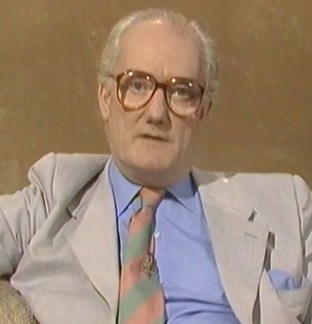
布莱恩·马基 杰弗里·沃诺克
EDITED TRANSCRIPT · 依据现场录音编译整理,可划线生成便签
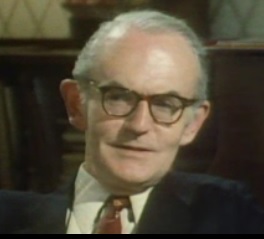
一九八七年,英国广播公司播出布莱恩·马基主持的哲学对谈系列,其中一集专论伊曼努尔·康德。对谈者是牛津哲学家杰弗里·沃诺克爵士,日常语言学派中人,赫特福德学院院长,一九八一至一九八五年间出任牛津大学副校长。两人从康德生平谈起,一路推进到物自体与现象的分界、先天综合判断、知识的界限,直至道德哲学与信仰的位置。本文依据现场录音编译整理。

一个足不出户的人

马基: 好几代人以来,认真研读哲学的人当中流传着一个相当普遍的看法:古希腊人之后,西方出现过的最伟大的哲学家是伊曼努尔·康德。康德一七二四年生于东普鲁士的柯尼斯堡,一八零四年也死在那里,差几个月满八十岁。关于他,笑话很多。他几乎不离开柯尼斯堡,终其一生没有走出过故乡那个省份。他还严守每日的作息,据说柯尼斯堡的居民看见他从自家窗前走过,就可以拿他来对表。他终身未婚,从外表看,他这一生波澜不惊。

马基: 不过,他绝不是我上面这番描述所暗示的那种干瘪之人。恰恰相反,他好交际,风趣,衣着讲究,谈吐机敏。他在柯尼斯堡大学做了三十多年教授,他的课以精彩著称。有一点颇出人意料:康德是近代第一位在大学里教书的伟大哲学家。笛卡尔、斯宾诺莎、莱布尼茨、洛克、贝克莱、休谟、卢梭,没有一个是学院中人。

马基: 康德之后那个世纪,也就是十九世纪,主要的哲学家大多也不是学院中人。明显的例外是黑格尔,可是叔本华、克尔凯郭尔、马克思、约翰·斯图亚特·密尔、尼采,都不是学院哲学家。只有到了二十世纪,几乎所有重要哲学家才都成了学院中人。哲学这门学问的职业化究竟是好是坏,很值得争论,我猜它是不可避免的。

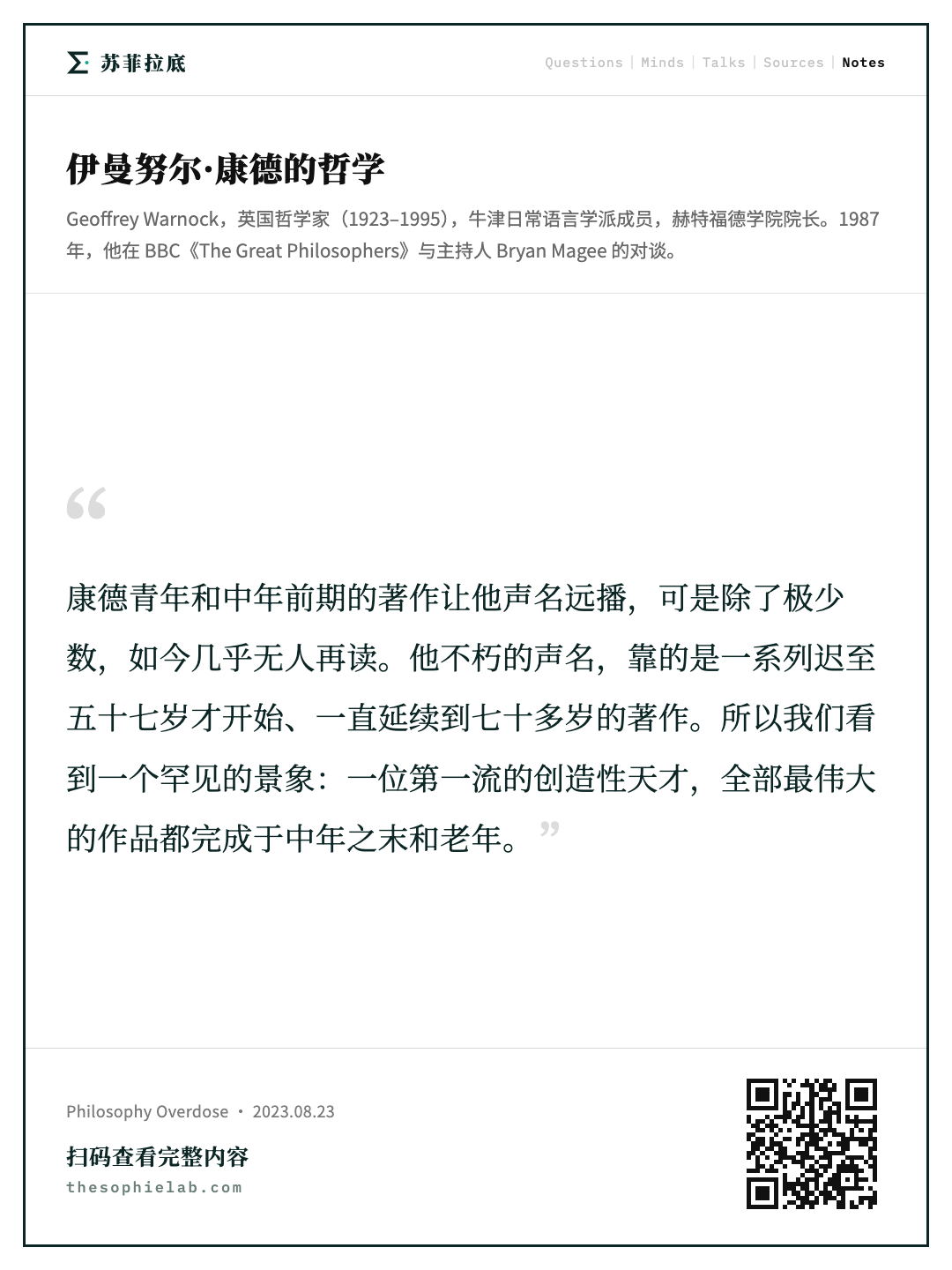
马基: 回到这第一位伟大的教授。康德青年和中年前期的著作让他声名远播,可是除了极少数,如今几乎无人再读。他不朽的声名,靠的是一系列迟至五十七岁才开始、一直延续到七十多岁的著作。所以我们看到一个罕见的景象:一位第一流的创造性天才,全部最伟大的作品都完成于中年之末和老年。

马基: 公认的代表作是《纯粹理性批判》,一七八一年出版。此书起初没有被很好地理解,于是两年后他把其中的核心论证写成一本简短的说明,单独出版,通常被称作《导论》。一七八七年,他又推出了大幅修订的《纯粹理性批判》第二版。紧接着是第二批判《实践理性批判》,一七八八年;第三批判《判断力批判》,一七九零年。

马基: 其间,他还在一七八五年出版了一本小书,叫《道德形而上学的奠基》。书名毫无诱惑力,可这本书此后对道德哲学的影响大得惊人。今天与我一起讨论康德的,是当代一位知名哲学家,杰弗里·沃诺克爵士,牛津赫特福德学院院长,曾任牛津大学副校长。

从何处切入

马基: 沃诺克爵士,在近代哲学里,康德也许是最著名的体系建造者。可凡是讲解一个体系,都有一个众所周知的麻烦:里面每样东西都跟别的东西咬合在一起,你从哪儿凿开一个口子?从哪儿起头?在您看来,讲解康德哲学,最好的切入点在哪里?

沃诺克: 确实有这个麻烦。从某个角度说,康德的长处之一,正是他极善于把范围极广的一大堆见解拼装得周严而成体系。不过,如果我们要谈,我想紧要的一点是别一上来就太技术化。人们有时把他描绘成一个裁判,在理性主义和经验主义的长短之间做仲裁,或者说他在讨论综合的必然真理如何可能。我觉得应该再往回退一步,退到那个更宽、更朴素的关切上去,正是它催生了后面这些问题。

沃诺克: 我认为,那个关切是:他那个时代的自然科学所得出的结论,和我们最根本的伦理信念、宗教信念之间,看上去有冲突。他觉得这里初看起来就存在一种不相容。

科学与道德的冲突

马基: 您能把他所说的冲突具体讲一讲吗?

沃诺克: 我想,这冲突最核心也最朴素的形态是这样的。自然科学似乎有一个前提,而且康德认为这是一个有充分根据、完全正当的前提:凡发生的事,都由在先的事所决定;总有一条规律在,凭这条规律你可以说,已经发生的事情是唯一可能发生的事情。

马基: 在物理世界里。

沃诺克: 在物理世界里,是的。可是,当我们思考自己的行为,比如思考我们可能陷入的种种道德困境时,我们相信我们自己和别人面前都摆着多个选项,我们本可以做出好几种不同的事情。正因为如此,我们才必须为自己实际做出的事情承担责任。这是一头。而康德认为,它初看起来和自然科学的前提相抵触。

马基: 换句话说,在一个所有物质运动都受牛顿定律支配的宇宙里,在一个受科学规律支配的宇宙里,怎么可能有自由意志?

沃诺克: 正是。此外他还关心另一个问题:在一个本质上是机械的、由物理因素决定的宇宙里,上帝该安放在什么位置。

前人为何失败

马基: 看到这些问题的哲学家,他不是第一个,甚至不是第一个重要的哲学家,对吧?

沃诺克: 当然不是。整个十八世纪,这类问题一直是哲学家的心事,从十七世纪末自然科学那次大跃进之后就是如此。在经验论一脉里,贝克莱就为这类问题所困扰;在康德自己的传统里,最显眼的是莱布尼茨。

马keting: 他确实不是第一个。那么,他为什么对前人在这个问题上的作为如此深切地不满?他显然是不满的。

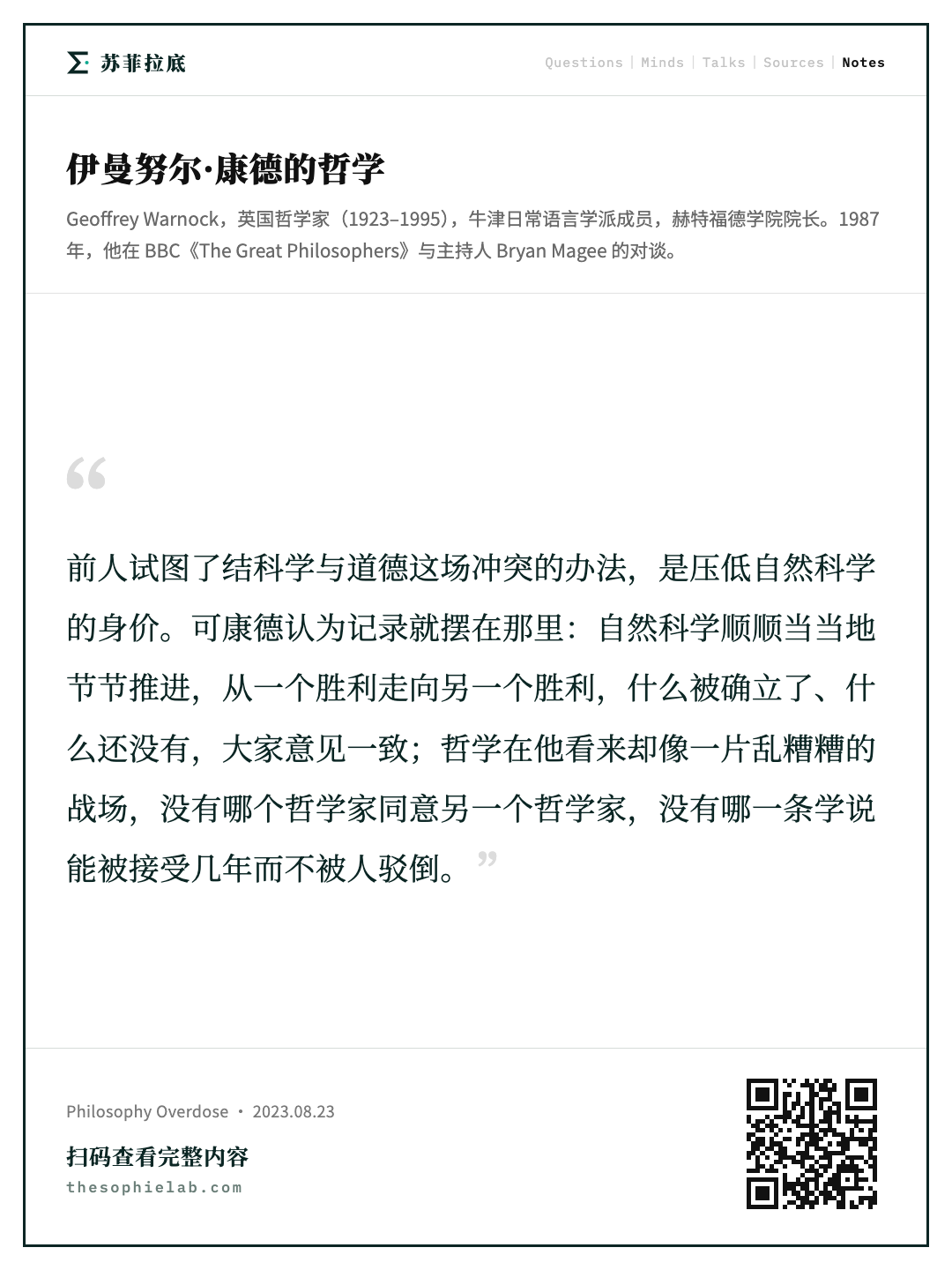
沃诺克: 他认为,而且我觉得他这么认为是对的,前人试图化解或者了结这场冲突的办法,是压低自然科学的身价。贝克莱肯定是这样,我想莱布尼茨也是。他们把自然科学说成低一等的东西,不配和形而上学的学说与论证平起平坐。

沃诺克: 一来,康德认为记录摆在那里,这条路走不通。一方面,自然科学看上去顺顺当当地节节推进,从一个胜利走向另一个胜利,什么被确立了、什么还没有,大家意见一致。另一方面,哲学在他看来像一片乱糟糟的战场:没有哪个哲学家同意另一个哲学家,没有哪一条学说能被接受几年而不被人驳倒,如此等等。这是一点。

沃诺克: 但他还有另一层想法,我觉得这一层更要紧:休谟已经对哲学的资格提出了严重怀疑,怀疑它究竟还能不能算作一项可以成立的智识事业。他认为休谟的这个诘难,如果可以这么叫的话,让人严重怀疑哲学家们自称在做的那件事,在原则上是不是根本就做不成。

休谟的诘难

马基: 他有一句名言,说读休谟把他从独断的沉睡中唤醒。我想您刚才说的正是指这件事。这个唤醒究竟是怎么回事?休谟把他唤醒到什么上头去了?

沃诺克: 粗糙地说,问题是这样的。休谟,还有莱布尼茨以及别的想过这问题的哲学家,都接受一个通行的看法:命题可以穷尽地分成两类。一类是从前所谓的理性真理,康德叫它分析命题(analytic),在某种意义上它们靠定义就为真,比如三角形有三条边,自行车有两个轮子,这一类。他们说这类命题可以先天地被认识,也就是说不依赖经验。

沃诺克: 另一类是实质性的命题,它告诉我们一些并非仅仅隐含在所用词项里的东西。他们说,这类命题有实质、有信息,但不可能是必然的。它们永远是偶然命题,只能靠经验或实验来确立。

沃诺克: 休谟于是说,而康德认为他说得完全对:如果这个划分是对的,那么哲学自身就陷入了严重的困境。因为哲学一方面并不自称是建立在观察和实验之上的经验科学;另一方面它也不肯承认自己所做的不过是在铺陈一套同语反复,分析我们说话思考时所用的词项。休谟的问题就是:一个哲学家如果这两件事都不做,他还可能在做什么别的事?

马基: 可是休谟难道没有意识到,康德之后也没有意识到,这对自然科学同样造成了严重的问题?因为科学上那些不受限制的普遍规律,也是既非分析命题,无法用逻辑演绎得出,也不能从经验中得到证明。这一点他们两人不是都看到了吗?

沃诺克: 休谟究竟怎么想这件事,我不敢断言,眼下深究下去恐怕也是岔开话题。我想休谟大概认为,科学可以就这么作为一套经验知识运作下去,当然那样一来它就没法宣称任何事情是必然如此的了。

第三类命题

沃诺克: 至于康德,他的看法很明确:这种自以为穷尽的二分法是错的。他对此毫不怀疑。因为,哲学家声称能提出既是综合的又是必然的命题,这个资格也许可以质疑;但康德毫不怀疑,这样的命题在自然科学和数学里根本就是家常便饭。所以他认为,确确实实存在一类命题,它们既不是分析的,也不是经验的、偶然的。

马基: 换句话说,这类命题适用于世界,可我们并不是从世界里读出来的,而是单凭论证就能确立的。

沃诺克: 是的。他给它们起了个技术名称:先天综合命题(synthetic a priori)。

马基: 那么,如果这样的命题适用于世界,却不是靠经验、靠观察从世界里读出来的,我们究竟是怎么得到它们的?

物自体与现象

沃诺克: 这里就得引入康德最重要的一个区分了,就是他所谓的物自体(things in themselves),也就是世界自身所是的样子,和现象(appearances)之间的区分。关于物自体,康德会说,我们对它提不出任何要求。它们就是它们所是的样子,我们对此无能为力。

沃诺克: 可是一旦转到另一个话题,转到我们所经验的世界,转到那个向我们呈现出来、作为经验对象的世界,也就是他所说的现象,情况就完全不同了。因为他主张,任何一个世界,只要它要成为我们可能经验的对象,就必须满足某些条件。这里说的我们,我想不只是我,也包括别人。他认为有一个关键事实:世界是无数经验主体所共有的经验对象。如果真有这样一个世界,能被一个由经验主体组成的共同体共同地经验和认识,那么他论证说,这个世界就必须满足某些条件。而我们可以先天地断定,现象必须满足这些条件。

马基: 把您刚才说的话换成下面这种说法,是否准确?我们能够经验、知觉或认识的东西,当然取决于外面有什么东西可供经验、知觉和认识,但它同样取决于我们拥有什么样的装置去经验、去看、去认识。而我们所拥有的这套装置是偶然的。举个现代的例子:我们恰好被配备成能够解读某些频率的电磁波,而不是另一些。也就是说,我们能接收并解读热波和光线,却接收不了也解读不了无线电波和X射线。可以设想,我们本来完全可以用另一套方式去把握实在。

沃诺克: 是的。

马基: 既然如此,康德是在说:我们要能经验任何东西,那东西就必须是我们这套装置可把握的。

沃诺克: 必须是我们现有的这套装置可把握的,对。

马基: 这并不是说别的东西不能存在,而只是说,它们不能为我们而存在,我们无法认识它、把握它。是这样吗?

沃诺克: 有一点我要加个限定。我想康德并不打算去讨论我们的感官装备具体是什么样,我们长着什么样的眼睛和耳朵。他想说的是更一般的东西:一个经验主体面对着作为经验对象的世界,这个观念本身就要求它得有某种感性能力,得有某种智性的、概念性的能力。至于这些能力具体是哪一种,他不想说。他不会去操心我们的眼睛和红隼的眼睛有什么不同,他只关心我们必须有某种知觉方式。

马基: 但要点在于,我们带着某些既定的先行条件而来,只有能装进这些条件的东西,才能成为我们的经验。

沃诺克: 完全正确。

马基: 而这种东西的性质,我想在他之前没有任何哲学家想到过。

沃诺克: 没有,我认为这是真正的新东西。

经验的形式

马基: 那么,这一步开始把他引向一种关于人类知识的什么样的全新看法?

沃诺克: 他提出了这样一个主张:只要想得足够仔细,论证得足够久,人就能把他所谓的一切可能经验的形式给指认出来。他把这项事业叫做自然的形而上学,有时也叫经验的形而上学。至于他所说的质料,那是偶然的,实际发生的可以是这样也可以是那样;但他认为,一切可能经验的形式是什么,人是可以想清楚、写出来的。

沃诺克: 这将是一套学说,它当然告诉了你关于世界的某些事情,因为它告诉你世界的本质形式是什么;而且它告诉你的是必然的东西,不可能是别样。正因为存在这样的命题,休谟和他别的前人才错了:他们把一切可能的命题拆成两类,一类是分析的,其真假取决于所用词项的性质;一类是综合的、后天的,其真假取决于观察和经验。

马基: 现在我们有了第三类。您能不能给我们举一两个例子,说说这类概念或命题是什么样的?

沃诺克: 用最一般的话说,它们分成两大类。首先,康德处理的是他所谓的感性形式,也就是知觉的形式。他认为在这里可以把空间和时间的根本性质梳理清楚。他认为空间和时间是由我们感性的本性强加于我们的经验之上的。

马基: 我想在这里打断一下,因为对头一回接触的人来说,这是个很难把握的想法。他是在说:空间和时间并不刻画事物自身所是的样子,而是我们无可逃避的经验方式。

沃诺克: 对。

马基: 我们只能在这些维度中经验事物,可是离开我们的经验,这些维度就谈不上存在。

沃诺克: 完全正确。如果有人不安地追问:那么造化自身呢,它自身呈现出什么样的空间秩序和时间秩序?康德会说,这不是一个可讨论的题目。我们能谈的只有那个作为我们经验对象的世界,也就是显现出来的世界。

沃诺克: 而且他还认为,他这么一来,把空间和时间引进来当作感性形式,实际上就把几何学和算术也一并引进来了。这一步他做得对不对,很可争议,说来也够奇怪的,可他确实认为几何学和算术处理的是感性形式,正因如此,它们是先天综合真理的集合。

马基: 既然他说存在这样一类特殊的命题,它们适用于世界却不来自经验……

沃诺克: 我能插一句吗?我刚才说他的先天综合命题分成两大类,我们只讲了其中一类。让我把第二类很简短地带出来。

马基: 请。

沃诺克: 他认为还存在他所谓的知性形式,也就是思想的形式。他试图证明是理解之可能性条件的那些根本原理,我想首先就是普遍因果决定论的原理,他认为这是其中之一。然后,多少有点难以令人信服,他还试图证明牛顿的物质守恒定律同样陈述了经验之可能性的一个条件。

知识的界限

马基: 为了把我们正在搭起来的整幅图景说清楚,让我把到这里为止的内容复述一遍。康德是说,因为我们的全部知识和经验都要通过我们的感官装置和心智装置才能到达我们,所以它们到达我们时全都带着依赖感官、依赖心智的形式。

沃诺克: 对。

马基: 而对于事物离开一切可能经验、自身所是的样子,我们没有任何直接的通道。既然我们所拥有的把握方式就是这么一些方式,那么可能的经验就必须能与它们咬合,才可能成为我们的经验。

沃诺克: 完全如此。

马基: 因此,他作为哲学家的部分工作,就是对这些形式的性质做一次大规模的考察。

沃诺克: 是的。

马基: 而如果这项考察成功而且完备,它就会告诉我们一切可能知识的界限在哪里。

沃诺克: 对。

马基: 界限之外的任何东西,对我们来说就是根本不可知的。

沃诺克: 对,正是。

马基: 那么这一步的后果就极其激进了,不只是就它容纳了什么而言,更是就它排除了什么而言。

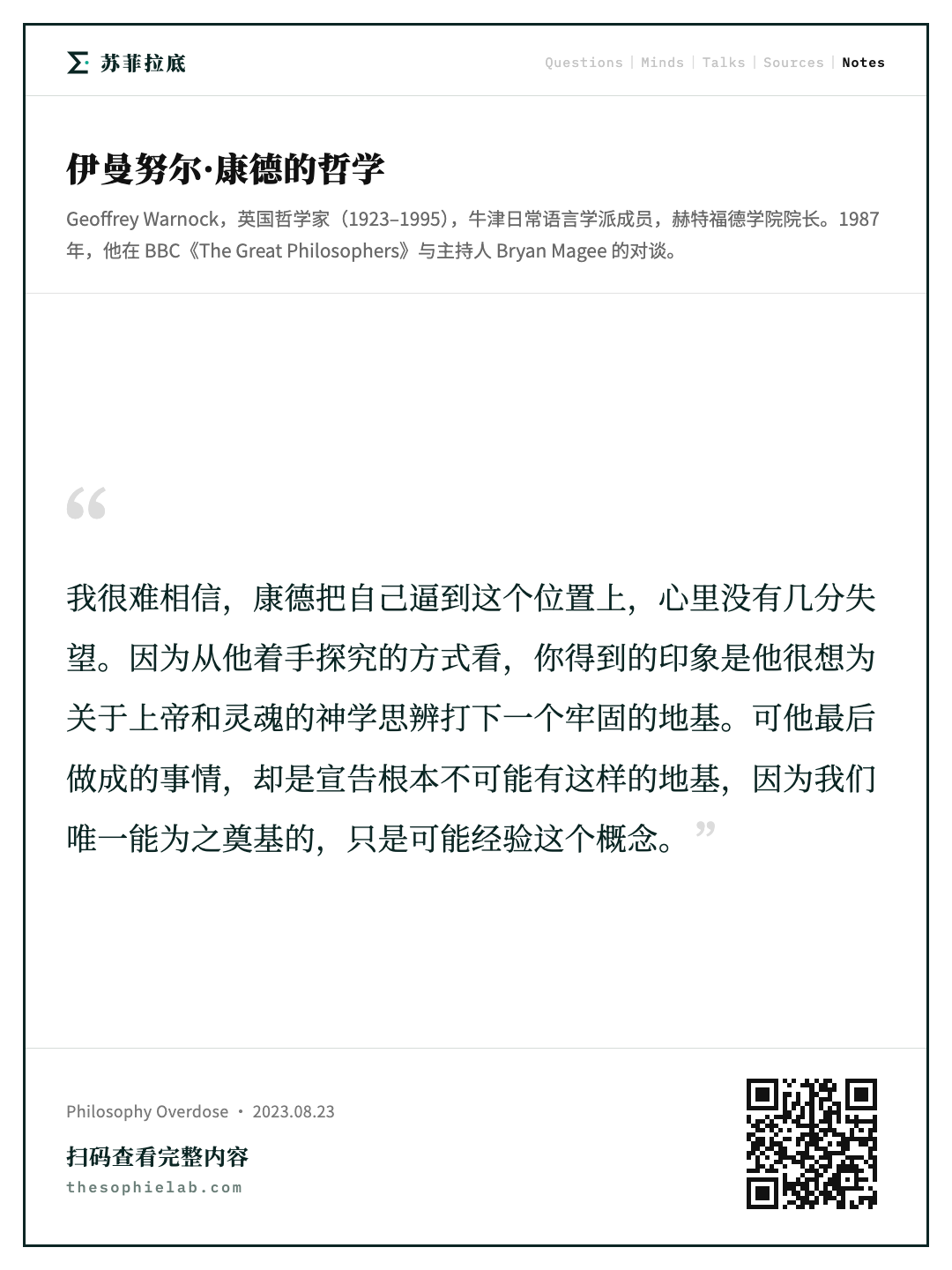
沃诺克: 这确实如此,而且是根本性的。我很难相信,康德把自己逼到这个位置上,心里没有几分失望。因为从他着手探究的方式看,你得到的印象是他很想为关于上帝和灵魂的神学思辨、关于宇宙的形而上学思辨打下一个牢固的地基。可他最后做成的事情,却是宣告根本不可能有这样的地基,因为我们唯一能为之奠基的,只是可能经验这个概念,以及什么东西能够成为可能经验的对象。

沃诺克: 一旦你想越过这条线,一旦你想追问宇宙该如何刻画而完全不牵涉任何可能的经验,或者你想去谈论上帝和灵魂,那么你这项事业就注定垮掉,原则上是空洞的。康德确实是在这么说。

信仰的位置

马基: 康德认为我们不可能知道上帝是否存在,也不可能知道我们是否有灵魂,可他本人是相信上帝存在、相信我们有灵魂的,对吗?

沃诺克: 确实如此。他非常清楚地表明,这是信仰的事,不是可知的事。

马基: 可是按他自己的前提,关于上帝或灵魂的谈论怎么可能连有意义都算得上?

沃诺克: 这是个很好的问题,而他在这一点上,我想说,有点闪烁其词。他想说的东西相当有意思,因为这里牵涉到他把整件事情颠倒过来的一个漂亮动作。他的一些前人曾经设定:我们的道德信念、道德态度和宗教信念需要某种形而上学的地基,于是他们试图以神学和哲学伦理学的形式提供这个地基。

沃诺克: 康德最后却把这件事整个倒过来放。他说,我们不但有权持有道德信念和宗教信念,而且我们非有它们不可,这是躲不掉的。这些信念会把我们引向关于上帝和灵魂的、本质上是形而上学的学说。但那些学说本身如果说还有什么根基的话,那根基就直接在我们那些最原初的道德信念里。所以,真正基本的是道德信念。

马基: 他是在说这个吗:有一个我们大家都直接熟悉、无可逃避的经验事实,就是不管我们愿不愿意,至少我们大多数人确实持有一些道德信念,而且哪怕想撇开也撇不开。这是一个事实。

沃诺克: 是的。

马基: 而要让这些信念具有任何真实的效力或意义,要让好与坏、对与错、褒与贬这些根本的道德词语具有任何意义,就必须有某种选择的自由。必须有可能,我们当中的一些人,在某些时候,本可以做出和实际所做不同的事,否则那些词语就是空话。可是这怎么可能?一方面,在那个一切物质运动都受牛顿定律支配的世界里,这怎么可能?这正是您在开头给我们提出的那个问题。

沃诺克: 是的。

马基: 另一方面,我们要有自由意志,而在他看来自由意志是我们对道德范畴的直接经验所无可避免地要求的,那就必须有某种道德的领域存在。是这样吗?

沃诺克: 是这样。

两个领域

马基: 那么他又是怎样从这里更进一步走到上帝那儿去的?

沃诺克: 关于自己对神学和宗教的思考,他有一句夫子自道,说他取消知识,是为了给信仰腾出地方。他只是表明了为什么神学的题材,姑且这么说,不可能是知识的对象。然后他说:这有什么可惊慌的?我们一直不都知道这本来就是信仰的事吗?

沃诺克: 不过正如您说得对的,人可以主张他的论证其实比这激进得多。问题不只是我谈论上帝时,说的是我并不知其为真的话。他的论证似乎真正导向的结论是:我并不知道自己在说什么,我说的话其实没有什么意思。可是他非常不愿意得出这个结论。他想说的只是:我所做的不过是表明这不是知识和证明的事。

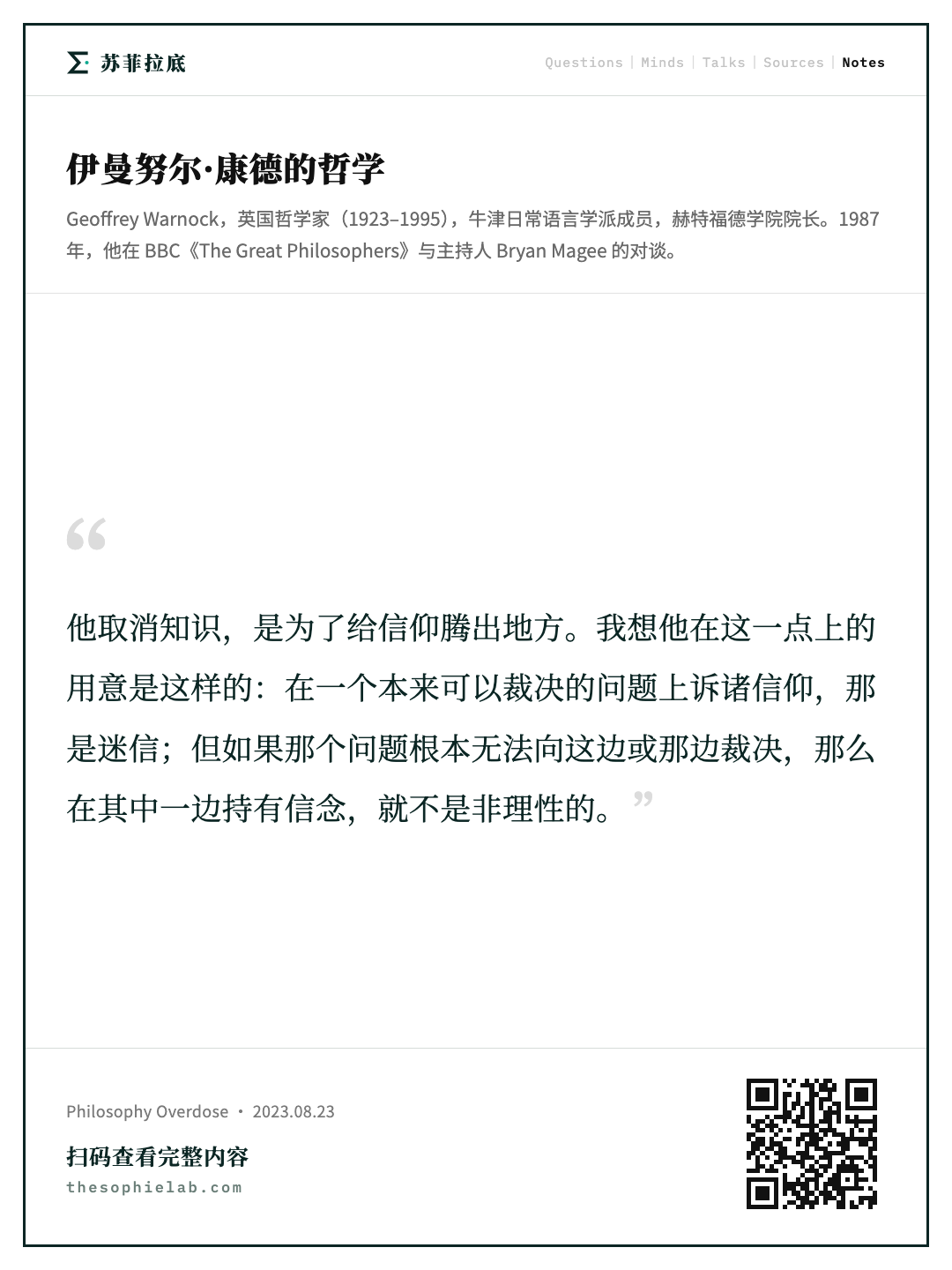
马基: 我想他在这一点上的用意是这样的:在一个本来可以裁决的问题上诉诸信仰,那是迷信。

沃诺克: 一点不错。

马基: 但如果那个问题根本无法向这边或那边裁决,那么在其中一边持有信念,就不是非理性的。

沃诺克: 完全正确。

马基: 杰弗里,在这场谈话一开头,您说把康德送上哲学事业之路的那个问题,可以说是他觉察到牛顿物理学和伦理学的要求之间似乎有冲突。那么,根据我们到此为止说的这一切,他是怎么解决那个问题的?

沃诺克: 说实话,解决得相当有限,我想他自己对此心里明白。他会主张的是:通过把作为现象、作为经验对象的世界和物自体的世界区分清楚,他就有资格说,现象的世界在那里,自然科学原则上给出关于它的全部真理。他相信科学确实做到了。他毫不怀疑牛顿完全正确,物理学家对这个作为可能经验对象的世界所做的描述是正确的,而且可以是穷尽的。

沃诺克: 但是他说,请记住,我们在那里谈的是现象的世界。此外还有物自体这个题目,那里给另外一整套概念留出了地方:自由意志、理性的行动者、对与错、好与坏、灵魂。这些概念有安身之处,不在现象界之内,而在现象界之外。

沃诺克: 当然,按他自己的原则他也看到,他必须承认这些事情不可能成为知识的对象。如果你问他,你知道有自由意志这回事吗,他会前后一贯地回答:不,这种事我一概不知道。我所知道的只是,那种可能性有安放之处。

马基: 而且我不能不相信它存在。

沃诺克: 那当然。他接下来一定会补上这一句。

从理性推出道德

马基: 既然照这个看法,伦理不知怎么是从一切可能知识的世界之外来到我们这里的,那么关于它从哪儿来、我们怎么得到它,他有没有说法?

沃诺克: 他认为它出自理性。

马基: 我想,如果您能告诉我们他的道德哲学得出了哪些主要结论,会帮我们把这个问题看得更清楚。在这场讨论里要展开他支撑那些结论的论证,恐怕是不可能的。但如果您能把结论简要地勾勒一下,我想会有助于理解。

沃诺克: 这个可以简短地说几句。他在道德哲学里真正想做的,是设法从纯粹的理性概念里把道德的要害抽取出来。他说,凡是我们能用道德词语去谈论的行动者,他最要紧的一点就是必须是一个理性的存在者,能够为做这做那设想赞成和反对的理由。他试图论证,道德的那些根本要求其实就内置在理性这个概念本身之中。

沃诺克: 说到底,他似乎是要证明:只有一套与道德原则相对应的行动原则,才能够被一个由理性存在者组成的共同体一贯地,也就是理性地,普遍采纳。这是他试图证明的东西。

马基: 由此当然就直接引出了那条著名的定言命令(categorical imperative)。也许该请您把它表述一下。

沃诺克: 他说:要只按照你同时能够愿意它成为普遍法则的那条准则去行动。我想这就是那个意思。他要说的是,道德真正加在我们身上的,是对行为的一些条件,而这些条件是任何一个可能的理性存在者共同体都会赞同的,我想他还认为,这些条件是被唯一地确定下来的。他要做的就是这件事。

为什么难懂

马基: 康德哲学初次接触时难懂,这是出了名的。我相信许多在听我们这场谈话的人此刻正感到这份吃力。我想,困难的根子在于他的这个论断:对于事物自身所是的样子,我们没有知识,也没有获得知识的途径,我们被自己的局限永久地隔在外面,而这些局限有一部分就体现在时间和空间上。

马基: 有一个说法不知是否有用:不妨向人们指出,在一个完全不同的脉络里,许多有宗教信仰的人一向相信的东西,其实和这个很像。他们相信真正的实在在我们这个经验世界之外,在时空之外,而我们这个经验世界是短暂的,甚至在某种形而上学的意义上是幻象。这么说是有帮助,还是反而把问题弄浑了?

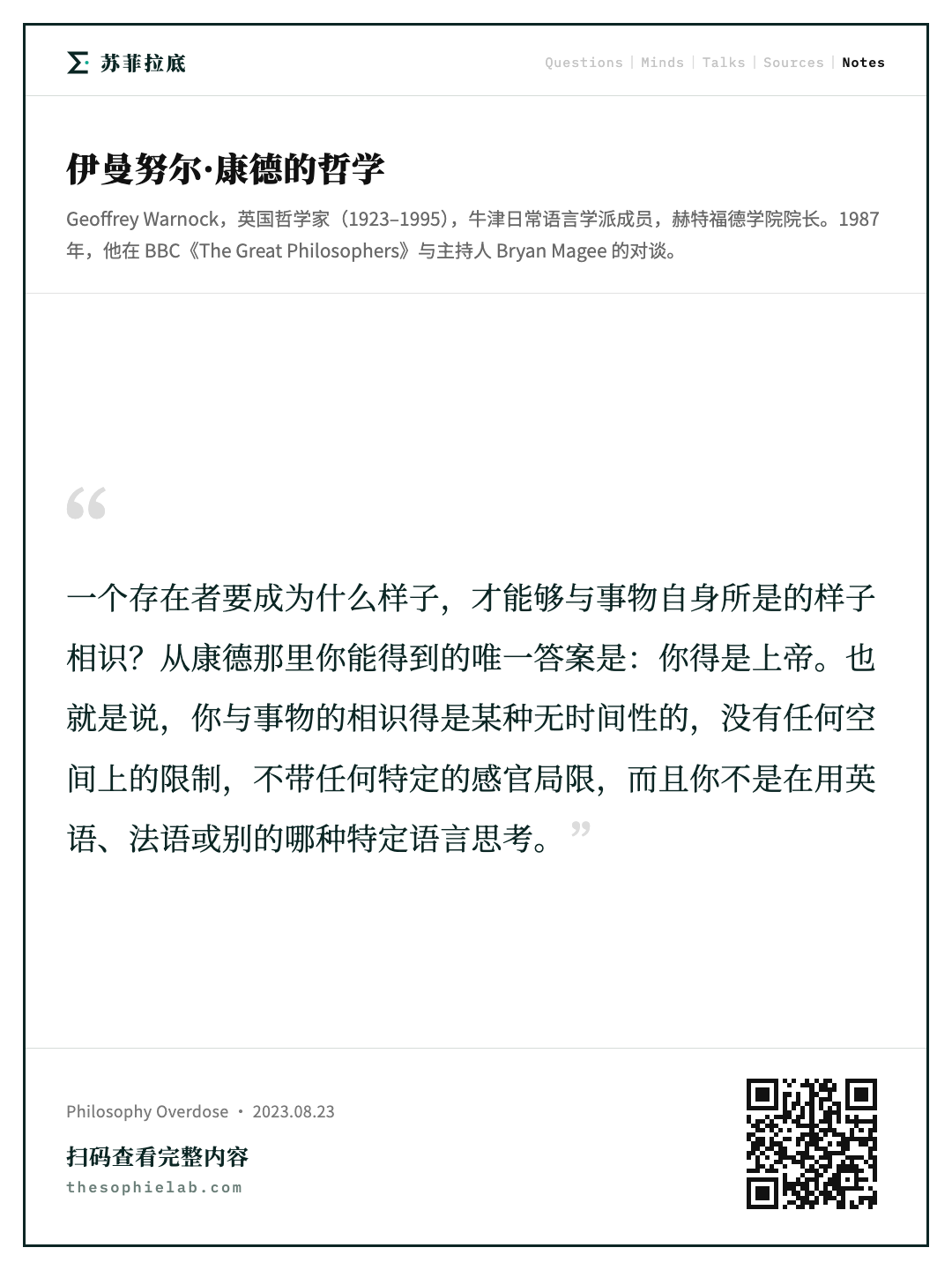
沃诺克: 不,我不觉得会弄浑。比方说,我们提一个多少带点假设意味、也许有点无聊的问题:一个存在者要成为什么样子,才能够与事物自身所是的样子相识?从康德那里你能得到的唯一答案是:你得是上帝。也就是说,你与事物的相识得是某种无时间性的,没有任何空间上的限制,你的相识方式也不带任何特定的感官局限,而且你不是在用英语、法语或别的哪种特定语言思考。你与宇宙的相识不受这一切限制中的任何一条。如果你接着问,那我得是什么才能这样呢?唯一的答案是:我得是上帝。

马基: 康德哲学有一个非常醒目的地方,我觉得,就是他的哲学做得无可挑剔地合乎哲学的标准,他不诉诸信仰,不诉诸启示,不诉诸任何这类东西,全凭论证,而且完全是在西方哲学的主流传统内部做工,经由洛克、休谟、莱布尼茨这些前人。可即便如此,他得出的结论却出人意料地能够与宗教信仰共处。

沃诺克: 是的,只是有一件不太舒服的事,就是我们刚才提到的:他不得不说,严格说来,关于那些题目的一切言说对我们都是不可理解的,我们并不真知道自己在说什么。这个命题,神学家一向不太愿意接受。

马基: 他们甚至可能会说,如今接受的人越来越多了。

沃诺克: 这也许是真的。

文风这道障碍

马基: 读康德还有一个困难,纯粹是文体上的。有些哲学家文章漂亮,读起来是享受,休谟是一个,柏拉图是一个,叔本华是一个。可康德最好的朋友也没法这么夸他。他的文字晦涩、艰难、不透亮。他为什么写得这么糟?

沃诺克: 我想大概可以说三点。一部分原因就是您开头提到的那个事实:他从职业上说,而且是极其专一地从职业上说,是个学院中人。他写起来是很重的学院腔,特别爱用技术术语和行话,还有他所谓的建筑术(architectonic)。这一切都非常学院。

沃诺克: 但关于那几部批判,还有一点我想很重要,这一点也和您开头说的话对得上。等到他真正动手写他知道、或者希望是自己代表作的那些书时,他已经快六十岁了,而且心里一直被一个念头缠着:他可能等不到写完就死了。那几百页文字,也就是他六十到七十岁之间写的东西,毫无疑问是写得极快的。他是在赶。我想这一点关系很大。

马基: 当然,两百年前人的预期寿命比现在短得多,他觉得自己可能很早就死,这在他是完全合理的。

沃诺克: 是的。所以他在赶时间。还有一点不太显眼:在那个年头,他是用德语写作的,这在当时还多少有点不寻常。德语那时刚刚才被承认为一种可以用于学术和学问的像样语言。

马基: 我记得莱布尼茨好像从来没用德语写过东西,全是法语或拉丁语。

沃诺克: 法语或拉丁语,对。当时根本还没有一种成型的德语学术文体可供康德取用,而贝克莱和休谟就有:英语早已是这类学问用途上的成熟语言。我想这对他是个难处,他没有范本可循。

马基: 我觉得这很可惜,因为对一位毕竟是无与伦比的思想家来说,这是一道巨大而本不必有的障碍。

沃诺克: 是的,确实如此。

何以居于顶峰

马基: 我在这场讨论一开头说过,好几代人以来,大量专业哲学家把他看作古希腊人以来最伟大的哲学家。他的声誉为什么会高到这个地步?

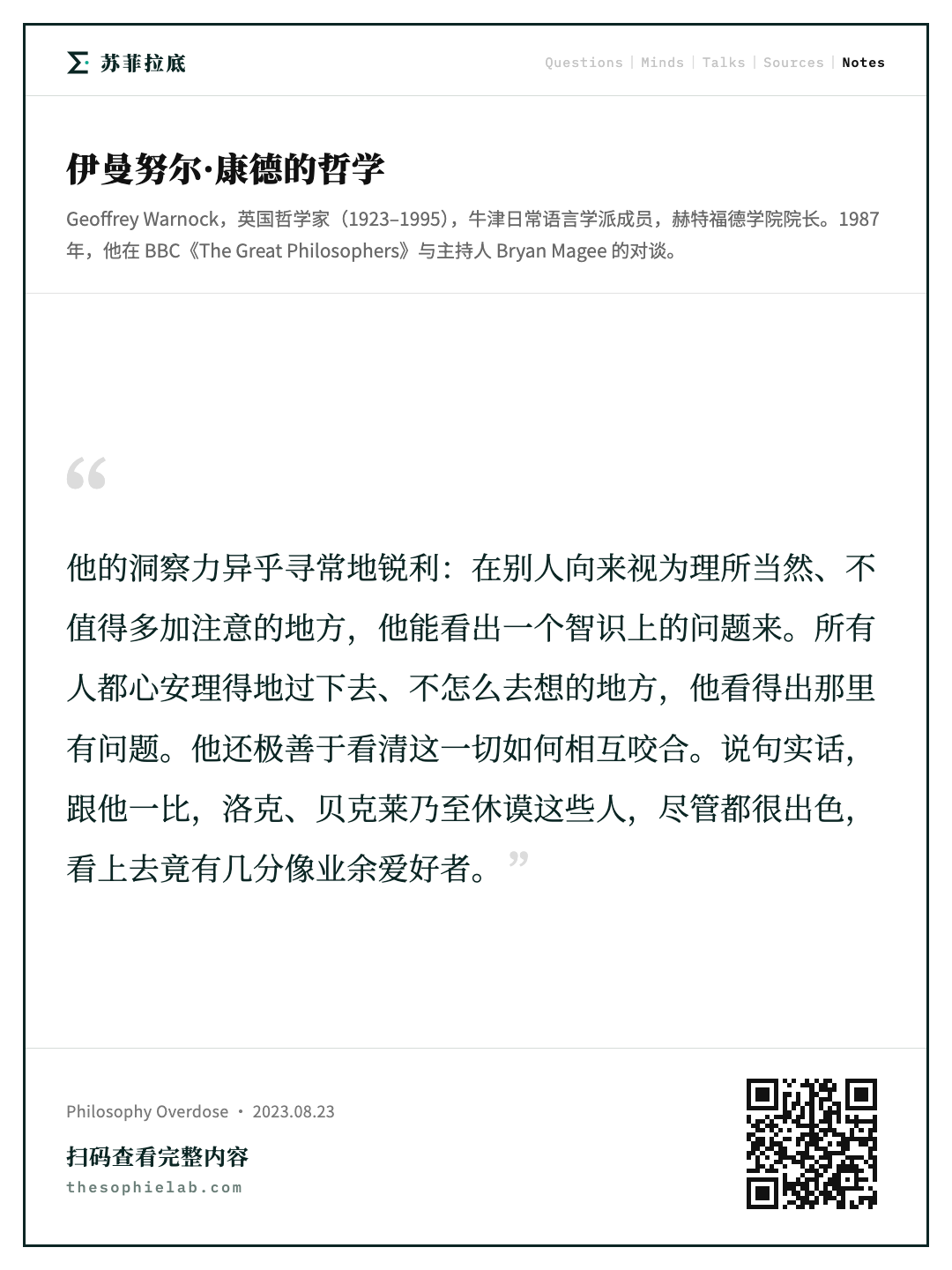
沃诺克: 我想有两种品质使他配得上这个位置。第一,他的洞察力异乎寻常地锐利:在别人向来视为理所当然、不值得多加注意的地方,他能看出一个智识上的问题来。他能看出问题在哪儿。我认为这是最了不起的哲学天赋之一:所有人都心安理得地过下去、不怎么去想的地方,他看得出那里有问题。

沃诺克: 第二点,这或许和他的学院职业性有关:他极善于看清这一切如何相互咬合,看清自己在这个题目上说的话会对另一处说过的话产生什么回响。他在这方面非常自觉,非常职业,非常有条理。说句实话,跟他一比,洛克、贝克莱乃至休谟这些人,尽管都很出色,看上去竟有几分像业余爱好者。

马基: 非常感谢您,杰弗里爵士。
本期讲者
布莱恩·马基英国哲学作家、广播主持人及前工党议员(1930–2019),以 BBC 哲学访谈系列《Men of Ideas》《The Great Philosophers》闻名,著有《叔本华的哲学》《哲学的故事》。
杰弗里·沃诺克英国哲学家(1923–1995),牛津日常语言学派成员,赫特福德学院院长,1981–1985 年任牛津大学副校长;著有《贝克莱》《英国哲学 1900 年以来》《当代道德哲学》《道德的对象》。
章节 · 点击跳转视频
0:00 康德生平与著作概览 ▶ 正在看
3:28 切入点:科学与道德的冲突 ▶ 正在看
6:16 前人的失败与休谟的挑战 ▶ 正在看
8:42 休谟之叉与先天综合判断 ▶ 正在看
12:51 物自体与现象:认识装置决定经验 ▶ 正在看
17:33 经验的形式:时空与范畴 ▶ 正在看
21:51 知识的界限:上帝与灵魂被排除 ▶ 正在看
24:57 倒转:从道德信念推出自由与信仰 ▶ 正在看
29:52 分域方案与道德哲学的结论 ▶ 正在看
34:58 为何难懂:物自体、上帝视角与文风 ▶ 正在看
40:54 康德为何是希腊以来最伟大的哲学家 ▶ 正在看
本期论点
本期回应
9:12
命题可以被穷尽地分为凭定义为真的分析命题和只能靠经验确立的偶然命题 只有两类有没有既非定义、也非经验的知识?杰弗里·沃诺克
12:25
存在既非分析也非经验偶然的命题,它们适用于世界却只需通过论证来确立 还有第三类有没有既非定义、也非经验的知识?杰弗里·沃诺克
14:02
任何世界要成为可能的经验对象都必须满足某些条件,这些条件可以先天地断定 还有第三类有没有既非定义、也非经验的知识?杰弗里·沃诺克
15:02
人能经验和认识什么,不只取决于外界有什么,也取决于人拥有什么样的官能装置 还有第三类有没有既非定义、也非经验的知识?布莱恩·马基
20:49
几何学和算术处理的正是感性形式,因而构成先天综合真理的体系 还有第三类有没有既非定义、也非经验的知识?杰弗里·沃诺克
26:45
好、坏、对、错这些道德词汇要有意义,就必须存在某种选择的自由 在自然外如果每件事都有原因,选择还算自由吗?杰弗里·沃诺克
31:23
自由意志、善恶、灵魂这些概念的容身之处不在现象世界之内,而在其外 在自然外如果每件事都有原因,选择还算自由吗?杰弗里·沃诺克
11:03
不受限制的普遍科学定律既不能由逻辑演绎得出,也不能从经验中得到证明 推不出来普遍的科学定律靠什么立起来?布莱恩·马基
24:00
神学与形而上学思辨不可能有坚实基础,唯一能确立基础的只有可能经验及其对象 没有意义经验检验不了的话还有没有意义?杰弗里·沃诺克
29:01
问题若实际可裁定,诉诸信仰就是迷信;若根本无法裁定,选择一边持有信念就不算不理性 不必另立标准信仰上帝算不算理性的?杰弗里·沃诺克
33:58
只有与道德原则相对应的行动原则,才能被理性存在者的共同体一致地普遍采纳 有答案道德问题有没有正确答案?杰弗里·沃诺克
其他论点
4:19
康德哲学的根本关切,是物理科学的发现与伦理宗教信念之间似乎存在的冲突 观察杰弗里·沃诺克
7:29
贬低物理科学的地位以维护形而上学,这条路走不通 杰弗里·沃诺克
19:32
空间和时间不是事物自身的特征,而是感性强加于经验、无法摆脱的形式 杰弗里·沃诺克
25:53
道德信念不需要形而上学根基,关于上帝与灵魂的形而上学学说反而以道德信念为根基 杰弗里·沃诺克
01康德生平与著作概览
0:00
For several generations now, it's been a widely held view among serious students of philosophy that the greatest philosopher to have appeared in the West since the ancient Greeks is Immanuel Kant. Kant was born in the town of Königsberg in East Prussia in 1724 and died there at the age of almost 80 in the year 1804. Many jokes have been made about the fact that he rarely left Königsberg and never went outside his native province in the whole of his life. Also about the fact that he stuck so strictly to a daily routine that the inhabitants of Königsberg could literally set their watches by him as he walked past their windows. He never married and outwardly his life was entirely uneventful.
几代人以来,认真研读哲学的人普遍认为,自古希腊以来西方出现的最伟大的哲学家就是伊曼努尔·康德。康德1724年出生于东普鲁士的柯尼斯堡,1804年在那里去世,享年将近80岁。关于他几乎从未离开柯尼斯堡、一生都没走出过故乡那个省份这件事,人们编了不少笑话。还有一件事也常被人取笑:他严格遵守每天的作息,以至于柯尼斯堡的居民真的可以在他走过自家窗前时,按他来对表。他终身未婚,从表面上看,他的一生毫无波澜。
便签引用
0:42
However, he was not at all the dry stick that my description so far would suggest. On the contrary, he was sociable and amusing, elegant in dress and witty in conversation. And his lectures at the University of Königsberg, where he was a professor for more than 30 years, were famous for their brilliance. Rather surprisingly, Kant was the first great philosopher of the modern era to be a university teacher. Descartes, Spinoza, Leibniz, Locke, Berkeley, Hume, Rousseau, none of these were academics.
不过,他绝不是我到目前为止的描述所暗示的那种枯燥乏味的人。恰恰相反,他为人善交际、风趣幽默,衣着讲究而且谈吐风趣。他在柯尼斯堡大学任教三十多年,他的讲课以精彩绝伦而闻名。精彩绝伦。相当令人意外的是,康德是现代第一位在大学任教的伟大哲学家。笛卡尔、斯宾诺莎、莱布尼茨、洛克、贝克莱、休谟、卢梭,这些人都不是学院中人。
便签引用
1:13
Nor were most of the major philosophers in the century after Kant, the 19th century. The obvious exception is Hegel, but Schopenhauer, Kierkegaard, Karl Marx, John Stuart Mill, Nietzsche, none of these were academic philosophers. It's only in the 20th century that nearly all important philosophers have been academics. Whether this professionalization of the subject is a good thing is very much a moot point. I suspect it's inevitable. However, to get back to the first of the great professors, the writings of Kant's youth and early middle age made him widely known, but all but a few of them are now virtually unread. His lasting fame rests on a series of publications which didn't begin till he was 57 and continued into his 70s. So, we have the rare spectacle of a creative genius of the first order producing all his greatest work in late middle age and old age.
康德之后一个世纪,也就是19世纪的多数重要哲学家也不是。明显的例外是黑格尔,但叔本华、克尔凯郭尔、卡尔·马克思、约翰·斯图亚特·密尔、尼采,这些人都不是学院派哲学家。直到20世纪,几乎所有重要的哲学家才都成了学院中人。这门学科的这种职业化究竟是好事这一点其实已经无关紧要了。我认为这是必然的。不过,回到第一位伟大的教授,康德青年和中年早期的著作让他声名远播,但如今其中除了少数几部之外,几乎无人问津。他持久的声誉建立在一系列著作之上,而这些著作直到他57岁才开始发表,一直延续到他70多岁。所以我们看到了一个罕见的景象:一位第一流的创造性天才,在中年晚期和老年才写出了他全部最伟大的作品。
便签引用
2:06
His acknowledged masterpiece is the Critique of Pure Reason, which was published in 1781. It wasn't very well understood at first, so 2 years later he published a short exposition of its central argument as a separate book, usually referred to as the Prolegomena, and then brought out an extensively revised edition of the Critique of Pure Reason in 1787. There followed in quick succession his second great critique, the Critique of Practical Reason in 1788, and then his third critique, the Critique of Judgment, in 1790.
公认的代表作是《纯粹理性批判》,出版于1781年。这本书起初并没有被很好地理解,于是两年后他把书中核心论证的简要阐述单独出版成一本书,通常被称为《导论》(《未来形而上学导论》),接着又在1787年推出了《纯粹理性批判》的大幅修订版。紧接着,他的第二大批判《实践理性批判》于1788年问世,随后是他的第三批判《判断力批判》,于1790年出版。
便签引用
2:41
Meanwhile, he'd also published in 1785 a little book called The Fundamental Principles of the Metaphysics of Ethics. In spite of its unseductive title, this book has had a simply immense influence on moral philosophy ever since. With me to discuss Kant's work is a well-known contemporary philosopher, Sir Geoffrey Warnock, Principal of Hertford College, Oxford, and a former Vice-Chancellor of Oxford University. Sir Geoffrey, Kant was perhaps the most famous system builder in the contemporary era in philosophy, and one notorious difficulty about expounding any system where everything fits in with something else is where to break into it, how to make a start. Where do you think is the the best point to break into Kant for an exposition of his philosophy?
与此同时,他还在1785年出版了一本小书,叫《道德形而上学原理》。尽管书名并不吸引人,这本书自问世以来对道德哲学产生了极其巨大的影响。今天和我一起讨论康德著作的,是一位著名的当代哲学家,杰弗里·沃诺克爵士,牛津大学赫特福德学院院长,也曾任牛津大学副校长。杰弗里爵士,康德大概是哲学近现代最著名的体系建构者了,而阐述任何一个环环相扣的体系时,有一个众所周知的难处,那就是从哪儿切入、从哪儿开头。您觉得从哪一点切入去阐述康德的哲学最合适?
便签引用
02切入点:科学与道德的冲突
3:28
There certainly is that problem. I mean, one of Kant's merits, in a way, was that he was very good at making an immense range of views fit together in a comprehensive and systematic way. But, um if we are um embarking on the discussion, I think it is important not to start off in too technical a way. I mean, to He's sometimes represented as conducting a sort of uh refereeing job uh between the merits and demerits of rationalism and empiricism, for example, or discussing how there can be synthetic necessary truths, but I think one ought to go rather further back to what the much wider and simpler concern was that really generated these other problems.
确实存在这个问题。我是说,康德的长处之一,某种意义上,就在于他非常善于把极其广泛的各种观点以全面而系统的方式整合到一起。不过,呃,如果我们要开始讨论,我认为重要的是别一上来就讲得太技术化。我是说,人们有时把他描述成在做一种呃仲裁的工作,呃评判理性主义与经验主义各自的优劣,或者讨论怎么可能有先天综合真理。但我认为应该往回追溯得更远一些,去看那个范围广得多、也简单得多的关切,正是它催生了这些别的问题。
便签引用
4:19
And that um I would submit was his concern with an apparent conflict between the findings of the physical sciences in his day and our fundamental ethical and religious convictions. He thought there was a prima facie um conflict inconsistency there. Can you spell out what he thought the conflict consisted in? Um I think the central and and simplest form of the conflict was that it seemed to be a presupposition and indeed Kant thought of well-founded and proper presupposition of the physical sciences uh that everything that happens is determined by antecedent happenings.
而那个关切,呃,依我看,就是他关心他那个时代的物理科学的发现与我们根本的伦理和宗教信念之间似乎存在的冲突。他认为二者初步看来呃是有冲突、有矛盾的。您能说说他认为这个冲突具体在哪儿吗?呃我想这冲突最核心、最简单的形式是这样:有一个预设——康德确实也认为这是个有充分根据的、恰当的物理科学的预设——那就是发生的一切都由先前发生的事情所决定。
便签引用
5:06
And that there is always a law um on the basis of which one can say that what happened was the only thing that could have happened. In the physical world. In the physical world. Yes. But of course, when we're thinking about our own conduct, when we're thinking, say, um about um moral predicaments we may find ourselves in, we believe that we and everybody else have alternatives before us and that there are various things we could do. And it's for that reason that we have to accept the responsibility for what we actually do.
并且总有一条规律,呃根据它人们可以说,所发生的事是唯一可能发生的事。在物理世界里。在物理世界里,是的。但当然,当我们思考自己的行为时,当我们思考,比方说,呃我们可能面临的道德困境时,我们相信我们自己以及其他每个人面前都有多种选择,有各种各样的事情是我们可以做的。正因为如此,我们才必须为自己实际所做的事承担责任。
便签引用
5:43
That was one thing, and he thought that that was prima facie contradicted by a presupposition of physical science. In other words, how in a universe in which the motions of all matter are governed by Newtonian laws? Can there be free will? scientific laws, can there be free will? Yes. That that was Yes. Yes. He was also concerned with the question uh how uh a God would fit in to an essentially mechanical and physically determined universe. He wasn't the first philosopher, even the first major philosopher, to see these problems, was he?
这是一方面,而他认为这初步看来与物理科学的一个预设相矛盾。换句话说,在一个所有物质运动都受牛顿定律支配的宇宙里,怎么可能……还能有自由意志吗?受科学规律支配,还能有自由意志吗?是的。那正是——是的。是的。他还关心一个问题,呃就是呃上帝如何能安置进一个本质上是机械的、由物理决定的宇宙之中。他并不是第一个看到这些问题的哲学家,甚至也不是第一个看到这些问题的大哲学家,对吧?
便签引用
03前人的失败与休谟的挑战
6:16
No. No, certainly not. Um they'd been really quite a preoccupation of philosophers all through the 18th century. I mean, ever since the um sort of great leap forward, so to speak, in the physical sciences at the end of the 17th century. Um among the empiricists, for example, Berkeley had been preoccupied with this sort of problem. And among those in Kant's own tradition, conspicuously Leibniz. Now, he certainly wasn't the first. Why was he so deeply dissatisfied, as he obviously was, with what his predecessors had done about this problem?
不,不是。当然不是。嗯,整个18世纪,这类问题一直相当困扰哲学家们。我是说,自从嗯,可以说是17世纪末物理科学的那种大跃进以来。嗯,比如说在经验主义者当中,贝克莱就一直在思考这类问题。而在康德自己的传统里,最显眼的就是莱布尼茨。所以说,他当然不是第一个。那他为什么对前人在这个问题上的做法如此深感不满呢?他显然是很不满的。
便签引用
6:52
Well, he thought, and I think correctly, that his predecessors had tried to somehow resolve this conflict or bring it to an end by downgrading the pretensions of the physical sciences. And that's certainly true of Berkeley, and I think it's true of Leibniz as well. And to um somehow present them as inferior and not having a claim to be an equal contestant with uh metaphysical doctrine and argument. And for one thing, I think Kant thought that the the record showed that that was not the right way to proceed, because on the one hand, the physical sciences seemed to proceed smoothly and progressively from triumph to triumph with everybody agreeing what had been established and what hadn't.
嗯,他认为——我觉得这个看法是对的——他的前辈们试图化解这种冲突,或者说了结这种冲突,靠的是贬低物理科学的地位。这一点在贝克莱身上肯定成立,我认为在莱布尼茨身上也同样成立。嗯,也就是把它们说成是低一等的,没有资格和形而上学的学说与论证平起平坐。首先,我认为康德觉得,历史记录表明这条路走不通,因为一方面,物理科学似乎在顺利地、不断进步地从一个胜利走向另一个胜利,大家都认同什么已经被确立、什么还没有。
便签引用
7:50
Um, and on the other hand, uh, philosophy looked to him like a sort of chaotic battlefield. I mean, no philosopher agreed with any other philosopher, no doctrine was accepted for more than a few years before somebody refuted it and so on. Um, that's one thing. But then, he also thought, and I think this is more important, that Hume, in particular, had raised serious doubts about the credentials of philosophy, um, as a sort of possible intellectual enterprise at all. And he thought that uh Hume's Hume's challenge, if one can call it that, had raised a serious doubt as to whether what the philosophers were professing to do was even in principle possible.
嗯,而另一方面,在他看来哲学就像是一片混乱的战场。我是说,没有哪个哲学家同意另一个哲学家的看法,没有哪个学说能被接受超过几年就有人把它驳倒,如此等等。嗯,这是其中一点。但他还认为——我觉得这一点更重要——尤其是休谟,对哲学的资质提出了严重的质疑,嗯,质疑它究竟能否算作一项可行的智识事业。他认为呃休谟的——休谟的挑战,如果可以这么称呼的话,已经引发了一个严重的疑问:即哲学家们声称要做的事情,是否在原则上根本就是可能的。
便签引用
04休谟之叉与先天综合判断
8:42
He made a famous remark once about reading Hume having woken him from his dogmatic slumber. I take it the virtual now saying refers to this. Yes. What was the awakening, in fact? What did What did Hume awaken him to? The problem, I think, in in, uh, a crude nutshell, was this, that, um, Hume and indeed Leibniz and such other philosophers had thought about it, had accepted the general view that propositions can be exhaustively divided into two classes. On the one hand, there are what used to be called truths of reason, which Kant called analytic propositions, where, um, in a sense, they're really true by definition. Like a triangle has three sides or a bicycle has two wheels, that sort of thing. Those they said could be known a priori, I mean independently of experience.
他曾有过一句名言,说读休谟的著作把他从独断论的沉睡中唤醒了。我想这位(嘉宾)刚才说的就是指这件事。是的。那次觉醒到底是怎么回事?休谟究竟把他唤醒到了什么?我想,粗略地概括起来,问题是这样的:休谟,实际上还有莱布尼茨以及其他一些哲学家,都思考过这个问题,他们都接受这样一个普遍观点:命题可以被穷尽地划分为两类。一方面,有那些过去被称为「理性真理」的东西,康德称之为分析命题,在某种意义上,它们其实是凭定义就为真的。比如三角形有三条边,或者自行车有两个轮子,这类之类的东西。他们说这些是可以先验地知道的,我是说,独立于经验就能知道。
便签引用
9:47
On the other hand, there were substantial propositions which tell us something not simply implicit in the terms we're using. Uh these they said um were substantial and informative, but couldn't be necessary. They were always contingent propositions and could be established only on the basis of experience or experiment. And Hume said, and Kant thought he was quite right to say that if that was right, then philosophy itself was in a serious predicament. Because it didn't put itself forward on the one hand as an empirical science based on observation and experiment. And on the other hand, it didn't want to say that all it was doing was elaborating a set of tautologies, analyzing the terms in which we speak and think.
另一方面,还有一些实质性的命题,它们告诉我们的东西并不只是隐含在我们所用的词项之中。呃,他们说这些命题是实质性的、有信息量的,但不可能是必然的。它们永远是偶然命题,而且只能在经验或实验的基础上被确立。休谟说过这话,而康德认为他说得完全对,如果这是对的,那么哲学本身就陷入了严重的困境。因为一方面,哲学并不把自己标榜为一门建立在观察和实验之上的经验科学;另一方面,它也不愿意说自己所做的一切不过是在阐发一套同义反复,分析我们说话和思考时所使用的那些词项。
便签引用
10:47
And Hume's question was, well, is there anything else that a philosopher could possibly be doing if he isn't doing either of those? But didn't Hume realize, and Kant after him, that it also created a serious problem for the natural sciences? Because scientific unrestricted general scientific laws Yes. are also propositions that are neither analytic, they can't be deductively arrived at by logic, nor can they be proved from experience. And they both realized that, too, didn't they? I'm I'm not sure and it shouldn't be I think a diversion at the moment to go into it.
休谟的问题是,那么,如果一个哲学家既不做这个也不做那个,他还可能在做别的什么事情吗?但休谟以及后来的康德难道没有意识到,这同样给自然科学制造了一个严重的问题吗?因为科学的、不受限制的普遍科学定律——是的。——同样是这样一类命题:它们既不是分析的,不能通过逻辑演绎得出,也不能从经验中得到证明。他们两人也都意识到了这一点,不是吗?我不太确定,而且我想此刻不该岔开去讨论这个。
便签引用
11:30
Really what Hume thought about that. I think Hume thought that the sciences could sort of carry on as a body of empirical knowledge. Um though of course in that case without the claim to establish that anything was necessarily so. Yeah. Um Kant's view though was certainly that um this belief in an exhaustive dichotomy uh was mistaken. He had no doubt that it was mistaken. Uh because uh while one might question the credentials of philosophers in claiming to put forward synthetic propositions that were both synthetic and necessary, that might be questionable.
休谟对此究竟怎么想。我想休谟认为,科学可以作为一套经验知识就那样继续下去。呃,当然,在那种情况下,就不能声称任何事情是必然如此的了。是的。呃,不过康德的看法肯定是,这种认为二分法穷尽一切的信念是错误的。他毫不怀疑它是错误的。呃,因为呃,虽然人们或许会质疑哲学家凭什么声称提出既是综合的又是必然的综合命题,这一点可能是可疑的;
便签引用
12:16
Uh Kant had no doubt that this was perfectly in common form, so to speak, in the natural sciences and in mathematics. So that there certainly were, he thought, undoubtedly there were propositions which were not analytic but were not empirical and contingent either. In other words, propositions which applied to the world but yet we which we didn't as it were derive from the world. but which we could establish simply by argument. Yes. Yes. And he called them synthetic a priori, the technical term he used.
呃,但康德毫不怀疑,这种做法在自然科学和数学中可以说是完全常见的形式。所以他认为,肯定存在——无疑存在——这样一些命题:它们既不是分析的,也不是经验的和偶然的。都行。换句话说,这些命题适用于这个世界,但我们却不是从这个世界中得出它们的,而是可以单单通过论证来确立它们。是的。是的。他把这些叫做「先天综合判断」,这是他使用的专业术语。
便签引用
05物自体与现象:认识装置决定经验
12:51
Now uh if such propositions apply to the world but are not, so to speak, read off from the world by experience, by observation, Yes. how do we arrive at them? Well, um yes. One has to introduce here, I think, one of Kant's most important distinctions between uh what he called things in themselves or the world as it is in itself and appearances. Uh now on the question of things in themselves, um Kant would have said we can't make any demands on the things in themselves simply are as they are and there's nothing we can do about that.
那么,如果这类命题适用于这个世界,却又不是——可以说——通过经验、通过观察从世界中读取出来的,是的。那我们是怎么得到它们的呢?嗯,是这样。我想,这里必须引入康德最重要的一个区分,也就是他所说的「物自体」——即世界本身是什么样子——与「现象」之间的区分。那么,关于物自体,康德会说,我们无法对物自体提出任何要求,它们就是它们所是的样子,我们对此无能为力。
便签引用
13:37
Um but if you move to the topic of the world as we experience it, as it presents itself to us as an object of experience, to the world what he called appearances, then he said it's a different matter uh because there are certain conditions, he claimed, which any world must satisfy if it is to be a possible object of experience at all for us. For well, us and other people, I think, too. Um he thought it um a crucial fact that the world is a common object of experience to an indefinite array of subjects of experience.
但如果转到我们所经验的这个世界这个话题上,转到它作为经验对象呈现给我们的样子,也就是他所说的「现象」的世界,他就说这是另一回事了,因为他主张,任何一个世界如果要成为我们可能的经验对象,就必须满足某些条件。我想,这不只是对我们,对其他人也一样。他认为有一个至关重要的事实:这个世界是无数经验主体所共有的经验对象。无数经验主体所共有的经验对象。
便签引用
14:28
And if there is to be such a world that can be experienced and known about in common to a community of subjects of experience, then he argued there are conditions which it must satisfy. And we can say a priori that um appearances must satisfy these conditions. Would it be correct to put what you've just said in the following sort of way that what there is for us to experience or perceive or know must of course depend on what there is to experience or perceive or know, but it must also depend on what apparatus we have for experiencing or seeing or knowing.
如果要存在这样一个世界,能够被一个经验主体的共同体共同经验、共同认识,那么他论证说,就有一些条件是它必须满足的。而我们可以先天地断定,现象必须满足这些条件。必须满足这些条件。把你刚才说的话这样表述是否正确:我们所能经验、感知或认识的东西,当然取决于有什么东西可供经验、感知或认识,但它同样也取决于我们拥有什么样的官能装置来进行经验、看见或认识。
便签引用
15:09
And that the apparatus that we have is a contingent matter. I mean, to use a modern example, we we happen to be equipped to interpret electromagnetic waves of some frequencies but not others. That's to say we can receive and interpret heat waves and light rays but we don't receive and interpret radio waves and x-rays. Yes. And it's imaginable that we might apprehend reality in entirely different terms from those that Yes. Yes. Um Now, uh Kant is saying this being so for us to be able to experience anything at all it must be such as is apprehensible by our apparatus.
而我们所拥有的这套装置是偶然的。我是说,举一个现代的例子,我们碰巧具备解读某些频率的电磁波的能力,却无法解读另一些频率。也就是说,我们能接收并解读热波和光线,却接收不了也解读不了无线电波和X射线。是的。而且可以设想,我们本可以用完全不同于现有的方式去把握实在。是的,是的。那么,康德是说,既然如此,我们要能经验到任何东西,它就必须是我们的官能装置所能把握的。我们的官能装置所能把握的。
便签引用
15:55
By the apparatus we've got. Yes. Yes. Now, that's not to say that nothing else can exist but only that it can't, so to speak, exist for us. That that we can't know it or apprehend it. Is that right? Well, I would qualify that in one way. I mean, Kant didn't, I think, want to get into considerations about what our sensory equipment specifically is. I mean, what kind of eyes and ears we have. Um I think he was trying to say something more general than that. That the notion of a subject of experience presented with a world as an object of experience uh requires that it should have sensory uh capacities of some kind and intellectual and conceptual capacities of some kind. But he didn't want to say they must be of this specific kind or that.
是我们现有的这套装置。是的,是的。这并不是说别的东西不能存在,而只是说它不能——可以这么讲——为我们而存在。也就是我们无法……认识它或者领会它。对吗?嗯,我要在一点上加个限定。我的意思是,我认为康德并不想去讨论我们的感官装备具体是什么样的。我是说,我们长着什么样的眼睛和耳朵。嗯,我觉得他想说的是比这更一般的东西。就是说,一个经验的主体面对一个作为经验对象的世界,这个概念本身就要求它必须具备某种感性能力,以及某种理智的、概念性的能力。但他并不想说这些能力必须是这一种或那一种具体的形式。
便签引用
16:55
I mean, he didn't he wouldn't have been interested in whether our eyes were different from those of kestrels, say. I mean, just that we must have some way of perceiving. Yeah. But the point then is that we bring certain, as it were, predispositions Yes. and only what fits into those predispositions can be experienced for us. That's absolutely right. Yes. And this was something the nature of which I think had not occurred to any philosopher before. No, genuinely novel, I think. Yes. Now, what sort of entirely novel view of the nature of human knowledge did this begin to lead him towards?
我是说,他不会,他也不会去关心我们的眼睛跟比如说红隼的眼睛有什么不同。我是说,重点只是我们必须有某种感知的方式。是的。但关键就在于,我们带来了某些,可以说是先天的倾向性。是的。而只有能纳入这些倾向性框架的东西,才能成为我们的经验。完全正确。是的。而我认为,在他之前没有哪位哲学家想到过这种东西的本质。不,我认为是真正全新的。是的。那么,这开始把他引向了一种关于人类知识本质的怎样全新的看法呢?
便签引用
06经验的形式:时空与范畴
17:33
Well, he he he put forward the claim that if one um sort of thought carefully enough and argued long enough, one could specify what he called the form of any possible experience. Um and this he he gave the name of this the metaphysic of nature or sometimes the metaphysic of experience to this enterprise. Um what he called the matter, that was a contingent matter and there might be this or that actually happening, but he thought one could spell out and think out what the form, as he called it, of any possible experience must be.
嗯,他,他提出了这样一个主张:如果一个人足够仔细地思考、足够长久地论证,就可以确定他所说的任何可能经验的形式。嗯,他把这项事业称为“自然的形而上学”,有时也叫“经验的形而上学”。这项事业。嗯,他所说的质料,是偶然的东西,实际发生的可能是这样也可能是那样,但他认为,人可以把任何可能经验的形式——用他的话说——阐明出来、思考清楚。
便签引用
18:19
And this would be uh a body of doctrine that would tell you something about the world, of course, because it's telling you what its essential form is, but telling you something necessary, it couldn't be otherwise. And for this and because there are such uh propositions, uh that was why Hume and others of his predecessors were wrong in analyzing all possible propositions into either analytic, which would be true or false by nature of the terms used, and synthetic uh or a posteriori, which were true or false according to observation and experience.
这将是一套学说体系,当然,它会告诉你关于这个世界的某些东西,因为它告诉你世界的本质形式是什么,但它告诉你的又是必然的东西——不可能是别的样子。正因为如此,也正因为存在这样的命题,休谟以及他之前的一些人才错了:他们把一切可能的命题都分析为两类,一类是分析命题,其真假取决于所使用的词项的性质,另一类是综合命题,或者说后验命题,其真假取决于观察和经验。
便签引用
18:56
We've now got a third kind. Yes. Yes. Now, can you give us an example or two of of of concepts or propositions which uh are of this sort? Well, um uh putting it in the most general terms, they divide into two broad classes. Um first of all, Kant tried to deal with what he called form of sensibility or perception. And he thought that here one could um spell out and work out the fundamental character of space and time. He thought these were imposed upon our experience by the nature of our sensibility.
而我们现在有了第三种。是的。是的。那么,你能不能给我们举一两个例子,说明哪些概念或命题属于这一类?嗯,呃,用最笼统的话来说,它们可以分成两大类。嗯,首先,康德试图处理他所谓的感性形式,或者说知觉形式。他认为在这里可以阐明并厘清空间和时间的根本性质。他认为这些是由我们感性的本性强加到我们的经验之上的。
便签引用
19:39
Uh I I I want to stop you there cuz I think this is a very hard idea to for people to grasp to who it's new. He was saying that space and time don't characterize things as they are in themselves, but are inescapable modes of experience for us. That's right. That we can only experience things in these dimensions, but independently of our experience, these dimensions can't be said to exist. That's certainly right. And he would say if some disturbed well, what about the creation as it is in itself, uh what kind of spatial and temporal order does it display? Kant would say not a discussable topic. And all we can talk about is uh that world which is an object of experience to us.
呃,我我我想在这里打断一下,因为我觉得对刚接触这个说法的人来说,这个想法很难把握。他是说,空间和时间并不是事物自身的特征,而是我们无法摆脱的经验方式。没错。也就是说,我们只能在这些维度中经验事物,但脱离我们的经验,就不能说这些维度是存在的。这肯定是对的。他会说,如果有人不安地问,那么就造化自身而言,它呈现出什么样的空间和时间秩序呢?康德会说,这不是一个可以讨论的话题。我们所能谈论的,只是那个作为我们经验对象的世界。
便签引用
20:29
Um the world as it appears. And he thought that here um it's very arguable whether he was right to have this thought, but he thought that in thus bringing in space and time as forms of sensibility, he was in effect bringing in geometry and arithmetic, amazingly, rather odd claim, but he thought that geometry and arithmetic dealt with forms of sensibility and were bodies of synthetic a priori truth for that reason. Given that he says that there are propositions of this special kind which apply to the world, but are not derived from experience.
嗯,也就是显现出来的世界。他认为在这一点上——他这么想是否正确其实很有争议——但他认为,把空间和时间引入为感性形式,实际上就等于把几何学和算术也引进来了,很惊人,是个相当古怪的主张,但他认为几何学和算术处理的正是感性形式,因此它们构成了先天综合真理的体系。既然他说存在这样一类特殊的命题,它们适用于这个世界,却又不是从经验中得来的。
便签引用
21:08
Yes. Could I just Could I just intervene? Yes. I was going to say that his synthetic a priori propositions divide into two broad classes. We've only dealt with one of them, of course. If I could just very briefly bring in the second. Right. He thought that there are also what he called forms of the understanding. In the sense forms of thought. And I suppose the fundamental principles which he tried to show were conditions of the possibility of understanding would be first of all the principle of universal causal determinism, which he thought was one of them.
是的。我能不能插一句?可以。我想说的是,他的先天综合命题分成两大类。我们当然只谈了其中一类。请容我非常简短地把第二类也带进来。请讲。他认为还存在他所谓的知性形式。也就是思维的形式。我想,他试图论证为理解之可能性条件的那些根本原理,首先应该是普遍因果决定论原理,他认为这是其中之一。
便签引用
07知识的界限:上帝与灵魂被排除
21:51
And then rather implausibly, he also tries to show that Newton's law of the conservation of matter states a condition of the possibility of experience, too. Now, in order to arrive at the sort of total picture that we are beginning to build up. Let me just recapitulate up to this point. That Kant is saying that because all of our knowledge and experience comes to us through our sensory and mental apparatus, it all comes to us in forms which are sense dependent and mind dependent. Yes. And that we have no direct access to things as they are in themselves independently of all possible experience. Now, given that the modes of apprehension that we have are whatever they are, uh possible experience must, as it were, fit in with them to be able to be experienced for us Yes.
然后,相当难以令人信服地,他还试图论证牛顿的物质守恒定律陈述了……之可能性的一个条件体验也是如此。那么,为了得到我们正在逐步建立起来的那种完整图景,让我先简单回顾一下到目前为止的内容。康德说的是,因为我们所有的知识和经验都是通过我们的感官和心灵机制获得的,所以它们呈现给我们的形式都是依赖于感官、依赖于心灵的。是的。而且我们无法直接接触到独立于一切可能经验之外的物自身。那么,既然我们所拥有的把握事物的方式就是这个样子,呃,可能的经验就必须可以说,与这些方式相契合,才能被我们所经验到。是的。
便签引用
22:46
at all. Absolutely. And part of his project as a philosopher, therefore, was to carry out a large-scale investigation into what the nature of these forms Mhm. Yes. And if that investigation is successful and complete, it will tell us what the limits of all possible knowledge Yes. Is that right? Yes. Yes. And that anything that's outside that is just simply unknowable to us. Yes. Yes. Now, the implications of this are absolutely radical, not only for what is included, but for what is left out up there.
才有可能被经验。完全正确。因此,作为一名哲学家,他的部分工作就是对这些形式的本质展开大规模的考察。嗯。是的。而如果这项考察是成功而完整的,它就会告诉我们一切可能知识的界限是的。是这样吗?是的。是的。而任何在这之外的东西,对我们来说都是根本无法认知的。是的。是的。那么,这一点的意涵是绝对激进的,不仅在于它包含了什么,还在于它排除了什么。那里。
便签引用
23:27
That's certainly true and fundamentally true and um I find it hard to believe that it wasn't, so to speak, something of a disappointment to Kant that this is the position he got himself into because one gets the impression from the way he embarks on his inquiries that he would like to build a sort of firm foundation for theological speculation about God and the soul and metaphysical speculation about the cosmos. Um whereas what he actually finishes up doing is saying that there can be no such foundations because all we can establish foundations for uh is the notion of possible experience and what can be an object of possible experience.
这当然是对的,而且是根本上正确的。嗯,我很难相信这对康德来说不算是——可以这么说——某种失望,因为他最后把自己置于了这样一个立场。因为从他着手展开探究的方式来看,人们会有一种印象:他其实是想为关于上帝和灵魂的神学思辨建立某种坚实的基础,关于宇宙的形而上学思辨。嗯,而他最终真正做的,其实是说根本不可能有这样的基础,因为我们唯一能为之确立基础的呃,只是可能经验这个概念,以及什么能够成为可能经验的对象。
便签引用
24:20
And if you try to go beyond that if you try to raise questions about how the cosmos should be characterized quite independently of any possible experience or if you try to talk about God and the soul uh then your enterprise must collapse and be in principle vacuous, Kant is saying certainly. Now, Kant thought that it was impossible for us to know whether God exists or not or whether we have souls or not, but he did himself believe that God did exist and that we do have souls, didn't he? Yes, indeed.
而如果你试图超出这个范围,如果你试图去追问宇宙应当如何被刻画——完全独立于任何可能的经验——或者你试图去谈论上帝和灵魂,呃,那么你的这项事业就必定会崩塌,并且原则上是空洞的,康德当然是这么说的。那么,康德认为我们不可能知道上帝是否存在,也不可能知道我们是否有灵魂,但他他自己确实相信上帝存在,也相信我们有灵魂,对吧?是的,确实如此。
便签引用
08倒转:从道德信念推出自由与信仰
24:57
He was very clear that this was a matter of faith and not something that was knowable. Yes. But how on his own premises is talk about God or the soul even intelligible? Yes. Well, that's a very good question and one on which he is I was going to say slightly shifty, I think. Um what he wants to say and this is rather interesting because it involves him sort of turning the whole issue upside down in a rather interesting way. Cuz it um some of his predecessors at any rate had made the supposition that moral convictions and attitudes and our religious convictions stand in need of some kind of metaphysical foundation and they tried to provide one in the form of theology and philosophical ethics.
他非常明确地表示,这是一个信仰问题,而不是可以被认知的东西。对。但按照他自己的前提,谈论上帝或灵魂又怎么会是有意义的呢?嗯。这个问题问得非常好,而在这个问题上,我想说,他的态度有点闪烁其词。呃,他想说的是——这一点很有意思,因为这涉及到他把整个问题彻底颠倒过来,在……相当有意思的方式。因为,嗯,至少他的一些前辈曾假定,道德信念、道德态度以及我们的宗教信念需要某种形而上学的根基,于是他们试图以神学和哲学伦理学的形式来提供这样一个根基。
便签引用
25:53
Um well, Kant finishes up um putting the thing exactly the other way up. He says that we are not only entitled to moral convictions and religious convictions, he thought it inescapable that we should have them. Uh but and these would lead us to essentially metaphysical doctrines about God and the soul. But that those doctrines themselves, if they had any foundation at all um it consisted directly in our primitive moral convictions themselves, so that it's those that are fundamental. Is he saying this, that it just is an inescapable empirical fact that we're all directly familiar with?
嗯,而康德最后把这件事完全颠倒了过来。他说,我们不仅有权持有道德信念和宗教信念,他还认为我们必然会拥有它们。呃,而这些信念会引导我们走向本质上是形而上学的关于上帝和灵魂的学说。但那些学说本身,如果说它们有任何根基的话,嗯,那这根基直接就在于我们原初的道德信念本身,因此这些才是根本的。他是不是在说,这就是一个我们所有人都直接熟悉的、无法回避的经验事实?
便签引用
26:34
Yes. But whether we like it or not, most of us at least simply do have moral convictions which we find ourselves unable to ignore even when we want to. Yes. And that's a fact. Now for these convictions to have any real validity or significance at all, the essential moral terms like good, bad, right, wrong, praise, blame, etc. For these to have any significance at all, there must be some freedom of choice. It must be possible for some of us some of the time to have done other than we did, otherwise the terms are meaningless. But how is that possible?
是的。但不管我们喜不喜欢,至少我们大多数人确实拥有道德信念,即使我们想忽略它们,也做不到。是的。这就是一个事实。那么,要让这些信念具有任何真正的有效性或意义,那些核心的道德词汇,比如好、坏、对、错、赞扬、责备等等,要让这些词有任何意义,就必须存在某种选择的自由。必须至少在某些时候,我们中的某些人有可能做出与实际所做不同的行为,否则这些词就毫无意义。可这怎么可能呢?
便签引用
27:13
Uh on the one hand in a world in which all motions of matter are governed by Newtonian laws. That was one problem that you started us off with right at the very beginning of the discussion. Yes. But also for for us to have free will, which he thinks is an inescapable consequence of the direct experience we do have of moral categories, then there must be some sort of moral realm. Is that correct? Yes. Yes. Now, how does he get even further, as it were, from that to God or I mean, what he says about himself thinking about theology and religion, I think specifically, he says that he had denied knowledge in order to make room for faith.
呃,一方面,在一个物质的一切运动都由牛顿定律支配的世界里。这正是你在讨论一开始就抛给我们的那个难题。是的。但同时,要让我们拥有自由意志——他认为这是我们对道德范畴所拥有的直接经验的一个无法回避的结果——那就必须存在某种道德领域。对吗?是的,是的。那么,他又是怎么从那里进一步推到上帝的呢,我是说,他关于自己思考这件事所说的那些神学与宗教。我想具体来说,他说他否定知识,是为了给信仰腾出地方。
便签引用
28:07
He had simply shown why it was that the sort of subject matter of theology, if I put it like that, is not a possible topic of knowledge, but then he says, "What's alarming about that? Because we've all all known all along it's essentially a matter of faith." But as you rightly say, and one could claim that his arguments have really been rather more radical than that. It isn't just that when I talk about God, I am saying things that I don't know to be true. His argument really seems to lead to the conclusion that I don't know what I'm saying. I think what I'm saying doesn't really mean anything. But he was very reluctant to draw that conclusion.
他只是表明了为什么神学的那类主题——如果可以这么说的话——不可能成为知识的对象。但接着他说:“这有什么可惊慌的呢?因为我们一直都知道,这本质上是信仰的问题。”但正如你说得对的那样,人们可以主张,他的论证其实要比这激进得多。问题不只是当我谈论上帝时,我说的那些话我并不知道是否为真。他的论证似乎真正导向的结论是:我不知道自己在说什么。我想我说的话其实并不意味着任何东西。但他非常不愿意得出那个结论。
便签引用
28:55
What he tries to say is all I've done is to show that it's not a matter of knowledge or proof. Yes. And his point on that is you I suppose is this that it whereas it's superstitious to rest on faith over a question which can actually be decided Exactly. Exactly. If the question can't be decided one way or the way or the other, it's not irrational to have belief on one side. Absolutely. Yes. Yes. At the very beginning of this discussion, Jeffrey, you said that that what the problem that could usefully be regarded as having as it were launched Kant on his philosophical enterprise was a perception of an apparent a conflict between Newtonian physics and the requirements of ethics. How in the light of everything we've said up to this point did he solve that problem?
他试图说的是,我所做的一切只是表明这不是知识或证明的问题。是的。而他在这一点上的看法,我想大概是这样:如果一个问题实际上是可以裁定的,那么诉诸信仰就是迷信;正是如此。正是如此。但如果这个问题无论如何都无法裁定,那么站在其中一边持有信念就不是不理性的。完全正确。是的。是的。杰弗里,在这次讨论一开始你说过,可以恰当地视为开启了康德哲学事业的那个问题,是他察觉到牛顿物理学与伦理学的要求之间存在明显的冲突。那么,根据我们到目前为止所说的一切,他是如何解决那个问题的呢?
便签引用
09分域方案与道德哲学的结论
29:52
Um yes. Um to really quite minimal extent, I think. And I think this was something of which he was himself perfectly aware. What he would claim is that um by making clear the distinction between the world as a appearance as an object of experience and the world of things in themselves he is in a position to say there is the world of appearances and the physical sciences in principle give us the whole truth about that. And he believed that they did. He had no doubt that Newton had got it absolutely right. And that um a physicist's description of the world as an object of possible experience was correct and could be exhaustive.
嗯,是的。嗯,我认为解决得相当有限。而且我认为他本人对此是完全清楚的。他会主张的是,通过厘清作为现象、作为经验对象的世界与物自体的世界之间的区别,他就有立场说:存在一个现象的世界,而物理科学原则上能给我们关于它的全部真理。而且他相信物理科学确实做到了。他毫不怀疑牛顿完全说对了。而且,物理学家对作为可能经验对象的世界的描述是正确的,并且可以是穷尽性的。
便签引用
30:51
But, he says, uh bear in mind that we are there talking about the world of appearances. There is also, um, the topic of things in themselves, and there is room, so to speak, there for other sorts of concepts altogether of free will, of rational agency, right and wrong, good and bad, the soul. There is a room for these concepts, not in the world of appearance, but, uh, outside the world of appearance. Uh, of course, he saw that on his own principles, he would have to say that these other matters couldn't be topics of knowledge.
但他说,请记住,我们在那里谈论的是现象的世界。此外还有物自体这个主题,可以说,那里为完全另一类概念留出了余地——自由意志、理性行动者、对与错、善与恶、灵魂。这些概念是有容身之地的,不是在现象世界之中,而是呃,在现象世界之外。呃,当然,他看到按照他自己的原则,他将不得不说,这些别的事情不可能成为知识的对象。
便签引用
31:45
And if I had you said to him, "Do you know that there is such a thing as free will?" He would consistently have said, "No, I do not know any such thing. All I know is that there is room for that possibility." And that I can't help believing that there is. Oh, certainly. Yes, he would have gone on to say that, too. Given that on this view, ethics comes to us somehow from outside the world of all possible knowledge, does he have a view about where it comes from, or how we get it? Um well, he thought it came out of reason.
如果你对他说:“你知道存在自由意志这样的东西吗?”他会一贯地回答:“不,我并不知道有这样的东西。我所知道的只是,这种可能性是有余地的。”以及,我不能不相信它是存在的。哦,当然。是的,他也会接着这么说。既然按照这个观点,伦理学是以某种方式从一切可能知识的世界之外来到我们这里的,那么他对于它从何而来、我们又如何获得它,有什么看法吗?嗯,他认为它出自理性。
便签引用
32:25
I think it'll help us to understand that problem further if you if if you tell us what the main conclusions of his moral philosophy were. It's quite impossible, I think, in the context of this discussion to go into the arguments with which he supported those conclusions. Yes. But if you are able out to outline the conclusions for us briefly, I think that will contribute to an understanding. Mhm. I think one could say something quite briefly about that. Uh what he really tries to do in his moral philosophy is somehow extract the essentials of morality from the pure concept of rationality.
我想,如果你能告诉我们他道德哲学的主要结论是什么,会有助于我们进一步理解这个问题。我想,在这次讨论的篇幅内,要深入他支持这些结论的论证是完全不可能的。是的。但如果你能为我们简要勾勒出这些结论,我想那会有助于理解。嗯。我想关于这一点可以相当简短地说几句。他在道德哲学中真正试图做的,是设法从纯粹的理性概念中抽取出道德的本质要素。
便签引用
33:12
He says the the essential thing about any agent of whom one can think or speak in moral terms is that he must be a rational being capable of thinking of reasons for and against doing this and that. And he tries to argue that the essential requirements of morality are really built into the concept of rationality itself. Um essentially trying to show that uh well, he seems to try to show that um only uh a body of principles of action um corresponding to uh principles of morality could consistently, i.e. rationally, be universally adopted by a community of rational beings. That's what he tries to show.
他说,任何一个我们能用道德术语来思考或谈论的行动者,其本质特征在于,他必须是一个理性存在者,能够思考做这做那的赞成理由与反对理由。而他试图论证,道德的本质要求其实就内建于理性这个概念本身之中。嗯,本质上是试图表明——他似乎试图表明,只有一套与道德原则相对应的行动原则,才能一致地,也就是理性地,被一个理性存在者的共同体普遍采纳。这就是他试图证明的。
便签引用
34:14
And there is the famous categorical imperative, which of course directly derives from that. Yes. Perhaps I should ask you to formulate it rather. Well, he says act only on that maxim which by which you can at the same time will that it should be a universal law. Um and I think that is the idea. He He He wants to say that what morality really imposes on us is conditions on conduct um which require and I think he also thinks uniquely determine the ascent of any possible community of rational creatures.
还有那个著名的定言令式,它当然是直接由此推出的。是的。也许我该请你把它表述一下。好的,他说:要只按照你同时能够愿意它成为普遍法则的那条准则去行动。嗯,我想这就是那个想法。他想说的是,道德真正强加给我们的,是对行为的种种条件,这些条件要求——而且我想他还认为是唯一地决定了——任何一个可能的理性生灵共同体的赞同。
便签引用
10为何难懂:物自体、上帝视角与文风
34:58
That's what he's trying to do. Now, Kant's philosophy is notoriously difficult to understand at the first encounter and I'm sure that many of the people listening to this discussion between you and me are experiencing this difficulty now. I think fundamental to the difficulty is his contention that of things as they are in themselves, we simply have no knowledge and no way of acquiring knowledge, that we are as it were permanently screened off from this by our own limitation. And these are partly limitations as it were in time and space.
这就是他想做的事。如今,康德哲学是出了名的初次接触时难以理解,我相信许多现在收听我们这场讨论的人,正在体会到这种困难。我认为这种困难的根本在于他的主张:对于事物自身的样子,我们根本没有任何知识,也没有获得知识的途径,我们仿佛被永久地隔绝在外,而这道屏障来自我们自身的局限。这些局限有一部分可以说是时间和空间上的局限。
便签引用
35:38
Is it helpful, do you think, to say to point out to people, "Look, in a quite different context, something very much of this sort is what many religious people have always believed, that as it were real reality is outside this world of our experience, outside space and time, and that this world of our experience is ephemeral and perhaps illusory in some metaphysical sense." Is it helpful to say that or do you think that just obscures the issue? No, I don't think it does. Um I mean, if for example, I mean, one raises the rather um in a sense hypothetical and perhaps idle question, "What sort of being one would have to be to be acquainted with things as they are in themselves.
你觉得这样说有帮助吗——向大家指出:"你看,在一个完全不同的语境里,很多有宗教信仰的人一直相信的,其实和这非常相似:真正的实在在我们的经验世界之外,在时空之外,而我们所经验的这个世界是短暂的,在某种形而上学的意义上或许还是幻象。"这样说有帮助,还是你觉得那只会把问题搞得更模糊?不,我不认为会。嗯,我是说,比如,如果有人提出一个多少带点假设性、也许有点无聊的问题:"一个人要成为什么样的存在,才能认识事物自身的样子?"
便签引用
36:32
The only possible answer you can get out of Kant is you'd have to be God, in fact. Um that's to say you would be acquainted with things in some timeless way and without any kind of spatial limitations and with no particular sensory limitations on the mode of your acquaintance. And I'm not thinking in English or French or any other particular language. Your acquaintance with the universe would be not subject to any of these limitations. And if you say well, and what would I have to be to be like that? You The only answer is I'd have to be God.
从康德那里你能得到的唯一答案是:事实上,你得是上帝。也就是说,你会以某种超越时间的方式认识事物,不受任何空间的限制,你的认识方式也不受任何特定感官的限制。而且不是用英语、法语或任何一种特定语言来思考。你对宇宙的认识将不受这些限制中的任何一种约束。如果你问,那我得是什么才能做到这样?唯一的答案就是:我得是上帝。
便签引用
37:11
It's a very striking feature, I think, of Kant's philosophy that although he conducted his philosophy impeccably in accordance with the criteria of philosophy, he didn't call on faith or revelation or anything of that kind, but relied purely on argument and was working, as it were, entirely from within the central tradition of Western philosophy. Yes. Through predecessors like Locke and Hume and Leibniz and so on. Nevertheless, he does arrive at conclusions which are strikingly um capable of cohabiting with religious belief.
我觉得康德哲学有一个非常引人注目的特点:尽管他完全按照哲学的标准无可挑剔地展开哲学工作,没有诉诸信仰、启示或任何这类东西,而是纯粹依靠论证,并且可以说完全是在西方哲学的核心传统内部展开的。是的。经由洛克、休谟、莱布尼茨等前人。但即便如此,他得出的结论却出人意料地能够与宗教信仰共存。
便签引用
37:47
Well, yes, except for the uncomfortable fact which we mentioned earlier that um he has to say that strictly speaking all discourse on those topics is unintelligible to us. We don't really know what we mean. And that's a proposition that theologians have been a bit chary of accepting. They might might even say that nowadays more and more are accepting Well, that may be true. May be true. Yes. Yes. Another difficulty about reading Kant is is simply the prose style. I mean, there are philosophers um Hume is one, Plato is another, Schopenhauer is another who are beautiful writers and a pleasure to read, but Kant's best friend couldn't say that about him. It's It's opaque, it's difficult, it's obscure.
嗯,是的,只不过有个让人不太舒服的事实,我们刚才提到过:严格说来,他不得不承认,关于那些主题的一切论述对我们来说都是不可理解的。我们并不真正知道自己在说什么。而这个命题,神学家们一直有点不太愿意接受。他们甚至可能会说,如今接受的人越来越多了。嗯,也许是这样。也许是这样。是的。是的。读康德的另一个困难,纯粹就是他的文风。我是说,有些哲学家——休谟是一个,柏拉图是另一个,叔本华也是——文笔优美,读来是种享受,但康德最好的朋友也说不出这种话来。他的文字晦涩,难懂,模糊。
便签引用
38:38
Why did he write so badly? I think there are perhaps three things that one might say. I think partly um it's uh due to the fact which you mentioned right at the beginning that he was by profession and very single-mindedly by profession an academic. And he does write in a very heavily academic style with a great taste for technical terminology and jargon and um what he called architectonic. It is all very academic. Um but another important point I think to remember about the critiques and this again connects with something you said at the beginning.
他为什么写得这么糟?我想大概有三点可以说。我认为一部分原因是你在一开始提到的那个事实:他在职业上、而且是非常专一地在职业上是个学院派。他的写作风格确实非常学院气,特别偏爱专门术语和行话,还有他所谓的"建筑术"。整个都非常学院派。嗯,但我觉得关于那几部《批判》还有一点很重要,这一点也和你在开头说过的话有关。
便签引用
39:21
Uh was that um by the time he was seriously launched on writing what he knew to be his sort of master works, he hoped would be his master works, he was nearly 60 and he was actually dogged by the thought that he might die before he'd got it all done. And there's no doubt that those hundreds of pages uh between the ages of 16 and 60 and 70 were written extremely fast. He was just writing in a hurry. And I think that has a lot to Of course, 200 years ago the expectation of life simply was very much shorter than now and it was perfectly reasonable to him to think that he might die quite early, I suppose.
嗯,那就是,当他真正着手写作那些他自认为、也希望成为传世之作的著作时,他已经快六十岁了,而且他一直被一个念头困扰:自己可能会在写完之前就去世。毫无疑问,那几百页的内容——在他六十到七十岁之间——写得极快。他就是在赶着写。我觉得这有很大关系。当然,两百年前的预期寿命比现在短得多,所以他觉得自己可能很早就会死,我想这是完全合理的。
便签引用
40:01
Yes. So, that he was writing in a hurry. Another point that slightly less obvious one is that um he was and still by that date somewhat unusually writing in German. Uh which had at that date barely become accepted as a sort of decent language for academic and learned use. Um I Leibniz I don't believe Leibniz ever wrote German. It was all either French or Latin. Either French or Latin. Yes. And um there just wasn't a sort of established style of academic learned German prose for Kant to adopt and as for example for Berkeley and Hume there was. I mean English had become a well-established uh language for that kind of learned use.
是的。所以他是在赶着写。还有一点没那么明显:他当时用德语写作,这在那个年代还多少有些不寻常。德语在那时才刚刚被勉强接受为一种适合学术和学问用途的像样语言。嗯,莱布尼茨——我不相信莱布尼茨用德语写过任何东西。他要么用法语,要么用拉丁语。要么法语,要么拉丁语。是的。而且当时根本没有一种成熟的德语学术文体供康德采用,而像贝克莱和休谟那样的人是有的。我是说,英语当时已经成为一种相当成熟的学问用语。
便签引用
11康德为何是希腊以来最伟大的哲学家
40:54
And I think that may have been a problem to him. He had no sort of models. It's a great sadness I think cuz it it's it's a huge unnecessary obstacle Yes. the work of somebody who after all Yes, it is. Yes. incomparable thinker. Yes. I said at the very beginning of this discussion that he's been regarded for generations by large numbers of professionals philosophers as the greatest philosopher since the ancient Greeks. Why is his reputation at quite that pinnacle? I think that there were I think I would mention as two qualities as entitling him to his pinnacle of fame.
我觉得这对他可能是个难题。他没有任何范本可循。我觉得这非常令人惋惜,因为这平白无故地设置了一道巨大的障碍。是啊。让一位毕竟是——是的,确实如此。是的。无与伦比的思想家的著作……是的。我在这场讨论一开始就说过,几代以来,大量的职业哲学家都把他视为……自古希腊人以来最伟大的哲学家。他的声誉为什么会高到这个地步?我想有两点特质,使他配得上这样的巅峰声誉。
便签引用
41:35
I think he was quite exceptionally penetrating in in the sense that he was able to see an intellectual problem in something which had previously been taken for granted and as not worth much attention. Um he was able to see where the problems were. Um and I think and that's one of the greatest philosophical gifts to be able to see that there is a problem where everybody else is going on quite happily without thinking about it much. Um then I think the other thing and this connects perhaps with his academic professionalism, um he was extremely good at seeing how how it all fitted together and how what he'd said on this topic might repercuss, so to speak, on what he'd said somewhere else. And he was very self-conscious about and so professional and methodical in this sort of way. He does, I must say, to me make writers like, say, Locke and Berkeley and indeed Hume, excellent there they are, look rather like amateurs.
我认为他的洞察力异常敏锐,也就是说,他能在一些以往被视为理所当然、不值得多加留意的事情里,看出一个哲学问题来。在一些以往被视为理所当然、不值得多加留意的事情里。嗯,他能看出问题究竟出在哪里。嗯,我觉得这是最伟大的哲学天赋之一——别人都心安理得地照旧行事、不多加思索,而你能看出那里其实有个问题。别人都心安理得地照旧行事、不多加思索。嗯,另外一点,这也许和他的学院派专业素养有关,嗯,他极其擅长看清这一切是如何彼此契合的,看清他在这个题目上说过的话,会对他在别处说过的话产生什么样的连锁影响,可以这么说,会对他在别处说过的话产生影响。他在这方面非常自觉,非常专业,也非常有条理,就是以这样的方式。我必须说,在我看来,这让像洛克、贝克莱,乃至休谟这样的作者——他们当然都很出色——显得相当业余。
便签引用
42:45
Thank you very much, Sir Geoffrey. Mhm.
非常感谢您,杰弗里爵士。嗯。
便签引用
视频总结 · 一句话概括与核心要点

一句话概括

牛津哲学家 Geoffrey Warnock 与 Bryan Magee 对谈,梳理康德如何从"牛顿物理学决定论与道德/宗教信念的冲突"出发,经由"综合先天判断""现象与物自体"的区分,最终得出"知识止于可能经验、信仰与道德另有空间"的体系结论,并评价其成就与晦涩文风。

核心要点

  • 康德是晚熟的天才与首位"教授哲学家":1724年生于柯尼斯堡,终生未离开故乡省份,作息精准到邻居可据以对表;但为人风趣、衣着讲究,讲课极受欢迎。他是近代第一位以大学教授身份成为一流哲学家的人(笛卡尔、斯宾诺莎、莱布尼茨、洛克、贝克莱、休谟均非学者),且全部重要著作皆完成于57岁之后:《纯粹理性批判》(1781,1787修订)、《未来形而上学导论》(1783)、《道德形而上学奠基》(1785)、《实践理性批判》(1788)、《判断力批判》(1790)。
  • 体系的真正起点是科学与道德的表面冲突,而非技术性的理性主义/经验主义之争:物理学预设一切事件皆由先行事件依定律决定(唯一可能结果),而道德实践预设我们面前有多种选择、故须负责;此外上帝如何嵌入一个机械决定的宇宙也是问题。
  • 康德不满前人(贝克莱、莱布尼茨)"贬低科学"的解决方式:科学从胜利走向胜利、人人认同已确立之物,而哲学是"混乱的战场",没有学说能存活几年;因此不能靠削弱科学的地位来为形而上学腾位置。
  • 休谟的挑战把康德从"独断的迷梦"中唤醒:休谟接受命题二分——分析命题(如"三角形有三边",可先天知,但空洞)与综合命题(有内容,但只能靠经验、必然偶然)。若二分穷尽,哲学既不是经验科学又不愿只做同义反复,便无事可做。康德断言此二分错误,因为数学与自然科学中显然存在既非分析又非经验的必然真理,即"综合先天判断"。
  • 综合先天判断的来源在于"现象/物自体"的区分:我们对物自体无从置喙,但任何要成为我们(以及一个共同体的众多主体)共同经验对象的世界,必须满足由我们的认知装置所设定的条件;这些条件可先天确定。Magee 以电磁波类比(人只能接收可见光与热,接收不到无线电与X射线),Warnock 补充康德并不关心具体感官(如人眼与红隼眼的差异),只论"任何经验主体必有某种感性与概念能力"这一普遍层面。
  • "经验的形式"分两类:感性的形式——空间与时间,它们不是物自体的属性而是我们经验的必然模式,康德据此(颇有争议地)把几何与算术归为综合先天真理;知性的形式——包括普遍因果决定原则,以及(Warnock 认为不太可信的)把牛顿物质守恒定律也当作经验可能性的条件。
  • 这一"经验形而上学"同时划定了知识的边界,结果对康德本人或许是种失望:他似乎本想为关于上帝、灵魂、宇宙的思辨奠基,最终却证明这类超出可能经验的探究"在原则上是空洞的"。
  • 康德把奠基关系颠倒过来:前人认为道德与宗教信念需要形而上学/神学作基础,康德则说道德信念本身是原始、不可逃避的事实(哪怕想忽视也做不到),由它推出自由意志,再为上帝与灵魂留出空间——形而上学的根基反而在道德之中。名言"否定知识以便为信仰留地盘":能被决定的问题上诉诸信仰是迷信,但无法决定的问题上持信念并非非理性。
  • 对最初冲突的解决其实"极为有限",康德自己也清楚:现象世界由物理学给出完整、穷尽的真理(他毫不怀疑牛顿完全正确);自由、理性行动者、善恶、灵魂等概念的"空间"在现象之外。若问"你知道有自由意志吗",他会一贯地回答"不知道,我只知道有这种可能,且我无法不相信它"。
  • 道德哲学试图从纯粹理性概念中抽出道德的本质:道德行动者必须是能权衡理由的理性存在者;只有与道德原则相符的行动原则才能被理性存在者共同体一致且无矛盾地普遍采纳。由此得出定言命令:"只依据那种你能同时愿意它成为普遍法则的准则去行动。"

结论与值得注意的细节

  • Warnock 指出康德立场中一个"有点狡猾"的缺口:按其前提,关于上帝与灵魂的言说不只是"不知其真",而是根本不知道自己在说什么——康德极不愿承认这一更激进的结论,神学家也对此颇为忌惮(Magee 补充:如今越来越多神学家倒在接受)。
  • 要"直接认识物自体",按康德只能是上帝:无时间、无空间限制、无特定感官、不依赖任何语言的认识方式。因此康德纯靠论证、不诉诸启示,却得出了与宗教信念高度相容的结论。
  • 文风晦涩的三个原因:单一而彻底的学院式写作(术语、"建筑术");动笔时已近60岁,怕来不及写完而极速赶稿(当时预期寿命远低于今日);用德语写作,而当时德语尚无成熟的学术散文范式(莱布尼茨全用法语或拉丁语),不像贝克莱、休谟有现成的英语传统可依。
  • 康德被视为古希腊以来最伟大哲学家的两大理由:能在人人视为理所当然之处看出问题;以及极强的系统自觉,能洞察各部分论点如何相互牵连——相形之下洛克、贝克莱乃至休谟"看起来像业余爱好者"。

核心句型 · 10
1. It's been a widely held view among … that …
“It's been a widely held view among serious students of philosophy that the greatest philosopher … is Immanuel Kant”
引述某群体的共识而不直接下断言,适合学术写作开头。仿写:It has long been a widely held view among economists that …
2. not at all the … that my description so far would suggest
“He was not at all the dry stick that my description so far would suggest”
先立后破的转折句式:承认前文可能造成的印象,再否定。适用于纠正刻板印象。
3. one ought to go rather further back to what …
“I think one ought to go rather further back to what the much wider and simpler concern was that really generated these other problems”
讨论中「回溯根源」的地道说法,暗示当前讨论层次太浅。仿写:We ought to go further back to what actually motivated this design.
4. X, I would submit, was …
“That I would submit was his concern with an apparent conflict between …”
I would submit 是英式学术口语中谦逊而正式的「我认为」,比 I think 更郑重,常用于提出一个有待辩论的主张。
5. It isn't just that …; … really seems to lead to the conclusion that …
“It isn't just that when I talk about God, I am saying things that I don't know to be true. His argument really seems to lead to the conclusion that I don't know what I'm saying.”
层层递进:先排除较弱的解读,再推出更强的结论。适合指出某论证的「更激进」后果。
6. Would it be correct to put what you've just said in the following sort of way …?
“Would it be correct to put what you've just said in the following sort of way that …”
主持人式复述求证,用自己的话重述对方观点并请其确认。访谈、讨论、面试中极实用。
7. Let me just recapitulate up to this point.
“Let me just recapitulate up to this point. That Kant is saying that …”
讨论中途做小结的标志句,之后用 That + 从句列出要点。适合会议、演讲的阶段性总结。
8. whereas it's … to …, if … can't be …, it's not … to …
“Whereas it's superstitious to rest on faith over a question which can actually be decided … If the question can't be decided one way or the other, it's not irrational to have belief on one side.”
用 whereas 对举两种情形,给出条件性判断。适合论述「在什么条件下 X 是/不是合理的」。
9. X couldn't say that about Y / X's best friend couldn't say that about him
“But Kant's best friend couldn't say that about him”
英式幽默的委婉贬损:连最偏袒的人也无法替他辩护。用于轻松语气下的批评。
10. make … look rather like amateurs
“He does … make writers like, say, Locke and Berkeley and indeed Hume … look rather like amateurs”
通过对比抬高一方:使原本出色的人相形见绌。like, say, … 是举例时的口语插入语。
词汇精讲 · 114 · 按出现顺序
uneventful /ˌʌnɪˈventfəl/ adj. 0:00
平淡无奇的,波澜不惊的
dry stick phr. 0:42
(口语)枯燥乏味的人,古板的人
sociable /ˈsoʊʃəbəl/ adj. 0:42
善交际的,合群的
moot point phr. 1:13
有争议且无实际意义的问题;悬而未决的问题
professionalization /prəˌfeʃənələˈzeɪʃən/ n. 1:13
职业化,专业化
virtually unread phr. 1:13
几乎无人阅读
of the first order phr. 1:13
第一流的,顶级的
spectacle /ˈspektəkəl/ n. 1:13
景象,奇观
exposition /ˌekspəˈzɪʃən/ n. 2:06
阐述,解说(尤指对理论的系统说明)
in quick succession phr. 2:06
接二连三地,紧接着
unseductive /ˌʌnsɪˈdʌktɪv/ adj. 2:41
不吸引人的(非常用词,seductive 的否定)
notorious /noʊˈtɔːriəs/ adj. 2:41
臭名昭著的;(此处)众所周知的(难处)
expounding /ɪkˈspaʊndɪŋ/ v. 2:41
详细阐述(expound)
break into phr. v. 2:41
(此处)切入,找到入口
merits and demerits phr. 3:28
优点与缺点,利弊
refereeing /ˌrefəˈriːɪŋ/ n./v. 3:28
裁判,仲裁
rationalism /ˈræʃənəlɪzəm/ n. 3:28
理性主义(哲学流派,主张知识源于理性)
empiricism /ɪmˈpɪrɪsɪzəm/ n. 3:28
经验主义(哲学流派,主张知识源于经验)
I would submit phr. 4:19
(正式)我认为,依我之见(submit 表「提出供考虑」)
prima facie /ˌpraɪmə ˈfeɪʃi/ adj./adv. 4:19
(拉丁语)初看之下,表面上
presupposition /ˌpriːsʌpəˈzɪʃən/ n. 4:19
预设,前提假定
antecedent /ˌæntɪˈsiːdənt/ adj. 4:19
先前的,在先的
predicaments /prɪˈdɪkəmənts/ n. 5:06
困境,窘境
free will n. 5:43
自由意志
preoccupation /priˌɑːkjəˈpeɪʃən/ n. 6:16
全神贯注的事;长期关切的问题
conspicuously /kənˈspɪkjuəsli/ adv. 6:16
显眼地,突出地
downgrading /ˈdaʊnɡreɪdɪŋ/ v. 6:52
降级,贬低
pretensions /prɪˈtenʃənz/ n. 6:52
(对地位、权利的)主张,自命
contestant /kənˈtestənt/ n. 6:52
竞争者,争辩一方
from triumph to triumph phr. 6:52
从一个胜利走向另一个胜利
refuted /rɪˈfjuːtɪd/ v. 7:50
驳斥,反驳(refute)
credentials /krəˈdenʃəlz/ n. 7:50
资格,资质凭证
professing /prəˈfesɪŋ/ v. 7:50
声称,自称(profess)
dogmatic slumber phr. 8:42
独断论的沉睡(康德名言)
in a crude nutshell phr. 8:42
粗略概括地说(in a nutshell 的变体)
exhaustively /ɪɡˈzɔːstɪvli/ adv. 8:42
穷尽地,无遗漏地
analytic /ˌænəˈlɪtɪk/ adj. 8:42
分析的(哲学:谓词含于主词的命题)
a priori /ˌeɪ praɪˈɔːraɪ/ adj./adv. 8:42
先天的,先验的(不依赖经验)
contingent /kənˈtɪndʒənt/ adj. 9:47
偶然的(非必然的)
tautologies /tɔːˈtɑːlədʒiz/ n. 9:47
同义反复,恒真式
deductively /dɪˈdʌktɪvli/ adv. 10:47
演绎地
diversion /daɪˈvɜːrʒən/ n. 10:47
岔开话题,偏离
dichotomy /daɪˈkɑːtəmi/ n. 11:30
二分法,两分对立
synthetic /sɪnˈθetɪk/ adj. 11:30
综合的(哲学:谓词超出主词内容的命题)
in common form phr. 12:16
常见形式,惯常做法
read off from phr. v. 12:16
从……直接读取
things in themselves phr. 12:51
物自体(康德术语)
appearances /əˈpɪrənsɪz/ n. 12:51
现象(康德术语,与物自体相对)
indefinite array phr. 13:37
数量不定的一系列
apparatus /ˌæpəˈrætəs/ n. 14:28
装置,机能(此处指认识官能)
apprehend /ˌæprɪˈhend/ v. 15:09
领会,把握,认识
apprehensible /ˌæprɪˈhensəbəl/ adj. 15:09
可领会的,可把握的
qualify /ˈkwɑːlɪfaɪ/ v. 15:55
(此处)加以限定,修正说法
sensory equipment phr. 15:55
感官装备
kestrels /ˈkestrəlz/ n. 16:55
红隼(一种小型猛禽)
predispositions /ˌpriːdɪspəˈzɪʃənz/ n. 16:55
先天倾向,禀性
genuinely novel phr. 16:55
真正新颖的
metaphysic /ˌmetəˈfɪzɪk/ n. 17:33
形而上学(体系)
spell out phr. v. 17:33
详细阐明,逐条说清
a posteriori /ˌeɪ pɒˌstɪriˈɔːraɪ/ adj./adv. 18:19
后天的,后验的(依赖经验)
sensibility /ˌsensəˈbɪləti/ n. 18:56
感性(康德术语:接受直观的能力)
inescapable /ˌɪnɪˈskeɪpəbəl/ adj. 19:39
无法逃避的,不可避免的
very arguable phr. 20:29
很有争议的,大可商榷的
in effect phr. 20:29
实际上,事实上
intervene /ˌɪntərˈviːn/ v. 21:08
插话,介入
the understanding n. 21:08
知性(康德术语:运用概念的能力)
causal determinism phr. 21:08
因果决定论
implausibly /ɪmˈplɔːzəbli/ adv. 21:51
难以置信地,不合情理地
recapitulate /ˌriːkəˈpɪtʃuleɪt/ v. 21:51
扼要重述,概括
large-scale investigation phr. 22:46
大规模考察
theological speculation phr. 23:27
神学思辨
vacuous /ˈvækjuəs/ adj. 24:20
空洞的,无内容的
shifty /ˈʃɪfti/ adj. 24:57
闪烁其词的,不坦率的
stand in need of phr. 24:57
需要(正式用法)
entitled to phr. 25:53
有权享有/持有
primitive /ˈprɪmətɪv/ adj. 25:53
(此处)原初的,基本的(非「原始落后」义)
validity /vəˈlɪdəti/ n. 26:34
有效性,效力
make room for phr. 27:13
为……腾出空间
subject matter n. 28:07
主题,题材
reluctant /rɪˈlʌktənt/ adj. 28:07
不情愿的
superstitious /ˌsuːpərˈstɪʃəs/ adj. 28:55
迷信的
launched Kant on phr. 28:55
使康德开始(某项事业)
to a minimal extent phr. 29:52
在极小程度上
exhaustive /ɪɡˈzɔːstɪv/ adj. 29:52
穷尽的,详尽无遗的
bear in mind phr. 30:51
记住,牢记
rational agency phr. 30:51
理性行动者身份,理性能动性
can't help believing phr. 31:45
忍不住相信,不得不相信
extract ... from phr. v. 32:25
从……中抽取出
agent /ˈeɪdʒənt/ n. 33:12
行动者(哲学术语)
built into phr. 33:12
内建于,作为固有部分
universally adopted phr. 33:12
被普遍采纳
categorical imperative n. 34:14
定言令式(康德道德哲学核心概念)
maxim /ˈmæksɪm/ n. 34:14
准则,行为格言
uniquely determine phr. 34:14
唯一地决定
contention /kənˈtenʃən/ n. 34:58
主张,论点
screened off phr. v. 34:58
被隔绝,被屏蔽
ephemeral /ɪˈfemərəl/ adj. 35:38
短暂的,转瞬即逝的
illusory /ɪˈluːsəri/ adj. 35:38
虚幻的,错觉的
idle question phr. 35:38
无意义的、闲来的问题
acquainted with phr. 35:38
熟悉,认识(此处指直接认识)
impeccably /ɪmˈpekəbli/ adv. 37:11
无可挑剔地
revelation /ˌrevəˈleɪʃən/ n. 37:11
(宗教)启示
cohabiting with phr. v. 37:11
与……共存(cohabit 原义同居)
chary of /ˈtʃeri/ adj. 37:47
对……谨慎的,不情愿的
opaque /oʊˈpeɪk/ adj. 37:47
晦涩难懂的;不透明的
single-mindedly /ˌsɪŋɡəlˈmaɪndɪdli/ adv. 38:38
专一地,一心一意地
jargon /ˈdʒɑːrɡən/ n. 38:38
行话,术语
architectonic /ˌɑːrkɪtekˈtɑːnɪk/ n./adj. 38:38
建筑术(康德术语:体系结构)
dogged by /dɔːɡd/ phr. v. 39:21
被……纠缠、困扰
expectation of life phr. 39:21
预期寿命
penetrating /ˈpenətreɪtɪŋ/ adj. 41:35
敏锐的,有洞察力的
taken for granted phr. 41:35
视为理所当然
repercuss /ˌriːpərˈkʌs/ v. 41:35
(罕用)产生连锁反响,反作用于
methodical /məˈθɑːdɪkəl/ adj. 41:35
有条理的,有系统的
精读便签
下载便签 手机:长按图片也可保存
← 上一期 · NO.065David Hume's Philosophy - Bryan Magee & John Passmore (1987) 下一期 · NO.067 →The Spell of Linguistic Philosophy - Bernard Williams & Bryan Magee (1977)
苏菲周报 · THE WEEKLY 每周一封,
追问一个大问题。
苏菲拉底的每周来信,写这一周在追问的问题和看到的回应。
苏菲拉底
ASK THE BIG QUESTIONS · THINK DEEPLY · SEE THE WORLD DIFFERENTLY
苏菲拉底微信公众号二维码 微信公众号
© 2026 苏菲拉底 · 内容仅供学习 [email protected]